Bicycle 7/21/2017

18 mile trip on bike trail.  Went early because excessive heat warning.

http://cyclemeter.com/4702d557707978f4/Cycle-20170721-0818

July 21 2017

Felt the exertion by the time I reached the top of the hill.  Was glad to notice the Relaxation Station, so rested there a while.

I’ve been taking my camera in my backpack.  Here are some other photos along the way.

DSC_3309DSC_3306

Posted in bicycles, Uncategorized | Leave a comment

Bicycle Tracking App

Now that I’m using a bicycle much more, I was looking for a phone app to tack the bicycle trips.  The one I’m using now is Cyclemeter from ABVIO.

As a programmer, I’m fascinated by one way a bicycle journey is displayed.  The following link is to a web page that interactively displays the bicycle speed and elevation for the entire trip, which is also coordinated with the map at the top of the web page.

There is a marker at each mile traveled on the map.

As you move the cursor along the graph at the bottom, you see where that data point is on the map at the top of the page.  The position on the maps moves as you move the cursor along the graph at the bottom, i.e. along the route of the trip.

You get such a report for each trip that you record if you have the paid version of the application ($10/year).

http://cyclemeter.com/4702d557707978f4/Cycle-20170718-0938

CyclometerExplorerJuly18 2017

Icons1


Posted in bicycles, Uncategorized | 2 Comments

Ethical Transportation

The following is an example of how Quakers work together as a spiritual community.  As those who know me know, and I’ve written about many times, nearly forty years ago I was led to live without a personal automobile.

That was triggered by a practical event.  I had reluctantly owned a couple of cars.  But when one was involved in an accident, at the time I was living in a city with a mass transit system, and increasingly concerned about many issues related to fossil fuels, the inner light showed me I simply could not continue to use a personal automobile.  So I did not replace that car.

This was from a confluence of factors, but basically because I felt it was wrong to waste so many resources on a personal luxury, when transportation could obviously be addressed by mass transit systems for the vast majority of people.  I was also acutely aware of the fact that fossil fuels are limited and nonrenewable resources, that we were wasting extravagantly, which would severely impact future generations.  I was also aware of the injustice of industrialized nations taking fossil fuels from other lands.

As someone with a strong background in science, there was no question that the greenhouse gas emissions would have devastating effects on our environment, although many of the specifics were not well understood at the time.

But perhaps the most motivating factor was related to art and beauty.  I was blessed to have been raised in beautiful, rural settings, as well as having been overwhelmed by the beauty and majesty of places like the Rocky Mountains, where our family camped during vacations.  Taking photographs of these places was one of my passions.  When I moved to Indianapolis in my early twenties, and was immersed in clouds of smog (this being prior to the advent of catalytic converters), I had the horrifying image of the Rocky Mountains and all places of beauty, obscured by clouds of exhaust.

DSC05735

Longs Peak, Rocky Mountain National Park, Colorado

It has been a lifelong source of frustration, and often tension with others, that I was unable to convince anyone else to give up their cars.  This was especially difficult regarding my own Quaker community, since so many Friends lived/live in rural settings with no mass transportation systems.  I was aware of these challenges, and knew I would be facing them myself when I returned to Iowa, which I just did.

In anticipation of this, using bicycles even more than I had in Indianapolis seemed one way forward.  I would often talk about this when I was asked about my plans for retirement.  I was very moved when my friends at Riley Hospital for Children, North Meadow Circle of Friends, and the Kheprw Institute (KI) all donated money to help me buy a good bicycle for this purpose.

One of the ways Friends support each other and their work is with a spiritual support committee.  Bear Creek Friends are small in number, and widely scattered geographically, but closely connected spiritually.   Recently one Friend brought attention to my concern about transportation, wondering if the meeting might provide more support, and suggested a conference phone call.  That resulted in some discussions by the whole meeting, and the writing and approval of the following minute (statement from the meeting).

I am very glad to have the meeting more connected to my concern now, and appreciate the support very much.  There are various things Friends have been doing related to this over the years.  I am not the only one who has been concerned about these things.  But I appreciate that this is now something that comes from the meeting as a whole.

One thing we have been doing now is to discuss ways we might bring more attention to the use of bicycles as a visible witness for non-fossil fuel transportation, especially in areas without mass transit available.  One idea is to explore the use of graphics and how they might help draw attention to this.

Icons1

Following is the minute that was approved at Bear Creek Friends Meeting.  This will be taken to the annual sessions of Iowa Yearly Meeting (Conservative) next week, where it will be one of the things the Peace and Social Concerns Committee will discuss.  If approved by the committee, after perhaps being modified, it would then be presented to the entire Yearly Meeting for discussion and possible approval.  If all of that happened, this would then be a statement from our Yearly Meeting to the wider world.  (This is not a forgone conclusion).

Ethical Transportation Minute

Bear Creek Meeting recognizes the long-standing concern that a member has held for several decades, regarding ethical transportation and care for the environment. As Standing Rock Water Protectors warn all of us, “We can’t drink oil. Keep it in the soil!”

We recognize that fossil fuel is a limited resource. Many of us consider the gravity of that fact seriously.
At this time, some of us continue to drive personal vehicles and use other gas-powered items, including farm equipment.

We recognize the discord between what we know–that we cannot rely on fossil fuel forever–and how we act. We are mindful that our driving is sometimes for convenience or matters of necessity, given the current structure of our urban, suburban, and rural landscape.

Engines and vehicles powered by renewable energy may be part of the answer, especially in rural areas and places without public transportation. Electric cars are not the entire or final answer. We also consider the infrastructure needed to support personal vehicles and the harmful extraction of resources and waste of materials involved in producing machinery that sits idle for so much of its lifetime.

With Divine leading, we endeavor to consider the urgency to take concrete steps now to prepare ourselves for prayerful discernment of a decision to give up our personal vehicle; to explore alternatives such as carpools, community-shared vehicles, moving to live close to public transit, etc.

Bear Creek Friends heeds the Counsel to take a serious look at making revolutionary and/or incremental changes in our lifestyles so we may move away from relying on fossil fuels , seeking to care for all creation.
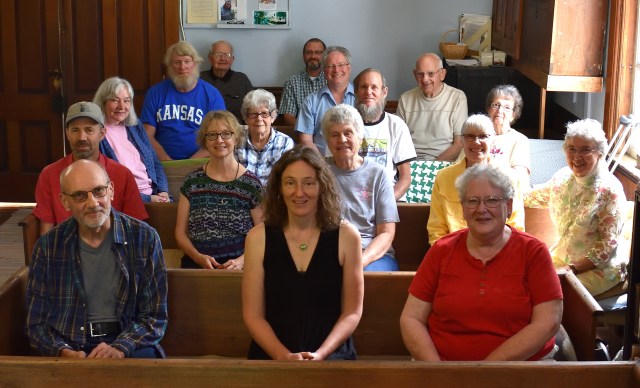
DSC_3241

Bear Creek Friends Meeting, Iowa Yearly Meeting (Conservative)


Posted in Arts, bicycles, climate change, Quaker Meetings, Uncategorized | Tagged , , | Leave a comment

BIKE/AFSC/FCNL/IYMC

This photo was taken at Iowa Yearly Meeting (Conservative)’s Midyear Meeting this spring at Bear Creek meeting, outside Earlham, Iowa.


ChristineJeffJonMidyear2017

Christine Ashley, FCNL, Jeff Kisling, IYMC, Jon Krieg, AFSC


These representatives of Quaker organizations illustrate ways Friends are providing witness for environmental justice with alternatives to personal automobiles and fossil fuel transportation.

Christine routinely uses the Metro mass transit system in Washington, DC, to travel to work at the Friends Committee on National Legislation.


DSC01078

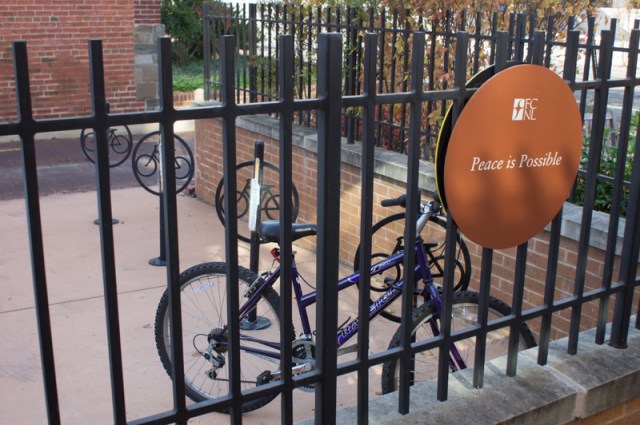
Bicycles at Friends Committee on National Legislation, Washington, DC


As I wrote yesterday, living without a car for almost forty years has been one of the defining efforts of my life. https://kislingjeff.wordpress.com/2017/07/18/bicycles-as-witness/  I am a life-long member of Iowa Yearly Meeting (Conservative), attended Scattergood Friends School, and am currently clerk of the yearly meeting’s Peace and Social Concerns Committee.


DSC_3245-001

My bicycle at Bear Creek Meeting, Iowa Yearly Meeting (Conservative)


Jon Krieg, of the American Friends Service Committee (AFSC) in Des Moines wrote yesterday:

Thanks for your blogs promoting biking. I’ve been a happy bike commuter and rider throughout my adulthood, riding to work at AFSC for 22 years now. We installed this rack many years back for Friends House and DMVF use.

There’s a mental wellness factor for me as the ride provides a welcome break between work and home.

My commute is a little over two miles and takes about 15 minutes. We’re very close to a great bike trail, so I often extend it and make a big loop.

Here’s hoping we can bike together soon!

Bicycle photo album


Jon Krieg AFSC Des Moines 1

Des Moines Valley Friends Meeting, Iowa Yearly Meeting (Conservative)

Jon Krieg AFSC Des Moines 1.j2g

Jon Krieg AFSC Des Moines, Iowa


Posted in bicycles, Quaker Meetings, Uncategorized | Tagged , , , | Leave a comment

Bicycles as Witness

Those who know me know I was led, almost 40 years ago, to give up having a personal automobile, and the many blessings that resulted in my life as a result.  Including nearly daily running, and making it possible to develop my photographic skills and collection of photos by being immersed in our environment as I walked, instead of being sealed up in a car.

But that also sensitized me to the tremendous damage all those cars were causing, burning all of that fossil fuel, dumping tons of carbon dioxide into the air and oceans, and the effects on temperatures, air and water quality, and weather patterns.  I was also aware of the injustices of industrial society’s squandering of non-renewable resources taken from other countries and future generations.  Meaning those peoples didn’t benefit from those resources, yet suffered, disproportionately, the negative effects of fossil fuel extraction and air and water pollution.

One of my life’s frustrations has been my inability to convince others  to reject personal automobiles.  This has been especially frustrating for my relationships with Quakers.  I was often, wrongly, judgmental.  But I am also acutely aware of the special problems posed for those living in rural areas, and other places without public transportation.  I knew I would be facing these challenges myself when I moved to Iowa.

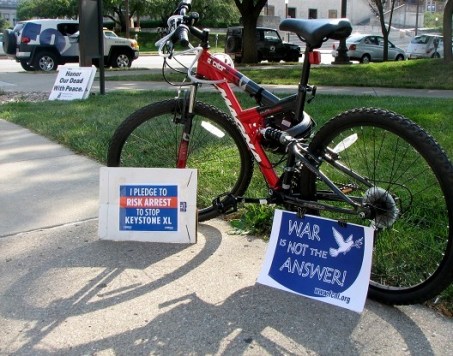
Bicycles have been the best alternative I have come up with, so far.  I used bicycles extensively when living in Indianapolis.  Here is my bicycle at our weekly Peace Vigil.

Jeff Kisling Indianapolis North Meadow Friends

And Quakers from the meeting I attended there, North Meadow Circle of Friends, Gilbert Kuhn and Anne Reynolds, would often ride their bicycles with me when we would go to events and visit our friends at the Kheprw Institute (KI).

This is Don Laughlin, a member of Iowa Yearly Meeting (Conservative) and life long environmentalist, demonstrating his bicycle powered electricity generator at Yearly Meeting.

Don Laughlin Iowa Yearly Meeting Conservative 4

Yesterday I wrote about Quaker organizations that promote the use of bicycles.  In that post I asked Friends to send me photos of themselves and their bicycles, because I know many Quakers do use bicycles.

Even as most of us are forced to use automobiles, one way we can reduce their use is by using bicycles when possible, and trying to do so more often.  One big advantage of that is it provides a VISIBLE WITNESS of how we are trying to address environmental justice issues.

Just since I wrote yesterday’s blog post asking for photos, I have received some responses.

Pam Marguerite sent the following comment:  That’s amazing! I live about 3 miles from my meeting, and usually bike when it’s nice out. Friends and I are planning a 49 miles bike ride next month in honor of our all turning 49 this year, but it will be a lot to work up to it (and it will probably be mostly flat)
I will try to take a picture of my bike at the meetinghouse next week!

My friend and fellow Bear Creek meeting Quaker, Liz Oppenheimer, shared my message with those who she knew who rode bicycles.

Central and Southern Africa Yearly Meeting

Quakers from Central and Southern Africa Yearly Meeting shared that blog post on their Facebook page and added this amusing comment:  Not sure we can manage bicycle racks at our meeting places…    https://www.facebook.com/Csaym/posts/950826295059502?notif_t=story_reshare&notif_id=1500284113034319

And my sister, Lisa, Bear Creek meeting member, sent the following photos from San Francisco, including bicycles on the ferry, where she is visiting her son Justin with her daughter Alice and other son Eric, and they rode across the Golden Gate Bridge:

I have begun to build a collection of these photos online here.  I would love to include your photos, which you can send to jakislin@outlook.com

Posted in bicycles, climate change, Quaker Meetings, Uncategorized | Leave a comment

First time bicycle at Bear Creek

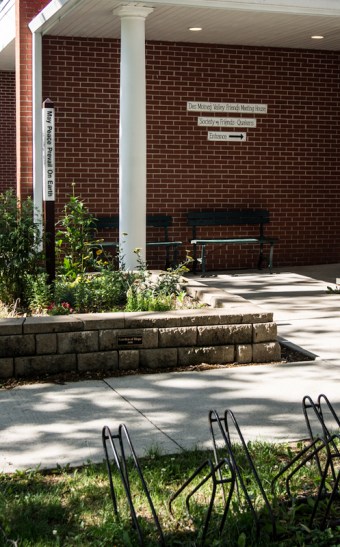
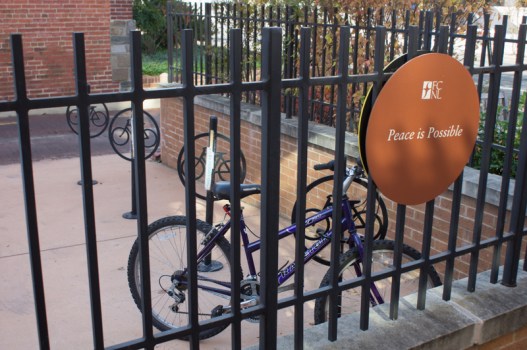
I know that riding a bicycle to Quaker meeting is not a new idea.  Some meetinghouses, including Des Moines Valley Friends,  have bicycle racks.

DSC07480

The Friends Committee on National Legislation (FCNL) offices in Washington, DC, have bicycle racks, showers and lockers.

DSC01078

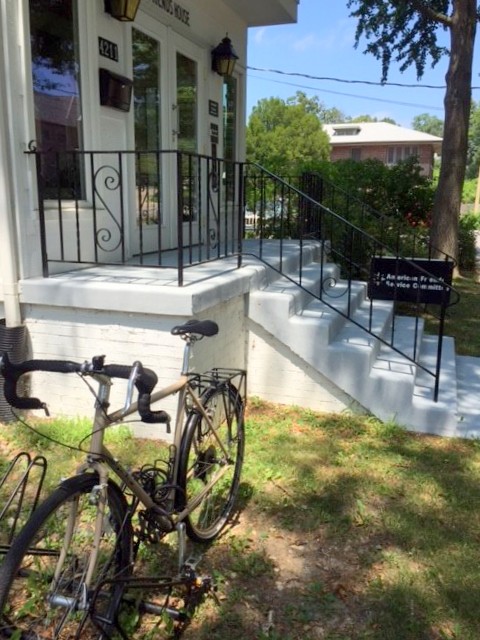
William Penn House in Washington has bicycle stands in front.

DSC04308

As I’ve been writing, I want to explore fossil-fuel free transportation in rural settings, now that I’ve moved to Iowa (June 30th).  One of the first things I had hoped to do, after buying a very nice bicycle with money donated by my many friends in Indianapolis (done), was to get into shape to be able to ride from where I am staying in Indianola, to Bear Creek meeting.

Unfortunately, that is a 44 mile distance.  I’ve been riding almost daily, most recently for almost 2 hours and 17 miles.  One of the first things I’ve been reminded of is vertical distances traveled are much more significant than horizontal!  The main bicycle trail I’ve been using drops 1,200 feet in about 8 miles, but it is a pretty gradual slope for the most part.  Unfortunately the first part of the round trip is all downhill, so you know what happens when you turn around to go home.

Yesterday, though, I was worn out after only a couple of miles, but that was on hills that seemed to be nearly vertical!

The photo below is not meant to be a dishonest representation, rather symbolic, instead.  I’ve been so anxious to connect bicycles to Bear Creek, that we loaded my bicycle on a bicycle rack, so I actually only rode about 1.5 miles from the Interstate 80 exit (including a pretty good hill) to get to the Bear Creek meetinghouse.  My friend and Scattergood roommate, Jonathan Tesdell had his bicycle on a rack there today, too.

My goal is to get more Friends to ride their bicycles to Quaker meeting.  Especially in urban areas, this could be a family project.

I’d like to gather photos of Friends and their bicycles at Friends meeting, with a growing collection symbolizing Friends commitment to reduce fossil fuel use. Please send me your bicycle photos.  jakislin@outlook.com


Posted in bicycles, Quaker Meetings, Uncategorized | Tagged , | 2 Comments

Nahko–Prayer is the most G thing you can do homey

Below is a clip from Nahko Bear’s performance at the Black Hills Unity Concert, September, 2017, for the Black Hills, the Earth, and all her peopleHonoring the sacred.

Where my warriors at?

And so I feel like what has been said many times tonight and I appreciate the sentiment that we can say this now in this time and this generation is that prayer is the most G thing you can do homey. And I can say that for my life, in the things that have happened in my life, the anger, for the pain, for the hate, that I’ve carried, that forgiveness, and therefore remembering to pray for those that oppressed us, is the most powerful testament to mankind.


My first exposure to Nahko and Medicine for the People was in Indianapolis this past winter, when I was part of a vigil organized by my friends Joshua Taflinger and Brandi Herron to support the water protectors at Standing Rock, which Nahko has been deeply involved with, outside the theater where Nahko was going to be performing that evening.


Posted in #NDAPL, Indigenous, Uncategorized | Tagged | Leave a comment

Application for Spiritual Warriors

Yesterday I wrote about how my spiritual life had been radicalized.  As the examples in that post, of the work at the Kheprw Institute and the global Indigenous peoples response to support the water protectors at Standing Rock show, a spiritual response is how we can create the world we want to see, and address our environmental crisis and current social injustices.

In yesterday’s post I shared a number of queries, including: are we willing to address this (environmental crisis) immediately, and how do we recruit, train, and deploy a nonviolent army of spiritual warriors?

I would like to start to build a band of spiritual warriors.  If you are serious about a spiritual and action commitment to address our environmental crisis, please send me an email message (jakislin@outlook.com) with your story about how you feel about this, and what you think we should do now.  Thank you very much.

My friend, Joshua Taflinger, has expressed this very well:

I am inspired to share with you all more directly a post I wrote, because I consider you an established & effective nature/spiritual warrior, and believe that there is a need for the perspectives shared in the attached post to be more common thought in the minds of the many.
If you feel truth from this writing, and are inspired, I highly encourage you to re-write your own version, in your own words/perspectives, and post to your network.
With the intention of helping us all wake up, with awareness, clarity, and direction.
..spreading and weaving reality back into the world….

dsc_0437

Recruiting Spiritual Warriors

A Radical Spiritual Evolution to Revolution

Spiritual Warriors

How to Prepare?

No Longer Taken for Granted

Not Nearly Enough

The Case for Mass Civil Disruption and Resistance

Posted in #NDAPL, civil disobedience, climate change, Indigenous, integral nonviolence, Kheprw Institute, revolution, spiritual seekers, Spiritual Warrior, Uncategorized | 2 Comments

A Radical Spiritual Evolution to Revolution

There was evidently a reason I was led to name my blog Quakers, Social Justice and Revolution when I was called to wrestle with issues publicly.  Writing a blog and sharing those writings on social media helped me clarify many things that had been confusing, often with the help of others who responded, which is one reason why this is important to do publicly.  Rev. William Barber recently wrote, “Quakers, it’s time to get back into the public square.”

Because we are in the midst of a revolution, and have the opportunity to influence how it will evolve.

I am grateful to have been raised as a Quaker.  To have witnessed a people who base their lives on faith, which of necessity is expressed in concern for and care of all people, since God is present in every single being.  I was born into a Quaker community that had just experienced the imprisonment of many of its members for refusing to participate in war.

Of course this commitment to obey the spirit rather than man-made rules is not limited to Quakers.

My own spiritual life has recently been radicalized by my involvement with two new, for me, communities.  One is the Kheprw Institute (KI), “a community organization that works to create a more just, equitable, human-centered world by nurturing youth and young adults to be leaders, critical thinkers and doers who see the people in any community as the most valuable assets and are committed to working with marginalized communities to bring about change that leads to empowered self-sustainable communities.”

The other is my experience in many different ways with Indigenous peoples, that began with local involvement in Indianapolis to support the water protectors at Standing Rock in the struggle against the Dakota Access Pipeline.  I have been profoundly affected by their deeply spirit led lives, and stunning example of nonviolence in the face of extreme state sponsored violence against them.

As Nahko says, nonviolent direct action is the way to a successful revolution.

My first experience with nonviolent resistance was a long, difficult struggle that resulted in my decision to become a draft resister during the Vietnam War.  Next was my lifelong commitment to refuse to participate in the war on our environment by refusing to own a personal automobile.  Then, in 2013, I joined the Keystone Pledge of Resistance, and was trained to organize and carry out acts of nonviolent direct action, including training others in the art of nonviolent civil disobedience.  I similarly trained those involved in Indiana Moral Mondays.

Last year I was heavily engaged with local activities to support the water protectors at Standing Rock, including the campaign to defund the pipeline with actions against the banks that are financing it.

I am now studying and writing about integral nonviolence and the national nonviolent direct action campaign outlined by Chris Moore-Backman in his recent book, The Gandhian Iceberg.

All of this has led me to construct the following advices and queries.  This is a method Quakers have traditionally used to reflect on various aspects of their lives.  The advice is used to introduce the topic, then the queries are questions used to stimulate responses to that.  This is a powerful technique when used by the gathered meeting, as the group works on the responses together.

I increasingly feel we need to rapidly and radically respond to two fundamental crises: environmental destruction and the racial economy. Our unfolding environmental disaster will actually accelerate the demise of the racial economy.

Advice:
The environmental damage to the earth is significantly greater than most people understand, and numerous conditions mean dramatic increases in air and water temperatures, rising sea levels, acidification of the oceans, changing precipitation patterns with floods, droughts and massive fires, scarce clean water supplies, migration of disease vectors, strong winds, and significantly decreased food production for many reasons will result in massive death by starvation, dehydration and disease. Mass migrations of people will occur. This will totally breakdown our economic, political and social systems. All of this is occurring now and will get worse at a rapidly accelerating rate.
Queries:
• Are we willing to commit ourselves to addressing this immediately?
• How can we work for the necessary immediate cessation of the use of fossil fuels, and rapid development of locally owned and operated renewable energy systems?
• How do we build local, just, self-sufficient, resilient, Beloved communities?
• How do we recruit, train, and deploy a nonviolent army of spiritual warriors?

Advice:
The economic and political system of the United States is built on racial capitalism. White people, especially males, enjoy privileges based upon land stolen from Indigenous peoples, who experienced genocide and are experiencing ongoing state supported violence and oppression. Racial capitalism is built on a history of slavery and ongoing state supported violence, death, and mass incarceration. Racial capitalism is built on the labor of migrant workers. Racial capitalism disrespects women.
Massive unemployment in this system that requires currency for trade and services is immoral and often intentional.
The rich have exploited all of this to an unconscionable degree with massive inequality in the distribution of wealth. The rich have developed extensive militarized systems to extract resources and protect their wealth, both domestically and abroad. The rich have developed intrusive systems of surveillance, and increasingly suppress civil rights and criminalize dissent.
Queries:
• How can we reject and dismantle racial capitalism?
• How can we personally redistribute our wealth with our immediate neighbors?
• How can we practice, recruit and teach others about radical faith based living?


Posted in #NDAPL, Black Lives, civil disobedience, climate change, Indiana Moral Mondays, Indigenous, integral nonviolence, Keystone Pledge of Resistance, Kheprw Institute, Quaker Meetings, race, renewable energy, revolution, spiritual seekers, Uncategorized | Leave a comment

Bicycle

I’ve been writing about being led to explore using a bicycle for longer range transportation as one way to try to deal with my recent move to Iowa, where local public transportation does not exist.  https://kislingjeff.wordpress.com/?s=bicycle

My friends in Indianapolis heard about this when they would ask about my plans for retirement.  I was very touched with a large number of people contributed to help me buy a good bicycle for this purpose, including my co-workers at Riley Hospital for Children, and friends from North Meadow Circle of Friends, and my friends at the Kheprw Institute (KI).  In addition, Dr. Robert Tepper, a life long friend and the Director of the Infant Pulmonary Function Lab where I spent most of my career, gave me a great backpack designed to be used with bicycles, that included a sleeve to carry a laptop computer.  The backpack is designed to hold the pack away from ones back, keeping sweat away from the pack itself.

One of the first things I did was buy the bicycle, a Cannondale Catalyst 4, the best bicycle I have ever owned.  I’m very thankful to all of my friends for making this possible.  It is a lightweight 21 speed mountain bicycle with a rugged frame and wide tires.  We added a portable tire pump and a mirror my Dad recommended, which works very well.

I’ve been concerned about my stamina, since about two years ago I could no longer run very far at all.  I started out slowly, but so far things seem to be going well.  There is a very nice bike trail in the woods from Indianola to a lake about 8 miles to the north—route below.  It is a pretty steep incline, with a change in altitude of 1,233 feet.  The small lake is picturesque, and I plan to take my camera on future trips.

Thanks very much to my friends for making this possible!

Posted in bicycles, Kheprw Institute, Quaker Meetings, Uncategorized | Tagged | Leave a comment