What Actually Changed?

I’ve been writing a lot about the Quaker queries related to civic responsibility, and this one in particular:

How do we share our convictions with others? Do we express our opinions with courage,  yet with love, mindful of the Divine Spirit within everyone?

I’ve been thinking about what my very good friend at the Kheprw Institute (KI), Alvin Sangsuwangul, often says–“What actually changed as a result of _________?”

From the first time I heard him say that (and I’ve heard him say it many times since, and I have begun to say it, too) I recognized how important that question is.

The reason I’m thinking about that now in regard to how we share our convictions with others, is because I think we often forget the sharing part.  None of us enjoy being lectured to, especially since that is usually accompanied by a somewhat superior attitude.

If we take the limited view of sharing our convictions as simply expressing them, and it ends there, I don’t think we are accomplishing much.  What changed?

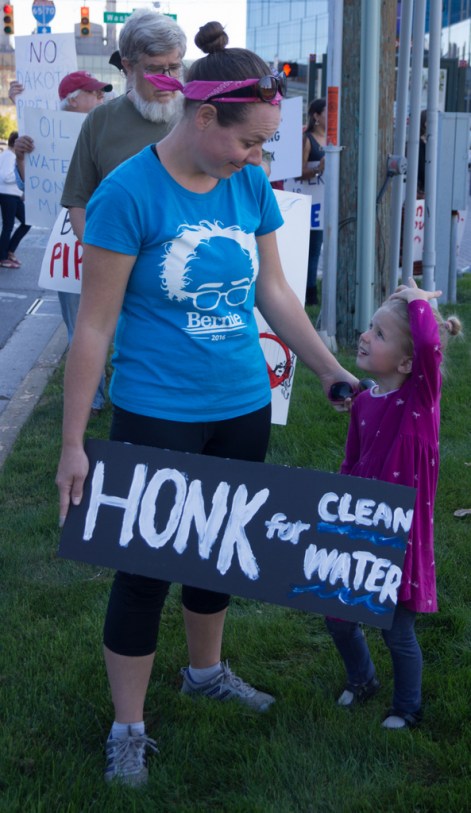
When I wrote about public vigils, I mentioned that interaction was important.  Debbie’s sign that says “Honk for Peace” does often get passing cars to honk their horns (and pedestrians to say “honk, honk” with a smile).  You know you got that person to at least process, and react to, the message.  Its like the more senses you use, the more impactful the learning.

The best times at the vigils are when people stop and engage with us, either positively or negatively.  I’ve found it helps to look and smile at people as they approach, sometimes saying “Hi”, showing you are open to visiting with them.  But you don’t want to be aggressive about doing so.

It is the exchange that is important, and that might be what does actually cause change.  People want to be heard, and if you show them the respect of actually hearing what they say, and respond to that, I think that might be the only way they might change their own thinking.

mindful of the Divine Spirit within everyone

And of course that is bi-directional.  When others listen to what you say, and they respond to that with questions or challenges, those can make you modify your own thinking.  That is the thing I find most rewarding about public vigils–the challenge to improve how I think, and how I can more effectively communicate my beliefs.

That was especially true when I started to bring signs about things other than peace.  Since we (Quakers, anyway) have been so focused on peace for so long, we don’t often stop to think in new ways about that issue.  But when I began to bring my “STOP KEYSTONE PIPELINE” sign, people would often stop to ask what that was about.  It gave me a chance to not only educate them, but refine my thinking and ways I tried to express that to others.  It also turned out to be a way to finally get some conversations going about climate change, since so many people immediately shut down when you mention those words.

This all became more intense when I began to bring my “Quakers Black Lives Matter” sign. I didn’t know how either people who consider themselves white, or people of color would react.  Not much happened the first time I took it to our weekly peace vigil, other than Gilbert wondering what I was up to now–although our discussions previously about bringing the Keystone sign to the peace vigil helped.

I was really uncomfortable the next week, when I came around the corner with the sign, and found myself in a crowd of thousands of people of color.  It was the weekend of the Indianapolis Black Expo celebration.  Although most people didn’t react, or had puzzled looks, a number did have positive responses.

Why did I do this?  I was led to do it.  For those who aren’t Quakers, what this means is there were several times when I felt nudged or pushed by the Inner Light, or spirit, that this was something I needed to do.  My grandmother, Lorene Standing, said the will of God is often revealed to us in a series of small steps.  Being raised as a Quaker, I heard all my life that there was that of God in every single person, so I was sensitive to the glaring racial injustices found throughout our society and institutions, even though I was raised in rural Iowa.  These things became especially personal when I became friends with those at the Kheprw Institute, and the wider community connected to them.  And when I became friends with a diverse group of young people who formed Indy10 in Indianapolis after they returned from Ferguson, Missouri, when the unrest was going on after Michael Brown was killed.

A young black man parked his car and came up to me and asked that very question, “Why are you doing this?”  His manner was both curious and serious.  I said something along the lines that I felt it was important that white people publicly acknowledge they believe this.  Especially in a time when multiple police killings seemed to be saying that was not so.  After all, who is this message directed at?  I assume black people know their lives matter.  That seemed to satisfy him.  He smiled and shook my hand.  But he also said, “this is a brave thing to do.”  I only mention that to show how others perceive what we do, and to acknowledge to those of you who are considering doing the same that there is the potential for an aggressive response, although I have never experienced that myself.

The few reactions from white people are always “all lives matter”.  But there are usually many cars of people of color who honk (enthusiastically), yell something like “yeah”, and/or very often take photos with their cell phone cameras.

Quaker House, in Fayetteville, North Carolina, has a similar photo.

Here is a link to an interesting article about Putney (Vermont) Friends meeting having their Black Lives Matter sign stolen and a letter they wrote in response.  From their minute on Black Lives Matter: “What’s important for us is that it’s not just a sign, not just a statement, it’s a commitment to join with others in doing the work we need to do.”

I’ve also written a lot about how important the monthly community book discussions at the Kheprw Institute (KI) have been, especially in the relationship between KI and North Meadow Friends meeting (related to Quaker Social Change Ministry).  Imhotep Adisa has called these regular gatherings “revolutionary”–the respectful sharing among such a diverse group of people and ideas.  He also says, “the value of conversation is greatly underrated.”

The core principle of nonviolence is the goal is not to win by defeating your opponent, but rather to genuinely listen to others, knowing there is truth in what they are saying, being willing to change yourself, and moving everyone further along the path to peace and justice.

I believe this is one answer to Alvin’s question, “what actually changed?”  Usually we are changed even as we try to change others.
 

Posted in #NDAPL, Black Lives, climate change, Keystone Pledge of Resistance, Kheprw Institute, peace, Quaker Meetings, Quaker Social Change Ministry, race, Uncategorized | Tagged | Leave a comment

Civic Responsibility – Social Justice Videos

Continuing with the queries regarding civic responsibility, the advice mentions the importance of staying informed on social issues.  I’ve been writing about the query “How do we share our convictions with others?”  Key to sharing our convictions is informing others about issues we care about, which they might not be as informed about.  This is especially true where the main sources of news are controlled by corporate and/or government interests, as is unfortunately increasingly the case in our country.  Our hope is that when others learn of injustice, they will want to do something to address that.  It is discouraging how often that is not the case.  But that is the point of talking about these queries related to civic responsibility, and sharing our convictions with others.

Multimedia is often a more powerful way to get attention and inform others than writing.  With the video capabilities of smart phones and digital cameras, it is easy for us to create our own videos, which can be shared on Facebook, YouTube, etc.  You can share other’s videos by including links to them in your email and other messages, on your Facebook page, etc.  Another way to be a “publisher of the truth”.

Since the damage to the environment from fossil fuels, and more specifically working against pipelines has been my main focus, below are some of the video resources I’ve either created or found useful in informing others.

The Keystone Pledge of Resistance was the first organizing effort I was involved with.  When my friend Derek Glass was looking for a video project for his intern, Andrew Berger to work on, I suggested one describing what the Keystone Pledge was about.

The video that brought the struggle at Standing Rock into the mainstream media was the one Amy Goodman created for Democracy Now, showing the security forces using dogs to attack the water protectors, including women and children.

Three days later, Nahko gave a concert for the youth who had been attacked.  He used the occasion as an opportunity to talk to them about nonviolence, and the importance of what they were doing at Standing Rock.  Some of the things he said that night in between songs:

Remember that nonviolent direct action is the way to a successful revolution.  And that is a hard one, because they are so bad (chuckles).  When they come at us you just want to hit ’em, you know?  Just sit with that.  I know it’s tough.  They’re going to try to do everything they can to instigate you.  But remember what we’re here for.  We’re here to create peace for our Mother.  We’re not here to create more violence.

When you’re feeling bad, when you’re feeling frustrated, put all your prayer into your palms, put them to the ground, put them back to the sky, honor the Father, the Mother, just know it will be alright.

Are you guys feeling proud, are you proud of yourselves?  Because the whole world is watching.  The whole world is watching.  So whatcha gonna do?  Gonna show love?  Are you gonna be smart?  You gonna think before you act?  Take care of each other?  You’re gonna show ‘em what family does.  They don’t know what that’s like.

You gotta put down the weight, gotta get out of your way.

Get out of your way and just look around the corner at your real self and look at all the potential that this beautiful Earth and love has to offer you.

It’s crazy being out in front of you guys.  I had a moment there.  I was like, I like started spacing out and I’m like oh god they’re looking at me aren’t they?  I was thinking about how much happened before any of us were here.  You know?  There is a lot of history here.   We gotta hold that when we’re standing out there.  You gotta hold that when you’re on that line out there, too.  You’re here for a lot more than just this pipeline.

It’s about rejoicing, it’s about laughter right now.  We’ve got a big day ahead of us tomorrow folks.  So, I just want to say I’m so grateful and I’m really proud of you guys.  I’m really proud of you.  (and then he turned away with obvious emotion).

One of the most powerful Dakota Access Pipeline resistance videos is Nahko’s Love Letters to God:

I’ve written a lot about my connection to the Kheprw Institute (KI) in Indianapolis.  One of our projects there was a radio interview by Ra Wyse with Aghilah Nadaraj and I about the Dakota Access Pipeline.

Finally, videos can be used to inspire us.  Nahko sang “Build a Bridge” in San Francisco to thank those who have been involved in the #NoDAPL struggle.

Build a Bridge

Nahko

I’ve come to build a bridge
So come, let’s build
Build, build, build
I have come to build a bridge
So come, let’s build
Build, build, build
I have come to build a bridge
So come, let’s build
Build, build, build
I have come to build a bridge
So come, let’s build
Build, build, build

Said prepare me for, for long battle
I am a witness, hold crystal bullets
I drop the hatchet, you won’t forget this
Said prepare me for, for long battle
I am a witness, hold crystal bullets
I drop the hatchet, you won’t forget this

Said, mine eyes have seen nothing but trouble
You must make peace with them gods and the devils
I can be rude, boy, I am not subtle
I tend to sneak in and burst all them bubbles
We are the ones, we been waiting to rumble
I torch my enemies out with a candle
Music is the weapon make empires crumble
We bring them bankers and wealthy to tremble

What we know is what we’re owed
Can’t be too careful, shoot flaming arrows
Hitting them wicked, burning them bridges
Said, what we know is what we’re owed
Can’t be too careful, shoot flaming arrows
Hitting them wicked, burning them bridges

I said I rep the misfits, (not the[?]) society
We struggle with housing, drugs, and sobriety
We’re not from here, but born here respectively
Immigrated cause America raped my country
My bridge ‘ain’t built with no white-man money
I’m on Indian time, you know you cannot rush me
I can be vicious, malicious, and ugly
A danger to darkness, to better run quickly

What we know is what we’re owed
Can’t be too careful, shoot flaming arrows
Hitting them wicked, burning them bridges
Said, what we know is what we’re owed
Can’t be too careful, shoot flaming arrows
Hitting them wicked, burning them bridges, said

I’ve come to build a bridge
So come, let’s build
Build, build, build
I have come to build a bridge
So come, let’s build
Build, build, build
I have come to build a bridge
So come, let’s build
Build, build, build
I have come to build a bridge
So come, let’s build
Build, build, build

I said, life was pretty crazy, I was 9 months old
Yeah, mama gave me up – 14 years old
Said, I don’t give a shit, grandmother, she was so bold
Son of that rape, my mama’s body got sold
Not to say poppa didn’t have a good soul
Cause he did give me the anger, I was born so cold
Raised white Christian in a white neighborhood
There was no bridges for me and my indigenous blood
I said I’m confused, identity crisis
Indigenous mastery is so timeless
Now I’m building bridges so that it will all make sense
Why I’m here with the music, so passionate
Got to ride hard or die trying
Said, I am a rain cloud, storm white lighting
I am relentless stop at nothing
I’m el coyote, bridges building
Building, building, building

I said, I rock the one feather on me next head
Must stay humble, never be like chief headdress
Hang the flag upside down, I’m in distress
Never take no title out of deepest respect
Welcome to Aquarius, son, you’re a legend
Guardian of the gate, it’s gate number seven
I tame that beast and I ride the dragon
I reincarnate as a wild stallion

What we know is what we’re owed
Can’t be too careful, shoot flaming arrows
Hitting them wicked, burning them bridges
Said, what we know is what we’re owed
Can’t be too careful, shoot flaming arrows
Hitting them wicked, burning them bridges, said

I’ve come to build a bridge
So come, let’s build
Build, build, build
I have come to build a bridge
So come, let’s build
Build, build, build
I have come to build a bridge
So come, let’s build
Build, build, build
I have come to build a bridge
So come, let’s build
Build, build, build

Said, my people my earth, my country, my heart
In service for ever, a mission to better
My passion, my fist, my heart, open it
Reclaim, recover, protect clean water
Said, I’ve come to live in peace
So come, let’s live
Live, live, live
Said, I’ve come to live in peace
So come, let’s live
Live, live, live
I have come to live in peace
So come, let’s live
Live, live, live
I have come to live in peace
So come, let’s live


Posted in #NDAPL, Arts, climate change, Indigenous, integral nonviolence, Kheprw Institute, peace, Uncategorized | Tagged | Leave a comment

Civic Responsibility – Dakota Access Pipeline

Continuing with the queries I’ve been discussing recently about civic responsibility, following are my experiences related to water protectors and the Dakota Access Pipeline resistance in Indianapolis.

The introduction to these queries includes:  “Speaking out on a personal level in our communities may be difficult, even dangerous, yet by doing so we may encourage others to work for justice.”  The following shows how several people were introduced to social justice actions.

Two of the queries are:

How do we share our convictions with others? Do we express our opinions with courage,  yet with love, mindful of the Divine Spirit within everyone?

Are we careful to reach our decisions through prayer and strengthen our actions with worship? Are we open to divine leadings?

I was very concerned when I began to learn about the Dakota Access Pipeline, often referred to as the Bakken Pipeline in Iowa.  Beside the usual concerns about pipeline leaks, extraction methods, and greenhouse gas emissions, this project was also an outrageous example of environmental racism.  The route of the pipeline was moved from near Bismarck, North Dakota, when (the predominately white) people were worried about leaks affecting their drinking water.  The route was moved to within a mile of the border of the Standing Rock Sioux reservation, where not only the water supply but ancient burial grounds were threatened.

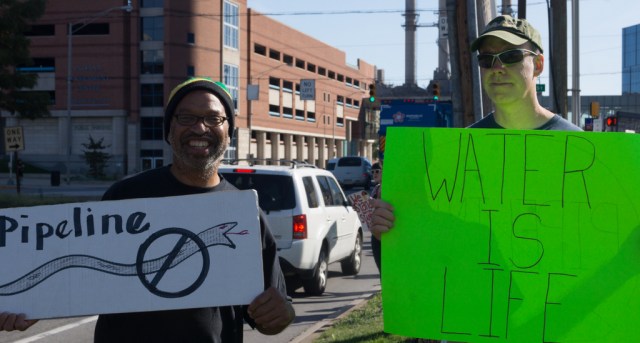
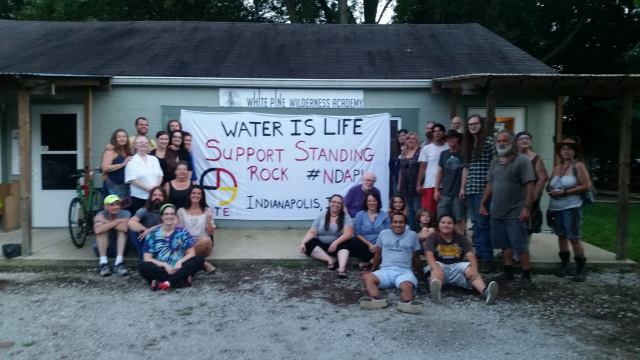
The White Pine Wilderness Academy that teaches about nature and native practices is in a wooded neighborhood near the White River on the near north side of Indianapolis.  When Matt Shull, Joshua Taflinger and Brandi Herron there wanted to find ways to support the water protectors at Standing Rock, they talked with my friend Jim Poyser, who lives near the Academy.  Jim is one of the 4 Action Leaders from the Keystone Pledge of Resistance.  He contacted the other three Action Leaders, Wayne Moss (white beard in photo below), Ted Wolner, and I (yellow hat below) to see if we would be interested in helping with this effort, because of our training and experience related to the Keystone Resistance.  We all wanted to do so.

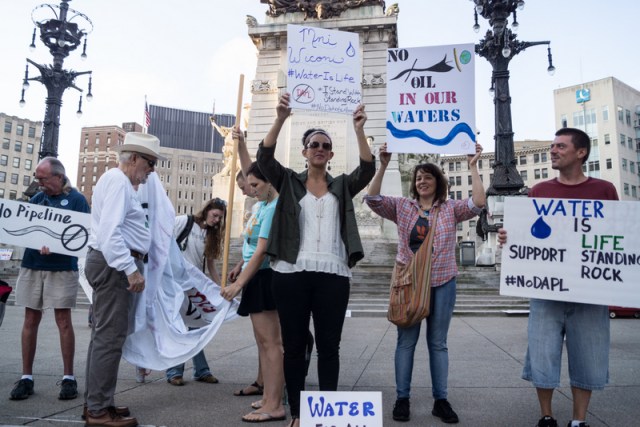
It was decided that we would hold a vigil on the Circle at the center of downtown Indianapolis to raise awareness about the pipeline (#NoDAPL).  The photo below was taken the night before, when we gathered at the Academy to organize the vigil, make signs for it, and also where a trailer was built to haul donated supplies to Standing Rock.

whitepine2

Initial #NoDAPL gathering at White Pine Wilderness Academy, Indianapolis

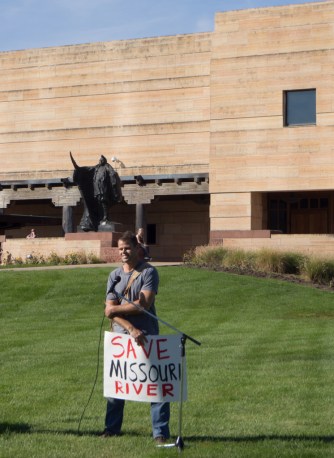
Below I am helping make signs.  Signs should have few words, but clearly tell your message.  They should also be very visible.  The sign above, which appears in many of the other photos, is a great example.  There were wooden handles on the ends to hold it.  Below, we used markers with thick lines, and colors that stand out.  We also had a variety of messages–Water is Life, Save Missouri River, Honor the Treaties, besides Stop Dakota Pipeline.

nodapl1

I’m helping make signs at the Academy that evening

The next (Saturday) morning I arrived downtown, and saw Joshua and Brandi and kids pulling a wagon full of the signs.  We didn’t know who would show up, but were very grateful that besides Jim, Wayne, Ted and I from Keystone Resistance, a large number of Native Americans, many in traditional dress, showed up.

Sage was burned, and several speakers talked, mainly to those who were part of the vigil, about native issues.  There was a profound feeling of spirituality encompassing us all.  This related to the query: Are we careful to reach our decisions through prayer and strengthen our actions with worship? in a whole new way for me. I think almost everyone who has had anything to do with Standing Rock and the water protectors has be affected by the spiritual aspect of this.  And that is a large part of the global support for, and success of these efforts.

Also shown below are a number of Quakers from North Meadow Circle of Friends meeting.

The drummers (video below) added a lot to the ceremonial aspects of the gathering.

dsc04538

Joshua Taflinger(center with hat) and Brandi Herron (megaphone) are the primary organizers, from the White Pine White Wilderness Academy.

dsc04499

Ted Wolner speaks to a local TV station

After an hour or so, we began to march, first to the State Capitol building, then on to the Eiteljorg Museum of American Indians and Western Art, which agreed to allow us to gather on their lawn.  The Indianapolis police on bicycles were very friendly and helpful to stop traffic during our march.

dsc05123

Matt Shull, founder of White Pine Wilderness Academy.

dsc05122

My ALWAYS present activist buddies from our years as Action Leaders of the Keystone Pledge of Resistance, Jim Poyser of Earth Charter Indiana and (left) and Ted Wolner who teaches at Ball State University.  I’m on the right.

dsc05084

John Gibson (Sustainable Indiana), Judy Voss, and Jim Poyser were involved with Keystone.

dsc05108

Briana Dines (with Brandi Herron) has just returned from Canada, where she was involved with Indigenous people.  She had been involved in Keystone here prior to that.  She told of her experience of visiting the Standing Rock camp recently.

dsc04476

Wayne Moss (white hat) and Amanda Shepherd (center) also worked with Keystone.

I was really happy to see so many Quakers from North Meadow Circle of Friends, where I attend.

dsc05095

Fred White, who attended Scattergood Friends School, Gilbert Kuhn, and David and Dinah Duvall.

Other North Meadow Friends are Shannon Effler and Kevin Angell.

dsc05140

On the right is my friend Jeff Howell who is involved with social justice issues, such as living wage, and a bicyclist and photographer.

dsc05096

Katie and Annie Glass walked from their apartment in my neighborhood.  Katie told me she and Derek just purchased an electric car, which they charge at Derek’s work from a renewable energy electrical source!  Derek developed the Sustainability Indiana website that aggregates the blogs of organizations and people who work on sustainability issues in Indiana.  Later in the year, Katie organized a kids’ peace rally at the State Capitol building.

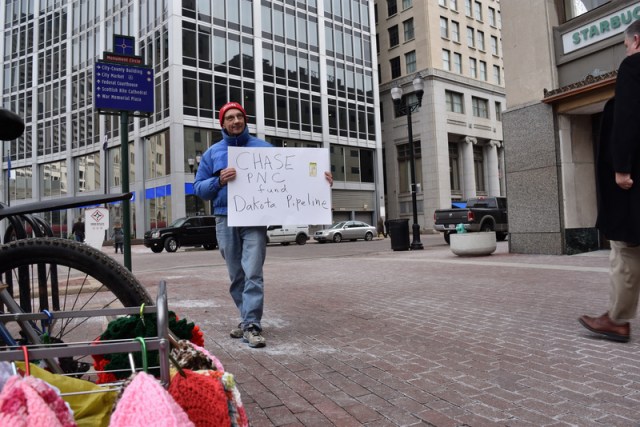
We talked about further actions, and decided to have another gathering related to defunding the pipeline a few weeks later.  After gathering at the Eitoljorg Museum, where prayers were given, led by Native Americans, we marched first to the PNC Center, then the Chase bank.  At each bank, the group stood in silence while those with accounts went inside to close their accounts.  $110,000 was withdrawn that day.

North Meadow Friends meeting closed its Chase bank account to support defunding the pipeline.  Quaker Earthcare Witness (QEW) published the story of my divestment efforts at Chase bank in the March-April, 2017, issue of Befriending Creation http://www.quakerearthcare.org/sites/quakerearthcare.org/files/bfc/bfc3002_small.pdf

dsc_0485

Defund Dakota Access Pipeline, Chase Bank, Indianapolis

Also related to the queries, “Speaking out on a personal level in our communities may be difficult, even dangerous, yet by doing so we may encourage others to work for justice.“, Alex Red Bear contacted Joshua, saying he wanted to organize another rally related to the pipeline.  Alex invited people to speak, so I talked about how people could close their bank accounts to help defund the pipeline.  Following are photos of Alex and that rally.

Another vigil was held outside the theater where music activist and Standing Rock supporters Nahko and Medicine for the People were performing in downtown Indianapolis.  While we were standing in the freezing cold, members of the band went past us, giving us huge smiles and fist bumps.  I’ve written a lot about Nahko’s activism.

One of the most moving gatherings was not so much a public rally, but a gathering for those who had participated in these events throughout the year to gather together in prayer and to reflect on what had happened.  We gathered on a very cold day on the grounds of the State Capitol building.

There is an active Federal court case related to the inadequate environmental impact study of the Dakota Access Pipeline, specifically not taking indigenous concerns into account.

I wrote several blog posts about my journey in September related to the pipeline, that began with the deliver of a petition for the removal of Richard W. Lozier, Jr. from the Iowa Utilities Board, which is responsible for approving pipelines, followed by a 40 mile bicycle journey to Bear Creek Friends meeting, where we had an evening program related to the activism of Nahko.

The struggles continue.  I’ve been very affected by the spiritual response of Native Americans, Quakers, Nahko, and all the water protectors.  Thanks be to God.


Posted in #NDAPL, civil disobedience, climate change, Indigenous, Keystone Pledge of Resistance, Quaker Meetings, Uncategorized | Leave a comment

Civic Responsibility 3 – Environment

Continuing to think about the Quaker queries we are considering regarding civic responsibility (Civic Responsibility and Civic Responsibility 2), I earlier wrote about peace vigils and marches.  The primary query I am referring to is:

How do we share our convictions with others? Do we express our opinions with courage,  yet with love, mindful of the Divine Spirit within everyone?

There are obviously many more ways to share our convictions, and on subjects other than war and peace.  The consequences of environmental damage have been the main subject of concern in my life, so following are some examples of a number of ways I have tried to share my convictions related to this.

Writing on this blog (https://kislingjeff.wordpress.com/) has become one of  the main ways since I began this a couple of years ago.  From the early days (1650s) George Fox and many other Friends began to publish pamphlets about their beliefs, becoming known as “publishers of the truth”, a concept that has continued since.  In this digital age, blogs and social media such as Facebook (https://www.facebook.com/jeff.kisling.3) and twitter (https://twitter.com/jakislin) are ways we can share our thoughts and actions.  To give an idea of the potential scope of these methods, I’ve published 619 blog posts that have been viewed over 21,000 times.  Prior to that I got in trouble for often sending more than one email message a day to those unfortunate enough to be on my list.

There are a number of places (wordpress.com) where you can create and publish your own blog, free of charge.  You just type the title, then your article, and click the publish button.  When Rev William Barber urges Quakers to get back into the public square, this is one way you can do that.

Quakers believe how we live our own lives is how we express our convictions.  I have been surprised, though, by how often people notice.  The main witness of my life has been to try to do as little damage to the environment as possible, mainly by refusing to have a personal automobile.  That has meant I have done a lot of running and bicycling.  I was completely surprised one day to be sitting with friends, and to hear them start listing all the places around town they had seen me running, and how many different places they came up with.  There have been numerous occasions when people I work with, but don’t spend time with outside work, will ask me things like “did you ride your bike to work today?”  People know about these things.

This also becomes important when trying to convince others.  The first thing people usually say to me when they try to defend pipelines or their own use of fossil fuels is “well you drive a car, don’t you?”  Although I don’t think I’ve ever convinced anyone else to give up their car, this at least makes them take me seriously and often provides a chance to move a little deeper into the subject.

Going up against the tremendous wealth, power and pervasiveness of the fossil fuel industry was definitely a David and Goliath situation.  Similar to pacifists taking on the war machine, or activists in the civil rights struggle, or Indians against the British Empire, or water protectors against the pipelines.

Such cases call for a moral response that is expressed as nonviolent civil disobedience and direct actions.

During the Vietnam War I was a draft resister.

Regarding the environment, the Keystone XL Pipeline permit was seen as a way to finally confront the fossil fuel industry.  I’ve written a lot about the Keystone Pledge of Resistance.  This was a digital age, nonviolent direct action campaign.  People could sign the Pledge on the Internet:

“I pledge, if necessary, to join others in my community, and engage in acts of dignified, peaceful civil disobedience that could result in my arrest in order to send the message to President Obama and his administration that they must reject the Keystone XL pipeline.”

This was a well designed campaign.  The Pledge website had a way to gather the contact information for those who were interested in participating, as well as for those who indicated they were willing to be Action Leaders in their community.  The Rainforest Action Network (RAN) then went to 25 cities in the U.S. to train those Action Leaders how to organize direct actions and train others in their local communities how to participate in nonviolent actions.  This training was essential because successful nonviolent actions require strict discipline.  About 400 Action Leaders were trained, who in turn trained about 4,000 people in their communities.  I was one of 4 Action Leaders in Indianapolis.  We held 6 training sessions, training about 50 people.  Our action was going to be to block the doors of the Federal Building in downtown Indianapolis.  If the State Department recommended that the Keystone Pipeline permit be granted, actions like ours would be triggered all over the U.S. to try to persuade the President to reject that recommendation and the permit.  President Obama accepted Secretary of State Kerry’s recommendation to reject the permit.  Recently President Trump approved the permit, but the delays and changing energy market make it look like the pipeline may still not be built.

We held many vigils in downtown Indianapolis.

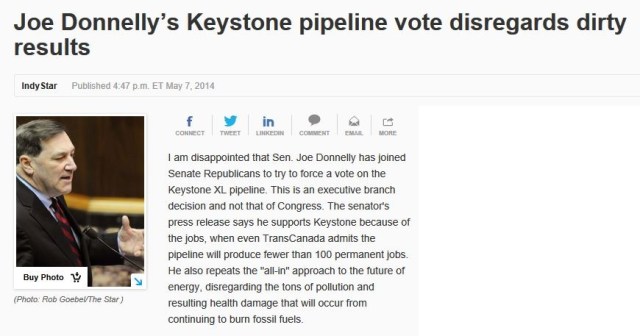
Other ways we shared this work in Indianapolis included writing a press release explaining to the public what we were doing.  When Indiana U.S. Senator Joe Donnelly indicated he would vote for the pipeline, the Indianapolis Star published the following letter I wrote:

donnelly keystone

Another approach was to work on divestment campaigns against fossil fuel projects.  Economic impacts get the attention of shareholders in banks that invest in fossil fuels.  In Indianapolis we participated in the Rainforest Action Network campaign to get Morgan Stanley to stop investing in coal projects.  We met with the manager of Morgan Stanley here, who politely listened to us and accepted the letter we brought with our demands.  Similar actions occurred across the country on the same day.  At a stockholders meeting shortly after, Morgan Stanley decided to stop investing in coal projects.

We also had several actions related to divestment related to the Dakota Access Pipeline here over the past year, including a day when $110,000 was withdrawn from the PNC and Chase banks in downtown Indianapolis.

North Meadow Circle of Friends Meeting closed their Chase bank account.

Quaker Earthcare Witness (QEW) published the story of my divestment efforts at Chase bank in the March-April, 2017, issue of Befriending Creation http://www.quakerearthcare.org/sites/quakerearthcare.org/files/bfc/bfc3002_small.pdf

dsc_0485

Posted in #NDAPL, civil disobedience, climate change, Indigenous, integral nonviolence, Keystone Pledge of Resistance, Quaker Meetings, social media, Uncategorized | Tagged , , | Leave a comment

Civic Responsibility 2 – Public Vigils

One of the reasons I love the Quaker use of queries is how they stimulate me/us to reflect on our lives, beliefs, and encourage us to do more.  Yesterday’s post was about the queries related to civic responsibility.  One of the parts of that I wrote about was:

How do we share our convictions with others? Do we express our opinions with courage,  yet with love, mindful of the Divine Spirit within everyone?

I focused on public vigils and marches, because I have spent a lot of time organizing and participating in such events for many causes over many years.  I’ve been thinking about this since and wanted to expand on that, especially because I think many people wonder if these things change anything.

The first public peace event I was involved with was when the entire student body (around 60 students) and most of the staff of Scattergood Friends School marched about 12 miles to the University of Iowa in Iowa City on October 15, 1969, as our part in the National Moratorium Days Against the Vietnam War.

DSC09398-2

Entire Scattergood Friends School marching 12 miles to Iowa City to protest Vietnam War

This idea was presented to the School Committee on October 11, 1969, which wrote:

A group of students attended Committee meeting and explained plans for their participation in the October 15 Moratorium. The Committee wholeheartedly endorses the plans.  The following statement will be handed out in answer to any inquiries:

“These students and faculty of Scattergood School are undertaking the twelve mile walk from campus to Iowa City in observance of the October 15 Moratorium. In order not to detract from the purpose of the walk, we have decided to remain silent. You are welcome to join us in this expression of our sorrow and disapproval of the war and loss of life in Vietnam. Please follow the example of the group and accept any heckling or provocation in silence.”

I think most of us were apprehensive about how people along the route might react, but I don’t remember any responses at all.  I do remember how quiet we were as we marched, like a moving prayer, or meeting for worship.

During the summer before my Senior year at Scattergood, I worked in (Quaker) Don Laughlin’s medical electronics lab at the University of Iowa Hospitals.  I accompanied him to the weekly peace vigil in downtown Iowa City.

vigil — a stationary, peaceful demonstration in support of a particular cause, typically without speeches

Then there was a big gap in time, when I moved to Indianapolis and was engaged in my career and life.  But when I became involved with North Meadow Circle of Friends meeting about five years ago, I was glad to learn about a weekly peace vigil and made an effort to attend every week when I could.

DSC01538

Weekly peace vigil in front of the Federal Building, Indianapolis

As you can see in this photo, our group was usually pretty small.  Debbie made the trip by bus every week.  She happens to be blind.  Gilbert Kuhn is a member of North Meadow Friends.  The three of us are usually all that show up.  The day of this photo Christian joined us.  He was homeless, but very enthusiastic in talking (and dancing) about peace.  We became a part of the downtown community, and the homeless people who spent a lot of time in the parks around us would often engage us.  That helped me consider who our audience was, which was everyone, not just the cars and pedestrians passing in front of us.

Signs are an important part of vigils, explaining why you are there.  The War Is Not The Answer signs are part of a many years long campaign from the Friends Committee on National Legislation (FCNL).  I think hand made signs like Debbie’s Peace Is Patriotic are also effective.  Debbie also has one that says Honk For Peace, which always results in cars honking their horns, which surprised me somewhat.  We also often have people walking by or on bicycles saying “honk, honk”.  Interaction is a good thing.

Especially at first, I think it is normal to feel some apprehension about doing this, especially knowing you might provoke negative reactions.  But especially for peace vigils it is essential to model your message.  How can you promote peace when you engage in conflict?  The core principle of nonviolence is the goal is not to win by defeating your opponent, but rather to genuinely listen to others, knowing there is at least some truth in what they are saying, and moving everyone further along the path to peace and justice.  It is just not acceptable to fight those who act negatively toward you.  You want to do whatever you can to deescalate the situation, so you can arrive at a place where a true dialog can occur.  That is why you are out there, isn’t it?

When I got deeply involve in the Keystone Pledge of Resistance, one thing our Keystone group did was hold public vigils.

At first I questioned the idea I had of taking my STOP Keystone Pipeline sign to the weekly peace vigil.  But I began to. Gilbert and Debbie also wondered about it at first but we all came to feel it made sense.  Those were the early days of the Keystone debate, and many people would stop and ask me what the Keystone pipeline was, which was a great opportunity to educate people about the dangers of tar sands and greenhouse gas emissions.

You can’t help but wonder what effects these vigils might have.  Especially in a society as militaristic as ours, I think it is important that people are made aware that there are those of us who believe in peace.  I think the one on one dialogs we have with people can be helpful.  As for those who are driving past, you never know.  Some people honk or wave the peace sign or yell encouragement as they drive past.

It is encouraging when, for example, as I walk through the public library with my War is Not the Answer sign, a librarian asks me if I am going to the peace vigil (which is not far from the library), and tells me she is glad we do that.

Another of the queries on civic responsibility is:

Are we careful to reach our decisions through prayer and strengthen our actions with worship? Are we open to divine leadings?

I feel I have been led by the spirit to make this witness, myself.

I’ve written more about this in response to an article Rev William Barber wrote in Friends Journal, September 1, 2016, The Third Reconstruction, where he says Quakers, it’s time to get back into the public square:

“It’s always been one of my great dreams to come and be at a Quaker Friends meeting, even if it meant just sittin’ and bein’ quiet. And that’s because I know enough about history to know about the Religious Society of Friends and the abolition campaigns that began long before the end of slavery in Britain. I know that George Fox, in 1657, challenged those who had Blacks and Indians as slaves, and said, Wait a minute. What about the equality of all people? I know about how Friends and Quakers saw it as their spiritual duty to be abolitionists. They didn’t separate it: I’m spiritual when I’m sitting in the meetinghouse. And then over here, I’m political. They knew your spirituality should inform your politics.”

“So my prayer is that we will refuse to live below the snake line. We’ve got to make this Reconstruction grow to full term, to full life. We can’t allow a snake to bite this reconstruction and cause it to die, so we’re gonna get it above the snake line. Quakers, it’s time to get back into the public square. If you believe that there’s life above the snake line, it’s time to get back in the public square.

“While I’m walking to get above the snake line, it might get hard. I might have to go through some spiked teeth that are trying to poison me. But I’m going above the snake line. I’m going above the snake line, and while I’m making my way, I’m gonna say, “Walk with me, Lord. Walk with me, Lord. Walk with me, Lord. While I’m on this tedious journey, going to be above the snake line, Lord, walk with me.” And if God walks with us, we can do just as they did in the First Reconstruction, and just as they did in the Second Reconstruction, we can be the generation that takes this generation above the snake line. It’s our time. It’s our time.”

Following is a video of photos I took during a march in 2014, when Rev Barber was in Indianapolis to help us launch Indiana Moral Mondays, including a speech Rev Barber gave then.


Posted in civil disobedience, Keystone Pledge of Resistance, peace, Quaker Meetings, Uncategorized | Tagged , , | Leave a comment

Civic Responsibility

The queries we will be considering this month at Bear Creek meeting are about civic responsibility.

CIVIC RESPONSIBILITY  

ADVICE

Because Friends believe there is that of God in all people, we strive for a world of freedom, justice and equality for everyone. Believing that progress toward these ideals is advanced by those who devote themselves to the shaping of a just society, we urge Friends to be active and conscientious citizens. This means staying informed on social issues, and on the opinions and activities of our elected representatives and of those seeking office. It is important that Friends speak truth to those in power. We recognize that, in our world, power in government and private sectors lies disproportionately with those of economic means. Speaking out on a personal level in our communities may be difficult, even dangerous, yet by doing so we may encourage others to work for justice.

Our first allegiance is to the Holy Spirit. In general, Friends support the laws of the State; but if those laws directly violate our religious convictions, we may be led to oppose them. When contemplating civil disobedience or unpopular personal testimony, we must carefully consider the spiritual basis for, and honestly face the consequences of our actions.

QUERY

  • What conflicts do we perceive between the laws of the State and our religious convictions? How do we resolve those conflicts in our lives? In what ways do we assume responsibility for the government of our community, state, nation and world?
  • How do we share our convictions with others? Do we express our opinions with courage,  yet with love, mindful of the Divine Spirit within everyone?
  • How do we maintain our integrity when we find ourselves in a position of power? How do we respond when we feel powerless?  Do we really respect and help those we seek to serve?
  • Are we careful to reach our decisions through prayer and strengthen our actions with worship? Are we open to divine leadings?

My response:

When I was living in Indianapolis I made it a priority to attend the weekly peace vigil in downtown Indianapolis.  We would fairly often have people stop and engage with us, some in support, some not.  There was much more interaction when I began to bring a sign that said “Quakers Black Lives Matter”, especially supportive honking from passing cars with people of color.  Several people of color also stopped to talk about what the sign said.  I miss that, and have been thinking about ways to have peace vigils either here in Indianola, or at Earlham/Bear Creek.

Similarly I was glad to help organize and participate in public events in Indianapolis recently supporting water protectors and raising awareness about the dangers of the Dakota Access Pipeline.  These often involved prayer ceremonies with native Americans.

I was impressed with how using the Quaker Social Change Ministry model (AFSC) at North Meadow Friends helped us bring a spiritual focus to our social justice work and helped us make successful connections with the Kheprw Institute (KI).  This has provided a number of powerful opportunities for us to learn about racism and ways we can work to improve our own lives in a society containing so much structural racism.  I hope we can use the Quaker Social Change Ministry model at Bear Creek meeting now that I am living in Iowa.

At our Peace and Social Concerns committee meeting at Yearly Meeting this summer, we talked a lot about nonviolence and civil disobedience.  The following is from the Peace and Social Concerns Committee report that was approved by the Yearly Meeting:

Members of our Committee were encouraged to study the new book calling for national nonviolent direct-action, The Gandhian Iceberg, by Chris Moore-Backman, who sent us the following message:

I pray that Quakers and others will move to hold bold action far above the careful crafting of right answers. In the end Jesus’ teaching is simple. Letting go of our attachments to our personal status quos is the catch. Intellectual rigor and discernment has its place, of course, but only – I believe – in service to direct, loving action and sacrifice. 

The report also included a minute that was approved by the Yearly Meeting in 2006, which ended with:

Our efforts to encourage our government to establish policies that will lead to peace and justice here and around the world have not been adequate to bring about the change which is so urgently needed.  The destructive forces unleashed in our world threaten the future of all people and the planet itself.  Throughout our history, Quakers have at various times found ourselves called to suffer for beliefs which have placed us in opposition to our government.  Based on this history of courageous witness, we challenge Friends to now consider participating in nonviolent civil disobedience.

Here is my response in 2015 https://kislingjeff.wordpress.com/2015/10/29/civic-responsibility/

Each year Iowa Yearly Meeting (Conservative) includes selected responses to each set of queries in the published Minute book.  Following is part of the response to these queries in 2003:

One person expressed his difficulty with this query, in that he is not interested in, nor trusts politics. Someone else agreed that she struggles with discouragement and the apathy of hopelessness. She had been in San Francisco during the Peace March, told how fun the experience had been, the delight, for instance, of seeing a child carrying a sign that read, “Another 3rd grader for peace.” She compared this experience to the account of someone from our meeting who went to the march in Cedar Rapids, which was much smaller, in frigid and windy weather, and how the responses from the public to the march were mixed, some of them being angry and negative. She sees the real challenge in working closer to home, where the work may be less fun and exhilarating, but where real need exists.
Again, someone expressed how she hates being in vigils, and how a small group is planning future vigils in West Branch. She struggles with carrying signs that only serve to antagonize. She does not want to participate in making George Bush or Saddam Hussein the focal points of hatred. She likes the 3rd grader’s sign and thinks hers may say, “Another grandmother for peace.” She finds she is afraid of mobs and of the possibility of mob action, even when the groups are very small. One has, she concluded, no idea how to measure the results or consequences of a vigil.
Another member spoke of a sign she saw years ago in Connecticut that said “Seek Peace and it will find you.” She hopes her standing up for peace can be a support to a passerby, who, for instance, may be tending toward such beliefs, but has not clarified them yet.
Others commented on the Cedar Rapids vigil, one saying she found positive responses outnumbered negative ones, another pointing out the vast majority did not respond. Someone wondered which is harder for the protester, a negative response or none at all.
Finally, someone spoke to the words in the advice, “staying informed.” He is aware of how in the Vietnam War we were concerned with the same struggles, and how frightening and appalling it is to be in the same place again today. Those who want power and wealth do not ever cease in pursuing those goals, but enjoy the fruits such as their yachts and fancy homes. He concluded that those who desire peace may want to reap the harvest of peace and do not stay the course so steadily, which may be at the root of our difficulties.

Posted in Black Lives, civil disobedience, peace, Quaker Meetings, Quaker Social Change Ministry, Uncategorized | Tagged , | Leave a comment

Medicine Wheel, Connections and Balance

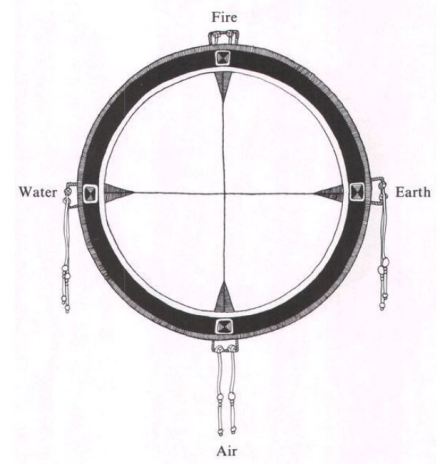
medicin wheel race

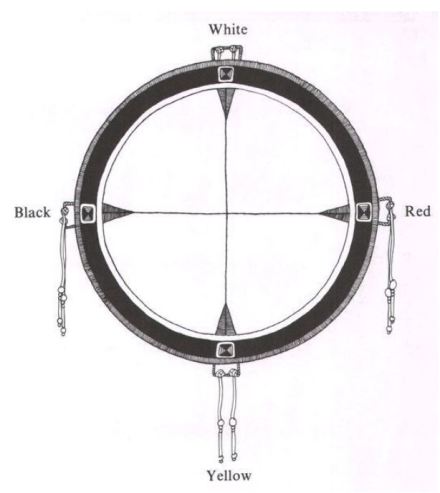
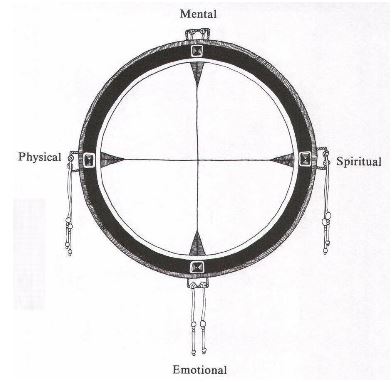
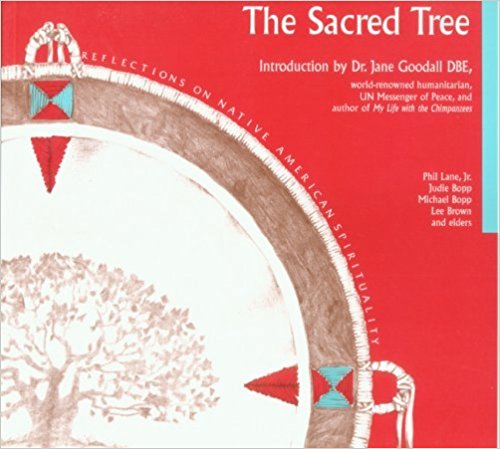
As I have been learning from  The Sacred Tree: Reflections on Native American Spirituality which these figures are from, the Medicine Wheel symbol is used by many native people in North and South America to represent many different things that are sets of four.

The circle is used to both illustrate that the things represented (race, elements, etc) are connected to each other as part of a continuum.  And that they are equal to, and must be in balance with each other.

All people, of all races, are each other’s relations and equal.

Medicine wheel elements

All of the elements of our environment are critical and must be respected and protected.  It is fascinating, that hundreds of years ago native people knew that if we poison our air, as we have with carbon dioxide, that would also hurt the water, for example, as the carbon dioxide absorbed from the air is converted to carbonic acid in the water.

medince wheel human nature

Likewise the importance of the connections and balance of these aspects of human nature.  In our society today the spiritual part seems to be especially diminished.

So many of the problems we face today relate to upsetting these balances and relationships.

The solutions are restoring the balances.


Posted in #NDAPL, Black Lives, climate change, Indigenous, Uncategorized | Tagged | Leave a comment

Symbols

Continuing to study The Sacred Tree: Reflections on Native American Spirituality, I am reading about the importance of symbols.  The Medicine Wheel is the ancient symbol used by most North and South American Native people.  Many relationships can be expressed in sets of four:  directions (north, south, east, west), races (white, black, yellow, red), elements (earth, air, fire, water), aspects of human nature (physical, mental, spiritual, emotional), etc.

This is a very intriguing sentence from the book:

Just like a mirror can be used to see things not normally visible (e.g. behind us or around a corner), the medicine wheel can be used to help us see or understand things we can’t quite see or understand because they are ideas and not physical objects.

Bopp, Judie. Sacred Tree: Reflections on Native American Spirituality (Kindle Locations 124-126). National Book Network – A. Kindle Edition.

Related to the Quaker testimony of simplicity, and the focus on inner light and spirit, Quakers reject the use of common traditional Christian symbols such as the cross and statues and paintings of Jesus and other religious figures, stained glass windows, church buildings, etc.

As with any group though, Quakers struggle to describe their spiritual experiences.  Would there be a symbol that could help people understand the Spirit?  The sentence above makes me wonder if a symbol similar to the Medicine Wheel could be useful.  However, the concept of cultural appropriation immediately comes to mind.  It would probably not be appropriate for the Medicine Wheel to begin to appear in Quaker meetinghouses.

Or would it, since native leaders are inviting us to join with them in a global spiritual awakening these days?  The book referenced here is being shared with us intentionally.

Quakers’ symbol is the example of how we live our lives.  The decisions we make, the work we do, and how we treat other people, animals and Mother Earth, are our living symbol of our spirituality.

medicine-wheel

Posted in Indigenous, Quaker Meetings, spiritual seekers, Uncategorized | Leave a comment

Sacred Tree: Reflections on Native American Spirituality

How I look at social justice and spirituality has been profoundly affected by my recent experiences with Native Americans. These things are difficult to put into words, but similar to Quaker meetings for worship, there was a palpable sense of spiritual connection I immediately shared when I joined groups of Native Americans, initially when we gathered together in downtown Indianapolis for prayers and to raise awareness about the dangers of the Dakota Access Pipeline.

I have just begun to study The Sacred Tree: Reflections on Native American Spirituality.  (that link includes both paperback and Kindle versions).

sacred tree book cover

“The Sacred Tree was created by the Four Worlds Development Project, a native American inter-tribal group, as a handbook of Native Spirituality for indigenous peoples all over the Americas and the world. Through the guidance of the tribal elders, native values and traditions are being taught as the primary key to unlocking the force that will move native peoples on the path of their own development. The elders have prophesied that by returning to traditional values, native societies can be transformed. This transformation would then have a healing effect on our entire planet. This handbook is being used by the Four Worlds Development Project to eliminate widespread drug and alcohol abuse in tribal communities. It is now being shared for the first time with all members of the human family desiring personal growth.”

From the first chapter, The Story of the Sacred Tree:

“The ancient ones taught us that the life of the Tree is the life of the people. If the people wander far away from the protective shadow of the Tree, if they forget to seek the nourishment of its fruit, or if they should turn against the Tree and attempt to destroy it, great sorrow will fall upon the people. Many will become sick at heart. The people will lose their power. They will cease to dream dreams and see visions. They will begin to quarrel among themselves over worthless trifles. They will become unable to tell the truth and to deal with each other honestly. They will forget how to survive in their own land. Their lives will become filled with anger and gloom. Little by little they will poison themselves and all they touch.

It was foretold that these things would come to pass, but that the Tree would never die. And as long as the Tree lives, the people live. It was also foretold that the day would come when the people would awaken, as if from a long, drugged sleep; that they would begin, timidly at first but then with great urgency, to search again for the Sacred Tree.


Posted in #NDAPL, Indigenous, peace, Quaker Meetings, spiritual seekers, Uncategorized | Leave a comment

KHOI Radio Interviews-North Korea Exchange

Following up on recent articles in the Des Moines Register about Iowa and agricultural diplomacy, KHOI (89.1 FM) radio talk producer Susan Franzen created an episode titled “Citizen Diplomacy through agriculture from USSR to PRNC“.
From the program’s website:

Ambassador Kenneth Quinn, president of the World Food Prize, spoke with us about the proposal he made in the Op Ed in the Des Moines Register,Agriculture could be key to easing U.S.-North Korea tensions.  His idea was inspired by a painting of the 1959 visit of then Soviet Premiere Nikita Khrushchev to the Iowa farm of Roswell Garst.,an event which opened the door to reducing the danger of nuclear war between the USSR and the USA during the Cold War.

Our next guest was Liz Garst, who remembers the visit and also could explain agricultural negotiations behind it.

A follow-up Editorial in the Des Moines Register led me to wonder about organizations that might provide channels for communication with North Korea today.  I spoke with Daniel Jasper the author of an article directly addressing this question, Opening More Channels with US-North Korean Relations.  He was our third guest in exploring this important topic..

This includes discussion of the North Korean agricultural delegation visit to the farm of Iowa Quakers Ellis and Win Standing in 2001.  And the quote from Quaker Herbert Standing during that visit at Bear Creek meeting:  “We must tell people that it is not through missiles and bombs that we find security and peace, but rather through the one-on-one sharing with persons of different countries, cultures and experiences.”

Originally broadcast 10/18/2017
Listen to the entire episode now!


KHOI Community Radio, 89.1-FM
Tell your friends to tune in!
To help us continue to broadcast donate by check at 410 Douglas Ave., Ames 50010 or online at khoifm.org where we are streaming live


Posted in peace, Quaker Meetings, Uncategorized | Tagged , , | Leave a comment