Lynch Quilts Artist Explains

The reason for sharing the disturbing photo I took of one of the quilts in The Lynch Quilts Project was because a friend of mine, Jeff Howell and the artist, LaShawnda Crowe Storm were hosting a discussion about the project at “the brand new ‘Center for Black Literature and Culture’ at Central Library to discuss racism- a part of which is portrayed within the soul-moving ‘Lynch Quilts’ Exhibit.” My photo was taken during the time the quilt was on display at the Central Library in Indianapolis several years ago. The quilts are still in the library until April 1st. There are discussions on Sunday from 12-2 and Wednesday from 6-8 pm until the quilt exhibition ends

Following are two comments LaShawnda posted about the event.

“Thank you both (Jeff Howell and a library staff member) for your support in helping to ensure this history is remembered and helping our community have these difficult conversations.”

“One of the most telling conversations of the day was a family with 2 tween/teen boys that knew nothing of the lynching history. As we talked they began to talk about they felt this was like the police shootings, their fear of the police, etc. They then went to check out books so they could learn more.”

Someone who shared my post summed this up well–“I didn’t even want to look at this, but this is our history, all of us. We need to see and be appalled.”

LaShawnda Crowe Storm does a very good job of explaining this exhibit in the following TED talk.

Posted in Black Lives, race, Uncategorized | Tagged | Leave a comment

Sea Level Projections for 2100

Some of us have been discussing how to address rising sea levels, and what to do about the resulting climate refugees.  Overground Railroad Facebook group.

Most people are not aware of how quickly sea levels are rising, and the urgency to plan accordingly.

An article on MSN News today shows the projected water levels of numerous cities in the year 2100:

“Even small increases can have devastating consequences, according to climate experts. If the worst climate-change predictions come true, coastal cities in the US will be devastated by flooding and greater exposure to storm surges by the year 2100.

Research group Climate Central has created a plug-in for Google Earth that illustrates how catastrophic an “extreme” sea-level rise scenario would be if the flooding happened today, based on projections in a 2017 report from the National Oceanic and Atmospheric Agency.

You can install the plug-in (directions here) and see what might become of major US cities.”

https://www.msn.com/en-us/news/world/disturbing-before-and-after-images-show-what-major-us-cities-could-look-like-in-the-year-2100/ss-BBJD7VN?ocid=spartanntp

surging seas


Posted in climate change, climate refugees, Uncategorized | Tagged | 2 Comments

Lynch Quilts Project

Here is a link to information about the Lynch Quilts Project.

The Lynch Quilts Project is a community based effort, which explores the history and ramifications of racial violence, specifically lynching, in the United States through the textile tradition of quilting. The project consists of a series of six quilts tackling the lynching phenomenon from various perspectives such as collective memory, communal conflict, gender, healing and politics.  The quilts combine a variety of traditional and contemporary quilting techniques to examine how the past, present and future are intricately connected. 

At the core of this project is not only a healing ritual, but a memorial process.

America, we are at a cross roads and now is the time to choose a future based on the reality of history. For it is the only way to move forward.”

 LaShawnda Crowe Storm


One of the quilts was on exhibit at the Central Library in Indianapolis a number of years ago. I took the following photo there.

DSC00012 (3)

Lynch Quilt Exhibit Project


Posted in Black Lives, race, Uncategorized | 1 Comment

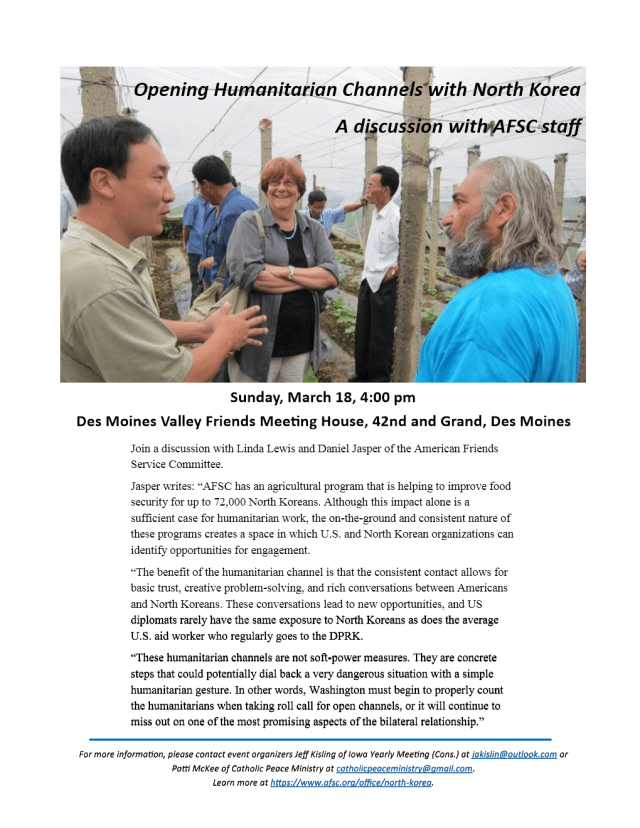
Opening Humanitarian Channels with North Korea

Please share the following information about a presentation by Daniel Jasper and Linda Lewis, from the American Friends Service Committee’s (AFSC), about Opening Humanitarian Channels with North Korea.

The meeting will be Sunday, March 18, at 4:00 PM at Des Moines Valley Friends Meeting, 42nd and Grand, Des Moines, Iowa.  Map: https://goo.gl/maps/8eS1ndrFikx

You can download this flyer for the event that you can print or sent via email.

Please contact me for more information.  Jeff Kisling jakislin@outlook.com
NorthKoreaFlyer

Posted in peace, Quaker Meetings, Uncategorized | Tagged , , | Leave a comment

Before the Panic

Are we going to get serious about climate change?

The following adds impetus to what I’ve been writing about, i.e. planning how to deal with millions of climate refugees who will be forced to leave coastal communities, and move inland. We need to design and build models for self sufficient communities that can be built rapidly with local resources.

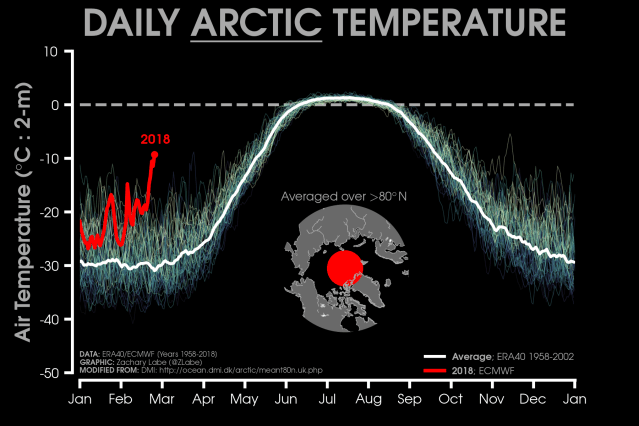
There are very ominous, rapid changes occurring in the arctic now. In particular temperatures so hot that at first scientists thought the equipment was faulty.

dailyarctice_temp_80N

Graphic by Zachary Labe, Department of Earth System Science, University of California, Irvine

In response to my blog post yesterday, Alarming Arctic Heat, there were comments about how people would be left to die, as in Puerto Rico. I was challenged when I suggested that millions would die. The figure 6 billion was suggested, and I and others agreed that was a more likely figure.

So far this year, besides the arctic heat eruption, we have had record breaking high temperatures in many parts of the country. Right now many states are experiencing significant precipitation and widespread flooding.

Sam Carana, editor of Arctic News, summarized the ten dangers of global warming   (recommended reading). The following is from the conclusion.

So, instead of facing gradual changes that can be mitigated by planned action, we may suddenly face a future in which many if not most people will have little or no access to food, water, medicine, electricity and shelter, while diseases go rampant and gangs and warlords loot and devastate the few livable areas left. Human beings as a species will face the risk of total extinction, particularly if many species of animals and plants that humans depend on will disappear.

While each of the above points is sufficient reason for concern, many people are still in denial about the severity of the problem of global warming, the accumulation of dangers and their progression.

Once they do get the message, though, there’s a risk of over-reaction edging into panic. This may result in people buying up all the food they can get hold of, trying to get their hands on weapons, etc. Unscrupulous companies may exploit the situation by deliberately creating scarcity of medicines, etc.

This is another reason to be open about these concerns and to come up with planning that makes sense.

Join the Overground Railroad Facebook group if you are interested in discussing how to plan communities for climate refugees.


Posted in climate change, climate refugees, Uncategorized | 4 Comments

Alarming Arctic Heat

North Pole surges above freezing in the dead of winter, stunning scientists is the title of an article by Jason Samenow in yesterday’s Washington Post.

arctic1daytempanomaly

GFS model analysis of temperature difference from normal (in Celsius) on Sunday over the Arctic. The temperature is above freezing at the North Pole. (University of Maine Climate Re-analyzer)

Temperatures may have soared as high as 35 degrees Fahrenheit (2 degrees Celsius) at the North pole, which is more than 50 degrees (30 degrees Celsius) above normal according the climate scientist Zachary Labe.

Graphic by Zachary Labe, Department of Earth System Science, University of California, Irvine

dailyarctice_temp_80N

There are several likely consequences of such extreme warming.  Temperatures above freezing for longer periods will melt glaciers. That will accelerate air and water warming, since there is less ice to reflect the sunlight. Higher air temperatures mean the air can hold more water. Water vapor also traps heat like greenhouse gases do. More water vapor also means greater rainfall amounts.

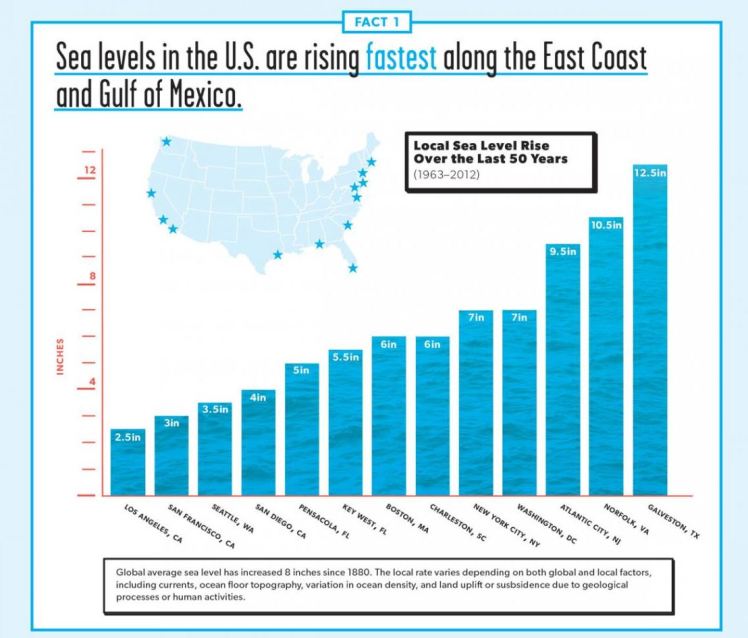
Melting ice will contribute to rising sea levels.

Sea Level Rise  Union of Concerned Scientists

sea level rise 1

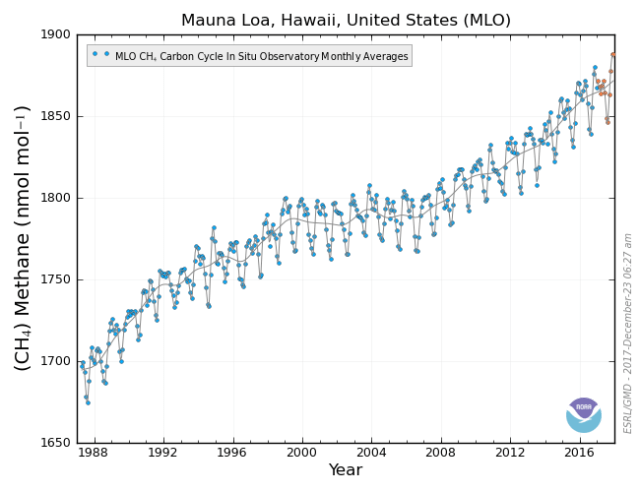
The other alarming consequence is that as the arctic waters warm and as the permafrost melts, huge volumes of methane are released. Methane is 86 times more potent as a greenhouse gas. Rising concentrations of methane will rapidly increase air temperatures.

methane

Environmental Protection Agency (EPA)

All of this portends increasingly severe storms, hotter air and sea temperatures, sea level rise, storm surges and flooding, droughts and wildfires. We need to prepare for dramatic changes in the movement of people as areas of the country are impacted by severe storms, drought and coastal flooding.

Posted in climate change, Uncategorized | Tagged , | Leave a comment

Josué Rivas: The Power of Stories

“When one lives in a society where people can no longer rely on the institutions to tell them the truth, the truth must come from culture and art.”  John Trudell

Josué Rivas (Mexica/Otomi) began his talk at Stanford, “The Power of Telling Your Story”, with those words.  He is an award winning photographer and videographer who spent nearly seven months at Oceti Sakowin camp. He has founded the long-term multimedia  Standing Strong Project, a quest for a contemporary vision of Native America.  He hopes it can create space for more indigenous folks to tell their own stories.

In contrast with some of the other media personnel who showed up to capture the stories of the water protectors at Standing Rock, Rivas was intentional about giving before he took. Observing tradition, he would show up with tobacco to offer before asking permission to document a person’s experience. Rivas even incorporates this into his language about the work, straying away from the traditional framework of “taking” photos — “because I don’t take. I create. I’m not taking photographs, I’m creating images.”

Rivas also acknowledges that “it’s an intimate thing, when you have a camera.” A photograph belongs both to the subject and the photographer, but the subject is usually in a more vulnerable position — especially in a place like Standing Rock, where people were making sacrifices, and grappling with all sorts of issues and traumas. These wounds are communicated both with tenderness and frankness in Rivas’s work.  https://www.stanforddaily.com/2017/11/07/the-power-of-telling-your-own-story-a-conversation-with-josue-rivas/

He directed the video of Nahko’s Love Letters to God, with powerful images from Standing Rock.

In the recent issue of Yes! magazine, the Decolonize Issue, Rivas wrote “Decolonization starts inside of you.”

Colonization, at its core, is about creating separation, separation among people and separation from spirit and our connection to the Earth. Humans have been taking more than we need, and we haven’t been giving enough back.

Decolonization starts inside of you. It is a lot about finding compassion and kindness, and less about anger and fear. We should remember that it begins with an internal process of healing and reconciliation. Once we find that peace, then we will be able to move forward and unify as peoples. We must remember that we are all related.

At Standing Rock, we saw a new vision of what it means to be human. The fire and the water were our tools for healing. It was not just a protest; it was an awakening for all of us to return home, back to where our spirit lives in harmony with our past and present. In that way, we can have a healthy future.

The real front lines are within.

Posted in #NDAPL, Arts, Indigenous, Uncategorized | Tagged , , | Leave a comment

Peace vs a culture of guns

Living in the United States, with our gun culture, is difficult for those who believe in peace and nonviolence. The debates quickly become partisan and generate deeply emotional responses.

There is a reason so much of these debates are simply based on opinions. Because the National Rifle Association (NRA) has been among those intensely lobbying, successfully, to forbid the Centers for Disease Control (CDC) to fund any research related to gun violence.

“Infuriated by CDC-funded research suggesting that having firearms in the home sharply increased the risks of homicide, the NRA goaded Congress in 1996 into stripping the injury center’s funding for gun violence research – $2.6 million. Congress then passed a measure drafted by then-Rep. Jay Dickey (R-Ark.) forbidding the CDC to spend funds ‘to advocate or promote gun control.’ ”
The NRA has blocked gun violence research for 20 years. Let’s end its stranglehold on science, Los Angeles Times, June 14, 2016

Most of my career was spent in medical research and I feel strongly about the unbiased study of a question, to seek the truth. We should strongly advocate for funds and a mandate to the CDC  to study the causes of gun violence, so we have actual data from which we can formulate policies to reduce it.

Chris Letts, FCNL, just wrote a powerful post, The Sickening Toll of Gun Violence, that begins “The gun violence epidemic is both a public health crisis and a troubling reflection on our country’s spiritual state. As we seek policy solutions to reduce deaths from guns, we must also look critically at the culture that enables so many people to kill each other with guns.”

Friends are encouraged to speak against proposals based upon the false premise that more weapons, such as arming teachers, will provide greater safety, when the opposite is true. Friends are encouraged to advocate for legislation to remove the weapons of war from civilians by reinstating the ban on assault weapons.

Perhaps most important at this moment Friends should be publicly supporting our youth as they speak truth to this issue today. This is on opportunity to invite our young Friends to lead these discussions and actions in our meetings and schools, and stand with them in their public witness.

FCNL suggestions for speaking to Congressional representatives about gun control:
I am horrified and appalled by the mass shooting that occurred in Florida. I am also outraged by the broader epidemic of gun violence in the United States. In our country, 100 people are killed with guns every single day. That is not acceptable.
Congress has a moral obligation to act. I support gun violence prevention through gun control. Please reinstate a ban on assault weapons and prevent access to military-style weapons that make mass shootings more deadly.

You are encouraged to share your story related to gun violence with the Friends Committee on National Legislation. https://act.fcnl.org/letter/gun-violence-prevention/
It is by sharing our stories that change is created.

Following is the Advice related to peace and nonviolence from Iowa Yearly Meeting (Conservative):

 12. PEACE AND NONVIOLENCE

“[We] seek to live in the virtue of that life and power that takes away the occasion of all wars.” George Fox

ADVICE

We seek peace within our own lives. Sometimes there are barriers to peace within families and meetings, and among individuals. Anger and frustration may result in hurtfulness which leaves physical, sexual or emotional wounds. Healing and forgiveness are possible when our hearts are opened to the transforming love that comes from the Spirit Within. The violence we oppose is not only war, but all unloving acts.

Friends seek peaceful resolution to conflicts among nations and peoples. Wars can easily erupt when nations depend upon armed forces as an option for defense and order. To oppose war is not enough if we fail to deal with the injustices and inequalities that often lead to violence. We need to address the causes of war, such as aggression, revenge, overpopulation, greed, and religious and ethnic differences.

Posted in Black Lives, Indigenous, peace, Quaker Meetings, Uncategorized | Tagged | Leave a comment

Overground Railroad

In response to my recent posts concerning how we in the Midwest might deal with the massive inland migration of climate refugees, I received the following interesting response from Jane Peers.

As a member of the coastal Quakers, I wonder how we Friends, after we find each other, will respond to the non-Quakers who will be fleeing to the same areas. Will we be building high walls? Offering classes in how to emulate our solutions? Something in between?
And, as a coastal dweller, I wonder how well we can adapt as well as how genuinely welcome we might be. We will lack almost all of the skills the new life will require.
This article is very welcome and could provide the basis of new acquaintances across the mountains – before the emergency. Could we share some of our visions – or nightmares – even if they are only small pieces of some larger as-yet-unseen vision? For example, how to keep warm in winter – skins were an early solution; Raising cotton or sheep and hand-spinning yarn and then learning to weave it and form garments – all this is just one other aspect of this vision.
Thank you for taking the trouble to write out this well-considered wake-up call.

In response I wrote:  Thank you Jane. I think it would be a great step forward to begin to build connections with coastal Quakers, completing the circle in a way. Figuring out what those on the coast grapple with, and how they make preparations for the journey would be another part of the way we can all help those who will become climate refugees. We would be building an ‘overground’ railroad.

I think this is a fascinating possibility.  I hadn’t considered that connecting with coastal Friends would be an important step in the migration process. As Jane implies, those Friends could be learning needed skills BEFORE they start their journey. And as importantly, they could be teaching those skills to hundreds or thousands of others who would soon become climate refugees.

Such connections between those living on the coast and those in the Midwest could allow time for planning and preparation of the new communities. This could make the massive migration somewhat manageable, instead of the alternative of unexpected arrivals. A new dimension to building a peaceable kingdom.

Posted in climate change, climate refugees, peace, Quaker Meetings, Uncategorized | 3 Comments

Building Communities 2

I don’t know to interpret the lack of response to yesterday’s post about creating and building self sufficient communities for the massive influx of climate refugees to the Midwest. Whether people don’t think there will be such a migration, or it won’t happen soon, or that should not be a Quaker focus.

Part of the reason for sharing those ideas yesterday was in response to the question “why is there no vision for the future of Quakerism?”  Two answers came to me then.

The first is that in general I agree that I don’t see such a vision in many Quaker groups I know a little about. Too many meetings seem so insular, and while most have members working on social justice issues, my impression is that few meetings work on such things as a whole meeting. And too often serving on committees is seen as adequate. I have also been disappointed that Friends in general have become comfortable with the status quo. Most know I feel strongly that Friends should have been leaders in protecting our environment, by refusing to own personal automobiles, travel by air, or live in energy wasting housing and poorly designed communities without mass transit systems. I am also disappointed that more Friends have not worked harder to learn about, and do something about systemic racism and privilege. That more have not worked to try to repair some of the damage from the genocide, forced assimilation and theft of land from Native Americans.

The second answer is I was blessed to participate in a vision of Quakerism in the work of North Meadow Circle of Friends, where I attended when I lived in Indianapolis, and our partnership with the Kheprw Institute (KI), a black youth mentoring and empowerment community located near the meetinghouse. That work was greatly aided by embracing the Quaker Social Change Ministry (QSCM) model from the American Friends Service Committee (AFSC).

The basic tenants of QSCM are:

  • Bring a spiritual focus to peace and justice work
  • Involve the whole meeting in a focused justice effort
  • Find a community experiencing injustice to partner with
  • Friends get out of the meetinghouse and into the community
  • Listen carefully and allow the impacted community to lead the work

So many good things came from that over the last three years. Quakerism is an experiential religion, and QSCM is experiential justice work. Both communities developed friendships with each other, and that is what broke down barriers between us.  Our meeting was energized by these experiences. We also got to know each other in the meeting much better as we met monthly to share our experiences related to this work with KI, and explore what that meant spiritually. An unanticipated effect was the growth of the meeting as others heard about this work. From KI we heard “we’re glad you came”, “we’ve learned from you”, etc. It was not necessarily easy work. We made mistakes, but together we dealt with and learned from them. Friends were deeply affected when we saw the hurt and struggles experienced by the KI community.

Thus I have seen a vision of the future of Quakerism and it is my hope that Iowa Yearly Meeting (Conservative) and other Friends will embrace that vision. Friends don’t necessarily have to adopt the QSCM model, but the tenants outlined above are the keys to success in social justice work, in my experience. The work should bring a spiritual focus and engage the entire meeting. And it is the relationships developed with an impacted community that teach us about the experience of injustice. I spoke about this at Yearly Meeting a couple of years ago, and would be happy to help any interested meeting learn more about QSCM.

In the Midwest there are a number of communities that could be partners–people of color, immigrants, Native Americans, people living in poverty in cities and rural areas.

There are several reasons why I see developing a model that others can use to rapidly and inexpensively build communities. Building and then living in such communities will allow us to live in a more environmentally just manner ourselves. We could live without personal automobiles, in houses that are environmentally sound. We can grow our own food, reducing fossil fuel used to transport food from distances. Everyone would contribute to the community, giving all a sense of dignity. Those who had been alone would be members of a beloved community.  People of all ethnicities and cultures would be welcome, and we could work on privilege together.

Those are among the benefits to us.  From that experience we can develop ways that others can build similar communities. The keys would be to build structures that were simple, inexpensive and use local material. And teach how to grow food and develop sources of water and energy. Ways to provide healthcare.

This is also a matter of peace and nonviolence. For the alternative to having a plan to help climate refugees build their own communities, would be conflicts, death and destruction as they are driven by desperation for food, water and shelter.

If you have trouble believing how rapidly environmental conditions are deteriorating, I urge you to do your own research. Even since yesterday’s writing there are alarming new reports about arctic air temperatures 45 degrees above normal right now.


Posted in climate change, Ethical Transportation, Indigenous, integral nonviolence, Kheprw Institute, peace, Quaker Meetings, Quaker Social Change Ministry, race, Uncategorized | Tagged , , | Leave a comment