Wet’suwet’en and the Law

The law related to the current situation of the Wet’suwet’en people’s opposition to the Coastal GasLink pipeline is complicated. Often at issue is whose law applies. I hope some of the excerpts below are helpful.

At the end is part of a Canadian Supreme Court case in which an alternate route for the pipeline was offered by the Wet’suwet’en people. The court ruled against the Wet’suwet’en when the pipeline company said it would be too expensive to use the suggested alternate route. You might remember when the original route of the Dakota Access pipeline was changed when the people of Bismark, ND, objected to the possibility of their water being polluted. The route was then moved to within a mile of the Standing Rock Sioux Reservation. The company behind the Dakota Access pipeline, Transcanda, is the same company with the new name, TC Energy, that wants to build the Coastal GasLink pipeline.


The right of free, prior, and informed consent enshrined in the United Nations Declaration on the Rights of Indigenous Peoples (UNDRIP) logically flows from the recognition that Indigenous governmental, legal, and political orders have existed on this land from time immemorial, long predating the arrival of European settlers.

SETTLER GOVERNMENTS ARE BREAKING INTERNATIONAL LAW, NOT WET’SUWET’EN HEREDITARY CHIEFS, SAY 200 LAWYERS, LEGAL SCHOLARS By Beverly Jacobs, Sylvia McAdam, Alex Neve and Harsha Walia, Thestar.com February 27, 2020


The images and stories coming out of the the RCMP raids on Wet’suwet’en are disheartening, disturbing and reflect a certain dishonesty about Canadian officials’ self-described commitment to Indigenous rights and reconciliation.

Lands Defenders of the Wet’suwet’en Nation are resisting a $6-billion, 670-kilometre pipeline set to be constructed through their territory. Raids by armed RCMP officers over the past few days have led to the arrest, detainment and denied access of Indigenous Peoples from their lands. The Canadian Association of Journalists and others have condemned police crackdowns on reporters covering the raids.

The complexity of what laws and whose laws apply is something you won’t always see or hear in news reports. Erin Seatter and Gitxsan journalist Jerome Turner (who has been embedded in the Land Defender camps during the raids), put together an amazing explainer piece to help people understand it.

Hereditary chiefs are the title holders of the land.

Under the traditional Wet’suwet’en land system, the hereditary chiefs from each of the five clans (divided into 13 house groups) that make up the Wet’suwet’en Nation have the right to control access over the territory. Trespassing is considered a terrible offence and must be immediately corrected.

“190 kilometres of the proposed route will run through our territory. It threatens our water, our salmon, and our rights, our title, our jurisdiction,” Hereditary Chief Na’Moks of the Tsayu Clan told APTN.

What you might not know about Indigenous law and the raids on Wet’suwet’en by Jesse Firempong, Greenpeace, 10 February, 2020


As lawyers and legal academics living and working on this part of Turtle Island now called Canada, we write to demand an end to the ongoing violations of Indigenous nations’ internationally recognized right to free, prior, and informed consent — for example, with the Trans Mountain and Coastal GasLink pipelines routed through unceded Indigenous lands, including Wet’suwet’en lands.

Canadian law and legal institutions — from legislation like The Indian Act to court decisions legitimizing treaty violations with racist stereotypes — have long served as instruments of settler colonialism. And they continue to do so with the legal authorization of the violent dispossession, suppression, and criminalization of Indigenous land and water protectors.

“Think about everything that First Nations people have survived in this country: the taking of our land, the taking of our children, residential schools, the current criminal justice system,” as the late Mohawk legal scholar Patricia Monture-Angus wrote. “How was all of this delivered? The answer is simple: through the law.”

Through Canadian Eurocentric Law, that is. Clearly, law is not synonymous with justice.
While the Supreme Court has officially recognized that Canada was not in fact terra nullius (“nobody’s land”) before European colonization, Canadian courts and legal institutions continue to treat Indigenous territories as if they are so — enabling a wide scope of governmental and corporate infringement on unceded Indigenous lands, including Wet’suwet’en land, even in the face of sustained Indigenous resistance.

The right of free, prior, and informed consent enshrined in the United Nations Declaration on the Rights of Indigenous Peoples (UNDRIP) logically flows from the recognition that Indigenous governmental, legal, and political orders have existed on this land from time immemorial, long predating the arrival of European settlers.

It is important to understand that while the Wet’suwet’en defence of the land, and the B.C. and Canadian governments’ amnesia about their legal and moral obligations, are now drawing international attention, these patterns of government-sanctioned lawlessness are being committed all across Turtle Island.

SETTLER GOVERNMENTS ARE BREAKING INTERNATIONAL LAW, NOT WET’SUWET’EN HEREDITARY CHIEFS, SAY 200 LAWYERS, LEGAL SCHOLARS By Beverly Jacobs, Sylvia McAdam, Alex Neve and Harsha Walia, Thestar.com February 27, 2020


IN THE SUPREME COURT OF BRITISH COLUMBIA
Citation: Coastal GasLink Pipeline Ltd. v. Huson,
2019 BCSC 2264
Date: 20191231
Docket: S1854871
Registry: Prince George
Between:
Coastal GasLink Pipeline Ltd.
Plaintiff
And
Freda Huson, Warner Naziel, John Doe, Jane Doe
and all other persons unknown to the plaintiff occupying,
obstructing, blocking, physically impeding or delaying access at
or in the vicinity of the area in and around the Morice River Bridge
or the area accessed by the Morice West Forest Service Road
Defendants

The Office of the Wet’suwet’en participated in the Environmental Assessment
Office’s Working Group for the Pipeline Project and actively proposed an alternate
McDonnell Lake route for the Pipeline Project. The plaintiff explored and considered
the proposed alternate route but ultimately rejected it for various reasons, including
inappropriateness for the diameter of the pipeline, increased cost, the desire to avoid
urban areas and greater adverse environmental impacts. The plaintiff determined
that it was not able to re-route the Pipeline Project through Sections 7 and 8.


Posted in #NDAPL, civil disobedience, decolonize, Indigenous, Uncategorized, Unist'ot'en, Wet’suwet’en | Leave a comment

Indigenous Youth have re occupied the BC Legislature

Indigenous Youth have re occupied the BC Legislature and have vowed to stay until Nation to Nation talks between the Wet’suwet’en and Canada take place.
Live 8:30 am Feb 27 at BC Legislature

It seems now that talks between the Wet’suwet’en hereditary chiefs and the provincial and federal government will happen, after earlier reports that they would not.

Chief Na’Moks, a spokesperson for the Wet’suwet’en hereditary chiefs, said a meeting with the provincial and federal governments is set to begin Thursday afternoon at a hotel in Smithers, B.C., and continue Friday. (Chad Hipolito/The Canadian Press)

Wet’suwet’en hereditary chiefs and ministers from the B.C. and federal governments are scheduled to meet Thursday afternoon to discuss the First Nation’s title and land rights amid an impasse over the issue, first sparked by the Coastal GasLink pipeline project.
Chief Na’Moks, one of several hereditary chiefs opposed to construction of the pipeline across Wet’suwet’en traditional territories, said talks are set to be held at a hotel in Smithers, B.C., and continue Friday.
B.C. Minister of Indigenous Relations and Reconciliation Scott Fraser said he’s eager to find a “path forward.”
“Finding a peaceful resolution to the situation we’ve found ourselves in over the last weeks is key and paramount, but it is deeper than that,” he said at the B.C. Legislature before leaving to fly north on Thursday.
Fraser stayed in Victoria on Thursday morning for a budget vote, but said he would arrive in Smithers well before the meeting is scheduled to begin.
“The issue of rights and title — we are committed with the Wet’suwet’en people to get that straightened out and to be able to recognize those,” he said.

Meeting of Wet’suwet’en hereditary chiefs and federal, provincial governments set to begin. Coastal GasLink pauses work in Morice River area for 2 days to ‘facilitate’ talks. CBC News · Posted: Feb 27, 2020 8:19 AM


Powerful actions and a widespread will to struggle against injustice have proliferated in response to the raid on Tyendinaga as anger grows at the Government’s use of force and steadfast refusal to negotiate in good faith. 

The Government’s demand that blockades end for talks to begin illustrate how powerful this movement is and how afraid they are of widespread and sustained Indigenous resistance. The Wet’suwet’en Hereditary chiefs have asked for people to continue to act in support of their demands.   

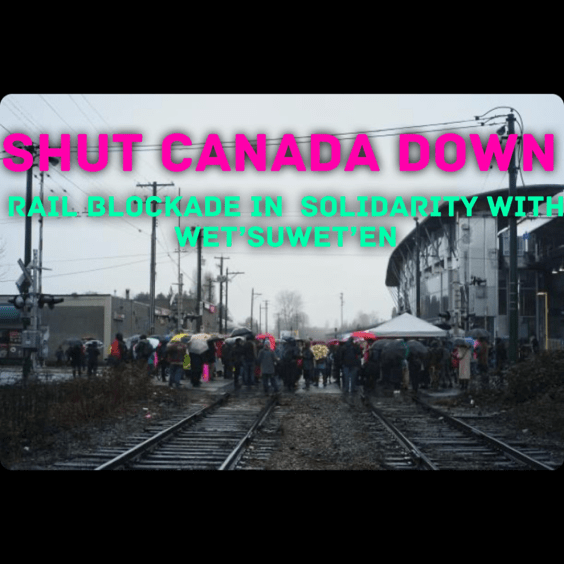
The last two days have been incredibly powerful as people have risen up in defiance of colonial injunctions and set up new rail and road blockades across the country: Over 500 people shut down rail traffic in Toronto, The Port of Vancouver was shut down for over 24 hours, Kahnawake Mohawks reinforced their barricades in response to an injunction, Indigenous youth retook the BC Legislature vowing to stay until Nation to Nation talks occur, and new rail blockades went up in Chase, Abbotsford, Maple Ridge, Hamilton, Gitxsan territory, Lennoxville among many other incredible actions. 

See photos below of this powerful and expanding resistance. 

As police begin to act more aggressively towards new blockades many people have made tactical temporary retreats avoiding arrests and setting themselves up to continue to struggle in a sustained fashion.  

As the Government refuses to move an inch continuing the resistance is critical! 


Statement from Indigenous Youth Leader Kolin Sutherland Wilson on the arrests at the Gitxsan Rail Blockade

“Last night [the RCMP] arrested three of my chiefs. 40 RCMP officers descended on the tracks. They made a line with their vehicles … to stop people from witnessing as they arrested our elders and our young ones and our leaders who speak for our Nation. Is that a Nation-to-Nation to dialogue?

When they arrested those chiefs — in the heart of Gitxsan country — our people descended on them like a tsunami … and they shutdown Highway 16. Last night, the Gitxsan shut down the highway of tears ✊ And they kept bringing in more officers and RCMP [but] there were not enough cops in northern B.C. to suppress our Nation. That’s the power of the people coming together. And they did so in a good way, in a peaceful way. They facilitated dialogue. They simply asked that they release our leaders, our matriarchs, our elders. This is Gitxsan territory you must adhere to Gitxsan law. So our leaders were returned.

This criminalization of Indigenous peoples is not the way forward, because when they attack one of us, they attack all of us.

We all stand together because we recognize that what is happening in this country is 500 years of colonial policy perpetuating assimilation and genocide finally bubbling to the surface. What his happening on Wet’suwet’en territories is not simply the result of one single natural gas pipeline; it is the result of Canada’s systematic erasure of Indigenous law and sovereignty and their attempts to extinguish our rights and title to our territories.

A victory for Wet’suwet’en is a victory for all of us.”

#youthforyintah #indigenousyouthforwetsuweten #wetsuwetenstrong
#westandwithwetsuweten


Mohawk Kahnawake Secretary Kenneth Deer speaks about CP rail getting injunction against the ongoing Kahnawake rail blockade

“There are no plans to take down the barricades at this time.”

No photo description available.

Tim Groves February 24 ·  Following raids in Tyendinaga railway blockades went up today in New Hazelton, Maple Ridge (just outside Vancouver), Hamilton, and Rimouski. This is addition rail blockades in Saskatoon, Kahnawake, and Elipogtog. And La Presse is reporting that blockades are also still up in Listuguj, Wemotaci, Neskonlith, and Magnetawan.
Since protest began there have been at least 33 railway blockades, and numerous highway blockades and slow downs.

See the updated version of online map of solidarity actions: https://www.google.ca/maps/d/viewer?mid=1LiCsNERxKvC2-iIUtEYDwXXCciC94Xps&ll=43.365624868860316%2C-92.69257622670682&z=4


Let’s keep pressure on Canada and ths RCMP to stop their attack on land defenders ! They can’t arrest us all.

Maryam Monsef has not fulfilled our demands from our meeting with her a few weeks ago. We need to keep pressure on her! The attacks against our brothers and sisters across the country need to stop!!


Port Shutdown in Vancouver Yesterday

SIX NATIONS OF THE GRAND RIVER TERRITORY: Six Nations Land Defenders blockaded Highway by pass between Argyle and Greens Road near the town of Caledonia. Six Nations Land Defenders blockaded the same during similar indigenous uprisings, such as the reclamation of Kanonhstaton in 2006 and is a symbol of indigenous struggle in so-called Canada. The blockade is ONGOING at this hour and is in need of reinforcement

Indigenous youth occupying the BC legislature and watching Invasion, and Kahnasatake 270 years of Resistance  a documentary on the so called Oka Crisis tonight. 
Join them this morning at 8 AM for a mass action and teach in
They have vowed to stay until Nation to Nation talks between the hereditary chiefs and the BC and Federal government occur. Sign up to help keep the occupation going here.

Mass action in Ottawa outside of Parliment
Image may contain: one or more people, sky and outdoor

Women’s Coordinating Committee for a Free Wallmapu [Toronto]· 2.27.2020 ·  #UPDATE: Land Defenders Arrested at Work and Home following a Rail Blockade in Hamilton this week | Some Remain in Custody

[Feb 27] Several Land Defenders in Hamilton have been arrested at work and in their homes following the recent rail blockade earlier this week in solidarity with the Wet’suwet’en and Mohawk Nations, with a total of four detentions so far according to the website North Shore Counter Info. Some Land Defenders are still in police custody and will be appearing in court in the next few days. The statement calls on people to remain mobilized and take extra precaution at the time of taking action, such as using face coverings etc.
More information to come…

For the full update/statement, visit: https://north-shore.info/2020/02/27/hamilton-update-news-about-arrests-and-tips-for-staying-safe-at-the-blockades-to-come

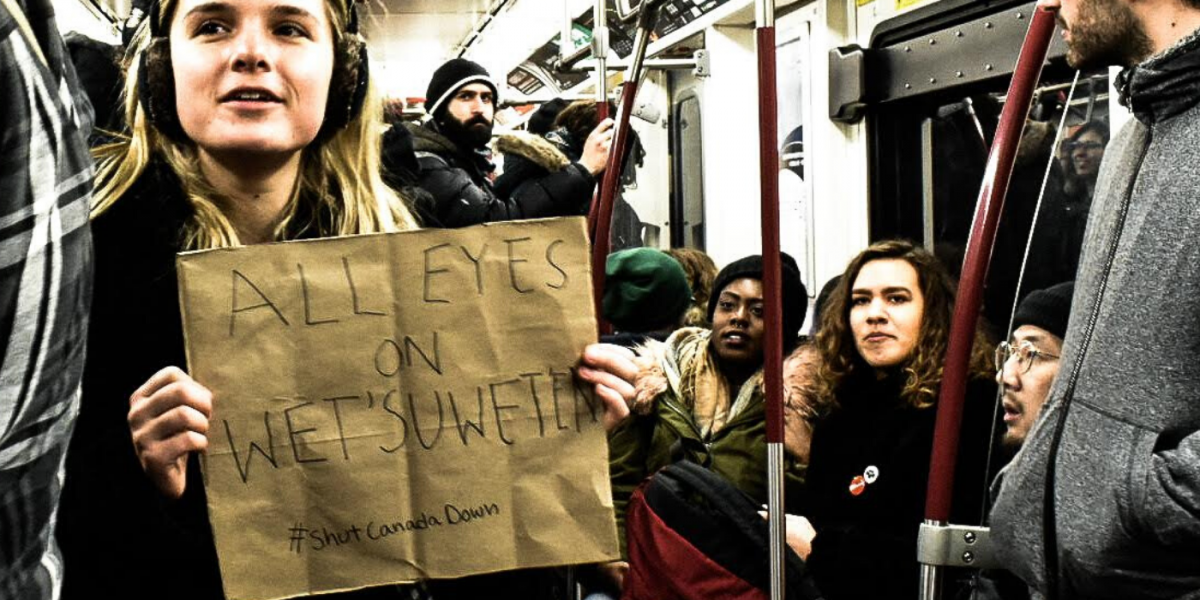
ALL EYES ON WET’SUWET’EN!
OIL & GAS OUT OF WET’SUWET’EN LAND!
AMULEPE TAIÑ WEICHAN!

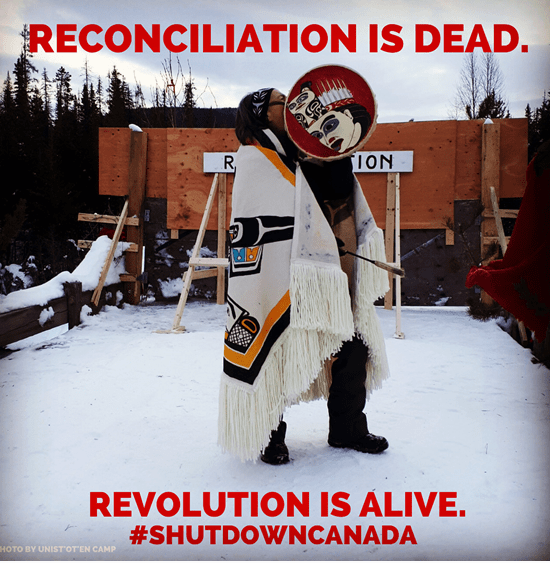
#ShutDownCanada #WetsuwetenStrong #RCMPOUT #ReconciliationIsDead

Posted in civil disobedience, climate change, decolonize, Indigenous, Uncategorized, Unist'ot'en, Wet’suwet’en | Leave a comment

Our Last Best Hope

We have arrived at a moment of truth.

The enclosure of the commons, and the rise of industrialization and capitalism fueled the subjugation of peoples and lands.

Will we finally act on the certain knowledge that continuing to extract and furiously burn fossil fuels means death for our children and of Mother Earth?

This moment requires that we return to Indigenous ways of living for each other and honoring the earth.

Indigenous peoples around the world have never stopped working and dying to preserve their ways. That is what Standing Rock and the struggles of the Wet’suwet’en people are about.

This is our moment of truth. We each have a choice. Will we do nothing and continue down the path of environmental devastation and social collapse? Or will we recognize this is our last best hope? Will we act in solidarity with Indigenous peoples, with the Wet’suwet’en?


Our moment of truth, justice and reconciliation

Elizabeth May Responds to Justin Trudeau’s Wet’suwet’en Statement Feb 18 2020

Elizabeth Evans May OC MP is a Canadian politician who served as leader of the Green Party of Canada from 2006 to 2019 and Member of Parliament for Saanich—Gulf Islands since 2011. Wikipedia


How could we convince lawmakers to pass laws to protect wilderness? Lopez argued that wilderness activists will never achieve the success they seek until they can go before a panel of legislators and testify that a certain river or butterfly or mountain or tree must be saved, not because of its economic importance, not because it has recreational or historical or scientific value, but because it is so beautiful.

His words struck a chord in me. I left the room a changed person, one who suddenly knew exactly what he wanted to do and how to do it. I had known that love is a powerful weapon, but until that moment I had not understood how to use it. What I learned on that long-ago evening, and what I have counted on ever since, is that to save a wilderness, or to be a writer or a cab driver or a homemaker—to live one’s life—one must reach deep into one’s heart and find what is there, then speak it plainly and without shame. 

Reid, Robert Leonard. Because It Is So Beautiful: Unraveling the Mystique of the American West . Counterpoint.

Posted in climate change, decolonize, Indigenous, Uncategorized, Unist'ot'en, Wet’suwet’en | Leave a comment

BREAKING: Indigenous Youth Locked Down at BC Parliament

Wet’suwet’en Solidarity Victoria

Reoccupation of the BC legislature now 2.24.2020

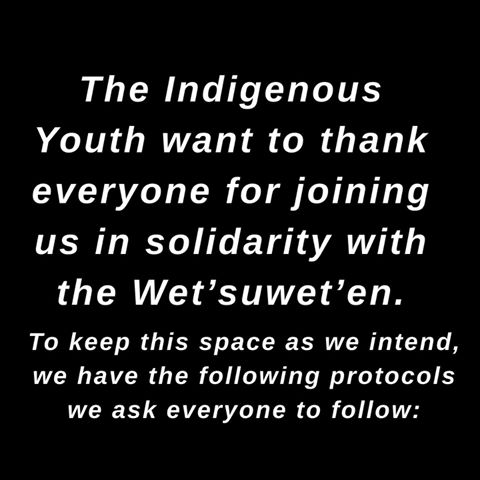
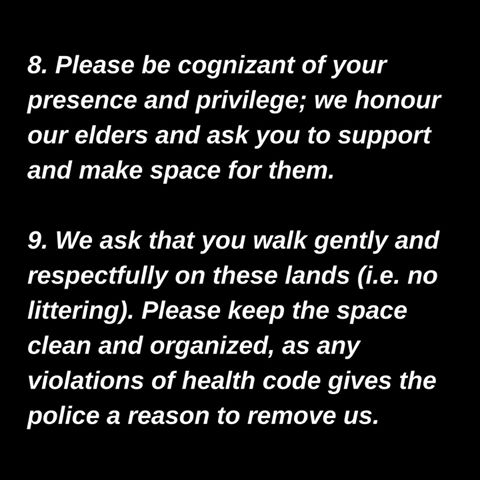
The Indigenous Youth for Wet’suwet’en are currently re-occupying the legislature steps. Arrests have been threatened by police and urgent support is needed. Please come down ASAP and follow their protocols. Check this spreadsheet for up-to-date info on their needs: https://docs.google.com/…/1lDjmEUUiKjg32r1fsJvVceAiRU…/edit…

Image may contain: 4 people, people standing, possible text that says 'URGENT SUPPORT NEEDED AT LEGISLATURE'

Come down to the legislature and observe for the Indigenous youth. Arrests have been threatened and support is needed.


Image may contain: 2 people, people standing and outdoor

Reoccupation of the BC legislature.

Posted in civil disobedience, decolonize, Uncategorized, Unist'ot'en, Wet’suwet’en | 2 Comments

Indigenous Youth Continue to Lead

Unist’ot’en Camp Today at 6:10 PM · Indigenous Youth Voices: Violence Won’t Break Us. Indigenous youth who have stood on the Wet’suwet’en front lines offer this message of solidarity for the Mohawks of Tyendinaga, and for people standing up across Turtle Island. The threat of violence will not stop us from defending the sacred for our future generations.
#ShutdownCanada #WetsuwetenStrong


In Canada, police arrested 12 indigenous youth activists early Wednesday morning, ending their day-long sit-in occupation of the offices of the Ministry of Energy, Mines and Petroleum Resources in British Columbia. Their protest was the latest among dozens of solidarity actions taken in support of the Wet’suwet’en First Nation, which is resisting the $6.6 billion Coastal GasLink fracked gas pipeline. Earlier this month, Wet’suwet’en leaders evicted construction workers from the territory and set up a road blockade that cut off access to a Coastal GasLink worksite. The Royal Canadian Mounted Police have since set up a checkpoint nearby, raising fears of a raid. This is First Nations activist Ta’Kaiya Blaney, one of the 12 arrested on Wednesday.

Ta’Kaiya Blaney: “Because what indigenous people remember and Canada has forgot is that we have a sacred obligation to this land. As human beings, we all have a responsibility to that which gives us life. And as indigenous peoples who have safeguarded and stewarded these territories since time immemorial, it is crucial that our sovereignty be respected for our collective climate future.”

12 Anti-Pipeline Activists Arrested in Wet’suwet’en Solidarity Protest, Democracy Now, January 29, 2020

Our culture and our tradition is the land. We are directly connected to the land. It’s our spirituality. We cannot be forced to be away from our land.
Nine days since we took the land back.
It feels like something you don’t normally do. (laughter) Its revolutionary, right?
I don’t think anyone’s ever really evicted like a 6 billion dollar pipeline before.
People get confused about what we want as Native people. Like “what do you want?”
Just like, “land back!”. Don’t need any reconciliation, don’t want money, like I don’t want programs or funding or whatever.
(whispers “land back”)
Funny though, when I said that to my Dad, Wet’suwet’en people, if you tell them about LANDBACK, they’re like “we never lost the land, anyway.” Which is true.
Wet’suwet’en have never given up title to their 22,000 square kilometer territory.


[ WARNING: This video contains graphic images of an armed threat on the lives of land defenders Denzel Sutherland-Wilson (Gitxsan) and Anne Spice (Tlingit). It may be traumatic for many to see. But we feel strongly that it should be available to witness. Denzel, Anne, and all the land defenders are now safe. These events took place during the RCMP raid on unceded Wet’suwet’en territory on February 7, 2020. The video was filmed by Gitxsan land defender Denzel Sutherland-Wilson from atop this tower. ]

When Canada is ready to kill us, reconciliation is dead. They deployed over 50 police officers, tactical teams, automatic weapons, dogs, snowmobiles, helicopters, and snipers to remove four unarmed Indigenous land defenders from unceded Wet’suwet’en territory. Canada has us in its sights. They bring lethal force because they are afraid of our power. We have the land, and all the ancestors, and dozens of indigenous nations standing behind us. Our land defenders were arrested, but they are free and safe. The land is still under siege. Rise up.


The following are excerpts from: Why Kolin Sutherland-Wilson can’t stay quiet. UVic student’s week-long protest draws attention to movement against pipeline project in northwestern B.C. by Josh Kozelj, Martlet, Jan 22, 2020


It was not until 1997, following failed negotiations with the province, that the Supreme Court of Canada found B.C. had no right to extinguish the rights of Indigenous peoples to their traditional territory. It was made clear that it was the hereditary chiefs who have the authority and title over this land.

Kolin was four years old.

It’s now 2020, and as a natural introvert, Kolin would prefer to avoid the spotlight.

He describes himself as a “hermit,” and typically enjoys quiet time at home with his wife and cat. However, when he woke up last December and learned that the B.C. Supreme Court granted an injunction to stop Wet’suwet’en peoples and anti-pipeline protesters from blocking roads to a pipeline project on their traditional territory, he knew something had to be done.

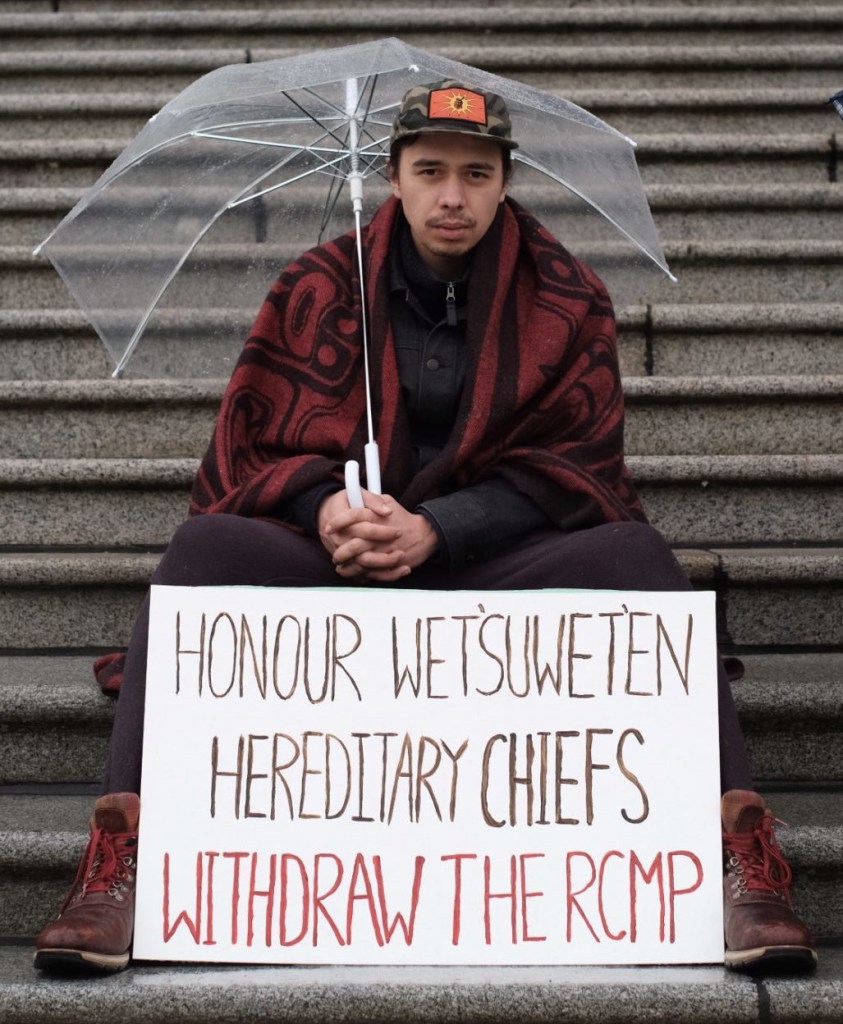
After the hereditary chiefs called for a week of solidarity, Sutherland-Wilson decided to stage a solo week-long strike of his own outside the B.C. Legislature in support of the Wet’suwet’en peoples against the pipeline. He walked out during the first week of classes on Jan. 6 and was there from 9 a.m. to 5 p.m. every day of that week.

Sitting in the NSU’s office in the basement of the Student Union Building, on an abnormally cold and snowy day in Victoria, Sutherland-Wilson gently clasps his hands together and stares straight ahead. The words “All Eyes on Wet’suwet’en” are written in big block letters on the whiteboard just over his right shoulder. He closes his chestnut-brown eyes for a few seconds, opening them to reveal weary tinges of red.

“Sitting on the steps was the least I could do, just to be a constant presence down there at the Legislature, just to be a constant reminder that what is happening is unacceptable and that B.C. has a duty to approach this nation-to-nation relationship in good faith and to not rely once again on the force of the RCMP like they did last year,” he says.

On Jan. 6, the first day of his week-long protest, Sutherland-Wilson published a video, “Colonialism in Canada: What is happening at Unist’ot’en?” to YouTube explaining the history of the Wet’suwet’en nation and why they continue to fight for their land.

This is the video Kolin published:


Video of Panel with David Suzuki and Indigenous Youth for Wet’suwet’en Leaders Ta-kaiya Blaney, and Kolin Sutherland-Wilson.


Teen climate strikers with Our Earth Our Future chose not to speak from the stage at the BC Legislature today, and instead handed the mic to the Indigenous youth sitting in to support of the Wet’suwet’en people. The RCMP were attacking #Wetsuweten land defenders during that day’s #ClimateStrike, in an attempt to get a fracked gas pipeline built. #WetsuwetenStrong #FridaysForFuture


Indigenous people in Canada are giving the world a demonstration of the power of nonviolent action. The justness of their cause — defending the land from those who would destroy it for short term profit and the elimination of a habitable climate on earth — combined with their courage and the absence on their part of cruelty or hatred, has the potential to create a much larger movement, which is of course the key to success.


Posted in civil disobedience, Indigenous, Uncategorized, Unist'ot'en, Wet’suwet’en | Leave a comment

Ontario Provincial Police (OPP) Raid Tyendinaga This Morning

“Our hearts are heavy as they were when we were arrested and removed off our lands.

This message to Canada: what will you do at this moment when violence continues against our people for trying to protect our lands from the violent attack on our waters, our animals, our trees?

Canada is illegally removing us off our lands in the name of profits. They continue to break they’re own Canadian laws and international laws. These lands are unceded. We’ve never given them over to anybody. We thank our neighbors for standing up with us.

It’s heartbreaking to watch people sit idle. People need to speak up. People have power. You have the power to speak up. Your voice is important. Your voice needs to be heard. you are the voice for your children, your grandchildren, and those yet unborn.

We are doing this for the future. We are starting to see the impacts of climate change now. Our children and our grandchildren are going to be the ones to suffer the consequences of us standing by and being silent.

Anytime we make our voice heard, RCMP is used to remove us off our lands.

It’s time for people to speak up, it’s time for people to stand up and do what is right.

Canada this is for you. It’s for your children, your grandchildren and those yet to be born.”


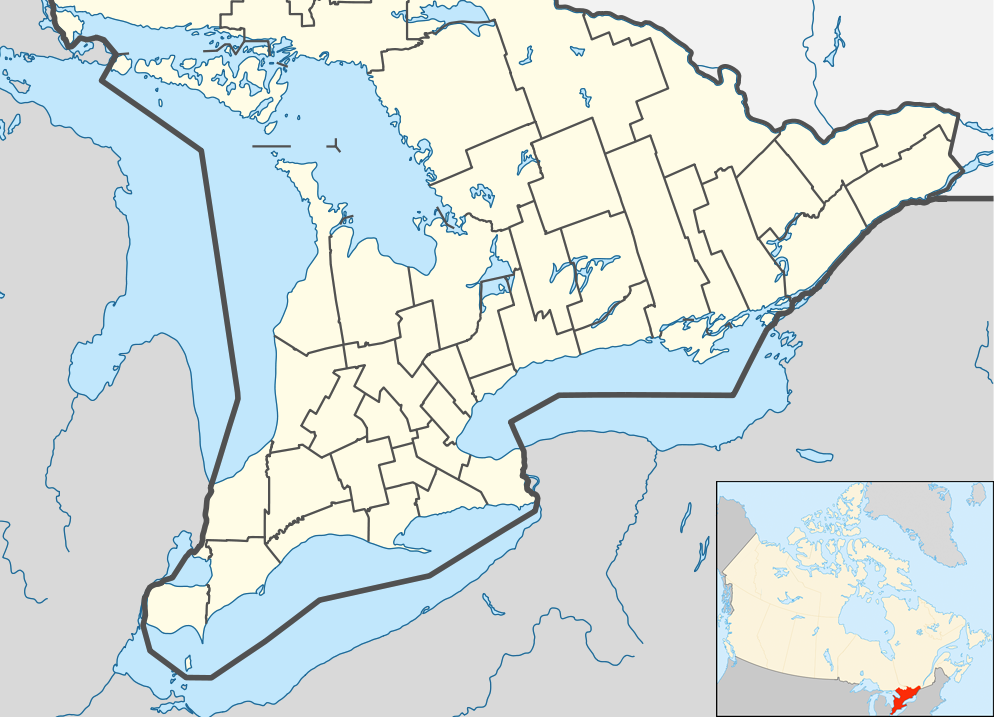
Tyendinaga is a township in the Canadian province of Ontario, located in Hastings County. The community takes its name from a variant spelling of Mohawk leader Joseph Brant‘s traditional Mohawk name, Thayendanegea.

Tyendinaga is located in Southern Ontario
By User:NordNordWestFile:Canada Ontario location map 2.svg, CC BY-SA 3.0, Link
OPP brought in mass numbers of police to arrest land defenders at Tyendinaga this morning. 

Solidarity actions are happening and being organized as this email is being written. 

Kahnawake Mohawks have stopped traffic on the Mercier bridge as they did in 1990 when the Canadian Military put the community of Kanehsatake under siege, and people are mobilizing to a second blockade in Tyendinaga territory. 

Real People’s Media is posting live feeds of the ongoing police action in Mohawk territory. Please watch and share them, and take action in this moment of gross injustice!

“It’s heartbreaking to watch people sit idle. People need to speak up. People have power. You have the power to speak up. Your voice is important. Your voice needs to be heard. you are the voice for your children, your grandchildren, and those yet unborn.”

-Freda Huson speaking this morning about OPP raid on Tyendinaga

Find or Post a Solidarity Action Here

Live Feeds: Real People’s Media

Massive police action to arrest land defenders in Tyendinaga today

Image may contain: one or more people and outdoor

Women’s Coordinating Committee for a Free Wallmapu [Toronto]· 2.24.2020
  
#BREAKING: Police have moved in and arrested Land Defenders in Tyendinaga. Solidarity across the country is being called with the Wet’suwet’en and Mohawk Nations!
This is just beginning
Marrichiweu!
#ShutCanadaDown
#WetsuwetenStrong
#RCMPOut
#ReconciliationIsDead
WCCC Toronto


Women’s Coordinating Committee for a Free Wallmapu [Toronto]· February 16 ·  The Fate of this Land is Not Yours Gentlemen… From Wallmapu to Wet’suwet’en: Pipelines OUT of Our Territories! Marrichiweu!

#WetsuwetenStrong
#ShutDownCanada
#RCMPOut
#NoPipelines

Support Land Defenders on the Front Lines:

TYENDINAGA: Mohawk warriors/land defenders hold out TWO blockades on the territory at this hour, always welcoming support from nearby community members. DONATE to tyendinagadonations@gmail.com or see list of suppies needed for the action here: https://www.amazon.ca/hz/wishlist/ls/1IK8OV2ZN98WF?fbclid=IwAR2nj7AYdidhYtuOtjU14jsQMgM1reo0MU-lXZvAZFU8N5HM1xGUzbvnIpk

MAGNETAWAN: Anishinaabe Land Defenders have set up camp next to the rail line that crosses in Magnetawan First Nation on highway 529 (past the band office) a few kilometres from Sudbury. CALLS FOR PEOPLE needed on the front lines!

VICTORIA: Land Denders and indigenous youth continue to hold the steps of the British Columbia parliament buildings continuing indefinetely in support of Wet’suwet’en demands.

ALL EYES ON WET’SUWET’EN!
OIL & GAS OUT OF WET’SUWET’EN LAND!
AMULEPE TAIÑ WEICHAN!
MARRICHIWEU

WCCC Toronto

teleSUR EnglishRedfishRed Power ResistanceReclaim Turtle IslandRed Braid Alliance for Decolonial SocialismUnist’ot’en CampWet’suwet’en Access Point on Gidimt’en TerritoryWet’suwet’en Solidarity VictoriaToronto Wet’suwet’en SolidarityMontréal Counter-InfoNo Borders MediaSoaring Eagle’s CampReal Peoples MediaANTICONQUISTASub.MediaRising Tide TorontoClimate Justice AllianceClimate Justice TorontoClimate Justice Climatique OttawaIndigenous Solidarity OttawaFuture Rising Ottawa


Indigenous Solidarity Ottawa· 2.24.2020  
We will be in front of Parliament all afternoon – we shut down #Ottawa!
Join us + take action from anywhere tinyurl.com/ISOaction
Demands:
1. RCMP off unceded territory!
2. CGL off!
3. Then Feds meet w #Wetsuweten Hereditary Chiefs for nation-to-nation talks! Thanks!
#wetsuwetenstrong#cdnpoli


MONTREAL — Indigenous protesters are blocking traffic on several highways in Quebec Monday in support of those who were arrested in Tyendinaga, Ont.
Ontario Provincial Police (OPP) moved in on a Mohawk blockade after supporters of the Wet’suwet’en hereditary chiefs refused to leave, despite being given a deadline of 11:59 p.m. Sunday to clear the area in order to avoid a police investigation and potential charges.
“We’re not happy. We’re very upset with what happened in Tyendinaga this morning. The OPP acted irrationally,” said Kenneth Deer, secretary of the Mohawk National Council of Kahnawake. “We are not going to take down our barricades and we will continue to have peaceful demonstrations in support of the chiefs of Wet’suwet’en.”

Indigenous protesters impede traffic on Quebec highways after multiple arrests in Tyendinaga by Rachel Lau, CTV, 2.24.2020

Posted in civil disobedience, decolonize, Indigenous, Uncategorized, Unist'ot'en, Wet’suwet’en | Leave a comment

A sorrow remembrance

As the eyes of the world are on the Wet’suwet’en people and their territory, we are reminded that three years ago today, on Feb. 22, 2017, North Dakota ordered the evacuation of the main #NoDAPL camp.

Lakota People’s Law Project

Right now, there are many other resistances taking place. #unistotencamp alongside the Mohawk are still resisting CGL in Canada, #noline3 is still taking place in Minnesota, #nokxl is gearing up in SD, NE & MT as well as #NODAPL resistance still being spearheaded in court by the Lakota and Dakota.

This weekend, take a moment to learn about the pipelines I just mentioned. This weekend will be a sorrow remembrance for many Water Protectors.

Knowledge and continuance is key. It’s still #MNIWICONI & #NODAPL forever.

No Spiritual Surrender

Below are two beautifully written posts found on the No Spiritual Surrender Facebook page, accompanied by beautiful photos. I had occasionally seen posts from No Spiritual Surrender, but didn’t know who wrote them. The following explanation is from that Facebook page. I love the phrase “no spiritual surrender”.

No Spiritual Surrender is a social commentary and information sharing outlet engaging millions of people every month. This page is operated by activist & independent photojournalist Ryan Vizzions.
Awards
2016 -Photos of the Year – PEOPLE MAGAZINE
2016 -Photos of the Year – ARTSY.net
2016 -Photos of the Year – Mic.com
2017 -Photos of the Year – The Guardian
2017 -Photos of the Year – ABC News


Much as I wanted to, I never made it to Standing Rock three years ago. But it always lifts my spirits to remember the wonderful friends I made as we did this work together in Indianapolis three years ago. And continuing this work with many new friends since I’ve moved to Iowa.

Posted in #NDAPL, civil disobedience, climate change, decolonize, Green New Deal, Indigenous, Native Americans, Quaker, Toward Right Relationship with Native Peoples, Uncategorized, Unist'ot'en, Wet’suwet’en | Leave a comment

Major Updates: Unist’ot’en Solidarity Brigade


FOR IMMEDIATE RELEASE – Wet’suwet’en Hereditary Chiefs Meet With Mohawks of Tyendinaga, Set Conditions for Nation-to-Nation Talks February 21, 2020 Tyendinaga –

Today, Wet’suwet’en Hereditary Chiefs met with the Mohawk People of Tyendinaga at the Council House in Tyendinaga to discuss the path forward for the Wet’suwet’en people to be able to end the illegal occupation of the RCMP and CGL on their lands.

Contrary to the announcement by the BC RCMP on February 20, 2020 that they are withdrawing from Wet’suwet’en territory, the BC RCMP and CIRG have in fact increased harassment, made illegal arrests, increased surveillance, and monitoring of Wet’suwet’en people and their invited guests. This is completely unacceptable and far from a show of good faith.

We remain deeply concerned by the myriad of laws that Canada has broken including Wet’suwet’en law, the Canadian Constitution, UNDRIP, and the Geneva Convention on Genocide.

In order that nation-to-nation discussions with Canada and BC may occur freely, and without duress, the Wet’suwet’en Hereditary Chiefs require the following conditions be met prior to any discussions:

– “We demand that the remote detachment (Community Industry Safety Office) established by the RCMP on Wet’suwet’en territory without our consent be immediately removed and that the RCMP are completely removed from our territory and cease patrols from our lands. Out means out

– We demand that all CGL activities cease within Wet’suwet’en territory while nation-to-nation talks are ongoing as pursuant to the eviction notice that was delivered to them on January 4th, 2020.

– We commit to entering into nation to nation discussions with Canada and BC once the above two demands are met and we insist when these discussions occur, that they will be held on Wet’suwet’en territory to ensure exclusivity for our nation’s Dini ze’ and Tsakiy ze’ (Hereditary Chiefs), and the members we are accountable to, in accordance with our law.”

The Mohawk people of Tyendinaga are standing in solidarity with the Wet’suwet’en people until their demands are met. Since the beginning the Mohawk people of Tyendinaga have stated their willingness to allow the trains to pass through their territory and remain committed to do so once it is verified by the Wet’suwet’en Hereditary Chiefs and their appointed legal observers that the BC RCMP are indeed out of territory. Upon confirmation, the Mohawks have agreed to negotiate the peaceful exit plan as agreed upon between the Mohawks and the Minister of Indigenous Services Canada, Marc Miller.

We remain deeply concerned at the ongoing violation of human rights on Wet’suwet’en territory and remind Canada that Wet’suwet’en land was never ceded or surrendered and as such Canada’s actions amount to an illegal occupation in Wet’suwet’en territory. (UN, international law)

The meeting came on the heels of a nine hour meeting between the Mohawk People of Tyendinaga and Minister of Indigenous Services, Mark Miller on February 15, 2020. They are keeping the discussions open and remain hopeful.

The Wet’suwet’en Hereditary Chiefs also reiterated their demands to Minsters Carolyn Bennett and Marc Miller and remain willing to enter into Nation to Nation talks when their demands are met.

Kanenhariyo Seth LaFort stated, “When you ask for the rule of law, then you have to follow it yourself. Canada has committed a crime against humanity in Wet’suwet’en territory. It has broken its own laws as well as Wet’suwet’en laws and international laws. You cannot remove people from their own lands at the end of a gun. A crime has been committed and the RCMP are the criminals.”

We encourage Justin Trudeau to continue to work towards a peaceful resolution.

Wet’suwet’en Access Point on Gidimt’en Territory was live.
6 hours ago · 24,000 views 736 shares
PRESS CONFERENCE IN TYENDINAGA

Canadian Pacific Railroad supports Wet’suwet’en dialog


Ongoing Rail Blockade in Secwepemc Territory outside of Chase BC


Canadian Prime Minister Justin Trudeau says that the barricades that have blocked railways in the country for two weeks must come down, calling the situation “unacceptable and untenable.”

Indigenous and environmental protesters have blocked key railways, shutting rail traffic in much of the country. Protesters are trying to stop the 416-mile, $4.68 billion Coastal GasLink pipeline project in British Columbia, which is being built through the lands of the Wet’suwet’en First Nations people.

After police removed Wet’suwet’en protesters from the path of the gasoline pipeline, opponents shifted to blocking railway lines as a way of bringing the issue to national attention.

Protesters have erected blockades in British Columbia, Ontario and Quebec in solidarity with the Wet’suwet’en people.

Canadian PM Trudeau Says Rail Barricades ‘Must Come Down’, Doesn’t Say How by Laurel Wamsley, NPR, Feb 21, 2020


Posted in civil disobedience, climate change, decolonize, Indigenous, Uncategorized, Unist'ot'en, Wet’suwet’en | Leave a comment

Needed: Show Your Solidarity with Wet’suwet’en

There are several important things to consider when you are thinking about being in solidarity with people who are being impacted by something that doesn’t directly affect you. (Of course anything that affects Mother Earth, such as the Coastal GasLink pipeline, affects us all).

The first is to make sure your help is wanted. The history of solidarity efforts is littered with the skeletons of actions that were not asked for. Efforts that end up causing more harm, sometimes much more harm, than good. In this case we are being asked to be in solidarity with the Wet’suwet’en peoples.

How do you find out if your help is wanted? The best way is to talk with someone who is involved in the problem in some way. Actually listen very deeply to what this person is saying to you. I think too often we try to translate what is being said to us into our existing frame of reference, which is a mistake. You might not have such a connection (which might be an indication that you should work on expanding your circle of friends and activists).

I am extremely blessed to have been making friends with a number of Indigenous people. They have helped me learn about the Wet’suwet’en struggles. Several have close friends in the Wet’suwet’en territory.

But it is often the case we don’t know someone directly involved. I’ll share some of what I’ve been learning recently related to the Wet’suwet’en peoples’ struggles to prevent a pipeline from being built through their lands.

The first thing is how I even became aware of this conflict. An important point about justice situations and actions is the mainstream media almost never covers stories about these things. Have you seen a story about the Wet’suwet’en on mainstream media?

As I was doing my usual Internet searches for stories related to fossil fuels and environmental devastation several weeks ago, I saw a story about First Nation peoples’ eviction of a company trying to build a pipeline through their land. I thought, are you kidding me? I’ve been battered and bruised from years of trying to bring attention to the dangers of greenhouse gases. Years of various attempts to try to stop the Keystone XL, and later the Dakota Access pipelines.

There are two important things I’d like to share at this point. While this might seem to be something you think would be a good idea to get involved with, I’d urge you to stop before going forward. We are all constantly bombarded with situations we would like to help with. A great danger is spreading ourselves too thin. If there is one thing I hope you might take from my usual torrent of words, it is to take some time to see the one thing that is most important to you. And pull away from the rest.

A different way to express this same idea is to work on seeking what the Spirit is asking of you. As a Quaker that is the context I use for guidance for my justice work. This doesn’t have to be expressed in religious terms. However you express it, you really need to know what work you are being led to do.

The second point is similar, or sometimes the same the point I was just trying to make. Which is you should feel a visceral connection to the justice issue you are thinking of getting involved in. You should feel it in your heart.

Returning to how I came to work on the Wet’suwet’en issues, the first point above, Spiritual guidance, I strongly felt. This is yet another manifestation of defending Mother Earth against corporate greed, which has been a focus my entire life.

Regarding the second point, I really felt it in my heart when I saw how beautiful the Wet’suwet’en territory is, the mountains, forests and streams. I can barely allow myself to think of the damage that would be done by the construction of pipelines through that land. (multiple pipelines are planned). And although facts and logic don’t impress capitalists, those who are reading this know it is essential to stop building fossil fuel infrastructure now. To leave it in the ground.

Here is another case when there was nothing in the mainstream media (there has been some coverage in Canada). So I began to use social media and Internet searches to learn more. This is another crucial point. You have to find as much information as you can. Especially from a distance, it can be difficult to sort out what is true and what is not. Finding multiple sources saying the same things gives you a way to begin to know which sources of information are authentic and true.

The Wet’suwet’en people and the Unist’ot’en camp have very good websites and Facebook pages that are kept up to date (up to the minute in many cases). There is also an excellent Wet’suwet’en Supporters Toolkit. http://unistoten.camp/supportertoolkit2020/

What has really resonated with me are the multiple videos that are used to share what is going on. Following is a link to many of those videos. I mentioned how my heart was affected by photos of the beautiful Wet’suwet’en territories. These videos also make a heart connection. Hearing the voices, seeing the faces and witnessing the actions is powerful. And one way you can share what’s going on with your friends. (I always wondered if a picture is worth a thousand words, how many thousands of words is a video worth?) 🙂
https://www.facebook.com/watch/wetsuwetenstrong/

The final point I’d like to make regards leadership. The most important thing I’ve learned from my justice activities is how important it is to just listen deeply. It is so important to extinguish our tendencies to want to help lead something. The people impacted must be the people who lead. And that usually involves leadership by young people. Think of the Vietnam War protests and the 1960’s Civil Rights struggles. I think it is a very hopeful sign that Indigenous youth are most definitely the leaders of what is happening in Canada.

So, regarding solidarity with the Wet’suwet’en peoples, they have issued multiple calls for Solidarity actions. And those actions are occurring all over Canada and beginning to happen in the US, and around the world. Previous blog posts I’ve written are about many of those solidarity efforts.

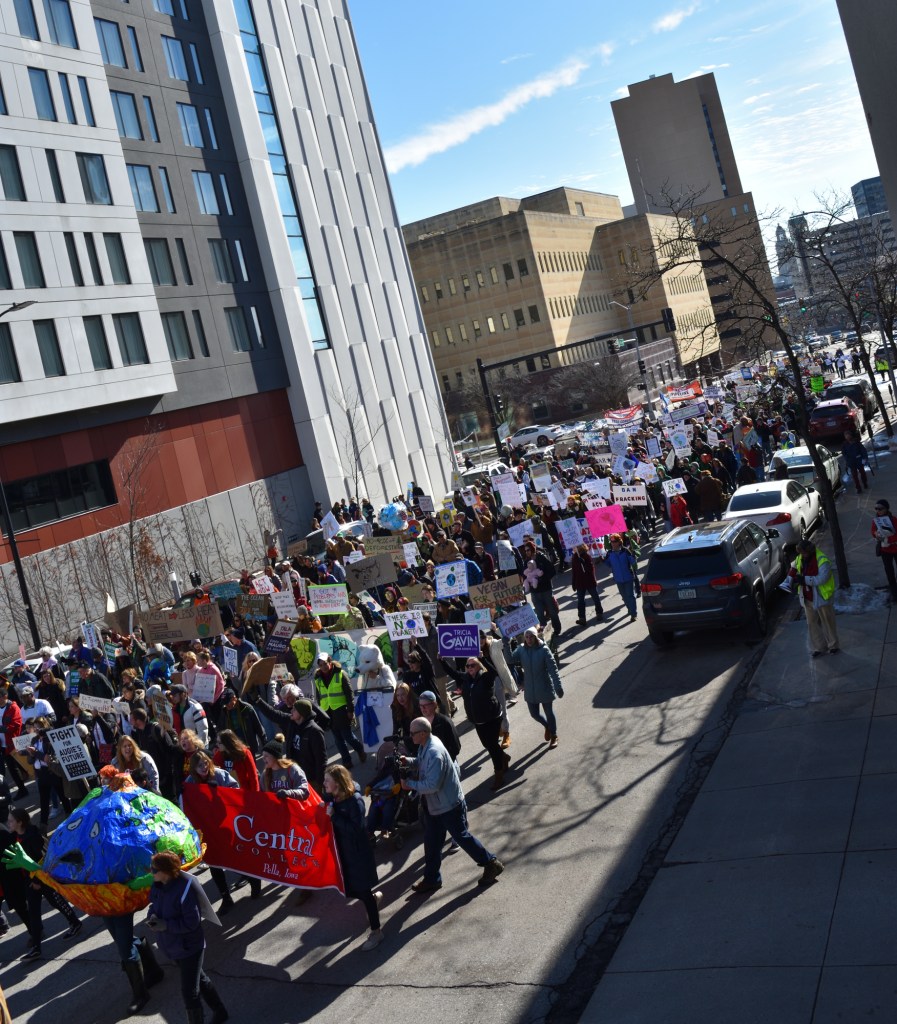
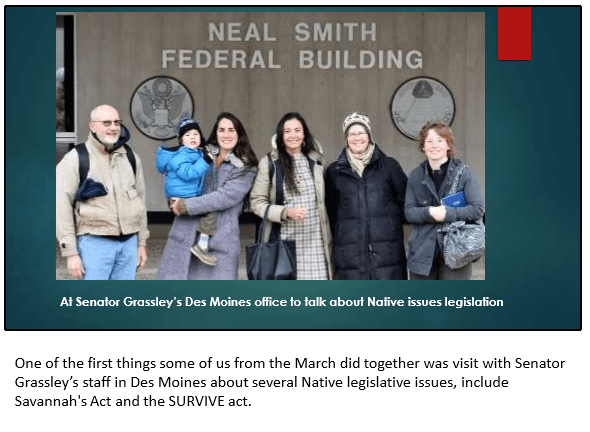
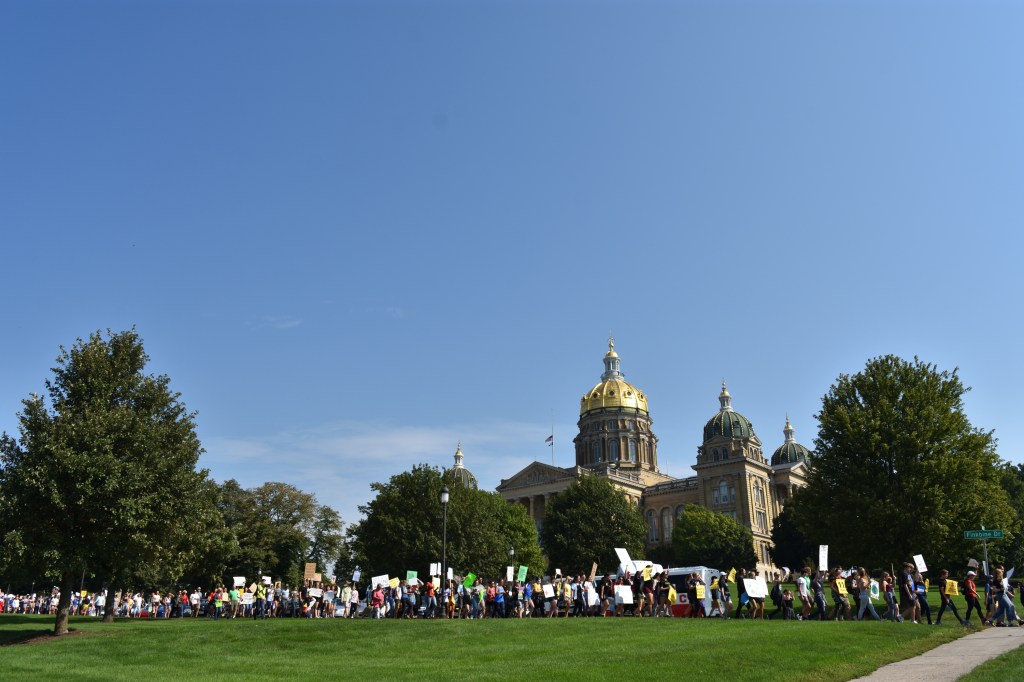
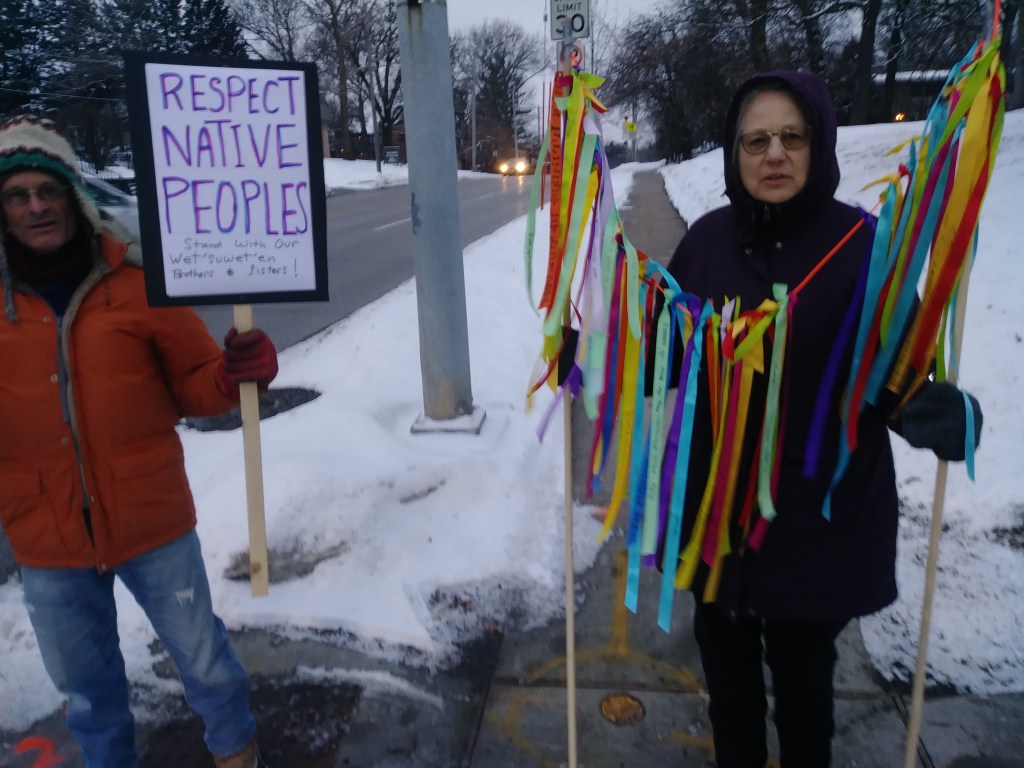
Here in Iowa, a small group of us recently gathered for a vigil in Des Moines. The size of your group isn’t important. What is important is that you show up.

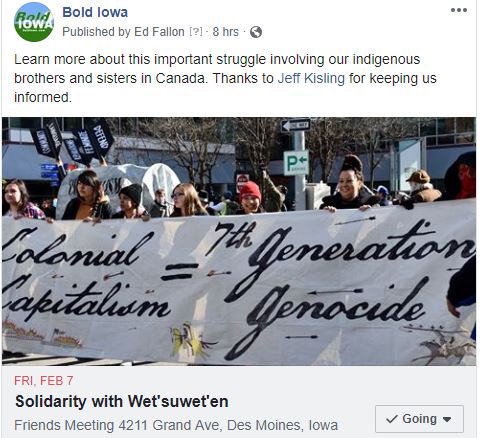
I haven’t yet mentioned there is a Facebook group We Support the Unist’ot’en and the Wet’suwet’en Grassroots Movement. I’ve shared some photos (take photos of your actions) and stories of what we’re doing in Iowa with that Facebook group. One way to be in solidarity is to share your solidarity activities. Our vigil is included in the interactive map below showing where solidarity actions are occurring. Sharing your actions is also a way to get connected to the network of others who are working on the same thing. I was contacted by someone in British Columbia who is making connections with those working in solidarity with the Wet’suwet’en. Maybe you’ll have a solidarity action to add soon?

A couple of the photos below show how you can contact local justice organizations to share your solidarity events with their, members. Bold Iowa and Iowa Citizens for Community Improvement helped us out.

Finally there are excerpts below from an excellent article about settlers and solidarity.


“Being a white settler on stolen unceded territory myself, I have found myself in this situation too- stuck in the throes of my own white settler guilt, essentially immobilizing myself. I let my fear of messing up and my guilt overshadow what needed to be focused on, solidarity.

Although this transition did not happen overnight, it was still possible. Indeed, settlers are needed in the fight for change and are required to uplift and support the voices of Indigenous peoples. To not involve oneself out of fear of making a mistake is far more harmful than making the mistake itself. Solidarity is needed, especially given the current political and social climate.

This is why I urge all settlers, especially those who may be frozen in their own fear and guilt right now, to shake themselves of such feelings.

So what can I do?

Donate, get involved, educate yourself, show up to solidarity actions. Bring some warm coffee, help make signs, offer drives to folks who need them. Share social media posts, have conversations with others- yes, even if it’s hard and uncomfortable. These little actions can add up to big changes.

Check out the Unist’ot’en website for more information on how you can be a helpful ally. If you are like me and live in Nova Scotia you can volunteer your time, voice, or money if possible, to the Stop Alton Gas Resistance. There are countless steps that can be made to help out.

The working class cannot afford to stand back and let the colonial system continue to oppress Indigenous peoples and destroy the planet.

Op-ed From settler guilt to settler solidarity, by Hailie Tattrie, spring, February 16, 2020

Op-ed From settler guilt to settler solidarity, by Hailie Tattrie

Posted in decolonize, Indigenous, Native Americans, Uncategorized, Unist'ot'en, Wet’suwet’en | Leave a comment

Complicity of the Privileged

Every once in a while I’ll read, hear or observe something that crystallizes an idea or concern I’ve been praying and/or thinking about for a long time, sometimes decades. That’s what happened when I read about the complicity of the privileged. The idea isn’t new to me, but the phrase frames it in a way I hadn’t before, and like how it does.


There are times I find it difficult to express publicly in certain spheres of attention the work I do within social movements as an organizer. Often, in predominantly Caucasian and bourgeois theory subcultures, there is a sometimes explicit, sometimes implicit, discrediting of efforts to operate within so-called “folk-political” and normie institutional systems while attempting to generate significant sociocultural change.

The arm-chair theorizers and spiritually exhausted tell us that ‘politics is dead’, or that praxis is a fools game. Meanwhile, the very same people continue to make excuses for continuing to live in ways extensively captured by pathological consumption patterns, and believing it nobler to suffer the slings and arrows of capitalist degradation than to risk their WiFi access by participating in an illegal occupation or some civil disobedience campaign.

The saddest irony of this complicity of the privileged is that social movements would be just that much more effective (in the ways that genuinely matter) if, instead of continuing the circus of hyper-abstraction, these big-brained soothsayers would lend their considerable intellects to social movements. How much better, for example, would the local Extinction Rebellion group be if their strategies and communications were deeply informed by leading academics and para-academics from appropriate fields of political science, media studies, communications, or whatnot?

UNNERVING REALITIES OF THE WET’SUWET’EN by michael james, Synthetic Zero, January 7, 2020

I think the terms “arm-chair theorizers and spiritually exhausted” are interesting. For years I’ve felt and spoken about spiritual poverty in our times. These are among the people who “continue to make excuses for continuing to live in ways extensively captured by pathological consumption patterns, and believing it nobler to suffer the slings and arrows of capitalist degradation than to risk their WiFi access by participating in an illegal occupation or some civil disobedience campaign.”

There are several things I discern from that quote:

  • spiritual exhaustion or poverty allows people to rationalize their behavior related both to participating in pathological consumption and to not agitate against that
  • there is an explicit or implicit discrediting of efforts to generate significant sociocultural change
  • capitalism degrades our lives
  • social movements would be more effective if people would move from abstraction to participation in social movements

What I was taught, and have tried to live is activism for justice must originate from my spiritual life. Time and again I have seen so many people spend a lot of time and effort doing things they think they should be doing. Unfortunately that usually ends up making them dispirited and exhausted, and often doing more harm than good. If this work is not spiritually grounded, people often stop trying. Working for justice takes a long time, with many frustrations along the way. From the examples of others, I see this work should continue for as long as you live.

Early in my life I was hesitant to talk about the spiritual basis of what I was trying to do. I guess I had my own ‘privilege’ of thinking people who weren’t Quakers or others who were spiritually grounded shouldn’t be expected to share my views. Fortunately I learned many people who don’t speak in religious terms are very spiritual. They have helped me grow spiritually.

The basic thing I have learned is how important it is to listen deeply and be patient. We can’t control when we receive spiritual guidance. Listening deeply is twofold, internal and external. We need to create times of quiet in order to hear what our inner light is saying to us. This spirit is in every single one of us.

Not only that, the spirit is part of everything, the earth, the air, the water, inanimate things, all our relations. Externally listen deeply to all that is around you, all the time. Some of my must significant experiences came from hearing a few words amidst the noise. Something about “a van of people going to Minneapolis to be with other water protectors,” or a “First Nation-Farmer Climate Unity March.” Too often we don’t pay attention to those things, they fly past us. But with deep listening we can hear.

When I read “the complicity of the privileged”, some pieces of the puzzle of my life came together. The focus of my spiritual leadings my whole life has been to reduce my own carbon footprint and try to get others to do so as well. We weren’t aware of the many dangers of greenhouse gas emissions when this spiritual path began for me some forty years ago. I am now realizing this is why it was a vision that started me on a journey that was to become part of my life’s work since. Even though much of the science wasn’t known at that time, some of the consequences were being expressed visually. In this case I guess deep listening involved deep visioning.

This was my vision. Our family summer vacations were camping trips to National Parks. Rocky Mountain National Park was our favorite. Part of that joy for me was trying to capture the beauty of the mountains on film (this was before digital photography). I moved to Indianapolis when I was 20 years old and was astounded by the thick clouds of smog. This was before catalytic converters. My horrifying vision was imagining my beloved Rocky Mountains hidden in smog. That convinced me I had to do whatever I could to prevent that from happening. The most immediate and impactful consequence was deciding I couldn’t contribute to the smog, so I gave up having a personal automobile for the rest of my life.

But no matter how vocal I was and how many different ways I tried to convince others they, too, should give up cars, I was spectacularly unsuccessful. Nearly everyone said they would like to give up their car. And then each person would tell me the reasons why they just had to have one.

In a way I wish catalytic converters had not been invented. Although they did remove the particles that caused the visual smog, they didn’t stop the greenhouse gases from spewing out into the air.

And as our cities were so poorly planned as they expanded, people who lived in the suburbs or other areas where there was no mass transit actually did need cars if they chose to live there. And it is a choice. I carefully scoped out a neighborhood I was thinking of moving into. The apartment would have to have a laundry, be on a bus route, close enough to work that I could walk there and have a grocery store within walking distance.

Many in Quaker communities did live in rural areas, and required a car or truck for transportation. The ways we could have avoided that mess would have been better urban planning and emphasis on mass transit. In rural areas it would have helped to cluster farm houses together.

So I finally get to the point about “the complicity of the privileged”. Most Quakers care deeply about our environment. And many have tried different ways to reduce their carbon footprint. Despite that, the very same people continue to make excuses for continuing to live in ways extensively captured by pathological consumption patterns.”

As is becoming increasingly, terrifyingly clear, we all should have found ways to escape being “captured by pathological consumption patterns.”

This “complicity of the privileged” is found in so many other parts of our lives: racial justice and White privilege, distribution of wealth, militarism and war, xenophobia, Indigenous rights and colonialism. The list goes on.

Below is an example of a group of land defenders and alt-world builders struggling to slow the deep grind of capitalism as it drives life on this planet towards obliteration. The struggle of Wet’suwet’en is happening now – today, and ongoing.

As this website becomes more and more a space where I finally integrate my work in political organizing with my varied research interests, I will be increasingly using these living examples in order to explore how the topics and strategies of “exit”, patchwork (as alt-community building), bioregionalism, and acts of resistance possibly converge in attempts to re-make the contemporary.

UNNERVING REALITIES OF THE WET’SUWET’EN by michael james, Synthetic Zero, January 7, 2020

The article goes on to give a history of the struggles of the Wet’suwet’en peoples and their stands to protect and assert their Indigenous rights. One example of the “complicity of the privileged” is White settlers who don’t want to acknowledge what it really means to honor Indigenous rights. This conflict is global because of the use of the Doctrine of Discovery to take the land from Indigenous peoples all over the world.

Following is a quote from a new friend of mine I think is relevant to this discussion.

I’m of the firm opinion that a system that was built by stolen bodies on stolen land for the benefit of a few is a system that is not repairable. It is operating as designed, and small changes (which are the result of huge efforts) to lessen the blow on those it was not designed for are merely half measures that can’t ever fully succeed.

So the question is now, where do we go from here? Do we continue to make incremental changes while the wealthy hoard more wealth and the climate crisis deepens, or do we do something drastic that has never been done before? Can we envision and create a world where a class war from above isn’t a reality anymore?”

Ronnie James

Wouldn’t it be great if we found ways to explore the “complicity of privilege” in such a way as to help people become aware of their complicity? And explore how to escape from that complicity?


Synthetic Zero is an experimental multimedia research and design space for exploring adaptive responses to the various crises and unequally distributed realities of contemporary life.
We salvage, analyze, and disseminate a wide range of speculative and pragmatic resources gleaned from the media wilderness.

Synthetic Zero

“through increased encounters and collaborations and connected to subversive intent, the fuzzy spaces become a Zone of Experimentation that aims not to outpace the future, but to retreat ahead of it…”

— Edmund Berger

“zero dissolves binaries, dis-associates, mutates existing structures, and generates the completely new…”

– Amy Ireland

Posted in climate change, decolonize, Indigenous, Uncategorized, Unist'ot'en, Wet’suwet’en | Leave a comment