South Dakota tribes continue COVID-19 checkpoints

This video of South Dakota governor Kristi Noem’s (Republican) press conference was revealing in that every question, and there were many, after the governor’s statement was about the COVID-19 checkpoints. The governor kept implying that the checkpoints were interfering with some people entering the tribal land. The tribes say that isn’t true. At one point the governor said she wanted to make sure ambulances could get through. When asked if that had happened she backed off. When asked if the SD Highway Patrol would possibly be doing enforcement on tribal lands, she said there would first have to be an agreement with tribal law enforcement to do so. She kept saying she was looking for clarity and it looks like she could use it.

Karen Eagle, Oglala Sioux Tribe media relation specialist, said the tribe has received an outpouring of support from Indian Country and beyond.

“One message that I would really like to get out there is that the tribe just appreciates all of the support and the understanding of so many people that this is actually a sovereignty issue, this is a treaty issue,” Eagle said. “This goes to the very core of our existence as a tribal nation, that we have this inherent right to protect, not only our lands and our waters but the health and wellbeing of our own people,”

The Sisseton-Wahpeton Oyate Chairman Donovan White and Lower Brule Chairman Boyd Gourneau voiced public support for Cheyenne River and Oglala.

“All of our Seven Council Fires stand in unity with Cheyenne River and Oglala Sioux Tribes,” White said. “The governor should work with her state legislators, work with the tribal chairmen, and councils, acknowledge the sovereign authority of the Cheyenne River and Oglala Sioux tribes and come up with a reasonable plan to assist them in protecting public safety and health of our Native people.”

Gourneau said Lower Brule has checkpoints on BIA roads to stop non-tribal-citizens’ access to tribal land and to popular water access to the Missouri River.

“We stand with our brothers. We must band together,” Gourneau said.

South Dakota tribes stand firm behind checkpoints by Dalton Walker, Indian Country Today, 5/10/2020

The issue pits an ambitious governor who has taken a mostly hands-off approach to restrictions on daily life during the pandemic against tribes who say her actions jeopardize their members. And it’s the latest flare-up in a relationship that has been tense since Noem took office in 2018, most notably in a longstanding conflict over construction of the Keystone XL pipeline.

The Cheyenne River Sioux, in northern South Dakota, and the Oglala Lakota Sioux, in the southwest corner of the state, began their roadblocks in April. Both tribes cited the threat of the virus, combined with their vulnerable populations and poor medical facilities, as urgent reasons to control access.

“We will not apologize for being an island of safety in a sea of uncertainty and death,” Cheyenne River Sioux chairman Harold Frazier said in a statement.

He described a health care system on the reservation with eight hospital beds and six ventilators, saying that the infection could “spread like wildfire” if they weren’t vigilant.

The tribes say they are still allowing essential businesses onto the reservations and said the checkpoints were set up to keep out tourists or other visitors who could be carrying coronavirus infections. The reservations are collectively home to about 30,000 people.

Oglala Sioux president Julian Bear Runner called the state’s approach to the coronavirus pandemic “ineffective,” pointing to a spike in confirmed cases in the state after a mass testing event last week at a hot spot.

Noem’s uncomfortable relationship with tribes dates to her first year in office, in 2018. Noem, mindful of the tumultuous, costly and sometimes violent demonstrations in neighboring North Dakota over the Dakota Access pipeline, pushed the Legislature to pass laws that heightened penalties for violent protest against the Keystone XL pipeline.

South Dakota Gov. Noem, tribes in virus checkpoints standoff. Two Native American tribes in South Dakota continue to defy orders from Gov. Kristi Noem to take down road checkpoints the tribes had set up to stop coronavirus infections from spreading. By STEPHEN GROVES Associated Press, May 11, 2020

South Dakota has been one of the few states to not issue a stay-at-home directive to counter the coronavirus spread. As of Monday, 3,614 people in South Dakota have tested positive and 34 people have died, according to the state Department of Health. Almost 3,000 of the cases have been reported in Minnehaha County, where the state’s largest city, Sioux Falls, is located. Sioux Falls had seen a coronavirus spike recently at a meat packing facility. The numbers don’t appear to include the new Oglala cases.

Cheyenne River and Pine Ridge have two of South Dakota’s larger reservations, with tribal land larger than some states. As of Monday, both tribes have felt only minimal effects from the coronavirus as each have placed strict directives in place like curfews and stay-at-home requirements.

Frazier has described a health care system on his reservation with eight hospital beds and six ventilators, saying the infection could “spread like wildfire” if the tribe isn’t vigilant.

Tribes across Indian Country have set up checkpoints, including in Arizona and New Mexico, two places hit hard by the coronavirus. Some Alaska tribes have enacted travel restrictions to remote villages, some only accessible via air or water. Those have caused no major issues.

On his Facebook page, Cherokee Nation Principal Chief Chuck Hoskin Jr., praised Frazier’s leadership. “Osda (good)! Another tribe standing strong for public health in a sea of resistance.”

South Dakota tribes stand firm behind checkpoints by Dalton Walker, Indian Country Today, 5/10/2020


In a Monday press conference, Noem affirmed that her office will take the Cheyenne River Sioux Tribe and Oglala Sioux Tribe to federal court, saying the checkpoints that were put in place last month on state and federal highways have prevented essential services from making their way to areas in need.

The restrictions require residents and non-residents to fill out a health questionnaire each time they enter or leave tribal lands. It also limits non-residents from entering the reservations unless on essential business or if the tribal government has granted them a travel permit. However, those who wish to drive straight through are allowed to pass, according to the tribes.

Meanwhile, the governments of both tribes say the decision to create an “island of safety” by restricting non-essential travel is well within their rights.

“We have every legal right to do what we’re doing,” Cheyenne River Sioux Tribe Chairman Harold Frazier told MSNBC on Sunday.

Both tribes have issued lockdowns, stay-at-home orders and curfews, while Noem has refrained from enacting such measures across the state.

Frazier and Oglala Sioux Tribe President Julian Bear Runner contend the tribal measures were put in place out of concern that an outbreak could overwhelm their limited health care facilities.

Checkpoint Clash Escalates Between South Dakota Governor, Tribal Leaders By VANESSA ROMO, Boise State Public Radio, 5/12/2020

Seeding Sovereignty #SeedingSovereignty

DONATE TO RAPID RESPONSE FUND

Vulnerable communities are hit hardest by crises – even those that purport to affect everyone.

Indigenous communities remaining strong and resilient during this global pandemic despite chronic, deep poverty, a youth suicide epidemic, violence to womxn, and myriad COVID-19 health complicating illnesses. Our communities will be last to receive desperately needed PPE, medical care and support.

Our new Indigenous Impact Rapid Response Initiative works in partnership with Navajo, Apache, and Pueblo communities in New Mexico where need is critical to immediately provide protective masks to communities, distribute healthy food to elders and families, redistribute money to fund essential stipends to those in need, and send Indigenous authored books to quarantined students.

We are committed to our Elder culture and language bearers who sustain our communities, ways of knowing and provide grandparent medicine. Their Indigenous knowledge can help our global community during this climate crisis. 

Indigenous peoples are on the frontlines and protect living forests, waterways and resist extractive projects for us all. During the COVID-19 crisis we are helping them first. Please join us!

How You Can Help

6137654B-67FF-4475-BD52-7EA3CD66413A.jpeg

Mask Drive

Sew, send or sponsor PPE masks to Indigenous frontline providers, elders and families. Join our community of makers, build a sewing circle or donate supplies! Patterns, community stories & mailing addresses here!

northernNM.jpg

Rapid Response Fund

We all know it’s not only about masks. Let’s send food, funds, supplies and books to Elders, families, frontline workers and homeschooling children.

Our COVID-19 Petition

Sign and share our petition demanding Congress cut the bureaucracy and expedite critical COVID-19 funds and resources to all Tribal Nations!

#SeedingSovereignty


Posted in decolonize, Indigenous, Native Americans, Uncategorized | Leave a comment

Sioux tribes reject South Dakota governor’s request

South Dakota governor Kristi Noem (Republican) demanded the Oglala Sioux and the Cheyenne River Sioux tribes take down their Covid-19 checkpoints on highways entering their lands. This is a microcosm of decades of colonization, the Republican policy of putting economics above public safety, and the infringement on civil liberties by criminalizing peaceful protest. Noem is one of the few governors, all Republicans, who refused to issue stay-at-home orders, like our governor, Kim Reynolds, in Iowa. Both states have significant outbreaks of Covid-19 in meat processing plants and the surrounding communities. The Oglala Sioux and Cheyenne River Sioux do have stay-at-home restrictions.


Previous posts:


On Saturday a group of 17 South Dakota legislators urged the state’s governor to try to reach a compromise with two tribes, saying they did not wish to be party of another lawsuit that will ultimately cost the people of South Dakota more money.

In their letter to the governor, the lawmakers said the state did not have jurisdiction in the matter, citing the 1851 and 1868 Fort Laramie Treaties and a 1990 ruling by the 8th Circuit Court of Appeals, which they said “held that the State of South Dakota has no jurisdiction over the highways running through Indian lands in the state without tribal consent. “The 1851 agreement, among other things, pledged peace between tribes as well as recognized the government’s right to create roads and posts in parts of tribes’ territories. The 1868 document recognized the Black Hills as part of the Great Sioux reservation and established it would be exclusively used by the tribe, according to the National Archives.

South Dakota’s governor threatened to take two tribes to court over coronavirus checkpoints. Here’s what to know By Sara Sidner, Artemis Moshtaghian and Susannah Cullinane and Leslie Perrot, CNN, 5/11/2020

The checkpoints are to help protect against the spread of coronavirus in Native communities while the governor is trying to make an issue of who has the authority, which the state of South Dakota does not have.

The Oglala Sioux and the Cheyenne River Sioux tribes set up checkpoints to regulate who comes in and goes through their reservations.
Both tribes have also issued strict stay-at-home orders — while Noem has not done so for the state — and curfews for their communities.
The checkpoints, established to help control the spread of the coronavirus, are the reservations’ best tool to protect themselves against the illness, Cheyenne River Sioux Tribe Chairman Harold Frazier told CNN. He said reservations aren’t equipped to deal with a coronavirus outbreak.
“The nearest health care, critical care is three hours away from where we live,” Frazier said. The tribe operates an eight-bed facility on the reservation — that is home to 12,000 people — and no intensive care unit (ICU), Frazier said.
About 198 Native Americans have been infected in the state so far, according to state data. At least 3,517 people in South Dakota have tested positive for the virus and at least 34 have died, according to Johns Hopkins University’s tally of cases.

South Dakota’s governor threatened to take two tribes to court over coronavirus checkpoints. Here’s what to know By Sara Sidner, Artemis Moshtaghian and Susannah Cullinane and Leslie Perrot, CNN, 5/11/2020

Cheyenne River Sioux Tribe Chairman Harold Frazier told CNN that the main purpose of the checkpoints set up by the tribe is to monitor and try to track coronavirus if it should ever come in to tribal lands.
“We want to ensure that people coming from ‘hot spots’ or highly infected areas, we ask them to go around our land,” Frazier said.
When asked about Noem’s request that the tribe take down the checkpoints as they “interfere with regulating traffic on US and state highways,” Frazier said that they’re going to stay put.
“With the lack of resources we have medically, this is our best tool we have right now to try to prevent [the spread of Covid-19],” Frazier told CNN. Frazier said that reservations are ill-equipped to deal with a coronavirus outbreak adding that, “the nearest health care, critical care is three hours away from where we live.”
Frazier says that the Cheyenne River Sioux Tribe only operates an eight-bed facility on the reservation and no intensive care unit (ICU) for the 12,000 people that live on the reservation.

South Dakota Sioux tribe refuses to take down checkpoints that governor says are illegal By Sara Sidner, Leslie Perrot, Artemis Moshtaghian and Susannah Cullinane, CNN, 5/10/2020

How do the checkpoints work?

Reservation residents may travel within South Dakota to areas the state hasn’t deemed as a hot spot for the virus if it’s for an essential activity, according to Cheyenne River Sioux Tribe checkpoint policies posted on social media.Those activities include medical appointments or getting supplies that may not be available on the reservation.But residents must complete a health questionnaire every time they go through a checkpoint, both when they leave and when they return, according to the policies.As for South Dakota residents who don’t live on the reservation, they’re only allowed there if they’re not coming from a hot spot and if they are there for an essential activity. Those individuals also must complete a health questionnaire.For those coming from a hot spot, they can only go to the reservation for essential activities — and can only do so after obtaining a travel permit, available on the tribe’s website.

South Dakota’s governor threatened to take two tribes to court over coronavirus checkpoints. Here’s what to know By Sara Sidner, Artemis Moshtaghian and Susannah Cullinane and Leslie Perrot, CNN, 5/11/2020

“We have an inherent and sovereign right to protect the health of our people, and no one, man or woman, can dispute that right,” Julian Bear Runner, president of the Oglala Sioux Tribe, said in a video posted to Facebook over the weekend.
“We must adopt serious measures to proactively deal with the serious public health crisis. We demand you to respect our sovereignty,” he continued. “Your threats of legal action are not helpful and do not intimidate us. The only way we can get through this is to work together as a nation.”
Bear Runner also said in his statement that his tribe believes it is operating “in full compliance” with the April memo, as it “has not closed non-travel roads or highways owned by the state of South Dakota or any other government.”
“It is not our intent to restrict access to such roads or highways,” he said. “We believe we are operating with your acknowledgement to our travel checkpoints since we advised you of the checkpoints and heard no objections.”
He added that tribal leaders are willing to discuss the matter further with “the United States in a government to government consultation.”

Sioux tribes reject South Dakota governor’s request to take down coronavirus checkpoints by Aris Folley, The HILL, 5/10/2020

The following are responses from my friends Alton and Foxy Onefeather when I asked them about this situation.

I think the Fort Laramie as well as all other treaties should be honored by the United States government. The Lakotas will not back down. I have no contacts. Thanks for offering the help. It’s awesome to have people wanting to help.

Alton Onefeather, Sr

His wife Foxy Onefeather sent this link:

Rosebud Sioux Tribe v. State of S.D
Summary
Holding that state failed to assume even partial jurisdiction in compliance with Public Law 280
https://casetext.com/case/rosebud-sioux-tribe-v-state-of-sd


Posted in #NDAPL, climate change, decolonize, First Nation-Farmer Climate Unity March, Indigenous, Native Americans, Uncategorized | Leave a comment

THE TREATIES OF FORT LARAMIE, 1851 AND 1868

THE TREATIES OF FORT LARAMIE, 1851 & 1868

From the earliest days of the United States, the federal government had not known what to do about Indian tribes. Finally, in 1831, in a case titled Cherokee Nation vs Georgiathe Supreme Court decided that Indian tribes were not foreign nations and were not states. Indian tribes were described as “domestic dependent nations.”  As nations, Indian tribes were not subject to the laws of states. However, the Constitution of the United States did not provide any guidelines for dealing with another nation within the boundaries of the United States. This ruling also meant that Indians were not citizens of the United States.

Fort Laramie Treaty of 1851

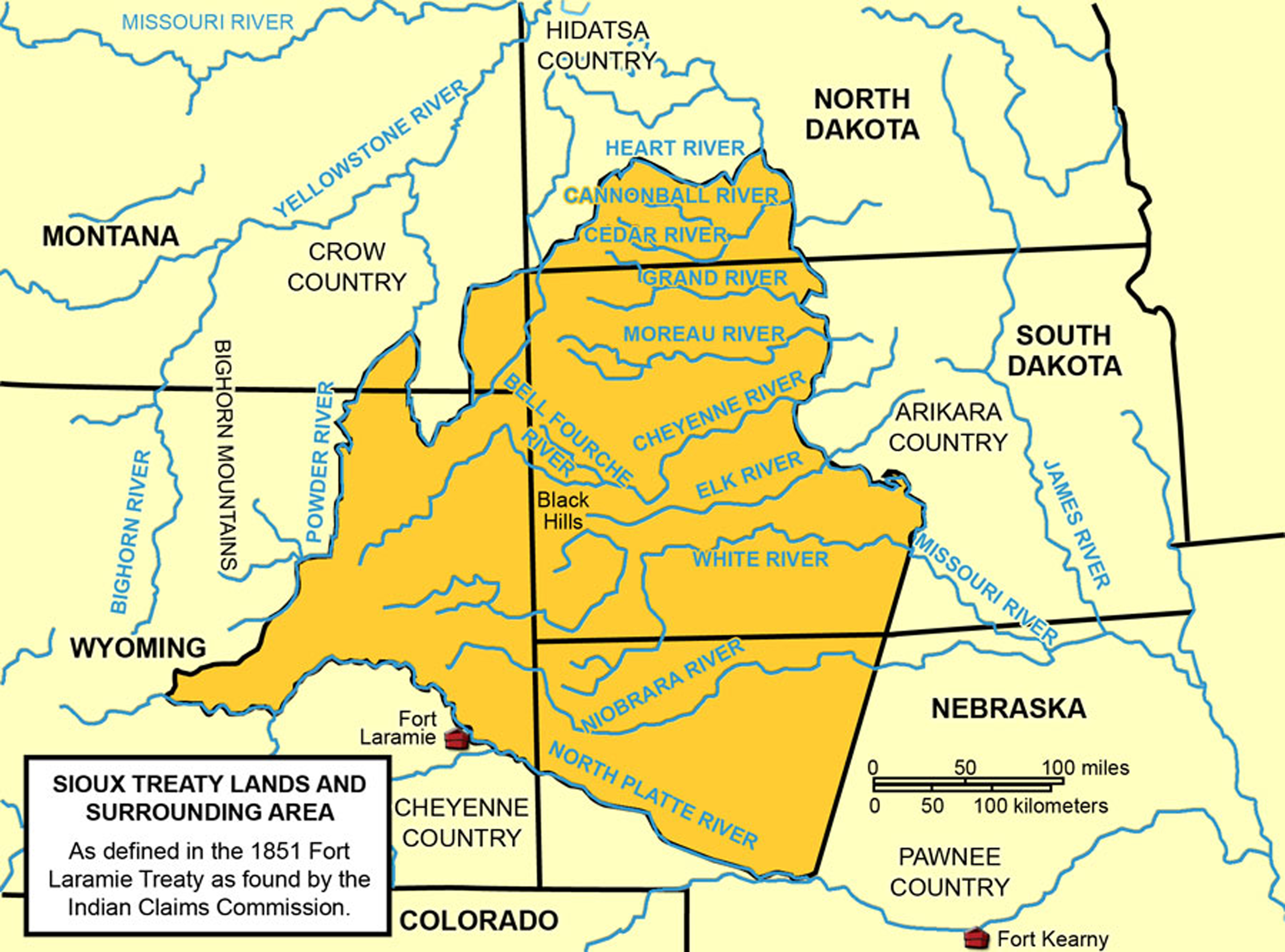
Map 1: Fort Laramie Treaty of 1851. This treaty was the first effort to define the territory of the Great Sioux Nation of Lakotas, Dakotas, and Nakotas. The treaty council was attended by thousands of Sioux men and their families as well as soldiers and officers of the U.S. Army, representatives of the United States government, and interpreters. Note that the tribes that surrounded the Sioux Treaty Lands did not yet have defined territories. The Treaty of 1851 did not establish a reservation, but began the process of defining territory in which the Sioux could live and hunt. The treaty was supposed to reduce warfare among the Indian tribes of the northern Great Plains.

The United States had to deal with Indian tribes through treaties. Treaties are written documents that outline the specific nature of the relationship between nations. Treaties are used to define alliances and to end wars. The treaties between the United States and Indian tribes generally defined the geographical territory the tribes could inhabit, land cessions (land the tribes gave up their claims to), and payments the government made for land cessions. Tribes made some demands for payment in dollars or goods and for schools or agencies. However, the tribes were often weak or impoverished when they signed the treaties, so they had little power to make demands.

In 1851, one of the most important treaties was signed at Fort Laramie in present-day Wyoming. The treaty council was attended by thousands of Indians from several different tribes. The Treaty of Fort Laramie of 1851 defined boundaries between Indian tribes of the northern Great Plains. (See Map 1.) The tribes that signed the treaty in 1851 agreed to

  1. allow travelers, railroad surveyors, and construction workers to enter tribal lands safely;
  2. allow the government to establish posts and roads;
  3. pay for any wrongdoing of their people;
  4. select head chiefs to deal with U.S. government agents;
  5. cease fighting with other tribes.

The United States had to

  1. protect Indians from U.S. citizens;
  2. deliver annuities if the terms of the treaty were upheld.

The Treaty of 1851 had several problems. There were not enough interpreters to be sure that every tribe had a full understanding of the treaty which was written in English. Another problem was that the government was accustomed to making decisions through elected representatives. Western Indian tribes made decisions when all of the people agreed (consensus). These two traditions clashed. The tribes agreed to appoint chiefs who signed the document, but they could not control the people who were not part of the decisions. A more important problem was that the terms of the treaty were broken by U. S. citizens, the government, and the tribes.

Over the next several years, the treaty faced new challenges. The Civil War had ended. The Union Pacific Railroad was under construction. Gold had been found in Montana and Colorado. There were many more people traveling west through the Great Plains. The increase in travel led to increase in conflict. Some of the conflict was centered on the Bozeman Trail in Wyoming that ran right through Sioux treaty lands toward the gold fields of Montana. Red Cloud, an Oglala Lakota, declared that he would continue to make war on travelers and Army posts until the government closed the road and removed the Army.

The Army also established military posts in Sioux treaty lands. Fort Rice and Fort Buford on the Upper Missouri River were on or near treaty lands. Sitting Bull, Gall, and other Hunkpapas continually harassed these posts and demanded that the posts be removed.

Fort Laramie Treaty of 1868

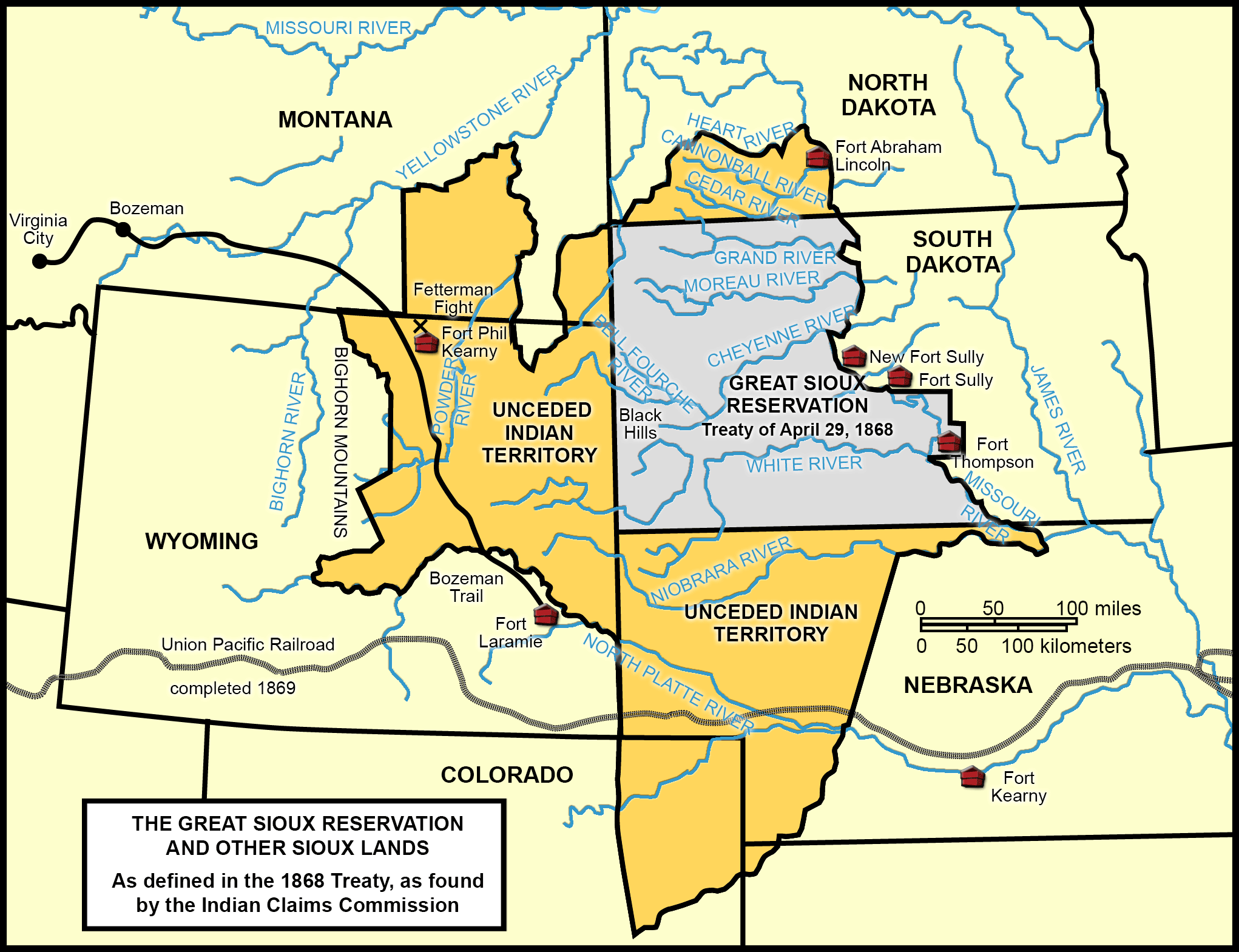
Map 2: Fort Laramie Treaty of 1868. The U. S. government sent agents to discuss a new treaty with the Great Sioux Nation in 1868.  The treaty created the Great Sioux Reservation (in gray).  Unceded lands (in yellow) in Wyoming, Nebraska and Dakota Territory were reserved for hunting.  A portion of the unceded lands in northern Dakota Territory became part of the Great Sioux Reservation (later Standing Rock Reservation) following an agreement between the federal government and the Sioux leaders in September 1876. Forts bordered the eastern edge of Sioux treaty lands. However, the Sioux had focused attacks on Fort Phil Kearney in central Wyoming, forcing the government to abandon the post under the terms of this treaty.

In 1868, a treaty commission again met at Fort Laramie. The U. S. agents at the council came with a new federal policy that focused on placing all tribes on reservations. The Treaty of Fort Laramie of 1868 established the Great Sioux Reservation which included the sacred Black Hills. (See Map 2)  Annuities (payments) of food and clothing were to be delivered to Indians living on the reservation. The government promised to close the Bozeman trail and the forts along the trail. According to the agreement, the treaty had to be signed by three-fourths (3/4 or .75 percent) of the males of the tribes. Many bands of Lakota Sioux agreed to the treaty. Some of them were already living within the boundaries of the Great Sioux Reservation. Others, such as Two Bears and his band, lived nearby and cooperated with the agents, though they did not move onto the reservation.

However, many did not sign the treaty. Sitting Bull and his band of Hunkpapas were among those who did not sign the treaty. The government considered the Hunkpapas dangerous because they refused to live on a reservation and continued to hunt north of the reservation.

Six years later, in 1874, gold was found in the Black Hills. Though the government offered to buy the land, the Sioux tribes refused the offer. The Black Hills were sacred to the Sioux and they would not sell. The Army did not prevent gold miners from entering the Black Hills. The federal government then demanded that all the Sioux report to the reservation. Sitting Bull and his band refused. More conflict followed. Treaties which were meant to bring peace led directly to more conflict.

Why is this important? The Treaty of Fort Laramie of 1851 created a short period of peace which allowed more settlers to enter or travel legally through tribal lands. However, as more non-Indians traveled through Sioux treaty lands, there were more opportunities for conflict and misunderstanding. The conflicts led members of Congress to think that another treaty was necessary.

The treaties created a new problem for the Sioux. Once the government had established specific territorial boundaries for the tribes, federal agents could negotiate for more land cessions. The Sioux came to the 1868 treaty council with a great deal of power because Red Cloud and Sitting Bull had fought settlers, miners, and the Army. However, the Sioux lost land in this treaty council, and over the next forty years would continue to lose land originally promised to them by the Treaty of 1851.


North Dakota People Living on the Land, Lesson 4: Alliances And Conflicts
Topic 2: Defending Lakota Homelands, SECTION 3: THE TREATIES OF FORT LARAMIE, 1851 & 1868

Posted in Indigenous, Native Americans | Leave a comment

Sioux Treaty of 1868

Sioux Treaty of 1868

Background

“This war was brought upon us by the children of the Great Father who came to take our land from us without price.”

–Spotted Tail

The report and journal of proceedings of the commission appointed to obtain certain concessions from the Sioux Indians, December 26, 1876

The history of Native Americans in North America dates back thousands of years. Exploration and settlement of the western United States by Americans and Europeans wreaked havoc on the Indian peoples living there. In the 19th century the American drive for expansion clashed violently with the Native American resolve to preserve their lands, sovereignty, and ways of life. The struggle over land has defined relations between the U.S. government and Native Americans and is well documented in the holdings of the National Archives. (From the American Originals exhibit script.)

From the 1860s through the 1870s the American frontier was filled with Indian wars and skirmishes. In 1865 a congressional committee began a study of the Indian uprisings and wars in the West, resulting in a Report on the Condition of the Indian Tribes , which was released in 1867. This study and report by the congressional committee led to an act to establish an Indian Peace Commission to end the wars and prevent future Indian conflicts. The United States government set out to establish a series of Indian treaties that would force the Indians to give up their lands and move further west onto reservations.

In the spring of 1868 a conference was held at Fort Laramie, in present day Wyoming, that resulted in a treaty with the Sioux. This treaty was to bring peace between the whites and the Sioux who agreed to settle within the Black Hills reservation in the Dakota Territory.

The Black Hills of Dakota are sacred to the Sioux Indians. In the 1868 treaty, signed at Fort Laramie and other military posts in Sioux country, the United States recognized the Black Hills as part of the Great Sioux Reservation, set aside for exclusive use by the Sioux people. In 1874, however, General George A. Custer led an expedition into the Black Hills accompanied by miners who were seeking gold. Once gold was found in the Black Hills, miners were soon moving into the Sioux hunting grounds and demanding protection from the United States Army. Soon, the Army was ordered to move against wandering bands of Sioux hunting on the range in accordance with their treaty rights. In 1876, Custer, leading an army detachment, encountered the encampment of Sioux and Cheyenne at the Little Bighorn River. Custer’s detachment was annihilated, but the United States would continue its battle against the Sioux in the Black Hills until the government confiscated the land in 1877. To this day, ownership of the Black Hills remains the subject of a legal dispute between the U.S. government and the Sioux.

Sioux Treaty of 1868, National Archives

Posted in Indigenous, Native Americans, Uncategorized | Leave a comment

Treaty of Fort Laramie, 1851

Articles of a treaty made and concluded at Fort Laramie, in the Indian Territory, between D. D. Mitchell, superintendent of Indian affairs, and Thomas Fitzpatrick, Indian agent, commissioners specially appointed and authorized by the President of the United States, of the first part, and the chiefs, headmen, and braves of the following Indian nations, residing south of the Missouri River, east of the Rocky Mountains, and north of the lines of Texas and New Mexico, viz, the Sioux or Dahcotahs, Cheyennes, Arrapahoes, Crows. Assinaboines, Gros-Ventre Mandans, and Arrickaras, parties of the second part, on the seventeenth day of September, A. D. one thousand eight hundred and fifty-one.

ARTICLE 1.

The aforesaid nations, parties to this treaty. having assembled for the purpose of establishing and confirming peaceful relations amongst themselves, do hereby covenant and agree to abstain in future from all hostilities whatever against each other, to maintain good faith and friendship in all their mutual intercourse, and to make an effective and lasting peace.

ARTICLE 2.

The aforesaid nations do hereby recognize the right of the United States Government to establish roads, military and other posts, within their respective territories.

ARTICLE 3.

In consideration of the rights and privileges acknowledged in the preceding article, the United States bind themselves to protect the aforesaid Indian nations against the commission of all depredations by the people of the said United States, after the ratification of this treaty.

ARTICLE 4.

The aforesaid Indian nations do hereby agree and bind themselves to make restitution or satisfaction for any wrongs committed, after the ratification of this treaty, by any band or individual of their people, on the people of the United States, whilst lawfully residing in or passing through their respective territories.

ARTICLE 5.

The aforesaid Indian nations do hereby recognize and acknowledge the following tracts of country, included within the metes and boundaries hereinafter designated, as their respective territories, viz:
The territory of the Sioux or Dahcotah Nation, commencing the mouth of the White Earth River, on the Missouri River: thence in a southwesterly direction to the forks of the Platte River: thence up the north fork of the Platte River to a point known as the Red Bute, or where the road leaves the river; thence along the range of mountains known as the Black Hills, to the head-waters of Heart River; thence down Heart River to its mouth; and thence down the Missouri River to the place of beginning.
The territory of the Gros Ventre, Mandans, and Arrickaras Nations, commencing at the mouth of Heart River; thence up the Missouri River to the mouth of the Yellowstone River; thence up the Yellowstone River to the mouth of Powder River in a southeasterly direction, to the head-waters of the Little Missouri River; thence along the Black Hills to the head of Heart River, and thence down Heart River to the place of beginning.
The territory of the Assinaboin Nation, commencing at the mouth of Yellowstone River; thence up the Missouri River to the mouth of the Muscle-shell River; thence from the mouth of the Muscle-shell River in a southeasterly direction until it strikes the head-waters of Big Dry Creek; thence down that creek to where it empties into the Yellowstone River, nearly opposite the mouth of Powder River, and thence down the Yellowstone River to the place of beginning.
The territory of the Blackfoot Nation, commencing at the mouth of Muscle-shell River; thence up the Missouri River to its source; thence along the main range of the Rocky Mountains, in a southerly direction, to the head-waters of the northern source of the Yellowstone River; thence down the Yellowstone River to the mouth of Twenty-five Yard Creek; thence across to the head-waters of the Muscle-shell River, and thence down the Muscle-shell River to the place of beginning.
The territory of the Crow Nation, commencing at the mouth of Powder River on the Yellowstone; thence up Powder River to its source; thence along the main range of the Black Hills and Wind River Mountains to the head-waters of the Yellowstone River; thence down the Yellowstone River to the mouth of Twenty-five Yard Creek; thence to the head waters of the Muscle-shell River; thence down the Muscle-shell River to its mouth; thence to the head-waters of Big Dry Creek, and thence to its mouth.
The territory of the Cheyennes and Arrapahoes, commencing at the Red Bute, or the place where the road leaves the north fork of the Platte River; thence up the north fork of the Platte River to its source; thence along the main range of the Rocky Mountains to the head-waters of the Arkansas River; thence down the Arkansas River to the crossing of the Santa Fé road; thence in a northwesterly direction to the forks of the Platte River, and thence up the Platte River to the place of beginning.
It is, however, understood that, in making this recognition and acknowledgement, the aforesaid Indian nations do not hereby abandon or prejudice any rights or claims they may have to other lands; and further, that they do not surrender the privilege of hunting, fishing, or passing over any of the tracts of country heretofore described.

ARTICLE 6.

The parties to the second part of this treaty having selected principals or head-chiefs for their respective nations, through whom all national business will hereafter be conducted, do hereby bind themselves to sustain said chiefs and their successors during good behavior.

ARTICLE 7.

In consideration of the treaty stipulations, and for the damages which have or may occur by reason thereof to the Indian nations, parties hereto, and for their maintenance and the improvement of their moral and social customs, the United States bind themselves to deliver to the said Indian nations the sum of fifty thousand dollars per annum for the term of ten years, with the right to continue the same at the discretion of the President of the United States for a period not exceeding five years thereafter, in provisions, merchandise, domestic animals, and agricultural implements, in such proportions as may be deemed best adapted to their condition by the President of the United States, to be distributed in proportion to the population of the aforesaid Indian nations.*

ARTICLE 8.

It is understood and agreed that should any of the Indian nations, parties to this treaty, violate any of the provisions thereof, the United States may withhold the whole or a portion of the annuities mentioned in the preceding article from the nation so offending, until, in the opinion of the President of the United States, proper satisfaction shall have been made.

In testimony whereof the said D. D. Mitchell and Thomas Fitzpatrick commissioners as aforesaid, and the chiefs, headmen, and braves, parties hereto, have set their hands and affixed their marks, on the day and at the place first above written.

D. D. Mitchell

Thomas Fitzpatrick

Commissioners.

      Sioux:

Mah-toe-wha-you-whey, his x mark.

Mah-kah-toe-zah-zah, his x mark.

Bel-o-ton-kah-tan-ga, his x mark.

Nah-ka-pah-gi-gi, his x mark.

Mak-toe-sah-bi-chis, his x mark.

Meh-wha-tah-ni-hans-kah, his x mark.

    Cheyennes:

Wah-ha-nis-satta, his x mark.

Voist-ti-toe-vetz, his x mark.

Nahk-ko-me-ien, his x mark.

Koh-kah-y-wh-cum-est, his x mark.

    Arrapahoes:

Bè-ah-té-a-qui-sah, his x mark.

Neb-ni-bah-seh-it, his x mark.

Beh-kah-jay-beth-sah-es, his x mark.

    Crows:

Arra-tu-ri-sash, his x mark.

Doh-chepit-seh-chi-es, his x mark.

    Assinaboines:

Mah-toe-wit-ko, his x mark.

Toe-tah-ki-eh-nan, his x mark.

Mandans and Gros Ventres:

Nochk-pit-shi-toe-pish, his x mark.

She-oh-mant-ho, his x mark.

    Arickarees:

Koun-hei-ti-shan, his x mark.

Bi-atch-tah-wetch, his x mark.

In the presence of—

A. B. Chambers, secretary.

S. Cooper, colonel, U. S. Army.

R. H. Chilton, captain, First Drags.

Thomas Duncan, captain, Mounted Riflemen.

Thos. G. Rhett, brevet captain R. M. R.

W. L. Elliott, first lieutenant R. M. R.

C. Campbell, interpreter for Sioux.

John S. Smith, interpreter for Cheyennes.

Robert Meldrum, interpreter for the Crows.

H. Culbertson, interpreter for Assiniboines and Gros Ventres.

Francois L’Etalie, interpreter for Arick arees.

John Pizelle, interpreter for the Arrapahoes.

B. Gratz Brown.

Robert Campbell.

Edmond F. Chouteau.

*This treaty as signed was ratified by the Senate with an amendment changing the annuity in Article 7 from fifty to ten years, subject to acceptance by the tribes. Assent of all tribes except the Crows was procured (see Upper Platte C., 570, 1853, Indian Office) and in subsequent agreements this treaty has been recognized as in force.

From Charles Kappler, Indian Affairs: Laws and Treaties (1899 – 1902).

North Dakota, People Living on the Land. Lesson 1: Changing Landscapes Topic 4: Reservation Boundaries SECTION 2: TREATY OF FORT LARAMIE 1851

Posted in Indigenous, Native Americans, Uncategorized | Leave a comment

SHIFT the Narrative

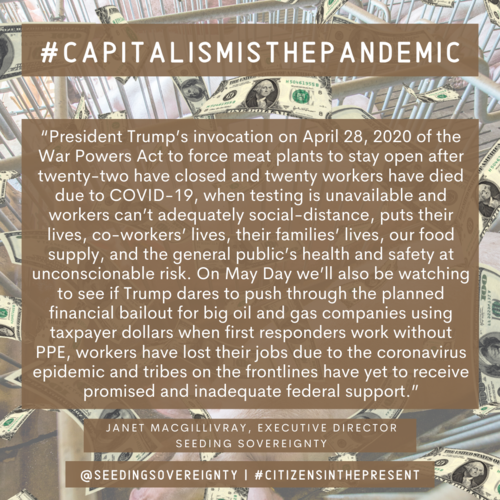
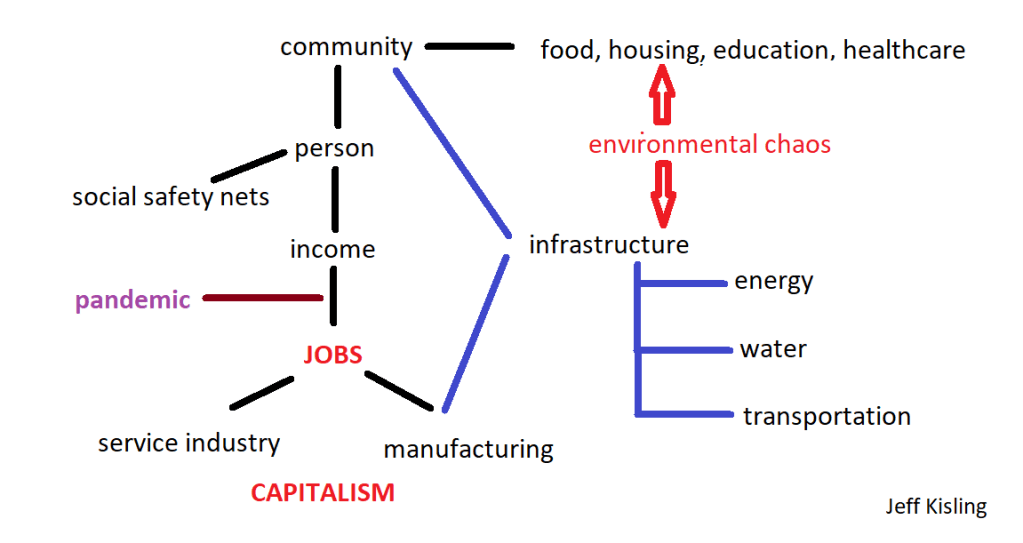
The COVID-19 pandemic has exposed so many failures of our corporate capitalistic government and economic system. “The crisis began before the virus, and the crisis will continue beyond the vaccine” as Jason Livingston said. #CapitalismIsThePandemic. Click here for a story about the #CapitalismIsThePandemic event recently in New York City.
https://kislingjeff.wordpress.com/2020/05/07/capitalismisthepandemic-flies-over-new-york-city/

We demand an end to the colonial-capitalist economy supported by institutionalized white supremacist and heteropatriarchal systems that have devastated our lands, climate, and peoples through ceaseless resource extraction, land occupation, border imperialism, misogyny, homophobia, enslavement, and genocide. This viral pandemic is part of a much larger problem as explained by Buffalo-based media artist, Jason Livingston, who conceived this action, “The crisis began before the virus, and the crisis will continue beyond the vaccine.” 

Seeding Sovereignty

To this day we have not come to grips with fundamental injustices our country was built on, the cultural genocide and theft of land from Native Americans, the enslavement of African Americans and the legal justifications of bestowing rights and privileges on white land-owning men. The consequences of these injustices continue to plague our society today. And will continue to impact us until we do what is necessary to bring these injustices to light and find ways to heal these wounds.

And as I’ve often quoted my friend Ronnie James:

I’m of the firm opinion that a system that was built by stolen bodies on stolen land for the benefit of a few is a system that is not repairable. It is operating as designed, and small changes (which are the result of huge efforts) to lessen the blow on those it was not designed for are merely half measures that can’t ever fully succeed.

So the question is now, where do we go from here? Do we continue to make incremental changes while the wealthy hoard more wealth and the climate crisis deepens, or do we do something drastic that has never been done before? Can we envision and create a world where a class war from above isn’t a reality anymore?”

Ronnie James

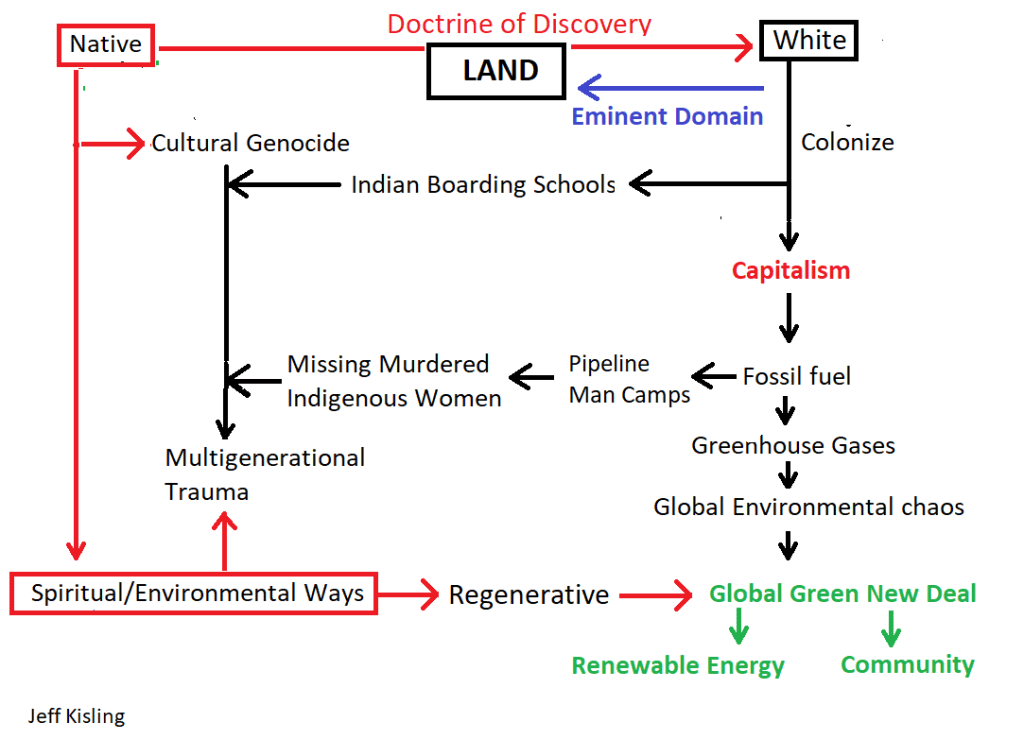
We need to shift away from our capitalistic system to one that embraces indigenous ways of living. Not only to find answers to the failures of the current system, but also to address the urgent need to deal with our environmental catastrophe. I use shift intentionally, because that is the name of a project of Seeding Sovereignty. To do this very thing-shift to indigenous leadership.

How do White people learn about indigenous solutions? One way is to hear indigenous people discussing their ideas. I’ve learned a great deal from these live ‘Shift the Narrative’ interviews.

One of the most profound things I’ve personally learned as I listen to these women leaders is how it feels, for a change, to not be the gender that is in control. As quoted above, demand an end to institutionalized white supremacist and heteropatriarchal systems.

See the information below about the next episode on May 14th, a discussion about border imperialism and Indigenous Peoples, ICE raids during COVID-19 and legislation affecting migrants rights in the US.

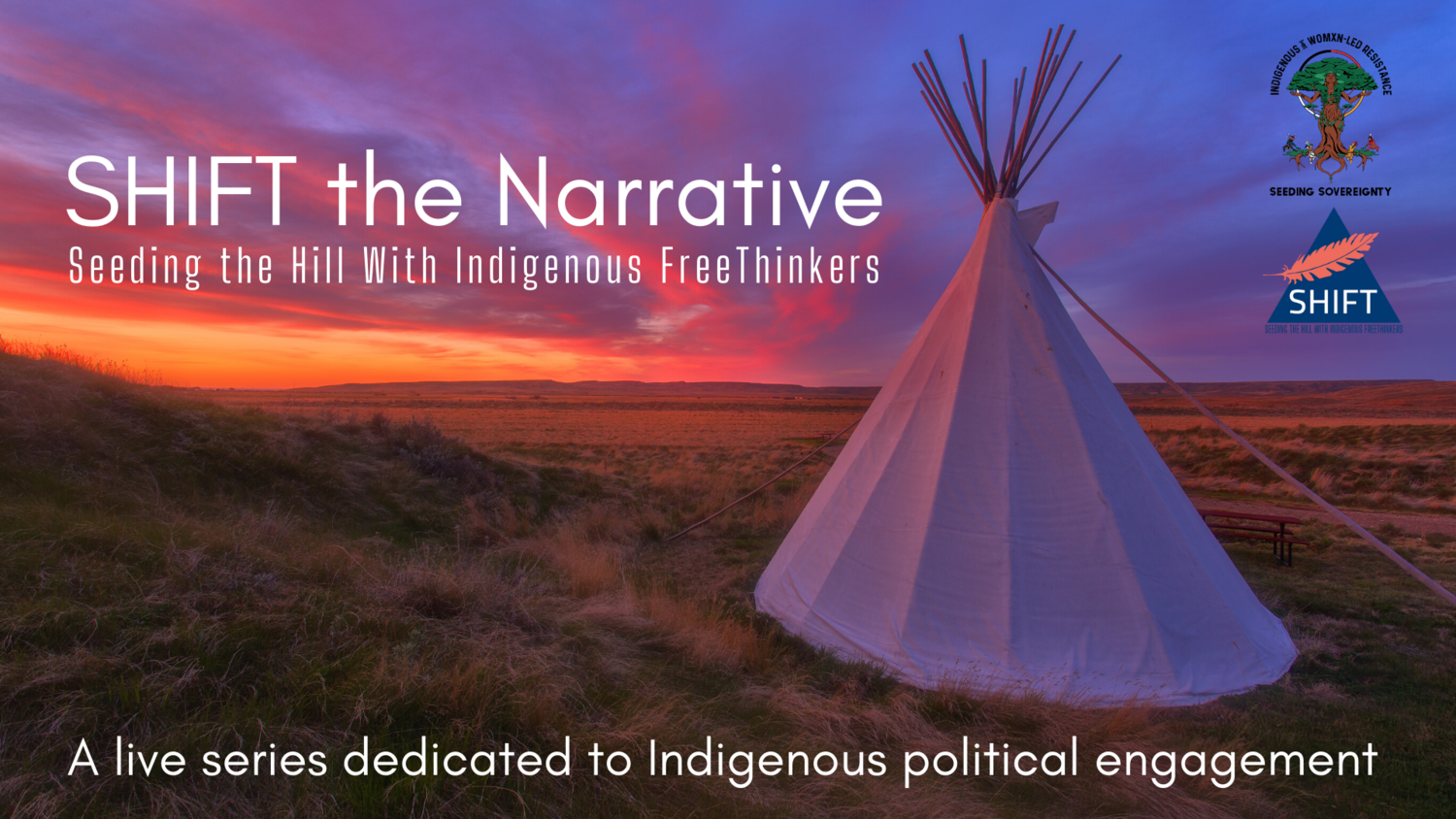
SHIFT the Narrative (3).png

Topic SHIFT the Narrative

Description SHIFT the Narrative is a live, online interview series produced by Seeding Sovereignty that covers different aspects of Indigenous political engagement and current issues in Indian Country through interviews with expert guest speakers.

Join us as we interview Nellie Jo David, Tohono O’odham Nation and Carolina Rubio MacWright, Colombian Latinx, to discuss border imperialism and Indigenous Peoples, ICE raids during COVID-19 and legislation affecting migrants rights in the US. Nellie Jo will discuss the U.S./Mexico border’s effect on O’odham way of life and maintaining connections between O’odham (people) while walls, integrated fixed towers, and militarization threaten to divide them during these pandemic times. Carolina will cover her work as an immigration attorney and activist and we will delve into legislation and voting for change.

Stay ahead of the curve! Join Sikowis and S.A. as we interview expert guests every second Thursday! Conversations will surround work in Indian Country such as getting out the vote, organizing to change policy, issues of sovereignty, running for office, and much more.

SHIFT is Seeding Sovereignty’s political engagement program focused on empowering Indigenous voices, values, and leadership; Particularly womxn, youth, LGBTQIA+, and Two-Spirit folx during this critical 2020 presidential election and beyond. We increase Indigenous voter turnout and respond to key issues within Indian Country by uplifting community concerns and initiatives both on and off the reservation. We support those who seek to Indigenize Congress as well as those that question our relationship with the US political system.

Above all else, we rally behind Indigenous-led environmental and climate justice movements as the fight for land sovereignty is at the center of every issue we face. Land defense is a force that has a long history of inciting political engagement–a force that Seeding Sovereignty believes catalyzes real, lasting change.Time

May 14, 2020 03:00 PM in Central Time (US and Canada)

Image may contain: 4 people, text

Posted in decolonize, immigration, Indigenous, Native Americans, Seeding Sovereignty, Uncategorized | Leave a comment

Follow-up on the state of South Dakota vs Sioux Tribes

This is a followup to this morning’s post: South Dakota governor tells Sioux tribes they have 48 hours to remove Covid-19 checkpoints

I asked some of my friends who live in South Dakota about this.

I think the Fort Laramie as well as all other treaties should be honored by the United States government. The Lakotas will not back down. I have no contacts. Thanks for offering the help. It’s awesome to have people wanting to help. thanks Jeff

Another friend sent this link to a court case that decided the state did not have permission to control the highways that travel through the reservation.

Rosebud Sioux Tribe v. State of S.D
Summary
Holding that state failed to assume even partial jurisdiction in compliance with Public Law 280
https://casetext.com/case/rosebud-sioux-tribe-v-state-of-sd


Cheyenne River Sioux Tribe and Oglala Sioux Tribe leaders have rejected South Dakota Gov. Kristi Noem’s demand that they remove checkpoints meant to regulate traffic through their reservation, set up to prevent the spread of coronavirus on tribal land.

In early April, the tribes’ governments separately decided to regulate travel on and off their reservations via checkpoints. The Oglala Sioux Tribe closed the Pine Ridge Indian Reservation to all non-residents for non-essential travel, though vehicles could pass through without stopping. The Cheyenne River Sioux Tribe also restricted travel, limiting non-residents from entering their reservation unless on essential business or if the tribal government has granted them a travel permit. Residents and non-residents entering the reservation must fill out a health questionnaire.

On Friday, South Dakota Gov. Kristi Noem sent letters to Chairman Harold Frazier of the Cheyenne River Sioux Tribe and President Julian Bear Runner of the Oglala Sioux Tribe demanding that they remove the checkpoints from state and U.S. highways. Noem said if the checkpoints are not removed within 48 hours, she would take “necessary legal action,” according to a statement released Friday.

In a video posted to Facebook on Saturday, Bear Runner (President Julian Bear Runner of the Oglala Sioux Tribe) said that Noem had “threatened the sovereign interest of the Oglala people when she issued an ultimatum,” but continued, “we have a prior and superior right to make our own laws and be governed by them.”

He said he believes the tribe’s checkpoints are in “full” compliance with the BIA’s memorandum since they “have not closed non-tribal roads or highways owned by the state of South Dakota or any other government,” and it is not their intent to restrict access to such roads.

South Dakota Governor Demands Tribe Leaders Remove Checkpoints Set Up to Prevent the Spread of COVID-19 by Madeleine Carlisle, TIME, May 9, 2020
Image may contain: text
No photo description available.

Posted in Uncategorized | Leave a comment

Questions looking for answers

You are probably as puzzled as I am regarding the pandemic and how we might respond. I’ve been praying about this, and thinking about what our ancestors did during catastrophes in the past. The three quotes below speak about the importance of stories.

For some years we have been collecting Quaker stories. I would love to hear stories you might have to tell. We’re looking for more stories to add to this collection.

I think one thing we have to offer the world are stories about what was and might be. https://quakerstories.wordpress.com/

https://quakerstories.wordpress.com/

If we are to find a new kind of good life amid the catastrophes these myths have spawned, then we need to radically rethink the stories we tell ourselves. We need to dig deep into old stories and reveal their wisdom, as well as lovingly nurture the emergence of new stories into being. This will not be easy. The myths of this age are deeply rooted in our culture. The talking heads (even the green ones) echo these myths with the dogmatic fervour of zealots. They talk of “saving the planet” through transitioning to a “sustainable” future, primarily through new renewable energy technologies. They seem only able to conceive of a good life that mirrors our lives more or less as they are now, where the living standard continues to improve and rate of consumption continues to grow, yet somehow decoupled from all the pollution, destruction and guilt.

Pontoon Archipelago or: How I Learned to Stop Worrying and Love Collapse By James Allen, Medium, June 18, 2019.

What comes to matter then is the creation of the best possible story we can while we’re here; you, me, us, together. When we can do that and we take the time to share those stories with each other, we get bigger inside, we see each other, we recognize our kinship — we change the world one story at a time.

Richard Wagamese

We are our stories, stories that can be both prison and the crowbar to break open the door of that prison; we make stories to save ourselves or to trap ourselves or others, stories that lift us up or smash us against the stone wall of our own limits and fears. Liberation is always in part a storytelling process: breaking stories, breaking silences, making new stories.   ’

Rebecca Solnit, ‘Silence Is Broken’, in ‘The Mother of All Questions

Following are five questions Cheryl Sutton posed to us during her presentations at Midyear Meeting of Iowa Yearly Meeting (Conservative) recently. I think telling our stories is pertinent to answers to several of these questions.

  • If we are called to change the world, as our Testimonies tell us, do we need to find like-minded people to work on solutions?  
  • Do Friends think it is God’s responsibility to decide who will find their way to our faith tradition?  
  • Do we as individuals and as a meeting, do enough to bring new people into our faith community? If not, why? 
  • When new people come into our community, do we have a way to help them understand our faith community transform our lives, and how Quaker history speaks to us today? 
  • Do we talk about our spiritual experience with one another, and when opportunities arise, with non-Quakers outside of our meeting?


One Quaker practice I really appreciate is the consideration of questions like these below. We refer to them as queries. There are twelve sets of queries, so each Quaker meeting discusses one set of queries each month. The various things people say to answer the questions are then summarized into a written response.

Our answers will likely be different in the face of the pandemic. Might help us live through it ourselves, and might help others as well.


ENVIRONMENTAL RESPONSIBILITY

  • What are we doing about our disproportionate use of the world’s resources?
  • Do we see unreasonable exploitation in our relationship ‑with the rest of creation?
  • How can we nurture reverence and respect for life?  How I can we become more fully aware of our interdependent relationship with the rest of creation?
  • To what extent are we aware of all life and the role we play? What can we do in our own lives and communities to address environmental concerns?

SOCIAL AND ECONOMIC JUSTICE

  • How are we beneficiaries of inequity and exploitation? How are we victims of inequity and exploitation? In what ways can we address these problems?
  • What can we do to improve the conditions in our correctional institutions and to address the mental and social problems of those confined there?
  • How can we improve our understanding of those who are driven to violence by subjection to racial, economic or political injustice? In what ways do we oppose prejudice and injustice based on gender, sexual orientation, class, race, age, and physical, mental and emotional conditions? How would individuals benefit from a society that values everyone? How would society benefit?

PEACE AND NONVIOLENCE

  • What are we doing to educate ourselves and others about the causes of conflict in our own lives, our families and our meetings? Do we provide refuge and assistance, including advocacy, for spouses, children, or elderly persons who are victims of violence or neglect?
  • Do we recognize that we can be perpetrators as well as victims of violence? How do we deal with this? How can we support one another so that healing may take place?
  • What are we doing to understand the causes of war and violence and to work toward peaceful settlement of differences locally, nationally, and internationally? How do we support institutions and organizations that promote peace?
  • Do we faithfully maintain our testimony against preparation for and participation in war?

Posted in Arts, climate change, peace, Quaker, Quaker Meetings, Uncategorized | Leave a comment

South Dakota governor tells Sioux tribes they have 48 hours to remove Covid-19 checkpoints

For a number of reasons the coronavirus spread among Native peoples is worse than in other populations in the U.S. Native families live in close proximity to each other and running water is sometimes a problem. When people go to doctor appointments or to get food, the car is full of people. Social distancing is a privilege these peoples don’t have.

Yesterday South Dakota Governor Kristi Noem sent letters to the leaders of the Oglala Sioux Tribe and the Cheyenne River Sioux Tribe demanding that checkpoints designed to prevent the spread of coronavirus on tribal land be removed within 48 hours. This from a governor who has not issued stay-at-home orders for the state, which mean there will be high levels of community spread. This from a governor who supported and signed legislation to criminalize protest.

The state of South Dakota doesn’t own any land or interest on the Cheyenne River Sioux Tribe Reservation.

“We are strongest when we work together; this includes our battle against Covid-19,” Noem said. “I request that the tribes immediately cease interfering with or regulating traffic on US and State Highways and remove all travel checkpoints.”

According to Cheyenne River Sioux Tribe checkpoint policies posted on its social media, its reservation residents may travel within South Dakota to areas the state has not deemed a Covid-19 “hotspot” if it’s for an essential activity such as medical appointments or to get supplies unavailable on the reservation. But they must complete a health questionnaire when they leave and when they return every time they go through a checkpoint.

South Dakota residents who don’t live on the reservation are only allowed there if they’re not coming from a hotspot and it is for an essential activity. But they must also complete a health questionnaire.

Those from a South Dakota hotspot or from outside the state cannot come to the reservation unless it is for an essential activity — but they must obtain a travel permit available on the tribe’s website.

Both tribes have also issued strict stay-at-home orders and curfews for their communities. Noem has not issued stay-at-home orders for the state.

There are 169 cases of Covid-19 among Native Americans in the state as of Friday, the health department said. The state has 3,145 confirmed cases and 31 deaths.

South Dakota governor tells Sioux tribes they have 48 hours to remove Covid-19 checkpoints By Chris Boyette, CNN, Updated 6:24 AM ET, Sat May 9, 2020

CHEYENNE RIVER INDIAN RESERVATION — As COVID-19 began to spread across the country in late March, the tribal chairman of the Cheyenne River Sioux Tribe ordered checkpoints that would limit non-reservation travelers into the Cheyenne River Indian Reservations. 

Chairman Harold Frazier had a reason for the checkpoints:  He wanted to protect his tribal citizens and limit the virus from spreading on the reservation.

“SHOW US HOW THE STATE OF SOUTH DAKOTA OWNS ANY LAND OR INTEREST ON THE CHEYENNE RIVER SIOUX TRIBE RESERVATION AND I WILL SHOW YOU HOW THE STATE HAS VIOLATED THEIR COMPACT WITH THE UNITED STATES AND THE SECOND CONDITION OF THE ENABLING ACT OF 1889 AS WELL AS ARTICLE XXII OF THE CONSTITUTION OF THE UNITED STATES,” FRAZIER SAID.

Last week, several South Dakota tribal officials expressed their concerns that South Dakota Gov. Kristi Noem has not acted strongly enough to stop the spread of COVID-19 as have other state governors. So far, she has not instituted a stay-at-home order, banned evictions and power shut-offs, or closed nonessential businesses.

“In light of the lack of action to protect our members and residents on the reservation we are doing the best we can with what is available and will continue to do so,” the Cheyenne River Sioux Tribes said in a press release.

BIA AND CHEYENNE RIVER SIOUX TRIBAL CHAIRMAN SQUARE OFF ON RESERVATION HIGHWAY COVID-19 CHECKPOINT BY LEVI RICKERT, Native News Online.net, 26 APR 2020

Our new Indigenous Impact Rapid Response Initiative works in partnership with Navajo, Apache, and Pueblo communities in New Mexico where need is critical to immediately provide protective masks to communities, distribute healthy food to elders and families, redistribute money to fund essential stipends to those in need, and send Indigenous authored books to quarantined students.

DONATE TO RAPID RESPONSE FUND

Seeding Sovereignty


#SeedingSovereignty

Posted in #NDAPL, Indigenous, Uncategorized | Leave a comment

To sleep is to fall into belief

I haven’t heard get “woke” used for some time. Maybe because Barack Obama said being “woke” doesn’t mean anything unless you do something in response.

It’s been disappointing to witness how many people have slept and fallen into belief regarding many things.

Also disturbing occasions, and there have been several, when I realized I had slept and fallen into belief. I needed to be “woke”. A recent occasion for me was to realize everything has a spirit. Having considered myself to be a spiritual person but not to see the spirit is not limited to human beings. That was a rude awakening for sure. And made me realize one reason it is hard for people to wake up is the embarrassment of admitting this to others.

Perhaps the first time I considered this concept was when, as a child, I learned many people had fallen into the belief that war could be justified.

Or that the color of one’s skin could make some people feel superior to others.

Or that land and resources could be owned.

This is one of the most important things our faith community can do for us. To help us awaken when we have slept. And deal with the pain that comes from these realizations of how we slept.

It is a challenge to see how our faith communities have slept, and fallen into belief. It has been a constant disappointment of my life to see how Quakers have slept regarding the use of fossil fuels. As Rae Armantrout says, ““The first section of ‘On Growth’ began while I was babysitting my young granddaughters and suddenly realized that everything in our immediate environment was a petroleum product.

My own process of waking up involved a vision of my beloved Rocky Mountains hidden behind clouds of smog. Among other things that led me to live without a car for most of my life. That’s what President Obama meant when he said being ‘woke’ must lead to change.

I was led to read this poem this morning because the COVID-19 pandemic has brought to light fundamental beliefs many have fallen into as we slept.

  • A belief that corporate capitalism works well
  • That the commons, water, air and land can be owned and access restricted
  • That corporations are beholden to their stockholders, even at the expense of the rest of us and Mother Earth
  • That all goods and services must by paid for
  • That society should no longer provide free education and healthcare to all
  • That the imbalance of extreme wealth while billions live in poverty is a sign of success
  • That spirituality has no value
  • and many more

Or, as expressed by Seeding Sovereignty:

With this action, we demand an end the colonial-capitalist economy supported by institutionalized white supremacist and heteropatriarchal systems that have devastated our lands, climate, and peoples through ceaseless resource extraction, land occupation, border imperialism, misogyny, homophobia, enslavement, and genocide. This viral pandemic is part of a much larger problem as explained by Buffalo-based media artist, Jason Livingston, who conceived this action, “The crisis began before the virus, and the crisis will continue beyond the vaccine.” 

#CapitalismIsThePandemic

As we are ‘woke’ by the COVID-19 pandemic, what do we do in response? What is emerging is a campaign of global mass strikes. see: https://kislingjeff.wordpress.com/2020/04/30/the-era-of-mass-strikes-begins-on-may-1/

The action described above is one of many that happened, and will continue to happen, as part of global mass strikes. Now is the time to learn and organize.


On Growth
Rae Armantrout


Dressed all in plastic,
which means oil,
we’re bright-eyed, scrambling
for the colored cubes
spilled
on the rug’s polymer.
Inside each
is a tiny car.
When we can’t unscrew the tops
we cry for help.
We’re optimists.
*
To sleep is to fall
into belief.
Airing even
our worst suspicions
may be pleasurable;
we are carried,
buoyed.
In sleep,
the body can heal,
grow larger.
Creatures that never wake
can sprout a whole new
limb,
a tail.
This may be wrong.

Copyright © 2020 by Rae Armantrout. Originally published in Poem-a-Day on May 8, 2020 by the Academy of American Poets

Rae Armantrout reading ‘On Growth’

“The first section of ‘On Growth’ began while I was babysitting my young granddaughters and suddenly realized that everything in our immediate environment was a petroleum product. The second section brings together some uneasy ruminations on sleep/unconsciousness and growth. ‘To sleep is to fall/into belief’ and also, sometimes, vice versa. It is in sleep that the young grow and that ‘lower’ animals transform. In our toxic environment, we can’t necessarily expect growth to be benign.”

—Rae Armantrout

#CapitalismIsThePandemic #SeedingSovereignty  #COVID19 #Coronavirus #ReturnStolenLand #GND #GeneralStrike2020

Posted in civil disobedience, climate change, Global Strike, Quaker, revolution, Seeding Sovereignty, Strike, Uncategorized | Leave a comment