Quaker Social Change Ministry progress

I’m sorry to have been absent from here for a bit.  Fortunately, it is for good reason.

I’ve been occupied with progress being made related to the Quaker Social Change Ministry (QSCM) program.  As I’ve written before, North Meadow Circle of Friends (NMCF) has been participating in the pilot of this program from AFSC’s Friends Liaison program.  We have found this program to be very beneficial in a number of ways.

What has been occupying me lately are two things related to QSCM.  I spoke about QSCM last summer at Des Moines Valley Friends meeting just prior to Iowa Yearly Meeting (Conservative)’s annual sessions, and then at those annual sessions during our Peace and Social Concerns Committee meetings.  I hope monthly meetings in IYMC will adopt the QSCM approach to social concerns work.  So I have been communicating with the Yearly Meeting planning committee about possibilities to talk more about QSCM, including our experience this past year in Indianapolis, at this summer’s annual sessions.

In the meantime, recent deportation raids caused the American Friends Service Committee (AFSC) to urge Friends meetings to consider offering sanctuary or hospitality to those facing deportation.  After sharing that with IYMC’s Peace and Social Concerns Committee, Des Moines Valley Friends indicated they had talked about this during business meeting, and were going to look into this further.

Immigration issues are one of the areas QSCM is designed to address.  This seemed like an opportunity to both work on immigration issues and introduce QSCM as a possible framework for approaching that work.

Yesterday Greg Elliott, the AFSC person in charge of QSCM informed me that he will be able to attend IYMC’s annual sessions this summer to talk about QSCM.  I hope we can somehow share the stories of North Meadow Friends and the KI (Kheprw Institute) and their experience with QSCM.

In addition, Greg and I are setting up a conference call for all who are interested in the sanctuary movement, to explore how QSCM might be helpful to Friends efforts in this area.

Posted in Uncategorized | Leave a comment

Rise of fear

Alarming as the political rise of Donald Trump is, it is easy to focus on him rather than the reasons for his success.  It really is beside the point to list all of the negative things about him and his campaign, because one of the fundamental traits of his supporters is “I don’t want to know (and I really don’t have any interest in anything you have to say about it)”.   He refuses to provide any information about what his policies might be, which avoids having to defend whatever position he might come up with.

And it clearly demonstrates that his supporters don’t care about policy.  What they do care about is finding someone to address their fears.  Someone who can channel their anger at the state of our economy and politics by finding a scapegoat, and easy solutions.

Our politics and economic policies have failed the vast majority of us.  We are now at a crossroads.  One path would be that of Donald Trump and his supporters.  Find someone who promises to return things the way they were, with a thriving middle class.  The problem is that Donald Trump doesn’t have a plan to achieve that.

The other path is to correct the political and financial corruption that got us here.  That is exactly what Bernie Sanders is attempting to do.

This election is about which path the country chooses.  Which is why it is so important for those who want to avoid the path of Donald Trump to not remain silent, and to actively work on the alternative pathway.  But to do that, we need to address the underlying problems, and not the symbol provided by the Trump campaign.  What we do, or do not do at this moment will determine our future.


Posted in Uncategorized | Leave a comment

Downside of car-less

Although I tend to dwell on how few problems there are with not having a car when I try to talk people out of having one, there are times that are more challenging than others.  This map shows the 2 mile walk from my apartment to Riley Hospital for Children.  Most days I walk about 6 blocks to Methodist Hospital, where I board the People Mover (overhead train) to Riley.  Unfortunately, very cold and/or icy conditions usually result in the train being shut down, as was the case this morning.

WalkRiley

The the temperature this morning was 10 F, with a wind chill of -5 F.  The temperature usually isn’t much of a problem, but today the wind was in my face at 14 mph.

Finally, locomotion is constrained because of pain related to my kneecap.  A knee brace helps considerably, and I’m doing exercises from a physical therapist.

So not having a car is not always a walk in the park.  🙂


Posted in Uncategorized | 1 Comment

Hope from New Hampshire

I barely had time to savor Bernie Sander’s New Hampshire victory, when the story appeared about the Supreme Court temporarily blocking the President’s Clean Power Plan until it hears and decides the case.  The liberal justices dissented from the order.

Republicans in Congress continue to attack the Plan and other efforts to reduce greenhouse gas emissions, choosing to side with the fossil fuel industry.

I would like to think the support for Bernie Sanders would tell Republicans that the public doesn’t want dirty fossil fuel, and does want renewable energy, along with all of the jobs that would come with that.  And I hope that those who continue to support fossil fuels will be defeated now that the public is becoming engaged in addressing our deteriorating environment and climate.  And I hope we may soon have a President that will help implement our priorities.

Posted in Uncategorized | 2 Comments

Bias of mainstream media

Those of us who worried about a “free” press when media companies were allowed to create media monopolies are seeing our fears come true.

In December, when it couldn’t be hidden that Bernie Sanders received 1/30th  (not 1/2 or 1/4, but 1/30th)  of the coverage of the leading Republican presidential candidates, the Sanders campaign released a statement that said, in part:

“But the insurgent campaign that has drawn the biggest crowds on the presidential campaign trail has been all but ignored on the flagship television network newscasts, according to Tyndall Report, which tracks nightly news coverage by NBC, CBS and ABC.”

There is no objective metric that the media can use to justify their blackout of his campaign, according to PolitusUsa  http://www.politicususa.com/2015/12/11/bernie-sanders-media-bias-blackout.html

Then last night on the NBC Nightly News, a report from Kasie Hunt said “Managing expectations is another concern for Sanders.  He’s so far ahead now that if Hillary Clinton does manage to close that gap it could still be a problem for him even if he comes in first, Lester”  So she is saying that being so far ahead is a problem???  Who writes this ______ ?

And today NBC’s political headline implies Bernie Sanders is being unfair to point out the hundreds of thousands of dollars Clinton has accepted from corporations.

This is the consistent narrative from the mainstream media.  And why we have to continue to support independent news outlets, and especially protect access to the Internet.

Posted in Uncategorized | Leave a comment

Rich employ domestic terrorism

Flint, Michigan, is the unfortunate, glaring example of what happens when governments are seen as businesses.  Michigan governor Rick Snyder, an accountant, replaced the democratically elected mayor and city council of Flint with a business manager whose goal was to deal with the city’s financial situation, IRREGARDLESS of how the citizens of Flint were effected.  WHY WERE THEY ALLOWED TO OVERTHROW THE GOVERNEMENT?  Who is going to return the government to the people?

A city of 100,000 people have been, and in many cases continue to be literally poisoned by toxic water.  All of this came about after additional tax breaks for the rich in Michigan, which, or course, left no money for public services, not even the $100/day treatment that would have prevented the leakage of the lead into the water.

This is yet another attack of domestic terrorism by the rich against the other 98% of us.

And the governor’s solution?  To “give” the residents of Flint a break on paying their bills for that toxic water.  But not for ALL of the water.  He actually parses out that part of the water bill estimated for non drinking uses, and expects the residents to pay for that.  And there is no consideration for how their lives have been upended, and permanent medical damage done.  Class action lawsuits are in the works to try to correct this.

The same thing happens here in Indiana.  Despite billion dollar surpluses of taxpayer money, the governor refuses to use that money to repair our failing infrastructure.  The latest example being the collapse of an interstate bridge on the main route between Indianapolis and Chicago.  And despite the wishes of the people of Indiana, and Indiana businesses, a handful of conservative white men refuse to pass legislation to protect Hoosiers from discrimination.

And there is the public spectacle of a billionaire who is actually running for the office of President of the United States, embarrassing us with bigoted rants against any number of groups that don’t represent the wealthy.

The results of the Iowa caucus are a hopeful sign that the American people have had enough abuse at the hands of the rich.  Truly, a revolution is what is needed now.  Feeling the Bern.


Posted in Uncategorized | 1 Comment

Quaker Social Change Ministry at North Meadow Friends

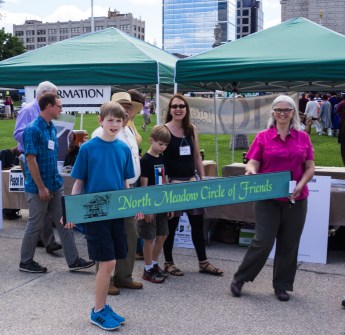
This is the story of the experiences of North Meadow Circle of Friends, an unprogrammed meeting in downtown Indianapolis, that were triggered by the killing of Michael Brown August 9, 2014, in Ferguson, Missouri, and where that has led us.

A group of ten young people, who became known as Indy10, discovered each other via social media, as people who wanted to do something in response to the plight of the Ferguson community and the excessive, militarized police response.  They arranged to meet and took food and water to Ferguson, and spent some time with the people in the community there.  The experience radicalized them, and they were determined to do what they could to address similar issues in Indianapolis.  One of Indy10 attends North Meadow Friends.  Her partner also became involved, and the meeting was aware of this work.

Unfortunately, after several months of frequent (3 times/week), intense meetings and some street protesting, conflict erupted, and the Friends left the Indy10 group.   That indicates how difficult this work can be.  It was especially disappointing because it had seemed real progress was being made after significant personal investment.  It became apparent that those in the North Meadow Meeting who had been involved were traumatized by the experience.  Fortunately some other Friends in the Meeting recognized this, and offered to meet to work through it.   Five of us, the three meeting members who had been involved with Indy10 and several of the Meeting’s spiritual elders, began meeting monthly over the winter last year (2014-2015), and found the meetings to be very helpful.  (I was the third, but more distant Indy10 member from North Meadow).

You might imagine our surprise, and excitement, when we learned that the American Friends Service Committee (AFSC) was looking for Friends Meetings that would be interested in participating in a pilot of a program called Quaker Social Change Ministry (QSCM), because that program seemed to reflect this process that we had started to deal with social justice work.
DSC08295

The Quaker Social Change Ministry program has two broad, connected goals.  One is to bring a more intentional spiritual focus to a Meeting’s social justice work, as well as to encourage people in our Meetings who don’t usually see themselves as activists, to become one.  It is common for meetings to have a number of people very involved in social justice and peace work.  But I think it is a little unusual to find that meetings do much more than support the individual in many cases.  They often don’t get involved, themselves, in that person’s work.  But just imagine what it would be like if the whole meeting found a way to participate in such work together.  Imagine how such work could flourish with the attention of more Friends, and how the spiritual life of the meeting would benefit by this shared work.

The second goal is to get Friends out of the Meetinghouse and into the community.  The idea of accompaniment is for the Meeting to find a group of people who are dealing with injustice now, and to learn from them what we might do to help.  Most of us are familiar with Friend’s history of jumping into situations and trying to provide leadership which often ends up not being what the impacted community needed.  This can end up causing more harm than good, and is why activists so find themselves discouraged, often giving up the work entirely.  QSCM helps Friends change the focus to the impacted community, because the people there are the ones who know the factors and people who are impacting their situation.  The impacted community has a better idea of what the driving issues are, and thus know what solutions are needed, and probably have a good idea of how to create those solutions.  Our role is to be ready to do what we are asked to do, when we are asked to do it.

To put it bluntly, white Quakers are simply ignorant about many issues facing people of color. “You know nothing until you realize that.” ― King Samuel Benson.   Until three years ago, I was as ignorant as most other white people I knew.  Now I know some things you can easily learn yourself, once you are aware of whatever the issue at hand is.  I have been very fortunate, but often saddened to have been able to see how different my new friends’ lives are from mine.  But this is the only way I see to begin to solve this problem.  Once individuals reconnect as fellow human beings, the problems then belong to all of us, and working together we solve those problems for all of us.  But I still have a great, great deal more to learn.

Ignorance can be corrected, as long as one is open to learning new things.  One of the problems of ignorance is that one simply doesn’t know what it is one does not know, or realize which historical narratives represent history that has been rewritten, to cover up injustices and atrocities.  I personally do not think you can be successful in this work if you do not start with the assumption of your own ignorance.  Friends in particular have a great deal of difficulty with this.  They are used to being well informed about social issues, and seen as leaders in social justice and peace work.

I know of the dangers of generalization, but what I have learned leads me to believe that if you are white, you do not understand, and you cannot understand what is happening to people of color until you have spent time with, and become friends with people of color.  These things cannot be learned intellectually, they are only taught by experience, informed by the heart and soul.

The community your Meeting partners with is doing you a favor by helping you correct your ignorance.  But be aware of this possible first misstep.  It actually adds insult to injury when (usually white) people expect those experiencing injustice to teach them (white people) what they (white people) need to know.   How would you feel if, after experiencing years of injustice, some of the very people who were involved in that injustice, even if they were unaware of doing so, came to you expecting you to teach them what the problem is and what they should do about it?

This was what really excited us at North Meadow regarding QSCM.  Several of us, in our own separate ways, had already established a relationship with just such a community which is not far from the meetinghouse.  The Kheprw Institute (KI) is a small (four main adult leaders) community that came into being over a decade ago to mentor young (teenage) children of color.  KI has become one of the most active social justice organizations in Indianapolis.  They are very generous in making their meeting facilities available for different groups working on all sorts of issues.  Because of the excellent training they are able to provide their interns (kids), KI is more and more providing technical support for other social justice organizations and meetings.  At a recent NAACP Environmental Justice presentation, KI provided live streaming of the event.  But most of their work is done at KI, where the youth learn about (by taking care of) the garden, aquaponics system, composting, web design, and social networking and programming.

Over 30 years ago Imhotep Adisa, KI’s Director, and JT, a North Meadow Friend who was involved in the original post-Ferguson group, and is now active in QSCM, went to the local University together.   It was about three years ago that I found KI when I attended an event there that was listed on an environmental organization’s website.  Kevin has helped with some construction and wood working.  Erin Polley, Indiana’s AFSC staff person, helped with the trip to Washington, DC, when one of the KI youth won the “If I Had a Trillion Dollars” video contest.  So we had the good fortune of a history of acquaintance and shared work.

For a number of years after KI first started, they tended to keep to themselves, forming a protected community for their youth, in a manner similar to how Friends used to maintain their own schools.  When I first met with them, I didn’t realize just how small and self-contained KI was.  My experience during that first meeting at KI was really amazing to me.  I describe that in detail here (https://kislingjeff.wordpress.com/2016/01/05/importance-of-stories/).  As I should have expected (but didn’t), that first meeting was actually an interview to see if I was someone who might fit into their community.  I mention this because I think Friends should be very cautious during their first meetings.  I hope you approach your meetings with the attitude that you are a seeker, wanting to learn about this new community, and, over time, growing into knowing one another, and remain open to what might be asked of you.  Remember, at least in my experience, it is better if you wait until you are asked for something, or to do something with or for the community.  Try to pay especially close attention, and listen for opportunities that may be somewhat subtle.  You might hear “we are having … event”, which is an invitation to you to attend.

Especially knowing how constrained KI’s resources are, I was committed to making sure we did our best to minimize what we asked of KI for this program.  Our goal was to help, not add to the burden of the KI community.  We were fortunate, again, this time for the wisdom of KI’s approach to community building.  For several years KI has held book discussions that are open to the community.  These events have a number of benefits, and have been key to KI’s spreading involvement in the Indianapolis activist community, as well as a perfect mechanism for North Meadow Friends to begin to accompany KI and their work.  Stimulating books are chosen, which have included “The New Jim Crow”, “The Pedagogy of the Oppressed”, “This Changes Everything”, “Animal, Vegetable, Miracle”, and the upcoming “Indigenous Peoples’ History of the United States”.  Last year the KI interns led the discussions of “The New Jim Crow”, which spanned several months of one a month meetings.  Rasul and Keenan would read a couple of chapters, and then each write a blog post about what they had read.  The community could then read those blog posts ahead of the discussion.  Then Rasul and Keenan led the public discussion.  They developed skills in critical thinking, public speaking, and leading group discussions.

Besides all of those good things, these discussions brought a wide diversity of people to KI to discuss ideas in a respectful and civilized manner.  The KI leaders, Imhotep, Miss Fair, Pambana and Alvin have created an atmosphere for the interns and all who come to KI that is based upon mutual respect, acceptance, and challenging each other’s ideas.  In his often subtle and humorous way, Imhotep helps people clarify their thoughts so everyone understands what they are trying to say.  And he gently leads the discussion back on track when it, fairly often, goes astray.  And helps summarize things.  People really enjoy these meetings because of the interesting topics, interesting participants, and welcoming, and yet challenging atmosphere.

More and more North Meadow Friends are attending these book discussions.  During our QSCM meetings we identified this as our first endeavor with KI, which would allow us all to get to know each other over several months’ time.  And it is also great in not adding a burden to KI in order for us to get this benefit.

So this is where we are with North Meadow Friends, KI, and the Quaker Social Change Ministry.  I think our participation in the book discussions at KI is appreciated.  And those at North Meadow who are involved (around a dozen) are finding QSCM and time at KI, and time together processing all of this to be very invigorating.  It does seem like we have had a unique set of circumstances leading to this point.  But I hope this program becomes widely used by Friends.

Additional information:

Quaker Social Change Ministry program                                     http://www.afsc.org/document/small-group-social-justice-ministry-model

Quakers and racism                                                                   https://kislingjeff.wordpress.com/2016/01/14/lessons-learned-about-quakers-and-racism/

Kheprw Insitute (KI)                                                                    http://www.indianalivinggreen.com/ki-ecocenter-cultivating-creativity-in-the-new-economy/

My first meeting at KI                                                                 https://kislingjeff.wordpress.com/2016/01/05/importance-of-stories/

https://kislingjeff.wordpress.com/2016/01/09/meeting-ki-part-2/

First combined meeting of North Meadow Friends and KI             https://kislingjeff.wordpress.com/2015/10/21/ki-and-north-meadow-friends/

“This Changes Everything” book discussion at KI                          https://kislingjeff.wordpress.com/2015/11/15/this-changes-everything-2/

Conversation is underrated (about book discussions at KI)            https://kislingjeff.wordpress.com/2016/01/24/conversation-is-underrated/

Beloved community                                                                                        https://kislingjeff.wordpress.com/2016/01/18/beloved-community/

Mind mapping racism                                                                                     https://kislingjeff.wordpress.com/2015/01/15/mind-mapping-racism/

Posted in Uncategorized | Leave a comment

Education Queries

As I’ve mentioned, a number of Quaker meetings spend one Sunday morning a month discussing that month’s set of questions, or queries.  The purpose is to provide a focus for sharing about our spiritual beliefs on the subject.  This month’s queries are about education.  My response follows.  Then the selected responses from the meetings in Iowa Yearly Meeting (Conservative) for a number of previous years are included for a historical perspective.

EDUCATION

 ADVICE

Friends seek an education which integrates our intellectual, emotional and spiritual dimensions and enables us to face difficult moral issues with courage.

While the religious education of our children is primarily the concern of parents, everyone benefits when the entire meeting is concerned with nurturing them. If a spirit of common concern is present, children will gain a sense of belonging to the larger community, and, knowing they are loved and respected, will be able to face the mysteries of life with trust.

Friends promote learning throughout life and encourage freedom of thought and inquiry in all educational pursuits. Our complex and changing world demands that we learn to think and act creatively to meet its challenges.   

QUERY

  • How can we most effectively foster a spirit of inquiry and a loving and understanding attitude toward life?​
  • What effort are we making to become better acquainted with the Bible, the teachings of Jesus, our Judeo‑Christian heritage, the history and principles of Friends, and the contributions of other religions and philosophies to our spiritual heritage?
  • In what ways can we encourage an educational process that is consistent with the values Friends cherish? How do gender‑based expectations affect the goals we set and the way we learn?
  • Do we take an active and supportive interest in schools, libraries and other educational resources in our communities and elsewhere?
  • How do we prepare ourselves and our children to play active roles in a changing world?


For a participatory government to work, the citizens have to have a broad understanding of history, and of how government works.  It is painfully clear not only do a great many citizens not understand how our government should work, but neither do a number of political candidates.

It saddens me to see so many people get so upset about issues which they obviously don’t have a good understanding of.  People who feel they have to intervene against people who don’t share their views do not understand rights, and tolerance and respect.

Finally, if the public had at least a rudimentary understanding of science, the fossil fuel industry would not have been able to stagnate needed environmental policies for decades.

Education in all its forms and everywhere it occurs is essential if we are to be able to tackle the global problems we are facing that threaten our very survival.

Education is essential for peace.

Jeff

DSC00797

  SELECTED RESPONSES   1998 Friends identify themselves as seekers.  We are drawn to books, magazines, newspapers, and media that express broad and diverse points of view.  We believe we teach openness to new ideas by example, and support each other in a thoughtful search for meaning and truth in the events of our time.  Our meeting’s diversity in age, gender, class, background, experience, and beliefs is a gift we greatly appreciate. No one present was involved in regular Bible study.  Several Friends agreed that the truth as found in scripture might have great personal value to a seeker, but it is difficult to quote scripture without getting tangled in arguments about interpretation.  Rufus Jones’ description of George Fox as “one who translated scripture into daily life” prompted one Friend to observe Friends’ actions are more convincing arguments for spiritual truths than learned pronouncements. We are heartened to have so many successful young adults who were once children of the meeting visiting this holiday season.  The parents of the meeting are doing something right.  There is also a concern that our religious education program is haphazard. One Friend pointed out that the convinced Friends of our meeting are often well versed in the Bible because they had the advantage of strong religious upbringing in other denominations.  There is concern that the meeting’s children are being short-changed.  Regardless of your philosophical stance on the Bible, you can not deny its importance in our culture and the need to know what the Bible says when evaluating appeals based on scripture.  There is a feeling of urgency on the need to move ahead with religious education. On the question of gender-based expectations, a Friend expressed tongue-in-cheek concern that the children may believe males do not clerk Quaker meetings.  On a more serious note, a member of the Religious Education Committee noted that it is very difficult to find teachers for our early elementary children; she felt one reason is that they are all very active little boys.  The phrase “active roles in a changing world” seemed very appropriate to how we see ourselves as honoring the truth we seek.  We put a high premium on being involved in the changing world in accordance with our values.

2000 There is a fine line between sharing knowledge and being able to still foster inquiry. Keeping this in mind will help the process of education within the Meeting, especially with the young Friends. To grow spiritually and intellectually, an exchange of ideas is welcome but can be difficult. Our small size tends to lend itself to a sense of limitation in this process of exchange since diversity could lead to unwanted conflict or a sense of alienation. Recognizing the need for establishing a foundation in religious study, we see the Meeting lacking success in this area. An attempt was made for some time to hold a worship sharing midweek, but there was a lack of commitment by attendees. The Bible, while not the only religious text worth study, is the foundation of Christian-Judeo teachings, central to our culture. Understanding the Bible’s teachings would be an appropriate tool by which to improve our religious education studies.  Educational outreach goals could include approaching the schools where our young Friends attend to see if books about Quakers are in the libraries. The same can be done at local public schools.

2001 Realizing that teaching by example is an effective way in which individuals learn, it is important for us to be constantly aware of the many questions of our children.  We feel there is an over-emphasis in our schools on the intellectual side of learning causing the emotional and spiritual sides of our children’s natures to often be neglected.  Schools sometimes instill a lack of trust in children when teaching safety to them in situations where they may potentially be confronted by people who would abuse them.  We need to nurture within them a healthy balance of trust and common sense.  It is important for everyone to help children cultivate curiosity, compassion, and caring for other people and for the world of nature.

2002 One person pointed out that the word education comes from a Latin word meaning draw forth, bring out.  He understands education as a challenge to draw forth what is already in the student, to help develop the ability to ask questions, find answers within themselves.  He suggested that we seek to educate, to connect that of God in us with that of God in the other and draw forth that light.  Thinking in either/or terms, labeling, thinking within closed boxes does not lead us to walk in that light of God. Another person suggested that we must learn to face moral issues with courage and creativity.  What do we “pour in” to “draw forth”?  As teachers, parents, adults, we inform and introduce possibilities to our young people.  He finds this a stimulating and difficult balancing act.  We are examples to/for our children in our homes and at meeting; our own efforts to understand, inquire will teach our children.  The query also makes clear the importance of children and adults sharing experiences, getting to know one another through such activities as leaf-raking, canoe trips, and washing dishes together.  We might benefit from more of such activities. We are aware that our meeting has been strongly influenced by our relationship and geographical proximity to Scattergood Friends School, in that many of our members and attenders have been or are part of that community.  We are grateful for this on-going influence among us. That of God within each person is central to the spirit of inquiry and reverence for life.  Equally central is the belief that Truth exists, that we can know that Truth, and commit ourselves to seeking it out. Determination to seek that Truth drives our spirit of inquiry.  To know that what we are doing is right, true, that it is in harmony with the will of God is central to integrity in education.  At the same time, someone suggested the difficulty of knowing the difference between our own occasional stubborn adherence to ideas that may not in fact be related to the divine Truth that we seek.  For this reason, it is important at times that the meeting consider such ideas in the spirit of worship and seeking the Light.

2003 Our First Day School regularly studies Quakerism and the Bible, and we are pleased that some of our grade school children are standing up at school as Friends and against war.  It would be a good idea to donate books in which Quakerism is explained to public and/or school libraries.  We recognize that our kids are still exposed to gender and sexual preference prejudice in society, and we need to provide an alternate view, especially for young teens who are forming their gender identities.  Some of our children are concerned about homosexuality and not wanting to appear to be gay.  We need to be aware of our children’s adult role models, of the attitudes they’re exposed to and taught in school. We do encourage our children to question the status quo, in First Day School and in discussions at home.  We talk to our kids about what we, and those we admire, have done.  We ask questions and challenge authority in front of and with our children.  Our children participate with us in service projects such as Brush Up Nebraska, directly learning that we value giving of ourselves. Some of us remember rebelling against our parents and their churches when we were young.  Often the problem was hypocrisy or inconsistency.   When we discuss our ideals and admit our shortcomings it might be easier for children to understand and accept both our religious principles and our human flaws. Second selected response: We feel the need to nurture within our children a wholesome balance of trust and common sense in this sometimes unsafe world. One of our members mentioned seeing a T-shirt that read, “children need to be seen, heard and listened to.” We support programs in the school that teach conflict resolution and mediation skills. A law student in our group raised a concern that higher, as it exists today, often promotes hierarchical rather than democratic values. Children need to have a healthy balance in their lives of activities that nurture their bodies, minds, and spirits. In order for children to gain self-esteem, they need to experience success. We feel the public education frequently places too much emphasis on competitive athletics, causing children who aren’t skilled in athletics to experience rejection. We were reminded that meeting First Day School needs is the responsibility of everyone in the meeting. A suggested learning experience would be to have children interview adults in the meeting in order to learn what adults do in the world.

2004 We assume our second hour discussions foster a spirit of inquiry among adults.  Children in religious education classes seem eager to learn.  A spirit of loving and understanding is learned by example. Several times religious education classes from other churches have attended meeting.  We wondered whether we’ve missed an opportunity to ask them about their beliefs. Quakerism 101 classes were held last year in pre-meeting sessions, and are being continued once a month this year.  One recently was about the book of Thomas, which is not in the Bible.  People who read about other religions sometimes share in meeting. We’re struggling with providing an education process consisted with Friends’ values for our young Friends, and in decisions about the educational needs of our children. One of our members was elected to the school board and exposed the school system to Friends’ values, but decided not to run for re-election. We spoke to the issue of gay and lesbian youth at a special meeting of the Des Moines School Board several years ago.  Several members teach in the schools and bring values with them.  None of our students attend Scattergood at present.  Quite a few attend Camp Woodbrooke, where they’re exposed to Quaker values.  We ordered Quaker book covers for our students to use at school instead of the ones the military services provide. Friends whose children are grown serve as role models – perhaps unconsciously – for young parents.  The activism of some Friends also provides a role model.  Preparation for a changing world requires prayer.

2005

We moved slowly into the discussion of the Advice and Query on Education, considering various ways in which we try to live our values in this area.  It was not difficult to see that many of us are active as parents and citizens in our local public schools, that we are working to strengthen our relationship with Scattergood Friends School (a process, we noted, which results in their giving to us also), and that some of us have been active with the local television program, “Conversations,” which focuses on issues of peace and justice and involves high school students in the production of the show.  The Library Committee is glad to report that the library is being well used. We recognized that the spirit of inquiry that the advice suggests we foster is a natural trait in our young children.  Early in their development, our work may largely be to step out of the way to effectively enjoy, and avoid squelching that natural inquisitiveness.  As children grow, we ruefully agreed, their spirit of inquiry can lead them to places we prefer them not to go.  Guidance always has its place.  We remember that, not uncommonly, adults too can use guidance.  As we considered how central it is to our Quaker beliefs to teach by living our testimonies, we encountered the tension that exists between teaching by example and the need to sometimes articulate our values to our young people.  Friends shared doubts about not having been clear enough with their children about the reasons behind their decision to live simply.  We are perhaps reticent about talking about why we choose the way we live.  We also remembered that our young people are astute in their understanding of our values, spoken or not, and that we respect and trust them as they move into adulthood.  Implicit Quaker values may teach our young people how to consider who they wish to become.  We must release them with grace as they find their own ways with the world, remembering that as we have found our own paths, so shall they. It became apparent in our discussion that we especially search for ways to teach simplicity, and that we are not sure we have been successful. It helped us when a Friend reminded us that the complications in our lives can interfere with our awareness of the presence of God.  A simple life better enables us to be in harmony with the Spirit.  We were grateful also for the reminder of one Friend that God’s love and generosity are in great abundance everywhere around us, and that our search for simplicity needs to focus on that very abundance, not simply on our response to materialism. We strive for simplicity within the experience of God’s abundance.

2006 Education continues throughout life.  People here are always investigating some topic.  We share things we read.  This encourages others to keep growing. Some worry that our children don’t get the biblical background they did.  We have a small number of children and struggle with the challenge of exposing them to the love of God.  Other churches can go to a religious bookstore and pick up a packet for the semester.  There are Quaker curricula about various subjects, and for different lengths of time. One told of having rejected Sunday school because of dogma.  Teachings of Jesus on loving kindness, connected to experiences each week, could be discussed and could stimulate curiosity. Two of our members attended divinity school, where students get involved in studies about Jesus.  One of them said that answering queries helps his spiritual development. A member who transferred from another meeting said people there shared their spiritual journeys.  We’ve had new people do that, but then they want to hear ours.  We used to take turns doing that with the children.  Doing this kind of sharing was suggested.  We do some of it as a by-product of discussing sections of the Faith and Practice revisions.


Posted in Uncategorized | Leave a comment

Crime against humanity

Michael Moore, a Flint native, has written an eloquent and accurate analysis of the situation in Flint, Michigan.  The headline is “How can you help Flint?  Do not send us bottles of water.  Instead, join us in a revolt.”

He shows that it is just not feasible to supply 100,000 with their daily water needs using bottled water.  He also describes how it is already too late to prevent the neurologic damage children have after two years of having complaints about the water ignored.  There is no ambiguity about what happened, and when.  The cloudy, yellow, smelly water began to come out of the water taps immediately when the cost saving switch was made.

For two years the citizens of Flint were poisoned–there is no other word.

And the citizen’s voice had already been silenced when the democratically elected government was replaced by accountants.  The state of Michigan choose saving money over the health of its citizens.

As Michael Moore warns, this is happening all over.  The relentless Republican assault on environmental regulations, unions, and using our tax money for infrastructure and services we need, has destroyed the middle class, and resulted in a crumbling infrastructure and dirty water, air and land.  And yet the Republicans continue to prevent funding for these things because they are pledged to not raise taxes.  And the government is not addressing climate destruction because a handful of radical white men are protecting the fossil fuel industry.

We need to accept Michael Moore’s invitation to join the citizens of Flint in a revolt.  Sign the petition and spread the word about this crime against humanity, and the system that perpetuates it.

These are the principles Bernie Sanders campaign is built on.

flintwater

“A crime against humanity has been committed against the people of Flint, making them refugees in their own homes. Tell me honestly: if you were living in Flint right now, and you learned that your children had been drinking lead-filled water for two years, and then you discovered that the Governor knew this and the state lied about it – tell me, just how fast would your head be spinning? With your children now poisoned, and with the poisoning continuing… is the word “nonviolence” dominating your thoughts right now? Are you absolutely, stunningly amazed how peaceful the people in Flint have remained? Are you curious how much longer that can last? I hope it does. If you want to help Flint, sign the petition, demand that the federal government take action, and then get involved yourself, wherever you live, so that this doesn’t happen to you – and so that the people we elect know they can no longer break the law as they rule by fiat or indifference. We deserve much better than this.”

For a better world,
Michael Moore

Posted in Uncategorized | Leave a comment

What if you gave a war and no one came?

Yesterday I wrote about a leading I had to urge people to respond to the Flint, Michigan, water crisis–Sound the Alarm.    Michael Moore has an excellent response web page here.

Leadings are difficult to explain.  As a scientist I work in a framework we like to believe is based upon facts and logic.  But the more we learn about our world and how it works, the more we realize how much more there is that we don’t know or understand.

Spiritual matters are often seen as almost an opposing viewpoint.  What our spiritual beliefs are and how we express the spiritual aspects of our lives don’t flow from the intellect, but from what we are able to discern and understand of that spirit that does live within us all, connecting us all to each other and everything in our world and beyond.  The heart versus the head.

As a Quaker scientist I don’t have a problem with the idea of integrating the science and the spirit in my life–the actual accomplishment of that doesn’t always go as well as I’d like.  But I have faith that it will always, eventually, happen.

Yesterday I awoke with a strong leading to raise up the issue of the lead contamination of the water supply of the city of Flint, Michigan.  Perhaps it was because I am sensitive to the profound and lifelong effects of neurological damage in children because of my work here at Riley Hospital for Children.  Maybe it was because I have been learning more and more about the privileges of being white in our society.  Maybe because I see more situations where people could help, but choose not to do so.  Maybe because I see friends of mine working so hard with Black Lives Matter, and seeing how they are affected when the message seems, time and again, to be that black lives just do not matter.

Water is obviously essential for life.  And we depend upon our municipal governments to supply us with clean, safe water.  But in Flint, Michigan, saving money was more important than the well being of the citizens the government is supposed to represent and serve.  And the government is resisting accepting blame and fixing the problem.  These people need our help.  The problem is urgent because of how essential water is for life.

So I reached out to everyone I could think of.  I also made suggestions that people write letters to the editor, contact their representatives, contact authorities in Michigan.

I only received one response which I really appreciated (anonymous since I haven’t asked permission to share the name)  “Thank you for sharing this call to action, Jeff. I feel your prophetic rage. I pray that Friends respond to this injustice.”

But the thing about leadings is that you try to do what the leading is telling you to do, and whatever response there is or isn’t, is really not what you are concerned about.  Very often one learns in another time and place, that someone did do something in response.   We are supposed to sow the seeds.  What happens next is out of our hands.


Posted in Uncategorized | 2 Comments