
The Great Bison Spirit and the Dakota Access Pipeline by thirdeye
http://www.whitewolfpack.com/2016/10/givers-of-courage-thousands-of-wild.html
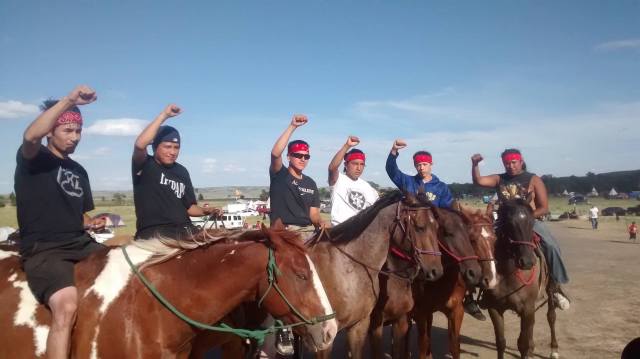
Peter Clay photo
Water protectors’ statements regarding commitment to nonviolence and prayer to oppose the Dakota Access pipeline:
According to the Associated Press, Don Cuny, the security leader for activists at the encampment, said Saturday that standoff “does not represent” the ongoing protest. Cuny noted that disagreements have surfaced about how to demonstrate, but he said any people involved in the protest who instigate trouble would be kicked out of the encampment.
Danny Grassrope, 24, told ABC News Saturday that he was arrested at the protest site and witnessed police officers spraying protesters while they were praying.
“This weekend we went to go demonstrate with peaceful action. We went to go pray,” Grassrope said. “Then while we were praying, the cops came and told us we couldn’t be there. We were just standing there and then this police officer came and opened up with some pepper spray. We weren’t antagonizing them or anything, we were just praying.”
“I don’t understand why it was a riot, the police were in riot gear we were just praying,” Grassrope added.
“Our camp needs to continue to be peaceful and prayerful,” Caroline High Elk, who has stayed at the encampment for brief periods eight times over the past few months, said Saturday.
From Democracy Now! story September 6, 2016:
AMY GOODMAN: Why is this such an important fight to you?
PROTESTER 17: Because water is life. Like I said, without water, we’d all—we wouldn’t be here. These plants wouldn’t be here. There’d be no oxygen. We’d all die without it. I wish they’d open their eyes and have a heart, to realize, you know, if this happens, we’re not going to be the only ones that are going to suffer. They’re going to suffer, too.
AMY GOODMAN: What tribe are you with?
PROTESTER 17: I’m Oglala Sioux, full blood.
AMY GOODMAN: From?
PROTESTER 17: Pine Ridge Reservation.
“Militarized law enforcement agencies moved in on water protectors with tanks and riot gear today,” tribe Chairman Dave Archambault II said. “We have repeatedly seen a disproportionate response from law enforcement to water protectors’ nonviolent exercise of their constitutional rights. Today we have witnessed people praying in peace, yet attacked with pepper spray, rubber bullets, sound and concussion cannons.”
Eryn Wise of the Indigenous Youth Council said, “I have no words for what happened to any of us today. They are trying to again rewrite our narrative and we simply will not allow it. Our youth are watching and remember the faces of the officers that assaulted them. They pray for them.”
“Yesterday, we saw folks being maced. I was standing right next to a group of teenagers that were all maced in the face, maced right—like all kinds of people. Myself, I actually was almost shot in the face by bean bag round. It ricocheted off a truck right next to my head. These police were actively trying to hurt people, pushing them back to allow construction of the Dakota Access pipeline. They were defending monetary interests as human beings were being physically hurt. You know, I saw—I saw, right in front of me, a group of police officers pull a protester forward and begin beating him over the head with sticks. There’s video of it that you can see. I mean, this was an all-out war that was waged on indigenous protectors that were doing nothing more than peacefully assembling.” Tara Houska, national campaigns director for Honor the Earth, on Democracy Now!
GENEVA (22 September 2016) – The United Nations Special Rapporteur on the rights of indigenous peoples, Victoria Tauli-Corpuz, today called on the United States to halt the construction of the Dakota Access Pipeline as it poses a significant risk to the drinking water of the Standing Rock Sioux Tribe and threatens to destroy their burial grounds and sacred sites.
“The United States should, in accordance with its commitment to implement the Declaration on the Rights on Indigenous Peoples, consult with the affected communities in good faith and ensure their free, and informed consent prior to the approval of any project affecting their lands, particularly in connection with extractive resource industries.
“I urge the United States Government to undertake a thorough review of its compliance with international standards regarding the obligation to consult with indigenous peoples and obtain their free and informed consent. The statutory framework should be amended to include provisions to that effect and it is important that the US Environmental Protection Agency and the US Advisory Council on Historic Preservation participate in the review of legislation.”


The question that has been put to me recently relates to how we decide which public events to support.
Quakers believe that the spirit of God is present in all of us, and guides our way each day. And it is our purpose to live our lives as closely as possible to that continued guidance. What we say and do should be as faithful to that as possible.
Friends extend that to believe that we accept responsibility for groups that we participate in. We join and are active with organizations that are working to put our faith into action. Quakers have created and support Quaker oriented organizations for this purpose, such as the Friends Committee on National Legislation (FCNL) and the American Friends Service Committee (AFSC).
The opening question concerns how we deal with organizations that support some of the things we agree on, but believe and work on additional things that we do not agree with. I had not thought about this much before I became involved in the Moral Mondays movement in Indiana. Prior to that I had just been involved with Quaker organizations. This was one of the fundamental things that had to be worked out when the Moral Mondays movement began in North Carolina. This diverse, faith based movement realized that they were never going to make any progress if everyone had to agree on everything.
Instead, they adopted the idea they call “fusion” politics, which means diverse organizations come together to work on their common goals, while at the same time acknowledging they have differences in other areas.
When we began organizing Indiana Moral Mondays, those of us in Indiana had to grapple with this idea, as well. North Meadow Friends decided not to join Indiana Moral Mondays primarily because they were uncomfortable with that idea.
Similar concerns were raised in Iowa Yearly Meeting (Conservative), when I began to encourage Friends to join the Keystone Pledge of Resistance. People questioned whether others participating in the Resistance would have the knowledge and discipline to act appropriately if a situation began to escalate. Those discussions made me even more aware of the importance of training those who might participate in nonviolent direct actions. I studied more about nonviolence, direct action, and civil disobedience. Then I always volunteered to teach that part of the training sessions we offered here. I guess I made my point when one student jokingly said “you’ll get mad at me if I get violent.”
Thus I was comfortable being engaged with the Keystone Pledge of Resistance. Training related to nonviolent civil disobedience was a large part of the training every person who wanted to participate in the Keystone Pledge of Resistance received. People from the Rainforest Action Network (RAN), who themselves had experience with this, went to 25 cities in the U.S. to do this training for local Action Leaders, who then trained local activists. There was always the possibility that someone would react inappropriately. But we made a commitment that this was a nonviolent campaign, and we could only trust that each person would do their best to be true to that goal. Fortunately the direct actions were not triggered because President Obama made the decision to deny the permit to build the Keystone XL pipeline, in part because of the pressure brought to bear by efforts like the Keystone Pledge of Resistance. Nonviolent campaigns are successful when what they are supporting happens because the decision makers are made aware of what will happen otherwise.
The reason the opening question is being asked today relates to a similar situation, i.e. the nonviolent campaign to stop the construction of the Dakota Access Pipeline (#NODAPL). Since April, Native American and other water protectors have camped near the point where the pipeline would be built along the bottom of the Missouri River. They are praying and committed to nonviolence. Hundreds of Native Americans were trained in nonviolent direct action during the Keystone campaign. Nearly 300 tribes and thousands of people have come to these camps.
The governor of North Dakota has aggressively reacted to these peaceful protests, employing the National Guard, and law enforcement officers from surrounding states. Even journalists have been illegally arrested. Helicopters, drones, militarized vehicles, and hundreds of law enforcement officers in riot gear have acted aggressively toward the peaceful gatherings, sometimes using pepper spray and attack dogs. First amendment rights have been violated over and over again. Just today USA Today published an article entitled “Dakota Access pipeline protests continue as questions of fairness emerge“.
Things escalated last Thursday when over 300 law enforcement officers moved in to forcibly remove people from where they were camping. Some tires and construction vehicles were set afire. Although authorities claimed one women fired three shots from a gun at officers, Native American Robbie Romero stated “the only gunshots that were fired would have come from them. They are armed. We are unarmed. They are trying to spin the narrative. They are using an increasingly vast military operation to respond to our spiritual resistance.”
This caused at least one Friend to state that Quakers should not be supporting these efforts. They feel that is condoning violence.
I disagree, but admit I am still praying about this. I believe we are responsible for our own actions. I also believe that if we are to support and engage in nonviolent direct actions, especially because of our study and participation in such actions ourselves, we have a responsibility to make sure everyone else involved knows as much as possible about this. There is a significant spiritual component to this that Friends can help others with. If one or two people fail to live up to the ideals of nonviolence, that definitely tarnishes the image of the campaign. The whole thing is founded on the principle of not returning violence with violence, and if one person does, that both decreases the effectiveness of the campaign as a whole, and is often used to justify violence by those opposing the campaign.
But I do not think that means we have to disengage from the campaign ourselves, though I know other Quakers disagree with this. I do not believe violence is ever justified. But I don’t think the failure of one person to show restraint invalidates the entire campaign. That failure needs to be addressed in the strongest possible terms, and used as an example of what not to do.
To me, when one chooses not to act, not to engage, that is an active decision. We are saying we have decided not to participate. I can respect those Friends who do not believe they can support the water protectors in North Dakota. But if environmental destruction is a concern for you, you know we have to stop mining and burning fossil fuels right away. That is why the Dakota Access pipeline is an urgent issue for me. I believe those in North Dakota who are camping there to oppose the pipeline are committed to the principles of nonviolent direct action to try to stop it, and I continue to support them, and related efforts of support here in Indianapolis.


The situation in North Dakota is being dramatically escalated by the Governor and the presence of militarized police from surrounding states. NOW is the time those of us who cannot be in North Dakota can do our part.
The Global Solidarity Campaign is asking you to help:
These are the ways to join the fight:
Please call the White House NOW 202-456-1111 and leave your comments for the president. the switchboard is 202-456-1414
Also note your local police department might be involved in North Dakota.
Although the Obama administration, and three Federal agencies have asked that construction on the Dakota Access pipeline be halted, construction continues. The Standing Rock Sioux have also asked for help from the United Nations, and received support there.
Water protectors in North Dakota affirmed in the 1851 Treaty of Ft. Laramie as sovereign land. under the control of the Oceti Sakowin, and established the Treaty Camp on what is designated as private property, along the route of the pipeline, in order to prevent construction continuing to the Missouri River. The Army Corps of Engineers has still not given permission for the construction of the pipeline under the river.
Now is the time to raise our voices in support of the water protectors, against the fossil fuel industry. The fate of future generations is what is at stake. It is up to each one of us.


Please contact the Department of Justice, your Congressional representatives and the White House to ask why law enforcement in North Dakota is being used to suppress the rights of the water protectors for peaceful protest. Why law enforcement officers from other states are being recruited. Native rights and multi-state law enforcement make this a Federal issue.
This is the natural progression from the shocking, militarized police response, one that we began to see in Ferguson after the killing of Michael Brown. We have to speak out, or you will soon see armed soldiers patrolling the streets of your neighborhood, if you don’t already.
Standing Rock Sioux Chairman, David Archambault, wrote in a letter to the Department of Justice:
“Peaceful protests are being met with military vehicles and heavily armed law enforcement personnel in riot gear. Rather than seeking to keep the peace, law enforcement personnel are clearly working in tandem with private security of Dakota Access.”
Is this what the next war will look like? Armed soldiers, protecting the rich against the rest of us on a global scale?
The CREDO online petition to North Dakota Gov. Jack Dalrymple and the U.S. Department of Justice reads:
“Journalism and activism are not crimes. Ensure that journalists can exercise their constitutional rights to do their jobs without fear of government intimidation or prosecution. Uphold the rights of Native Americans and their allies to peacefully resist the Dakota Access pipeline without threat of violence.”
From: No Dakota Access Indy
Indiana Homeland Security has sent our police officers to the Standing Rock camps in North Dakota to participate in the bullying and brutalizing of peaceful water protectors.
Please call the police departments who are participating in this and let them know you do not approve or support and are ashamed that our state would send representatives to be part of the lawless, unprofessional, un-constitutional actions and behaviors that the police have demonstrated towards peaceful water protectors at Standing Rock.
The team from Indiana includes 37 total officers from 9 different offices all being organized by and through the Indiana Homeland Security Office:
Indiana Homeland Security Office: 317.234.6713 ; pio@dhs.in.gov
Indiana Department of Natural Resources: (812) 837-9536 ; ICODispatch@dnr.IN.gov
Lake County Sheriff’s Department: (219) 755-3400
Marion County Sheriff’s Office: (317) 327-1700


Stories are appearing more frequently about robots and advances in artificial intelligence (AI). As a computer programmer I find this to be a fascinating subject. Perhaps that is also the reason I find the subject so terrifying. I know how easy it is to write software that interacts with machines. Daily I write computer code to open and close valves and to read flow, pressure and gas instruments in order to automate breathing tests for babies.
I know how easy it is to write a program to:
I also know of the problems related to “Identify target”. Once you have refined algorithms well enough, and are using enough sensors, it is pretty easy to be sure the machine is looking at a human. And eventually identifying which particular human will be as accurately defined, and I’m sure already is in systems being developed today.
The real question becomes how the decision is made to kill a particular person. This is the question that has not been satisfactorily answered regarding our use of drone warfare. And how close are we to using, or are we already using, drones for domestic “targets”? Imagine that being added to our problems with policing!
But the greatest danger comes when robots are programmed to act independently in situations, such as combat or a police encounter, to make its own decision as to when to kill a target.
The consequences of software that empowers that kind of autonomous decision making are difficult to contemplate, they are so potential horrible. Combine that with automated manufacturing process like 3-D printing, and it is easy to image weaponized robots manufacturing clones of themselves.
Perhaps not quite as horrifying, but sooner to be a practical problem for all of us, are how driverless cars make decisions about who to save and who to sacrifice when an accident looks eminent. Recent statements about protecting the car’s occupants don’t sound that attractive to those of us who aren’t likely to be in cars.

As I’ve been writing lately this is a time for Quakers and others to return to the public square. Corporate control of the mainstream media means news about injustices such as those related to the Dakota Access pipeline and either not reported or slanted to favor the fossil fuel industry.
Things in North Dakota are escalating now that construction of the pipeline is drawing closer to the Missouri River, where the Native American camps are. This is also the point of the primary legal hope for stopping the pipeline, since the Army Corps of Engineers has not given final approval for constructing the pipeline under the river.
Organizers are sending out emergency calls for people who understand nonviolent direct action to come to the camps. 83 people were arrested Saturday, and the size and militarization of law enforcement is increasing dramatically.
Yesterday water protectors took back unceded territory affirmed in the 1851 Treaty of Ft. Laramie as sovereign land under the control of the Oceti Sakowin. There is supposed to be a meeting today at the White House to discuss this issue of eminent domain.
Those of us who cannot get to North Dakota need to do what we can to raise awareness about the Dakota Access pipeline and the many, global issues related to it. This is an opportunity to have a deep, needed discussion about past treatment of Native Americans, and an opportunity to do the honorable thing and acknowledge Native American’s relationship to the Earth, one that we would do well to learn from and emulate today.
We would not be struggling over pipeline issues, and facing human extinction from environmental destruction, if we had cared for the Earth as indigenous people around the world do. Please add your voice however you can to make others aware of the environmental emergency we are in.
As Chief Arvol Looking Horse, of the Lakota, Dakota, and Nakota Nations recently said:
“To us, as caretakers of the heart of Mother Earth, falls the responsibility of turning back the powers of destruction. You yourself are the one who must decide.”
“You alone – and only you – can make this crucial choice, to walk in honor or to dishonor your relatives. On your decision depends the fate of the entire World.”


In yet another example of global environmental leadership and creative resistance, water protectors in North Dakota took back unceded territory affirmed in the 1851 Treaty of Ft. Laramie as sovereign land under the control of the Oceti Sakowin
Mekasi Camp-Horinek, an Oceti Sakowin camp coordinator states, “Today, the Oceti Sakowin has enacted eminent domain on DAPL lands, claiming 1851 treaty rights. This is unceded land. Highway 1806 as of this point is blockaded. We will be occupying this land and staying here until this pipeline is permanently stopped. We need bodies and we need people who are trained in non-violent direct action. We are still staying non-violent and we are still staying peaceful.”
Joye Braun, Indigenous Environmental Network organizer states, “We have never ceded this land. If DAPL can go through and claim eminent domain on landowners and Native peoples on their own land, then we as sovereign nations can then declare eminent domain on our own aboriginal homeland. We are here to protect the burial sites here. Highway 1806 has become the no surrender line.”
This seems only right, especially since eminent domain has long been abused by private, pipeline companies for their own profit. Many farmers and landowners did not want to give up their land for the Keystone, Dakota Access, or other pipelines. As just one example, imagine the amount of damage done to the tile systems in the fields to aid water drainage.
Perhaps this will trigger an honest and ethical review of Native American rights in regard to infrastructure projects, as the Obama administration has indicated it wants to do.


After writing about the tensions between religion and culture yesterday, I read this:
“Indian cultural traditions provided an easy explanation for certain kinds of religious acts whereas Christian religious acts depended primarily upon the acceptance of Western culture. It was this cultural and historical perspective that Indians rejected. The result we see today is the rapid movement away from secularism and Christianity toward a more serious traditional religious life.” God Is Red: A Native View of Religion, Vine Deloria Jr. p. 38
I wonder if this is another indication that there are similarities between Indian and Quaker views of spirituality. Fortunately there are several Friends at North Meadow who have experience with Native Americans, and we plan to explore this.
One of the things I came across in God Is Red is the difficulty Native Americans have in finding people who can understand their views.
Native issues have long been a focus of the work of Friends Committee on National Legislation (FCNL).
https://www.fcnl.org/about/policy/issues/native-americans
https://www.fcnl.org/updates/standing-with-the-standing-rock-sioux-tribe-89
https://www.fcnl.org/updates/dakota-pipeline-protest-250

North Meadow Friend Kevin Angell at No Dakota Access rally downtown Indianapolis
I am at a place when things are swirling around in my mind and spirit. On the one hand I welcome these times, because I know from past experience these are times of growth. I love the expression “outside your comfort zone”. As I get more experience with life, I find myself actively seeking occasions where I can get outside my own comfort zone. Life is short, so why not push the boundaries as far as you can? Once you break through a boundary, you find a whole new vista before you. On the other hand, who doesn’t like being comfortable?
Recent experiences that have helped me with being uncomfortable include getting involved with the Keystone Pledge of Resistance, with the opportunities to make deep friendships and work with people willing to risk arrest to try to raise public awareness of our environmental crisis. Engaging with the Kheprw Institute (KI), and making deep friendships, discussing difficult issues in a public place, and learning by seeing how the people there live exemplary lives. Maintaining ties with my friends involved with local Black Lives Matter issues. Most recently getting involved with the folks at White Pine Wilderness Academy, and beginning to make deep friendships there, and benefitting from their connections with Native Americans, and hoping to have similar opportunities with them.
But then there are the continuous images of our country’s military incursions all over the world, and knowing how the vast military budget consumes the resources our citizens so desperately need for dignified life. There is no more glaring failure than to know millions of children and adults live in hunger, and far too many without even shelter.
All of those situations churn up ugly parts of our dominate culture. The more you learn about our historic treatment of Native Americans and Black people, the worse it gets. Its no wonder the dominate culture rewrites history and our children’s textbooks.
Our dominant culture has fallen for the false promises of materialism while at the same time creating a spiritual vacuum and a crisis of values. “It is easier for a camel to pass through the eye of a needle than for a rich man to enter the Kingdom of Heaven.”
At North Meadow Circle of Friends (Quaker) meeting, we are studying the book “Fit for Freedom, Not for Friendship: Quakers, African Americans, and the Myth of Racial Justice”, by Donna McDaniel and Vanessa Julye.
Vanessa Julye, who is African American, wrote “When I joined the Society of Friends I believed that Quakers of European descent had a wonderfully special relationship with Friends and non-Friends of African descent. Thus the book provided the opportunity I needed to understand what had happened to this relationship. I learned that the relationship in which I believed had never existed. As a whole community the Religious Society of Friends through the centuries has always reflected the beliefs and cultural practices of mainstream North American society.” page xix
In our first meeting to discuss this book, we struggled to understand how anyone could justify enslaving another person. How especially Quakers, who say they believe “there is that of God in everyone” could be involved in the slave trade, and enslaving people themselves. And the only, unsatisfying answer anyone could come up with was that they didn’t see Black people as people. How much effort, and spiritual cost, did that take on the part of the enslaver, let alone the many much more severe costs to the enslaved? Quakers live in the culture of their time, then and now.
As someone wisely asked at the time of the discussion, what things are we doing today that are similarly wrong, just because they are part of our current culture?
I used to wonder about Friends’ idea of a “guarded” education. Now it is clear to me that they were hoping to teach us (as Scattergood Friends and other Quaker schools have done) to try to be aware of the dangers of the culture we live in.
This is all the more important in today’s culture of materialism and militarism and spiritual void. The Advices and Queries Friends meetings use, questions about how we are living our lives right now, are one useful way to force our attention to these cultural dangers.
One of the reasons participating in things like Black Lives Matter, and trying to stop the Dakota Access Pipeline and respect Native rights, is because these movements are shining a light on the ongoing injustices of our dominant society. For our own spiritual good, we need to get involved with these things ourselves. We need to start from the assumption that there is much in our dominant culture that needs to change. What things do we accept because “that’s the way things are”, that are actually unacceptable?
As just one example, because this has been a lifelong issue for me, now that there is no question about how much damage driving a personal automobile does to our environment, doesn’t that tell you that you have to get rid of your fossil fuel burning car, and support mass transit and walkable communities now?
Doesn’t it mean that we have to change policing practices now so that families of people of color don’t have to teach their children how to interact with police in a manner that hopefully won’t get them killed?
Doesn’t it mean that we finally honor Native rights, especially when doing so can save us from our own environmental destruction?
We have to stop living under the influence of culture. Sometimes it helps to look from a different perspective. What do you think future generations will think about the way we are living now? In the environment they will be living in, with much higher temperatures and more frequent and violent storms, and rising seas and flooding, scarce food and clean water?
As I have been writing lately, and as Rev. William Baber has admonished us in a recent article in Friends Journal, it is time for Quakers to get back into the public square to speak about these things.
“One of our people in the Native community said the difference between white people and Indians is that Indian people know they are oppressed but don’t feel powerless. White people don’t feel oppressed, but feel powerless. Deconstruct that disempowerment. Part of the mythology that they’ve been teaching you is that you have no power. Power is not brute force and money; power is in your spirit. Power is in your soul. It is what your ancestors, your old people gave you. Power is in the earth; it is in your relationship to the earth.” ― Winona LaDuke
The parts of Friends’ history that continue to help us today are the lessons that teach “power is in your spirit.”


 Quakers, social justice and revolution