Thanks for the comments about my photographs, especially related to theZen Photographer blog post.
Now that I’m back to being just a regular photographer, with my new camera, I’m reminded that I haven’t shared this autumn’s photos, yet. I thought I was going to miss out on photos this fall because of the camera theft, and the album is pretty small, so I’m also including a link to last year’s autumn album. I was frustrated because this was a particularly color fall here in Indianapolis.
There is a limit to how many photos you can include in your WordPress blog posts that I keep running up against, so following are two links to the online photo albums on OneDrive.
I’ve mentioned that one way Quakers share and develop their spiritual lives are by considering a series of questions, we refer to as queries. Each month there are a set of queries to think about and discuss together on a certain topic.
A number of members of my home Quaker meeting, Bear Creek, near Earlham, Iowa, don’t live near the meetinghouse, so we send our responses to the meeting via email. This months queries are related to the topic of personal responsibility, with my response following.
“Life is meant to be lived from a Center, a divine Center–a life of unhurried peace and power. It is serene. It takes not time, but it occupies all our time.” Thomas Kelly
ADVICE
Historic testimonies of the Society of Friends against taking oaths, joining secret organizations, gambling and using addictive substances grew out of efforts of Friends to live with integrity and consistency. To swear an oath implied that one is obliged to be truthful only under oath. Joining secret organizations, gambling and using addictive and/or consciousness altering substances were recognized as practices which diverted resources from useful purposes, distracted attention from the Inner Light, and placed obstacles in the way of Friends seeking to lead lives of integrity. We recognize the spirit of these testimonies and endeavor to apply the same principles in our lives today.
Honesty and simplicity are essential parts of personal responsibility. We manifest our commitment to Truth in all we do. We can have joy and beauty in our lives without allowing material things to dominate them. We need to free ourselves from distractions that interfere with our search for inner peace, and accept with thanksgiving all that promotes fullness and aids in service to the divine Center.
QUERY
• How do we center our lives in the awareness of God the’ Spirit, so that all things may take their rightful places?
• How do we structure our individual lives in order to keep them uncluttered with things and activities? How does Meeting help us examine our personal lives for simplicity?
• Do we choose recreational activities which foster mental, physical and spiritual health?
• How are our lives affected by tobacco, alcohol and drug use? What can we do to deal with problems resulting from their use? What can we do to recognize and deal with unhealthy ways we treat ourselves?¬
• How do we ensure that we act with fairness and integrity?
• Are we sensitive to our own use of language which may be offensive or oppressive to others?
My response this month:
As Martin Luther King, Rev William Barber, and others have stated, the three main evils of our time are materialism, militarism, and racism, and all seem ever more powerful today. As the extent of environmental destruction becomes ever more clear, I wish Friends, especially, would live with environmental integrity. I know there are challenges for those who live in rural areas, but it is simply environmentally irresponsible to use a gasoline powered personal automobile. I know people are tired of hearing me say this, but it is just wrong to continue with “business as usual”. Dealing with the loss of my lifelong partner, Randy, five years ago, forced me to deeply consider the meaning of life. I reached a point where only listening to the inner light provided any way forward. As I have more intensely and constantly focused on that, I have become more comfortable in giving what I do over to the spirit. I awake each morning with the question, “what are we doing today?” The answer to that is what leads me to write almost daily on my blog about these matters. The answer to that led me to the Kheprw Institute (KI) and the deeply rewarding work they share with me in building the Beloved community. The answer to that has led me to work with the #NoDAPL community, and deeply enriching engagement with Native Americans here in Indianapolis. The answer to that was the only reason I agreed to be clerk of the Peace and Social Concerns Committee even though I really questioned I would be able to do the work. And continues to make me appreciate the Bear Creek meeting, Iowa Yearly Meeting (Conservative), and North Meadow Circle of Friends communities.
Many of you know I have worked in an Infant Pulmonary Function Laboratory (IPFT) for nearly 30 years. This type of work isn’t done in many pediatric hospitals for a number of reasons, one of the most relevant being there is no commercially available equipment for many of the tests. That is why most of my work involves writing the computer software to do this type of testing, as well as putting the equipment/hardware together to perform the tests.
Almost ten years ago we developed a system to measure how well gases diffuse between the lung alveoli and the capillary blood supply that surrounds these air sacs. Oxygen diffuses out of the lungs into the blood, and the carbon dioxide produced by the body’s cells diffuses the other direction, from the blood into the air sacs, and then exhaled from the body. Ours is actually the only lab in the world able to do this test on babies.
To do this test, a system of valves first inflates the baby’s lungs with air for a couple of breaths to help them relaxed. They are mildly sedated and asleep during this. Then at the end of a breath, the valves switch to a test mixture containing Helium (He) and a small concentration of carbon monoxide (CO). Helium is an inert gas, and does not diffuse out of the alveoli. Thus the difference in the Helium concentration between what is inhaled and what is exhaled is determined by the amount of air in the lung. The more air, the more the He is diluted, and the greater the difference. This way, we can measure the volume of air in the infant’s lung.
CO on the other hand rapidly diffuses into the blood, so the difference between what is inhaled and exhaled represents how well gases diffuse.
The reason for this post at this time is that I’ve been putting together this new portable version of the system for these past couple of weeks. The box on the very bottom is the balloon valve controller, that inflates/deflates the balloons to deliver the right gas at the right time, and controls when inspiration and expiration occurs. The box with the mess of cables is the interface between the computer and the balloon valve controller and another electronic flow control valve, as well as reading the signals from the amplifiers and transducers measure airflow, volume, and pressures. (I’ll be cleaning that up now that the system is working).
This video shows the various balloons opening and closing during the test, inflating a test lung.
Here is the results screen of the software I’ve written.
These are some publications from our lab using the lung diffusion system.
Balinotti Juan E; Chakr Valentina C; Tiller Christina; Kimmel Risa; Coates Cathy; Kisling Jeffrey; Yu Zhangsheng; Nguyen James; Tepper Robert S Growth of lung parenchyma in infants and toddlers with chronic lung disease of infancy. American Journal of Respiratory and Critical Care Medicine 2010;181(10):1093-7. Department of Pediatrics, Indiana University Medical Center, James Whitcomb Riley Hospital for Children, 702 Barnhill Drive, Indianapolis, IN 46202-5225, USA.
Valentina C. Chakr, MD, Conrado J. Llapur, MD, Edgar E. Sarria, MD, PhD, Rita Mattiello, PT, MS, Jeffrey Kisling, RRT, Christina Tiller, RRT, Risa Kimmel, RN, Brenda Poindexter, MD, and Robert S. Tepper, MD, PhD, Ventilation Homogeneity Improves with Growth Early in Life, Pediatr Pulmonol. 2012 Apr;47(4):373-80.
Daniel V. Chang, Christina J. Tiller, Jeffrey A. Kisling, Jamie Case, Julie A. Mund, Laura S. Haneline, David A. Ingram and Robert S. Tepper, Membrane and capillary components of lung diffusion and pro-angiogenic cells in infants, Eur Respir J. 2014 Feb;43(2):497-504.
Ehsan Z, Montgomery GS, Tiller C, Kisling J, Chang DV, Tepper RS., An infant with pulmonary interstitial glycogenosis: clinical improvement is associated with improvement in the pulmonary diffusion capacity. Pediatr Pulmonol. 2014 Mar;49(3):
I sometimes wonder what is the point of all the photographs I take?
I tried to explain some of this in this document, that is rather out of date at this point: Jeffrey A Kisling Photography
Not many people see most of my photos, and once I’m gone, they will likely be buried on some hard drive or whatever storage medium is used then.
As the document above tries to say, I continue to take photos because they help me see the world in different ways, in much more detail in many ways. And there is a deep spiritual component in the attempt to capture and share beauty in a way that words cannot.
My camera was stolen almost two months ago. I wasn’t as upset as I would have thought. For one thing, a camera is a material thing, which can be replaced. Plus I’d had that camera for a number of years and was thinking of replacing it, anyway.
The reference to Zen photographer was an attempt to express that even without a camera, I continued to look for and capture images in my mind’s eye. I had developed the habits of scanning my immediate environment for images to such an extent that I continued to do so, just without the step of pressing the button on a camera.
But I was frustrated not to have a camera. I tried to use the camera on my phone, but those images were just not worth saving.
I have a tablet for reading eBooks, and that camera wasn’t bad under ideal lighting conditions. But the resolution, color depth and contrast weren’t great.
The new camera, this time a Nikon, arrived today, and I really am happy to have my tool back again. Here are a few of the thirty or so photos I took on my first trip home with the new camera.
Those of you who follow this blog know that the Kheprw Institute (KI), a Black youth mentoring and environmental, community building organization here in Indianapolis, has been a focus of my social activism.
This is Giving Tuesday, and an opportunity to raise money to support organizations such as this. If you are so moved, please donate here. Thank you very much!
I have always greatly admired the NBC television show, The Voice. It is such a simple but amazing concept that amateur singers audition for judges who are successful musical artists, with the judges’ chairs turned so they cannot see the performer, i.e. the performance is totally judged on the singer’s voice.
The show is a testament to acceptance and diversity.
In dark and troubled times such as these, it is often art that helps us. I was deeply moved by Billy Gilman’s performance of the Martina McBride song, “Anyway” last night.
I appreciate my friend and fellow North Meadow Friends attender, Anne Reynolds, sharing this article with us today.
The article is an interview with a disciple of Buddhist leader Thich Nhat Hanh, Vietnamese American Brother Phap Dung. He says “Compassion is not sitting in your room; it’s actually very active and engaging.”
Regarding the election, he expressed what many of us have been trying to say, that we need to address the conditions that lead to the election of Donald Trump, not focus on the man himself.
“We see the mind like a house, so if your house is on fire, you need to take care of the fire, not to go look for the person that made the fire. Take care of those emotions first; it’s the priority. Because anything that comes from a place of fear and anxiety and anger will only make the fire worse. Come back and find a place of calm and peace to cool the flame of emotion down.
As a collective energy, fear and anger can be very destructive. We make the wrong decisions if we base it on fear, anger, and wrong perception. Those emotions cloud our mind. So the first thing in the practice that we learn from the Buddhist tradition is to come back and take care of our emotion. We use the mindfulness to recognize it.
What’s in my heart is that people find the patience and clarity to listen before they start to blame and criticize.“
Dialog is what is needed now, and that can only happen when we ourselves actually listen deeply.
We build the future. If we are fearful, the future will be fearful. Community practice is what is needed now.
Thanksgiving is the one day of the year when the general public might give some thought to Native Americans. Unfortunately we know the long history of betrayal as settlers killed many Native Americans and forcibly took over the land of what is now known as the United States.
Despite the determined attempts of corporate controlled mainstream media to suppress what has been happening in North Dakota, the militaristic response of law enforcement and private security forces against Native American water protectors is becoming more widely known, thanks to people sharing what is actually happening via social media. Those journalists who have bravely reported from the scene, such as Amy Goodman of Democracy Now, have faced arrest and imprisonment in flagrant violation of freedom of the press.
Fortunately yesterday the New York Times editorial board published a scathing statement about the situation. “When injustice aligns with cruelty, and heavy weaponry is involved, the results can be shameful and bloody. Witness what happened on Sunday in North Dakota, when law enforcement officers escalated their tactics against unarmed American Indians and allies who have waged months of protests against the Dakota Access oil pipeline.”
Because so much of this has not been reported, I would like to use this opportunity to document some of what has been happening related to Quaker efforts to support the water protectors. Quakers very much avoid calling attention to themselves, and I know there are many Friends involved in many things related to this I am not aware of. But as Martin Luther King said, “a time comes when silence is betrayal”, and I would like there to be some documentation for history that Friends were not silent about this.
This is from Iowa Yearly Meeting (Conservative) Friend Scott Greenler on Facebook yesterday. “Friends, on thanksgiving day, I will be traveling to Cannon Ball, ND, to join the protesters at the Sacred Stone camp in the Standing Rock Reservation. I would ask that you all hold the protesters and private police in the light, and pray for a peaceful, respectful and ecologically sound resolution.”
Peter Clay photo
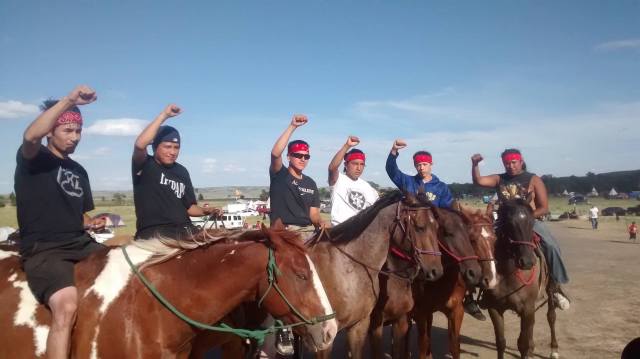
This is a photo Des Moines Valley Friend Peter Clay has said I can share, which he took on one of his several visits to North Dakota, where he is now. Peter once took his kayak to North Dakota to participate in a water rally.
Bear Creek Friends Nick Knight and his daughter Shazi have participated in a number of the protests along the pipeline’s route in Iowa, and Liz Oppenheimer has published numerous things online supporting #NoDAPL. My brother, Randy Kisling, recently participated in a #NoDAPL rally in Madison, Wisconsin. Bear Creek meeting’s clerk, Jackie Leckband, has sent us many messages of support. Ellis and Win Standing have been working on water issues related to faming practices for many years.
West Branch meeting Friend Marcia Shaffer was arrested for blocking the Dakota Access driveway in eastern Iowa and was in a holding cell for 9 hours.
Lincoln meeting Friends Jean Eden and Lorene Ludy attended some #NoDAPL rallies.
Omaha meeting Friend Carol Gilbert’s interview at a #NoDAPL rally was televised. Omaha meeting Friend and environmentalist Marshall Massey has also published much online related to the pipeline issues.
Paullina meeting Friend Judy Plank, and Penn Valley meeting Friend Shirley Scritchfield have also been active in social media discussions of these issues.
Members of the North Meadow Circle of Friends meeting that I attend have been very involved in local #NoDAPL efforts here in Indianapolis. Here are Kevin Angell and Shannon Effler at our first rally in downtown Indianapolis this summer. Shannon has a long history of work with Native Americans.
And here are North Meadow Friends Fred White (a fellow Scattergood Friends School graduate), Gilbert Kuhn, and David and Dinah Duvall.
At this month’s meeting of Quaker Social Change Ministry at North Meadow, Friends JT and Evalyn shared their past experiences with Native Americans.
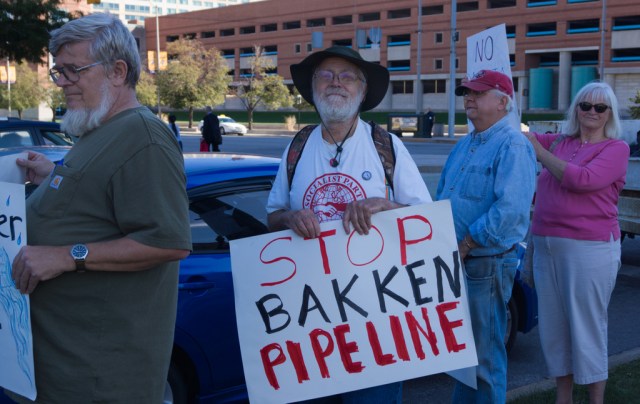
I am a member of Bear Creek meeting, and attend North Meadow Circle of Friends. I’ve been involved in organizing the three rallies related to #NoDAPL here in Indianapolis. Here we are at the White Pine Wilderness Academy, making signs for our rallies.
Our last rally involved going to two of the banks in Indianapolis involved in financing the pipeline, where people who had accounts in those banks, PNC and Chase, closed their accounts. Over $120,000.00 were withdrawn that day. I am closing my Chase account. Here is a link to many of the blog posts I have written about #NoDAPL.
Ra Wyse and Aghilah Nadaraj, who work at the Kheprw Institute (KI) that I have been involved with for several years now, were involved in creating the audio interview that accompanies some photos I took at our #NoDAPL rallies here in Indianapolis.
The New York Times editorial board statement concludes: “President Obama could step in to protect everyone’s safety and pressure the sheriff’s officers to stand down. Barring that, resolute protesters, a heavily militarized police force unwilling to budge, a company that refuses to consider an alternate route and an onrushing Great Plains winter — how can this possibly end well?”
Iowa Yearly Meeting (Conservative) Friend and friend Marshall Massey urged Friends (i.e. me) not engage in hyperbole, which I agree with, and was probably guilty of when I wrote my last post about the possible consequences of a leak in the Dakota Access Pipeline. I was envisioning the very worst case possible, which is unlikely to happen. I was thinking if the pipeline were to be built under the Missouri River, as currently planned, it would be possible for hundreds of thousands of gallons of oil to pool under the river in a giant lake before that erupted into the river itself.
It is frustrating that so few people pay attention to these issues. I was trying to use that story of a possible of disaster as perhaps a different way to get more people’s attention. But Marshall is right, I shouldn’t exaggerate.
His Facebook comments related to this were so excellent, I asked if I could reproduce them for a wider audience. Thanks for the caution, and the information, Marshall.
From Marshall Massey:
I think I can guarantee that Omaha and Lincoln don’t actually draw their water from the Missouri. They do have to worry about a Keystone XL spill contaminating the groundwater in the areas where they do get their drinking water, but that is another and much more unpleasant story. (We have got to prevent Trump from letting Keystone XL be completed!)
Although there was a pipeline oil spill into the Yellowstone River upstream from Billings, where I now live, a few years back, and the Yellowstone flows into the Missouri, the entire Missouri River watershed and the farmland for miles on each bank did not become a dead zone. You would be welcome to check the watershed and see for yourself. Denver, Colorado, incidentally, is within the Missouri River watershed. Even Billings did not have a water crisis, since it does not actually depend on Yellowstone for its water supply; it gets its water from wells up above. Still, Billings residents were very unhappy about the spill!
There was another pipeline oil spill into the Yellowstone just last year, downstream from us but just upstream from Glendive, Montana. Glendive had to switch to bottled water for about a week, while the oil actually rising into the river was contained and suctioned up, but that was it. The entire Missouri River watershed did not die.
There is still oil in the sediment at the bottom of the Yellowstone River just downstream from each of these two spills, which is a bad thing and will be very hard and expensive to clean up any further. Fortunately, it is heavy, tarry oil and does not rise into the river water very rapidly. The Yellowstone is still clean to yours truly’s eyes — although Montanans sure have dumped a lot of garbage along its banks, alas. The fish in the Yellowstone River are still healthy.
The Standing Rock Sioux are vulnerable because (a) they actually *do* draw their drinking water from the river, like Glendive but unlike Billings or Omaha or Kansas City, (b) that pipeline will cross the river far, far too close to their water intake, and (c) if it happens to them, they will get the same loving care from the feds and state government that Indians always get, which is a level of care I don’t know how to characterize without obscenities.
*Any* oil spill pollution of the Missouri River ecosystem is unacceptable, of course; most U.S. river ecosystems are already badly damaged, and what we have left needs to be preserved with TLC. And anything furthering the U.S. addiction to fossil fuels is unacceptable as well. But I don’t see any need to exaggerate to make our case.
Many people most clearly see issues in terms of their impact on their own lives. So this is what your town will look like when the Dakota Access Pipeline spills.
Just as when TransCanada was trying to sell the Keystone pipeline as completely safe, and then the pipeline spilled 14 times in the first year, the company building the Dakota Access pipeline claims it will not leak. Facts prove that to be unbelievable, actually. But even if the chances were, say 5%, would even that be worth the risk of the consequences? How can this be done just for the profits of an oil company? We don’t benefit, but instead will be further harmed when that oil is burned and the CO2 added to the atmosphere.]
Your town will become another Flint, Michigan. Of course their water was poisoned by lead, where as your water would be poisoned by oil and the toxic chemicals used to make it flow through the pipelines. But you, too, will no longer have clean water flowing through your water pipes.
Your family won’t be taking showers. Laundromats will have to close, and you’ll have to decide how much of your water you want to use to clean your clothes. Nobody will be washing their cars or watering their lawns.
You will have to buy bottled water, while it is possible to find it. Who knows how long that will be? The real question is what can you possibly do when bottle water is no longer available?
The entire Missouri River watershed and the farmland for miles on each bank will become a dead zone. No more acres of corn. The nation’s bread basket will be empty.
The pipeline will also leak into farmlands along the land route of the pipeline, killing more acres of land.









 Quakers, social justice and revolution