The War of North Dakota

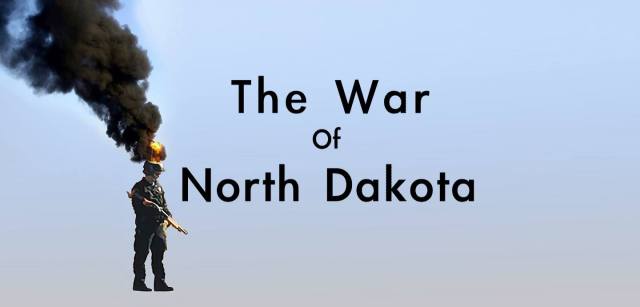
Last night was our latest local #noDAPL event,  seeing the rough cut of the documentary made at Standing Rock called “War of North Dakota” produced by Rod Webber.  The documentary opens with a warning that the film contains violence (by militarized law enforcement and private security) that might trigger PTSD.

Most of us have seen video clips from the attacks on the water protectors at Standing Rock, but the documentary gives a more prolonged, in depth look at what was done by law enforcement, and how the water protectors maintained their prayerful, disciplined, nonviolent response in the face of those atrocities.

How did we reach the point where fossil fuel corporations could corrupt the government to the extent that this was allowed to happen?

Why didn’t more citizens react in outrage?

The event was hosted by Healing Arrows, Indigenous Social Justice and Healing, whose Executive Director, Che Jim, led the discussion afterward.

 We believe that in order to advocate for social justice, we need to participate in social justice movements for Indigenous Peoples. As part of this commitment, we take a stand against the oppression and suppression of our Indigenous human rights as peoples of Turtle Island and in global Indigenous rights movements. We support the protections of Native nations’ Treaty rights and we promote self-determination for Native nations. We witness and we protect these rights through direct social action and education.     http://healingarrows.org/

Joshua Taflinger, of White Pine Wilderness Academy, also spoke about teaching kids about nature.  He said “someone who is involved in nature would not build pipelines”.  Joshua is our main local #noDAPL organizer.
war in north dakota

Posted in #NDAPL, civil disobedience, Indigenous, spiritual seekers, Uncategorized | Leave a comment

The More Beautiful World Our Hearts Know Is Possible

This Sunday at KI (Kheprw Institute), the monthly book discussion will be about Charles Eisenstein’s The More Beautiful World Our Hearts Know Is Possible.  Isn’t that a great title?  I didn’t suggest the book, but when someone else did, I said I had read other things by him that I really liked.

I was especially happy when the group decided to discuss this book, because it provides a worldview that is generally in line with that of the Quaker, KI, and indigenous communities.  It will provide us the opportunity to share more about each other’s spiritual viewpoints.

One of the main ideas is that we are in a transition between “Separation” and “Interbeing”.  Separation is the view that we are each separate from each other and the natural world.  We are responsible for making things work for ourselves.

Interbeing says we are instead intimately connected to each other and the natural world.  And each act can have powerful and unpredictable consequences.

We do not have a new story yet. Each of us is aware of some of its threads, for example in most of the things we call alternative, holistic, or ecological today. Here and there we see patterns, designs, emerging parts of the fabric. But the new mythos has not yet formed. We will abide for a time in the “space between stories.” It is a very precious—some might say sacred—time. Then we are in touch with the real. Each disaster lays bare the reality underneath our stories. The terror of a child, the grief of a mother, the honesty of not knowing why. In such moments our dormant humanity awakens as we come to each other’s aid, human to human, and learn who we are. That’s what keeps happening every time there is a calamity, before the old beliefs, ideologies, and politics take over again. Now the calamities and contradictions are coming so fast that the story has not enough time to recover. Such is the birth process into a new story.

Posted in Arts, Indigenous, Kheprw Institute, Quaker Meetings, spiritual seekers, Uncategorized | Leave a comment

Reality Check

When the world around you seems to be unraveling, what do you do?

I see:

  • An environmental crisis primarily caused by greenhouse gas emissions from burning fossil fuels.
  • Even knowing that, Americans continue their widespread use of personal automobiles.  Continue to fly.  Continue to build and live in single family, large houses, needing to heated and cooled.  Continue to invest in fossil fuel related infrastructure.  Continue to build communities based upon personal transportation.
  • So greenhouse gas emissions continue to climb at a time when we need to be reducing them dramatically if there is going to be any hope of avoiding human extinction, and increasingly terrible environmental conditions leading up to that.
  • Federal and state governments have been taken over by corporate interests, and no longer serve the people.
  • Regulations and policies to hold industry accountable for their impact on the environment are quickly being undone by the current Republican administrations at the Federal and state levels.
  • Science had to be discredited in order for that to happen.
  • Those who are trying to protect Mother Earth have their civil liberties denied and are aggressively, violently suppressed.  The violence against the water protectors in North Dakota was simply hard to believe.  Many state legislatures are considering legislation to criminalize constitutionally protected rights to free speech.
  • The denial of freedom of speech is important to those who are trying to protect their profits because they know that protests by the people are the only way to stop this.
  • We need to prepare ourselves to continue and intensify our demonstrations supporting our environment.  We need to prepare for continued nonviolent direct actions, since this will increasingly be the only way we can try to protect Mother Earth.

We seem to have several choices.

  • Most people will continue to do nothing.
  • We can continue to try to engage with government.  I don’t know how to address what seems to be the total corruption of the Federal government now.  But there are many encouraging things going on at the local level.
  • We can accept that this comes down to us, anyway, and we can continue our personal efforts to reduce our own greenhouse emissions.
  • It comes down to us, and our own communities.  We need to help each other with this.  Sharing rides.  Expanding public transportation.  Redesigning our neighborhoods to be more walkable.  Insisting our power utilities move to renewable sources.  Grow food locally, avoiding transportation.
  • We need to embrace a more realistic, less materialistic, standard of living.
  • We need to identify the most grievous actions against our environment, and ourselves, and determine when direct action is called for.

Following is from Grace Lee Bogg’s The Next American Revolution:

The next American Revolution, at this stage in our history, is not principally about jobs or health insurance or making it possible for more people to realize the American Dream of upward mobility. It is about acknowledging that we Americans have enjoyed middle-class comforts at the expense of other peoples all over the world. It is about living the kind of lives that will not only slow down global warming but also end the galloping inequality both inside this country and between the Global North and the Global South. It is about creating a new American Dream whose goal is a higher Humanity instead of the higher standard of living dependent on Empire. It is about practicing a new, more active, global, and participatory concept of citizenship. It is about becoming the change we wish to see in the world.

The courage, commitment, and strategies required for this kind of revolution are very different from those required to storm the Winter Palace or the White House. Instead of viewing the U.S. people as masses to be mobilized in increasingly aggressive struggles for higher wages, better jobs, or guaranteed health care, we must have the courage to challenge ourselves to engage in activities that build a new and better world by improving the physical, psychological, political, and spiritual health of ourselves, our families, our communities, our cities, our world, and our planet.

Line graph of global carbon dioxide emissions from fossil fuels. It shows a slow increase from about 500 million metric tons in 1900 to about 1,500 in 1950. After 1950, the increase in emissions is more rapid, reaching approximately 9,500 in 2011.

https://www.epa.gov/ghgemissions/global-greenhouse-gas-emissions-data

Posted in #NDAPL, civil disobedience, climate change, renewable energy, revolution, Uncategorized | Leave a comment

Celebrating Fred White

Fred White died unexpectedly January 12, 2017, in Indianapolis.  Fred was a Freshman at Scattergood Friends School, along with my brother Randy, at the time I was a Senior there.

I hadn’t heard from Fred since then, until he moved to Indianapolis a little over a year ago and began to attend North Meadow Friends meeting.  I appreciated that Fred lived without a car.  He joined us almost every week during our peace vigil in front of the Federal Building in downtown Indianapolis.  I also appreciated his presence at all of the Dakota Access Pipeline rallies that we held here.

This Sunday members of Fred’s family will be joining us at North Meadow Friends to remember Fred.  I had asked Fred’s Scattergood classmates and North Meadow Friends to share any stories or memories they had, and I’m so  glad so many people did so–it was amazing how comments kept appearing.  Thanks to all of you for doing so.  Those stories and photos of Fred have all been combined in a PDF file, that is available here:

Shared memories of Fred White


Posted in #NDAPL, Quaker Meetings, Uncategorized | Tagged | Leave a comment

How to Give Up Your Car

My Friend Georgette sat me down last Sunday after Quaker meeting and basically said she wished I would tell people how to give up their personal automobiles, instead of just saying that is what we need to do, as I recently did, once again.  And Friends at Bear Creek meeting noticed, and arranged a conference call last night to explore this.  In preparation for that meeting, and for Georgette, I came up with the following outline.

We will never seriously address environmental issues as long as we think in terms of the status quo.  Our communities are designed with the assumption that people will travel wherever they need/want to go.  Burning gasoline in a personal vehicle is the most effective way to add greenhouse gases to the environment.  Internal combustion engines are not energy efficient (only 25-30% useful energy), so this will accelerate the depletion of fossil fuel for future generations, and produce even more greenhouse gases.

To live without a personal automobile requires:

  • Determining where you need to go
    • Routinely
      • Work / school
      • Food
      • Meeting / church
    • Occasionally
      • Healthcare / pharmacy
      • Shopping
      • Entertainment
  • How to get there
    • Public transportation (may have to relocate where you live)
    • Walking
    • Bicycle
    • Shared vehicle
  • Make the decision
  • Implement the changes necessary

Committing to the decision is the most important, and probably most difficult, part.  This requires real discipline to break the car habit.

Implementation
There may be different ways to implement your decision to give up your personal automobile.  Perhaps it is possible to make the decision, and then implement changes gradually.  You will probably have to do it this way if you don’t have public transportation available, and can’t move to a better location right away.
I would think that would be a difficult way to do it.  The challenge is breaking the car habit in the first place.  One thing that would help there would be to keep a log for each time you used the car.  I would suggest locking the car keys in a box, so you have to make a conscious decision to use the car.
My experience was to go 100% carless from the beginning.  When my car was involved in an accident, I considered, and then decided to try to live without a car.  I was able to make that work because I lived on a bus route, and lived close enough to work that I could ride my bicycle when public transportation was not available.  That meant from then on, whenever I moved, I had to plan to be on a bus route, close to a grocery store, and close enough to work to be able to bicycle there.
I know there can be significant challenges, especially in rural areas or those not served by public transportation.  More on that soon.
Posted in climate change, Quaker Meetings, Uncategorized | Tagged | Leave a comment

Spiritual Warriors

Warrior
1. One who is engaged in or experienced in battle.
2. One who is engaged aggressively or energetically in an activity, cause, or conflict
Warrior seems an unlikely term for Quakers to use, since the word is usually thought of in terms of battles and wars, which Quakers oppose and work against.
I like the second definition above though, related to engaging energetically in a cause.  Today there are many causes to choose from, with widespread conflict, injustice and oppression.
jeff_blm1

Quakers, it’s time to get back into the public square. If you believe that there’s life above the snake line, it’s time to get back in the public square.”  Rev. William Barber, The Third Reconstruction, Friends Journal, September 1, 2016.  More from the article:  “That’s what Quakers were doing when they stood against slavery. They said slavery was below the snake line. Hate is below the snake line. Racism is below the snake line. Homophobia and xenophobia are below the snake line. Greed is below the snake line. Injustice is below the snake line. It’s time for us to raise the moral standard above the snake line.”

Images of Native Americans come to mind when thinking of warriors.  What continues to deeply move me is the absolute commitment the Native Americans and other water protectors/warriors in North Dakota to prayer and nonviolence.

Following is part of a recent message from my friend, and local #noDAPL organizer, Joshua Taflinger (in blue shirt below).

What has risen to the surface at Standing Rock is a physical/spiritual movement. Learn how to quiet your mind. To find the silent receptive space to receive guidance. To learn to adapt and follow the pull of synchronicity to guide you to where you will find your greatest support and strength.

What I have found in my time praying in the indigenous earth based ways, is that it’s not about putting your hands together and talking to god…. It’s about quieting and connecting with the baseline of creation, of nature. Tuning into the frequency and vibration of the natural world, the nature spirits. The beings and entities that have been in existence, for all of existence, the examples and realities of sustainability and harmony.

It’s about becoming receptive to these things. Being open and flowing with them. The spirit guides us, but we have to make ourselves receptive to feel, sense, and respond to this guidance.

I think it is good for us to think of ourselves as spiritual warriors, and to seek out other spiritual warriors to work with.  Other spiritual warriors are looking for you to connect to.  Share your spiritual commitment on social media, so others might connect with you.

This is the introduction Joshua wrote for the message above:

I am inspired to share with you all more directly a post I wrote, because I consider you an established & effective nature/spiritual warrior, and believe that there is a need for the perspectives shared in the attached post to be more common thought in the minds of the many.
If you feel truth from this writing, and are inspired, I highly encourage you to re-write your own version, in your own words/perspectives, and post to your network.
With the intention of helping us all wake up, with awareness, clarity, and direction.
..spreading and weaving reality back into the world….

Posted in #NDAPL, Quaker Meetings, spiritual seekers, Uncategorized | 1 Comment

Moonlight

Moonlight was the only movie I saw in a theater last year.  I had read that it was the story of a gay black man, played by three different actors, representing the main character’s childhood, youth and adulthood.

I grew up in a time when homosexuality was not a subject of public discussion, unless in derogatory terms, to put it mildly.  Only the bravest publicly acknowledged being gay.  It took me many years to even realize I was gay–the information blackout was nearly complete.

Growing up in a Quaker family and community had its own additional challenges.  Quakers are a sometimes paradoxical, confusing blend of strict moral principles, and great tolerance.  I think it has been easy for me to recognize various cultural privileges, like white privilege and ecological privilege (personal cars) because that was what I experienced related to being gay.  People who were known to be gay were accepted and welcome, but there was definitely the assumption that the norm was heterosexual relationships and families.  To such an extent that it seemed like gays were tolerated, but not quite equals.   I am sure some of this was hypersensitivity on my part, but it is really confusing when you don’t know where to turn for answers.

So I turned to the Spirit, and eventually found understanding and peace there.

So, I am always more than thirsty for any occasion to learn more about how others have navigated this.  From what I read about Moonlight, it seemed like an interesting approach to telling the story.

One of the disadvantages of refusing to own a car is that you do make a lot fewer trips for things like seeing movies.  It happened that Moonlight had just been released around the time I was in Iowa for Thanksgiving.   I arrived in Indianola a few days before others arrived for Thanksgiving.  With some time available, I thought seeing Moonlight with Mom and Dad would be a way for them to learn more about what it is like to be gay, although it was somewhat of a risk, not having seen it myself.  Mom was busy getting ready for the rest of the family to arrive, but Dad took me into Des Moines and saw the movie with me.

It was better than I hoped it would be.  The story, the acting, the cinematography, the music, the acting, acting, acting!

Congratulations on the Academy Awards (eventually) won!


Posted in Arts, Black Lives, Uncategorized | Leave a comment

#LoveThyNeighbor (No Exceptions)

#LoveThyNeighbor(No Exceptions) is the new campaign from the Friends Committee on National Legislation (FCNL).

lovetheyneighborblue-png

In these days of widespread turmoil, #LoveThyNeighbor is intended to shift the narrative away from looking for “others” to blame, and remind us all that we are in this together.  Our way forward is to rebuild our communities, reconnect with one another and the Earth.

i-see-value-in

The new Republican  administration is attempting to use fear to divide us for many reasons.

i-see-the-light-in

Multiple groups of “others” are being targeted.

i-see-dignity-in

The new watch word from this administration is “safety”.  Authoritarian governments always use fear and safety to justify taking away civil liberties.

i-see-god-in

We must work to show that the way forward, the way to true safety, is to embrace everyone.  Divisions will only add to distrust and fear.

I think it is interesting that the hashtag/slogan uses the word THY.   Perhaps this helps bring a bit of spiritual focus.

I have been having increasingly difficult conversations with a politically conservative friend who supports the current Republican administration.  He always tries to frame the discussions in terms of the impact on himself, especially related to how the issue affects “safety”.

The only times I have been able to get him to consider anything I try to say is when I bring up the principles we live for.  #LoveThyNeighbor is a great way to keep the attention where it needs to be.


Posted in Quaker Meetings, revolution, Uncategorized | Tagged | Leave a comment

7th Generation

Having written, once again, of my frustrations related to Quakers and the environment, more specifically about how Friends have not given up personal automobiles, I have to wonder if part of the problem is how I have been expressing this.  The issue is, of course, about much more than just having personal automobiles.

Maybe it would help to bring attention to the Native American principle of the 7th generation, that every decision be evaluated in terms of how it will affect our descendants seven generations into the future.

Fossil fuel is non renewable.  Each gallon of gas burned is a gallon that will not be available for future generations.  Additionally, easily accessible deposits of oil have been drained.  That is why the fossil fuel industry has been forced to use extreme extraction practices for tar sands and natural gas.  These practices are highly energy intensive, energy wasteful.  Vast quantities of toxins are produced, ruining huge quantities of water.  Hundreds of square miles of boreal forest stripped away.  Earthquakes from fracking.  Huge increases in greenhouse gases, and rising air and water temperatures.

This is what we are leaving for future generations to deal with.

It seems to come down to environmental privilege.  “I should be able to buy and burn as much fossil fuel as I want.”   Which is saying, “I don’t care about the 7th generation.”

The following was just written by my friend and local #NoDAPL organizer, Joshua Taflinger, who has spent time at Standing Rock this winter.  Quakers will recognize the spiritual message.

The mistake they made, however, was that while driving blindly towards us with all their force, they woke the world up and a new Army of physical/spiritual warriors has risen. An Army who will never back down, for we know, the future of human life depends on us.

The time for rest is over.

Every able minded and able bodied person alive on this planet today, must take action, NOW. Find out what you are good at and perfect it and then teach your neighbor or friend. We can take back control, but it will take every single of us, working tirelessly and supporting each other.

What has risen to the surface at Standing Rock is a physical/spiritual movement. Learn how to quiet your mind. To find the silent receptive space to receive guidance. To learn to adapt and follow the pull of synchronicity to guide you to where you will find your greatest support and strength.

What I have found in my time praying in the indigenous earth based ways, is that it’s not about putting your hands together and talking to god…. It’s about quieting and connecting with the baseline of creation, of nature. Tuning into the frequency and vibration of the natural world, the nature spirits. The beings and entities that have been in existence, for all of existence, the examples and realities of sustainability and harmony.

It’s about becoming receptive to these things. Being open and flowing with them. The spirit guides us, but we have to make ourselves receptive to feel, sense, and respond to this guidance.

Joshua Taflinger

Posted in #NDAPL, climate change, Indigenous, Quaker Meetings, renewable energy, spiritual seekers, Uncategorized | Leave a comment

Losing Faith

What do you do when you begin to lose faith in your faith community?  My discouragement is with Quakers in general, not necessarily with my home meeting or the meeting I attend locally.

One of the main reasons I remained involved as a Quaker has been Friends’ admirable expression of their spiritual life in the way they lived their daily lives, and extended their concern to those beyond their Quaker meeting community.

Unfortunately, it is my perception that Friends in the United States have become too comfortable with the American lifestyle.  There are so many injustices that result from allowing materialism to be the driving force of public policy, and personal choice.  Many of the injustices have deepened, and involve many more people as the corporate, profit driven economy leaves more and more people behind.

But by far the greatest danger is the continued destruction of our environment.  Decades of ignoring the environmental consequences of industry and fossil fuel use can no longer be hidden.  Indeed it was because greenhouse gases are invisible that made it so easy to dump tons of carbon dioxide into the atmosphere.

We are rapidly moving down the path to the extinction of the human race because of this denial.  The most important personal change we can make is to do whatever we can to stop burning fossil fuel.   The two most significant things an individual can do is to give up personal automobiles, and find living space that uses the least amount of energy.

I have been living without, and speaking against personal automobiles for over thirty years with little apparent effect.   I am struggling with how much longer I can be a part of a community that refuses to face this.

In the past, Friends were usually involved in trying to address injustices that they weren’t themselves necessarily part of.  The issues of Friends and the environment are especially troubling because Friends are actively, daily contributing to this disaster.


Posted in #NDAPL, climate change, Quaker Meetings, Uncategorized | 1 Comment