Scaffold

A sculpture, called Scaffold, that was being installed at the Walker Art Center in Minneapolis, has created such controversy, especially in Native communities, that it is going to be removed.

A little known episode in United States history was the Dakota War.  A series of events led to conditions in which the Dakota were facing starvation, and not allowed to hunt outside defined boundaries.  Armed conflict eventually occurred but didn’t last long.  Afterwards, the largest mass execution by the United States, the hanging of 38 of the Dakota warriors at the same time, took place in Mankato, Minnesota, on December 26, 1862, on the order of Abraham Lincoln.

To promote healing and reconciliation related to that, the Dakota created a film, “Dakota 38”,  in response to a vision that came to one of them in 2005.  To make the story widely available, the film is distributed free of charge:

This sculpture was based upon that. Although it is difficult to believe, the artist, Sam Durant, didn’t talk with Native Americans about the sculpture.  This is especially puzzling, since Mr. Durant talks about white supremacy as his motivation for creating the sculpture.

From the artist, Sam Durant:

I made Scaffold as a learning space for people like me, white people who have not suffered the effects of a white supremacist society and who may not consciously know that it exists. It has been my belief that white artists need to address issues of white supremacy and its institutional manifestations. Whites created the concept of race and have used it to maintain dominance for centuries, whites must be involved in its dismantling. However, your protests have shown me that I made a grave miscalculation in how my work can be received by those in a particular community. In focusing on my position as a white artist making work for that audience I failed to
understand what the inclusion of the Dakota 38 in the sculpture could mean for Dakota people. I offer my deepest apologies for my thoughtlessness. I should have reached out to the Dakota community the moment I knew that the sculpture would be exhibited at the Walker Art Center in proximity to Mankato.

My work was created with the idea of creating a zone of discomfort for whites, your protests have now created a zone of discomfort for me. In my attempt to raise awareness I have learned something profound and I thank you for that. Can this be a learning experience for all of us, the Walker, other institutions and artists and larger society? I look forward to meeting the Dakota Elders on Wednesday in Minneapolis, and am open and ready to work together.

Walker Art Center Executive Director Olga Viso said she anticipated a discussion about the nation’s use of capital punishment, and she regrets the pain that the sculpture has caused.

Durant’s sculpture raises complex questions about how contentious moments in history are remembered. It raises deeper questions still about how, why, by whom, and for whom. As an institution that champions the work of living artists, we also champion the freedom of expression extended to artists and audiences alike,” she said. “We recognize, however, that the siting of ‘Scaffold’ in our state, on a site that is only a short distance from Mankato, raises unique concerns. We recognize the decision to exhibit this work might cause some to question the Walker’s sensitivity to Native audiences and audiences in Minnesota more familiar with this dark history.

http://www.southwestjournal.com/news/2017/05/scaffold-sculpture-garden-piece-will-come-down/

ScaffoldSculpture640

Credit:  MinnPost.com
https://www.minnpost.com/sites/default/files/imagecache/article_detail/images/articles/ScaffoldSculpture640.jpg

Posted in Arts, Indigenous, Uncategorized | Tagged | Leave a comment

Who is Deserving?

Thinking more about our unjust economic system, I was further discouraged to read Sheila Kennedy’s post today,  What Swamp is Being Drained?

She points out that the Administration is saying there are people who don’t “deserve” the programs and benefits they are cutting and eliminating.

From the Washington Post:

The whole point here is to set “taxpayers” against the supposedly undeserving whose scams and schemes can be stopped with only indiscriminate cuts to social programs. Watching Mulvaney answer questions from the press this morning, that idea came through again and again. Every time he’d get a question about a specific cut the administration proposes — to Social Security disability, to food stamps, to Medicaid — Mulvaney would say that the only people who would suffer would be those who don’t deserve to get the benefit in the first place. “We are not kicking anybody off of any program who really needs it,” he said.

But if you paid close attention, you noticed a curious logical gap in his argument. See if you can spot it in this line of reasoning:

There are people on these programs who don’t deserve to be.
Therefore, we will slash the program.
Then only the deserving will receive the benefit.

What’s missing is any suggestion that the Administration has some sort of plan to distinguish the deserving from the undeserving.

https://www.washingtonpost.com/blogs/plum-line/wp/2017/05/23/the-white-house-justifies-its-savage-budget-with-a-divisive-lie/?utm_term=.bea847be12e1


Example: Pine Ridge Indian Reservation

The future at Pine Ridge could soon grow bleaker. The budget that President Donald Trump unveiled on Tuesday makes deep cuts to a slew of areas that life at the reservation depends on. The spending reductions touch every part of life from access to clean drinking water to block grants that fund programs to feed the elderly to much-needed after-school programs. In one of the nation’s most deeply impoverished communities, residents and tribal leaders say the cuts could be devastating.  –CNN

http://www.cnn.com/2017/05/27/politics/indian-reservation-trump-budget/index.html

feferalbudget2015taxdollars

Posted in Uncategorized | Tagged , , | Leave a comment

Memorial Day 2017 – Vietnam War

I was glad to see Harry Targ’s blog post yesterday, Remember Those Who Protested Wars, Too

Memorial Day observances are often uncomfortable for those of us who oppose war. But this is a chance to honor the memories of those who sacrificed their very lives in service to their country, and the many others who were wounded, physically and/or mentally.

And an opportunity to reflect on the ideas of war and peace in general.

DSC_2101

Vietnam War Memorial    Washington DC

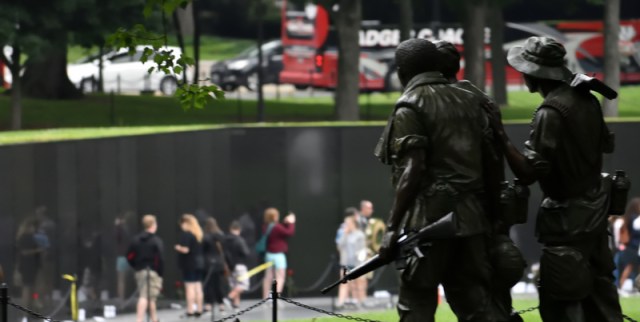
I was moved, as always, when visiting the memorials last week while in Washington, DC.  This time I was thinking in particular about the Vietnam War, which was going on while I was a student at Scattergood Friends School.
DSC_2003-001

Statue of soldiers,  overlooking the Vietnam War Memorial

That meant that I turned 18 years of age during the Vietnam War.  Which meant I had to make a decision about registering for the Selective Service System (draft).

I was born into the rural Iowa Quaker community, Bear Creek, in 1951.  This community had recently been dealing with the imprisonment of nearly twenty Quaker men who refused to register for the peacetime draft.  That had a profound effect on my thinking, as I struggled with my own decision.

Quakers are considered one of the historic peace churches, which made it easier for Quakers to register for alternative service instead of military service.  The question was whether accepting conscientious objector status was cooperating too much with the war machine.DonnLauughlinLetterfor Jeff
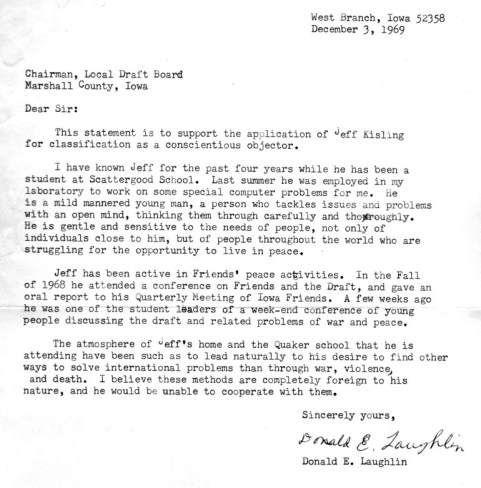
Since I hadn’t been able to make my decision about that when my birthday arrived, I applied for, and was granted conscientious objector status by my draft board.

This letter, supporting my application, was written by Don Laughlin, one of the Iowa Quakers who was imprisoned for refusing to register for the draft.

The Vietnam War was the subject of much discussion, and numerous activities, at Scattergood School.  In 1968, Scott Hoskins and I rode with teacher Kent Van Zandt to Earlham College to attend a conference on the draft.  Following is part of the Richmond Declaration on the Draft and Conscription that was written there:

We call on Friends everywhere to recognize the oppressive burden of militarism and conscription. We acknowledge our complicity in these evils in ways sometimes silent and subtle, at times painfully apparent. We are under obligation as Children of God and members of the Religious Society of Friends to break the yoke of that complicity.

As Friends we have for many years been granted privileged status within the draft system. This has often blinded us to the evil of the draft itself, and the treatment of those not so privileged. We are grateful for all those who by resolutely resisting the draft have quickened our conscience. We are called into the community of all who suffer for their refusal to perform unconscionable acts.

The national uproar against the war, mainly on college campuses, reached a peak during the fall of 1969, with monthly National Moratorium Days Against the Vietnam War.

During the October, 15, 1969, Moratorium Day, the entire School marched into Iowa City, 14 miles away, to participate in the anti-war activities at the University of Iowa.

“These students and faculty of Scattergood School are undertaking the twelve mile walk from campus to Iowa City in observance of the October 15 Moratorium. In order not to detract from the purpose of the walk, we have decided to remain silent. You are welcome to join us in this expression of our sorrow and disapproval of the war and loss of life in Vietnam. Please follow the example of the group and accept any heckling or provocation in silence.”

During the November 15, 1969, Moratorium Day, we held a Draft Conference at the School.
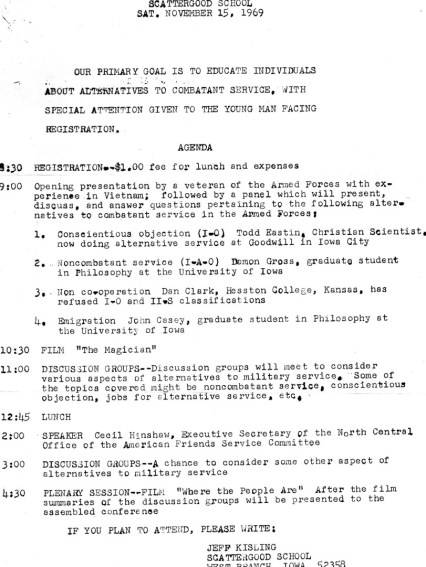
ScattergoodDraftConference

But it was the following letter that had the most influence on my decision, which was signed by Don Laughlin (letter above) and another Iowa Friend, and cousin, Roy Knight:

An Epistle to Friends Concerning Military Conscription

Dear Friends,
It has long been clear to most of us who are called Friends that war is contrary to the spirit of Christ and that we cannot participate in it.  The refusal to participate in war begins with a refusal to bear arms.  Some Friends choose to serve as noncombatants within the military.  For most of us, however, refusal to participate in war also involves refusal to be part of the military itself, as an institution set up to wage war.  Many, therefore, become conscientious objectors doing alternative service as civilians, or are deferred as students and workers in essential occupations.
Those of us who are joining in this epistle believe that cooperating with the draft, even as a recognized conscientious objector, makes one part of the power which forces our brothers into the military and into war.  If we Friends believe that we are special beings and alone deserve to be exempted from war, we find that doing civilian service with conscription or keeping deferments as we pursue our professional careers are acceptable courses of action.   But if we Friends really believe that war is wrong, that no man should become the executioner or victim of his brothers, then we will find it impossible to collaborate with the Selective Service System.  We will risk being put in prison before we help turn men into murderers.
It matters little what men say they believe when their actions are inconsistent with their words.  Thus we Friends may say that all war is wrong, but as long as Friends continue to collaborate in a system that forces men into war, our Peace Testimony will fail to speak to mankind.
Let our lives speak for our convictions.  Let our lives show that we oppose not only our own participation in war, but any man’s participation in it.  We can stop seeking deferments and exemptions, we can stop filling out Selective Service forms, we can refuse to obey induction and civilian work orders.  We can refuse to register, or send back draft cards if we’ve already registered.
In our early history we Friends were known for our courage in living according to our convictions.  At times during the 1600’s thousands of Quakers were in jails for refusing to pay any special respect to those in power, for worshiping in their own way, and for following the leadings of conscience.  But we Friends need not fear we are alone today in our refusal to support mass murder.  Up to three thousand Americans severed their relations with the draft at nation-wide draft card turn-ins during 1967 and 1968.  There may still be other mass returns of cards, and we can always set our own dates.
We may not be able to change our government’s terrifying policy in Vietnam.  But we can try to change our own lives.  We must be ready to accept the sacrifices involved if we hope to make a real testimony for Peace.  We must make Pacifism a way of life in a violent world.
We remain, in love of the Spirit, your Friends and brothers,

Don Laughlin
Roy Knight
Jeremy Mott
Ross Flanagan
Richard Boardman
James Brostol
George Lakey
Stephen Tatum
Herbert Nichols
Christopher Hodgkin
Jay Harker
Bob Eaton
Bill Medlin
Alan & Peter Blood

I, too, came to the conclusion that accepting conscientious objector status was going along with the Selective Service System, so I turned in my draft cards and became a draft resister.  Due to a related case that came before the Supreme Court, I was not prosecuted.

While visiting the Martin Luther King, Jr, Memorial, I was reminded of how he felt he had to speak out against the Vietnam War, and the controversy that created for him.

DSC_2053

Martin Luther King Jr Memorial     Washington DC

But he recognized that global struggles are interrelated.

ecumenical

DSC_1910

Martin Luther King, Jr Memorial    Washington DC

I also remember Muhammad Ali’s firm and courageous draft resistance stand.

“Under no conditions do we take part in war and take the lives of other humans.”

“It is in the light of my consciousness as a Muslim minister and my own personal convictions that I take my stand in rejecting the call to be inducted. I do so with the full realization of its implications. I have searched my conscience.”

“Man, I ain’t got no quarrel with them Vietcong…they never called me nigger.”

It was very clear what the consequences of that decision could be (and were), and yet he would not be persuaded to change his position, even knowing he was jeopardizing his boxing career.  I was impressed by his clear vision of the universal struggle of every person for peace and freedom, and every person’s responsibility to the world community, no matter their religion, race or country.

Posted in civil disobedience, peace, Quaker Meetings, Uncategorized | Tagged , , , | Leave a comment

Economic Concentration Camp

The more I think about our broken economic system, the more sinister my thoughts become.  How have we come to accept millions of people living in extreme poverty, living without adequate food, water, shelter, healthcare, safety or hope?  How have we come to the point where African American men have been removed from society via incarceration at ridiculous rates for ridiculous offenses?  How have we come to the point where private security firms and police from surrounding states can violently attack and brutalize Native American and other men, women and children who are merely peacefully praying for protection of water?

I used to think the rich, and their corporations, were just not very smart.  That they evidently didn’t see that pushing people further and further into poverty did not make sense for the corporations.  By refusing to address unemployment caused by automation, and by refusing to raise the minimum wage, millions of people are left with barely, or not enough money to survive, removing them as consumers of the products and services offered by those corporations.

Now I am beginning to better understand these relentless economic and law enforcement attacks are intentionally being used to attempt to control the masses.  Forcing people to spend all their time and energy simply surviving, keeps their attention diverted away from the continued rape of the Earth, and exploitation of us all, for corporate profits.

The rich and their corporations have forced millions into economic concentration camps.   These camps don’t have physical walls, but are just as real as if there were walls enclosing, entrapping vast numbers of us.

Now we have a Republican administration and Congress that are accelerating the corruption of our government in service of the wealthy.  That focuses on increasing the misery of those less fortunate (economically) by brutally targeting the small amounts of help Federal safety net programs had been providing.  While at the same time wasting much more money on increased military spending.  Although that certainly makes sense in the context of increasing military resources being available for civilian population control, as social unrest continues to rise.

The following is from a very disturbing report just released from The Intercept, “Leaked documents reveal counterterrorism tactics used at Standing Rock to ‘Defeat Pipeline Insurgencies'”:

“As policing continues to be militarized and state legislatures around the country pass laws criminalizing protest, the fact that a private security firm retained by a Fortune 500 oil and gas company coordinated its efforts with local, state, and federal law enforcement to undermine the protest movement has profoundly anti-democratic implications. The leaked materials not only highlight TigerSwan’s militaristic approach to protecting its client’s interests but also the company’s profit-driven imperative to portray the nonviolent water protector movement as unpredictable and menacing enough to justify the continued need for extraordinary security measures.”

The paradox is the wealthy know if we stop buying into this corrupt economic scheme, their wealth will be worthless.  The gifting economic model is an alternative to this.

One of the fundamental principles of Integral Nonviolence is that it is not possible to build Beloved community without turning away from materialism and addressing economic inequality.

“If politics must truly be at the service of the human person, it follows that it cannot be a slave to the economy and finance. Politics is, instead, an expression of our compelling need to live as one, in order to build as one the greatest common good: that of a community which sacrifices particular interests in order to share, in justice and peace, its goods, its interests, its social life. I do not underestimate the difficulty that this involves, but I encourage you in this effort.”  Pope Francis, address to joint session of Congress, 9/24/2015

https://kislingjeff.wordpress.com/2015/09/19/economic-privilege/

https://kislingjeff.wordpress.com/2015/09/22/economic-privilege-2/


DSC_2054

Martin Luther King Jr Memorial     Washington DC

Posted in #NDAPL, Black Lives, civil disobedience, Indigenous, integral nonviolence, revolution, satyagraha, Uncategorized | Leave a comment

Meaningful Work

We need to find ways to address the accelerating loss of traditional, paying jobs.

At his Harvard University commencement speech, Facebook chief executive Mark Zuckerberg, said

“Our generation will have to deal with tens of millions of jobs replaced by automation like self-driving cars and trucks.”

“When our parents graduated, purpose reliably came from your job, your church, your community. But today, technology and automation are eliminating many jobs. Membership in communities is declining. Many people feel disconnected and depressed, and are trying to fill a void.”

In an interview with Quartz, Bill Gates said:

“And what the world wants is to take this opportunity to make all the goods and services we have today, and free up labor, let us do a better job of reaching out to the elderly, having smaller class sizes, helping kids with special needs. You know, all of those are things where human empathy and understanding are still very, very unique. And we still deal with an immense shortage of people to help out there.
So if you can take the labor that used to do the thing automation replaces, and financially and training-wise and fulfillment-wise have that person go off and do these other things, then you’re net ahead.”

And Jeremy Rifikin writes (New technology and the end of jobs):

“A technology revolution is fast replacing human beings with machines in virtually every sector and industry in the global economy. Already, millions of workers have been permanently eliminated from the economic process, and whole work categories and job assignments have shrunk, been restructured, or disappeared. Global unemployment has now reached its highest level since the great depression of the 1930s. More than 800 million human beings are now unemployed or underemployed in the world. That figure is likely to rise sharply between now and the turn of the century as millions of new entrants into the workforce find themselves without jobs.

The rapid elimination of work opportunities resulting from technical innovation and corporate globalisation is causing men and women everywhere to be worried about their future. The young are beginning to vent their frustration and rage in increasingly antisocial behaviour. Older workers, caught between a prosperous past and a bleak future, seem resigned, feeling increasingly trapped by social forces over which they have little or no control. In Europe, fear over rising unemployment is leading to widespread social unrest and the emergence of neofascist political movements. In Japan, rising concern over unemployment is forcing the major political parties to address the jobs issue for the first time in decades. Throughout the world there is a sense of momentous change taking place – change so vast in scale that we are barely able to fathom its ultimate impact.”


It is imperative that we develop alternatives to the failed economic model that is based upon the exchange of money.  Traditional means of earning money are no longer available for millions and millions of people.  It is fundamentally wrong to maintain a system that requires money for all goods and services, knowing increasing numbers of human beings no longer have the means to earn that money.

One of the many things I’ve been learning from time spent in the Kheprw Institute (KI) community is how a vibrant, happy, healthy community can be built without money.  There was really no alternative.  One initiative relates to food, for example.  A small aquaponics system has increased in size dramatically, after more experience with the system.  Gardening has expanded, and a food co-op developed.  The food can not only be used by the community, but sold to local restaurants, which generates a little money.

Much of what is done at KI is based on the idea of the gifting economy.  People share  work and items in exchange for work and/or items from others.  The KI facilities have a large room with chairs that is in constant use by community organizations.  A rental fee is not charged.  Donations are encouraged.  This has made KI the central place in Indianapolis for social justice organizations to be able to meet and exchange ideas–something that wouldn’t happen if a fee was required to use the space.

We need to help each other find ways to celebrate the work, skills and ideas of our friends and neighbors.   Building Beloved communities is more important now than ever.

DSC_2070

Martin Luther King, Jr Memorial, Washington, DC


Posted in Uncategorized | Tagged , , | Leave a comment

Out of the Mountain of Despair, a Stone of Hope

This is the first time in Washington, DC, that I have been able to visit the Martin Luther King, Jr, Memorial.  I walked there last night, but was in a hurry, and there were a lot of other visitors around, blocking views.

I was so impressed with it, and disappointed that I hadn’t been able to capture all of his quotations engraved there, that I walked back to the Memorial this morning to take more photos.

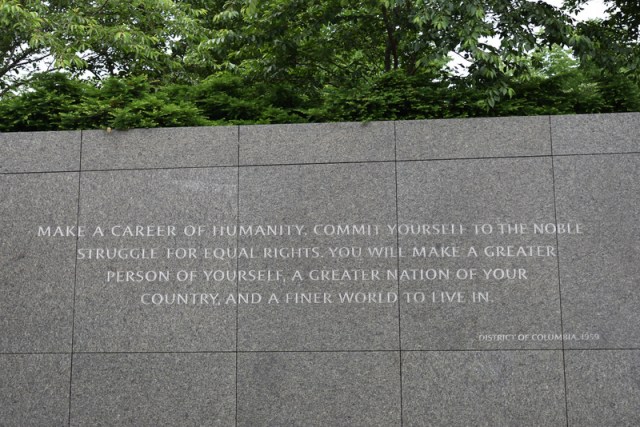
The words in the title of this are cut into the stone.

The Memorial sculpture was created out of shrimp pink granite.  The finished piece was cut into 156 pieces for transport, then reassembled.  The center piece, that is the sculpture of Dr. King, was placed in front of the other two pieces.

Numerous quotations of Dr. King are cut into the walls of the marble around the sculpture.

My photos:   https://1drv.ms/f/s!Avb9bFhezZpPh-klLzfMhKa3SoxsAw

National Park Service website: https://www.nps.gov/mlkm/index.htm

Posted in Arts, Uncategorized | Tagged | 2 Comments

In the Belly of the Beast

I’ve been fortunate to visit Washington, D.C., quite a few times.  The first time would have been 1970, during the Scattergood School Senior trip.  I remember staying in William Penn House then, and attending a session of the Supreme Court, but not much else.  We also went to New York City to visit the United Nations.

Then I visited each year for the seven or eight years I was a member of the General Committee of the Friends Committee on National Legislation (FCNL).  I remember being disappointed the first year to arrive to heavy rains.  William Penn House, where I was staying, had umbrellas for use.  I clearly remember trying to take photos of the U.S. Capitol building while holding the umbrella in one hand, swaying in the wind, while trying to take photos with the other hand.  Byron Sandford, director of William Penn House, got used to me showing up for the 7:30 morning meetings after having been out taking photos at the crack of dawn–I usually was not late!

I’ve always been fascinated by the U.S. Capitol building, and have many photos in all kinds of weather and light conditions.  I enjoy the challenge of getting photos of it at night.

Today was the first time that I was able to actually go into the building (photos here).  I was very impressed with how efficiently so many visitors were given tours at the same time.  They use a headphone system that allows a tour guide to be speaking just to his/her group of about 30.  This allows many, many groups to be in the same area, and still hear what their guide is saying.

The tour begins with a mandatory film about the history of the creation of our government, and of the building, which is really well done.

E pluribus unum–out of many, one.

The film talked about how the country could not come together as one regarding slavery, with the Civil War resulting.  I wonder if we are approaching another conflict rising out of our differences today.


Posted in Uncategorized | Tagged , | Leave a comment

American Thoracic Society (ATS)

I’m beginning to upload photos (link below) from here in Washington, DC, where I am attending the annual meetings of the American Thoracic Society.

DSC_1725

The photo below is of Eduardo Lima Leite Praça, a pediatric pulmonologist from Brazil who has been working in our lab for the past year. The poster describes research he did in our lab that shows we get very similar results when we measure the diffusing capacity of the lungs by either of two methods. The method we’ve been using for years uses a mass spectrometer to measure gas concentrations continuously in real time. The new method is to use a gas chromatograph, instead, which is much less expensive and much more portable.

DSC_1723
DSC_1618

Photos from this trip:  https://1drv.ms/f/s!Avb9bFhezZpPh-klLzfMhKa3SoxsAw

Photos from past years:  https://1drv.ms/f/s!Avb9bFhezZpPgvkfJFTGovjWMl_zmw

Posted in Uncategorized | Tagged , , | Leave a comment

Trains – continued

As I mentioned, I traveled by train to Washington, DC, to attend the annual meetings of the American Thoracic Society.  Unfortunately the rest of the trip didn’t go as well as the beginning.

We arrived in Chicago pretty much on time, and I knew there was a 7 hour layover.  I had hoped to spend most of that taking photos of Chicago.  Instead, the temperature was 44 degrees and it was raining.  So I got to spend a lot of time in Union Station.

Boarding was much improved.  Rather than crowding into the small area just outside the train tracks, boarding is done from the Great Hall of the station (at 7 pm).  Since the train was full, we were assigned seats as we boarded.  I was fortunate to get a window seat, and also fortunate that my seat mate, Rodger, chose to spend the entire trip in the observation car, watching movies.  It is more comfortable to not have someone sitting next to you.

I had forgotten they keep the coaches pretty cool (cold), and I had only packed a sweatshirt, thinking of the hot temperatures in Washington.

Sleeping in a train seat is not very comfortable, but I managed to get a fair amount, tossing and turning.  When I check our location on my cell phone, it didn’t look like we were getting across Ohio very quickly.  I had noticed a lot of time when the train wasn’t moving.  At 7 am we were informed that we had spend a lot of time stopped, waiting for freight traffic, and were 4 hours behind schedule!!

This is the problem with train travel in the United States.  The tracks are owned by the freight companies, and passenger trains always have to yield to them.  I heard so many stories of people’s trips being ruined by this delay.  Someone was supposed to be picked up by someone who had to travel an hour and a half to pick them up.  Someone else was going to miss the bicycle journey he was going on with friends.  Someone else had already spent hours outside a closed train station in a bad neighborhood.

We did finally arrive in Washington four hours late, with the entire trip from Indianapolis taking 36 hours!!

This is a microcosm of our society’s attitude toward public transportation, that people are basically less valuable than things (freight).  And of so many politicians’ attitude, that they don’t believe in funding transportation, because most of the constituents they pay attention to, don’t use it (ever).

Posted in Uncategorized | Tagged | Leave a comment

Trains

I’m traveling by train to the annual meetings of the American Thoracic Society in Washington, DC.  I’m struck yet again by the differences in travel experiences.   Travel by automobile just seems like an extension of everyday car trips.  Whereas travel by train is stepping into a less common experience.  One has to pack more carefully and compactly, knowing you won’t be able to just drive somewhere to get what you may have forgotten.  And knowing you will have to get your luggage from place to place yourself.

The journey begins by gathering with your fellow travelers at the station.  People checking out their fellow passengers.  People sharing cell phone chargers, travel information, or personal stories.

Then the call to board, and we climb the stairs to the dark and quiet platform.  Greeted by the conductor, “take any seat you like.”  So unhurried and relaxed compared to air travel, including no security procedures!  Moving into the large, clean, comfortable coach with big seats and electrical outlets.  WiFi is also provided.

The train begins to move so smoothly you don’t realize it until you notice motion outside the windows.  The cars sway gently from side to side, andy you hear the clickety-clack of the wheels on the rails.  Lightning flashes and rain runs down the windows, but we are cozy inside.

train1

I wonder again about the decisions in the past to tear up the train tracks and build bicycle trails on the (former) rail beds.


Posted in Uncategorized | Tagged , | 1 Comment