Social and Economic Justice

I’ve mentioned the Quaker practice of routinely considering questions related to our spiritual and social lives and practices.  Praying about and discussing these questions, or queries, together is a way for us to share what we believe, and sometimes find help about things we have questions about.

Iowa Yearly Meeting (Conservative), that my monthly (local) meeting, Bear Creek belongs to, has twelve sets of queries, so we consider one set each month.  The meeting’s combined response each month is eventually sent to the assistant clerk of the Yearly Meeting, who then selects responses from all of the monthly meetings, to be read during Yearly Meeting sessions.  In this way, all of the meetings in the Yearly Meeting share their work on the queries.

This month’s queries are about social and economic justice.  The Advice provides an introduction to the topic.  The queries are then listed.

Five or six years ago Bear Creek meeting began to invite those members who lived far away from the meeting to participate in the query process by sending their responses to the meeting via email.  We began to refer to this as long distance queries.  My response to this months queries follows the queries below.

“For when I was hungry you gave me food, when thirsty you gave me drink, when I was a stranger you took me into your home, when naked you clothed me, when in prison you visited me.”     Matthew 25:35‑36

ADVICE

We are part of an economic system characterized by inequality and exploitation. Such a society is defended and perpetuated by entrenched power.

Friends can help relieve social and economic oppression and injustice by first seeking spiritual guidance in our own lives. We envision a system of social and economic justice that ensures the right of every individual to be loved and cared for; to receive a sound education; to find useful employment; to receive appropriate health care; to secure adequate housing; to obtain redress through the legal system; and to live and die in dignity. Friends maintain historic concern for the fair and humane treatment of persons in penal and mental institutions.

Wide disparities in economic and social conditions exist among groups in our society and among nations of the world. While most of us are able to be responsible for our own economic circumstances, we must not overlook the effects of unequal opportunities among people. Friends’ belief in the Divine within everyone leads us to support institutions which meet human needs and to seek to change institutions which fail to meet human needs. We strengthen community when we work with others to help promote justice for all.

QUERY

How are we beneficiaries of inequity and exploitation? How are we victims of inequity and exploitation? In what ways can we address these problems?

What can we do to improve the conditions in our correctional institutions and to address the mental and social problems of those confined there?

How can we improve our understanding of those who are driven to violence by subjection to racial, economic or political injustice? In what ways do we oppose prejudice and injustice based on gender, sexual orientation, class, race, age, and physical, mental and emotional conditions? How would individuals benefit from a society that values everyone? How would society benefit?


Economic practices are very often at the root of social injustices. While there are innumerable examples of inequities and discriminatory practices related to wages, access to housing, education, medical, and other services, we have failed to come to grips with some foundational economic injustices. We live and work on land that was outright stolen from Native Americans. Our buildings and infrastructure was built with the labor of enslaved African Americans and other people of color, with the resulting extensive benefits and profits going to white males. We will not be able to make progress regarding racial (including indigenous) injustice until we apologize for these wrongs, and find ways to redistribute the wealth and resources that were created as a result.
Secondly, we need to acknowledge our current economic system no longer works, and has created the situation where millions of people are denied the means to support themselves and their families. During the industrial revolution, with nearly full employment, a wage based economy worked fairly well for the majority of people, although there were great disparities in wages. But with massive industrial automation, and moving labor intensive industries to other countries, millions who are eager to work can no longer find jobs. And millions of jobs that are available pay at rates that don’t, or barely, cover basic necessities. It is an immoral economic system that means millions of people go to bed hungry, don’t have access to medical care, or good schools, or decent housing.
The need to fix this broken system is a moral challenge to us. This is becoming increasingly urgent as we will increasingly be facing the breakdown of social, political and economic systems in the face the many consequences of our evolving environmental disasters, including increasing numbers and intensities of storms like Hurricane Harvey.

Posted in climate change, Indigenous, race, Uncategorized | Tagged , | 1 Comment

Harvey and the (near) Future

The recent article in Politico Magazine, Harvey Is What Climate Change Looks Like: It’s time to open our eyes and prepare for the world that’s coming, by Eric Holthaus, is an excellent summary of what we can expect in the very near future as the consequences of climate change occur with greater intensity and frequency.

While Hurricane Harvey would likely have occurred anyway, there is no doubt that a season of record breaking high air and surface water temperatures this year in the Gulf of Mexico feed the record breaking rainfall.

From the article:  Climate change is making rainstorms everywhere worse, but particularly on the Gulf Coast. Since the 1950s, Houston has seen a 167 percent increase in the frequency of the most intense downpours. Climate scientist Kevin Trenberth thinks that as much as 30 percent of the rainfall from Harvey is attributable to human-caused global warming. That means Harvey is a storm decades in the making.

If we don’t talk about the climate context of Harvey, we won’t be able to prevent future disasters and get to work on that better future. Those of us who know this need to say it loudly. As long as our leaders, in words, and the rest of us, in actions, are OK with incremental solutions to a civilization-defining, global-scale problem, we will continue to stumble toward future catastrophes. Climate change requires us to rethink old systems that we’ve assumed will last forever. Putting off radical change—what futurist Alex Steffen calls “predatory delay”—just adds inevitable risk to the system. It’s up to the rest of us to identify this behavior and make it morally repugnant.

Urban planning has to take increasing intensity and frequency of rainfall into account, with better flood control systems.

And as Houston and others look to rebuild housing, smaller, more energy efficient as well as multi-tenant buildings should be built, not more large, single family houses.  Neighborhoods have to be built to be walkable, and public transit systems are critical.  Harvey adds to the urgency to drastically reduce fossil fuel use and greenhouse gas emissions.

The other gigantic issue of flooding from Harvey is the thousands of climate refugees it created.  This will be a rapidly increasing problem we will be facing both nationally and globally.  While our attention has been focused on Harvey, yet another severe monsoon season in South Asia has resulted in over 1,200 deaths and affected millions.  Climate refugees will be increasingly created not only from increasingly severe flooding from storms, but also from rising sea levels, and large areas affected by drought and polluted water supplies.


Posted in #NDAPL, climate change, Uncategorized | Tagged , , , | Leave a comment

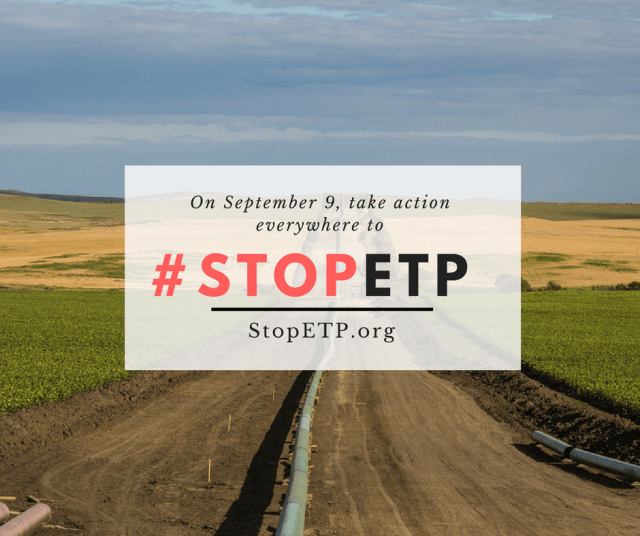
#StopETP Day of Action

A large number of environmental justice organizations are calling for a national day of action against Energy Transfer Partners, the company behind the Dakota Access and many other pipelines.  http://stopetp.org/

From the organizers:

We are a growing coalition of communities and organizations that care deeply about our rights to clean water, clean air, a stable climate, and a democratic society.

We believe that landowners and indigenous tribes have the right to determine what happens to their land. But Energy Transfer Partners (ETP), a giant oil company based in Texas, has been consistently violating those rights in their drive to build new oil and gas pipelines. And along the way, communities have suffered.

Here is a toolkit with resources to help you engage with this effort, including images to share on your Facebook page and twitter feeds.     StopETP Day of Action Digital Toolkit

#StopETP

Facebook post 1


Posted in #NDAPL, social media, Uncategorized | Tagged , , | Leave a comment

Thwarting the Rule of Law

Our system of government is based upon the balance of powers among its three branches:  executive, legislative and judicial.  While the president has unlimited power to pardon people except for impeachment, the recent decision to pardon Sheriff Joe Arpaio undermines the rule of law.  The sheriff has abused his authority and broken the law many times himself.  He has denied citizens their constitutional rights, inflicted cruel and unusual punishment on hundreds of prisoners, and illegally arrested reporters covering him.  He was convicted of contempt for refusing to obey a Federal judge’s order to stop illegally detaining people on suspicion of being undocumented immigrants.

In trying to justify the pardon the president endorsed the use of these illegal tactics as a way to secure the border and gave tacit approval to the sheriff’s illegal actions.  This abuse of executive power to defy the judicial branch undermines the rule of law.  I think the president should be removed from office for that, and before he does more damage in this regard.

Addendum:  Law professor Sheila Kennedy explains this very well in a recent blog post    http://www.sheilakennedy.net/2017/08/pardon-me/

DSC_1615


Posted in Uncategorized | Tagged | Leave a comment

Circle

Seeing so much of life is broken, I was struck by the following from the book Black Elk Speaks:

You have noticed that everything an Indian does is in a circle, and that is because the Power of the World always works in circles, and everything tries to be round.  In the old days when we were a strong and happy people, all our power came to us from the sacred hoop of the nation, and so long as the hoop was unbroken, the people flourished. The flowering tree was the living center of the hoop, and the circle of the four quarters nourished it. The east gave peace and light, the south gave warmth, the west gave rain, and the north with its cold and mighty wind gave strength and endurance.  This knowledge came to us from the outer world with our religion.  Everything the Power of the World does is done in a circle.

But the Wasichus have put us in these square boxes.  Our power is gone and we are dying, for the power is not in us any more.

Well, it is as it is. We are prisoners of war while we are waiting here. But there is another world.

Photos taken with permission at the 103rd Meskwaki Powwow, August 2017

Posted in Indigenous, Uncategorized | Tagged | Leave a comment

Charlottesville and Quaker Social Change Ministry

Fourteen Friends of North Meadow Circle of Friends gathered for the monthly Quaker Social Change Ministry meeting.  It had been announced that this meeting would discuss the recent demonstrations in Charlottesville, Virginia, where people opposing the removal of a statue of Robert E Lee, which included supporters of white supremacy, neo-Nazis and the KKK, clashed with counter-demonstrators.  Heather Heyer was killed when a car rammed into the counter protestors.

North Meadow has been using Quaker Social Change Ministry, a model supported by the American Friends Service Committee (AFSC), for nearly two years as a way to approach issues related to racial injustice.  This involves various tools to bring a spiritual focus to social justice work that engages the meeting as a whole.  A large part of that relates to the idea of accompaniment, which is supporting a local community currently experiencing injustice.  North Meadow Friends are fortunate that the Kheprw Institute (KI), a black youth mentoring and empowerment community, has been interested in being our partner in this work together.

The continued hate and belief in white superiority revealed by these demonstrators is deeply discouraging.  The more those of us who are white have discovered how racism has been intentionally built into almost every structure of American society, the more we realize the scope of the work needed to correct racial injustice.  And racial violence is more visible today, including the killing of unarmed people by police.

To see people violently supporting the continuation of these deeply flawed, unjust ideas is difficult to comprehend.

After opening silent worship and a review of the Friendly agreement (below), Friends shared as they were led.  Discussions such as these are difficult to summarize.

We reviewed many of the ways racism is built into our society, and how those who are white routinely benefit whether we want to or not, and often in ways we have been unaware of.  One of the greatest benefits of our work with the Khreprw Institute has been an increasing awareness of these advantages, as we see those at KI do not have them.

This increasing awareness has helped us be more aware of the foundational injustices American society is built upon.  Stealing the land from Native Americans, and the enslaved labor of African Americans.  We are convinced that we can not make real progress in creating a more just society until we acknowledge these foundational injustices, find ways to begin try to make amends, and stop the continuing inequities that have been built into our society.

We are grateful that we can continue to learn about, and begin to correct these things with our ongoing connection with the Kheprw Institute community.  Based upon our experience, we would encourage others to consider adopting the Quaker Social Change Ministry Program, which can be used for groups other than Quaker meetings, too.

https://www.afsc.org/QSCM

Friendly Agreement

Be fully present in the moment, with your doubts, fears and failings as well as your joys and successes.

When we offer attentive presence, we nurture love and respect. We commit to restorative justice practices.

Observe deep confidentiality as we build trust. Nothing personal said in this circle will ever be repeated to other people.

Refrain from interrupting others.

Set aside judgment so you can listen to others, and to yourself, more deeply.

Listen with resilience, “hanging in there” when hearing something that is hard to hear. Feel free to ask for time and space for personal reflection if needed. Set your own boundaries for personal sharing; ask yourself, “what parts of my life story, if any, am I comfortable sharing?”

“Pass” or “pass for now” if you are not ready or willing to respond to a question –no explanation is required.

Speak personal truths in ways that respect other people’s truth. Speak using “I” statements,
assuming others can deduce the meaning as it applies to them.

Assume positive intent on the part of fellow participants.

When the going gets rough, turn to wonder. If you feel judgmental, or defensive, ask yourself, “I wonder what brought her to this belief?” “I wonder what he’s feeling right now?” “I wonder what my reaction teaches me about myself?”

Commit to regular attendance.

*Adapted from Parker Palmer’s “Touchstones for Circles of Trust 

Posted in Uncategorized | Leave a comment

Nonviolence needs to be part of our national conversation now

As Robert F Kennedy said when he spoke to a crowd predominately of people of color the day Martin Luther King was killed April 4, 1968:

We can move in that direction as a country, in greater polarization — black people amongst blacks, and white amongst whites, filled with hatred toward one another. Or we can make an effort, as Martin Luther King did, to understand, and to comprehend, and replace that violence, that stain of bloodshed that has spread across our land, with an effort to understand, compassion, and love.

He was asking the country to embrace nonviolence.  Unfortunately in many ways the country choose to move in the direction of greater polarization, instead.  And not just between white people and people of color, but with other divisions as well–economic, cultural, and political.

The tragic events in Charlottesville are the most recent example of polarization and the public eruption of violence.  Fortunately thousands have gone into the streets to peacefully express their opposition to hate and nationalism.

Demonstrations such as those are welcome and important but may or may not have truly been expressions of nonviolence, depending on how they were done.  While being peaceful is not violent, if the intention is not to aid in understanding and helping everyone move toward justice, they are not actively nonviolent.  If the counter demonstrators act hatefully toward the nationalists, that is not nonviolence.

Trying to overwhelm the white nationalists with sheer numbers does not get at the underlying issues.  Far too often we react to the symptoms, but don’t deal with the underlying causes.  What is really needed is the very difficult work of understanding what causes people to become nationalists.  We have to find out what that is, then we will know what needs to be done to take away those conditions that result in hate and conflict.

One way to keep this in mind is to use a sense of wonder, as in, “I wonder why they think that?  I wonder why they are acting that way?”  And the corollary, “I wonder why I think or feel this?”  (Taken from the AFSC Quaker Social Change Ministry material)

We need to help our friends and allies focus on understanding underlying causes so we can achieve peace and justice.  To embrace nonviolence in our own lives and teach nonviolence to others.  I hope you will consider initiating conversations, classes and training sessions about nonviolence yourself.  The easiest and most effective way is to create situations where others are given opportunities to express themselves.  Showing genuine interest and listening deeply to each other.  Expressing your own doubts and questions, being vulnerable.  Believing you can learn something from someone else.

This is how we can begin to reverse polarization.

–apologies to electrical engineers 🙂

Posted in integral nonviolence, peace, race, Uncategorized | Tagged , | Leave a comment

Nonviolence does not necessarily require direct action

It is common for people to believe that nonviolence means direct action, because the two are closely related and direct action gets public attention.  This can unfortunately mean people don’t feel they can engage in nonviolence because they think that means subjecting themselves to dangerous, confrontational situations and the possibility of being arrested.

A commitment to nonviolence has to begin with the individual for many reasons.  Nonviolence has to become the way you experience every moment of your life, before you can effectively engage in the outward parts of nonviolence, which may eventually  lead to participating in direct action, or may never.

We each have to discover the many, often insidious threads of violence that are part of of our own lives.  Our relationships with others, our treatment of our environment, plants and animals, our social and political lives can all have violent aspects that we may be unaware of until we begin to pay close attention to them.  As can seen from this list, violence means much more than physical force.  A useful term is power in its many forms, which can be used to influence other people and entities in ways that are unwelcome or detrimental.

As we learn more about ourselves, we learn there are always new things to be aware of, which makes us more open to consider new ideas and able to change ourselves.  This makes us more tolerant of others, knowing they can engage in these same processes, and we can help others do so, when conditions are appropriate.

This is a core concept of nonviolence, that success is measured by how much progress is made toward justice together, which often involves changing not only those who have been engaging in injustice, but also changing ourselves.  It is often the awareness by others that we are willing to change that makes it possible for them to consider changing too.  Deeply listening to each other is key.

The new book, The Gandhian Iceberg, by Chris Moore-Backman is a very helpful manual on nonviolence.  Iceberg is used as an image to illustrate the three basic parts of nonviolence.  The bulk of an iceberg is underwater.  In nonviolence, this is the part discussed above, sometimes referred to as “self-purification”.  The part of the iceberg above water represents the work that is done in the world to bring about peace and justice, which Chris refers to as the constructive program.  Finally, the very smallest projection of the tip of the iceberg represents nonviolent direct action against specific social evils.


Posted in civil disobedience, peace, Uncategorized | Tagged | Leave a comment

Robert F Kennedy Speaks to our Time

I’d like to share, again, a video I made of photos I took at the Kennedy King Memorial, with audio of Martin Luther King’s speech just before he was killed, and the audio of Robert F Kennedy announcing Dr. King’s death to the crowd in Indianapolis.  The crowd was gathered for what was supposed to be a presidential campaign speech.

Ladies and Gentlemen,

I’m only going to talk to you just for a minute or so this evening, because I have some–some very sad news for all of you — Could you lower those signs, please? — I have some very sad news for all of you, and, I think, sad news for all of our fellow citizens, and people who love peace all over the world; and that is that Martin Luther King was shot and was killed tonight in Memphis, Tennessee.

Martin Luther King dedicated his life to love and to justice between fellow human beings. He died in the cause of that effort. In this difficult day, in this difficult time for the United States, it’s perhaps well to ask what kind of a nation we are and what direction we want to move in. For those of you who are black — considering the evidence evidently is that there were white people who were responsible — you can be filled with bitterness, and with hatred, and a desire for revenge.

We can move in that direction as a country, in greater polarization — black people amongst blacks, and white amongst whites, filled with hatred toward one another. Or we can make an effort, as Martin Luther King did, to understand, and to comprehend, and replace that violence, that stain of bloodshed that has spread across our land, with an effort to understand, compassion, and love.

For those of you who are black and are tempted to fill with — be filled with hatred and mistrust of the injustice of such an act, against all white people, I would only say that I can also feel in my own heart the same kind of feeling. I had a member of my family killed, but he was killed by a white man.

But we have to make an effort in the United States. We have to make an effort to understand, to get beyond, or go beyond these rather difficult times.

My favorite poem, my–my favorite poet was Aeschylus. And he once wrote:

Even in our sleep, pain which cannot forget
falls drop by drop upon the heart,
until, in our own despair,
against our will,
comes wisdom
through the awful grace of God.

What we need in the United States is not division; what we need in the United States is not hatred; what we need in the United States is not violence and lawlessness, but is love, and wisdom, and compassion toward one another, and a feeling of justice toward those who still suffer within our country, whether they be white or whether they be black.

So I ask you tonight to return home, to say a prayer for the family of Martin Luther King — yeah, it’s true — but more importantly to say a prayer for our own country, which all of us love — a prayer for understanding and that compassion of which I spoke.

We can do well in this country. We will have difficult times. We’ve had difficult times in the past, but we — and we will have difficult times in the future. It is not the end of violence; it is not the end of lawlessness; and it’s not the end of disorder.

But the vast majority of white people and the vast majority of black people in this country want to live together, want to improve the quality of our life, and want justice for all human beings that abide in our land.

And let’s dedicate ourselves to what the Greeks wrote so many years ago: to tame the savageness of man and make gentle the life of this world. Let us dedicate ourselves to that, and say a prayer for our country and for our people.

Thank you very much.

Robert F Kennedy
April 4, 1968
Indianapolis, Indiana

Posted in Uncategorized | Tagged , | Leave a comment

Nonviolence and anti-fascists

Many of us who want to advance peace and justice, and who disagree with what white nationalist and other hate groups stand for, are alarmed by the violent tactics these groups are increasingly displaying in public.  And are also alarmed that groups who identify themselves as anti-fascist (antifa) feel they are justified in using violence and force against the white nationalists.

Those who believe in nonviolence know it takes a great deal of discipline for a nonviolent campaign to be successful.  The slightest deviation is pounced upon by the opposition to de-legitimatize the campaign.  Nonviolent campaigns are successful when they show by example their willingness to suffer for their cause, and their refusal to attack those they are working to change.  Because a core principle of nonviolence is that winning is not prevailing over an opponent, but instead helping those they are working against find another way to see the issue and make it possible for them to move away from injustice.

We need to find ways to help the anti-fascists understand the error of using violence.  We must apply the principles of nonviolence as we deal with them, as well as the hate groups.  This is a puzzling development but one that we need to find a way to deal with quickly.

This is a website that seems to be one of the places this movement uses, called Its Going Down.

Noam Chomsky wrote Antifa is a major gift to the right:

http://www.washingtonexaminer.com/noam-chomsky-antifa-is-a-major-gift-to-the-right/article/2631786

DSC_1910

Martin Luther King Memorial, Washington, DC

Posted in civil disobedience, integral nonviolence, peace, Uncategorized | Tagged | Leave a comment