Scattergood Journal, Peace Walk 1969

I think the reason these past times have captured my interest now is I wonder how(desperately wish) we can create something like those antiwar and civil rights movements today.

October 11, 1969  School Committee Day

From the school committee minutes:
A group of students attended Committee meeting and explained plans for their participation in the October 15 Moratorium. The Committee wholeheartedly endorses the plans. The following statement will be handed out in answer to any inquiries:

“These students and faculty of Scattergood School are undertaking the twelve mile walk from campus to Iowa City in observance of the October 15 Moratorium. In order not to detract from the purpose of the walk, we have decided to remain silent. You are welcome to join us in this expression of our sorrow and disapproval of the war and loss of life in Vietnam. Please follow the example of the group and accept any heckling or provocation in silence.”

JournalOct15

DSC09398-2

Vietnam War Moratorium Day, October 15, 1969  Scattergood Friends School

This is one of the first photos I ever developed, using a simple darkroom in the basement of the Main building at Scattergood.

The Friends Committee on National Legislation (FCNL) frequently published photos of their War is Not the Answer signs in various locations, such as the one below which also includes a photo from one of the Peace Walks Christine Ashley organized in 2012.  As many of you know, Christine and Mark are working for FCNL now.

Peace Scattergood then now
FCNL: Scattergood Peace Marches

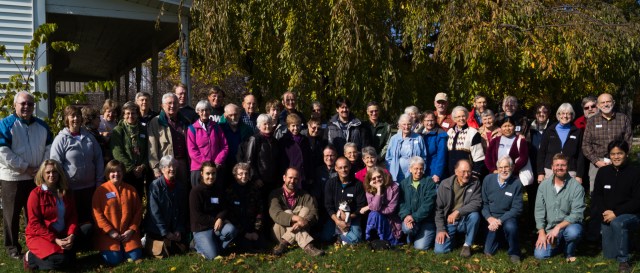
Christine also organize an Earth Walk in 2013.  This occurred the day after Iowa Yearly Meeting (Conservative) and the School held a Climate Conference at the School.

DSC03170

Iowa Yearly Meeting (Conservative) Climate Conference, 2013

The Earth Walk would follow the same route of the earlier Peace Walks, this time with signs about the environment, and with us picking up trash along the way.  I really wanted to be part of this walk, and came from Indianapolis (by bus) so I could.  Below is a video of photos I took along the way, with interviews of people on the walk.

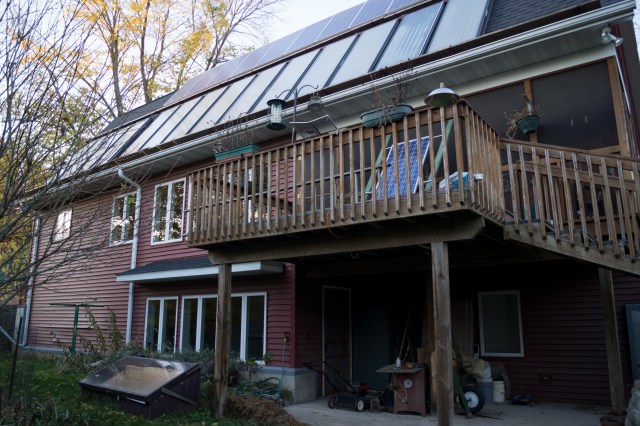
In case you didn’t see the video above, the last part mentions Don Laughlin, and the amazing environmentally innovative house he helped design and build.  We walked near the house during the Earth Walk.  Below is a photo of the house, with passive solar, solar panels, in floor heating, etc.

DSC03206

Don Laughlin’s energy efficient home

Don was also a draft resister, and I’ll be writing more about that soon.


Posted in climate change, peace, renewable energy, Uncategorized | Tagged , , | 1 Comment

Scattergood Journal 1969

Reading Chris Matthew’s new book, Bobby Kennedy: A Raging Spirit, I am remembering that tumultuous time in my life, and in our country. I had begun to write in a journal at the beginning of my Senior year, 1969, at Scattergood Friends School.

September 1969

Why a journal?  I would like to have a record of some of my thoughts and experiences. I once started a diary and often enjoyed looking through it, though I soon gave it up as there was little room for an entry every day and comments were limited to the day’s activities in the most superficial sense.  One philosophy of life urges one not to worry about the past, but to live today in such a way as to make the past a fond memory.

Another reason is that I feel myself in a crisis at this particular time and feel that writing about my concerns will help to clarify my thoughts. (note–I guess this was the precursor to all the blog posts)  I have less than two month’s time till my 18th birthday at which time I will be faced with the problem of registration for the draft.

I am considering two alternatives to the draft–conscientious objector status under the Selective Service System or non cooperation with the Selective Service System.   The Richmond Declaration on the Draft and Conscription of 1968, which I helped write, says that Friends opposing war should refuse any type of military service; Friends opposing conscription should refuse to cooperate with the Selective Service System.  The Declaration went on to say that we should work for the abolition of the draft and not accept draft reform, as the issue is not equal treatment under compulsion, but freedom from compulsion.

I would hope that we will soon realize that military force is obsolete and immoral, therefore eliminating any need for the draft.  And yet at times I almost abandon my idealistic concerns, since it often appears that few other people in this world do have such concerns.

October 6, 1969

One of George Fox’s major insights was that the mark of a true believer, Christian, is a changed life.  It seems to me that this is what I’m wrestling with.  I fear that if I go to college and get a well paying job, I’ll settle down into the same rut that I see most everyone settling into, and I don’t like it really.  It looks comfortable–an easy way out.  I feel I’m at the turning point.  If I feel compulsion is wrong, I believe I’ll have to take a complete stand against it now, or I’ll never be able to take a stand against the government, with all of the responsibilities I’ll soon acquire.  I see the choice essentially between a way of life I idealistically believe to be best, but am not totally sure how to pursue, and a “normal” way of life which I am idealistically uneasy with but believe would be a comfortable way of life.

October 7

Today Callie Marsh (librarian) passed out some information about the draft, partially for preparation for our discussion with the draft counselor this Thursday.  Most of the boys spent a lot of time looking through it today.

October 9

I got a letter from Cornell University saying they had heard that I had participated in a National Science Foundation (NSF) program this summer (working in Don Laughlin’s medical electronics lab at the University of Iowa Hospitals), and invited me to apply to their college of engineering.  I also got a letter from Iowa State University inviting me to apply and to consider studying in their Department of Chemical Engineering because of my ACT scores.

We had dinner and spent the evening at the Marsh’s with a draft counselor (Senior boys).  It was interesting to hear about the conscientious objector process, but of course didn’t help me make up my mind.

20171107_081338~2 (2)

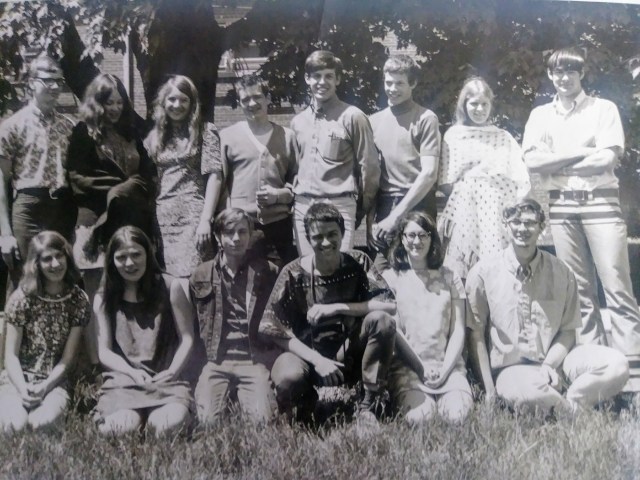
Scattergood Friends School Class of 1970

20171107_081609 (2)

Jeff Kisling

Peace Scattergood then now

FCNL: Scattergood Peace Marches

Posted in civil disobedience, peace, Uncategorized | Tagged , , | Leave a comment

Robert Kennedy, Ronald Reagan, Vietnam and Dissent

While reading Chris Matthew’s new book, Bobby Kennedy: A Raging Spirit, I read about a CBS news program “Town Meeting of the World” in 1967, where Senator Robert Kennedy and Gov. Ronald Reagan take student questions, most of which were about the war in Vietnam.  I found a copy of that on YouTube and it is a fascinating discussion, including their views on the antiwar movement, and legitimacy of the U.S. involvement in the war.  Gov. Reagan mentions his support for conscientious objection based upon religious beliefs, and mentions Quakers.  But besides that, he basically disagrees with protest during war.  Robert Kennedy broadly defends peaceful protest even in times of war.

DAVID JENKINS: Mr. Reagan, just five minutes ago on this program, you said every man has the right of dissent and I believe that every man has the right to be wrong. No doubt you’d also support the American ideal of freedom. Now, while on this I want to ask you whether you’d support the people who at the moment you say are dodging the draft, and whether you will go on record as supporting people who claim to be conscientious objectors as a means for not joining the war in Vietnam?

REAGAN: Oh, now wait a minute I thank you for giving me a chance, if I left the wrong impression. We agree in this country of the right of people to be wrong, but as I said before, taking advantage of the technicality that we are not legally in a state of war, we have people doing things with which I am in great disagreement. I do not believe in those who are resisting the draft. Now, we draw a line between the conscientious objector on religious grounds. With our great belief in religious freedom in our country, we have always said those whose religion specifically prohibits them, such as our Quakers, from taking human life, we offer them military service in a noncombat role such as being medics and so forth, and they have a great and honorable history, people of this kind, of serving in our wars in that capacity. But I believe if government is to mean anything at all, that all of us have a responsibility, once the action has been decided upon and supposedly by the majority will, that we then, while reserving our right to disagree, we support the collective or the unified effort of the nation. Otherwise, all law and order and all government breaks down, because we might have a citizen who has a conscientious objection to paying taxes and if we allow our citizens to voluntarily quit paying taxes the government breaks down–or obeying the law, or anything else that may come along. We give up certain individual freedoms in the interest of–well, I suppose it comes from our own Constitution our idea that every American or every person has the right, is born with the right to life, liberty and the pursuit of happiness. But my pursuit of happiness, if it comes from swinging my arm, I must stop swinging my arm just short of the end of your nose.

COLLINGWOOD: Senator Kennedy is there anything you want to add to that?

KENNEDY: Well, I expect I disagree somewhat with the Governor. I don’t think that we’re automatically correct or automatically right and morality is on our side or God is automatically on our side because were involved in a war. I don’t think that the mere fact that the United States is involved in the use of force with an adversary makes everything that the United States then does absolutely correct. So I–the idea that we’re involved in this kind of a struggle, if there are those within the United States that feel that the struggle could be ended more rapidly with less loss of life, that the terror and the destruction would be less if we took a different course, then I think that they should make their views known. I don’t think they’re less patriotic because they feel that. In fact, I think that they would be less patriotic if they didn’t state their views and give their ideas, just because the United States is involved in this kind of a conflict as we are at the present time. Not to state any opposition, or say that we can’t state an opposition because of the–the fact that we’re involved in a struggle I think is an error. This is a difficult period of time, but the mere fact that we’re shooting one another across the world doesn’t make the United States automatically right. I think it should be examined. It doesn’t make the course that we’re following at the present time automatically right, automatically correct and I think that those who have a different point of view, no matter what their point of view might be and whether they are in favor of using increased force, or in favor of lessening the force, or even some–of pulling out unilaterally–I happen to disagree with that but I think they have a responsibility and a right to state those views, even though we’re in a difficult period of time.

Posted in peace, Quaker Meetings, Uncategorized | Tagged , , , | Leave a comment

Queries and Action

Continuing to think about Quaker queries, I’ve been stimulated to think more about how we use them.  During a recent discussion I said, “isn’t the purpose of queries to lead us to action?”  Then I realized we might not all see them that way, and perhaps I hadn’t always thought so myself.

Recently I wrote the following to a Friend who has been working to try to get Quakers to come to grips with issues related to white privilege and racial justice:  “One of many ways to possibly move forward is the invitation from Ministry and Counsel to revise our queries. Since this month’s is about civic responsibility, I included “Many Friends have worked in various ways for legislation that promotes peace and social and economic justice, and have supported candidates for office with those views. This requires being informed about the social and economic conditions of the society we live in. To do so it is essential that we spend time with people in diverse communities.” in the advice and “Do we spend time in a diversity of communities, especially those experiencing injustice?” as one of the queries.”

When she politely responded she didn’t see revising the queries as meaningful action, I responded:  “I see queries as a way to cause action to occur. When we discussed the queries related to social justice in August I asked what we were going to do? Which lead to talking about relations with Native Americans and Prairie Awakening. Eight Friends then attended and we are working on a letter to support it’s continuation. Likewise I hope a query about spending time in communities experiencing injustice will result in experiences like North Meadow has with KI which I see as real progress.

The following was included in the report of the Peace and Social Concerns Committee of Iowa Yearly Meeting (Conservative) this year:

“Members of our Committee were encouraged to study the new book calling for national nonviolent direct-action, The Gandhian Iceberg, by Chris Moore-Backman, who sent us the following message:”
I pray that Quakers and others will move to hold bold action far above the careful crafting of right answers. In the end Jesus’ teaching is simple. Letting go of our attachments to our personal status quos is the catch. Intellectual rigor and discernment has its place, of course, but only – I believe – in service to direct, loving action and sacrifice.

I realized after my first try at coming up with new queries, that much of the advice, and several of the queries, were of a general nature, rather than specific to the topic (civic responsibility in this case).  My second attempt had parts that were more focused on civic responsibility, by the more general parts were still there.

So this morning I’ve been led to consider whether (1) there should be some overarching advice and queries and (2) an explicit inclusion of action steps to consider for each set of queries.  Following is my first draft.  I’d be interested to hear what you think of this modification of the current approach.

Introductory Advice
Quakers know that the Spirit of God is present throughout our entire world. We are all members of one human family. Suffering by anyone is felt by us all. Our communities are organized by social, economic and political structures. These are imperfect and sometimes result in injustice and oppression.

We listen carefully, to hear how God calls us to find ways to advance justice and peace for us all, and for Mother Earth.  We must also listen closely to those with differing views, looking for the truth in what they say, and finding ways to move along the path of justice together.

Throughout history Quakers have refused to obey laws or participate in social conventions that contradict our beliefs, sometimes being imprisoned as a result. There may be times when we are led to use nonviolent practices to restore peace and justice.

We use the opportunity of prayerfully considering the advices and queries, both individually and together as a meeting, to evaluate our present condition, and seek guidance for improvements in our lives, and how to implement them.

Inviting distant members to share in this process is a way for our meetings to speak to the spiritual conditions of all members and attenders, and grow together.

Queries
• Do we study how Quakers throughout history have lived in the Spirit in the world?
• How do we overcome obstacles related to our spiritual practices and social justice work? Do we maintain an awareness of the struggles of others, both in the meeting and the wider community, and support them as they work for peace and justice?
• Does the meeting as a whole discern what it is being called to do? Do we include all members and attenders, of all ages, in this discernment and work?

Action
• How are we going to implement what God is leading us to do?
• How can we keep attention on the Inner Light as we are doing this, especially in the midst of conflict and confusion?
• As publishers of the truth, what will we share about what we are being led to do, and how will we do that?

Then each month we could revisit those overarching advices, queries and action statements, along with the particular queries for that month.  Since Bear Creek will be considering the civic responsibility queries this month, that might look like the following (suggested new advice and queries)

Civic Responsibility

Advice
Our civic responsibility is living our lives in the Spirit, letting that be an example to others. And finding ways to share what we know of God’s will with the world.
We seek to find ways to be engaged with our communities and in political processes in ways that are consistent with our spiritual leadings.

Queries
• Are we called to attend or help organize public political or social justice events?
• Are we called to support political parties and or candidates that embrace our beliefs?
• Do we spent time in communities experiencing injustice?
• Do we remain well informed about community policies that impact peace and justice, health, education, and our environment?
• Do we share our concerns with our elected representatives?
• Do we support the Friends Committee on National Legislation and it’s work on our behalf with our Congressional representatives and the Federal administration?
• Do we write letters to the editor or other articles about our concerns and beliefs?

Actions
• What specific civic engagement tasks are we being led to take now?
• Who is going to do each task?
• How and when will each task be done?

Posted in peace, Quaker Meetings, Uncategorized | Tagged , | Leave a comment

Civic Responsibility revised

As I’ve been writing recently, we will be discussing the queries about civic responsibility at Bear Creek meeting this month.  I was also trying to come up with a new version of the queries.  But I think my first attempt was too broad, so a new version follows.

Advice
“Civic responsibility is the responsibility of citizens in a society to exhibit certain attitudes and actions related to participation in society and democratic governance.” https://www.reference.com/world-view/civic-responsibility-66a4800099c91789

Quakers know that the Spirit of God is present throughout our entire world.  We are all members of one human family.  Suffering by anyone is felt by us all.  Our communities are organized by social, economic and political structures. These are imperfect and sometimes result in injustice and oppression. When that happens, we listen carefully, to hear how God calls us to find ways to restore justice and peace for us all, and for Mother Earth.  We must also listen closely to those with differing views, learning the truth in what they say, and finding ways to move along the path of justice together.

Many Friends have worked in various ways for legislation that promotes peace and social and economic justice, and have supported candidates for office with those views.  This requires being informed about the social and economic conditions of the society we live in.  To do so it is essential that we spend time with people in diverse communities.

Throughout history Quakers have refused to obey laws or participate in social conventions that contradict our beliefs, often being imprisoned as a result. There may be times when we are led to use nonviolent practices to restore peace and justice.

Our civic responsibility is living our lives in the Spirit, letting that be an example to others. And finding ways to share what we know of God’s will with the world.

Queries
• Do we study how Quakers throughout history have lived in the Spirit in the world?
• Do we spend time in a diversity of communities, especially those experiencing injustice?
• Do we remain well informed about policies and conditions that impact peace and justice, health, education, and our environment?
• How do we overcome obstacles related to our civic engagement? Do we maintain an awareness of the struggles of others, both in the meeting and the wider community, and support them as they work for peace and justice?
• Are we publishers of the truth, sharing what we know of God’s will with the world?
• Does the meeting discern what it is being called to do as a whole to promote peace and justice? Do we include all members and attenders, of all ages, in this discernment and work?
• How do we obey what God is leading us to do? Do we pay close attention to the Inner Light as we are doing this work, especially in the midst of conflict and confusion?

Posted in civil disobedience, peace, Quaker Meetings, Uncategorized | Tagged , , , , , | Leave a comment

What do we do today?

I’ve been thinking and writing about Quaker queries for some time now.  I’ve written about ways we use them, and how I as an individual use them as an important part of my spiritual practice.  I am grateful some have suggested we may need to revise or rewrite some of our queries, which has given me an opportunity to think more about different questions we might be asking.  The queries Bear Creek will be working on this month are about civic responsibility.  I shared my written response to those queries.   Then I came up with some possible new queries related to civic responsibility.

Today I thought I’d answer one of those new queries, “how do we obey what God is leading us to do?”  Thus, the title of this blog post.  For many years I’ve be led to write about my spiritual experiences, so I struggle to express them as well as I can.  In the past I used to overburden people by sending out too many email messages of these writings. Using this blog is a better approach.

After doing this for quite a while, I came to realize that each morning I was asking God “what do we do today?”  Or more specifically, “what do you want me to write about today?” Often this would be something I’ve been thinking about for the past several days.  Commonly things percolate during the night.

When I began these writings, I would sometimes wonder if I was promoting myself.  Sometimes people would suggest that possibility.  I didn’t think that was the case. It was helpful to read the following that (Quaker) Noah Baker Merrill wrote in Prophets, Midwives, and Thieves (highly recommended):

“We need to be careful when we talk about humility. The kind of humility this work brings isn’t the kind that would have us reject or repress our gifts. This kind of false humility leads us to oppress each other in the name of preventing pridefulness. This happens far too often.
Real, life-giving humility means living up to the light that we have been given without judgment of how bright or dim that light is. False humility is hiding this light under a bushel for fear of jealousy or judgment. The challenge is to be faithful right where we are—no more, no less. This takes courage.”

So one answer to “how do we obey what God is leading us to do?” for me is to write what I am led to write.  Of course I’m led to do much more than just write, such as living without a car, attending and organizing community building events and vigils, studying, photography, etc.

The important precursor of “how do we obey what God is leading us to do?” is to develop the discipline of always being mindful of the Spirit so we are aware of what we are being led to do at any given time.  Even after a lifetime of practice, I still loose track of the spirit at times throughout the day.

As I was reading Noah Merrill’s article, I was reminded of some of the other things he wrote.

“In a world experiencing unprecedented climatic, ecological, and societal change, many in the Religious Society of Friends are coming to know our own need for newness. We thirst to find and share a clearer sense of the relevance of our beloved tradition to the challenges we face. We yearn to come more fully alive together, to speak and serve today in the Life and Power that generations of our spiritual ancestors knew. Across North America and beyond, Friends are recognizing a shared calling to rediscover and reclaim traditional understandings of who we are and how we are as Friends that will help us continue to travel this Way of Love.”

My leading to write is related to that, finding and sharing a clearer sense of our traditions today.

Posted in Quaker Meetings, spiritual seekers, Uncategorized | Leave a comment

When will they ever learn?

Pete Seeger’s classic song about war comes to mind as I wonder when we will ever learn about environmental destruction from fossil fuels?

We have been at war against Mother Earth these last several decades.

Many of you know I’ve been talking about this most of my life, with very little effect.  Logic, scientific data and mathematical models don’t move the masses.  There are new reports of increasingly dire environmental conditions, but I don’t think it would affect anything by talking, more, about them here.

People are beginning to be concerned about the more dramatic effects of the damage–obviously changing seasons, hotter temperatures, more destructive hurricanes, ferocious wildfires.  But they refuse to connect the dots.  They want to think each one of these things is just one unusual event.

It has to be that people are actually afraid to acknowledge this.  Probably feeling if they did, they would feel compelled to try to do something about it, and believing they probably won’t, would feel (do feel?) guilty.  Believing they couldn’t do anything, anyway, why think about it?  Maybe our task now is to help confront these fears.  I don’t think we can make the progress we need to until we do.

The most effective things you can do are stop flying,  stop using personal automobiles,  have less children, and remove meat from your diet.  Seriously, just do not fly anymore.  You can do this.

I would like to think that it is basic to all humans to be concerned about the well being of their children.  Native American’s have a wonderful principle, The Seventh Generation Principle, which is that every decision should take into consideration what its impact would be on our descendants seven generations into the future.  I hadn’t realized that was codified into the Great Law of Peace. “The central idea underlying Iroquois political philosophy is that peace is the will of the Creator, and the ultimate spiritual goal and natural order among humans.”

The main thing that still gives me hope is the wonderful example the water protectors showed us as they used prayer and nonviolence at Standing Rock, and other places of environmental threat around the world.  A movement has been ignited that continues.

Quakers, too, believe peace is the will of the Creator.  Today peace is urgently needed to halt the war we are waging against Mother Earth.


Posted in #NDAPL, climate change, Indigenous, peace, Quaker Meetings, Uncategorized | Leave a comment

Quakers and North Korea–Update 11/2/2017

I was very glad to have a phone conversation with Dan Jasper, Asia Public Education and Advocacy Coordinator for the American Friends Service Committee (AFSC)I have written some about his work before.  He spoke of how alarming it is that the little positive interactions between North Korea and the United States are the few and fragile bridges represented by humanitarian efforts, mainly by a few faith organizations, including AFSC and the Mennonite Central Committee.

He mentioned working with the Scarsdale Friends Meeting in New York City, just 20 miles from the United Nations headquarters.  North Koreans need a special visa to travel more than 25 miles from the U.N.  So there might be a possibility that the North Korean Ambassador to the United Nations might be able to visit the Scarsdale Meeting.

Linda Lewis (AFSC) is in North Korea now.  Dan will discuss the possibility of another North Korean visit to Iowa with her when she returns.  We hope one of them will be able to meet with Iowa Friends to discuss what we might do next to make that happen.

In the meantime, please contact your Congressional representatives to support the bills below to require congressional authorization for military action against North Korea.

Prevent War with North Korea
Support H.R. 4140/S.2016 and S. 2047

War with North Korea would be a strategic disaster for the United States and its regional allies. Congress urgently needs to seize control of this situation and stop the dangerous, escalating rhetoric on both sides from sparking a global catastrophe.
Support H.R. 4140/S. 2016 and S. 2047 to keep President Trump from starting a war with North Korea without congressional authorization
The No Unconstitutional Strike Against North Korea Act (H.R. 4140/S. 2016) and S. 2047, A bill to restrict the use of funds for kinetic military operations in North Korea, would bar the use of funds for President Trump to start a war with North Korea without congressional authorization or absent an attack on the U.S. or allies.
The North Korean challenge is urgent, but the United States has successfully used dialogue and diplomacy in the past to avoid both war and capitulation.
Sanctions, missile defenses, threats, and pressure on other countries cannot be relied on as stand-alone solutions to stop further North Korean nuclear and missile advances or to avoid catastrophic misunderstandings and miscalculations.
Avoiding war and reducing tensions should be key objectives of U.S. strategy and diplomacy alongside denuclearization, nonproliferation, and human rights.
FCNL Contact: Anthony Wier, Anthony@fcnl.org

https://www.fcnl.org/updates/prevent-war-with-north-korea-1117

Posted in peace, Quaker Meetings, Uncategorized | Tagged | Leave a comment

Advices and Queries

Since I’ve been writing about the Quaker practice of considering the advices and queries, and since people who aren’t Quakers sometimes read these blog posts, it might be helpful to step back and explain more about this.

Quakers attend a meeting near them, where they may be members or not.  Everyone is welcome to attend Quaker meetings.  Those who aren’t formally members may be referred to as attenders in things you might read about Quakers.  These local meetings, which usually meet every week, are referred to as monthly meetings because the business sessions of these meetings usually occur once a month.  Monthly meetings in the same geographical area (often covering several states) belong to an umbrella organization referred to as a yearly meeting.  The monthly meetings of which meet together for several days or a week each year to take care of business common to them all, and to socialize.  My monthly meeting is Bear Creek, in the countryside north of Earlham, Iowa, which belongs to Iowa Yearly Meeting (Conservative).  The word conservative is often a source of confusion, since most members would be considered liberal in the political sense.  In this case, it refers to preserving traditional Quaker practices, such as having meetings for worship in silence instead of having a sermon and singing.

Each yearly meeting usually has a document that defines how the meeting approaches Quakerism, including how committees are structured, and how things like marriages are done.  This is commonly titled the Faith and Practice of the yearly meeting.  Each yearly meeting’s Faith and Practice usually includes their version of the advices and queries.  Iowa Yearly Meeting (Conservative)’s Faith and Practice can be found here.

The following explanation of the queries comes from the Faith and Practice of Philadelphia Yearly Meeting.

“Friends have assessed the state of this religious society through the use of queries since the time of George Fox. Rooted in the history of Friends, the queries reflect the Quaker way of life, reminding Friends of the ideals we seek to attain. From the Christian tradition, Friends have taken as a standard the life and teaching of Jesus, not only as recorded in the New Testament, but even more importantly as revealed inwardly, as we seek God’s truth and its expression through our lives today. Friends approach queries as a guide to self-examination, using them not as an outward set of rules, but as a framework within which we assess our convictions and examine, clarify, and consider prayerfully the direction of our lives and the life of the community.”

I know many Friends have shared with me over the years, that we find the practice of using the queries as a way to focus on how we are doing, individually and as a meeting, regarding our own faith, and how we practice it, right now in our lives, something we treasure.

Discussing the queries is also a great way to know each other better, and how we are doing spiritually.  There is a fairly common misconception that you can believe anything you want as a Quaker, which is not true.  Discussing our faith and beliefs together helps identify when we, or someone else, is straying from the truth.  Or when someone could use help when experiencing difficulties.  This is also one of the best ways people new to Quakerism can learn about our faith.

In Iowa Yearly Meeting (Conservative), our Faith and Practice has twelve sets of advices and queries (which I’ve included at the end of this).  The advice is an introduction to the topic, and the queries are the questions.  Usually each monthly meeting considers one of the queries each month.  After the discussion, someone writes a summary, which is then read for approval at the next meeting for business.  These written responses are sent to the yearly meeting, where selections for each query are read during the yearly meeting business sessions, and those selections are included in the printed minutes from the yearly meeting sessions.

My monthly meeting, Bear Creek, created an added dimension to this several years ago.  Several member of the meeting live far from the meetinghouse, but maintain close ties with the meeting by means of email exchanges, telephone calls and by visiting when possible.  The meeting decided to strengthen these connections by inviting those who could not be present to send their responses to the meeting ahead of time.  Then when that set of queries was being discussed, those responses were read, to add to the discussion, and perhaps parts of which would be included in the written report about that query.  We refer to this as “long distance queries”, and all involved have found this a meaningful, wonderful practice.

If you don’t live near a Quaker meeting, you could consider the queries yourself.

Following are the current advices and queries.  As some of you know, we are in the process of seeking revisions of them.

ADVICES AND QUERIES OF
IOWA YEARLY MEETING (CONSERVATIVE)

Introduction

Quakerism is a living faith made real through the inward light of the living Christ. This faith holds that our individual lives and the corporate life of the meeting can be guided by continuing revelation through the Holy Spirit.

When we behold the splendor of creation, we realize that knowledge of what is divine is beyond description. Traditionally, Friends have referred to the divine in such terms as God, the Inward Light, the Living Water, the Creator, the Christ Within, and the Spirit. Many believe that when we limit the divine to one gender we also limit ourselves and each other. Becoming aware of how we discern Spirit is important to our worship.

The Quaker faith is not written in the form of a creed, but is experienced in our lives as a vibrant, living truth. Advices and queries serve to engage our minds and hearts in a process which may provide openings to the leadings of the Spirit within us. These leadings may speak to our individual and corporate needs. The advices and queries reflect experiences from many lives as they contribute to the gathered wisdom of the group. They serve to guide us on our spiritual journeys by opening our hearts and minds to the possibility of new directions and insights.

Uses of Advices and Queries

We look for our own truths and the truths of our meeting when we discuss the advices; and answer the queries. It is suggested that one advice and one query be considered by the local meeting each month.

Monthly meeting answers to each of the queries are to be mailed to the assistant clerk of the Yearly Meeting one month prior to Yearly Meeting. While Friends are encouraged to consider each query in its entirety, replies need to cover only those questions the meeting is led to address. A summary answer, to be read at the Yearly Meeting session, will be chosen by the assistant clerk from among the monthly meeting answers.

1. MEETING FOR WORSHIP

ADVICE

Meeting for Worship is the heart of the meeting. In the silence, we seek direct communion with God the Spirit, conscious of the seeking of others. From the depths of living silence may come an awareness of the presence of the Spirit.

Sometimes the silence is unbroken. At other times a message may come to any one of us which seems intended not simply for the worshiper, but for the gathering as a whole. If the message is not expressed one may feel a sense of not having been faithful to a leading of the Spirit, but if it is spoken, a sense of peace may follow. We are most effective if we speak clearly, simply and from our own experience. Because we are unique individuals who come from varied backgrounds and life experiences, our messages reflect diversity. Part of our worship together is listening with an open spirit, holding the speaker in love, remembering that silence after the message is part of the message.

Our daily lives are linked with Meeting for Worship. In the search for truth, Friends are encouraged to spend time in individual study, meditation or prayer and to be open to other sources of inspiration around us. The life of the meeting may be strengthened by a deep level of sharing, discussion or worship at times other than regularly scheduled meetings.

Friends should make an effort to arrive a Meeting for Worship prepared in mind and spirit to support one another in a worshipful atmosphere. As we give and receive, in speech or in silence, we are drawn together in the life of the Spirit.

QUERY

• Are our Meetings for Worship held in a spirit of expectant waiting and communion with the Holy Spirit? How do we prepare our hearts and minds for worship?

• How do we refer to that which is divine? How does ascribing gender to the Holy Spirit affect our worship?

• How does the vocal ministry of the meeting contribute to its spiritual life? In what ways do we recognize and nurture vocal ministry and other spiritual gifts?

2. OUTREACH

ADVICE

Friends believe it is essential to express in words and deeds the faith that sustains us and the convictions that arise from that faith. It is important to speak with integrity and courage ourselves as well as to listen to others with open hearts and minds. We seek fellowship with a branches of Friends and with other seekers of Truth. We recognize the oneness, of humanity in the Spirit and believe that in learning from one another we may come to respect differences. Truth is greater than any of us may know, individually or as a group.

As we work and share with others within our communities, we may find opportunities to invite them to attend our meetings for worship and other meeting activities. A genuine welcome to everyone is consistent with Friends’ testimony of acknowledging the Divine Spirit in each person and of our belief in the dignity and worth of every human being.

QUERY

• Do we encourage intervisitation within the Yearly Meeting and with other Friends?

• What are we doing to share our faith with others outside our Friends community? How do we speak truth as we know it and yet remain open to truth as understood by others?

• In what ways do we cooperate with persons and groups with whom we share concerns? How do we reach out to those with whom we disagree?

• How do we make the presence of our meeting known to the larger community? Do we invite others to share in our Meetings for Worship and other meeting activities? Do we welcome everyone and appreciate the gifts that differences such as race, creed, economic status, disability, age, gender or sexual orientation may bring to us?

3. MEETING FOR BUSINESS

ADVICE

In our Meeting for Business, Friends seek divine guidance in handling the affairs of the meeting. By opening the meeting with a period of worship, Friends can more easily wait patiently upon the will of the Divine Spirit while conducting business. This assists our Meetings for Business in finding the loving unity that might never be achieved through discussion alone. The right conduct of Meetings for Business, even in routine matters, is important to the life of the meeting.

Friends are encouraged to prepare for and attend Meetings for Business just as they would other Meetings for Worship. Participating in Meetings for Business and acceptance of responsibilities within the Meeting should not be taken lightly. When filling positions within our meetings, it is important to consider the suitability of individuals for specific tasks. Although the clerk is particularly charged with gathering the sense of the meeting, all Friends can assist the process by committing themselves to be faithful in opening their hearts and minds to wait upon the Divine Spirit.

QUERY

• How can we hold our Meetings for Business in the spirit of love, understanding and patient search for unity without becoming frustrated by differences of opinion or the pressures of time?

• How do we respond when no one else in the meeting seems to hold the views that we do on an issue? How do we respond to a dissenting minority?

• How do we share responsibilities among Friends in our meeting? How do we serve our meetings?

4. HARMONY WITHIN THE MEETING

“This is my commandment: Love one another as I have loved you.” John 15:1

ADVICE

It is sometimes difficult to remember that love is a gift of the Divine Spirit and not simply a human emotion. As imperfect human beings, it is not always possible for us to feel loving toward one another, but by opening ourselves to the Light Within, we can receive and give love beyond our human abilities.

Relationships among meeting members take time to evolve. Sometimes misunderstandings develop. When differences arise, they should not be ignored for the sake of superficial unity. We believe disagreements which might divide or disrupt a meeting can be resolved through human effort and divine grace, and may result in a stronger and more creative meeting. True harmony depends upon each persons deep respect of and faithful attention to the Divine Spirit within us all. We endeavor to practice humility, attempting to understand positions of others and being aware of the possibility that we may be mistaken.

It is the responsibility of the Ministry and Oversight Committee to be sensitive to needs which may arise. Others in the meeting may be equally concerned, and because of greater understanding in certain cases, be able to give counsel. In reconciliation of differences, a position not previously considered may prove mutually beneficial. At times it may be necessary to confront individuals whose behavior is disruptive. A clearness committee or professional help may be suggested in some situations. We must always remember the power of holding one another in the Light, and the healing that comes from forgiving ourselves as well as others.

QUERY

• What can we do to deepen our relationships with one another? How does gender affect the way we relate to each other?

• How does our meeting balance the needs for honesty and kindness? What topics do we avoid for the sake of “unity”?

• When in conflict with others, do we cultivate a forgiving spirit? Do we look to that of God in ourselves and seek to address that of God in those with whom we disagree?

5. MUTUAL CARE

ADVICE

Friends consider the meeting to be a family in which the welfare of each individual is of utmost concern. For some, the meeting may be the only family in the community. In mutual caring we seek greater wisdom than our own. We listen to the silence within ourselves and to one another with openness of heart. Sharing our pain as well as our joy can bring us closer together, making it easier to ask for help when we need it. Each of us is both giver and receiver, ready to help and to accept help.

Friends try to be aware of those who require special attention within the meeting community. We believe friendly interaction benefits both adults and children. It is the responsibility of adults to recognize and give voice to the needs of children in the meeting. Inactive and absent members require the care of the meeting; those who do not currently attend meeting may be contacted by mail or by personal visit. We need also to minister with sensitivity to those in transition and to support caregivers and those requiring care within the meeting community. It is important to be responsive to the needs and gifts of newcomers and seekers who may attend our meetings for a short time.

We endeavor to be conscious of how differing gender role expectations may affect the quality of our relationships and influence how we empower ourselves in the home, meeting, community, school, workplace and government. We envision a society that provides opportunities for all people to reach their potentials, to share similar expectations, reap comparable rewards and contribute equally to society.

QUERY

• How do we respond to each other’s personal needs and difficulties in sensitive and useful ways? Do we encourage both men and women to share in caregiving?

• What are we doing to welcome and draw members and attenders of all ages into the fellowship of the meeting?

• How do we help our children feel the Ioving care of the meeting? What do the children contribute to the meeting?

• How do we keep in touch with inactive and distant members and attenders?

6. EDUCATION

ADVICE

Friends seek an education which integrates our intellectual, emotional and spiritual dimensions and enables us to face difficult moral issues with courage.

While the religious education of our children is primarily the concern of parents, everyone benefits when the entire meeting is concerned with nurturing them. If a spirit of common concern is present, children will gain a sense of belonging to the larger community, and, knowing they are loved and respected, will be able to face the mysteries of life with trust.

Friends promote learning throughout life and encourage freedom of thought and inquiry in all educational pursuits. Our complex and changing world demands that we learn to think and act creatively to meet its challenges.

QUERY

• How can we most effectively foster a spirit of inquiry and a loving and understanding attitude toward life?

• What effort are we making to become better acquainted with the Bible, the teachings of Jesus, our Judeo Christian heritage, the history and principles of Friends, and the contributions of other religions and philosophies to our spiritual heritage?

• In what ways can we encourage an educational process that is consistent with the values Friends cherish? How do gender based expectations affect the goals we set and the way we learn?

• Do we take an active and supportive interest in schools, libraries and other educational resources in our communities and elsewhere?

• How do we prepare ourselves and our children to play active roles in a changing world?

7. HOME AND FAMILY

ADVICE

We seek an atmosphere within our homes and within our families which nurtures the many physical, social, spiritual and emotional needs of each of us. This is true whether we live alone or with others.

A family, whatever its composition, is a unique and sometimes fragile bonding of people. At its best, it is concerned with the welfare of the whole and each of its constituents.

Children bring gifts to the families that nurture them. Our children’s earliest encounters with the principles of Friends usually occur within our homes. Examples we set are often more effective than verbal guidance. The loving support of the meeting is needed as children learn to understand and practice Quaker principles in their lives.

While we try to make our homes centers of love, we sometimes feel anger and hostility. Part of the challenge of being human is to learn to constructively channel the energy of anger, relying on the Divine Spirit for love and guidance., Worship in the home can enable us to hold ourselves and one another in the Light. Respect for truth, as each discerns it, is essential to the happiness and spiritual growth of a persons within the home. Clear communication, patience and a sense of humor are vital to family relationships.

We value setting aside time for rest, recreation and creative activities. Offering hospitality can foster mutual bonds of friendship and love and can enrich our own lives and the lives of others.

QUERY

• How can we make our homes places of love and hospitality?

• What different expectations do we hold for women and men, boys and girls? How can we bring more equality into our relationships?

• How do we develop and maintain lines of communication?

• In what ways do we share our deepest experiences, struggles, concerns and beliefs with our children and others, yet encourage them to develop their potential as the Spirit leads them?

• What place do we make in our daily lives for meditation, spiritual renewal and reading of inspiring literature, such as the Bible?

• How does our Meeting support families of all kinds?

8. PERSONAL RESPONSIBILITY

“Life is meant to be lived from a Center, a divine Center–a life of unhurried peace and power. It is serene. It takes not time, but it occupies all our time.” Thomas Kelly

ADVICE

Historic testimonies of the Society of Friends against taking oaths, joining secret organizations, gambling and using addictive substances grew out of efforts of Friends to live with integrity and consistency. To swear an oath implied that one is obliged to be truthful only under oath. Joining secret organizations, gambling and using addictive and/or consciousness altering substances were recognized as practices which diverted resources from useful purposes, distracted attention from the Inner Light, and placed obstacles in the way of Friends seeking to lead lives of integrity. We recognize the spirit of these testimonies and endeavor to apply the same principles in our lives today.

Honesty and simplicity are essential parts of personal responsibility. We manifest our commitment to Truth in all we do. We can have joy and beauty in our lives without allowing material things to dominate them. We need to free ourselves from distractions that interfere with our search for inner peace, and accept with thanksgiving all that promotes fullness and aids in service to the divine Center.

QUERY

• How do we center our lives in the awareness of God the’ Spirit, so that all things may take their rightful places?

• How do we structure our individual lives in order to keep them uncluttered with things and activities? How does Meeting help us examine our personal lives for simplicity?

• Do we choose recreational activities which foster mental, physical and spiritual health?

• How are our lives affected by tobacco, alcohol and drug use? What can we do to deal with problems resulting from their use? What can we do to recognize and deal with unhealthy ways we treat ourselves?¬

• How do we ensure that we act with fairness and integrity?

• Are we sensitive to our own use of language which may be offensive or oppressive to others?

9. CIVIC RESPONSIBILITY

ADVICE

Because Friends believe there is that of God in all people, we strive for a world of freedom, justice and equality for everyone. Believing that progress toward these ideals is advanced by those who devote themselves to the shaping of a just society, we urge Friends to be active and conscientious citizens. This means staying informed on social issues, and on the opinions and activities of our elected representatives and of those seeking office. It is important that Friends speak truth to those in power. We recognize that, in our world, power in government and private sectors lies disproportionately with those of economic means. Speaking out on a personal level in our communities may be difficult, even dangerous, yet by doing so we may encourage others to work for justice.

Our first allegiance is to the Holy Spirit. In general, Friends support the laws of the State; but if those laws directly violate our religious convictions, we may be led to oppose them. When contemplating civil disobedience or unpopular personal testimony, we must carefully consider the spiritual basis for, and honestly face the consequences of our actions.

QUERY

• What conflicts do we perceive between the laws of the State and our religious convictions? How do we resolve those conflicts in our lives? In what ways do we assume responsibility for the government of our community, state, nation and world?

• How do we share our convictions with others? Do we express our opinions with courage, yet with love, mindful of the Divine Spirit within everyone?

• How do we maintain our integrity when we find ourselves in a position of power? How do we respond when we feel powerless? Do we really respect and help those we seek to serve?

• Are we careful to reach our decisions through prayer and strengthen our actions with worship? Are we open to divine leadings?

10. ENVIRONMENTAL RESPONSIBILITY

ADVICE

All of creation is divine and interdependent: air, water, soil, and all that lives and grows. Since human beings are part of this fragile and mysterious web, whenever we pollute or neglect the earth we pollute and neglect our own wellsprings. Developing a keen awareness of our role in the universe is essential if we are to live peacefully within creation.

The way we choose to live each day as we manufacture, package, purchase and recycle goods, use resources, dispose of water, design homes, plan families and travel affects the present and future of life on the planet. The thought and effort we give to replenishing what we receive from the earth, to keeping informed and promoting beneficial legislation on issues which affect the earth, to envisioning community with environmental conscience, are ways in which we contribute to the ongoing health of the planet we inhabit.

Preserving the quality of life on Earth calls forth all of our spiritual resources. Listening to and heeding the leadings of the Holy Spirit can help us develop qualities which enable us to become more sensitive to all life

QUERY

• What are we doing about our disproportionate use of the world’s resources?

• Do we see unreasonable exploitation in our relationship with the rest of creation?

• How can we nurture reverence and respect for life? How I can we become more fully aware of our interdependent relationship with the rest of creation?

• To what extent are we aware of all life and the role we play? What can we do in our own lives and communities to address environmental concerns?

11. SOCIAL AND ECONOMIC JUSTICE

“For when I was hungry you gave me food, when thirsty you gave me drink, when I was a stranger you took me into your home, when naked you clothed me, when in prison you visited me.” Matthew 25:35 36

ADVICE

We are part of an economic system characterized by inequality and exploitation. Such a society is defended and perpetuated by entrenched power.

Friends can help relieve social and economic oppression and injustice by first seeking spiritual guidance in our own lives. We envision a system of social and economic justice that ensures the right of every individual to be loved and cared for; to receive a sound education; to find useful employment; to receive appropriate health care; to secure adequate housing; to obtain redress through the legal system; and to live and die in dignity. Friends maintain historic concern for the fair and humane treatment of persons in penal and mental institutions.

Wide disparities in economic and social conditions exist among groups in our society and among nations of the world. While most of us are able to be responsible for our own economic circumstances, we must not overlook the effects of unequal opportunities among people. Friends’ belief in the Divine within everyone leads us to support institutions which meet human needs and to seek to change institutions which fail to meet human needs. We strengthen community when we work with others to help promote justice for all.

QUERY

• How are we beneficiaries of inequity and exploitation? How are we victims of inequity and exploitation? In what ways can we address these problems?

• What can we do to improve the conditions in our correctional institutions and to address the mental and social problems of those confined there?

• How can we improve our understanding of those who are driven to violence by subjection to racial, economic or political injustice? In what ways do we oppose prejudice and injustice based on gender, sexual orientation, class, race, age, and physical, mental and emotional conditions? How would individuals benefit from a society that values everyone? How would society benefit?

12. PEACE AND NONVIOLENCE

“[We] seek to live in the virtue of that life and power that takes away the occasion of all wars.” George Fox

ADVICE

We seek peace within our own lives. Sometimes there are barriers to peace within families and meetings, and among individuals. Anger and frustration may result in hurtfulness which leaves physical, sexual or emotional wounds. Healing and forgiveness are possible when our hearts are opened to the transforming love that comes from the Spirit Within. The violence we oppose is not only war, but all unloving acts.

Friends seek peaceful resolution to conflicts among nations and peoples. Wars can easily erupt when nations depend upon armed forces as an option for defense and order. To oppose war is not enough if we fail to deal with the injustices and inequalities that often lead to violence. We need to address the causes of war, such as aggression, revenge, overpopulation, greed, and religious and ethnic differences.

QUERY

• What are we doing to educate ourselves and others about the causes of conflict in our own lives, our families and our meetings? Do we provide refuge and assistance, including advocacy, for spouses, children, or elderly persons who are victims of violence or neglect?

• Do we recognize that we can be perpetrators as well as victims of violence? How do we deal with this? How can we support one another so that healing may take place?

• What are we doing to understand the causes of war and violence and to work toward peaceful settlement of differences locally, nationally, and internationally? How do we support institutions and organizations that promote peace?

• Do we faithfully maintain our testimony against preparation for and participation in war?

Posted in Quaker Meetings, Uncategorized | Tagged , , , , | Leave a comment

New Civic Responsibility Queries

While sharing my responses about our Quaker queries regarding civic responsibility, an Iowa Yearly Meeting (Conservative) Friend explained reasons he felt our queries should be revised.  I asked him to provide an example and he said he is working on one.  In the meantime, the following is what I have come up with.

When I shared the discussion about improving the queries with the clerk of our Ministry and Counsel Committee, which is responsible for the queries, she reminded us of the following, from the report of that committee in 2016:  “We are aware that some of our yearly meeting queries are outdated and no longer seem relevant. We invite others to pay attention to this over the next year as our own meetings consider the queries …”

In working on this I found I was having trouble identifying what is related to civic responsibility, and what might be more related to other topics, such as peace and social concerns.  We might need to reorganize the topics, too.

Those of you in Iowa Yearly Meeting (Conservative) meetings are encouraged to suggest new or revised advices and queries.  I plan to share these with Bear Creek meeting, but they have not been considered there, yet.  Sharing your work with the rest of us, either on the unofficial yearly meeting Facebook page or email, would be very helpful.  You should also include any changes your meeting comes up with in the responses you submit to the yearly meeting.  I hope you will be excited to take up this work.

Civic Responsibility

Advice
Quakers know God is present in the world today, in every person, and continues to guide us. Our purpose is to always be faithful to the leadings of the Spirit. We are distressed by any action or condition that deviates from the path of love, peace and justice. We pray to discern the ways we are called to be instruments of God’s will.
Our communities are organized by social, economic and political structures. These are imperfect, and sometimes result in injustice and oppression. When that happens, we listen carefully, to hear how God calls us to find ways to restore justice and peace for us all, and for Mother Earth.
Quakers have throughout history refused to obey laws or participate in social conventions that contradicted our beliefs, often being imprisoned as a result. There may be times when we are led to use nonviolent practices to restore peace and justice.
Our civic responsibility is living our lives in the Spirit, letting that be an example to others. And finding ways to share what we know of God’s will with the world.

Queries
• Do we study how our forbearers have lived in the Spirit in the world?
• How do we obey what God is leading us to do? Do we pay close attention to the Inner Light as we are doing this work, especially in the midst of conflict and confusion?
• Do we spent time in communities experiencing injustice?
• How do we overcome obstacles related to our spiritual practices or social justice work? Do we maintain an awareness of the struggles of others, both in the meeting and the wider community, and support them as they work for peace and justice?
• Are we publishers of the truth, sharing what we know of God’s will with the world?
• Does the meeting discern what it is being called to do as a whole? Do we include all members and attenders, of all ages, in this discernment and work?
• Do we remain well informed about community policies that impact peace and justice, health, education, and our environment?

Posted in civil disobedience, peace, Quaker Meetings, social media, Uncategorized | Tagged , , | Leave a comment