Quaker Voluntary Service (QVS)

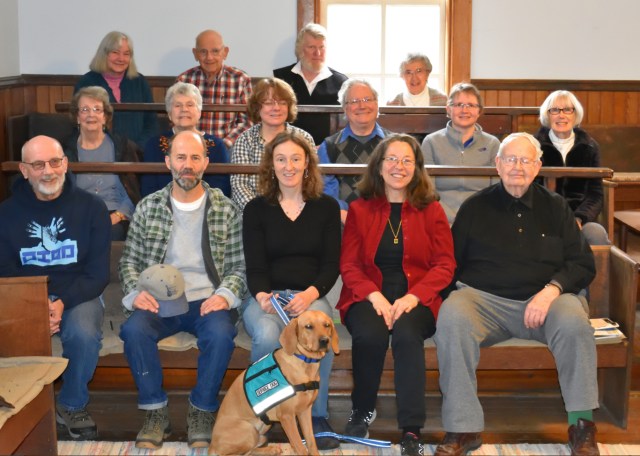
Last Sunday Sonja Sponheim and Elizabeth O’Sullivan, both of whom live in Minnesota but recently became  members of Bear Creek Friends Meeting, were able to be at Bear Creek with us.

DSC_6534_01

Bear Creek Friends Meeting 1/21/2018

One thing we learned about was Sonja’s new job as Minneapolis Start Up Coordinator for Quaker Voluntary Service (QVS).  Following are information and links related to QVS.

Mission
Boldly and deeply Quaker – grounded in worship, forming leadership for the present and the future of Friends. Passionately engaged in service and social justice – both helping change the world and being transformed together through the experience. Practicing radical hospitality and inclusiveness – with one another and in the community, following the ministry and message of Jesus. This is the vision and the unfolding mission of Quaker Voluntary Service.

STORY
We are a year of service program for young adults 21-30. If you are interested in living in intentional community with others, exploring your spiritual life and the Quaker faith tradition, and serving in a full time position in a nonprofit, this program might be for you!   From the QVC Facebook page

Quaker News
By John Helding, QVS Board Clerk | 5/23/12
FGC staff are excited about this new Quaker initiative and wanted to be sure you heard about it.
Quaker Voluntary Service equips the work and witness of Friends by providing support to a network of Quaker service communities. The first community will launch this fall under the spiritual care of the Atlanta Friends Meeting.
Growing out of a 2009 consultation supported by the FGC’s former Youth Ministries Committee, a dedicated group of volunteers has worked hard to make this vision a reality. Christina Repoley, a long-time FGC volunteer, has recently been appointed the first Executive Director of QVS. Visit the QVS website to learn more about this exciting new initiative, and their first cohort of volunteers.  Friends General Conference (FGC)

QuakerSpeak video:  Transforming Service, Living Faith: Quaker Voluntary Service

I was very interested to learn more about this program.  We need to find ways to engage young people in Quaker oriented work.  I was also interested because of the parallels to the Friends Volunteer Service Mission (VSM) that I participated in (early 1970’s).  This is the story of my experience there.  Scattergood, Draft Resistance and Volunteer Service Mission.  Following are some photos from my time at VSM.

Posted in Quaker Meetings, Uncategorized | Tagged , , | Leave a comment

Women’s March and Privilege

I’m glad that again this year so many people turned out for the Women’s Marches across the country.  Guys, when are we going to become as well organized and have Men’s Marches?

Something with additional significance happened at the Women’s March in Indianapolis that I’d like to share.  I’ve known Leah DeRae since Michael Brown was killed in Ferguson, Missouri, in August 2014.  Leah was part of a group of 10 young people who hadn’t know each other, but met via social media, and traveled together to Ferguson right after Michael was killed, bring food and support.  They returned to Indianapolis and have been working hard on social justice issues since.  They became Indianapolis’ Black Lives Matter.  I was loosely involved with the group, and we were often at the Kheprw Institute (KI) together working on various projects.  Leah and I both worked at Riley Hospital for Children and occasionally saw each other there, too.

Leah and Kyra caused some controversy last weekend at the Women’s March in Indianapolis, when they asked white women where they were during the Black Lives Matter struggle.  Here is the video of their speech (Leah is on the right):

Another friend of mine, Amanda Shepherd, wrote an eloquent response to those who criticized Leah an Kyra and their speech.  Amanda and I worked on many environmental justice things in Indianapolis, including the Keystone Pledge of Resistance and the Dakota Access Pipeline resistance.

“I have seen many women complaining about some of the speakers at this past weekend’s #WomensMarch here in Indy. And I’ve tried to stay quiet. But honestly I think it’s time to point out that your privilege is showing, ladies. I understand that you may not have liked the tone of some of the speakers. You were made to feel uncomfortable. You were called out for not showing up when it matters. And you know what? I’m right there with you – I haven’t shown up every time I could. Because you and I HAVE THAT CHOICE – and THAT is our privilege. Black women and other POC do not have a choice but to show up in the struggle for equity and justice every day. We do. And much too often we choose not to be there. So while many were complaining (or even apparently leaving in protest) I was cheering these women on as they spoke because I choose to bear witness to their struggle – and am ready to commit to do more. And while I have not shown up as often as I should, I do understand that I am complicit in the perpetuation of the power structures that exist when I do not choose to engage in fighting for equity. So tell me – are you ready to do the work?”

Posted in #NDAPL, Black Lives, Keystone Pledge of Resistance, Kheprw Institute, race, Uncategorized | Tagged | Leave a comment

Wind Threat and Polar Vortex

Yet another consequence of environmental destruction are the extreme wind velocities from shifts in the polar vortex. I think it is important for us to be as informed as possible about climate change if we are to try to address it. Those who don’t want to believe these things are happening delight, for example, in saying that these periods of extreme cold disprove that global warming is occurring.

One aspect of this that concerns me is what this might mean regarding energy generation from wind turbines.  Commercial wind turbines can operate up to a wind speed of about 160 mph.  No one knows how high winds speeds might go as further warming of the earth’s surface occurs.

“In the autumn, the circumpolar winds increase in speed and the polar vortex rises into the stratosphere. The result is the polar air forms a coherent rotating air mass: the polar vortex. As winter approaches, the vortex core cools, the winds decrease, and the vortex energy declines.”  Polar vortex – Wikipedia
“The evidence is clear that the Arctic has been warming faster than the rest of the planet. That warming is reducing the amount of Arctic sea ice, allowing more heat to escape from the ocean. The scientists think that the ocean energy that is being released is causing a weakening of the polar vortex winds over the Arctic, which normally keep cold air centered over the polar region. That weakening is then allowing cold polar air to slip southward more often.” Ice Loss and the Polar Vortex: How a Warming Arctic Fuels Cold Snaps Climate Change 9/18/2017

Think winters are getting colder? Blame Arctic warming and, yes, the polar vortex, Mashable, Sept 22, 2017

New WUWT Polar Vortex Reference Page  Watts Up With That

Wicked-strong storm beats the Netherlands with 90-mph wind gusts, Washington Post, 1/19/2018.    http://wapo.st/2DmzPjv

Storm Eleanor: Travel chaos and thousands left without power as UK lashed by 100mph winds   The Telegraph 1/3/2018

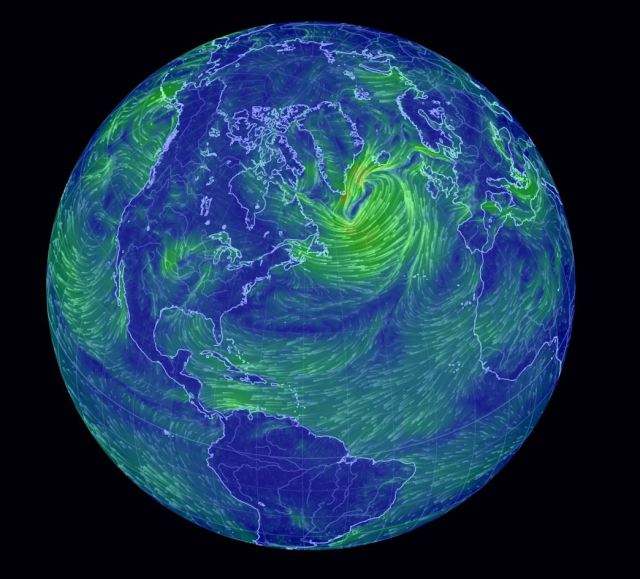
https://earth.nullschool.net/#current/wind/surface/level/orthographic=-35.77,29.36,347

windspeed1

Extreme wind speeds over North Sea

Sam Carana’s Facebook post shows additional wind images.

Posted in climate change, Uncategorized | Tagged , | Leave a comment

Right now in America, our land is being raped

I met Joshua Taflinger and his wife Brandi August 30, 2016, during the first organizing meeting for the Dakota Access Pipeline resistance in Indianapolis, at the White Pine Wilderness Academy. They were married last August. I took the bus to Indianapolis to attend the wedding.

They were the main organizers of our #NoDAPL efforts.  Joshua went to Standing Rock several times, taking supplies with him.

I completely agree with what he wrote recently:

“Right now in America, our land is being raped because the super rich that have so much invested in fossil fuel based industry are balls to the wall working to extract every penny they can before that industry is proclaimed obsolete…

All around the world, major counties are switching to renewable energies as their main source of power, while in America we are 150% full force in extracting the fossil fuels and sacrificing the health of this land to feed a dying beast for some dollars….

And what will be the effect caused by all of this?
We’re already seeing it and will continue to see more heavily poisoned air, land, and water… We are preparing and acting right now to leave behind a land that our grandchildren won’t be able to inhabit…

What can we do now to create a different future?”

We could be creating thousands more good jobs while building for a sustainable energy future if we would invest more in renewable energies, at the same time reducing the incredible environmental damage that is pushing us closer to human extinction.  Extractive practices also pollute millions of gallons of water.

And where does that leave us as these dwindling supplies of fossil fuel and clean water run out?

We have to unlearn capitalism.

#waterprotectors #nodapl

Posted in #NDAPL, climate change, Indigenous, renewable energy, Uncategorized | Leave a comment

Women’s March, Des Moines

Women’s March, Des Moines, Iowa. 1/20/2018

I had hoped to find some Friends in the crowd since I knew a number planned to attend, but didn’t.  Large crowd.


Posted in peace, Uncategorized | Tagged | Leave a comment

Nexus of the Kheprw Institute, Indigenous Peoples and Quakers

The realization that we have to move away from capitalism for environmental and social justice reasons, indeed for our very survival has given me new perspectives on the significance of several different communities I’ve been blessed to work with over the past seven years or so.

Readers of this blog know how deeply grateful I am to have been involved in the Kheprw Institute (KI) in inner city Indianapolis, not far from North Meadow Friends meeting. That proximity made it possible for some of us to ride our bicycles from the meeting to KI, since the book discussions there were on Sunday afternoons. I initially learned about KI because of their environmental work, with a huge aquaponics system, community gardens, and making and selling rain barrels.

I was immediately drawn in by the loving community of the kids and adults. I’ve written about the spiritual experience of my initial meeting with this community. That continued to be an important part of our relationship, and the relationship between KI and North Meadow Friends. And needs to be for communities of the future.

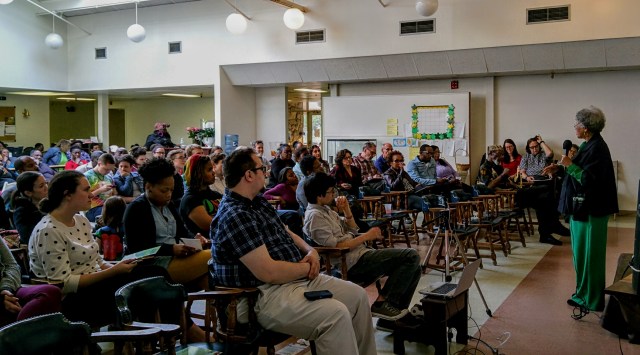
KI IMG_20160422_1919521

If you look closely you’ll find me in the audience at KI (below the yellow sheet on the whiteboard)

I also soon became aware of the significance of how KI was building a vibrant community despite having almost no financial resources.  They depended upon their self reliance, continuous study and social experimentation, and community partnerships to become as self-sufficient as they could be. KI is a model of how we need to be creating similar communities everywhere as we move beyond capitalism.

Numerous times I’ve tried to express the spiritual connection I felt during many opportunities I was able to spend with Native Americans in Indianapolis as we worked together to raise awareness about the dangers of the Dakota Access Pipeline in particular, and more broadly about how capitalism and extractive  practices are killing Mother Earth. Prayers were always part of these gatherings.  One gathering, on the grounds of the state Capitol was just for those who had worked together over the year to gather to celebrate that work.  We stood in a large circle and people spoke out of the silence.

Similarly I was able to join Bear Creek Friends in their efforts to support Native Americans in Iowa, including the Prairie Awakening ceremony.

Dear Dallas County Conservation Staff and Board,
Bear Creek Friends Meeting (Quakers) are writing you to express our support for continuing the annual Prairie Awakening celebration. A number of members of Bear Creek Friends Meeting have been involved in the Prairie Awakening celebration for many years, at times helping to prepare meals and volunteering in other ways. At least eight of us attended this year’s celebration and were so impressed with the ceremony and variety of things that occurred—the release of the butterflies, and the raptor, and the honoring of several individuals of the Native American community for their years of wonderful contributions. We were touched by the opportunities to greet each other and participate ourselves, and the several occasions when stories were told to the children.
The hoop dance of Dallas Chief Eagle and his daughter was amazing to behold. Perhaps the most meaningful to many of us was hearing him speak to us around the campfire about how important it was to take time to set aside busy activities, be still, and listen to the Spirit. We feel a kinship with Native Americans for this and other reasons.
We also believe we should honor the Earth, and live simple lives. We are very concerned about the environmental damage that has been done. We appreciate the leadership of indigenous people in protecting Mother Earth.
We see the Prairie Awakening ceremony as an important way to celebrate these things, and we applaud the involvement of the Dallas County Conservation Staff and Board in providing this cultural opportunity to educate the greater Dallas County community and beyond about ways to live to honor Mother Earth and move along the path together. We deeply appreciate your work in making this happen, and would be glad to do what we can to help this important celebration continue.
Sincerely,
Bear Creek Friends Meeting
Earlham, Iowa

As with the KI community, indigenous peoples live lives not built on capitalism. I believe communities such as these are the model we need to strive for. A spiritual approach to a lifestyle not built on capitalism. One that celebrates people and relationships and love of Mother Earth.

Quakers have worked to build similar communities. But we need to work harder to dissociate ourselves from a capitalistic, extractive society. We need to unlearn capitalism.


Posted in #NDAPL, climate change, Indigenous, Uncategorized | Tagged , , | Leave a comment

Unlearning Capitalism

“Unlearning racism” refers to teaching people who believe they are white about thoughts, beliefs, attitudes and actions which they are not aware of, which support racism. Racism is so deeply embedded in our culture that most white people uncritically accept any number of norms in our society that are actually discriminatory and unjust.  The first thing white people have to do when they want to engage with people of color or address race is to learn about their own racial biases.  This is a life long process in our society, but it is important to begin.

Similarly, I believe it is urgent today that we “unlearn capitalism“.  As discussed in the post about Capitalocene, capitalism has evolved into a system that values profit over people and that has pursued extractive practices that consume resources far beyond the ability of Mother Earth to replenish them.  Capitalocene is powered by fossil fuel energy and is overwhelming our environment with toxic methods of extracting these fuels, the consumption of vast amounts of water in the process, and production of greenhouse gases that result from burning them. And those countries with the greatest industrialization consume vastly disproportionate amounts of these fuels, thus producing the bulk of the resulting pollution.

These are not a new concepts among Quakers.

“At the World Conference of Friends held at Guilford College in North Carolina in 1967, some young Friends crossed over from a concurrently running young Friends conference to raise a concern that became known as Right Sharing of World Resources. The new concern recognized poverty in the world economic system as in part a systemic problem, and as a legacy of colonialism.”  Quakers and Capitalism, Steven Dale Davison, Friends Journal,  July 1, 2006.  The organization Right Sharing of World Resources is devoted to addressing global economic and energy inequalities.

Steven Davison has written much more about this on his website Quakers and Capitalism–The Book.

I’m re-posting the following comments that were made recently after Quaker midweek meeting for worship in Indianola, Iowa.  These Quakers were describing the life they lived as children in the early 1900’s.  It is clear that people once lived and thrived in what seem to be primitive conditions compared to our lives today. We need to quickly return to a similar lifestyle.

  • We didn’t have electricity or running water.  (I might add we had a party line telephone, no television, and an outhouse for the bathroom)
  • We broke a lot of glasses that we had taken upstairs during the night (as the water turned to ice)
  • There was no heat upstairs
  • We wrapped the kids in a cocoon of multiple blankets with only their arms outside
  • We heated stones on the stove, and put them in the beds before we got into them
  • We used bottles of warm water for the same purpose
  • The first thing we did in the morning was open, and sit on the door of the stove to warm up
  • Sometimes we had to be picked up by someone in a horse and buggy when the school bus was stuck on the muddy roads
  • (There was also mention of mud-ball fights)
Posted in climate change, Quaker Meetings, Uncategorized | Tagged , , , | Leave a comment

A Plea for Us All

As I wrote yesterday, capitalism is killing Mother Earth, and us.  Capitalocene indicates how capitalism, driven by fossil fuels, wantonly destroys nature and oppresses millions to achieve material production and wealth.

The story in today’s New York Times contains graphics that clearly show the warming from greenhouse gas emissions that has occurred as a result, and forecasts the continued warming in the future. Earth’s Warming Continued in 2017. And That Was Without El Niño. Among other things, the story tells of how Cape Town, South Africa, with a population of 3.4 million people, will probably run out of water within 90 days, because of extended drought from warming. Many more cities will soon suffer the same fate.

We are immersed in a capitalistic society.  To say this is not sustainable is basically the definition of the word.  We have to begin to build a better system now. We each need to look to our own lives, as Quaker John Woolman expressed it so well–in the 1700s!!

“Oh! that we who declare against wars, and acknowledge our trust to be in God only, may walk in the light, and therein examine our foundation and motives in holding great estates! May we look upon our treasures, and the furniture of our houses, and the garments in which we array ourselves, and try whether the seeds of war have nourishment in these our possessions, or not. Holding treasures in the self-pleasing spirit is a strong plant, the fruit whereof ripens fast.

A day of outward distress is coming, and Divine love calls to prepare against it. Hearken then, O ye children who have known the light, and come forth. Leave everything which Jesus Christ does not own. Think not his pattern too plain, too coarse for you. Think not a small portion in this life too little. But let us live in his spirit, and walk as he walked: so shall we be preserved in the greatest troubles. “       John Woolman, A Plea for the Poor

Posted in climate change, Uncategorized | Tagged , | Leave a comment

Capitalocene and Revolution

Two things are clear.  We are facing rapidly accelerating deterioration of environmental conditions, and current approaches to making changes on the scale necessary to prevent these things from spiraling out of control are stunningly ineffective.

It is time for nothing short of a revolution.  The capitalist system is killing Mother Earth and us.  As I study a wide variety of sources about this, the term Capitalocene,  is emerging as an important concept.

Geologic ages are divided into epochs.  Our current epoch is the Holocene epic.

“The Anthropocene is a proposed epoch dating from the commencement of significant human impact on the Earth’s geology and ecosystems,including, but not limited to, anthropogenic climate change.”  https://en.wikipedia.org/wiki/Anthropocene

The following is from the blog of David F. Ruccio Occasional Links and Commentary.

“Jason Moore in Capitalism in the Web of Life proposes that the Anthropocene be renamed the ‘Capitalocene’, since ‘the rise of capitalism after 1450 marked a turning point in the history of humanity’s relation with the rest of nature, greater than any watershed since the rise of agriculture.’”

Capitalocene points to the ways capitalism—the particular tendencies and dynamics associated with the appropriation and distribution of surplus-value, the accumulation of capital, and much else—has both made the despoiling of the natural environment (e.g., through the use of fossil fuels) central to the production and distribution of commodities and shifted its effects onto poor people and minorities, who bear higher levels of water, air, and other kinds of pollution than anyone else.

Finally, the term Capitalocene carries with it the possibility of imagining the end of capitalism, and therefore a radical change in the way human beings relate to the natural environment. To be clear, I am not suggesting that global warming and other environmental problems would be automatically eliminated with a radical transformation of the way the economy is currently organized.

Environmental concerns will require particular changes in thinking to be made central to whatever noncapitalist economies are imagined and enacted as we move forward.

I do, however, maintain that eliminating capitalism will be an important step in setting aside and overcoming many of the obstacles to creating a different, better relationship in and with the natural environment.”
https://anticap.wordpress.com/2017/03/07/capitalocene/

Posted in climate change, revolution, Uncategorized | Tagged | Leave a comment

Iowa Yearly Meeting (Conservative) and our Environment

Yesterday I wrote about the message from the Friends World Committee for Consultation’s  efforts to promote sustainability action in the global Quaker community.  Following is my response, which included the Minutes related to our environment that have been approved by Iowa Yearly Meeting (Conservative) over the past decade.

Dear Susanna,
I am glad to hear from you about FWCC’s work. I’m afraid I didn’t know about the 2016 Minute. I’ve shared that with the Peace and Social Concerns Committee of our yearly meeting, of which I am clerk.
I would be very glad to work with you on this. Our yearly meeting has a long history of concern for care for our environment. We have been challenged in trying to reduce our fossil fuel use because so many live in rural areas, as mentioned in the ethical transportation minute.
At one time we had an Earthcare subcommittee of the Peace and Social Concerns Committee, but a couple of years ago laid that down and moved that work back to the Peace and Social Concerns Committee.
Attached are the more recent Minutes related to our environment that Iowa Yearly Meeting (Conservative) has approved.
Several Friends have had a life long commitment to environmental justice and concerns. Don Laughlin, who died recently, was an engineer who worked on a number of things related, such as LED lighting. Probably about 10 years ago he and his son, who is an architect, designed the last house he lived in that had solar panels, passive solar, composting, in floor water heating, etc. His ANNUAL electric bill was about $300
Until recently I had spent most of my adult life in Indianapolis, but remained closely connected to the yearly meeting. The environment has been one of the main focuses of my life. After having a few cars, when one was involved in an accident about 40 years ago, I decided to see if I could live without owning another one, and was successful in that. That had a number of significant impacts on my life.
The last six years, before I moved to Iowa last summer, I attended North Meadow Circle of Friends, an unprogrammed meeting belonging to Ohio Valley YM, so some of my projects have been shared with that meeting and Iowa Friends. Some of those include being an Action Leader in the Keystone Pledge of Resistance, being involved with Indianapolis’ Dakota Access Pipeline resistance efforts, where I made wonderful connections with Native Americans, and being involved with a black youth mentoring community, the Kheprw Institute, in an inner city neighborhood in Indianapolis, that has a strong environmental focus. They have a huge aquaponics system, sell rain barrels that they make, and are the social justice center for most of the organizations in Indianapolis. I was also involved in fossil fuel divestment campaigns. An article about that was in a Quaker Earthcare Witness publication. North Meadow Friends divested their Chase bank account.
Bear Creek meeting recently “officially” joined in my environmental efforts, and the ethical transportation Minute grew out of that.
I’m an avid photographer, which I use as photojournalism, so I have hundreds of photos related to these efforts.
In 2013 Iowa Yearly Meeting held a Climate Conference at the Yearly Meeting’s boarding high school that is on a working farm, Scattergood Friends School and Farm. The conference had presentations and discussions involving environmental justice leaders around the state, including a state senator, and Jose Aguto who was at the time the environmental lobbyist of FCNL. The next day an Earth Walk involved some of the participants of the conference (me) and several Scattergood students and staff, who walked the 13 miles from the school into the local university town, Iowa City, picking up trash along the way. I made a video of that that is included in the links on the Quakers and Climate Change Worldwide website. (I really wanted to be on the walk, because I was a senior at Scattergood in 1969, when, as part of the Moratorium on the Vietnam War, the entire student body and most of the staff walked that same 13 miles into Iowa City to join in the antiwar events there).
I also created a video related to the Dakota Access pipeline.
Native American concerns have long been a concern of my monthly meeting, Bear Creek, in central Iowa. My recent relationships with Native Americans, and learning about the water protectors at Standing Rock, have lead me to believe indigenous people may have many answers for how to proceed on environmental justice issues. In September I had an evening presentation at the Bear Creek meetinghouse where I showed videos of the dog attacks on the water protectors at Standing Rock, and played a number of videos of Nahko and Medicine for the People.
I write about these things almost daily on my blog: https://kislingjeff.wordpress.com/
I’m glad to hear from you, and about your work. I’d be glad to continue interacting with you about this.
Peace,
Jeff Kisling

Minutes Approved by Iowa Yearly Meeting (Conservative)

2008
The following minute is a statement of concern and suggestion for action about a set of issues that are affecting us now and will increasingly affect all of us in the future. Friends are encouraged to prayerfully consider how they will each respond as individuals, families, and meetings.

Minute
Humanity is no longer in a right relationship with God’s creation. Because of our numbers and the way many of us live, we are using resources and impacting the environment in ways that cannot be sustained, the primary example being our dependence upon fossil fuels. Society‘s consciousness of this has recently been heightened by rapidly increasing oil prices. People are becoming aware that the way of living that we have become accustomed to cannot continue. If we don’t make changes voluntarily, they will be forced upon us. There has been an unspoken assumption that it is acceptable for developed countries to use a disproportionate amount of resources compared to underdeveloped countries. As oil supplies dwindle and prices soar, there is a growing potential for conflict to arise worldwide over remaining oil supplies. Vast resources are required, not only to produce personal automobiles, but for the infrastructure to support them, including highway systems, parking, car washes, supply stores, repair shops, auto insurance, licenses, sales lots, highway patrol, and gas stations. Exhaust from all types of vehicles contributes to greenhouse gases and global warming. Our communities are built on the assumption that we all have the means to travel great distances to get food, go to school, work, and meeting. This has an enormous impact on oil supplies. Friends could help provide leadership by redesigning our communities and lifestyles in such a way that we can forego automobiles. Improved systems of inter- and intra-city mass transportation will be one key to this. There are organizations working to expand and improve rail passenger transportation. Creating more bicycle trails and encouraging the use of bicycles is important. The challenge of giving up automobiles is much greater in rural than urban areas, but the factors at work are the same. If those who do have alternatives to personal automobiles would use them, it would help those who need more time and resources to develop their own alternatives. The ease and relatively low cost of long distance travel by air has led to a sense that rapid travel over long distances is normal and acceptable. This has made the air travel industry a major contributor to global climate change. Friends are encouraged to avoid air travel and to work to reduce the need for long distance travel. We need to explore ways to do business remotely. This is a new area that will require trial and error to see what does and does not work for us. Our eating habits also should be considered. It is estimated that the food for an average American meal travels 1,500 miles from the farm to the consumer. Studies have shown that the livestock industry contributes more to greenhouse gas emissions than transportation does. We need to eat locally grown food whenever possible. Community garden plots, community-supported agriculture, and re-learning how to preserve foods will help, as will reducing meat consumption. Friends are encouraged to work with the Friends Committee on National Legislation, and their local, state, and national representatives to help pass environmentally responsible legislation, including government support for improved mass transportation, and blocking construction of new coal and nuclear fission power plants. We have seen the unintended side effects of legislation promoting the increased use of ethanol. We encourage Friends to be examples as we explore creative ways to promote renewable energy, reduce energy consumption, recycle, and facilitate the use of local foods and products. There is an urgent need to curb oil consumption and greenhouse gas emissions dramatically, right now. Until some of these physical and social changes occur, it may be difficult for some Friends to give up their cars. Doing so as soon as possible is our goal, and could be a catalyst for change of the magnitude needed to reduce the current rate of environmental damage.
2013
Iowa Yearly Meeting (Conservative) opposes the practices of both tar sands extraction and hydraulic fracturing.

2014
Minute
Iowa Yearly Meeting (Conservative) is grateful to Scattergood Friends School and Farm for recognizing the need for converting to renewable energy supplies, and strongly supports it in this endeavor.

Minute
Iowa Yearly Meeting (Conservative) supports a carbon fee and dividend approach to accelerate the necessary transition from fossil fuel to renewable sources of energy.

Minute
We are deeply moved and appreciate the contribution of Junior Yearly Meeting to our ongoing concern regarding changes in our environment. Their project to raise funds for FCNL’s efforts to address environmental concerns by selling flowers was both spiritually and artistically beautiful.

2016
Minute

Interconnections Among Dilemmas

We as Quakers, experience the unifying core that animates all peoples and nature. This common experience compels us to work at resolving injustices that separate peoples and people from nature.
American society, in which we live and breathe, is today saturated by greed and violence to the extent that life as we know it veers toward extinction. Maladies that we experience as separate are in reality deeply interconnected.
Examples are legion:

Our imperialist foreign policy, which encompasses mass killings of people of color has the same roots as violence within our borders.
Gun violence parallels military violence and systemic racism.
Domestic violence, sexual assault, and child abuse are directly coupled with military violence and structural poverty.
Massive population displacement results from war, climate disruption and economic policy.
Climate disruption follows from the unquenchable greed and military dominance that alienates us from each other and the rest of the world.

Only radical turning will save the world. It is both frightening and challenging to consider that a great part of both the problem and the solution lies within U.S. society.
Our hope rests in the spirit of Christ moving within and among us and our attentiveness to its direction. Within Friends, different members bring different gifts of discernment and action.
Artistic creativity opens possibility and inspires broader participation. Those who faithfully lobby lawmakers and insert themselves in democratic processes move us forward. Those who engage in healing and rebuilding our communities provide the basis for peace and stability. Interrupting the racism woven into our culture opens untold possibilities. Alternatives to Violence workers dismantle roots of violence and build bridges. Those who aid in releasing us from the greed endemic to capitalism can do much to save the environment and interrupt rapacious resource exploitation. Spirit-grounded educators ease technological and intellectual barriers to the world we seek. Individuals nearing the end of their life may offer unique wisdom, love and support to those with the energy to continue life on earth.
Quaker Social Change Ministry of AFSC, Advocacy Teams of FCNL, Experiment with Light, and Clearness Committees are among the various Quaker techniques for moving us forward towards the Light and away from fear and despair. How we avail ourselves of them will rest on the particular resources of the communities in which we live and diverse gifts within our meetings.
We have one purpose; a spiritual awakening and creating a peaceful, loving, just and sustainable world. And there are diverse approaches to reach the goal. We act in harmony when we support, appreciate, and speak truth to those whose struggles intersect with ours, even when the paths seem to be different.

2017
Minute

Ethical Transportation

Radically reducing fossil fuel use has long been a concern of Iowa Yearly Meeting (Conservative). A previously approved Minute urged us to reduce our use of personal automobiles. We have continued to be challenged by the design of our communities that makes this difficult. This is even more challenging in rural areas. But our environmental crisis means we must find ways to address this issue quickly.
Friends are encouraged to challenge themselves and to simplify their lives in ways that can enhance their spiritual environmental integrity. One of our meetings uses the term “ethical transportation,” which is a helpful way to be mindful of this.
Long term, we need to encourage ways to make our communities “walkable”, and to expand public transportation systems. These will require major changes in infrastructure and urban planning.
Carpooling and community shared vehicles would help. We can develop ways to coordinate neighbors needing to travel to shop for food, attend meetings, visit doctors, etc. We could explore using existing school buses or shared vehicles to provide intercity transportation.
One immediately available step would be to promote the use of bicycles as a visible witness for non-fossil fuel transportation. Friends may forget how easy and fun it can be to travel miles on bicycles. Neighbors seeing families riding their bicycles to Quaker meetings would have an impact on community awareness. This is a way for our children to be involved in this shared witness. We should encourage the expansion of bicycle lanes and paths. We can repair and recycle unused bicycles, and make them available to those who have the need.


Posted in #NDAPL, climate change, Ethical Transportation, Indigenous, Kheprw Institute, Quaker Meetings, Uncategorized | Tagged | Leave a comment