Environmental Justice

As part of its series on environmental justice in America, the article the Guardian published today is about a study of 90,000 schools across the US, Air pollution: black, Hispanic and poor students most at risk from toxins – study.

The study used EPA and census data to map out air pollution exposure for those 90,000 schools, and concluded “Schoolchildren across the US are plagued by air pollution that’s linked to multiple brain-related problems, with black, Hispanic and low-income students most likely to be exposed to a fug of harmful toxins at school, scientists and educators have warned.”  The article includes numerous statistics and maps to document this.

“When you look at the pattern, it’s so pervasive that you have to call it an injustice and racism.” Dr Sara Grineski, author of the first national study on air pollution and schools. “We’re only now realizing how toxins don’t just affect the lungs but influence things like emotional development, autism, ADHD and mental health,” she said. “Socially marginalized populations are getting the worst exposure.”

Definitions:
Environmental equity: Poison people equally
Environmental justice: Stop poisoning people, period.

Environmental racism is the disproportionate impact of environmental hazards on people of color. Environmental justice is the movement’s response to environmental racism. “Environmental equity” is not environmental justice. “Environmental equity” is the government’s response to the demands of the environmental justice movement. Government agencies, like the EPA, have been coopting the movement by redefining environmental justice as “fair treatment and meaningful involvement,” something they consistently fail to accomplish, but which also falls far short of the environmental justice vision. The environmental justice movement isn’t seeking to simply redistribute environmental harms, but to abolish them.  from the Energy Justice Network.

The way that I became connected to the Kheprw Institute (KI) in Indianapolis was because of their work on environmental problems in the inner city.  Their initial projects involved a large aquaponics system and building and selling rain barrels.  I remember talking with Scattergood School’s farm manager, Mark Quee, about what KI was doing.  And I remember him saying he would be very concerned about raising food in the inner city because of the toxins in the soil.

KI is a great place to connect with social activists, and I was very fortunate to meet and become friends with Denise Abdul-Rahman, chairwoman of Indiana’s NAACP Environmental Justice Committee.

DSC09750

Imhotep Adisa and Denise Abdul-Rahman at KI

Denise almost single-handedly convinced the Indianapolis Power and Light Company, which has a huge power plant in downtown Indianapolis, to switch from burning coal to natural gas, instead. I have mentioned one of the things my KI friends do is to support social justice meetings, including live-streaming them. The photos below are from the NAACP celebration of stopping the coal burning.

Posted in Kheprw Institute, race, Uncategorized | Tagged , , | Leave a comment

Spiritual Fire

Lately I’ve been thinking and writing about light and Inner Light.

Many years ago, around the year 2000, Dan Treadway and I were the reporters for the annual sessions of Iowa Yearly Meeting (Conservative).  The reporters write articles about the yearly meeting sessions to send to newspapers.  Digital cameras were just becoming available and Dan asked for permission to take photographs for use in the article we would submit.  He was told that would be permitted with the exception of photos taken during meeting for worship or meeting for business.  I had also obtained one of my first digital cameras at that time.  I extended that permission to continue to take photographs of people at Quaker and other events from that time on, but also to not take photos during meeting for worship or business.

About three years ago, during meeting for worship at North Meadow Circle of Friends in Indianapolis, the shadows on the bench in front of me kept drawing my attention.  A slight breeze was causing the pattern of the sunlight shining through the curtain to continuously move. It came to me that looked like spiritual fire, even though I couldn’t remember hearing that term before, and was lead to give the following message:

“Shifting patterns of shadow and light on the bench before me look like spiritual fire.”

After meeting, my friend Daniel Ballow said, “I always wondered what spiritual fire looked like.”  And I replied, “Now you know.”  Afterward I wondered if that meant he was already familiar with that term, but never remembered to ask him.

Since I had my camera with me, after meeting was over, I took a short video of those shadows moving on the back of the bench, and recorded that message on the video.

Posted in spiritual seekers, Uncategorized | Tagged , , | Leave a comment

Glick Photography Selection 2013

The Glick Eye Institute sponsored an art contest for Indiana artists as a way to acquire artwork for their eye clinic. My photograph of tulips was one of the selections that year.

KISLING_5

Tulips

Glick Public Art Project

Public Art for the Eugene and Marilyn Glick Eye Institute – 2012 Request for Proposals

Deadline: October 31, 2012

The Eugene and Marilyn Glick Eye Institute Public Art Committee seeks proposals from artists with a connection to Indiana for art to be displayed in the Eugene and Marilyn Glick Eye Institute. The Glick Eye Institute is home to the IU Health Ophthalmology Center, the Department of Ophthalmology’s Optical Shop, research labs, conference space and ophthalmology administrative offices. All kinds of art will be considered for the building, which is nearly 80,000 square feet on four floors. 

Why is public art being sought for the Eugene and Marilyn Glick Eye Institute?

It is important to have visual stimulation in a building dedicated to preserving eyesight and reducing vision impairments. Public art is being considered because a limited budget is available for purchased art. While an anonymous donation provided seed funding to purchase some art, and while fundraising to purchase new art continues, we must rely on the generosity of Indiana artists and artists who trained in Indiana to exhibit their works in the Glick Eye Institute.

We seek art that depicts or expresses vision, light, color, perspective and/or reflection.

My Submission

I still remember how astonished I was when I put on my first pair of eyeglasses and the world suddenly came into focus in incredible detail.  It was like magic.  I loved to read, and was aware of how important the eyeglasses were in making reading much easier and more enjoyable.  I’d always been interested in science, so I learned the basics of optics.  And I’ve had a lifelong, intense interest in photography, learning the theory and application of techniques to capture images.  With photography I try to paint a picture with light in its many intensities, colors, and contrasts.  I try to use novel perspectives and compositions to both better define three dimensional objects with a two dimensional medium, and to catch the viewer’s attention so he/she might look at something a little differently.  I learned to do darkroom work in both high school and college, but am grateful for the digital revolution, which provides much greater control of almost all aspects of photography.

As a Quaker, and having been raised on working farms in Iowa, I have always had great interest in and concern for our environment.   I use photography to try to promote appreciation for our natural world.

EUGENE AND MARILYN GLICK
EYE INSTITUTE

 INDIANA UNIVERSITY
School of Medicine

December 4, 2012

Dear Jeff,

Thank you for submitting your photography for consideration to the Eugene and Marilyn Glick Eye Institute’s Public Art Project.

We were fortunate to receive 123 submissions; all of the art was thoroughly reviewed by a committee comprised of IU School of Medicine faculty and staff, and artists from the Indianapolis community.

The committee is interested in exhibiting the photograph titled “Tulips” in the Glick Eye Institute for the calendar year 2013. We will accept the art for exhibition in January and will be in touch to arrange a mutually convenient date for delivery. Your pieces must be ready to hang; our facilities services employees and the IU art curator will oversee the installation.

Additionally, we wish to continue to incorporate your photography of “Open Eyes” in the institute’s printed materials and website. We thank you for allowing us to use those images.

Again, thank you for submitting your work. We appreciate your participation.

Sincerely,

Jeff Rothenberg, M.D.

Chair of the Glick Eye Institute Public Art Committee Eugene and Marilyn Glick Eye Institute

1160 W. Michigan St.

Indianapolis, IN 46202

Posted in Arts, Uncategorized | Leave a comment

Queries on Education

This month’s queries are about education.

ADVICE

Friends seek an education which integrates our intellectual, emotional and spiritual dimensions and enables us to face difficult moral issues with courage.

While the religious education of our children is primarily the concern of parents, everyone benefits when the entire meeting is concerned with nurturing them. If a spirit of common concern is present, children will gain a sense of belonging to the larger community, and, knowing they are loved and respected, will be able to face the mysteries of life with trust.

Friends promote learning throughout life and encourage freedom of thought and inquiry in all educational pursuits. Our complex and changing world demands that we learn to think and act creatively to meet its challenges.

QUERY

• How can we most effectively foster a spirit of inquiry and a loving and understanding attitude toward life?
• What effort are we making to become better acquainted with the Bible, the teachings of Jesus, our Judeo Christian heritage, the history and principles of Friends, and the contributions of other religions and philosophies to our spiritual heritage?
• In what ways can we encourage an educational process that is consistent with the values Friends cherish? How do gender based expectations affect the goals we set and the way we learn?
• Do we take an active and supportive interest in schools, libraries and other educational resources in our communities and elsewhere?
• How do we prepare ourselves and our children to play active roles in a changing world?

My response:

Callie Marsh writes about implicit education in her book, A Lively Faith, Reflections on Iowa Yearly Meeting of Friends (Conservative). Most of us didn’t receive much formal religious education as children. But we did learn a lot as we listened to adult Friends talk, and observed how they lived their lives. We heard their messages in meeting for worship, and discussions during business meetings. I grew up in a Quaker community where nearly 20 men had gone to prison because they could not participate in conscription for the military. I was very grateful for their example when I was faced with my own decision related to registering for the draft.

Callie also writes about the dangers of implicit education. That newcomers often feel like outsiders because they haven’t had those experiences, and we often don’t help them learn. Also this lack of formal religious education can make new people think they can believe anything at all.

Those of us fortunate to attend Scattergood Friends School received an amazing education. We learned how to live and work in community, because that was how we actually lived at the school. We had to struggle with community problems, come up with solutions, and then implement them. We learned the tools to prepare us to be life long learners, and community leaders.

Quaker Voluntary Service provides opportunities for young people to learn to live in community and work on social justice issues.

Quaker publications like Pendle Hill Pamphlets and Friends Journal are helpful educational sources. The relatively new QuakerSpeak videos are not only well done, but are in a format that might be more likely to reach young people.

Social media provides other platforms to educate. The unofficial Facebook group for the yearly meeting contains new posts frequently. And the ability for people to comment on what is posted sometimes leads to interesting discussions.

Realizing the importance of social media in our culture, I created the Facebook group Quakers Welcome Spiritual Seekers, hoping to introduce Quakerism to those who are searching for a spiritual home.

For similar reasons, three years ago I created a blog, and write posts on it nearly daily. I usually write about spiritual or social justice matters. As more people turn away from attending church services, I felt there was a need to have places where seekers could learn about what Quakerism might offer them. This writing has turned into an educational experience for me as well, as I listen and learn from the Inner Light.

Over the past 7 or so years as I got more involved with several social justice efforts and communities in Indianapolis, there were many occasions to teach Quaker ways of approaching these things to people. I was the one who taught about nonviolence and civil disobedience in our training sessions for the Keystone Pledge of Resistance. It was by being urged to explain myself that provided the opportunity to talk about Quakerism when the Kheprw Institute (KI) was trying to figure out if I was someone they wanted to work with. There was a fundamental spiritual force behind the Dakota Access Pipeline resistance in Indianapolis, and opportunities to learn about the spiritual practices of Native Americans.

I recently purchased a computer projector so that I could share photographs and other presentations with others. To use as an educational tool.


Posted in peace, Quaker Meetings, Uncategorized | Tagged , | Leave a comment

Light Revisited

I’ve been thinking about yesterday’s post, Intersection of Inner and Outer Light. Sometimes I don’t fully understand messages I receive and try to express in words, or express them well enough, and yesterday’s post is an example. One aspect of faith in my life is to trust in the message even, or especially, when I don’t completely understand it. That is more difficult, riskier, when I know other people will read it.

Although I wonder if it might be better to leave it alone, as a scientist I can’t help but further explore, and also try to reconcile the science. What I’m trying to say is I’ve studied the physics of light and I know there are characteristics of visible light, such as wavelength, that can be measured, which is not true of Inner Light.

And the physics of light includes more than visible light.  “In physics, electromagnetic radiation (EM radiation or EMR) refers to the waves (or their quanta, photons) of the electromagnetic field, propagating (radiating) through space-time, carrying electromagnetic radiant energy. It includes radio waves, microwaves, infrared, (visible) light, ultraviolet, X-rays, and gamma rays.”  Wikipedia

That does not pertain to Inner Light.

I still like the expression “the intersection of inner and outer light”.  It’s just that we understand that doesn’t mean what is experienced inwardly is the same quantity as outward light if one is referring to visible light. That was what began my reflections, because I was thinking about photography.

When I made the jump yesterday to the photograph representing a spiritual message, I was trying to say the Inner Light can lead us to a certain action, such as witness for peace.  And the visible light, captured in a photograph, is a way of seeing the outward expression of the Inner Light.

And the converse is also possible.  Things we see visually, whether natural beauty like a mountain range, or the actions of others, can excite, illuminate, our Inner Light.

I would still say we are the intersection of inner and outer light. But we do that by being a transformer, the term for converting one thing into another.

Posted in Arts, Uncategorized | Tagged , , | Leave a comment

Intersection of Inner and Outer Light

It occurred to me that some might wonder why I was sharing photographs on internet pages that are related to Quakers.

I recently began to think of photography as capturing outer light, in contrast to the term Inner Light, one of the ways Quakers refer to inward, spiritual feelings or messages.  And then to think about the beauty seen (via outer light) in the natural world and the acts of people and animals.  Which lead to thinking we are the intersection of inner and outer light.  And I began to realize all is a manifestation of the spirit and we just observe it from a different perspective, depending on whether our attention is turned inward or outward.

DSC09398-2

This is one of the earliest photographs I still have a copy of.  I developed it in the primitive darkroom at Scattergood Friends School. The quality is very poor in photographic terms, but I find a powerful spiritual message in it nonetheless.  It was taken on October 15, 1969, which was a national day of action called the Moratorium to End the War in Vietnam. There were demonstrations all across the United States that day, mainly on college campuses. The entire student body and most of the faculty of the School marched 14 miles in silence, to the University of Iowa.

From the school committee minutes October 11, 1969:
A group of students attended Committee meeting and explained plans for their participation in the October 15 Moratorium. The Committee wholeheartedly endorses the plans. The following statement will be handed out in answer to any inquiries:
“These students and faculty of Scattergood School are undertaking the twelve mile walk from campus to Iowa City in observance of the October 15 Moratorium. In order not to detract from the purpose of the walk, we have decided to remain silent. You are welcome to join us in this expression of our sorrow and disapproval of the war and loss of life in Vietnam. Please follow the example of the group and accept any heckling or provocation in silence.”

JournalOct15

This is an example of the Inner Light being expressed in outward action, seen with the outer light.


Posted in peace, Uncategorized | Tagged , , | Leave a comment

“Open Eyes” Sculpture

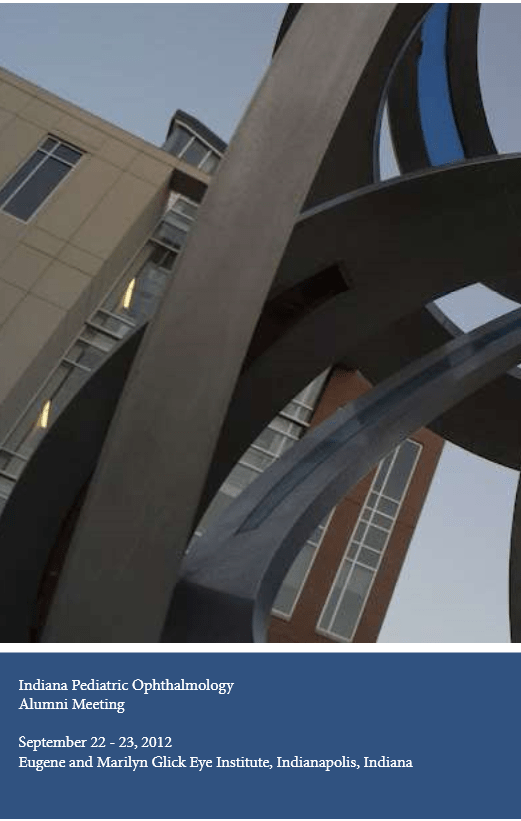
In August, 2011, the 18 foot tall stainless steel and colored glass sculpture “Open Eyes” was installed outside the new building which houses the Department of Ophthalmology at the Indiana University Medical Center, where I was working.  The sculptor, Don Gummer, is an Indianapolis native who attended the Herron School of Art at Indiana University, Purdue University, Indianapolis (IUPUI).

I found this sculpture to be fascinating, since its form seems to change as it is viewed from different angles.  The colored glass, representing the color in the iris, is a challenge to capture.  In the first photos you could barely make out where the glass was.  Then I was able to make it stand out more, but it all appeared to be black.  Finally, working with contrast and exposure, I was able to get the colors to appear.

I shared some of the photos with Rich Schreiner, MD.   He knew Barry Cantor, MD, the Chairman of the Department of Ophthalmology, and shared them with him.  The Department began to use them on their website and in their publications.

Over 500 more photos here: https://1drv.ms/f/s!Avb9bFhezZpPg51In9ziqsMrxhgLtA

OpenEyes1

Posted in Arts, Uncategorized | Leave a comment

Feeling Unfree

Following is from a press release from Bold Iowa. Ed Fallon says “Proposed bill could render peaceful protest against oil pipeline impossible”.  Felony charges were brought against water protectors at Standing Rock, and other environmental protestors across the country.

If you are like me you are weary from trying to get your legislators’ attention. But I would strongly encourage you to speak out against Senate Study Bill 3062 intended to stifle peaceful protests in Iowa.  https://www.legis.iowa.gov/legislators/find

According to the American Civil Liberties Union (ACLU) “In response to epic protests around the country, state legislators in nearly 20 states proposed bills in 2017 that would restrict people’s right to protest.”  They have an interactive map at this link displaying the status of these bills that is current as of June, 2017, so this new proposed legislation in Iowa is not reflected there.

Bold Iowa press release

Bold Iowa today strongly criticized legislation that passed unanimously out of a Senate subcommittee on Thursday. The legislation — Senate Study Bill 3062 — defines “critical infrastructure sabotage” as an “unauthorized act that is intended to or does in fact cause a substantial interruption or impairment of service rendered to the public related to critical infrastructure property. The bill provides that a person who commits critical infrastructure sabotage commits a class B felony.” Such an offense would come with a fine of $100,000 and a prison sentence of up to 25 years. The parent company of the Dakota Access pipeline — Energy Transfer — is listed in support of the bill.

“This latest attempt by Big Oil to silence dissent is no surprise,” said Ed Fallon, a former lawmaker who now directs Bold Iowa. “This is legislative extremism at its worst. The bill’s backers want you to believe this is about cracking down on arson and vandalism. But the hundreds of pipeline protests who were peaceful, nonviolent and didn’t engage in property destruction could be accused of interrupting service under this bill and subject to insane consequences.”    http://boldiowa.com/release-pipeline-sabotage-bill-called-legislative-extremism/

Unfree: My battle against Texas Oil & Gas

“I now know what it feels like to be “unfree.” My husband Mark was arrested last Friday morning, Jan 19th, and incarcerated overnight in Marfa, TX, for an expired license plate. The same weekend felony charges against Dakota Access Pipeline (DAPL) protester Red Fawn Fallis were rendered.
That night alone with my children, I locked my doors. Where I live, we don’t lock our doors. Would my outcry on Facebook about police harassment be construed as a violation of probation? At any moment blue and red lights could be flashing outside my door. Paranoia? Maybe. But, in December the local police were driving up and down my quiet dead end road twice daily. When out walking, I was stopped by Border Patrol. Is this what it feels like to live in a fascist police state? Is this what it is to lose your freedom?
Last January 14, 2017, I locked-down to a bulldozer in peaceful protest of the construction of an Energy Transfer Partners (ETP) 42 inch gas export pipeline, the Trans-Pecos Pipeline (TPPL) in Far West Texas. ETP, the company who abused Water Protectors at Standing Rock, had destroyed 148 miles of our pristine Chihuahuan Desert and violated our community and private property rights.
I was charged with a felony.”
from http://stopetp.org/ blog  by Lori Glover of the Big Bend Defense Coalition, Unfree: My battle against Texas Oil & Gas, January 27, 2018.

Posted in #NDAPL, civil disobedience, climate change, Indigenous, Keystone Pledge of Resistance, Uncategorized | Tagged , | Leave a comment

Randy’s Birthday

Today is Randy Porter’s birthday. He was my best friend.  We met when I first arrived in Indianapolis to work with the Friends Volunteer Service Mission (VSM) in 1971, and died 12/26/2011.  He asked me to be godfather to his sons Brandon and Shawn, and gave me the chance to share in the experience of the joy of raising children, that I wouldn’t have had otherwise.  We saw each other every day of our adult lives, with very few exceptions.

I recently came across the YouTube video of the X Factor audition of Josh Daniel.  He sang “Jealous” by Labrinth. He explained that he lost his best friend, and was jealous that his friend was happy in heaven and he couldn’t still be with him. His performance brought the judges to tears, and a standing ovation. It makes me tear up when I watch it, too, because of how it expresses how much I miss Randy.

“Jealous”

I’m jealous of the rain

That falls upon your skin

It’s closer than my hands have been

I’m jealous of the rain

I’m jealous of the wind

That ripples through your clothes

It’s closer than your shadow

Oh, I’m jealous of the wind, ’cause

[Chorus:]

I wished you the best of

All this world could give

And I told you when you left me

There’s nothing to forgive

But I always thought you’d come back, tell me

All you found was heartbreak and misery

It’s hard for me to say,

I’m jealous of the way

You’re happy without me

Labrinth


Posted in Uncategorized | Tagged | 1 Comment

The Artistic Excellence of Black Music

So how do we respond to our dark times? The greatest tradition of prophetic fightback in the American empire is the black freedom struggle. The greatest tradition of moral and spiritual fortitude in the American empire is the black musical tradition.
The artistic excellence in the best of black music – including the magnanimity and majesty of the sound – sets the standards for the black freedom struggle.
These standards consist of radical freedom in love and radical love in freedom – the freedom to tell the truth in love about one’s self and world, and the love of the truth as one freely speaks and lives.
The Movement for Black Lives is a grand sign of hope. It is an exemplary collective effort to put prophetic fight back in our bleak moment of imperial meltdown and spiritual blackout.” America is spiritually bankrupt. We must fight back together. Cornel West, The Guardian January 14, 2018

I’ve written about how my practice of silence and worship first thing in the morning is where I often learn what I am lead to write about that day.  To such an extent that some years ago I realized when I awoke I was asking the Spirit “What are we going to do/write today?”  Often I will have a vague idea of something the night before.  Last night the thought crossed my mind that I didn’t have any ideas for the next day.

But last night I was lead to discover the QuakerSpeak video Guided By An Inner Truth: Quaker Hip-Hop Artist Sterling Duns The caption to the video says “West Philly rapper Sterling Duns talks about his writing process and how he came to be a Quaker.” I was in the middle of watching it, but had to leave to go to midweek meeting for worship.

When I awoke this morning I didn’t feel I had a message. After breakfast I finished watching Sterling Duns’ video, and then the second one of his performance of “R.I.P Walter Scott” and was profoundly moved.

The videos eloquently speak for themselves.

I felt the connection to what I wrote a couple of days ago about the truth my friend Leah had about privilege and the Women’s March.

I thought about my friend Diop Adisa, from the Kheprw Institute (KI).  Diop and I share a love of photography.  During some of those conversations Diop also shared about some of the struggles he experienced, especially related to his music.  Recently a number of good things have been coming from that.

Posted in Black Lives, Quaker Meetings, race, Uncategorized | Tagged , | Leave a comment