Design and Build Beloved Community Models

In a recent article in Friends Journal, Donald McCormick asks “why is there no vision for the future of Quakerism?” That and the increasing threats from environmental destruction led me to share my vision, which has been evolving over the past several years. I would be interested to hear what you think about it. (jakislin@outlook.com)

As outlined below, I believe we are already experiencing an environmental catastrophe, the effects of which will be rapidly, increasingly destructive. Much of the increasing heat from increasing greenhouse gas emissions has been absorbed by the oceans. But they are basically heat saturated, so air temperatures will begin to increase more rapidly. The other major danger is the release of methane, a much more potent greenhouse gas than carbon dioxide, as permafrost melts in the artic regions.

The havoc from increasingly violent storms and development of large areas of drought will overwhelm our economic and political systems. Municipal services such as water, power, sewage and trash processing will fail.  Food will no longer be transported to grocery stores. We need to begin to prepare now. Not wait until the day water is no longer flowing from the faucet as will be the case for 4 million people in Cape Town, South Africa in matter of weeks, with more cities to follow. Not wait until more of us are left without infrastructure as in the case of Puerto Rico. Not wait until millions are forced to flee coastal cities as the oceans flow into their streets.

Even if you don’t believe these changes will happen, or not happen soon, there are other compelling reasons to design and build new communities. Our economic system has not adapted to the loss of jobs overseas and to automation. There are simply not enough jobs for millions of people, and many of those who do have work are paid at poverty levels. Forced to depend upon increasingly diminishing social safety nets. That is morally wrong. Building small communities in rural areas will give people fulfilling work to do, food to eat, shelter, and a caring community to belong to, restoring their dignity.

Following is a draft of how I see us creating such communities, with the intention of creating a model that can be rapidly replicated all over our country. So the flood of climate refuges have a template to build their own self sufficient communities.

How do we speak to our current and approaching challenges?

  • Environmental disasters
    • Weather extremes
      • Widespread and persistent drought, rising seas and more intense storms and fires
        • Destroyed homes, cities, land
        • Destroyed infrastructure
        • Water, food and energy scarcity
        • Resource wars
        • Collapsing social/political order
        • Climate refugees
    • Militarism and police states
    • Decreasing availability and complexity of health care and medications
    • Spiritual poverty

We are facing, and will increasingly experience failures of our social, economic, energy, health, education, safety, production and distribution systems. This will result in millions of climate refugees. People without stable sources of food, water, lodging, healthcare, education, power, spiritual community, or security.

Urgency

We saw the intense rainfall in Houston, the devastating hurricanes in the Caribbean, the extreme wildfires in the west, melting permafrost and collapse of ice sheets this past year. Cape Town, South Africa, a city of nearly 4 million is on the verge of running out of water. These are just a prelude of things to come.

Climate changes continue to occur much more rapidly than predicted. Feedback mechanisms are accelerating changes.

The UN Refugee Agency estimates that by 2050, up to 250 million people will be displaced by climate change impacts such as rising sea levels, floods, famine, drought, hurricanes, desertification and the negative impacts on ecosystems.

The Midwest

We are faced with two broad problems. How to adapt our own lives to deal with these changes, and what to do about the flood of people who will be migrating to the Midwest.

“Along America’s most fragile shorelines, [thousands] will embark on a great migration inland as their homes disappear beneath the water’s surface.” LA Times, Victoria Herrmann Jan 25, 2016

Since we will soon not be able to depend on municipal water and power, transport of food from distances, schools and hospitals, many will be forced to move to rural areas where they can live and grow their own food.

The Choice

It would seem we have two choices.

  1. One is to narrowly focus on the best we can do to prepare ourselves and immediate community to adapt to the coming changes.
  2. The other is to also work on ways we can help the many people who will be coming to learn, adapt and thrive as well as possible.

Disaster Preparedness

As Friends we will make the second choice, to care for those who will be displaced. This will be like disaster relief work, only on a scale never seen before.

We first need to learn how to adapt to this uncertain future ourselves. Part of that will be to network with others, both to learn from, and to build a network to coordinate the response to the needs of the climate refugees.

Building Communities-The Vision

We need to build model sustainable communities. There have been numerous such experiments in intentional community. But this model must be created with the intention of being replicated many times over with minimal complexity, using locally available materials—a pre-fab community.

Pre-fab components

  • Community hub with housing and other structures
    • Simple housing
      • Straw bale houses
      • Passive solar and solar panels
      • No kitchens, bathrooms or showers (community ones instead)
    • Stores, school, meetinghouse
    • Central kitchen, bathrooms and showers
  • Surrounding fields for food and straw
  • Water supply
    • Wells, cisterns and/or rain barrels
  • Power
    • Solar, wind, hydro, horse
  • Manufacturing
    • 3 D printing
    • Pottery
    • Sawmill
  • Communication
    • Radio, local networks
  • Transportation
    • Bicycles
    • Horses
    • Pedal powered vehicles
  • Medical
    • Stockpile common medications
    • Essential diagnostic and treatment equipment
    • Medical personnel adapt to work in community
  • Spiritual
    • Meeting for worship
    • Meeting for business
    • Religious education

I believe this is the answer to the question about the future of Quakerism. The future for us all.


Posted in bicycles, climate change, Quaker Meetings, renewable energy, revolution, Uncategorized | Tagged , | 2 Comments

Heed the Spirit

The people of the world and Mother Earth herself are oppressed and losing hope for a return to a right relationship among people, and with nature. Those who know how to listen to the Spirit, know the Spirit will show us how to heal our broken world, and those who have forgotten should be reminded.

The Spirit is in everyone and everything. The Spirit has always shown us how to live in peace and love one another. Our society is broken when too many have turned from the Spirit. We can all be more faithful in our obedience.

Far too many people struggle for the basic necessities of life. Too many don’t have the love and support of family and community, and lose hope. Too many see diversity as a threat instead of a joy.

Mother Earth is dying from abuse. We have recently witnessed the power of the water protectors as we have risen up to protect the water and the earth, guided by prayers.

The tools and ways of conflict are everywhere. Our children no longer feel safe when they go to school. We hear the truth in their voices saying enough is enough. Shootings have shaken us to the core. We feel the Spirit telling us now is the time to protect our most precious and vulnerable. Now is the time to show our children we have the courage to join them in following the Spirit to make the changes that will keep us safe and bring peace to us all.

Posted in peace, Uncategorized | Tagged , , | Leave a comment

More related to Native Americans

I’ve written about how meaningful my connections with Native Americans were as we worked together in Indianapolis to support water protectors and against the Dakota Access pipeline.

At Iowa Yearly Meeting (Conservative) last summer there was a panel discussion about Building Bridges with Native Americans. On the panel with Peter Clay were Donnielle Wanatee and Christine Nobiss. At the end of that discussion, Donnielle invited us to attend the Meskwaki pow-wow later that fall, and Dad and I did. As another step in building bridges, I shared the photos I took there, which are on the pow-wow’s Facebook page.

I saw Christine again when Indigenous Iowa and Bold Iowa delivered a petition to the governor’s office to remove a member of the Iowa Utilities Board, which approves pipeline projects, because of his conflicts of interest with the fossil fuel industry.

I saw both of them, and other Native Americans, when we went to Minneapolis recently to call attention the US Bank’s continued funding of Energy Transfer Partners (builders of the Dakota Access Pipeline) even after they had stated they would stop funding fossil fuel projects. I was entranced with the stories told by those who live at Standing Rock as we traveled together in the van to Minneapolis.

I wrote about my first attendance at the Prairie Awakening-Prairie Awoke celebration that Bear Creek Friends have been involved with for years.

And yesterday I described the gathering of Friends of Prairie Awakening-Prairie Awoke.

There are a couple more connections I haven’t written about, yet. After the Minneapolis trip, Ed Fallon created a new Facebook group, Stop DAPL 2.0! for us to continue to share our local work related to the Dakota Access pipeline. This has provided a way for me to share more about what Quakers are doing related to this.

I have also been sharing some of these stories with the Facebook group, Quakers Welcome Spiritual Seekers.  There Shane Moad, of Beverley Friends Meeting, Beverley Australia, made some related comments he gave me permission to share. He and his wife have also been affiliate members of Rockingham Monthly Meeting, Virginia, OYM for the last 15 or so years.

I have gained a lot over my life learning from both Apache and Lakota people, which has made my life as a Quaker even more enriched. Thank you for posting this.

I know for myself as a Quaker, that much of how the Apache and Lakota (and I am sure many other Native American people) see their world view is very much how I see it explained through Christ in both scripture and spirit concerning their connection to spirit and the earth, being related to all things. When we see we are related to all things we start respecting all things. A much better understanding than thinking we have “dominion” over all things, which to me makes us more owners than carers. Their connection with the spiritual world is not just a thing for after we are dead and gone but a real and present reality to be experienced now as well. I think over the years through history, believers have often watered down our beliefs to the point they just happened in the past. Life has a way of wrapping us up in the physical and making the spiritual often seem a very distant second. I am thankful to have extended family on both San Carlos Apache Rez and Pine Ridge. Praying your day is a good one Jeff.  related to https://kislingjeff.wordpress.com/2018/02/17/dallas-chief-eagle-spirit-led-life/

Really enjoyed that article Jeff and what you guys are doing at Bear Creek. If we are open to Spirit we are in a position to be blessed by learning from others how they connect with God. In our meeting down here our seats are in a circle of sorts, as best we can to the shape of the meeting house. Ours are done in the tradition of Quaker meetings, but on first day I often sit and remember the circle as very important to Native American worship. Thanks for sharing!

related to https://kislingjeff.wordpress.com/2018/02/19/friends-of-prairie-awakening-prairie-awoke-meeting/

Posted in Uncategorized | Leave a comment

Friends of Prairie Awakening-Prairie Awoke meeting

A number of members of Bear Creek Friends (Quaker) meeting have been involved in the Prairie Awakening-Prairie Awoke celebration for many years. Last fall’s celebrations was the first I was able to attend and I was just amazed by the variety and depth of things that happened there.

Sunday 2/19/2018, Bear Creek Friends Russ and Jackie Leckband, Win and Cheri Standing, and I were among about forty people who gathered at the Bear Creek Nature Center, Kuehn Conservation Area to explore our vision for the celebration in the future.

The meeting was lead by Chris Adkins, a naturalist and the environmental education coordinator for the Dallas Country Conservation Board, and one of the main organizers of the celebration.

We sat in a circle, and the gathering began by Chris putting a candle and a smoothed piece of granite in the circle.  He explained where the rock came from.  As I understand it, rocks are considered to hold some of the oldest spirits. He lit the candle and we sat in silence for several minutes to center ourselves.

Russ spoke briefly about how there was also a light within each of us.

A week ago I had written to Chris to see if there would be any use in displaying some of the photos I took at last fall’s celebration.  He said that would be helpful, because we would begin the gathering by reviewing that celebration. So I began a slideshow of these photos, that played throughout our discussions.   https://1drv.ms/f/s!Avb9bFhezZpPiIpEGtxXe9VA7m89cQ

People spoke of things they liked about the last celebration. Several problems were raised. The sound system could have worked better. The previous license for selling food was no longer available, so there was discussion about what to do about food in the future.

There was a lot of discussion about ways to improve advertising the celebration. Some suggestions related to social media, and to include even more students and more schools in the demonstrations Dallas Chief Eagle did at local schools in the days prior to the celebration.

There was quite a discussion about planting burr oak trees at the points of the four directions around the arena, including a couple of water colors of what that might look like.

It was awesome to hear Rob Knuth tell the story of how the vision for what became Prairie Awakening came to him 20 years ago.

There was also discussion about native involvement. One thing I heard sounded similar to what has happened with Quaker families, that is that the children often don’t embrace the culture.

It was moving to hear the stories and the hopes for the future, including what might happen with this celebration. Several times people would talk about how this could look 20 years from now.

At Bear Creek meeting we have been talking about making work with indigenous people more of an intentional focus of the meeting as a whole. Part of that came from discussions about possibly implementing the AFSC Quaker Social Change Ministry model. Two of the main ideas of that is to get the meeting as a whole to work on a specific peace and/or social justice area, and to connect with a community outside the meeting. We had similar discussions when we considered the queries about peace and social justice, which was done just before last fall’s Prairie Awakening-Prairie Awoke celebration. About a dozen Bear Creek Friends then attended the celebration.

medicine-wheel
We recently re-arranged the benches in the meeting house in a square, in part related to the importance of the circle in native culture (the square was as close as we could get to a circle). That is reminiscent of the arrangement of the benches in the Quaker Meetinghouse in Monteverde, Costa Rica.

We are looking forward to helping bring these visions of the future of Prairie Awakening-Prairie Awoke into being.

Posted in Indigenous, Quaker Meetings, Uncategorized | Tagged , | Leave a comment

Resistance Gathering On The Oglala Homeland

I received the following email message today. There wasn’t a web page to link to so the message is copied below.

gathering on the homeland

Resistance Gathering On The Oglala Homeland

by Lakota Media Project with partial reprint from Lakota Country Times article by Natalie Hand

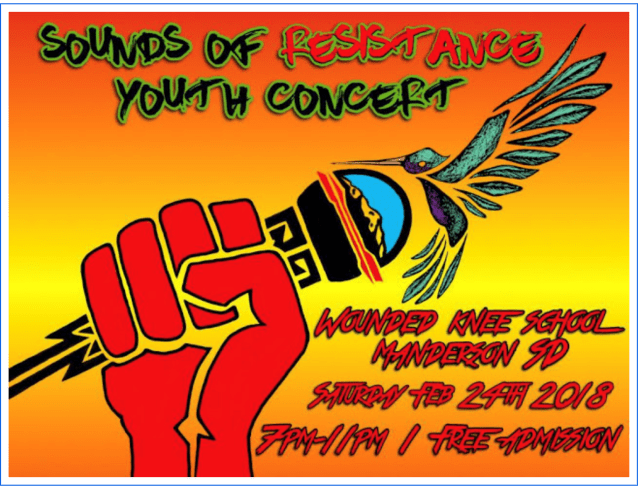
The “Gathering on the Homeland: Solidarity, Decolonization and Celebrating Acts of Resistance” is a two-day event being held in the heart of native resistance in Indian Country, the Oglala Lakota Nation on February 24 and 25, 2018 at the Wounded Knee School in Manderson, SD.

“Along with the beauty and power of 10,000 people coming together in 2016-17 along the riverbanks at Cannon Ball, ND we experienced the chaos that emerged, as it became apparent that the understanding of MOVEMENT was as diverse as the people gathered there. We have brought together folks from many Red Nations and allies from the four directions who have led, founded, and/or participated in movements in order to examine, explore, and discuss how their experience can teach young emerging social change makers, community leaders, students, families, and our youth,” stated Wioweya Najin Win (Debra White Plume), event Co-Organizer and Director of Owe Aku.

What does the frontline of Non-Violent Direct Action at Cannon Ball, ND have in common with hip hop music? or Resistance Art for Youth? or the formation of an Indigenous Resistance Media Network? or Idle No More? or serving as Medic or Legal Observer?

“Many paradigm-shifting experiences along the river banks felt by thousands of people from all walks of life have resonated throughout the world since the camps were closed and the structures burned. There was such an awesome and truly special fire ignited from that spark of energy inside all of us on the frontline, that many people have expressed an urgent need to gather, pray, discuss, debrief, and learn together from our experiences there. We decided to pull together people who have past experiences that not only fuel and inspire their current ongoing work, but whose historical presence merges into today’s organizing and change-making work to help provide a framework for young organizers and change makers to learn from. They will present a panel discussion entitled “What Is Movement?”on Sunday beginning at noon. Some of the presenters gained their first and only experience at the river, some have been at this work for years, some for decades. We have been working at great risk to empower and shape a generation in this racist and punitive country, but we are willing to continue to take that risk. We have put together this two-day event to provide a forum for such teachings through art, music, dialogue, brainstorming, and prayer with the best energy we have for our younger generations,” continued White Plume. Nina Waste, co-founder of Idle No More is the keynote speaker for this panel discussion.

Native Artists In Action, an indigenous collective from New Mexico and Arizona will host a youth workshop Saturday afternoon to create art that teaches not only art skills, but the philosophy of art and the preservation of ancient life ways. There are also a number of native musicians coming to perform a free youth concert on Saturday night, who promote an alcohol/drug free lifestyle as well as using music to inspire youth to reclaim their ancestral identities. Native musicians will debut recent single and CD releases at the concert, including Nataanii Means and Tracy Bone.

“Our youth need to know that there is music in the world created by Indigenous people that carries the truth of their message of overcoming the genocide of the big world, the alcohol, drugs, violence to women. It is a voice of resistance and of proudly and loudly reclaiming native identity and celebrating that decolonization,” said Olowan Martinez, co-organizer for the event. “The artists coming here to work with our youth have been doing this for a long time, and bring a special talent to working with youth.”

The “GurREALla Media, Do’s and Don’ts on the Frontline” film forum and training beginning at noon on Saturday is extremely necessary in todays world of social media and immediate internet that connects people around the world. When do you put your camera down? What do you do when arrested and film is conficasted? What does guerrilla media really mean? Film makers will show their video shorts and feature length films and discuss their work, their risks, and be available for Q and A with workshop participants.

Organizers state that the event is being held in conjunction with the 45th Anniversary of the 1973 Liberation of Wounded Knee. Through the past 45 years the annual celebration has enjoyed pow-wows and feasts, but very little has been done in terms of educational experiences and/or solidarity building for the long term work ahead of Red Nations, so this event is designed for the Oglala Oyate and their nearby sister nations on the Rosebud, Cheyenne River, Crow Creek, Lower Brule, and Standing Rock Homelands but all of the Oceti Sakowin are encouraged to attend and participate. Organizers have stated that all people from all walks of life are encouraged to attend, especially past and current allies and accomplices. The event poster states “No Feds, Informers, Infiltrators, or TigerSwan” as part of the security culture the organizers observe.

Beverages during breaks, and evening meals will be provided as part of the Lakota way of life, and security will be present throughout the event. People are encouraged to bring their own eating utensils if possible, in order to minimize the amount of trash that will need to be hauled out of the Wounded Knee School in Manderson, which has so graciously provided space for the event.

The “Gathering On The Homeland” two day event is hosted by Owe Aku (Bring Back the Way) and the Red Robin Hood Fund. Please contact Olowan Martinez at 605-407-138. Please visit www.oweakuinternational.org to learn more about the work of Owe Aku.

Owe Aku is a grassroots organization of Lakota people and our allies founded to promote the protection of sacred water and preservation of our territorial lands.  Our actions for environmental justice rely upon cultural revitalization as our major tool in achieving our goals.  The principle location from which are operations are based are on Lakota territory along Wounded Knee Creek on what is called the Pine Ridge Indian Reservation .  More information on our work can be found at www.oweakuinternational.org

sounds of resistance

Posted in #NDAPL, civil disobedience, Indigenous, Uncategorized | Tagged , | Leave a comment

I speak about Keystone

Today I came across the video below. This was taken at a gathering of water protectors who had been working together in Indianapolis for about a year, in solidarity with those at Standing Rock. We were gathered on the grounds of the Indiana state capitol this cold day in March, 2017.

My friend Brandi Herron speaks about the many things we are grateful for.

Then I tell the story of how I became concerned about our environment at a young age, and the story of the Keystone Pledge of Resistance.


Posted in #NDAPL, civil disobedience, Keystone Pledge of Resistance, Uncategorized | Leave a comment

Dallas Chief Eagle–spirit led life

As I mentioned yesterday, there is a meeting tomorrow, 2/18/2018, 3:00 PM, at the Kuehn Conservation Area, to organize a Friends of Prairie Awakening-Prairie Awoke group. If you have an interest in native matters, I hope you will attend.

Stand with us in the arena, carved into the tall grasses of the prairie, and experience the song, dance, drums, flute and stories of the First Peoples of this place. As the prairie is once more awakened, we are hoping you can step inside these stories and awaken yourself here in the wilds of your home.  From <http://www.iowalivingmagazines.com/2015/08/18/dallas-county-conservation-board-public-programming-special-event-press-release/>

Although many Bear Creek Friends have been involved with this for many years, the ceremony last September was the first I was able to attend, and I was so impressed.  To learn more about this in preparation for tomorrow’s meeting, I’ve been doing a lot of research.

Dallas Chief Eagle, from Pine Ridge, has participated in many Prairie Awakening ceremonies. I saw the amazing hoop dance he and his daughter performed. Then I was really moved by the way he spoke around the bonfire that evening about a spirit led life.  He spent quite a bit of time talking about clearing your mind to allow space for the spirit. Then we all practiced that with some time of silence. He asked the children what they felt afterwards, and they said peace and calm.

There is a recording of a wonderful interview with him on KHOI 89.1 FM in Ames, IA, recently, where he talks much more about living a spirit led life.

Following are some notes I took as I listen.:

Teach how to turn my brain off.
How do we turn our bodies off? How do we turn our emotions off?
Allow the spirit the space that it needs so that it can move and be the leader.
Don’t move, we sit in silence, we turn off our brains, and turn our attention to the spirit.
Rock has sat there for many years. Doesn’t move.
Peace, compassion, clarity, calm is the outcome.
I teach people how to do this.
There is a power in that spirit.
Don’t give attention to our bad habits.
Our own spirit can show up for us.
Turn all the channels off and turn it over to the spirit.

I became a volunteer and got a badge so I can go into the prison system.
Before I go into the prison system I’ll sit and calm myself.
Prisoner: ‘No one has ever called me a spirit before.’
Many of us are overwhelmed emotionally, mentally. Lots of pain and confusion we can eliminate if we get into the spirit mode.
We are all related by the spirit. Rock is the older spirit. Sit with the rock and have a conversation.
If you know how to get in spirit, that can be a new habit when you are facing danger and other problems.
Every time you turn to the spirit it will give you peace and insight. And we all have that.

Description of sweat lodge.  Healing through laughter or heat.

Dallas Chief Eagle has been allowed to have sweat lodges in prison.
“I have been alcohol, drug free for about 35 years.” 
“I would say maybe 90% of people do not know how to manage their own spirit.”
Many use the quick fix system. All they know. That will not fix what is wrong with us.
We are looking for long term sustainability.
Lakota saw the spirits that are all around us.
Discussions on spirit led language. Is it spirit led and what does that mean? How do we go about doing that?
How do we bring those spirits together to make decisions.
A universal language that can benefit all cultures.
We live in a world that can learn, practice and appreciate the message we have to give.
There is a place inside yourself that is very magical. The happy hunting ground is in you now.

During Vietnam War. Buddhist monks. Self emollition. Did not move.

You can tell when a person is spirit driven by the words they use.

When people begin to learn how to live in the spirit they want more.

The indigenous culture has been subjected to genocidal assault, yet still thriving.

Posted in Indigenous, peace, spiritual seekers, Spiritual Warrior, Uncategorized | Tagged , , , | Leave a comment

Friends of Prairie Awakening-Prairie Awoke

Bear Creek Friends have been involved with the Native American celebration, Prairie Awakening-Prairie Awoke, at the Kuehn Conservation Area for many years.

Everyone is invited to attend an organizational meeting about creating Friends of Prairie Awakening this Sunday (not specifically Friends as in Quakers).


Friends of Prairie Awakening – Prairie Awoke

Organizational Meeting

The Dallas County Conservation Board invites you to an organizational meeting working towards the creation of a Friends of Prairie Awakening-Awoke group. The function of this Friends group will be to look forward to the next twenty years and vision the future of the celebration. Guided by the conversations and actions of this group, the vital functions of the Celebration– planning, promotion, funding, volunteer coordination will be addressed. Join us as we seek to bring the next twenty years of celebrations to our place and ensure the awakening continues. Your skill, and more importantly– your spirit is needed. Please consider joining us. Registration is required for this program.

For more information or to register for any of our programs, contact:

Dallas County Conservation Board

14581 K Avenue Perry, IA 50220

515-465-3577 Office Hours: M-F 8 am – 4:30 pm

conservation@dallascountyiowa.gov

www.dallascountyiowa.gov/conservation

Posted in Indigenous, Quaker Meetings, Uncategorized | Tagged , , | Leave a comment

How effective?

Recent reactions to posts about actions related to social and environmental justice have made me reflect again on their effectiveness. My very good friend Alvin Sangsuwangul at the Kheprw Institute (KI) frequently asks, “what actually changed as a result?”

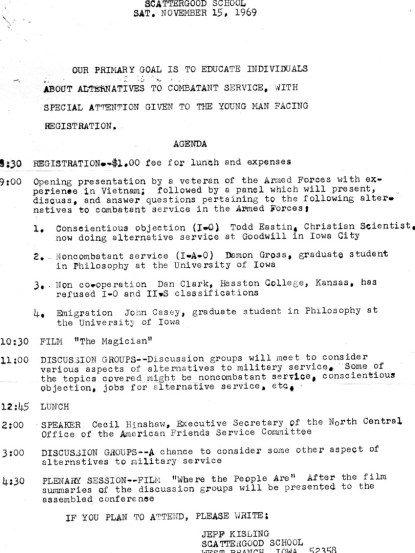
My earliest experiences were related to the Vietnam War. One thing we did at Scattergood Friends School was hold a draft conference, where the various alternatives available to young men at the time they were required to register for the Selective Service System were presented. The option to register as a conscientious objector to war was not widely known. Perhaps someone who attended the conference did that, instead of going into the armed forces. Education about justice is always a good goal.

ScattergoodDraftConference

Draft conference, Scattergood 1969

The effectiveness of the Peace Walk during the National Moratorium Against the Vietnam War on October 15, 1969, when the entire student body and most of the faculty walked in silence from the School into Iowa City, about 12 miles away, to participate in activities that day at the University of Iowa, might be more difficult to measure. This may be one of those things some deride as only making those who participate feel better. That was definitely one effect. We were traumatized by the relentless news of the war, which was perhaps more difficult for those who believed in peace. This was a time we were called to say NO, to witness against war. For me, I store things like that internally, to draw from in the future in difficult times.

That walk was just one of many things done across the country that day, and other Moratorium days. I don’t think there is much doubt that these demonstrations hastened the end of our involvement in the Vietnam War.

The next national campaign I was involved with was the Keystone Pledge of Resistance, which was launched in 2013. The permit to build the Keystone XL pipeline was thought to be a foregone conclusion.  But environmental groups trained over 4,000 people across the United States, and had plans for civil disobedience actions in many cities if it looked like the recommendation of approval was eminent. Eventually President Obama refused the pipeline permit. Although it is true the Trump administration has approved the permit, it is questionable whether it will be built. Nebraska finally gave approval, but for an alternate route through the state. The delay, the depressed oil market, and the lower quality of the tar sands product don’t bode well for the pipeline.

The Keystone campaign in Indianapolis created a network of activists who went on to become involved in a number of other social justice efforts, such as Indiana Moral Mondays, homelessness, Black Lives Matter, kids and the environment, and the Dakota Access pipeline.

The Rainforest Action Network (RAN)’s analysis was that financial institutions and their shareholders are very susceptible to bad publicity. RAN became a leader in the global fossil fuel divestment campaign. Student pressure on college campuses have been effective in getting universities to divest.

Just before a major Morgan Stanley shareholder meeting, Rainforest activists simultaneously delivered petitions to Morgan Stanley offices in cities across the country, asking Morgan Stanley to stop investing in coal projects. We had a very nice conversation with the Morgan Stanley manager in Indianapolis. At the shareholder meeting, the decision was made to stop investing in coal.

Morgan Stanley stops

Most recently was the amazing coming together of the tribes at Standing Rock to try to protect the water from the Dakota Access pipeline, and a global movement to support them and protect water all over the world. I’ve written before about how much the spiritual approach of water protectors has meant to me. Our gatherings always included prayers.

Pressuring financial institutions and individuals to divest from the pipeline was one part of this. During one gathering in Indianapolis, after prayers a group of several hundred walked to two of the banks involved with the pipeline, Chase and PNC, and stood outside in silence as those who had accounts withdrew their money. $110,000 was withdrawn that day. I had my own positive experiences when I closed my Chase account. North Meadow Circle of Friends closed their Chase account.

It is true that oil is now flowing through the Dakota Access pipeline. But there is still a case in court involving Iowa landowners against the way eminent domain was used to allow the pipeline to be built on their property. Pressure supporting that case continues. If the landowners win, the pipeline will have to be removed from their property.  There was at least one similar case in another state that resulted in a natural gas pipeline being removed from Native land.

And pressure on financial institutions to divest or not approve new loans for Energy Transfer Partners (ETP) continues. That was the purpose of the trip to Minneapolis recently, at the US Bank headquarters. The main reason I wanted to go on that trip was to network with other water protectors I was sure would be going along, though I didn’t know who they would be ahead of time. I got to know Ed Fallon, Donnielle Wanatee, who had spoken at Iowa Yearly Meeting (Conservative), a couple of people from Standing Rock, and others. It was also inspiring to witness the organization and passion of so many people at the Minnesota branch of 350.org. This kind of networking and mutual support means a lot to those involved in what are lonely and difficult struggles. The reason for choosing Minneapolis the day before the Super Bowl was played there was because of the large crowds. With the consolidation of mainstream news, the story of water protectors and other social justice actions is rarely seen on television or in newspapers. I believe that sometimes grassroots raising of awareness eventually has more effect than efforts to change laws.

Posted in #NDAPL, civil disobedience, climate change, Indigenous, peace, Quaker Meetings, Uncategorized | Leave a comment

Leadings and racial justice

Many of you had already heard one version or another of the story about not having a personal automobile that I wrote about again yesterday. Many Friends have also heard the story of how I became connected to the Kheprw Institute, too. For those who haven’t, the reason I share this again is to illustrate one way a white person began to learn about racial injustice. This experience was another example of being guided by the Inner Light at several junctures along the way.

But first about the term white. I love the term: people who “believe that they are white” that I read in Between the World and Me by Ta-Nehisi Coates. As the commercials for genetic DNA kits so wonderfully show, we are all a mixture of ethnicities. White doesn’t make sense except, I guess, to those with light skin who feel that is important.

Many of us struggle with how to address racism in our lives and communities.  Some have found ways to do so.  I’ve heard workshops on the subject can be helpful, though I haven’t attended one myself.

Believing there is God in everyone means every person is precious as a child of God. It is not right to treat some people better than others.

I struggle for ways to address racism in my own life. I had become increasingly distressed by the privileges I have in our society based solely on the color of my skin, and denied others based on theirs. The lack of diversity in the Midwest can make these issues often seem removed from our daily lives, and can make it more of a challenge to address them. Friends are often bewildered when they are challenged about their privilege. Our culture has hundreds of years of history of building these privileges into our societies, and teaching this is how things should be. This is what structural racism is. It is a long and often difficult process to unlearn racism.

The path the Inner Light led me down related to racism started about four years ago. I was deeply involved in the environmental activist movement, mainly through the Keystone Pledge of Resistance. At that time various environmental groups would organize national days of education or action to try to raise awareness about our environmental crisis. These things were organized via the Internet. When I learned of an upcoming day of events, I looked to see where something in Indianapolis was occurring. The only event was at a place I’d never heard of, the Kheprw Institute (KI). I was led to attend that event.  As often seems to happen, when the day of the event arrived, I had second thoughts about going to the trouble of bicycling several miles to something I wasn’t sure would be useful. But I was getting a nudge from within, so I went.

I arrived at an old building that had previously been a convenience store in an inner city neighborhood in Indianapolis. But it was full of young, black kids enthusiastically showing us their aquaponics system and rain barrel making enterprise as ways they were working for the environment.

I was intrigued, and wanted to learn more. At the time, their meeting place was only open occasionally. KI did have a web page, but the only contact information was an email address. On the web page I saw one of their projects was “Open Source Activism”, to develop computer applications to support activism. Being a computer programmer, I thought this would be a way for me to connect with KI.

I sent an email message indicating that I would like to be involved with that, but did not receive a reply. I was thinking this was not meant to be, but this was one of those times when the Inner Light was not going to let me give up, so after a couple of weeks, I sent another email message. After some time, I received an offer to meet at that old convenience store. I arrived on my bicycle on a dark, rainy evening, to find the same group of about a dozen kids in their early to late teens, and KI’s leaders, Imhotep, Pambana, Miss Fair, and Alvin.

After some greetings, we all sat down, and I thought we would talk about programming languages and projects. Instead everyone looked at me, and Imhotep said, “Tell us about yourself.” I talked a little about being concerned about the environment and working with the Keystone Pledge of Resistance, and my work at Riley Children’s Hospital. “Tell us some more.” So I mentioned I was a Quaker, and Miss Fair enthusiastically talked about Quakers and the Underground Railroad. When she stopped, everyone looked at me. I said something along the lines of how grateful I was that my ancestors had done that work, but Quakers try to not take credit for things they personally hadn’t done.

Which led me to talk more about how Quakers didn’t see religion as something only involving listening to a sermon once a week, and left me at the point where I needed to provide an example from my own life. Since KI is built on concern for the environment, I spoke of how I had reluctantly purchased a used car for $50 when I moved to Indianapolis, mainly for trips home to Iowa. Car rental was not common in the early 1970’s. When my car was totaled several years after that, I decided to see if I could live in the city without a car, and have since then. I was hoping that would show how Quakers try to translate what they believe, what they feel God is telling them, into how they actually live their lives. At that point Imhotep, with a smile on his face, said something like “Thirty years? You are a warrior.” I had never been called a warrior before. It seemed a humorous term to use for a pacifist (and I suspect that was his intention now that I know him) but I liked it.

I have since learned that Imhotep is very good at drawing stories out of people. So again he said, “OK, tell us some more.” I finally realized, and should have anticipated, that this was actually an interview to see if I was going to fit in, and the usual surface information wasn’t going to be adequate. I remember everyone looking expectantly at me, and I wondered what to say next. I also clearly remember the Inner Light telling me what I needed to do then. I said “Quakers believe there is that of God in everyone” and I turned to each person near me and said “that includes you, and you…” The first time, I think I hesitated slightly as I was asking myself, “Ok, we Friends always say this, but do you really believe this of a group that is different from you?” And I’m really glad the answer was an immediate and emphatic YES, but it also seemed to reaffirm that by exploring it intentionally. At that point I remember smiling at the thought, and the young person whose eyes I was looking into saw it, too, I think. Each person smiled at me as I said that to them, and I had the impression they were thinking, “of course”. I strongly felt the presence of the Spirit among us.

That finally seemed to satisfy the questioning. This was a real revelation to me, how it is important to express spiritual matters as well as you are able when the situation calls for it. (It is also important NOT to do so when the situation does not call for it.) And to be alert for those possibilities, and how the Inner Light guided me through that evening. That set the tone for my involvement with KI since that night, for which I am profoundly grateful.

Because the relationships and experiences at KI over these past several years are how I began to understand racism, and how I can respond. The crucial, essential first step for a white person is to find some way, anyway, to develop friendships with people of color. Not (just) attend meetings and vigils, but become friends. We are all children of God, and I have been so blessed to be connected with these children.

I would often relive that initial meeting. As wonderful as it was, and as significant as it was in changing the direction of my life, there was something troubling me about it. I finally faced the problem, which was why did I even hesitate to ask myself about the phrase “that of God in everyone”? Much as I didn’t want to admit it, I felt that showed there was something of racism in me. It is good to be humbled, and I have paid more attention to this since. And the deep friendships I was blessed to develop with many in the KI community erased any hesitation I now have about there being that of God in everyone.

I also thought about how different things would have gone if Imhotep had not persisted in getting me to reveal so much about myself, including about my faith.

Although much attention was paid to desegregation of our schools in the 1960s, so many people today live segregated lives.

What I hope you take from this story is to seek out opportunities to increase the diversity of people in your life. To recognize opportunities, like a meeting advertised on the Internet or in the news about an event related to an interest of yours, that is with a new group of people. I think it is helpful if you think of what you might have to offer. I also think it is important to be prepared to share about your faith if an appropriate opportunity arises.

One of the most important things I learned is how important it is to both listen very carefully, so you learn about the new community and people, and avoid offering suggestions or any type of leadership. Instead, wait to be asked. We don’t know what it is we don’t know, until others teach us. Respecting the community helps remove barriers, and open space for trust to develop. Then you will be asked for what the community needs from you.

As an example of that, after nearly a year of attending book discussions and other events at KI, I was delighted to be asked to teach about photography during the summer camp. A good way to close might be to share some of those photos.

Posted in Black Lives, Keystone Pledge of Resistance, Kheprw Institute, Quaker Meetings, race, Uncategorized | Leave a comment