Quakers and Peace Today

Much has been written about the role of some Quakers in the Underground Railroad, that network of safe places where those escaping enslavement found help on their journey northward. It seems not as many Friends were involved as we might have thought. It was recognized that it would not be possible to speak against enslavement when one had their own enslaved people. Over many years, those Quakers who had enslaved people working for them released them.

Looking back to those times, it is difficult to believe that any Quaker could participate in the enslavement of others. There are many other conflicts Friends find while living in the United States today, including white privilege, fossil fuel consumption, excessive consumption, racism, intrusion of religion into politics, stigmatizing and oppressing “others”, militarism and the endless war on terror.

What are we doing today that future generations will look back on and find it hard to believe we lived as we are now?

The Peace Testimony has been a fundamental part of Quakerism. For centuries many Friends have worked against, and refused to participate in war. But the nature of war has changed. Our country has found ways to be involved in international conflicts without formal declarations of war. It was a shrewd move to build volunteer armed forces, making it possible for most citizens to pretend the country is not at war. Protests against war largely went away when the children of the upper and middle classes were no longer directly threatened.

Here is a link to a collection of stories Iowa Quaker Don Laughlin gathered that he titled “Young Quaker Men Face War and Conscription.”  https://1drv.ms/b/s!Avb9bFhezZpPiaMFA58DbzX6vnhaYw

Many people still think of peace as the absence of war. Or today, think of peace as the condition where war can be adroitly hidden from view. But the fighting, death and destruction continue.

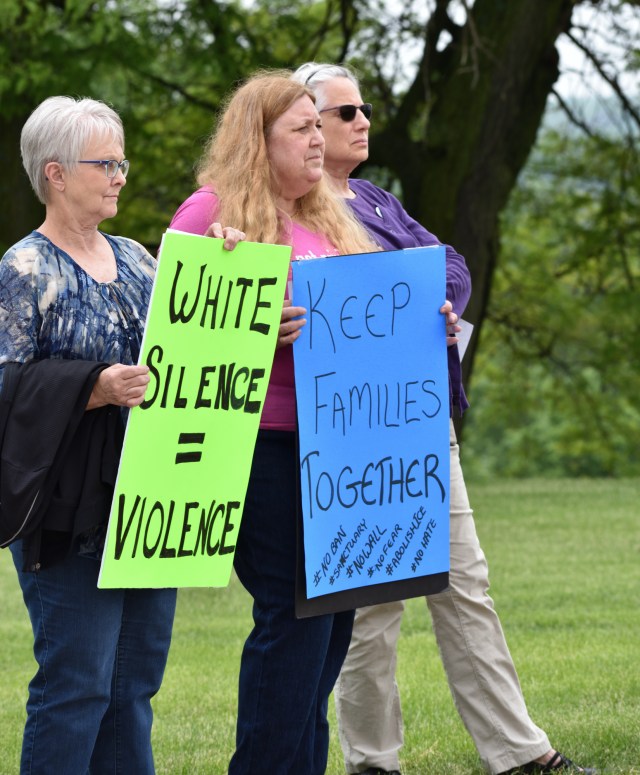
A common message heard during rallies and demonstrations is “No Justice, No Peace.”  We are not at peace as long as any among us are oppressed. When one of us is in pain, we all experience pain. We feel the shared pain of children torn away from their families on our southern border, for example.

Rev. Martin Luther King, Jr., was led to speak out against the Vietnam War, a decision many in the civil rights movement disagreed with. Many feared that would dilute the campaigns for social justice, but Dr. King recognized how this was all related.

Speaking out against militarism and gun violence are among the many themes of the new Poor People’s Campaign. Working with this campaign to address injustices is one way to work for peace today.

Here is a link to a SWAY presentation about “Peacebuilding” I created several years ago: https://sway.com/GHWWMUcypHaJ1K4S

I recently came across the following Theory of Active Peace by John Wilmerding.

The Theory of Active Peace

August 8, 2015 at 3:15 PM

The Theory of Active Peace– by John Wilmerding (January 4, 2009)

Presented here, for comment and discussion, are the five developmental stages toward Active Peace.

[0. ‘Surface’ — conformity without question. Unconsciousness, unawareness, denial, or opposition to issues of social conscience involving violence, oppression, subjugation.]

1. ‘Acquiescence’ — You know there is something wrong, but take no action, or it doesn’t affect how you live your life. Your response is to remain ‘quiet’ to others and within yourself. “Things have always been this way … there is nothing that I or anyone else can do to change them.”

2. ‘Pacifism’ — You are no longer quiet within yourself. Your discomfiture with violence, oppression, etc. begins to affect how you live your life. You might turn the other cheek in a fight, for example. You are likely to witness to others (and to yourself) that organized violence and oppression is wrong.

3. ‘Passive Nonviolent Resistance’ — Many or all of your private decisions become influenced or governed by conscience. ‘Conscientious objection’. You make changes in your own behavior by reasons of conscience but are not necessarily social about it, or don’t publicly, systematically cite your actions or your reasons for them. It’s also akin to the concept of ‘standing aside’ or of ‘abstaining’ on a vote.

4. ‘Active Nonviolent Resistance’ — You take social leadership in attempting to thwart the forces of violence, oppression, and subjugation, or join with others who do, publicly, and attempting to spread the word about the initiative and get others to take part. ‘Standing In The Way’.

5. The triad of ‘Active Peace’:

5A. ‘Peacemaking’ — the transformation of conflicts away from violence, oppression, and subjugation by social and political means. Mediation, conferencing, circles peacemaking, and kindred ‘encounter’ forms. ‘Workshop’ methods such as AVP can also be effective. There are hybrid forms (encounter/workshop) such as HROC, a spinoff of AVP in Rwanda.

5B. ‘Peacekeeping’ — Nonviolent Accompaniment. Need not be organized or public in its motivations, but is more effective when it is done publicly, and the reasons are publicized. [Not what the UN does with guns and uniforms, though they call it that.] Most well-known exemplars are Nonviolent Peaceforce, the proposed Canadian Civilian Peace Service, Christian Peacemaker Teams, Muslim Peacemaker Teams. “Why are the missiles called peacekeepers when they’re aimed to kill?” — Tracy Chapman

5C. ‘Peacebuilding’ — Sustainable Development — providing for human needs so that the associated conflicts involving sustaining life (land, water, food, health care, etc.) are ameliorated or eliminated. Fair Trade as opposed to ‘”free trade”. Local economic initiatives. Local alternative currencies. Barter economies. ‘Organic’ agriculture. Methods of redistribution of wealth, including economic stimuli, may be useful on the way to more synergistic outcomes where the weal is more naturally held and distributed in common.

One interesting aspect of the five-stages theory seems to be that the next one only becomes visible or understandable to you once you have attained the one before. In this way, each stage represents a ‘perspective’, both individual and social, and social ‘organisms’ can be said to progress through the stages as well as individual ones.

Another dynamic is that, for various psychological reasons I won’t go into here, people or social groups can vary in how they move through the stages, and sometimes regress. However, my understanding is that one one has a firm purchase on a stage, retrogression becomes much more unlikely. Human beings and social organizations are very complex, however, so there is still much more to learn about how to bring everyone into higher stages. Education about these things is both inevitable and necessary.

Of the five stages, only Active Peace — stage V — can accurately be interpreted as ‘the ocean of light flowing over the ocean of darkness.’

by John Wilmerding


Posted in Indigenous, peace, Poor Peoples Campaign, Quaker Meetings, race, Uncategorized | Leave a comment

Race, Culture and Ideology

In a review of the book The Great Alignment: Race, Party Transformation, and the Rise of Donald Trump,” Paul Rosen writes:

Emory University political scientist Alan Abramowitz argues that Trump is the product of an ongoing multigenerational process that has reshaped American politics. In this view, Trump is a striking result of that process, but not a departure from what’s been happening for some time — and will likely continue along similar lines after he’s gone.

Most fundamentally, Abramowitz argues that the New Deal coalition “based on three major pillars: the white South, the heavily unionized northern white working class, and northern white ethnics” was eroded by post-World War II changes that have transformed American society. Those resenting the changes have become increasingly Republican, those welcoming them, increasingly Democratic:

This transformation has included the civil rights revolution, the expansion of the regulatory and welfare state that was first created during the New Deal era, large-scale immigration from Latin America and Asia, the changing role of women, the changing structure of the American family, the women’s rights and gay rights movements, and changing religious beliefs and practices.

Three cleavages were most prominent in this process — race, culture and ideology — but they each had their own trajectories as well as interactions with the nation’s political geography.

You explain partisan polarization in terms of three main divides: racial, cultural and ideological, with the racial divide being the most important. What’s most important about the trajectory of change they’ve gone through, and what’s the most striking evidence to illuminate it?

I’d say what is most striking about the trajectory of change is that, at least with regard to the first two trends, they are driven by forces that seem likely to continue for some time. In the case of the racial divide, we know that the population, and therefore the electorate, will become increasingly diverse for decades. This is driven by the effects of differential fertility rates as well as immigration. As diversity increases, it is also almost inevitable that so will the negative reaction among a large segment of the white electorate.

With regard to the cultural divide, I see it likely to grow for some time due to the deep generational divide within the electorate. Young people in the U.S. are much less likely to be white and Christian than older people. So generational replacement will inevitably increase the proportion of the population who are non-Christian or secular in outlook, and this will almost certainly produce a negative reaction and pushback from those with more traditional beliefs

What can we do to bridge these divides? Shouldn’t our role as peacemakers be to work to break down racial, cultural and ideological divisions?

Nonviolence teaches us the way to address conflict is to deeply listen to everyone involved, and to understand that we ourselves must change if we expect others to change. How many of us have been willing to engage with those who are different from us racially, culturally or ideologically?

Personally, I have written and spoken a lot about how much I learned and was changed by my connections with the Kheprw Institute (KI), the Black youth mentoring and empowerment community in Indianapolis. And by opportunities to engage with Native Americans at the Prairie Awakening/Prairie Awoke celebration, as well as work with Native Americans in Indianapolis as water protectors and our efforts to stop the Dakota Access pipeline. More recently I have had opportunities to work with the Poor People’s Campaign.

Quakers are familiar with the following story about Margaret Fell. “You will say, ‘Christ saith this, and the apostles say this;’ but what canst thou say? Art thou a child of the Light, and hast thou walked in the Light, and what thou speakest, is it inwardly from God?”  This opened me so, that it cut me to the heart; and then I saw clearly we were all wrong. So I sat down in my pew again, and cried bitterly: and I cried in my spirit to the Lord, “We are all thieves; we are all thieves; we have taken the scriptures in words, and know nothing of them in ourselves.”

We have to look at our own lives and find what we ourselves can do to bridge the racial, cultural and ideological divisions in our communities. I believe this starts by looking for opportunities to be with and work with those who are different from ourselves.

Posted in #NDAPL, Black Lives, Indigenous, Kheprw Institute, peace, Poor Peoples Campaign, Quaker Meetings, Uncategorized | Leave a comment

Family Separation

Following is a Minute approved by Bear Creek Friends Meeting of Iowa Yearly Meeting (Conservative), 6/24/2018.

Family Separation

In the face of almost universal condemnation at home and abroad, we are glad the President has reversed his decision to forcibly remove children from their families at our southern border. Unfortunately, much damage has already been done, to the children and their families, and to our social fabric. The least we can do is work for the immediate reunion of these children with their families. That should include providing transportation back to this country for those who were deported while their children were held in camps here. Mental health services should be provided to those traumatized children.

Congress should pass legislation to ensure this never happens again.

The administration should stop restricting the ability of people to apply for asylum. The change in policy that does not recognize fear of domestic abuse or rape as credible fear should be rescinded. Morally, crossing the border without papers is not criminal, but survival.

Efforts by both our government and non-governmental organizations to improve conditions in those countries refugees are fleeing from is a crucial part of addressing immigration.

Underlying all this must be reclaiming the moral narrative for our public policies. Too much of what the current administration has done, and continues to do, is related to stigmatizing those who are seen as “others”.  We should instead embrace diversity.

Bear Creek Friends Meeting, Earlham, Iowa

Posted in Uncategorized | Tagged , | 2 Comments

National Commission on Military, National, and Public Service

According to Quaker House of Fayetteville, North Carolina, one of the few listening sessions of the new congressional National Commission on Military, National, and Public Service will be held:

Vinton, Iowa at 
Wesley Methodist Church
516 2nd Avenue
June 26, 2018,
6:30 pm – 8:00 pm

The Mandate:  This commission is tasked with gathering information in order to make proposals for updating the regulations and laws in the following areas:

Selective Service—Is it still needed or should it be discontinued, does anything need to be changed?
Draft—The Selective Service is the draft.  Currently, all 18-year-old men (and the Commission is considering women) are required to register with the Selective Service, and your local draft board is currently staffed.  If, at any point, Congress and the President authorize a draft, everything is already in place for it to be implemented instantaneously.
Military, National, Public Service—Should a service requirement be mandatory for young adults in the United States?  If not mandatory, how can public service be encouraged?

From Quaker House:

Advocating Peace:  The initial listening session of this Commission was in Harrisburg, Pennsylvania, on February 23, 2018, and Quaker House was there to comment.  Only Quaker House (Kindra Bradley), the Center on Conscience & War (Bill Galvin and Maria Santelli), and a Mennonite long-time peace advocate and counselor for the GI Rights Network (Titus Peachey) spoke on behalf of conscientious objectors.  Our collective comments covered eliminating the Selective Service System, restoring the full rights of people who have not registered with the Selective Service, officially allowing registrants to self-designate as conscientious objectors during Selective Service registration if it is maintained, and ensuring that any alternative service program is run by a civil agency and with the same benefits as military service.  I was somewhat encouraged that two veterans who commented after we made our statements publicly agreed that the US should allow people to be conscientious objectors without punishment or other negative characterization.

You can submit comments before September 30, 2018 either online at http://www.inspire2serve.gov/content/share-your-thoughts

Or by mail at:

National Commission on Military, National, and Public Service
Attn: RFI COMMENT—Docket 05-2018-01
2530 Crystal Drive, Suite 1000, Box No. 63
Arlington, VA 22202

Some of my blog posts about the Selective Service System and the draft can be found here:    https://kislingjeff.wordpress.com/?s=selective+service+draft

Posted in peace, Quaker Meetings, Uncategorized | Tagged , , , , | Leave a comment

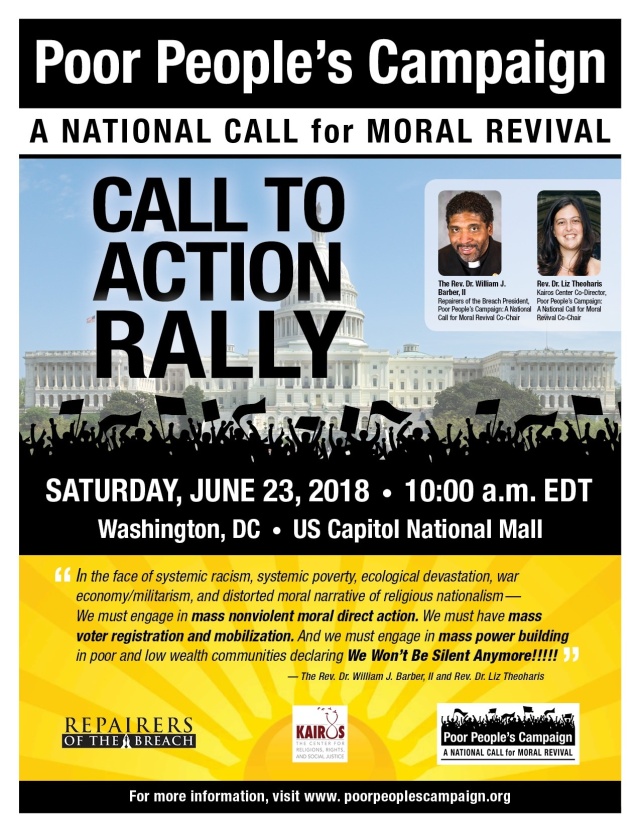
Poor People’s Campaign Returns to Washington, DC

In 1968 the Poor People’s Campaign came to Washington, DC.

Fifty years later, June 24, 2018, the new Poor People’s Campaign returns to Washington.

Iowa Poor People’s Campaign

Minnesota Poor People’s Campaign

(more photos from my friend Rezadad Mohammadi in Minneapolis/St. Paul)

PPC June 23rd flyer

Posted in Poor Peoples Campaign, Uncategorized | Leave a comment

Intentional Incompetence

I cannot come to any other conclusion than that the current administration intentionally scattered the children stolen from their families in a manner that would make reunification difficult or impossible. Which is the very situation we are in now.

Part of my career related to designing and using complex databases for research data. A database to keep track of which child belonged to which parent would be extremely easy to create and use. The only technical part would be a method to identify each child and parent. A simple identification bracelet such as those used in hospitals would work. Indeed, from a video the government shared of these holding facilities, you can see such a bracelet being scanned as each child is given his food tray.

It could not be more self evident that such a system would be needed if you were to separate children from their parents. Since this was not done, it had to be a deliberate decision not to do so.

This entire debacle is sinister. Since when do we allow the government to prevent reporters and congressional representatives from seeing where these children are kept? Since when has the government brought children into cities without notifying the local authorities? Since when has the government lied to airlines about who is being transported? Since when have children been ripped from their parents in the first place, causing all these problems?

This is obviously unacceptable. Those responsible need to be held accountable.  Those responsible need to be removed from their positions so they cannot do further damage. We need to speak out. There are too many parallels to taking Jewish people or Japanese Americans to concentration camps while others remained silent. Too many parallels to young African American men either killed or imprisoned here.

DSC_7562


Posted in Uncategorized | Tagged | 2 Comments

Reclaiming the Moral Narrative

Last Monday’s rally at the Des Moines capitol building was week 6 of the Poor People’s Campaign, with the theme “Reclaiming the Moral Narrative”.

From the Poor People’s Campaign handout:

As Rev. Dr. Martin Luther King, Jr., prophetically described 50 years ago, “There are millions of poor people in the country who have very little, or even nothing to lose. If they can be helped to take action together, they will do so with a freedom and a power that will be a new unsettling force in our complacent national life.”

“If you are generous with the hungry and start giving yourselves to the down-and-out, your lives will begin to glow in the darkness, your shadowed lives will be bathed in sunlight. You’ll be like a well-watered garden, a gurgling spring that never runs dry. You’ll use the old rubble of past lives to build anew, rebuild the foundations from out of your past. You’ll be known as those who can fix anything, restore old ruins, rebuild and renovate, make the community livable again.”  Isaiah 58

We are a new and unsettling force. And we are powerful!

So many things that have occurred over the past year show the moral narrative eclipsed by selfishness, greed and intolerance. The Muslim travel ban, Charlottesville, Puerto Rico, dismantling of environmental protections, attacks on health care, a tax bill for the wealthy, inflated military spending, and the reprehensible taking of children from their families.

From Move On:

Thanks to powerful public pressure, the Trump administration has been forced to shift its outrageous treatment of immigrant children. We have momentum—but we’re far from done.

The executive order that Donald Trump signed today is not the solution. It allows the indefinite incarceration of immigrant families in federal prisons, and there is still no plan to reunify the thousands of families that have been forcibly separated. Which is why we must continue to stand together at hundreds of events nationwide on Saturday, June 30, to say that families belong together—and freeClick here to join the June 30 event near you to Keep Families Together and free and reject Trump’s brutal policies.

This Saturday’s event in Des Moines:

When:  Saturday, June 30 at 6 p.m. (local time)
Where: la placita
Des Moines, IA 50316

Many organizations will be joining the Poor People’s Campaign national rally this Saturday on the mall in Washington, DC. (flyer below).

Here is Rodger Routh’s video, “Reclaiming the Moral Narrative”, of our Poor People’s Campaign gatherings here in Iowa. This campaign is just getting started. Hopefully more and more will join.


PPC June 23rd flyer

Posted in Indigenous, Poor Peoples Campaign, race, Uncategorized | Leave a comment

Babies alone in concentration camps

Rachel Maddow breaks down trying to report on “tender age” shelters.

Concentration Camp: a guarded compound for the detention or imprisonment of aliens, members of ethnic minorities, political opponents, etc., especially any of the camps established by the Nazis prior to and during World War II for the confinement and persecution of prisoners.

“Tender age”  concentration camps.  I can not even envision such a place. Which is why the administration is hiding this from us. There needs to be a continued groundswell of protest against these barbaric policies.

Lucy Duncan writes “This reminds me of Letter from Birmingham City Jail… and I think of liberal religious folks who we need in the fight of our lives… against white supremacy…not on the sidelines…and I reflect on this myself, I speak out a lot now, but the urgency could be greater…. and it took too long for me to show up with a sense that living in white supremacy was suffocating me while it was killing people of color.

Black people and other people of color alone cannot abolish discrimination and hate. It is a problem created by white America and maintained by the silence of the majority. Every form of inequality would disappear by next Friday if every white person in America used his or her privilege to eliminate it.” She is referring to this article in The Root, White People are Cowards.

The CREDO blog has a good list of things we can do. Four ways you can fight Trump’s policy of ripping children away from their parents at the border  by Nicole Regalado

CREDO and our allies at MoveOn and dozens of other organizations are planning a massive “Families Belong Together” rally in Washington and in cities and towns across the country on June 30.  To learn more and find a rally near you, please click here.

Some of us have been participating in local Poor People’s Campaign events. There will be a national rally in Washington, DC, this Saturday, June 23rd.

PPC June 23rd flyer

Posted in Black Lives, Poor Peoples Campaign, Uncategorized | Leave a comment

How Ironic

How ironic is it that a day referred to as Freedom Day finds this country denying children their freedom? Children, even very young children, forcibly taken from their parents and locked in cages. What perversion of authority could conceive of, let alone execute, such in immoral policy?

The audio of children crying for their parents is heartbreaking, devastating to hear.

Imagine the outrage the current administration would profess if any other country was doing this? Would they be sending Tomahawk missiles and calling for regime change? Imposing sanctions? Calling an emergency session of the United Nations Security Council? What hypocrisy.

As helpless as it seems, we need to at the very least let our representatives and the White House hear from us. This is not a time to do nothing. Write letters to the editor, join local actions, do something.

This should have been an opportunity to enjoy Juneteenth Day to celebrate the freedom of enslaved people. Instead we find this country denying immigrant children and their parents their freedom.

And then to have the audacity to quote scripture to justify this government sponsored child abuse.

At the Poor People’s Campaign event in Des Moines yesterday, a pastor demolished Attorney General Jeff Session’s citing of scripture to try to justify what cannot be justified.

PPC June 23rd flyer

Posted in Poor Peoples Campaign, Uncategorized | Tagged | Leave a comment

Digital Photography

Although I said I am glad I was glad for my experiences working in the darkroom with black and white photography, that made me appreciate digital photography all the more. The technical aspects of film and paper developing are so exacting (maintaining constant temperature during the process, keeping everything free from dust) that the process made it difficult to get quality results. The whole process is also very time consuming.

Removing those technical challenges with digital photography was truly revolutionary. It is really freeing to be able to take any number of exposures of a subject, not to be limited by the number of spaces for photos on physical film. Then the film development process is basically eliminated. You can see the photos right away, on the camera itself, and then if/when the images are transferred to a computer.

Digital cameras have improved tremendously over the years. The first one I had experience with was the Sony camera we gave to my parents for their 50th wedding anniversary in the fall of 2000. It was a 3 megapixel camera but took surprisingly good images, such as this one in Rocky Mountain National Park. One problem was the memory sticks were 8 megabytes, so we had to transfer the pictures off the stick after about a dozen photos were taken. I remember going down Trail Ridge Road, transferring the photos to a laptop computer several times in the course of the trip.

mom dad 3 megapixel

Editing the images with computer software apps usually greatly improves the images. It is easy to straighten and crop the images. Then there are a myriad of controls to adjust brightness, contrast, color, and sharpness. You learn so much as you make trial and error adjustments and see the results on screen immediately.

At that point I think most photos are viewed on screen. If you do want paper copies of images, color photo printers are relatively inexpensive and very easy to use, eliminating the photo paper process with wet chemicals. Or you can send them to a local digital printing service, like a drug store.

Being able to take many photos with different camera settings in a short time allows you to explore photographing subjects extensively, learning all along the way. For example, I eventually took over 900 photos over the course of a couple of years, of the “Open Eyes” sculpture near my work at the Indiana University Medical Center in Indianapolis. The building behind the sculpture with the glass face is the Department of Ophthalmology, and the sculpture is an abstraction of eyes.

In the first photos you could barely see the color glass in the aluminum rings. Then as I began to get them to show up, they tended to all look black. Then I learned how to make the colors in the glass show up. After that I worked to find so many different angles of the sculpture, including from inside it. And taking photos in all types of light and weather.

The Glick Eye Institute (Department of Ophthalmology) became aware of the photos I was taking, and used some of the photos on their website and in publications.

Posted in Uncategorized | Tagged , , | Leave a comment