New Queries – Sacred Questions

Many readers of this blog are probably familiar with the Quaker practice of contemplating answers to a set of written questions that we refer to as queries. While individuals can of course consider their answers to the queries, the usual practice is for the meeting as a whole to discuss the queries, and a group response is written.

The following explanation of the queries comes from the Faith and Practice of Philadelphia Yearly Meeting.

“Friends have assessed the state of this religious society through the use of queries since the time of George Fox. Rooted in the history of Friends, the queries reflect the Quaker way of life, reminding Friends of the ideals we seek to attain. From the Christian tradition, Friends have taken as a standard the life and teaching of Jesus, not only as recorded in the New Testament, but even more importantly as revealed inwardly, as we seek God’s truth and its expression through our lives today. Friends approach queries as a guide to self-examination, using them not as an outward set of rules, but as a framework within which we assess our convictions and examine, clarify, and consider prayerfully the direction of our lives and the life of the community.”

Further discussion about queries can be found here:   https://kislingjeff.wordpress.com/2017/11/02/advices-and-queries/

I have followed the blog posts of Mark Morey since the beginning of the Standing Rock/Dakota Access pipeline story, and have appreciated his thoughtful writing. Lately he has been on a journey to Ireland. In his recent article, titled “Sacred Questions and Helpers on the Journey” he poses the following questions that I find relate to similar questions I’ve been asking myself. I have recently moved to a new stage in life, since I retired last year.

I’ve been thinking about my ancestors, and how they lived with an ecological balance that has been radically disrupted over the past generation. I’ve been thinking of the strong stance they took against war, when a number of Quaker men were imprisoned for refusing to cooperate with the military, and what I can do in today’s environment of constant and pervasive war.

I find the last question about learning from native peoples especially interesting in light of numerous experiences I’ve had over that past several years with Native Americans. And my desire to learn more, which is one of the main reasons I plan to participate in the First Nation–Farmer Climate Unity March.

Here are Mark’s sacred questions:

What life stage am I in and what is the developmental imperative?
How can this quest serve my living family to learn, heal and grow from the diaspora, both upstream and downstream from me? How do my ancestors live through me? What kind of ancestor will I be?
What is the lineage of my ancestors from this moment back through to a specific person’s feet on specific soil?
What was going on at the time that they left, culturally, politically, economically, ecologically?
What was left behind in exchange for a new life?
How does what I’m learning reflect on my life-work of regenerating healthy culture and my history of learning from native peoples?

Mark Morey, “Sacred Questions and Helpers on the Journey”

climate march poster

Posted in #NDAPL, climate change, Indigenous, peace, Quaker Meetings, Uncategorized | Leave a comment

Climate Migrants

I’ve been writing a lot about the millions of people who will be forced to move from their homes because of any one of a number of the effects of climate change. That includes fires, floods, destruction from high winds, and melting permafrost. Other reasons will be to escape areas of disease as organisms are released from melted water and soil. Huge areas of drought, rising sea levels and unbearable high air temperatures will be the leading causes of forced migration.

Food insecurity will be caused by drought, high temperatures and coastal areas swamped with salt water. Water insecurity will result from high air temperatures holding more water vapor, draining of aquifers, and changes in precipitation patterns.

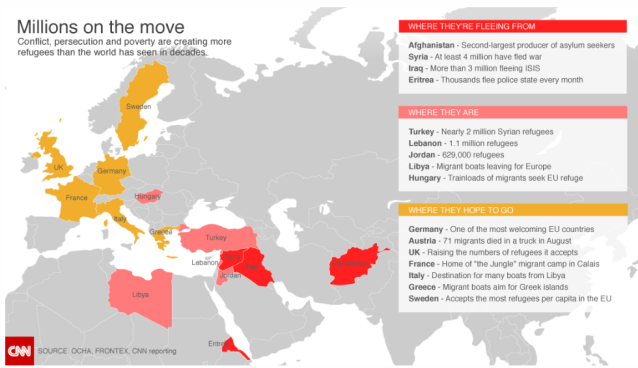
I’ve been using the term climate refugee, but a related term is climate migrant. The main difference is refugees are forced to leave their homes, whereas migrants choose to leave.

“The distinction is an important one, because an international convention in 1951 outlined certain rights for people deemed refugees, whereas migrants have no such rights. Refugees are protected from being deported or returned to situations that might threaten their lives. They are to be given access to social services and to be integrated into their new country’s society. Migrants are subjected to a country’s immigration laws and procedures and can be turned away or deported back to their homeland.” Encyclopaedia Britannica

This is an added dimension to the whole question of borders and immigration policies.

CNN refugees

https://www.cnn.com/2015/09/08/world/what-is-difference-migrants-refugees/index.html

The following video discusses climate migrants. In 2017, 18 million people were displaced by flood, storms, and drought worldwide.  Over the next 30 years it is estimated that over 200 million people will be displaced for the same reasons, although that number might be significantly higher.

As the video says, we need to make plans for these vast migrations of people. I created the Facebook group, Overground Railroad, as a place for people to discuss these ideas.

My vision for a way to respond to the needs of those who will be migrating inland, as the coastal cities are flooded, is outlined here:   https://atomic-temporary-82209146.wpcomstaging.com/2018/02/22/design-and-build-beloved-community-models/

Posted in climate change, climate refugees, Uncategorized | Tagged | Leave a comment

Space-“the next battlefield”?

It is profoundly sad and disturbing to hear that the current Republican administration would like to expand militarism into outer space. Those of us who believe in peace have the opportunity to vigorously speak out against this new threat to peace. We have this chance to work to not only prevent this new branch of the armed forced from being created, but to continue to challenge the idea that war is the answer. That war on land, sea, air, or outer space, is immoral, and does not make us safer.

The ideas of force and dominance have no place in our desire to build a better world, to create Beloved communities for our children’s sake. We are still suffering from the consequences of the idea of dominance that resulted in enslavement, genocide, and wars both in our history and the present day.

Vice President Pence says “we must have American dominance in space”.

“The time has come to write the next great chapter in the history of our armed forces, to prepare for the next battlefield where America’s best and bravest will be called to deter and defeat a new generation of threats to our people, to our nation,” Mr. Pence told an audience at the Pentagon. He called for Congress to allocate an additional $8 billion for space security systems over the next five years.  https://www.nytimes.com/2018/08/09/us/politics/trump-pence-space-force.html

Fortunately many are resisting this idea. Retired Navy Capt. Mark Kelly, who began piloting space shuttle missions in 2001 said:

“Some of the resistance stems from the fact that the United States already has a Space Command. It’s part of the Air Force, and it reports to both the secretary of the Air Force and to U.S. Strategic Command, or STRATCOM, the military’s joint structure overseeing the U.S. nuclear arsenal.

“You know, the Air Force Space Command already does this. It’s at Peterson Air Force base in Colorado,” Kelly said.

“They do this with about 20,000 people,” he said, adding: “It doesn’t make sense to build a whole other level of bureaucracy.””   https://www.nbcnews.com/news/us-news/trump-s-proposed-space-force-could-have-trouble-getting-ground-n899466


Let us have the courage to listen, and then act on what God is calling us to do now.

Posted in peace, Uncategorized | Tagged , , | Leave a comment

Press Release: First Nation-Farmer Climate Unity March

Those of us who plan to join the First Nation–Farmers Climate Unity March could really use your help to spread the word about the March and it’s purpose. The more people who are aware of the things we are trying to bring attention to, the better.  You can use the press release for you local newspapers and other media outlets. Sharing on your social media platforms would also be great. Thank you so much for your help.

Practicing Hope

################

FOR IMMEDIATE RELEASE
Wednesday, August 8, 2018, 9:00 a.m. CT

Contact: Ed Fallon at (515) 238-6404 or ed@boldiowa.com
Contact: Christine Nobiss at (319) 499-8039 or cnobiss@gmail.com

Groups announce First Nation – Farmer Climate Unity March
Natives, farmers, environmentalists to walk 90 miles following DAPL route

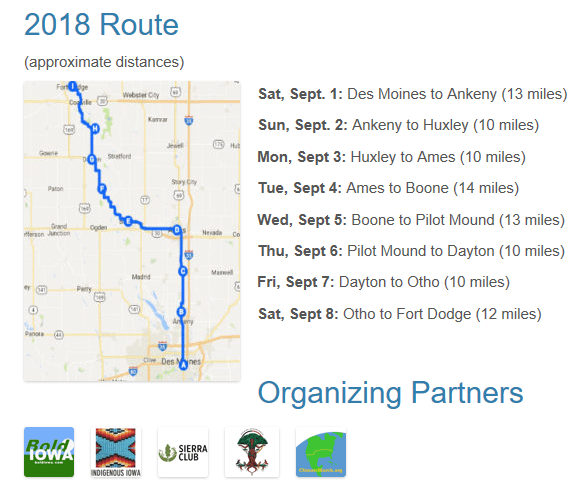
Indigenous Iowa and Bold Iowa today announced that thirty opponents of the Dakota Access Pipeline will march ninety miles from Des Moines to Fort Dodge to raise awareness about the landowner/Sierra Club lawsuit, which will be heard by the Iowa Supreme Court on September 12.

The March kicks off on Saturday, September 1 at 9:00 a.m. with a press conference at the Iowa Utilities Board (1375 E. Court Ave, Des Moines). Marchers will then trek thirteen miles to camp at the Griffieon Family Farm (11655 NE 6th St, Ankeny). The March will finish in Fort Dodge on Saturday, September 8 with a rally and celebration at City Square Park, 424 Central Ave, at 2:00 p.m.

“The First Nation – Farmer Climate Unity March was initiated to support the landowner/Sierra Club lawsuit against the Dakota Access Pipeline,” said Bold Iowa director, Ed Fallon. “Through this huge challenge of walking ninety miles, we hope to raise awareness about how this historic lawsuit potentially impacts all of us regarding our land, water, climate, and property rights. If landowners prevail, it could stop the oil from flowing through Iowa. If they lose, it could blow eminent domain wide open for all sorts of private purposes.”

The March will be a self-contained community, with participants camping on farms or in parks each night. The March has its own “bathroom trailer,” complete with environmentally-friendly commodes and solar showers. Marchers will use a solar collector for much of their power needs. The “Veggie Thumper” bus will provide food, much of it purchased from Red Earth Farms at the Meskwaki settlement. Each evening, there will be a community dialogue facilitated by a Native American leader and an Iowa farmer.

People interested in marching are encouraged to sign up on Bold Iowa’s website. The application, profiles of marchers, and more information can be found here.

Indigenous Iowa was founded by Christine Nobiss, Plains Cree-Salteaux from the Gordon First Nation. She is a decolonizer and also works with Seeding Sovereignty. One of the main goals of Indigenous Iowa is to raise awareness about the devastating effects that oil, gas, and coal have on the environment, particularly on Indigenous lands where government-backed corporate conglomerates practice predatory economics and exploit communities. Indigenous Iowa promotes the development and implementation of renewable energy through the worldview of Indigenous ideologies.

Bold Iowa builds rural-urban coalitions to fight climate change, prevent the abuse of eminent domain, promote non-industrial renewable energy, and protect Iowa’s soil, air and water.

################


Posted in #NDAPL, civil disobedience, climate change, Indigenous, Keystone Pledge of Resistance, Uncategorized | Leave a comment

Remembrance of the Victims of the Bombings of Hiroshima and Nagasaki

From Christine Ashley (FCNL) today, August 9:

I’m looking forward to gathering at FCNL’s Quaker Welcome Center tonight at 6:15 P.M. ET in remembrance of the victims of the atomic bombings at Hiroshima and Nagasaki. I hope you can tune in.

Watch Live

Just last week, Congress gave the military the green light to develop a new “low-yield” nuclear weapon specifically designed to be more “usable.” Now is a critical time to remember the terrible toll of using nuclear weapons and renew our commitment to never do so again.

The event is tonight, August 9, 2018 at 6:15 P.M. ET. Click here to sign up to watch via live stream.

Here is Roger Routh’s video of the event that was held in Des Moines on August 6, the anniversary of the bombing of Hiroshima:

My photos and video from Monday’s event:

https://kislingjeff.wordpress.com/2018/08/07/ringing-japanese-peace-bell-2018/

Posted in peace, Uncategorized | Tagged | Leave a comment

Ferguson and Militarized Police

Today is the anniversary of the killing of unarmed 18 year old Michael Brown by a white police officer in Ferguson, Missouri, in 2014. Sadly this was far from the first killing of unarmed people, especially people of color, by white police officers. Television coverage of Michael Brown’s death, though, brought these killings into the homes of Americans, largely because of the rising up of Ferguson’s Black community. White Americans finally began to learn of the tensions related to police and Black communities, and were stunned by the callous way Michael’s body was left lying on the street for hours.

This was also the first time most of us learned about the militarization of our civilian police departments. We were shocked by the scenes from the streets of Ferguson, and to realize armored vehicles could be rolling down our own streets. We began to see the extent to which the police were seeing us as the enemy. We learned about the Pentagon’s 1033 program, part of the National Defense Authorization Act of 1997, that allowed the Pentagon to donate surplus military equipment to local law enforcement agencies.

From the Friends Committee on National Legislation (FCNL):

“Ferguson is just one of many communities to receive equipment through this program. Towns all over the country now possess Mine-Resistant, Ambush-Protected vehicles (MRAPs) and other equipment designed for a war zone. Police in towns such as Columbia, South Carolina; McLennan County, Texas; Nampa, Idaho; West Lafayette, Indiana; St. Cloud, Minnesota; Yuma, Arizona; Calhoun, Alabama; and at Ohio State University are kitted out to respond to violent extremists with lethal, military force.

The U.S. response to the September 11 attacks is partly behind this dangerous escalation. Suddenly, communities felt they needed to be on high alert at all times, ready to respond to any threat. In this culture of fear, the Pentagon spent billions of dollars on weapons and equipment for war. That equipment went to Afghanistan, Iraq and elsewhere in the Middle East and Africa. As troops came home, surplus equipment went straight to police departments, thanks to the 1033 program.

For a police department like Ferguson’s, the path to becoming a paramilitary force is a short one. After getting this free military gear, law enforcement agents use it. The 1033 program’s regulations require that the police use what they receive within one year.” https://www.fcnl.org/updates/how-tanks-got-to-main-street-1009

My experience related to Ferguson was getting to know a group of young people who met through social media discussions of Michael Brown’s killing. Previously strangers, this group who became know as Indy10 (there were originally 10 people involved) got together to take water and food to Ferguson the weekend after the killing, and to offer their support. They were radicalized by the experience, and have worked very hard to bring attention to these issues to the Indianapolis community ever since. Indy10 became Indianapolis’ Black Lives Matter organizers. One way I contributed was to help create a questionnaire that was used to take into the community to learn how people felt about relations with local law enforcement.

In 2015 President Obama placed restrictions on what the Pentagon could give to local police departments.

A year ago President Trump reversed those restrictions. “Those restrictions went too far,” Mr. Sessions said. “We will not put superficial concerns above public safety.”

More from FCNL “How Tanks Got to Main Street”:

“Rolling back the 1033 program is important, but it’s not enough. Through the Department of Homeland Security’s “terrorism grants” program, local police departments have received more than $34 billion to acquire surveillance drones, Army tanks, and other equipment ill-suited for local policing. Like the 1033 program, these grants contribute to militarized policing that damages trust between police officers and community members. We are encouraging members of Congress to roll back this program as well.”

Following are some of the recommendation from the American Civil Liberties Union’s (ACLU) report “War Comes Home: The Excessive Militarization of American Policing”

“The militarization of policing is one example of how contemporary policing in America is failing to deliver on its primary objective of protecting and serving communities. The culture of policing in America needs to evolve beyond the failed War on Drugs, and the police should stop perceiving the people who live in the communities they patrol—including those the police suspect of criminal activity—as enemies.
This type of reform must be achieved systemically and include a transformation in police culture; the problems of overly aggressive policing cannot be solved by disciplining a few officers or dismissing the problem as a few isolated incidents. These recommendations are aimed at ensuring that law enforcement responses minimize harm to civilians and property and maximize as oppose to jeopardize the safety of everyone involved.
The federal government should take the lead by reining in programs that incentivize local police to engage in excessively militarized tactics, especially in drug cases. The federal government holds the purse strings, and restricting the flow of federal funds and military-grade equipment into states and localities, and/or conditioning funds on the appropriate use and training with regards to such equipment, would significantly reduce the overuse of hyper-aggressive tactics and military-grade tools in local communities.”

Posted in Uncategorized | Leave a comment

First Nation – Farmer Climate Unity March Introduction

Here is the promo video for the First Nation-Farmer Climate Unity March:

Landowners who had their property taken by force for the Dakota Access Pipeline have joined with the Iowa Sierra Club in a lawsuit against the Iowa Utilities Board (IUB). They allege that the IUB illegally allowed Energy Transfer Partners (ETP) to use eminent domain to build the Dakota Access Pipeline. Their case is strong and has potentially historic significance.

To raise awareness of the importance of this lawsuit, Bold Iowa and Indigenous Iowa are partnering with the Sierra Club Iowa Chapter and Seeding Sovereignty to organize an eight-day, 90-mile march. Fifty marchers will set out from the IUB’s headquarters in Des Moines on Saturday, September 1. They’ll follow the general route of the pipeline through Story, Boone and Webster counties and arrive in Fort Dodge on September 8 for an action at the conclusion of the March.  http://boldiowa.com/2018-first-nation-farmer-climate-unity-march/

2018 route

Posted in #NDAPL, climate change, Indigenous, Keystone Pledge of Resistance, Poor Peoples Campaign, Uncategorized | Tagged | Leave a comment

Two-eyed Seeing and our Environment

Unprecedented wildfires, deluges of rain, storm surges and flooding, melting ice, multi-year droughts and record high air and ocean temperatures, and rising concentrations of greenhouse gases show we are moving deeper into environmental chaos.  Now people are realizing climate change is real, and we should have been working to protect Mother Earth decades ago. Millions have been, and millions more will soon be displaced or die as a result of food and water insecurity, drought, fire, and flooding. Our social and economic structures are collapsing. People are beginning to panic and give up hope for the future.

The root of this can be traced back hundreds of years, when natural resources began to be seen as commodities to be owned for private use and profit regardless of the consequences. Industrialized nations plundered non renewable resources and polluted the land, air, and water in the process.

Indigenous people did not accept those views and practices.

“In Native American culture, by contrast, they study the interconnections of the entire ecosystem.  ‘Seeing in a sacred manner’ means perceiving interspecies links. The word for ‘prayer’ in Lakota is wacekiye, which means ‘to  claim relationship with’ or ‘to seek connection to.’ To the Lakota people, the cosmos is one family. To live well within the cosmos, one must assume responsibility for everything with which one shares the universe. There are familial obligations toward water, plants, minerals. Any harm done to the slightest of these relatives has devastating consequences for the whole ecosystem. The merest hint suffices as a warning of eco-cataclysm.

We are blinded to these subtle signs by having been taught that matter is dead and inert. Considering it inanimate makes it available for exploitation as a resource. Lame Deer insists that ‘the earth, the rocks, the minerals, all of which you call ‘dead’ are very much alive.’ He implores us to ‘talk to the rivers, to the lakes, to the winds as to our relatives.'”  Lame Deer, Seeker of Visions by John (Fire) Lame Deer and Richard Erdoes.

I know there are dangers related to cultural appropriation, and idealizing Indigenous cultures. I have tried to be cognizant of cultural appropriation by asking permission to take photos at Native American gatherings. But I feel led to learn more about Indigenous views and practices because the views expressed in the quotation above are similar to my own. I was led to give up owning a personal automobile forty years ago because I knew the damage fossil fuels were causing. I have tried to have a small carbon footprint by living in small apartments, not using air conditioning, etc.

I have been powerfully affected by opportunities I began to have to spend time with Native Americans. I felt a deep spiritual connection from the beginning as I joined Native Americans in Indianapolis as we worked together as water protectors to oppose the Dakota Access pipeline. Part of that connection is a shared belief in the power of prayer and commitment to nonviolence, which have been important parts of my own spiritual development and practices. I was so moved by the unyielding commitment to nonviolence of those gathered at Standing Rock even in the face of violence from state authorities. Indigenous people have been responding the same way in similar situations all over the world.

I like the concept of two-eyed seeing.

Two-eyed seeing “recognizes the benefits of seeing from one eye with the strengths of Indigenous ways of knowing, from the other eye the strengths of the Western ways of knowing, and using both of these eyes together to create new forms of understanding and insight.”   Elder Albert Marshall (Mi’kmaq, Eskasoni First Nation) from Urban Tribes, edited by Lisa Charleyboy and Mary Beth Leatherdale

To “create new forms of understanding and insight,” we have to learn more about each other. I’ve written more about that in the blog titled Building Bridges. I have also been sharing a lot of blog posts related to this with the closed Facebook group, “Stop DAPL 2.0!” that has a lot of Native American members. I am trying to share about the “Western ways of knowing”.

The reason for writing this today is to try to express why I think it is important to continue to do things that will advance this idea of two-eyed seeing. That is why I plan to participate in the First Nation–Farmer Climate Unity March. I encourage you to seek and participate in opportunities for sharing between those of the West and Native Americans.

climate march poster


Posted in #NDAPL, climate change, Indigenous, Quaker Meetings, Uncategorized | Leave a comment

Family Separation at the Southern Border

Minute: Family Separation at the Southern Border

At the root of our faith is the sacredness of relationships among ourselves and between us and God. We have been heartbroken to see those sacred connections broken as children are separated from those who love them. We are so thankful for the efforts of those who are working toward the goal of reuniting every child with their family.

We would like our Congressional representatives to create and pass legislation to prevent such separations from ever occurring again.

We affirm the right of anyone to seek asylum.

We believe a change in policy that does not recognize fear of gang violence, domestic abuse or rape as credible fear should be rescinded.

We urge that mental health services be provided to traumatized children and their families.

Efforts by both our government and non-governmental organizations to help improve conditions in those countries people are fleeing from is a crucial part of addressing asylum. We recognize that historical and ongoing U.S. foreign policies have contributed to the violence in those countries.

Underlying all this should be reclaiming the moral narrative for our public policies. Too much of what the current administration has done, and continues to do, is related to stigmatizing those who are seen as ‘others.’ Rather, we believe in embracing diversity.

Approved by Iowa Yearly Meeting (Conservative)  2018


Posted in Quaker Meetings, Uncategorized | Tagged , | Leave a comment

How Friends Can Help the Climate March

I will be writing a lot about this year’s First Nation – Farmer Climate Unity March, September 1 – 8, 2018, that I plan to be participating in. Here is the introduction from the Climate March website:

Landowners who had their property taken by force for the Dakota Access Pipeline have joined with the Iowa Sierra Club in a lawsuit against the Iowa Utilities Board (IUB). They allege that the IUB illegally allowed Energy Transfer Partners (ETP) to use eminent domain to build the Dakota Access Pipeline. Their case is strong and has potentially historic significance.

To raise awareness of the importance of this lawsuit, Bold Iowa and Indigenous Iowa are partnering with the Sierra Club Iowa Chapter and Seeding Sovereignty to organize an eight-day, 90-mile march. Fifty marchers will set out from the IUB’s headquarters in Des Moines on Saturday, September 1. They’ll follow the general route of the pipeline through Story, Boone and Webster counties and arrive in Fort Dodge on September 8 for an action at the conclusion of the March.

Several friends have asked how they can help, so I’d first like to answer that.

Each marcher is being asked to contribute $20 per day for food, etc. I will pay for myself, but you are encouraged to contribute to the March to help cover the costs of those who don’t have that much money.

It would be wonderful if you could join us anywhere along the route, for any length of time. Bring your children.

2018 route

What I would most like from you, my friends, is sharing our stories.

I believe change comes from us sharing our stories with each other. You can amplify the impact of what this March is about by sharing the stories as widely as possible. The Follow Me on the March page lists the links where marchers will be sharing their stories. I plan to be blogging a lot in the days leading up to the March, and during the March itself. If you find any of that worthwhile, perhaps you could pass those stories along.

What I would MOST like from YOU is for you to share your own stories with me.

They don’t have to be lengthy, but it would be awesome if you would share your stories, hopes and dreams about your concerns for Mother Earth, each other and our future. I would especially love drawings or short stories from your children. Their innocence shines through. And it is their future we are creating now. This March is trying to work toward a better future for them.

Many of you are, or have been farmers. Many of you are working on farm practices to help our environment. I would like to hear your stories.

I would really like to hear any experiences or thoughts you have about First Nations people. I have written a lot about some very powerful experiences I’ve had over the past couple of years when I had my first opportunities to be with Native Americans in Indianapolis as we worked together as water protectors against the Dakota Access pipeline. Those of you who are Quakers may have attended the session at Iowa Yearly Meeting (Conservative) when Peter Clay, Donnielle Wanatee and Christine Nobiss spoke about Quakers building bridges with Native Americans.

I believe it is very important that we join together, as happened at Standing Rock, as is happening with this unity climate march. A commitment to nonviolence and prayer is how we can most effectively help Mother Earth and our children’s future. Be a part of this!

climate march poster

Posted in #NDAPL, climate change, Indigenous, peace, Poor Peoples Campaign, Quaker Meetings, Uncategorized | Tagged , | Leave a comment