Fifth Day of the First Nation-Farmer Climate Unity March

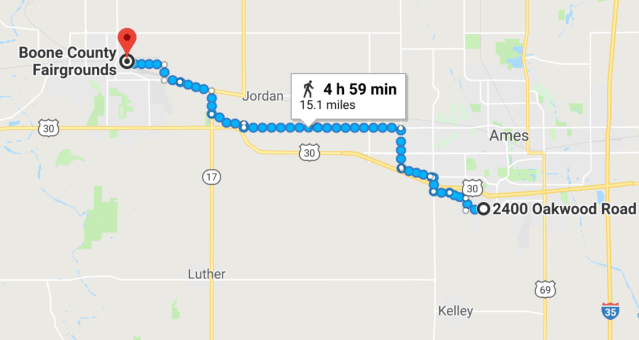
Day 5. September 5, 2018.  14 miles from the Boone County Fairgrounds to Pilot Mound, Iowa.

Once again I was pleasantly surprised to awaken feeling fairly refreshed, despite being pretty tired at the end of yesterday’s 15 miles, and staying up late to write. Since we were all sleeping in the same large room, the lights went out a little after 10 p.m. There were no windows so it was pretty dark. Several others and I were in a smaller ‘media’ room writing. I didn’t get to bed until 11:30. It was a little tricky finding my way through the large darkened room to my sleeping bag, hoping I didn’t try to get into the wrong one 🙂

When we arrived yesterday I discovered I had worn a hole into the sole of my shoes, and developed a blister. I would have been more concerned but I had seen Miriam work on a number of other people’s blisters. She cut a piece of adhesive foam larger than the blister, then cut a hole in the middle of that the size of the blister, to help keep pressure off it. Then the ever useful duct tape was wrapped around the foot to hold things in place. And it worked pretty well. A photo of my bandaged foot was included in the article about the March in the Fort Dodge Messenger, Many Steps, One Journey.

My foot Fort Dodge Messenger

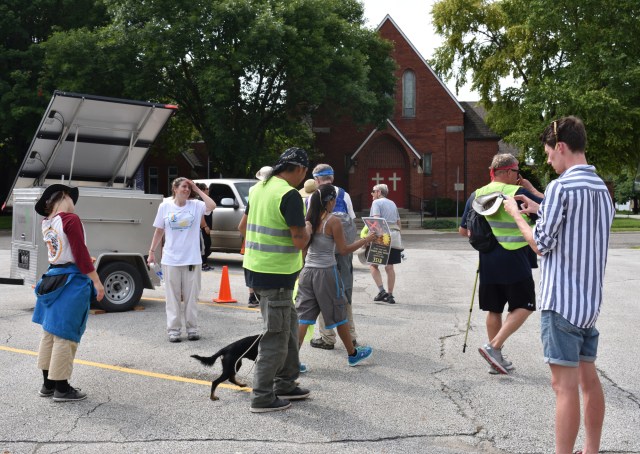
It was raining harder than ever when we started out that morning. But again I didn’t hear any complaints. We were warned to be more aware of traffic because we started out going through town. Before we started burning sage was brought to each of us. And Alton made a raincoat for his dog Oceti.

Being outside all day, and sometimes sleeping outside (sometimes in some strong thunderstorms) has made me more and more aware of the natural world. I’ve mentioned before how I enjoyed being outside as I trained for this March. Walking has been much more interesting now that I am aware, as Indigenous people have always been, that everything: trees, water, plants, rocks, wind, etc. has the Spirit in them. I found myself focusing on talking to the trees, squirrels and birds as I walked.

At one rest stop a police officer stopped to see what we were doing. Manape spoke to him. We were careful to use a system to announce when a car was approaching from the front (“car up”) or back (“car back”). Everyone then immediately formed a single file and got as far off the road as possible. Even so, the police often seemed to have heard about us marching, though none of the policemen caused us any trouble.

There wasn’t quite as much talking today since there wasn’t much of a shoulder on the road, so we had to walk in single file.

Before crossing the river just before reaching our destination of Pilot Mound, we came to another pipeline crossing. We could see the area where trees had been removed to build the pipeline on the hill on the other side of the river.

As always, we stopped for prayers. This time I was asked to lead them. I was very happy to have this opportunity to share some about Quakers and the Spirit. As we stood in a circle holding hands, I mentioned that Peter Clay, Lee Tesdell, and I were Quakers. And that I hoped they would meet my brother Randy, also a Quaker, when he comes to Fort Dodge at the end of the March, for the celebration and give me a ride home. I’ve been trying to share about Quakers as opportunities come up for several reasons. I think there are many parts of Quakerism that are common with the spirituality of Indigenous people.

And as Manape has said, the reason we are marching together is to make it possible for us to continue to work together in the future. For that to happen, we need to trust each other. And for trust to be established, we need to understand each other. That was why I shared about Quakerism when it seemed appropriate.

As we stood in the circle I said that Quakers do not believe spirituality is just a matter of Sunday morning services. We try to be attentive to the spirit all the time, though we often get distracted. We do also gather together Sunday morning to worship in silence. That sometimes someone is given a spiritual message that they speak into the silence. During the March someone had asked if I was a minister and before I could answer, Miriam said, “he’s a Quaker and all Quakers are ministers.”

During the ceremony at this pipeline crossing I asked the circle of my friends to listen together to the Spirit (saying we wouldn’t do so for a whole hour). But in the time we spend worshipping together, I felt the presence of the spirit among us. Afterward several people gave me hugs and thanked me. As I think about it now, I have felt the spirit among us all week.

Once we arrived in Pilot Mound some of us noticed we were being followed by a car for a while. We learned the driver was Manape’s father, Frank, and he was just enjoying watching us march together. Frank has been a very active activist.

One of the most moving parts of this journey occurred as Frank spoke to us before we ate dinner. He began by saying he was honored to be with us and how blessed he felt as he watched us marching. He said it made his “heart soar like a hawk.” He spoke of the many issues he has worked on in his life. And how it takes many, many years to see results (40, more). That it is not the number of people involved that is important. It is their persistence in raising up the truth. Once a certain concern starts to see a shift toward what is right, others remember the people or person who never went away during all those years.

We found there was no cell phone or internet service available in Pilot Mound. In a way that seemed to symbolize that we were cut off from civilization. The whole marching and camping experience felt like we were back in a simpler time. We felt more in touch with nature. We also knew things like the severe storms and flooding we experienced were related to climate change, and to what we were trying to call attention to by marching.
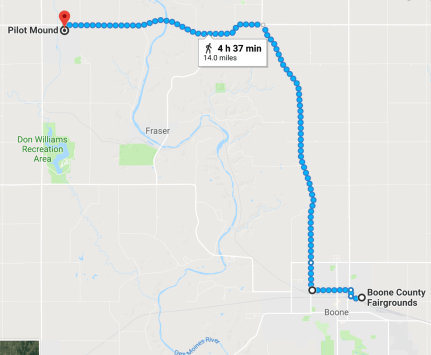
2018-Boone-to-Pilot-Mound-walking

Posted in #NDAPL, climate change, First Nation-Farmer Climate Unity March, Quaker Meetings, Uncategorized | Leave a comment

BTS Speaks at the United Nations’ Generation Unlimited

I first saw BTS perform at the 2018 Winter Olympics in Pyeongchang, South Korea and have been entranced by videos of their performances since. They were recently in New York City. “To help launch the United Nations’ Generation Unlimited, an education and employment program for young people, K-pop super group BTS gave a speech about empowerment and love.” Washington Post, September 24, 2018. (Transcript below).

“Tell me your story.
I want to hear your voice, and I want to hear your conviction.
No matter who you are, where you’re from,
your skin color, your gender identity, just speak yourself.
Find your name and find your voice by speaking yourself.”


While in New York they also performed on the Jimmy Fallon Show.


-Thank you, Mr. Secretary-General,

00:12
UNICEF executive director,
00:14
and all the excellencies and distinguished guests
00:16
from all across the world.
00:19
My name is Kim Nam-joon, also known as RM,
00:22
the leader of the group BTS.
00:24
It is an incredible honor to be invited to an occasion
00:27
with such significance for today’s young generation.
00:30
Last November, BTS launched the Love Myself campaign
00:34
with UNICEF,
00:35
built on our belief that true love
00:38
first begins with loving myself.
00:41
We’ve been partnering with UNICEF’s End Violence program
00:44
to protect children and young people
00:46
all over the world from violence.
00:49
And our fans have become a major part of this campaign
00:52
with their action and with their enthusiasm.
00:55
We truly have the best fans in the world.
01:01
And I’d like to begin by talking about myself.
01:05
I was born in Ilsan, a city near Seoul, South Korea.
01:10
It is a really beautiful place with a lake, hills,
01:13
and even an annual flower festival.
01:16
I spent a very happy childhood there,
01:18
and I was just an ordinary boy.
01:22
I used to look up at the night sky and wonder,
01:25
and I used to dream the dreams of a boy.
01:29
I used to imagine that I was a superhero
01:32
who could save the world.
01:35
In an intro to one of our early albums,
01:38
there’s a line that says,
01:40
“My heart stopped when I was maybe nine or ten.”
01:45
Looking back, I think that’s when I began to worry
01:48
about what other people thought of me
01:51
and started seeing myself through their eyes.
01:54
I stopped looking up at the night skies, the stars.
01:59
I stopped daydreaming.
02:02
Instead, I just tried to jam myself
02:05
into the molds that other people made.
02:09
Soon, I began to shut out my own voice
02:12
and started to listen to the voices of others.
02:17
No one called out my name, and neither did I.
02:22
My heart stopped, and my eyes closed shut.
02:26
So, like this, I, we, all lost our names.
02:34
We became like ghosts.
02:38
But I had one sensory, and that was music.
02:42
There was a small voice inside of me that said,
02:45
“Wake up, man, and listen to yourself.”
02:48
But it took me a long time to hear music calling my real name.
02:54
Even after making the decision to join BTS,
02:56
there were a lot of hurdles.
02:58
Some people might not believe,
03:00
but most people thought we were hopeless.
03:04
And sometimes I just wanted to quit.
03:08
But I think I was very lucky that I didn’t give it all up.
03:14
And I’m sure that I, and we, will keep stumbling
03:19
and falling like this.
03:22
BTS has become artists
03:25
performing in those huge stadiums
03:26
and selling millions of albums right now,
03:29
but I am still an ordinary 24-year-old guy.
03:34
If there’s anything that I achieved, it was only possible
03:38
that I have my other BTS members right by my side
03:43
and because of the love and support
03:46
that our ARMY fans all over the world make for us.
03:51
And maybe I made a mistake yesterday,
03:54
but yesterday’s me is still me.
03:58
Today, I am who I am with all of my faults and my mistakes.
04:06
Tomorrow, I might be a tiny bit wiser, and that’ll be me, too.
04:14
These faults and mistakes are what I am,
04:18
making up the brightest stars in the constellation of my life.
04:23
I have come to love myself for who I am, for who I was,
04:29
and for who I hope to become.
04:33
I’d like to say one last thing.
04:37
After releasing our “Love Yourself” albums
04:40
and launching the “Love Myself” campaign,
04:42
we started to hear remarkable stories
04:44
from our fans all over the world,
04:46
how our message helped them overcome their hardships in life
04:50
and start loving themselves.
04:53
Those stories constantly remind us of our responsibility.
04:58
So, let’s take all one more step.
05:03
We have learned to love ourselves,
05:06
so now I urge you to speak yourself.
05:13
I’d like to ask all of you, “What is your name?
05:19
What excites you and makes your heart beat?
05:23
Tell me your story.
05:26
I want to hear your voice, and I want to hear your conviction.
05:31
No matter who you are, where you’re from,
05:34
your skin color, your gender identity, just speak yourself.
05:41
Find your name and find your voice by speaking yourself.”
05:47
I’m Kim Nam-joon and also RM of BTS.
05:52
I am an idol, and I am an artist from a small town in Korea.
05:58
Like most people, I’ve made many and plenty mistakes in my life.
06:04
I have many faults, and I have many more fears,
06:08
but I’m going to embrace myself as hard as I can,
06:12
and I’m starting to love myself gradually,
06:15
just little by little.
06:18
What is your name?
06:21
Speak yourself.
06:23
Thank you very much.
Posted in Arts, Uncategorized | Tagged , , | Leave a comment

Fourth Day of First Nation-Farmer Climate Unity March

Fourth Day.  September 4, 2018. 15 miles from Ames to the Boone County Fairgrounds.

I believe today is our longest mileage march–15 miles. More rain is predicated for this afternoon and there are flash flood warnings.

The group is becoming more cohesive as we share our stories. As Donnielle said, “we are a tribe.”

We crossed the pipeline again, and had another ceremony there. Donnielle gave the prayer. Being near the pipeline stirs up a lot of emotions for each of us.

Tim Dwight walked with us today. He used to play in the National Football League. Now his work relates to solar energy. I learned a lot about how he can work with communities to build solar energy systems. He has been involved in lobbying efforts in the Iowa legislature to support solar energy.  Tim is going to talk more about that for the whole group tomorrow or the next night.

Those of you from the Bear Creek area might recognize the name Gary Clague, who grew up in Earlham. He knows the Knights and others.

Alton was talking about the strong bond that forms between a child and an animal. He spoke fondly of a horse from his youth. When he and his friends went to ride their horses, his was the only one who came up to him every time. He talked about how easy is was to ride the horse that was in tune with where he wanted to go. “I really miss that horse.” I spent a lot of time visiting Foxy Jackson, who we learned is going to marry Alton in a couple of weeks. More about Alton and Foxy can be found here.

Matthew Lone Bear and I continue to talk a lot about photography, videography and drones. He sometimes goes for unusual camera angles, for example lying on his back. I think that is a sign of a good photographer.

Mahmud Fitil shared stories related to tar sands spills, saying most commercial labs won’t analyze the water samples from tar sands spills because they fear repercussions from the government. Fitil went to Doon, Iowa, site of a train derailment and oil spill of an estimated 230,000 gallons in June. He said there was little activity related to the cleanup. The smell was worse than that of raw gasoline, causing some to vomit.

DSC_8591

Mahmud Fitil

Miriam Kashia and I compared my Quakerism to her Universal Unitarian church and community. I told her the Quaker Social Change Ministry program we used at North Meadow Circle of Friends in Indianapolis was modeled after the program created by the Universalists. Miriam says her new church is the greenest church in Iowa.

At 5:30 pm we all straggled into the Boone County Fairgrounds, 15 miles from our Ames camp. Everyone seems to be limping a little. I discovered I had worn a hole in my shoe, which resulted in a blister! Fortunately we have Miriam, who plugged the hole, and will treat my blister in the morning. Several others also developed blisters. It was a rough day.

The building we are in is actually the site where the Public Utilities Commission had a meeting for public comments about the Dakota Access Pipeline in November, 2015. Peter Clay spoke and Miriam Kashia attended. That was where Peter had his first contact with Native Americans, who came from South Dakota to fight the pipeline.

I’ll try to get people’s names later, but before dinner, someone described how they went to the Bakken oil fields to see what tar sands oil looked like. He was able to obtain a couple of quarts of it, and found an independent lab to analyze it. As expected it was full of toxic chemicals.  He found that the tar sands product became suspended in water, so a spill cannot be cleanup up simply by skimming it off the top of the water.

Someone else talked about the damage to the fields done by the pipeline construction. Heavy treaded vehicles traveled over the fields in wet weather, compacting the soil. Where the pipeline was laid, the rich top soil was scraped off. It was supposed to be saved to put pack in place, but wasn’t. The clay layer was dug up, then a mixture of the topsoil and clay refilled in the trench. The clay disrupts the flow of water and nutrients through the topsoil/clay mixture. It is common to see ponds of water over areas of the pipeline because of nonporous clay layer.

Dinner that included buffalo meat and fry bread followed. Looking around the table I thought it would be nice if this was a “real” Thanksgiving dinner. Manape said, we call it Thanks-taking.

Storms are predicted for tonight and tomorrow so we are glad to be inside. This was the first night we all slept in the same space together, which I thought added another dimension to us growing closer as a group.

2018-Ames-to-Boone-walking

Posted in #NDAPL, First Nation-Farmer Climate Unity March, Uncategorized | Leave a comment

Third day of the First Nation-Farmer Climate Unity March

September 3, 2018.  10 miles from Huxley to Ames.

It was a nice change to sleep indoors (in the Fjeldberg Lutheran Church) especially because it rained again. When I arrived in the dining room at 7 a.m. several people were continuing the discussion stimulated by Lee Tesdell’s presentation the night before.

Prior to beginning today, Tricia performed smudging for us, to remove negative energy and bring positive energy. That this was offered to all of us, sharing this Native practice, is just one of many examples of all of us sharing with each other. This sharing was crucial to our growing interconnections, and building a single community, together.

This video was shot by Mahmud Fitil who is marching with us. My feet actually felt better after that.

For the first several hours it was raining pretty hard. Prior to this march, I never would have ventured out into such heavy rain. But this morning I didn’t hear one person suggest we should wait until it wasn’t raining so heavily.  Not one person complaining. We just put on our rain gear, had our morning circle to discuss the day’s route, and began to march and continue sharing our stories. One of the most remarkable and most meaningful things that happened on this march was the extended length of time we were with each other, and the conversations went on almost non-stop.

Just before I began writing this morning I found this on Facebook:

‘We are our stories, stories that can be both prison and the crowbar to break open the door of that prison; we make stories to save ourselves or to trap ourselves or others, stories that lift us up or smash us against the stone wall of our own limits and fears. Liberation is always in part a storytelling process: breaking stories, breaking silences, making new stories.’”    Rebecca Solnit, ‘Silence Is Broken’, in ‘The Mother of All Questions’ (07/03/2017).

After Lee Tesdell’s presentation last night, he took me to see where the pipeline crossed the highway we would be traveling on when we left Huxley. We planned to have a ceremony when we reached the pipeline. Donnielle Wanatee offered good prayers, asking for protection for the walkers, and for their families at home. I was surprised at what an emotional time this was. It was especially difficult for Kathy Byrnes, bringing back a lot of bad memories of her past experiences with the construction of the pipeline on her neighbor’s land. Many offered her hugs.

These deep emotions were felt by all of us every time we crossed the pipeline. I could see from the expressions and body language that every one of us was feeling the trauma of the land and water being desecrated by the black snake.

There was a moment when Donnielle and I were standing together. I reminded her we had traveled to Minneapolis in a van together in February.   She said she remembered me, thinking I had a kind face.  That made my day. I would usually refrain from sharing something like that, but wanted to show how our connections are extended and deepened each time we come together again.

Each day we have a break every 3 to 4 miles. We meet portable toilet shed and the sag wagon at each stop. Food and water are available. These are important things that help us cover the distance each day. We appreciate those of us who volunteer each day to drive these vehicles to each rest stop.

There were additional pipeline crossings. Miriam offered prayers at the second crossing. It was deeply emotional, again.

We marched past a pipeline pumping station, where we also stopped and offered prayers.

We arrived at our destination, the Oakland Road Church and Community Center in Ames.

So today was mostly about walking in the rain, sh aring more stories,and experiences at the pipeline sites. The tipi was setup again. Following is a short video of putting the cover on the tipi.

2018-Huxley-to-Ames-walking

Posted in #NDAPL, First Nation-Farmer Climate Unity March, Uncategorized | Leave a comment

Help Bring Attention and Resources to Missing and Murdered Native Women

The video and information below about the huge numbers of missing and murdered Indigenous women (MMIW) is stunning. The video offers some explanations of why so little attention has been, and continues to be paid to this horrible situation.


I did not become aware of this myself until I had opportunities to spend time with Native Americans in Indianapolis, and this past year in Iowa.

I recently shared some of what I learned. Christine Nobiss and Donnielle Wanatee spoke about this when we were in Minneapolis this past February to bring attention to U.S. Bank’s continued funding of fossil fuel projects.

Christine also spoke at some of the Poor Peoples’ Campaign events.

This became personal to me as I learned more about it from my new friend, Matt Lone Bear during the First Nation-Farmer Climate Unity March. He told me about his work using drones to search for missing people, including at least one person close to him. People like Matt spend months and months searching. That is also highlighted in the video above. Matt has so much experience doing this that he plans to work on a manual for others to use as they do their own searches.

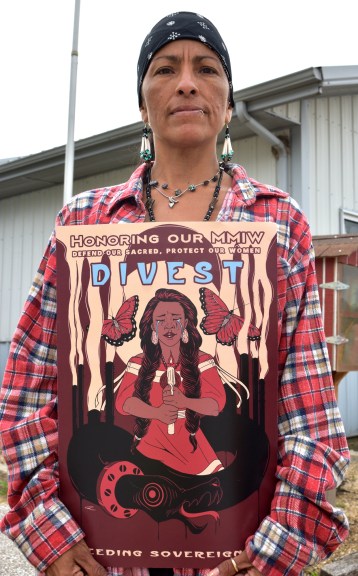
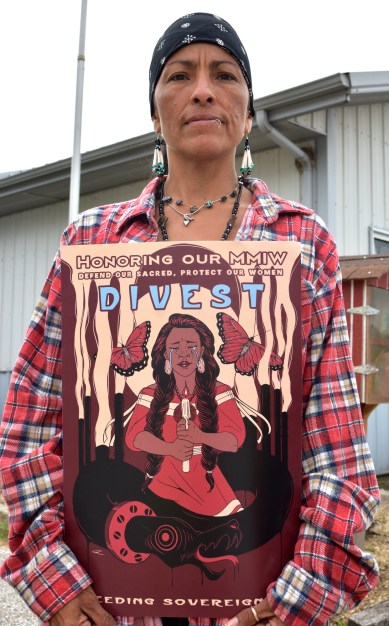
Also on the First Nation-Farmer Climate Unity March, Foxy Onefeather carried a sign about missing and murdered Indigenous women.

DSC_8942

Foxy Onefeather, Missing and Murdered Indigenous Women


Here is the link to a good resource, the Seeding Sovereignty website:  https://seedingsovereignty.org/mmiw/


Christine Ashley of the Quaker lobby organization, Friends Committee on National Legislation (FCNL) alerted me to the following letter from Representative Tom O’Halleran. You can help by asking your member of Congress to co-sponsor the SURVIVE Act.  http://dearcolleague.us/2017/12/co-sponsor-bipartisan-survive-act-4/

Sending Office: Honorable Tom O’Halleran
Sent By:
Maggie.Farry@mail.house.gov

Support Victims of Crime Across Indian Country

Co-Sponsor Bipartisan SURVIVE Act

Dear Colleague,

As a former law enforcement officer, ensuring victims of domestic violence and crime have the resources they need to seek justice has always been a critical priority. Today, too many victims in vulnerable communities struggle to access vital services and supports they need. Nowhere is the need for increased access to services greater than across Indian Country.

According to federal data, American Indian and Alaska Native (AIAN) communities face some of the highest victimization rates in the country. Unfortunately, less than 0.7% of the Crime Victim’s Fund (CVF) established by the Victims of Crime Act reaches Indian tribes. This important funding provides victim services including crisis intervention, emergency shelter, medical costs, and counseling.

Currently, VOCA does not incorporate tribal governments for victim assistance and victim compensation formula grant programs. If we want to tackle the unacceptable disparities facing these communities, we need to make sure victims have equitable access to the critical resources VOCA funds support.

That is why I have introduced the bipartisan Securing Urgent Resources Vital to Indian Victim Empowerment (SURVIVE) Act. This bill would create a tribal grant program within the Department of Justice’s Office for Victims of Crime and require a 5% allocation from the CVF be provided to Indian tribes. It would expand the use of CVF funds for domestic violence shelters, medical care, counseling, legal assistance and services, and child and elder abuse programs to enable tribes to deliver critical services to their
communities.

My legislation is the House companion to the bipartisan SURVIVE Act in the Senate, S. 1870, sponsored by Sen. Hoeven. These identical bills are supported by the Navajo Nation, National Congress of American Indians (NCAI), United Tribes of North Dakota, Confederated Tribes of Colville Reservation, and the Sisseton Wahpeton Oyate Tribe.

For questions or to co-sponsor this important legislation, please contact Maggie Farry (maggie.farry@mail.house.gov) in my office.

Sincerely,

TOM O’HALLERAN

Member of Congress


https://www.fcnl.org/updates/washington-interfaith-staff-coalition-s-letter-to-support-the-survive-act-1547

July 5, 2018

Washington Interfaith Staff Coalition’s Letter to Support The Survive Act

The Native American Working Group of the Washington Interfaith Staff Coalition recently lobbied the House Judiciary Committee to support the SURVIVE Act. Here’s what the Working Group submitted.

As faith-based advocacy organizations and service providers committed to uplifting Native American concerns, we write to you to ask you to support the Securing Urgent Resources Vital to Indian Victim Empowerment (SURVIVE) Act, H.R. 4608.

We are members of the Washington Interfaith Staff Community (WISC) Native American Working Group, composed of faith based organizations from a broad range of religious traditions, and we are committed to the well-being of all our neighbors. We are led not only by compassion, but also by a sense of justice, acknowledging the historic role of faith groups and others in restricting the cultural and economic cohesion of Indian nations here on this continent. We seek to heal our connections with Native people, and to ensure Congress upholds its trust responsibilities with tribes. Congress has an obligation to provide the resources needed to enable tribes to self-govern and to effectively deliver essential services to tribal communities.

The Department of Justice has found that on some reservations, the murder rates of Native women are ten times the national average. 83% of American Indian and Alaska Native adults have experienced violence in their lifetime. Native communities face some of the highest crime victimization rates in the country yet many of these victims are less likely to access victim services.

The Victims of Crime Act (VOCA) was enacted in 1984 and established the Crime Victims Fund (CVF). This Fund establishes grant funding to support victim services such as domestic violence shelters, counseling, and court advocacy. In addition to services, the Fund provides victims compensation to cover medical care, funeral and burial costs, and lost wages. The CVF is funded only though the money the government collects from criminal fines and penalties. Prior to FY 2018, tribes have only indirectly received funding which amount to less than 0.7% of available funds.

Each year, tribes have had to lobby through the budget appropriations process to receive funding, but this strategy is only a temporary fix for a significant need. Tribes require a permanent, authorized set aside from the Crime Victims Fund, which is why we’re asking you to support the (HR. 4608/S. 1870) SURVIVE Act.

We support the SURVIVE Act because it amends the VOCA to include tribes in grant funding, and provides a 5% set aside for tribes. Having access to the CVF will improve the safety of tribal communities and provide needed resources for Native victims of crime.

This bill has strong bipartisan support, and will provide equal access to the Fund without increasing overall spending. Grant funding will go towards culturally-appropriate victim services such as domestic violence shelters, medical care, counseling, and crisis intervention and prevention. It will be instrumental for improving safety in tribal communities and helping Native victims of crime in this current epidemic of violence, especially against Native women.

We believe the SURVIVE Act’s creation of a long-term support mechanism for victim services will both prevent crime and violence, and will help victims heal. It is a long-due step forward for the safety of Native peoples, and we urge you to support this important bill.

Sincerely,

Washington Interfaith Staff Coalition (WISC)
Friends Committee on National Legislation
Office of Justice and Ecology, Jesuit Conference of Canada and the United States
Franciscan Action Network
Christian Reformed Church Office of Social Justice
Mennonite Central Committee U.S. Washington Office
Ecumenical Poverty Initiative
Islamic Society of North America
Disciples Center for Public Witness (Disciples of Christ)
The United Methodist Church – General Board of Church and Society
American Friends Service Committee
National Council of Churches


Washington, DC (July 30, 2018) – The Quaker lobby, Friends Committee on National Legislation (FCNL) called on Congress to reauthorize the Violence Against Women Act of 1994 (H.R. 6545). Led by Rep. Sheila Jackson Lee (D-TX), the bill seeks to expand protections to women victims of violence.

Contact: Adlai Amor, Friends Committee on National Legislation, media@fcnl.org; 202-903-2536

“The Violence Against Women Act is particularly significant to Native women and girls across the nation,” said Diane Randall, Executive Secretary for the Friends Committee on National Legislation. “We welcome this initiative and urge the House to swiftly reauthorize H.R. 6545.”

Native women experience violent crimes at disproportionately higher rates than other women in the United States. While the federal government has jurisdiction in Indian Country, it lacks the resources to effectively prosecute crimes. Non-Native offenders regularly avoid prosecution for sexual assault and domestic violence.

With over 100 cosponsors among House Democrats, the bill will improve tribal access to federal crime information and standardize protocols for responding to cases of missing and murdered Native peoples. The current bill expires on Sept. 30, 2018.

The bill also extends tribal jurisdiction to include sexual violence, sex trafficking, stalking, child violence and violence against tribal law enforcement attempting to execute these provisions.

“If passed, the bill will be a huge win for Indian country, as more than half of American Indian and Alaska Native women experience sexual violence in their lifetime,” said Lacina Tangnaqudo Onco (Shinnecock/Kiowa), FCNL’s Advocate for Native American Policy. “Safety from violent crimes should not be a privilege but for too long, many Native women have gone unprotected by the law.”

In addition to advocating for the Violence Against Women Act, FCNL has also been a strong advocate for a bill to address the crisis of missing and murdered Native women. If passed, Savanna’s Act (S.1942/H.R.4485) will create a standard protocol for law enforcement and expands tribal access to criminal databases.

FCNL has also been a strong advocate for the SURVIVE Act (S.1870/H.R.4443) which authorizes a permanent five percent tribal set-aside in the Crime Victims Fund.

For more information, please visit www.fcnl.org.

https://www.fcnl.org/updates/quaker-lobby-urges-lawmakers-to-reauthorize-violence-against-women-act-1579


Support a tribal set-aside of the crime victims fund

https://www.fcnl.org/updates/support-a-tribal-set-aside-of-the-crime-victims-fund-1475


Posted in First Nation-Farmer Climate Unity March, Indigenous, Uncategorized | Tagged , | Leave a comment

Discussion of Agricultural Practices

September 2, 2018. Huxley, Iowa. Day 2 of the First Nation-Farmer Climate Unity March.

The forum this evening gets to the heart of First Nation-Farmer unity. Local progressive farmer Lee Tesdell described his work in improving agricultural practices (detailed at the end of this post) which was followed by a good discussion including Native American’s reactions to what he said.

Lee Tesdell

If you just want the simplified version of this discussion, Matt Lone Bear captures that in the following video, where Christine Nobiss explains that she feels Native agricultural practices are superior ways to grow food, especially regarding the quality of the soil and water.

Ed Fallon then asks the key question, how can more farmers be convinced to change to the improved agricultural practices Lee and Christine talk about?


Lee and I, and our brothers Jon Tesdell and Randy Kisling, attended Scattergood Friends School in the late 1960’s.  The School’s name has been changed to Scattergood Friends School and Farm, because this Quaker boarding high school in on a working farm near West Branch, Iowa, which plays a large role in the students’ education. Students rotate through various crews to do the work needed at the school. Some of the crews are dishes, pots and pans, laundry, various cleaning crews, bread baking, dinner prep, farm, etc. Various academic subjects involve working on the farm

I am not very familiar with farm subsidies and practices, so what follows is mainly from internet research. Most farmers focus on producing corn and soybeans because of government subsidies to farmers that help reduce the risk if crops don’t do well. Little of this corn and soybean production is used for food.

“Iowa leads the nation in ethanol production, with 39 percent (953 million bushels) of the corn grown in Iowa going to create nearly 30 percent of all American ethanol.”  Iowa Corn.

“Nitrate (NO3) is a naturally occurring form of nitrogen in soil. This form of nitrogen is created when nitrification, the conversion of ammonium into nitrate, occurs. Nitrate is used as food by plants for growth and production.”  https://homeguides.sfgate.com/normal-soil-nitrate-levels-80102.html

“Beneath agricultural lands, nitrate is the primary form of nitrogen. It is soluble in water and can easily pass through soil to the ground-water table. Nitrate can persist in ground water for decades and accumulate to high levels as more nitrogen is applied to the land surface every year.

Knowing where and what type of risks to ground water exist can alert water-resource managers and private users of the need to protect water supplies. Although nitrate generally is not an adult public-health threat, ingestion in drinking water by infants can cause low oxygen levels in the blood, a potentially fatal condition (Spalding and Exner, 1993)”  A National Look at Nitrate Contamination of Ground Water

“Des Moines Water Works officials said continued high nitrate levels in the Raccoon and Des Moines Rivers have forced Water Works to activate its nitrate removal facility in order to keep finished drinking water safe for consumption.

Under the Safe Drinking Water Act, Des Moines Water Works is obligated to meet the Environmental Protection Agency’s standards for the maximum contaminate level in its finished drinking water.” https://www.kcci.com/article/500-000-iowans-now-paying-to-remove-this-from-drinking-water/6905782

Lee described a bio reactor he built on his farm to help denitrify the water draining from his fields. This 30 foot trough of wood chips located just before the water enters surface runoff reduces the nitrate content of the water.

los_nitrate_runoff5_conservation_bioreactor

Lee spoke about his Century Farm, “located on Alleman Creek in the 76,000 acre Fourmile Creek Watershed, Lincoln Township, Polk County, Iowa.” Most of the following is from the fact sheet he handed out. Lee installed solar panels on his farm quite a few years ago.

Farm Goal

Enhance soil health and water quality while we produce good grain yields and stay financially sound.

History

We are the southern tip of the Des Moines Lob which was last glaciated about 12,000 years ago; human occupation followed soon after. In Iowa, simple agriculture emerged about 5,000 years ago; human occupation followed soon after. In Iowa, simple agriculture emerged about 5,000 years and Native American peoples ere growing maize and other crops here by about 1,100 years ago. (Note, some of the Native Americans here indicated that the agriculture wasn’t really simple. For example, a number of kinds of maize were developed.)

Themes

  • Industrial grain production degrades our water quality, so we should do our part to solve the problem.
  • Farm management focused on the long term leads to improved water quality and soil health; short-term yield-based farming is harmful to the natural environment.
  • Operators and owners need to work together to implement science-based conservation practices.

Farm Drainage and Crops

  • Three modern drainage tiles: two on terraces and one on the waterway. Several older clay tiles.
  • Five acres of alfalfa/orchard grass hay. About ten acres of creek and buffer strips.

Conservation Practices : In-field and edge-of-field

In-Field

  • No-till soybean/corn rotation since 1993
  • Cover crops since 2012. On August 30, 2017 we seeded cereal rye and tillage radishes into standing corn with a Hagie. Planted SB on April 28, 2018. On September 1, 2018 we aerially seeded rye, vetch, lentils, and rapeseed

Edge of Field

Waterway on south end (built and tiles in 2010.

Brome grass strips (50 feet on both sides) along Alleman Creek (seeded 2000, re-enrolled 2015).

Three east-side terraces designed by NRCS (build and tiled April 1991) and one west-side terrace (built and tiled in May 2010).

Woodchip bioreactor designed by NRCS installed by local contractor (November 2013). Since May 2014, with 4 years of data, we show that we have reduced the nitrates in this tile water by 53%. Note that our nitrate load is already low and some water may bypass the bioreactor in heavy flow times.

Saturate buffer on west of creek installed September 1,2017 on neighbor’s tile. First 7 data points show 93% denitrification.

Prairie strips on east side of creek incorporating the three existing terraces seeded November 25, 2017. Several native plant species identified summer 2018. Mowed three times during summer.


Posted in climate change, First Nation-Farmer Climate Unity March, Uncategorized | Leave a comment

Missing and Murdered Indigenous Women

Many of the First Nation-Farmer Climate Unity Marchers are involved with the ongoing tragedy of missing and murdered Indigenous women.  Christine Nobiss, who is with us on this March, is one of the leaders of Seeding Sovereignty, one of the sponsors of this march.

From the Seeding Sovereignty website: “Over 90 percent of Native American women have experienced some sort of violence in their lifetime. 86% of those women are sexual assaulted by a non-tribal member. Tribal courts can’t try non-Native individuals, which means non-natives can commit crimes on Native American land—including sexual assault—with virtually zero consequence.”

At this year’s Women’s March, Christine Nobiss said, “This (Women’s) March is about many things, but primarily it is about empowering women. The reality is that Native American and Alaska Native women endure the highest rates of rape and assault in this country. Older statistics told us that one in three Native American women will be raped or experience sexual assault in their lifetime, but recently that statistic has been moved to 1 in 2…”   https://seedingsovereignty.org/mmiw/

Foxy Onefeather holds a painting about this crisis by Jackie Fawn during the First Nation-Farmer Climate Unity March.

DSC_8942

Foxy Onefeather

“The story of this piece is of a sister being engulfed by the blacksnake, and its poison. She holds a candle that has burned for what seem like an endless time in the darkness. Protecting her spirit are two red butterflies that carry the prayers of the people for our murdered and missing. For our women and children we must rise. For our water and the connection that the earth and women share, we must rise. For their futures, we rise.” – Jackie Fawn

Christine Nobiss and Donnielle Wanatee spoke about missing and murdered Indigenous women at our gathering in Minneapolis this past February, protesting U.S. Bank’s continued funding of fossil fuel projects. The relationship between these two things is that many of the Native women assaulted, taken and/or murdered were assaulted by men working in the pipeline construction camps or oil fields.

One of the most powerful stories I heard during the First Nation-Farmer Climate Unity March related to drones. One of the first people I got to know, and became good friends with, was Matt Lone Bear, a single father of four children. He was taking a lot of video during the March, so he and I were often in the same location, to take a particular shot of the March or our surroundings. (I didn’t try to duplicate his shot from lying on his back as seen below.)

Matt and I talked a lot about photography and videography. As happens during a march like this, you hear all kinds of stories from your new friends. Conversations were going on the entire time we walked. That’s one of the purposes of this march, to work toward understanding and unity, and the many hours we spent together each day helped a great deal with that.

On the second day of the March, a drone flew overhead while Matt and I were talking. I asked if he had ever taken video with a drone. It turns out he has a great deal of experience with drones. When I asked what he used drones for, he said to search for missing people. He had recently spent several months searching for someone close to him who had disappeared.  But that wasn’t the only person he has been involved in searching for. This is related to the huge problem with disappearing and murdered Native women briefly described above. I think he was actually taking a break from those emotionally draining searches by participating on this March. Talking to him since the March ended, I learned he is heading to another area to search for yet another missing person. Matt is planning to use his experience to develop a manual for others who plan to search for people. Prior to the use of drones, lines of people would walk to search.

I feel sad for my friend’s loss. Later that day, Matt was driving one of the vehicles after we arrived in Huxley, and came upon me as I was walking back from the store. He stopped and asked, “haven’t you had enough walking today?”

On a lighter note, I asked if any of his kids were interested in drones. He told me one of them won a drone in a contest.

Once during the March I heard someone say “Matt is one of my favorite people, he always has a smile on his face.”

I was completely surprised when he told me he is also a cage fighter, and evidently a very good one from what I learned of his reputation. The back of his shirt in the photo above is related to cage fighting.

Posted in #NDAPL, Arts, climate change, First Nation-Farmer Climate Unity March, Indigenous, Uncategorized | Leave a comment

First Nation-Farmer Climate Unity March-Day 2

We were a bit slow getting started, mainly because of the storm during the night. Most of us were up two or three hours during the most intense parts of the storm. Some people went to the machine shed to sleep. The next morning one person found their tent in the field nearby.

I was really glad to find myself refreshed despite the short night. Our bodies do a good job of rejuvenating. After an awesome breakfast by Lyssa, including French toast with strawberry/blueberry topping (most of us could’t resist second helpings), we prepared to leave for a 9 mile trek today to Huxley, Iowa. It seemed good psychology to have a shorter segment after yesterday’s 13 miles. I never thought I find myself thinking “we’re only walking 9 miles today.”

As you can see, a lot of us marchers are also media folks. Several even have drones to take pictures and video.

The sun is shining! Although the clouds were threatening the whole day, we didn’t get any rain. We did see creeks flooding over their banks from the recent rains. One thing we learned later in the week was how significantly the disturbance of the earth during the construction of the pipeline affected the drainage of rain water by the soil.

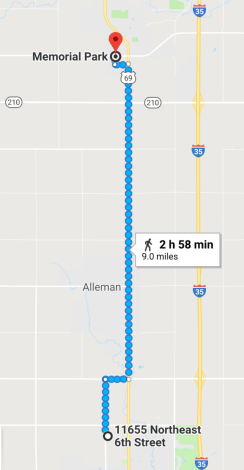
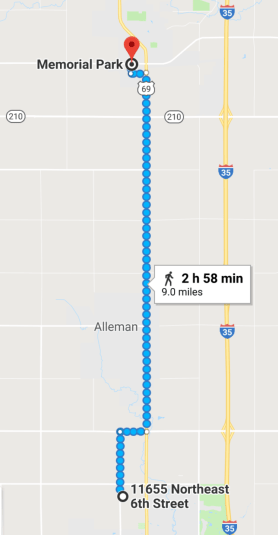
From the Griffieon Farm to Huxley, Iowa.

Sam, our sag wagon driver and scout discovered our intended camping spot at Huxley was underwater. Thankfully, when she was able to contact someone associated with the Fjeldberg Lutheran Church in Huxley, they offered us sanctuary which we are very grateful for. We scattered our sleeping bags throughout the rooms in church. Some of the rooms ended up being co-ed, which led to jokes like “I slept with ______ last night.” But I think that was another good example of building trust and community.

DSC_8515

Fjeldberg Lutheran Church in Huxley

2018-Ankeny-to-Huxley-walking

Posted in #NDAPL, First Nation-Farmer Climate Unity March, Uncategorized | Leave a comment

Alton and Foxy Onefeather Married

Two of the friends I made during the First Nation-Farmer Climate Unity March are Alton Onefeather and Foxy Jackson, now Foxy Onefeather since their marriage yesterday. Congratulations! When we learned of their upcoming wedding, we marchers collected money as a gift to them. Fintan’s artwork decorated the envelope.

Some of what I learned about Foxy and Alton follows.

Alton was talking about the strong bond that forms between a child and an animal. He spoke fondly of a horse from his youth. When he and his friends went to ride their horses, his was the only one who came up to him every time. He talked about how easy is was to ride the horse that was in tune with where he wanted to go. “I really miss that horse.”

He made a raincoat out of a plastic bag for their dog Oceti when we marched in the rain.

I had a delightful conversation with Foxy. She had an abusive childhood. She grew up in a very diverse area in California and said she had never experienced racism until she moved to the Midwest. When she went into a restaurant, she was told they were full, when there was a room full of empty tables. Eventually she was told she could stay if she ate quickly. Another time she was entering a restaurant with her child as a white woman was leaving. The woman pushed her own children behind her, and told Foxy she needed to leave. When Foxy asked why, the woman said she was scaring her children. Afterward she took her child to a park and explained what had happened was because of the wrong beliefs of the white woman, and that it was not anything about Foxy’s child.

Another story relates to bullying. When she noticed some kids bullying a gay kid, she intervened and asked what damage the gay boy was doing to them? The bullies said, “nothing”. Then she said he was minding his own business, and they (bullies) should mind theirs.

She said she didn’t often have much money. She does make some by selling jewelry she makes. Her mother once gave her some abalone that she could use to make jewelry to sell. Foxy made the jewelry but gave it all away. When on the phone her mother asked if she had sold any of the jewelry, yet? After a pause, her mother said “you gifted it, didn’t you?” She told me Alton Onefeather makes dreamcatchers to make money, but he, also, usually gifts them all away.

Foxy also told me about a book, The Tribe. Looking it up on line, I think this is the book: https://www.amazon.com/Tribe-Homecoming-Belonging-Sebastian-Junger-ebook/dp/B01BCJDSNI/ref=sr_1_2?ie=UTF8&qid=1536154493&sr=8-2&keywords=the+tribe

This book has a number of exercises to help people new to a diverse setting learn to know each other. Foxy said one example included assigned seating to mix people up, rather than the usually tendency of people of each culture creating their own group. Another example is for pairs of kids/adults to draw a picture of their partner. They then take turns introducing their partner to the group. When it came time for the group to break apart, they don’t want to leave their new friends.

Alton told me about some of his experiences in construction, and how he would serve as foreman for a crew to build houses. He also spoke of fighting forest fires. He said some fireman called themselves ‘hotshots’, but they gave themselves that designation and weren’t necessarily better trained than anyone else.

Alton pointed out various plants to us during the March.

He said he and Foxy planned to travel by bus to California (where Foxy is from) and elsewhere after they were married, partly to look for jobs. They don’t have a car, which I was delighted to hear since I’ve worked for years to try to get people to get rid of their cars.

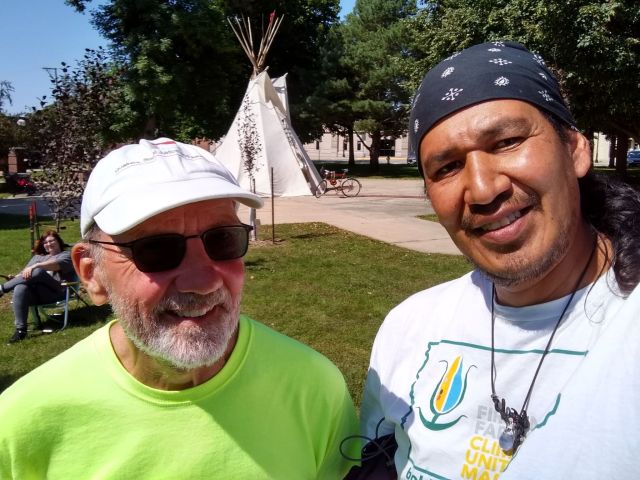
I am really glad to have this selfie photo Alton took of us at the end of the March in Fort Dodge.

Alton Jeff

Jeff Kisling and Alton Onefeather


Posted in #NDAPL, Arts, First Nation-Farmer Climate Unity March, Uncategorized | 4 Comments

First night’s forum at the Griffieon Farm

We (finally) arrived at our first destination, the farm of Craig and LaVon Griffieon on the north side of Ankeny. When we arrived the tipi had been setup. We setup our tents and prepared for dinner and the evening forum.  Not long after we setup, thunderstorms began. Rain was predicted for every day of the March, and so far that’s what we got. Fortunately the last couple of days ended up being dry.

I took a very quick shower in our portable shower/toilet trailer. Somehow the solar part hadn’t warmed the water. Tables were setup in the large machine shed. Unfortunately I missed the first part of the presentation after dinner (almost missed the food, too) because I was working on photos and a blog post.

The Griffieon’s have for years been in a struggle against the city of Ankeny’s efforts to rezone their farm as city property. When I was sharing my experiences about the March with my Quaker meeting, Bear Creek, people there were familiar with the Griffieons and their fight to keep their farm.

After the Griffieon’s shared their story, Regina Tsosie spoke. First she embraced and thanked Craig and LaVon for their hospitality. Then she spoke about the parallels of the attempts to take their farm with the theft of Native lands in the United States.

This theme was expressed a number of times during the March, how the court case we were marching for about the wrongful use of eminent domain related to the illegal taking of land from farmers for the Dakota Access Pipeline was ironic, because the modern day ownership of the land was land that had been stolen from Native Americans.

The other concept of the March, Climate Unity, is about changing current U.S. agricultural practices that have many harmful environmental effects, to move back toward Native practices that are much healthier for the land and water. These evening forums were ways we learned to think about Native and current agricultural practices and discuss ways to begin to unify, so we can work together to improve agricultural practices today.

Regina expressed sympathy for the Griffieon’s situation, and said all of us would be willing to do what we could to help and support them. Regina said she hoped they would not lose their land.

Severe thunderstorms began during the evening forum and continued through the night. A tornado was sighted about 20 miles away from us. At one point the wind was so strong that the side of my tent was pushed inward toward the floor. I was trying to decide whether to leave the tent and go into the machine shed. I didn’t really want to go out into the storm, and was afraid if I did the tent might blow away, so I stayed.

Ed Fallon wrote “I’m a veteran tent-dweller, yet have never seen my tent pummeled so mercilessly by the driving rain that hit us in the middle of the night. It was as if buckets of water were being hurled against the sides of the tent. I worried that the nearby ditch between our tents and the road would fill with water and wash over the field where we camped. That didn’t happen, but if our first night’s rainfall had been as bad as some storms that Iowa has seen in recent years, that field could have indeed been swamped.”

The next morning we trudged through the rain soaked yard to get our tents into the gear truck. The following images seem symbolic of First Nation-Farmer Unity, as Craig Griffieon brought his tractor to where the tipi was being taken down so the poles could be put on the tractor, to be carried to the gear truck.


Matt Lone Bear’s video nicely shows our camp at the Griffieon Farm and second day’s journey to Huxley.


2018-Ankeny-to-Huxley-walking


Posted in #NDAPL, climate change, First Nation-Farmer Climate Unity March, Indigenous, Quaker Meetings, Uncategorized | Leave a comment