Reparations refers to correcting past wrongs. Some of the greatest wrongs committed by the United States include the enslavement of Black people, the genocide, broken treaties and land theft of Native Americans, the internment of Japanese Americans, the separation of children from their loved ones at our southern border, and acts of war.
There don’t seem to be clear answers about what form reparations for these things might take.
But the very least we can do is stop perpetuating wrongs. Stop our acts of war. Stop separating children from their loved ones. Stop environmental damage. Fix an economic system that causes millions of people to struggle for food, healthcare, education and shelter. Fix a justice system that targets people of color.
Stop continuing to celebrate the arrival of white Europeans in America. Stop the erasure of the Native Americans who have lived in this land, and respected and cared for it for thousands of years before Columbus arrived. Stop continuing to try to silence indigenous people who love and respect Mother Earth, who pray and stand as water protectors.
My Scattergood Friends School classmates Dan Mott and Steve Maxwell just completed their epic journey across the United States on bicycles. Following is a summary about the trip.
Mission Accomplished! From Sea to Shining Sea!
39 days- 3,314 total miles- 133,947 feet of climbing- 16.41mph daily average mph. 8 flats, 3 tires, one cable shifter, unknown gallons of Gatorade, coffee, cokes, water and a couple of beers, 11 bags of Dot’s Pretzels, a daily bag of potato chips, unknown quantities of donuts, rolls, apple fritters, scones, muffins and cookies and several jars of peanut butter. The four Saggers drove over 10,000 miles and flew over 3,000 miles to provide 24/7 coverage over the 6 weeks of this adventure.
Great success on the fundraisers: Cherokee Trails: over $5,000 raised for local trails at the Go-Fund-Me page.
Scattergood Friends School -$15,000 for student scholarships were raised by Steve and Dan at the Scattergood School site.
The fundraisers will close on October 15, 2018.
To donate to Scattergood Friends School go to their website www.scattergood.org/donate, and write “Dan and Steve’s Biking Adventure” in the notes.
I also came upon this old entry from my journal. I had forgotten about their visit when I was a freshman at Earlham College
Journal 11/15/1970
Dan Mott and Steve Maxwell stopped here Friday night and Saturday. Steve may come to Earlham next year, and Dan is looking into various colleges. They are riding their motorcycles to Florida, hoping to work with the National Park Service. I think they were very wise to not attend college right after Scattergood.
Photos from visit to Indianola during the bicycle trip, September 10, 2018.
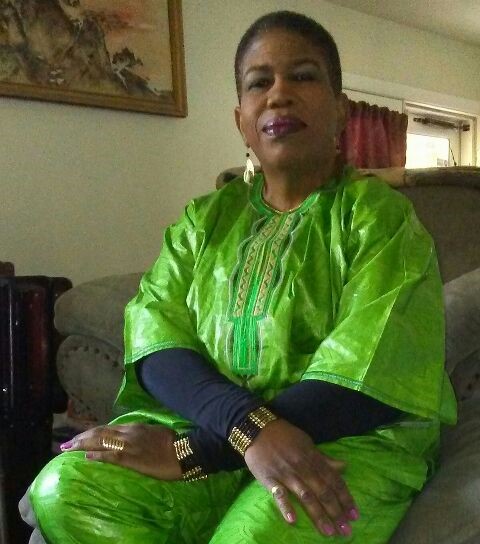
My friend, Avis Wanda McClinton continues to challenge and educate us about both the history of enslavement and the continued oppression of black, Indigenous, and other people of color (BIPOC).
Avis Wanda recently spoke at an NAACP Zoom meeting. This is a video of the visual aids she created and spoke about:
She gave me permission to share that video, and sent the following:
Hear my plea,
Dear descendants of slave owning families,
I’d like to ask you to share your records about the people that were enslaved by your ancestors.
Slavery produced many records, such as ” master bills of lading”. These are thorough and clear receipts with pertinent information about the cargo of human beings being transported, including shipping instructions about ports of entry and ports of discharge. There are bills of sale and lease contracts that were left behind.
The legal documentation of the disbursement of the enslaved men, women and children that your families held in bondage, are in wills, marriage records, household inventories, deeds and probate records.
Exploitative, wealthy European families kept exact records of their trafficking in dark skinned humans. These early Quakers accrued great wealth, which has been passed down from generation to generation, and now to you.
The letters, correspondence, and photographs that are selected and stored for permanent preservation in your archives at Swarthmore and Haverford colleges are historical materials.
They provide evidence and memories and tell stories of American’s history from long ago.
They help us today to understand and interpret the past and help us to learn from it, so that we all can have a better future.
Query: Does your faith community face the need of having honest and open discussions about the legacy of slavery with all its hurtful facets? Can we accept the strong feelings that will arise from these discussions? Query: Is your faith community prepared to work with your local community to create a racially diverse and equal society? Query: As a Friend would you allow another individual to insult, demean, hurt, or exclude another from his or her worship? How can people just stand there and let bad things happen?
My hope in researching the American slavery era is for a more humane world and a better existence for everyone. We are all God’s children.
My friend, Avis Wanda McClinton, continues to challenge and educate me, and I hope, others, about both the history of enslavement and the continued oppression of people of color today. In this message Avis includes some queries for us all to consider. This earlier blog post has more about Avis and Quakers, and includes the following queries: https://kislingjeff.wordpress.com/2018/04/28/avis-wanda-mcclinton/
Query: Does your faith community face the need of having honest and open discussions about the legacy of slavery with all its hurtful facets? Can we accept the strong feelings that will arise from these discussions? Query: Is your faith community prepared to work with your local community to create a racially diverse and equal society? Query: As a Friend would you allow another individual to insult, demean, hurt, or exclude another from his or her worship? How can people just stand there and let bad things happen?
It is my understanding that there are different practices among Quaker meetings regarding the use of queries. In Iowa Yearly Meeting (Conservative) each of our monthly meetings considers one of twelve sets of queries each month. The summary of each month’s query is then sent to the Yearly Meeting, and a selection from those responses is read during our annual meeting sessions, and included in the printed Minutes. You might encourage your meeting to consider Avis’s queries this year.
Avis writes:
Greetings Friends,
This is Avis Wanda McClinton an old, black, Pennsylvania Quaker woman who wants you to understand the blindness I see among the Friends of Middletown Monthly Meeting, Langhorne, Pennsylvania and many other predominantly white meetings.
There are people who are unaware that Quakers kidnapped and held black people in chattel slavery for generations.
Even George Fox founder of Quakerism seldom spoke out against the institution of slavery.
The unsavory reality of the Religious Society of Friends slave heritage is the brutality and violence white Quakers perpetrated on people of African decent.
This has rarely if ever been written about in history books.
These were people who would dig a hole big enough for a pregnant woman to rest her stomach in to be whipped mercilessly.
The first abolitionists were African men and women who were enslaved, NOT white Quakers who were in fact slow to give freedom to those they first exploited and regarded as pieces of property and creatures devoid of souls.
The rediscovery of the graves of enslaved Africans, causes us to see the continued ties to slavery’s vile history and it’s legacy that still effect race relations in our society.
Query:
Old meeting houses were built by slave labor. Has your meeting located the site of a whipping post used to punish and maim black bodies?
Query:
Has your meeting accepted the Truth that early Friends were enslavers, probably before any them were abolitionists?
Fact:
Enslavers made a profit on deceased black bodies by selling them to medical schools.
White America amassed tremendous wealth and white-skinned privilege through the exploitation of innocent African men, women and children.
Friend Benjamin Lay, called slave owning Quakers, “Christian Hypocrites” and “Spawns of Satan”! In his eyes, the existence of the “peculiar institution” was a direct and constant violation of the “inner light” belief of Quakers.
To hold another human being in bondage is an injustice and is innately evil. The erroneous idea we have inherited from slavery is that black people are inferior to white people and the domination of black bodies by white people is appropriate.
Friend, if you are uncomfortable by my heartfelt words, understand from whence they came. Perhaps God is trying to reach you in a way I can’t.
Being ever mindful of the ‘white fragility’ of Friends. I will say I was understandably pissed at Middletown Friends for willfully ignoring of my ministry. It is morally wrong for white Quakers to step in (entitlement) and take over when I am here!
Dismissal of African American Quakers concerns doesn’t begat a racially diverse society of Friends.
Faultless people were stolen from Africa and lived their entire lives held in bondage by religious people that wouldn’t see the God in them.
White friends can trace their lineage back for hundreds of years.
African Americans however, are depended on the descendants of the white people who enslaved their ancestors to resurrect their genealogy because they hold the records.
The Religious Society of Friends’ centuries old practice of enslavement of African people left a vast repository of genealogical information and documentation about where their slave ships departed Africa and the life experiences of the captured human beings that they brought and sold.
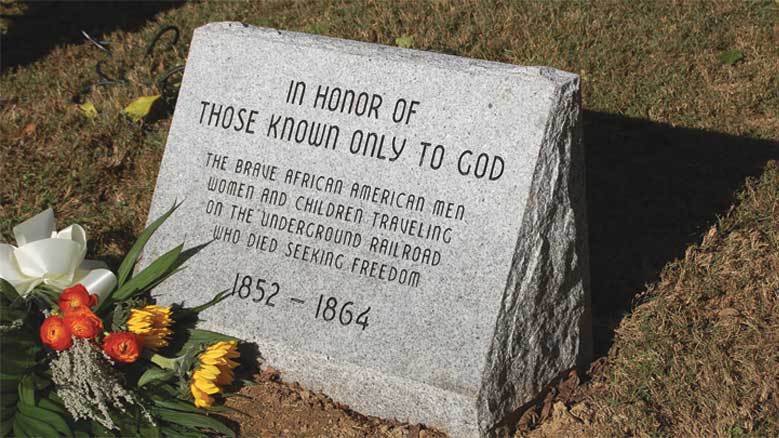
It’s important to share this information about the enslaved Africans interred in Quaker graveyards both locally and more broadly with such groups like the “Honoring Those Known Only To God” a Quaker project, the Smithsonian’s African American Museum and Ancestry.com., the world’s largest online family history resource, in the hopes that any African American searching for his or her biological family can be reunited with them.
I feel called to speak plainly with you.
When God tells me to do anything, He means for me to be obedient. My sacred calling to find the enslaved Africans graves in Quaker’s graveyards is immensely important to me, because I am finding my ancestors and adding to the history of African American people in America. I have a deeper reverence and appreciation for my ancestors and what their lives means to my life, to America, and to the world.
Philadelphia Yearly Meeting prohibited members from owning slaves in 1776.
But there were also Quakers who wouldn’t free their Africans captives.
A Philadelphia Yearly Meeting minute of acknowledgement of their role in the slave trade would be a start to healing.
What consideration has been given to the powerful emotions that will arise in those attending the event at Middletown Meeting?
My hope in researching the American slavery era is for a more humane world and a better existence for everyone. We are all God’s children.
The First Nation-Farmer Climate Unity March involved a group of about thirty native and non-native people walking, eating, and camping together for 8 days. We walked 94 miles from Des Moines to Fort Dodge Iowa, along the route of the Dakota Access Pipeline during the first week of September, 2018. I am reflecting on what was for me a transformative experience.
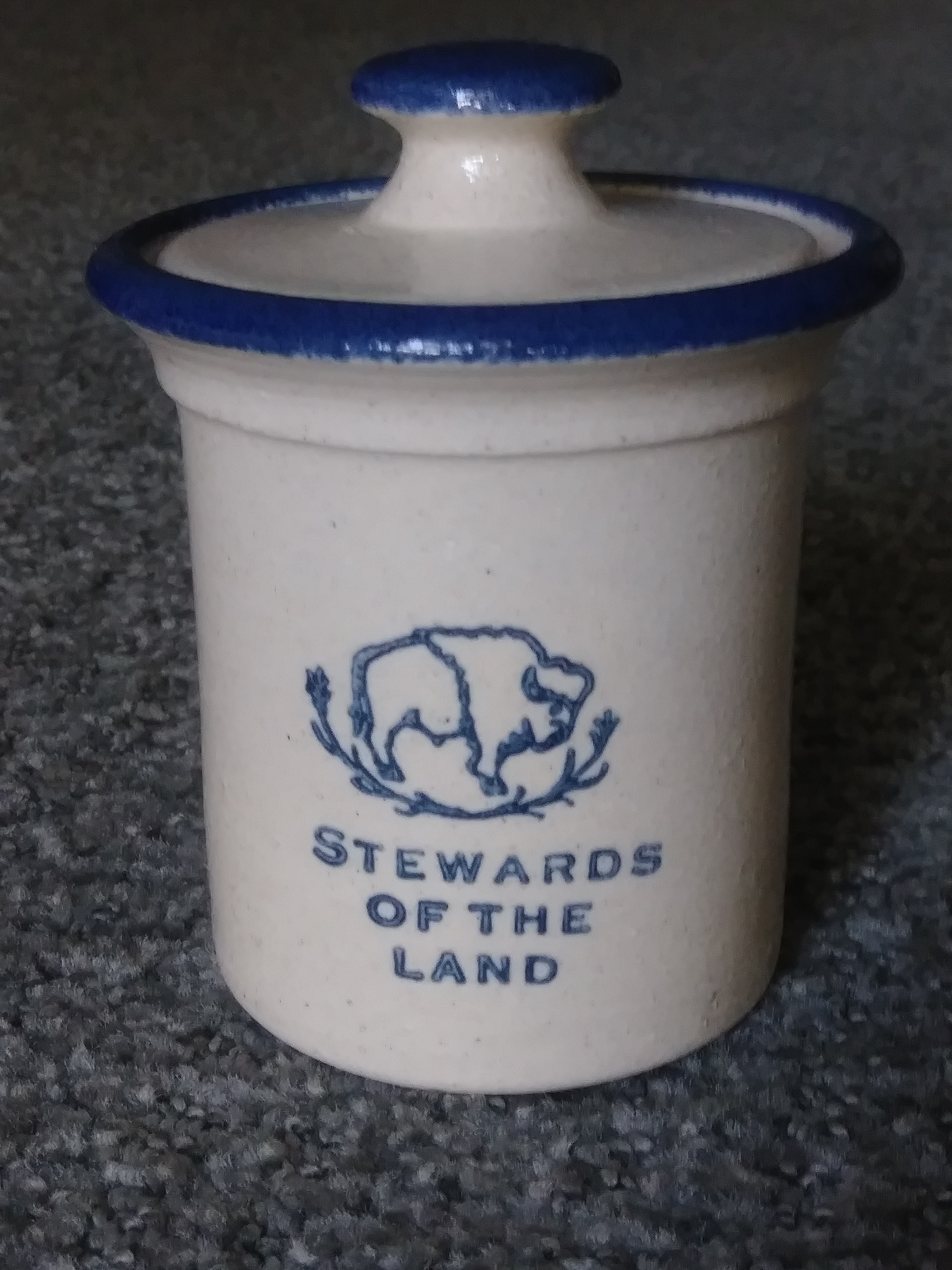
Gift from Bear Creek Quaker and potter Russ Leckband after the March
The title of the March was what grabbed my attention. As I’ve written often elsewhere, from my teenage years on I have been horrified by what our fossil fuel based economy was doing to Mother Earth. As a scientist I knew about greenhouse gas emissions and their consequences. I knew climate denial was a sham.
As a Quaker this was also a spiritual matter for me. This has caused a great deal of tension with my Quaker community because I felt many other Quakers were not doing enough to live with environmental integrity. I gave up having a personal automobile some forty years ago, and felt we all should work to drastically reduce our fossil fuel consumption. I don’t think I convinced a single person to give up their car. I knew this would be difficult for the many people living in rural areas, but there were things that could have been done.
Looking for cultures that did live with environmental integrity, I wanted to learn more about Indigenous peoples. It became clear that I couldn’t rely on books because of questions about how truthful or accurate many authors were. I learned that native people rely on oral, not written history. And it was clear there were differences between tribes.
I was glad to have a few opportunities to spend a little time with Native Americans in Indianapolis as we worked together to support water protectors and to defund the Dakota Access Pipeline.
Moving back to Iowa upon my retirement last year, I looked for other opportunities to learn more about Indigenous people. At the annual meetings of Iowa Quakers the summer of 2016, Peter Clay, Donnielle Wanatee and Christine Nobiss spoke about building bridges between Quakers and Native Americans. Since then I have taken advantage of every opportunity to spend more time with Native Americans, such as the Meskwaki Powwow and work with Iowans against the Dakota Access Pipeline. Either Donnielle or Christine or both were usually present at these various gatherings. I also got to know Ed Fallon of Bold Iowa who was leading environmental organizing efforts.
My Quaker meeting, Bear Creek Friends, in the countryside north of Earlham, Iowa, has been involved with the annual Prairie Awakening/Prairie Awoke ceremony at the Kuehn Conservation Area, just a few miles from the meetinghouse, for over 10 years. I was very impressed when I was finally able to attend that ceremony in 2017.
But none of those opportunities allowed me to really get to know the native people and their beliefs. So I was really excited about the First Nation-Farmer Climate Unity March because it seemed like a way to finally develop some understanding and relationships with Native Americans.
I was convinced that corporate capitalist society has it all wrong regarding our environmental, economic and social practices, and the solution for our very survival had to be to return to ways that respect and begin to heal Mother Earth. We would have to adopt the indigenous ways to respect and begin to heal the Earth. So I searched for those who could teach me these things. Who would be willing to help show how we can work together to change our agricultural practices, economy and society in ways that might change the path to continuing, deepening environmental chaos we are currently on.
At the most fundamental level, on the First Nation-Farmer Climate Unity March we had the opportunity, and the length of time, to not only learn about Indigenous ways, but even better, become friends with the native and non-native people on the March. Prior to the March I hadn’t thought about the great amount of time we would be together without distractions. Walking side by side for hours a day, for eight days, we had the time to share many, many stories with each other. We were basically our own captive audience. The following expresses why I think sharing stories is so important. I believe we change the world one story at a time.
ALL THAT WE ARE IS STORY
From the moment we are born to the time we continue on our spirit journey, we are involved in the creation of the story of our time here. It is what we arrive with. It is all we leave behind. We are not the things we accumulate. We are not the things we deem important. We are story. All of us. What comes to matter then is the creation of the best possible story we can while we’re here; you, me, us, together. When we can do that and we take the time to share those stories with each other, we get bigger inside, we see each other, we recognize our kinship — we change the world one story at a time. Richard Wagamese (October 14, 1955-March 10, 2017) Ojibwe from Wabeseemoong Independent Nations, Canada
This practice of spending a lot of time together has become fundamental to what I have learned about activism over the past 5 or 6 years. I recently wrote about the path to a 94 mile spirit quest. I had found protests and meetings and presentations weren’t satisfying to me, and didn’t seem to lead to progress toward correcting injustices.
I was blessed to become connected to, and a part of the Kheprw Institute (KI), in Indianapolis. What I discovered was that as I listened deeply, I began to learn a little about what it is like to be a person of color in Indianapolis. It was by hearing stories that I learned. Stories go both directions. When I recently shared some stories about this March with one of my friends from KI, Diop Adisa, he said, “8 days wow. The commitment is transcending.”
One night last year I was fortunate to hear Arkan Lushwala speak about “Indigenous Ways of Restoring the World” during a call sponsored by the Pachamama Alliance. “Arkan Lushwala is a rare indigenous bridge of the global north and south, carrying spiritual traditions from the Andes in his native Peru as well as being adopted and initiated by the Lakota people of North America.”
He said:
“Everywhere people ask, “what can we do?” The question, what can we do, is the second question. The first question is “what can we be?” Because what you can do is a consequence of who you are. Once you know what you can be, you know what you can do”
This is why we need what I call Spiritual Warriors. Because we ask ourselves the first question, “what can we be?” By knowing who we are, what we can be, Arkan says, “our actions are precise, our actions are in harmony with the movement, the sacred movement, of that force that wants to renew life here on Earth and make it better for the following generations.”
The beautiful thing we experienced during the First Nation-Farmer Climate Unity March was learning more about what we can be. As I think of it, to begin to think of ourselves as Spiritual Warriors. https://kislingjeff.wordpress.com/2018/05/08/spiritual-warrior/
“I used to think that top environmental problems were biodiversity loss, ecosystem collapse and climate change. I thought that thirty years of good science could address these problems. I was wrong. The top environmental problems are selfishness, greed and apathy, and to deal with these we need a cultural and spiritual transformation. And we scientists don’t know how to do that.” Environmentalist Gus Speth
Spiritual Warriors work to learn how to do that. As Christine Nobiss, who walked on the First Nation-Farmer Climate Unity March writes on the Seeding Sovereignty website:
“During this time of climate crisis, it is imperative that we transform the colonized mind of settler descendant society by pushing Indigenous ideologies onto the world stage. We need to convey the profound and sustainable perspectives of Indigenous communities, cultures, and relationships to the earth by giving Indigenous people the opportunity to investigate, speak, write, photograph, and so much more. In particular, we need to encourage Indigenous women on to the world stage and empower them to convey the sacred feminine that has been violently oppressed.”Christine Nobiss, Seeding Sovereignty
“For most First Nations, wealth was seen as an ability to give gifts and provide for the people. It was a completely different perspective that offended settlers to the point that, in Canada, the government banned potlatch ceremonies (giveaways) and the people were forced to carry out their ceremonies underground. This is an important part of North American Indigenous culture to know because it explains how an Indigenous-led regenerative economy can help us curb the onslaught of climate change and end social injustice caused by colonial-capitalism. This ideology can help us better understand how to interact with the land and fight corporate conglomerates that are destroying the earth on which they carry out their unhealthy and inhumane commercial farming practices.”Christine Nobiss, Seeding Sovereignty
I also wanted to show Indigenous people that there are non-natives who care for Mother Earth, and could both learn from Native Americans, and join in their efforts to change agricultural and social thinking and practices. Quaker worship is fairly unique in non-native culture in not having structured rituals and services. Rather, Quakers gather in silence in order to try to hear and obey what the Spirit is saying to them. And throughout the week try to be attentive to the Spirit at all times, though we often aren’t successful in doing so. This means we reflect on the current state of our lives, and try to be open to new ideas.
I am convinced a spiritual approach is the only way to begin to tackle the rapidly evolving environmental chaos. That it makes sense that the spiritual approach of Quakers can be in tune with the spiritual approach of Indigenous peoples. So beside wanting to hear the stories shared by Native Americans, I also looked for ways to share about Quakers as we walked together.
We gave prayers every time our path crossed the Dakota Access Pipeline. Most often Donnielle offered the prayers on behalf of all of us. One time I was honored to be asked to give the prayers at another pipeline crossing. I briefly explained about Quaker worship, then we stood in a circle, holding hands, and held a short Quaker meeting for worship. Afterward I was touched that several people thanked me and gave me hugs.
I am hopeful those of us who marched together, and shared our stories with each other, can find ways to continue to work together.
Although made in November, 2016, this video interview of me is about settler colonialism and work against the Dakota Access Pipeline in Indianapolis, along with photos I took of events there.
This Rodger Routh video about the First Nation-Farmer Climate Unity March captures how we felt about what we were doing on the March.
Saturday, October 6, 2—5 p.m. @ Kuehn Conservation Area
Dallas County Conservation, DCCB, the State Office of Archaeology (OSA), and Iowa’s First Nations Peoples invite you to help us in healing the burial mounds at the Kuehn Conservation Area. Long before this land was in public management, these sacred sites were desecrated. It is now our time to erase this scar on the landscape and heal these mounds. At this event, participants will learn from the OSA archaeologists the history of the Woodland Culture, mound builders, and their story here in the Raccoon River Valley. The First Nations People will also share their history of their stories on this land and the sacred nature of the mounds.
Following these presentations, participants will be invited to carry soil to the scarred mounds and participate in a ceremony to heal the wounds in these sacred sites. Come step inside these stories and experience the memory of our land.
Preregistration is required for this free event. To register call 515 465 3577
Eighth day. September 8, 2018. Walk 12.4 miles from Otho to the end of the march at Fort Dodge, Iowa.
It was cold when we awoke this morning at 6:00 a.m. and broke camp in the dark. I didn’t want to get out of the sleeping bag. But this was the big day, one we were both looking forward to, and not. Fortunately hot coffee was ready. Last night we talked about the need to get going early, because people would be expecting us to arrive in Fort Dodge by 1:30 pm. Many of us were skeptical that we could leave early enough to walk the 12.4 miles to get there in time, but we managed to do so.
One way this will be an interesting day for me is because my camera battery finally died. I thought it would last, and hadn’t brought my battery charger. So the photos of this final day of the march were taken with my cell phone camera.
Before we started walking, we had a nice ceremony where we gave the money we had collected to Alton and Foxy as a gift for their upcoming wedding. Fintan decorated the envelope.
Many times I heard people talking about how sad they will be when the March is finished. Many friendships had been made, as you can see from all the smiles in the photos. Among my many new friends were Matt and Alton, so I was glad to have the selfie Alton took of us, and the photo Miriam took of Matt and I. Matt and I talked much of this final day of the March. Since the end of the March we have chatted via Messenger. I’m glad we’re keeping in touch. He is editing more of the video he took during the March and I look forward to seeing them.
Jeff Kisling and Alton Onefeather
Jeff Kisling and Matt Lone Bear
We had a police escort through downtown Fort Dodge. At the City Square Park the tipi had been set up.
Christine Nobiss speaks:
Donnielle Wanatee:
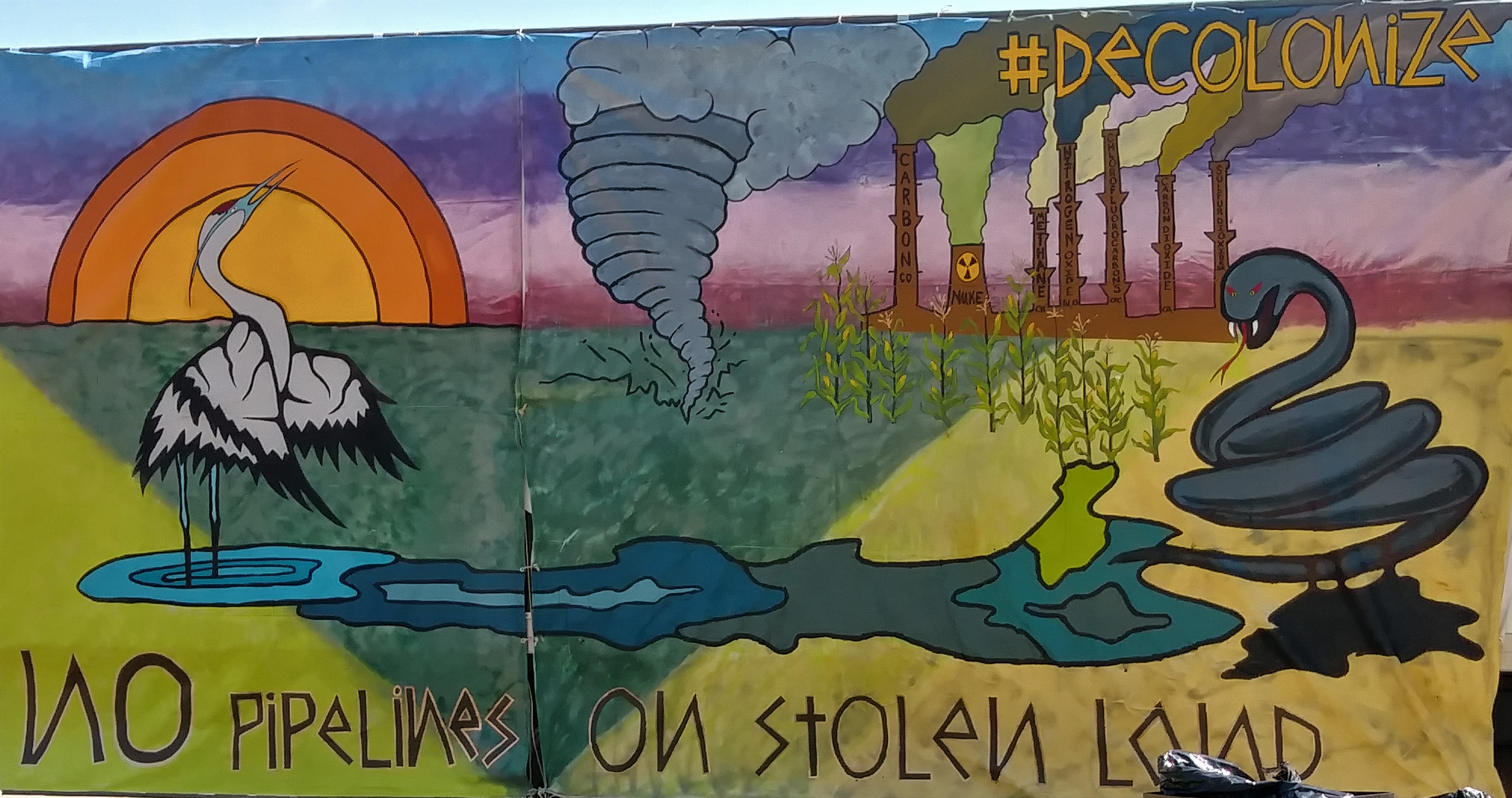
I was amazed by the huge mural that hung on the side of the gear truck. The Native Americans had been working on this all during the week.
Drummers played and sang the “Mni Wiconi Song.” According to The Messenger newspaper, the English translation of the lyrics is:
“Grandmother earth gives life
The water is sacred
The water that gives life is sacred
DAPL is very bad
The Nation needs to take heart and be brave.”
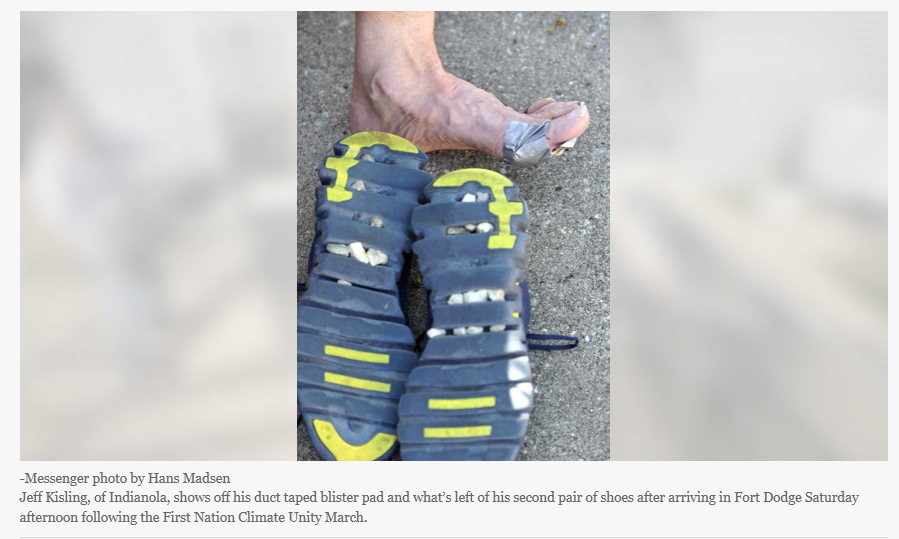
The Messenger published a nice summary of the March and celebration, with photos, including one of my bandaged foot and shoes. “Many steps. One journey”, September 10, 2018.
The band Brutal Republic performed. All of their equipment was being powered by the solar system that had accompanied us all week. My brother Randy, who was there to give me a ride home, thought they sounded really good and would have like to stay for a while. But I was way too tired to enjoy it.
During the week we came to understand how much work was involved in planning and guiding this March, and are very grateful. So many people contributed in so many ways.
I hope we can be together again soon. As our environmental chaos gets worse, I think a combination of the knowledge and wisdom of Indigenous people and progressive farmers, thinkers and activists will be crucial.
Two-eyed seeing “recognizes the benefits of seeing from one eye with the strengths of Indigenous ways of knowing, from the other eye the strengths of the Western ways of knowing, and using both of these eyes together to create new forms of understanding and insight.” Elder Albert Marshall (Mi’kmaq, Eskasoni First Nation) from Urban Tribes, edited by Lisa Charleyboy and Mary Beth Leatherdale
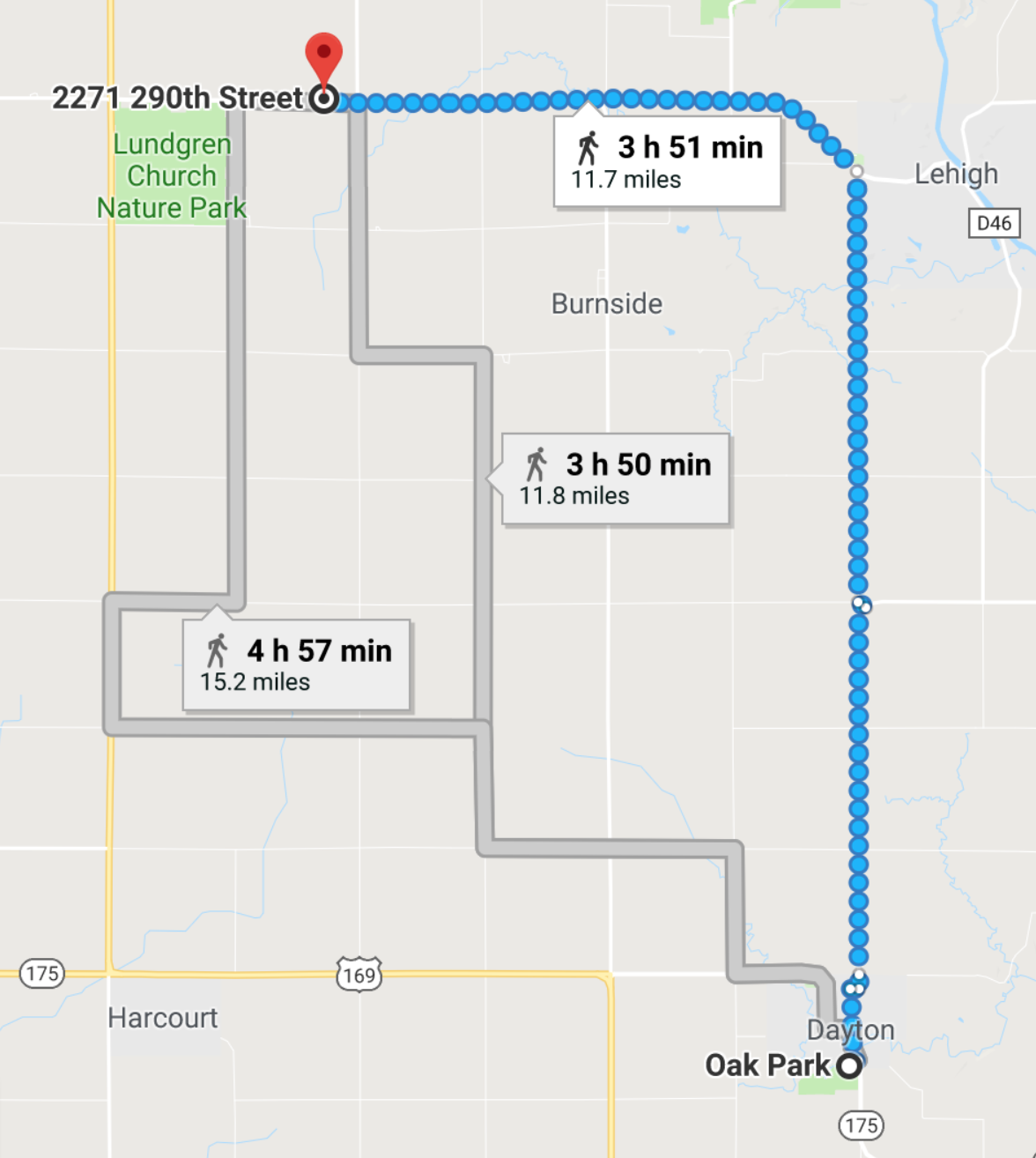
Day 7, September 7, 2018. 11.7 miles from Dayton to Otho, Iowa.
Yesterday evening the solar panel unit was set up because there wasn’t any electricity available in the park.
It was cool when we broke camp, but a pretty pleasant day to march, with the sun coming out soon after we started. Since much of the route today wasn’t on busy roads, we were able to walk side by side and share more stories.
ALL THAT WE ARE IS STORY
From the moment we are born to the time we continue on our spirit journey, we are involved in the creation of the story of our time here. It is what we arrive with. It is all we leave behind. We are not the things we accumulate. We are not the things we deem important. We are story. All of us. What comes to matter then is the creation of the best possible story we can while we’re here; you, me, us, together. When we can do that and we take the time to share those stories with each other, we get bigger inside, we see each other, we recognize our kinship — we change the world one story at a time. Richard Wagamese (October 14, 1955-March 10, 2017) Ojibwe from Wabeseemoong Independent Nations, Canada
Ed Fallon played his flute as we marched.
There was a funny moment when this herd of cattle moved as one toward us, and then stopped as one, as we walked past.
I don’t know if someone just made the name up, but this very steep hill was called ‘suicide hill’. At the bottom was a creek. On the wall of the bridge someone had previously written ‘Mni Wiconi”, Water Is Life.
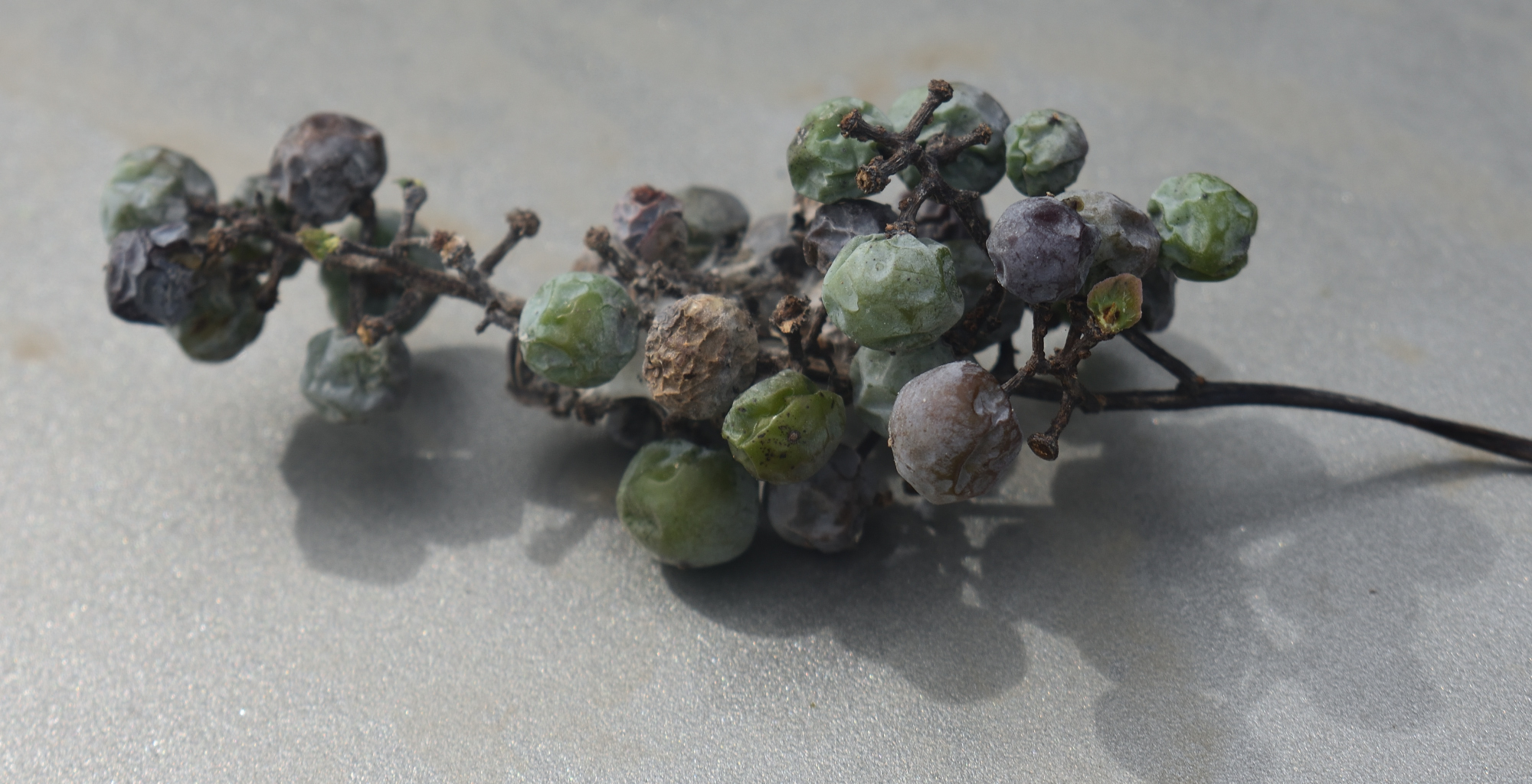
Also near that creek, Manape showed us wild grapes growing along side the road, and the fragrance of them when they were crushed.
The last part of the day’s walk was past a field of wind turbines. I didn’t notice sound coming from them as we walked past, but that night as we were sitting around the bonfire there was a noticeable “whoosh” sound.
After dinner it was dark. We sat around a bonfire. Trisha Etringer led a very interesting discussion about decolonization. Then Manape spoke about sovereignty, and especially sovereignty of yourself. And how he came to the conclusion that he should give up both his United States citizenship and tribal membership to achieve his own sovereignty.
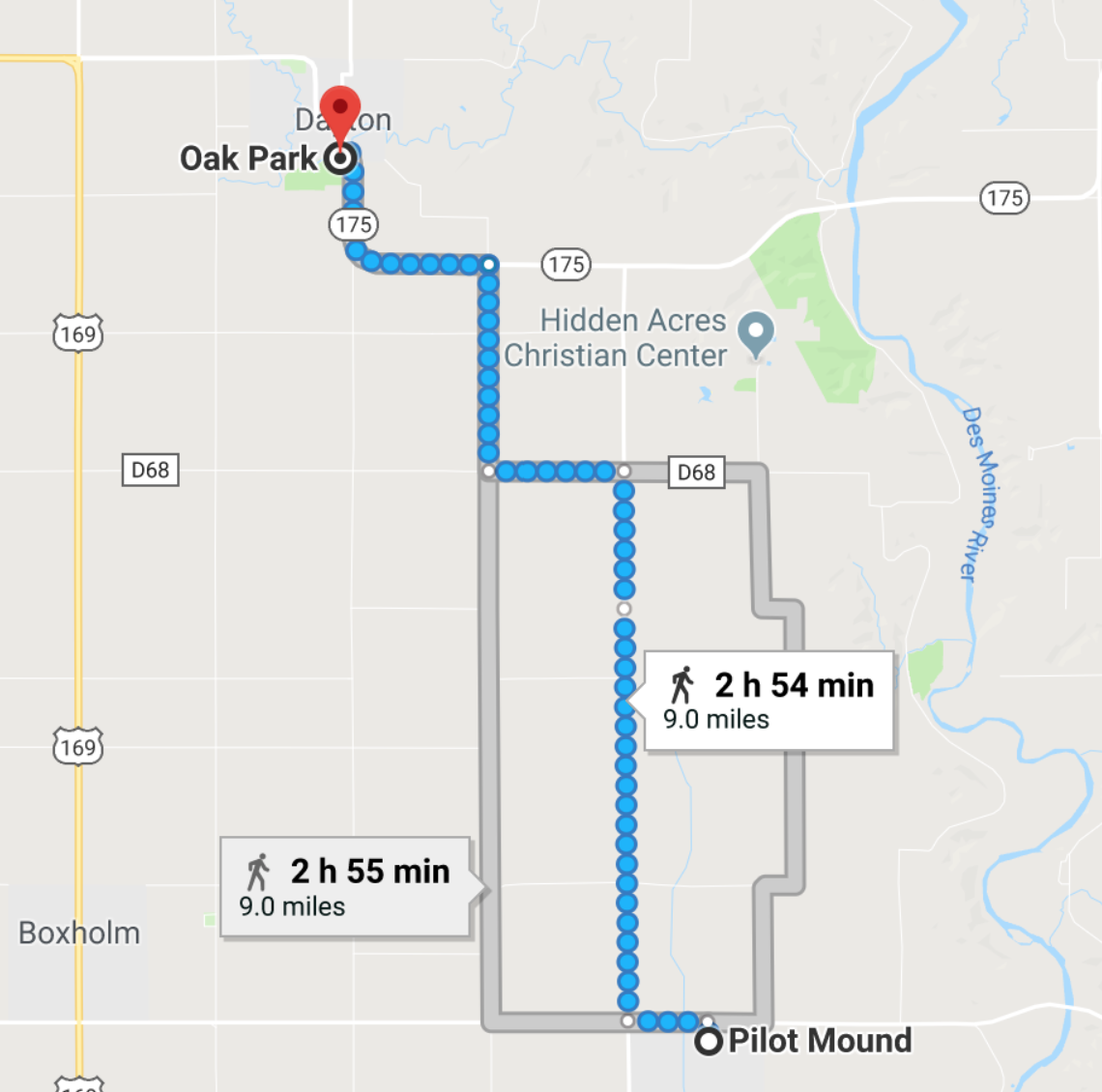
Day 6. September 6, 2018. 9 miles from Pilot Mound to Oak Park in Dayton, Iowa.
Day 6 of the First Nation-Farmer Climate Unity March began with another awesome breakfast by Lyssa Wade. As we were waiting to start walking we saw one of the March t-shirts hanging in the window across the street.
I was again reminded of my reliance on cell phone and Internet access when I couldn’t check the weather, news or email that morning. I hoped my family wasn’t worried that I hadn’t been able to connect with them while we were in Pilot Mound.
Rather then getting more difficult with each passing day, it is getting easier to cover the miles (fortunately!), even now that I’m walking on a blistered foot and my backup shoes.
This was another day of sharing stories and getting to know each other better. I’ll let the photos tell today’s story.
After setting up my tent once we arrived at Oak Park in Dayton, I spent most of the rest of the day at the public golf course’s country club, which was adjacent to the park. I had two days of photos and writing to catch up on. Unfortunately I missed the evening presentation.
The folks at the country club were very nice, allowing us to sit in the club where there was internet service available (which didn’t extend as far as the campground). They also invited those who wanted to use their showers.
While I’ve been writing about my adventures during the First Nation-Farmer Climate Unity March, I’ve been thinking about ways Quakers support Native Americans. The Friends Committee on National Legislation (FCNL), our Quaker lobbying organization, has made advocacy for Native Americans a priority for decades.
“Since 1976, FCNL’s Native American advocacy program has worked to restore and improve U.S. relations with Native nations so that our country honors the promises made in hundreds of treaties with these groups. FCNL provides information to Congressional offices and to national faith groups about the continuing struggles of Native people and advocates in support the resilient and inventive solutions proposed by tribal governments and Native American organizations.
This work takes us into all of the issue areas encountered by any government: land and borders; environment, energy, and natural resources; economic development; care for the safety and well-being of tribal citizens; and investment in the future through health and education.”Witnessing in Solidarity with the First Americans
“Lacina Tangnaqudo Onco manages the Native American Advocacy program lobbying on legislation that affects Native communities. She builds connections between tribes, tribal organizations, and non-Indian allies, particularly among a wide range of faith groups, to ensure tribal needs are addressed.
FCNL’s offices are just across the street from the Hart Senate Office Building in Washington, DC. FCNL lobbyists and Quakers who come to Washington visit Congressional representatives and their staff’s to discuss legislative issues and concerns.
More recently FCNL has been working with Quaker meetings to build relationships at their local Congressional district offices. It is highly effective to establish these personal relationships. Several Iowa Yearly Meeting (Conservative) Quakers have been visiting their local Congressional offices for years.
My Quaker meeting, Bear Creek Friends, is beginning to explore how we can build a Quaker advocacy team, to develop deeper relationships with our local Congressional offices. The first topic we plan to work on is support for the SURVIVE Act.
According to federal data, American Indian and Alaska Native (AIAN) communities face some of the highest victimization rates in the country. Unfortunately, less than 0.7% of the Crime Victim’s Fund (CVF) established by the Victims of Crime Act reaches Indian tribes. This important funding provides victim services including crisis intervention, emergency shelter, medical costs, and counseling.
Currently, VOCA does not incorporate tribal governments for victim assistance and victim compensation formula grant programs. If we want to tackle the unacceptable disparities facing these communities, we need to make sure victims have equitable access to the critical resources VOCA funds support.
That is why I have introduced the bipartisan Securing Urgent Resources Vital to Indian Victim Empowerment (SURVIVE) Act. This bill would create a tribal grant program within the Department of Justice’s Office for Victims of Crime and require a 5% allocation from the CVF be provided to Indian tribes. It would expand the use of CVF funds for domestic violence shelters, medical care, counseling, legal assistance and services, and child and elder abuse programs to enable tribes to deliver critical services to their communities. Tom O’Halleran, Member of Congress
Supporting the SURVIVE Act is a natural extension of Bear Creek Friends’ involvement in the local annual Native American celebration Prairie Awakening/Prairie Awoke for more than a decade.














 Quakers, social justice and revolution