Following is from the book I’m reading, Tears We Cannot Stop, A Sermon to White America, by Michael Eric Dyson.
Early in his career King believed in the essential goodness of white America. He trusted most whites to put away their bigotry in the face of black suffering. In the last three years of his life he grew far more skeptical of the ability or willingness of white folk to change. He concluded, sadly, that most whites are unconscious racists.
“Our nation was born in genocide when it embraced the doctrine that the original American, the Indian, was an inferior race,” King said. “Even before there were large numbers of Negroes on our shores, the scar of racial hatred had already disfigured colonial society.” We are “perhaps the only nation which tried as a matter of national policy to wipe out its indigenous population.”
I am beyond rage, Oh Lord, at the utter complicity of even good white folk who claim that they care, and yet their voices don’t ring out loudly and consistently against an injustice so grave that it sends us to our graves with frightening frequency. They wring their hands in frustration to prove that they empathize with our plight–that is, those who care enough to do so–and then throw them up in surrender.
What we mostly hear is the deafening silence. What we mostly see is crushing indifference. Lord, what are we to do in a nation of people who claim to love you and hold fast to your word and way and yet they let their brothers and sisters murder us like we are animals?
One of the many benefits from participating on the First Nation-Farmer Climate Unity March was making friends with Native Americans as we walked together. My life experiences as a Quaker have taught me our lives can, and should, be guided by the Spirit. For many reasons I have long wanted to learn more about Native Americans and other indigenous people because what little I did know was that their lives and communities are also Spirit led.
But as I tried to learn more about native beliefs, I found there were conflicting stories, and warnings that many things written about native people were inaccurate or untrue.
I was glad to come upon the teachings of Chief Arvol Looking Horse. I felt a spiritual unity as I read his words and heard him speak on videos. I was glad to be able to ask my Native American friends whether he was someone who’s teachings I could trust, and they said “yes”.
Here he asks all of us to come together to promote healing of Mother Earth. Fundamental to the beliefs of Quakers is working for peace, so I especially appreciate what he said about achieving a universal consciousness toward attaining Peace.
In our prophecies it is told that we are now at the crossroads: Either unite spiritually as a global nation, or be faced with chaos, disasters, diseases, and tears from our relatives’ eyes.
I ask you to join me on this endeavor. Our vision is for the peoples of all continents, regardless of their beliefs in the Creator, to come together as one at their Sacred Sites to pray and meditate and commune with one another, thus promoting an energy shift to heal our Mother Earth and achieve a universal consciousness toward attaining Peace.
One of the first things I learned when I began to spend time with Native Americans in Indianapolis as we supported the water protectors was Mni Wic’oni, water is life.
Following is Chief Looking Horse’s message on the importance of water in the Lakota tradition.
A Message from Chief Arvol Looking Horse
“We as caretakers of Turtle Island have always understood Great Spirit has blessed us with the water of life, Mni Wic’oni. We always knew it is the life-line to maintain health and well-being. For a few decades now, we have been told through our ceremonies that man has gone too far, disrupting many cycles of life. Through our passed down knowledge that still carry traditions of respect for the world in order to maintain balance and harmony, we still carry our ways to honor the four seasons upon Mother Earth. On March 21st, many People will be Welcoming the Thunders in ceremonies throughout Turtle Island. We also acknowledge another honoring for water around Mother Earth to unite and offer prayers on March 22nd, known as World Water Day.
We are asking to open your heart and minds to this time of crisis that is now upon us, threatening a healthy life for our future generations and also for the many spirit lives of the four legged, winged ones, those that crawl and that swim who depend on Mni Wic’oni, the water of life.
Those that know how strong spiritual energy is, understand water is the most essential life-line to survival. It is a ‘Source of Life’ that is so powerful, that when we offer our energy of prayers, it can change into medicinal healing, through united intentions. Even science finally found this out only recently. Water carries the Keeper’s energy and can change very fast. It can also bring death by not respecting its gift, especially when over abused as a Resource. It is time we wake up the World to stop abusing and destroying a gift of life – before it is too late.
In a sacred hoop of life, where there is no ending and no beginning.”
Onipiktec’a (that we shall live),
Chief Arvol Looking Horse
19th Generation Keeper of the Sacred White Buffalo Calf Pipe
For years now I’ve been writing about why a spiritual approach is required to address our evolving environmental disaster.
As environmentalist Gus Speth says, “I used to think that top environmental problems were biodiversity loss, ecosystem collapse and climate change. I thought that thirty years of good science could address these problems. I was wrong. The top environmental problems are selfishness, greed and apathy, and to deal with these we need a cultural and spiritual transformation.”
Our environmental crisis has been caused by viewing natural resources as raw materials to build products and by squandering fossil fuel supplies. Some believe natural resources belong to whoever owns the land or material. The owner usually doesn’t worry about how sustainable the use of the resource is, or the environmental damage from the manufacture or use of the products made from these resources. Those views, which abuse Mother Earth, have led to the environmental chaos we are moving into today.
As Chief Arvol Looking Horse writes below, “We fail to appreciate and honor our Sacred Sites, ripping out the minerals and gifts that lay underneath them as if Mother Earth were simply a resource, instead of the source of life itself.”
“There needs to be a fast move toward other forms of energy that are safe for all nations upon Mother Earth. We need to understand the types of minds that are continuing to destroy the spirit of our whole global community. Unless we do this, the powers of destruction will overwhelm us.”
What we need now to protect and heal Mother Earth are spiritual warriors. https://kislingjeff.wordpress.com/2017/02/28/spiritual-warriors/ The main reason I participated on the First Nation-Farmer Climate Unity March was to learn more about native views and practices.
Chief Arvol Looking Horse is the author of White Buffalo Teachings, and a tireless advocate of maintaining traditional spiritual practices. He wrote the following to teach us about the Indigenous perspective of the state of our world, and how we must all work together, in Indian Country Today.
Important Message from Keeper of Sacred White Buffalo Calf Pipe
To understand the depth of this message you must recognize the importance of Sacred Sites and realize the interconnectedness of what is happening today I, Chief Arvol Looking Horse, of the Lakota, Dakota, and Nakota Nations, ask you to understand an Indigenous perspective on what has happened in America, what we call “Turtle Island.” My words seek to unite the global community through a message from our sacred ceremonies to unite spiritually, each in our own ways of beliefs in the Creator.
We have been warned from ancient prophecies of these times we live in today, but have also been given a very important message about a solution to turn these terrible times.
To understand the depth of this message you must recognize the importance of Sacred Sites and realize the interconnectedness of what is happening today, in reflection of the continued massacres that are occurring on other lands and our own Americas.
I have been learning about these important issues since the age of 12 when I received the Sacred White Buffalo Calf Pipe Bundle and its teachings. Our people have strived to protect Sacred Sites from the beginning of time. These places have been violated for centuries and have brought us to the predicament that we are in at the global level.
Look around you. Our Mother Earth is very ill from these violations, and we are on the brink of destroying the possibility of a healthy and nurturing survival for generations to come, our children’s children.
Our ancestors have been trying to protect our Sacred Site called the Sacred Black Hills in South Dakota, “Heart of Everything That Is,” from continued violations. Our ancestors never saw a satellite view of this site, but now that those pictures are available, we see that it is in the shape of a heart and, when fast-forwarded, it looks like a heart pumping.
The Diné have been protecting Big Mountain, calling it the liver of the earth, and we are suffering and going to suffer more from the extraction of the coal there and the poisoning processes used in doing so.
The Aborigines have warned of the contaminating effects of global warming on the Coral Reefs, which they see as Mother Earth’s blood purifier.
The indigenous people of the rainforest say that the rainforests are the lungs of the planet and need protection.
The Gwich’in Nation in Alaska has had to face oil drilling in the Arctic National Wildlife Refuge coastal plain, also known to the Gwich’in as “Where life begins.”
The coastal plain is the birthplace of many life forms of the animal nations. The death of these animal nations will destroy indigenous nations in this territory.
As these destructive developments continue all over the world, we will witness many more extinct animal, plant, and human nations, because of mankind’s misuse of power and their lack of understanding of the “balance of life.”
The Indigenous people warn that these destructive developments will cause havoc globally. There are many, many more indigenous teachings and knowledge about Mother Earth’s Sacred Sites, her chakras, and connections to our spirit that will surely affect our future generations.
There needs to be a fast move toward other forms of energy that are safe for all nations upon Mother Earth. We need to understand the types of minds that are continuing to destroy the spirit of our whole global community. Unless we do this, the powers of destruction will overwhelm us.
Our Ancestors foretold that water would someday be for sale. Back then this was hard to believe, since the water was so plentiful, so pure, and so full of energy, nutrition and spirit. Today we have to buy pure water, and even then the nutritional minerals have been taken out; it’s just empty liquid. Someday water will be like gold, too expensive to afford.
Not everyone will have the right to drink safe water. We fail to appreciate and honor our Sacred Sites, ripping out the minerals and gifts that lay underneath them as if Mother Earth were simply a resource, instead of the source of life itself.
Attacking nations and using more resources to carry out destruction in the name of peace is not the answer! We need to understand how all these decisions affect the global nation; we will not be immune to its repercussions. Allowing continual contamination of our food and land is affecting the way we think.
A “disease of the mind” has set in world leaders and many members of our global community, with their belief that a solution of retaliation and destruction of peoples will bring peace.
In our prophecies it is told that we are now at the crossroads: Either unite spiritually as a global nation, or be faced with chaos, disasters, diseases, and tears from our relatives’ eyes.
We are the only species that is destroying the source of life, meaning Mother Earth, in the name of power, mineral resources, and ownership of land. Using chemicals and methods of warfare that are doing irreversible damage, as Mother Earth is becoming tired and cannot sustain any more impacts of war.
I ask you to join me on this endeavor. Our vision is for the peoples of all continents, regardless of their beliefs in the Creator, to come together as one at their Sacred Sites to pray and meditate and commune with one another, thus promoting an energy shift to heal our Mother Earth and achieve a universal consciousness toward attaining Peace.
As each day passes, I ask all nations to begin a global effort, and remember to give thanks for the sacred food that has been gifted to us by our Mother Earth, so the nutritional energy of medicine can be guided to heal our minds and spirits.
This new millennium will usher in an age of harmony or it will bring the end of life as we know it. Starvation, war, and toxic waste have been the hallmark of the great myth of progress and development that ruled the last millennium.
To us, as caretakers of the heart of Mother Earth, falls the responsibility of turning back the powers of destruction. You yourself are the one who must decide.
You alone – and only you – can make this crucial choice, to walk in honor or to dishonor your relatives. On your decision depends the fate of the entire World.
Each of us is put here in this time and this place to personally decide the future of humankind.
Did you think the Creator would create unnecessary people in a time of such terrible danger?
Know that you yourself are essential to this world. Understand both the blessing and the burden of that. You yourself are desperately needed to save the soul of this world. Did you think you were put here for something less? In a Sacred Hoop of Life, there is no beginning and no ending.
Yesterday I wrote about the global threats America posesand shared the article America’s Next Civil War–The United States shows all the warning signs of impending social and political collapse by Stephen Marche, Illustration by Sebastien Thibault, Oct. 22, 2018.
After that I was asked how I proposed to address these problems.
As I began to formulate an answer, I was reminded of what Arkan Lushwala said in the video below.
“Everywhere people ask, “what can we do?” The question, what can we do, is the second question. The first question is “what can we be?” Because what you can do is a consequence of who you are. Once you know what you can be, you know what you can do”
My answer to what I can be, who I am, has been developing over the course of my life, as it does for each of us. Some of what I have become include a runner, writer, photographer, environmentalist, respiratory therapist, software engineer, medical researcher, teacher, and community organizer.
But the core answer to who I am is a spiritual seeker and Quaker.
As Arkan said, “once you know what you can be, you know what you can do.” What I can do is follow the leadings of the Spirit as best I can. That led me to resist the draft during the Vietnam War. Led me to live without a car for the past forty years. Led me to seek opportunities to experience and work with diverse communities like the Kheprw Institute, a Black youth mentoring organization. Led me to help organize nonviolent resistance campaigns related to the Keystone XL and Dakota Access pipelines. And more recently to engage with Native Americans, including participating on the First Nation-Farmer Climate Unity March.
“We as a nation must undergo a radical revolution of values. . . . We must rapidly begin the shift from a “thing-oriented” society to a “person-oriented” society. When machines and computers, profit motives and property rights are considered more important than people, the giant triplets of racism, materialism, and militarism are incapable of being conquered.” Rev Martin Luther King, Jr
During the course of my life American society has increasingly moved away from a ‘person-oriented’ society to a ‘thing oriented’ society. But thanks to the support of my Quaker communities, my experiences have remained ‘person oriented’ and spiritually guided.
So my answer to how to address the problems related to the collapse of American society and institutions is to find others who want to work toward a radical revolution of values. We should stop working to try to improve the current ‘thing oriented’ social and political institutions because their very foundations are wrong. And they are collapsing.
As Martin Luther King, Jr, said, we will never be able to address materialism, militarism, and racism until we have a radical revolution of values. That is why I have been led to develop relationships with Native Americans. Because they never made the mistake of changing from a ‘person-oriented’ society to a ‘thing-oriented’ society. As American society collapses, they can teach us how to live, help Americans learn what they can be. Then they will know what they can do.
As the article referenced above details, there are many signs of impending social and political collapse. It is unclear how rapidly that will play out. If that doesn’t happen first, this radical revolution of values will be forced upon us as environmental chaos damages the ‘thing-oriented’ society beyond repair.
Fundamental to this revolution is strict adherence to the principles of nonviolence. Martin Luther King demonstrated this during the civil rights struggles of the 1960’s. And demonstrated by the Vietnam anti war movement.
This was also dramatically exemplified at Standing Rock as the water protectors stood firm in the face of relentless state sanctioned violence against them. I am reminded of what Nahko Bear said to the Water Protectors during the Youth Concert at Standing Rock in the midst of the state sanctioned violence there, just days after men, women and children were attacked by police dogs:
“Remember that nonviolent direct action is the way to a successful revolution. And that is a hard one, because they are so bad (chuckles). When they come at us you just want to hit ’em, you know? Just sit with that. I know it’s tough. They’re going to try to do everything they can to instigate you. But remember what we’re here for. We’re here to create peace for our Mother. We’re not here to create more violence.”
My vision of how to bring about a ‘person-oriented’ society is for people to come together to build self sufficient communities for so many people who don’t have homes now, and for the millions who will have to leave their homes as a result of the consequences of environmental chaos.
I like the term Spiritual Warrior to emphasize the spiritual roots of those of us who will be working on this vision.
Building Communities-The Vision
We need to build model sustainable communities. There have been numerous such experiments in intentional community. But this model must be created with the intention of being replicated many times over with minimal complexity, using locally available materials—pre-fab communities.
Pre-fab components
Community hub with housing and other structures
Simple housing
Straw bale houses
Berm houses
Recreational vehicles
Passive solar and solar panels
No kitchens, bathrooms or showers (community ones instead)
I know this is a provocative title, but as I read about yet another environmental disaster, the 14 year long oil spill in the Gulf of Mexico, which might become worse than the Deep Horizon disaster, that thought crossed my mind. How many countries see the United States and its policies as a global threat? People are finally beginning to realize how dire our environmental situation is. As I read this morning’s story I wondered how many countries see the United States as a rogue nation now? How many people of the world are thinking enough is enough?
The relentless rollback of environment protections is just one of our country’s many threats to the environment, which of course impacts the environmental conditions of the entire world. Added to that is withdrawing from the Paris Climate Accords, opening many more areas to fossil fuel extraction and actively promoting the fossil fuel industry while resisting the development of renewable energy sources.
Then there are the billions of dollars added to our already gigantic military budget. And leaving multiple agreements with other countries such as the Iran nuclear deal and the Intermediate-Range Nuclear Forces Treaty. And the President’s cozy relations with authoritarian leaders, when he is not publicly taunting them.
Try to imagine what this looks like to citizens of other countries.
While I would like to think the billions of dollars we have squandered on the military might at least serve as a deterrent to actual military strikes from some other country or countries, it is sad to think about how the United States has abdicated its moral leadership.
What does this mean to those of us who consider ourselves peacemakers? When do we say enough is enough?
Fifty years ago Rev Martin Luther King, Jr, warned:
“We as a nation must undergo a radical revolution of values. . . . We must rapidly begin the shift from a “thing-oriented” society to a “person-oriented” society. When machines and computers, profit motives and property rights are considered more important than people, the giant triplets of racism, materialism, and militarism are incapable of being conquered.”
“If we do not act, we shall surely be dragged down the long, dark, and shameful corridors of time reserved for those who possess power without compassion, might without morality, and strength without sight.”
Martin Luther King, Jr memorial
Fifty years later we have certainly been dragged down those long, dark, and shameful corridors.
Two things are clear. We are facing rapidly accelerating deterioration of environmental conditions, and current approaches to making changes on the scale necessary to prevent these things from spiraling out of control are stunningly ineffective.
It is time for nothing short of a revolution of values such as Martin Luther King said above. This is why I named my blog Quakers, social justice and revolution.
The capitalist system is killing Mother Earth and us.
Capitalism (and the resulting materialism) has evolved into a system that values profit over people and that has pursued extractive practices that consume resources far beyond the ability of Mother Earth to replenish them. Capitalism is powered by fossil fuel energy and is overwhelming our environment with toxic methods of extracting these fuels, the consumption of vast amounts of water in the process, and production of greenhouse gases that result from burning them. And those countries with the greatest industrialization consume vastly disproportionate amounts of these fuels, thus producing the bulk of the resulting pollution.
Following are comments that were made recently after Quaker midweek meeting for worship in Indianola, Iowa. These Quakers were describing the life they lived as children in the early 1900’s. It is clear that people once lived and thrived in what seem to be primitive conditions compared to our lives today. We need to quickly return to a similar lifestyle.
We didn’t have electricity or running water. (I might add we had a party line telephone, no television, and an outhouse for the bathroom)
We broke a lot of glasses that we had taken upstairs during the night (as the water turned to ice)
There was no heat upstairs
We wrapped the kids in a cocoon of multiple blankets with only their arms outside
We heated stones on the stove, and put them in the beds before we got into them
We used bottles of warm water for the same purpose
The first thing we did in the morning was open, and sit on the door of the stove to warm up
Sometimes we had to be picked up by someone in a horse and buggy when the school bus was stuck on the muddy roads
(There was also mention of mud-ball fights)
One of the main reasons I am trying to learn more about Indigenous people is because they did not go down the path of materialism. They have tried to preserve a culture that values relationships among people, and respect for Mother Earth. They did not give up a “person-oriented” society for a “thing-oriented” society.
One of many lessons I learned during the First Nation-Farmer Climate Unity March was that we could travel many miles by foot (no fossil fuel transportation), carrying what little we needed with us–sleeping bag, tent, and clothes. Traveling with us was our portable toilet system and solar generated electricity. We were modeling what was close to a (mobile) self sufficient community such as described below.
It is morally wrong that non-native Americans consume many times more resources than other people of the world. And many times more than it is possible for the earth to replenish.
We have seen the continual search for more money and more things. Rather than cutting back on possessions, it seems the goal of most main stream Americans is to accumulate as much as they can, even though that results in millions of people going to bed hungry, many of whom don’t have a bed.
As we are seeing now there are severe consequences for the environmental damage that has been done, and continues to be done by this extractive based materialism. The worsening environmental chaos is beginning to overwhelm the resources and infrastructure of this materialistic society. The wealth that exists as paper money and stocks will disappear. There will be increasing water and food insecurity. We will all be forced to learn how to survive without the structures and services we are used to.
It would be wise to learn how to create basically self sufficient communities before utter chaos occurs. We will see dramatically increasing numbers (millions) of climate refugees as people’s homes and communities are devastated by flood, fire and stronger storms. Communities will no longer be habitable as clean water supplies disappear. Coastal cities will be flooded by rising waters. There will be an increasing number of communities that cannot be rebuilt after experiencing stronger storms.
It would be wise to learn how to create such communities right now to provide food and shelter for the millions living in poverty.
The reason I am trying to learn about Native Americans is because I believe their beliefs and practices are our only hope for the future. They can help us build communities similar to the following.
Building Communities-The Vision
We need to build model sustainable communities. There have been numerous such experiments in intentional community. But this model must be created with the intention of being replicated many times over with minimal complexity, using locally available materials—pre-fab communities.
Pre-fab components
Community hub with housing and other structures
Simple housing
Straw bale houses
Passive solar and solar panels
No kitchens, bathrooms or showers (community ones instead)
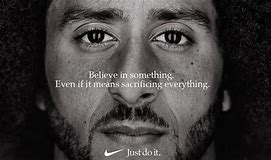
The news that Rihanna declined the opportunity to perform during half time at the 2019 Super Bowl in support of Colin Kaepernick again brings attention to the attacks on peaceful protest by the current Republican administration and many of its supporters.
San Francisco 49ers quarterback Colin Kaepernick has willingly immersed himself into controversy by refusing to stand for the playing of the national anthem in protest of what he deems are wrongdoings against African Americans and minorities in the United States.
“I am not going to stand up to show pride in a flag for a country that oppresses black people and people of color,” Kaepernick told NFL Media in an exclusive interview after the game. “To me, this is bigger than football and it would be selfish on my part to look the other way. There are bodies in the street and people getting paid leave and getting away with murder.” NFL News 8/27/2016
The current Republican administration and its supporters have demonized Kaepernick specifically, and peaceful protestors in general. In many speeches Mr. Trump has encouraged his supporters to assault protestors and attack reporters. Mr. Trump has suggested that protests should not be allowed. In many states new laws redefine peaceful protest as illegal and have significantly increased penalties for those convicted of protesting.
Believe in something even if it means sacrificing everything
Native American affairs have been a focus of the work of the Friends Committee on National Legislation (FCNL) for decades. This Quaker organization, based in Washington, D.C., works in many different ways to get legislation related to peace, justice and Native American issues written and approved. FCNL has lobbyists, but also is very effective in making it possible for anyone to give a voice to their concerns.
One of the most useful tools helps us send letters to our Congressional representatives, such as the one below about reauthorizing the Violence Against Women Act. When you click on this link https://act.fcnl.org/letter/tell-congress-reauthorize-violence-against-women-act you will be taken to a web page that has the following information about this act, including the bill number. You can easily modify the letter. Based upon the address you enter on that page, your letter will be sent to your Representative or Senator.
Ask Congress to reauthorize the Violence Against Women Act
Please support H.R.6545 to reauthorize the Violence Against Women Act.
Native American women face disproportionately high rates of violence. Most of these violent acts involve non-Indians. Prior to the reauthorization of VAWA in 2013, tribal courts did not have jurisdiction over non-Indians. The Special Domestic Violence Criminal Jurisdiction returned this jurisdiction, but it offers limited protections.
The Special Domestic Violence Criminal Jurisdiction is only for domestic violence involving non-Native perpetrators. It does not give tribes jurisdiction over crimes involving sexual assault, stalking, sex trafficking. It also does not protect children who are often victims of domestic violence and abuse.
H.R.6545 expands tribal jurisdiction to include sexual violence, sex trafficking, stalking, child violence and violence against tribal law enforcement attempting to execute these provisions. This bill also improves the coordination and collaboration between tribal, local, and federal jurisdictions in response to cases of missing or murdered Natives. It will also improve tribal access to federal databases for Missing cases. These provisions are huge steps forward to protecting Indian Country’s most vulnerable.
Please support the tribal provisions in H.R. 6545 to reauthorize the Violence Against Women Act and cosponsor this bill. Tribes need the jurisdictional authority to protect their people from all forms of violence.
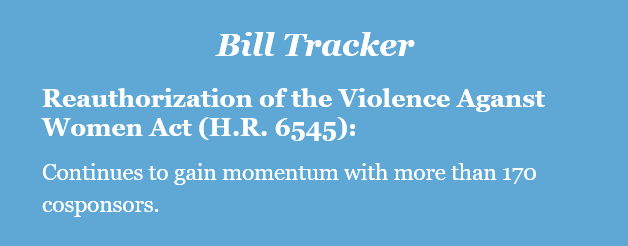
The monthly Native American Legislative Update includes information about relevant bills and ways for you to contact your representatives about them. This month, for example, besides the link to the letter above, updates of the status of the bill is provided:
What We’re Reading:
A recent court hearing found that the Indian Child Welfare Act of 1978 illegally gives Native American families preferential treatment based on race in adoption proceedings for Native American children.
The Supreme Court declined to overturn North Dakota’s controversial voter ID law, which requires residents to show identification with a current street address. A P.O. box does not qualify. Many residents on Native American reservations, however, do not have street addresses.
A record number of Native women candidates are running for office this year. They have formed a strong network “Standing Shoulder to Shoulder.”
Lacina Tangnaqudo Onco (Shinnecock/Kiowa) Congressional Advocate Native American Policy Program
I hope you have had an intense experience that changed you so much you had trouble returning, or could not return to what had been your routine. A life changing experience. I have been blessed to have had a number of such experiences, the most recent of which was marching 94 miles on the First Nation-Farmer Climate Unity March, which I have written a lot about.
After eight days of sharing our stories with each other on the March and being with people who care deeply about Mother Earth, I’m finding it difficult to return to a society that refuses to acknowledge our unfolding environmental chaos, even in the face of more violent storms and flooding, rising temperatures and fierce fires, and spreading areas of long term drought.
I’m finding it difficult to return to a political situation where our deepest values and liberties have been, and continue to be systematically eroded. Where profit is what drives our national political decisions. Where we no longer find basic human decency.
In the midst of all this, can we find the courage to face climate change?
Climate scientist Kate Marvel writes:
I have lived a fortunate, charmed, loved life. This means I have infinite, gullible faith in the goodness of the individual. But I have none whatsoever in the collective. How else can it be that the sum total of so many tiny acts of kindness is a world incapable of stopping something so eminently stoppable? California burns. Islands and coastlines are smashed by hurricanes. At night the stars are washed out by city lights and the world is illuminated by the flickering ugliness of reality television. We burn coal and oil and gas, heedless of the consequences.
Our laws are changeable and shifting; the laws of physics are fixed. Change is already underway; individual worries and sacrifices have not slowed it. Hope is a creature of privilege: we know that things will be lost, but it is comforting to believe that others will bear the brunt of it.
We are the lucky ones who suffer little tragedies unmoored from the brutality of history. Our loved ones are taken from us one by one through accident or illness, not wholesale by war or natural disaster. But the scale of climate change engulfs even the most fortunate. There is now no weather we haven’t touched, no wilderness immune from our encroaching pressure. The world we once knew is never coming back.
I have no hope that these changes can be reversed. We are inevitably sending our children to live on an unfamiliar planet. But the opposite of hope is not despair. It is grief. Even while resolving to limit the damage, we can mourn. And here, the sheer scale of the problem provides a perverse comfort: we are in this together. The swiftness of the change, its scale and inevitability, binds us into one, broken hearts trapped together under a warming atmosphere.
We need courage, not hope. Grief, after all, is the cost of being alive. We are all fated to live lives shot through with sadness, and are not worth less for it. Courage is the resolve to do well without the assurance of a happy ending. Little molecules, random in their movement, add together to a coherent whole. Little lives do not. But here we are, together on a planet radiating ever more into space where there is no darkness, only light we cannot see. https://onbeing.org/blog/kate-marvel-we-need-courage-not-hope-to-face-climate-change/
I am glad a friend told me about Richard Rohr’s Daily Meditation from the Center for Action and Contemplation. The following by Karen Armstrong appeared in contemplations about Unknowing.
Our scientifically oriented knowledge seeks to master reality, explain it, and bring it under the control of reason, but a delight in unknowing has also been part of the human experience. Even today, poets, philosophers, mathematicians, and scientists find that the contemplation of the insoluble is a source of joy, astonishment, and contentment.
One of the peculiar characteristics of the human mind is its ability to have ideas and experiences that exceed our conceptual grasp. We constantly push our thoughts to an extreme, so that our minds seem to elide naturally into an apprehension of transcendence.
One of the conditions of enlightenment has always been a willingness to let go of what we thought we knew in order to appreciate truths we had never dreamed of. We may have to unlearn a great deal about religion before we can move on to new insight. Karen Armstrong, a religious historian and creator of the Charter for Compassion
I’ve often thought about the importance of making mistakes. Making mistakes is a process that can be used to explore what is unknown, and begin to know something, or something more, about it.
I have come to appreciate the wisdom of the saying “that if you do something successfully you don’t learn anything new”. You learn by making mistakes. You try something new, and find out if that worked or not, in either case gaining knowledge you didn’t have before.
Digital photography made it very easy to experiment, since the results are immediately available to see on the camera. Far different from the old film and paper processes that were very time intensive and rigorous. With digital photography, I became aware that I was purposely choosing difficult conditions under which to capture images with my camera. The more I tried to photograph difficult images, the more I learned. One of the more extreme examples was when I took over 900 photos of an 18 foot tall sculpture, in different lighting and weather conditions, over more than a year’s time. I eventually began to learn how to pull the color out of the glass inserted in the rings of the sculpture. And I learned a lot about composition as I took photos from all angles, and from inside the rings. I even put the camera on a tripod, clicked the 10 second delay, and threw the camera up in the air to get photos from above. Learning from mistakes is a way to change unknowing to knowing about the subject at hand.
Open Eyes
Open Eyes
Open Eyes
Open Eyes
Open Eyes
I like this word, UNKNOWING. Much of my life has been about learning about what is unknown to me. I was one of those kids who enjoyed school and doing homework. One of the greatest influences of spending my high school years at Scattergood Friends School and Farm, was an even greater appreciation of life long learning, and acquiring the tools needed for that endeavor.
This love of learning eventually led to my career in medical research. Part of that work involved software engineering, and as any computer programmer knows, you have to learn something new nearly every single day. The languages, tools and frameworks used for computer programming are continually being updated, or completely new ones become available. And the purpose of research is to learn more about something unknown.
What really caught my attention in the quotation above was “one of the conditions of enlightenment has always been a willingness to let go of what we thought we knew in order to appreciate truths we had never dreamed of.” One of the greatest frustrations throughout my life has been the frustration of finding ways to tackle injustice. There are so many injustices and they seem so deeply embedded in our societies.
We do not know what it is that we don’t know. To discover what those things are, we have to learn. And we most effectively learn by our own experiences, especially from our own mistakes.
All justice is interrelated, but the area that has been my deepest concern relates to environmental destruction and chaos. The Quaker approach is to live your life as an example that others might emulate, thereby creating change. While that works in some cases, it seems not always. Nearly forty years ago I was led to see that we could not preserve our environment if everyone in developed countries owned and operated their own automobile. So I gave up having my own car. Forty years later, I don’t think I’ve influenced one person to give up theirs. Many people know my story and many have engaged with me about cars. Unfortunately, always saying they would like to give up their car(s), but… I know simply using logic and facts does not work to convince people. I have to keep reminding myself that the result I wanted might not have been what the Spirit wanted to happen. All I can do is continue to live as the Spirit leads me.
In a similar way, I haven’t found effective ways to get white people to see how privilege and racism are built into our society. Found ways to help people understand the economic and social and environmental injustices that are built into our non-native cultures. Unable to make others see we have to return to the example of Native lives, with their respect for Mother Earth and each other, if we are going to have any success in dealing with our unfolding environmental chaos.
What does this have to do with unknowing?
At a fundamental level, I believe change cannot happen as long as a person is afraid of the unknown, when they are afraid to acknowledge their unknowing. When a person fears change, they cling ever more tightly to what they think they do know. And are too afraid to even consider they might be wrong. Even though I think they often subconsciously fear they might be wrong.
It seems to me we need to find ways to help people find the courage to embrace unknowing. To experience the joy of discovering something new. To learn that it is not only alright to make mistakes, but it is important to do so.
The reason I wanted to participate in the First Nation-Farmer Climate Unity March was because I was aware of my ignorance about Native Americans and their beliefs. This was one area of my unknowing. I admit there was a little tension about the endeavor–mainly whether I had the physical stamina to walk 94 miles, but also being not only with people I didn’t know, but people of a different culture. But I embraced this unknowing. I wanted to learn about Native Americans. I knew ahead of time I would make mistakes, and I did. But I learned new things from those mistakes.
As Manape said during the March, the reason we are marching together is so we can work together in the future. To do that, we need to begin to trust each other. To trust each other we need to understand each other. From all I’ve seen and heard, I believe we did begin to build that understanding and trust.
In our broader communities we need to work on this understanding, and trust building. But that can’t happen until we find ways to spend time, significant time, with those who are unknown to us. Until we are not only willing, but want to put ourselves in situations where we are likely to make mistakes. And to know this is how we come to know what it is that we don’t know. And to know the joy of discovering that new knowledge.
It’s ironic that the sculpture above is named “Open Eyes” (it is in front of the Ophthalmology Department at the Indiana University Medical Center.) One way to think about approaching unknowing is to open our eyes.
A Warrior knows that the ends do not justify the means.
Because there are no ends, there are only means. Life carries him from unknown to unknown. Each moment is filled with this thrilling mystery: the Warrior does not know where he came from nor where he is going.
But he is not here by chance. And he is overjoyed by surprises and excited by landscapes that he has never seen before. He often feels afraid, but that is normal in a Warrior.
If he thinks only of the goal, he will not be able to pay attention to the signs along the way. If he concentrates only on one question, he will miss the answers that are there beside him.
That is why the Warrior submits.
Coelho, Paulo. Warrior of the Light: A Manual (p. 131). HarperCollins. Kindle Edition.






 Quakers, social justice and revolution