I can think of no greater failure of our society than the accelerating rate of school shootings. Protecting our children is our most sacred duty.
And yet even the most common sense policies for gun control are shut down by corrupt politicians controlled by the gun lobby. Even President Obama was powerless.
But as he laid out the executive actions he’s taking to curb gun violence in the East Room Tuesday, the President wiped tears from his face. His emotions were stirred while reflecting on the “college students in Santa Barbara, and from high schoolers at Columbine, and from first graders in Newtown” who had their “inalienable right to life” stripped from them by a barrage of bullets. He repeated “first graders,” before pausing to rest his arm on the podium, his eyes beginning to fill. “Every time I think about those kids it gets me mad,” he said with a stream trickling down his nose. “And by the way, it happens on the streets of Chicago every day.”
It is unbearable to see the terrified, tear stained faces of little kids leaving schools where yet another incident of gun violence just occurred. Children everywhere are aware, and affected by each school shooting.
Each time a student has to go through a metal detector, it is a reminder. Armed guards, and even teachers, are not only a reminder, but in many induce more fear. Children of color, especially, are afraid of law enforcement officers, knowing how many unarmed kids are killed in their neighborhoods. I can’t image the trauma of being forced to be in a building where there are armed people. In the latest school shooting at the STEM school in Colorado it looks like an armed school guard shot a student (that won’t be known until ballistic tests are done, we’re told. But how long does it take to do such a test?). The way to reduce violence is not to escalate the use of violence. People of faith, especially, need to be bringing this to the discussions of school shootings.
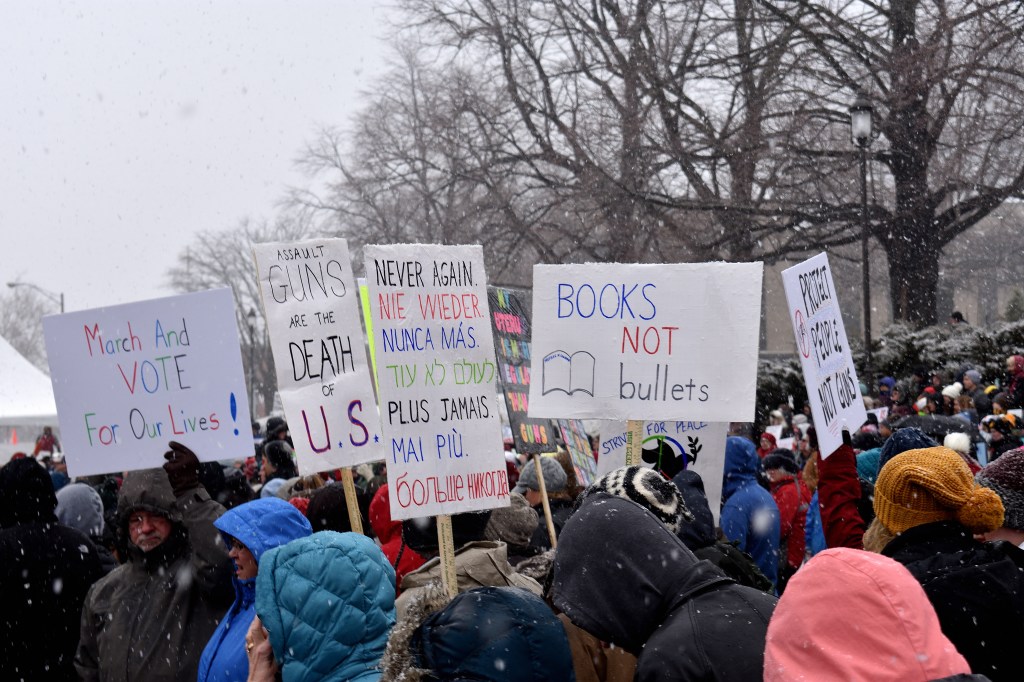
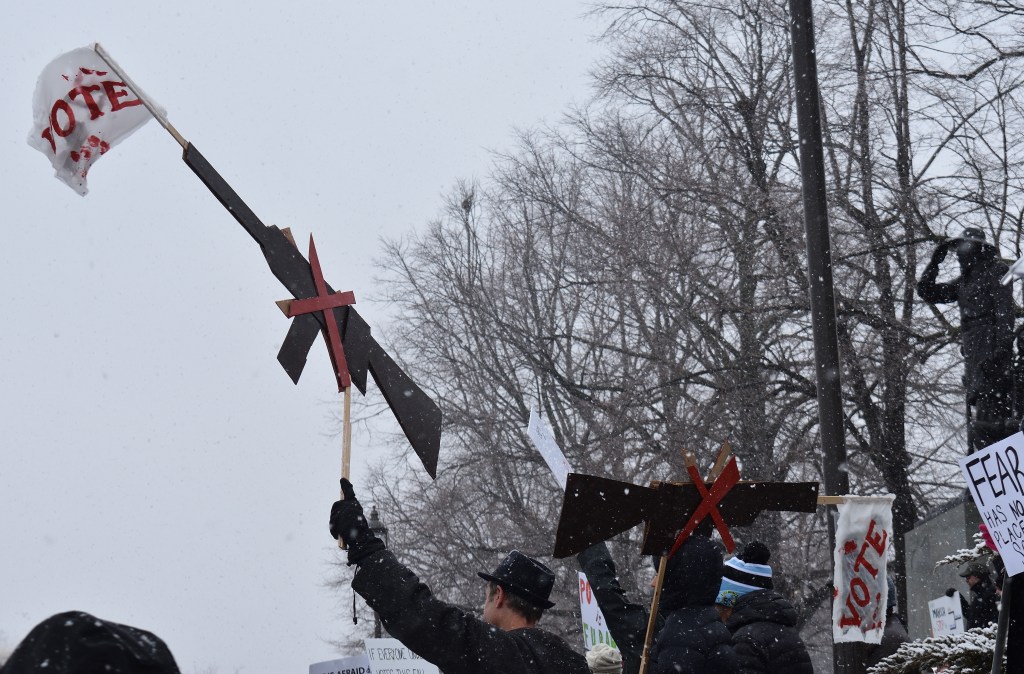
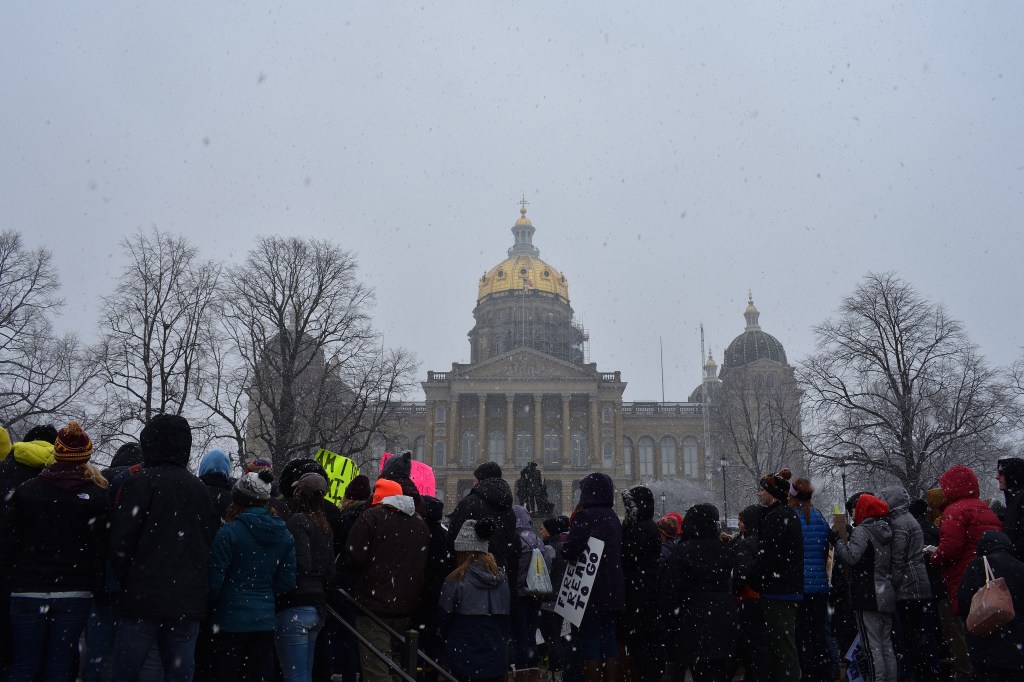
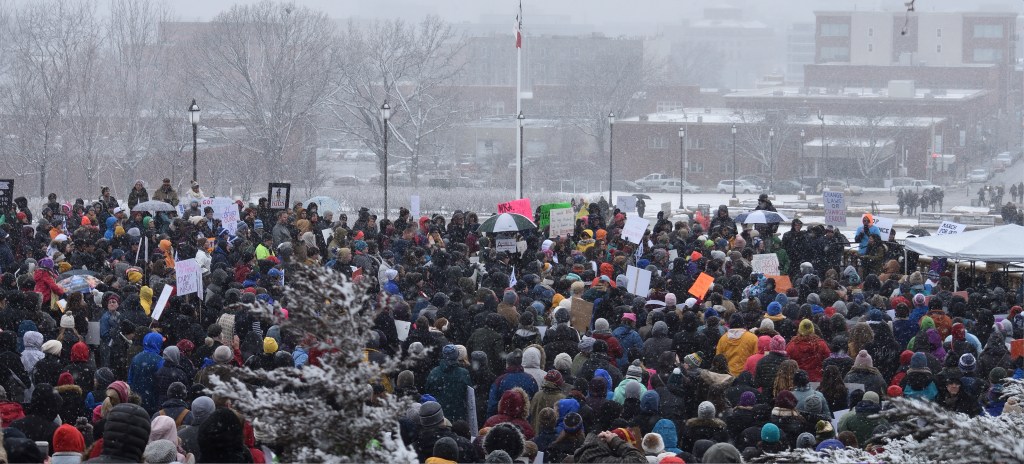
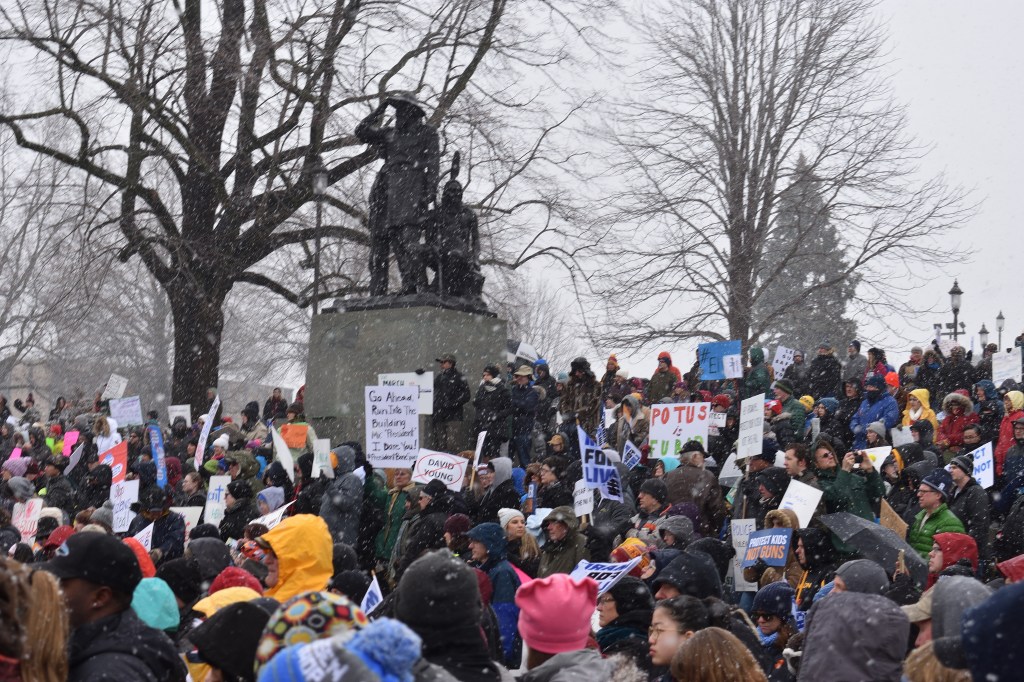
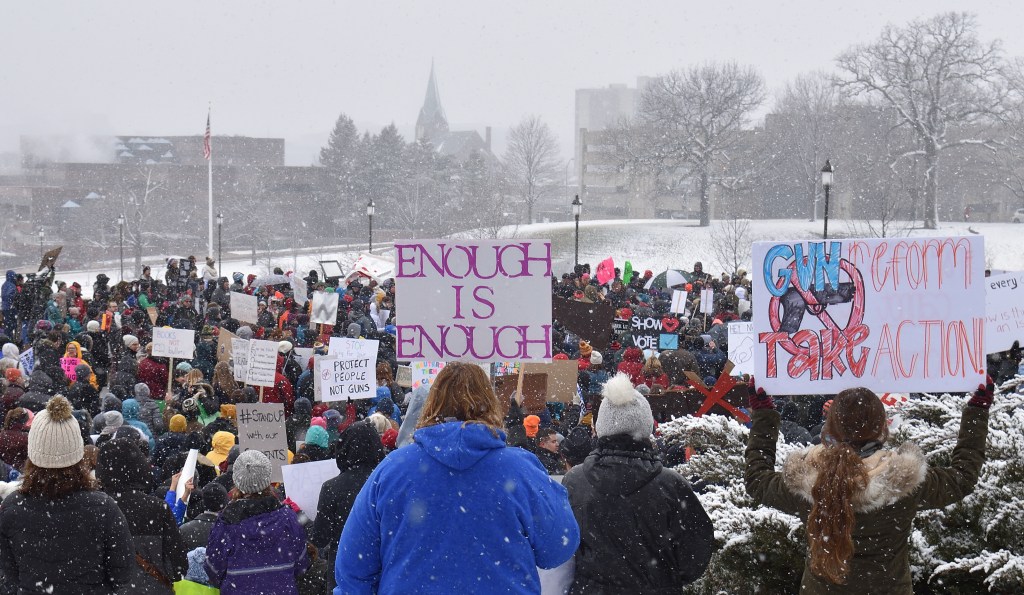
On February 14, 2018, a gunman opened fire at Marjory Stoneman Douglas High School in Parkland, Florida, killing seventeen students and staff members and injuring seventeen others. Since then Parkland students have spoken eloquently about gun violence. National “March for our Lives” events have been held. And yet very little has changed.
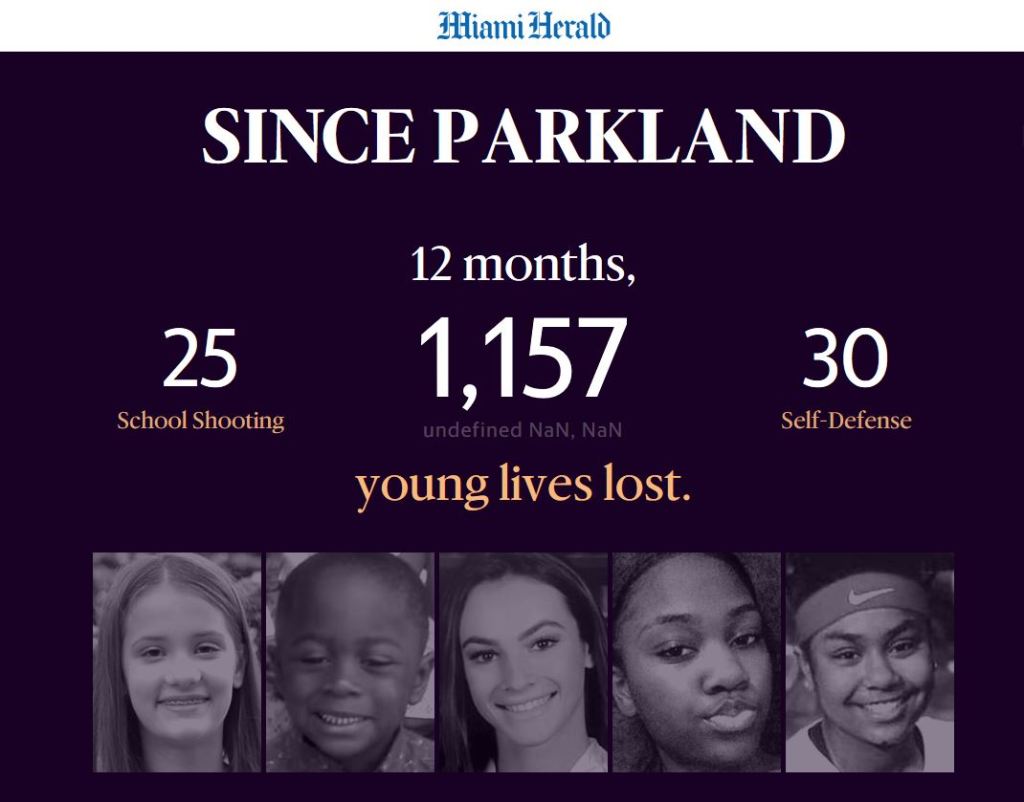
Sharing stories is one of the best ways to create change. The Miami Herald maintains a website named SINCE PARKLAND with many stories related to school gun violence.
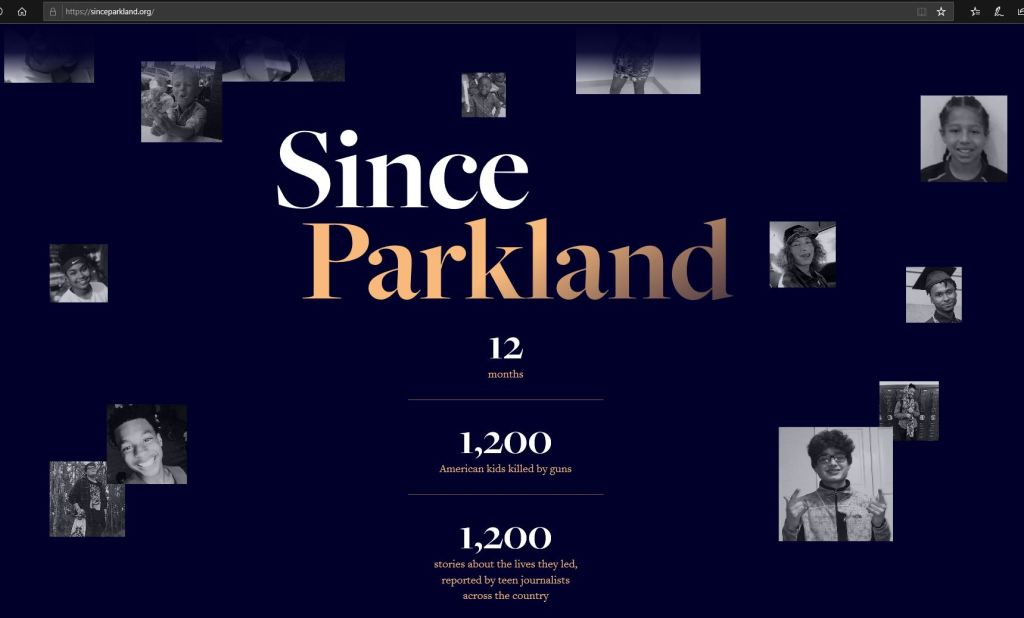
A related website, SINCE PARKLAND.ORG, includes a list of the names of all the young lives lost, and stories about each of those children. The list of names looks eerily similar to the Vietnam War Memorial in Washington, DC.
Yesterday I wrote about some history related to how the U.S. got involved with the Vietnam and Iraq Wars. About how flimsy the rationale to start those wars was, and the parallels today as we see the same pattern developing, moving us closer to conflict in Iran, which would likely spread to other countries in the Middle East and possibly beyond.
Unfortunately, Iran is not the only country the U.S. has heightening tensions with, which include North Korea, China, Russia and Venezuela. This is an especially perilous time, with a President and Cabinet members who are ill-informed about international affairs, and the State Department’s decimated diplomatic corps. In addition, becoming involved in conflict has been used in the past as an attempt to help a president’s election chances.
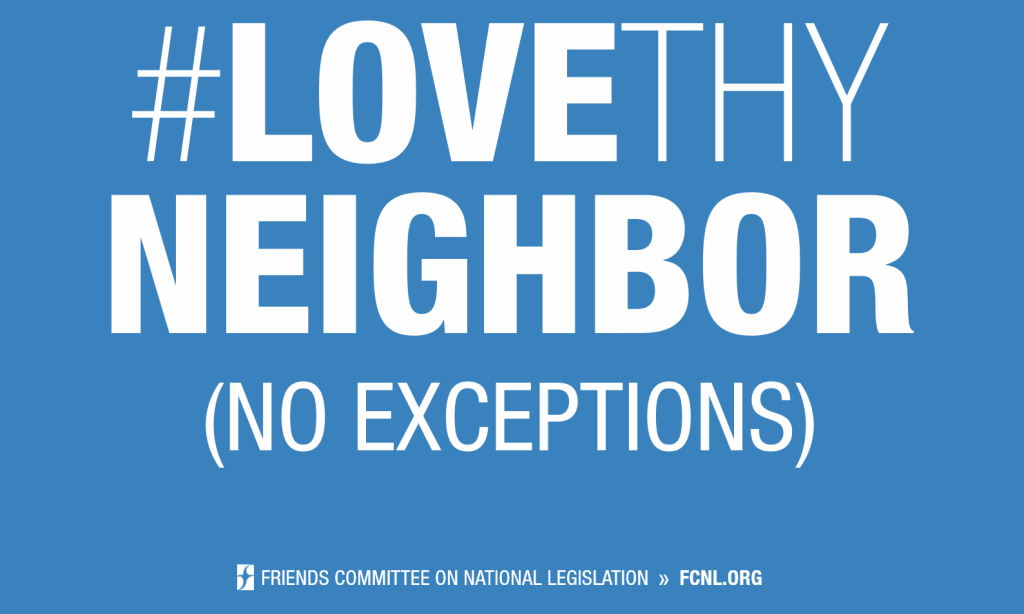
The Quaker lobby organization, the Friends Committee on National Legislation (FCNL) has a 75 year history of working with Congress and the Administration in a non-partisan manner to support legislative and diplomatic efforts for peace and justice. Part of the effectiveness of FCNL is the large network of supporters, and the tools FCNL provides to help them engage in our democratic processes. Of course everyone is welcome and encouraged to use these tools. It is important that our representatives hear from those of us who want to deescalate the conflicts and prevent war.
Among those tools are very informative articles about current affairs, and online tools to help anyone write a letter to the editor, or letters to their Congressional representatives. Suggested content for such letters, which people are encouraged to modify, are then sent to the appropriate Senators, Representatives, and/or the Administration based upon the writer’s home address.
As another example, the following is recent information from FCNL about Iran.
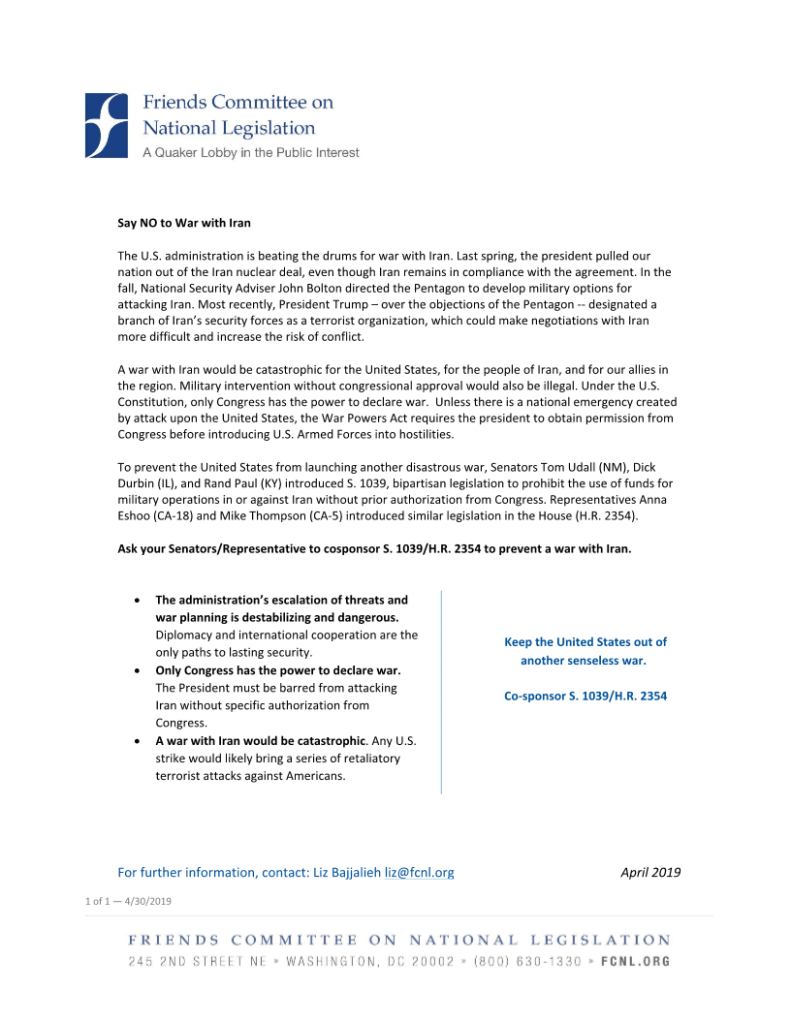
Earlier this year President Donald Trump said, “Great nations do not fight endless wars.” Yet his administration continues to drag our country towards war, this time with Iran. First he pulled us out of the Iran nuclear agreement and re-imposed sanctions. Then he designated the Revolutionary Guard Corps as a terrorist organization over the objections of the Pentagon, and tightened sanctions even further. Now the Secretary of State is suggesting that Trump already has permission from Congress to go to war. Fortunately, a bipartisan group of senators and representatives are taking steps to prevent an unauthorized war. Sens. Tom Udall (NM), Rand Paul (KY) and Richard Durbin (IL), and Reps. Anna Eshoo (CA-18) and Mike Thompson (CA-5), recently introduced the “Prevention of Unconstitutional War with Iran Act of 2019” (S. 1039/H.R. 2354). These bills would ban funding for a U.S. military attack against Iran without specific, prior authorization from Congress. The legislation would thus assert the constitutional authority of Congress to determine if and when the U.S. goes to war. Act now. Urge your members of Congress to cosponsor the “Prevention of Unconstitutional War with Iran Act” (S. 1039/H.R. 2354) to prevent war with Iran. Legislative Ask Say NO to War with Iran › Co-sponsor S. 1039/H.R. 2354 The U.S. administration is beating the drums for war with Iran. Last spring, the president pulled our nation out of the Iran nuclear deal, even though Iran remains in compliance with the agreement. In the fall, National Security Adviser John Bolton directed the Pentagon to develop military options for attacking Iran. Most recently, President Trump – over the objections of the Pentagon — designated a branch of Iran’s security forces as a terrorist organization, which could make negotiations with Iran more difficult and increase the risk of conflict.
That article includes a link to a page where you can write a letter to your member of Congress, asking them to co-sponsor a specific bill, in this care S. 1039/H.R. 2354 “Prevention of Unconstitutional War with Iran Act. Following is the page where you enter your information so the letter will be sent your representatives.
After you fill in that information, the next page appears:
Letter to Congressional representative
You should note in the picture above there are two tabs: Message 1 -Cindy Axne, which is the letter you see above. At the bottom of the page is a link that says NEXT MESSAGE, which will take you to the following page to send a similar letter to your Senators.
There are similar tools to help you write a letter to your newspaper, including a link to choose which newspapers to send your letter to.
I recently saw the tulips that Pella, Iowa, is famous for. They reminded me of the photograph below that was selected for the Glick Public Art Project. At the time I was working at Riley Hospital for Children, part of Indiana University Medical Center in Indianapolis. The Glick Eye Institute was located near Riley. Someone once said these tulips looked like cups of light. I really like that expression.
Tulips
Glick Public Art Project
Public Art for the Eugene and Marilyn Glick Eye Institute – 2012 Request for Proposals
Deadline: October 31, 2012
The Eugene and Marilyn Glick Eye Institute Public Art Committee seeks proposals from artists with a connection to Indiana for art to be displayed in the Eugene and Marilyn Glick Eye Institute. The Glick Eye Institute is home to the IU Health Ophthalmology Center, the Department of Ophthalmology’s Optical Shop, research labs, conference space and ophthalmology administrative offices. All kinds of art will be considered for the building, which is nearly 80,000 square feet on four floors.
Why is public art being sought for the Eugene and Marilyn Glick Eye Institute?
It is important to have visual stimulation in a building dedicated to preserving eyesight and reducing vision impairments. Public art is being considered because a limited budget is available for purchased art. While an anonymous donation provided seed funding to purchase some art, and while fundraising to purchase new art continues, we must rely on the generosity of Indiana artists and artists who trained in Indiana to exhibit their works in the Glick Eye Institute.
We seek art that depicts or expresses vision, light, color, perspective and/or reflection.
My Submission
I still remember how astonished I was when I put on my first pair of eyeglasses and the world suddenly came into focus in incredible detail. It was like magic. I loved to read, and was aware of how important the eyeglasses were in making reading much easier and more enjoyable. I’d always been interested in science, so I learned the basics of optics. And I’ve had a lifelong, intense interest in photography, learning the theory and application of techniques to capture images. With photography I try to paint a picture with light in its many intensities, colors, and contrasts. I try to use novel perspectives and compositions to both better define three dimensional objects with a two dimensional medium, and to catch the viewer’s attention so he/she might look at something a little differently. I learned to do darkroom work in both high school and college, but am grateful for the digital revolution, which provides much greater control of almost all aspects of photography.
As a Quaker, and having been raised on working farms in Iowa, I have always had great interest in and concern for our environment. I use photography to try to promote appreciation for our natural world.
EUGENE AND MARILYN GLICK EYE INSTITUTE
INDIANA UNIVERSITY School of Medicine
December 4, 2012
Dear Jeff,
Thank you for submitting your photography for consideration to the Eugene and Marilyn Glick Eye Institute’s Public Art Project.
We were fortunate to receive 123 submissions; all of the art was thoroughly reviewed by a committee comprised of IU School of Medicine faculty and staff, and artists from the Indianapolis community.
The committee is interested in exhibiting the photograph titled “Tulips” in the Glick Eye Institute for the calendar year 2013. We will accept the art for exhibition in January and will be in touch to arrange a mutually convenient date for delivery. Your pieces must be ready to hang; our facilities services employees and the IU art curator will oversee the installation.
Additionally, we wish to continue to incorporate your photography of “Open Eyes” in the institute’s printed materials and website. We thank you for allowing us to use those images.
Again, thank you for submitting your work. We appreciate your participation.
Sincerely,
Jeff Rothenberg, M.D.
Chair of the Glick Eye Institute Public Art Committee Eugene and Marilyn Glick Eye Institute
We are clearly seeing yet another deliberate series of steps to provoke war. This time Iran seems to be the target. This video from the editors of History.com explains how President Lyndon Johnson used the alleged attack on U.S. Navy destroyers in the Gulf of Tonkin to get support from Congress and the country to begin the Vietnam War. Johnson wanted the war in Vietnam as a way to stop the spread of Communism. He also saw it as a way to improve his chances for re-election, although ultimately he was forced to announce he would not run.
The video begins, “How do you start a war? Simple. You blame it on the other guy.”
The Gulf of Tonkin Resolution authorized President Lyndon Johnson to “take all necessary measures to repel any armed attack against the forces of the United States and to prevent further aggression” by the communist government of North Vietnam. It was passed on August 7, 1964, by the U.S. Congress after an alleged attack on two U.S. naval destroyers stationed off the coast of Vietnam. The Gulf of Tonkin Resolution effectively launched America’s full-scale involvement in the Vietnam War. Congress passed the Gulf of Tonkin Resolution at the insistence of President Lyndon B. Johnson, with the understanding that the president would seek their approval before launching a full-scale war in Vietnam with U.S. military personnel. However, that ultimately proved not to be the case.
More recently, and more transparently, President George W. Bush and his Vice President, Dick Cheney, declared Iraq had weapons of “mass destruction”, which provided the excuse to invade Iraq in 2003. John Bolton, currently the National Security Advisor, was one of those then, who repeatedly made that claim. As we know, it turned out there were no such weapons in Iraq.
So it is concerning today that Bolton, who called for the U.S. to leave the Iran Nuclear Deal, seems to be trying to provoke war with Iran now.
Bolton’s influence over Iran policy has been more worrisome. Given his long record of advocating military action against Iran, Bolton sparked concerns at the Pentagon last year that he could be trying to precipitate a conflict when he demanded military options against Iran. Those concerns were hardly assuaged when in February, on the 40th anniversary of the Iranian revolution, Bolton posted a video warning the ayatollahs: “I don’t think you’ll have many more anniversaries to enjoy.” The U.S. confrontation with Iran took a more ominous turn on Sunday night, when Bolton announced that, “in response to a number of troubling and escalatory indications and warnings,” the Pentagon would be rushing an aircraft carrier task force to the Persian Gulf. “The United States is not seeking war with the Iranian regime, but we are fully prepared to respond to any attack,” Bolton said. In Iran, however, I fear that Bolton is trying to instigate a costly conflict that could engulf the entire Middle East.
John Bolton may be trying to provoke Iran into firing the first shot, by Max Boot, The Washington Post, May 5, 2019.
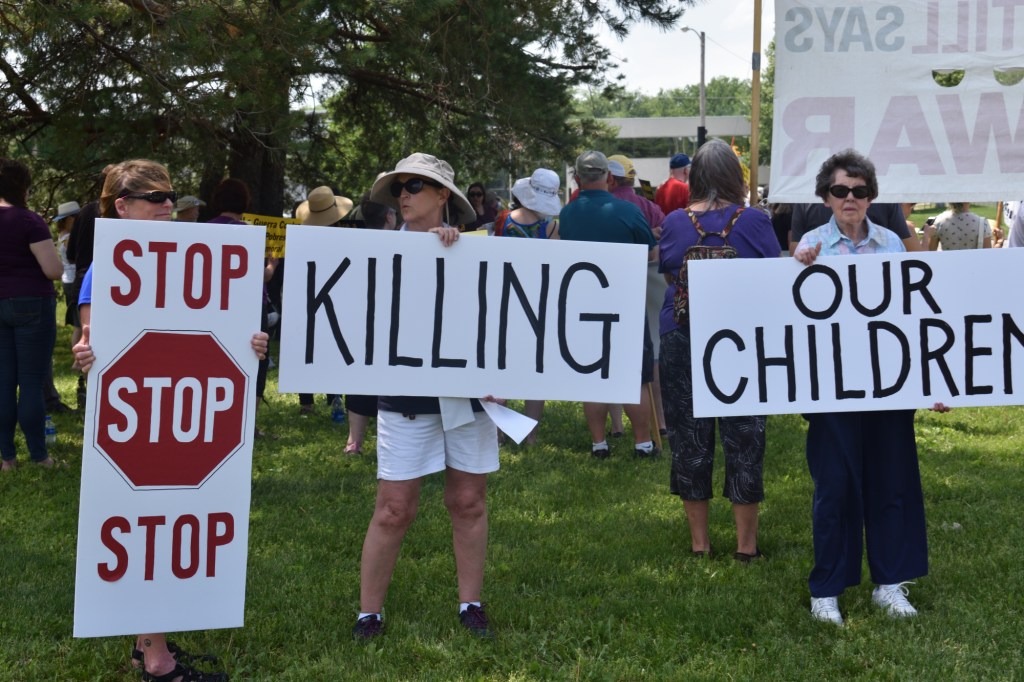
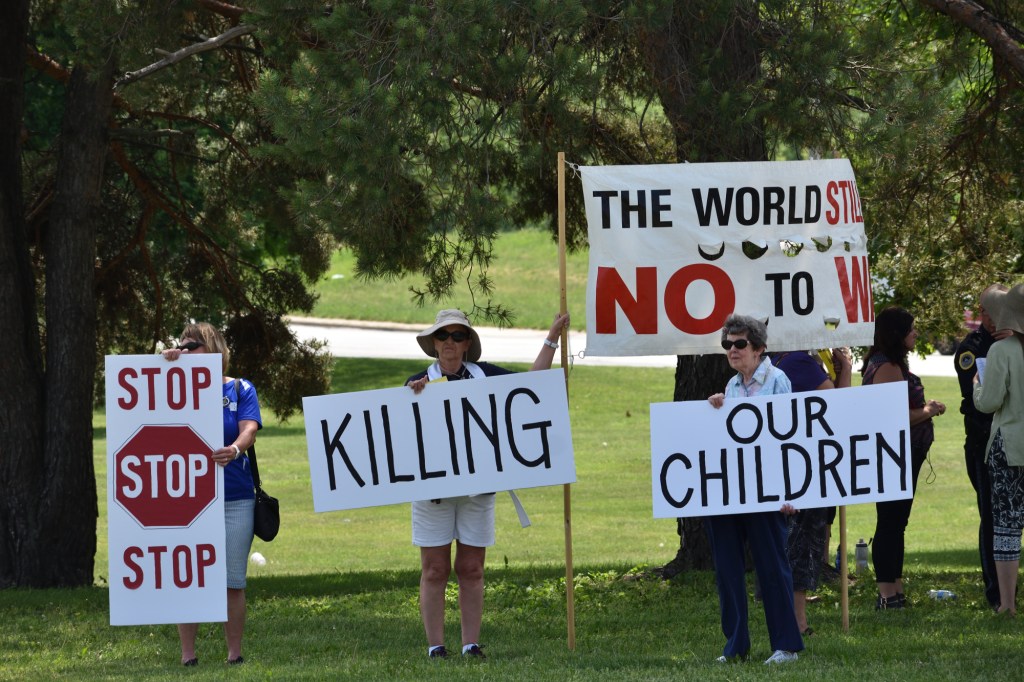
As a Quaker, I don’t believe there can ever be a justification for war. In retrospect, knowing how flimsy the justifications for the Vietnam and Iraq wars were, it seems both could have been stopped by rejecting those justifications at the time. It is tragic how easily those wars were begun.
We should make sure the United States does not begin a war with Iran. We should proactively prepare to anticipate and counter the attempted justifications that the Administration is likely to use. We should make clear to our Congressional representatives that we expect them to reject a call for war, if it comes.
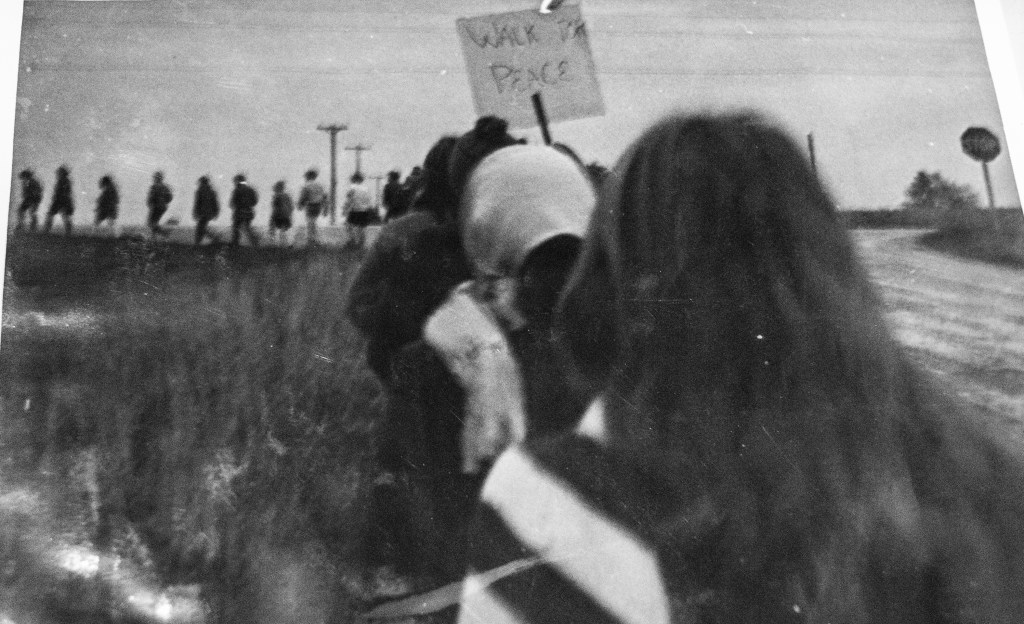
I’m old enough to remember the coordinated, national days calling for a Moratorium to End the War in Vietnam. I was a Senior at Scattergood Friends School and Farm, near West Branch, Iowa. On one of the Moratorium Days, the entire school and most of the teachers walked in silence to the University of Iowa, 12 miles away, to participate in the activities on the campus there. I remember seeing mannequins floating in the river and passionate speeches. https://kislingjeff.wordpress.com/?s=moratorium
Why don’t we organize some National Days to Prevent a War in Iran? Let’s be proactive and stop this new disaster that appears to be unfolding before our eyes now?
A new message from Chase Iron Eyes, Lead Counsel, Lakota People’s Law Project, describes the continued challenges from the flooding at Pine Ridge and a threat to the rights of anyone who protests in South Dakota, or supports those who do.
Here at the Pine Ridge Reservation, flood relief efforts are making a huge difference. Your moral support and in-kind donations directly to the Oglala Sioux Tribe have assisted families and helped us recruit the talent needed to keep pushing forward. This Thursday, a preliminary FEMA assessment team will arrive to begin analyzing the damage, and our fingers are crossed that FEMA will recognize that this community has suffered enough to justify a federal disaster declaration. We will know the outcome in June.
The other threats relate to two bills signed into law on March 27, 2019, by South Dakota Governor Kristi Noem. Leaders of the Oglala, Cheyenne River and Yankton Sioux tribes have told the Governor she is no longer welcome on their land.
It is outrageous that the tremendous costs to North and South Dakota were incurred by deploying large numbers of law enforcement officers and their equipment to oppress people who were only praying and peacefully demonstrating against the Dakota Access pipeline at Standing Rock. There was no need for those resources. They were deployed at the request of the TransCanada Pipeline company. The people of North and South Dakota have a right to be upset that they have to pay those cost, but should realize they were incurred because of TransCanada.
That also means there is no need for a bill like SB 190 because the “extraordinary expenses” came from the state’s mismanagement of the situation at Standing Rock. I find it ironic that the acronym for that bill is “PEACE”.
SB 189 created a fund to recover damages from third parties “to offset costs incurred by riot boosting.” According to the law, someone is responsible for riot boosting if that person participates in a riot or “directs, advises, encourages, or solicits other persons participating in the riot to acts of force or violence.” SB 190 was created to establish a Pipeline Engagement Activity Coordination Expenses (PEACE) fund to pay for administrative costs and “extraordinary expenses,” which are costs that come as a result of “opposition to a project that would not have been incurred but for pipeline construction” and can cover the performance of law enforcement officers, functions arising from pipeline construction, and prosecution of criminal offenses.
“I fully support the freedoms of speech and assembly, but we must also have clear expectations and the rule of law,” Noem said after signing the bills into law. “My pipeline bills make clear that we will not let rioters control our economic development. These bills support constitutional rights while also protecting our people, our counties, our environment, and our state.”
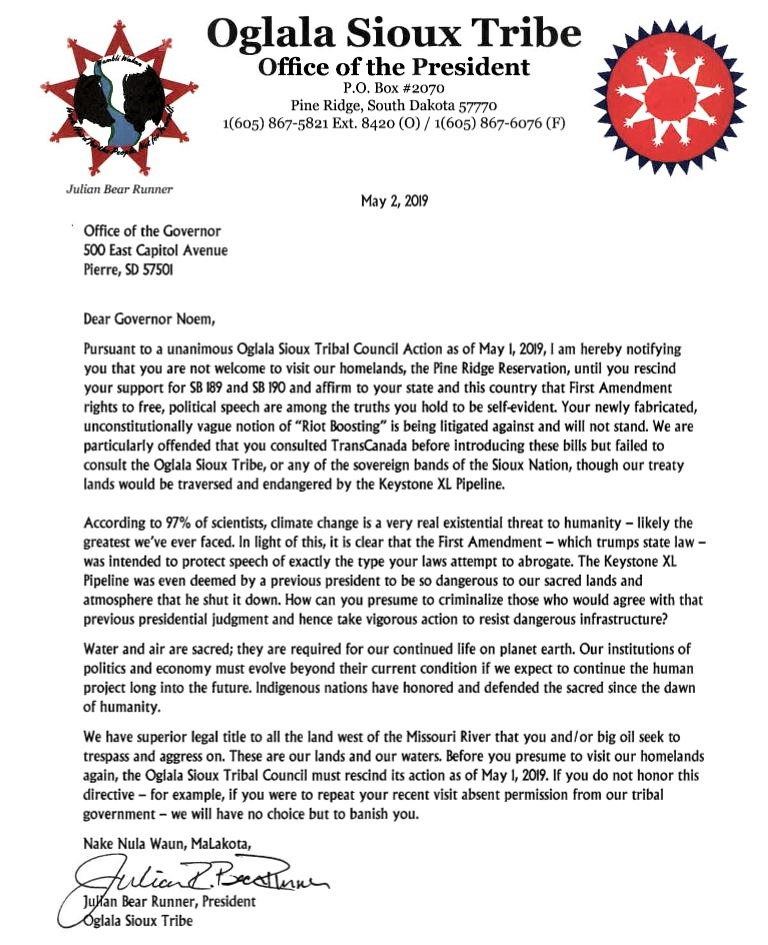
The Oglala Sioux tribal council tasked President Julian Bear Runner’s office with sending a letter informing Governor Noem of its decision. The governor provoked the ire of the council by recently introducing two so-called “riot boosting” laws. These laws, which went into effect at the end of March, allow the state to sue organizations that encourage protest against pipelines like Keystone XL and levy penalties against those who choose to exercise their First and Fourteenth Amendment rights.
The Lakota People’s Law Project will continue to support all peaceable tribal efforts to resist pipeline construction in Lakota treaty lands. And I can’t overemphasize how much we appreciate your ongoing solidarity! Please continue to stand with us, as the months ahead promise both challenge and more opportunity to make a positive difference. Keystone XL is scheduled to begin construction this summer. We will be here.
Wopila!
Chase Iron Eyes
The American Civil Liberties Union and the ACLU of South Dakota had filed a federal lawsuit in April over three South Dakota laws dealing with protests, including the law on riot boosting. The lawsuit said the laws “violate the First and Fourteenth Amendments to the Constitution by targeting and chilling protected speech, and by failing to adequately describe what speech or conduct could subject protesters and organizations to criminal and civil penalties,” according to the ACLU.
Following is a blog post I wrote a year ago. I’m sharing this again today because it provides a history of recent connections with Native Americans and Iowa Yearly Meeting (Conservative) Friends, up to when the post was written in June, 2018. (A lot has happened in the year since, but that will be covered again later). I wanted to provide this as a reminder, and because it introduces a number of people and events that can provide context for our continuing work with Indigenous people. Specifically to help us prepare for the workshops about “Toward Right Relationship with Native Peoples” that will be held at Scattergood Friends School and Farm, near West Branch, Iowa, the evening of July 6th and the morning of the 7th. The workshops in Des Moines will be held on July 8 and 9. (more here).
One evening at the annual meeting of Iowa Yearly Meeting (Conservative) in 2017, there was a panel discussion about “Building Bridges with Native Americans.” On the panel were Christine Nobiss (Indigenous Iowa and Seeding Sovereignty), Donnielle Wanatee (Meskwaki Nation) and Peter Clay (Des Moines Valley Friends). From the Yearly Meeting Minutes:
Peter shared what he has learned this past year from going to the Oceti Sacowin Camp at Standing Rock to stand in solidarity with the ongoing protests against the Dakota Access Pipeline. Christine spoke of her role in establishing ‘Indigenous Iowa’ and ‘Little Creek Camp’ and stressed the importance of decolonizing our minds and including a true history of Native Americans in the history of all of us so that we can move forward together. Donnielle Wanatee spoke of the importance of building community, and how the history of the Meskwaki tribe and settlement teaches valuable ways to do this. Both Christine and Donnielle emphasized that we all come from somewhere, are all “indigenous”, our stories and intertwined, and by not fearing but embracing the truth in our history, we can come to understand that “we are one”.
Minutes of Iowa Yearly Meeting (Conservative) 2017
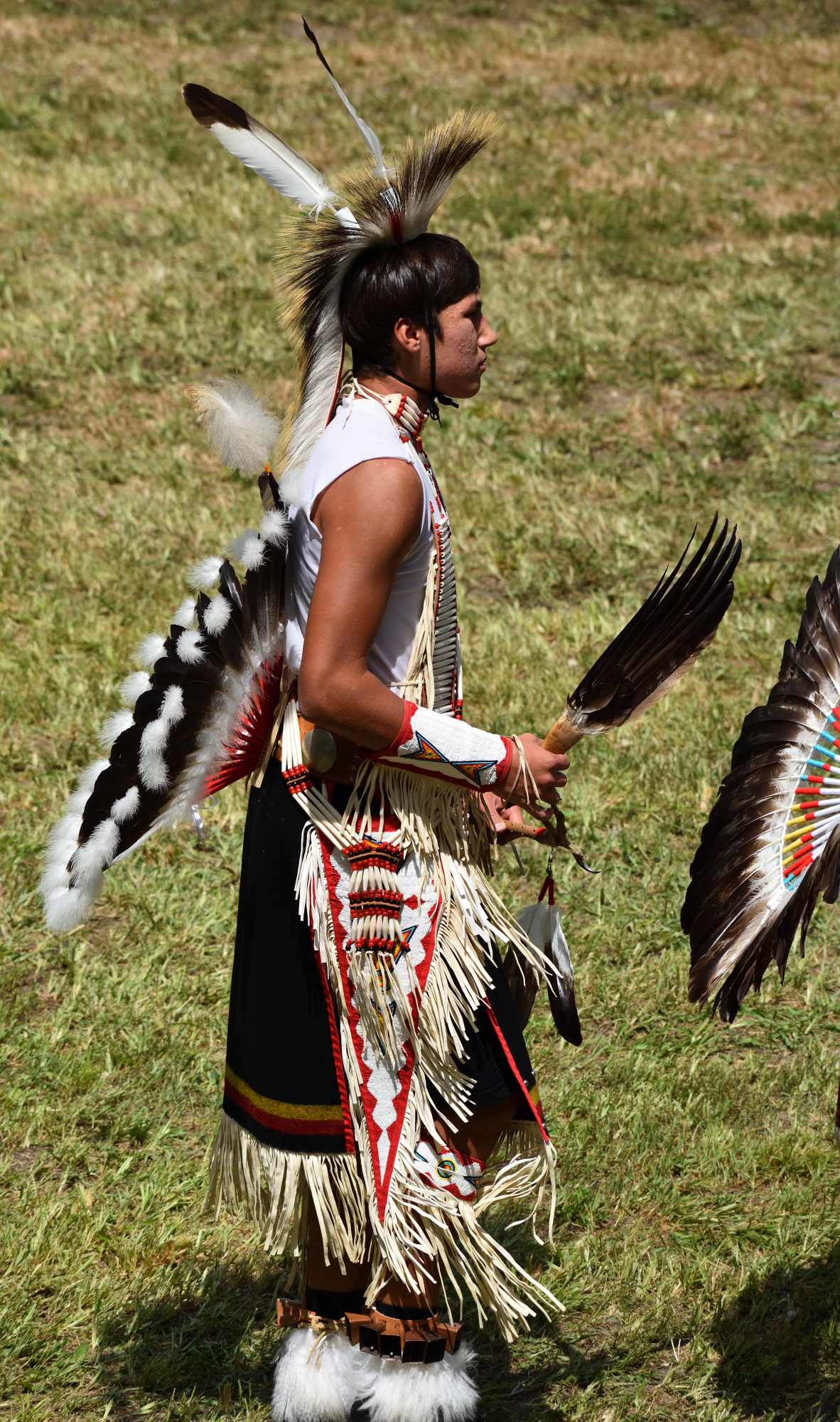
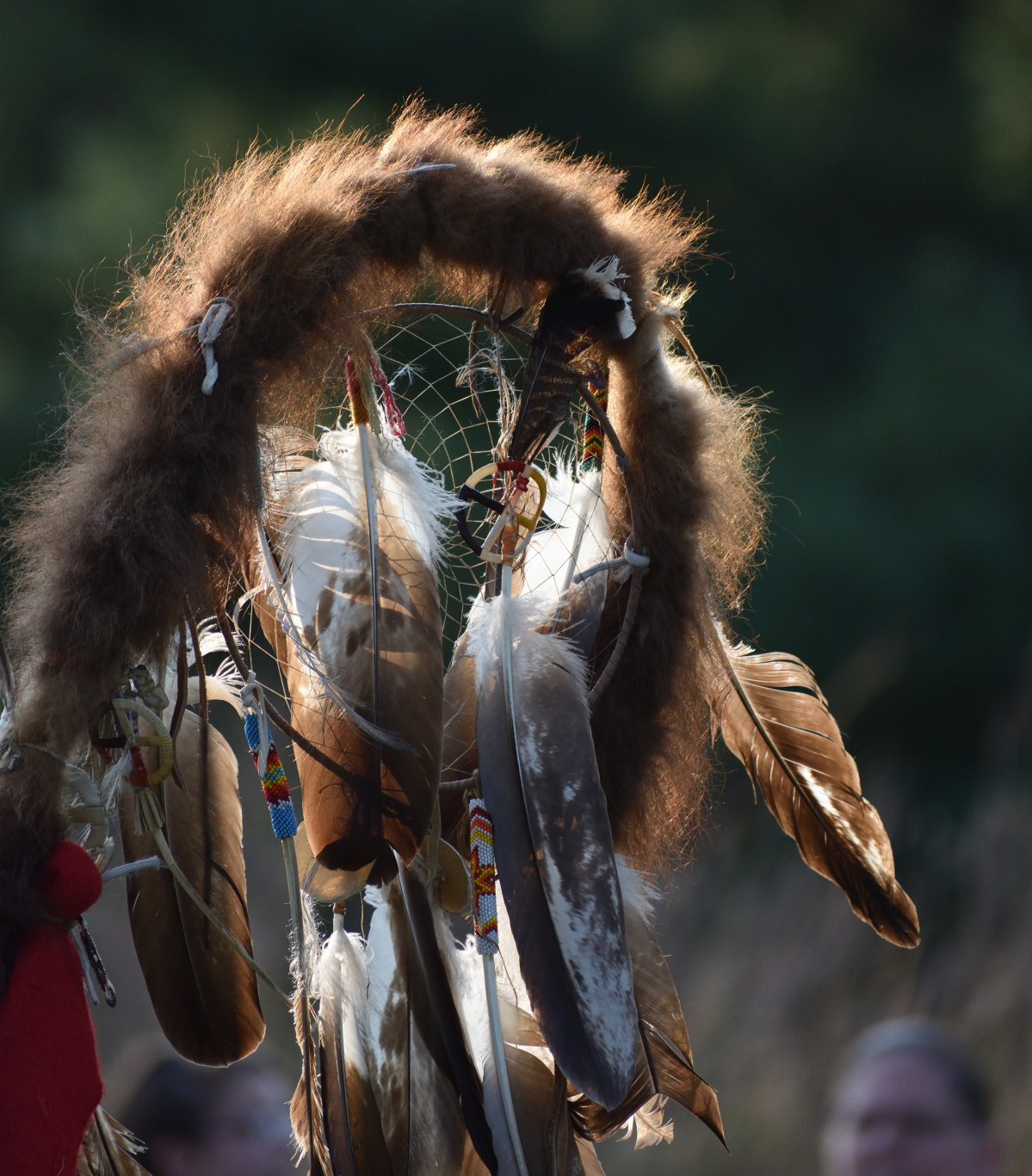
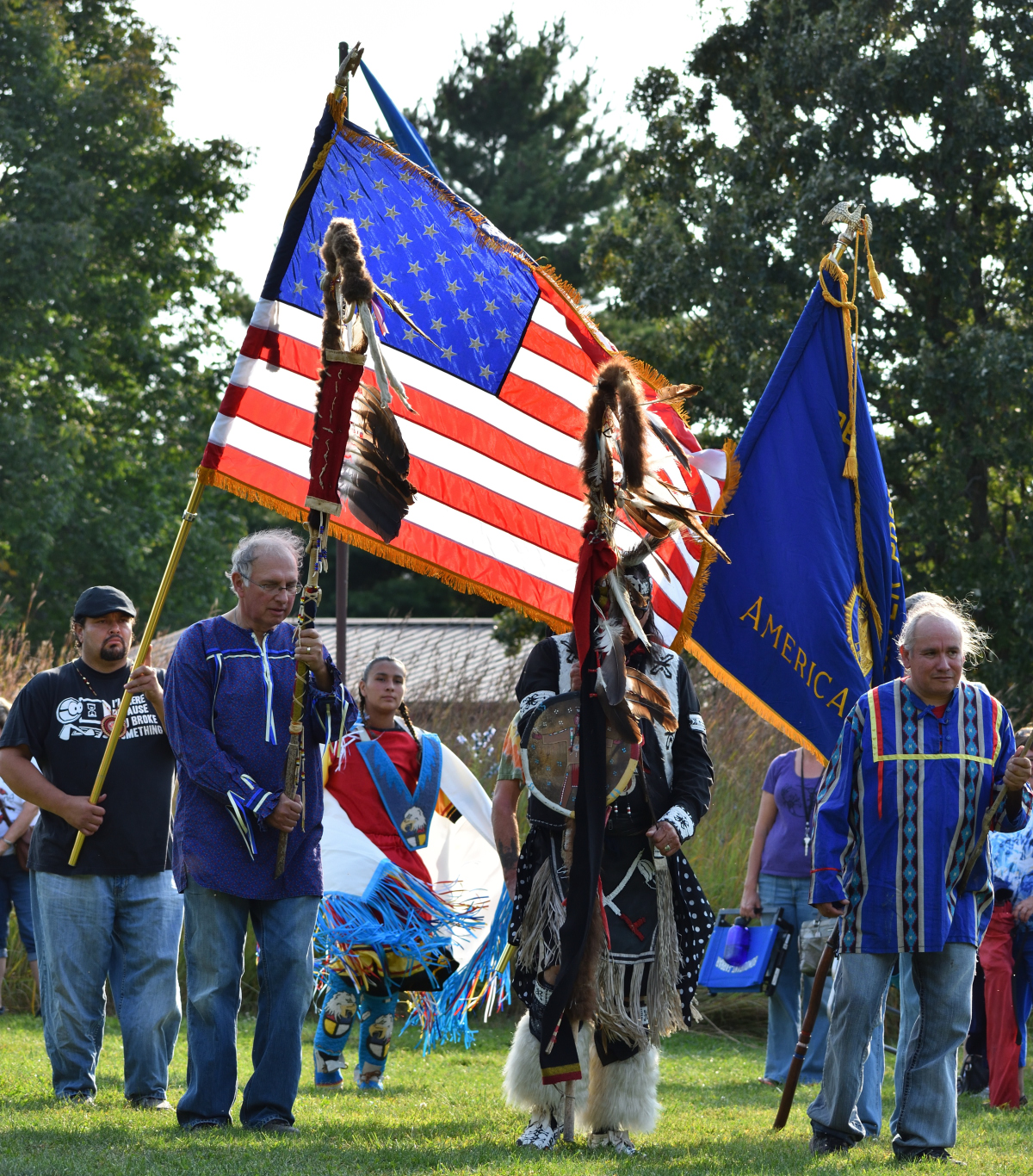
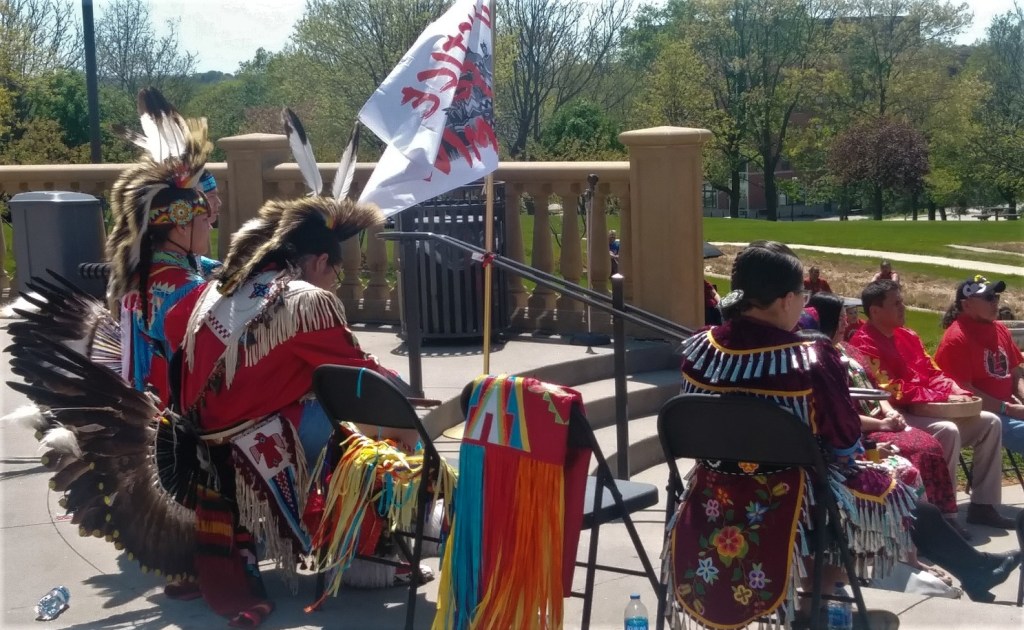
At the end of that panel discussion, Donnielle invited us to attend the annual Meskwaki Powwow, which my father and I did. (This blog post discusses permission to use these photos and the concept of cultural appropriation. I was asked to share my photos with the powwow, and did.)
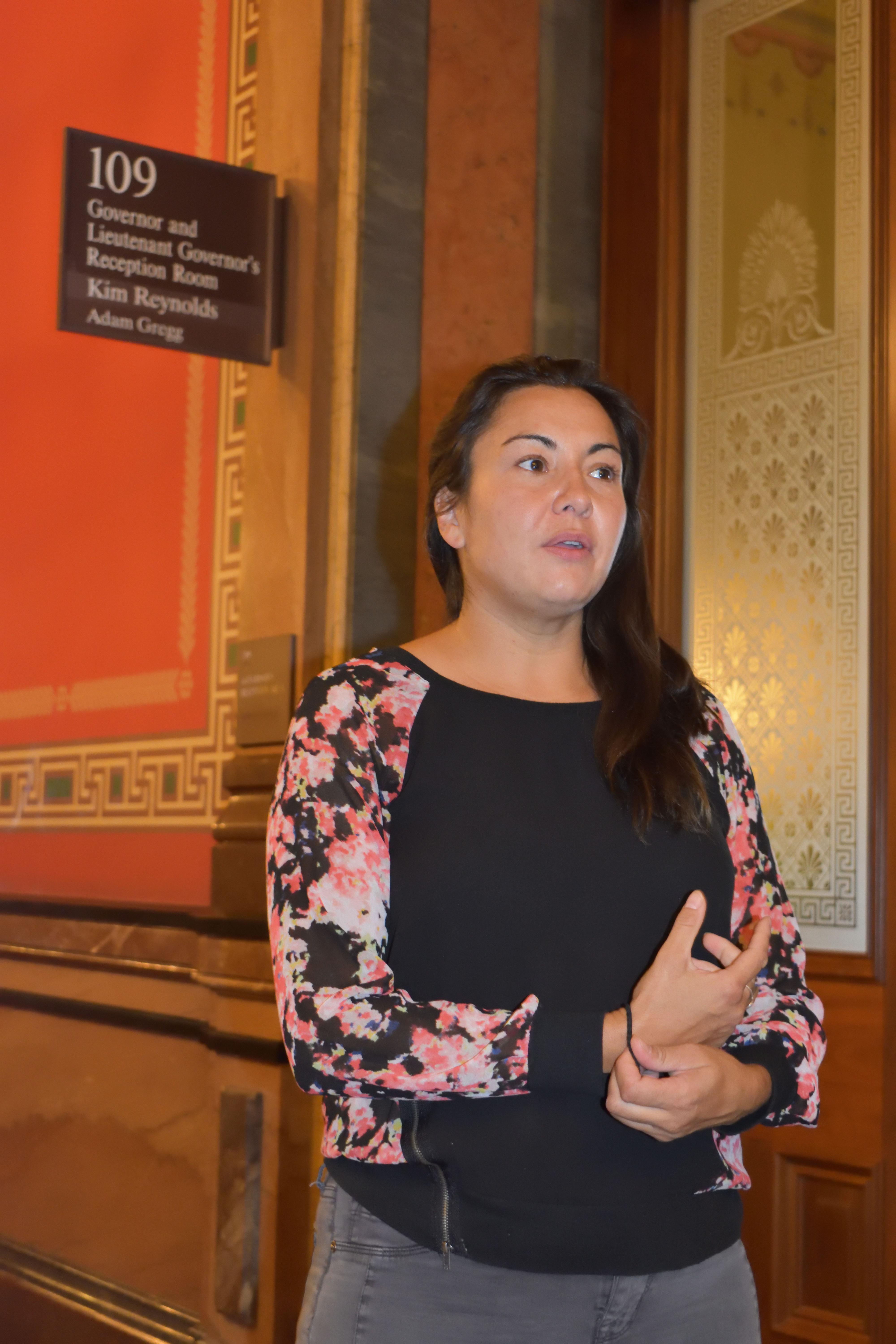
September 8, 2017, my parents dropped me and my bicycle off in Des Moines at the State Capitol building where a group of us, including Christine, delivered a petition to the governor’s office, asking for the removal of Richard W. Lozier, Jr. from the Iowa Utilities Board, because of his close ties to the fossil fuel industry. This was one of several things I was involved with as part of the national StopETP (Energy Transfer Partners) campaign events held all over the country this weekend.
The next day, as another event related to the StopETP weekend, Bear Creek Meeting invited people to attend an evening discussion about Native Americans and the Dakota Access Pipeline. I shared some of my experiences related to Nahko and Medicine for the People. The first clip I shared was Nahko saying:
Where my warriors at? And so I feel like what has been said many times tonight and I appreciate the sentiment that we can say this now in this time and this generation is that prayer is the most G thing you can do homey. And I can say that for my life, in the things that have happened in my life, the anger, for the pain, for the hate, that I’ve carried, that forgiveness, and therefore remembering to pray for those that oppressed us, is the most powerful testament to mankind.
The next day, Sunday, the third day of this journey, was the day of the Prairie Awakening/Prairie Awoke ceremony. Bear Creek Friends have worked to support this event for many years. Having heard about this for years, I was excited to finally be able to attend myself. I was truly amazed at the beauty and power of the many things that occurred there. The full description of this can be found here: https://kislingjeff.wordpress.com/2017/09/12/september-journey-day-3-prairie-awakening/ (I asked permission to take those photos, too, and they were shared with the people who organized the event.)
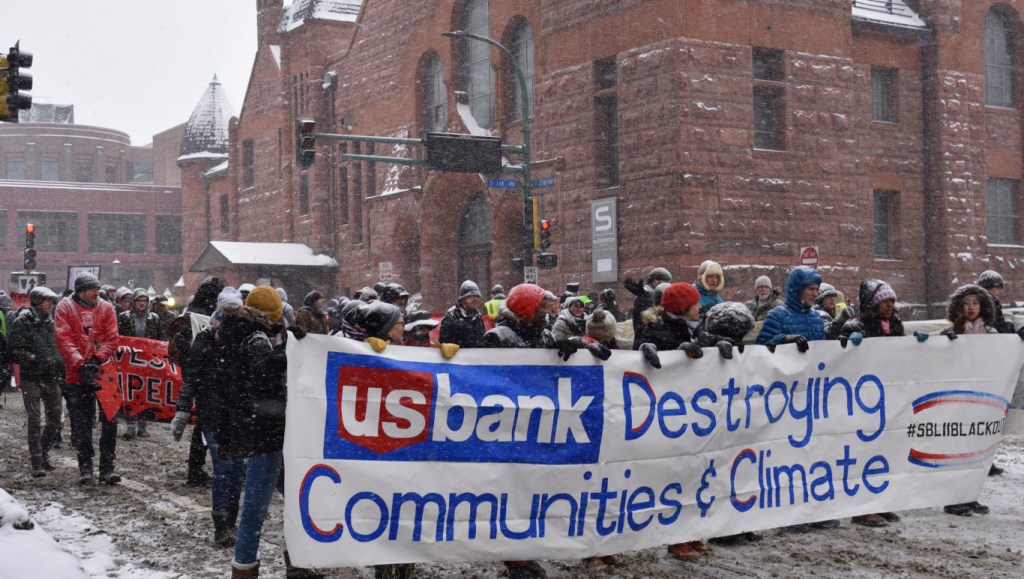
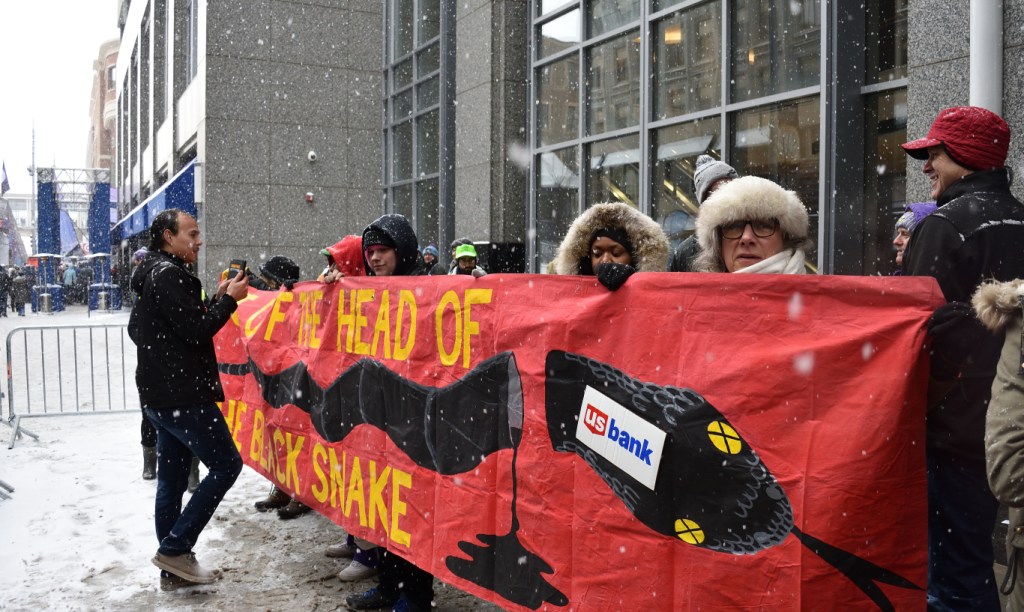
This February 3rd I had another chance to be with both Donnielle and Christine. Ed Fallon (Bold Iowa) organized a van trip to Minneapolis the day before the Super Bowl was held there, where we held a rally against funding pipelines at the headquarters of US Bank. Donnielle was in the van and I mentioned I had heard her speak at the Iowa Yearly Meeting (Conservative) panel discussion last summer, and that Dad and I attended the Meskwaki Powwow. She and Christine both spoke during the event.
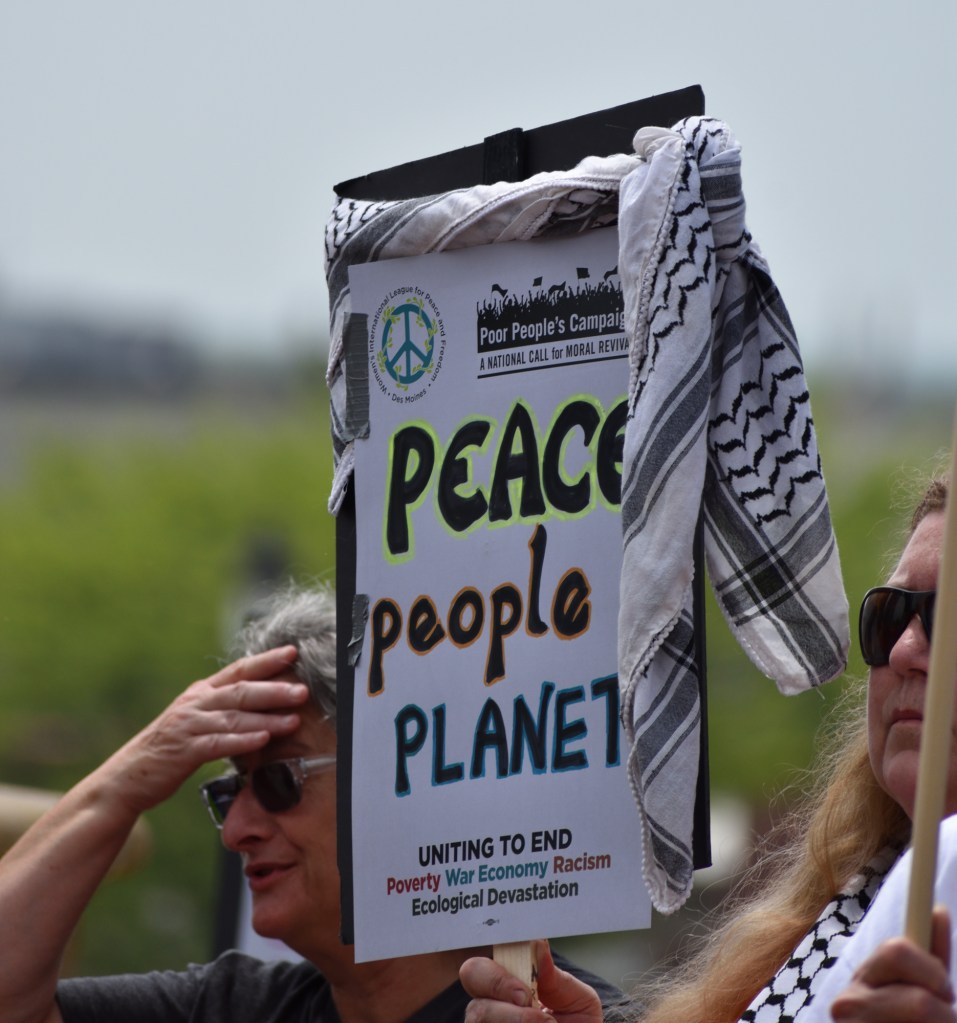
I also saw Christine and Ed at both the “March for Our Lives”, and Poor People’s Campaign events.
Recently my friend Peter Clay (who was part of the Yearly Meeting panel discussion mentioned above) was able to attend the Truth and Healing conference at Pendle Hill. His first report of that follows. He asks a number of questions for us all to consider.
With support from Iowa Yearly Meeting and Des Moines Valley Friends Meeting I attended the Truth and Healing conference at Pendle Hill during the first week of May. The impact of this gathering on all who attended was profound. There was a rich diversity among those in attendance. Included were many Quakers and some non-Quakers. Many Indigenous people were also present, and their voices were given deeply respectful attention.
At the beginning, we acknowledged that we were gathered on the Lenapehokink — the traditional lands of the Lenape tribal nations. Do Des Moines Valley Friends ever think about on whose land our Meetinghouse is sited? Do we have permission to be here? The Iowa Tribe was here long before us and the place where we meet is certainly stolen land. Are Friends in our meeting ready to acknowledge these truths? Would we consider putting up a plaque on our building to plainly state on whose land we gather each week for worship? I invite all of us to reflect on these questions, and many others.
The terrible harm that Quakers knowingly participated in by overseeing about thirty of the more than 350 Indian Boarding Schools in the United States needs to be studied and fully acknowledged. Emphatically, it is NOT something in the past! The trauma that we caused reverberates to this day through intergenerational impacts on families. It is long past time to consider how we are led to speak and what actions we will take today in seeking to heal both ourselves and the Indigenous Peoples whom we harmed.
There is so much more to share. This is a start. Below is a partial description of the conference, from the Pendle Hill website:
“Both Canada and the United States of America are built on the so-called Christian Doctrine of Discovery, which purports to justify the theft of land and resources and the enslavement or destruction of many Nations. As descendants of European settlers, Quakers benefitted and benefit from this history. Even when well-intentioned, Quakers often played a paternalistic role with Indigenous Peoples, and US Quakers ran Indian Boarding Schools, enterprises designed to erase Indian language and culture from Native youth – “Kill the Indian . . . Save the Man.”
As Friends, we rarely talk about our continuing benefit from this history or about our roles as invasive peoples on what the Original Peoples of this land called Turtle Island. We invite Quakers from throughout Canada and the United States to gather at Pendle Hill to meet together with Indigenous people, to hear truth spoken plainly, to listen deeply with open hearts and minds, and to seek together ways of acknowledging ongoing and intergenerational injuries, owning responsibility, and repairing injustice as Spirit guides us.”
I joined those who gathered and I was changed by what I heard, saw and learned. Peter Clay
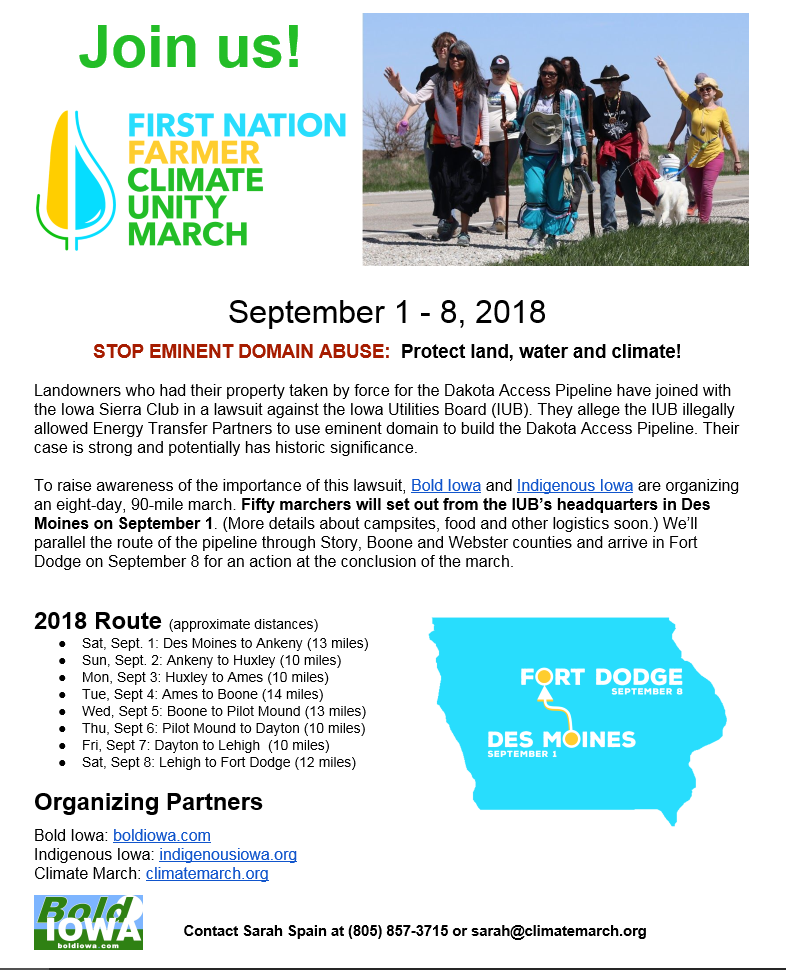
I look forward to continuing to build bridges. Here are several more opportunities to do so. The 105th Meskwaki Powwowwill be held August 8-11 this year, at the settlement at Tama, Iowa. I haven’t heard the date for the next Prairie Awakening/Prairie Awoke ceremony. September 1-8 there will be a First Nation – Farmer Climate Unity March from Des Moines to Fort Dodge. Peter Clay, Jon Krieg, Lee Tesdell and I were fortunate to be able to be part of that. More blog posts about Quakers and Indigenous people can be found here https://kislingjeff.wordpress.com/?s=quakers+native
The Billings Gazette has an amazing collection of photos from the Line the Rim event yesterday, where hundreds gathered along the edge of the Billings Rimrocks to honor missing and murdered indigenous people. The event was organized by Montana State University Billings and the local community. The Billings Gazette has published a whole series of articles about Missing and Murdered Indigenous Women (MMIW).
Several bills aiming to combat the crisis of missing Native Americans in Montana are now on the books, after members of the Montana Legislature’s Indian Caucus fought to make them a reality. While the November 2018 elections were noted nationally for substantially increasing the number of women serving in elected office, Montana saw its largest-ever group of Native American lawmakers elected. For the first time in state history, the percentage of Native legislators mirrored that of the state population as a whole, close to 7%.
One of those bills, Hanna’s Act, passed the legislature nearly unanimously last month, and was signed into law Friday. Part of a package of legislation developed by the legislature’s State-Tribal Relations Interim Committee, it will create a new position with the Department of Justice to track missing-persons cases in the state and assist families and law enforcement agencies to find those people.
The Arizona Republic has a story about a billboard that recently went up about MMIW. Some fear the billboard could be a trigger for those who are missing or have lost loved ones. It can be seen driving east on Indian School Road near the on ramp for I-17 in Phoenix.
A bill is making its way through the Arizona Senate on the subject. HB 2570 would establish a study committee on missing and murdered Indigenous women and girls in Arizona. Arizona has the third-highest number of missing and murdered Indigenous women and girls in the country, according to a 2017 study from the Urban Indian Health Institute. The study recorded 506 known cases in 71 urban cities across the country. Fifty-four cases exist in Arizona, 31 of those in Tucson. From 1976 to 2017, the Murder Accountability Project has identified 156 homicide cases involving Native women in Arizona. Of those, 42 remain unsolved.
The following is the latest legislative update from the Friends Committee on National Legislation (FCNL), a Quaker lobby organization that works to help the passage of peace and social justice legislation. You can sign up to receive monthly updates on congressional action and legislation related to Native American affairs here: https://act.fcnl.org/signup/nalu-signup/
On April 4, the House passed H.R. 1585, a bill to reauthorize the Violence Against Women Act (VAWA). The bill included several strong provisions for Native American women. It would expand tribal jurisdiction over non-Indians to include crimes of sexual assault, stalking, sex-trafficking, and child abuse. The bill also contains Savanna’s Act, a bill from the 115th Congress. It addresses the crisis of missing and murdered Indigenous women by improving responses to cases and data collection. Native American women are facing a crisis of violence. More than 80 percent have experienced violence in their lifetimes, and nearly half have experienced sexual violence at the hands of a non-Indian assailant. Often these assailants face no repercussions and victims are left in unsafe situations. Thanks to the persistent work of advocates, these victims found some degree of safety and justice through the special domestic violence criminal jurisdiction. This was established when VAWA was last reauthorized in 2013. The protection it offers is extremely limited. H.R. 1585 would fix that, by expanding crucial protections to ensure the safety of Native American women, and entire communities. Now H.R. 1585 now moves to the Senate for a vote. With your help, we can make sure the Senate prioritizes the safety of Native American women. Contact your Senators today and urge them to pass a strong VAWA reauthorization that expands tribal jurisdiction and includes Savana’s Act!
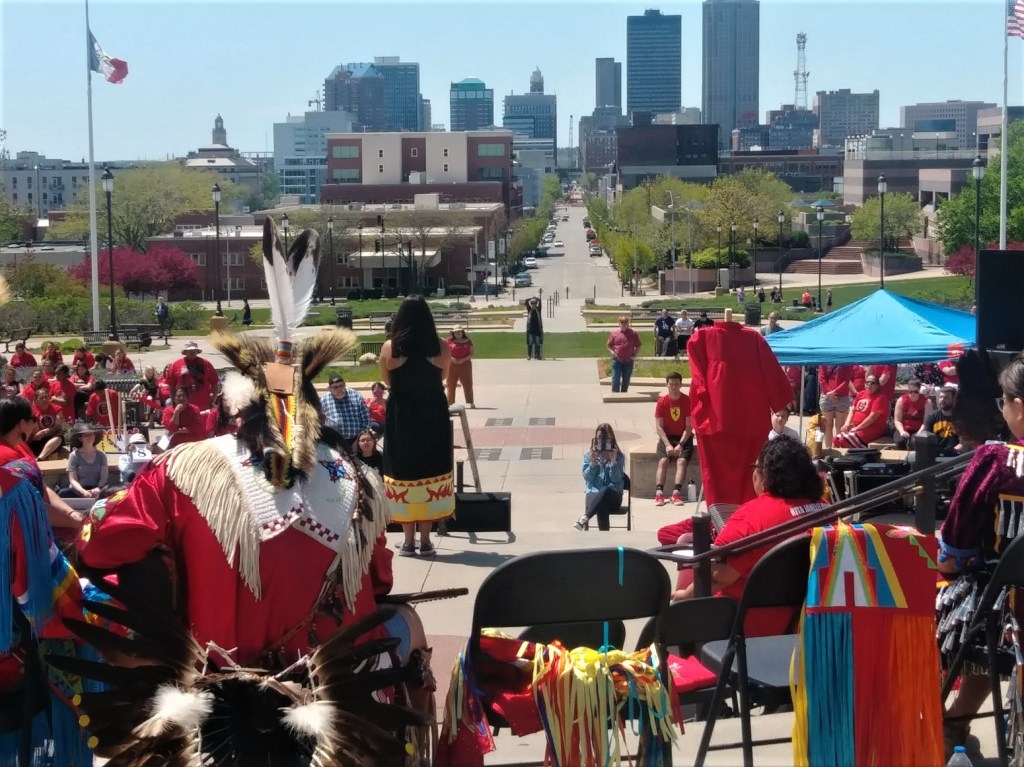
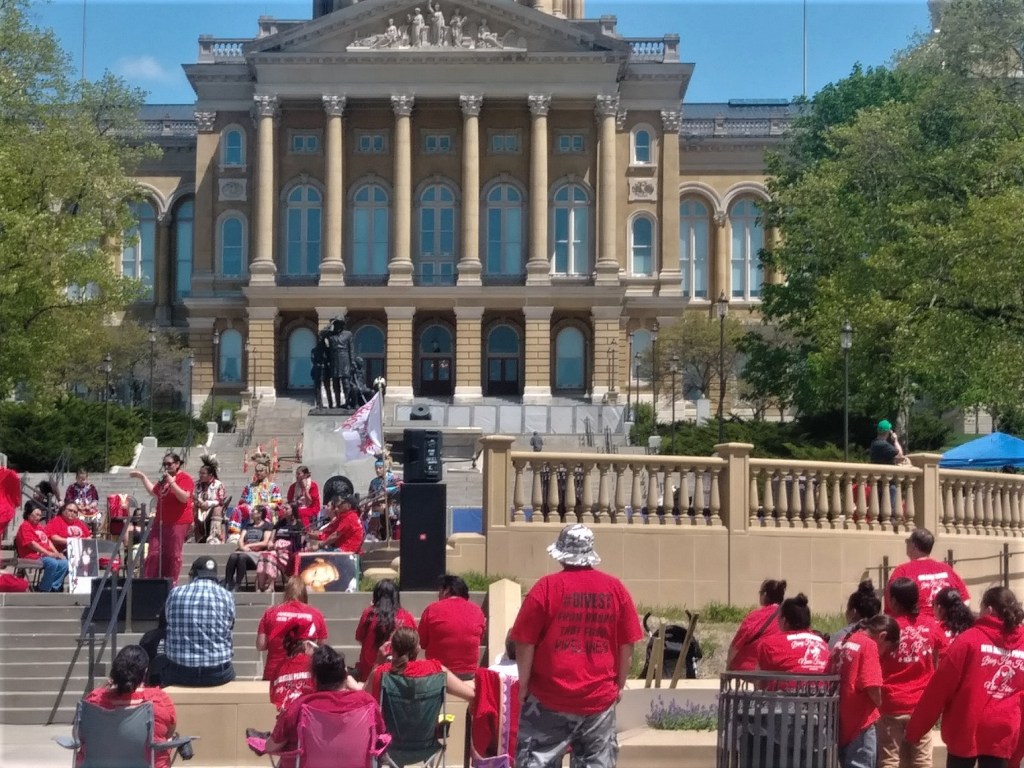
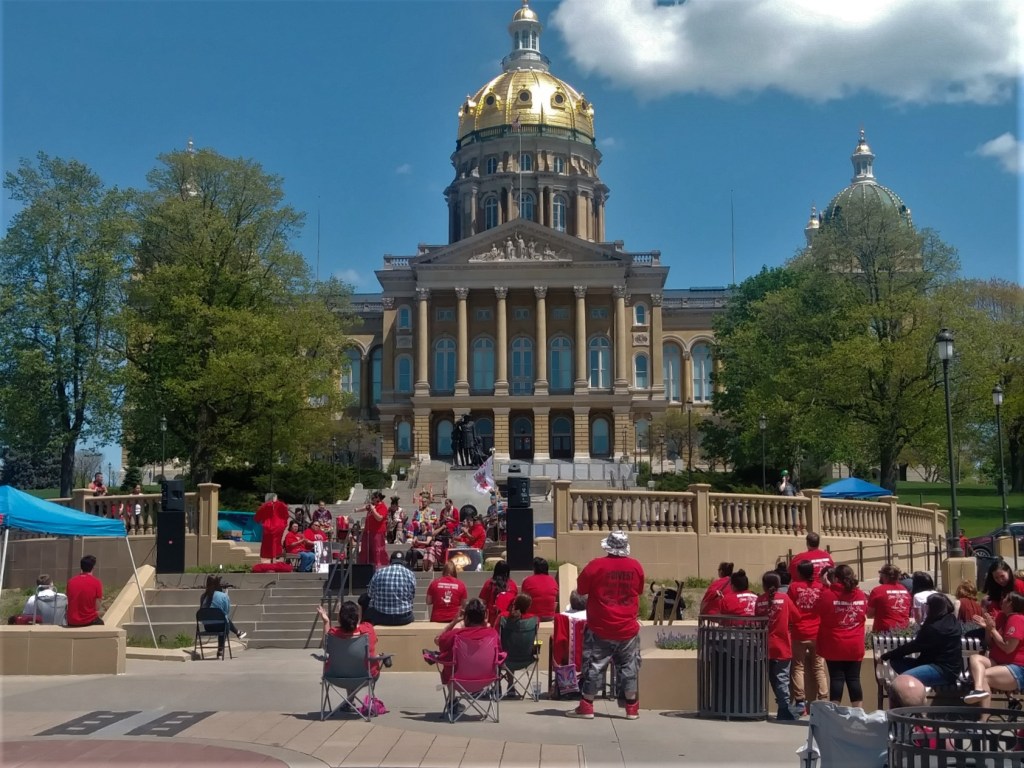
Following are some photos from the National Day of Awareness for Missing and Murdered Indigenous Women Rally on the Iowa State Capitol grounds in Des Moines yesterday.
National Day of Awareness for Missing & Murdered Indigenous Women
I feel badly that it was merely two years ago when I began to learn about the epidemic of Missing and Murdered Indigenous Women (MMIW) in the United States, Canada and other countries with indigenous communities.
Over 90 percent of Native American women have experienced some sort of violence in their lifetime. 86% of those women are sexual assaulted by a non-tribal member. Our men and children also experience this increased violence. Tribal courts can’t try non-Native individuals, which means non-natives can commit crimes on Native American land—including sexual assault—with virtually zero consequence. In the United States, mainstream society fails to address this crisis even though it’s at epidemic proportions. Indigenous peoples are raped, assaulted, abused, murdered, and kidnapped at rates far above the national average. This attack on our bodies is akin to attacks on our land. The health and safety of indigenous people is directly linked to the health and safety of our land. Our indigenous people’s body sovereignty is entwined with the sovereignty of our First Nations. There is a direct correlation between increased rates of sexual abuse, trafficking, and domestic violence against women and children in regions where fossil fuel extraction companies set up “man camps” to house workers. Our goal is to grow the network of MMIW activists and bring light to this problem with a platform to connect people, communities, and resources across Turtle Island in the United States and Canada. The women at Seeding Sovereignty work hard to prevent our sisters from going missing and/or murdered and help raise awareness about the epidemic of Missing and Murdered Indigenous Women.
Missing and Murdered Indigenous Women-Land and Body Sovereignty- Seeding Sovereignty
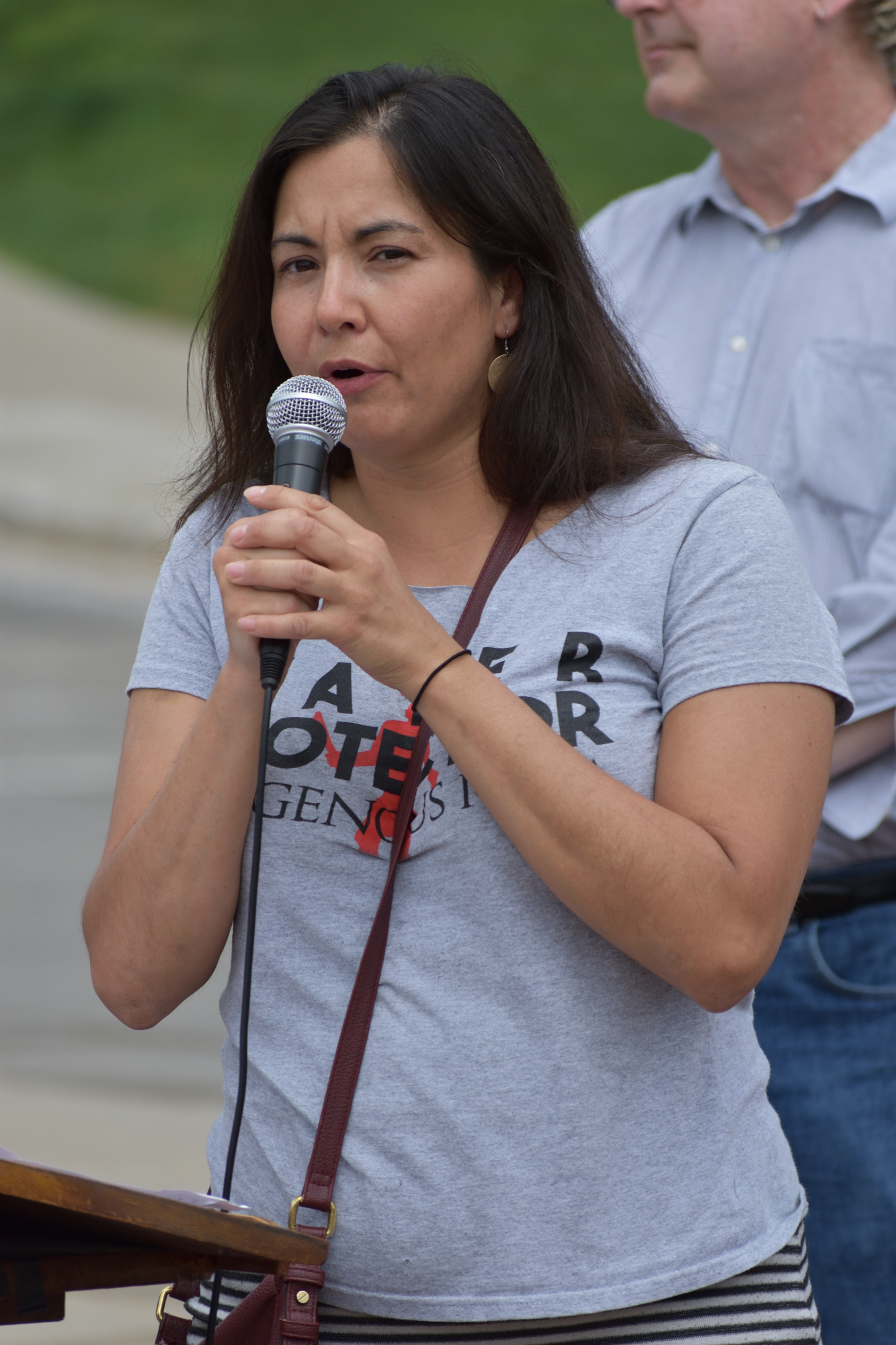
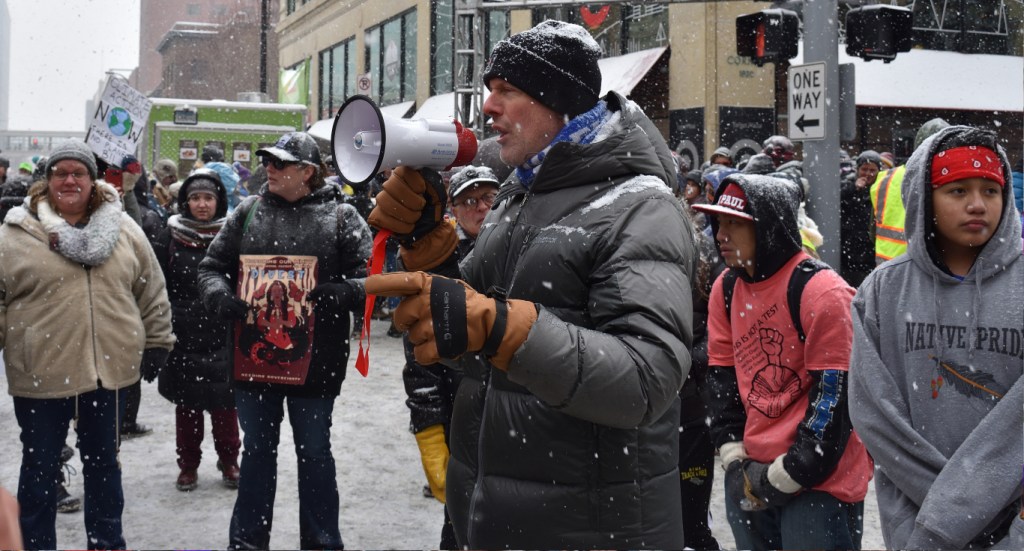
I think the first time I heard about this tragedy was in February, 2017, when a group of us rode in a van trip organized by Ed Fallon of Bold Iowa, to Minneapolis, to demonstrate in front of the US Bank headquarters, because of the fossil fuel projects they fund. This was the weekend the Super Bowl was played there in the US Bank Stadium, so we had a huge audience. Both Christine Nobiss of Seeding Sovereignty and Indigenous Iowa, and Donnielle Wanatee from the Meskwaki Nation spoke about Missing and Murdered Indigenous Women (MMIW)
water protectors
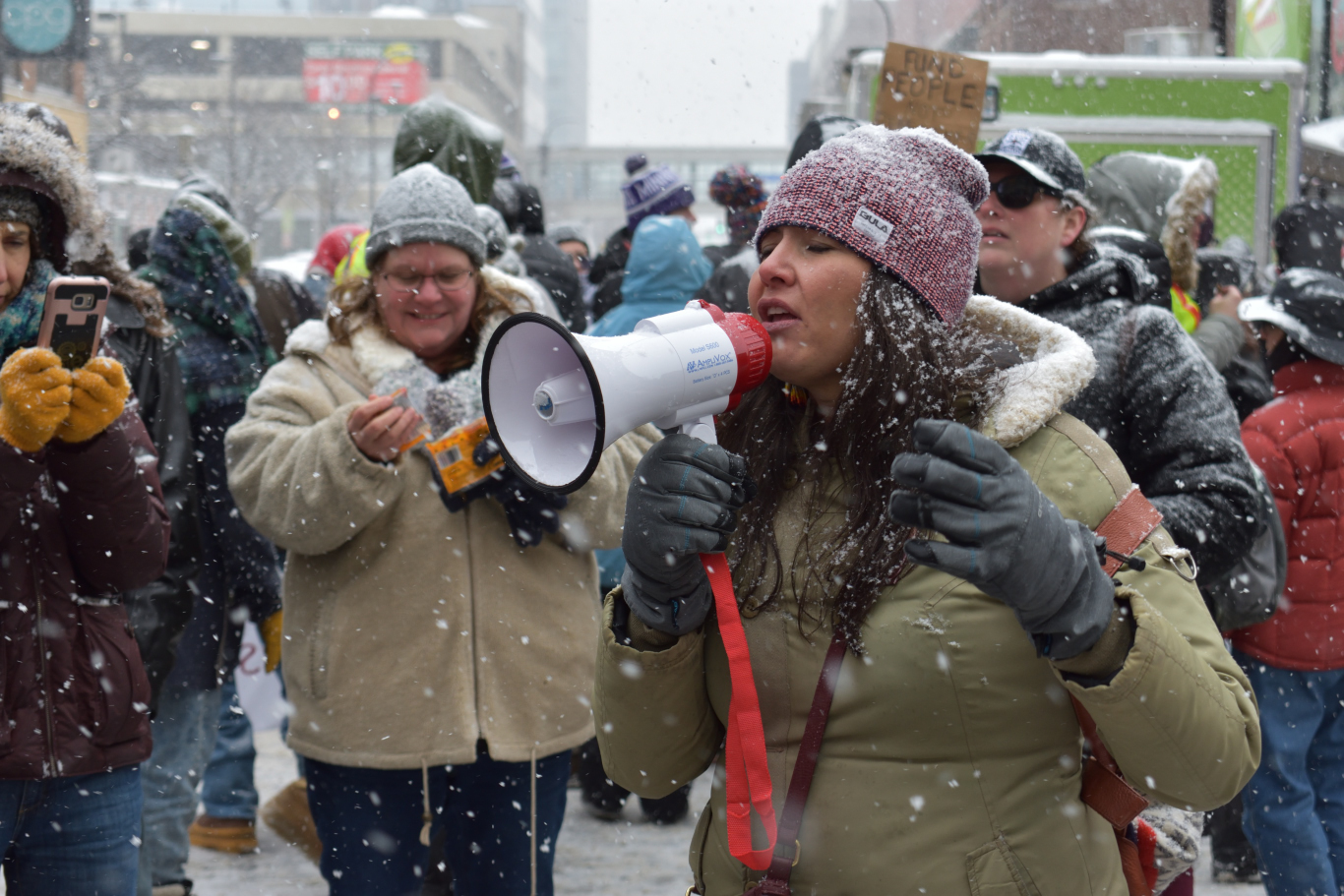
Christine Nobiss
Donnielle Wanatee
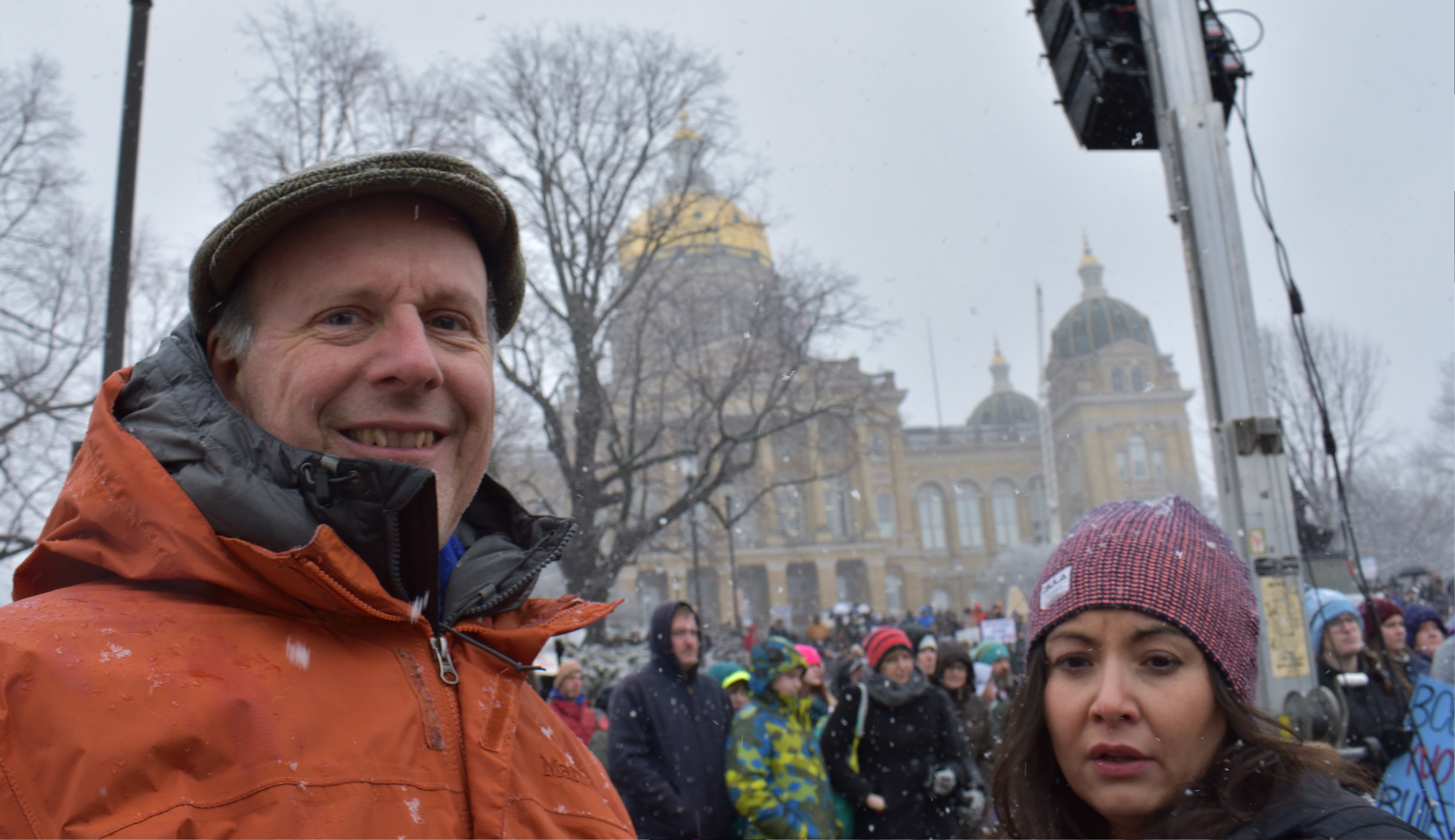
Ed Fallon
Kathy Byrnes
Then while walking 94 miles, from Des Moines to Fort Dodge, Iowa, the first week of September, 2018, on the First Nation-Farmer Climate Unity March, I learned a lot more about MMIW from those who had been directly affected. For example, in the process of sharing stories about photography, videography and drones with a new friend, the story slowly evolved about his work in using drones to search for missing women.
During the March, my friend Foxy Onefeather often carried a MMIW poster.
Foxy Onefeather
The story of this piece is of a sister being engulfed by the blacksnake, and its poison. She holds a candle that has burned for what seem like an endless time in the darkness. Protecting her spirit are two red butterflies that carry the prayers of the people for our murdered and missing. For our women and children we must rise. For our water and the connection that the earth and women share, we must rise. For their futures, we rise.
Jackie Fawn, the artist of the poster above
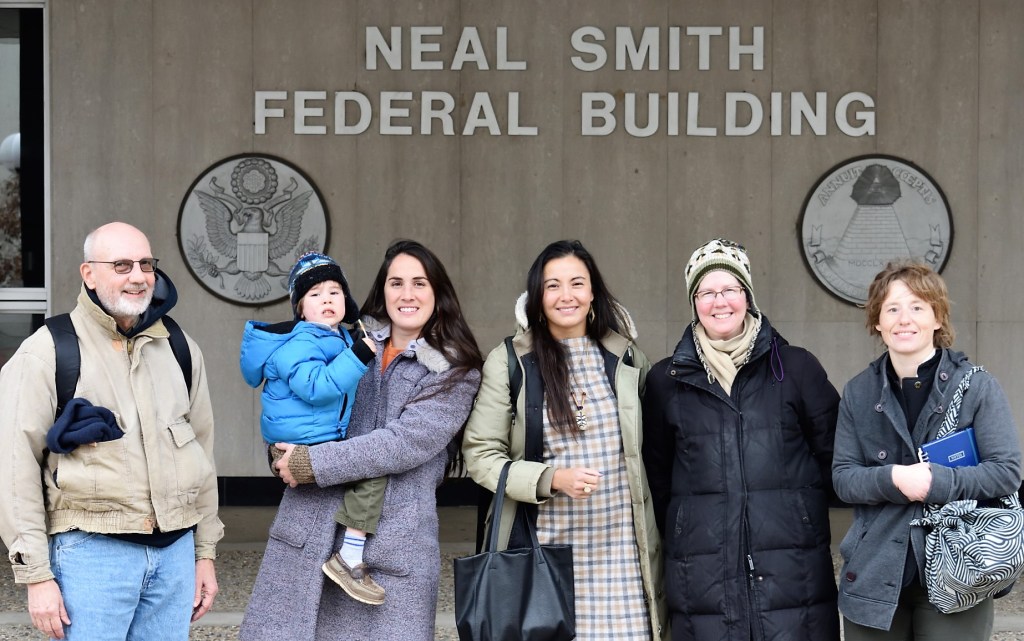
The purpose of the First Nation-Farmer Climate Unity March was for a small group of Native and non native people to get to know each other, so we can work on things of common concern. One of the first efforts was when the group below visited Iowa Senator Chuck Grassley to talk with his staff about two pieces of legislation related to Native communities, One was the SURVIVE Act which is intended to get more funds from the Victims of Crime Act to Native communities. The second is Savanna’s Act, which allows tribal police forces to have jurisdiction over non-Native people on Native land, access to criminal databases and expanded collection of crime statistics. Senator Grassley was involved in the passage of the Victims of Crime Act.
Today was the National Day of Awareness for MMIW.
Wear red and join us in solidarity as we honor the Lives of Missing and Murdered Indigenous Women with a rally at the West Capitol Terrace Stage in the Iowa State Capitol. Raise awareness, stand against injustice and show support!
If you look closely you’ll see a red dress hanging near the event speakers.
Red is bold and direct, and yet complex. It can express vitality but also violence. Métis artist Jaime Black intended both readings when she hung more than a dozen red dresses along the River Walk that meanders past the north side of the Smithsonian’s National Museum of the American Indian. It’s the U.S. debut of “The REDress Project,” which has been installed in both urban and rustic sites in Black’s native Canada. Because they’re disembodied, the garments appear ghostly and ominous. That’s also intended. Black derived the image from a painting on the cover of a book about the experiences of a woman who identifies as Métis (descendants of First Nations people and European, mostly French, settlers). The artist uses red dresses to symbolize the estimated 1,200 missing and murdered indigenous women in Canada. Now that a few of the hundreds of donated dresses flutter in Washington, the project can also be seen to represent violence against native women in the United States and the rest of the Americas.
This summer Paula Palmer will be leading a series of workshops related to “Toward Right Relationship with Native Peoples”. My experiences over the past several years working with people of color and indigenous people on environmental issues has reinforced my belief that a spiritual approach to our social and environmental chaos is what is needed now.
A year ago I posted an introduction to Arkan Lushwala. I was blessed to hearing him speak on the topic of “Indigenous Ways of Restoring the World”, part of which follows:
Speaking about what is happening on Earth right now, many of the conditions of life that we used to take for granted, now are really out of balance. Hopefully we still have time to get back into balance so life may continue. I travel around the world and meet people and talk to people from all different cultures. And everywhere people ask, “what can we do?” The question, what can we do, is the second question. The first question is “what can we be?” Because what you can do is a consequence of who you are. Once you know what you can be, you know what you can do, and we cannot afford wasting time; we have little time. We need to be precise now. When someone sincerely asks, “what can I do?” my humble answer, the only answer that I find in my heart to be sincere is, “First find out what you can be.” Action is extremely necessary at this time. This is not a time just to talk about it. The most spiritual thing now is action. To do something about what’s happening. To go help where help is needed. To stand up when we need to stand up, and protect what is being damaged. And still, this action needs to be born from a place in ourselves that has real talent, real intelligence, real power, real connection to the heart of the Earth, to universal wisdon, so our actions are not a waste of time. So our actions are precise, our actions are in harmony with the movement, the sacred movement, of that force that wants to renew life here on Earth and make it better for the following generations.
Arkan Lushwala
As I see it all around me, the trees are dying out, our water is contaminated, and our air is not good to breathe. Those are the reasons why today I’m trying my best to come back to our ways of thousands of years ago.
We have to come back to the Native way of life. The Native way is to pray for everything. Our Mother Earth is very important. We can’t just misuse her and think she’s going to continue.
We’ve been told to take care of what we’ve got so that we can leave something for the younger generation. We’ve tried to practice that from the beginning of our life, but we forgot our way.
I never have spoken out until lately here, the Spirit coming to me and telling me, ‘Well, you are going to have to give us a hand here.’ It was in a vision, Water said to me, ‘I’m going to look like water, but pretty soon nobody’s going to use me.’
We, the people, are going to have to put our thoughts together to save our planet here. We only have One Water… One Air… One Mother Earth.
Corbin Harney, Spiritual leader of the Western Shoshone Nation, The Way It Is, Blue Dolphin, 1995
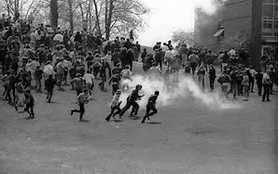
I clearly remember May 4, 1970, when Alison Krause, William Schroeder, Sandra Scheuer, and Jeffrey Miller were shot and killed by Ohio National Guard troops at Kent State University while protesting against the Vietnam War.
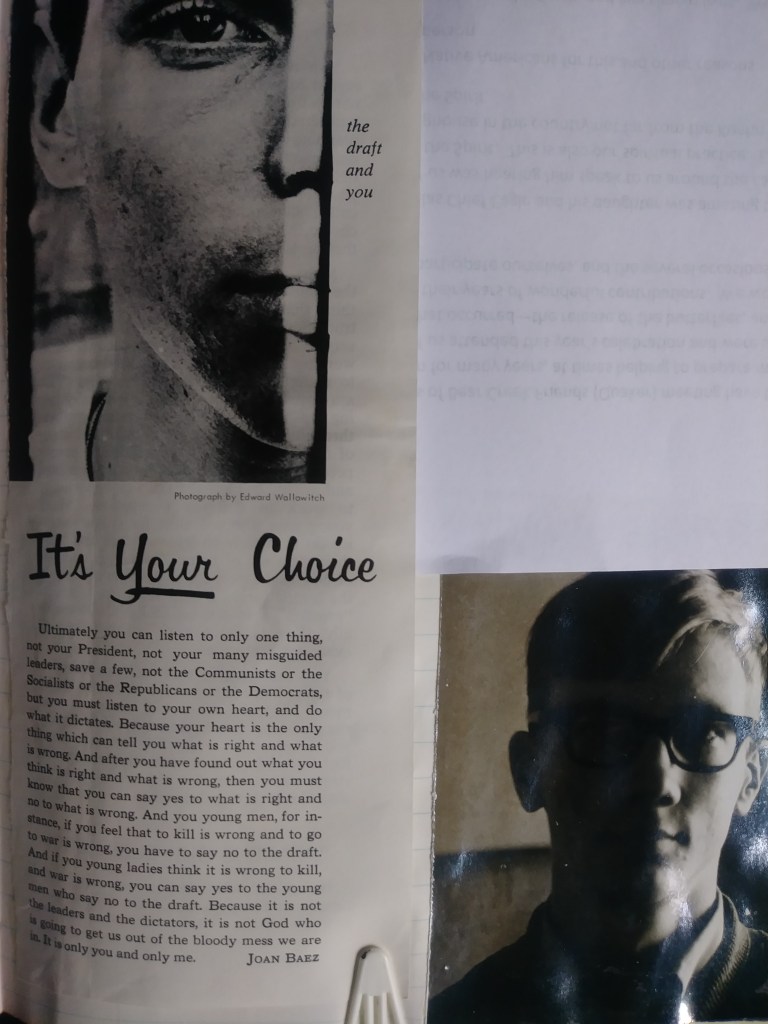
I was a Senior at Scattergood Friends School. Trying to figure out whether to be a conscientious objector, or to be a draft resister, occupied a lot of thought and time. I kept a journal at that time, and used that as a basis for a lot of blog posts I wrote about my struggles with the draft. https://kislingjeff.wordpress.com/?s=draft In the end I chose to be a draft resister.
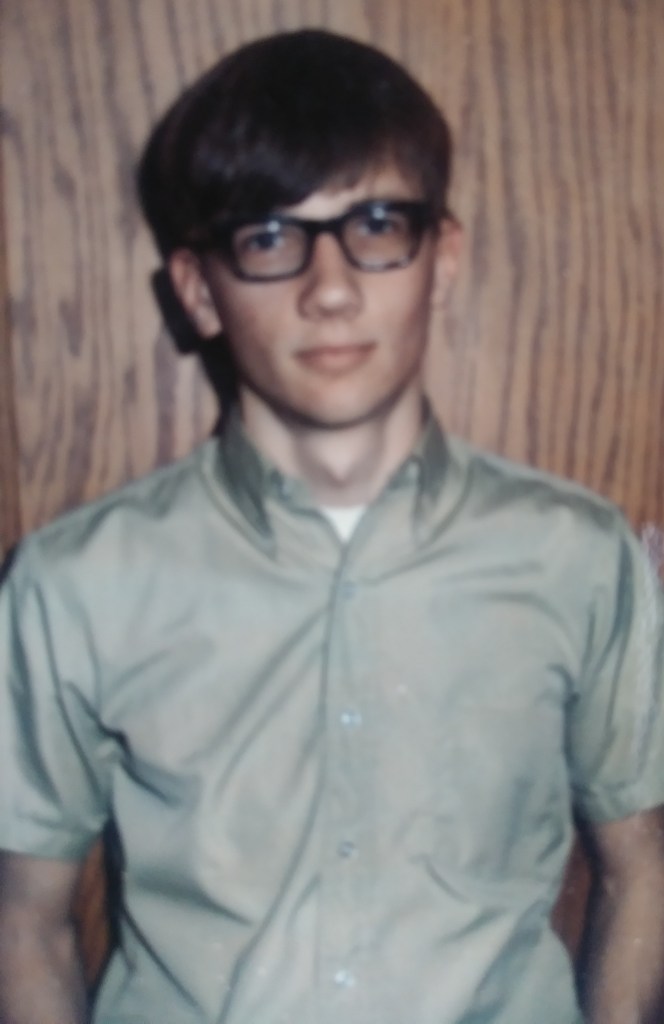
Jeff at Volunteer Service Mission 1971
My Senior class at Scattergood Friends School
Scattergood Friends School Class of 1970
Jeff Kisling
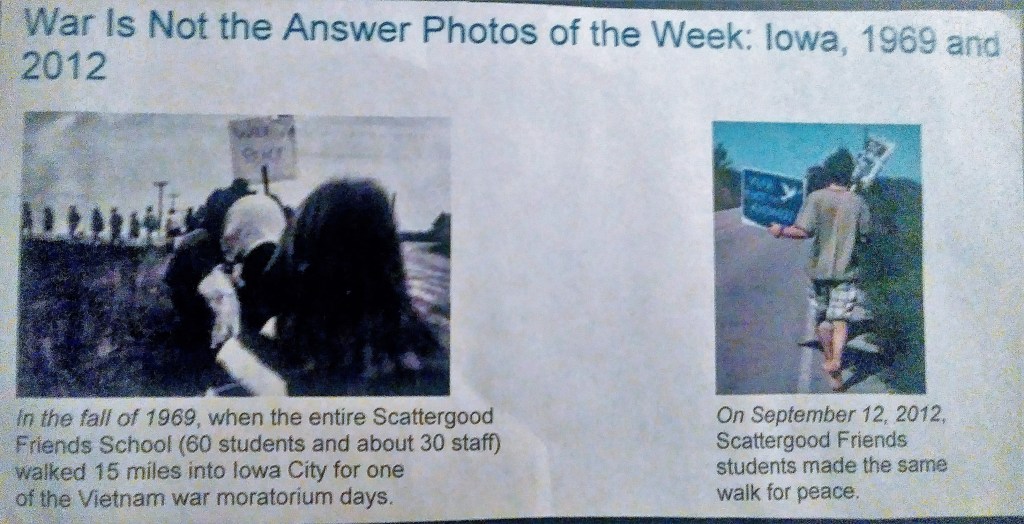
On October 15, 1969, one of the National Moratorium Days to End the War in Vietnam, the entire School and most of the teachers walked from the School to the University of Iowa campus, in Iowa City, around 12 miles from the School. We walked in silence, with a couple of peace signs.
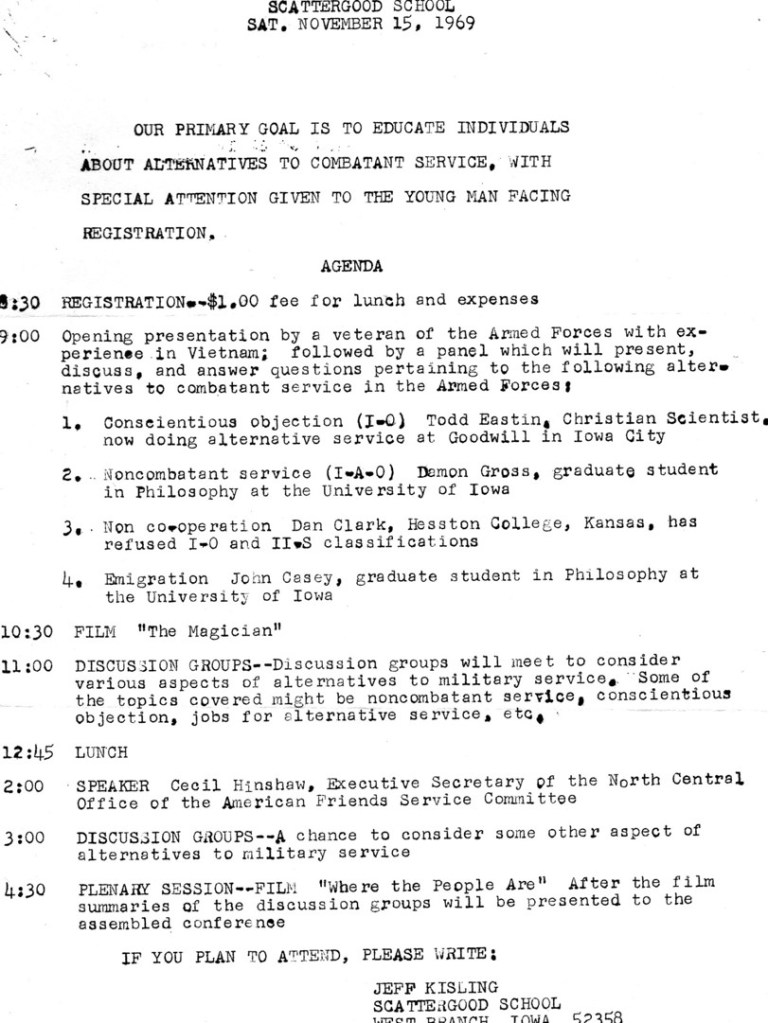
On the Moratorium day in November, we held a draft conference at the School.
Draft conference, Scattergood 1969
Crosby, Stills, Nash and Young “Ohio”
Buffalo Springfield – “For what it’s worth, Vietnam War”












































 Quakers, social justice and revolution