Intentional Cruelty

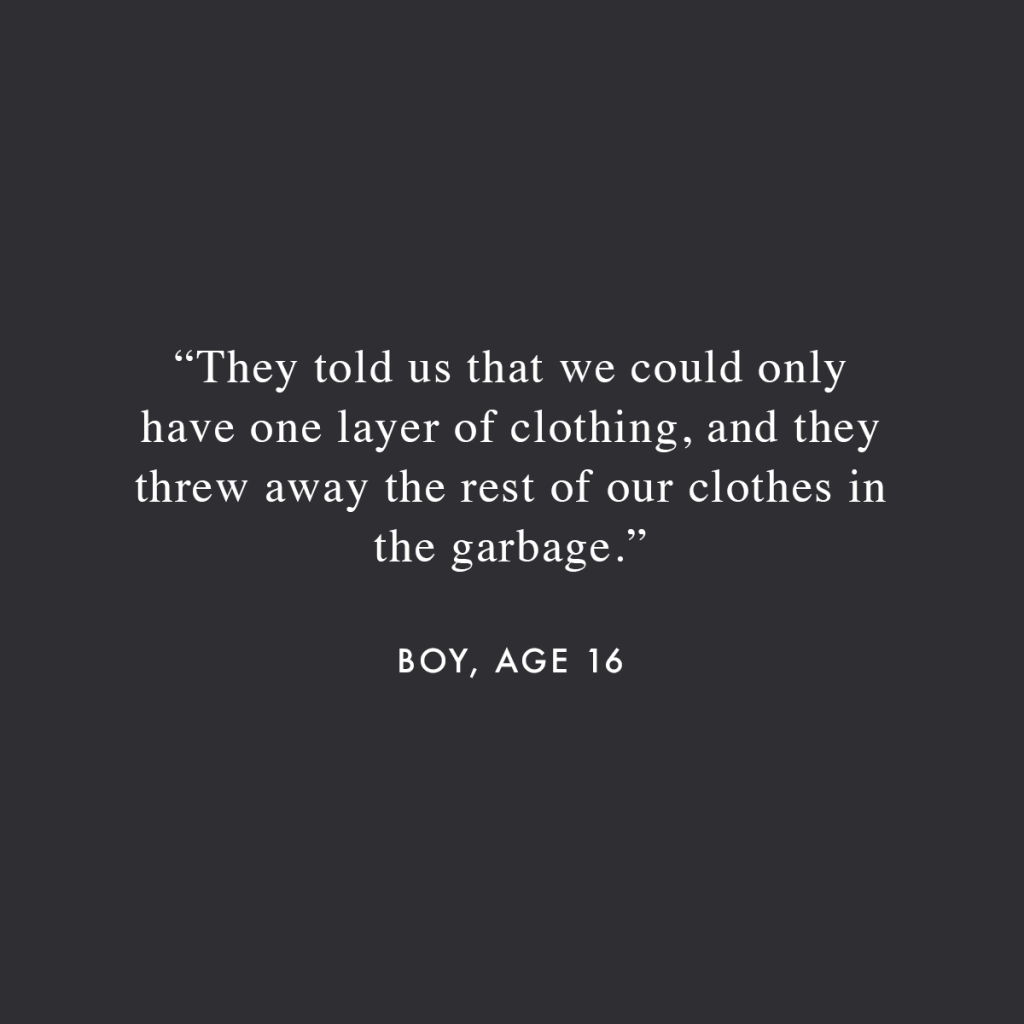
There are so many things about the current Republican administration that many of us have trouble believing could ever have happened. I recently heard the following on the Rachel Maddow Show. “He (the President) is eager to be seen as being I think as cruel as possible to immigrants”, which is at the heart of what we have been seeing. Following is the transcript of part of her show on 7/2/2019 during an interview with former HUD Secretary and 2020 presidential candidate, Julian Castro. 

MADDOW: strategically, I wonder as you think about the prospect of becoming the Democratic nominee, running against Donald Trump, he is eager to be seen as being I think as cruel as possible to immigrants. I think he’s eager to be seen as acting against the interests of Latino voters, and certainly Democratic voters.

I wonder to the extent that you fight him on this stuff, and you’ve made it such a priority in your campaign so far, how much do you worry about playing on his turf and playing to an image that he likes for his base?

CASTRO: Number one, I don’t think we have any choice. He has a huge bullhorn, and so, he’s going to make this an issue. So I believe that we have to offer a compelling strong alternative.

Now, I’ve said that we can maintain border security, but what I’m betting is that there are enough people out there that know that we can do this a better way. And if he’s going to proceed with a dark heart of cruelty, then I want to proceed with a heart of compassion and common sense.

And I’ll tell you, about a year ago, I was at the Ursula Processing Center down in McAllen, Texas, on the border. I was there to join activists protesting the family separation policy. And as sad as the situation was with the little children that were inside that facility, what gave me hope was that the activists that were there, they were white, they were black, they were Asian-American, they were Latino.

In other words, it was people of all different backgrounds from throughout the country who were united with their compassion and their values, their belief in humanity and a common respect for these human beings, no matter the color of their skin or the fact that they’re not American. I’m betting on that, even as he bets on cruelty.

The Rachel Maddow Show, 7/2/2019
http://www.msnbc.com/rachel-maddow/watch/castro-calls-on-career-officials-to-resist-trump-cruelty-policy-63195205556

The whole history of this country is based on the theft of land and killing and cultural genocide of people Native to this land, and the labor of enslaved people. Millions of people have been killed in conflicts with our country. We are the only nation to have used nuclear weapons. Today we have a multitude of egregious governmental policies. Structural racism is deeply embedded. I may well be naive, but it seems to me the people who did, and continue to do these things, at least believe what they are doing is right, or at least best for themselves. They believe in white privilege. The basis for their views may be very flawed, and covers the underlying problem of their fear of others. But I don’t think for the most part they delighted in doing harm just for the sake of being cruel.

Perhaps I’m wrong about the past. But I don’t think anyone can argue this administration routinely employs cruelty intentionally.

Fundamentally we are faced with a conflict of values. The question is how do we return to the values most of us hold? As Secretary Castro says above, “it was people of all different backgrounds from throughout the country who were united with their compassion and their values, their belief in humanity and a common respect for these human beings, no matter the color of their skin or the fact that they’re not American. I’m betting on that, even as he bets on cruelty.

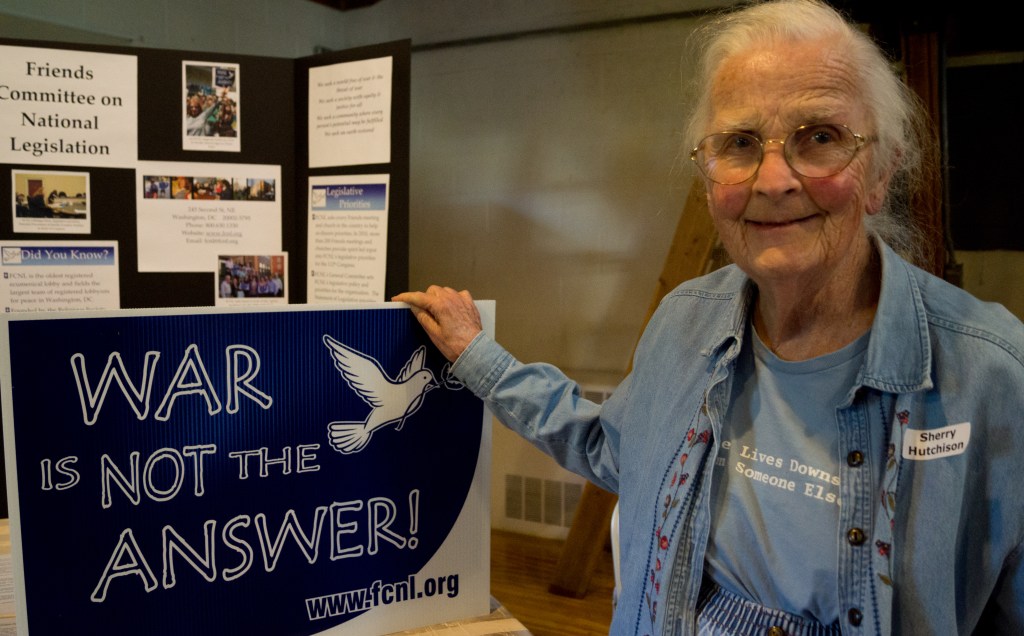
The problem is in the past we could have some influence on government policies by engaging with our Congressional representatives or publishing letters to the editor. They might not agree with us, but we could sometimes actually see what we said did affect laws and policies. 75 years ago Quakers established the Friends Committee on National Legislation (FCNL) to serve as a lobbying organization to promote Quaker values in government policies.

But for some time now Congress has become extremely partisan. Rather than have substantive debates about legislative issues, Democrats and Republicans each see winning their point of view and defeating the other party as the goal so most bills can only pass, often only be brought to a vote, it passage will be a win for the party in the majority.

Even the third branch of government, that used to be a check and balance, has been corrupted with ideological justices.

So here we are with no government checks and balances to control an administration that is destroying democratic norms and routinely employs intentional cruelty. What can we do?

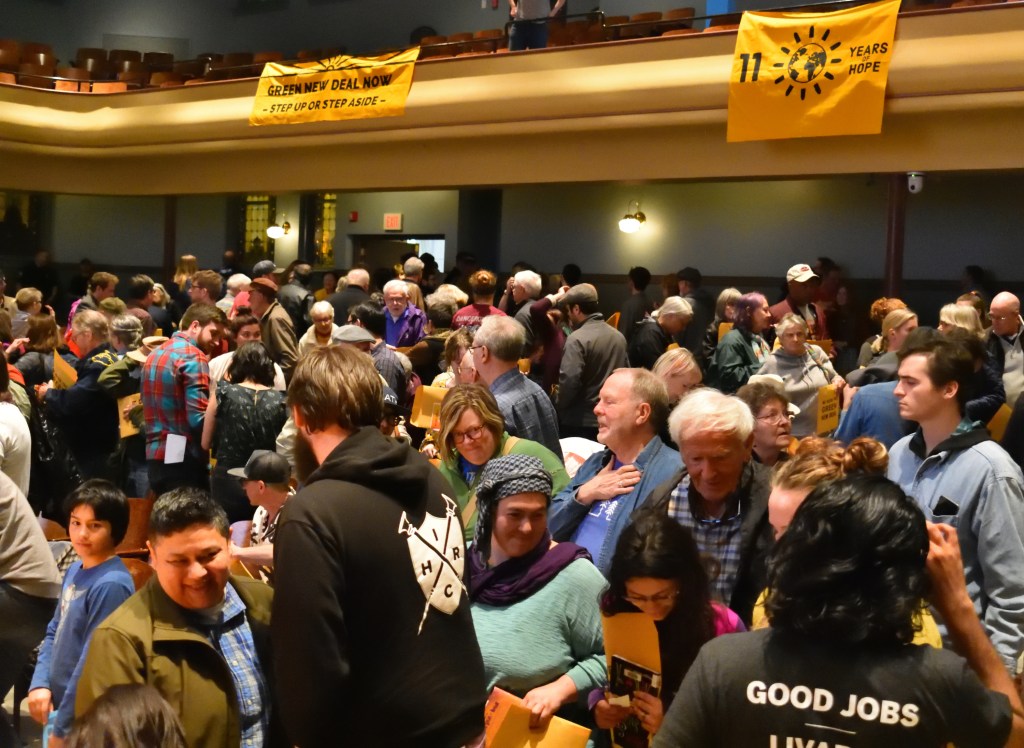
The most recent example of people effectively making change is the Sunrise Movement, which is advocating for a Green New Deal, and that I’m a supporter of. Leaders that began Sunshine spent months studying the history of activism to see what was effective. They came to the conclusion that two things are necessary: people power and political power.

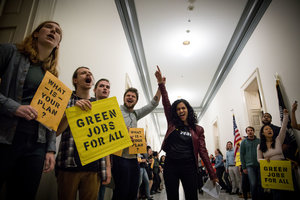
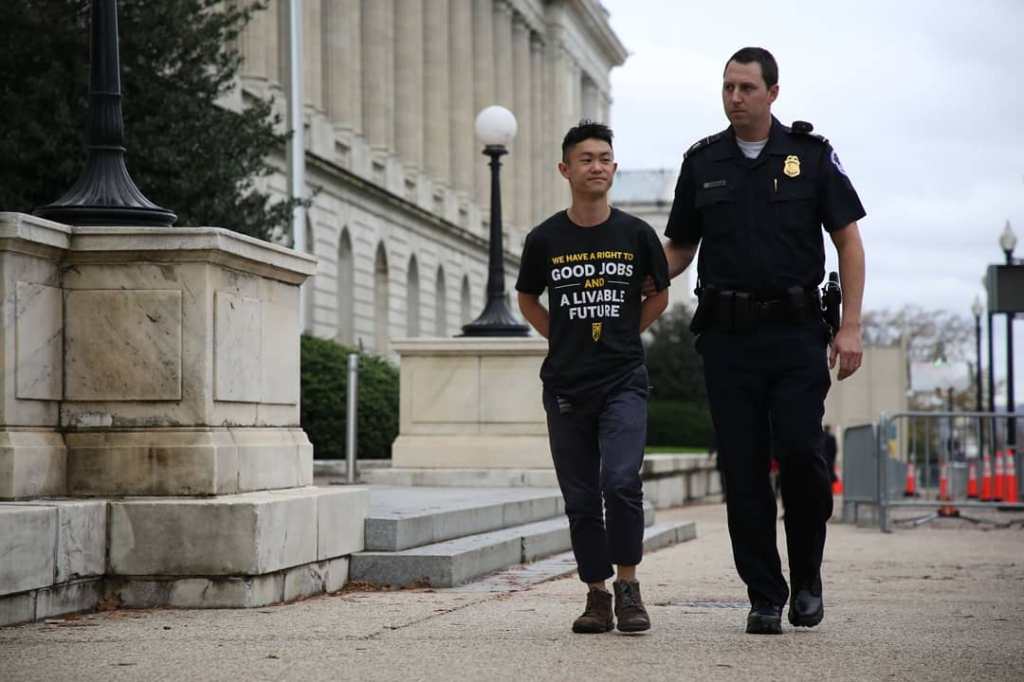
Thousands of young people of the Sunrise Movement went to Capitol Hill for direct actions. With the first 50 were arrested for nonviolent civil disobedience, and 150 were arrested during the second actions. But, because of that, climate change is FINALLY being discussed in Congress.

More recently, the Sunrise Movement has been demanding a presidential candidate debate solely about climate change, saying the brief responses about that in the first debate were completely inadequate. When the Democratic National Committee (DNC) refused, Sunrise Movement youth spent 60 hours in front of DNC headquarters, including sleeping there. That forced DNC Chairman Tom Perez to agree to put the idea up for a vote when the committee meets August 22nd. https://kislingjeff.wordpress.com/2019/07/03/sunrise-movement-and-the-democratic-national-committee/

Now Sunrise Members are going to go to their local Democratic party offices to pressure their local members to commit to voting for a climate-only debate when that comes up for a vote at the August meeting. The Sunrise Movement is very well organized, has very specific principles they follow, and has shown it can respond quickly, creatively and effectively to force attention on addressing climate chaos. Members of Sunrise had also worked hard to get out the vote for candidates that support their ideas in the last election, and were successful in getting most of their candidates elected, include Alexandria Ocasio-Cortez.

My friend Lucy Duncan, who works for the American Friends Service Committee has written an excellent article about people of faith publicly putting their bodies on the line to affect change. Why I Got Arrested at the Border.

This is the model that has been shown to work despite the dysfunctional Congress, biased courts, and intentionally cruel Republican administration. People going to the streets, and building political power.

Posted in Arts, civil disobedience, climate change, Green New Deal, immigration, Indigenous, Native Americans, Sunrise Movement, Uncategorized | 1 Comment

Fourth of July 2019

The more I learn about the true history of the United States, especially related to Native people and people of color, the more problematic the Fourth of July celebration is for me because of our past history and current state of freedom, or lack thereof.

This year even more so with the inhumane treatment of immigrants at the southern border, including those who are legally seeking asylum and “freedom” here.

Then there is the spectacle of the President trying to turn this year’s Fourth of July into a campaign rally. I’m a photographer and visual person and deeply offended by the disturbing images of military tanks in front of the Lincoln Memorial.

The following video is from a Newsweek article “Veterans Tell Donald Trump They ‘Feel Deeply Betrayed’ in July 4 Video Calling For Impeachment” by Jessica Kwong.

“I served almost 15 years in the Army and I feel deeply betrayed,” veteran Jose Vasquez says in a video produced in light of Independence Day. “Our democracy is under attack and we want to make sure that we protect it.” 

Army veteran Perry O’Brien said in the video that the Fourth of July is for celebrating the country’s independence from foreign powers, and, “How can we do that when we have someone in the White House who actively conspired with a foreign adversary to get there?”

Marine Corps veteran Marie Delus says in the video that Trump “should be impeached” because she believes he is not only cruel, but “also a criminal.”  

“Veterans Tell Donald Trump They ‘Feel Deeply Betrayed’, Jessica Kwong Newsweek, July 4, 2019

But the best orators who have marked the day have understood that our nation’s laurels are not meant to be rested on. Fourth of July speeches tend to divide into two sorts. The predominant variety is commemorative, celebratory, and prescriptive—solemnized, as John Adams predicted in 1776, “with pomp and parade, with shows, games, sports, guns, bells, bonfires and illuminations from one end of this continent to the other.”

But in his exuberance, Adams failed to anticipate that the Fourth, as it brought Americans together, would continually threaten to tear them apart. Over the years, celebrations of the Fourth have become a periodic tug of war between commemorations designed to affirm and even enforce the common identity of Americans—out of many, one—and subversive pushback from those obstreperous enough to insist that we are not all free, emphatically not all equal, and certainly not one.

James West Davidson

What, to the American slave, is your 4th of July? I answer; a day that reveals to him, more than all other days in the year, the gross injustice and cruelty to which he is the constant victim. To him, your celebration is a sham; your boasted liberty, an unholy license; your national greatness, swelling vanity; your sounds of rejoicing are empty and heartless; your denunciation of tyrants, brass fronted impudence; your shouts of liberty and equality, hollow mockery; your prayers and hymns, your sermons and thanksgivings, with all your religious parade and solemnity, are, to Him, mere bombast, fraud, deception, impiety, and hypocrisy-a thin veil to cover up crimes which would disgrace a nation of savages. There is not a nation on the earth guilty of practices more shocking and bloody than are the people of the United States, at this very hour.

July 5, 1852, in Rochester, New York, Frederick Douglass delivered “What to the slave is the 4th of July?”

The Secretary of the Interior issued this Code of Regulations (Code of Indian Offenses) in 1884, 1894, and 1904 through Indian Affairs Commissioner’s circulars and Indian agent directives. Indian superintendents and agents implemented the code until the mid-1930s. During this 50-year period, Indian spiritual ceremonies such as the Sun Dance and Ghost Dance were held in secret or ceased to exist. Some have since been revived or reintroduced by Indian tribes.

In response to this policy of cultural and religious suppression, some tribes saw in the 4th of July and the commemoration of American independence a chance to continue their own important ceremonies. Superintendents and agents justified allowing reservations to conduct ceremonies on the 4th of July as a way for Indians to learn patriotism to the United States and to celebrate its ideals. That history is why a disproportionate number of American Indian tribal gatherings take place on or near the 4th of July and are often the social highlights of the year. Over time these cultural ceremonies became tribal homecomings. American Indian veterans in particular were welcomed home as modern-day warriors. The Navajo Tribe of Arizona and Pawnee of Oklahoma are two examples of tribes that use the 4th of July as an occasion to honor their tribal veterans.

http://teachingamericanhistory.org/library/document/what-to-the-slave-is-the-fourth-of-july/

Now, your question might be wondering if July 4th is a time for sadness or bitterness toward the US for its long history of bullying, White supremacy, theft, tyranny, oppression, and cultural annihilation. Kiowas ain’t got time for that; it’s more important to remember that past so as to prevent a recurrence in the future. By the early 20th century, most Kiowas were fine being “Americans” too. We’re dual citizens, basically. And the men in particular relished the chance to gain war glory fighting for the red-white-and-blue. At the big annual Gourd Dance, every day starts and end with a flag song, where the US flag is raised high at the start, and lowered ceremoniously at the end. Other gourd dances often specifically honor veterans and brave warriors who’ve served in the US armed forces. 

What do Native Americans do on the Fourth of July? Andrew McKenzie, Kiowa Indian

Most native people see the 4th of July as a coming together with the larger American community. We are distinct individuals with a traditional culture, but there are plenty of Indians who find special significance in this holiday, including many American-Indian war veterans who have defended this nation.

Believe me, we native peoples remember that this country was taken from our ancestors–and the taking has not stopped. It might be cutbacks in education budgets or cancellation of programs to fund prescription medicine for our elderly and uninsured. Or it might be a stripping away of our rights to natural resources, or a whole host of other issues facing this community–but we are fully aware that colonialism is not dead.

OK, I will concede that historically the 4th of July is not actually about liberty and justice for all. It is a toast to freedom for a few. But my people are busy working to try to balance two worlds, to find our own voices and express our knowledge and creativity while living in a still-hostile white America. I don’t think it will help to go rain on somebody’s Independence Day parade.

I can’t be bothered indulging the pleas of some guilt-ridden white folks asking me to go fight for social justice and make a vocal protest on this symbolic holiday, while most of the country is relaxing and roasting corn and singing patriotic songs.

HOW AMERICAN INDIANS REALLY FEEL ABOUT INDEPENDENCE DAY, Chicago Tribune, July 4, 2000 (no author given)

When our server, who was also native, came to the table, I asked if I could show him something. I then stood up and pointed out that 30 lines below the famous quote “All men are created equal” the Declaration of Independence refers to Natives as “merciless Indian savages.”

This is the dilemma that Native ‘Americans’ face every day. The foundations of the United States of America are blatantly unjust. This land was stolen. Native peoples, Africans and many other minority communities have long been recipients of systemic racism. And the roots of it are right there for the entire world to see, printed in many of our founding documents; like the Declaration of Independence, the Constitution and United States Supreme Court case rulings.

As a nation we embrace this history because we are largely ignorant of the true nature of our past and have never been held accountable for our actions. As Americans we celebrate our foundations of ‘discovery’ and cling to our narrative of ‘exceptionalism’ because we have been taught that this nation was founded by God on a principle of freedom for all.

But the reality is that the United States of America exists because this land was colonized by Europeans who used a Doctrine of Discovery to dehumanize, steal from, enslave and even commit cultural genocide against indigenous peoples from both the “New World” and Africa.

Georges Erasmus, an Aboriginal leader from Canada, said, “Where common memory is lacking, where people do not share in the same past, there can be no real community. Where community is to be formed, common memory must be created.”

Those are wise words that get to the heart of our national problem regarding race. On days like Columbus Day, Thanksgiving and the Fourth of July, the United States of America celebrates its history. But a majority of our citizens celebrate in ignorance. After traveling throughout the country and educating audiences on the Doctrine of Discovery and its influence on our nation, I would estimate that less than 3% of Americans know this history or understand its impact on the current-day situation of Native peoples.

As a nation, the United States of America does not share a common memory, and therefore struggles to have true community.

So this Fourth of July I invite every American to start their day by learning about the Doctrine of Discovery. Allowing the reality of the dehumanizing nature of this doctrine to temper your celebrations.

The Dilemma of the Fourth of July, Mark Charles, Native News Online.Net, July 3, 2018

Posted in Black Lives, enslavement, immigration, Indigenous, Native Americans, Poor Peoples Campaign, Uncategorized | Tagged | Leave a comment

Sunrise Movement and the Democratic National Committee


Together, we will change this country and this world, sure as the sun rises each morning.

In these challenging times especially, I always look forward to attending meetings of the Sunrise Movement. I’m so inspired by the passion and determination that infuses everything we do together. Most of our meetings are online via ZOOM, which allows us to see and hear each other.

I see parallels with the anti-war movement I was involved in during the Vietnam War and with the civil rights movement at that time. https://kislingjeff.wordpress.com/2019/05/29/peace-activists-best-hope-the-sunrise-climate-movement/

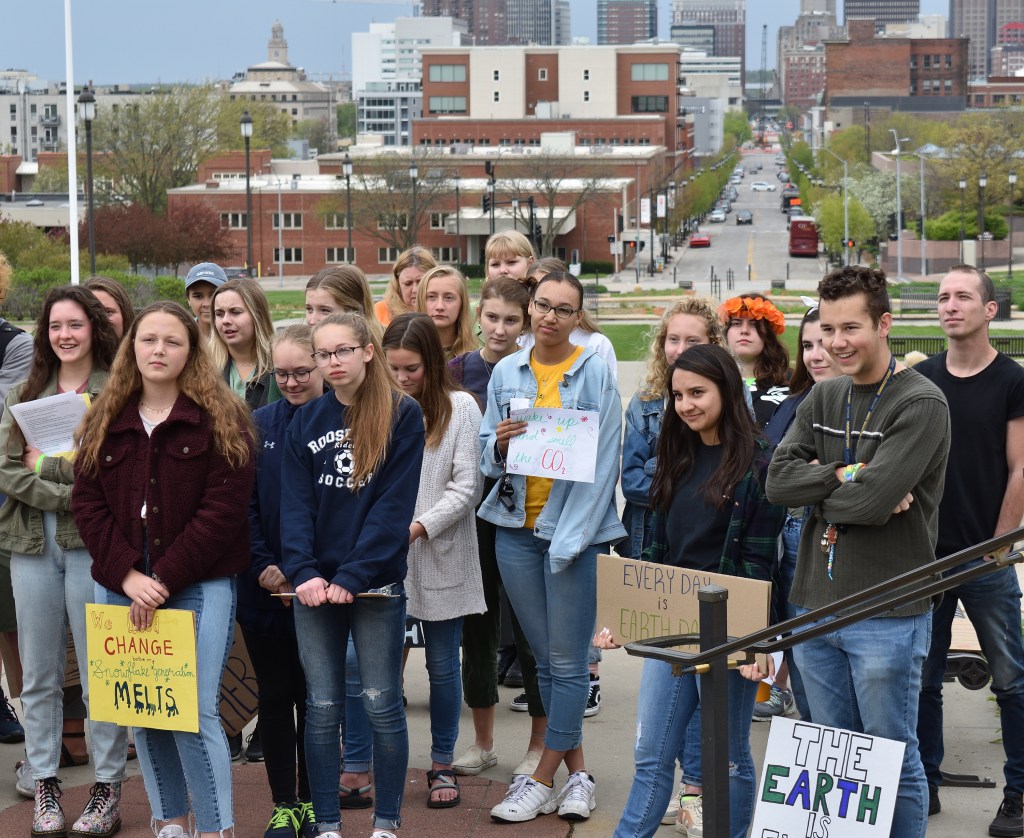
I really enjoyed seeing some of the members of the Sunrise Movement in person when they were in Des Moines for the Green New Deal Tour on Earth Day. https://kislingjeff.wordpress.com/2019/04/24/green-new-deal-tour-comes-to-des-moines/

You may have been hearing news stories about the conflict in the Democratic party regarding having one presidential debate that focuses solely on climate chaos. Democratic National Committee (DNC) Chairman Tom Perez has angered the environment movement by refusing to consider this idea, claiming climate change to be a single issue. Indicating that if there was a debate solely about climate chaos, others would want other single issue debates. That statement shows how out of touch he is regarding the scope of environmental destruction.

In response to the DNC’s refusal to hold a climate change focused debate, the Sunrise Movement quickly organized another sit-in in front of the DNC headquarters in Washington, DC. Last night’s Sunrise mass organizing call was a chance for us to hear about that sit-in, and the plans to continue to demand a climate centered debate.

Josh and Luis began the meeting by telling about the DNC sit-in. Sunrise Movement meetings are all about sharing stories, which is one of the main reasons, I believe, the movement has been so successful. One of the 11 Sunrise Principles is “we tell our stories and we honor each other’s stories”. You can see all the principles below.

They talked about the disbelief and anger they felt when they heard the DNC decision to refuse to hold a climate focused presidential debate.

“Our institutions are utterly failing us.”

Thinking of how to respond, they quickly put together a sit-in in front of the national DNC headquarters in Washington, DC. Much of what then happened was spontaneous. I am really impressed by how creative and effective Sunrise is in organizing.

When Sunrise Movement members, many from the Washington, DC Hub got to the DNC offices, they began telling their stories, as they always do. In response the building’s doors were locked!

The Sunrise members stayed and continued to tell their stories.They called on the DNC to have the moral courage to focus on environmental chaos. Much of what happened was spontaneous. They sang songs and camped out, staying there for 60 hours. One idea was to hold an outdoor watch party. Other Sunrise Principles are “we take initiative” and “we embrace experimentation and we learn together.”

They talked about the great community support. People brought meals, sun screen, etc. Other Sunrise Principles are “we ask for help and we give what we can”, “we take care of ourselves, each other, and our shared home”, and “we grow our power through talking to our communities.”

The Sunrise Principle I see all the time is “we shine bright.”

Because of this sit-in, Tom Perez will now put a climate focused debate up for a vote when the DNC meets August 22nd.

There were nearly 750 of us on the call last night! During the call, 400 of us committed to either plan or attend an action at our local Democratic party offices in the next few weeks. We want to pressure our local party leaders to vote for a climate only presidential debate when the DNC holds its August 22nd meeting.

Use this link to sign up to participate in whatever action becomes planned at your local Democratic party offices. bit.ly/climatedebateaction


These are guidelines of our movement which we all commit to uphold. Any action that does not embody these principles is not a Sunrise action.

  1. We are a movement to stop climate change and create millions of good-paying jobs in the process. We unite to make climate change an urgent priority across America, end the corrupting influence of fossil fuel executives on our politics, and elect leaders who stand up for the health and wellbeing of all people.
     
  2. We grow our power through talking to our communities. We talk to our neighbors, families, religious leaders, classmates, and teachers, in order to spread our word. Our strength and work is rooted in our local communities, and we are always growing in number.
     
  3. We are Americans from all walks of life. We are of many colors and creeds, from the plains, mountains, and coasts. A wealthy few want to divide us, but we value each other in our differences and we are united in a shared fight to make real the promise of a society that works for all of us.
     
  4. We are nonviolent in word and deed. Remaining nonviolent allows us to win the hearts of the public and welcomes the most people to participate. We need maximum participation in order to achieve our goals.
     
  5. We tell our stories and we honor each other’s stories. We all have something to lose to climate change, and something to gain in coming together. We tell our individual stories to connect with each other and understand the many different ways this crisis impacts us.
     
  6. We ask for help and we give what we can. We all have something to offer to the movement. Some of us give time through volunteering anywhere from 1 to 50 hours per week. Some of us give money. Some of us donate housing or meeting space. We invite our community into the movement by asking for the help we need.
     
  7. We take initiative. Any group of 3 people can take action in the name of Sunrise. We ask for advice — not permission — from each other to make this happen. To make decisions, we ask ourselves, “does this bring us closer to our goal?” If yes, we simply do the work that is exciting and makes sense.
     
  8. We embrace experimentation and we learn together. We welcome imperfection, share innovations, and learn through honest mistakes followed by honest conversations that help us move forward together. If we see something we don’t like, we contribute with something we do like, modeling an alternative.
     
  9. We take care of ourselves, each other, and our shared home. We maintain our health of body, mind, spirit, and environment to the best of our ability so that we can maintain a strong movement together. We respect that for each of us this looks different. 
     
  10. We stand with other movements for change. Stopping climate change requires winning and holding power at every level of government. This is a huge job and we can’t do it alone. When it makes sense, we work with other movements who share our values and are also working to win political power.
     
  11. We shine bright. There are hard and sad days, to be sure. This isn’t easy work. But we strive to bring a spirit of positivity and hope to everything we do. Changing the world is a fulfilling and joyful process, and we let that show.

#SunriseMovement

Posted in climate change, Green New Deal, Sunrise Movement, Uncategorized | Leave a comment

When Principles Clash with Activism

I’m pretty sure anyone who knows me or has read these blog posts knows about 40 years ago I was led to live without owning a personal automobile. A farm boy, I was shocked by the smog that enshrouded Indianapolis when I moved there after a year at Earlham College. This was in 1971, before catalytic converters started to come into use in 1975.

I didn’t know at the time how the consequences of that decision would touch almost every part of my life, as I’ve detailed in the past. Most of those situations improved my life in some way, i.e. being healthier because of walking and running for transportation and becoming a much better photographer because of all my walking with my camera to name a few.

The inconveniences, like walking in the rain or snow, or having to plan what to get at the grocery store that won’t be too heavy or bulky, running to all parts of town for my godson’s baseball games, etc. soon became a regular part of my life.

The times living without a car is frustrating is when there are social justice meetings or rallies that I can’t attend because there isn’t a bus that goes there or it is too far to ride a bicycle. It is tempting to think I should make an exception, like the end justifies the means. But I usually don’t make an exception. Since moving to Iowa two years ago I have had to use my parent’s car to get to Bear Creek Meeting. I’m still hoping to find a way around that. I’ve tried to increase my bicycling range but Bear Creek is 40 miles from Indianola. Eventually I plan to move close enough to be able to bicycle to meeting.

But I do not think the ends justify the means. The means must remain as close to your principles as possible. People aren’t going to take what you say about a given subject seriously if you aren’t setting a good example yourself. The example, or lack thereof that I often think about is when people who say they care about Mother Earth fly from meeting to meeting to talk about the environment.

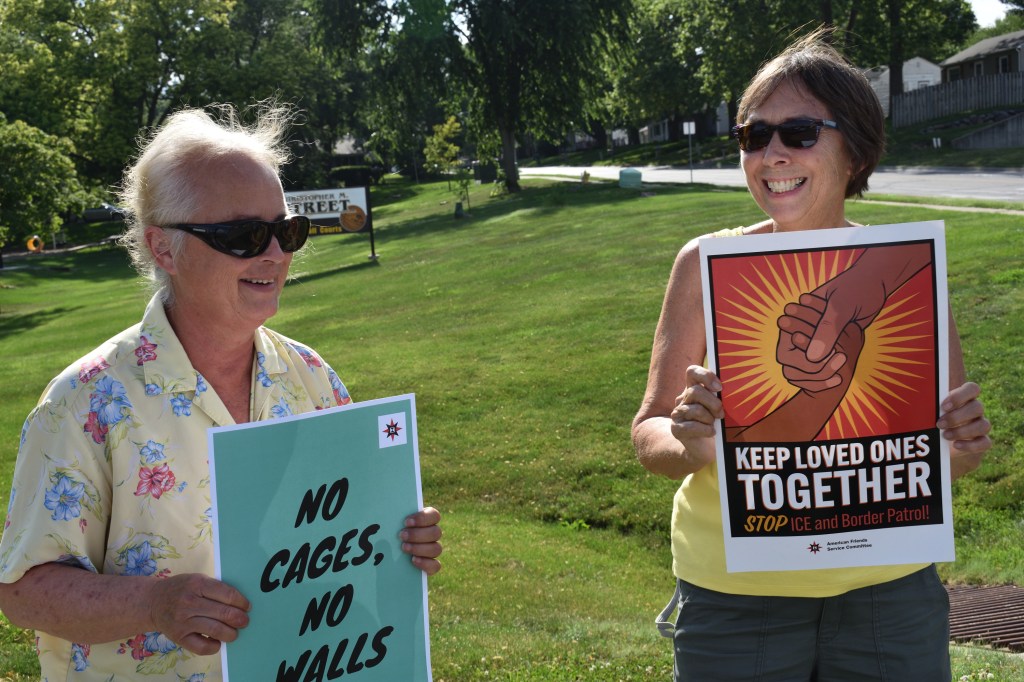
One solution is to connect with local activists. Today there were nationwide rallies to protest the immigrant concentration camps. Many were held at the district Congressional offices, which would have been in Des Moines for me, so I didn’t make it there.

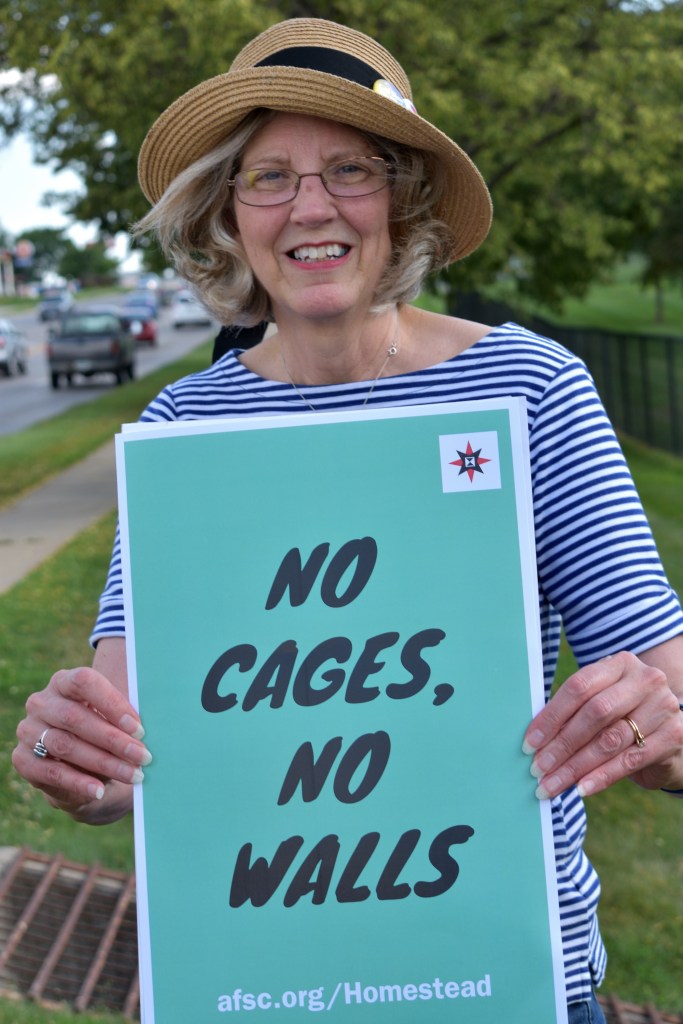
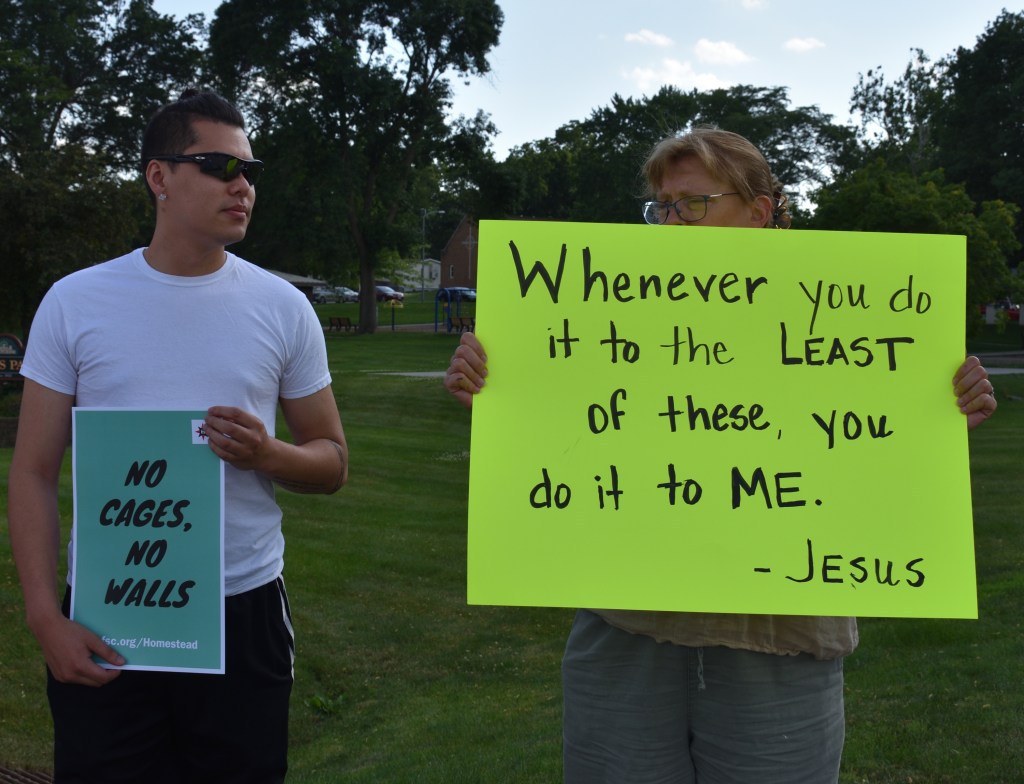
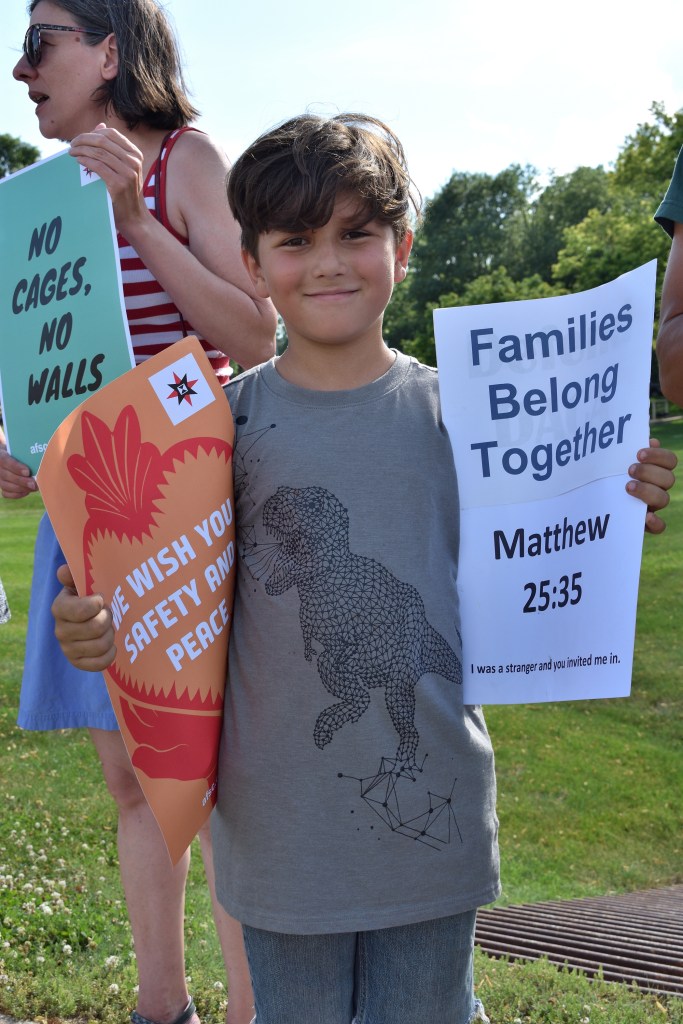
But Indivisible Warren County did organize a rally here in Indianola today about the migrant camps, close enough for me to walk to. There are advantages to bringing these messages to local communities.

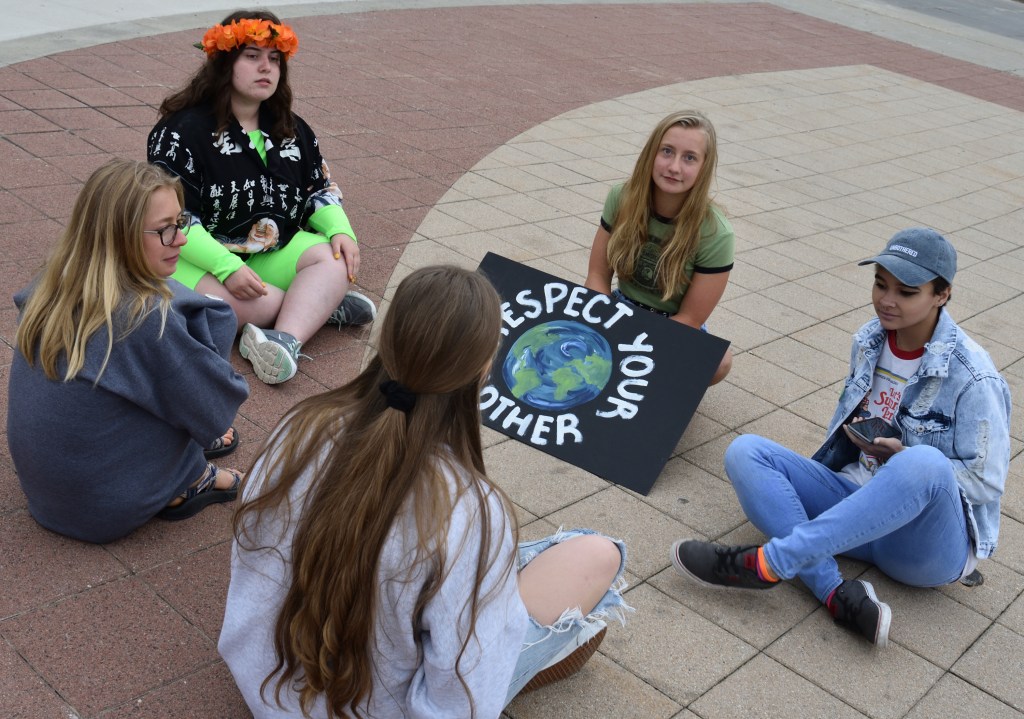
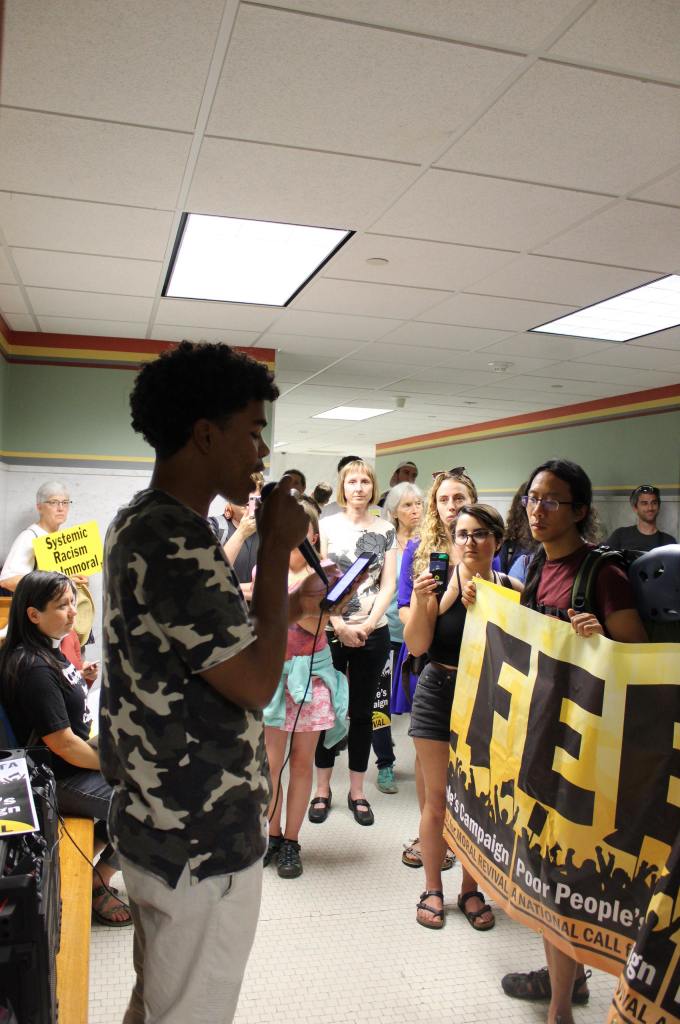
Following are photos from today’s rally. I asked for permission to include the photos of the children, which I find to be especially compelling considering we are talking about the conditions of the children in the concentration camps.

Posted in immigration, Uncategorized | Tagged , , , | Leave a comment

Children and Injustice

While many may not realize it consciously, injustice is viscerally felt by everyone in the society where injustice is occurring. We are all devastated by the continuing revelations about the deplorable conditions of the concentration camps at our southern border. This hurts so much more because it involves children.

Native people consider children to be sacred beings. Wakanyeja, pronounced WAH-KUH-AY-JA, is Lakota for “sacred little ones”

I wonder how the young people I met last week in a cold, crumbling school building in a poor village in Georgia understand or experience social justice. They spoke of loneliness; a lack of love and emotional attachment with their families; being afraid of speaking up; being labelled and detached from society; a poor physical environment; financial and health problems and poor educational opportunities.

At the heart of children’s vulnerabilities lie the more intangible relational, identity and protection issues that shape their daily lives and experience of social justice.

Understanding how children experience injustice, World Vision

Many of us have contacted our Congressional representatives but Congress is dysfunctional. It is hopeful to hear the reports of the exposure of more of what is happening in the camps from yesterday’s visit by members of Congress.

Today many of us will demonstrate in public, at Congressional offices, hoping to create change. https://kislingjeff.wordpress.com/2019/07/01/closethecamps/

I am in Birmingham because injustice is here. Just as the prophets of the eighth century B.C. left their villages and carried their “thus saith the Lord” far beyond the boundaries of their home towns, and just as the Apostle Paul left his village of Tarsus and carried the gospel of Jesus Christ to the far corners of the Greco Roman world, so am I compelled to carry the gospel of freedom beyond my own home town. Like Paul, I must constantly respond to the Macedonian call for aid.

Moreover, I am cognizant of the interrelatedness of all communities and states. I cannot sit idly by in Atlanta and not be concerned about what happens in Birmingham. Injustice anywhere is a threat to justice everywhere. We are caught in an inescapable network of mutuality, tied in a single garment of destiny. Whatever affects one directly, affects all indirectly. Never again can we afford to live with the narrow, provincial “outside agitator” idea. Anyone who lives inside the United States can never be considered an outsider anywhere within its bounds.

You deplore the demonstrations taking place in Birmingham. But your statement, I am sorry to say, fails to express a similar concern for the conditions that brought about the demonstrations. I am sure that none of you would want to rest content with the superficial kind of social analysis that deals merely with effects and does not grapple with underlying causes. It is unfortunate that demonstrations are taking place in Birmingham, but it is even more unfortunate that the city’s white power structure left the Negro community with no alternative.

Rev Martin Luther King, Jr. Letter from a Birmingham Jail

A society cannot long exist without truth which is the bedrock of justice, it cannot long live a lie. In the final analysis the Social Contract is both a perception and a belief. When the substance of life in a society as it is lived is perceived to fail our natural expectations of truth and justice, our belief in the social contract is betrayed and cynicism follows. With that cynicism, the commitment to the commons is undermined and ultimately destroyed. When the social contract becomes everyone for themselves with all which that entails a civil society no longer exists.

The Social Consequences of Injustice by Emanuele Corso, Nation of Change, February 16, 2016

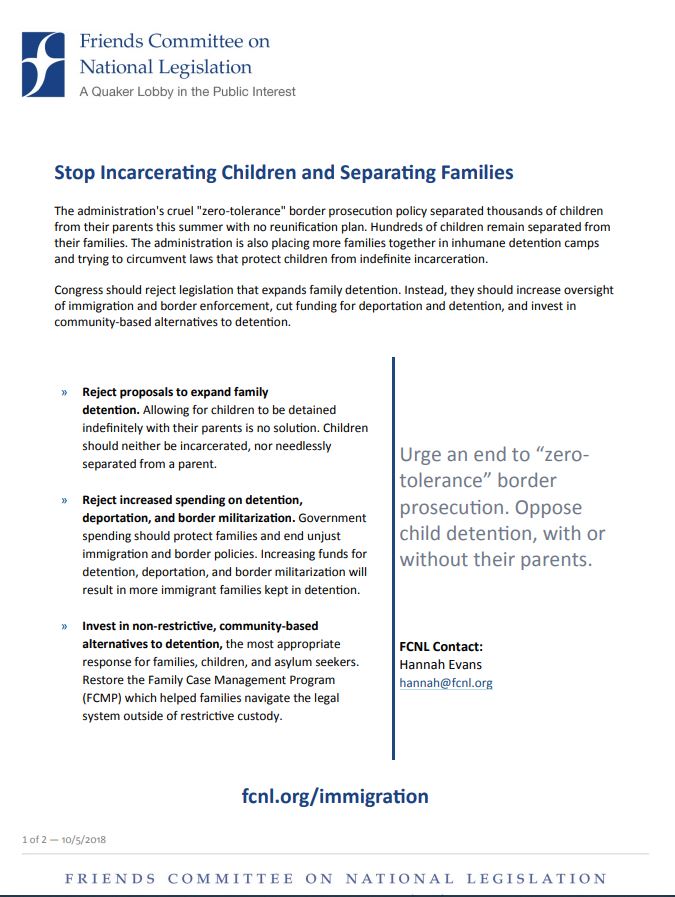
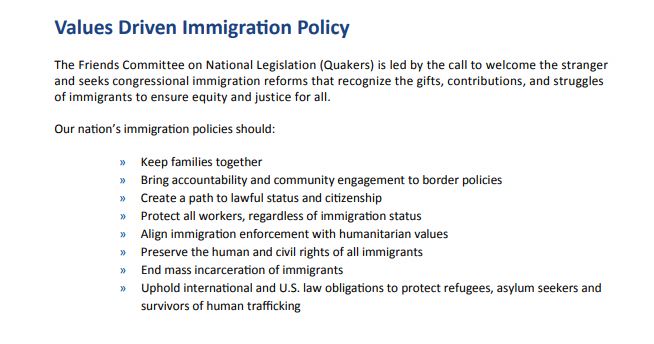
The following can be downloaded here: https://www.fcnl.org/documents/655

As the following photos show, children also agitate for justice. The last photos are from the Children’s March in Birmingham in 1963. I would encourage you to speak with young people today.


Posted in immigration, Uncategorized | Tagged , , | Leave a comment

Spirit Walking in the Tundra

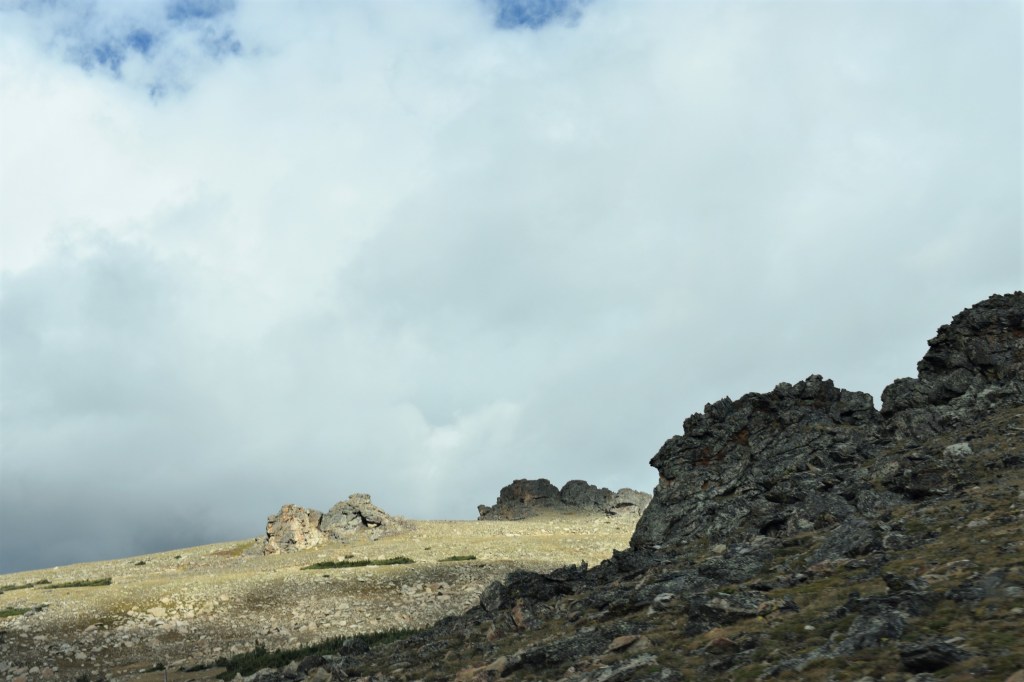
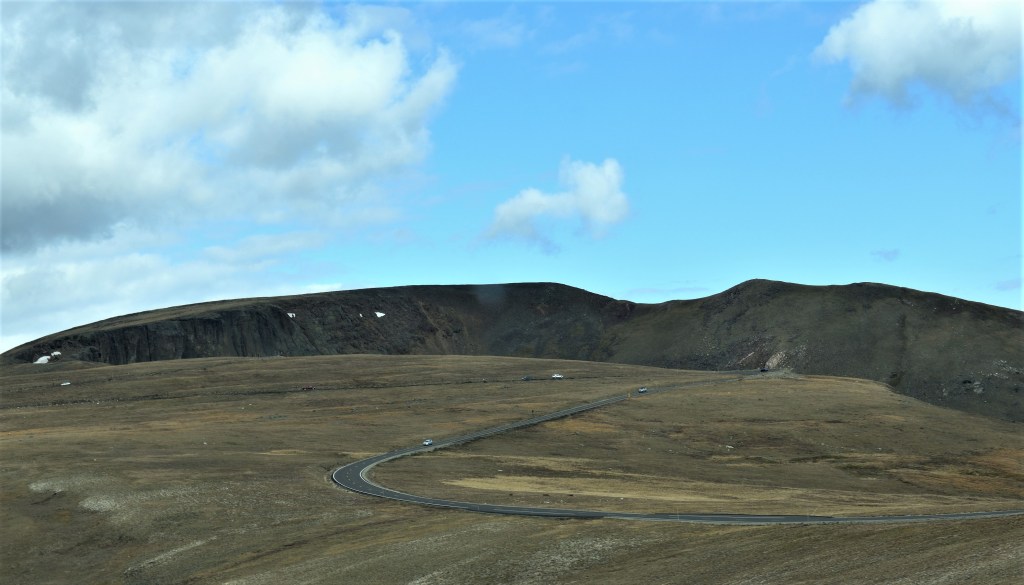
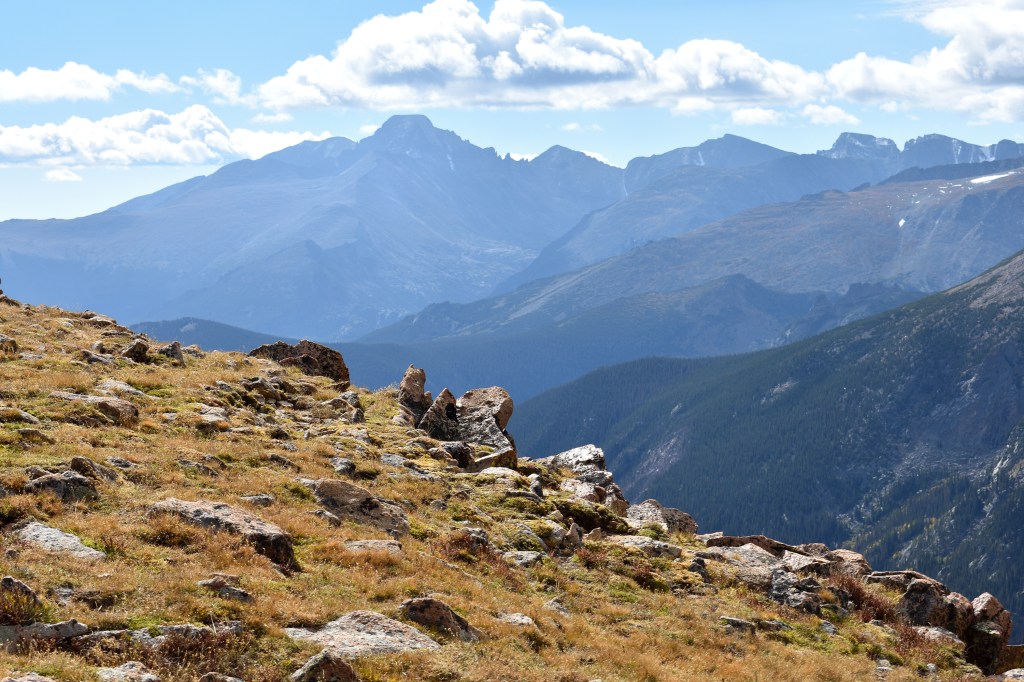
I am very grateful my parents chose to take us on camping trips across the United States for our summer family vacations, specifically selecting National Parks to camp in.  Actually camping in the Parks was key to the whole experience.  Our first camper was a King camper, which was an aluminum trailer with a canvas covered framework that unfolded to form the top half when we stopped at the campsite.  Being in the woods, hearing the sounds of the wind and wildlife and the glacier streams rush over the boulders, feeling the cold at night, and smelling the pine trees made the experience so much better than traveling into the park during the day and returning to a motel at night.

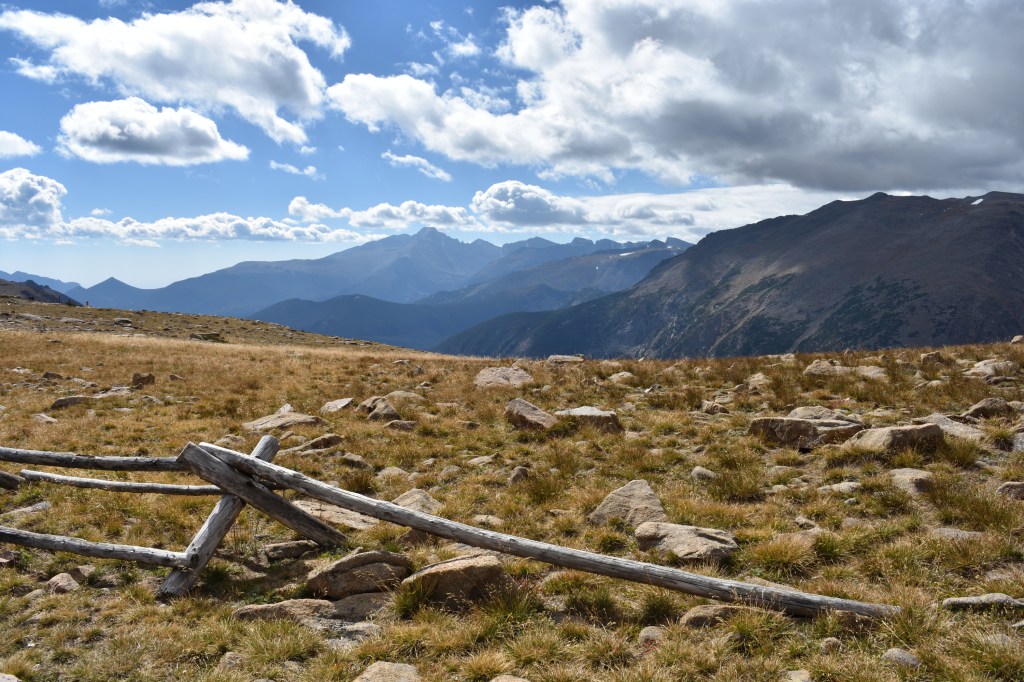
Hiking through the meadows and forests and upon mountainsides with countless, stunning vistas, were life changing experiences for me.  I was overwhelmed by the intense beauty.  Rocky Mountain National Park was our favorite, and we returned there time and again as we were growing up. We quickly found that not many people traveled too far from the parking areas, and with even a short hike we were practically alone in the woods.  Hikes of just a mile or two brought us to lakes, canyons, waterfalls, cliffs, meadows, snowfields, boulder fields, and rock walls to climb. Places we were able to appreciate alone.

I hadn’t reflected much on why we sought opportunities to be by ourselves in the mountains. It just seemed a much better experience that way. Now I think it was related to feeling closer to God when we were deep in the quiet of the forests. Having grown up in Quaker communities, I was used to worshiping in silence, as we do so we can hear the whisper of the Spirit. Being enveloped in the silence of the mountains was a natural extension of Quaker worship.

Spirit Walking in the Tundra

All the way to Nome, I trace the shadow of the plane as it walks Over turquoise lakes made by late spring breakup Of the Bering Sea. The plane is so heavy with cargo load it vibrates our bones. Like the pressure made by light cracking ice.

Below I see pockets of marrow where seabirds nest. Mothers are so protective they will dive humans. I walk from the tarmac and am met by an old friend. We drive to the launching place And see walrus hunters set out toward the sea. We swing to the summer camps where seal hangs on drying frames. She takes me home. I watch her son play video games on break from the university.

This is what it feels like, says her son, as we walk up tundra, Toward a herd of musk ox, when you spirit walk. There is a shaking, and then you are in mystery.

Little purple flowers come up from the permafrost. A newborn musk ox staggers around its mother’s legs.

I smell the approach of someone with clean thoughts. She is wearing designs like flowers, and a fur of ice. She carries a basket and digging implements. Her smell is sweet like blossoms coming up through the snow. The spirit of the tundra stands with us, and we collect sunlight together, We are refreshed by small winds.

We do not need history in books to tell us who we are Or where we come from, I remind him. Up here, we are near the opening in the Earth’s head, the place where the spirit leaves and returns. Up here, the edge between life and death is thinner than dried animal bladder.

(FOR ANUQSRAAQ AND QITUVITUAQ) NOME, ALASKA, 2011

Harjo, Joy. Conflict Resolution for Holy Beings: Poems (pp. 34-35). W. W. Norton & Company. Kindle Edition.

Photos: Jeff Kisling

Posted in Quaker, Uncategorized | Tagged , | Leave a comment

#CloseTheCamps

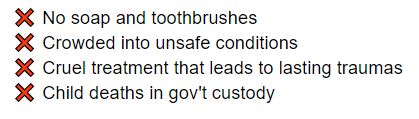
We have watched with mounting horror as details and images of the inhumane treatment of children in the detention centers at our southern border continue to emerge. Tomorrow there will be protest rallies across the country demanding that the camps be closed.

“Everyone now knows just what is at stake along our southern border. This is a humanitarian crisis that gets worse and worse each day we choose to ignore it,” said Diane Randall, FCNL executive secretary. “Quakers see the light of God in every person. This includes the children suffering unjustly in our border detention centers, their parents from whom they have been separated, and the government officials enforcing these immoral policies. We need to fund emergency assistance that ends family separation and assures community-based care for children and their families immediately.”

https://www.fcnl.org/updates/fcnl-supports-humanitarian-crisis-funding-not-enforcement-2177
  • On Tuesday, July 2, 2019, MoveOn, United We Dream, American Friends Service Committee, and Families Belong Together will lead protests across the country in front of congressional offices to demand the closure of inhumane immigrant detention centers that subject children and families to horrific conditions. 
  • The protesters will call on members of Congress to close the camps, refuse to authorize any more funding for family detention and deportation, and visit detention camps to bear witness to the atrocities being committed.
  • Tens of thousands of migrants are being held in horrific conditions, forcibly separated from their families, with no promise of reunification or future assistance. 
  • The conditions at these camps  are the product of a cruel and intentional strategy by the Trump administration to terrorize immigrant communities, criminalize immigration, and dismantle our asylum laws. 
  • From imprisoning children in inhumane detention centers, threatening widespread raids to break up families, and covering up reports of migrants dying in U.S. custody there is no end to the Trump Administration’s  inhumane, cruel and morally bankrupt policies. 
  • On Tuesday, we will raise our voices together to demand the permanent end to family detention and separation, ensure all families are reunited, and close these camps. 

Sign the petition here: http://mvn.to/camps-sign

You can see where events are happening here:
https://act.moveon.org/event/close-camps-now_attend/search/?

Text CAMPS to 668366 to continue taking action to #CloseTheCamps.

A core principle shared by supporting organizations is a commitment to nonviolent, peaceful actions. All actions that are sponsored or organized on this page are intended to be nonviolent and peaceful. We expect all participants to act lawfully at all times and to seek to de-escalate any potential confrontation with those who disagree with our values.


Posted in immigration, Uncategorized | Tagged , , , , | Leave a comment

Some Challenges of Working for Justice

Each human is a complex, contradictory story. Some stories within us have been unfolding for years, others are trembling with fresh life as they peek above the horizon. Each is a zigzag of emotional design and ancestral architecture. All the stories in the earth’s mind are connected.

Harjo, Joy. Conflict Resolution for Holy Beings: Poems (p. 20). W. W. Norton & Company. Kindle Edition.

A large part of my Quaker heritage is for us to work to help those in need and, more broadly, to change our social and political institutions to become more just. There is often some tension in Quaker meetings between those who are led to be involved in activism and those who are not called to do that work. (Note: references to “meeting” below are to Quaker meetings.)

There are, unfortunately so many justice issues. Usually a given person in the meeting might be led to work on a particular issue. Thus most meetings might have some people who focus on race, others on the environment, others on immigration, etc. Each person becomes an expert in their subject, and usually knows more about that than others in the meeting. What works best is for each person to educate the rest of the meeting about what they have learned and are concerned about. We can’t all be experts, by any means, on every issue.

This is complicated for a number of reasons. One being the history most of us learned was “white washed” in the sense of changing history to make white people’s actions appear better than what actually happened, or not mentioning injustices that occurred at all. We have to re-learn history, and find that not as many Quakers as we have been led to believe actually participated in the underground railroad. We learn many Quakers were involved in the institution of slavery. We learn about what actually happened in Indian boarding schools, with the participation of Friends.

Even more difficult, partly because of the “white washed” history, many white people do not realize the extent to which their lives today are privileged.  Perhaps don’t know that in the past there were actual maps to show where people of color could not buy or rent a house. There were many forms of blatant public discrimination in the not too distant past and today. And don’t realize the extent to which racism is built into the structures of our society now.

We are each at our own point along the spectrum of understanding about each justice issue. There is frustration when those who learn more about an issue see that changes must be made to address the injustice. They then want the rest of the meeting to work to make those changes. But the rest of the meeting may have trouble seeing the problem, seeing the urgency of addressing the problem, or understand what needs to be done.  

The frustration is compounded when those who have learned about structural racism, for example, come to understand that the status quo is unjust. That certain beliefs and practices of the Friends in the meeting are now seen, by them, as perpetuating injustice.

What do we do in those situations? It would help to acknowledge who has expertise in a given area, and find ways for them to educate us. This is often a difficult and lengthy process.

An example of this has been my 40 year struggle to convince Friends to give up personal automobiles. Back then many people were not aware of the extent of the environmental damage that was being done by burning fossil fuels. It was possible for me to live without a car because I lived in a city and mass transit was available. It is obviously a completely different situation in rural areas and small communities, which is where Friends in my meeting lived. So, for 40 years there has been this tension between me and my meeting about this. I could readily see what a challenge this was and is for those who don’t have access to mass transit. But I couldn’t stop raising the issue, because I knew that no matter how good one’s reasons are for having a car, Mother Earth was being severely damaged. As a result we are now in the sixth mass extinction event.

One thing that resulted from these discussions was a Minute on Ethical Transportation (see below) that was approved by my meeting, Bear Creek, and then by Iowa Yearly Meeting (Conservative). https://kislingjeff.wordpress.com/2017/07/20/ethical-transportation/

This makes me again appreciate how powerful the Quaker Social Change Ministry (QSCM) program is. Having the entire meeting focus on one specific area of justice helps us all move along the path of learning more about the injustice. But more importantly, one of the fundamental parts of QSCM is accompaniment of a community currently experiencing injustice. You cannot understand justice issues just by studying and having committee meetings. You have to commit to spending a significant amount of time and energy working alongside those in the impacted community.

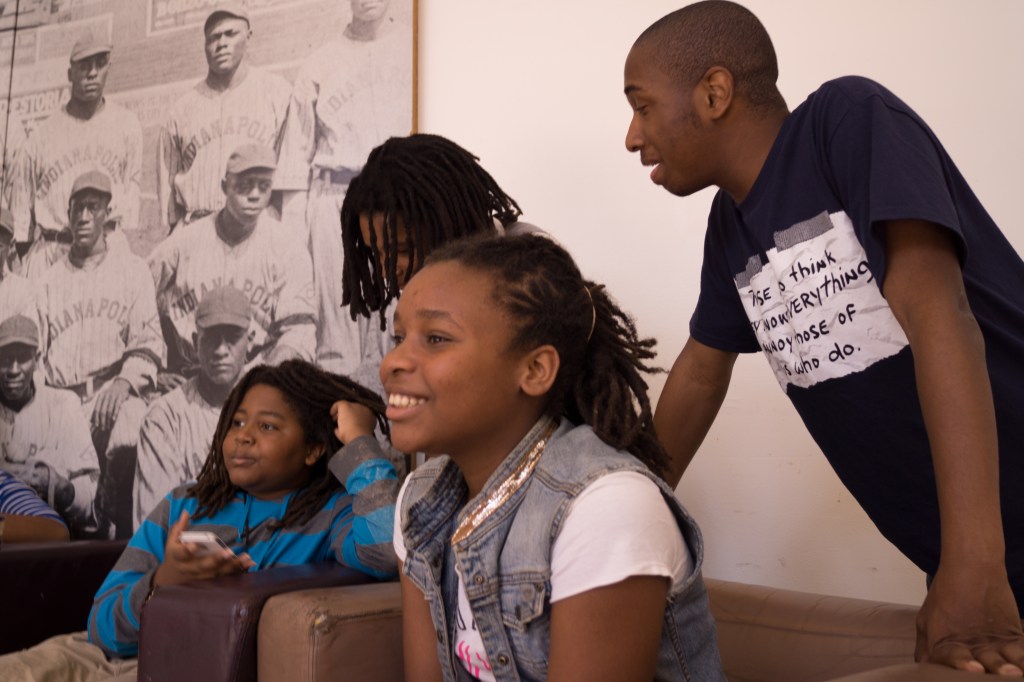
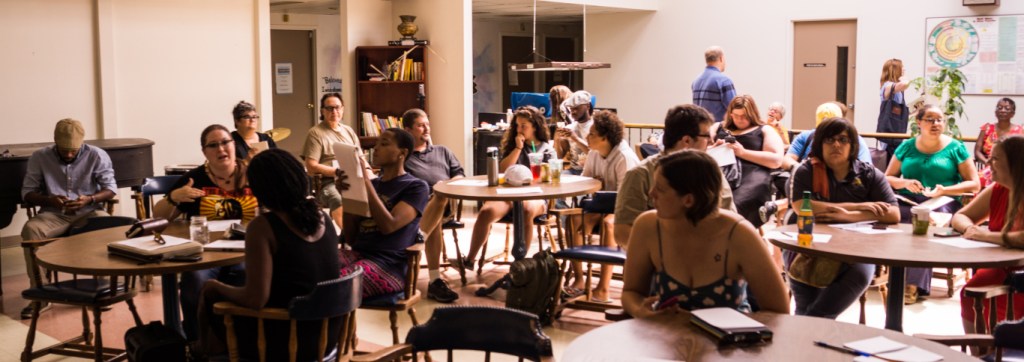
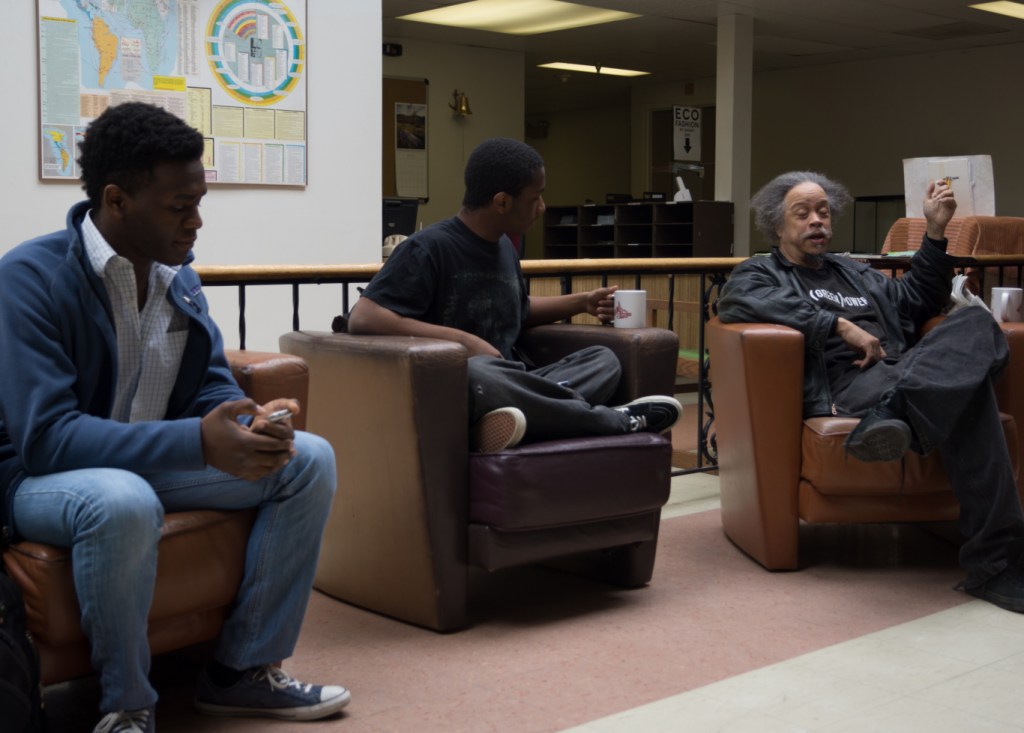
I’ve written a lot about our experience at North Meadow Circle of Friends in Indianapolis when we adopted the Quaker Social Change Ministry model, and accompanied the black youth mentoring organization, the Kheprw Institute (KI): https://kislingjeff.wordpress.com/?s=ki+kheprw. These photos are of the KI community and North Meadow Friends.

Information about Quaker Social Change Ministry (QSCM) can be found here: https://www.afsc.org/quakersocialchange

Ethical Transportation

Radically reducing fossil fuel use has long been a concern of Iowa Yearly Meeting (Conservative). A previously approved Minute urged us to reduce our use of personal automobiles. We have continued to be challenged by the design of our communities that makes this difficult. This is even more challenging in rural areas. But our environmental crisis means we must find ways to address this issue quickly.

Friends are encouraged to challenge themselves and to simplify their lives in ways that can enhance their spiritual environmental integrity. One of our meetings uses the term “ethical transportation,” which is a helpful way to be mindful of this.

Long term, we need to encourage ways to make our communities “walkable”, and to expand public transportation systems. These will require major changes in infrastructure and urban planning.

Carpooling and community shared vehicles would help. We can develop ways to coordinate neighbors needing to travel to shop for food, attend meetings, visit doctors, etc. We could explore using existing school buses or shared vehicles to provide intercity transportation.

One immediately available step would be to promote the use of bicycles as a visible witness for non-fossil fuel transportation. Friends may forget how easy and fun it can be to travel miles on bicycles. Neighbors seeing families riding their bicycles to Quaker meetings would have an impact on community awareness. This is a way for our children to be involved in this shared witness. We should encourage the expansion of bicycle lanes and paths. We can repair and recycle unused bicycles, and make them available to those who have the need.

Minute approved by Iowa Yearly Meeting (Conservative)

Posted in Kheprw Institute, Quaker, Quaker Meetings, Uncategorized | Tagged , | Leave a comment

Into This Morning Light to You

The light is beautiful this morning.

I’ve done my best to try to continue to believe there might be ways we could avoid environmental catastrophe and societal collapse. I hoped people would wake up before it was too late. For forty years I tried to get others to join me in giving up personal automobiles, to no avail. Still, my carbon footprint is many times greater than that of those who live in underdeveloped countries. If we had invested in mass transportation and cities designed to be walkable, Mother Earth might be healthy today.

Instead, we are in the midst of the sixth mass extinction and it looks like humans will be among the species that will not survive. We are now experiencing the consequences of the damage we have done to Mother Earth. “And now we had no place to live, since we didn’t know how to live with each other.”

“Then one of the stumbling ones took pity on another
And shared a blanket.
A spark of kindness made a light.
The light made an opening in the darkness.”

Joy Harjo

I believe what we are called to do now is create sparks of kindness.


Once the World Was Perfect

Once the world was perfect, and we were happy in that world.

Then we took it for granted.

Discontent began a small rumble in the earthly mind.

Then Doubt pushed through with its spiked head.

And once Doubt ruptured the web,

All manner of demon thoughts Jumped through—

We destroyed the world we had been given

For inspiration, for life—

Each stone of jealousy, each stone

Of fear, greed, envy, and hatred, put out the light.

No one was without a stone in his or her hand.

There we were,

Right back where we had started.

We were bumping into each other

In the dark.

And now we had no place to live, since we didn’t know

How to live with each other.

Then one of the stumbling ones took pity on another

And shared a blanket.

A spark of kindness made a light.

The light made an opening in the darkness.

Everyone worked together to make a ladder.

A Wind Clan person climbed out first into the next world,

And then the other clans, the children of those clans, their children,

And their children, all the way through time—

To now, into this morning light to you.

Harjo, Joy. Conflict Resolution for Holy Beings: Poems (pp. 14-15). W. W. Norton & Company. Kindle Edition.
Posted in climate change, Uncategorized | 1 Comment

Seeding the Hill with Indigenous FreeThinkers

I’ve written a lot about why I believe a Green New Deal is our best hope to try to tackle evolving environmental collapse. And why I feel it is so important for a developing Green New Deal to be led by Native peoples. I recently came upon the following which expresses why.

How it came to be

Only the Indian people are the original people of America. Our roots are buried deep in the soils of America. We are the only people who have continued with the oldest beliefs of this country. We are the people who still yet speak the languages given to us by the Creator. This is our homeland. We came from no other country. We have always looked at ourselves as human beings . . . Every tribe has a trail of tears. We wonder when it is going to end.
PHILLIP DEERE (1929–1985)

Harjo, Joy. Conflict Resolution for Holy Beings: Poems (p. 1). W. W. Norton & Company. Kindle Edition.

In the following video Chase Iron Eyes and others from the Lakota People’s Law Project talk about indigenous leadership for a Green New Deal.

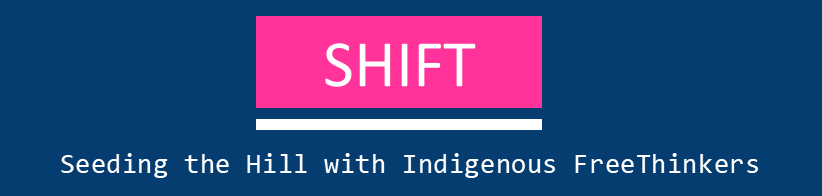
I am excited to learn about “SHIFT. Seeding the Hill with Indigenous FreeThinkers.”

https://seedingsovereignty.org/shift

SHIFT is Seeding Sovereignty’s political engagement program launched to empower the political voice of Indigenous Peoples in order to impact the 2020 Presidential election. This enterprise was developed by Indigenous FreeThinkers determined to create long term change by decolonizing the American colonial-capitalist political system. SHIFT’s mission is motivated by the ceaseless assault on Indigenous communities,  disproportionately coveted by the extraction industry and poisoned by insatiable greed for oil, gas, coal, uranium, timber, dams, Big-Ag, CAFOs and more. Along with violence to the earth comes danger to our people–we and our cultures are in crisis with the highest rates of poverty, illness, youth suicide, missing and murdered people in this country.

Our Mother Earth is also in crisis and Indigenous people have long recognized this. For hundreds of years we have fought at the frontlines of environmental threats that are now leading us to climate catastrophe. We have long spoken of the repercussions of colonial-capitalism, the need for a regenerative economy, land stewardship for the generations to come, and the important role of women.  Enter the  Green New Deal. This paradigm shifting movement is where we can plant our experience, grow our diverse networks and  build a collective vision for a thriving future for everyone. At this time our world needs the tangible example of Indigenous stewardship of our planet to change the world’s ecological and socio-economic trajectory and turn the tide on the climate crisis, poverty, and ongoing systemic inequities. David Suzuki says it, Noam Chomsky says it, the Drawdown team says it— but most importantly, our ancestors lived it and our own tribal experts say it.

https://seedingsovereignty.org/shift

SHIFT’s goals:

  • Empowering the Indigenous role in the Green New Deal to raise the voice and leadership of Indigenous, Black, Immigrant, LGBTQ, Women, Youth, Latinos and Refugees.
  • Discussing tribal sovereignty and respect for treaties to SHIFT the political landscape beyond the tokenization of our tribal nations and to end the notion of domestic dependent nations.
  • Catalyzing Indigenous political engagement by discussing and publicizing issues affecting Indian Country on all our media platforms.
  • Galvanizing Indigenous voter registration and turnout for a population that is historically disenfranchised by supporting the work of voter advocacy groups and grassroots actions.
  • Shining light on the historic election of two Indigenous congresswomen and the many other people of color that are making great legislative change.
  • Education and grassroots organizing, direct actions, art builds, youth leadership development, candidate convenings, and cultural events with the goal to diversify the political movement.

To contact Christine Nobiss, SHIFT Director, email christine@seedingsovereignty.org

With the DNC debates starting tonight, our SHIFT director, Christine Nobiss, has a few things to say.

Firstly, we all know that none of the candidates are going to speak about Indigenous sovereignty and the fact that we need more control over our territories to protect ourselves and our land from the destruction and mayhem caused by colonized industry. Also, the the candidates will most likely not mention any of the treaties this country is founded on and the fact that the DNC is hosting its debate on occupied land. Miami rests on stolen land. Florida is home to the Miccosukee and Creek tribes in the north and countless nations to the south that were genocides. And let’s not forget the Seminoles that spent a lot of time in that area retreating from settler vigilantes.

Then there’s the fact that Tom Perez, chair of the DNC, has put a halt on a climate debate because the party does not want to focus on any issue specifically because that might allow certain candidates to dictate the flow of the event. They’ve gone so far is to threaten to bar any candidates from future DNC debates if they organize their own climate debates.

All we have to say about this is “whaaat”? The sunrise movement is currently rallying outside of the DNC headquarters because of this debate failure. As and Indigenous and womxn lead organization, Seeding Sovereignty takes a hard stance on climate change and the environment. Colonization is the cause of climate change and environmental destruction everywhere, and, we see no other option but to solve both these issues together as they are intrinsic to each other.
The state of the economy and jobs for blue-collar people won’t matter if we cannot grow food or drink water. None of these capitalist-based economic issues will matter at all if the world is on fire and our cities are drowning.

https://seedingsovereignty.org/shift

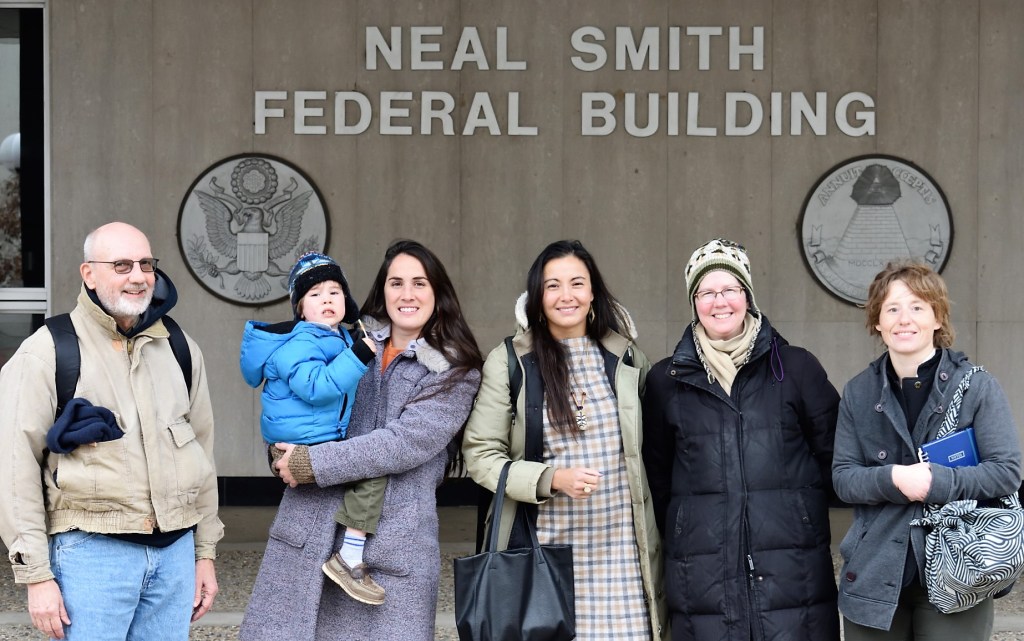
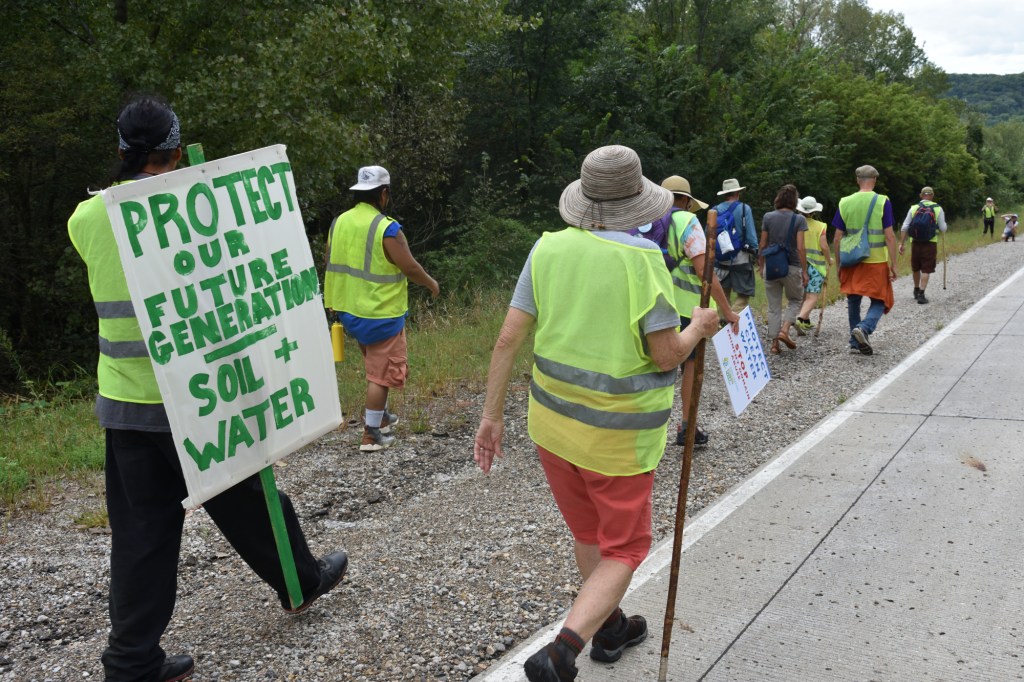
Christine Nobiss walked on the First Nation-Farmer Climate Unity March, so I was able to get to know her a little. One of the goals of that March was to create a small group of Native and non-Native people who could work together on things of common interest. One of the first things a small group of us from the March, that included Christine, did was to meet with Senator Chuck Grassley’s Des Moines staff, both to introduce ourselves and to talk about two pieces of legislation before Congress related to Native Americans, Savannah’s Act and the SURVIVE Act.

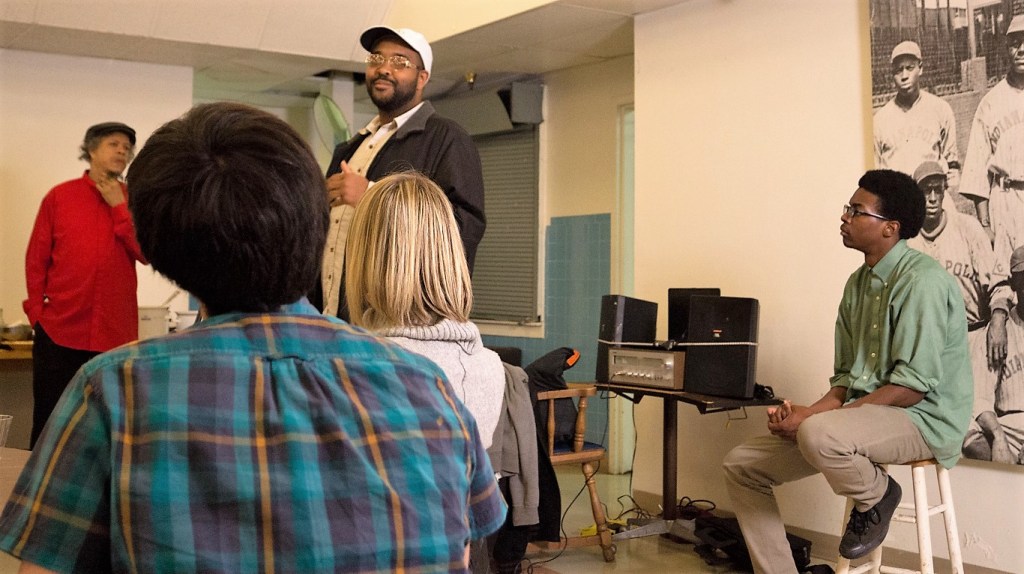
Jeff, Fox, Shazi, Christine, Shari and Sid

It was great to see my friends Trisha and Lakasha on the program when the Green New Deal Tour came to Des Moines, a great step in the direction of an indigenous led Green New Deal.

Posted in #NDAPL, climate change, Green New Deal, Indigenous, Sunrise Movement, Uncategorized | 1 Comment