Following are updates regarding support for the Wet’suwet’en Peoples and information about a hearing tomorrow evening that will be live streamed: DATE: Thursday January 30, 2020 TIME: 9:00 a.m. PST LOCATION: UBCIC Boardroom- 312 Main Street, 4th floor, Vancouver https://www.facebook.com/UBCIC/
Independent Jewish Voices stands in firm and uncompromising solidarity with the people and the Hereditary Chiefs of the Wet’suwet’en nation in their struggle to defend their land against Coastal GasLink and other pipeline companies which have encroached on their sovereign territory in unceded British Columbia.
The situation is once again at a boiling point. On December 31, 2019, the BC Supreme Court granted an injunction against members of the Wet’suwet’en nation who have been stewarding and protecting their traditional territory from the destruction caused by Coastal GasLink’s work in the area. RCMP forces are now amassing and poised to enforce the injunction.
Our ancestors came to this country we call Canada, often fleeing persecution, or to make a better life. But we must acknowledge that we are still visitors on these lands, many of which were never surrendered, or were subject to broken treaties. In the Jewish spirit of tikkun olam (Hebrew for “repairing the world”), we give our full support to Indigenous peoples who are acting to repair the very ground on which we walk. And the only way forward is if we walk together, united against colonialism.
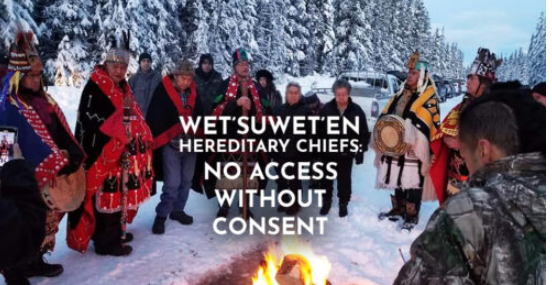
January 24th, Gitksan and Wet’suwet’en Hereditary Chiefs and Matriarchs met to discuss an alliance in the fight for upholding Wet’suwet’en law on unceded Wet’suwet’en territory.
The Wet’suwet’en invited theGiktsan formally onto the territory to stand and walk beside them through the upcoming RCMP invasion.
After a Solidarity Saturday gathering of indigenous and non-indigenous local supporters, a moose appeared as an offering to the three camps of land defenders currently holding it down behind the police line.
Thank you everyone for your dedication and support.
MEDIA ADVISORY OF PRESS CONFERENCE: Wet’suwet’en Hereditary Leadership, BCCLA, UBCIC and Legal Coalition file complaint about RCMP Checkpoint and Exclusion Zone
January 29, 2020
For Immediate Release
WHAT: A coalition is calling on the Chairperson of the Civilian Review and Complaints Commission for the RCMP to initiate a policy complaint and public interest investigation regarding the improper and unlawful actions of the Royal Canadian Mounted Police (“RCMP) in implementing and enforcing a checkpoint and exclusion zone on Morice West Forest Service Road in Wet’suwet’en territory.
They will speak about the policy complaint, which includes eight first-hand accounts, and answer media questions.
WHO: The Wet’suwet’en Hereditary Chiefs, the BC Civil Liberties Association, and the Union of BC Indian Chiefs have filed the policy complaint with the endorsement of West Coast Environmental Law and Pivot Legal Society.
DATE: Thursday January 30, 2020 TIME: 9:00 a.m. PST LOCATION: UBCIC Boardroom- 312 Main Street, 4th floor, Vancouver
SPEAKERS: Dini’ze Na’moks (John Ridsdale), Tsayu Clan, Wet’suwet’en (via skype) Grand Chief Stewart Phillip, President, Union of BC Indian Chiefs Harsha Walia, Executive Director, BC Civil Liberties Association Irina Ceric: Faculty member at Kwantlen Polytechnic University, non-practicing Lawyer excluded from the RCMP Exclusion Zone
I’ve been writing about the #Wet’suwet’en peoples and their efforts to stop the construction of the Coastal GasLink Pipeline project. Tensions between the Wet’suwet’en peoples and the Royal Canadian Mounted Police (RCMP) are escalating. There is fear the RCMP will raid the camps as they did last year. Then they were armed with assault rifles and there are reports they had discussed using lethal force. This is a microcosm of the struggle of Indigenous rights and protection of Mother Earth versus corporations and profits.
A set of headlights came peering out of the darkness, accompanied by a rattling diesel engine.
Rising from beside a warming fire at a watch camp inside an RCMP roadblock, Sabina Dennis rushed to the road.
“Cops!” she shouted as the first RCMP officer’s boot hit the snowy ground. “Someone get a camera.” More people scrambled from the fire to join Dennis as a second officer got out of the truck. Someone started filming the interaction with a cellphone. Now that a standoff between RCMP and Wet’suwet’en First Nation land defenders who oppose a pipeline has entered a fourth week, the mood behind police lines is understandably tense.
During last year’s raid, police deployed tactical officers armed with assault and sniper rifles, at one point brandishing a chainsaw. The officers forced their way over barbed wire and a reinforced gate, amid the screams of land defenders, some of whom had chained themselves to the gate itself.
The lines of this conflict are hardening, with no word yet on when—or how—it will end.
Inside the Wet’suwet’en Anti-Pipeline Camp That Police Are Blockading. Indigenous land defenders are keeping a close eye on cops as the standoff enters its fourth week.By Jesse Winter, VICE.com, Jan 28 2020
Day 24 of freedom for our yintah! We will stand strong for all those yet to come. We have the ancestors on our side, our allies and neighbours behind us and the world watching! We will never surrender. Join us. Donate here: gf.me/u/xakpk9 Other ways to support: www.yintahaccess.com Wet’suwet’en Access Point on Gidimt’en Territory
Wes Regan took this photo of protesters walking along West Broadway toward Environment and Climate Change Strategy Minister George Heyman’s constituency office.
The federal and provincial governments, LNG Canada, and Coastal GasLink Pipeline Ltd. all thought that a $40-billion fossil-fuel project would proceed in B.C. after proponents signed deals with 20 elected First Nations chiefs and councils.
But they may have underestimated the degree of public goodwill for Wet’suwet’en hereditary chiefs who are resisting a natural-gas pipeline that will provide fuel for the LNG plant near Kitimat.
Today, more than 600 Metro Vancouver secondary and university students walked out of classes to register their opposition to the pipeline.
The protesters also want the province to respect the United Nations Declaration on the Rights of Indigenous Peoples’ call for “free, prior and informed consent” to projects affecting Indigenous peoples or their territories.
The protest comes two days after Indigenous youth occupied a B.C. government Energy and Mines Ministry office that ended when Victoria police arrested 13 people. Four of those arrested spoke during the protest on Friday.
Ta’Kaiya Blaney, 18, said she was arrested by police at the ministry protest but has yet to be charged. She said Indigenous youth back the hereditary chiefs who are protecting lands that will ensure the survival of their people.
“When you attack one, you attack us all,” she told the crowd. “We, as Indigenous youth, know that what Canada is willing to do to Wet’suwet’en people is a demonstration of the measures they are willing to go to bulldoze and destroy Indigenous lands in the name of profit and industry.”
RCMP arrested 14 people at a Wet’suwet’en protest camp in northwest B.C. last January and police are now back patrolling the same area.
Fond du Lac, MN. –– A group of Indigenous and Non-Indigenous Water Protectors, blockaded an access road to a TC Energy work site where the Canadian company—formerly known as TransCanada—is performing work on natural gas lines on the Fond du Lac reservation. Today’s action is in solidarity with the Wet’suwet’en Nation’s fight to protect their traditional territories from fossil fuel expansion. The hereditary chiefs representing the five clans of the Wet’suwet’en are currently blocking construction on a section of TC Energy’s C$6.6-billion Coastal Gaslink pipeline, which would run through their ancestral lands in northern B.C.
“We will stand for no colonial resource extraction on Indigenous lands any longer, in solidarity with our Wet’suwet’en brothers and sisters in so-called Canada who are fighting the Coastal Gaslink pipeline,” said an Indigenous Water Protector. “We are a new generation of warriors and we have awoken with the call in our hearts to protect the sacred. It is no longer a rallying cry, it is something that we mean to live by.”
Local resistance to pipelines has been mounting in recent years in opposition to Enbridge’s proposed Line 3 tar sands pipeline which would violate Anishinaabe treaty rights to hunt, fish, and gather in their treaty territories. Line 3 and TC Energy’s gas pipelines threaten Indigenous sovereignty and full access to their lands.
“This is a call to arms from Indigenous elders who believe that showing solidarity with other struggles is very needed and very necessary in the fight moving forward,” said another Indigenous Water Protector.
MN: Water Protectors Stage Direct Action in solidarity with the Wet’suwet’en Fight Against the Coastal Gaslink pipeline. Rising Tide North America, January 28, 2020
Si‘Äôam Hamilton (center low) speaks to the crowd as Indigenous youth living in Lekwungen Territories stand in solidarity with the Wet‘Äôsuwet‘Äôen on the front steps of the BC Legislature in response to the arrests of 11 Indigenous youth and an Elder.Photograph By ADRIAN LAM, TIMES COLONIST
VICTORIA — Indigenous youth who rallied at the British Columbia legislature say their arrests earlier this week are minor when compared to the sacrifices of hereditary Wet’suwet’en chiefs who oppose a liquefied natural gas pipeline running through their traditional territories.
About 100 people attended a protest Friday at the B.C. legislature to urge Prime Minister Justin Trudeau and B.C. Premier John Horgan to respect Wet’suwet’en laws.
Yesterday I provided some background to explain how Bear Creek Friends (Quaker) meeting decided to write a letter to British Columbia Premier, John Horgan regarding the Wet’suwet’en peoples.
Bear Creek Friends (Quaker) meetinghouse is in the Iowa countryside. Many members have been involved in agriculture and care about protecting Mother Earth. A number of Friends have various relationships with Indigenous peoples. Some Friends have worked to protect water and to stop the construction of fossil fuel pipelines in the United States, such as the Keystone XL and Dakota Access pipelines.
There was some response on social media about the need for white people to be careful of how we get involved in areas of concern, such as solidarity with the Wet’suwet’en Peoples. Complex situations with many parts. That many times more harm than good can result.
That is very important to keep in mind, and one of the most important lessons I’ve learned from the American Friends Service Committee’s Quaker Social Change Ministry project our meeting in Indianapolis participated in. The lessons I learned were to (1) get out of the meetinghouse and into the community, and (2) when you are there do not try to provided any leadership. But instead to listen, listen very deeply. Listen until something is asked of you.
The community we connected with was the Kheprw Institute (KI), a black youth mentoring community. Being physically present in the KI community and being respectful, showing we were there to support them, not try to suggest changes, allowed us to get to know and trust each other as friends. It was a tremendous gift to see how that process of listening worked. And I have continued that model of deep listening, ever since. With similar positive results.
The KI community was holding monthly book discussions, of books like The New Jim Crow and An Indigenous Peoples’ History of the United States. These discussions were open to the public. During these book discussions we Friends were encouraged to share what we felt about the book. This was an excellent process because the focus was on the ideas in the book, not on each other. At the same time we began to know each other as we shared our thoughts and stories.
We Friends looked forward to the times we could be with our new friends at KI. When we saw each other at events outside the KI Center, we greeted each other as the friends we had become. When I engage with others now, my focus is on creating friendships. These friendships make us more open to challenging each other’s viewpoints. Being friends means you have moved beyond the initial barriers of whether to trust each other. You learn each other’s skills and are thus aware of who and what might be helpful in a given situation.
It took about a year of waiting and listening until one of us was asked to share his skills in photography during KI’s summer camp.
One of the most difficult things when I retired and moved away from Indianapolis was missing my friends at the Quaker meeting and at the KI community (and co-workers at Riley Children’s Hospital). My last Sunday at Quaker meeting, my friends from KI came to the meetinghouse. It was great that most of us knew each other. When I told my friend Alvin from KI that I felt the KI community had given me a maters degree in community organizing, he said, “we’ll send you your diploma!”
I had always wondered what the KI community felt about our work together over several years. But I didn’t feel it was appropriate to ask. I’ve never shared this before, but am now because it pertains. Imhotep said, “thank you for walking the walk.” And I’m very glad the relationships between North Meadow (Indianapolis) Friends and the KI continues to this day.
This has turned out to be a long way to get to why Bear Creek Friends offered support to the Wet’suwet’en Peoples’ current situation.
Bear Creek Meeting’s meetinghouse is in a rural setting. Many members live, or at one time lived in the vicinity of the meetinghouse or nearby Earlham, Iowa. The natural world is part of our lives. We share Quaker’s value of simplicity, including being careful of the Earth’s resources we use. It has been a challenge to minimize the use of fossil fuels in rural areas, but we continue to work on that.
We don’t believe in the profligate use of fossil fuels that pervades industrial societies. Many of us have worked, continue to work to stop fossil fuel projects such as building pipelines. We often find ourselves working with Indigenous peoples on these shared concerns. This has been another opportunity for white people to listen deeply, and follow the leadership of Native peoples. And build friendships.
Friends have also felt the necessity to learn more about the history of Quakers and Native peoples. Most Friends have heard about Quakers and the Indian Boarding Schools. I think many thought, as I did, that Quakers were helping the Native people. This is, unfortunately, an stunning example of how well meaning people can cause tremendous harm. Quaker Paula Palmer has been called to a ministry about Friends and our relations with Native peoples. Her article in Friends Journal is an excellent introduction to this history: https://www.friendsjournal.org/quaker-indian-boarding-schools/ She also holds workshops about”Toward Right Relationships with Native Peoples.” The title of one presentation is “Quaker Indian Boarding Schools: Facing Our History and Ourselves.”
Native children were forcibly removed from their families. At the boarding schools their hair was cut, they weren’t allow to speak their language or observe their customs. (“forced assimilation”). They missed out on what they would have learned about their own culture. I don’t know how many died but I think the number was in the thousands.
More than 100,000 Native children suffered the direct consequences of the federal government’s policy of forced assimilation by means of Indian boarding schools during the nineteenth and twentieth centuries. Their bereft parents, grandparents, siblings, and entire communities also suffered. As adults, when the former boarding school students had children, their children suffered, too. Now, through painful testimony and scientific research, we know how trauma can be passed from generation to generation. The multigenerational trauma of the boarding school experience is an open wound in Native communities today.
I was shocked to learn how that trauma was passed from generation to generation, and continues to be “an open wound in Native communities today.”
I observed that trauma myself.
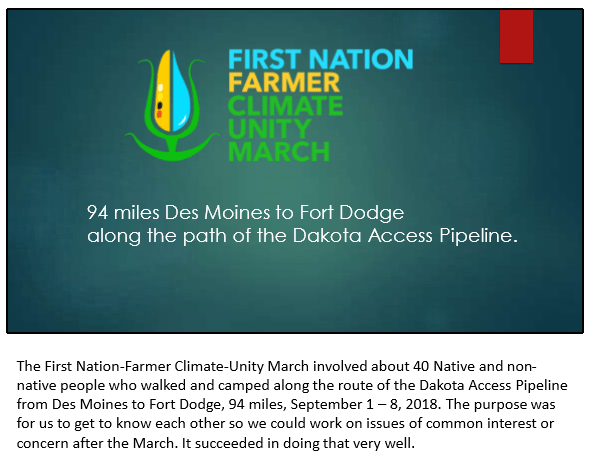
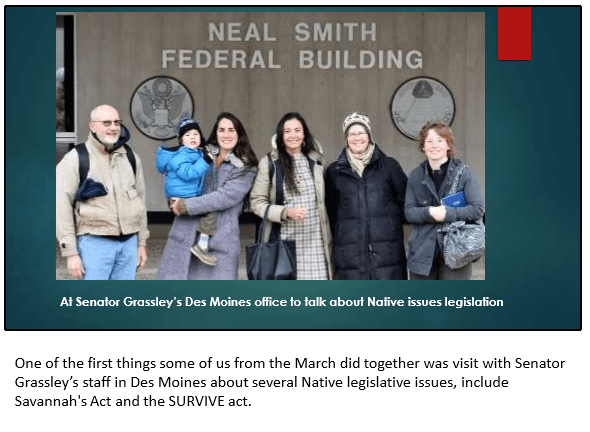
I was blessed to have walked from Des Moines to Fort Dodge, Iowa, with a small group of Native and non native people on the First Nation-Farmer Climate Unity March, Sept 1-8, 2018. It took eight days to walk and camp on that 94 mile journey. The intention was for a group of people who are passionate about protecting Mother Earth, from these two cultures, to get to know each other, so we could combine our efforts going forward. Many hours and miles walking together, sharing our stories.
As I thought ahead of time about what might happen, I wondered if and how I might bring up the Quaker Indian Boarding Schools. I didn’t have a plan. The Spirit did.
I was spending a lot of time in the same places with Matthew as we both took photos (videos for him) to document the March. We talked a lot and became friends pretty quickly. We’d been walking together for a while on the second day, I think, when I was moved to say something like “I know about the Quaker Indian Boarding Schools and I’m sorry about what happened.”
I was apprehensive about whether I should have said that, whether that was appropriate or could pull up bad memories. We continued to walk side by side. All I noticed was a slight nod of his head. He always smiles, and that didn’t change.
One of the next times we walked together, Matthew shared a story with me. He had been living at Standing Rock for about six months, when he learned a new rope was needed to ferry people back and forth across a short channel of water. He offered a rope so the ferry’s operation could continue. He went on to say his mother called him after she recognized the rope while watching a TV news story. She was very upset because that brought back terrifying memories of how the Native families would use a similar rope and boat to try to help their children escape when white men came to kidnap them and take them to a boarding school. https://kislingjeff.wordpress.com/2019/06/17/the-past-isnt/
Since then, I’ve often thought of what would have happened if I hadn’t acknowledged Quakers’ involvement with the boarding schools. We wouldn’t have any real trust if I acted like I wasn’t aware of the boarding schools, but he definitely was. More, he and his family are still experiencing trauma from the schools. Sometime later I told him I appreciated him sharing his story, and he said, “thanks for listening.”
This has been a long way to get to the reasons I thought Bear Creek meeting should send a letter to British Columbia’s Premier, John Horgan. There hasn’t yet been an opportunity for our meeting to meet any of the Wet’suwet’en people so we can begin to build trust, person to person, with them. The next best thing included contacting my friends who do have a relationship with the Wet’suwet’en people. Miriam, who walked on the First Nation-Farmer Climate Unity March, spent time with the Wet’suwet’en people several years ago and had moving experiences there. I was also able to get positive feedback about the Wet’suwet’en peoples from some Native friends I made on the March.
The Wet’suwet’en Peoples are also very active in using social media, blog posts and videos where they do a very good job of sharing their stories. We can hear their voices, see their faces as they share their deep convictions and connections to their land.
They ask us supporters, to share their stories with others. I have been writing blog posts that are also shared on Facebook about what I have been learning. Sharing the videos and stories the Wet’suwet’en have asked us to share. https://kislingjeff.wordpress.com/?s=Wet%E2%80%99suwet%E2%80%99en+ In addition, what I write is added to the spread of Wet’suwet’en stories when I use the hashtag #WetsuwetenStrong. You can see that when you click on that link.
We know the situation is complicated, There are questions about who has the authority to approve pipeline construction. Some of the law might be on the side of the Canadian government. In our letter we didn’t attempt to insert ourselves into the situation, other than to ask for de-escalation of law enforcement and for both sides to listen to each other.
We’re concerned that you are not honoring the tribal rights and unceded Wet’suwet’en territories and are threatening a raid instead.
We ask you to de-escalate the militarized police presence, meet with the Wet’suwet’en Hereditary Chiefs, and hear their demands:
Our letter did list what the demands were, but not that we suggested we had any right ourselves to ask the government to implement those demands.
It is challenging to be in solidarity when we are not directly connected to those we are trying to support. That doesn’t mean we shouldn’t, I think. But is does require that we are very careful of how we choose to do so. I think it is important that we find some way to check the authenticity of the community we plan to express solidarity with.
Bear Creek Friends (Quaker) meetinghouse is in the Iowa countryside. Many members have been involved in agriculture and care about protecting Mother Earth. A number of Friends have various relationships with Indigenous peoples. Some Friends have worked to protect water and to stop the construction of fossil fuel pipelines in the United States, such as the Keystone XL and Dakota Access pipelines.
We are concerned about the tensions involving the Wet’suwet’en Peoples, who are working to protect their water and lands in British Columbia. Most recently they are working to prevent the construction of several pipelines through their territory. Such construction would do severe damage to the land, water, and living beings.
Bear Creek Friends Meeting, of Iowa Yearly Meeting (Conservative) approved sending the following letter to British Columbia Premier, John Horgan.
John Horgan. PO BOX 9041 STN PROV GOVT VICTORIA, BC V8W 9E1. Email premier@gov.bc.ca
John Horgan,
We’re concerned that you are not honoring the tribal rights and unceded Wet’suwet’en territories and are threatening a raid instead.
We ask you to de-escalate the militarized police presence, meet with the Wet’suwet’en Hereditary Chiefs, and hear their demands:
That the province cease construction of the Coastal Gaslink Pipeline project and suspend permits.
That the United Nations Declaration on the Rights of Indigenous Peoples (UNDRIP) and tribal rights to free, prior and informed consent (FPIC) are respected by the state and RCMP.
That the Royal Canadian Mounted Police (RCMP) and associated security and policing services be withdrawn from Wet’suwet’en lands, in agreement with the most recent letter provided by the United Nations Committee on the Elimination of Racial Discrimiation’s (CERD) request.
That the provincial and federal government, RCMP and private industry employed by Coastal GasLink (CGL) respect Wet’suwet’en laws and governance system, and refrain from using any force to access tribal lands or remove people.
Bear Creek Monthly Meeting of Friends (Quakers) 19186 Bear Creek Road, Earlham, Iowa, 50072
For the past couple of weeks I’ve been sharing what I’ve been learning about the Wet’suwet’en peoples and their opposition to all tar sands and natural gas pipelines that are planned to run through their territory. https://kislingjeff.wordpress.com/?s=wet%27suwet%27en+
I’ve found there are many pieces to this story. An excellent overview is: The Wet’suwet’en Nation re-occupies Unsurrendered Territories. And following is a very good video, showing where the pipelines are planned, discussing open and informed consent and shows many aspects of the Wet’suwet’en culture.
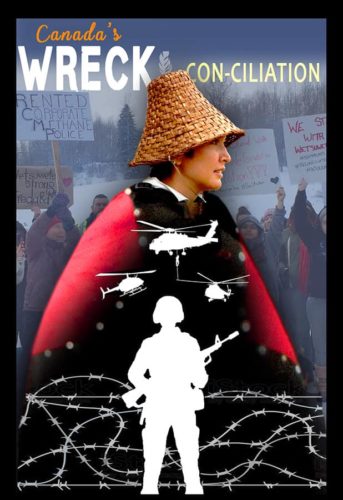
Tensions in the Wet’suwet’en territories are high now, most recently because personnel who had setup camps to begin the Coastal GasLink pipeline construction were peaceably evicted several days ago. The Royal Canadian Mounted Police (RCMP) are restricting access to the territories and using aerial surveillance. This is especially concerning because RCMP with assault rifles breached the barriers at the territory border and arrested 14 people a year ago. This is even more alarming after it was learned the RCMP had discussed using lethal force against the First Nations people.
Canadian police were prepared to shoot Indigenous land defenders blockading construction of a natural gas pipeline in northern British Columbia, according to documents seen by the Guardian.
The letter below is from Indigenous legal professionals from across Canada who are asking Prime Minister Trudeau and Premier Horgan to meet with Wet’suwet’en Hereditary Chiefs to deescalate the situation.
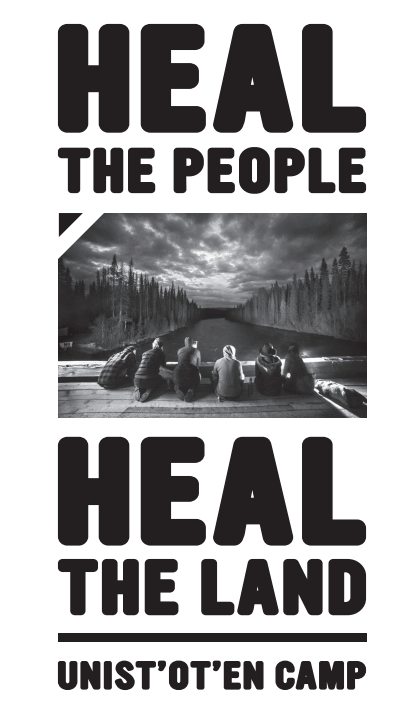
As most of you will be aware, the possible RCMP enforcement of an injunction against the Unist’ot’en (a client of ours) in response to their continued opposition to the Coastal GasLink pipeline has been in the national news.
Dozens of academics and lawyers from across Canada have signed the following letter urging the provincial and federal governments to meet directly with the Wet’suwet’en Hereditary Chiefs to open a nation-to-nation dialogue in the hopes of peacefully resolving the matter.
OPEN LETTER TO PRIME MINISTER TRUDEAU AND PREMIER HORGAN RE: WET’SUWET’EN HEREDITARY CHIEFS’ OPPOSITION TO COASTAL GASLINK PIPELINE PROJECT by Staff, Firstpeopleslaw.com, January 25, 2020
Dear Prime Minister Trudeau and Premier Horgan:
Re: Wet’suwet’en Hereditary Chiefs’ Opposition to Coastal GasLink Pipeline Project
We write as settler and Indigenous legal professionals from across Canada to express deep concern about the conflict regarding the Coastal GasLink pipeline in Wet’suwet’en territory. We call on the federal and provincial governments to meet with the Wet’suwet’en Hereditary Chiefs immediately and to address this issue in a manner that upholds the principle of reconciliation, the authority of the law of the Wet’suwet’en, the UN Declaration on the Rights of Indigenous Peoples and the honour of the Crown.
The police presence on Wet’suwet’en territory has intensified alarmingly since the December court order prohibiting individuals from obstructing the project, and the Hereditary Chiefs’ eviction notice to Coastal GasLink. Indigenous and human rights organizations, including the UN, have raised concerns about violations of Indigenous rights in Wet’suwet’en territory. Meanwhile, the Province has declined the Hereditary Chiefs’ requests to meet. Premier John Horgan recently announced that the “rule of law” must prevail and the project will proceed despite the Hereditary Chiefs’ opposition. He subsequently refused to meet with the Chiefs while in northern BC. Prime Minister Justin Trudeau has also distanced himself, calling the dispute a provincial matter.
We are deeply troubled by BC’s and Canada’s positions. This is not fundamentally a dispute between Coastal GasLink and the Wet’suwet’en, nor between Hereditary Chiefs and Indian Act band councils. It goes to the core of the relationship between the Crown and Indigenous Peoples and the obligations that arise therefrom. Both the provincial and federal governments must participate directly in its resolution.
The Hereditary Chiefs, not the band councils, were the plaintiffs in the landmark Delgamuukw-Gisday’wa case before the Supreme Court. The Court confirmed that the Wet’suwet’en never surrendered title to their ancestral lands, and accepted extensive evidence outlining their hereditary governance system. The fact that band councils have signed benefit agreements with Coastal GasLink cannot justify the erasure of Indigenous law or negate the Crown’s obligation to meet with the Hereditary Chiefs.
Nor can Wet’suwet’en opposition be resolved by meetings between Coastal GasLink and the Hereditary Chiefs. The Supreme Court has been clear: The Crown must engage directly with the Indigenous group whose rights are at stake. This obligation cannot be fulfilled by third parties with vested interests in the project’s success.
Premier Horgan’s insistence on the “rule of law” fails to acknowledge that the relevant law includes not just the injunction order but the Constitution, Supreme Court decisions, and – crucially – Wet’suwet’en laws and institutions. The laws of Indigenous Peoples, including the Wet’suwet’en, predate those of Canada, are equally authoritative, and are entitled to respect. In an age of truth and reconciliation, respect for the rule of law must include respect for the authority of Indigenous law and a commitment to work out a just and sustainable relationship between Indigenous and settler Canadian legal systems.
BC and Canada are obligated to act honourably in their dealings with Indigenous Peoples, including by engaging in respectful processes to advance reconciliation. Moreover, a key reason that the 1867 Constitution gave the federal government exclusive legislative authority over “Indians, and the lands reserved for the Indians” was the recognition that local settler communities might fail to respect the pre-existing relationships between Indigenous Peoples and their territories. The Supreme Court has repeatedly affirmed Ottawa’s responsibilities to Indigenous Peoples. For Canada to shirk them now would be contrary to a key principle of Canadian constitutionalism.
The federal and provincial positions risk undermining Canada’s collective effort to achieve meaningful reconciliation with Indigenous Peoples. We are just beginning to confront our shared colonial past and present, and to address the longstanding wrongs inflicted on Indigenous Peoples. Some governments have taken positive steps in this direction, including commitments to implement the Truth and Reconciliation Commission’s Calls to Action and the UN Declaration. These initial steps ring hollow when the Crown refuses to honour the Hereditary Chiefs’ request for a meeting, let alone recognize and respect Wet’suwet’en law.
More than twenty years ago, Chief Justice Lamer, writing for Supreme Court, recognized the Crown’s moral duty to engage in good faith negotiations with the Wet’suwet’en to resolve the issue of ownership and jurisdiction over their ancestral lands. This apt statement is reinforced by the growing appreciation that these negotiations are between two systems of legal and political authority. Reconciliation and justice cannot be achieved by relying on the RCMP or resource companies to do the Crown’s work.
We urge BC and Canada to meet with the Wet’suwet’en Hereditary Chiefs and to commit to a process for the peaceful and honourable resolution of this issue.
I often don’t know what I will write when I sit to try to capture the day’s story. It is a spiritual practice, to try to hear what the Spirit is saying to me. Recently I was led to begin to learn about the Wet’suwet’en peoples.
January 13, 2020, I first learned about the Wet’suwet’en peoples in British Columbia,Canada, and their struggles against the construction of fossil fuel pipelines on their land. What caught my attention was the headline, “All CGL workers have now been peacefully evicted from Unist’ot’en and Gidimt’en territories.” I watched the following video, “Coastal Gaslink Evicted from Unist’ot’en Territory.”
This was amazing. All my adult life I have been asking people to stop burning so much fossil fuel. Including giving up personal automobile, as I had done over 40 years ago. I had no success in convincing others to do so.
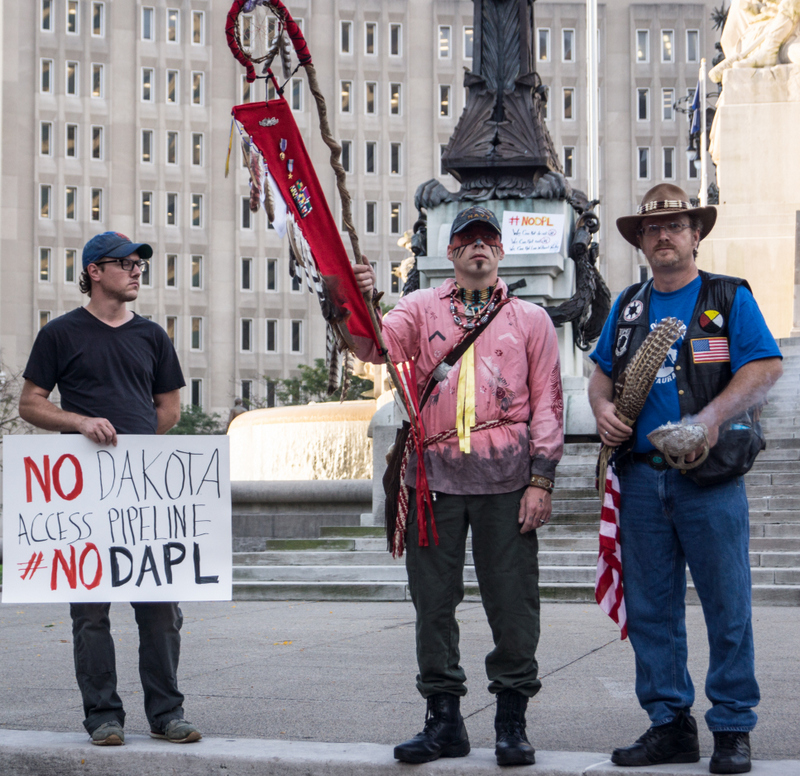
In 2013 I was trained as an Action Lead in the Keystone Pledge of Resistance, where I learned how to plan nonviolent direct actions, and train people in Indianapolis how to participate in those actions. Then beginning in 2016 I helped others work to stop the Dakota Access Pipeline.
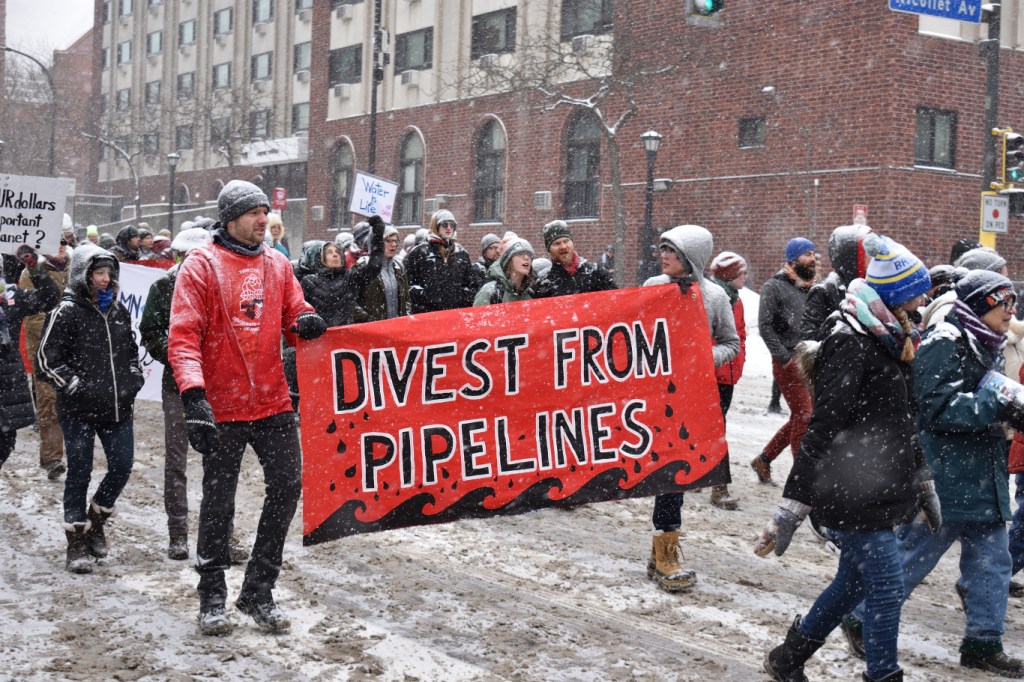
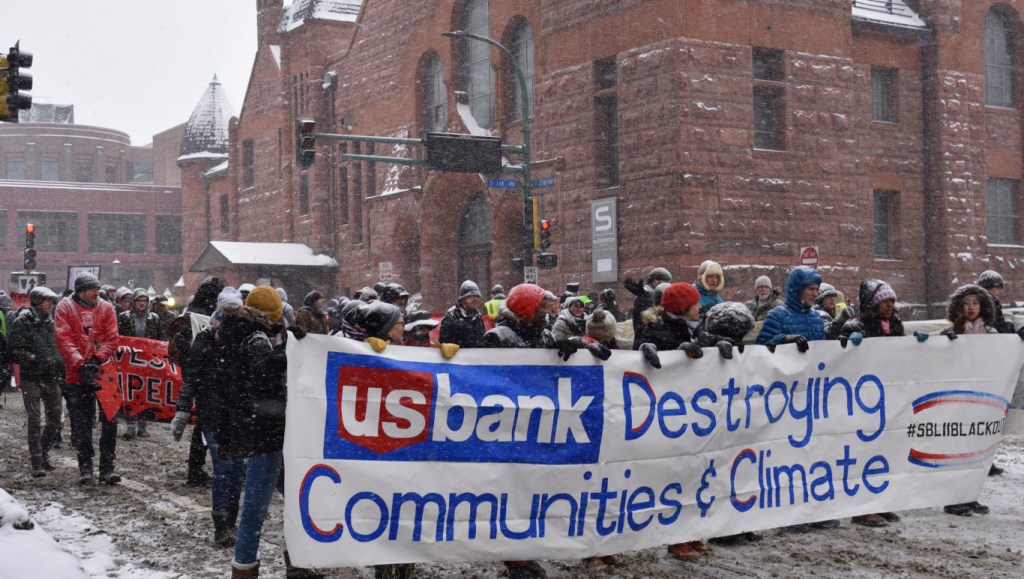
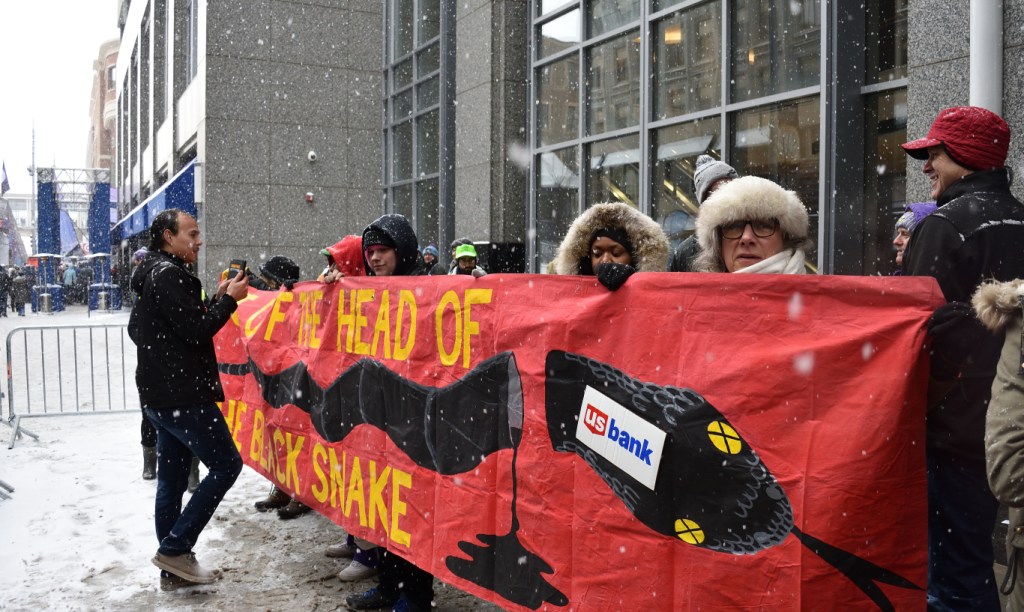
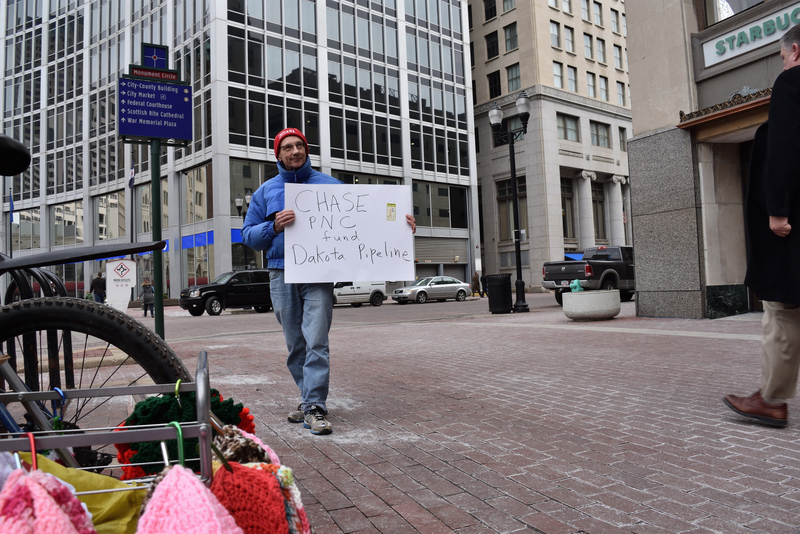
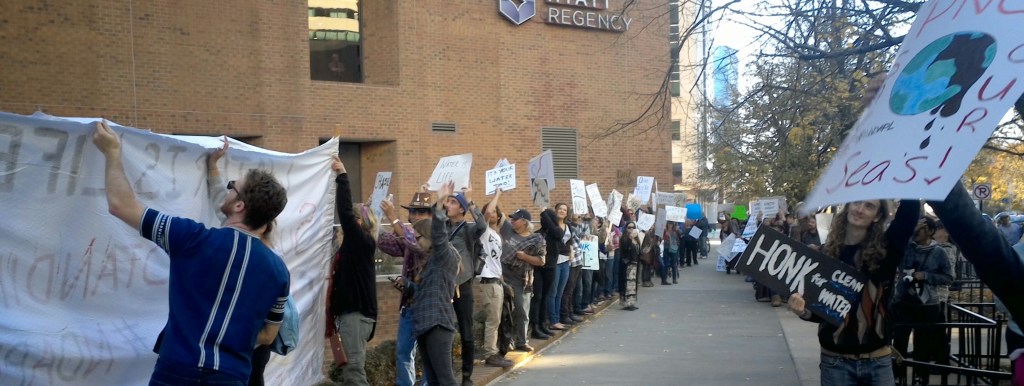
One of the tools we used were actions to divest from banks funding fossil fuel projects. In Indianapolis that included MorganStanley, Chase bank, and PNC bank. I was blessed to join other water protectors in a demonstration in front of USBank in Minneapolis (on Super Bowl weekend). https://kislingjeff.wordpress.com/2019/11/19/black-snake/
It was also transformative for me to spend a week with Native and non-native people as we walked 94 miles along the path of the Dakota Access Pipeline, from Des Moines to Fort Dodge, Iowa, on the First Nation-Farmer Climate Unity March. I had long wanted to learn more about Indigenous peoples and their cultures of protecting Mother Earth. I’m thankful to have made new friends, people with passion to protect Mother Earth.
Another benefit of these new friendships was being able to check whether new things I was learning were valid. There is so much misinformation today in social media and news channels.
When I began to learn about the Wet’suwet’en peoples and their work for more than the a decade to protect their ancestral lands, I was told by some of my Native friends these stories are true. I also learned from Miriam, who walked on the First Nation-Farmer Climate Unity March, that she had visited the Wet’suwet’en territory and what a moving experience it was.
The more I learn about the Wet’suwet’en people, the more impressed I am. They are building community and structures to practice their beliefs about honoring the land and All Their Relations. They are doing what I have long wanted to do, build a self sustaining community.
Here are a people who have put their lives on the line, to protect the land they live on. Literally putting their lives on the line. There are numerous reports the Royal Canadian Mounted Police (RCMP) discussed using lethal force when they raided the ancestral lands of the Wit’suwet’en Nation last January.
Canadian police were prepared to shoot Indigenous land defenders blockading construction of a natural gas pipeline in northern British Columbia, according to documents seen by the Guardian.
Notes from a strategy session for a militarized raid on ancestral lands of the Wet’suwet’en nation show that commanders of Canada’s national police force, the Royal Canadian Mounted Police (RCMP), argued that “lethal overwatch is req’d” – a term for deploying an officer who is prepared to use lethal force.
The RCMP commanders also instructed officers to “use as much violence toward the gate as you want” ahead of the operation to remove a roadblock which had been erected by Wet’suwet’en people to control access to their territories and stop construction of the proposed 670km (416-mile) Coastal GasLink pipeline (CGL).
This video, RESIST:The Unist’ot’en’s Call to the Land gives an excellent presentation about the various Wet’suwet’en territories, the planned paths of several pipelines and what the Wet’suwet’en are doing.
I’m continuing to learn about the struggle of the Wet’suwet’en peoples in British Columbia against the construction of fossil fuel pipelines on their unceded lands. Tensions are high since January 4th, 2020, when the Wet’suwet’en House Chiefs representing all 5 clans oversaw the successful eviction of Coastal Gaslink (CGL) employees from Unist’ot’en and Gidimt’en territories.
RCMP Admits It’s Monitoring Wet’suwet’en Camps by Air Now. After denying drone and flyover surveillance at a pipeline blockade last week, RCMP says “air assets can and will be deployed as necessary.” Sarah Berman, VICE, Jan 22, 2020
The air surveillance has fueled speculation that the Royal Canadian Mounted Police (RCMP) might be preparing for an armed raid like the one that forcibly removed 14 land defenders from a Wet’suwet’en checkpoint in January 2019.
Yesterday Wet’suwet’en land defenders at Gidimt’en Checkpoint spoke about what they’re defending and the State’s continued use of violence to colonize and steal Indigenous land.
Do you feel helpless in the face of the continuing onslaught of environmental catastrophes? Who doesn’t? Banks know that fossil fuel mining and use has to end now in part because of environmentalist’s actions like those below. But instead continue significant funding of these projects. Stopping that funding is one of the most effective ways to stop these projects.
This video shows a powerful action you can take in your own community.
Carrying the fire back to the bank that lit the match is such logical justice. Here look at this, the world is on fire. We are peaceful but not polite.
The bank’s investments should be known to us if the profiteering is cutting life short. The bank that blew up the Paris Climate Agreement – everyone should know what Chase has done. Unimaginable streams of money- $2.6 trillion pouring into destruction: Amazon deforestation, coal power, pipelines, weapons, prisons, Saudi refining and palm oil plantations. This should be known to everyone. We should know and the bankers should know that we know. We carry the karmic visuals right into the lobby and we are immediately told that this is private property and the police are coming for us. Let them come, they need to know this too.
Fire Fire burning bright in the forest in the night Chase investment lit the spark Can you finance Noah’s Ark?
How much will burn before we learn? How much life is lost before we know the cost? The earth is burning burning burning EARTHALUJAH
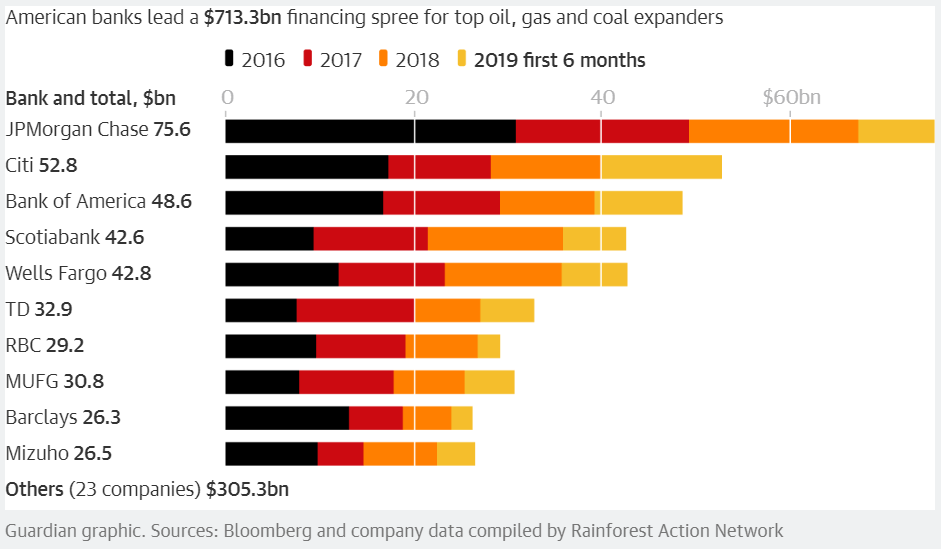
You can ask your bank to stop funding fossil fuel projects. Following is data compiled by the Rainforest Action Network (RAN) regarding which banks are providing, profiting, from those projects.
Divesting from banks that fund fossil fuel projects has been going on for many years, with billions of dollars divested. And yet the banks continue pursue those profits.
I’ve had a number of experiences related to fossil fuel divestment.
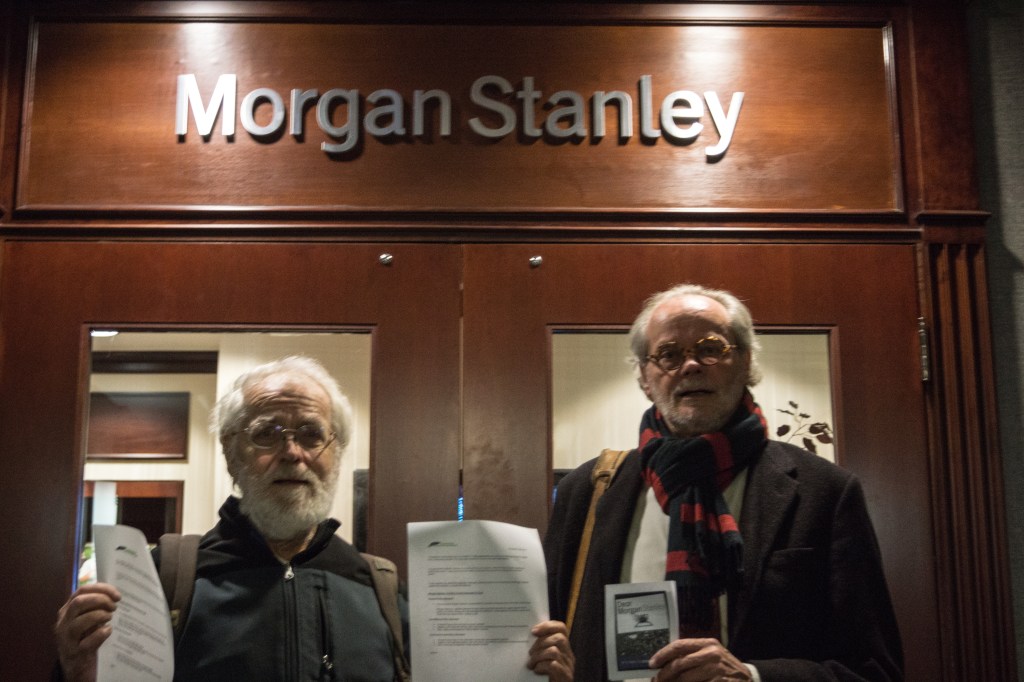
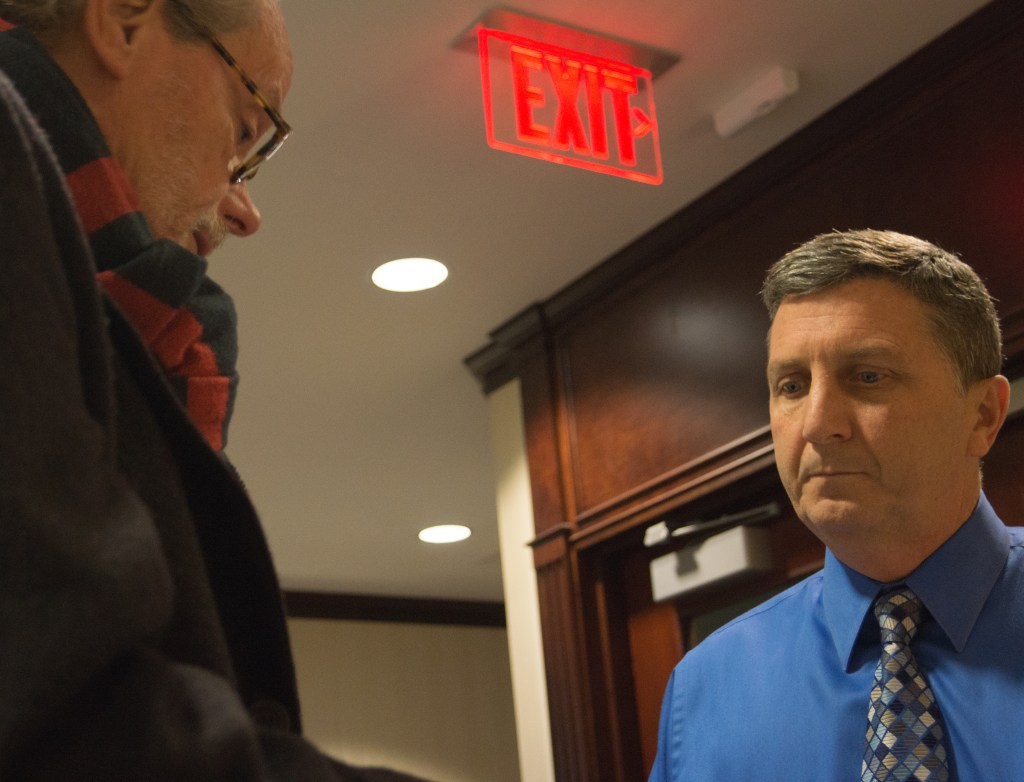
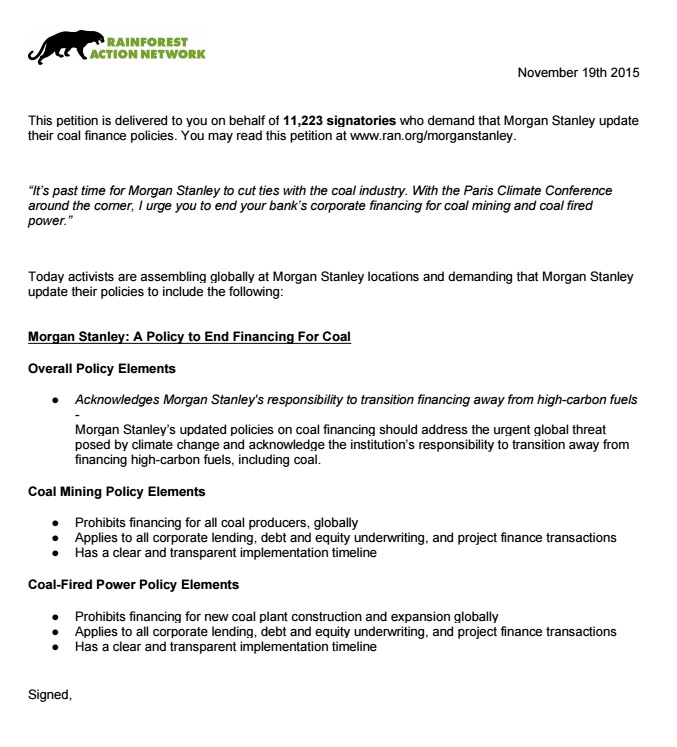
In November, 2015, the Rainforest Action Network (RAN) organized actions in several cities to ask MorganStanley to stop funding coal mining projects. We were part of that network of cities in Indianapolis. We took the petition you can see below to the MorganStanley office, and spoke to the Manager about that funding. He was very polite and accepted our petition. He had heard ahead of time that activists might be going to MorganStanley offices. Later that week, at the MorganStanley shareholders meeting, they took action to stop funding coal projects.
Asking MorganStanley to stop funding coal projects in Indianapolis
I won’t repeat all the other stories of my experiences with fossil fuel divestment. You can read those here: https://kislingjeff.wordpress.com/?s=divest I’ll end with photos from some of those events/actions.
In this video, Royal Canadian Mounted Police (RCMP) tells Water Protector Legal Collective (WPLC) Co-Executive Director Carl Williams that he is banned from re-entering Unist’ot’en Camp, after he conducted three legal observer trainings at the request of the camp.
According to police, any lawyers not licensed in “British Columbia,” and anyone who doesn’t have snow chains on their tires and two-way radios will not be allowed to pass roadblocks. This is a clear effort to target, harass, and intimidate international human rights and legal workers and observers, and to strip Wet’suwet’en people of their access to human rights legal support in their effort to protect their land from pipelines that could carry tar sands oil to the Pacific Coast.
Part of the ongoing legacy of settler colonialism, these efforts by RCMP to control who can and cannot enter Wet’suwet’en land is a flagrant violation of their sovereignty and right to control their own land.
We ask you to support Unist’ot’en Camp efforts, in particular, their legal support fundraising efforts.
As you may know, almost 50 years ago, I co-founded Women of All Red Nations (WARN) with fellow the Lakota People’s Law Project (LPLP) organizer Phyllis Young and several others. We formed a frontline to confront the issues we face as Indigenous women. At the time, uranium mining in the southern Black Hills of South Dakota was poisoning my people’s water and, in turn, poisoning our wombs. Our coalition mobilized to stop this assault on our reproductive health, and we successfully prevented a mining corporation from further contaminating our life-giving water.
Now, most of us are grandmothers and great-grandmothers. But we’ve assembled once again against an imminent threat to our water: the Keystone XL (KXL) pipeline. Last week, TC Energy reported to a Montana federal court that it intends to begin pre-construction activities in South Dakota next month.
KXL doesn’t only threaten our water, it also threatens our women and girls. Along with the transport of toxic chemicals and machinery, oil pipelines bring man camps to our lands. These temporary housing sites near our reservations have proven time and again to exacerbate the crisis of Missing and Murdered Indigenous Women. Big Extraction moves in to violate the earth, and in turn, our women and children pay the price.
Now #WARNRidesAgain to protect our water and women. In December, a group of matriarchs from across the Oceti Sakowin performed a symbolic horseback border patrol along the southeastern boundary of the Cheyenne River Reservation, sending a message to KXL and its man camps: you are not welcome on our homelands.
Madonna Thunder Hawk, Tribal Liaison The Lakota People’s Law Project
In December, a group of women from the Fours Bands of the Oceti Sakowin— the Minnicoujou, Itazipco, Siha Sapa, and Oohenumpa— made a symbolic horse ride on the western edge/border of the Cheyenne River Reservation where the TransCanada KXL Pipeline will construct temporary workforce housing, commonly known as a “man camp.”
The ride signifies a stand against the violence and human trafficking that will increase with the establishment of this “man camp” near the border of the reservation. The ride idea originated with some of the original members of Women of All Red Nations (W.A.R.N.), a Native women’s activist group founded in 1978 to fight for and protect the lives of Native women, families, and the Earth.
The ultimate goal of the ride is to raise awareness and send a message—it’s time to wake up and be ready to protect the sovereign borders of the reservation nation and everyone vulnerable to the impact of the “man camps.” While the building of the pipeline itself is a significant act of violence to the Earth, this violence also translates directly into human trafficking.


































 Quakers, social justice and revolution