I usually don’t know what I will be led to write each morning. Lately I’ve been so distressed by the destruction of our (White people’s) political norms, the rise of authoritarianism by the president and Republican party, militarized police, the disregard for civil rights, the catastrophic failure to control COVID-19. The list goes on.
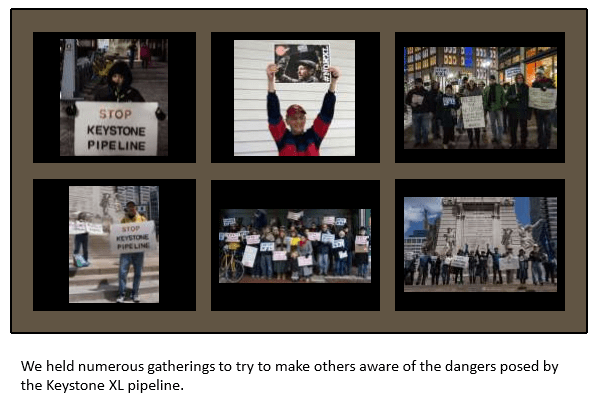
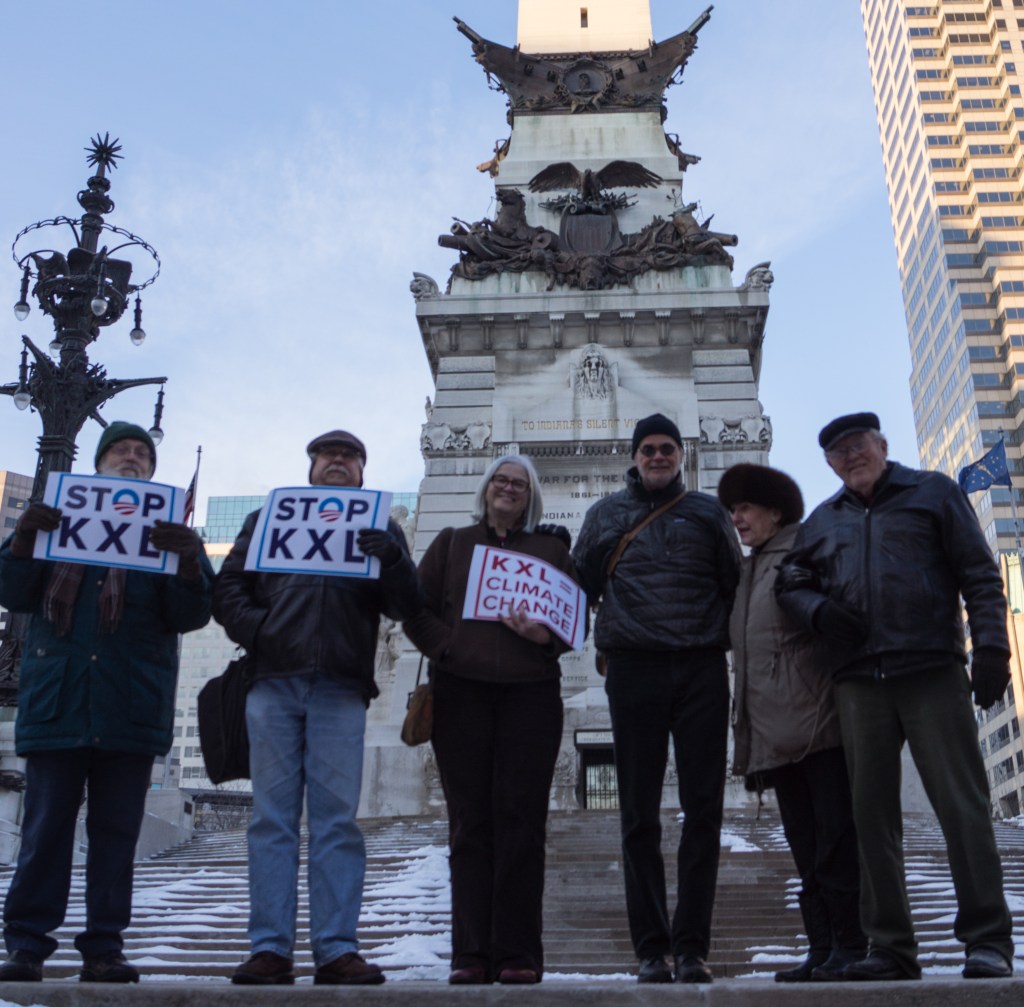
This seems all the worse when compared to the memorials to John Lewis, whose life was rooted in nonviolence. I have studied, taught, and tried to practice nonviolence in my life. One way I learned was by studying how John Lewis and the Student Nonviolent Coordinating Committee (SNCC) did such an effective job of training hundreds of people to participate in nonviolent direct actions during the civil rights movement in the 1960’s. I taught about nonviolence during training for people who were going to participate in nonviolent civil disobedience in the Keystone Pledge of Resistance, which worked to stop the Keystone XL pipeline. And did so, until the current president tried to rejuvenate Keystone by Executive Order. Construction had not been completed because of violations of environmental law.
And then I remind myself that Black and Indigenous peoples, all people of color, have suffered in this country for over 400 years.
My spirits were lifted when I was blessed to come across a beautiful mural that has just been painted in Colorado Springs titled ‘Take Back the Power’ @HaseyaProgram, #MMIWG2S. The person in the mural is Sage Deal, daughter of Indigenous artist and activist Gregg Deal. In the mural Sage has a red handprint on her face which is a reference to the epidemic of Missing and Murdered Indigenous women, girls and Two-Spirit (LGBTQ) individuals.
Sage hopes the mural will bring more attention to Indigenous peoples. She asks how people can be allies if they don’t see Indigenous peoples as contemporary?
Monycka Snowbird, of the Haseya Advocacy Program that is a partner in the mural project, says many of the White people who come to the mural are unaware of the epidemic of missing and murdered Indigenous women. She calls that privilege. Every Native American knows about, and most have been affected by the missing.
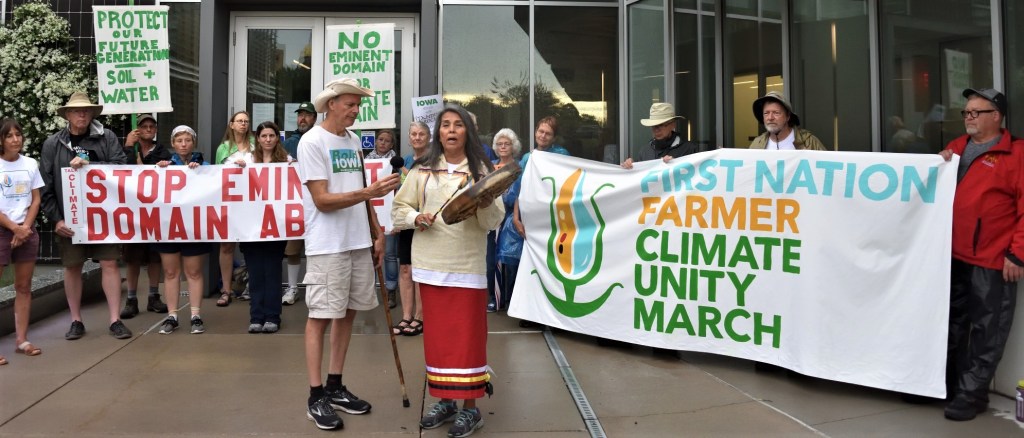
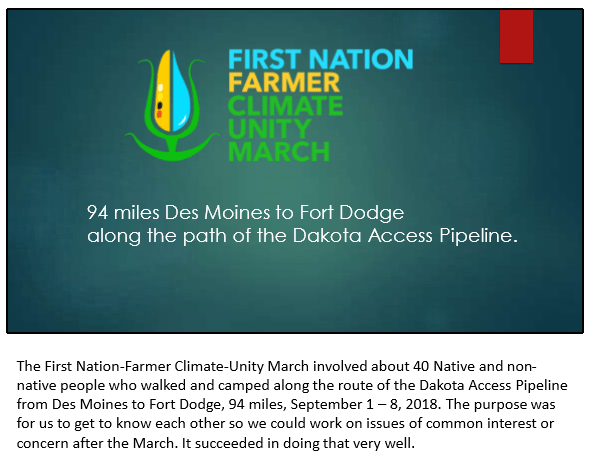
I, too, was ignorant about MMIW until I had the opportunity to participate in the First Nation-Farmer Climate Unity March, September, 2018. A small group of about 15 Native and 15 nonnative people walked and camped together for eight days along the path of the Dakota Access Pipeline. The goal was to create a group of people who began to know and trust each other, so they could work together on issues of common concern thereafter. That goal was realized as we shared our stories with each other as we walked, and walked, and walked. (The path was 94 miles long). https://firstnationfarmer.com/
I thought the March was going to be about the environment and climate change. And it was. But I also heard a lot about Missing and Murdered Indigenous Women. I remember thinking, what does that have to do with our environment? I quickly learned there was a direct connection. Most of the missing and murdered women were attacked by White men who live in the “man camps”, housing the pipeline construction workers. I heard a number of terrible stories from my new friends who had direct, personal experiences related to these kidnappings and murders.
#StolenButNotForgotten
As we heal ourselves, we heal our ancestors, and transform the future of our children.
Dr. Corrine Sanchez
More than 4 in 5 American Indian and Alaska Native women have experienced violence in their lifetime, according to the National Institute of Justice Research Report. Gregg Deal, an Indigenous artist and activist, has partnered with Art of the Streets to create a 60-foot mural titled ‘Take Back the Power’. The mural shows Deal’s daughter, 14-year-old Sage Deal, wearing a mix of contemporary clothing and traditional Indigenous accessories. She is depicted with a red handprint painted on the lower half of her face, a reference to the national Missing and Murdered Indigenous Womxn, Girls, and Two Spirit campaign bringing awareness to the high rate at which Indigenous women, girls and Two-Spirit (LGBTQ) individuals go missing or are murdered. (Video by Katie Klann)
Done. My daughter Sage and I are there for scale. This effort is for Missing and Murdered Indigenous Women, Girls and Two Spirit, for modern Indigenous identity and representation. I’m proud of this pic.twitter.com/J5HBGcsJIz
All these years fighting pipelines, I’m surprised I don’t remember learning about the concept of expropriation. On the other hand, I learned about eminent domain from the beginnings of opposing pipelines and protecting water.
Expropriation is the act of a government taking private property; Eminent Domain is the legal term describing the government’s right to do so.
No person shall be held to answer for a capital, or otherwise infamous crime, unless on a presentment or indictment of a grand jury, except in cases arising in the land or naval forces, or in the militia, when in actual service in time of war or public danger; nor shall any person be subject for the same offense to be twice put in jeopardy of life or limb; nor shall be compelled in any criminal case to be a witness against himself, nor be deprived of life, liberty, or property, without due process of law; nor shall private property be taken for public use, without just compensation.
Fifth Amendment, U.S. Constitution
July 16, 2020, Lake Charles, LA – Today, the Third Circuit Court of Appeal for the State of Louisiana ruled that the Bayou Bridge Pipeline Company (BBP) violated the due process rights of landowners when it constructed an oil pipeline across their property before acquiring the legal rights to do so. The construction – including clearing trees, trenching, and laying pipe – took place across privately owned land in the ecologically sensitive Atchafalaya Basin. The court awarded each of the property owners $10,000 and legal fees.
In its decision, the court wrote:
When BBP consciously ordered construction to begin on this property prior to obtaining a judicial determination of the public and necessary purpose for that taking, it not only trampled Defendants’ due process rights as landowners, it eviscerated the constitutional protections laid out to specifically protect those property rights.
“When we first considered taking on BBP, it was conventional wisdom that you couldn’t win against a pipeline company in Louisiana, but we wanted to do what was right regardless,” said landowner Peter Aaslestad. “For others out there thinking they can’t win, I hope this victory shows that they can, and that these companies cannot simply do what they want, run roughshod over people’s rights, and get away with a small fine as the cost of doing business.”
“The court’s decision rightly takes BBP to task for its blatant disregard and abuse of the law and landowners in Louisiana,” said Pam Spees, senior staff attorney at the Center for Constitutional Rights and one of the attorneys for the landowners. “BBP made a calculated decision that violating the law was cheaper than following it, and the lower court’s ruling let them get away with it. This decision is an important reminder to companies like BBP, and more importantly to small landowners, that these rights mean something.”
The landowners opposed the expropriation and filed counterclaims for trespass and violations of their constitutional rights. In reversing the trial court and finding that BBP violated the land owners’ rights to due process, the Court of Appeal noted that “BBP’s conduct clearly shows no fear of the consequences of trampling on property owner’s constitutionally protected due process rights.”
One of the purposes of the First Nation-Farmer Climate Unity March (September, 2018) was to call attention to the abuse of the use of eminent domain to force landowners to allow the Dakota Access Pipeline (DAPL) to be constructed on their property, whether they wanted to, or not.
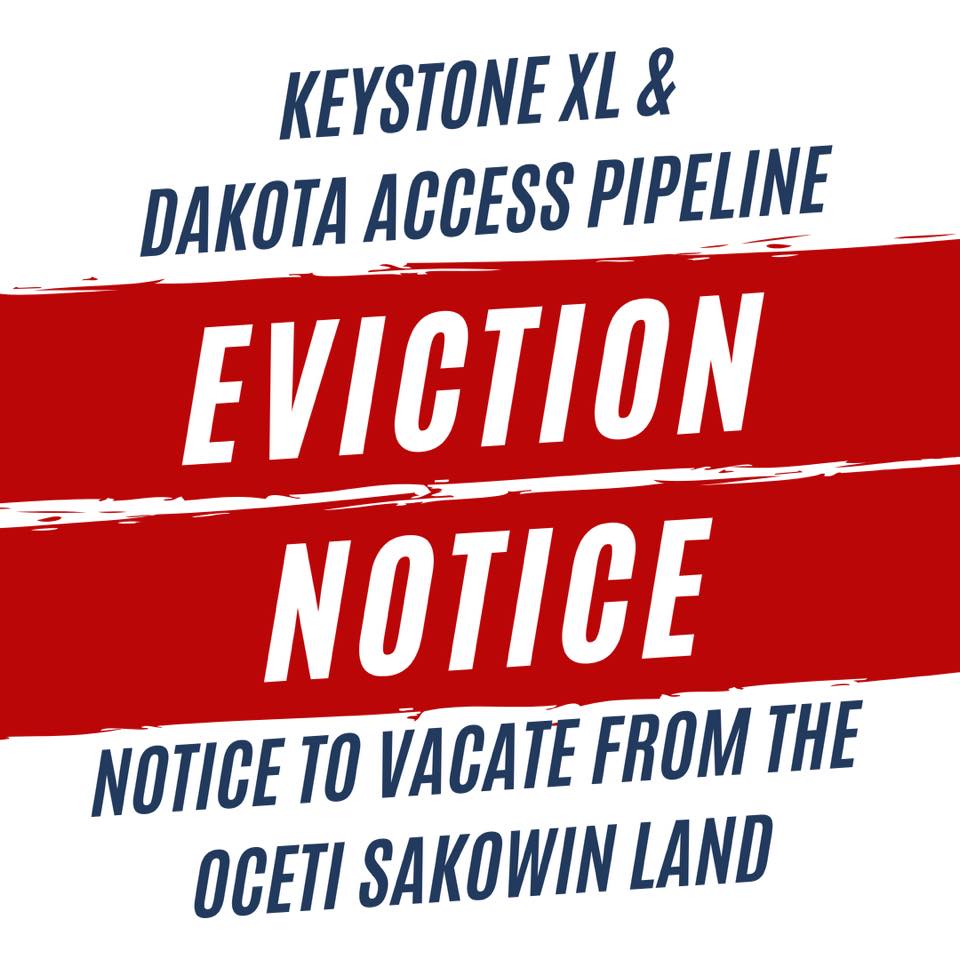
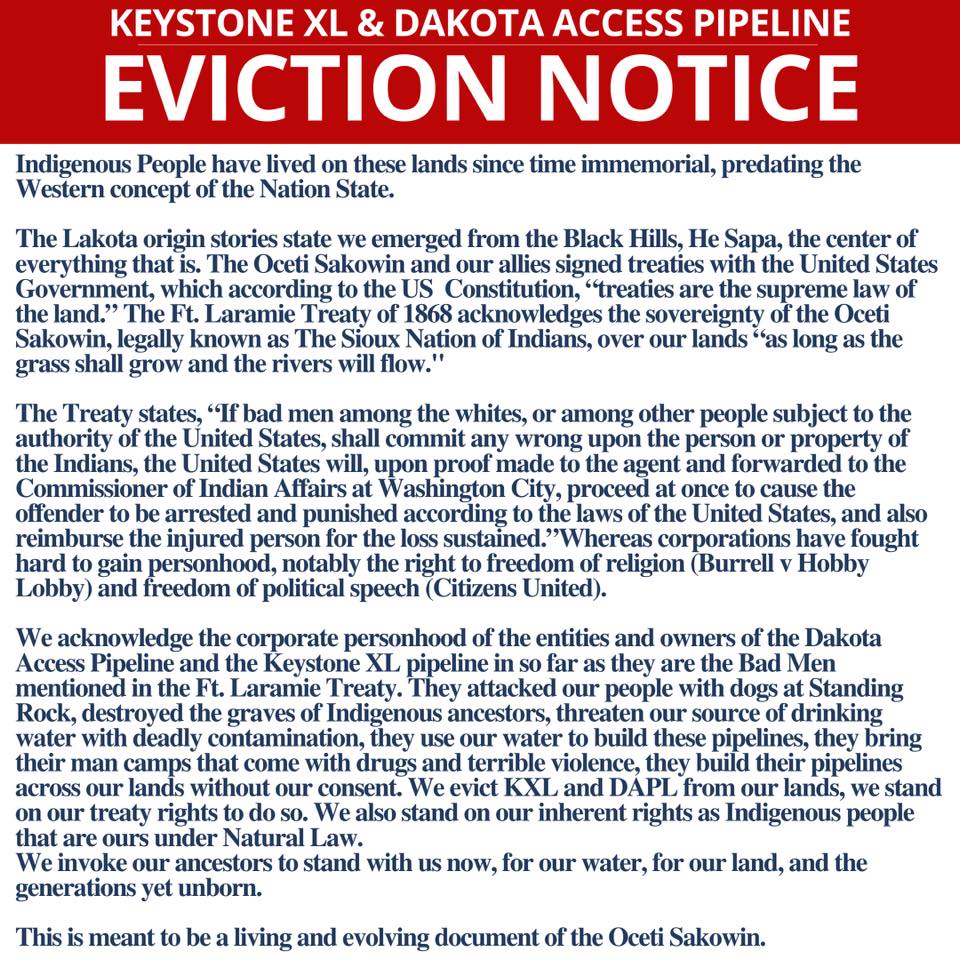
We, as allies of the Oceti Sakowin Oyate, support their notice of eviction to KXL and DAPL from their Lakota lands.
We support their letter as it follows below:
“Indigenous People have lived on these lands since time immemorial, predating the Western concept of the Nation State. The Lakota origin stories state we emerged from the Black Hills, He Sapa, the center of everything that is.
The Oceti Sakowin and our allies signed treaties with the United States Government, which according to the US Constitution, “treaties are the supreme law of the land.” The Ft. Laramie Treaty of 1868 acknowledges the sovereignty of the Oceti Sakowin, legally known as The Sioux Nation of Indians, over our lands “as long as the grass shall grow and the rivers will flow.”
The Treaty states, “If bad men among the whites, or among other people subject to the authority of the United States, shall commit any wrong upon the person or property of the Indians, the United States will, upon proof made to the agent and forwarded to the Commissioner of Indian Affairs at Washington City, proceed at once to cause the offender to be arrested and punished according to the laws of the United States, and also reimburse the injured person for the loss sustained.”
Whereas corporations have fought hard to gain personhood, notably the right to freedom of religion (Burrell v Hobby Lobby) and freedom of political speech (Citizens United). We acknowledge the corporate personhood of the entities and owners of the Dakota Access Pipeline and the Keystone XL pipeline in so far as they are the Bad Men mentioned in the Ft. Laramie Treaty.
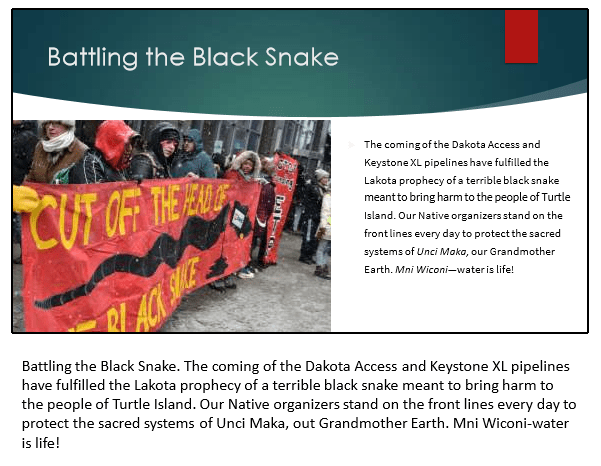
They attacked our people with dogs at Standing Rock, destroyed the graves of Indigenous ancestors, threaten our source of drinking water with deadly contamination, they use our water to build these pipelines, they bring their man camps that come with drugs and terrible violence, they build their pipelines across our lands without our consent.
We evict KXL and DAPL from our lands, we stand on our treaty rights to do so. We also stand on our inherent rights as Indigenous people that are ours under Natural Law.
We invoke our ancestors to stand with us now, for our water, for our land, and the generations yet unborn.” ———————————————————
As expected there was little reporting in the mainstream media about the Strike for Black Lives that occurred in cities across the country yesterday. Thus it is hard to know how many people were involved or news about reactions to the strikes.
One of the goals of the strikes was to unite the fights for racial and economic justice.
“I think it’s a historic moment, a new level of intersection between our fights,” Mary Kay Henry, president of the Service Employees International Union said. “The labor movement is owning that until Black communities can thrive, none of us can thrive.”
At a strike in New York, the legacy of late Congressman John Lewis was invoked: “If you see something that’s not fair, not right, not just, we have a moral obligation to do something about it.”
From Boston to San Francisco, essential workers in cities around the U.S. walked off their jobs and took to the streets Monday to demand racial and economic justice as part of a nationwide “Strike for Black Lives.”
The planned day of strikes and protests was organized by 60 different labor unions and racial and social justice organizations, from the International Brotherhood of Teamsters to the Movement for Black Lives to the U.S. Youth Climate Strike Coalition.
Organizers listed four primary demands on their website: “Justice for Black communities, that elected officials use their authority to rewrite the rules so that Black people can thrive, that corporations dismantle racism, white supremacy and economic exploitation including at work and that every worker has the opportunity to join a union.”
In New York, Antoine Andrews, a UPS driver in Long Island City and member of Teamsters Local 804, helped lead more than 100 employees in a demonstration in front of their workplace early Monday. Andrews and co-workers did not strike, but wanted to express solidarity with the Black Lives Matter movement and send a message to their employer to take issues of inequality seriously.
Andrews, who has worked for UPS for 23 years, invoked the legacy of late Rep. John Lewis (D-Ga.), the civil rights leader who marched at Selma, Ala., and spoke at the famous 1963 March on Washington for Jobs and Freedom, in his remarks to co-workers.
“If you see something that’s not fair, not right, not just, we have a moral obligation to do something about it,” Andrews said. “I mentioned to the crowd that this is my purpose for being here and that should be our purpose for being here.”
“I left them with the question: What do you choose to do? Do you choose to stand or sit? Do you choose to be silent and complicit, or do you speak out and demand to be heard?” he added. “Let people know where you stand against systemic racism. We have to do this not just for ourselves, but for our children and for children unborn. This is our fight for them.”
Thousands of U.S. workers walk out in ‘Strike for Black Lives’. Organizers say economic inequality and systemic racism have only worsened since the pandemic by Jacob Bogage, The Washington Post, July 20, 2020
Fast-food and service industry workers in Chicago marched downtown Monday as part of a nationwide walkout to demand businesses take action to fight income inequality and better protect Black and Latino employees.
The “Strike for Black Lives” aimed to highlight the disparities employees of color face while working during the coronavirus pandemic. In Chicago, nearly 400 people participated, including a car caravan that honked in support of marchers in the city’s Loop, according to organizers with Fight for $15, a union-backed movement to organize fast-food workers.
Chicago fast-food workers join ‘Strike for Black Lives’ with march downtown by ABDEL JIMENEZ, CHICAGO TRIBUNE, 7/20/2020
In Washington, strikers gathered on Capitol Hill in support of the Health and Economic Recovery Omnibus Emergency Solutions Act, or Heroes Act, as talks intensify over a fourth coronavirus relief package. Senate Minority Leader Charles E. Schumer (D-N.Y.) joined demonstrators in New York outside Trump Tower. Health workers at a nursing home outside of Los Angeles planned walkouts during multiple shifts, while other workers took part in a car caravan down President Barack Obama Boulevard, a major thoroughfare on the city’s west side.
Organizers encouraged people unable to leave their jobs to take a knee or break away for 8 minutes and 46 seconds — the amount of time a Minneapolis police officer knelt on the neck of George Floyd, whose death sparked a wave of protests and national reckoning on racial justice.
Organizers did not have exact figures on how many people walked off the job, but said around 1,500 janitors in San Francisco struck together. Close to 6,000 nurses from 85 nursing homes in New York, New Jersey and Connecticut picketed outside their workplaces. Overall, demonstrations took place in 200 cities.
Thousands of U.S. workers walk out in ‘Strike for Black Lives’. Organizers say economic inequality and systemic racism have only worsened since the pandemic by Jacob Bogage, The Washington Post, July 20, 2020
Will this be the day that will launch steps toward racial justice in the land called the United States? The horrendous public execution of George Floyd by White police officers has triggered massive protests in cities across the country and the world. Years of simmering anger and resentment have erupted. I pray this will be the day when the power of the people begins to break apart and destroy the systems of racism.
#StrikeForBlackLives
The strike continues an ongoing global reckoning on race and police brutality set off by the death of George Floyd, a Black man who died at the hands of Minneapolis police in late May. At noon in each U.S. time zone on Monday, workers are expected to take a knee for about eight minutes — the amount of time prosecutors say a white police officer held his knee on Floyd’s neck.
Strikers are demanding sweeping action by corporations and government to confront systemic racism and economic inequality that limits mobility and career advancement for many Black and Hispanic workers, who make up a disproportionate number of those earning less than a living wage.
Specifically, they are calling on corporate leaders and elected government officials to use executive and legislative power to guarantee people of all races can thrive. That demand includes raising wages and allowing workers to unionize to negotiate better health care, sick leave and child care support.
‘Strike for Black Lives’ set in dozens of US cities on Monday, By The Associated Press, July 20, 2020
“All labor has dignity,” the Rev. Dr. Martin Luther King Jr. told striking sanitation workers in Memphis more than 50 years ago.
“One day,” he said, “our society will come to respect the sanitation worker, if it is to survive. For the person who picks up our garbage, in the final analysis, is as significant as the physician. For if he doesn’t do his job, diseases are rampant.”
I never paid much attention to what sanitation workers did until a small group of them went on strike in early May in my hometown, New Orleans. They are called “hoppers,” because they spend all day hopping on and off the backs of trucks, rounding up garbage containers, and using their strength to dump them into the barrel that crushes the trash.
My Uncle Jonathan is one of them, and he asked me to help him and his fellow Black workers organize their City Waste Union in the first weeks of the strike. Their fight, which has now gone on for more than two months, has shown me more clearly than ever before that Black people are still shackled to a cycle of generational poverty and mistreatment.
They often carry signs that say, “I Am a Man,” as they protest. It’s the iconic sign Memphis sanitation workers first carried in 1968, in their bitter, 65-day strike, during which Dr. King was assassinated after coming to support them. I am only 25, but it’s obvious to me that my uncle and his co-workers are still waging the same civil rights battle 52 years later.
After 50 Years, Sanitation Workers Still Fight for Dignity. A determined handful of men in New Orleans carry on the cause Dr. King died defending in Memphis by Daytrian Wilken. Ms. Wilken is the spokesperson for the City Waste Union in New Orleans. The New York Times, July 20, 2020
On April 3, 1968, Dr. Martin Luther King Jr. stood up at the Mason Temple in Memphis and spoke in support of the city’s 1,300 sanitation workers. The workers were on strike to fight for the ability to unionize, put better safety standards in place, and their right to a livable wage. They had stopped work, partially in response to the deaths of Echol Cole and Robert Walker, who had been crushed to death by a garbage truck while on the job.
On that day, on the eve of his assassination, Dr. King said, “We’ve got to give ourselves to this struggle until the end. Nothing would be more tragic than to stop at this point, in Memphis. We’ve got to see it through. And when we have our march, you need to be there… Be concerned about your brother. You may not be on strike. But either we go up together, or we go down together.”
Why we’re striking for Black lives: It’s time for a reckoning. Workers of all races are walking off the job today, to unite in demanding racial and economic justice by KARISSA LEWIS and MARY KAY HENRY, salon, July 20, 2020
Today’s the day! If you have not already signed up, sign up now & join the #StrikeForBlackLives.
— Rev. Dr. William J. Barber II (@RevDrBarber) July 20, 2020
The fight for racial justice and Black liberation has always been deeply connected to workers’ rights movements and we are here today to demand transformational change in our workplaces.
— Movement 4 Black Lives (@Mvmnt4BlkLives) July 20, 2020
Being home sick with Covid-19 won’t keep Edie from participating in the Strike for Black Lives, though, which she plans to do over FaceTime. On Monday, tens of thousands of workers from a variety of different lines of work in more than 25 cities will go on strike to demand that the corporations they work for and the government that’s supposed to work for them confront systemic racism.
Fast food workers like Edie will be joined by an enormous swath of the workforce: other low-wage workers like airport employees, rideshare drivers, nursing home caregivers, and domestic workers alongside middle-class teachers and nurses and even high-paid Google engineers. Those who can’t strike the whole day will walk off the job for eight minutes and 46 seconds, the amount of time a white police officer kept his knee on Black Minneapolis resident George Floyd’s neck before he died.
It’s a massive action that will bring together major unions as well as grassroots organizers. The Service Employees International Union, International Brotherhood of Teamsters, and American Federation of Teachers will join forces with the Fight for 15, United Farm Workers, and the National Domestic Workers Alliance. Social justice organizations, such as the Movement for Black Lives, Poor People’s Campaign, and youth climate organizers will also participate. It represents a unique partnership: Labor unions don’t always act in concert, let alone partner with grassroots and social justice groups.
But demand for putting together such an action came from the bottom: Workers who have been activated by the toll of the pandemic and the massive uprisings against racial injustice and police violence across the country. They see these things as inextricable.
“Across the country, people are gaining a new understanding that it is impossible to win economic justice without racial justice. That health care for all, fair immigration policies, and bold action on climate change all require racial justice,” said Mary Kay Henry, president of SEIU. “This is a unique and hopeful moment in our movement’s history, because in organizing this strike with our partners, we found broad acceptance and acclamation that now is the time to take large-scale action to demand that corporations and government do more to dismantle structural racism and protect Black lives. We are all clear that until Black communities can thrive, none of us can.”
José Santos Woss: Holding Black and Brown Lives in the Light. Please share these powerful words on race in America from José Santos Woss, FCNL’s Legislative Manager, Criminal Justice and Election Integrity.
In this moment of national reckoning, working people from across the nation and allies in the interconnected fights for justice are standing together to Strike for Black Lives.
Service Employees International Union
International Brotherhood of Teamsters
American Federation of Teachers
United Farm Workers
Athena
Partnership for Working Families
United Food and Commercial Workers
Communication Workers of America
National Domestic Workers Alliance
Amalgamated Transit Union
Fight for $15 and a Union
Coalition of Black Trade Unionists
Movement for Black Lives
Poor People’s Campaign: A National Call for Moral Revival
I was sad to hear of the death of John Lewis yesterday, 7/17/2020. In a time when there are few heroes, John Lewis was a hero to me and many others. He was in his early twenties when he was put in charge of training for nonviolent direct action by the Student Nonviolent Coordinating Committee (SNCC).
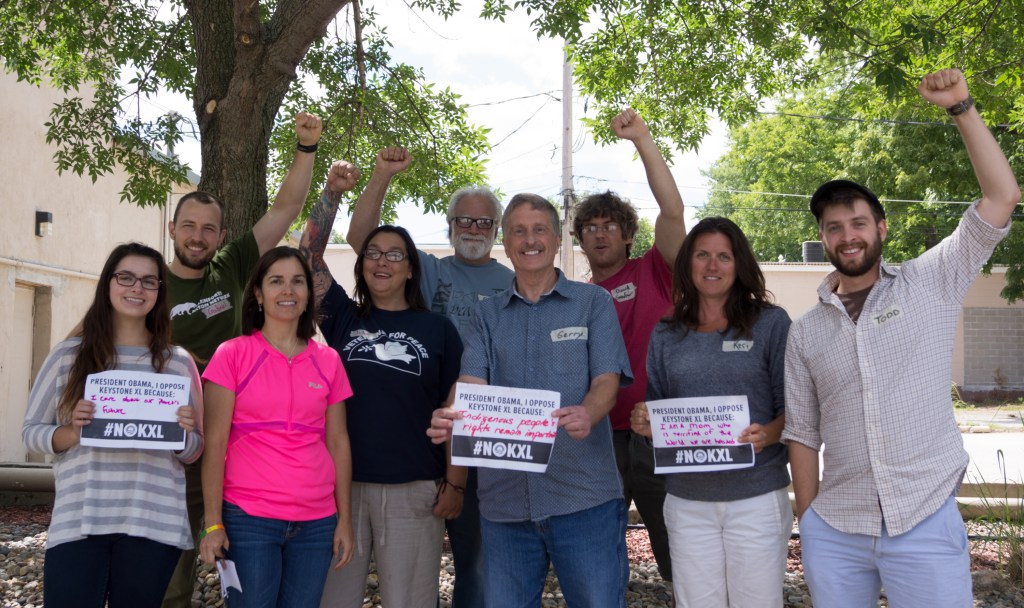
I studied John Lewis and the SNCC in 2013 when I became involved with the Keystone Pledge of Resistance (see below). The Keystone Resistance was a national campaign, that would trigger acts of nonviolent civil disobedience across the country, simultaneously, if it appeared that President Obama was going to approve the permit for the Keystone pipeline. At then end of this are parts of the training manual for the Pledge. And President Obama’s letter about his decision regarding Keystone.
The Rainforest Action Network (RAN) held training sessions in 25 U.S. cities that summer. This was training for people who would then organize and train others in their communities for nonviolent direct action. Nearly 400 Action Leads (those who received this training) were trained, who then trained nearly 4,000 people in their communities. In Indianapolis, we held six training sessions in which about 50 people were trained.
I always asked to teach the parts about nonviolence and direct action.
President Obama denied the permit for the Keystone pipeline. The current president approved the permit. Currently parts of Keystone have been constructed, but as of now construction has been halted while further environmental assessments are being done.
The Edward F. Snyder Award for National Legislative Leadership in Advancing Disarmament and Building Peace is presented annually to an outstanding member of Congress who has displayed leadership in advancing legislative priorities consistent with those advocated by the Friends Committee on National Legislation.
Edward Snyder served the Friends Committee on National Legislation for 35 years, as a Legislative Secretary from 1955 until 1962, then as Executive Secretary until 1990. The 2007 recipient was John Lewis:
2007: Rep. John Lewis (GA), for his commitment to non-violent resistance, both in his work with the civil rights movement and his opposition to the Iraq war.
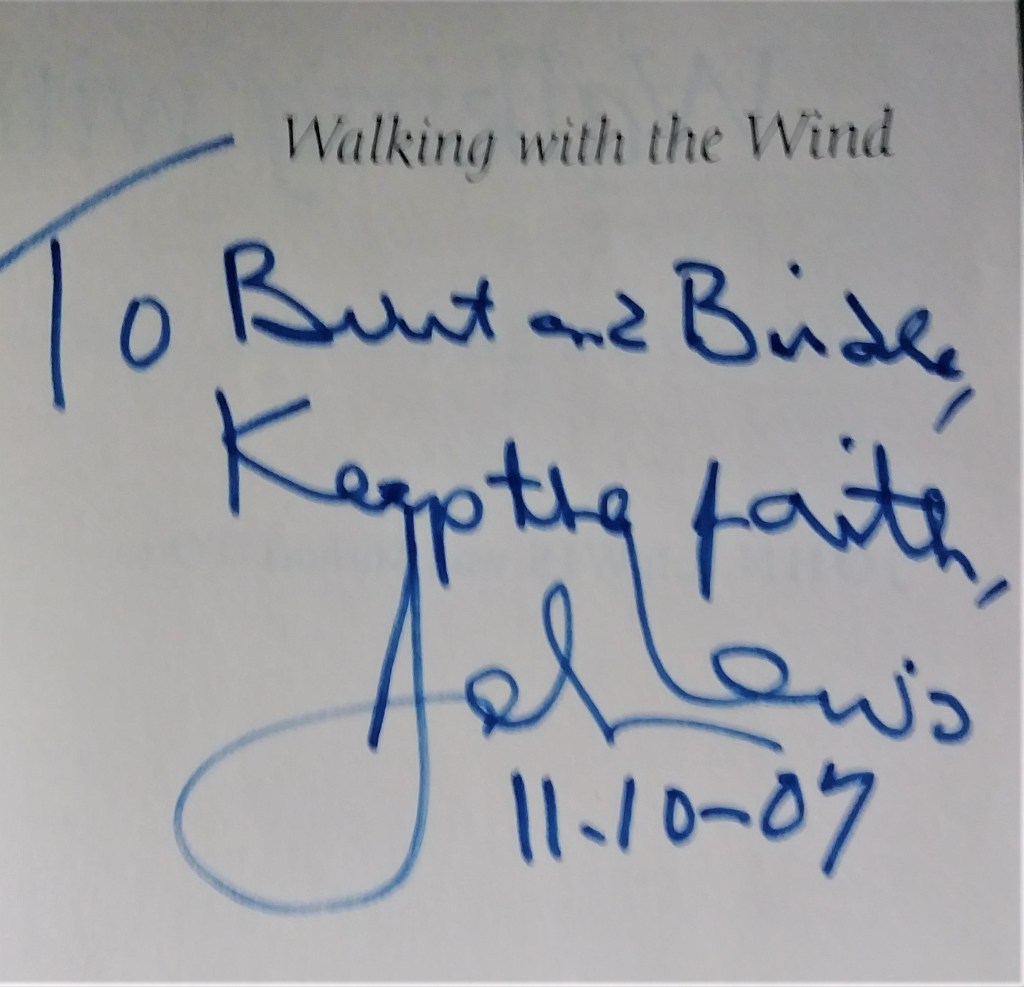
When John Lewis came to the FCNL annual meeting to receive this award, he signed copies of his book, “Walking with the Wind: a Memoir of the Movement”. My parents were there.
If you’ve read recent posts from this blog, you know I’ve been using the journal I started when I was a Senior at Scattergood Friends School to share what was going on at a particularly significant and chaotic time in my life, and for the country. That was in 1969, at the height of the Vietnam War. Yesterday’s post was the conclusion of the long, difficult process of coming to my decision to commit an act of civil disobedience, and become a draft resister.
The other significant influences on my life that I hadn’t mentioned, since they weren’t written in my journal then, were related to the civil rights struggle that was going on at the same time, including the eloquent speeches by, and example of Martin Luther King, Jr. In 1963, for example, Martin Luther King, Jr, wrote his Letter from Birmingham Jail about nonviolent resistance.
The key to the success of any nonviolent campaign, besides inspiration and commitment, is training. It is a sad commentary that our country devotes so much effort and billions of dollars to training our armed forces, but to work for peace and justice, we have to do our training ourselves. The success of the civil rights movement hinged on the incredible organization and training of thousands in the techniques of nonviolent civil disobedience and direct action by John Lewis and the Student Nonviolent Coordinating Committee (SNCC) and many others.
There was the inspiration of the willingness of so many to risk their lives, and the tragic deaths of James Chaney, Andrew Goodman, and Michael Schwerner and others.
The courage of the parents of, and the high school, middle school and elementary students who marched in Birmingham in 1963 with over 1,000 of them filling the jails after being brutally attacked by dogs and with fire hoses.
“A truly moral agenda must be anti-racist, anti-poverty, pro-justice, pro-labor, transformative and deeply rooted and built within a fusion coalition. It would ask of all policy, is the policy Constitutionally consistent, morally defensible and economically sane. We call this moral analysis and moral articulation which leads to moral activism.” —Rev. Dr. William, J. Barber, II
Rev William Barber continues his faith based activism, using nonviolent civil disobedience as a tool for change:
“People of faith and moral conscience around the nation are preparing for direct actions to protest the laws and policies of this administration. We pledge to support nonviolent civil disobedience as a form of #MoralResistance. We will learn about the moral framework for civil disobedience and choose a role for ourselves, whether as protesters, medics, legal observers, witnesses, or care providers. We will train in civil disobedience as practiced and perfected by thousands before us. And we will show up in the time, place, and manner we are needed.
Nonviolent civil disobedience is grounded in the ethic of love – for others, opponents, and ourselves. When people use civil disobedience to protest not just a single policy but widespread injustice, then this act of love becomes revolutionary. It can change a community, a culture, even a country. #RevolutionaryLove is the call of our times. We pledge to answer the call together.”
Here is our modern day Student Nonviolent Coordinating Committee (SNCC)–if you weren’t around in the 1960’s, SNCC was the group, at one time led by Representative John Lewis, that trained people for the civil disobedience actions during the civil rights movement.
The United States House of Representatives Democrat’s sit in has been fascinating to watch.
The symbolism of the action being led by Representative John Lewis, a leader in the civil rights movement of the 1960’s was powerful. John Lewis was once the leader of the Student Nonviolent Coordinating Committee (SNCC) which trained many people in the theory and techniques of nonviolent direct action. His book, “Walking with the Wind” is well written and very interesting history of the civil rights movement and SNCC.
It is highly unusual that this technique needed to be employed in the very institution that is supposed to craft the legislation that is often the goal of nonviolent action. This points to the failure of the Congress to fulfill its purpose, by which we create laws to support a just society.
In the face of a decision on the Keystone XL pipeline coming in the next few months, the Keystone XL Pledge of Resistance is a commitment to massive and historic nationwide acts of peaceful, dignified civil disobedience if President Obama’s State Department recommends approval of Keystone XL as in the National Interest.
The pledge is being organized by CREDO, Rainforest Action Network and the Other 98% to put direct political pressure on President Obama to reject Keystone XL.
More than 62,000 people have already signed the pledge, committing to risk arrest if necessary to protest approval of Keystone XL. In making this pledge, it is our hope that we can convince President Obama to reject Keystone XL, so that our risking-arrest is not necessary.
To demonstrate our commitment and seriousness, over the summer we will have small-scale preview actions, and we will train hundreds of activists to lead civil disobedience actions in their own community, at State Department Offices, federal buildings and other strategic targets.
NON-VIOLENCE GUIDELINES AND PRINCIPLES
With the recognition that history is on our side in the fight against the fossil fuel industry, that we are a part of the proud and successful tradition of nonviolent civil disobedience, and that our actions also reflect on tens of thousands of others standing together across the country, we will conduct our behavior in only the most peaceful and dignified manner.
We are each firmly committed to the safety of all participants and the surrounding community, and will not bring with us any weapons, drugs or alcohol, or participate in any acts of vandalism or destruction of property.
We will work to protect everyone around us from insult or attack, including those who may oppose or disagree with us.
We will remember that irresponsible actions could endanger others, or lead to the arrest of people who do not want to go to jail, and will not use threatening language or threatening motions toward anyone.
We will act and communicate in a manner of openness, friendliness and respect toward everyone we encounter, including police officers and members of the community at large.
As members of this action, we will follow the directions of the designated organizers.
If an individual has a serious disagreement with the organizers of the action, the individual will withdraw from the action.
If an individual does not respect these guidelines and principles, that individual can not participate in an action as part of the Pledge of Resistance to the Keystone XL pipeline.
Civil Disobedience as a Tactic
There is a long history of non-violent civil disobedience in the U.S.
This slide depicts a movement you might be familiar with:
During the 1960s, members of the civil rights movement staged ‘sit-ins’ at lunch counters to draw attention to unjust segregation – this photo was taken in Greensboro, North Carolina
Civil disobedience has been – and still is – used by many movements for justice, including: the women’s rights movement, “suffragettes” who won the right for women to vote, the labor rights movement, pacifist and immigrants rights movements.
Since the 1970s, the environmental movement has used this tactic to challenge nuclear power, deforestation and fossil fuel extraction.
Now the climate movement is following in a long proud tradition to stop the Keystone XL pipeline.
Keystone Pledge of Resistance Training Manual
PROLOGUE
I want to begin this book with a little story. It has nothing to do with a national stage, or historic figures, or monumental events. It’s a simple story, a true story, about a group of young children, a wood-frame house and a windstorm.
Now the house was beginning to sway. The wood plank flooring beneath us began to bend. And then, a corner of the room started lifting up.
I couldn’t believe what I was seeing. None of us could. This storm was actually pulling the house toward the sky. With us inside it.
That was when Aunt Seneva told us to clasp hands. Line up and hold hands, she said, and we did as we were told. Then she had us walk as a group toward the corner of the room that was rising. From the kitchen to the font of the house we walked, the wind screaming outside, sheets of rain beating on the tin roof. Then we walked back in the other direction, as another end of the house began to lift.
And so it went, back and forth, fifteen children walking with the wind, holding that trembling house down with the weight of our small bodies.
More than half a century has passed since that day, and it has struck me more than once over those many years that our society is not unlike the children in that house, rocked again and again by the winds of one storm or another, the walls around us seeming at times as if they might fly apart.
It seemed that way in the 1960’s, at the height of the civil rights movement, when America itself felt as if it might burst at the seams–so much tension, so many storms. But the people of conscience never left the house. They never ran away. They stayed, they came together and they did the best they could, clasping hands and moving toward the corner of the house that was the weakest.
And then another corner would lift, and we would go there.
And eventually, inevitably, the storm would settle, and the house still stand.
But we knew another storm would come, and we would have to do it all over again.
And we did.
And we still do, all of us. You and I.
Children holding hands, walking with the wind. That is America to me–not just the movement for civil rights but the endless struggle to respond with decency, dignity and a sense of brotherhood to all the challenges that face us as a nation, as a whole.
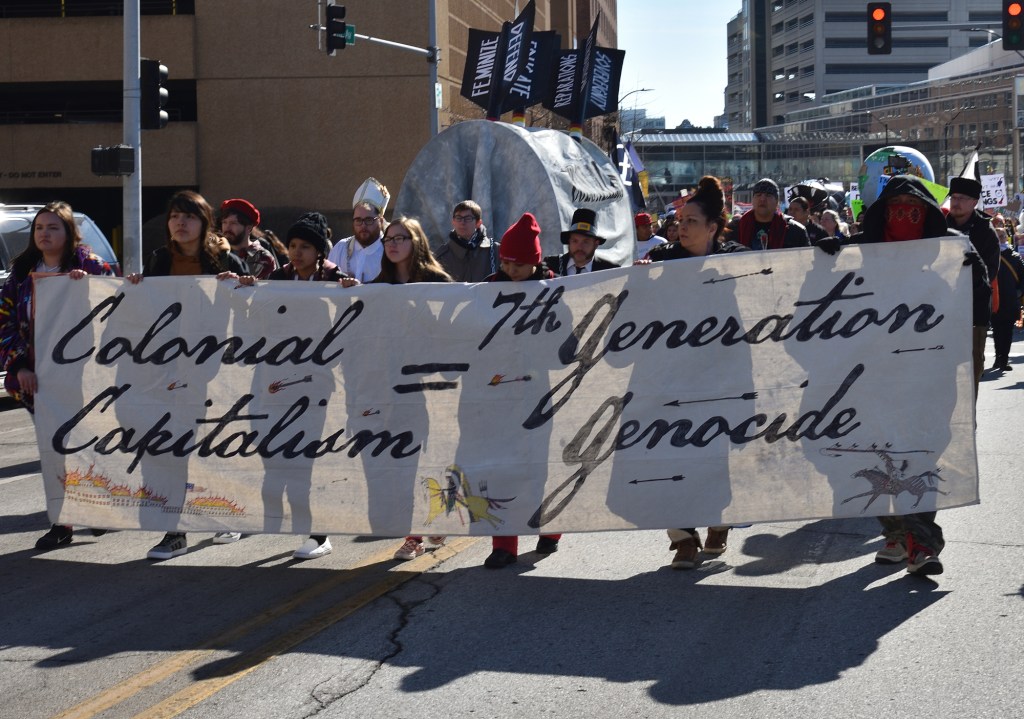
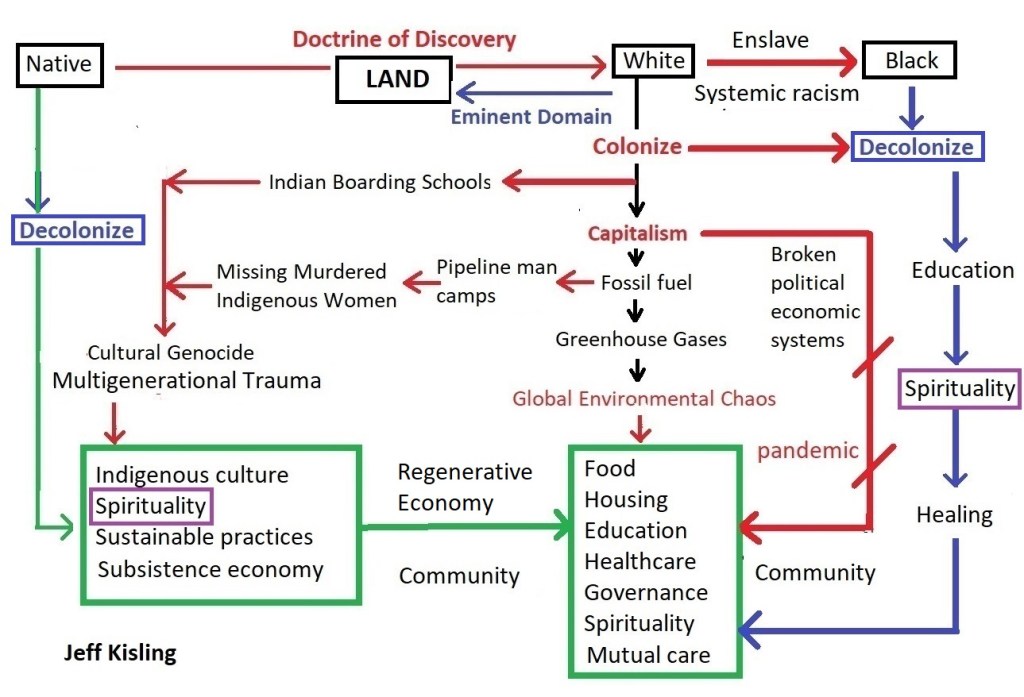
Following is the current state of a diagram I’ve been working on to help me understand the relationships among White settler colonists, Indigenous peoples and other people of color. Many of the basic problems today stem from our capitalist economic system which is heavily dependent on energy.
Until recently fossil fuels were the energy source for capitalist systems. But there is a rapid transition to renewable energy sources today. This transition is related to falling prices of renewable source electricity, and Indigenous led resistance to extractive, fossil fuel sources.
What would replace our failing capitalist system?
Our strongest chance of restoring balance on the planet and respecting the interconnectedness of all things, human and other-than-human, is to fervently advocate for justice for Indigenous communities and return to them the power of governance—which was violently apprehended through war, genocide, starvation, disease, abuse, the dispossession of land, and forced repression of Indigenous communities on reservations. The only way to upend this form of sociopolitical and economic ordering, I argue, is through the reinstatement of Indigenous authority and sovereignty.
The intersecting crises of income and wealth inequality and climate change, driven by systemic white supremacy and gender inequality, has exposed the frailty of the U.S. economy and democracy. This document was prepared during the COVID-19 pandemic which exacerbated these existing crises and underlying conditions. Democratic processes have been undermined at the expense of people’s jobs, health, safety, and dignity. Moreover, government support has disproportionately expanded and boosted the private sector through policies, including bailouts, that serve an extractive economy and not the public’s interest. Our elected leaders have chosen not to invest in deep, anti-racist democratic processes. They have chosen not to uphold public values, such as fairness and equity, not to protect human rights and the vital life cycles of nature and ecosystems. Rather, our elected leaders have chosen extraction and corporate control at the expense of the majority of the people and the well-being and rights of Mother Earth. Transforming our economy is not just about swapping out elected leaders. We also need a shift in popular consciousness.
There are moments of clarity that allow for society to challenge popular thinking and status quo solutions. Within all the challenges that this pandemic has created, it has also revealed what is wrong with the extractive economy while showcasing the innate resilience, common care, and original wisdom that we hold as people. Environmental justice and frontline communities are all too familiar with crisis and systemic injustices and have long held solutions to what is needed to not only survive, but also thrive as a people, as a community, and as a global family. We cannot go back to how things were. We must move forward. We are at a critical moment to make a down payment on a Regenerative Economy, while laying the groundwork for preventing future crises.
To do so, we say—listen to the frontlines! Indigenous Peoples, as members of their Indigenous sovereign nations, Asian and Pacific Islander, Black, Brown and poor white marginalized communities must be heard, prioritized, and invested in if we are to successfully build a thriving democracy and society in the face of intersecting climate, environmental, economic, social, and health crises.
A just and equitable society requires bottom-up processes built off of, and in concert with, existing organizing initiatives in a given community. It must be rooted in a people’s solutions lens for a healthy future and Regenerative Economy. These solutions must be inclusive—leaving no one behind in both process and outcome. Thus, frontline communities must be at the forefront as efforts grow to advance a Just Transition to a Regenerative Economy.
A People’s Orientation to a Regenerative Economy offers community groups, policy advocates, and policymakers a pathway to solutions that work for frontline communities and workers. These ideas have been collectively strategized by community organizations and leaders from across multiple frontline and grassroots networks and alliances to ensure that regenerative economic solutions and ecological justice—under a framework that challenges capitalism and both white supremacy and hetero-patriarchy—are core to any and all policies. These policies must be enacted, not only at the federal level, but also at the local, state, tribal, and regional levels, in US Territories, and internationally.
I’ve had an evolving understanding of tearing down statues related to racism and other injustice. At first I thought these were mainly acts of venting frustration. Perhaps symbolic resistance to injustices of the past.
But when I attended the July 4th event on the Iowa State Capitol grounds titled “Hey! Come get your racist uncle! Remove monuments to White supremacy in Iowa” I learned these statues continue, to this day, to make people feel unwelcome.
I’ve come to realize this is another aspect of intergenerational trauma. I’d learned that the trauma from forced assimilation of native children in the residential schools is passed from generation to generation. That trauma is keenly felt in tribal communities to this day. In the same way, the traumas from the White settler colonists as they stole native lands, killed the buffalo and outlawed cultural practices have passed from generation to generation, to this day. These statues are a constant reminder to Indigenous peoples, of the oppressions by White settlers of the past and present.
Across the pond, protests have also erupted in Britain. In a context of recession and repression, it is common for widespread rebellions to flare up at instances of injustice. But the protesters’ actions have also led to an unexpected discussion of history and memory. This was a product of direct action: protesters in Bristol took down the controversial statue of the slave trader Edward Colston, defaced it, and threw it into the harbor.
Ranging from distraction to culture war, right-wing reactions converge on the notion that memorials are but fragments of a time long gone by. Even if these figures held some vile opinions, this was a widely shared disposition of their time and in any case, these issues have since been resolved. From this perspective, the destruction is nothing more than aimless vandalism, a diversion from the real issues. Deliberately or otherwise, these claims miss the point. Offensive statues are toppled not because they are historical, but they are actual. This is not an erasure of the past, but precisely its recognition in the injustices of the present, related to an ongoing trauma quite literally transmitted from the past.
A study reveals that exposure to discrimination impacts genetic expression across generations, such that Black people, who bear the brunt of racial prejudice, are more likely to suffer from stress-related problems due to the suffering inflicted on their ancestors. This is a striking example of how the past is reproduced in the present.
The removal of offensive statues may seem to be a distraction, but it is a redemptive challenge against injustices transmitted from the past. —Onur Acaroglu
As all these statues to White supremacy are taken down, you might wonder, as I do, what should take their place?
As a Quaker I sometimes feel uncomfortable around statues and monuments to military campaigns and leaders. I sometimes wonder why there aren’t statues of peacemakers?
I was delighted to hear the story of the replacement of the statue of the slave trader Edward Colston in Bristol by the sculpture of Black Lives Matter protester, Jen Reid. Even though it was removed after about 24 hours, it might inspire other artists, activists and the public.
The sculpture of a Black Lives Matter protester, Jen Reid, which replaced a toppled statue of the slave trader Edward Colston in Bristol, has been removed. The artist Marc Quinn installed the work on the empty plinth, left when a statue of Colston was torn down during protests in June. The statue of Reid with a raised fist, installed in a clandestine operation, was removed about 24 hours after it went up. Guardian News, July 16, 2020
There’s a lookout stationed at the end of Colston Street and a load of people, some dressed in hi-vis vests, are gathering at a nearby restaurant. Then, in the dawn light, a statue concealed in plastic wrapping can be seen approaching on a hiab truck. It turns the corner and reverses towards the plinth where the statue of Edward Colston once stood. There’s a sense of mischief in the air on this bright clear morning in Bristol – and revolution.
The team spring into action and, minutes later, a new statue has been placed on the spot where Colston’s stood and swiftly unwrapped. It’s of a young black woman, her fist raised in a black power salute. “There’s a new woman in power!” a cyclist shouts as he turns the bend. On Twitter, responses start coming in fast. Dr Lola Solebo writes: “Am waking my girls up early so I can show them this. What a thing of beauty. What a thing to wake up to.”
Another woman is standing by the plinth. “I feel full of pride, so, so full of pride,” she says, looking up at the sculpture. It’s of her.
‘Hope flows through this statue’: Marc Quinn on replacing Colston with Jen Reid, a Black Lives Matter protester. The sculptor has placed a statue of a woman doing a black power salute on the vacant plinth in Bristol. Our writer, who was at the dawn unveiling, tells the full story of its creation – and speaks to Jen Reid, the protester whose gesture inspired him by Aindrea Emelife, The Guardian, July 15, 2020
Global protests against racism are a direct challenge to contemporary oppressors. Through this historical opening, the vanquished take the mantle of progression. At the hands of the protesters, statues are not simply removed, but replaced with alternative imaginaries of what public memorials might look like. The outlook of redemption may appear to be a philosophically weighty way to problematize established modes of remembrance and closure, but it has a quite practical relevance and implications for moving forward from the present.
What is advocated here is not a rejection of all remembrance. It is rather the substitution of periodic remembrance for reconciliation and healing that is at the root of the problem. In fact, the empty plinths left after the removal, and the unguarded statues themselves, have been the canvas of a myriad cultural expressions that are in themselves artistically valuable.
This video and part of the transcript below are about the event held at the Iowa State Capitol grounds in Des Moines, Iowa, July 4, 2020. This was organized by Seeding Sovereignty and other organizations mentioned below.
My friends Christine Nobiss and Donnielle Wanatee spoke. And then a letter related to the monuments was given to state representative Ako Abdul-Samad.
I was blessed to be able to attend this ceremony. Sometimes things we get involved with don’t seem to impact us directly. But they might in ways we may not be aware of at the time. This July 4th ceremony with the voices of Christine and Donnielle helped me see the effects of these statues in a new way. See these with my heart and not just my mind. That illumination came from the story Christine shared.
This land is stolen land. Where we are standing it’s the land of the Ioway and the Meskwaki and the Dakota.
I am tired as an Indigenous person coming to these spaces and seeing these because it does trigger historical trauma. And it does make me feel unwelcome here. And I should not feel unwelcome here, especially as an indigenous person of Turtle Island.
I think this is hate speech. Iowa doesn’t have any laws per se against hate speech, but it does have laws against discrimination. So I feel discriminated when I come here and I look at this or when I go inside and I have to look at that awful mural of westward expansion that tells the story of bringing proper farming practices to Iowa. Like the people here didn’t know what they were frickin’ doing, And especially the Columbus statue, which is over there somewhere, but it’s being protected right now.
Christine Nobiss, Seeding Sovereignty
ALL THAT WE ARE IS STORY. From the moment we are born to the time we continue on our spirit journey, we are involved in the creation of the story of our time here. It is what we arrive with. It is all we leave behind. We are not the things we accumulate. We are not the things we deem important. We are story. All of us. What comes to matter then is the creation of the best possible story we can while we’re here; you, me, us, together. When we can do that and we take the time to share those stories with each other, we get bigger inside, we see each other, we recognize our kinship — we change the world one story at a time.
Richard Wagamese (October 14, 1955-March 10, 2017) Ojibwe from Wabeseemoong Independent Nations, Canada
On July 4th from 1-3 PM we gathered at the Iowa State Capitol to demand that monuments to white supremacy be removed in Iowa. Organizers presented Iowa State Representative Ako Abdul-Samad with a letter demanding that all racist, misogynistic, homo/transphobic, whitewashed historical depictions be removed from all state grounds and facilities.
About 100 white supremacists/nationalists showed up to protect their sacred monuments with guns and threats of violence beforehand. In response to police brutality and racial injustice, monuments to white supremacy are being removed all over the country but People of the World Majority are being forced to put their safety on the line to carry out this long-overdue purge. Folx have been shot, arrested, and targeted. Now, #45 has signed an executive order to arrest anyone who vandalizes, removes a statue or threatens federal property and jail them for up to 10 years.
This was an Indigenous-led rally, organized by Seeding Sovereignty and co-hosted by Great Plains Action Society, Sage Sisters of Solidarity, Des Moines BLM, Humanize My Hoodie, Vote Mob, Iowa CCI and Gulf Coast Center for Law & Policy. We are demanding that the state–the colonizers–do the job for us.
All we should need to do is ask, especially when these monuments fall into the realm of hate propaganda and make folx feel unwelcome in public spaces. However, this colonially enforced government is built upon white supremacy and human rights violations and, thus, will not budge unless we make them take action on the issue.
If they won’t protect those that are doing the right thing to create a better society then we demand legislation that removes all monuments, murals, and depictions of white supremacist persons, acts, and ideologies from all Iowa state grounds and state-funded institutions.
To start, we insist that the following statues and mural be removed from the Iowa State Capitol Building and grounds.
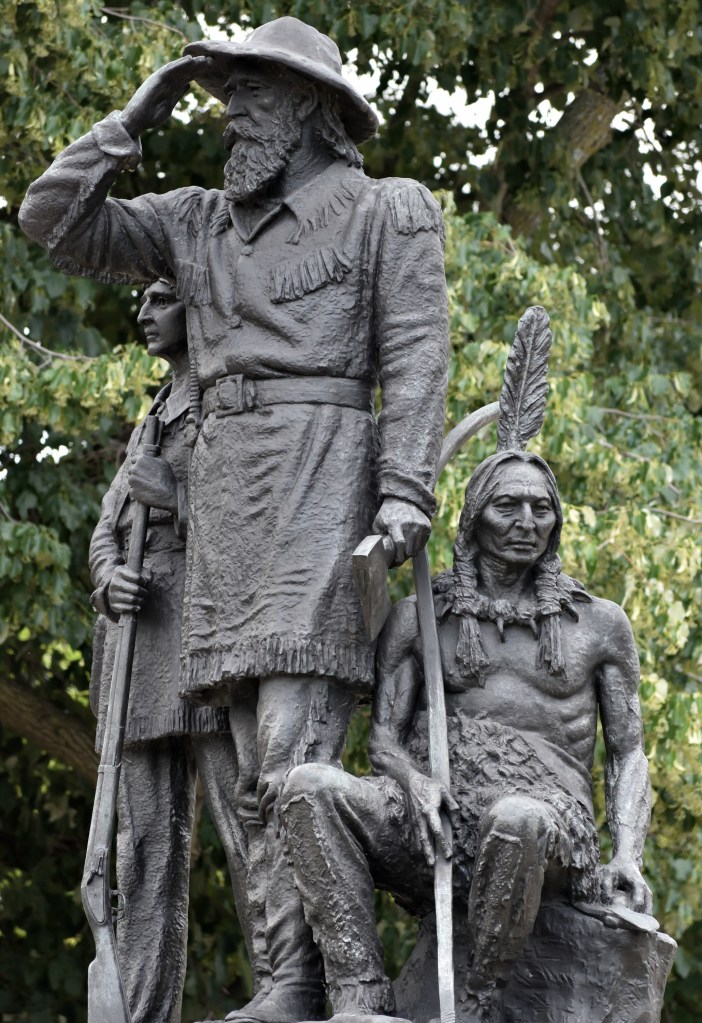
The Pioneer, Iowa State Capitol grounds
On the West Lawn, there is a 15-foot bronze statue on a large pedestal that stands in front of the Iowa State Capitol Building. According to the Iowa State Government website, the statue depicts “The Pioneer of the former territory, a group consisting of father and son guided by a friendly Indian in search of a home. The pioneer depicted was to be hardy, capable of overcoming the hardships of territorial days to make Iowa his home.” The father and son settler invaders are standing tall and proud, looking west, as the “friendly Indian” sits behind them in a less powerful, dejected position. Inside the capitol is a piece that overwhelmingly encompasses this sentiment called the Westward Mural, which covers a massive wall. The artist writes that “The main idea of the picture is symbolical presentation of the Pioneers led by the spirits of Civilization and Enlightenment to the conquest by cultivation of the Great West.” He also speaks about overcoming the wilderness with plowed fields–as if the current Indigenous inhabitants, such as the Ioway and the Meskwaki, had not already created capable and efficient land management systems.
On the South Lawn, there is a Christopher Columbus Monument that was celebrated in 1938 by five thousand people who showed up for the dedication of the statue on Columbus Day. The statue was put up just a couple years after the Columbus Club of Iowa successfully lobbied to have Walker Park renamed to Columbus Park and have a Columbus monument placed there.
[partial transcript from the video]
We are here today to begin talks with this state about removing all monuments to white supremacy.
And yes, we do know that white supremacists are over there. They’ve agreed to leave us alone. This took a lot of guts because we knew that there would be pushback, not just from the police, but from white supremacists, because this is their holy day. And because these are their holy relics.
Because what this statute depicts is a lie. A white settler on his son, looking for a new home with a friendly Indian showing them the way. And as you can see, the Indian is sitting down in a lower position and obviously looking in my opinion, somewhat dejected.
And this is not the story of this state. We did not have friendly Indians showing the way to people. We had settler invaders and colonial militias come into the state and murder their way across this country.
This land is stolen land. Where we are standing it’s the land of the Ioway and the Meskwaki and the Dakota.
I am tired as an Indigenous person coming to these spaces and seeing these because it does trigger historical trauma. And it does make me feel unwelcome here. And I should not feel unwelcome here, especially as an indigenous person of Turtle Island. I think this is hate speech. Iowa doesn’t have any laws per se against hate speech, but it does have laws against discrimination. So I feel discriminated when I come here and I look at this or when I go inside and I have to look at that awful mural of westward expansion that tells the story of bringing proper farming practices to Iowa. Like the people here didn’t know what they were frickin’ doing, And especially the Columbus statue, which is over there somewhere, but it’s being protected right now.
Thank you so much representative Ako Abdul-Samad. I really appreciate you being here today. And I would like to present with you this letter to bring to the legislators of this state. So we can start making change where we all feel welcome and safe.
Christine Nobiss. Transcript from the video above
This violent suppression of resistance at Standing Rock raises an essential question: How can we expect the same colonial government that is partnered with an international mercenary security firm enlisted to brutally halt opposition to a pipeline project to work in the service of climate recovery? We can’t. Our strongest chance of restoring balance on the planet and respecting the interconnectedness of all things, human and other-than-human, is to fervently advocate for justice for Indigenous communities and return to them the power of governance—which was violently apprehended through war, genocide, starvation, disease, abuse, the dispossession of land, and forced repression of Indigenous communities on reservations. The only way to upend this form of sociopolitical and economic ordering, I argue, is through the reinstatement of Indigenous authority and sovereignty.











































 Quakers, social justice and revolution