Education as Part of the Next American Revolution

As I wrote yesterday, the book that we will be discussing at KI today is The Next American Revolution: Sustainable Activism for the Twenty-First Century by Grace Lee Boggs.  The last part of the book is about education, and how we need a revolution in our educational system, too.  The current public education model hasn’t changed since it was developed to actually train, rather than educate, workers needed to work in factories.  To give people  enough basic skills in reading and math to be able to work in mass assembly plants.  That doesn’t develop critical thinking skills, and has the effect of making workers very passive, because they are used to being told what to do.

The book describes why what is needed is to instead develop critical thinking skills, and ways to do that.  Which is basically to help students be engaged in their everyday living activities, to apply their creativity to everyday tasks, and to building community.

This was one of the main things that attracted me to the Kheprw Institute (KI) community.  I first learned of this community via an Internet advertised environmental event.  When I arrived, it was all about the kids showing us their work related to the environment, including an aquaponics system and making rain barrels.  It was amazing to see how excited and knowledgeable the kids were, and continue to be in the years since I’ve been connected to KI.  I quickly learned that the emphasis is on developing critical thinking skills.  An example of that is the student/intern led community discussions about books like The New Jim Crow.  KI is a model of the revolution needed in education that the book talks about.

I was so fortunate to have received this kind of education myself at Scattergood Friends School and Farm, which is a four year, co-ed, boarding Quaker college preparatory high school on a working farm in Iowa.  This is the main focus of the Quakers of Iowa Yearly Meeting (Conservative), which many members have attended, and many taught at.

It has a class size of about 15, so the total student population is about 60 maximum.  The staff size is around 30 or so.  An effort has always been made to have some international students, so we could learn about other cultures and races.

I don’t know if this was the original intention or whether it was mainly an economic necessity, I suspect both, but all of the work done at the school and farm is done by the students and staff.  There is a “crew” system, which students rotate through, so that eventually each student works on each crew.  The crews involve preparing meals, doing dishes, cleaning classroom, baking bread, farm chores, laundry, etc.  We had name tags sown into all of our clothes, since the laundry crew did everybody’s laundry.

Everyone had to attend Quaker meeting for worship, in the meetinghouse on campus, every Sunday morning.

KONICA MINOLTA DIGITAL CAMERA

Academic work included writing a lot of papers, which taught English skills and critical thinking.  Letter grades were not used.  Rather, each teacher would write a several paragraph report evaluating what each student had done for the class.  That eliminated competition between us, and put the focus on working to our own full potential.

There was a lot of emphasis on art.  The art building had pottery wheels and a kiln.  Glassblowing was taught for a time.  Every class put on a play every year.  Some years looms were in use for weaving.

The farm was integrated into the classroom, now even more so than when I was there.  The sophomore class raised pigs, including delivering and caring for the babies.

The Junior class would spend a week among Quakers in a city to learn about urban issues.  Our class went to Minneapolis.

The Senior class would go the New York City to attend sessions at the United Nations, and then to Washington, D.C., to visit our Congressional representatives, and attend a session of the U.S. Supreme Court.

I was a Senior there in 1969-70, at the height of the Vietnam War, and the country in turmoil with the rise of the massive anti-war movement (more about that here).  During the fall of 1969 there were national War Moratorium Days each month to focus on anti-war efforts.   Quakers have always worked for peace and against war.  Many Quaker men went to prison for refusing to participate in the draft and military.  A number of our teachers at Scattergood had been imprisoned, providing examples for us.  One month the students organized a draft conference that was open to the public.  Another month on the Moratorium Day, several of us went into the nearby town of West Branch to talk with people there, to find out what they thought about the war.  I remember being very nervous about that, and then astonished to find that everyone we talked to (these were not Quakers) was also against the war.  A real educational experience.

In October, on the War Moratorium Day, the entire school, students and faculty, marched 12 miles from the school into the local university, carrying peace signs, to participate in the anti war events there, which included occupying the University President’s office, and seeing mannequins floating down the river.  This photo, taken during that march, is one of the first I ever developed, in the darkroom at Scattergood.

DSC09398-2

Entire Scattergood Friends School marching 12 miles to Iowa City to protest Vietnam War


Posted in peace, Quaker Meetings, Uncategorized | Tagged , | Leave a comment

The Next American Revolution

I am especially grateful for our continuing book discussions at KI (Kheprw Institute) this month because the book we will be discussing (tomorrow) is The Next American Revolution: Sustainable Activism for the Twenty-First Century by Grace Lee Boggs, Scott Kurashige.   At the end of this are several links to posts that talk about these book discussions, and how they have been the main way North Meadow Friends have begun to be engaged with KI, and why they are so important.

This book has helped me put the recent election in perspective.  In many ways it doesn’t really matter who won the election, because the political system has finally, completely failed, and the next revolution has already begun.  There will certainly be plenty of awful things coming from the current government and the military industrial complex, most of which would be coming no matter which particular individuals are in the government.  The Trump administration will just make this unravel more quickly and painfully.

The following paragraphs from the book explain this very clearly, and are the reason I have been led to join the KI community, because we are engaged in this revolution now.

The next American Revolution, at this stage in our history, is not principally about jobs or health insurance or making it possible for more people to realize the American Dream of upward mobility. It is about acknowledging that we Americans have enjoyed middle-class comforts at the expense of other peoples all over the world. It is about living the kind of lives that will not only slow down global warming but also end the galloping inequality both inside this country and between the Global North and the Global South. It is about creating a new American Dream whose goal is a higher Humanity instead of the higher standard of living dependent on Empire. It is about practicing a new, more active, global, and participatory concept of citizenship. It is about becoming the change we wish to see in the world.

The courage, commitment, and strategies required for this kind of revolution are very different from those required to storm the Winter Palace or the White House. Instead of viewing the U.S. people as masses to be mobilized in increasingly aggressive struggles for higher wages, better jobs, or guaranteed health care, we must have the courage to challenge ourselves to engage in activities that build a new and better world by improving the physical, psychological, political, and spiritual health of ourselves, our families, our communities, our cities, our world, and our planet.

This means that it is not enough to organize mobilizations that call on Congress and the president to end the wars in Iraq and Afghanistan. We must also challenge the American people to examine why 9/11 happened and why so many people around the world understand, even though they do not support the terrorists, that they were driven to these acts by frustration and anger at the U.S. role in the world, such as supporting the Israeli occupation of Palestine and dictatorships in the Middle East and treating whole countries, the peoples of the world, and Nature only as resources enabling us to maintain our middle-class way of life.

We have to help the American people find the moral strength to recognize that—although no amount of money can compensate for the countless deaths and indescribable suffering that our criminal invasion and occupation have caused the Iraqi people—we, the American people, have a responsibility to make the material sacrifices that will enable them to begin rebuilding their infrastructure. We have to help the American people grow their souls enough to recognize that because we have been consuming 25 percent of the planet’s fossil fuels even though we are less than 5 percent of the world’s population, we are the ones who must take the first big steps to reduce greenhouse emissions. We are the ones who must begin to live more simply so that others can simply live.

Moreover, we urgently need to begin creating ways to live more frugally and more cooperatively NOW because with times getting harder, we can easily slip into scapegoating “the other” and goose-stepping behind a nationalist leader, as the good Germans did in the 1930s.

More about KI book discussions:

https://kislingjeff.wordpress.com/2016/04/18/ki-and-quakers/

https://kislingjeff.wordpress.com/2016/02/02/quaker-social-change-ministry-at-north-meadow-friends/

https://kislingjeff.wordpress.com/2016/01/24/conversation-is-underrated/

https://kislingjeff.wordpress.com/2016/01/05/importance-of-stories/

Posted in climate change, Kheprw Institute, revolution, Uncategorized | Leave a comment

Addressing the Hurt

Hurt seems to be a pervasive feeling these days.  Hurt from political turmoil and rumors of all kinds related to the Trump victory, feeling the fear of all who seem to be threatened in so many different ways.  But even before that, the hurt created by our failing economic and political system.  Hurt from the deep and widespread divisions among so many different groups in the United States.  Hurt from a wide variety of injustices.  Hurt knowing so many live in hunger and poverty.  Hurt from the loss of any sense of community by so many.

And the widespread feelings of bewilderment, and not knowing how to deal with the hurt, how to make it better.  Feelings of despair that things may never get better, will likely get worse.

I feel fortunate to have strong family support.  I am also fortunate that so many of my old and new friends are reaching out to each other.  I especially appreciate the efforts of so many friends who have been, and continue to be engaged in social activism reaching out to support each other.  It is disconcerting to find those of us who have invested in caring for others now find the need for care each other.

I am also very thankful to belong to a strong spiritual community, Quakers here and in Iowa, and the Kheprw Institute (KI) community.  I have also felt deep spiritual strength coming from Native Americans I have just begun to spend some time with related to the Dakota Access pipeline struggle.

For many years, more and more people have found organized religion no longer meets their needs, for a number of reasons, I think.  Unfortunately, that has left a great spiritual void in many people’s lives.

I think the answer to addressing the hurt is to reconnect, or more deeply connect, to the spiritual parts of being human.  I’d like to offer a way that might do this for you, if you are looking to deepen your own spiritual life.  Quakers address spiritual life in a way that is different from many of the usual practices of organized religions, in that they don’t confine their religious experience primarily to going to church on Sunday, and depending upon a minister to lead their spiritual life.

Instead, Quakers gather together, usually in a simple meetinghouse or even just someone’s home, to sit together in silence, as they meditate, or pray or just reflect on their lives.  The thing that is hard to describe is how this communal time spent in reflection is so much more powerful than meditating on your own.  This group attention to the spirit seems to invite the presence of the spirit among us.  Occasionally someone speaks out of the silence to share a spiritual message.

But that is not all.  This spiritual focus and connection to each other is carried out through the week, as well.  Friends (as Quakers are also called) share in community in many different ways.  Shared social justice projects, shared meals, visits among each other.

If you are interested in this, I’ve written more along these lines in a post called Modern Quakers.  You can find where Quakers are near you at this website, Quaker Finder.  I hope you can find ways to address your hurt.


Posted in Quaker Meetings, Uncategorized | 2 Comments

Through a Different Lens

Several weeks ago my camera was stolen.  I’ve tried using my phone’s camera, but the resolution is just not very good.  I had recently purchased a computer tablet because I’m doing most of my reading via electronic books these days.  The tablet has been working out well for that, being much smaller and lightweight than a laptop, but with a much larger screen than a cell phone (6.5  X  9.5  inches).  It also has a very nice built in speaker (so I can listen to Alicia Keys’ “Holy War”).

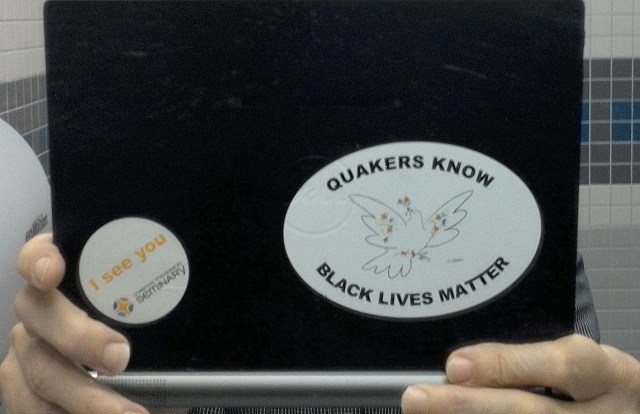
I used the tablet’s camera for the photos from our latest #NoDAPL gathering and was surprised at how well those turned out.  As I was taking photos during that event, someone remarked “Oh, Quakers Know Black Lives Matter?”, which reminded me that I had placed one of the stickers that Jenny, a Bear Creek Meeting Quaker, had created, on the back of the tablet.  Another way to spread that message.  Interesting juxtaposition: Black Lives Matter and Native Americans.

This is what the “subject” sees when I’m taking a photo:

Jpeg


Posted in #NDAPL, Uncategorized | Tagged | Leave a comment

Holy War

Last night on The Voice, Alicia Keys was going to perform “Blended Family (What You Do for Love)” from her newly released album titled Here.  But due to the “current political climate,” she said, “there’s only one song I can sing, called ‘Holy War.’”

She was accompanied by Adam Levine on the guitar.


Holy War

If war is holy and sex is obscene
We’ve got it twisted in this lucid dream
Baptized in boundaries, schooled in sin
Divided by difference, sexuality and skin

Oh so we can hate each other and fear each other
We can build these walls between each other
Baby, blow by blow and brick by brick
Keep yourself locked in, yourself locked in
Yeah we can hate each other and fear each other
We can build these walls between each other
Baby, blow by blow and brick by brick
Keep yourself locked in, yourself locked
Oh maybe we should love somebody
Oh maybe we could care a little more
So maybe we should love somebody
Instead of polishing the bombs of holy war
What if sex was holy and war was obscene
And it wasn’t twisted, what a wonderful dream
Living for love, unafraid of the end
Forgiveness is the only real revenge
Oh so we can heal each other and fill each other
We can break these walls between each other
Baby, blow by blow and brick by brick
Keep yourself open, yourself open
Yeah we can heal each other and fill each other
We can break these walls between each other
Baby, blow by blow and brick by brick
Keep yourself open, you’re open
So maybe we should love somebody
Maybe we could care a little more
So maybe we should love somebody
Instead of polishing the bombs of holy war
What if love was holy and hate obscene
We should give life to this beautiful dream
Cause peace and love ain’t so far
If we nurse our wounds before they scar
Nurse our wounds before they scar
Alicia Keys, from the album Here
Posted in peace, Uncategorized | Tagged | Leave a comment

#NoDAPL Indianapolis Banks

I was really happy to see a much larger crowd with many more young people at our #NoDAPL gathering here in Indianapolis yesterday, part of a national day of actions supporting the water protectors.  I was glad my brother Randy was able to attend a #NoDAPL rally in Madison, Wisconsin.

Again I was so moved by the Native American prayers.  I was also happy to meet Josiah Helland, a ceremonial flute player who I had been put in touch with via Facebook a few weeks ago, when a friend was looking for someone to perform at an environmental awards ceremony.

Photos here

Our focus yesterday was to let the banks who are helping fund the Dakota Access Pipeline know of our disapproval.  We helped facilitate the closing of 18 Chase/PNC Bank accounts in Indianapolis for a total of over $100,000, and numerous others attending are planning to close their accounts.

This is along the lines of the Rainforest Action Network (RAN) campaign I was involved in last November that targeted Morgan Stanley and some other financial institutions involved in financing coal.  Those institutions implemented new policies to not fund coal projects.

If you want to support #NoDAPL, please consider closing your accounts at the banks involvedhttps://kislingjeff.wordpress.com/2016/11/03/whos-banking-dapl/

Posted in #NDAPL, Uncategorized | Tagged | Leave a comment

WYSE Radio #NoDAPL

As I recently wrote, Sunday I went to KI where Ra Wyse recorded a session with Aghilah Nadaraj and I for his radio show.  Ra and Aghilah both work for the Kheprw Institute (KI).  This session was the first related to the new project, Rise Up Indy, that is intended to help centralize the efforts of the activist community in Indianapolis, and make it easier for people who are interest in justice issues connect with each other.  Wyse did a good job of leading me through a discussion about the Dakota Access Pipeline.  I combined his audio with my photos to produce the video below.

Today is another step in that journey, with actions and events related to #NoDAPL occurring all over the country.


Posted in #NDAPL, Uncategorized | Leave a comment

How to begin to heal?

We in the United States have just experienced a contentious, divisive, ugly political season and election.  Many of us were stunned by the result, others exultant.  Many who had been quiet used this election to speak.  Confusion and fear abound.  Many of us are shaken by the realization that there are powerful forces at work that we don’t understand.   We are fearful for what happens next, not just for ourselves but for those we care about.  We worry about the rise of hate and the impacts on vulnerable populations.

Since then, many of us, on all sides, seem to be becoming even more entrenched in our own positions.  If we are going to begin to heal, that is exactly what we must work against.  Now is the time we should move outside our usual, comfortable circles.  Healing requires really listening to those we disagree with.  Healing means we have to examine ourselves as honestly as we can, to try to see how our positions might look to others, to see how we might be contributing to the negativity.

The fundamental principle of nonviolence is to begin from the assumption that all parties involved in a situation have some truth.  This means really believing there is something to learn from everyone involved.  Those who have experienced this know they themselves develop a deeper, better understanding by learning from others.

I understand why many of my friends have been involved in anti-Trump demonstrations.  When the rhetoric from the Trump campaign has promoted division and disparagement, the protests are meant as a warning against implementing policies that would legislate those same principles.

But I think we should consider how those who voted for Trump see these protests.  First, I believe a great many people who voted for Trump did not vote for him, but were saying establishment politics by elites has not only not worked for them, but has worked against them, and I agree with that.   Our political system has been corrupted by money and the influence of corporate lobbyists.

Also, the Trump administration is finding out what a huge task it has before it.  Isn’t now the time to say we, who didn’t vote for him, want to have a voice, even if we have the impression we will probably have little influence?   We will have no, or a negative influence, if we don’t give the new administration any chance at all.  Trump has actually made some promises that would be great if he can make them happen, particularly related to creating jobs.  We might be most effective if we turned our attention to seeing what we could do to actually make some of those ideas work.


Posted in Uncategorized | Tagged , , | Leave a comment

Rise Up Indy – Local Environmentalism

Over the past five or six years I have been truly blessed to have met, and gotten to know and become friends with so many different people in the Indianapolis activist community.  I think of the expression, they “feed my soul”.

As things have evolved on many different fronts, we have realized we need to become better organized ourselves, both so we can better support each other, and be more effective in engaging many more people in our efforts.  Led by Aghilah, who works at KI (Kheprw Institute), we are beginning to do that.  KI is creating the website, Rise Up Indy, that we hope will be a central place for the activist community to do their own organizing, and be a place where those who are interested can come to find out how to engage in the issues they are concerned about.

Another piece of this is to spread news via podcasts.  Ra Wyse, who also works at KI, produces podcasts.  A few of us are gathering at KI this afternoon for our first session, which will be on what we think the local effects of the Trump/Pence administration will be.  With some hesitation, I agreed to talk about how this might affect environmental issues.  My hesitation was/is because I’m not sure what will happen.  But I guess none of us really does, but we should at least be exploring the possibilities, especially since Trump has indicated he is for further fossil fuel development.  Indeed, this is one of the problematic aspects of his administration, in that he is heavily invested in the company building the Dakota Access pipeline.  And Governor Pence has always been a strong ally of the coal industry in Indiana.

In particular, Trump has said he would approve the Keystone XL Pipeline if the U.S. got some of the profits.   Oil, gas, and coal stock prices surged, and renewable stocks fell after Trump’s election.

Perhaps most problematic are his statements that climate change is a “hoax”.  Whereas the scientific evidence is absolutely clear that we must dramatically reduce burning fossil fuels now if future generations are going to have a viable environment to live in.  We are in an environmental emergency, that will lead to (continued) disasters if not addressed immediately.

Trump has selected Myron Ebell, a well known climate skeptic, to head the Environmental Protection Agency (EPA).

Speaker Paul Ryan: “There are so many more things that I am excited about. Think about the laid-off coal workers now who see relief coming. Think about the farmers here in Wisconsin who are being harassed by the EPA in the waters of the USA. ”

It looks like we are heading for an epic conflict between the Trump administration and the environmental movement.

What does this mean, locally?

Basically we will probably see all kinds of legislation at the Federal and state levels that will promote the fossil fuel industry and gut the Environmental Protection Agency.

On our part this will probably involve the re-activation of the Keystone Pledge of Resistance.  I had been one who had planned to be arrested if it came to that, and was relieved when President Obama decided to deny the permit.

Another will be that the Indianapolis Riverside community water contamination situation will probably not receive  funding from the EPA for cleanup as a superfund site.

The main focus of our local environmental efforts recently has been to support the water protectors in North Dakota, as they try to defeat the construction of the Dakota Access Pipeline.  We have had two large, peaceful gatherings aimed at increasing public awareness about the pipeline, and will be having another this week with the focus on the banks financing DAPL.

What is concerning is what the reaction of the police will be to our continued peaceful protests.

It also seems we have an urban versus rural disconnect regarding environmental concerns.  It seems people in rural America are often alienated by urban environmentalists, who haven’t engaged with people intimately connected to the environment on their farms.  We need to find a way to address this.

Finally, as always, the real key to addressing environmental damage is to be the change we want to see ourselves.


Posted in #NDAPL, civil disobedience, climate change, Keystone Pledge of Resistance, Kheprw Institute, renewable energy, Uncategorized | 1 Comment

Challenged on Democracy

I appreciate some friends of mine arguing that this election was not, as I recently wrote, what democracy looks like.  They point out that Hilary Clinton won the popular vote.  According to CNN, voter turnout was at a 20 year low, with 55.4% of eligible voters turning out.  Clinton received 26.5% and Trump 26.3%

From Wikipedia, “According to political scientist Larry Diamond, democracy consists of four key elements: (a) A political system for choosing and replacing the government through free and fair elections; (b) The active participation of the people, as citizens, in politics and civic life; (c) Protection of the human rights of all citizens, and (d) A rule of law, in which the laws and procedures apply equally to all citizens. [1]

What I meant was that Donald Trump will win the election if the Electoral College vote reflects the votes of each state.  This is the fifth time a candidate has won the popular vote but lost the election.

We know the other things that are wrong with the election process, including politically drawn voting districts and the multiple tactics to suppress voter registration and turnout.

These things need to be changed.  But this election, if the Electoral College vote reflects the votes of the states, Donald Trump will have won.  We should work to fix these problems, but we also have to accept the results of the system we have in place now.  And organize to resist the policies that are probably coming.


[1]  Diamond, L., Lecture at Hilla University for Humanistic Studies January 21, 2004: “What is Democracy”; Diamond, L. and Morlino, L., The quality of democracy (2016). In Diamond, L., In Search of Democracy. London: Routledge. ISBN 978-0-415-78128-2.

Posted in Uncategorized | Tagged , , , | 1 Comment