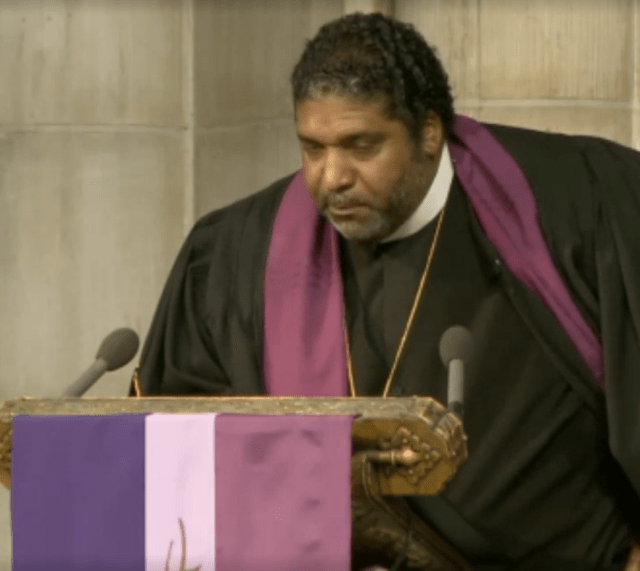
On the 49th Anniversary of the assassination of Dr. Martin Luther King, Jr., Fusion Films is re-broadcasting the powerful sermon delivered just two days ago by Rev. Dr. William J. Barber, II at the historic Riverside Church in New York City. The Riverside Church is where Dr. King preached his controversial “Beyond Vietnam” sermon on April 4th, 1967, exactly one year before his death.
Rev. Barber speaks again about the three major issues Dr. King so often spoke about, racism, materialism and militarism.
What has happened to the peace movement? How did militarism become so mainstream and accepted in our society? How did military equipment end up in domestic police departments? As Rev. Barbers points out in this sermon, the Republican administration is proposing an additional $56 billion be added to an already out of control military budget.
How can politicians rail against the costs of programs that benefit everyday Americans, like health care, Medicare and Medicaid, programs supporting the arts, public education and transportation, medical research, and on and on, when all of those things add up to a fraction of the military budget? How?
Over 300 members of the Indianapolis community came together at the Kennedy King Park today, for our annual celebration of the remarkable speech Robert Kennedy gave 49 years ago, announcing the death of Martin Luther King, Jr. This story is captured in the PBS documentary, Ripple of Hope (highly recommended).
That day, and that speech, were remarkable for many reasons. In those days before the Internet and instant news, most of those in the crowd that had gathered to hear Senator Kennedy speak as part of his Presidential campaign, were not aware that King had been killed. The Park was located in a predominately Black neighborhood in downtown Indianapolis. The Indianapolis police told Kennedy they feared for his safety, and didn’t want him to go, but he insisted.
In 1968 the county was being torn apart by the Vietnam War and racism. Martin Luther King was nearly universally criticized when he gave a speech strongly condemning the Vietnam War. He saw the issues of injustice, oppression and immorality in both struggles.
Robert Kennedy recognized the profound loss King’s death represented for the country, and the causes of peace and justice.
That is why I am so proud that my city, and its leaders and citizens, have continued to honor the memories of these two men, and their life’s work for peace, justice and equality.
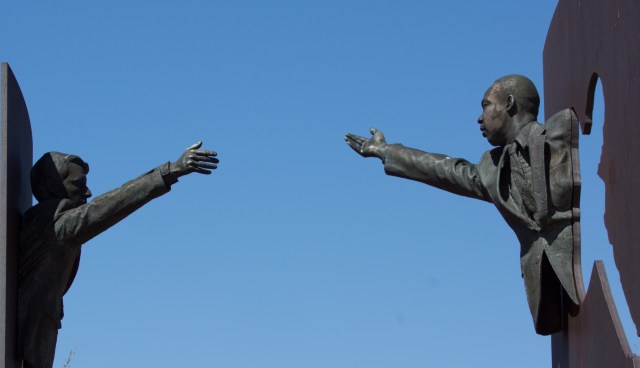
Robert Kennedy, Martin Luther King, Jr Indianapolis
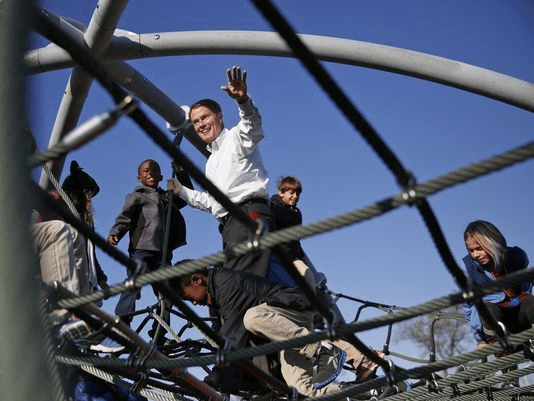
Last year new playground equipment was installed in the park. During his speech tonight, Mayor Hogsett asked us to be quiet. We could hear the voices of the children playing in the park. The Mayor has been known to do so himself:
Indianapolis Mayor Joe Hogsett
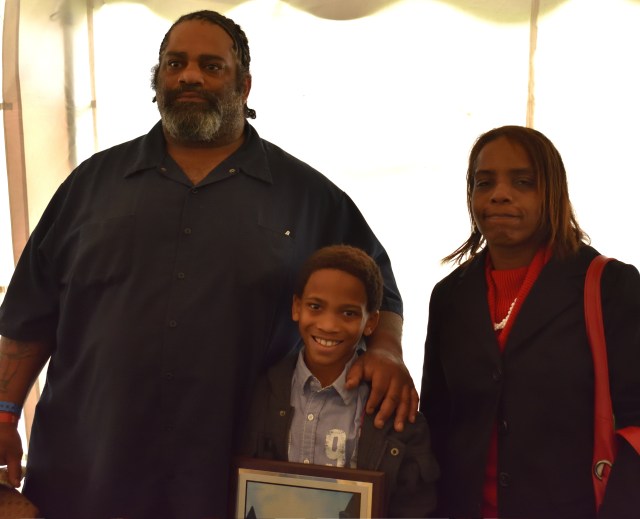
Tonight we were all enthralled to hear the story of Reese Hamilton, 8 years old, who was honored with the Trailblazer Award by the Kennedy King Memorial Initiative. Last year Reese was very disturbed by two murders that occurred near his home. He didn’t want any of his classmates to come home to crime tape.
He wrote a letter to Mayor Joe Hogsett. “8-year-old Reese has called this community together to make sure we understand our fundamental responsibility to all these kids and that’s to provide them with a peaceful and safe future,” said Hogsett.
Reese organized a peace walk through his neighborhood. Participants included the his football team and friends, players from another football team (Indianapolis Colts), the Mayor, city policemen and firefighters.
Many have written about the amazing, extemporaneous speech Robert Kennedy gave in Indianapolis, announcing King’s death to the crowd who had gathered for what was to have been a Presidential campaign stop.
I’m only going to talk to you just for a minute or so this evening, because I have some–some very sad news for all of you — Could you lower those signs, please? — I have some very sad news for all of you, and, I think, sad news for all of our fellow citizens, and people who love peace all over the world; and that is that Martin Luther King was shot and was killed tonight in Memphis, Tennessee.
Martin Luther King dedicated his life to love and to justice between fellow human beings. He died in the cause of that effort. In this difficult day, in this difficult time for the United States, it’s perhaps well to ask what kind of a nation we are and what direction we want to move in. For those of you who are black — considering the evidence evidently is that there were white people who were responsible — you can be filled with bitterness, and with hatred, and a desire for revenge.
We can move in that direction as a country, in greater polarization — black people amongst blacks, and white amongst whites, filled with hatred toward one another. Or we can make an effort, as Martin Luther King did, to understand, and to comprehend, and replace that violence, that stain of bloodshed that has spread across our land, with an effort to understand, compassion, and love.
For those of you who are black and are tempted to fill with — be filled with hatred and mistrust of the injustice of such an act, against all white people, I would only say that I can also feel in my own heart the same kind of feeling. I had a member of my family killed, but he was killed by a white man.
But we have to make an effort in the United States. We have to make an effort to understand, to get beyond, or go beyond these rather difficult times.
My favorite poem, my–my favorite poet was Aeschylus. And he once wrote:
Even in our sleep, pain which cannot forget
falls drop by drop upon the heart,
until, in our own despair,
against our will,
comes wisdom
through the awful grace of God.
What we need in the United States is not division; what we need in the United States is not hatred; what we need in the United States is not violence and lawlessness, but is love, and wisdom, and compassion toward one another, and a feeling of justice toward those who still suffer within our country, whether they be white or whether they be black.
So I ask you tonight to return home, to say a prayer for the family of Martin Luther King — yeah, it’s true — but more importantly to say a prayer for our own country, which all of us love — a prayer for understanding and that compassion of which I spoke.
We can do well in this country. We will have difficult times. We’ve had difficult times in the past, but we — and we will have difficult times in the future. It is not the end of violence; it is not the end of lawlessness; and it’s not the end of disorder.
But the vast majority of white people and the vast majority of black people in this country want to live together, want to improve the quality of our life, and want justice for all human beings that abide in our land.
And let’s dedicate ourselves to what the Greeks wrote so many years ago: to tame the savageness of man and make gentle the life of this world. Let us dedicate ourselves to that, and say a prayer for our country and for our people.
Yesterday after meeting, Evalyn Kellum and Pat Zarowin shared how the North Meadow Circle of Friends meeting was started, almost 40 years ago.
Eric Hailperin-Lausch, North Meadow clerk, Evalyn Kellum and Pat Zarowin
They spoke of their families search for a spiritual home, with the familiar story of meeting in rented spaces and peoples’ homes.
Evalyn recalled an incident when guns were discovered in the building the meeting was renting space in, which lead to finding another place to meet.
She and Pat talked about how much work was involved in moving from home to home, especially regarding First Day school supplies.
They also talked about Neighborhood Friends, one of two Friends United Meeting projects, called Volunteer Service Mission (VSM), which was designed to provide space for Friends to engage inner city communities, and to provide ways for conscientious objectors to fulfill their alternative service in meaningful ways (this was in the late 1960’s, early ’70s, during the Vietnam War. A number of community members were involved, including Julia Carson, who became our U.S. Congresswoman.
I was serving in the other VSM project, this one on the Southwest side of Indianapolis, in a lower income, transient population, associated with Second Friends Church.
They spoke about how Neighborhood Friends was what brought those who eventually formed North Meadow Friends together.
Pat spoke of the experience she and her husband Jerry Barrows had when there were negative (anti-Vietnamese) reactions from the Friends Church they were attending, to a presentation by those who were providing prosthetics for Vietnamese who were wounded by the war that was going on at that time.
The group found a house to buy, but the purchase was delayed because one member strongly objected to the meeting owning property. After some time, that person moved away, and the house was bought.
The meeting wanted to make sure the house was used as much as possible to support community events, and not just on Sunday. Various groups continue to meet at the meetinghouse, include the Indianapolis Peace and Justice Center, Socialist Party, 350.org, some AFSC programs and meetings, and, sometimes, Quaker Social Change Ministry.
Although the meeting at one time belonged to Western Yearly Meeting, there was a parting of ways when North Meadow Friends approved a minute supporting marriage equality. Ron Haldeman spoke of performing one or more same-sex weddings. North Meadow now belongs to Ohio Valley Yearly Meeting.
Meeting members continue to be involved in a wide range of peace and social justice efforts, including a weekly peace vigil in front of the Federal Building downtown.
Jeff Kisling, Fred White and Gilbert Kuhn at the weekly peace vigil at the Federal building
One of the recent meeting efforts was to be one of the meetings involved in the pilot year of the new AFSC program, Quaker Social Change Ministry. This was a natural outgrowth of the meetings involvement with local Black Lives Matter that formed when Michael Brown was killed in Ferguson, Missouri. Quaker Social Change Ministry is designed to help get more people in Friends meetings involved in social justice work, and to get Friends engaged with impacted communities.
Several people who attend North Meadow Friends have had years long relationships with the people at the Kheprw Institute (KI), a small organization devoted to mentoring Black youth, and to the environment. KI has a huge aquaponics system, rain barrel production, community garden and composting, and run a food coop. KI also has a web design and computer programming business, and provides video/technology support for community groups. We were really glad to have my friend Diop Adisa and Precious from KI at yesterday’s meeting to record it.
It seems the more deeply one is involved in studying environmental changes, the more one is alarmed to realize the extent and speed with which the damages are going to be coming.
We know that climate prediction models have consistently, significantly underestimated the extent and speed of changes that have already occurred.
I believe we are entering a time of very rapid environmental, climate, and social deterioration for a number of reasons:
There is a delay of as much as 10 years between injecting greenhouse gases into the atmosphere, and when the thermal effects of that appear. In other words, the effects of the entire past decade of increasing, global greenhouse gas emissions have not appeared yet, but are coming.
The oceans have responded by absorbing huge amounts of carbon dioxide and heat, dampening the effects of the greenhouse gases. But the rising ocean temperatures, and amount of CO2 already absorbed, mean the oceans will no longer be able to serve as a buffer against greenhouse emissions into the atmosphere. Nor as a buffer against the increasing atmospheric temperatures that result from the increased greenhouse gases.
Increasing temperatures, especially in arctic regions, are melting the permafrost, which is releasing huge amounts of the even more potent greenhouse gas, methane.
Ice all over the world is rapidly melting. That contributes to rising temperatures because the white glaciers no longer reflect sunlight, but the exposed water and land will absorb sunlight, adding heat. Also the shift in weight, as all of that ice melts, is affecting the Earth’s rotation. What the effects of that might be are not yet known.
Rapidly increasing concentrations of carbon dioxide and methane, and decreasing ability of the oceans to absorb the heat, will mean that atmospheric temperatures are about to begin to rise much more rapidly, and to much higher levels than previously expected.
Precipitation patterns are changing, and will continue to do so.
Warmer air holds more water vapor, leading to
drought and desertification in some areas, and
huge downpours of rain, with flooding and mudslides, in other areas.
Water supplies are threatened by these changing precipitation patterns.
We water protectors understand this, and cannot understand why corporations are allowed to put water supplies at risk by continued pipeline construction and other fossil fuel development.
Crops/food production will be adversely affected, leading to food insecurity, famine, disease, mass migration and conflict.
Marine life is being massively destroyed by increasingly warm and acidic ocean waters. This will also result in food insecurity.
And yet most people in Western, industrial societies have yet to engage in addressing these issues.
We are going to find ourselves woefully unprepared and overwhelmed as the chaos approaches. It will be difficult enough to do when we are aware of what we are facing. The longer our society continues to refuse to believe this, the more unprepared we will be as the disasters continue to come at us with increasing ferocity, at an accelerating rate.
We are facing two significant tasks at this time:
We need to be exploring the moral and justice issues of the choices we will be forced to make, many of which we are already embroiled in.
How do we respond in the face of these insecurities?
food
water
land
energy
health, including mental
physical/shelter
How do we care for others when we don’t have enough to care for ourselves?
How to adapt to a hostile environment?
Nomads?
Shelter from heat, wind, rain
In ground or cave dwellings
Water supply
Know where water sources are
Ways to purify water
Food supply and preservation
Adapt to
increasing temperatures
drought conditions
migrating flora and fauna
migrating pests and diseases
Underground agriculture
Medicines and health supplies
Preserve sustainable diagnostic tools
Stockpile drugs and medical equipment and supplies
Train many people in basic medical care
Energy
Rugged, long lasting renewable devices
3D printers to produce solar cells or wind turbines
Parts and supplies
3D printer manufacturing
Community organization
Safety in a chaotic, lawless world
Education
Faith and spiritual
leaders
practices
Can we, should we, preserve things that are important to us from our current digital lives? That may be the only practical way to preserve knowledge (besides oral histories).
Addendum: Or drawings on the walls of the caves people will be living in.
One of the interesting things I’ve noticed as we all struggle to deal with a Republican President and Party that is misusing and abusing its power, is how those who had been living a privileged life in our society suddenly no longer are, at least to the same extent.
I welcome the resistance to this abuse. But I also hope those who suddenly feel powerless might realize this is how many people have lived their entire lives and histories.
This has the potential to be a “teachable moment” for those in the dominant culture.
I hope we can pay attention to this, and explore what it is like to be in an oppressed position ourselves, and how that affects us.
Hopefully this will help us better understand the privilege we had experienced, and be better able to understand and relate to those who have never benefited from that type of privilege.
I hope this will help us move forward to build the Beloved Community together. You can help by making others aware of the opportunity we have at this moment.
Weekly peace vigil Indianapolis
Joshua Taflinger
#noDAPL Joshua Taflinger
#noDAPL
Brandi Herron
Sherry Hutchison
Entire Scattergood Friends School marching 12 miles to Iowa City to protest Vietnam War
The Trump Republican administration is beginning to try to implement its war on the environment, signing another Executive Order to role back the Clean Power Plan. The Republicans claim that is necessary to save 77,000 coal mining jobs. That is not going to happen, because automation and market forces are why mining jobs are declining, a trend that started well before these environmental regulations were put in place. The conversion to renewable energy continues at an accelerating pace.
Similar claims were made by the Republican administration regarding ramming through approval of the Dakota Access and Keystone pipelines, where job claims are even more ridiculous. Only 49 permanent jobs would be created by Keystone.
These continued false narratives are great examples of doublespeak:
Doublespeak is language that deliberately obscures, disguises, distorts, or reverses the meaning of words. Doublespeak may take the form of euphemisms (e.g., “downsizing” for layoffs, “servicing the target” for bombing), in which case it is primarily meant to make the truth sound more palatable. https://en.wikipedia.org/wiki/Doublespeak
The real reason behind all of this is to roll back regulations that require industry to care for the environment, which does involve some costs. But those are minute in comparison to the damage industry has done, and continues to do to the Earth.
This Republican administration is fully committed to placing corporate profits above the real needs of the people and Mother Earth.
But we still each need to continue to evaluate how our own lives are impacting the environment.
Quaker meetings of Iowa Yearly Meeting (Conservative) are spread throughout the Midwest, including Iowa, Kansas, Minnesota, Missouri, Nebraska and South Dakota. We look forward to times we can be together to catch up with each other’s lives, as well as to attend to the business of the Yearly Meeting. Our two annual gatherings include Yearly Meeting, which occurs in the summer and is held at Scattergood Friends School and Farm in Eastern Iowa, near the town of West Branch. These meetings last most of a week, and are where the business of the Yearly Meeting and updates related to faith and social justice work occur.
The other is Midyear Meeting, that occurs in the spring, and is held at my home meeting, Bear Creek, in the country outside of Earlham, Iowa. I just returned from this year’s Midyear Meeting. These meetings are related to a theme that varies from year to year, with meeting sessions on Saturday afternoon, evening, and Sunday morning. The weekend begins with meeting for worship on Saturday morning, and ends with meeting for worship Sunday morning.
Midyear Meeting of Iowa Yearly Meeting (Conservative) at Bear Creek
There is usually a cycle of someone in the Yearly Meeting leading these sessions one year, alternating with an outside leader on the alternate year. This year Drew Smith, from the Friends Council on Education, led sessions related to Friends schools and education.
Operating Scattergood Friends School and Farm is one of the main responsibilities of Iowa Yearly Meeting Friends. Many members of Iowa Yearly Meeting (Conservative) attended the school, and continue to be involved in its work. We always enjoy opportunities to hear about the school, and to spend time with the students and staff. This year some Scattergood students were involved in the program, in keeping with the topic of Quaker education. During one session, Drew asked the students a series of questions related to their experiences and how they felt about the school and education, which was very interesting.
Saturday evening we broke up into small groups to come up with answers to complete “Iowa Yearly Meeting (Conservative) will ________ ” (related to the school). Again the Scattergood students were actively involved, this time recording the ideas being considered, and then doing the report back to the gathered meeting. Another great chance to interact with the students, who did an excellent job of working with us.
There are two committees that usually meet at Midyear Meeting. The Interim Committee meets to consider any Yearly Meeting business that requires attention before the Annual Sessions will occur.
The other committee that usually meets is the Yearly Meeting’s Peace and Social Concerns Committee, which I am the clerk of. We had really excellent reports of work being done in the monthly (local) meetings. There is a lot of concern related to immigration issues. Jon Krieg, of the American Friends Service Committee (AFSC) introduced Erica Johnson, who recently joined AFSC to work on these issues.
Christine Ashley, previously Head of Scattergood Friends School and now working for the Friends Committee on National Legislation (FCNL) was also able to be with us, and report on her work.
Christine Ashley, FCNL, Jeff Kisling, Iowa Yearly Meeting (C) and Jon Krieg, AFSC
Here is a link to more photos from the Midyear Meeting, 2017
According to High Country News, oil is expected to flow beneath the Missouri River, through the Dakota Access Pipeline, as early as this week.
A District of Columbia court has yet to release its ruling related to the Standing Rock Sioux and Cheyenne River Sioux’s claims that the Army Corp of Engineers violated environmental, historic-preservation and religious-freedom laws in its approval of the pipeline.
One of the arguments is that the presence of the pipeline beneath Lake Oahe (Missouri River lake) desecrates the water, making it useless for religious ceremonies. They say this violates the Federal Religious Freedom Restoration Act (RFRA). Past attempts to use invoke RFRA by the tribes have not been successful, although it did work out for Hobby Lobby.
Word is that President Trump will approve the Keystone XL permit soon. There are significant issues now, though, related to whether the pipeline is needed any longer, including Canada’s new plans to transport the tar sands product to Canadian ports, diminished long term availability of tar sands product, and the prohibitive cost of tar sands mining with oil prices so low. One of the ridiculous things about tar sands mining is that it takes almost as much energy to extract the oil and that oil will end up generating.
The environmental movement is preparing for future action.




 ors to fulfill their alternative service in meaningful ways (this was in the late 1960’s, early ’70s, during the Vietnam War. A number of community members were involved, including Julia Carson, who became our U.S. Congresswoman.





 Quakers, social justice and revolution