The Ministry and Counsel Committee of Iowa Yearly Meeting (Conservative) is asking our monthly meetings to consider possible revisions to our advices and queries.
During the online Facebook discussion about this, Marshall Massey wrote:
Just speaking for myself, I do not think we should propose any queries for others, that have not first proven their effectiveness in our own lives, changing our own selves. That is what I was referring to, in my comment earlier, about queries designed by seasoned yearly meetings. The seasoning I was referring to is our own past experience of having been opened up and changed ourself by a query that hit us where it counted.
I often return to my first meeting with the Kheprw Institute (KI) community in Indianapolis, a small community whose purpose is to mentor and empower black youth. I should have realized this first encounter was going to basically be an interview, to see if they thought I would be someone they could work with and trust.
The best query of the evening was Imhotep asking me to “tell us about yourself”. After talking about the basics, such as my work at Riley Hospital, Imhotep said, “tell us more”. After sharing more about living in Indianapolis, he asked again, “tell us more”, always in a friendly manner. The group of teenaged kids were very quiet and attentive.
So I mentioned that I was a Quaker, and Miss Fair immediately went into an enthusiastic explanation for the kids about Quakers and the underground railroad. When she stopped, all eyes turned back to me. I remember asking the spirit what I should say now. So I first said Quakers tried to not take credit for things they had not done themselves, and while I greatly appreciated that my ancestors did that, I didn’t do it. What I was next led to say was that Quakers believe there is that of God in everyone, but I heard a clear message from within that I needed to do more that just say those words. So I turned to each young person near me and said, “that means you, and you and you”. And every time, the young person looked into my eyes, and smiled, and I could almost hear them thinking, “of course”.
There was one other part of this that I continue to dwell on. Just before I started to say “Quakers believe there is that of God in everyone”, I remember asking myself, “we always say that, but is it really honest of me to say that to this diverse group?” And the internal answer was an immediate “yes”.
So two queries come to mind from this experience. One is, why did I hesitate to talk about Quakerism outside Quaker gatherings, especially seeing how important it was to do so in this situation?
But the troubling query for me is why did I even have to ask myself the question of whether I believed there was that of God in everyone, in a diverse group of people? Doesn’t that imply I wasn’t sure? What does that mean about racism in my life?
Rasul, Diop and Imhotep
Imhotep and JT
Leah
Evalyn Kellum and Diop Adisa
Diop Adisa
Taken during photography during summer camp at the Kheprw Institute
According to documents leaked by Edward Snowden, the United States base known as the Joint Defense Facility Pine Gap controls satellites that gather intelligence related to military operations in places like Afghanistan, Iraq and Syria, and intelligence gathering related to drone strikes in countries the United States is not a war with, such as Pakistan, Yemen and Somalia. And intelligence related to Korea.
Last year 5 “peace pilgrims” breached the perimeter fence of the base. During the activist’s trials, “A Quaker knitted flower brooches. A Buddhist brewed coffee from the back of his van. A collection of colorful banners tied to fences read “Close Pine Gap” and “End the U.S. Alliance and Pine Gap Terror Base.”
“In terms of actions like this, it’s pretty basic: We are called to love our enemies,” said Jim Dowling, 62, a member of the pacifist Catholic Worker Movement who was one of the protesters. “Do good to those who persecute you. To turn the other cheek. Put up our swords. All the teachings of Jesus on nonviolence.” Mr. Dowling said he had been arrested between 50 and 60 times. He didn’t seem concerned about the relatively few number of people who came to support him during his trial.
“There’s not a huge number engaged in nonviolent resistance in the name of their faith, but numbers don’t matter, do they?” he said. “Just follow your conscience, you know?”
Thanksgiving Day is when we reflect on all we have to be thankful for. Often this involves paying attention to things we unintentionally take for granted during the routines of daily life and struggles. We so often forget to be in awe of the very fact that we have awoken to experience another day. To simply be able to see and touch and feel and taste and hear. To share love and joy and sorrow.
I am reminded of a story of my godson Brandon. He was one of those kids who enjoyed every day, and almost never got upset. But when he was around 4 years old he wanted to know what daylight savings time was. I had never seen him so upset, before or since, after I tried to explain it to him. “They took away an hour of my life?!” He was outraged. He didn’t act out physically, but could talk of nothing else for days afterward. Every time I think about that, I am reminded of how precious each minute is.
I have both good and sad memories related to Thanksgiving. Randy Porter, one of the most significant people in my life, used to greatly enjoy making a huge Thanksgiving feast every year. I miss him dearly, now 6 years after his death. I would often stop to thank God for having him in my life. I would say no matter how much longer we had together, I would always treasure all we shared. That was the first thing that came to mind when I learned of his death At the same time, I couldn’t help but wish it didn’t have to end. But then I learned that death doesn’t take away those memories and feelings, and they continue with us as we go on.
Randy Porter
Randy Porter
Jeff and Randy
Randy Porter
Jeff and Randy
I’ve been thinking a lot about that as I’ve been saddened to see a new friend of mine going through the experience of unexpectedly losing his brother this week.
I do have a special joy on this Thanksgiving Day. I’ve become good friends over the past several years with Diop Adisa. I got to know Diop when I was fortunate to become involved with the Kheprw Institute (KI) in Indianapolis. We shared interests in music, photography, justice and activism. I was so happy for him when Spike Lee chose to use one of Diop’s songs, “Lowkey Lowkey” in his new Netflix series, “She’s Gotta Have It” that was released on Netflix today.
One of the things I’m most thankful for this Thanksgiving is having been able to make connections with Native Americans. I’m not going to go into the false, sanitized versions of the Thanksgiving story and our settler-colonial history. Rather, I’d like to express my thanks for some of the wonderful changes in my life resulting from various direct and indirect connections with Native Americans and others working with them.
I imagine many of you have also experienced cycles in your spiritual life, and times when things seem at a plateau. I am grateful that my spiritual life was energized about five years ago when a number of things happened, including becoming clerk of Iowa Yearly Meeting (Conservative)’s peace and social concerns committee, being able to connect to Bear Creek meeting with the “long distance queries” idea, being trained as an Action Leader, and organizing in the Keystone Pledge of Resistance, connecting with Indy10, Indianapolis’ Black Lives Matter group, being involved with the launch of Indiana Moral Mondays, which provided a number of opportunities to be with Rev. William Barber, involvement with North Meadow Circle of Friends in Indianapolis, and with them, participating in the pilot year of AFSC’s Quaker Social Change Ministry Program, which involved partnering with my new friends at the Kheprw Institute (KI), which, among many other things, allowed me to share my passion of photography with the youth there.
This past year has taken my spiritual life to a whole new level as I have been fortunate to have had a number of different ways to connect with Native Americans and water protectors, related to the Dakota Access Pipeline struggle. I am not well versed about Native American culture and spirituality, although I have been studying this, but I want to try to express my own experiences for a number of reasons. I know I have been blessed to have had some experiences that people who consider themselves white don’t often get to have. Although many are beginning to now, for the same reasons I have, as we work together to protect water and oppose the pipeline. But I hope I can convey why I see the best hope for our future would be to seek and follow the leadership of indigenous people.
Many Americans first became aware of what was going on when Amy Goodman of Democracy Now published the video of private security forces using dogs to attack water protectors at Standing Rock in September last year. This brought back memories of the awful images of dog and water hose attacks on the children marching in Montgomery, Alabama, in 1963.
This was at the same time that our efforts in Indianapolis began. Joshua Taflinger, Brandi Herron, and Matt Shull of the White Pine Wilderness Academy contacted my friend and fellow Keystone Action Leader, Jim Poyser, who lived in the same neighborhood, about ways to organize and provide support for the water protectors at Standing Rock. They invited the other Indianapolis Keystone Action Leaders, Wayne Moss, Ted Wolner, and I, to share our experience and join with them to build a local #NoDAPL movement, which we were all glad to do. We gathered for the first time at the Academy, where some of us made signs, while others built a trailer to take donated supplies to Standing Rock. Joshua and others did make several trips there.
Saturday, September 9, we had our first gathering on the Circle at the center of downtown Indianapolis. We had no idea who would show up, but many people did, including Kevin, Matt and Shannon from North Meadow Friends, my Keystone Pledge of Resistance group, Jim, Wayne, Ted and Amanda, and Jeff from Indiana Moral Mondays, Aghilah from the Kheprw Institute (KI), and Joshua, Brandi, Matt and children from the White Pine Academy.
In addition, a large number of Native Americans came. This was my first experience, and I was deeply moved. There was a deep spiritual presence from the beginning. Everyone was very friendly, but serious and silently witnessing, between chants of Mni Wiconi, Water is Life. Many holding signs of their own, or those we had made at the White Pine Academy. Several addressed those gathered and we prayed. Sage was burned, and drummers played the drum.
After a time there, we marched past the State Capitol, to the Eiteljorg Museum of American Indians and Western Art, who allowed us to gather on their grounds, and provided water.
#noDAPL
#NoDAPL
Brandi Herron
Brandi Herron and Joshua Taflinger and others
#noDAPL Joshua Taflinger
It was this deep, palpable spiritual presence that really affected me, at this and all the subsequent gatherings we had together. It was witnessing how the Native Americans comport themselves in public, how they treated each other and were so kind to those of us they were just meeting. Learning from their prayers and songs their deep reverence for Mother Earth, and how we are all connected.
We had a number of other gatherings. One involved marching to, and standing in silence outside the two main banks in downtown Indianapolis that were involved in funding the pipeline, while those with accounts withdrew their money, $110,000 that day! I closed my own Chase account, and North Meadow Friends closed the meeting’s account.
Jpeg
Jpeg
Jpeg
Jpeg
#noDAPL
Soon to be my friend, Alex Red Bear, contacted Joshua to say he wanted to organize a demonstration, too. At that gathering I talked about the campaign to defund the pipeline.
#NoDAPL
At the Kheprw Institute (KI) Ra Wyse interviewed Aghliah Nadaraj (who attend the first #NoDAPL gathering downtown) and I about #NoDAPL for his radio show.
One of the most moving events was when we gathered on the State Capitol grounds one very cold winter day, to celebrate what we had done, and pray together.
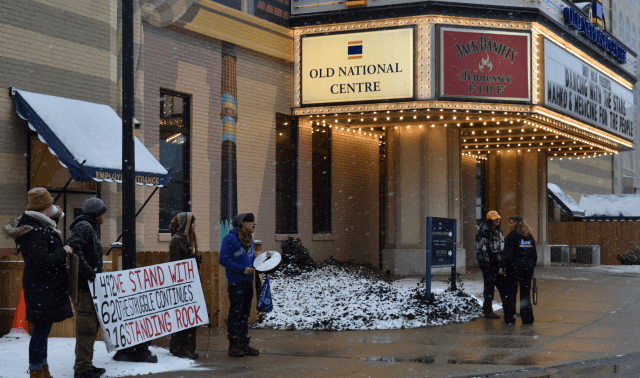
I was really glad we gathered (even though it was a really cold, snowy day) at the theater where Nahko and Medicine for the People was going to perform. None of us knew about Nahko, but had heard he and his band were supporting the water protectors. As we shivered outside the theater, members of the band went past us, and gave each of us a huge smile and fist bump.
Indianapolis #NoDAPL gathereing. Nahko and Medicine for the People on the marquee.
When I began to find videos of Nahko on YouTube, I became a huge fan. It was through his words and music I have learned the so much about the indigenous approach to Mother Earth and life.
As soon as he could get to Standing Rock after the dog attacks mentioned above, he put on a concert for the youth who had been attacked. Not only were his songs powerful, but what he said to the kids between the songs was, too. He says the resounding message he hears during his travels is:
“Remember that nonviolent direct action is the way to a successful revolution. And that is a hard one, because they are so bad (chuckles). When they come at us you just want to hit ’em, you know? Just sit with that. I know it’s tough. They’re going to try to do everything they can to instigate you. But remember what we’re here for. We’re here to create peace for our Mother. We’re not here to create more violence.” When you’re feeling bad, when you’re feeling frustrated, put all your prayer into your palms, put them to the ground, put them back to the sky, honor the Father, the Mother, just know it will be alright.
Are you guys feeling proud, are you proud of yourselves? Because the whole world is watching. The whole world is watching. So whatcha gonna do? Gonna show love? Are you gonna be smart? You gonna think before you act? Take care of each other? You’re gonna show ‘em what family does. They don’t know what that’s like.
You gotta put down the weight, gotta get out of your way.
Get out of your way and just look around the corner at your real self and look at all the potential that this beautiful Earth and love has to offer you.
It’s crazy being out in front of you guys. I had a moment there. I was like, I like started spacing out and I’m like oh god they’re looking at me aren’t they? I was thinking about how much happened before any of us were here. You know? There is a lot of history here. We gotta hold that when we’re standing out there. You gotta hold that when you’re on that line out there, too. You’re here for a lot more than just this pipeline.
It’s about rejoicing, it’s about laughter right now. We’ve got a big day ahead of us tomorrow folks. So, I just want to say I’m so grateful and I’m really proud of you guys. I’m really proud of you. (and then he turned away with obvious emotion).”
This deep commitment to nonviolence and how that is exemplified in the culture of indigenous people has affected me deeply. Nonviolence and civil disobedience have been a large part of my life, with draft resistance, the Keystone Pledge of Resistance, and Indiana Moral Mondays, for example. Every person who went to the camp at Standing Rock was required to be trained in nonviolent direct action. Nahko’s Love Letters to God is about this.
It was this example that caught the attention and respect of so many in our country and around the world. I believe this is our only real hope of addressing our environmental crises. In my experience, Native Americans welcome others to join with them in this struggle. But it is important that we listen to them, and follow their leadership.
The way I see it, industrial societies got off track, and have done tremendous damage to our physical and spiritual worlds. Native Americans did not, and they are who can teach us how to get back on track.
Below is the song Nahko played to thank those who have been part of this movement, “Build a Bridge”. It begins with “I have come to build a bridge, so come let’s build” and ends with “I have come to live in peace, so come let’s live.”
I’ll close with this wonderful song Nahko sings in an empty church in Germany. “I resist and I survive.”
“SILENCE = DEATH” was used by the AIDS Coalition to Unleash Power(ACT UP), a group committed to the use of direct action to end the AIDS crisis, which is still active 30 years later. From the website: “For meeting the challenge of the AIDS epidemic and its crisis of conscience with vigilant acts of political and cultural provocation – thereby giving voice to the essential creative will of our humanity.”
“SILENCE = DEATH” today relates to our environmental disaster and its crisis of conscience. We are rapidly heading toward the death of Mother Earth.
Why aren’t more of us speaking out against the disastrous practices that are literally killing our planet?
Why aren’t more of us denouncing the dismantling of the Environmental Protection Agency and regulations that protect our environment?
Why aren’t more of us calling out the abuse of power that allows ideology to trump science?
Why haven’t more of us supported water protectors?
Why aren’t more of us blocking pipelines and any further fossil fuel infrastructure?
Why don’t we increase our energy conservation and recycling efforts?
Why are some of us still traveling by air?
Why?
Be still and listen to your heart. Heed the Spirit. Have courage to do what you know is right. After being still, raise your voice.
I’ve recently shared my journal entries from the trip to Washington, DC, and New York Citythat our Scattergood Friends School Senior class took in 1970.
Looking back forty seven years later, I realize a number of significant things that I didn’t have the perspective to appreciate at the time. One of the first is how remarkable it was that the School could provide such an experience, knowing that financial resources have always been a significant challenge.
For transportation, one of my best friends and Scattergood classmate Ron Ellyson and his mother, Trudy, wrote a story about Howard Hampton’s bus line, including that his buses provided transportation for the Scattergood Senior trips.
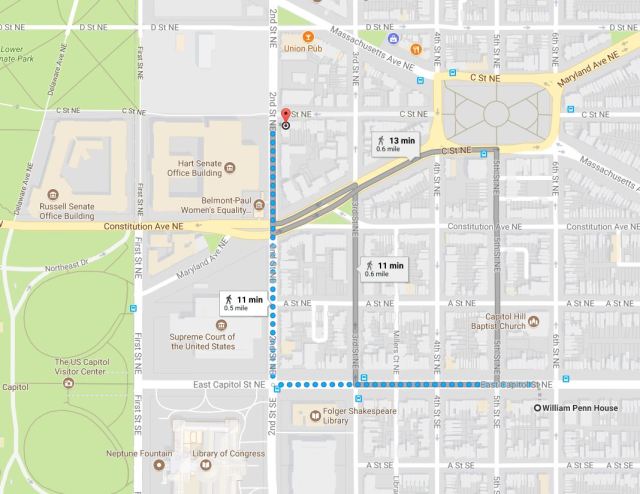
The mission of William Penn House in Washington, DC, where we stayed, is to provide radical hospitality, a very inexpensive place for Quakers and others to stay while they do their work there, most commonly related to the Federal government, and as a result, most often with the Friends Committee on National Legislation (FCNL). William Penn House has made it possible for many Friends who probably could not have afforded to do so, the opportunity to witness in Washington, and is conveniently located just 5 blocks from the U.S. Capitol, which helps with transportation needs, too. There is meeting for worship every morning, and breakfast. A number of Iowa Yearly Meeting (Conservative) Friends, including my parents and I, have served on William Penn House’s National Consultative Committee. Recently William Penn House has become very involved in numerous community garden projects in Washington among many other things.
SONY DSC
SONY DSC
SONY DSC
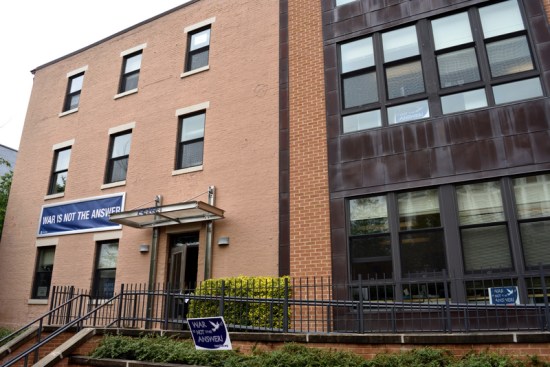
William Penn House, FCNL (Marker at 2nd and C St), US Capitol, Supreme Court
FCNL
The visits to the House and Senate in session, and meeting with our Congressional Representatives, made us aware that we had a real connection to, and responsibility for our personal involvement in our government. Many years later I was again in the offices of Congressional Representatives and Senators, lobbying with Friends and FCNL staff.
FCNL lobbying
FCNL lobbying
Although FCNL didn’t play a large role in our Senior trip, we did visit the FCNL offices, and made that connection. Again, many Iowa Yearly Meeting (Conservative) Friends have had numerous, intimate ties with FCNL from its inception. My parents served on many committees, and I was on the General Committee for 7 years.
In New York City we stayed at the YMCA. I do remember how stark the rooms were, but they served the purpose. I also remember how friendly I found the city, and quickly got over my initial fears, coming from a rural Iowa background.
YMCA to Greenwich Village
YMCA to Union Station
YMCA to UN Building
Again, actually seeing the United Nations building, and the Security Council in session, made these things we had studied about at Scattergood, real.
Recently Aaron Woolfson wrote the following on Facebook, that is a good account of how important our Scattergood education has been for us.
“SCATTERGOOD is no doubt one of the most important parts of our lives – and shaped, in large part, who we are today – and what we have become. It is no accident that emotional empathy, and logical deduction and analysis, was as much of a part of the every day experience at Scattergood as were the academic challenges which required its’ use. So Scattergood is a victim of its’ success, having created thousands of highly emotionally evolved and empathetic people who can literally succeed at ANYTHING they want. And because of the success of Scattergood in our lives, we tend to be more self-sufficient and nimble. BECAUSE OF THIS, we tend to forget how much Scattergood contributed to who we are today.” Aaron Woolfson, Scattergood alumnus
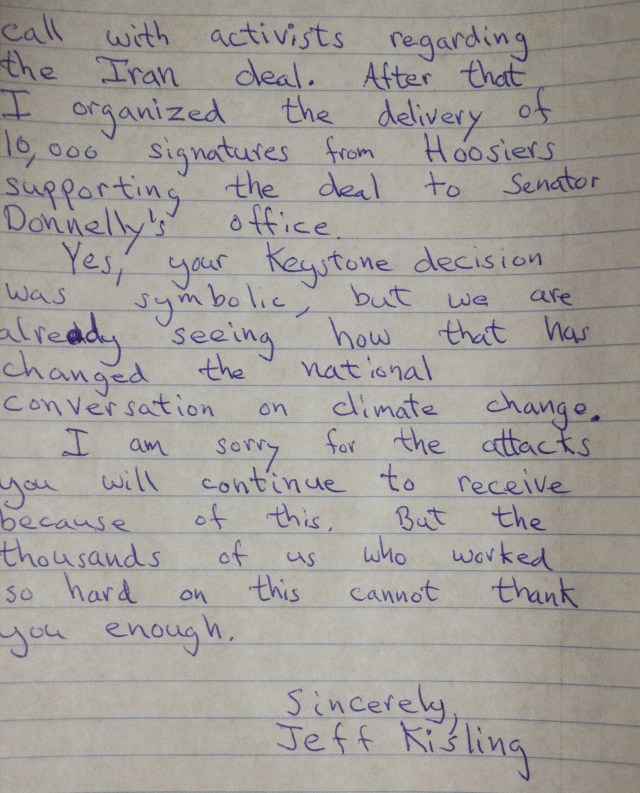
I am in deep mourning today at the news of yet another oil spill. This one from the Keystone pipeline network that I’ve invested so much time and energy and prayer resisting.
I am at a loss. I have faith, but man can, and does, ignore the will of God. The consequence of that for Mother Earth is we have caused so much damage that our environment will become increasingly unlivable and humans will become extinct in a very short time.
We will need to love and care for each other, and listen to the Spirit, as we live through these perilous times.
The water protectors at Standing Rock, and all who support them, show us how to do this. Prayer, honoring Mother Earth, and nonviolent civil disobedience.
Then we began the trip to New York City. We arrived at about 5:30 and it was dark.
At 8:00 pm we went to the Rainbow Room atop Rockefeller Center (65th floor). We had a fantastic view of the city! Hank Newenhouse was entertaining us there for dinner. First we had shrimp and crab, then broth, then a huge piece of extremely high quality beef, followed by Baked Alaska, covered with flaming alcohol.
Then we went to Greenwich Village. Finally back at the Grand Central YMCA at 12:30. Ron Ellyson and I were rooming together there.
January 29, 1970
Next morning, Thursday, January 29, we had meeting for worship at Quaker House at 9:00. Then we heard about the Quaker U.N. program and got some background information about Latin America. We walked to and had a tour of the United Nations building. After lunch Juan Pascoe spoke to us about the UN Development Program.
At 3:30 we were very fortunate to get to see a meeting of the Security Council, which actually didn’t begin until 5:00, when were supposed to visit the Museum of Modern Art. But Ron and I stayed until 7:10 at the UN. The Council was talking about Namibia (S.W. Africa). We heard the Russian ambassador charge the U.S. and NATO of supplying arms and equipment to Namibia.
After a quick bite at the Y, Ron and I started walking to Greenwich Village, about 32 blocks away. There we saw the plays “Adaptation” and “Next”. Then the two of us walked back to the Y.
January 30, 1970
Today after meeting for worship at the Y we spoke with Mr. Álvaro de Soto, 3rd Secretary of the Peru Mission to the UN. His main point was that the Latin American countries have to develop their trade in such a way as to develop their own economy instead of exporting and therefore always being economically and politically dependent.
Then we spoke with Mr. Eduardo Schjimm, Press Attaché of the Mission of Chile. I enjoyed and agreed with his main proposition, that experiencing social conditions is the only way to understand them. He also said establishments were too short-sighted.
Then Mr. James Knight told us about the International Labor Organization (ILO). One of the things ILO does is to encourage governments to use men instead of machines whenever possible.
Then Richard Garza presented a “revolutionary” view of the development of Latin America. He said that the U.S. didn’t want to develop, or let Latin American develop itself, as this would endanger its economy, which is the U.S.’s primary interest.
We had an evaluation in the evening. Then Ron and I spent most of the evening walking through New York City as last night. We talked to an elevator operator and doorkeeper at the Newsweek building. A nice guy. Temperature down to 20 degrees.
January 31, 1970
First we visited the ocean liner, New Amsterdam. It was disgusting to see such lavish luxury. Then we went on the Staten Island Ferry. Then through Chinatown and Harlem to Phoenix House, where we spent three hours, mainly with James Cromwell, who started the Phoenix House concept and is in charge of education. Former drug addicts live with and help people who have just quit drugs, not only to stay off drugs, but to discover why the person resorted to drugs in the first place. Everyone is given a crew-promoted when attitude has changed. Everyone was extremely friendly and interested in us. This program of really getting to know people and help them discover the root of their problems can be applied to anyone with any problem, not just drug addiction.
This evening we visited an Ashram, in which there was chanting (I don’t believe in), silent meditation, and teaching that one must search oneself, not rely on the external.
One of the high points of the trip occurred yesterday afternoon. We visit the United Nations Meditation Room–A Room of Quiet. Dag Hammarskjöld wrote the following text to be distributed to the visitors of the room:
“We all have within us a center of stillness surrounded by silence. This house, dedicated to work and debate in the service of peace, should have one room dedicated to silence in the outward sense and stillness in the inner sense. It has been the aim to create in this small room a place where the doors may be open to the infinite lands of thought and prayer. People of many faiths will meet here, and for that reason none of the symbols to which we are accustomed in our meditation could be used. However, there are simple things which speak to us all with the same language. We have sought for such things and we believe that we have found them in the shaft of light striking the shimmering surface of solid rock. So, in the middle of the room we see a symbol of how, daily, the light of the skies gives life to the earth on which we stand, a symbol to many of us of how the light of the spirit gives life to matter. But the stone in the middle of the room has more to tell us. We may see it as an altar, empty not because there is no God, not because it is an altar to an unknown god, but because it is dedicated to the God whom man worships under many names and in many forms. The stone in the middle of the room reminds us also of the firm and permanent in a world of movement and change. The block of iron ore has the weight and solidity of the everlasting. It is a reminder of that cornerstone of endurance and faith on which all human endeavour must be based. The material of the stone leads our thoughts to the necessity for choice between destruction and construction, between war and peace. Of iron man has forged his swords, of iron he has also made his ploughshares. Of iron he has constructed tanks, but of iron he has likewise built homes for man. The block of iron ore is part of the wealth we have inherited on this earth of ours. How are we to use it? The shaft of light strikes the stone in a room of utter simplicity. There are no other symbols, there is nothing to distract our attention or to break in on the stillness within ourselves. When our eyes travel from these symbols to the front wall, they meet a simple pattern opening up the room to the harmony, freedom and balance of space. There is an ancient saying that the sense of a vessel is not in its shell but in the void. So it is with this room. It is for those who come here to fill the void with what they find in their center of stillness.”
As I said, my visit to this room was the high point of the trip. I had become very interested in the United Nations and in Dag Hammarskjöld. I bought several books in New York City, one on human rights, world economy, Che Guevara, a spiritual portrait of Dag Hammarskjöld, and a copy of his book Markings.
One special dedication to the Meditation Room is to Dag Hammarskjöld:
“The moment I entered the room I was awed not only by the structure-the shaft of light, the iron block and the painting, but also by a strong spirit I felt in the room. It seemed that all the forces dedicated to peace and humanity had gathered in this one place to meditate and rest. And I was greatly inspired to try to continue my efforts, little as they often seem, toward peace and human rights.”
This evening, just now, 9:45, I walked into the New York Grand Central Station. As I reached for the handle, another man (a black man) did also. I stepped back to let him in, but he said, “excuse me, you go on ahead.” I went in and he repeated, “excuse me” and I nodded, but he said again, “excuse me”. I stopped to see what he wanted. He said, “excuse me, first for startling you, you were meditating”. I nodded, then he asked a question and when I replied I didn’t know the answer, he said “thank you”, and left. I was very impressed with his courtesy and more with his comment about my meditating. I hadn’t myself realized that that was what I was doing. This was a beautiful experience with which to end my visit to New York City.
(note: photos were taken in later years during trips to FCNL Annual Meetings and meetings of the American Thoracic Society)
Journal, January 25, 1970
Saturday, January 24, we left Scattergood, about 3:30 pm. We arrived in Washington, DC, at about 10:00 am. After seeing the Washington Cathedral, we attended the Florida Ave. Friends Meeting. After lunch we arrived at William Penn House, meeting Bob and Sally Cory.
Then we went sightseeing–as we went through downtown Washington to get to William Penn House we saw so many things at once it was hard to absorb it all. First we caught a glimpse of the Washington Monument, then the Executive Office Building and the White House, then down Pennsylvania Avenue to the Capitol and William Penn House.
Washington Monument
Executive Office Building
White House
White House
Washington Monument and WWII Memorial
William Penn House
U.S. Capitol
After unloading, we went to the Smithsonian Institute, the Washington Monument, Lincoln Memorial. The Jefferson Memorial was being repaired, the Library of Congress, then we ate at the National Gallery, listened to a concert, saw the National Archives, and went to bed.
Lincoln Memorial
Abraham Lincoln
National Archives
Jefferson Memorial
Washington Monument and Jefferson Memorial
Thomas Jefferson
Library of Congress
Library of Congress
January 26, 1970
The next morning began with meeting for worship at 7:45 and breakfast at 8:00. We went to hear the Supreme Court decisions at 10:00 and decided on our special projects.
U.S. Supreme Court
U.S. Supreme Court
U.S. Supreme Court
U.S. Supreme Court
U.S. Supreme Court
I was chairman of the draft group–Bruce, Paul, Aline, Steve Maxwell, J’lee. Bruce, Wayne and I went to the FCNL office and got the address of the National Council to Repeal the Draft (NCRD). At 1:30 we went to the Population Reference Bureau where we saw a film and talked with Alvaro Garcia-Pena.
FCNL Washington, DC
Then we got some literature and talked to William Payne at the U.S. Civil Rights Commission. There we had a good discussion about the whole U.S. government. We went back to William Penn House in order to talk with Ed Anderson, lobbyist for FCNL. He was graduation speaker at Scattergood last year. We had a very interesting talk with him. His conception of the youth activities are that the young people become involved in an activity until it becomes dangerous, and then they move on to something else, e.g. when some kids were killed during the civil rights campaign, interest began to wane and the kids turned to Vietnam. Now that there are some arrest, they are turning to pollution. An interesting idea. But, he said, Quaker kids stuck with it, citing the AQAG reading of the names of the Vietnam war dead on the Capitol steps and, though some were arrested, more came until the list was finished. The law was also changed. Pat Deluhery, one of Senator Hughes’ aides, had dinner and spent the evening with us. We learned about Senator Hughes’ amendment to the drug bill, trying to lower penalties for individual drug users which, I found today, was defeated, though the penalty was lowered for individuals, but increased for those marketing marijuana.
Tuesday, January 27
Began with worship (7:45) and breakfast. We then had the entire day to visit our own Congressmen, Congress in session, and work on our projects. I talked with Representative John Kyl, 4th district (Marshall) from 8:30-9:00 and was interested and impressed. We spoke a lot about his job. Then Bruce and I went to the NCRD where we got a lot of really good literature and talked to one of the girls in charge, who is also in charge of the draft part of the Moratorium. Then we saw the Senate and then the House in session. There weren’t many people in the Senate, but I guess there some roll call votes in the afternoon in which almost everyone showed up. After lunch our group met and all decided to talk to Congressmen about the draft and hearings, while I went to some offices downtown.
Somewhat after 1:00 I started down Constitution, then Pennsylvania Avenue. First I visited the National Service Board for Religious Objectors (NSBRO). This organization deals mainly with 1-0 and 1-A-0, not resistance. I guess they have good relations with the Selective Service System and exchange information with each other. I guess the NSBRO has a fairly successful program of helping people in the armed forced. Then I went past the White House and soon arrived at the National Headquarters of the Selective Service System. I got a lot of current information on the lottery, as well on as on SSS in general there.
Then I tried to find the Vietnam Moratorium Committee. The address was 1029 Vermont St, I believed between 10th and 11th Streets on Vermont. I found I was wrong, which caused me a detour of over 40 blocks through a poor Black section of the city–one of the most important parts of the trip. I did finally find the Moratorium offices and talked to the press secretary, Ted Johnson. He gave me some good information about the plans for the Moratorium for this winter and spring. I was looking mainly for literature, which we could later use at Scattergood to help plan our activities. I was in the White House area now, and walked back to William Penn House, in all around a 100 block walk. We had dinner together at the Sampan, a Chinese restaurant that night, followed by project reports and discussion of the trip. Here, as at the Civil Rights Commission, we had a very good discussion of our government–very critical, too. My whole attitude about government has change a little, but I should talk about that later.
Wednesday, January 28
The next day, after worship and breakfast, we packed up and left William Penn House.
Our first stop was at the State Department where we talked to Paul Russell about the Agency for International Development (AID) and the Food for Peace Program, especially in his area of Korea. All of these people said a lot of interesting things, but I’m far behind on events, so maybe something about what these people said could be mentioned later. We visited the White House which was pretty much a disappointment.
Then we visited Arlington National Cemetery, which was a very interesting, moving experience. Watching the guard at the Unknown Soldier was rather frightening–a human robot.
Nonviolence is not simply a political strategy, but meant to be how you live each moment of your life. When Rabbi Michael Lerner spoke about the moral integrity of Mohammad Ali and his draft resistance, he was speaking of the moral integrity of the practice of nonviolence, too.
I’ve continued to think about Richard Wagamese’s idea “all we are is story”. “We are story. All of us. What comes to matter then is the creation of the best possible story we can while we’re here; you, me, us, together. When we can do that and we take the time to share those stories with each other, we get bigger inside, we see each other, we recognize our kinship — we change the world one story at a time.” This leads me to think of nonviolence in a little different way, as a way to share our stories with each other, including those who oppose us, as a way to change the world one story at a time. Nonviolence is the antithesis of the idea of winning by force and disregarding those who are defeated.
The fundamental principle of nonviolence is to listen for the truth, or story, of everyone engaged in the struggle, of all viewpoints, so that we all can find a way to move closer to justice together. I think Martin Luther King, Jr, captured this idea when he said “The arc of the moral universe is long, but it bends toward justice.”
The other fundamental principles are that you will always exhibit nonviolent behavior even when being provoked. And that you are willing to accept the consequences of your actions, including being arrested if necessary. The willingness to suffer, either verbal or physical abuse, or financial, legal or other consequences, is part of ones commitment to nonviolence. Being an example is the point. Living such that your actions are consistent with your words demonstrates how seriously you take the issue.
After the draft resistance story was finished, I didn’t become engaged with another nonviolence campaign until many years later. The Keystone Pledge of Resistance was launched in 2013, to use the threat of nationwide civil disobedience direct actions to attempt to persuade President Obama to deny the Keystone pipeline permit. Then last year I was very involved with events related to water protectors and the Dakota Access pipeline in Indianapolis, both of which are described in some detail here: https://kislingjeff.wordpress.com/2017/10/12/building-an-environmental-action-movement/
Planning and training are required for a successful direct action. I was fortunate to be trained by Todd Zimmer and Gabe from the Rainforest Action Network (RAN) in Des Moines the summer of 2013, as part of the national Keystone Pledge of Resistance. RAN went to 25 cities in the U.S. that summer to train local leaders to (1) plan the direct action in their city and (2) teach them how to train others in their area. That resulted in about 400 Action Leaders being trained, who in turn trained nearly 4,000 local activists. If the action was triggered, nonviolent direct actions would unfold in at least 25 cities in the country simultaneously.
Anyone who wanted to participate in the Keystone Resistance was required to sign a statement saying they would abide by the following nonviolence guidelines:
Non-Violence Guidelines and Principles 1. With the recognition that history is on our side in the fight against the fossil fuel industry, that we are a part of the proud and successful tradition of nonviolent civil disobedience, and that our actions also reflect on tens of thousands of others standing together across the country, we will conduct our behavior in only the most peaceful and dignified manner. 2. We are each firmly committed to the safety of all participants and the surrounding community, and will not bring with us any weapons, drugs or alcohol, or participate in any acts of vandalism or destruction of property. 3. We will work to protect everyone around us from insult or attack, including those who may oppose or disagree with us. 4. We will remember that irresponsible actions could endanger others, or lead to the arrest of people who do not want to go to jail, and will not use threatening language or threatening motions toward anyone. 5. We will act and communicate in a manner of openness, friendliness and respect toward everyone we encounter, including police officers and members of the community at large. 6. As members of this action, we will follow the directions of the designated organizers. 7. If an individual has a serious disagreement with the organizers of the action, the individual will withdraw from the action. 8. If an individual does not respect these guidelines and principles, that individual can not participate in an action as part of the Pledge of Resistance to the Keystone XL pipeline
The training involved a Saturday of being taught how to organize direct actions, and how to train others. The next day, the students became the teachers. We practiced providing the same training we would be doing when we returned home. The participants training guide can be found here: https://1drv.ms/w/s!Avb9bFhezZpPhPZwoFHONmVV69trwA
Training involved acquiring a thorough knowledge of the issues involved. This is important for when you will engage the public and the media about what you are trying to accomplish. The principles of nonviolence are discussed. Participants engage in role playing exercises that are used to learn how to remain nonviolent in the face of abuse, and techniques to de-escalate such situations.
Civil disobedience training
A lot of time is spent on the various legal issues that might be involved, including possible charges and what to expect and how to act if you are taken to jail. People are taught things like not bringing much with the other than identification and perhaps money for bail, to write the phone number to call in ink on their body, etc. Although it might be a little dated, this is the video we used to cover much of that: https://1drv.ms/f/s!Avb9bFhezZpPiNVbbulOBg9xvKIogQ
The Action Leaders were also taught how to identify the target for their action, and to deliver a letter of intent to the target ahead of time, so personnel there know what you plan to do.
We were taught how to build and maintain our local group of activists.
Finally the various roles, such as media support, volunteer lawyer, police liaison, jail support, and volunteer support are explained.
In Indianapolis we had four Action Leaders who had been trained, and we held six training sessions, training about 50 people. Our target was the Federal Building in downtown Indianapolis. We were going to block the doors if our action was triggered. This photo shows us there the day we delivered our letter of intent, which was politely received by security officers in the building.
We would often gather with our local group for demonstrations downtown to raise awareness about tar sands and the pipeline and climate change.
President Obama decided not to approve the pipeline, so we didn’t have to trigger the action.










 Quakers, social justice and revolution