Subjects of writing

I recently attempted to explain why I write so much. That I attempt to express what I feel the Spirit is leading me to say, and how difficult that can be. Often that means trying to describe and/or reflect upon recent experiences. In a way those are sort of a one-off expression, since the experiences are usually things I was led to do. As I said, I usually begin the day by asking “what are we going to do today?”, which often includes actually performing an act, not just writing.

Experiential is an adjective commonly used to describe Quakerism because that is such a fundamental concept of what it means to be a Quaker. Friends believe everyone is able to communicate with God, and has the responsibility to try to do what the Spirit is telling them to do now. Which means they experience communion with the Spirit, which also usually leads to the experience of putting their faith into practice.

I think it is important to try to describe these experiences we are led to for several reasons. One is that I think many of us have occasions when we hear of an upcoming opportunity and briefly think that sounds interesting or like something we should do, but often dismiss it. In my experience, these are the very things we should actually do, and are significant missed opportunities if we don’t. I hope when we share our experiences with each other, we might all learn how to be more aware of such possibilities.

Before I give some examples of my own experiences, I think it is important to distinguish between things we are reluctant to do because of the expectations of others, as opposed to something our inner Spirit is urging us to do.  In the past I would occasionally do something just because of pressure from others.  Not only were those unfulfilling, but my efforts were ineffective.

Similarly, I have come to be highly critical of committee meetings. If the meetings have a specific purpose that is tied to planning or reviewing some actual action, that is one thing. But far too often I have the impression many people feel committee work is all they need to do. (Expressing that frequently gets me in trouble.)

Certain decisions may require years of prayer. My grandmother, Lorene Standing, said the will of God is often revealed in a series of small steps. That describes my winding path of reaching the decision to become a draft resister.

One of my own most significant experiences was being led to live without a car. When I first moved to Indianapolis in 1971, one thing I experienced was the dense smog, since this was before catalytic converters came into use (1975).  This also being before car rental was widely available, I did buy a used car for trips home to Iowa, but became increasingly uneasy about that, the more I learned about the damage from burning fossil fuels. About 5 years later the car was involved in an accident. Faced with expensive repairs, and my growing environmental concerns, I wondered if I could live without a car. I didn’t know anyone who didn’t, but I was aware of the city bus system. I felt the Spirit was saying to give up cars. I remember being really nervous about the idea, but knew I could always buy a car if things didn’t work out. It took a while to learn. I had to be very careful about the volume and weight of what I bought at the grocery store. There were times I arrived at work soaking wet from riding the bicycle in the rain. When I started, this was before bicycle helmets and bike lanes. I was so scared riding through traffic that I wore a motorcycle helmet!

But as often happens when following a leading, there were several important, unforeseen consequences of the decision to live without a car. One was feeling I was significantly reducing my contributions to the evolving environmental damage. And as I became more involved in public discussions about our environment, I had an answer when someone would ask (usually the first thing they would ask) “well don’t you drive a car?”

The decision also had a major impact on my health. Because I wore scrubs at the hospital, I could ride my bike or a bus to work, then run home. When I began this I lived 7 miles from the hospital. Each time I moved, besides making sure I was on a bus line and near a grocery store, I moved a little closer to the hospital. One of the great experiences this made possible was running in the Indianapolis 500 Mini Marathon each year for 22 years.

Another result of the decision to live without a car was, when I eventually lived close enough to the hospital to walk to work, the amount of time I spent outside each day. Besides the time to think and pray, I realized the opportunities I had to take pictures. I began to take my camera to work every day. My photography improved dramatically as I had so many occasions to stop and closely observe flowers and scenes during the walks to and from the hospital.

That one decision, which I was scared to make at the time, to not have a car, profoundly affected the rest of my life in so many ways. It would have been so easy to say “everyone else drives”, etc., and to have missed all that followed.

That’s why I urge all of us to really pay attention and listen to that “still small voice within”. Whenever you feel that slight little tug, whenever you think “…., but”, that is the time to really consider refuting the “but”.  “But” is a red flag.

There are so many other things I was led to do that had similar significant impacts on my life. But this is long enough for now. I do hope you might consider sharing some of your experiences. Sharing our stories is how we all learn from each other.


Posted in Arts, bicycles, climate change, Ethical Transportation, Uncategorized | Tagged , , | Leave a comment

Our own seeds of destruction

Historically Quakers have spoken out against war and knew the causes of war came from the desire to take land or resources from other countries or peoples.

“I told [the Commonwealth Commissioners] I lived in the virtue of that life and power that took away the occasion of all wars… I told them I was come into the covenant of peace which was before wars and strife were.” George Fox

“Oh! that we who declare against wars, and acknowledge our trust to be in God only, may walk in the light, and therein examine our foundation and motives in holding great estates! May we look upon our treasures, and the furniture of our houses, and the garments in which we array ourselves, and try whether the seeds of war have nourishment in these our possessions, or not. Holding treasures in the self-pleasing spirit is a strong plant, the fruit whereof ripens fast.” John Woolman

Today war is waged on a global scale against Mother Earth herself.  Only death can result when the resources our environment depends upon (land, water, air, energy) are excessively consumed, and polluted in the process.

Today we must speak out against this environmental war and find a way to live in the virtue of that life and power to take away the occasion of this ongoing environmental destruction.

May we look upon our treasures, the cars we drive, the large homes we heat and cool, the electronic devices we use and try whether the seeds of war against our environment have nourishment in these our possessions, or not.

We must speak into the stunning silence about our environmental catastrophe now.

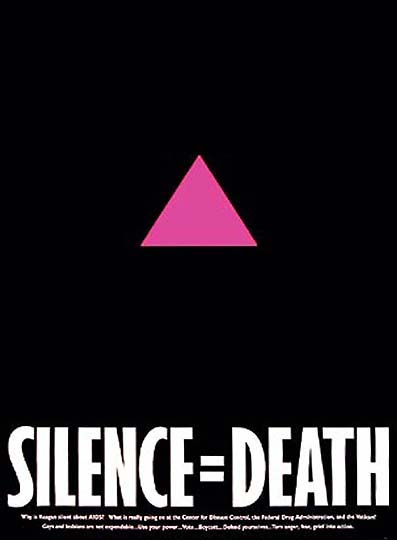
We need a campaign today that parallels the SILENCE = DEATH Project in the 1980’s about the oppression of gay people and refusal to address the AIDS epidemic. The project protested both taboos around discussion of safer sex, just as there are now taboos around discussion of the environmental crisis, and the indifference of people and government agencies to deal with the present and coming disasters.  ACT UP

Silence=Death_lg

Posted in climate change, Uncategorized | Tagged , | Leave a comment

Why do I write so much?

I used to irritate people by sending far too many email messages about things I was concerned about.  Three years ago I started writing on this blog which is better because people choose whether they want to come here to read something or not. (Aside from those who sign up to follow the blog, which means they get an email message of each blog post.) The other thing I like about using a blog is being able to share photographs, since photography is my main recreation and I’ve developed (pun) into a photojournalist, trying to capture stories in pictures, especially of social justice actions.

I still get in trouble for sharing too many of these blog posts with various Facebook groups, and am trying to reduce that.

The reason I share so much is because I try to put the spiritual leadings I receive into words, which is a daunting task. We don’t have the vocabulary to translate spiritual messages. I think of this as similar to the expression that a photograph is worth a thousand words. What that means is a photograph is a different medium of expression. That is the main reason I love photography, because some photographs are a better expression of my spirituality.

Difficult and inaccurate as it is to write and talk about spiritual things, I think it is important to try, because this is one of the main ways humans communicate with each other. Just as Eskimos have many words to describe snow, I hope the more we try to express the Spirit, the better we might become at doing so.  We might create better words and terms. So far, as they say, not so much.

What attempting to write about what the Inner Light (one term Quakers use to refer to spiritual messages) has done is improve how often and, I think well, I hear “that still small voice”–another spiritual phrase. I know I don’t receive more messages than anyone else, but it takes practice and attention to hear these messages, especially perhaps in our increasingly busy and noisy culture.

The other part of this is people know it is not what you say, but what you do that matters.  Many therefore just don’t try to put these things into words, concentrating on living lives that exemplify what they believe, instead. This is a fundamental concept in Quakerism (and I imagine every other religion).

I found (Quaker) Callie Marsh’s discussion of implicit education in her book about the yearly meeting we both belong to,  A Lively Faith, Reflections on Iowa Yearly Meeting of Friends (Conservative), helpful. Quaker children primarily learn about Quaker beliefs by observing how Friends (another name for Quakers) live their daily lives, as well as what they say to each other. She also talked about the dangers of primarily relying on implicit education, that being that newcomers don’t have the benefit of years of implicit education, and that we need to be more explicit then.

That is the reason I feel led to write so much, to try to be more explicit about our spirituality. Led is the key word here. The spiritual messages I have received over the years indicate that I need to try to express my spiritual messages in words and photographs as best I can. I was especially hesitant to do this at first, because another of the main principles of Quakerism warns about calling too much attention to ourselves. That was one of the largest barriers for me when I first began to write, and something I continue to be aware of.

The influence of, and participation in organized religions has diminished significantly in recent times in our culture. It is my sense that means there are huge numbers of people looking for alternatives for their spiritual needs.  I believe that is one of the main reason I, and many others, are being led to try to express spirituality in places outside organized religion.  Blogs and various social media platforms are where many look for such answers.

As I learned to listen more often and more closely to the Inner Light, I became aware that each morning I awoke asking the Spirit, “what are we going to do today?” Often one of those things was to write yet another blog post. That is why I write so much.

(Quaker) Noah Baker Merrill expresses these things better than I have in a lecture he gave called Prophets, Midwives and Thieves: Reclaiming the Ministry of the Whole:

“In a world experiencing unprecedented climatic, ecological, and societal change, many in the Religious Society of Friends are coming to know our own need for newness. We thirst to find and share a clearer sense of the relevance of our beloved tradition to the challenges we face. We yearn to come more fully alive together, to speak and serve today in the Life and Power that generations of our spiritual ancestors knew. Across North America and beyond, Friends are recognizing a shared calling to rediscover and reclaim traditional understandings of who we are and how we are as Friends that will help us continue to travel this Way of Love.

Prophets

We must first encounter the eternal Truth that is unchanging and ever-present. This Truth is far beyond our own limited perspective. It’s impossible to articulate fully, and so we’re left with the hope of being able to know it only incompletely. Even that incomplete knowledge can be enough to guide our lives when we’re willing to pay attention.
Once we’ve touched it, our work is to hold up our present circumstance to this Truth, and to ask how this Truth could be put into practice in the present situation.
We live in a 21st century at the threshold of transformations unknown in human history until now. So what does Love require of us, today? What does Love desire for us, today? Helping re-articulate the eternal Truth we encounter in worship in light of the present situation—by word and action—is the work of prophets.
Finally, the work of prophets is to make spirit available. This has to do with inspiration, with helping people to be freed from all that keeps us from fully living. Often we do this more with the shape of our lives than with the values we articulate—since the clearest messages we send are the messages we live. Working prophetically means helping people find reasons for hope in places where hope seems absent, nursing trust that even in the dead and dying moments in our lives, precious newness might be waiting.
It’s not enough for us to preach that the world is broken. Too often, what we call ‘prophetic witness’ goes this far and no further. The real work of prophets criticizes and then inspires us to participate in the way all things are made new.”


Posted in climate change, Quaker Meetings, Uncategorized | Tagged | Leave a comment

“We were all humans until…”

“We were all humans until race disconnected us, religion separated us, and wealth classified us.” Pravinee Hurbungs

My friends Diop Adisa and Ra Wyse from the Kheprw Institute (KI) in Indianapolis let me know about the short film “Bluebird” by a friend of theirs, Keiana Whatley.

“In honor of Black History Month, we present “Bluebird” to a nation scarred by racism and injustice. ”  Keiana Whatley

#BlackHistoryMonth


Posted in Black Lives, Uncategorized | Tagged , | Leave a comment

Building Bridges

The reason I wanted to be part of the group who went to Minneapolis last weekend was to make connections with water protectors and environmental activists. Over the last six years in Indianapolis I was blessed to be part of an environmental/social justice network, and wanted to make similar connections now that I’m in Iowa.  In Indianapolis that began with being trained as an Action Leader in the Keystone Pledge of Resistance, and training about 50 people to execute a nonviolent civil disobedience action if there were indications that the Obama administration was going to approve the Keystone XL Pipeline permit.

What was interesting about that was this became the core of activists who came together again and again to participate in other social justice organizations and actions, including helping to launch Indiana Moral Mondays, supporting high school students addressing homelessness, lobbying support for the Iran nuclear deal, pressuring Morgan Stanley, Chase Bank, and PNC Bank to stop funding fossil fuel projects, working with the Kheprw Institute (KI), and engaging with water protectors and the Dakota Access Pipeline resistance.

That reminded me of the Margaret Mead quote, “Never doubt that a small group of thoughtful, committed citizens can change the world; indeed, it’s the only thing that ever has.”  I had thought of that in terms of a specific issue. In Indianapolis, anyway, that was true of multiple areas of concern being worked on by the same small group of people. That is also in line with what I was learning about Native American spirituality and how all things are connected, symbolized by the Medicine Wheel.medicine-wheel

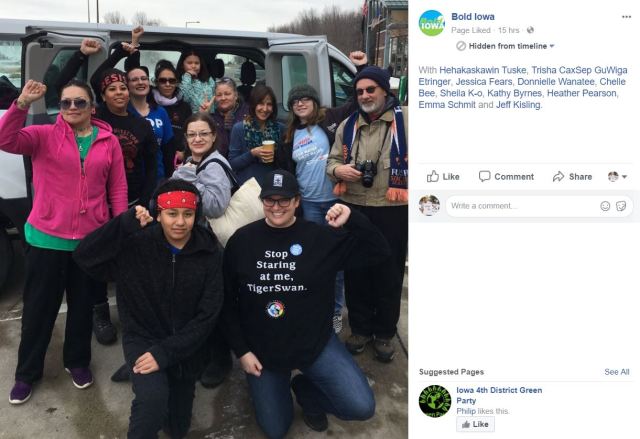
When I learned that Ed Fallon, of Bold Iowa, was organizing a group to travel together to Minneapolis, I was pretty sure this would be a similar group of people, and it was. It would actually be the first time I met Ed, although we had communicated by email a number of times since I arrived in Iowa last summer.

As background about some of the people I was with that weekend, the theme of last year’s annual sessions of Iowa Yearly Meeting (Conservative), i.e. Quakers, was Building Bridges.  The first evening was a panel talking about Building Bridges with Native Americans, consisting of Peter Clay, who had been to Standing Rock, Donnielle Wanatee, from the Meskwaki settlement near Tama, Iowa, and Christine Nobiss, the founder of Indigenous Iowa. During that panel discussion Donnielle invited us to attend their pow wow that fall.  Seeing this as an opportunity to build bridges, Dad and I did attend the pow wow and really enjoyed it. Being aware of cultural appropriation, I contacted the pow wow ahead of time about taking photographs there, and was told it was alright to take photos of the ceremonies, and I was asked to share them with the pow wow, which I did. They are on the pow wow’s Facebook page.


I saw Christine Nobiss again last September when Bold Iowa and Indigenous Iowa delivered a petition to the governor’s office asking for the removal of an Iowa Utilities Board member who had conflicts of interest with the fossil fuel industry.


Also at the Capitol gathering were Patti McKee of Catholic Peace Ministry and Des Moines Valley Friends member, Heather Pearson, and Kathy Byrnes, an Iowa landowner fighting against the Dakota Access pipeline.

Heather, Kathy, and Donnielle and her daughter, were among the 13 of us in the van.  I talked with Donnielle about being present when she spoke at Iowa Yearly Meeting (Conservative), and that Dad and I had attended the pow wow, and about taking photos there. The person I had communicated with about permission to take the photos was a relative of hers. She told me she was on the pow wow planning committee, which was a lot of work.

Donnielle, Kathy and Ed were among the speakers during our action in Minneapolis. Heather lead the chanting. Although Christine did not ride in the van with us, she also spoke.

Also riding with us on the 4 hour trip to Minneapolis was a Native woman and her son who live at Standing Rock. One of the most amazing parts of that trip was to hear them talk about the incident involving the security guards’ dog attack, which Amy Goodman of Democracy Now happened to be present for, and captured on video. I was in the presence of some of my heroes/heroines.

The trip in the van and action in Minneapolis turned out to be an even greater experience than I hoped.

27336441_323175491506121_1555820667218555826_n

Van full of water protectors on the way to Minneapolis

Nahko said the following performance of Build a Bridge was for those who were part of the water protector movement. The song begins with:

I’ve come to build a bridge

So come, let’s build

Build, build, build

I have come to build a bridge

So come, let’s build

Build, build, build


and ends with

Said, my people my earth, my country, my heart

In service for ever, a mission to better

My passion, my fist, my heart, open it

Reclaim, recover, protect clean water

Said, I’ve come to live in peace

So come, let’s live

Live, live, live

Said, I’ve come to live in peace

So come, let’s live

Live, live, live


And at the end of the song he says, “and together we will.”

Posted in #NDAPL, climate change, Indigenous, Quaker Meetings, Uncategorized | Tagged , , | Leave a comment

Public Stories

Yesterday’s post about speaking out against injustice generated some interesting discussion on the unofficial Facebook page of my yearly meeting.  As I said, I tend to agree that protests that just involve carrying signs aren’t useful for a number of reasons.

I agree that any public witness should be grounded in a spiritual calling. I remember the first time I went to a peace vigil.  I was working with (Quaker) Don Laughlin in his medical electronics lab at the University of Iowa Hospitals the summer of 1969, just before my senior year at Scattergood Friends School.  When he invited me to join him at the weekly peace vigil, I was intimidated by the idea of standing in the middle of downtown Iowa City. But I knew of Don’s stance as a draft resister, and that he served time in prison as a result. I knew the depth of his commitment to peace. I was struggling with my own decision about the draft and was facing the time when I was required to register on my 18th birthday that coming November.  So I went, and found the vigil to be like meeting for worship. After that first time, I looked forward to going each week.

Many years later, when I started attending North Meadow Circle of Friends in Indianapolis, I joined the weekly peace vigil with Gilbert Kuhn, from North Meadow, and Debbie. It was usually just the three of us. It became apparent that that small number was actually an advantage, making people feel more comfortable about approaching us. Almost every week someone would stop and either ask what we were doing, or tell us what they thought about the message of one of our signs. It is that engagement, the sharing of our stories, that I believe is the goal. The basic tenant of nonviolence is not to defeat an enemy, but rather this very type of exchange, of really listening to others, and learn from what they say. And it is that openness and attitude that can remove barriers, and provide the space for other people to also listen to you.

I love this quote from Richard Wagamese (October 14, 1955-March 10, 2017), Ojibwe from Wabeseemoong Independent Nations, Canada

ALL THAT WE ARE IS STORY. From the moment we are born to the time we continue on our spirit journey, we are involved in the creation of the story of our time here. It is what we arrive with. It is all we leave behind. We are not the things we accumulate. We are not the things we deem important. We are story. All of us. What comes to matter then is the creation of the best possible story we can while we’re here; you, me, us, together. When we can do that and we take the time to share those stories with each other, we get bigger inside, we see each other, we recognize our kinship — we change the world one story at a time.

Being there consistently is also important. People notice, and realize your commitment. For example, I was walking through the Central Library to get to the vigil one day when a librarian asked me if that was where I was going, saying she saw us each week and appreciated us being there.

Another thing I learned is you can bring your concern for things other than war and peace to this public space. As I got deeply involve in the Keystone Pledge of Resistance, I hesitantly brought a sign related to that to the vigil, not being sure what the others would think about changing the message. We did indeed have discussions about that over the next several weeks, but we all became comfortable with it.  Larry actually made a much larger and clearer sign for me, that I used during the year or so it took for President Obama’s administration to finally decided to reject the pipeline proposal.

The Keystone Pledge of Resistance was the first time I was involved in a nationwide social justice campaign. Because the threats to our environment from burning fossil fuels occur on so many fronts, it was difficult to find a way to try to get people to stop burning fossil fuels.  My own witness of living without a car didn’t seem to be having any real effect (although I was often surprised when people I hadn’t even talked to about that would ask me if I rode my bike to work that day, etc.)

But environmental groups saw the opportunity to have an impact with the Keystone pipeline decision, because it was up to the president alone to decide. This gave us a well defined objective, and a specific target to apply pressure.  So the Rainforest Action Network (RAN), CREDO, and the Other 98% created the Keystone Pledge of Resistance. People were invited to sign the Pledge: “I pledge, if necessary, to join others in my community, and engage in acts of dignified, peaceful civil disobedience that could result in my arrest in order to send the message to President Obama and his administration that they must reject the Keystone XL pipeline.”  On that web page, people’s contact information was gathered so organizers could communicate with them. The page also had a place to indicate if you would be willing to be a local Action Leader, and I did. RAN trained us to create a local action for civil disobedience, and to train people in the art of nonviolent civil disobedience.  Organizers then let President Obama know there would be nation wide acts of civil disobedience by thousands of people if he approved the pipeline permit.

Then after Michael Brown’s killing and the ongoing killings of unarmed people of color, I changed my message again. I was very unsure of how that sign would be received by people of any race, but felt called to do it. It was especially uncomfortable the second time I was carrying it downtown, and I had to walk through a crowd of thousands of people, having forgotten it was the Black Expo weekend. But people either ignored me, or gave positive responses.

One day a car circled the block and then parked in front of us. A Black man got out of the car and came up to me with a serious expression and asked my why I was doing that. I told him I thought it was important for white people to acknowledge they knew black lives mattered. Who else was the message for? He thought about that for a moment, then shook my hand, saying “Alright. That’s a brave thing to do.”  (I’m a little embarrassed to write that, but wanted to show how others see what we try to do.) Also, many times a car of people of color would honk, and people smile and cheer and wave their hands. And many times take photos with their phones.

Also related to Black Lives Matter was this decal Jenny Cisar created, and the sign Kathy Hall brought to Iowa Yearly Meeting (Conservative), shown here with the Peace and Social Concerns Committee.

The Keystone Pledge of Resistance was important for the Dakota Access Pipeline struggle, because there was a pool of trained Action Leaders that could and did (at least in Indianapolis) join the DAPL movement, helping with their organizing skills.

The thing I really love about the DAPL experience was how grounded that was in the Spirit.  It was significant that we referred to ourselves as water protectors, instead of resisters or protestors. We were very fortunate to have a number of Native Americans join our public events, where prayers were said, sage burned, and speakers talked to the group, not necessarily to the public.  One event was related to defunding the banks involved with the pipeline, which in Indianapolis were the Chase and PNC banks. After prayers we went to those two banks in downtown Indianapolis. As the crowd stood in silence outside each bank, those with accounts went in to close them.  $110,000 was withdrawn that day!

I wasn’t ready to close my account that day, since I needed to change direct deposit, etc.  I wrote quite a bit about my experiences when I did close my account.   Basically I returned to the bank after closing my account about a week later and spoke to the same bank officer, who told me she and her husband had talked about our visit.

North Meadow Friends also closed their Chase bank account.

My favorite experience related to DAPL was the final gathering that was for those of us who had worked together that year. We gathered in a large circle on the grounds of the State Capitol building in silent prayer, and a couple of speakers.

Posted in #NDAPL, Black Lives, civil disobedience, Indigenous, peace, Quaker Meetings, race, spiritual seekers, Uncategorized | Leave a comment

The most shameful and tragic problem is silence

Since our trip to Minneapolis last Saturday as water protectors, I’ve been thinking about activism, yet again.  Wondering, again, why so few people come out to the streets with us, though it was heartening to find that around 500 or so did that day. Remembering all the times on the streets of Indianapolis for our weekly peace vigil, where there were usually only three of us, the many times our Keystone Resistance folks were out in all weather, especially the freezing cold, with our Stop the Keystone Pipeline signs.  There we had a core group of about 20.  Just 3 of us showed up to deliver a petition to Morgan Stanley to stop financing coal projects.  I was on my own with a sign about stopping the oil trains.  And alone again on the streets and into the bank to close my Chase account because of their support of the Dakota Access Pipeline (DAPL).  There were other times, though, when more like 100 of us, including Native Americans, gathered to pray and raise awareness about DAPL.  The Women’s Marches this year and last did have good crowds of over 1000.

There are always those who say such actions don’t accomplish anything other than to make those who show up feel a little better.  I tend to agree, if all one does is come out once a year and doesn’t do anything else. Being persistent is important. Being creative and doing different things is, too. Writing letters to the editor, speaking in church, telling stories.

Another part of this came out when I created a Facebook group called Quakers Welcome Spiritual Seekers.  I appreciated some comments by James Funches. “After reading the pinned post and skimming the posts below. I’m left feeling that the stated intent is entirely missed. Or I could be wrong. I get that maybe the posts are showing faith in action but, one could be active in social causes without any spiritual connection. This is an issue I find when I’ve visited Quakers and online as well . I rarely get a glimpse of the Spiritual side just activism. I’m not writing from a negative place just sharing my experience and view from where I’m at.”

I thought about that, but kept posting things about faith and activism. Sometime later he also wrote: “I’m getting some understanding of difference Quakerism vs my background that practice or lived faith plays vs doctrines or theology. I now see a little better how the activism of many Quakers comes out of the spiritual experience . I would say that to an outsider or seeker it can feel intimidating or be misunderstood if one hasn’t read some of the writings of say Woolman , GF , Margaret Fell, etc. who speak specifically to the spiritual condition. I read a bit before I ever approached online or attended a meeting for worship and it’s still been an issue for me. I’m more comfortable with my understanding now than I was months ago but I wonder how many may not make it that far. Between the activism they see which might not be a drive for them and the varying spiritual focus of different Friends from Christian and beyond.”

Then Brian Hall wrote, So are political activities ‘spiritual seeking’?”  My response was “That may depend on how you define political activities. And I think the intention you bring to the activity is key, as I tried to express in today’s post about #NoDAPL and the effect these activities have had on my own spiritual life.”  One of the most meaningful things for me recently was to see and experience the importance of the spirituality of the water protectors.  This is fundamentally important to this kind of work.

I’m thinking a lot more about this now, because the political institutions we had relied on as a way to address social concerns are being corrupted.  I believe that means we are going to have to make more use of public actions to raise our concerns.  The risks of speaking out are also increasing, as those in political power are criminalizing dissent.

Remaining Awake Through a Great Revolution was the title of the commencement address Dr. Rev. Martin Luther King, Jr, delivered at Oberlin College in 1965.

“There are all too many people who, in some great period of social change, fail to achieve the new mental outlooks that the new situation demands. There is nothing more tragic than to sleep through a revolution. There can be no gainsaying of the fact that a great revolution is taking place in our world today.”

Rabbi Joachim Prinz spoke before Martin Luther King did at the March on Washington in 1963:

When I was the rabbi of the Jewish community in Berlin under the Hitler regime, I learned many things. The most important thing that I learned under those most tragic circumstances was that bigotry and hatred are not the most urgent problem. The most urgent, the most disgraceful, the most shameful and the most tragic problem is silence.

 “In the End, we will remember not the words of our enemies, but the silence of our friends.” – Martin Luther King, Jr.

So I encourage all of us to seriously reflect on how our own lives are speaking, or not.

Rev. William Barber says,

“So my prayer is that we will refuse to live below the snake line. We’ve got to make this Reconstruction grow to full term, to full life. We can’t allow a snake to bite this reconstruction and cause it to die, so we’re gonna get it above the snake line. Quakers, it’s time to get back into the public square. If you believe that there’s life above the snake line, it’s time to get back in the public square.

While I’m walking to get above the snake line, it might get hard. I might have to go through some spiked teeth that are trying to poison me. But I’m going above the snake line. I’m going above the snake line, and while I’m making my way, I’m gonna say, “Walk with me, Lord. Walk with me, Lord. Walk with me, Lord. While I’m on this tedious journey, going to be above the snake line, Lord, walk with me.” And if God walks with us, we can do just as they did in the First Reconstruction, and just as they did in the Second Reconstruction, we can be the generation that takes this generation above the snake line. It’s our time. It’s our time.”

Posted in #NDAPL, Black Lives, civil disobedience, Keystone Pledge of Resistance, Quaker Meetings, race, revolution, spiritual seekers, Uncategorized | Tagged | Leave a comment

Super Bowl and Justice

The costs to cities hosting NFL Super Bowl games are a glaring example of the economic and social burdens incurred for the sake of corporations and the wealthy.  These include the new $1.2 billion dollar stadium, huge costs for and presence of massive security, displacement of the homeless, and allowing only Super Bowl ticket holders to ride the light rail system on game day.  The average ticket costed over $5,000.

Numerous social justice groups held events and actions related to these things and police shootings in Minnesota and around the nation during Super Bowl weekend.

I recently wrote about US Bank saying they were going to stop funding fossil fuel projects, but who then extended further credit to Energy Transfer Partners (ETP), the company behind the Dakota Access Pipeline. They justified that by saying that loan was NOT to fund a specific project.

US Bancorp is the parent company of US Bank.  Since US Bancorp’s headquarters are in Minneapolis, and the Super Bowl was going to be held in the US Bank stadium there, environmental and social justice groups realized the opportunities to reach large numbers of people during the Super Bowl weekend.

I traveled to Minneapolis the day before the game with a group organized by Ed Fallon of Bold Iowa.  We left Des Moines at 7:00 am and arrived at the MN350 (Minnesota branch of 350.org) at 11:30.Jeff to Minneapolis

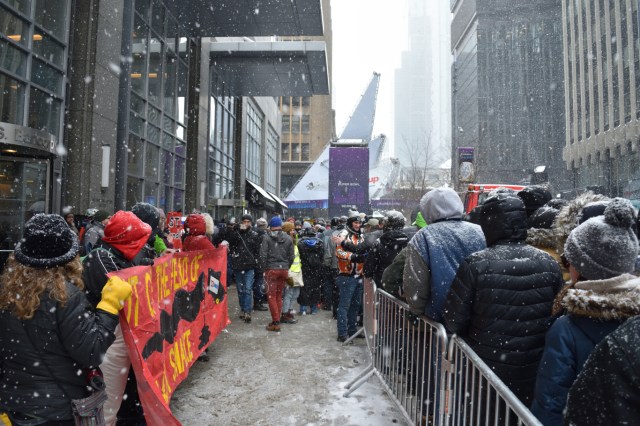
350MN was very well organized.  The plans for locations, times, contact phone numbers, etc were well done.  Marshalls wore fluorescent vests for easy identification. It wasn’t too cold (about 25 F), but was snowing.  That was a challenge for me taking photos, both avoiding snow melting on the lens, and because automatic focus can be impaired by focusing on snowflakes instead of the subject.

This was not to be an action involving civil disobedience and arrest.  Because there would be huge crowds near the bank, we traveled in small groups to that area, and then had a flash mob type of coming together at a specified time.

Walking downtown there was a heavy security presence and I wondered what the reaction would be to our demonstration.  When the time arrived, more and more of us gathered in front of the bank.  Banners began to be unfurled and our chant leader, Heather Pearson, who came with us in the van, began leading chants using a megaphone.

Interestingly, the police remained largely out of sight.  A portable fence was quickly set up, separating us from the Super Bowl crowd, and we were allowed to stand and chant for at least half hour, while the snow began to fall more heavily.

DSC_6727

It was also a surprise that so many of the pedestrians seemed supportive, even though we were making it harder for them to get around.

Next we marched together a few blocks to take over an intersection (auto traffic was already blocked off anyway) and various people addressed the crowd with the megaphone. One of the speakers was Donnielle Wanatee, who rode to Minneapolis in our van.  She spoke about the epidemic of the missing and murdered Native American women. Christine Nobiss, founder of Indigenous Iowa, also spoke. Both of them had spoken to us at Iowa Yearly Meeting (Conservative) last summer on a panel about building bridges with indigenous peoples.

After the speakers, we continued marching about 10 blocks until we reached a highway overpass, where some held signs for the traffic below to see, and the rest of us dispersed to return to the 350MN offices.  After a debriefing and some food, we headed home, arriving in Des Moines at 10 pm.

Posted in #NDAPL, civil disobedience, climate change, Indigenous, Quaker Meetings, Uncategorized | Tagged , , , | Leave a comment

US Bank vs Water Protectors

I’m planning to join a van full of water protectors going to Minneapolis tomorrow.  As the Des Moines Register put it yesterday, Iowa environmentalists heading to Super Bowl to protest Dakota Access pipeline.   Our group has been organized by Ed Fallon of Bold Iowa.  I’m going as a water protector and photojournalist.

There are two ways you can help (see below).

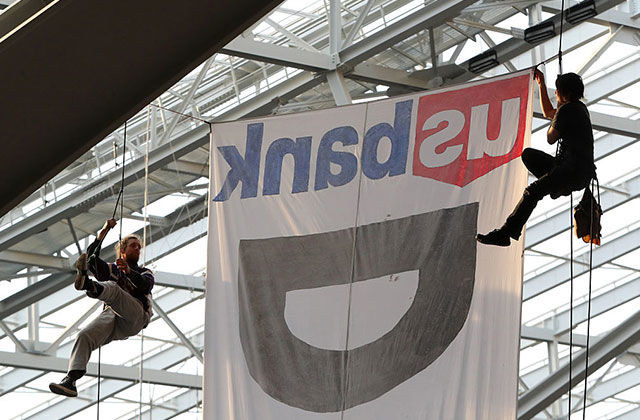
us-bank-divest-051617

Protestors hang suspended from ropes above the Minnesota Vikings and Chicago Bears football game on January 1, 2017 at U.S. Bank Stadium in Minneapolis, Minnesota. 
Photo: Adam Bettcher/Getty Images

US Bank had provided a quarter of a BILLION dollars worth of financing to Energy Transfer Partners (ETP), builder of the Dakota Access Pipeline.

But US Bank and other banks who funded the pipeline have been under intense pressure since then.

Environmentalists famously dropped a banner calling on U.S. Bank to divest from DAPL at the New Years 2017 Minnesota Vikings and Chicago Bears football game.

The language of the bank’s new policy seemed blunt.

“The company does not provide project financing for the construction of oil or natural gas pipelines,” U.S. Bancorp, parent company of U.S. Bank, wrote in its April 2017 Environmental Responsibility Policy.  https://www.desmogblog.com/2017/12/20/us-bank-oil-gas-pipeline-4-billion-loan-energy-transfer-partners-dakota-access

The problem is that language seems to indicate that loans can still be made to companies involved in building pipelines, since that would not be considered project financing.

US Bank told shareholders it will provide all the funding of the original loan to Energy Transfer Partners.  In addition, in a December 1, 2017, filing to the Securities and Exchange Commission, US Bank was revealed to be part of a new four billion dollar credit deal to Energy Transfer Partners.

You can help!

First, your prayers would be most welcome. Spirit power has always been a fundamental force in the water protector movement.

Second, please consider writing a letter to the editor.  Talking points can be found below. Track down contact information for the newspaper and person you need to send your LTE or Op Ed to here.

On the Stop DALP 2.0! Facebook page, Ed Fallon just posted:

In solidarity with the 20-30 Iowans traveling to Minneapolis for the US Bank action prior to the Super Bowl, who would be willing to write a letter to the editor tomorrow? We especially need to get the word out about the Landowner/Sierra Club lawsuit. Can we get ten volunteers to each write a letter?

“STOP DAPL 2.0” TALKING POINTS

The fight to stop the Dakota Access pipeline is again ramping up! Recently, there was this excellent piece by Carolyn Raffensperger, the story about pipeline sabotage legislation (click here to read Bold Iowa’s press release in response), and this story about US Bank and the divestment campaign.

Good, but we need a lot more chatter and clamor — especially around the Landowner/Sierra Cub lawsuit before the Iowa Supreme Court. Letters to the editor (LTE) and Op Eds in newspapers across Iowa would be very helpful right now.

Here’s a check list to give your letter to the editor or Op Ed the best possible odds of being picked up by a regional or local newspaper, or both:

1. Link to a recent story, e.g., Carolyn’s Op Ed, the Pipeline Sabotage Legislation story, the US Bank divestment campaign, or the Landowner/Sierra Club lawsuit (see below).

2.  Keep it short. LTEs are best kept to 200-300 words and Op Eds around 650-750.

3. If one or more newspapers agree to run an Op Ed, include a head shot of yourself. A photo of the author absolutely increases readership!

4. Track down contact information for the newspaper and person you need to send your LTE or Op Ed to here.

About the lawsuit . . . In 2016, nine landowners and the Iowa Sierra Club filed a lawsuit that is now before the Iowa Supreme Court. The suit contends that the Iowa Utilities Board (IUB) acted illegally when it granted Dakota Access the authority to use eminent domain. The IUB also failed to follow the statutory requirement that the pipeline provide a public benefit.

If the lawsuit goes our way, it could shut down the pipeline! Beyond that, the lawsuit’s impact on property rights is huge. If Dakota Access and its parent company, Energy Transfer Partners (ETP), can claim that it provides a public benefit because oil flowing through Iowa may eventually come back to us as gasoline, then what’s to stop a mall developer from arguing that it should be able to condemn your land because Iowans will shop at the mall’s stores?

If the Supreme Court rules the wrong way on the lawsuit, it’s impossible to overstate all the harm that could be done to landowners in the future!

The stakes are high. Yet most Iowans aren’t even aware of this lawsuit. One simple thing you can do to help change that is to write an LTE or an Op Ed to your local or regional newspaper.

In addition to the information above, here is some talking points to include in an LTE or Op Ed:

  • In granting Dakota Access a permit to build the pipeline, the IUB simply made the wrong decision. In section 6A.21(1)(c), the Iowa Code states that public use, public purpose, or public improvement do not include the authority to condemn farmland for private development. The Code contains an exemption for utilities regulated by the IUB, but the IUB must still prove public use, purpose or improvement. It hasn’t and it can’t.
  • Pipeline company representatives told landowners the pipeline was needed for domestic consumption and to end America’s dependence on foreign oil. The IUB bought that line, but now it’s clear that much if not most of the oil is for export. This further weakens ETP’s contention that the Dakota Access pipeline has a public purpose.
  • The IUB neglected to determine whether the pipeline would provide a needed service and benefit to the public. According to state law, a permit for a hazardous liquid pipeline can be granted by the IUB only if the company shows that the pipeline will promote public convenience and necessity. That’s simply not the case.
  • One reason the IUB gave for granting Dakota Access a permit was because of the construction jobs. This reasoning is flawed. Determination of a public purpose should be only for the project itself, not for any jobs created in the construction phase. If allowed to stand, the IUB’s decision sets a precedent that any private development constitutes a public purpose simply because it creates jobs during construction. This goes against the very intent of the law. Furthermore, very few of the construction jobs went to Iowans. Apple anecdotal evidence collected by pipeline opponents, landowners and area residents found that perhaps one out of very ten vehicles at a pipeline construction site had Iowa plates.
  • The IUB allowed construction of the project to begin before Dakota Access had met all the requirements the IUB had stipulated. Dakota Access hadn’t received all of the necessary permits and approvals, nor had the company completed an Environmental Impact Statement. It still hasn’t. The company hasn’t obtained what are called “parental guarantees,” nor does it have the insurance required under the IUB’s permit.
  • The Iowa Supreme Court needs to consider the true public necessity: clean water, healthy soil, a stable climate, and the rights of farmers and rural property owners.

[Authors: Kari Carney of 1000 Friends of Iowa, Ed Fallon of Bold Iowa, and Wally Taylor of the Iowa Sierra Club.]


Posted in #NDAPL, civil disobedience, Indigenous, Uncategorized | Tagged , , | Leave a comment

Super Bowl XLVI Indianapolis 2012

My friend Daniel Chang and I experienced downtown Indianapolis at the time of Super Bowl XLVI in 2012.

Posted in Uncategorized | Tagged , , | Leave a comment