Iowa Yearly Meeting (Conservative) of Friends (Quakers) meets twice a year. Midyear meeting occurs in March or April. It is a time to hear speakers on Quaker or peace and justice subjects, usually with a lot of audience participation, sharing our experiences. This past weekend was this year’s midyear meeting. These meetings are held at my monthly meeting, Bear Creek Friends meeting in the countryside north of Earlham, Iowa. This year Jeff Cox, a member of the Iowa City meeting, spoke about Conservative Friends’ history, beliefs, and worship. (For those not familiar with our yearly meeting, Conservative refers to preserving the practices of the early Quakers of the mid 1600’s in England. Most Iowa Conservative Friends tend to be quite liberal politically.)
Photos often express how people are relating to each other better than words. The following are from this year’s meeting. The first set are of the women who worked with the youth. One thing they did was make Quaker bonnets out of construction paper.
The link below is to the report to the United Nations Special Rapporteur on the Rights of Indigenous Peoples, Victoria Tauli-Corpuz, prepared by faculty and students of the International Human Rights Advocacy Workshop at the University of Arizona Rogers College of Law on behalf of the Water Protector Legal Collective. https://law.arizona.edu/sites/default/files/indigenous_resistance_to_the_dakota_access_pipeline_report.pdf
From the introduction to the report: “Peaceful demonstrations are a catalyst for the advancement of human rights. Yet around the world governments are criminalizing dissent and suppressing public protest, often as a means to protect corporate interests. In this context, indigenous peoples increasingly find themselves as the subjects of criminal prosecution and police violence when defending the lands they rely upon for their existence and survival from resource extraction.”
“The United States takes pride in the constitutional protections of the rights to free expression and assembly, as being stronger in the US than virtually any other place in the world. This reputation may soon change. As the President of the Inter-American Commission on Human Rights (“Inter-American Commission”) stated during a recent hearing on the rights to freedom of association, peaceful assembly, and freedom of expression in the United States: “We are concerned about what has been happening lately…. there is a regression in these pillars of democracy…. from the highest levels of power.”
As of the date of this report, 31 US states have proposed 58 anti-protest bills, 8 have passed into law and 22 have been defeated with 28 still pending in state legislatures.” (see below regarding Iowa’s new anti-protest bill.)
Conclusion and Recommendations: “The United States has failed in its duty to prevent and protect against the use of excessive force and unlawful arrests and to investigate, punish, and provide reparations for these human rights abuses. By condoning the behavior of state law enforcement and private security in this context, the state is normalizing, encouraging, and emboldening state and non-state actors to act similarly in future situations.
We urge the Special Rapporteur to reiterate her requests to the United States to “develop and provide anti-oppression and anti-racism training to federal and state law enforcement agents, and to mandate the Department of Justice to open an investigation into the excessive use of force and militarized response to the water protectors at the Standing Rock Sioux Reservation, including the use of non-lethal weapons.”
In addition, we ask the Rapporteur to include the following recommendations to the US in her report on the criminalization of indigenous human rights defenders:
a) Review and reconsider criminal proceedings against water protectors and direct prosecutors to seek proportionate penalties for protestors who violate the law; b) Investigate, punish, and provide appropriate reparations for all human rights violations, including the use of excessive force and mass arrests in response to DAPL opposition; OR convene a truth commission with the indigenous representative institutions of the Oceti Šakowiŋ; c) Adopt a regulatory framework to supervise and monitor activities of extractive industries and energy companies,85 private security firms and other non-state actors to prevent human rights violations in regard to activities that affect indigenous peoples and their lands; d) Provide training to law enforcement and private security on best practices for managing peaceful demonstrations; the right to free expression and assembly; and indigenous peoples rights under international law; e) Implement national measures to protect indigenous human rights defenders in compliance with the UN Declaration on Human Rights Defenders, the UN Declaration on the Rights of Indigenous Peoples and other international standards to ensure the full enjoyment of their rights to free expression and assembly; f) Issue executive order regulating and restricting transfer of military-grade weapons and equipment to local law enforcement; g) Reject or amend state legislation that violates the right to free assembly; h) Ensure that state and local emergency powers are not abused in the context of social protest; and i) Implement the UN Declaration on the Rights of Indigenous Peoples and recommendations on indigenous peoples rights issued to the United States by the UN Treaty Bodies, Universal Periodic Review process, UN Special Procedures and the Inter-American System of Human Rights.
We further urge the Rapporteur to report on the corporate conduct and human rights accountability of the companies and investors behind the Dakota Access Pipeline and the need to sanction those responsible for human rights violations.“
The major threat of Martin Luther King Jr to us is a spiritual and moral one.
Martin Luther King Jr turned away from popularity in his quest for spiritual and moral greatness – a greatness measured by what he was willing to give up and sacrifice due to his deep love of everyday people, especially vulnerable and precious black people. Neoliberal soul craft avoids risk and evades the cost of prophetic witness, even as it poses as “progressive”.
If King were alive today, his words and witness against drone strikes, invasions, occupations, police murders, caste in Asia, Roma oppression in Europe, as well as capitalist wealth inequality and poverty, would threaten most of those who now sing his praises.
Today, 50 years later the US imperial meltdown deepens. And King’s radical legacy remains primarily among the awakening youth and militant citizens who choose to be extremists of love, justice, courage and freedom, even if our chances to win are that of a snowball in hell! This kind of unstoppable King-like extremism is a threat to every status quo!
I’ve been thinking about the history and present condition of Quakers’ work regarding peace and justice. The main reason Friends have had an impact through history is because that work has been spiritually grounded, in the same manner King held steadfastly to a spiritual and moral compass.
When people rely on their intellect to guide them, they are limited to only being able to analyze and work within the constraints of what they have been taught, or experienced themselves. When confronted with difficulties in the struggle, they don’t have the spiritual resources that would continue to give them hope and the courage and strength to continue. And to find new, unexpected ways forward.
That also constrains the depth of their relationships with others, since they will not be open to the spiritual dimensions of a situation or the people involved.
It is difficult to describe our own experiences of being spirit led. We don’t have a good vocabulary. We speak of the Inner Light, or still small voice within, or spirit, or truth or God. “Be still, and know that I am God.” Psalm 46:10. But that doesn’t make sense to someone who has not experienced this.
I’ve written a number of times about my first meeting with the Kheprw Institute community in Indianapolis. Thanks to their persistent questions asking me to tell why I wanted to work with their community, I was in the end led to talk about Quakers believing there is that of God in everyone, which meant everyone in that room that evening. That understanding among us made it possible for us to then work together.
I am also thinking about my experiences with Native Americans as we worked together as water protectors. I felt immediately connected as various people spoke about protecting water and the Spirit. “Mni Wiconi, Water is life”. We had public prayers, burning sage and beating drums. A deep spiritual connection was made without words.
I sometimes wonder if some of us today avoid risk and evade the cost of prophetic witness. Or do we choose to be extremists of love, justice, courage and freedom, even if our chances to win appear hopeless? Do we strive to be radicals, as Martin Luther King was?
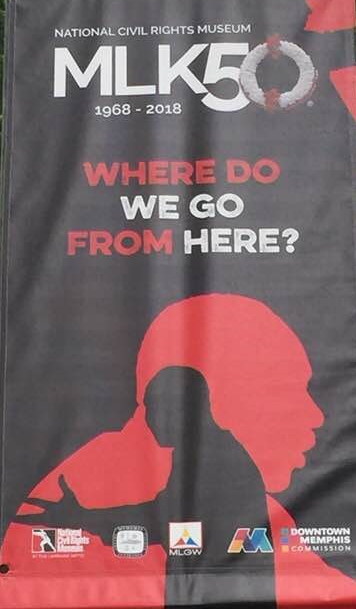
Where to we go from here? This question, and the related statement below are from Indiana Black Expo President Tanya Bell on this, the 50th anniversary of the assassination of Dr. Martin Luther King, Jr. Following that is a minute on racial justice approved by Iowa Yearly Meeting (Conservative).
We must refrain from skipping over the “context” of King’s dream that is out of reach for so many of us due to the color of our skin or the marginalization of our communities. Commemorating his life goes beyond highlighting historic speeches and offering eloquent remarks. We can do without the rhetoric. We need action. We need an acknowledgment of the truth – that the dream for too many of us has not been realized; the dream has been marginalized. The Economic Policy Institute reported on the state of Black America in February:
• Blacks are half as likely to obtain a college degree than whites; • Black home-ownership has stayed unchanged since 1968 with only 41% of us owning a home; • Unemployment is worse today than in 1968. In 1968, Black unemployment was 6.7%. In 2017, Black unemployment was 7.5%. A Black worker only makes 82 cents on every dollar earned compared to a White worker. According to Dr. Maurice Hobson, history professor at Georgia State University, “a Black person would need to live 230 years to catch up with the generational wealth of a white person….”; and • Since 1968, the number of Blacks incarcerated has tripled.
As I personally reflect upon Dr. King’s love, works, leadership and commitment to ensure that none of us are left behind, I am saddened and depressed by our lack of progress. “Where do we go from here?” is a profound question for which I eagerly await thoughtful and strategic answers.
Minute on Racial Justice Iowa Yearly Meeting (Conservative)
A testimony of Quakers is that all people are beloved and equal in the eyes of God.
We live in a society that is struggling to deal with consequences of slavery, and the failure to achieve equity for all after slavery was abolished. Conditions such as discriminatory lending practices, multigenerational inequities around home ownership, and easier access to education for white people persist in our laws and culture, resulting in institutional racism.
Some Friends once owned slaves. William Penn believed that “slavery was perfectly acceptable, provided that slave owners attended to the spiritual and material needs of those they enslaved.” Penn “had a curious blind spot about slavery. Quakers were far ahead of most other Americans, but it’s surprising that people with their humanitarian views could have contemplated owning slaves at all.”
Picking up the work of colonial Quaker Anthony Benezet, who wrote an early tract opposing slavery, John Woolman traveled up and down the Atlantic coast laboring with Quaker slaveholders and testifying against the institution of slavery. It was through his years of patient dialogue that Quakers first freed their slaves then testified against slavery and over time became the backbone of the anti-slavery movement in America.
A gap in awareness exists today, which allows so many people who consider themselves white to continue practices that give them advantages over people of color.
The scope of these problems is extensive and deep. Racial tensions continue to result in violence and death. There is an increasingly militarized police response. The Black Lives Matter movement is helping raise awareness around these issues.
Many white people are still not as aware of some of these issues. But to continue to benefit from these privileges is not right.
Not having relationships with people of color often results in misunderstanding and unfortunate racial attitudes among white people. One significant consequence of that is the election of so many representatives who reflect these views to legislative bodies.
Building relationships with people of color is one way we can begin to address this, as we build Beloved Communities together.
We urge each person to take a careful look at their life, to identify where one is benefiting from this, and work to correct that. We urge Friends to speak out and take action against these systemic injustices and violence occurring today.
April 4, 1968, Robert F Kennedy gave several speeches in Indiana as he campaigned for the Democratic nomination for President of the United States. This young white man, as the United States Attorney General, along with his brother the President, had been thrust into the middle of the civil rights struggle. And then his brother was assassinated.
At Notre Dame he spoke about the Vietnam War, and told the students there that college deferments for the draft discriminated against those who could not afford to attend college, and should be eliminated.
After speaking about racism at Ball State, an African American student said, “Your speech implies that you are placing a great deal of faith in white America. Is that faith justified?” Kennedy answered “Yes” and added that “faith in black America is justified, too” although he said there “are extremists on both sides.” Before boarding a plane to fly to Indianapolis, Kennedy learned that Martin Luther King, Jr. had been shot. On the plane, Kennedy told a reporter “You know, it grieves me. . . that I just told that kid this and then walk out and find that some white man has just shot their spiritual leader.”
It wasn’t until the flight had nearly arrived in Indianapolis that he learned Martin Luther King, Jr, had died of his wounds. There wasn’t time to write something to cover this news. The Indianapolis event was to be held at a park in a predominately black neighborhood downtown. The Indianapolis police and city leaders tried to get him to cancel the speech, telling him they couldn’t protect him if there was a riot.
But he insisted. At the park, from the back of a flatbed truck, he said:
Ladies and Gentlemen,
I’m only going to talk to you just for a minute or so this evening, because I have some–some very sad news for all of you — Could you lower those signs, please? — I have some very sad news for all of you, and, I think, sad news for all of our fellow citizens, and people who love peace all over the world; and that is that Martin Luther King was shot and was killed tonight in Memphis, Tennessee.
Martin Luther King dedicated his life to love and to justice between fellow human beings. He died in the cause of that effort. In this difficult day, in this difficult time for the United States, it’s perhaps well to ask what kind of a nation we are and what direction we want to move in. For those of you who are black — considering the evidence evidently is that there were white people who were responsible — you can be filled with bitterness, and with hatred, and a desire for revenge.
We can move in that direction as a country, in greater polarization — black people amongst blacks, and white amongst whites, filled with hatred toward one another. Or we can make an effort, as Martin Luther King did, to understand, and to comprehend, and replace that violence, that stain of bloodshed that has spread across our land, with an effort to understand, compassion, and love.
For those of you who are black and are tempted to fill with — be filled with hatred and mistrust of the injustice of such an act, against all white people, I would only say that I can also feel in my own heart the same kind of feeling. I had a member of my family killed, but he was killed by a white man.
But we have to make an effort in the United States. We have to make an effort to understand, to get beyond, or go beyond these rather difficult times.
My favorite poem, my–my favorite poet was Aeschylus. And he once wrote:
Even in our sleep, pain which cannot forget falls drop by drop upon the heart, until, in our own despair, against our will, comes wisdom through the awful grace of God.
What we need in the United States is not division; what we need in the United States is not hatred; what we need in the United States is not violence and lawlessness, but is love, and wisdom, and compassion toward one another, and a feeling of justice toward those who still suffer within our country, whether they be white or whether they be black.
So I ask you tonight to return home, to say a prayer for the family of Martin Luther King — yeah, it’s true — but more importantly to say a prayer for our own country, which all of us love — a prayer for understanding and that compassion of which I spoke.
We can do well in this country. We will have difficult times. We’ve had difficult times in the past, but we — and we will have difficult times in the future. It is not the end of violence; it is not the end of lawlessness; and it’s not the end of disorder.
But the vast majority of white people and the vast majority of black people in this country want to live together, want to improve the quality of our life, and want justice for all human beings that abide in our land.
And let’s dedicate ourselves to what the Greeks wrote so many years ago: to tame the savageness of man and make gentle the life of this world. Let us dedicate ourselves to that, and say a prayer for our country and for our people.
Thank you very much.
Rioting did break out in many cities that day, but not in Indianapolis. Most believe that was because of Bobby Kennedy’s speech.
The text of this speech is displayed at Robert Kennedy’s gravesite in Arlington National Cemetery, Washington, DC.
PBS produced a documentary of this event called “A Ripple of Hope”.
Below are some photos from the Kennedy-King Park, where the speech was delivered, in Indianapolis. link to photo gallery
Despite the snow there was a fair turnout for the March for Our Lives at the state capitol in Des Moines. The crowd was completely silent as the names of the 17 victims of the Parkland shooting were read.
I was emotionally drained, often brought to tears, by all of the youth’s stories of how they were personally affected by gun violence that I heard during the day on television. So many who had lost a brother or sister.
But also uplifted. I was reminded of the anti war and civil rights movements of my own youth. This day will be remembered in history.
Students gather for “March for Our Lives” marches across the country and the world in the wake of yet another school shooting, this time in Parkland, Florida. These students are leading the demands for legislative action, saying “enough is enough”. One of their main demands, which has had wide public support for years, is to ban assault weapons. The latest (February, 20, 2018) Quinnipiac Pollshows 67% support a national ban on assault weapons, and 97% support universal background checks.
It is well known that the reason Congress refuses to reinstate the assault weapons ban is because of the money they receive from the National Rifle Association (NRA).
In a March 12, 2018, letter from Senator Chuck Grassley in response to my urging him to support reinstatement of the assault weapons ban, he wrote: “In response to tragedies like this, there are often calls to ban all guns, to ban the specific type of weapon that was used in the most recent shooting, or to ban so-called “assault weapons.” Such bans would be unconstitutional or ineffective.”
In February of this year yet another Federal court case ruledthat Senator Grassley and others are wrong. “A federal appeals court has ruled that the assault weapons banned by the state of Maryland are not protected under the Second Amendment of the US Constitution. Maryland’s ban on 45 kinds of assault weapons and 10-round magazines has been upheld. The 4th US Circuit Court of Appeals in Richmond, Virginia ruled: ‘we have no power to extend Second Amendment protections to weapons of war’.”
The Federal Assault Weapons ban was passed in 1994 and survived multiple challenges in court. Unfortunately it was not renewed when it expired in 2004.
Now is the time to reinstate the assault weapons ban.
The video below is an update on gun violence policy by the Friends Committee on National Legislation and the Islamic Society of North America. #marchforourlives #prayerandpolicy
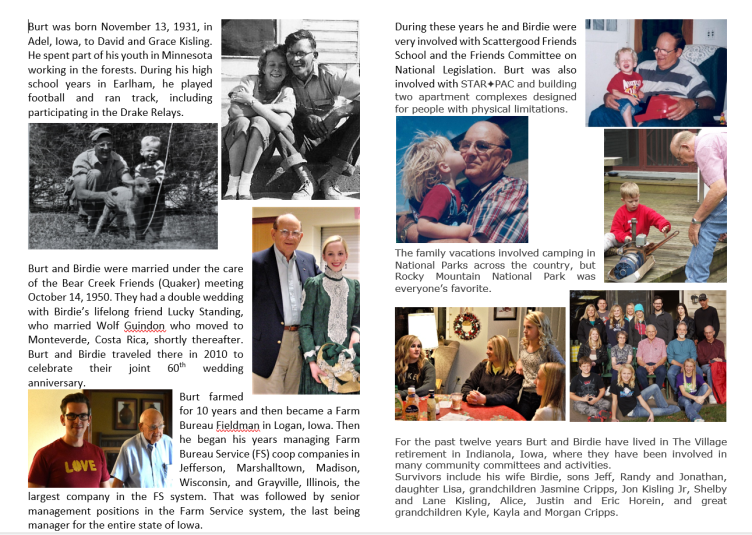
I haven’t been writing much lately because my father, Burt Kisling, had been battling pneumonia for the past three weeks. He died peacefully at a wonderful hospice facility, Taylor House, in Des Moines on Wednesday, March 21. The memorial service will be Saturday morning, April 14, at Bear Creek Friends Meeting, Earlham, Iowa.
The photo below with the lamb is my father and I many years ago.
Excellent video by Rodger Rouths interviewing AFSC’s Linda Lewis and Daniel Jasper about their work for peace in North Korea. Linda and Daniel were in Iowa this past weekend to discuss their work with agricultural projects in North Korea and to talk with us about how we might possibly arrange for another North Korean agricultural delegation to Iowa, as happened in 2001, to try to reduce tensions between North Korea and the United States.






 Quakers, social justice and revolution