Should I Give Up on White People?

I cannot imagine how frustrating it is for people of color to constantly observe the behaviors of, and hear so many things people who consider themselves White say that reveal their unexamined, but wrong ideas related to race and privilege. Privilege is a word that often triggers a visceral, negative response in White people, but accurately names the unequal hierarchy between White people and others in our society. People who consider themselves White often feel unfairly blamed when they hear the word, and mistakenly believe they are being held accountable for things done in the past. The articles referenced below are a gift, as the author expresses it, to us to help us begin to understand these things.

I am not by any means very knowledgeable about White privilege. The reason I try to express what I have learned is because I don’t believe we will ever make any real progress in race relations until people who consider themselves White force ourselves to become aware of our unintended biases and advantages in our society. I have been very fortunate to begin to learn about these things because of the time I spent in the Kheprw Institute (KI) community when I was in Indianapolis.

I think the key to this, which applies to any situation that is unfamiliar to any of us, is that we don’t know what it is that we don’t know. We begin to learn those things in one of two ways. Certain things can be taught in a classroom. We can learn science, or about grammar, etc, from a teacher or book. These things are based on facts and rules that aren’t open to interpretation.

Other things need to be learned by our personal experience in situations new to us. So many of the things I learned at KI were not from formal lessons, but instead hearing and observing what life is like for people of color.

How could I not be affected by seeing tears run down the face of a Black mother, barely able to speak, as she told of how terrified she is any time her child leaves the house? How could I not be delighted to share in the laughter of my new friends at KI?
DSC_3257

How could I not feel honored by the prayers my friends at KI sent at the time of my father’s illness and death? I realized I was wearing my DIOP sweatshirt for the sense of comfort that gave me during this difficult time.

Should I Give Up on White People? by George Yancy, professor of philosophy at Emory University was published by the New York Times, April 16, 2018. He tries to teach us how to begin to learn about these things. He references an essay of his that was published in the New York Times on Christmas eve, 2015, titled Dear White America.

I think Quakers will especially appreciate the references to silence. From that article:

Dear White America,
I have a weighty request. As you read this letter, I want you to listen with love, a sort of love that demands that you look at parts of yourself that might cause pain and terror, as James Baldwin would say. Did you hear that? You may have missed it. I repeat: I want you to listen with love. Well, at least try.

This letter is a gift for you. Bear in mind, though, that some gifts can be heavy to bear. You don’t have to accept it; there is no obligation. I give it freely, believing that many of you will throw the gift back in my face, saying that I wrongly accuse you, that I am too sensitive, that I’m a race hustler, and that I blame white people (you) for everything.

In this letter, I ask you to look deep, to look into your souls with silence, to quiet that voice that will speak to you of your white “innocence.” So, as you read this letter, take a deep breath. Make a space for my voice in the deepest part of your psyche. Try to listen, to practice being silent. There are times when you must quiet your own voice to hear from or about those who suffer in ways that you do not.

Posted in Black Lives, Kheprw Institute, race, Uncategorized | 1 Comment

Iowa Yearly Meeting (Conservative) 1966

I recently came across an article in Friends Journal, October 1, 1966, written by my uncle Bernard Standing. It was interesting to see how many similarities there were with Iowa Yearly Meeting (Conservative) today.

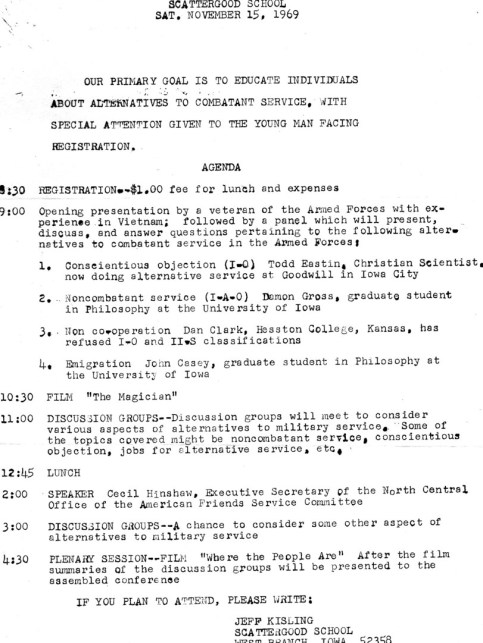
That was the year I first attended Scattergood Friends School. The Vietnam War was a major factor in the lives of the boys there, since we were required to register for the draft on our eighteenth birthday. Like many Iowa Quakers, I eventually decided to become a draft resister.  Cecil Hinshaw of the American Friends Service Committee (AFSC) who spoke at the 1966 Yearly Meeting sessions, also spoke at a draft conference held at the school that fall.

ScattergoodDraftConference

Draft conference, Scattergood 1969

There were visitors from the Quaker settlement in Monteverde, Costa Rica. My parents, sister and her family, and I visited Monteverde in 2010.

“Other concerns were Indian welfare and race relations” which continue to be concerns today.

Finally, there was discussion related to the Meskwaki Native American settlement near Tama, Iowa. Last summer Donnielle Wanatee from that settlement spoke to us at the Yearly Meeting sessions about building bridges with Native Americans, and invited us to their annual powwow, (the same powwow referenced below) which my father and I did attend last fall.

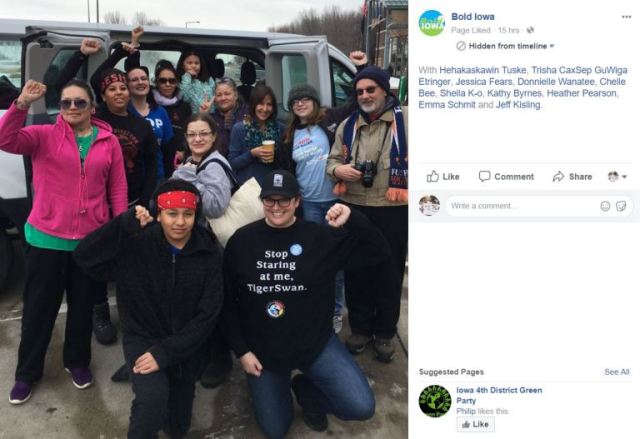
Then in February of this year, Donnielle was in a van of water protectors I went with to Minneapolis to demonstrate in front of the US Bank headquarters because of their funding of fossil fuel projects.

Iowa Yearly Meeting (Conservative) Reported by BERNARD A. STANDING

IOWA Yearly Meeting of Friends (Conservative) held its sessions August 16-21 in the rural community of Mapleside near Paullina, Iowa. A family atmosphere prevailed, as evidenced by the parent-children groups arriving by car or seated in the meeting house, by the many young people at play on the volleyball court, and by the little children at the sand-pile and the swings. The mingling of Friends from urban communities with those from rural areas was a truly growing experience. Lincoln Meeting in eastern Nebraska has been added to this group within the past year. Visiting Friends were welcomed from Monteverde (Costa Rica), Concord (New Hampshire), and Media (Pennsylvania).

A dominant concern was the war in Vietnam. E. Raymond Wilson of the Friends Committee on National Legislation spoke on this topic to different age-groups at several sessions. Various approaches to a peaceful settlement of the conflict were presented. T he meeting gave its approval to the statement issued recently by Friends United Meeting, “An Appeal to End the War in Vietnam Now,” which calls for cessation of hostilities, negotiations, free elections, economic development of the land, and the help of all nations of the world to accomplish these results.

Boyd Trescott of the Friends World Committee for Consultation explained the function of that committee, placing special emphasis on the Friends World Conference to be held at Guilford College in North Carolina in 1967. Plans are being made to send seven delegates from Iowa Yearly Meeting.

Marian Baker, a young Friend from New Hampshire, told of the Young Friends’ plans for that conference and for subsequent visitation throughout the United States.

Other concerns were Indian welfare and race relations.

Projects of the North Central Region of the American Friends Service Committee were reported. The summer workshop in which several young people joined with the Musquakie Indians in preparing for the annual powwow at Tama, Iowa, was successful in fostering understanding and friendship between the two groups.

James Thomas, director of the Iowa Rights Commission, spoke one evening about the efforts of his group to achieve equal opportunities in housing and employment for minorities.

The annual report of Scattergood School at West Branch, Iowa, the Yearly Meeting’s major educational project, showed progress in the building program, including the construction of· a new science building. The purpose of the school is reflected in the lives of returning alumni.

At the last evening gathering, Cecil Hinshaw described possible vast changes in our material world in the near future. He challenged Friends to cope with these new situations by imaginative training of personnel in the fields of industry and education. Though change is inevitable, the eternal values of truth and love remain.

October I, 1966 FRIENDS JOURNAL

Posted in Indigenous, peace, Quaker Meetings, race, Uncategorized | Tagged , | Leave a comment

Diop Is Going to London

I’ve written a lot about my experiences with the Kheprw Institute (KI), a Black youth mentoring and empowerment community in Indianapolis. A key person in that story and community is Diop Adisa, who became a very good friend of mine.  You can read more about my initial connection to Diop and KI here:

https://kislingjeff.wordpress.com/2016/01/14/lessons-learned-about-quakers-and-racism/

Below, Cornel West writes about the importance of music in the black freedom struggle. Among other things, Diop is a musician and hip-hop artist. Below are some of the things I’ve written about Diop over the past several years.

I don’t think I’ve ever written a blog post to appeal for money, but I just learned that Diop is going to London soon, and could use some help for expenses. If you are interested, you can contribute at PayPal to diopostle@gmail.com  I hadn’t used PayPal before, but it is very easy to send money without even setting up an account at https://www.paypal.com/us/home

Our conversation yesterday:

“Hey Jeff I hope you’re doing well. I’m headed to London from May 5th – 28th to build relationships and connections in the hip hop world over there. I’m trying to raise money to help with housing and food expenses while I’m there. If you or anyone you know could possibly contribute anything to assist that would be greatly appreciated.”

Wow, sounds great. Where should we send the money?

Yeah it’ll definitely be a journey. You can send it via PayPal. diopostle@gmail.com

1/25/218

So how do we respond to our dark times? The greatest tradition of prophetic fightback in the American empire is the black freedom struggle. The greatest tradition of moral and spiritual fortitude in the American empire is the black musical tradition.
The artistic excellence in the best of black music – including the magnanimity and majesty of the sound – sets the standards for the black freedom struggle.
These standards consist of radical freedom in love and radical love in freedom – the freedom to tell the truth in love about one’s self and world, and the love of the truth as one freely speaks and lives.
The Movement for Black Lives is a grand sign of hope. It is an exemplary collective effort to put prophetic fight back in our bleak moment of imperial meltdown and spiritual blackout.”America is spiritually bankrupt. We must fight back together. Cornel West, The Guardian January 14, 2018

9/13/2017

Check out the new video by my friend Diop Adisa, filmed in Ghana, Flex (Hey).

After Diop recently asked me how I was doing since I moved to Iowa, I asked him the same.  He saidI’m doing pretty good, just trying to continually figure it all out.

1/13/2016

For those of us who consider ourselves white (an interesting phrase I first encountered in “Between the World and Me” by Ta-Nehisi Coates) and who want to help our society improve how we all treat each other, for those who admire young people leading the way with Black Lives Matter, we struggle with just exactly what we can do.

Here is one possibility.  My friend Diop Adisa is a musical artist, whose album Black Dragon is now available on Spotify, Amazon, ITunes, Google Play, etc.   Here is a chance to support an artist, and learn what he has to say, as well.  My favorite is “YardWork”.

Posted in Arts, Black Lives, Kheprw Institute, race, Uncategorized | Tagged | Leave a comment

Quakers and the Future of Racial Healing

Quaker rapper Sterling Duns speaks about Dreaming of Wholeness: Quakers and the Future of Racial Healing in a new QuakerSpeak video.

“It feels simple and deeply radical to just say as a group that is committed to honoring that of God in everyone, that that person of color, that Black person is deserving to have their full humanity recognized by me as a Quaker. That’s a simple thing to say and it’s a radical thing to say.”

“Quakers are equipped to have a role in the racial healing work we need today because inherent to the faith, inherent to the spiritual practice is the belief in that of God in everyone.”

“I spend time dreaming about the future and really spending some deep time imagining what it would be like for us all to be free. I think Quaker communities can spend that time and energy doing that, I think they can absolutely do that. When we talk about Quaker communities being more inclusive I think you literally have to spend time on Dream Mountain, going to Dream Mountain and looking out, and return to reality, Reality Meadows, and then Dream Mountain, then Reality Meadows, you know? I spend a lot of time oscillating between those different worlds and I think having a practice of being able to do that as a group, as multiple groups, would be really important.”

One First day morning at Bear Creek Friends meeting earlier this year we listen to, and talked about the following two QuakerSpeak videos featuring Sterling Duns.

Following is a Minute on Racial Justice, approved at Iowa Yearly Meeting (Conservative) in 2016.

Minute on Racial Justice

Iowa Yearly Meeting (Conservative) 2016

A testimony of Quakers is that all people are beloved and equal in the eyes of God.
We live in a society that is struggling to deal with consequences of slavery, and the failure to achieve equity for all after slavery was abolished. Conditions such as discriminatory lending practices, multigenerational inequities around home ownership, and easier access to education for white people persist in our laws and culture, resulting in institutional racism.

Some Friends once owned slaves. William Penn believed that “slavery was perfectly acceptable, provided that slave owners attended to the spiritual and material needs of those they enslaved.” Penn “had a curious blind spot about slavery. Quakers were far ahead of most other Americans, but it’s surprising that people with their humanitarian views could have contemplated owning slaves at all.”

Picking up the work of colonial Quaker Anthony Benezet, who wrote an early tract opposing slavery, John Woolman traveled up and down the Atlantic coast laboring with Quaker slaveholders and testifying against the institution of slavery. It was through his years of patient dialogue that Quakers first freed their slaves then testified against slavery and over time became the backbone of the anti-slavery movement in America.

A gap in awareness exists today, which allows so many people who consider themselves white to continue practices that give them advantages over people of color.

The scope of these problems is extensive and deep. Racial tensions continue to result in violence and death. There is an increasingly militarized police response. The Black Lives Matter movement is helping raise awareness around these issues.

Many white people are still not as aware of some of these issues. But to continue to benefit from these privileges is not right.

Not having relationships with people of color often results in misunderstanding and unfortunate racial attitudes among white people. One significant consequence of that is the election of so many representatives who reflect these views to legislative bodies.

Building relationships with people of color is one way we can begin to address this, as we build Beloved Communities together.

We urge each person to take a careful look at their life, to identify where one is benefiting from this, and work to correct that. We urge Friends to speak out and take action against these systemic injustices and violence occurring today. We appreciate how much we learn from communities of color.

Posted in Black Lives, Quaker Meetings, race, Uncategorized | Leave a comment

#noDAPL Summary

I hesitate to share things I don’t now the origin of, but the following image summarizes the struggle to stop the Dakota Access Pipeline so well.  Many people didn’t follow what was going on related to this last year. Text in the image indicates it is from The Free Thought Project.com, but I haven’t been able to find it on that site. The only statement I’m not sure about is the 13 year old girl shot in the face. Some say that was with a rubber bullet, others say it didn’t happen at all.

let me get this straight

Following are other things related to #noDAPL.  https://kislingjeff.wordpress.com/page/2/?s=dapl

Amy Goodman, Democracy Now, was present during the security dog attacks on the peaceful men, women and children at Standing Rock:

Nahko and Medicine for the People. Love Letters to God

Ra Wyse, Wyse Radio, interviewed me about local #NoDAPL actions:

My online photos related to several #NoDAPL events in Indianapolis.  You have my permission to use them:  https://1drv.ms/f/s!Avb9bFhezZpPh6lG9yID1Jj2_jT06A

The struggles to protect our water continue. In February I went with a group of water protectors to Minneapolis to demonstrate in front of US Bank headquarters, to urge them to stop funding fossil fuel projects.  https://kislingjeff.wordpress.com/2018/02/05/super-bowl-and-justice/

jeff-to-minneapolis

Posted in #NDAPL, Indigenous, Uncategorized | Leave a comment

North Korea Update 4/18/2018

Last month Linda Lewis and Daniel Jasper, AFSC staff who have been working in North Korea, visited us in Iowa for a number of events (https://kislingjeff.wordpress.com/?s=north+korea).

We have been wondering what, if anything, might happen next. I’ve been telling people that will probably depend on what happens if the meeting between the leaders of the U.S. and North Korea occurs.  Yesterday we received the following update from Daniel:

“Thanks again for all the hospitality when Linda and I came to visit. Our timing couldn’t have been better. I just had a meeting with State yesterday and they are looking for ideas for exchanges in the event the Trump-Kim Jong un summit goes well. Naturally, I highlighted AFSC’s willingness and ability to help and spoke about our recent Iowa visit. I stressed that Des Moines Quakers and an ag delegation would be a natural fit and gave them the Des Moines Register article about Khrushchev.”

Posted in Uncategorized | Tagged , | Leave a comment

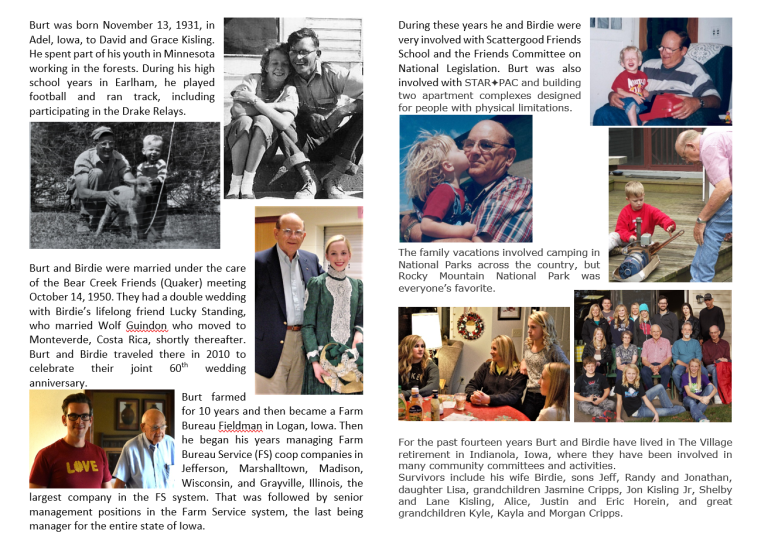
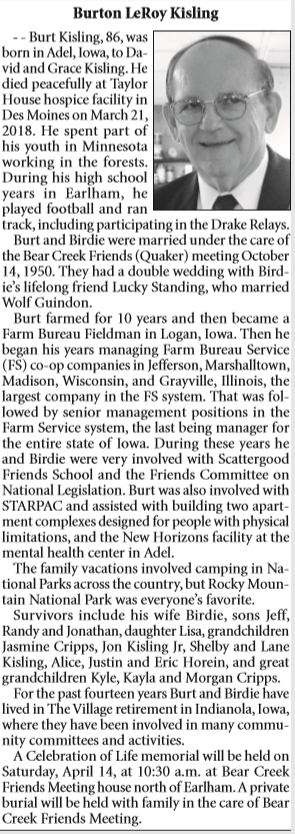
Burt Kisling remembered

Tomorrow will be the memorial service for my father, Burt Kisling, who died March 21, 2018, after a three week struggle with pneumonia, which triggered heart and kidney failure. He was an awesome father, teacher and role model. I’m thinking of “attitude is everything” that I read somewhere. Dad always had not only a good attitude, but engaged everyone around him, improving their attitude as well. It took me a while to appreciate how significant it was that he interacted with anyone near him, especially strangers. Nearly every time, the person he spoke to would light up and share their story with him. Although he had a wealth of experiences and stories himself, his real gift was to create the space for others to share their stories with him.

Anytime there was an opportunity to help, he would, no matter the cost to himself. His employees loved him because he knew they were the heart of the business and treated them well. They became part of his extended family.

Although he wasn’t a Quaker when he met Mom, he quickly adopted the Quaker way of life. They both served on the Scattergood Friends School committee for many years, and each served as clerk of the committee at one time or another.

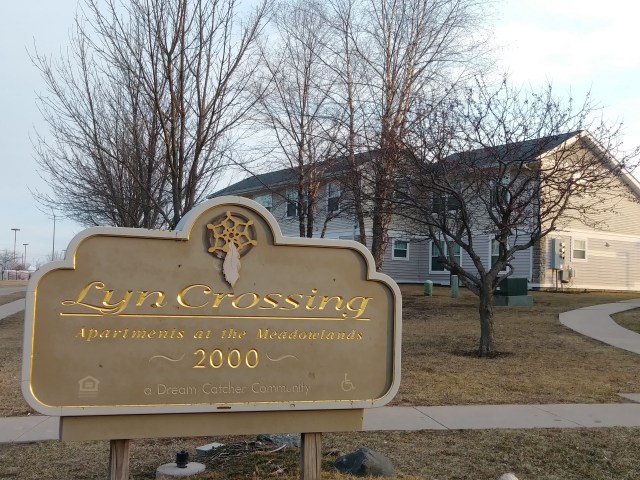
He worked for years with his good friend Chuck Day on several projects. Lyn Crossing is a Dream Cather community in Des Moines designed for people with physical and mobility challenges.

lyn crossing 1

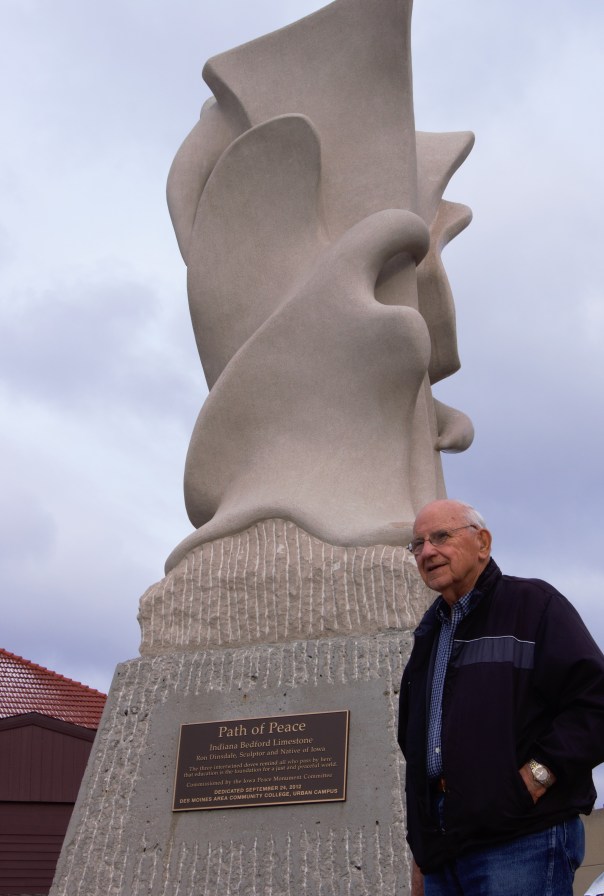
They were also involved with the Path of Peace public sculpture.

Path of Peace Dad

Chuck and were also involved with STAR PAC, a political peace organization.

His wife, Alberta (Birdie) Kisling, was the light of his life. Theirs was a model of a great marriage and family.

Throughout our lives we would travel around the country, camping in various National Parks, although Rocky Mountain National Park was everyone’s favorite. They visited the park more than thirty times, in the later years staying at the YMCA of the Rockies, instead of camping.

Dad fought valiantly to recover from his last illness. It was difficult to accept when it became clear he would not recover. We feel very fortunate that we were made aware of Taylor House Hospice. Mom had worked with hospice patients for years. The final day of his life Dad was transferred there and we are very grateful for how things went. The staff were very kind and gentle with him and us. A red t-shirt replace the hospital gown. We were able to open doors near his bed so he could enjoy fresh air. The combination of oxygen and medications they gave made him much more comfortable than he was in the hospital.

An amazing thing happened at the end. We were offered to have Dad placed in a warm, whirlpool bath. We asked for that, and Dad immediately, visibly relaxed as he was lowered into the water, and quietly took his last breaths there with a smile on his face.

I love the idea of Dad continuing on his spirit journey. And the truth that “what comes to matter then is the creation of the best possible story we can while we’re here.” I believe Dad did that exceptionally well, and he changed the world one story at a time.

ALL THAT WE ARE IS STORY. From the moment we are born to the time we continue on our spirit journey, we are involved in the creation of the story of our time here. It is what we arrive with. It is all we leave behind. We are not the things we accumulate. We are not the things we deem important. We are story. All of us. What comes to matter then is the creation of the best possible story we can while we’re here; you, me, us, together. When we can do that and we take the time to share those stories with each other, we get bigger inside, we see each other, we recognize our kinship — we change the world one story at a time.  Richard Wagamese (October 14, 1955-March 10, 2017)  Ojibwe from Wabeseemoong Independent Nations, Canada

BurtMemorial

obituary

Posted in Quaker Meetings, Uncategorized | Tagged , | Leave a comment

Memorial to Victims of Lynching

“Inside the Memorial to Victims of Lynching” is a recent 60 Minutes (CBS) story by Oprah Winfrey.   https://www.cbsnews.com/video/inside-the-memorial-to-victims-of-lynching/

The story begins “there is a reckoning taking place in America over how we remember our history. Much of the focus has been on whether or not to take down monuments that celebrate the Confederacy. But this story is about a new monument going up in Montgomery, Alabama. It documents the lynchings of thousands of African-American men, women and children during a 70 year period following the Civil War.

The project is being led by criminal defense attorney Bryan Stevenson, who is determined to shed light on a dark period in our past that most people would rather forget. It’s a shocking and disturbing reality that lynchings were not isolated murders committed only by men in white hoods in the middle of the night. Often, they were public crimes, witnessed — even celebrated — by thousands of people. Stevenson believes if we want to heal racial divisions we must educate Americans — of every color and creed.”

“The National Memorial for Peace and Justice, opening to the public on April 26, 2018, will become the nation’s first memorial dedicated to the legacy of enslaved black people, people terrorized by lynching, African Americans humiliated by racial segregation and Jim Crow, and people of color burdened with contemporary presumptions of guilt and police violence.”  https://eji.org/national-lynching-memorial

From the video above, “our country will begin to heal after more than a century of silence.”

The memorial is one project of the Equal Justice Initiative (EJI). On the EJI’s website is a report, “LYNCHING IN AMERICA: CONFRONTING THE LEGACY OF RACIAL TERROR”

The National Memorial for Peace and Justice provides a sacred space for truth-telling and reflection about racial terrorism and its legacy.

The museum and memorial are part of EJI’s work to advance truth and reconciliation around race in America and to more honestly confront the legacy of slavery, lynching, and segregation. “Our nation’s history of racial injustice casts a shadow across the American landscape,” EJI Director Bryan Stevenson explains. “This shadow cannot be lifted until we shine the light of truth on the destructive violence that shaped our nation, traumatized people of color, and compromised our commitment to the rule of law and to equal justice.”  https://eji.org/national-lynching-memorial

A member of North Meadow Circle of Friends, Jimmy Ilachild, who moved to Alabama spoke to us about another Equal Justice Initiative project, the Community Remembrance Project. He spoke of the powerful experience he had when he traveled with a group to the site of a lynching, and they gathered the soil from that site, and placed it in a jar labeled with the person’s name. Hundreds of these jars of soil from lynching sites have been collected.

I have previously writing about another project, the Lynch Quilts Project.  These are difficult and disturbing things to see and think about. But it is important that we do.

The 60 Minutes episode concludes: “Bryan Stevenson: And right now, when we talk about our history, when we talk about our past, we’re not telling the truth. We’re just not. America can be a great nation, even though there was slavery, even though there was lynching, even though there was segregation. But if we don’t talk about those things we did, we don’t acknowledge those things, we’re not going to get there.”

Posted in Black Lives, Uncategorized | Tagged , , | Leave a comment

Lyle Smith

Wednesday evenings here in Indianola a group of about ten Quakers gather for meeting for worship.  Most I have known for much of my life. Someone I hadn’t known is Lyle Smith, and since he doesn’t often say much, I haven’t learned much about him. Last week he distributed copies of his new book, Why We Believe in GOD and Other Discussions. From the back cover: “Lyle Smith is a 93-year-old lawyer who has read and seen much history and he notes a growing displeasure with Capitalism. In the past when one civilization gave way to a new one it was usually followed by a new religion.”

I was pleased to read much that is related to what I’ve been thinking and writing about for years.  The first chapter in Part I, Why We Believe in God, is titled Day One. In it four friends have a conversation about religion. Following are some quotes:

“I haven’t gone to church much for a long time but I am beginning to become interested in the possibility that religion might help get us to a better future than science alone.”  

I, too, have been writing that we are in a period of spiritual poverty. But I have a growing sense of people searching for something that speaks to their spiritual needs. It has become increasingly apparent to more people that relying on science and logic alone has not worked out well.

“It was the belief in God as ruling patriarch and then as monarch which helped humans to visualize and formulate large communities and nations. Without religions, humans would probably still be living by hunting and gathering. The question I have been asking myself is: Have we outgrown the need for this larger vision? And if not, is there any better way to spread it before our world?”

I didn’t occur to me that religion played a role in the development of large communities and nations.

One of the things we discussed last weekend at the Midyear Meeting of Iowa Yearly Meeting (Conservative) was how difficult it was for others to find our meetings. Our meetinghouses usually don’t have large signs in front of them, for example. Most don’t advertise meeting times in local publications. This was the reason I created the Facebook group, Quakers Welcome Spiritual Seekers, thinking that those who search online might discover that to learn more about Quakers.

We also discussed how often  newcomers will feel they have found their spiritual home when they experience a Quaker meeting for worship, often without any spoken words. As Lyle asks, “is there any better way to spread it before our world?”

My question about the quote above is how indigenous spirituality fits, especially since I have been trying to learn about that recently.  I’m thinking the answer is related to how one defines religion. Indigenous spirituality permeates all aspects of native life, whereas most would probably say religion is usually seen as a separate thing in most non-native cultures.

Just as some newcomers immediately connect to the spirit in a Quaker meeting, Friends shared their experiences of similar connections in situations outside Quaker meetings. I’ve written about how spirituality was what made it possible for me to connect to and be accepted by the Kheprw Institute community in Indianapolis. Similarly, I felt an immediate spiritual connection with Native Americans who I worked with as water protectors against the Dakota Access Pipeline:  “Sage was burned, and several speakers talked, mainly to those who were part of the vigil, about native issues. There was a profound feeling of spirituality encompassing us all.”  

Maybe one way to interpret “without religions, humans would probably still be living by hunting and gathering” might be to say we would be better off without religions.

I think these are important discussion to have, especially because I believe the spiritual, nonviolent approach demonstrated by water protectors at Standing Rock and elsewhere is how we can address our unfolding environmental chaos.


Posted in #NDAPL, climate change, Indigenous, Kheprw Institute, Quaker Meetings, spiritual seekers, Uncategorized | Leave a comment

Spiritual Warriors Gather

I like to think of this past weekend’s Midyear Meeting as a gathering of Spiritual Warriors.

I have enjoyed pondering the writings of Paulo Coelho, specifically Warrior of the Light: A Manual.  I have spent a lot of time trying to find ways to express spiritual matters, and I like the way he does that.  The concept of Warrior of the Light was disconcerting at first, since pacifism is core to Quaker life. But I had been using a variation of that, Spiritual Warrior, in my own writings.  I’m not sure where I first heard the term.   According to Wikipedia: The term spiritual warrior is used in Tibetan Buddhism for one who combats the universal enemy: self-ignorance (avidya), the ultimate source of suffering according to Buddhist philosophy.

Each Warrior of the Light contains within him the spark of God. His destiny is to be with other Warriors , but sometimes he will need to practice the art of the sword alone; this is why, when he is apart from his companions, he behaves like a star. He lights up his allotted part of the Universe and tries to point out galaxies and worlds to all those who gaze up at the sky. The Warrior’s persistence will soon be rewarded. Gradually, other Warriors approach , and they join together to form constellations, each with their own symbols and mysteries.  Coelho, Paulo. Warrior of the Light: A Manual (p. 89). HarperCollins. Kindle Edition.

My friend, Joshua Taflinger, who I worked with as a water protector during our Dakota Access Pipeline efforts in Indianapolis, wrote about this last summer.

I am inspired to share with you all more directly a post I wrote, because I consider you an established & effective nature/spiritual warrior, and believe that there is a need for the perspectives shared in the attached post to be more common thought in the minds of the many.

If you feel truth from this writing, and are inspired, I highly encourage you to re-write your own version, in your own words/perspectives, and post to your network.

With the intention of helping us all wake up, with awareness, clarity, and direction.

..spreading and weaving reality back into the world….


This is the post Joshua was referring to:

What has risen to the surface at Standing Rock is a physical/spiritual movement. Learn how to quiet your mind. To find the silent receptive space to receive guidance. To learn to adapt and follow the pull of synchronicity to guide you to where you will find your greatest support and strength.

What I have found in my time praying in the indigenous earth based ways, is that it’s not about putting your hands together and talking to god…. It’s about quieting and connecting with the baseline of creation, of nature. Tuning into the frequency and vibration of the natural world, the nature spirits. The beings and entities that have been in existence, for all of existence, the examples and realities of sustainability and harmony.

It’s about becoming receptive to these things. Being open and flowing with them. The spirit guides us, but we have to make ourselves receptive to feel, sense, and respond to this guidance.


I am thinking about Quakers and like minded people as Spiritual Warriors now, because we need to organize ourselves to fight together for what is coming as our environmental chaos continues to unfold, and forces us to adapt to increasingly hostile conditions, both environmental and social. One key to that will be to wake up those who are sleeping now, to recruit Spiritual Warriors.

Posted in #NDAPL, Quaker Meetings, Spiritual Warrior, Uncategorized | Tagged , | Leave a comment