We don’t need God?

Britain Yearly Meeting is meeting this weekend, and will be discussing whether to revise their Faith and Practice.

Yesterday Simon Jenkins wrote an  opinion piece in The Guardian, The Quakers are right. We don’t need God. The subtitle reads “The group is considering dropping God from its meetings guidance as it makes some feel uncomfortable. This is the new religiosity”.

That’s a provocative title and has been shared more than 4,000 times on social media.

Some quotes from the article:

“The Quakers are clearly on to something. At their annual get-together this weekend they are reportedly thinking of dropping God from their “guidance to meetings”. The reason, said one of them, is because the term “makes some Quakers feel uncomfortable”. Atheists, according to a Birmingham University academic, comprise a rising 14% of professed Quakers, while a full 43% felt “unable to profess a belief in God”. They come to meetings for fellowship, rather than for higher guidance. The meeting will also consider transgenderism, same-sex marriage, climate change and social media. Religion is a tiring business.”

“The Quakers’ lack of ceremony and liturgical clutter gives them a point from which to view the no man’s land between faith and non-faith that is the “new religiosity”. A dwindling 40% of Britons claim to believe in some form of God, while a third say they are atheists. But that leaves over a quarter in a state of vaguely agnostic “spirituality”. Likewise, while well over half of Americans believe in the biblical God, nearly all believe in “a higher power or spiritual force”.”

“The sublimity of Dolobran meeting house and the exhilaration of Ely cathedral offer more than an emotional A&E unit. They offer places so uplifting that anyone can find it in themselves to sit, think, clear their heads and order their thoughts. There is no need for gods or religion to rest and be refreshed.
To that, Quakerism has added the experience of standing up and expressing doubts, fears and joys amid a company of “friends”, who respond only with their private silence. The therapy is that of shared experience. Clear God from the room, and the Quakers are indeed on to something.”

I was shocked when I first read the title, and after reading it, still not sure how seriously some these remarks are meant to be taken. I assume he is speaking more literally about the ideas and practices that many religions have developed in their forms of worship that often get in the way of people’s relationship with God.

I believe the key statement is “a full 43% felt ‘unable to profess a belief in God'” (in Great Britain). It is interesting that the statistics noted above are so different with Americans (well over half of Americans believe in the biblical God, nearly all believe in “a higher power or spiritual force”)

My experience with Quakers is limited mainly to Iowa Yearly Meeting (Conservative), and while in Indianapolis, with North Meadow Circle of Friends, who I found to be very similar to Iowa Friends. This distinction is important because the word ‘conservative’ refers to retaining or preserving many of the beliefs and practices of the ‘original’ Quakers (Quakerism began in Great Britain in the mid 1600’s). The core of those beliefs is that every person is capable of communicating directly with God today, to hear spiritual messages from God, and speak back to God. God is our guiding force, so we could not say “we don’t need God”, as the article puts it.

I have found even among ‘conservative’ Friends either difficulty or reluctance to use the word ‘God’. Usually, I think, because of the unhelpful thoughts or ideas that others associate with the word.  My experience is that ‘conservative’ Friends do believe in God. But I have heard many Friends say they have not themselves had a personal experience with God. I often wonder what that means for their spiritual life. Having been blessed to have had such experiences myself has been so meaningful, in so many different ways, in my own life.

North Meadow Friends meeting, and I know other meetings do some form of this, has a practice of inviting members to share their “spiritual journey.” About once a month someone will have been asked to share their spiritual journey. Everyone enjoys hearing these stories very much and we learn quite a bit about each other that we hadn’t known before. During these stories, some use ‘God’ while others speak more in terms of the spirit or Inner Light or similar terms.

A less dramatic view of this coming weekend is found in the comments related to the article:
“Like Simon Jenkins, we too wait in anticipation to see what decision will be made by the Quaker yearly meeting this weekend, about whether to revise the Quaker book of faith and practice. For many younger Quakers, though, a potential rewrite is about more than just language, so much as a process through which we could become as inclusive as it is possible for a faith group to be. Quaker advice is to “respect that of God in everyone though it may be expressed in unfamiliar ways”. Through this weekend and the years that follow, that is what we are committed to do.”
Jessica Hubbard-Bailey The Young Quaker Podcast, Gabriel Cabrera Young Friends General Meeting


Posted in Quaker Meetings, Uncategorized | Tagged , , , | 7 Comments

Michael Foster ‘valve turner’

In a Newsweek article last year, Michael Foster wrote about “why I turned off the Keystone pipeline and face 21 years in jail.”

My friend and fellow Keystone Pledge of Resistance Action Leader, Jim Poyser, mentioned that Michael was a friend of his, and would probably appreciate letters while he is serving his prison sentence (3 years with 2 deferred). Our first exchange of letters follows:

TO: Michael Foster
North Dakota State Penitentiary
Bismarck, ND 58506-5521
March 27, 2018

Dear Michael,
Jim Poyser told me you are a friend of his and kindly gave me your address, so we could correspond if you like.
Jim and I first started to work together in 2013 as Action Leaders in the Keystone Pledge of Resistance in Indianapolis. We spent a lot of time providing training for local folks regarding nonviolent direct action. And a lot of time on the streets trying to raise awareness. Since then he has drug me into some of the many outstanding things he was and is involved with, especially related to kids and the environment.
I am so impressed with your witness to protect our environment. I wish more people would have worked harder years ago. I fear we have damaged Mother Earth beyond repair. If one believes that, the question becomes should we just enjoy our last days or continue to work to at least slow down our demise. Or hope that somehow, we might survive.
I was raised on various farms we rented around central Iowa. I think farmers have a unique connection to our environment. We had dairy farms. When I was around 10, Dad began to work in various positions with the Farm Bureau co-op, Farm Service. That meant both that we left the farm and moved a lot from town to town.
I was raised as a Quaker. I attended Scattergood Friends School, a co-ed college prep boarding school on a working farm in eastern Iowa. There were only about 15 students per class. Partly for financial reasons, but also what I eventually appreciated as a wonderful educational approach, the students did all the work at the school and on the farm, supervised by the faculty. We rotated through the various crews-meal preparation, dishes, cleaning, farm crew, orchard, bread baking crew, etc. There was a pottery and kilm for art classes, and every student had to be in a theater production every year. There was also mandatory study hall after dinner, so pretty much every minute was scheduled. The other wonderful education we received was learning how to live in community, because that was how the school ran. Weekly community meetings were where we all were involved in community issues, and learned how to make decisions as a community, and come up with and implement solutions. We didn’t really realize until years later that gave us a confidence and skills in community building we didn’t know we were getting at the time.
I was at Scattergood from 1966-70, at the height of the Vietnam War. I struggled deeply with my decision related to the Selective Service System. I organized a draft conference at the School. During another of the Moratorium Days to End the Vietnam War, the entire school walked to the University of Iowa in silence with a couple of signs reading Peace March.
I eventually concluded I had to be a draft resister and turned in my draft cards. A case someone else brought to the Supreme Court meant I was not indicted for draft resistance. (Dodged the bullet, so to speak.)
While struggling with that decision, though, I joined Friends Volunteer Service Mission (VSM), a Quaker project to provide meaningful work for young men doing their alternative service. The idea was to live in an impoverished community during the two years of alternative service. The first year was to do one of the usual alternative service jobs and save enough money to support yourself during the second year. And to get to know the neighborhood during the first year so you could come up with what you wanted to do the second year. I was in the VSM project in a white inner-city neighborhood in Indianapolis. My first year I worked as an on the job trained respiratory therapist. During that year I saw there were no programs for kids in the neighborhood. That became my focus. We would play games at the local city park. I set up a darkroom in the bathroom of the house we (VSM) were living in and taught the kids how to develop film and photos. We took bike trips around town to take photographs. During my second year I spent full time in the neighborhood working with the kids. We organized a 4H club, had Young Friends come to pour concrete in the Second Friends parsonage driveway for a basketball court, continued with photography, etc.
When the two years were up, I returned to Iowa and went to community college for a semester. But I missed working with the kids so much, I returned to Indianapolis. I got work in another Indianapolis hospital as a respiratory therapy technician, and later graduated with a degree in Respiratory Therapy from Indiana University.
I continued to be involved with some of those neighborhood kids as we lived our adult lives. I was godfather to the kids of the neighborhood kid who became my best friend.
As soon as I could I got a position at Riley Hospital for Children, since I realized how much I liked working with kids. After a number of years working in Riley’s Neonatal Intensive Care Unit, I got in on the ground floor of a new research laboratory devoted to studying infant lung development and disease, where I spend the rest of my professional career. I began learning how to write computer software while at Scattergood, when the University of Iowa gave free computer time to surrounding schools. I continued to learn about computer programming after that, which became invaluable in the Infant Pulmonary Function research lab. There was no commercial equipment to do lung function studies in babies, so we had to build our own equipment and write the testing and analysis software needed to do our research. That is what I did. I was co-author on 40 peer reviewed publications about our research by the time I retired last summer.
The other big part of my life was related to concern about our environment. Besides my connection to nature while we were on the farm, we were also blessed to visit many of our National Parks as we grew up. We didn’t have much money, so we would rent, and later own, simple fold up campers, and camp in the parks, Rocky Mountain National Park being everyone’s favorite. We loved spending the whole day hiking in the park and sleeping there as well. I previously mentioned my love of photography. The beauty of the National Parks, and the mountains of Colorado especially, were nearly overwhelming. The last time I was there, last fall, I took over 1,000 photos that week.
All this sensitized me to environmental damage. I first moved to Indianapolis in 1971. This was before catalytic converters began to be used (in 1975), so I would be riding my bicycle through clouds of noxious fumes. I distinctly remember having a horrible vision of the Rocky Mountains becoming enveloped in smog.
So, although I did have a couple of cars for trips home to family in Iowa, this being before car rental was very common, I was uncomfortable about the environmental damage I knew I was contributing to. When the car was involved in an accident, I had become uncomfortable enough about having a car, that I decided to see if I could live without one, since I lived on a city bus route. With a good deal of trepidation, I decided to try. Although it took a while to learn how to do so, it eventually became my way of life since then, about 40 years ago. Each time I moved, the first requirements were that the apartment had to be on a bus route and had a grocery store within walking distance. I learned to be careful about the weight, size, and perishability of things I had to get from the grocery store to the apartment.
There were a number of unanticipated benefits from this. One was my running improved dramatically, because I would take a city bus to work, and then run home every single day. Around the time I started this, I lived seven miles away from the hospital. Each time I moved, I looked for something closer.
When I eventually lived close enough to walk to work some days, I began to be more aware of the flowers and scenes along the walk. I started to take my camera to work with me, and that soon became a daily habit. And I found the more closely I looked, the more I saw. Of course, the other part of this was I actually had the time to stop and take photos of what I was seeing. For years I was coming home with 30 or 40 photos every day. I had to plan an extra 15 minutes or so for the walk in order to take photos.
The other effect of this was it gave me a certain authority when I began to speak out against environmental damage, fossil fuels, tar sands, etc. Almost without fail the first thing someone who disagreed with me would say would be something like “well you drive a car, don’t you?” I grew to look forward to the reaction when I said “no”. But it was being able to create that disruption that often lead to more than a knee-jerk reaction, so we could have a deeper conversation.
Well, I’ve gone on and on as usual. But I hope we can have an ongoing exchange.
I really appreciate your environmental witness and would love to hear more about you.
I write nearly daily on a WordPress blog I call Quakers, Social Justice and Revolution. Often about environmental subjects. I you are interested I would be glad to post things you want to tell the world on that blog.
Peace,
Jeff Kisling
Indianola, IA 50125

FROM: Michael Foster

Jeff,
Thank you for reaching out to me. Any friend of Jim Poyser is partly nuts and OK by me! We all share a common pursuit, working with youth and the outdoors. You can pick up bits of my story in the NYT Magazine and in Seattle Met magazine last summer, so I won’t bore you.
One thing you wrote, “I fear we have damaged Mother Earth beyond repair,” touches on why I devoted myself to this emergency at this moment. Reading James Hansen’s research on “Avoiding Danger Climate Change: Required Reductions in Carbon Emissions to Protect Yong People, Future Generations and Nature” I realized this is the last moment when returning a stable planet to our children might yet be physically possible, and nobody seems interested in how quickly we must drop pollution. After this time, the efforts we make to restore health, bold and drastic, even revolutionary, will only matter for a little while, like hospice care for parents before they go, so important yet a return to life is not an option anymore.
What we do now, today, either slams the door shut against our own kids and most life forms on Earth, or turns off the gas in this chamber we share, and leaves the door open a crack, just enough that this place might start to cool down in another 30 years or more. But today we decide whether future Earth has life. Tomorrow, not so much.
11 % cuts in pollution each year PLUS 1 trillion new trees EQUALS an outside chance our kids get to raise kids.
Nobody speaks of this is media or leadership or policy. If we delay until 2015 to begin, a mere 7 years:
25% cuts in pollution each year PLUS more than1.5 trillion trees just to do the same thing. Get back to 350 ppm CO2 in the air near 2100.
Massive global cuts don’t happen if we think and live as “consumers”, but OK then. As you discovered living car-free, life without opens doors you can’t purchase on a Tesla. As opposed to annoying, inconvenient, incremental change, dramatic about-face changes turn around everything so quickly, shedding dull routines and thinking promises mere adventure in life, and our pace quickens.
Is it possible for humans to leave a healthy planet for youth? Only today, not tomorrow.
That does it for me! If I am lucky enough to live in this moment when life goes forward or not at all because of my/our waste, then I can only remain human if I refuse to destroy everything I love. I am accountable.
Your letter got me all worked up, ready to preach, something I’ve enjoyed doing as a guest in pulpits since shutting down Keystone 1. Maybe when I get released, we can cook up some tasty plans for youth seeking justice.
Thank you for writing. I’m doing great, more relaxed, smaller footprint, well-fed (vegan diet), and for the moment, on the right side of history.
Michael


Posted in climate change, Keystone Pledge of Resistance, revolution, Uncategorized | Leave a comment

History Lessons?

I appreciate it when people sometimes respond to a blog post, because often what I write about are things I’m wondering about, things I don’t completely understand, and am hoping for insight from others.

That is partly because I was raised in the Quaker tradition that the Spirit continues as a fundamental force in our lives today, and often leads in unexpected directions. But we have to be very attentive to discern when a message comes to us, what it is saying, and to avoid the temptation to try to fit messages into our preconceived frameworks.

This continuous questioning also comes from my profession as a scientist and researcher. I love the challenge of figuring out what it is we don’t know, and formulating the right questions to help find those answers. Early in my medical career I learned the importance in science, too, of avoiding the temptation to fit our data into preconceived theories. During the analysis of the data from one of the first research projects I was involved in, I was trying to fit the data to conform to what I thought the results “should” be. The lead researcher taught me to report exactly what the data “did” show, instead.

A recent blog post I wrote, Seeking a People, was about a post by Hye Sung Francis, describing why he was disappointed that the Quakers he found today were not like the early Quakers he had read about, and so decided to leave Quakers.

One comment was related to the question posed by Bear Creek Friend Liz Oppenheimer, “whose responsibility is it when a person of a historically marginalized community leaves Quakerism?” I tried to address that in the subsequent blog post, We are Responsible,

But comments from another Iowa Yearly Meeting (Conservative) Quaker, Marshall Massey, discussed how it is ultimately the decision of the person who is questioning what is happening, in this case Hye Sung and the Quakers he was involved with, whether to stay and try to change things, or to leave. Marshall then described his own experience in trying to get Quakers to engage about our unfolding environmental catastrophe at a time when change could have avoided the situation we are in now. “I labored for decades trying to get myself heard on the urgency of the need for our Society to address the environmental crisis *corporately*, in a way that grabbed headlines and made the public reconsider, while there was still time to head off ecological disaster. I did not succeed, indeed I was marginalized and mocked, and I eventually felt in my heart and conscience that our Society’s collective opportunity had passed. But I did not leave the Quaker community on that account; I simply waited for the next leading from our Lord.”

My story related to Quakers and the environment is very similar to Marshall’s. He wrote a lot, traveled to speak to Quakers about the environment, and worked with environmental organizations. Over that same period of time, I wasn’t writing so much, beyond email messages to local Friends. But I had been led to give up owning a personal automobile about forty years ago. I had hoped that example might eventually get others to realize how we were destroying our environment, and to give up, or at least radically reduce their own use of cars. But my example wasn’t any more successful than Marshall’s efforts.

Today, Marshall and I and increasing numbers of scientists and others know we have caused so much environmental damage that runaway global warming can no longer be avoided, human extinction will occur, and much sooner than anyone expected.

I would still really like to know why we chose not to do those things we could have done 50 years ago, which would have prevented this. Even though it is too late now.

What lessons of history should we have learned? Can we make changes now that will help us live humanely into an increasingly hostile environmental future? As our current, accepted social fabric is ripped apart, will we have the wisdom, courage and strength to seek and follow the Spirit into the unknown? Can we learn and teach how to come together to face these adversities, instead of spiraling into chaos?

The idea of the Overground Railroad that I’ve been writing about is the spiritual vision that has begun to be shown to me. The ideas that we can proactively plan for ways to help the climate refugees that I believe will be massively migrating to the center of our country as coastal areas are flooded and inundated with salt water.

Can we learn from past opportunities lost, and make the radical changes needed today? Will we seek and follow what the Spirit reveals now?

Posted in climate change, climate refugees, Quaker Meetings, spiritual seekers, Uncategorized | Tagged , | 2 Comments

We Are Responsible

I last wrote Seeking a People which was about a blog post by Hye Sung Francis, who describes looking for a spiritual home, and concluding it wasn’t in the Quaker meetings he experienced. My response was to try to express things my meeting is working on that demonstrate ways I feel a Quaker meeting should be involved in the world today.  I was thinking that if Quaker meetings were bringing a spiritual approach to what we are lead to do, and involved in the communities around us, others will be drawn to join us. But why isn’t that actually happening? Are we not clearly hearing what the Spirit is asking of us? Are there attitudes or assumptions we, perhaps unconsciously, have that hurt and/or push people away?

To quote a bit more from Hye Sung’s article:

“What I’ve found, instead, is that Friends have converged on a shared history and a handful of practices.

But if the Society of Friends is to ever again carry the anointing of early Quakers, if it is to ever embody the vision of Margaret Fell, going “hand in hand in the unity and fellowship of this eternal Spirit,” it must do more than embrace a convoluted historical connection and some shared practices.

If we are converging on history and practice, we are missing the point. If we are depending on institutions to create a new society or usher in the Kingdom, then we are deceived. These will not bring the radically egalitarian and Spirit-filled communities that God fostered among early Friends. These are forms, and Friends must follow the Spirit.

I’ve met others who need a Spirit-led Society. We share this vision, and we share the disappointment of being drowned out in meeting by classism, ageism, and racism.

At the end of the day, though, if tables aren’t being turned, if people aren’t being healed and set free, if the prophets aren’t marching naked, I’ll have to follow Jesus elsewhere.”

As Bear Creek Friend Liz Oppenheimer puts it, “whose responsibility is it when a person of a historically marginalized community leaves Quakerism?”

We, members and attenders of our meetings, are responsible if we are not meeting the needs of spiritual seekers. And we bear the responsibility when anyone leaves because of “classism, ageism, and racism” or for any reason that makes them feel unwelcome, not a valued member of the meeting community.

Too often I make the mistaken assumption that others aren’t drawn to our meetings because they don’t want to sit in silence for an hour, or wouldn’t be interested in serving on committees, etc.

When it appears the questions should be more along the lines of what assumptions and practices do we need to examine from a different point of view?

I was fortunate to have been taught early in life that we most often learn from our mistakes. In photography, I would purposely look for difficult conditions to capture. The ‘mistakes’ made in extreme conditions refined my techniques, and I learned from them. One of the things I love about computer programming is that the “debugger” gives you immediate feedback when you’ve made error(s) in the code you just wrote.

We need to challenge ourselves to take risks, to be vulnerable, to be ready to make mistakes.

Hye Sung Francis says, “if tables aren’t being turned, if people aren’t being healed and set free, if the prophets aren’t marching naked, I’ll have to follow Jesus elsewhere.”

Why aren’t we turning over the tables? Healing people, setting them and ourselves free?

I continue to think that we too often “filter” what the Inner Light is trying to tell us. Too often we try to fit that into our current, comfortable lives. Instead of accepting a message that says “you have to stop burning fossil fuels” we twist that around to think “I need to buy a hybrid car, or I need to drive less”.

The answers to the questions above will come to us from the Spirit if we have the audacity to actually do what we are being told, unfiltered.

Posted in Quaker Meetings, race, spiritual seekers, Uncategorized | 2 Comments

Seeking a People

Below is the blog post of Hye Sung Francis, who describes looking for a spiritual home, and concluding it wasn’t in the Quaker meetings he experienced. He writes, “I’ve met others who need a Spirit-led Society. We share this vision, and we share the disappointment of being drowned out in meeting by classism, ageism, and racism. Some of us wonder if Quakerism isn’t all that different from the rest of liberal religion.”

What do you think about that, and how you would respond?

As I read my response now,  I fear what Hye Sung says may be accurate for too many Quaker meetings:

I agree with much of what you say here. My small Quaker meeting in the Iowa countryside attempts to be relevant to today. Meeting members have been involved in supporting an annual Native American celebration that is held not far from the meetinghouse.
The meeting hosted a North Korean agricultural delegation in 2001, and is currently working with American Friends Service Committee staff who have been working in North Korea for many years, to try to arrange another visit of North Koreans to Iowa.
We are working on addressing climate change, most recently promoting the use of bicycles even in a rural setting. We are thinking of ways we might help climate refugees who will be moving inland as coastal waters flood major cities and towns.
We listen for, and try to obey what the Inner Light is revealing to us.
I write nearly daily on my blog to try to let people know what we are doing, hoping they might seek out a Quaker meeting near them.
https://kislingjeff.wordpress.com/

Seeking a People

I used to call myself a Quaker. I never joined a meeting, and honestly, I had suspicions from the beginning that it just wasn’t going to work. But I was desperate for people, and I really wanted the Quakerism I’d read about.

I couldn’t find it, though, and now I’m not sure it exists.

In the meantime, I’ve been talking, and writing, and a number of Friends say my critical observations about Quaker institutions and culture are illegitimate, either because of my lack of membership or because of my newness. I don’t have a right to point out classism and white supremacy, they say.

It’s been hard finding my place and voice in the Religious Society of Friends. And honestly, I’ve given up. I don’t see the point.

When I read what early Friends wrote, I’m drawn to their vision. Friends lived out of step with the world. Their yielding to Christ demanded deep listening, joy in suffering for the truth, abandonment to the movement of Love. They declared the end of days and rejected the idolatry of nationalism. They were living into a new Society of Friends.

George Fox wrote about the Kingdom of God breaking into this world – and it came from within – this was the gospel I knew, the gospel I needed. Quakers were holy fools, apocalyptic evangelists, soldiers of prophecy. They were about liberation and creating the age-to-come. That was the Spirit I knew. This was the church I longed for.

Then I found Quakers. They weren’t exactly what I’d read about, and it was kind of confusing. But I decided to stick around for a while. After all, maybe God could use existing Quaker institutions to renew the Society of Friends. I believed and hoped that some of these institutions might lead Friends of all branches into convergence, and then that the Spirit might dissolve our dependence on institutions. I thought that as we yielded to the Spirit, she would return us to that apostolic and anarchic ecclesiology of early Friends.

What I’ve found, instead, is that Friends have converged on a shared history and a handful of practices.

But if the Society of Friends is to ever again carry the anointing of early Quakers, if it is to ever embody the vision of Margaret Fell, going “hand in hand in the unity and fellowship of this eternal Spirit,” it must do more than embrace a convoluted historical connection and some shared practices.

If we are converging on history and practice, we are missing the point. If we are depending on institutions to create a new society or usher in the Kingdom, then we are deceived. These will not bring the radically egalitarian and Spirit-filled communities that God fostered among early Friends. These are forms, and Friends must follow the Spirit.

I’ve met others who need a Spirit-led Society. We share this vision, and we share the disappointment of being drowned out in meeting by classism, ageism, and racism. Some of us wonder if Quakerism isn’t all that different from the rest of liberal religion. From what we’ve seen, it isn’t apocalyptic. It isn’t radical. It doesn’t sound like Fox or look like Jesus. It works at incremental transformation while simultaneously shushing those who need the system overthrown.

I’ve moved on.

But even as I’ve stopped attending meeting – even as institutional Quakerism has, for the most part, become irrelevant to me – I cannot deny that I am a Friend. Quaker conceptions of Christ’s gospel have led me closer to Jesus and it’s integral to what I believe and how I live. At the end of the day, though, if tables aren’t being turned, if people aren’t being healed and set free, if the prophets aren’t marching naked, I’ll have to follow Jesus elsewhere.

I hear early Friend Sarah Blackwell’s words ringing in my heart: “Christ is trying to make a dwelling place within you but he is left rejected and homeless.”

Jesus is still seeking his people, people who see the Spirit of God in the suffering and offer refuge. I’m seeking those people, too.

Hye Sung Francis

Clipped from: https://hyesungfrancis.com/2017/07/23/seeking-a-people/comment-page-1/

Posted in climate change, Ethical Transportation, Quaker Meetings, Uncategorized | Leave a comment

Avis Wanda McClinton

Avis Wanda McClinton is an African American Quaker. There are several parts to the story of her recent experiences with Friends. There isn’t space here to completely cover all of those experiences. What I’d like to do is tell some of my own connection, and that of Bear Creek Friends, with Avis. And share some of the queries she has offered us to consider.

The October, 2014, issue of Friends Journal contains an article Avis wrote, “My Experience as an African American Quaker.”

From that article: “The concern I have is to express my experiences as an African American Quaker and also to be believed…I began to attend Quaker worship at Upper Dublin Meeting at a difficult time in my life in 2009 when I needed a quiet place to connect with God. I am the only African American member the meeting has ever had.”

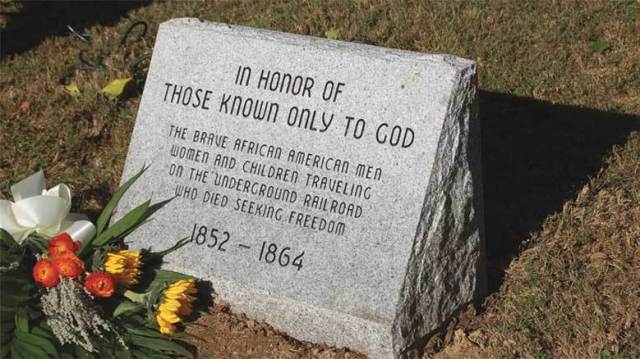
She explains the history of the Upper Dublin Meeting, in Maple Grove, Pennsylvania. The meeting was a station of the Underground Railroad. When runaways died at this station, their bodies were secretly buried in the meeting’s graveyard because it was against the law to help them. This history means a great deal to her.

The article continues: “My leading from God is to do everything in my power to protect the earthly remains of the enslaved African Americans interred in the Upper Dublin meetinghouse graveyard. I have taken this leading personally because these are my ancestors. At a meeting for business, I learned that my meeting was making plans to sell the plots where they knew the enslaved African Americans were buried. I thought that was a desecration of my ancestors’ final resting place. How would you like it if someone disturbed the remains of your loved ones?”

On October 26, 2013, a dedication ceremony was held for the installation of a granite memorial marker where the enslaved African American bodies were buried. The inscription reads “IN HONOR OF THOSE KNOWN ONLY TO GOD / THE BRAVE AFRICAN AMERICAN MEN, WOMEN, AND CHILDREN TRAVELING ON THE UNDERGROUND RAILROAD WHO DIED SEEKING FREEDOM / 1852–1864”

mcclinton-banner

photo credit: Friends Journal, October, 2014

Unfortunately, significant conflicts developed between Avis and most of the other members of Upper Dublin Meeting. You can read about that in the Friends Journal article referenced above.

My connection with Avis was the result her relationship with Bear Creek Friend, Liz Oppenheimer, who began to support Avis during these difficulties with Upper Dublin Meeting.  With Avis’s permission, Liz invited Bear Creek members who were interested, to begin to connect with Avis. This was first done with exchanges of email messages. Then, earlier this year, about eight Bear Creek Friends were able to join a conference telephone call with Avis, where we could hear each other’s voices, and I think we all found to be meaningful. We are all open to continuing communication and possible conference calls, or other ways to support Avis.

Bear Creek Friends have a history of trying to use technology appropriately for our work. For the past several years we have used the practice of asking distant members to join each month’s query discussions by submitting the responses to that month’s query to the meeting. Those responses are included in the discussion at the meetinghouse. The conference call with Avis was another experiment related to working together over distances.

Avis’s Friends Journal article, cited above, concludes with the following queries for us to consider:

“Where is God here? Historically injustice and inequality have been a part of American society and of the Religious Society of Friends. This situation at Upper Dublin Meeting is horrible. Obviously, if these incidents happened to a white Quaker, things would be a lot different. Sadly, the kinds of things that happened to me in my meeting continue to happen to Quakers of color in other meetings. This makes me feel frustrated, marginalized, and alienated. A faith community is supposed to be a nurturing place whose members should not tolerate such hateful actions.

Query: Does your faith community face the need of having honest and open discussions about the legacy of slavery with all its hurtful facets? Can we accept the strong feelings that will arise from these discussions?
Query: Is your faith community prepared to work with your local community to create a racially diverse and equal society?
Query: As a Friend would you allow another individual to insult, demean, hurt, or exclude another from his or her worship? How can people just stand there and let bad things happen?

God has given me the leading to do this work. God is real to me. If God asks me to do something, He expects me to do it to the best of my ability because He said, “I will never forsake you.” The legacy that I want to pass on to future generations does not include hatred.

Where, as a Quaker, do you personally stand on this issue, and where do I go from here?”


Posted in Black Lives, Quaker Meetings, race, Uncategorized | Tagged | Leave a comment

Finding Truth and Beauty

Photography is the primary way I look for and try to express beauty. But I appreciate all forms of art and expressions of beauty.

There is a strong spiritual component to beauty, and strong beauty component to the spiritual.

I’m thinking about beauty more than usual because the theme of this year’s annual sessions of Iowa Yearly Meeting (Conservative) is “Being Centered in an Uncentered World.” The first evening session, Tuesday, July 24th, I’ll being showing some of my photographs for a session titled “Finding Truth and Beauty”. Photography definitely centers me, and helps me find Truth.

As I often write, we don’t have a good vocabulary to express spiritual matters, but art is often able to do so.

But here I’m writing about a beautiful song and performance.  I don’t listen to the radio much, but while driving in Madison, Wisconsin, recently first heard “Lights Down Low’ by someone I hadn’t heard of, Max Schneider (MAX). It’s a song about the love of his life. Max has an amazing voice. He sings this song with “gnash” and the Hells Kitchen Orchestra.


Lights Down Low
Max Schneider

Heaven only knows where you’ve been
But I don’t really need to know
I know where you’re gonna go
On my heart, where you’re resting your head
And you just look so beautiful
It’s like you were an angel

Can I stop the flow of time?
Can I swim in your divine?
‘Cause I don’t think I’d ever leave this place

Oh, turn the lights turn the lights down low
Yeah, now I’m feeling you breathing slow
‘Cause, baby, we’re just reckless kids
Trying to find an island in the flood
Oh, turn the lights, turn the lights down low, oh

Under heavy skies in the rain
You’re dancing in your bare feet
Just like we’re in a movie
Grab my hand and we’re chasing the train
I catch you looking back at me
Running through a cloud of steam

Can I stop the flow of time?
Can I swim in your divine?
‘Cause I don’t think I’d ever leave this place

Oh, turn the lights turn the lights down low
Yeah, now I’m feeling you breathing slow, oh
‘Cause, baby, we’re just reckless kids
Trying to find an island in the flood
Oh, turn the lights, turn the lights down low

And I will give you everything baby
But can you feel this energy? Take it
You can have the best of me baby
And I will give you anything
Can you feel this energy? Take it
You can have the best of me baby

Oh, turn the lights turn the lights down low
Yeah, now I’m feeling you breathing slow
Oh, turn the lights turn the lights down low
Yeah, now I’m feeling you breathing slow
‘Cause, baby, we’re just reckless kids
Trying to find an island in the flood
Oh, turn the lights, turn the lights down low, oh

Songwriters: Liam O’donnell / Max Schneider / Nathaniel Motte
Lights Down Low lyrics © Sony/ATV Music Publishing LLC

Posted in Arts, Uncategorized | Tagged , | Leave a comment

“A new era of peace” in Korea

The leaders of North and South Korea met in an historic meeting and signed an agreement pledging “no more war” and the “complete denuclearization” of the Korean peninsula, calling this a “new era of peace.”

This is a stunning development in light of recent rising tensions between our president and North Korea’s Kim Jong Un. I would think that the cooperation between North and South Korea during the Winter Olympics was a helpful step in this process.

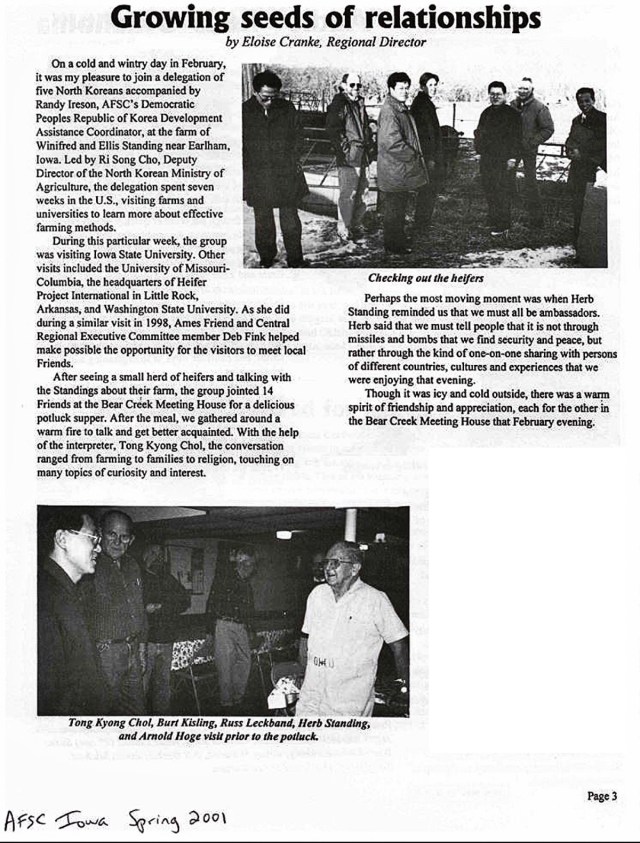
An agricultural delegation from North Korea visited the Midwest in 2001 (see article below),  including a visit and pot luck dinner at Bear Creek Friends Meeting. Last year, when Bear Creek Friends began talking about inviting another North Korean delegation to Iowa, we weren’t sure such a visit would be possible under the new travel ban that included North Korea. But we approved a letter inviting another visit, which was published by the Des Moines Register.

A letter to North Korea

Dear friends,
Many of us at Bear Creek Friends meeting, in the Iowa countryside, were present, and fondly remember the visit of a delegation from your country in 2001. We enjoyed sharing a meal, having you visit one of our farms, and talking together about farming and each other’s families and lives.
Most of us are either farmers or have been involved in farming, and share your interest in providing food for others. It deeply saddens us to know not everyone has enough to eat, in our own country and around the world. We are very interested in doing whatever we can to help improve this troubling situation.
We would welcome another visit from your country. It would be very good to continue to share each other’s work and stories. To talk about how we can provide more food for the world.

Bear Creek Friends Meeting
Earlham, Iowa

In March, Linda Lewis and Daniel Jasper, American Friends Service Committee staff who work with North Korean farmers visited Bear Creek and Des Moines Valley Friends Meetings, and Scattergood Friends School and Farm, to talk about their work in North Korea, and discuss possible ways to make another North Korean visit to Iowa happen.

Recently Daniel wrote that he had been invited to the U.S. State Department to talk about possible North Korean/U.S. exchanges in case the meeting of President and Kim Jong Un happens, and is successful. He told them about the interest of Iowa Quakers. Hopefully this news about a new era of peace in Korea will help make a another visit to Iowa a reality.

AFSC article about North Korean ag visit to Iowa Spring 2001 Edited 2

North Korea visit to Bear Creek 2001

Posted in peace, Quaker Meetings, Uncategorized | Tagged | Leave a comment

National Memorial for Peace and Justice

The National Memorial for Peace and Justice opens today in Montgomery, Alabama. From that name you might be surprised that it is, as the New York Times calls it, A Lynching Memorial.  That article begins:

“In a plain brown building sits an office run by the Alabama Board of Pardons and Paroles, a place for people who have been held accountable for their crimes and duly expressed remorse.

Just a few yards up the street lies a different kind of rehabilitation center, for a country that has not been held to nearly the same standard.

The National Memorial for Peace and Justice, which opens Thursday on a six-acre site overlooking the Alabama State Capitol, is dedicated to the victims of American white supremacy. And it demands a reckoning with one of the nation’s least recognized atrocities: the lynching of thousands of black people in a decades-long campaign of racist terror.”

https://www.nytimes.com/2018/04/25/us/lynching-memorial-alabama.html

the root 1

from The Root

I am reminded of the chant we often use when demonstrating on the streets, “No Justice, No Peace”.  I don’t believe we can make progress for peace and justice until we finally acknowledge our country’s history related to enslavement of Black people, and the theft of land from, and genocide of Native Americans for several reasons. One is that the history we choose to believe, and continue to teach our children, does not own up to what was actually done in the past. Many people who consider themselves White feel affronted by this idea, and don’t want to hear about it now. Another reason is that now, in our time, these same attitudes persist, and continue to be embedded in not only many people’s beliefs, and influence their actions, but continue to influence governmental policies.

Among other things Montgomery was the site of the bus boycott, and the church bombing that killed four children, and where Martin Luther King Jr’s house was bombed.

Until we achieve justice for people of color and Native Americans, we will not have peace. That is why I think the name of this new memorial, National Memorial for Peace and Justice, is so appropriate.

There will be many stories about the Memorial on this opening day. I previously wrote a fuller description of the Memorial itself, including the 60 Minutes segment by Oprah Winfrey.


Posted in Black Lives, Indigenous, peace, race, Uncategorized | Leave a comment

Overground Railroad Update

I have been writing about the likelihood of the migration of millions of people, climate refugees, from coastal areas to the middle of the country when the oceans rise, calling this the Overground Railroad. I began thinking about this in response to a recent article in Friends Journal, in which Donald McCormick asks “why is there no vision for the future of Quakerism?”

My vision for the future of Quakerism is that Friends will lead the way in responding to our increasing environmental damage and the resulting chaos in several ways. One will be figuring out how to rapidly build communities for the new arrivals, basically pre-fab communities. These communities will need to be created with very simple structures built with local materials, such as straw bale houses, or berm houses. Kitchen and bathroom facilities will be in a common area, shared by all. Food would be grown in fields around the community.  Cisterns and rain barrels would help with water supplies. Acquiring solar panels while they are still available would provide a source of electricity.

Friends from the San Diego area who are interested in this idea pointed out it would be best if those who will be migrating learned as much as possible about building the structures, raising food, etc, prior to moving inland.

The Facebook group, Overground Railroad, was created for discussion of these ideas.

The other way Friends can help is with spiritual leadership and support. It is clear that a major part of the response to our environmental crisis is the need to return to valuing relationships among people, and with Mother Earth. To reject the idea that natural resources can be owned by corporations and can be used without regard to the consequences to society and our environment. The examples of indigenous people rising up to protect the environmental all over the world is one we should honor and embrace. The powerful, nonviolent response at Standing Rock is an example. We need to support and become water and earth protectors ourselves. This is all based upon a spiritual vision, one that is a natural fit for Quakers. I urge Friends to engage with these efforts.

There is a great deal of inertia related to these ideas. Few people grasp the urgency of working on these things. An excellent explanation of how rapidly sea levels may rise, written by Kevin Loria was published yesterday in Business Insider, http://www.businessinsider.com/antarctic-glacier-melting-could-warm-seas-and-cause-ice-shelf-collapse-2018-4

From the article:

  • Warm waters are pooling underneath Antarctic glaciers in a way that’s causing glaciers to melt more rapidly and preventing the formation of cool water beneath Antarctica, according to a new study.
  • This could slow ocean currents and potentially lead to a rapid sea-level rise event known as a pulse.
  • Such an event could be devastating, causing sea levels to rise by more than 10 feet by the end of the century.


Posted in #NDAPL, civil disobedience, climate change, climate refugees, Indigenous, Quaker Meetings, spiritual seekers, Uncategorized | Leave a comment