Formula for Success

I can’t find the article I read recently, but I remember the formula for success that it was written about:

stress  +  rest  =  growth

Searching the Internet reveals there are a lot of articles about various formulas for success.

This one caught my attention because it is a formula I have used most of my life in a number of areas.

Studying is probably the first area most of us learned to use this formula. Teachers and books teach us new things. It is often a struggle (stress) to understand new material, but as we alternate between going over the material time and again, with times of rest in between, our knowledge grows. Often during rest we have insights that help us learn (grow).

If you want to learn (grow) more, you challenge yourself (stress) to delve into subjects more deeply, and achieve some expertise in the subject area (growth). There have to be times when you take a break for the studying (rest). Most of us can’t study constantly, and during these breaks we often review what we are learning. Often new connections to things we already know are revealed during these times of rest.

A large part of my career in medical research involved software development. Computer programmers have no choice but to learn new computer languages, systems and techniques because of continual improvement in computer operating systems, languages and frameworks both offer advantages over the old ones, and also makes what you used to use obsolete many times. The concept of life long learning really applies to computer programmers. They have to continuously grow. But periods of rest are needed to allow the material to sink in. I remember some times when I was determined to keep trying to solve a programming problem, and would continue for hours without success, only to find the next morning (after rest) the answer almost magically appeared.

I especially use this formula to improve (grow) my photography. I purposely look for images that will be difficult (stress) to capture, either because of lighting or composition challenges. Even though I might not get exactly the image I wanted, the photos improve (grow). But an important part is to spend time reviewing the photos (rest) to see what worked well, and what didn’t. I spend hours watching slideshows of photos and usually learn something by doing so.

This formula can also apply to my spiritual life. During periods of rest I think about ways I am being challenged (stress) to understand things like white privilege or Indigenous spiritual practices. Prayer and meditation are the tools I use to try to make progress related to these things and over time, grow spiritually.

I look forward to being offered opportunities to grow by accepting invitations to do things like give presentations or clerk a committee. These things often are quite stressful, but I know I will grow as a result of trying to figure out how to do these new things. A recent example of that relates to being clerk of the Peace and Social Concerns Committee for my Yearly Meeting, some of which I tried to explain in yesterday’s blog post. I often make mistakes, sometimes hurting others in the process, sometimes getting very discouraged. But seeing these things as stresses that will eventually lead to growth helps put things in perspective.

I eagerly took the challenge of becoming connected to the Kheprw Institute, the Black youth empowerment organization in Indianapolis. I recognized this would be an opportunity to begin to really learn about race relations, even though it was pretty intimidating at first. I’ve made mistakes, but I have definitely grown.

If we want to grow, we have to seek out these stressful situations. We have to assume we will make mistakes, because how else does anyone learn? If you keep doing the things you have always done, in the way you always do, there is no growth there.

One of the best things I got out of our recent Yearly Meeting sessions was a feeling that the Peace and Social Concerns committee has recognized how little we actually know about racism and privilege. People were hurt in the process of discovering this. But we have accepted the challenge to learn more about this for ourselves, and so we can use what we learn to help our Yearly Meeting learn about, and move away from white privilege and systemic racism. We have taken on the stress of this so that we will be able to grow.

Posted in Kheprw Institute, race, Uncategorized | Tagged | Leave a comment

Reflections on a Quaker Annual Meeting

I just returned home from a week spent at Scattergood Friends School, where the annual meeting of Iowa Yearly Meeting (Conservative) was held. My blog posts are definitely not official or approved by the yearly meeting.

This post is a way for me to reflect on my experiences there this year, especially those that were traumatic.

The theme for this year’s meetings was “Being Centered in an Uncentered World.” Its ironic that I was knocked off-center many times during the week.

The week began well. The first evening program on Tuesday was “Finding Truth and Beauty–Jeff Kisling will share his photographs as a focus for how we find truth and beauty in the world.” I was glad to have this opportunity. My experience has been that computer projectors do not display photos well, with problems related to resolution, color and brightness. I had been thinking about getting a large screen TV for photo editing and display. Many evenings I have a slideshow of my photos run while I read. So I purchased a 65 inch screen so the photos would be clearly seen during the presentation.

About a week ago I was trying to organize my thoughts about photography in preparation for this program, writing about how a vision of smog obscuring the mountains made me into an environmental activist. I briefly told that story at the beginning of the program. Then we watched the slideshow together in silence, a visual worship sharing. The photos were grouped into some of my favorite photos, mainly of flowers or unusual compositions. A second group were photos of the many activist things I have been involved with, such as the Keystone and Dakota Access pipeline resistances, time at the Kheprw Institute, etc. The final group were photos of the Rocky Mountains.  Then the audience was invited to share any thoughts they had, and quite a number of people said some very nice and interesting things.

Most of the rest of the time was spent working with the Peace and Social Concerns Committee, of which I am the clerk. We met for an hour in the morning and an hour after lunch. Usually around a dozen people attended, and not always the same people. Anyone is welcome to attend these meetings. Each Quaker meeting has their own Peace and Social Concerns Committee, and those are the people who usually attend these meetings during the annual meeting.  Each of these local meetings send a report of their peace and social concerns work to the clerk of the Yearly Meeting’s Peace and Social Concerns Committee (me). The way things are supposed to work is the local meetings may decided there are things they think the whole Yearly Meeting should address, most often in the form of Minutes, which are statements about a specific issue, or letters to our Congressional representatives.

The things that were brought to us to work on this year were a letter about the Authorization for the Use of Military Force (AUMF), a Minute related to the children being torn away from their families at our Southern border, a Minute about racial justice, and a request to send a contribution to Casa Pueblo, a community based solar energy company in Puerto Rico. Approving the money for this solar company was the easiest thing we did.

The AUMF has been the way Congress gives the President the permission to carry out military operations without actually declaring war (which was last done Dec 8, 1941). The current AUMF’s were used by President’s Bush, Obama and now Trump to justify expanding the so-called war on terror wherever they wanted to. The letter that our committee was asked to approve said those AUMF’s should be terminated and also to reject the new AUMF that was being developed by the Senate Foreign Relations Committee, which would give even more war power to the President.

Our committee approved that letter with minor changes and it was given to the Yearly Meeting clerk so that it could be read for comments and possible approval during the business sessions of the Yearly Meeting. That discussion did not go well. One Friend forcefully declared he could not believe that we were saying it would be permissible to go to war as long as the process for improving AUMF’s was done correctly, going on with Bible scripture and our Quaker testimonies and how this letter betrayed those.

Perhaps the letter could have been modified to be clearer, but it was asking Congress to take back the responsibility for declaring war, which the U.S. Constitution says is the responsibility of Congress, not the President, so there are checks and balances, making it more difficult to declare war. Then we as citizens would have an opportunity to try to convince our own representatives to vote against a declaration of war.

If that was unclear to this Friend, it would have been better if he had asked for clarification before he suggested we were supporting any type of war. The monthly meeting that sent this to our Yearly Meeting Peace and Social Concerns Committee worked through the process of writing and approving this letter. Then our committee considered it, made some modifications, and also approved it. For this Friend to accuse all of those people of supporting war was deeply hurtful to me, and I would assume everyone else who had worked on it.

This led to a very lengthy discussion about AUMF’s and peace testimony and war, some of which was helpful, such as whose responsibility it is to speak about these things. It was said that it would probably be more effective if we engaged with our local representatives ourselves, rather than have one letter sent from a group of people, not all of whom the Congressperson or Senator represented.

Perhaps the best thing that came from that discussion was questioning why we spent so much time and effort related to these letters in these days when Congressional offices are flooded with thousands of email messages and phone calls. I have also felt these letters were no longer effective, as they were in years past, and spoke during this meeting in support of us stopping this practice.

In 2016 Iowa Yearly Meeting (Conservative) approved a Minute on Racial Justice, which encouraged us to examine how we benefit from white privilege. Feelings ran high at that time. Our committee was asked to revise the minute, but after an intense hour and a half, we could not come up with anything better, and told the Yearly Meeting that when we reconvened. I assumed we would then not approve the Minute. Instead, someone asked to hear the Minute again, and it was approved. I was surprised and uncomfortable with that decision, since there still seemed to be people who were uncomfortable with it.

Quakers in our Yearly Meeting have been struggling with racism and white supremacy for a long time. We are not a very diverse group, historically or now. Closer study of the abolitionist movement has shown fewer Quakers were involved with that work than we might like to think.  It is very uncomfortable for white Friends to be told how much they continue to benefit from privilege.

One meeting approved a Minute as a kind of follow up to the 2016 minute that asked us to examine our lives to see where we benefit from privilege now. Early in the discussion of that it became very clear that we continued to cause hurt and harm, unintentionally, because those of us who are white continue to do and say things that display our ignorance of the privileges we have because of our skin color.  That led to an excellent suggestion for us to ask for outside help, which we plan to do. We want to do the work on our own knowledge of privilege, so we can then serve the rest of the Yearly Meeting by helping them learn what we are going to learn. We have a vision of our Yearly Meeting eventually understanding white privilege and living in ways that are no longer privileged. We realized we did not understand racism and white privilege well enough to be able to suggest a Minute such as the one proposed, so we did not approve it.

Finally we considered the Minute related to the separation of families at our Southern border. One Friend asked us how we decide when a Minute is needed, and why this Minute? Another Friend berated us, saying “all I hear is should, should, should. Where is the love?” I wondered where is the love for our Peace and Social Concerns Committee?

But getting past the angry tone, the Friend had a good point. We were asked to work some more on the Minute. I wrote something much shorter that we looked at when the Committee reconvened. This is where the Committee was especially helpful. They said the new version was so weak, why bother, and they were absolutely right. They also felt all of the information in the original Minute was important. Someone on the Committee expressed the truth that the Yearly Meeting was considering this at a deeper level than we had, which was hard to hear, but I agreed with.

The following discussion included ideas such as it was Spiritual damage that was being done to the children, their families, and the oppressors. And that the issue is not immigration, but asylum because these people were at grave risk if they stayed where they were.

Although it was rough getting there, thanks to this work a much better Minute resulted. We are not supposed to be sharing these things until we get the approved version from the Yearly Meeting clerk, but these excerpts might give you an idea of the changes.

Original version begins : “In the face of almost universal condemnation at home and abroad, the President has been forced to stop his decision to forcibly remove children from their families at our southern border. Unfortunately, much damage has already been done, to the children and their families, and to our social fabric. The least we can do is work for the immediate reunion of these children with their families. That should include providing transportation back to this country for those who were deported while their children were held in camps here. Mental health services should be provided to those traumatized children…”

The new version begins:  “At the root of our faith is the sacredness of relationships among ourselves and between us and God. We have been heartbroken to see those sacred connections broken as children are separated from those who love them. We are so thankful for the efforts of those who are working toward the goal of reuniting every child with their family.
We affirm the right of anyone to seek asylum…”

Committee work can be difficult. But it can also be very meaningful when a group comes together to do this work. I am grateful the Peace and Social Concerns Committee, along with direction from the Yearly Meeting, was able to accomplish what was done this year.


Posted in peace, Quaker Meetings, race, Uncategorized | Tagged , , | 3 Comments

Visual Leadings

Yesterday I tried to explain how I see photography as a spiritual practice. As often happens, I realized there was more I wanted to say. I tried to explain how my awareness of the beauty of the natural world being threatened by smog triggered a deep concern that has persisted since. Photography had awakened my love of natural beauty first. Then the idea that we might not be able to continue to see that beauty set the course for my life’s work to try to prevent that from happening.

The process of taking a photograph is itself a spiritual practice. As I spent more time in the natural world, I found my “eye” was being guided to see things. Similar to Quaker worship, I was getting leadings, in this case visual leadings. I found if I stood still and quiet, I would discover an image to photograph. This eventually led to conversations with the Spirit. “That is a beautiful flower you created God.” “You painted the sky brilliantly”. “That is a nice arrangement of rocks.”

The awareness of these visual leadings helped me maintain a spirit of worship throughout the day.

One morning I had a visual leading during meeting for worship at North Meadow Friends. I noticed the shadows of a curtain moving on the back of the wooden bench in front of me. The shadows moved as the curtain moved gently in the wind. That led me to share a message. As usual, I had my camera with me. After meeting, I recorded this short video to show what I was seeing, and I repeated the message I was given. This was a convergence of spiritual and visual leadings I was blessed to experience.

After meeting my friend Daniel Ballow said, “I always wondered what spiritual fire looked like.” To which I said, “now you know.”

Posted in Quaker Meetings, spiritual seekers, Uncategorized | Leave a comment

Photography as spiritual practice

As I wrote a month ago, the theme of the upcoming annual meeting of Iowa Yearly Meeting (Conservative) is “Being Centered in an Uncentered World.” The first evening session will be “Finding Truth and Beauty” where I will share my photographs “as a focus for how we find truth and beauty in the world.”  I had intended to try to organize my thoughts by writing here about that, but each day since, there were other things to write about. I don’t know what I will write about until I sit down in front of the computer and listen to what I am being led to write that day. Writing is a spiritual practice. But time is pressing because this presentation will occur next Tuesday.

This morning I will try to organize my thoughts to explain why photography is also a spiritual practice in preparation for that presentation.

I am so grateful that my parents took us camping for our summer vacations as I was growing up. We would camp in various national parks, but the vast majority of the time we camped in Rocky Mountain National Park which was everyone’s favorite. There were so many sights like Long’s Peak, Hallett’s Peak, Bear Lake, Sprague Lake, Dream Lake, etc. Our early campers were ‘fold-ups’, the upper part made of canvas. There wasn’t a heater, so we often awoke to (very) crisp mornings. But we felt immersed in the woods, could smell the pines and hear the birds. Each day we would choose a different trail to hike, and there were so many to choose from.

One of the many things I’m learning from Indigenous ways is the Spirit is in all things, including animals, plants, water, sky and mountains. I felt this deeply when I was in the forests and mountains. I’ve heard others express this in various ways as feeling closer to God, and that was how I felt.

I’m also very grateful that I learned the basics of film and paper development at Scattergood Friends School. I gathered the equipment needed to setup a darkroom in the bathroom of whichever apartment I was living in.

It was a real joy to try to capture what I felt when I was in the mountains and woods with the camera, and then make the photographic prints of those images. It was also frustrating to try to do justice to the views when constrained by two dimensional, black and white prints. But with a lot of practice, I began to get more satisfying results. I eagerly awaited each new visit to the parks.

This spiritual connection I ‘developed’ (pun intended) with the mountains, lakes and forests had profound consequences in my life.

When I moved to Indianapolis in 1971, the city was enveloped in smog. This was before catalytic converters, which began to appear in 1975. When I saw that, I had a profound spiritual vision of the Rocky Mountains being hidden by clouds of smog. The possibility that I would no longer be able to see the mountains shook me to my core.

From that moment on I saw cars as ‘evil’ because of the damage they were doing. I decided I could not be part of that, and have lived without a car since then. I began my lifelong study of environmental science and work to try to bring awareness about the catastrophic damage being done to Mother Earth. Although I give thanks that catalytic converters took care of the visible smog, I knew of the continued damage and consequences of the tons of carbon dioxide and other gases coming from the exhaust of ever increasing numbers of cars.

I also saw automobiles as the ‘seeds of war’.  For example, although other reasons were given at the time, the invasion of Iraq was to protect the oil fields there.

“I told [the Commonwealth Commissioners] I lived in the virtue of that life and power that took away the occasion of all wars… I told them I was come into the covenant of peace which was before wars and strife were.” George Fox

“Oh! that we who declare against wars, and acknowledge our trust to be in God only, may walk in the light, and therein examine our foundation and motives in holding great estates! May we look upon our treasures, and the furniture of our houses, and the garments in which we array ourselves, and try whether the seeds of war have nourishment in these our possessions, or not. Holding treasures in the self-pleasing spirit is a strong plant, the fruit whereof ripens fast.” John Woolman

It was camping in the national parks, and spiritual connections to the lakes, forests, wildlife, sky and mountains, that made me become a lifelong environmental activist. And photography was how I tried to express that for myself, and others. I was still afraid environmental damage from burning fossil fuels would damage the mountains, so I tried to preserve those scenes with photographs. And that may happen with higher air temperatures, likelihood of forest fires, infestation with migrating insects, torrential downpours, etc.

I also hoped, as other photographers have, that sharing this beauty with those who hadn’t visited the mountains might make them care more about Mother Earth, though there is little evidence of that happening.

There were many other ways photography has been important in my life.

In 1971-3 I was part of the Friends (Quaker) Volunteer Service Mission (VSM) in an inner city neighborhood on the Southwest side of Indianapolis. My focus was working with the youth there. One thing I did was setup a darkroom in the bathroom of the VSM house, and teach the kids how to develop film and prints. I can still see their faces as the image magically appeared in the developing tray. That led us to take cameras on bicycle trips around the city, and then developing those photos. Through the magic of Facebook, recently two of those kids connected with me, and each mentioned those days when we developed photos.

Not having a car had several other effects. One was I became an avid runner, since running was often my mode of transportation. That, among other things, led to the joy of running in the annual mini-marathon for 22 years.

The other effect of not having a car was I was able to stop and take photos of things I saw as I walked to and from work and other places. I began to have to leave for work earlier to account for the time I was stopping to take photos. I also began to see more and more detail as I took more photos of flowers and other things. I was being taught to ‘see’ more, the more photos I took. I learned about the incredible shapes and colors of flowers, for example.

Another thing that happened was as I became more involved in social activism, I became a photojournalist, documenting the things I was involved in.  That included the Keystone Pledge of Resistance, Indiana Moral Mondays, Black Lives Matter, Dakota Access pipeline resistance and Poor People’s Campaign among others.

I’ll close with my experience with the Kheprw Institute (KI), which is a Black youth mentoring and empowerment community on the near north side of Indianapolis. It was an environmental event held at KI that introduced me to this community. They demonstrated their aquaponics system and rain barrel making enterprise. But I also recognized this as an opportunity to finally begin to learn about racial justice, which I’ve written quite a bit about.One thing I knew (from what I learned from Quaker Social Change Ministry) was it was important for me to wait to be asked what I could do in the KI community. It was important not to try to offer my own suggestions. After over a year of spending time at KI, I was asked if I would be interested in teaching about photography in the upcoming summer camp.  I was very happy to have the opportunity to do so.


Posted in #NDAPL, Arts, Black Lives, Indiana Moral Mondays, Keystone Pledge of Resistance, Kheprw Institute, Poor Peoples Campaign, Quaker Social Change Ministry, race, Uncategorized | Tagged | Leave a comment

Living the Change

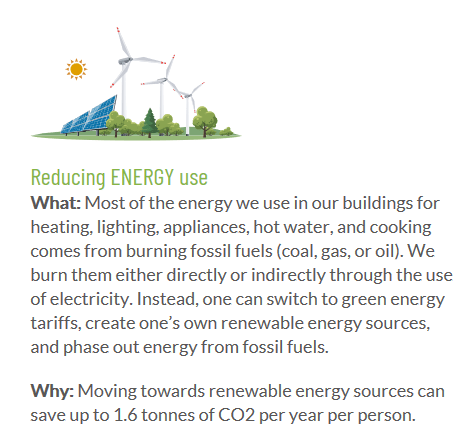
As I wrote yesterday, I heard from Susanna Mattingly, the Sustainability Communication Officer for the Friends World Committee for Consultation (FWCC). FWCC is joining a multi-faith campaign to work for sustainable living, called Living the Change.   This encourages us to make personal commitments to make changes in our own lives to reduce our impact on our environment.

“Each of us has the power to make faithful choices for a flourishing world. If we have the courage to listen to the spirit, together we can ensure a peaceful and just future for our common home.”    – Gretchen Castle, FWCC General Secretary

“Friends are encouraged to challenge themselves and to simplify their lives in ways that can enhance their spiritual environmental integrity.” from the Minute on Ethical Transportation, Iowa Yearly Meeting (Conservative)

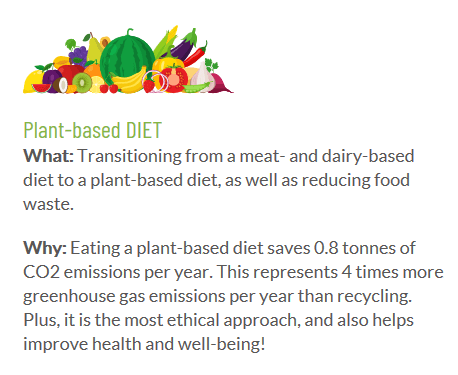
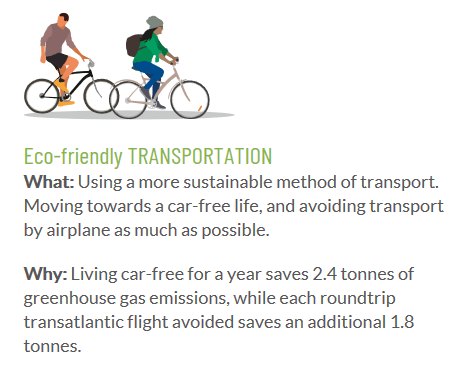
The focus of Living the Change is on three high-impact areas: transportation, home energy use, and diet.
Plant base dietReduce energy use
Eco friendly transportation
Yesterday I wrote about the Minute on Ethical Transportation that Iowa Yearly Meeting (Conservative) approved last year, that encourages the use of bicycles for transportation.

Also, from a Minute approved in 2008:

We encourage Friends to be examples as we explore creative ways to promote renewable energy, reduce energy consumption, recycle, and facilitate the use of local foods and products.  There is an urgent need to curb oil consumption and greenhouse gas emissions dramatically, right now.  Until some of these physical and social changes occur, it may be difficult for some Friends to give up their cars.  Doing so as soon as possible is our goal, and could be a catalyst for change of the magnitude needed to reduce the current rate of environmental damage. Iowa Yearly Meeting (Conservative)

Increasingly violent weather is one effect of climate change.  It was shocking to see the damage from multiple tornadoes across Iowa yesterday, especially in Marshalltown where I once lived. While some might argue it cannot be proven those tornadoes were caused by climate change, increasingly violent weather from climate change is being observed around the world.

https://nca2014.globalchange.gov/highlights/report-findings/extreme-weather

https://www.scientificamerican.com/article/extreme-weather-caused-by-climate-change/

The Red Cross set up an emergency shelter at the Meskwaki Conference Center. We discussed “Building Bridges with Native Americans” at Yearly Meeting last year.  One of the panel participants was Donnielle Wanatee from the Meskwaki settlement. Donnielle and I spoke briefly about that discussion as we traveled together to Minneapolis in February for a demonstration in front of the US Bank headquarters regarding their funding of fossil fuel projects.

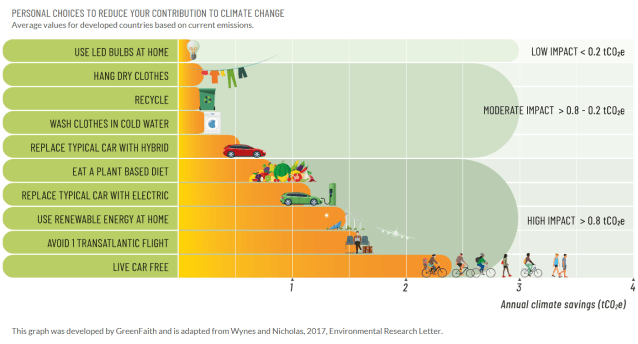
personal impact

This graph was developed by GreenFaith and is adapted from Wynes and Nicholas, 2017, Environmental Research Letter.

climate march poster

Posted in #NDAPL, climate change, Quaker Meetings, Uncategorized | Tagged , | Leave a comment

Truth, Beauty and Bicycles

This morning I received this message from Susanna Mattingly, the Sustainability Communication Officer for the Friends World Committee for Consultation (FWCC):

I’m trying to select a few images that will represent Quakerism to faith groups all around the world. FWCC (as the body representing Quakers worldwide) has just joined a global multi-faith sustainable living initiative and we are creating ‘pledge cards’ for each faith, where inspirational Quaker text/quotes will be superimposed over significant images.

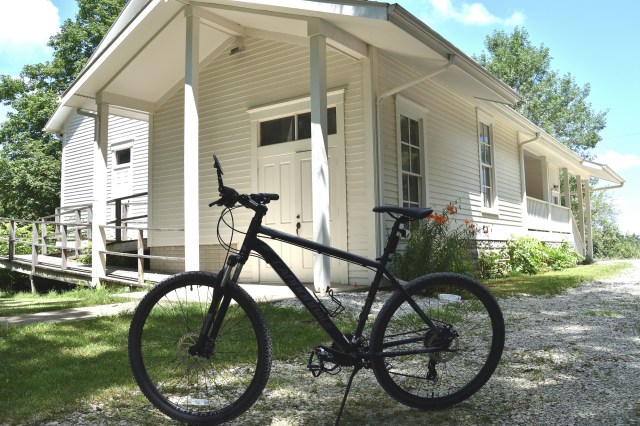
Since Quakers don’t have sacred places, people or statues like many faiths do it’s proving a bit tricky but I wondered if you would be willing for us to use one of the photos you sent me some months back, of a bicycle in front of what I think is Bear Creek meeting in Iowa.

This is the photo that Susanna is referring to:

Iowa Yearly Meeting (Conservative) bike_01

Bicycle for ethical transportation. Bear Creek Friends meetinghouse, Earlham, Iowa

The reason Susanna had this photo was because she had contacted Iowa Yearly Meeting (Conservative) when she was creating case studies about what Quakers are doing regarding sustainability. You can see those case studies here: http://fwcc.world/sustainability-resources

IYMC screnshot

Higher resolution pamphlet available  here: http://fwcc.world/sustainability-resources

A higher resolution version of the pamphlet can be found here: http://fwcc.world/wp-content/uploads/2018/01/Case-Study-Iowa-Yearly-Meeting-Conservative.pdf

The bicycle photo was used to illustrate the Ethical Transportation Minute that was approved by Iowa Yearly Meeting (Conservative) in 2017 (below). That Minute included the suggestion that Friends make more use of bicycles as an alternative to fossil fuel transportation.

Several other blog posts related to FWCC sustainability and Iowa Yearly Meeting (Conservative)’s work can be found here: https://kislingjeff.wordpress.com/?s=fwcc

The title of this post relates to the evening session we will have at Iowa Yearly Meeting (Conservative)’s annual sessions next week titled “Finding Truth and Beauty” in the photographs I will be sharing. This photo seems like a good example of that idea.

2017   Minute   Ethical Transportation

Radically reducing fossil fuel use has long been a concern of Iowa Yearly Meeting (Conservative). A previously approved Minute urged us to reduce our use of personal automobiles. We have continued to be challenged by the design of our communities that makes this difficult. This is even more challenging in rural areas. But our environmental crisis means we must find ways to address this issue quickly.
Friends are encouraged to challenge themselves and to simplify their lives in ways that can enhance their spiritual environmental integrity. One of our meetings uses the term “ethical transportation,” which is a helpful way to be mindful of this.
Long term, we need to encourage ways to make our communities “walkable”, and to expand public transportation systems. These will require major changes in infrastructure and urban planning.
Carpooling and community shared vehicles would help. We can develop ways to coordinate neighbors needing to travel to shop for food, attend meetings, visit doctors, etc. We could explore using existing school buses or shared vehicles to provide intercity transportation.
One immediately available step would be to promote the use of bicycles as a visible witness for non-fossil fuel transportation. Friends may forget how easy and fun it can be to travel miles on bicycles. Neighbors seeing families riding their bicycles to Quaker meetings would have an impact on community awareness. This is a way for our children to be involved in this shared witness. We should encourage the expansion of bicycle lanes and paths. We can repair and recycle unused bicycles, and make them available to those who have the need.


Posted in bicycles, Ethical Transportation, Quaker Meetings, Uncategorized | Tagged , | Leave a comment

Who am I?

My Quaker meeting, Bear Creek, is part of Iowa Yearly Meeting of Friends (Conservative). As the name implies, people who belong to this group of Quaker meetings come together annually for business, worship, learning and spending time with each other.

Each year there is a theme for the week. This year it is “Being Centered in an Uncentered World”.

Quakers use the word ‘centered’ to describe how we create the conditions, either individually or as a group, to block out the noise and activity around us, and thoughts within us, so that we can focus on our inner spiritual ‘center’ in order to hear what God or the Spirit is saying to us. Quaker meetings for worship are a group of people who are centering themselves, which sometimes results in the group being centered. The way we know that the group (meeting) has been centered together is when messages are spoken into the silence that mirror what others present are experiencing.

It is clear that we are living in an ‘uncentered world’ today.

There is a program each evening at yearly meeting, each related to that year’s theme. The program describes the first evening program as: “Finding Truth and Beauty–Jeff Kisling will share his photographs as a focus for how we find truth and beauty in the world.” I am honored that I will have this opportunity, and have been sorting through which photographs to use, trying to figure out which ones demonstrate finding truth.

As often happens, opportunities such as this give us chances to reflect on things that we often don’t spend much time thinking about, which is why I appreciate them.

The reason for the title of this blog post though relates to a different piece of this. I was asked to provide a brief bio for the program. I have just retired from my career at Riley Hospital for Children, as a medical researcher, software engineer and respiratory therapist. And moved to Iowa. So that no longer defines me, but I hadn’t thought much about who I am now.

I came up with a list of possibilities to choose from, but the entire list was used. The bio on the program reads:

Jeff Kisling is a water protector, community organizer, spiritual warrior, writer, photojournalist, medical researcher and member of Bear Creek Friends Meeting.

Quakers believe we shouldn’t draw attention to ourselves, and some of those terms sound a little presumptuous. One of the reasons for this blog post is to explain some of those descriptions.

Water protector–I was an Action Lead in the Keystone Pledge of Resistance and then helped organize related to the Dakota Access pipeline. Both campaigns were attempts to block tar sands oil pipeline construction in order to protect the environment from pollution of the air when the oil is burned, and of the land and water when the pipelines spill. I like the term water protector that was used at Standing Rock. I think it is better to be for something than against something, even if it is just a matter of which terms you choose to use. Positive is in line with hope, and invites opponents to join, rather than negative terms that put barriers between you and your opponents.

Community organizer–My first experience with organizing was when I organized a draft conference when I was a Senior at Scattergood Friends School in 1969, at the time of the Vietnam War.

From 1971-3 I participated in the Friends Volunteer Service Mission (VSM) in an inner city neighborhood in Indianapolis. My focus was working with neighborhood youth. There were no youth programs in that part of the city at that time.

I was very fortunate to have been trained as an Action Lead during the Keystone Pledge of Resistance. Todd and Gabriel from the Rainforest Action Network spent a weekend in Des Moines at Iowa Citizens for Community Improvement, teaching a small group of us how to organize and carry out acts of nonviolent civil disobedience. I returned to Indianapolis where I spent the next several years training local activists and organizing events to spread awareness about the dangers of the Keystone Pipeline. I was also able help organize our efforts in Indianapolis to oppose the Dakota Access pipeline.

I helped organize Indiana Moral Mondays, related to Rev. William Barber’s Moral Mondays campaign that started in North Carolina.

I also helped organize our Quaker Social Change Ministry efforts with Friends at North Meadow Circle of Friends, and our connections with the Kheprw Institute.

Spiritual warrior–This is the term I’m afraid people might see as presumptuous. But I was given that title by my friend and fellow NoDAPL organizer, Joshua Taflinger, who wrote the following:

I am inspired to share with you all more directly a post I wrote, because I consider you an established & effective nature/spiritual warrior, and believe that there is a need for the perspectives shared in the attached post to be more common thought in the minds of the many.
If you feel truth from this writing, and are inspired, I highly encourage you to re-write your own version, in your own words/perspectives, and post to your network.
With the intention of helping us all wake up, with awareness, clarity, and direction.
..spreading and weaving reality back into the world….

What has risen to the surface at Standing Rock is a physical/spiritual movement. Learn how to quiet your mind. To find the silent receptive space to receive guidance. To learn to adapt and follow the pull of synchronicity to guide you to where you will find your greatest support and strength.

What I have found in my time praying in the indigenous earth based ways, is that it’s not about putting your hands together and talking to god…. It’s about quieting and connecting with the baseline of creation, of nature. Tuning into the frequency and vibration of the natural world, the nature spirits. The beings and entities that have been in existence, for all of existence, the examples and realities of sustainability and harmony.

It’s about becoming receptive to these things. Being open and flowing with them. The spirit guides us, but we have to make ourselves receptive to feel, sense, and respond to this guidance.

Receiving this message from Joshua, and how it complements Quaker thought, I began to aspire to the spirit of the message and idea of spiritual warrior. As Joshua suggested, I have written and shared about the concept of spiritual warriors since.  https://kislingjeff.wordpress.com/?s=spiritual+warrior


Posted in #NDAPL, civil disobedience, climate change, Indiana Moral Mondays, Kheprw Institute, Quaker Meetings, Quaker Social Change Ministry, Uncategorized | Tagged , , | Leave a comment

A Difficult Time

Yesterday’s meeting between the United States President and Russian leader Vladimir Putin represented the culmination of an administration that has upended many of the norms by which our government functioned and changed our relationships with other countries.  There is much confusion and concern.

I recently shared some of what Thomas Kelly wrote about the relationship between faith and social concern. https://kislingjeff.wordpress.com/2018/06/13/the-eternal-now-and-social-concern-2/

Following is more from his “Testament of Devotion.”

“The experience of Divine Presence changes all this familiar picture. There come times when the Presence steals upon us, all unexpected not the product of agonized effort, and we live in a new dimension of life. You who have experienced such plateaus of glory know what I mean. Out from the plain of daily living suddenly loom such plateaus. Before we know it we are walking upon their heights, and all the old familiar landscape becomes new. The experience of Paul is very true: ‘The former things are passed away; behold, they are become new.” One walks in the world yet above the world as well, giddy with the height, with feather tread, with effortlessness and calm security, meeting the daily routine, yet never losing the sense of Presence. Sometimes these periods are acute and brief, too dazzling to report to anyone. Sometimes they are less elevated but more prolonged, with a milder sense of glory and of lift, yet as surely of a piece with the more acute experience. Such experiences are emotionless, in themselves, but suffuse all emotion with a background of peace, utter, utter peace and security.”

As have many Friends and others, I have been blessed to have “experienced such plateaus of glory.”

This is not to say that we should turn away from the strife of everyday life, especially such as our current political situation. But we should pray and center ourselves in the Light within us. We should listen closely for the guidance from the Presence. We should act as peacemakers, helping our fellows avoid the pitfalls of anger and despair, and remember there is that of God in everyone, even those who seem intent on doing us, our social fabric, harm.


Posted in Uncategorized | Tagged , | Leave a comment

“We Will Be Waiting”

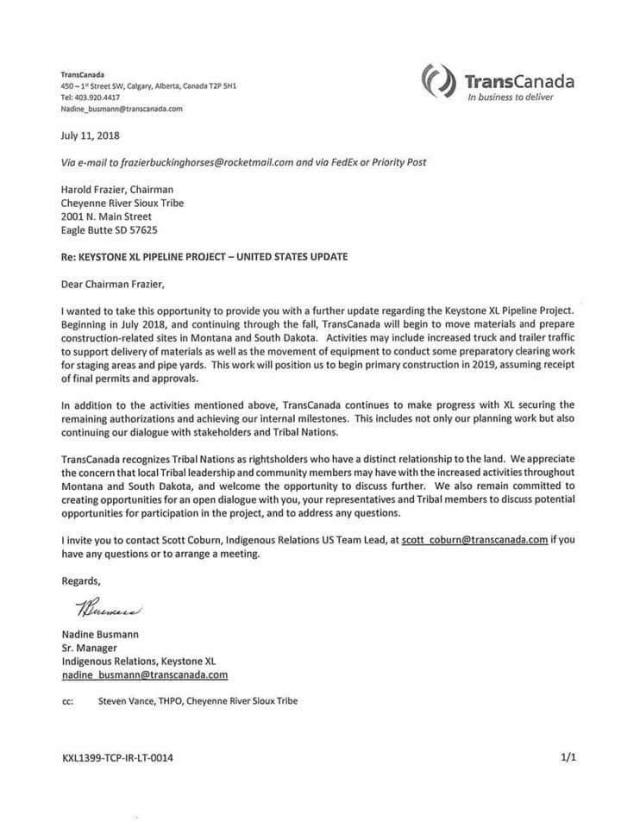
The Keystone XL pipeline is back in the news. Wednesday, July 11, the Cheyenne Sioux River Nation in South Dakota received the following letter from TransCanada.transcanada-letterThe Cheyenne River tribe has opposed the Keystone pipeline since it was first proposed in 2008. The tribe’s land in central South Dakota is just south of Standing Rock. The Cheyenne River tribe supported the water protectors at Standing Rock who opposed the Dakota Access pipeline, and is concerned  that similar efforts will be needed to resist the Keystone XL pipeline that is planned to cross the Cheyenne River just upstream of the tribe’s land.
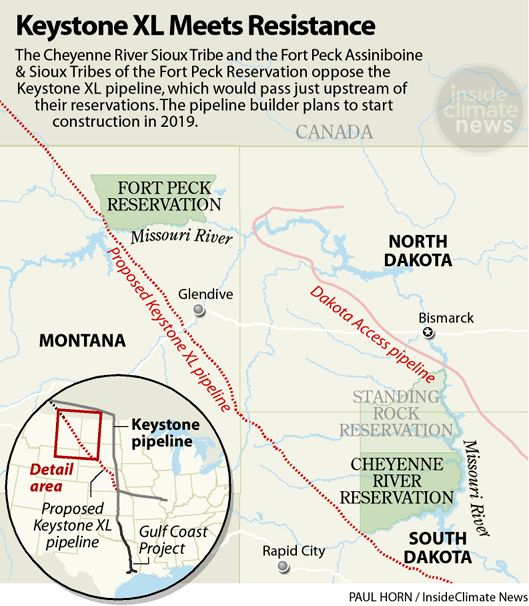
Keystone-XL-Resist-MT-SD-529px

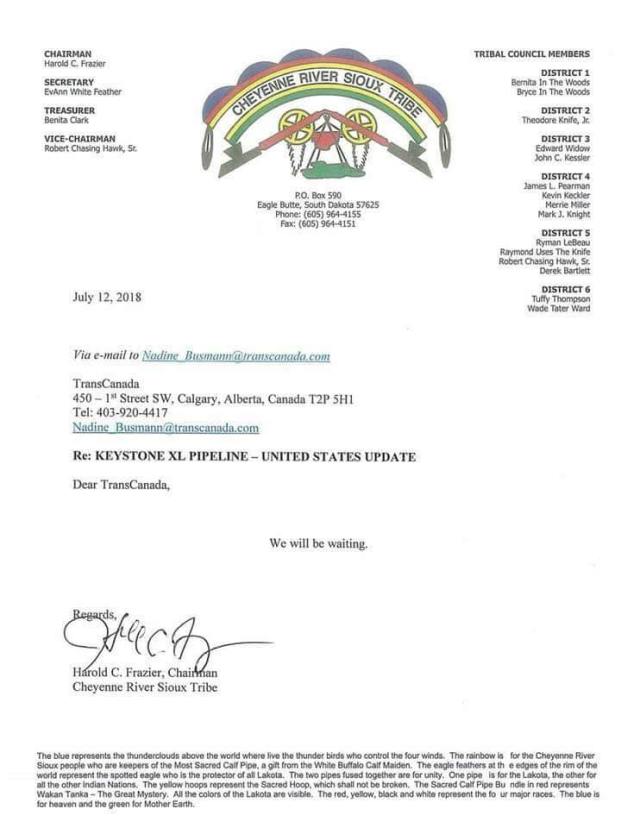
Tribal Chairman Harold Frazier responded: “We will be waiting.”

cheyennen-river-responseRemi Bald Eagle, intergovernmental affairs coordinator for the Cheyenne River tribe, said “I can’t speak about what is going to happen—obviously different groups have different ideas about what they are going to do—but the Cheyenne River Sioux Tribe is fully prepared to support any of its tribal members in any of their efforts to resist the pipeline.”

Posted in #NDAPL, civil disobedience, Indigenous, Uncategorized | Tagged , | Leave a comment

Two-eyed Seeing

Two-eyed seeing “recognizes the benefits of seeing from one eye with the strengths of Indigenous ways of knowing, from the other eye the strengths of the Western ways of knowing, and using both of these eyes together to create new forms of understanding and insight.”   Elder Albert Marshall (Mi’kmaq, Eskasoni First Nation) from Urban Tribes, edited by Lisa Charleyboy and Mary Beth Leatherdale

I have written about my relatively new connections with Native Americans. My first experiences related to working together in Indianapolis to try to protect water, in particular to try to stop the construction of the Dakota Access Pipeline. I was very impressed with how they expressed their connections to Mother Earth, each other, and those of us who joined them, initially as strangers.

As a Quaker who has studied, taught and practiced nonviolence, I was particularly impressed with the commitment to nonviolence of water protectors at Standing Rock. How strong they were in the face of police violence. I was able to see how the water protectors there were supported by Indigenous people all over the world. It became clear to me this is the way forward for those who want to protect the water and Mother Earth.

As we enter the twenty – first century , Western civilization is confronting the inevitable results of this European – American philosophy of dominance . We have gotten out of balance with our earth , and the very future of our planet depends on our capacity to restore the balance . We are crying out for help , for a grounding in the truth of nature , for words of wisdom . That wisdom is here , contained in the words of the native peoples of the Americas . But these people speak quietly . Their words are simple and their voices soft . We have not heard them because we have not taken the time to listen . Perhaps now the time is right for us to open our ears and hearts to the words they have to say . Unlike many traditions , the spiritual wisdom of the Native Americans is not found in a set of “ scriptural ” materials . It is , and always has been , a part of the fabric of daily life and experience.  The Wisdom of the Native Americans: Including The Soul of an Indian and Other Writings of Ohiyesa and the Great Speeches of Red Jacket, Chief Joseph, and Chief Seattle . New World Library. Kindle Edition.

I am grateful for the presentation at last summer’s gathering of Iowa Yearly Meeting (Conservative) titled “Building Bridges with Native Americans” , and know a number of Quaker/Native connections have occurred over this past year. My father and I attended the Meskwaki Powwow. Many Bear Creek Friends have participated in the Prairie Awakening/Prairie Awoke celebrations. I am grateful for the day I spent with water protectors when we traveled to Minneapolis to rally at the headquarters of US Bank related to their financing pipelines.

I would encourage us to use two-eyed seeing as we continue the work of protecting and healing Mother Earth together. One opportunity to do that will be September 1-8, the First Nation – Farmer Climate Unity March from Des Moines to Fort Dodge. I plan to be part of that.

climate march poster


Posted in #NDAPL, civil disobedience, climate change, Indigenous, Keystone Pledge of Resistance, Uncategorized | Tagged | Leave a comment