Preview of the Future

Beginning around 5:30 this morning a line of severe thunderstorms came through Indianola, Iowa.

I don’t remember ever being in a storm when there was continuous lightning for a prolonged time. The wind caused trees to violently whip around and nearly bow to the ground. Almost three inches of rain fell during the nearly one hour the storm raged.

I thought about the recent experience of my friend Peter Clay (who was also on the First Nation-Farmer Climate Unity March referenced below). You get a sense of the magnitude of both the physical damage to the land, and the emotional damage to Peter. The Iowa Land Acknowledgement Statement found at the end of this relates to Peter’s reference to “stolen land”. (I appreciate Peter giving me permission to share this.)

On July 19th, just two days after I returned to our stolen land in northeast Wisconsin, a monster storm destroyed our entire ten acre Red Pine plantation around me. I was inside our cabin, which also made it through the 100 mph winds pretty much unscathed. In the surrounding mixed hardwood forest around the now former pine plantation the devastation was also horrific, with many of the places most sacred and special to me utterly unrecognizable now, with huge, noble trees lying splintered and supine. I am now 69 and have been in relationship to this land since the age of 9, when my parents first planted Red Pines here. I’m still in shock, numb and traumatized.

And when Peter returned later:

The devastation on our family/stolen land is even more devastating than I had previously known. I arrived back here on Saturday, August 17th. On Sunday, I traveled through the mixed forest surrounding the now former Red Pine plantation. Up to 90 percent of the large oak trees are down, most of the large maples, popple/aspen and on and on it goes. It is almost impossible to even travel through the destruction. Our logger will have a difficult time even figuring out how to do the salvage logging of these tree persons. I am trying to take in that the forest as I have known it for most of my life has been completely destroyed. I have no idea what healing looks like, for the land or for me. I will continue laying down virtually all formal roles or responsibilities that I have, Quaker and non-Quaker, for the indefinite future. I don’t have the energy or interest anymore.

Peter Clay

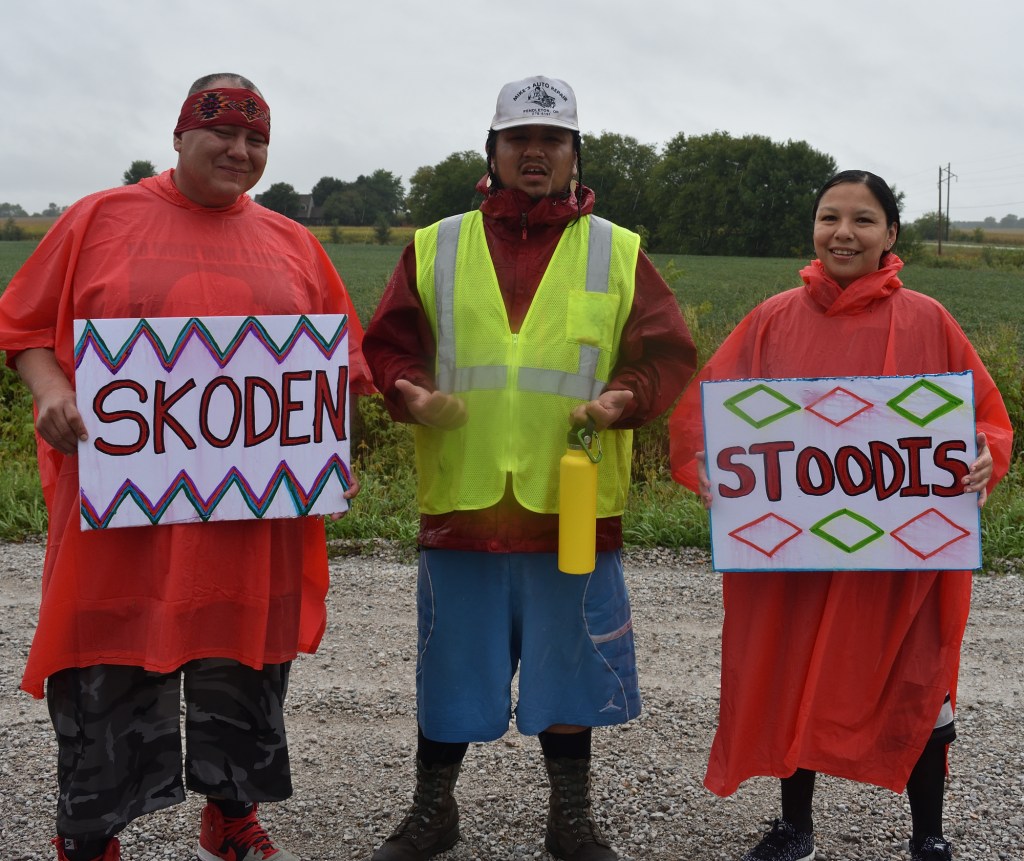
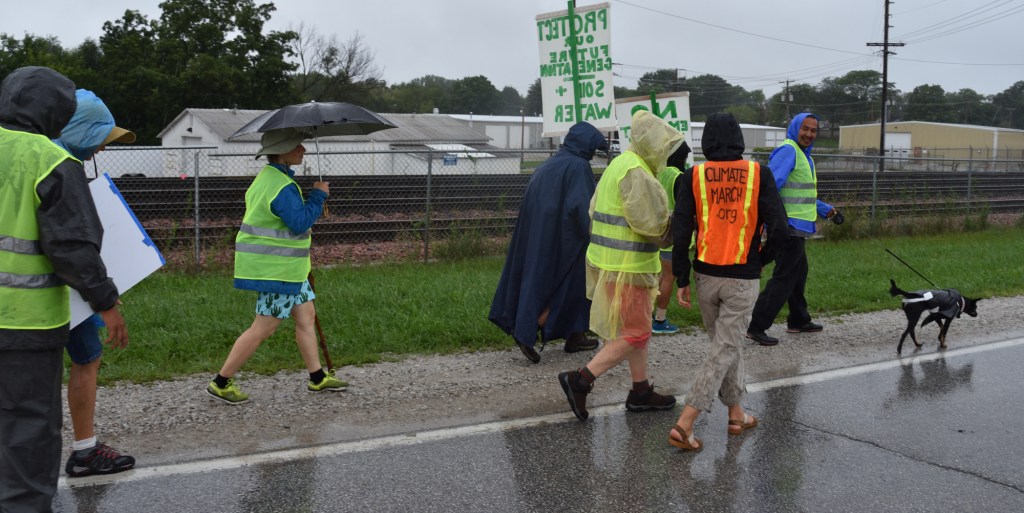
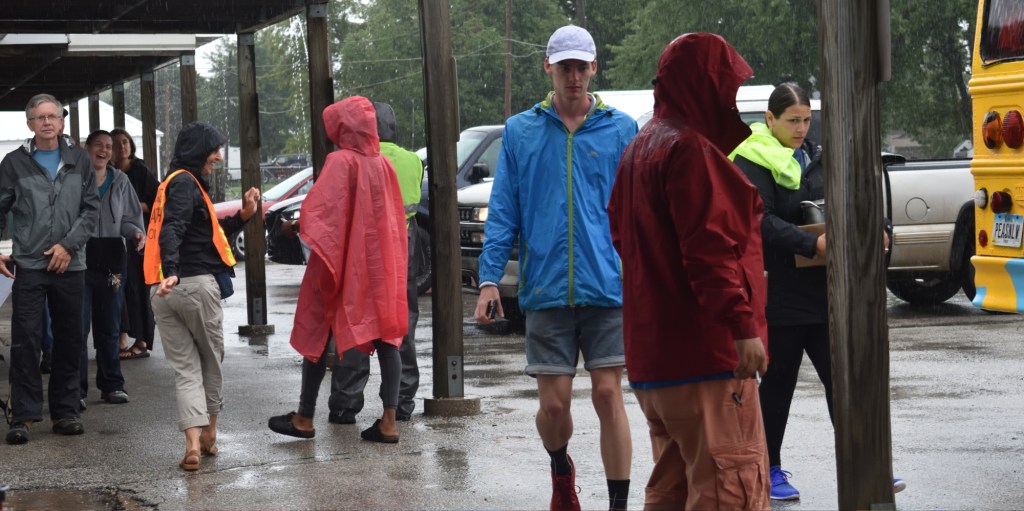
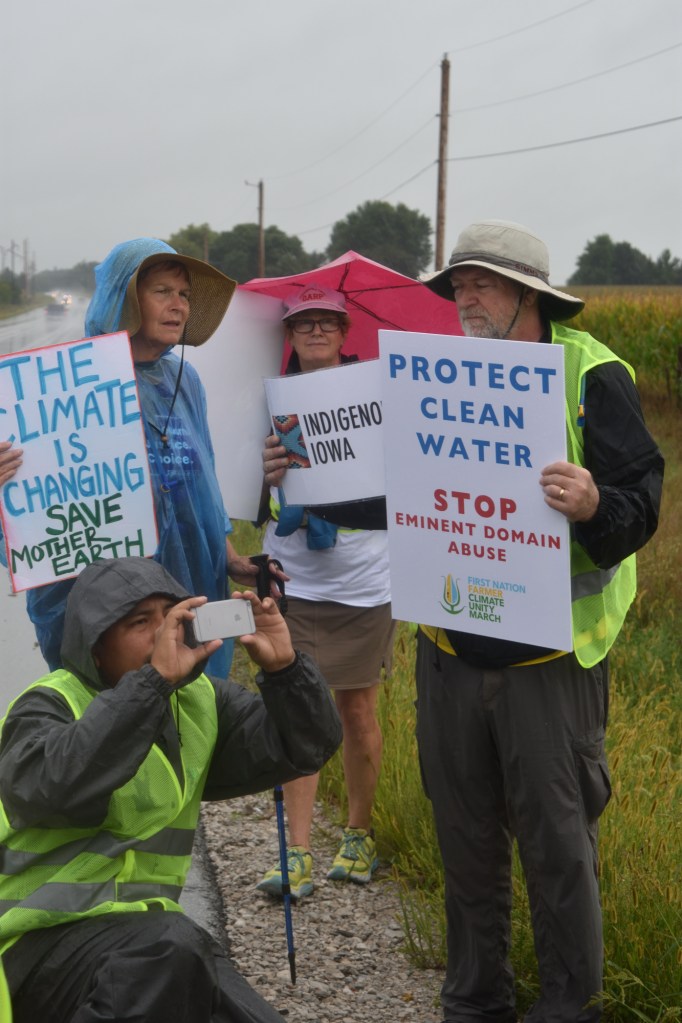
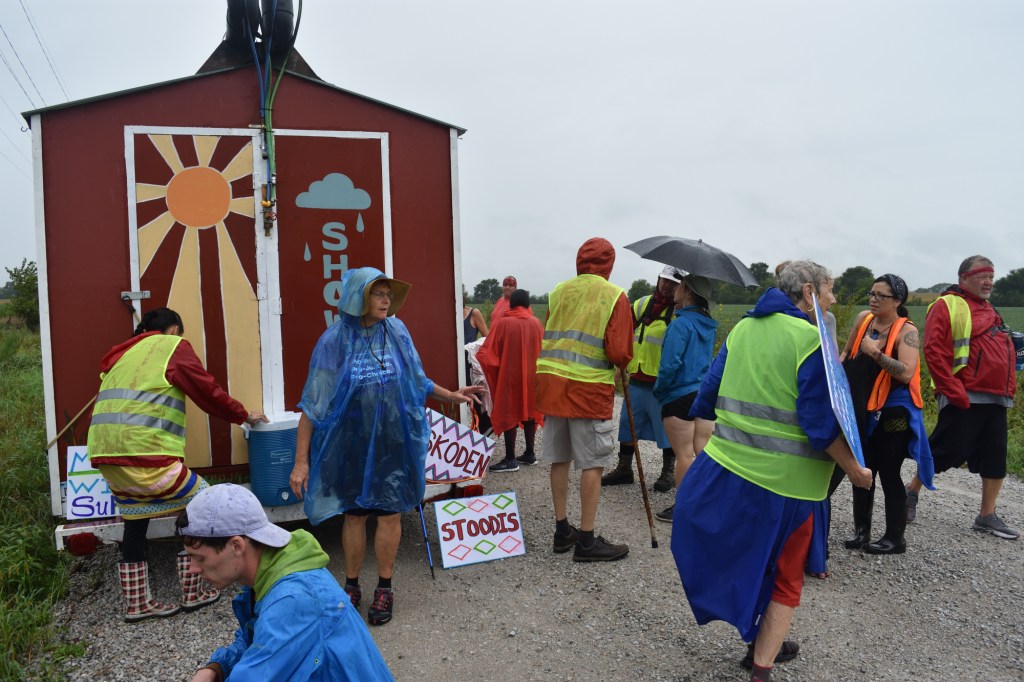
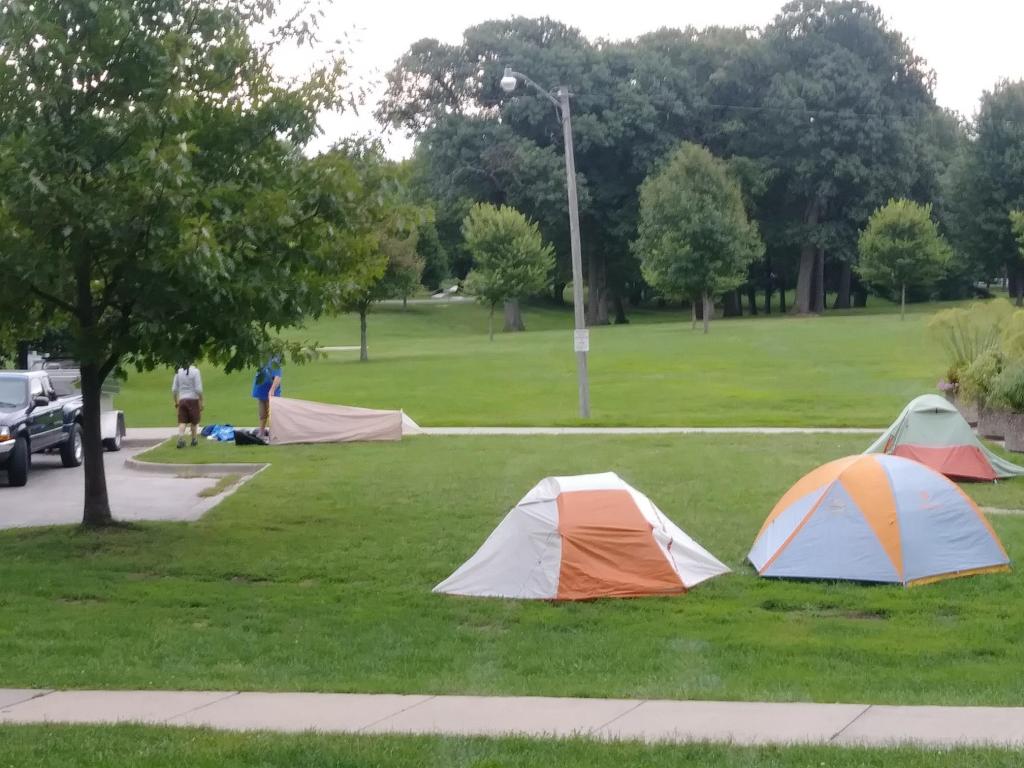
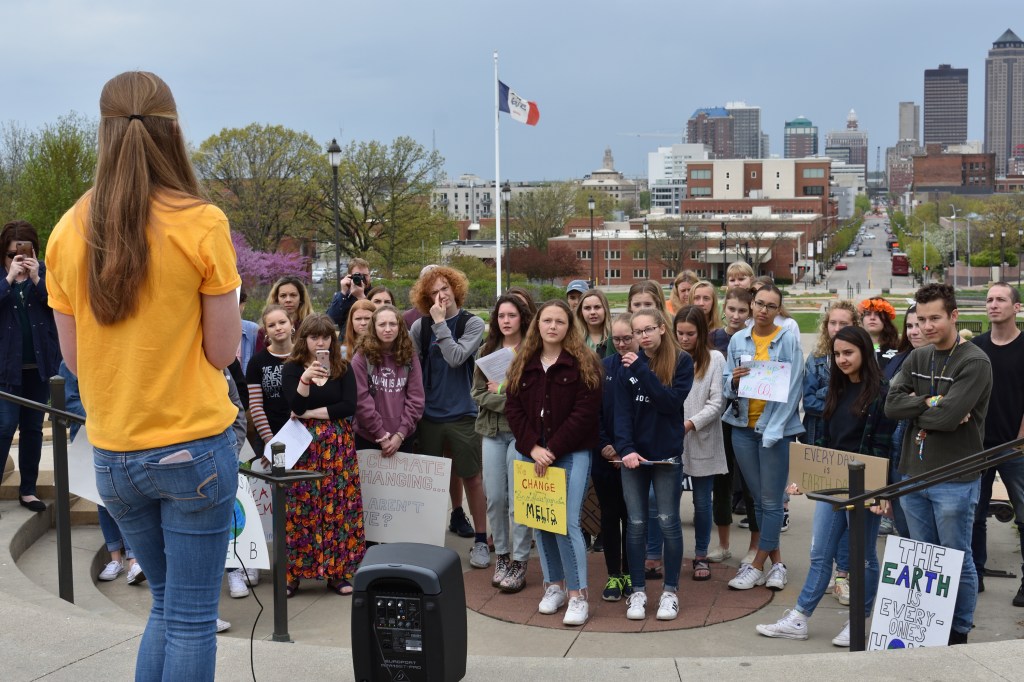
We did experience some severe thunderstorms during the First Nation-Farmer Climate Unity March last September. The following are descriptions of the storm the first night of the March. Rain was predicted for the entire week of the March. Although there was rain for the next few days, the last couple of days were dry.

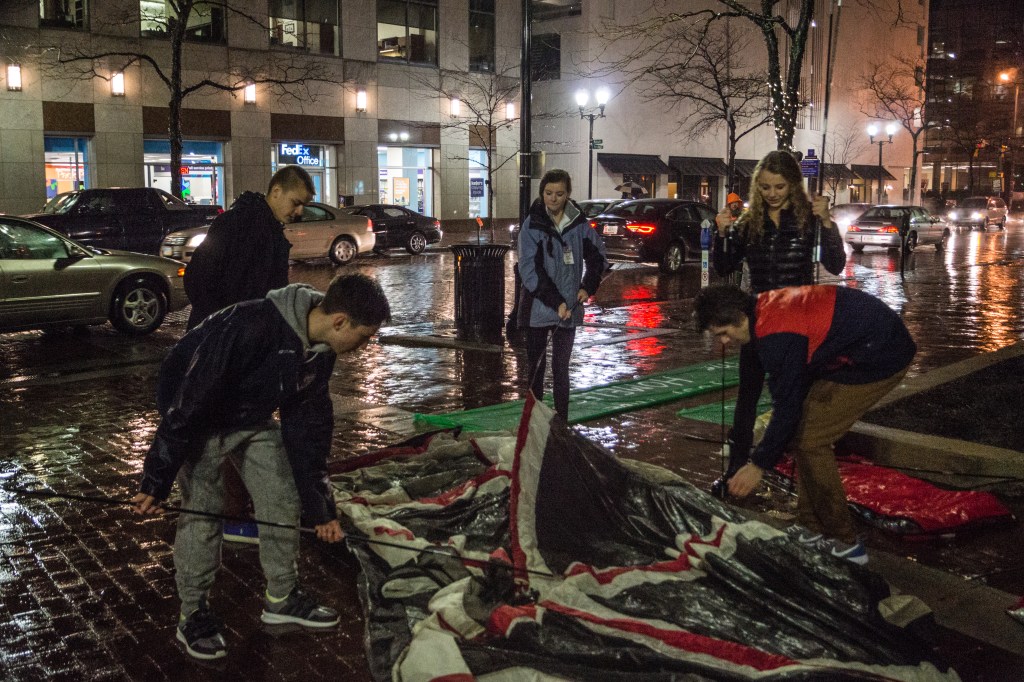
We had prolonged, severe thunderstorms for much of the night. Lots of lightening and thunder. Again I was surprised at how well the tent held up, keeping the water out. There were times when the intensity of the rain could only be described as a downpour. I did get a little concerned when for about a 15 minutes the wind was blowing so strongly that side of the tent bowed inward. I was thinking of escaping to the farm’s shed, but was afraid without my weight, the tent might blow away.

Jeff Kisling, https://kislingjeff.wordpress.com/2018/09/02/second-day-of-the-march-begins/

I couldn’t believe how hard the rain was falling during that storm. I recorded the sound of the rain falling on my tent that night:

Rain and thunder

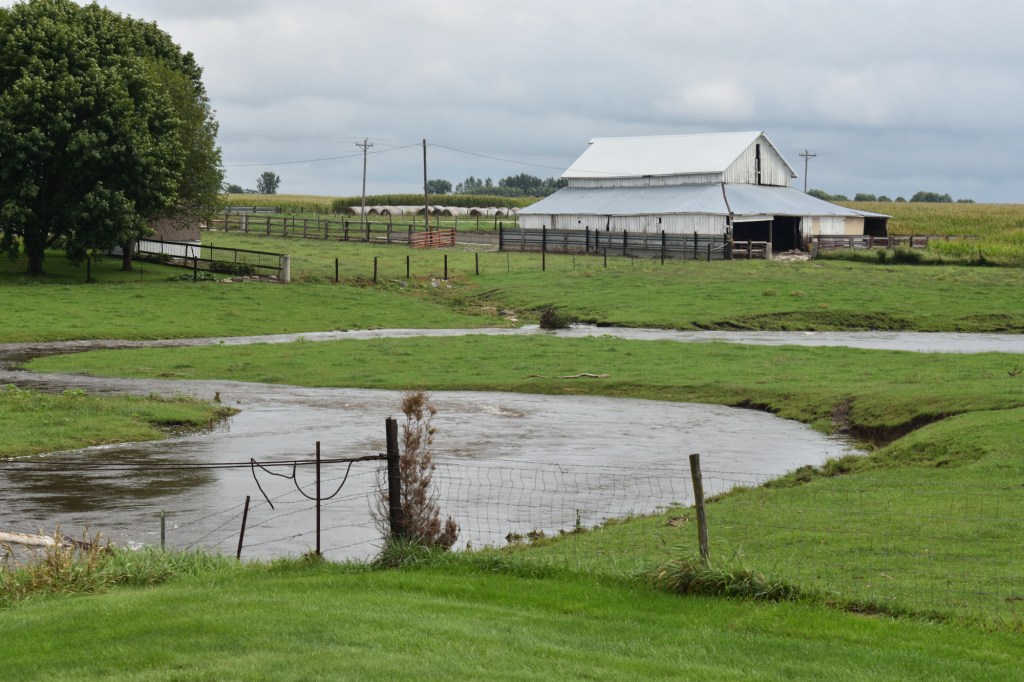
Ed Fallon wrote “I’m a veteran tent-dweller, yet have never seen my tent pummeled so mercilessly by the driving rain that hit us in the middle of the night. It was as if buckets of water were being hurled against the sides of the tent. I worried that the nearby ditch between our tents and the road would fill with water and wash over the field where we camped. That didn’t happen, but if our first night’s rainfall had been as bad as some storms that Iowa has seen in recent years, that field could have indeed been swamped.”

First Night of the First Nation-Farmer Climate Unity March

It is predicted there will be more frequent and severe storms with our evolving environmental catastrophe. During this morning’s storm, with the power out, I realized this may soon be the norm as widespread areas of no energy result from damage to the infrastructure, breakdown of the energy grid from increased use for air conditioning as temperatures continue to climb, and less energy production.

Sitting in the dark this morning I thought about the breakdown of the Internet, and how I couldn’t receive news, publish this blog, etc. No electricity would mean spoiled food. So many things that millions of people have never had. We need to start preparing for these and other changes to come now.


We begin by acknowledging that the Land between Two Rivers, where we sit and stand today, has been the traditional homeland for many independent nations. These include the Ioway and the Otoe, who were here since before recorded time. The Omaha and the Ponca were here, moving to new lands before white settlers arrived. The Pawnee used this land for hunting grounds. The Sioux, Sauk and Meskwaki were here long before European settlers came. Members of many different Indigenous nations have lived on these plains. Let us remember that we occupy their homeland and that this land was taken by force. Today, only the Meskwaki Nation, the Red Earth People, maintain their sovereignty on their land in the state of Iowa. They persevered and refused to be dispossessed of their home. Place names all over our state recognize famous Meskwaki chiefs of the 1800s like Poweshiek, Wapello, Appanoose, and Taiomah or Tama. We honor the Meskwaki Nation for their courage, and for maintaining their language, culture and spirituality. May our time together bring respectful new openings for right relationship to grow.
IOWA ACKNOWLEDGEMENT STATEMENT

Posted in climate change, First Nation-Farmer Climate Unity March, Uncategorized | Leave a comment

Then They Came for…

First they came for the socialists, and I did not speak out—
Because I was not a socialist.
Then they came for the trade unionists, and I did not speak out—
Because I was not a trade unionist.
Then they came for the Jews, and I did not speak out—
Because I was not a Jew.
Then they came for me—and there was no one left to speak for me.

Martin Niemöller

Then they went to Africa for black men, women and children
Then they came for black men, women and children
Then they came for indigenous people and took away their children and the land
Then they came for immigrants and took away their children
Then they came for women
Then they came for LGBTQ people
Then they came for antiwar protesters
Then they came for those against the corporate world
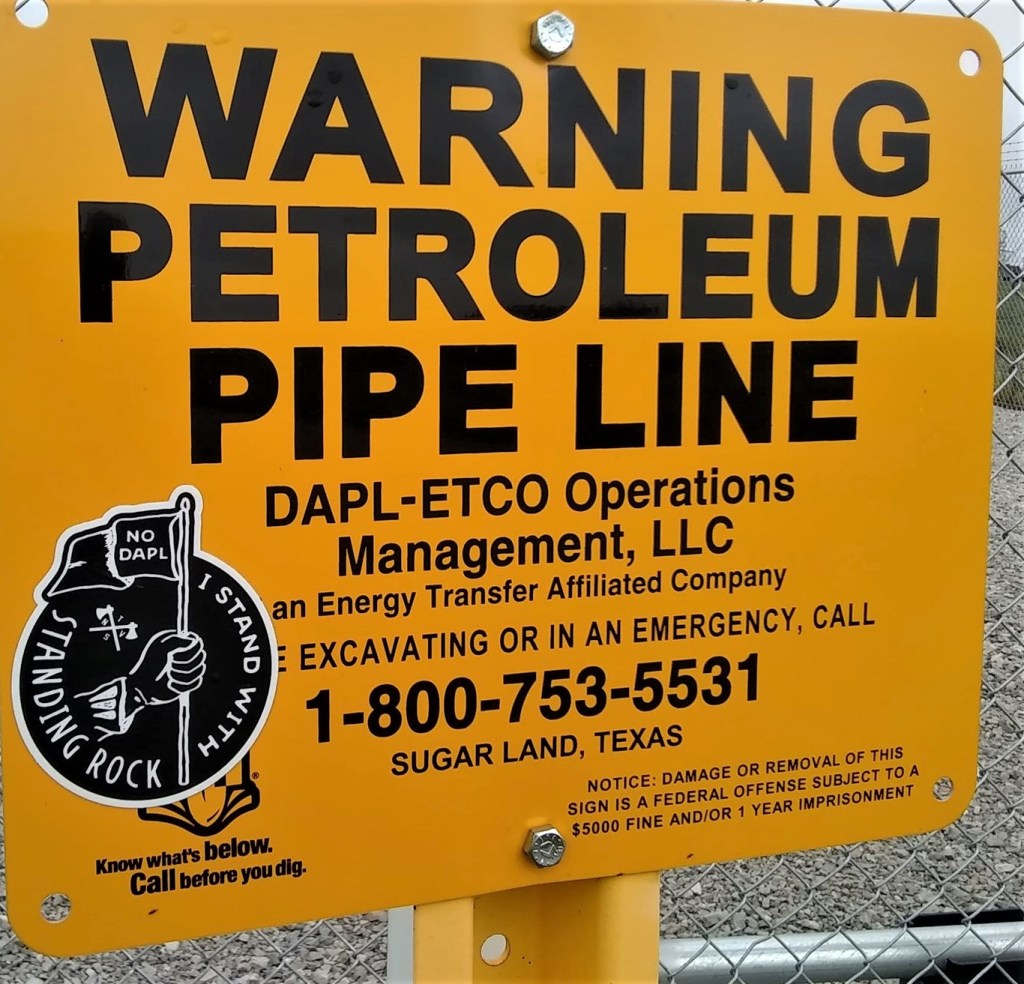
Then they came for water protectors
Then they came for..
.

The subtitle of this recent article in Think Progress, “the criminalization of pipeline opposition is ramping up” is certainly true and alarming.

Trump pushes up to 20 years in prison for pipeline protesters
The criminalization of pipeline opposition is ramping up.
E.A. CRUNDEN, Think Progress, JUN 3, 2019, 3:14 PM

Further evidence we are living in an expanding police state is that the Pentagon is testing mass surveillance balloons over the Midwest.

Pentagon testing mass surveillance balloons across the US
Exclusive: the high-altitude balloons promise a cheap monitoring platform that could follow multiple cars and boats for extended periods
by Mark Harris, The Guardian, Fri 2 Aug 2019 06.00 EDT

This reminds me of correspondence I had with Michael Foster:

Earth First! Newswire Editor’s Note: Valve Turner Michael Foster was convicted of felony conspiracy to commit criminal mischief and misdemeanor conspiracy trespass in October of 2016 when he entered a valve site of the Dakota Access Pipeline in North Dakota and shut the valve off after notifying Keystone that he was doing so and giving them an option to shut it off remotely. This act of climate disobedience, coordinated with other activists who faced lesser charges, shut down 15% of US crude oil imports for nearly a day – a display of the sorts of shifts that are necessary to avoid complete cataclysm. In February 2018, he was sentenced to 3 years (2 deferred) and his projected released date was December 5, 2018. He was released on August 1, 2018. 

Valve Turner Michael Foster Has Been Released from Prison! Earth First Journal, August 2, 2018

‘I’m Just More Afraid of Climate Change Than I Am of Prison’
How a group of five activists called the Valve Turners decided to fight global warming by doing whatever it takes, New York Times Magazine, 2/13/2018.


My friend and fellow Keystone Pledge of Resistance Action Leader, Jim Poyser, mentioned that Michael was a friend of his, and would probably appreciate letters while he is serving his prison sentence (3 years with 2 deferred). Our first exchange of letters follows:

TO: Michael Foster
North Dakota State Penitentiary
Bismarck, ND
March 27, 2018

Dear Michael,
 Jim Poyser told me you are a friend of his and kindly gave me your address, so we could correspond if you like.
 Jim and I first started to work together in 2013 as Action Leaders in the Keystone Pledge of Resistance in Indianapolis. We spent a lot of time providing training for local folks regarding nonviolent direct action. And a lot of time on the streets trying to raise awareness. Since then he has drug me into some of the many outstanding things he was and is involved with, especially related to kids and the environment.
 I am so impressed with your witness to protect our environment. I wish more people would have worked harder years ago. I fear we have damaged Mother Earth beyond repair. If one believes that, the question becomes should we just enjoy our last days or continue to work to at least slow down our demise. Or hope that somehow, we might survive.
 I was raised on various farms we rented around central Iowa. I think farmers have a unique connection to our environment. We had dairy farms. When I was around 10, Dad began to work in various positions with the Farm Bureau co-op, Farm Service. That meant both that we left the farm and moved a lot from town to town.
 I was raised as a Quaker. I attended Scattergood Friends School, a co-ed college prep boarding school on a working farm in eastern Iowa. There were only about 15 students per class. Partly for financial reasons, but also what I eventually appreciated as a wonderful educational approach, the students did all the work at the school and on the farm, supervised by the faculty. We rotated through the various crews-meal preparation, dishes, cleaning, farm crew, orchard, bread baking crew, etc. There was a pottery and kilm for art classes, and every student had to be in a theater production every year. There was also mandatory study hall after dinner, so pretty much every minute was scheduled. The other wonderful education we received was learning how to live in community, because that was how the school ran. Weekly community meetings were where we all were involved in community issues, and learned how to make decisions as a community, and come up with and implement solutions. We didn’t really realize until years later that gave us a confidence and skills in community building we didn’t know we were getting at the time.
 I was at Scattergood from 1966-70, at the height of the Vietnam War. I struggled deeply with my decision related to the Selective Service System. I organized a draft conference at the School. During another of the Moratorium Days to End the Vietnam War, the entire school walked to the University of Iowa in silence with a couple of signs reading Peace March.
 I eventually concluded I had to be a draft resister and turned in my draft cards. A case someone else brought to the Supreme Court meant I was not indicted for draft resistance. (Dodged the bullet, so to speak.)
 While struggling with that decision, though, I joined Friends Volunteer Service Mission (VSM), a Quaker project to provide meaningful work for young men doing their alternative service. The idea was to live in an impoverished community during the two years of alternative service. The first year was to do one of the usual alternative service jobs and save enough money to support yourself during the second year. And to get to know the neighborhood during the first year so you could come up with what you wanted to do the second year. I was in the VSM project in a white inner-city neighborhood in Indianapolis. My first year I worked as an on the job trained respiratory therapist. During that year I saw there were no programs for kids in the neighborhood. That became my focus. We would play games at the local city park. I set up a darkroom in the bathroom of the house we (VSM) were living in and taught the kids how to develop film and photos. We took bike trips around town to take photographs. During my second year I spent full time in the neighborhood working with the kids. We organized a 4H club, had Young Friends come to pour concrete in the Second Friends parsonage driveway for a basketball court, continued with photography, etc.
 When the two years were up, I returned to Iowa and went to community college for a semester. But I missed working with the kids so much, I returned to Indianapolis. I got work in another Indianapolis hospital as a respiratory therapy technician, and later graduated with a degree in Respiratory Therapy from Indiana University.
 I continued to be involved with some of those neighborhood kids as we lived our adult lives. I was godfather to the kids of the neighborhood kid who became my best friend.
 As soon as I could I got a position at Riley Hospital for Children, since I realized how much I liked working with kids. After a number of years working in Riley’s Neonatal Intensive Care Unit, I got in on the ground floor of a new research laboratory devoted to studying infant lung development and disease, where I spend the rest of my professional career. I began learning how to write computer software while at Scattergood, when the University of Iowa gave free computer time to surrounding schools. I continued to learn about computer programming after that, which became invaluable in the Infant Pulmonary Function research lab. There was no commercial equipment to do lung function studies in babies, so we had to build our own equipment and write the testing and analysis software needed to do our research. That is what I did. I was co-author on 40 peer reviewed publications about our research by the time I retired last summer.
 The other big part of my life was related to concern about our environment. Besides my connection to nature while we were on the farm, we were also blessed to visit many of our National Parks as we grew up. We didn’t have much money, so we would rent, and later own, simple fold up campers, and camp in the parks, Rocky Mountain National Park being everyone’s favorite. We loved spending the whole day hiking in the park and sleeping there as well. I previously mentioned my love of photography. The beauty of the National Parks, and the mountains of Colorado especially, were nearly overwhelming. The last time I was there, last fall, I took over 1,000 photos that week.
 All this sensitized me to environmental damage. I first moved to Indianapolis in 1971. This was before catalytic converters began to be used (in 1975), so I would be riding my bicycle through clouds of noxious fumes. I distinctly remember having a horrible vision of the Rocky Mountains becoming enveloped in smog.
 So, although I did have a couple of cars for trips home to family in Iowa, this being before car rental was very common, I was uncomfortable about the environmental damage I knew I was contributing to. When the car was involved in an accident, I had become uncomfortable enough about having a car, that I decided to see if I could live without one, since I lived on a city bus route. With a good deal of trepidation, I decided to try. Although it took a while to learn how to do so, it eventually became my way of life since then, about 40 years ago. Each time I moved, the first requirements were that the apartment had to be on a bus route and had a grocery store within walking distance. I learned to be careful about the weight, size, and perishability of things I had to get from the grocery store to the apartment.
 There were a number of unanticipated benefits from this. One was my running improved dramatically, because I would take a city bus to work, and then run home every single day. Around the time I started this, I lived seven miles away from the hospital. Each time I moved, I looked for something closer.
 When I eventually lived close enough to walk to work some days, I began to be more aware of the flowers and scenes along the walk. I started to take my camera to work with me, and that soon became a daily habit. And I found the more closely I looked, the more I saw. Of course, the other part of this was I actually had the time to stop and take photos of what I was seeing. For years I was coming home with 30 or 40 photos every day. I had to plan an extra 15 minutes or so for the walk in order to take photos.
 The other effect of this was it gave me a certain authority when I began to speak out against environmental damage, fossil fuels, tar sands, etc. Almost without fail the first thing someone who disagreed with me would say would be something like “well you drive a car, don’t you?” I grew to look forward to the reaction when I said “no”. But it was being able to create that disruption that often lead to more than a knee-jerk reaction, so we could have a deeper conversation.
 Well, I’ve gone on and on as usual. But I hope we can have an ongoing exchange.
 I really appreciate your environmental witness and would love to hear more about you.
 I write nearly daily on a WordPress blog I call Quakers, Social Justice and Revolution. Often about environmental subjects. I you are interested I would be glad to post things you want to tell the world on that blog.
 Peace,
 Jeff Kisling
 Indianola, IA 50125


FROM: Michael Foster

Jeff,
 Thank you for reaching out to me. Any friend of Jim Poyser is partly nuts and OK by me! We all share a common pursuit, working with youth and the outdoors. You can pick up bits of my story in the NYT Magazine and in Seattle Met magazine last summer, so I won’t bore you.
 One thing you wrote, “I fear we have damaged Mother Earth beyond repair,” touches on why I devoted myself to this emergency at this moment. Reading James Hansen’s research on “Avoiding Danger Climate Change: Required Reductions in Carbon Emissions to Protect Yong People, Future Generations and Nature” I realized this is the last moment when returning a stable planet to our children might yet be physically possible, and nobody seems interested in how quickly we must drop pollution. After this time, the efforts we make to restore health, bold and drastic, even revolutionary, will only matter for a little while, like hospice care for parents before they go, so important yet a return to life is not an option anymore.
 What we do now, today, either slams the door shut against our own kids and most life forms on Earth, or turns off the gas in this chamber we share, and leaves the door open a crack, just enough that this place might start to cool down in another 30 years or more. But today we decide whether future Earth has life. Tomorrow, not so much.
 11 % cuts in pollution each year PLUS 1 trillion new trees EQUALS an outside chance our kids get to raise kids.
 Nobody speaks of this is media or leadership or policy. If we delay until 2015 to begin, a mere 7 years:
 25% cuts in pollution each year PLUS more than1.5 trillion trees just to do the same thing. Get back to 350 ppm CO2 in the air near 2100.
 Massive global cuts don’t happen if we think and live as “consumers”, but OK then. As you discovered living car-free, life without opens doors you can’t purchase on a Tesla. As opposed to annoying, inconvenient, incremental change, dramatic about-face changes turn around everything so quickly, shedding dull routines and thinking promises mere adventure in life, and our pace quickens.
 Is it possible for humans to leave a healthy planet for youth? Only today, not tomorrow.
 That does it for me! If I am lucky enough to live in this moment when life goes forward or not at all because of my/our waste, then I can only remain human if I refuse to destroy everything I love. I am accountable.
 Your letter got me all worked up, ready to preach, something I’ve enjoyed doing as a guest in pulpits since shutting down Keystone 1. Maybe when I get released, we can cook up some tasty plans for youth seeking justice.
 Thank you for writing. I’m doing great, more relaxed, smaller footprint, well-fed (vegan diet), and for the moment, on the right side of history.
 Michael


Posted in #NDAPL, Black Lives, civil disobedience, climate change, enslavement, Green New Deal, Keystone Pledge of Resistance, Quaker, Uncategorized | Leave a comment

Looking Back

Since retiring two years ago, I occasionally spend time remembering various things that happened up to this point in my life. In part, to keep the memories alive. Also, to evaluate what things seemed to have accomplished intended goals, but more often to try to learn from mistakes. I’m glad I learned early in life that we learn from making mistakes. I was always interested in science, where I learned the purpose of an experiment is to test a hypothesis. Whether your hypothesis was proven correct, or not, in either case you learned more about what you are studying. I was the kid who had a microscope, chemistry set, and built and launched model rockets. And when computers arrived, the kid who wrote computer software. (and yes, had a pocket proctor, slide rule, and 6 or 7 science books under my arm.)

The reason I’m thinking about the past this morning is because of the following photo I posted on Facebook last night.

Neonatal Intensive Care Unit. Permission given to use photo.

My sister, Lisa, recently suggested I share a photo a day. I liked the idea because I enjoy sharing my photos, and have realized when I die, no one will likely ever see them. Sharing photos is also possible with the new Facebook Story idea. I usually share a photo I have taken, though this one obviously was not. Permission had been granted to share this photo because it was used in a publication about the children’s hospital.

I have been blessed to make a great many friends, many of whom don’t know about my work in the hospital, so this was an opportunity to share that part of my life with them. This seems to be one of those cases where a picture is worth a thousand words, since it would take a lot to explain this work with words alone.

One of the main things I wanted to share this morning is HOW I ended up in the Neonatal Intensive Care Unit, and later the Infant Pulmonary Function Research Lab. I think many of us fail to “connect the dots” of our path through life. I know I didn’t realize some of that while I was actually living the experiences.

Being interested in science from an early age, as described above, was important for a couple of reasons. The obvious one is that provided both knowledge content, and a familiarity with the scientific method, and tools used for experimentation (microscope, flasks, petri dishes, etc.).

The other thing that gave me, that I didn’t appreciate at the time, was confidence in myself. I think we all want to have something we are good at, and math and science were that for me.

Looking back now, I wonder WHY I was interested in math and science.

I think most people of faith believe God or the Spirit can be an influence in their lives. As a Quaker, trying to figure out what the Spirit is asking of us is the basis of our meetings for worship. We gather in a group for about an hour, where we listen for “the still, small voice” of the Spirit. Speaking for myself, that doesn’t happen every Sunday morning. And when it does it might not be very clear at the time. My grandmother, Lorene Standing, says the will of God is most often revealed in a series of small steps, and that has been my experience.

My interest in math and science started when I was very young. I don’t remember God saying, “study math and science”. But there were many times when I was finding those subjects were too difficult, or was starting to lose interest. But I was always guided to continue with them, in a series of small steps it seems now, looking back.

When it came time to enroll in Scattergood Friends (High) School, I was very concerned because the School struggles financially and I knew there wouldn’t be a lot of equipment in the science lab. This is another time when the Spirit led me to go to Scattergood despite those reservations. There was also a lot of pressure from my parents, but that came to them from God, too, I believe. I think I received a better science and math education at Scattergood than at public school. I learned critical thinking was much more important than lab equipment. As for math, the first day of class the teacher provided the definition of a point, and then told us to define other math concepts–lines, circles, etc. I clearly remember how great it felt to solve the formula for quadratic equations.

Oddly enough, the next step on the path to the NICU was my struggle deciding what to do about the requirement to register for the Selective Service System (the draft for the Vietnam War). As a Quaker and pacifist, I knew I could not join the armed forces. The problem was I could apply to be classified as a conscientious objector, and do two years of civilian (alternative) service instead of 2 years in the armed forces. Although I put in a lot of prayer and effort related to this, I was convinced early on that I could not choose to be a conscientious objector, because I felt that was a ploy to deal with dissent against the draft. I was very clear God was telling me I should resist (not cooperate) with the draft.

The problem was my parents were very much against that idea, because they didn’t want me to have a record as a felon, which would have happened if I my lottery number had been called. They were fine with the idea of being a conscientious objector. This became a long, drawn out struggle. I had no double I must resist the draft, but wanted to be able to convince my parents that was what I was being called to do.

While all that was going on, my 18th birthday arrived. In order to give my parents more time, I did register for the draft as a conscientious objector, though I still planned to resist the draft by returning my draft cards, once I had convinced my parents. I was classified as a conscientious objector. Don Laughlin wrote a letter below to support my CO application.

Don Laughlin’s letter for CO application

During this time in limbo, I joined the Friends Volunteer Service Mission (VSM) which was a project to provide young men who were going to do alternative service as conscientious objectors, a way to do meaningful work. The VSM project I joined was in a transient, white inner city neighborhood in Indianapolis. The idea was to live in the neighborhood, and work in an alternative service job for the first year, and save enough money from that to support yourself doing whatever work you decided to do in the neighborhood the second year. More about VSM here:https://kislingjeff.wordpress.com/?s=vsm

The job I found was to be trained on the job as a respiratory therapy technician. Although up to this point I had planned to return to college to study physics, I found I really enjoyed work as a respiratory therapy technician. It was a nice blend of science and working with people.

During that first year I found there were absolutely no children’s programs in the neighborhood. So I would take the kids to the swimming pool or play games like capture the flag. I found I really enjoyed working with kids So my second year at VSM, I focused on working with the neighborhood kids. One thing we did was organize a 4-H Club. Although 4-H is farm oriented, there were other ways to be involved. One of our 4-H projects related to photography. I had learned at Scattergood and Earlham College how to work in a darkroom. This was 1972, way before digital photography. I asked people to donate 35 mm cameras, and we ended up with 4 or 5. We would take the cameras with us as we rode our bicycles around Indianapolis, taking photos. Then in the crude bathroom darkroom we set up at the VSM house, we would develop the film negatives, and then print the photos. I can still see the expressions on the kids’ faces as the image appeared like magic. Through the magic of Facebook, within the last year two of those kids reconnected with me, and they both talked about how much they enjoyed those days in the darkroom.

At the end of the two years at VSM, I returned to Iowa to figure out what to do next. I attended one year of community college, but I missed the kids in Indianapolis so much, that I returned to Indy. While at home in Iowa, my parents finally gave in to my decision to resist the draft, and I turned in my draft cards.

Returning to Indianapolis my previous training during alternative service allowed me to obtain a job as a respiratory therapy technician at the Indiana University Medical Center in Indianapolis. I also lived in the neighborhood where I had done the VSM work.

I was still planning to study physics, but still enjoyed working as a respiratory therapy technician. When the interviews were being given to select students for the Medical Center’s Respiratory Therapy program, I didn’t apply. There were many applicants for the 15 student class, and I wasn’t planning to make a career of respiratory therapy. But God intervened, again, and the course program director came to where I was working, and practically dragged me to be interviewed and subsequently accepted.

During my continued work at the hospital while going to school, I would often be in the delivery room in case problems with the newborn baby required resuscitation.

If the baby needed more than routine treatment, a team from Riley Hospital for Children, just across the street, would come with equipment to transport the baby to the children’s hospital. I was intrigued by the work the neonatal respiratory therapists from Riley did, so I applied and was give a position at Riley.

That is how I ended up working as a Registered Respiratory Therapist in the Neonatal Intensive Care Unit at Riley Children’s Hospital.

Although I usually wasn’t aware of it much of the time as this saga was unfolding, looking back now, I can see the working of the Spirit at each step along the way.


Permission was obtained for all photos of babies

Posted in Quaker, Uncategorized | Tagged , | 1 Comment

At a crossroads

The reason I’ve spent so much time thinking and writing about James Allen’s essay, Pontoon Archipelago or: How I Learned to Stop Worrying and Love Collapse, is because I agree with what he is saying about how we need to move forward now.
He doesn’t dwell on the foundational idea that we are heading into environmental and, therefore, political and economic collapse, but instead takes that as a given.

The evidence is in — even if we manage to avoid the worst applications of exponential technologies, we are at minimum already committed to an environmental catastrophe at a scale humans have never endured, and whose consequences we cannot fully fathom. The implications, for instance, of findings delivered by the International Panel on Climate Change are that, in order to avoid climate catastrophe we should already be achieving massive reductions in emissions today, and if we fail to make up for lost time by 2030, then we will have passed the point of no return. But we aren’t even in the realm of achieving this. Emissions are at record highs and continue to climb with no sign of meaningful abatement. Even complete compliance with the Paris Accords puts us on track for three degrees of global warming, by which time the thawing of tundra permafrost, disappearance of arctic ice and melting of the Greenland ice sheet are predicted to set in motion a series of self-reinforcing feedback loops that will see warming spiral well beyond our control. That’s only to speak of climate change alone, let alone the myriad of implications of the other ecological and socio-technological crises…

To take the world as you find it, to assume responsibility for that which you can, and to act as if what you do actually matters, is the mark of a mature adult.

My young children need me to be an adult. They are the reason I feel despair so profoundly. Yet they are also the reason I cannot wallow in it, acquiesce to it, or turn away from the horror. This is the reason I have sought to imagine another way, and to find and focus on that which I might do to usher that vision into existence, and to behave as if what I do really matters for their future. They are the reason I have directed my imagination to the multitude of paths only visible once I looked beyond the myths that have clouded much of my thinking. It is up to me show them a way beyond grief to a way of life truly worth living for, even if it isn’t the path I had expected to be showing them.

Pontoon Archipelago or: How I Learned to Stop Worrying and Love Collapse. By James Allen, Medium, May 24, 2019

The following video from the Extinction Rebellion provides an excellent discussion about the state of our environment now, titled “Tell The Truth.”

“Tell the Truth” Extinction Rebellion

The crossroads we’re at now is whether to [1] join activist groups like the Extinction Rebellion to try to force urgent political change, or [2] accept we are past the point where we can stop the unfolding environmental catastrophe and work on ways to create community and support each other during the collapse.

As James Allen has written, and I’ve commented in recent posts, https://kislingjeff.wordpress.com/?s=archipelago, I am led to believe we should follow the second path.

I have directed my imagination to the multitude of paths only visible once I looked beyond the myths that have clouded much of my thinking. It is up to me show them (my kids) a way beyond grief to a way of life truly worth living for, even if it isn’t the path I had expected to be showing them.” James Allen

Posted in climate change, Extinction Rebellion, Uncategorized | Leave a comment

Spiritual Warriors

I just finished a series of blog posts about James Allen’s essay, “Pontoon Archipelago or: How I Learned to Stop Worrying and Love Collapse”. I spent so much effort doing that because I found the essay to be the most coherent discussion I’ve yet found to describe the environmental catastrophe we are moving into and what we can do to prepare, and help others prepare for the increasing chaos we are moving into.

The problems before us are emergent phenomena with a life of their own, and the causes requiring treatment are obscure. They are what systems scientists call wicked problems: problems that harbour so many complex non-linear interdependencies that they not only seem impossible to understand and solve, but tend to resist our attempts to do so. For such wicked problems, our conventional toolkits — advocacy, activism, conscientious consumerism, and ballot casting — are grossly inadequate and their primary utility may be the self-soothing effect it has on the well-meaning souls who use them.

If we are to find a new kind of good life amid the catastrophes these myths have spawned, then we need to radically rethink the stories we tell ourselves. We need to dig deep into old stories and reveal their wisdom, as well as lovingly nurture the emergence of new stories into being. This will not be easy. The myths of this age are deeply rooted in our culture.

Pontoon Archipelago or: How I Learned to Stop Worrying and Love Collapse. By James Allen, Medium, May 24, 2019

Most of us lack the stories that help imagine a future where we thrive in the midst of unstoppable ecological catastrophe. James Allen

It is not clear to me what the work will require of me precisely, but what does seem clear is that there are few threads of work worth following.

The first thread is the cultivation of deep humility. Deep listening is needed. To listen deeply — to become profoundly aware of all aspects of your environment and your place in that system — is fundamentally a spiritual practice that reveals to us the essential interconnectedness of everything. It changes us as a consequence. Perhaps this is what is needed in order to shatter [see Shattering Silence below] our sense of separateness from nature. Yet this change won’t occur through devouring propositional knowledge or via rhetorical persuasion. It is knowledge only gained through participation in the practice of deep listening itself.

We don’t know today what things will enable us to solve the problems of tomorrow. Our biggest problems are emergent and non-linear and most won’t be solved with linear thinking. Only emergent collective intelligence can produce non-linear solutions. This requires us to first cultivate our own ability to be present, perceive the world accurately, orient ourselves toward it, and find ways to give creatively. It also requires that we find new ways to assemble with people with diverse perspectives who are capable of coming into coherent relationships with each other for long enough to produce something worthwhile.

Pontoon Archipelago or: How I Learned to Stop Worrying and Love Collapse. By James Allen, Medium, May 24, 2019

Deep listening is how Quakers (and mystics of all faiths) worship, gathering together to listen for what the Spirit might say to us. Deep listening is our spiritual practice. I believe this is a time to invite others to share in this spiritual practice with us. Perhaps framing these invitations as a way to learn how to move through environmental catastrophe will interest those who don’t usually think in terms of deep listening and worship.

From what I’m beginning to learn about indigenous spirituality, every moment is prayerful listening. My opportunity to experience this with Native Americans was during the First Nation-Farmer Climate Unity March. That March was intended to, and did, “find new ways to assemble with people with diverse perspectives”.


I’ll close with the story of how I came to be part of the Kheprw Institute (KI), a small black youth mentoring community in inner city Indianapolis. I think this is an example of “stories that help imagine a future where we thrive in the midst of unstoppable ecological catastrophe” as James Allen writes. It also demonstrates deep listening, and “new ways to assemble with people with diverse perspectives”. It also explains how I came to see myself as a “spiritual warrior.” (This is uncomfortable for me because Quakers strongly discourage calling attention to ourselves. But we can only authentically describe our own experiences, so I hope you’ll take this story in that manner.)


I had long been struggling with the knowledge that simply through the circumstances of the family I was born into, my life was significantly better in many ways than that of a great many others in America and the world.   This was a spiritual problem for me.

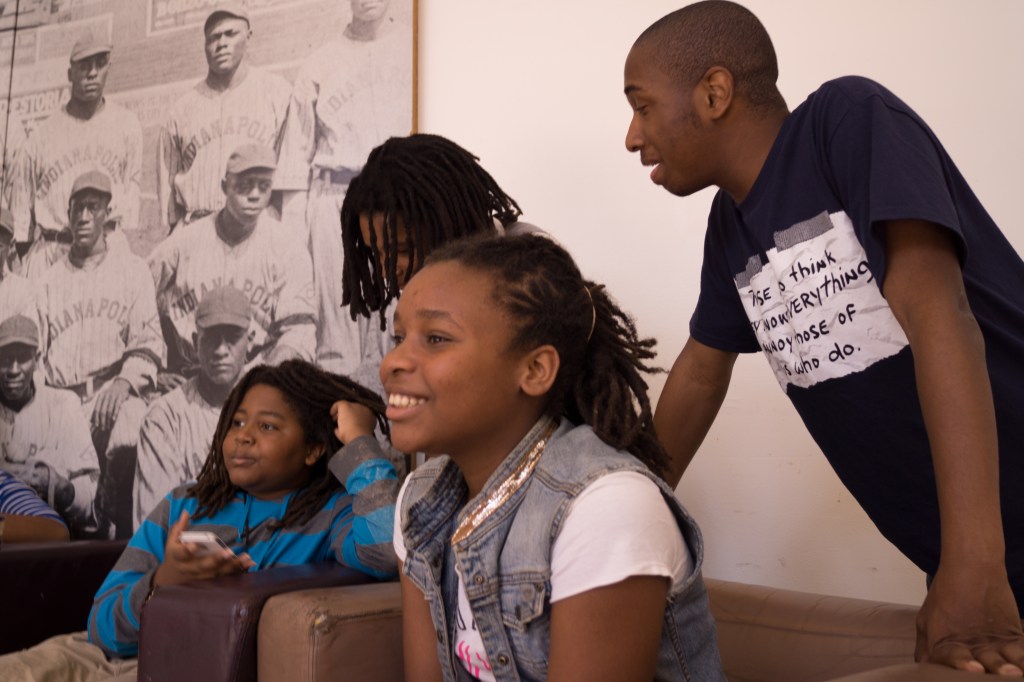
God (finally) provided me with a way to begin to learn about that. Nearly three years ago (2013) the environmental group 350.org organized a national day for environmental education/actions. Only one event was listed in Indiana that day, and it was at the KI Eco Center, which was how I found out about KI.   The day of the event, I arrived at the run down building that had once been a convenience store.  But it was full of kids excited to show us the work they were doing, including their aquaponics system, and the rain barrels they created and sold.

I was intrigued, and wanted to see if I could become involved with this group.  The store mentioned above is not where they were usually to be found. But I did find their web page that included an email address. On that web page I found a description of one of their projects, which was teaching the kids coding. Since I was a computer programmer, I thought this would be a great way for me to connect to KI, to have something to offer.

So I sent an email message, but didn’t receive a response. I thought about forgetting about this idea, but the Spirit wouldn’t let me. So I sent another email message, and did get a response that time. (I’ve found persistence is needed in many situations.)

So we arranged a meeting.  On a dark, rainy night I rode my bicycle to the KI building.  The adult leaders, Imhotep, Pambana, Paulette and Alvin, and about a dozen young people from the Eco Center were here.  I had thought we were going to discuss working on some computer software projects together.

But Imhotep began asking me a series of questions about myself. I don’t talk a lot about myself, but Imhotep, I’ve come to learn, is very good at drawing stories out of people.  So I spoke a bit of having grown up on farms in Iowa and my work at Riley Hospital for Children. Everyone was very quiet and attentive (deep listening). Imhotep asked me to tell more about myself. I should have anticipated this, but I soon realized I was basically being interviewed so they could determine if I was someone they felt comfortable working with, or not. 

When I mentioned that I was a Quaker, Paulette enthusiastically spoke about Quakers and the underground railroad, which was welcome.  But when she stopped speaking, everyone looked at me…

I had thought about this many times over the years.  I greatly admired the work of Friends who helped with the underground railroad, as I likewise admired those who worked to help address any injustice or need.  These situations should be a challenge to us.  Where is the need today, and what am I called to do about it?

There is also a danger here.  Sometimes Friends point to this work of other Friends to illustrate the work of Quakers.  Noah Baker Merrill wrote a wonderful piece entitled “Prophets, Midwives and Thieves” discussing this very thing, warning us not to claim the work of others as our own. 

So I could immediately respond that while I was really glad my ancestors had done that, and it was the right thing to do, I didn’t do it.  Which led me to talk more about how Quakers didn’t see religion as something only involving listening to a sermon once a week.

That left me at the point where I felt I needed to provide some example from my own life. Since KI is built on concern for the environment, I spoke of how I had reluctantly purchased a used car for $50 when I moved to Indianapolis, mainly for trips home to Iowa. Car rental was not common in the early 1970’s. When my car was totaled several years after that, I decided to see if I could live in the city without a car, and have since then, 40 years ago. I was hoping that would show how Quakers try to translate what they believe, what they feel God is telling them, into how they actually live their lives.

At that point Imhotep, with a smile on his face, said something like “Forty years?  You are a warrior.”    I had never been called a warrior before.  It seemed a humorous term to use for a pacifist, but I liked it.

When Imhotep asked me to tell them more, I said something like, “Quakers believe there is that of God in everyone, and that includes you, and you…” The very first time, I think I hesitated slightly as I was asking myself, “Ok, we Friends always say this, but do you really believe this of a group that is different from you?” And I’m really glad the answer was an immediate and emphatic YES, but it also seemed to reaffirm that by exploring it consciously and publicly. At that point I remember smiling at the thought, and the young person whose eyes I was looking into saw it, too, I think. Each person smiled at me as I said that to them, and I had the impression they were thinking, “of course”.   I strongly felt the presence of the Spirit. (Since then I have recognized this as unintended bias on my part. Why would I even ask that question in the first place?)

Then everyone looked at me…

Somewhat embarrassed at that point, what popped out of my mouth without much thought was “well…yes, I am really old!”, at which everyone laughed, and then our meeting concluded.

The best part of the evening was that then several of the kids came up to me to shake my hand. That seemed to satisfy the questions for the evening, and they have welcomed me into their community ever since.

Posted in climate change, First Nation-Farmer Climate Unity March, Indigenous, Kheprw Institute, Native Americans, Quaker, race, Spiritual Warrior, Uncategorized | Leave a comment

Muddling along at sea

“Muddling along at sea” is the title of the final section of the essay I’ve been writing about for the past week, Pontoon Archipelago or: How I Learned to Stop Worrying and Love Collapse. by James Allen. This section is an allegorical tale of a large passenger ship that is taking on water, reminiscent of the Titanic. Part of the story follows:

Then there are those who have quietly disembarked the ship. Look overboard and you’ll see them. They’re not fleeing for dry land though. They’re staying close by. You’ll see more paddling toward rafts they’ve built from whatever they could harvest with their own hands. In groups that seem to grow and contract on a loop as if breathing, they are working feverishly, yet creatively and playfully. They’re building structures on the water, only to pull them down again and reconfigure until they settle on a more elegant shape. The more who join the raft-builders, the more elegant their structures become.

The builders do this work because when the ship’s descent into the abyss accelerates, those aboard will need to look to something that will abate the terror. Something to swim towards. They will need to see something that offers a hope beyond hope that they might climb aboard or even emulate. What the builders have created may look shabby now, but all elegant things begin in exactly this way. They know this and they share stories with one another that speed along this transmutation. Their transition may take decades, perhaps centuries. They’ll carry on working. Together, they’re dreaming of a pontoon archipelago where the sun never sets without music.

Pontoon Archipelago or: How I Learned to Stop Worrying and Love Collapse. By James Allen, Medium, May 24, 2019

The essay ends with this poem:

Let this darkness be a bell tower

Quiet friend who has come so far,
feel how your breathing makes more space around you.
Let this darkness be a bell tower
and you the bell. As you ring,
what batters you becomes your strength.
Move back and forth into the change.
What is it like, such intensity of pain?
If the drink is bitter, turn yourself to wine.
In this uncontainable night,
be the mystery at the crossroads of your senses,
the meaning discovered there.
And if the world has ceased to hear you,
say to the silent earth: I flow.
To the rushing water, speak: I am.

Sonnets to Orpheus II, 29. By Rainer Maria Rilke

The following is from a blog post I wrote Feb. 23, 2018, Design and Build Beloved Community Models.

How do we speak to our current and approaching challenges?

  • Environmental disasters
    • Weather extremes
      • Widespread and persistent drought, rising seas and more intense storms and fires
        • Destroyed homes, cities, land
        • Destroyed infrastructure
        • Water, food and energy scarcity
        • Resource wars
        • Collapsing social/political order
        • Climate refugees
    • Militarism and police states
    • Decreasing availability and complexity of health care and medications
    • Spiritual poverty

We are facing, and will increasingly experience failures of our social, economic, energy, health, education, safety, production and distribution systems. This will result in millions of climate refugees. People without stable sources of food, water, lodging, healthcare, education, power, spiritual community, or security.

The Midwest

We are faced with two broad problems. How to adapt our own lives to deal with these changes, and what to do about the flood of people who will be migrating to the Midwest.

“Along America’s most fragile shorelines, [thousands] will embark on a great migration inland as their homes disappear beneath the water’s surface.”

LA Times, Victoria Herrmann Jan 25, 2016

Since we will soon not be able to depend on municipal water and power, transport of food from distances, schools and hospitals, many will be forced to move to rural areas where they can live and grow their own food.

The Choice

It would seem we have two choices.

  1. One is to narrowly focus on the best we can do to prepare ourselves and immediate community to adapt to the coming changes.
  2. The other is to also work on ways we can help the many people who will be coming to learn, adapt and thrive as well as possible.

Disaster Preparedness

As Friends we will make the second choice, to care for those who will be displaced. This will be like disaster relief work, only on a scale never seen before.

We first need to learn how to adapt to this uncertain future ourselves. Part of that will be to network with others, both to learn from, and to build a network to coordinate the response to the needs of the climate refugees.

Building Communities-The Vision

We need to design model sustainable communities that can be rapidly built for climate refugees who flee from coastal flooding, fires, flooding and drought. There have been numerous such experiments in intentional community. But this model must be created with the intention of being replicated many times over with minimal complexity, using locally available materials—a pre-fab community.

Posted in Arts, bicycles, climate change, climate refugees, Quaker, renewable energy, Uncategorized | Leave a comment

The Work

I don’t like to use so many quotations when writing, but James Allen’s essay, “Pontoon Archipelago or: How I Learned to Stop Worrying and Love Collapse” is the most coherent and insightful exploration about the unfolding environmental catastrophe we are in now, and how to deal with it, that I have found. I especially like what he has written about the importance of spiritual practice. I recommend reading the whole essay. Previous blog posts of mine related to this essay can be found here: https://kislingjeff.wordpress.com/?s=pontoon

The most profound meaning in our lives is located in the ties that bind us together. Many on their deathbed have attested that the quality of our connection with others is that which matters above all else. To that end, the calling is to shed the things that separate us, reacquaint ourselves with one another in our families and communities. In doing so, we reacquaint ourselves with meaning, and only then can we see clearly enough to begin realigning our economies and political structures to serve that which is meaningful.

I therefore take my task to be in finding the ways of living that preserve dignity throughout collapse and, more importantly, to create a lineage of ideas, traditions, rituals and institutions that might be useful after it.

Pontoon Archipelago or: How I Learned to Stop Worrying and Love Collapse. By James Allen, Medium, May 24, 2019

“We as a nation must undergo a radical revolution of values. . . . We must rapidly begin the shift from a “thing-oriented” society to a “person-oriented” society. When machines and computers, profit motives and property rights are considered more important than people, the giant triplets of racism, materialism, and militarism are incapable of being conquered.”   

Martin Luther King, Jr

During the course of my life American society has increasingly moved away from a ‘person-oriented’ society to a ‘thing oriented’ society, i.e. in the opposite direction Martin Luther King said. But thanks to the support of my Quaker communities, my experiences have remained ‘person oriented’ and spiritually guided. Quakers will appreciate what is said here about spiritual practice and listening deeply.

It is not clear to me what the work will require of me precisely, but what does seem clear is that there are few threads of work worth following.

The first thread is the cultivation of deep humility. Deep listening is needed. To listen deeply — to become profoundly aware of all aspects of your environment and your place in that system — is fundamentally a spiritual practice that reveals to us the essential interconnectedness of everything. It changes us as a consequence. Perhaps this is what is needed in order to shatter [see Shattering Silence below] our sense of separateness from nature. Yet this change won’t occur through devouring propositional knowledge or via rhetorical persuasion. It is knowledge only gained through participation in the practice of deep listening itself.

The second thread is finding coherence, with one’s self, with each other and with place. We don’t know today what things will enable us to solve the problems of tomorrow. Our biggest problems are emergent and non-linear and most won’t be solved with linear thinking. Only emergent collective intelligence can produce non-linear solutions. This requires us to first cultivate our own ability to be present, perceive the world accurately, orient ourselves toward it, and find ways to give creatively. It also requires that we find new ways to assemble with people with diverse perspectives who are capable of coming into coherent relationships with each other for long enough to produce something worthwhile.

The third thread is conservation. For its many flaws, Western civilisation has produced some of the greatest accomplishments of recorded human history. From the rule of law to the sovereignty of the individual, from its art and music to philosophy and science, the western tradition remains rich with value. Our task is to slowly and carefully decide what traditions we will carry forward. Decoupling them from their undesirable effects is difficult, if not impossible in many cases.

The requirement for novelty in the face of unprecedented predicaments is why we should pursue the final thread: experimentation. Most good ideas ever tried throughout history have failed, some quietly and others catastrophically. Our traditions are those ideas that emerged over time as the things that worked repeatedly over hundreds if not thousands of years. We don’t know what will work in an uncertain future


Pontoon Archipelago or: How I Learned to Stop Worrying and Love Collapse. By James Allen, Medium, May 24, 2019

Those who know about Iowa Yearly Meeting (Conservative) can appreciate what James Allen says about conservatives. “It requires us to be conservatives on one hand, preserving and passing on what we have that is good, and radically progressive on the other hand, ready to meld the old ideas and traditions with new, the familiar with the strange, so that we may give birth to useful novelty.”

One of the main points of this essay for me is the recognition that spiritual practice is how we navigate through the unknown and chaotic future. That study and discussions are not how we will learn what we must do. Instead we will learn “only guided through participation in the practice of deep listening itself.” Quakers should make others aware of our meetings for worship, that model this very approach.

It is also important to “find new ways to assemble with people with diverse perspectives who are capable of coming into coherent relationships with each other.” In particular I believe this means we should seek and nurture relationships with Native people to learn from their sacred relationships with Mother Earth. The main way I see to do that is to support an indigenous led Green New Deal. SHIFT is a project of Seeding Sovereignty related to this. https://seedingsovereignty.org/shift

We are moving into more uncertain and chaotic times. Although this will be scary, it also provides opportunities to build Beloved communities, and bring peace and justice to so many who don’t have that now.

Shattering Silence. “Those moments when Iowa has been at the forefront of breaking the silence of inequality and commemorates those Iowans who refused to stand by silently when they saw injustice.”
Posted in Uncategorized | Leave a comment

The Future Now

I realize the future now doesn’t seem to make sense, since the future is what happens after the present. Another way of thinking about time comes from the title of the book “How Soon is Now?” by Daniel Pinchbeck.

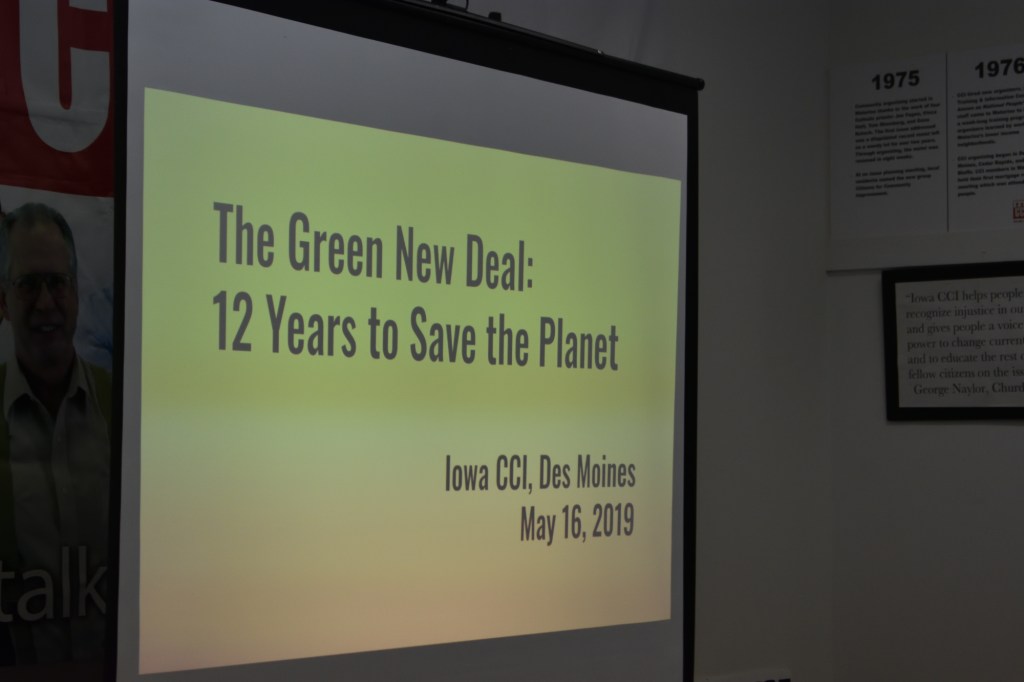
One reason I’ve been thinking about time relates to the recent claim that we only have twelve years to make absolutely massive cuts to our greenhouse gas emissions. If not, it is said, we will have reached the point where runaway burning of Mother Earth will be unstoppable. A growing number of us think we are already past that point. The intention was to try to stimulate action to reduce fossil fuel emissions, but it appears instead to give many people the false impression that we have 12 years until we really need to worry about climate change.

But along with the material, industrial aspects of this transition, we will need to undergo a shift in our values, beliefs and habits. In other words, we need to change our technical and industrial base, our political and economic system, as well as our consciousness and our culture – our way of relating to the world. I know this is no small feat, but it is possible. It could occur through a tipping point, where a small group discovers a new way of being that quickly spreads out to encompass the whole. And it could happen fast.

Pinchbeck, Daniel. How Soon is Now (p. 20). Watkins Media. Kindle Edition.

Of course there already is a small group that continues to live in the way Pinchbeck and many others are suggesting is needed now. Indigenous people the world over have a sacred bond with Mother Earth and have always lived within the ecological boundaries that ensure resources used are replenished. That is why I wanted to be part of the First Nation-Farmer Climate Unity March and am so blessed to have made friendships during those days of walking together.

Now we are working on how to implement an indigenous led Green New Deal.

After a lifetime of studying about our environment, and trying, and failing, to convince people of the urgent need for change, I finally realized logic and scientific data would not create change. What is needed is a change of heart, an attention to spiritual guidance. I’ve posted the following several times already, but it applies here.

What has risen to the surface at Standing Rock is a physical/spiritual movement. Learn how to quiet your mind. To find the silent receptive space to receive guidance. To learn to adapt and follow the pull of synchronicity to guide you to where you will find your greatest support and strength.
What I have found in my time praying in the indigenous earth based ways, is that it’s not about putting your hands together and talking to god…. It’s about quieting and connecting with the baseline of creation, of nature. Tuning into the frequency and vibration of the natural world, the nature spirits. The beings and entities that have been in existence, for all of existence, the examples and realities of sustainability and harmony.
It’s about becoming receptive to these things. Being open and flowing with them. The spirit guides us, but we have to make ourselves receptive to feel, sense, and respond to this guidance.

Joshua Taflinger

Well, things seem to have taken an unexpected turn this morning. I had intended to write more about James Allen’s essay. After yesterday’s discussion about community, the next is about how to build what is needed for the future.

I therefore take my task to be in finding the ways of living that preserve dignity throughout collapse and, more importantly, to create a lineage of ideas, traditions, rituals and institutions that might be useful after it. To that end, my job is to be attuned to the existing system, to work within it to the extent that I must, but to also work in parallel to it, experimenting in building the relationships, tools and structures that may be of use in reestablishing a good life when the centre begins to give way.

Pontoon Archipelago or: How I Learned to Stop Worrying and Love Collapse. By James Allen, Medium, May 24, 2019
Posted in climate change, Indigenous, Uncategorized | Leave a comment

Community is the Answer

What follows from the essay, “Pontoon Archipelago or: How I learned to stop worrying and love collapse” by James Allen about the importance of building community reminds me of the Friends Committee on National Legislation (FCNL) “War is Not the Answer” campaign. To face the deepening environmental chaos we are moving through, “Community is the Answer.”

Bear Creek Friends Meeting, “War is Not the Answer”, Friends Committee on National Legislation

I’ve used (extensive) parts of that essay in the past few blog posts because I’ve found it to be a clear summation of the environmental collapse we are moving through now, and what we might be able to do about it. Something I’ve been focused on for the past several years as the extent of our evolving climate chaos becomes increasingly clear.

The viability of our civilisation is uncertain. While opening our eyes means we’ll confront darkness, keeping them shut means it’ll stay dark. Let’s dare to look and start building new worlds alongside the old.

I offer you this essay in the hope that you may find something within it that will keep you buoyed in the years ahead. It reflects my own attempt to understand the converging crises in our near future, and to grapple with the question of what I might be able to offer that will be useful in that future.

It was the birth of my first child that catalysed a sense of urgency to take the idea-threads I had been tracing for some years now and to weave them into a relatively coherent whole. As any conscientious parent will testify, there are few things that will sharpen one’s focus on the future than a deeply felt sense of responsibility for a new being.

Pontoon Archipelago or: How I Learned to Stop Worrying and Love Collapse. By James Allen, Medium, May 24, 2019

Community

We cannot live for ourselves alone. Our lives are connected by a thousand invisible threads, and along these sympathetic fibres, our actions run as causes and return to us as results. –Herman Melville

That quote is how the section of the essay about community begins. I’ve done my best to try to continue to believe there might be ways we could avoid environmental catastrophe and societal collapse. I hoped people would wake up before it was too late. For forty years I tried to get others to join me in giving up personal automobiles, to no avail. Still, my carbon footprint is many times greater than that of those who live in underdeveloped countries. If we had invested in mass transportation and cities designed to be walkable, Mother Earth might be healthy today.

Instead, we are in the midst of the sixth mass extinction and it looks like humans will be among the species that will not survive. We are now experiencing the consequences of the damage we have done to Mother Earth. “And now we had no place to live, since we didn’t know how to live with each other.” — Joy Harjo

The havoc from increasingly violent storms and development of large areas of drought will overwhelm our economic and political systems. Municipal services such as water, power, sewage and trash processing will fail.  Food will no longer be transported to grocery stores. We need to begin to prepare now. Not wait until the day water is no longer flowing from the faucet. Not wait until more of us are left without infrastructure as in the case of Puerto Rico. Not wait until millions are forced to flee coastal cities as the oceans flow into their streets.

There are other compelling reasons to design and build new communities. Our economic system has not adapted to the loss of jobs overseas and to automation. There are simply not enough jobs for millions of people, and many of those who do have work are paid at poverty levels. Forced to depend upon increasingly diminishing social safety nets. That is morally wrong. Building small communities in rural areas will give people fulfilling work to do, food to eat, shelter, and a caring community to belong to, restoring their dignity.

As I’ve hopefully made clear, the jumping-off point for this essay is a regrettable acceptance that a forthcoming energy descent combined with multiple ecological crises will force massive societal transformation this century. It’s hardly a leap to suggest that, with less abundant cheap energy and the collapse of the complex political and economic infrastructure that supports our present way of life, this transformation is likely to include the contraction and relocalisation of some (if not most) aspects our daily lives.

Pontoon Archipelago or: How I Learned to Stop Worrying and Love Collapse. By James Allen, Medium, May 24, 2019

In the essay, James Allen talks about those (the wealthy) who are building and stockpiling fortresses to hide in when the collapse occurs, and why building communities instead is the answer.

The greatest weakness of survivalism — besides lacking the imagination to envision a future beyond self-preservation, rationing and a descent into depravity — is that the prepper largely conceives their activities as an individual affair. They prepare to protect themselves and perhaps a select few others by erecting barriers and shutting out a crumbling world. This misses a critical point: the resilience of humans depends less on their individual skill and intelligence and more in their ability to pool skills and intelligence, enter into coherent relationships with others, and cooperate on common goals. We even have a name for this kind of arrangement. We call it community. Humans are the only species of hominid capable of forming and sustaining cooperative relationships at scale for the purpose of pursuing mutually beneficial endeavours. On balance, these arrangements tend to generate more value for everyone than individuals can generate separately. Community is fundamental to the human experience, underpinning our capacity to both survive and thrive through difficult times.

This is why I do not feel called to stockpile, build a wall, and batten the hatch. Instead I feel called to open up and build the tiny world that may not extend all that far beyond my town. If many of us join together in that task and we do it well, then we will find a good life in our future, despite the collapse of the world we were born into. If we can sustain this good life, we may even discover a way to scale it to our regional, national and global levels. But even if my work only begins and ends on my own street, or my own home, this is important work nonetheless.

Pontoon Archipelago or: How I Learned to Stop Worrying and Love Collapse. By James Allen, Medium, May 24, 2019

“Then one of the stumbling ones took pity on another
And shared a blanket.
A spark of kindness made a light.
The light made an opening in the darkness.” Joy Harjo

I believe what we are called to do now is create sparks of kindness and build Beloved communities (literally).


Once the World Was Perfect

Once the world was perfect, and we were happy in that world.
Then we took it for granted.
Discontent began a small rumble in the earthly mind.
Then Doubt pushed through with its spiked head.
And once Doubt ruptured the web,
All manner of demon thoughts Jumped through—
We destroyed the world we had been given
For inspiration, for life—
Each stone of jealousy, each stone
Of fear, greed, envy, and hatred, put out the light.
No one was without a stone in his or her hand.
There we were,
Right back where we had started.
We were bumping into each other
In the dark.
And now we had no place to live, since we didn’t know
How to live with each other.
Then one of the stumbling ones took pity on another
And shared a blanket.
A spark of kindness made a light.
The light made an opening in the darkness.
Everyone worked together to make a ladder.
A Wind Clan person climbed out first into the next world,
And then the other clans, the children of those clans, their children,
And their children, all the way through time—
To now, into this morning light to you.

Harjo, Joy. Conflict Resolution for Holy Beings: Poems (pp. 14-15). W. W. Norton & Company. Kindle Edition.
Posted in climate change, revolution, Uncategorized | Leave a comment

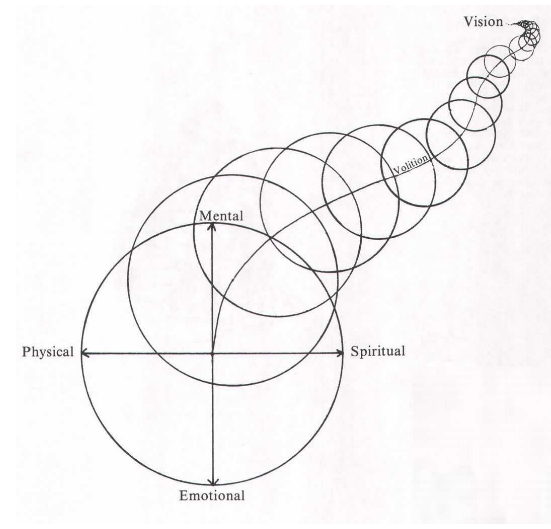
Imagination and Vision

imagination: the faculty or action of forming new ideas, or images or concepts of external objects not present to the senses.

vision: a thought, concept, or object formed by the imagination

vision
Bopp, Judie. Sacred Tree: Reflections on Native American Spirituality

We gain a vision of what our potential is from our elders and from the Teachings of the Sacred Tree. By trying to live up to that vision and by trying to live like the people we admire, we grow and develop. Our vision of what we can become is like a strong magnet pulling us toward it.  

Bopp, Judie. Sacred Tree: Reflections on Native American Spirituality (Kindle Locations 150-151). National Book Network – A. Kindle Edition.

This is a time when so many people seem lost and unsure of what the future holds.  What we need now are visions of what the future might look like.  Something to engage the heart and soul.  Something concrete to work toward now.

Most of us lack the stories that help imagine a future where we thrive in the midst of unstoppable ecological catastrophe. We have been propelled to this point by the myths of progress, limitless growth, our separateness from nature and god-like dominion over it.

If we are to find a new kind of good life amid the catastrophes these myths have spawned, then we need to radically rethink the stories we tell ourselves. We need to dig deep into old stories and reveal their wisdom, as well as lovingly nurture the emergence of new stories into being. This will not be easy. The myths of this age are deeply rooted in our culture.

My young children need me to be an adult. They are the reason I feel despair so profoundly. Yet they are also the reason I cannot wallow in it, acquiesce to it, or turn away from the horror. This is the reason I have sought to imagine another way, and to find and focus on that which I might do to usher that vision into existence, and to behave as if what I do really matters for their future. They are the reason I have directed my imagination to the multitude of paths only visible once I looked beyond the myths that have clouded much of my thinking. It is up to me show them a way beyond grief to a way of life truly worth living for, even if it isn’t the path I had expected to be showing them.

All that is needed is to cross the threshold with ready hands and a sense, even a vague one, of what might be yours to do.

Pontoon Archipelago or: How I Learned to Stop Worrying and Love Collapse. By James Allen, originally published by Medium
June 18, 2019

Having a vision can guide us through the chaos. It teaches us what we are being called to do and that can give us hope.

People often mistake hope for a feeling, but it’s not. It’s a mental discipline, an attentional practice that you can learn. Like any such discipline, it’s work that takes time, which you fail at, succeed, improve, fail at again, and build over years inside yourself.

Hope isn’t just looking at the positive things in this world, or expecting the best. That’s a fragile kind of cheerfulness, something that breaks under the weight of a normal human life. To practice hope is to face hard truths, harder truths than you can face without the practice of hope. You can’t navigate dark places without a light, and hope is that light for humanity’s dark places. Hope lets you study environmental destruction, war, genocide, exploitative relations between peoples. It lets you look into the darkest parts of human history, and even the callous entropy of a universe hell bent on heat death no matter what we do. When you are disciplined in hope, you can face these things because you have learned to put them in context, you have learned to swallow joy and grief together, and wait for peace.

IT IS BITTER TEA THAT INVOLVES YOU SO: A SERMON ON HOPE
April 30, 2018 by Quinn Norton

People of faith try to be very attentive to the Spirit at all times, so we don’t miss messages being given to us, telling us what we need to do next. Although we try to be attentive, we are often distracted by the demands of everyday life.

For those who have faith in a greater power, spirit, God, or however you express your spirituality, this is an opportunity to delve more deeply into your faith. This is also an opportunity to share your spirituality with those who don’t have faith or hope, as long as they are open to what you have to offer. The way that has worked best, in my experience, is to first offer the space for others to express their doubts, fears, or concerns to you. And really listen to what they are saying. Have the attitude that you can learn from this listening, because you can. Once someone else finds you are really listening, they often eventually reach the point where they begin to ask questions of you and to listen to your responses.

I wrote a post titled “Spiritual Depth” that tells a story about an indigenous man who changed the weather. That story made me realize my faith is sometimes too constrained, and I have work to do to deepen my own faith.

In this time of increasing chaos Mother Earth needs us to have the wisdom and courage to create visions from our imaginations and do what the Spirit is leading us to do. Do not be afraid.

“Fear is not real. The only place that fear can exist is in our thoughts of the future. It is a product of our imagination, causing us to fear things that do not at present and may not ever exist. That is near insanity. Do not misunderstand me, danger is very real but fear is a choice.”

from the movie After Life

Posted in climate change, Indigenous, Uncategorized | Leave a comment