De-escalation is the key element of peacemaking and nonviolence. Escalation of tensions is the path to war, as we all saw too clearly yesterday.
Tensions between the United States and Iran escalated in response to the killing of Maj. Gen. Qassim Suleimani, a leader of the Islamic Revolutionary Guards Corps. A number of escalating statements were made by the U.S. president and the leader of the Iranian people. Massive numbers of Iranians demonstrated in the streets of Tehran.
Last night we were on the brink of war as ballistic missiles were launched from Iran, attacking bases in Iraq housing American and Iraqi personnel.
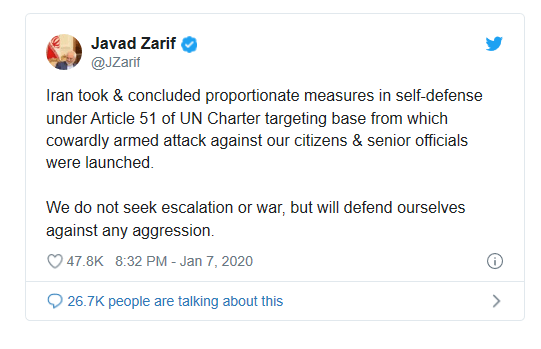
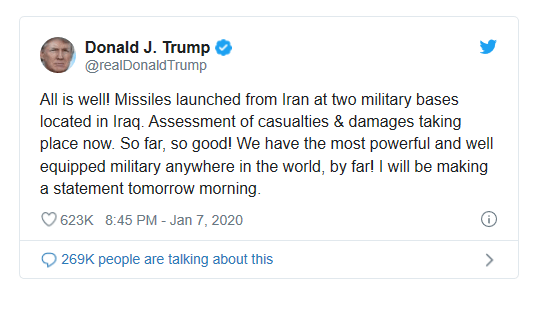
For now, it appears the outbreak of war was avoided. Credit for that goes to Iran’s foreign minister stating Iran has “concluded” its attacks, and to President Trump for acknowledging that statement, and refraining from further escalation. Tensions are still high, but this de-escalation is hopeful.
Iran has “concluded” its attacks on American forces and does “not seek escalation or war,” the country’s foreign minister said in a tweet on Wednesday.
Moments later, President Trump said in a tweet that he would make a statement on Wednesday morning about the conflict, and suggested that damages and casualties sustained by American forces were minimal. But he also said the assessment of the attacks was ongoing.
I am old enough to remember the Cuban Missile Crisis in 1962. Escalating tensions between the U.S. and the Soviet Union resulted when the pilot of an American U-2 spy plane making a high-altitude pass over Cuba on October 14, 1962, photographed missile bases being built there. I still remember how scared I was, that we all were.
The U.S. Navy blockaded Soviet ships carrying nuclear missiles that were trying to get to Cuba. This is an involved story, but the end result was an agreement between the U.S. and the Soviet Union. If Soviet ships had tried to breach the blockade, a military confrontation would have been likely. The Soviet ships did not try to penetrate the blockade.
Despite the enormous tension, Soviet and American leaders found a way out of the impasse. During the crisis, the Americans and Soviets had exchanged letters and other communications, and on October 26, Khrushchev sent a message to Kennedy in which he offered to remove the Cuban missiles in exchange for a promise by U.S. leaders not to invade Cuba. The following day, the Soviet leader sent a letter proposing that the USSR would dismantle its missiles in Cuba if the Americans removed their missile installations in Turkey.
Officially, the Kennedy administration decided to accept the terms of the first message and ignore the second Khrushchev letter entirely. Privately, however, American officials also agreed to withdraw their nation’s missiles from Turkey. U.S. Attorney General Robert Kennedy (1925-68) personally delivered the message to the Soviet ambassador in Washington, and on October 28, the crisis drew to a close.
The key was President Kennedy would probably have refused publicly to withdraw the missiles in Turkey. By choosing to publicly respond to the first message from Khrushchev, that didn’t involved publicly acknowledging the removal of U.S. missiles from Turkey, while agreeing to do so secretly allowed the two countries to back away from war.
De-escalation requires both sides of a conflict to compromise and create a mutually acceptable solution.
Myself, I’ve got to get to a place where I can accept what Stalin did to people in the Siberian gulags, the scale of it. This, too, is us. This is what we do. That’s why I told my grandson in the book’s prologue, as we stood over the wreckage of that battleship at Pearl Harbor, “This is what we do.” He had no idea that we killed each other on that scale. But I could say to him, “I love you, and I want you to know that this is what we do. And as you grow, you will see a way to help. And I hope that when you do, you choose that path, no matter how hard it is.” Barry Lopez
Just today I was reading the Sun article referenced above at a friends suggestion and it seemed an apt introduction to my story today. The following quote does, too. Although I’m old, I’m not sure I’m an elder. But I do often find myself telling people things they don’t want to hear. For my whole adult life I’ve been telling people they need to get rid of their cars, and reduce their carbon footprint.
I think what has happened in our society, and in other Western societies, is that the elders were telling us things we didn’t want to hear, so we’ve gotten rid of them. A lot of their message for us was “You’ve got to grow up. You’re too distracted by venal desires, and you are ignoring your responsibilities to others.” What we’ve said to elders in the West is “Oh, shut up.” We’ve pushed them off into the darkness, denied them a place of respect.
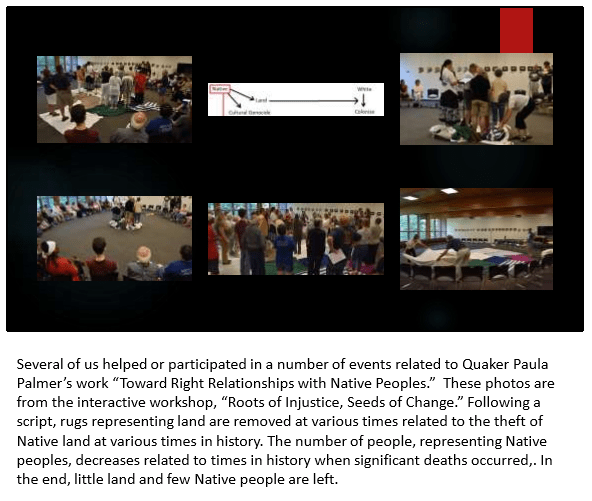
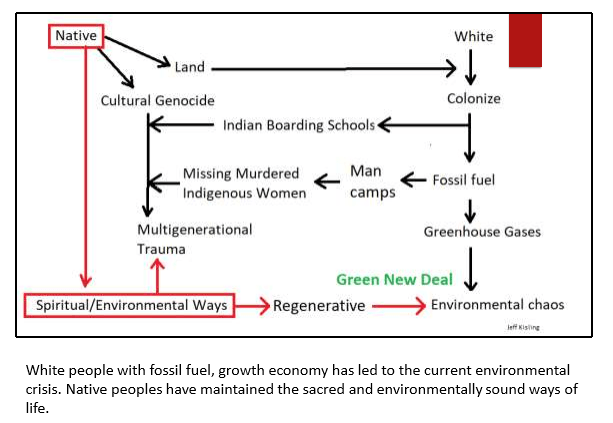
Lately I’ve also been telling people we need to learn about the history of White men forcibly removing Native children from their families to attempt to assimilate them into White culture. My experience has been that not many Friends have an accurate awareness of the history of Quakers’ involvement with Quaker Indian Boarding Schools. This is yet another example of how history is rewritten to show the colonists in a better light.
I hadn’t known about the numbers of Native children forced to attend those schools. I didn’t know so many died. I didn’t know about the widespread physical and sexual abuse. I didn’t know the children were forcibly taken from their families, and often not returned for years, if they survived. I didn’t know these children no longer fit into their communities when the did return from the schools. I didn’t know Quakers were so involved with these schools. I didn’t know that trauma is passed from generation to generation.
White people usually don’t want to hear about this and resist bringing up these things now. There are a number of reasons why I believe it is important that we do so.
The trauma to Native communities is not a matter of the past. That trauma is passed from generation to generation. That trauma is described as “an open wound” in Native communities today.
Native children continue to be removed from their families and are then usually placed with non-native families.
The recent U.S. policy of taking children from their parents at the southern border is not the first time this cruelty has been employed.
People need to participate in opportunities, like Truth and Reconciliation Commissions, to learn about what actually happened. These meetings should provide the sacred space for Native people who are willing to do so, tell of their experiences. And like the screening of the movie “DAWNLAND”, details found at the end of this post.
These shared experiences are important, to help both White and Native people move forward together toward healing.
I do not believe we can make progress on justice issues today until we first begin to heal ourselves and those who were harmed by what was done.
As Barry Lopez said in the quote above, speaking to his grandson at Pearl Harbor, I could say to him, “I love you, and I want you to know that this is what we do. And as you grow, you will see a way to help. And I hope that when you do, you choose that path, no matter how hard it is.”
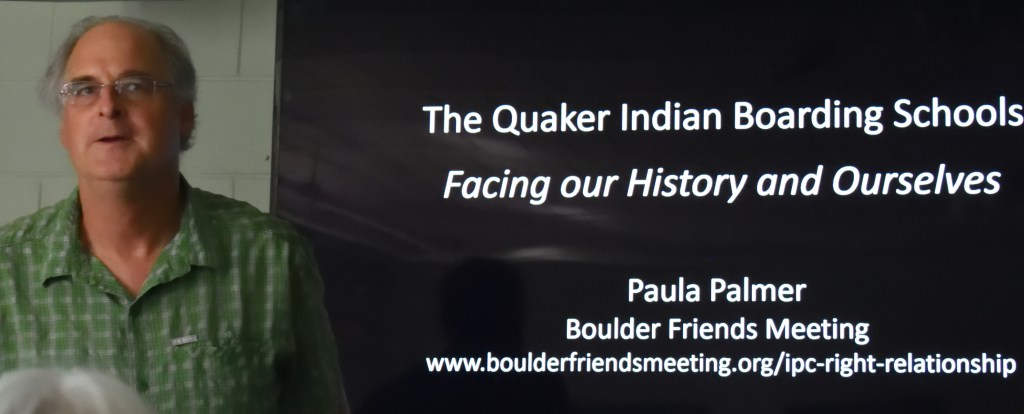
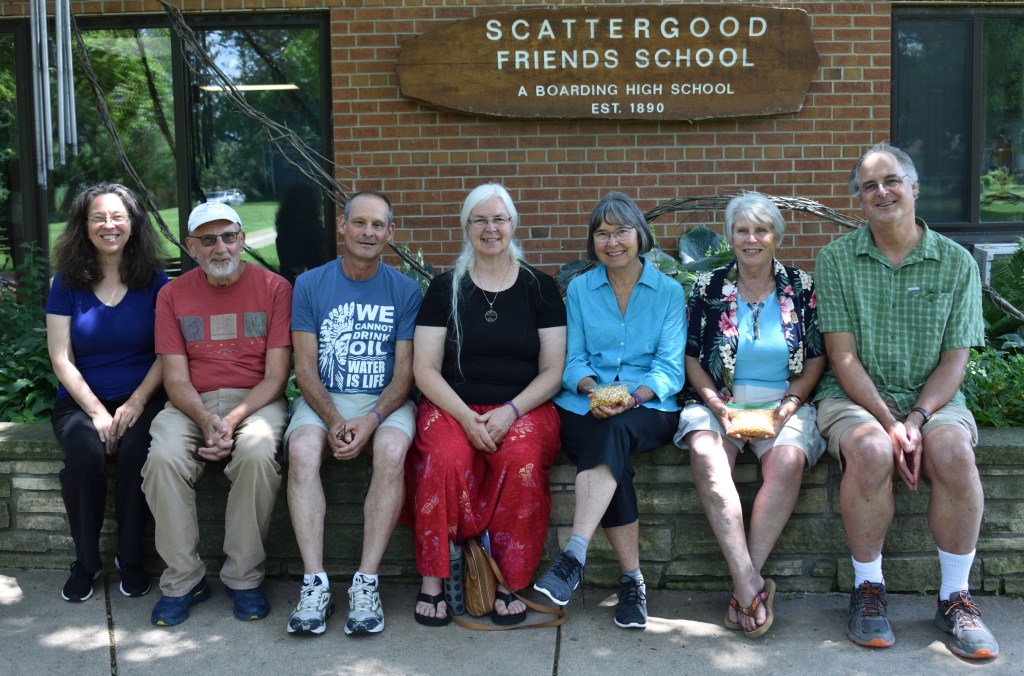
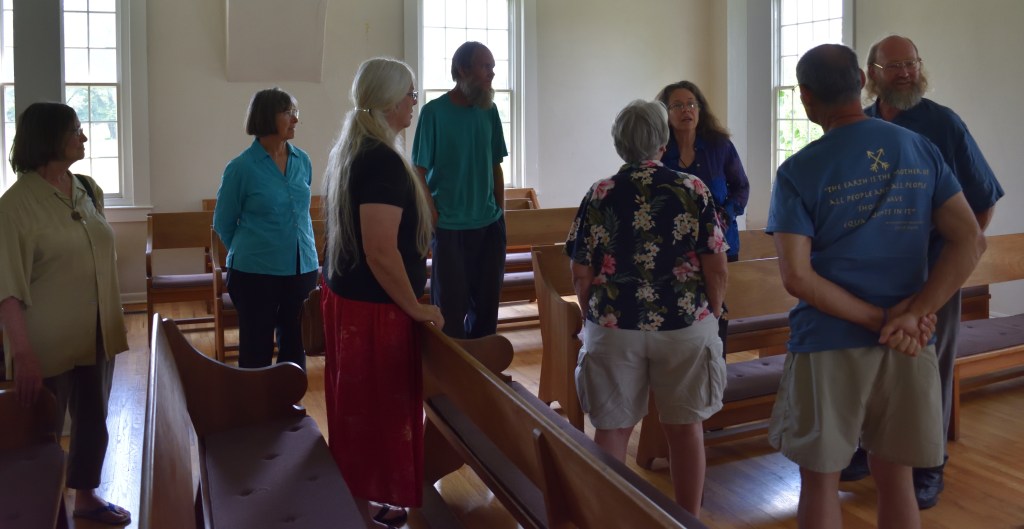
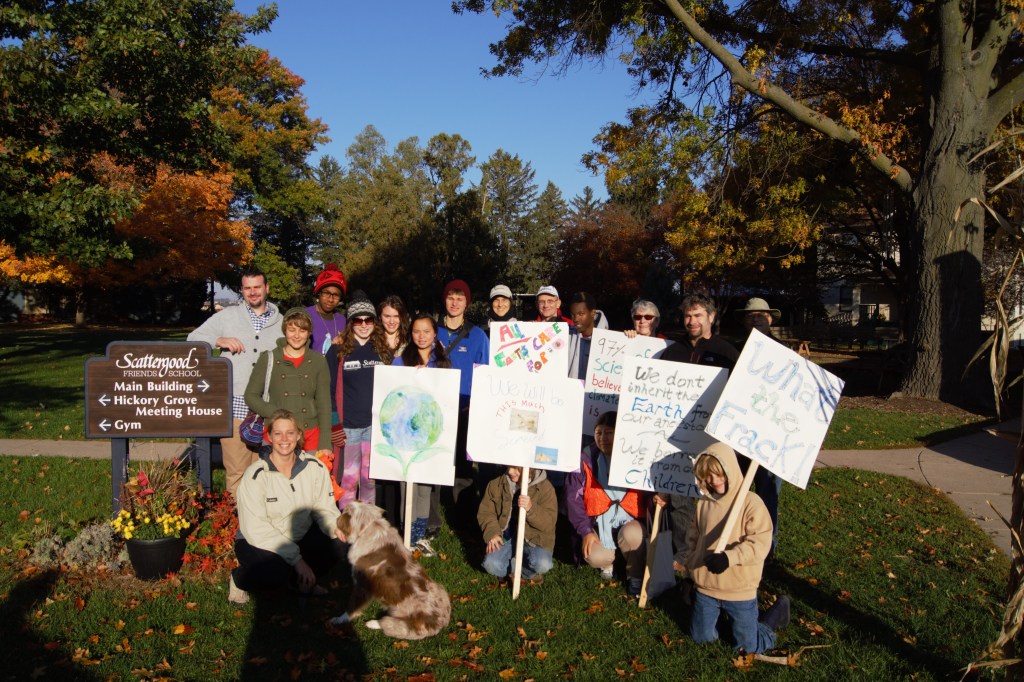
One of the workshops that (Quaker) Paula Palmer led last summer was “The Quaker Indian Boarding Schools, Facing our History and Ourselves” that was part of her ministry “toward right relationships with Native peoples”. It was a bit ironic that the workshop was held at Scattergood Friends School, a Quaker boarding high school that I attended.
The reason for bringing this up again now is because there is an opportunity for you to attend the screening of “DAWNLAND”. This powerful video is about the Truth and Reconciliation Commission’s work in Maine related to the forced removal of Native children of the Wabanaki people. The video will be shown this Friday, January 10th from 6:30 – 9:00 pm, at the Friends Meetinghouse, 4211 Grand Ave in Des Moines.
A man with long gray braids tells how his mother hid him away when the Indian agents came to take the children. He escaped boarding school by hiding under an overhung bank where the sound of the stream covered his crying. The others were all taken and had their mouths washed out with soap, or worse, for “talking that dirty Indian language.” Because he alone stayed home and was raised up calling the plants and animals by the name Creator gave them, he is here today, a carrier of the language. The engines of assimilation worked well. The speaker’s eyes blaze as he tells us, “We’re the end of the road. We are all that is left. If you young people do not learn, the language will die. The missionaries and the U.S. government will have their victory at last.” A great-grandmother from the circle pushes her walker up close to the microphone. “It’s not just the words that will be lost,” she says. “The language is the heart of our culture; it holds our thoughts, our way of seeing the world. It’s too beautiful for English to explain.” PuhpoweeI
Kimmerer, Robin Wall. Braiding Sweetgrass: Indigenous Wisdom, Scientific Knowledge and the Teachings of Plants (p. 50). Milkweed Editions. Kindle Edition.
USE WHAT YOU LEARN TO RESOLVE YOUR OWN CONFLICTS AND TO MEDIATE OTHERS’ CONFLICTS:
When we made it back home, back over those curved roads that wind through the city of peace, we stopped at the doorway of dusk as it opened to our homelands.
We gave thanks for the story, for all parts of the story because it was by the light of those challenges we knew ourselves— We asked for forgiveness.
We laid down our burdens next to each other.
Harjo, Joy. Conflict Resolution for Holy Beings: Poems. W. W. Norton & Company. Kindle Edition
De-escalation is the key element of peacemaking and nonviolence. Escalation of tensions is the path to war. There have been tensions between the United States and Iran for many years. A significant move toward de-escalation was the approval of the Iran nuclear deal in 2015. The Obama administration worked very hard to get support for that deal. I recently wrote about the small part of my involvement in working to get my senator, Joe Donnelly, to support the approval of the deal in Congress.
The Iran deal had been successful, allowing United Nations inspections to verify Iran was not making material for nuclear weapons. Those inspections have shown Iran has remained compliant with the deal.
But the Trump Administration decided to leave the Iran nuclear deal. And now, as a result of the assassination of General Qasem Soleimani, Iran says it will no longer be bound by the deal. Also as a result of the assassination, the Iraqi parliament has passed a non binding resolution for the removal of U.S. forces.
Instead of trying to calm the situation in the Middle East, the president is exchanging rhetoric with the Iranian leader, each side making more belligerent threats, each bringing us closer to war.
Following is a statement from the Friends Committee on National Legislation (FCNL). After that there is a template that will help you send a message to you U.S. Representatives and Senators.
The Trump administration’s assassination of the military commander of Iran’s Quds Force is a dangerous escalation of the confrontation with Iran that will lead to more bloodshed, further destabilize Iraq, and expand conflict and instability throughout the Middle East.
FCNL condemns the assassination of Maj. Gen. Qasem Soleimani and other pro-Iran militia leaders. We are opposed to all killings and condemn the killings of hundreds of Americans and other civilians by Iran’s Quds Force and their militia allies. The only way to de-escalate tensions and resolve our differences with Iran is through diplomacy.
Congress has the power to stop the march to war with Iran and return our nation to the path of diplomacy and international engagement – that is the only way to prevent war.
As a Quaker organization we hold firm to the faith that war is not the answer; neither is assassination or mass killings of innocent civilians. We believe the origin of this crisis lies with the Trump administration that has withdrawn from the international nuclear agreement with Iran, undermined diplomatic efforts, and escalated economic and military pressure on Iran. And with Congress’ failure to act to explicitly reject war with Iran and insist on diplomacy.
Make no mistake, Congress has not authorized war with Iran. But in December 2019, Congress struck language from a military policy bill that would have explicitly denied authorization for a war with Iran. That legislative language would have repealed the outdated 2002 Authorization for War with Iraq, which the administration may be using to provide legal cover for this assassination.
Speaker Nancy Pelosi, Rep. Eliot Engel (NY-16), Sen. Chris Murphy (CT) and other members of Congress who have stated that Congress did not authorize this escalating war with Iran are correct. Congress should – as many members are already declaring – demand a full briefing on the attack and hold public hearings on the on the escalation of violent conflict with Iran. But Congress’ core concern should be stopping a destructive war. That is why we urge Congress to swiftly pass legislation taking away any legal justification and explicitly prohibiting funding for a war with Iran.
Truly, these escalating acts of war will not end what has been an endless war in Iraq and other countries in the Middle East. This recent assassination will only unleash a new cycle of the deadly conflict in the Middle East at the cost of millions of peoples’ lives and livelihoods. It will be answered with violence and war, not peace.
Congress has the power to stop the march to war with Iran and return our nation to the path of diplomacy and international engagement – that is the only way to prevent war. It must exercise its constitutional authority now.
Here is the link to the following page you can use to send a message for no war with Iran to you Congressional Representatives. Tell Congress: No War with Iran! ›
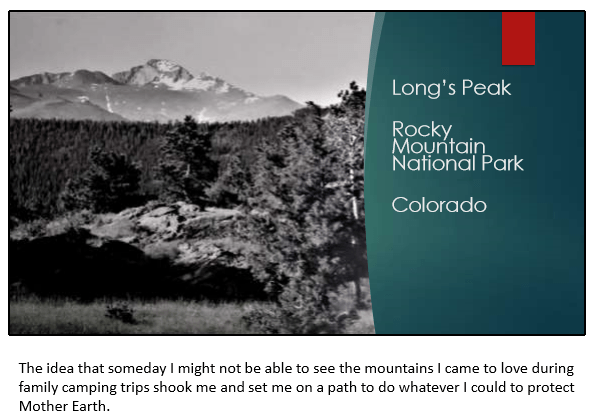
Love of and care for Mother Earth has been the focus of my entire adult life (50 years). For those who don’t know me, one of the main ways I was led to this focus came from a vision of my beloved Rocky Mountains hidden behind clouds of smog. That vision was more than a picture in my head. It was a spiritual message from the Inner Light or the spirit of God. And it wasn’t just a one-time message, but I continued to receive these messages, this guidance, throughout my life. My grandmother, Lorene Standing, said the will of God is often revealed in a series of steps. That is what the “Light” in the title of this refers to.
That vision meant I could not own a car, and so I learned to live without one. I always have trouble writing this because I fear it will be taken as bragging which is not my intention at all. And I know many other people live without a car.
The reason for saying this is because the first thing someone usually says when I try to talk about the need to get off fossil fuels is to suggest I am part of the problem when they assume that I own a car. Being able to say no, I don’t, will sometimes at least get that person to continue a conversation instead of immediately dismissing what I’m saying.
Yet I am part of the problem because my carbon footprint is many times greater than that of people in many other parts of the world. I do ride in other people’s cars and on buses and trains. Fossil fuel is keeping me warm today, and provides electricity for the laptop I’m writing this on, is used to transport food to the grocery store.
It has been a long, frustrating journey to try to convince others to give up their cars and reduce their fossil fuel consumption. Despite the lows there were a few high points along the way.
But today I’m feeling worse than I can remember. Feeling the pull toward hopelessness. Seeing the ferocious fires in California, the vast flooding of the rivers on both sides of my state (Iowa) and the devastation from hurricanes Katrina, Maria and Dorian is hard to grasp.
But the scenes of the fires in Australia, the fleeing kangaroos and Koala bears, thousands of people forced to beaches, awaiting evacuation, not knowing if they can ever return to rebuild what is lost, has been overwhelming to me. The hopelessness comes from all of that happening while the Australian government continues to support the coal industry. Literally adding fuel to the fire. And we have similar situations in the United States, Canada and elsewhere.
For some reason I’m reminded of James Taylor’s song, “Fire and Rain.”
What can we do? Is there any hope? I’m not sure what the answers are, but I am convinced they will have a spiritual basis. What happened at Standing Rock is an example of what I believe the answer will be. Following are a number of ideas I’ve been dwelling on for some time now.
I’ve been thinking about the concept of a Spiritual Warrior ever since I received the following message from my friend Joshua Taflinger:
I am inspired to share with you all more directly a post I wrote, because I consider you an established & effective nature/spiritual warrior, and believe that there is a need for the perspectives shared in the attached post to be more common thought in the minds of the many.
What has risen to the surface at Standing Rock is a physical/spiritual movement. Learn how to quiet your mind. To find the silent receptive space to receive guidance. To learn to adapt and follow the pull of synchronicity to guide you to where you will find your greatest support and strength.
What I have found in my time praying in the indigenous earth based ways, is that it’s not about putting your hands together and talking to god…. It’s about quieting and connecting with the baseline of creation, of nature. Tuning into the frequency and vibration of the natural world, the nature spirits. The beings and entities that have been in existence, for all of existence, the examples and realities of sustainability and harmony.
It’s about becoming receptive to these things. Being open and flowing with them. The spirit guides us, but we have to make ourselves receptive to feel, sense, and respond to this guidance.
Joshua Taflinger
The Spiritual Warrior is a person who challenges the dreams of fear, lies, false beliefs, and judgments that create suffering and unhappiness in his or her life. It is a war that takes place in the heart and mind of a man or woman. The quest of the Spiritual Warrior is the same as spiritual seekers around the world.
Each Warrior of the Light contains within him the spark of God. His destiny is to be with other Warriors , but sometimes he will need to practice the art of the sword alone; this is why, when he is apart from his companions, he behaves like a star. He lights up his allotted part of the Universe and tries to point out galaxies and worlds to all those who gaze up at the sky. The Warrior’s persistence will soon be rewarded. Gradually, other Warriors approach , and they join together to form constellations, each with their own symbols and mysteries.
Coelho, Paulo. Warrior of the Light: A Manual (p. 89). HarperCollins. Kindle Edition.
Everywhere people ask, “what can we do?” The question, what can we do, is the second question. The first question is “what can we be?” Because what you can do is a consequence of who you are. Once you know what you can be, you know what you can do.
Arkan Lushwala
Speaking about what is happening on Earth right now, many of the conditions of life that we used to take for granted, now are really out of balance. Hopefully we still have time to get back into balance so life may continue. I travel around the world and meet people and talk to people from all different cultures. And everywhere people ask, “what can we do?” The question, what can we do, is the second question. The first question is “what can we be?” Because what you can do is a consequence of who you are. Once you know what you can be, you know what you can do, and we cannot afford wasting time; we have little time. We need to be precise now. When someone sincerely asks, “what can I do?” my humble answer, the only answer that I find in my heart to be sincere is, “First find out what you can be.” Action is extremely necessary at this time. This is not a time just to talk about it. The most spiritual thing now is action. To do something about what’s happening. To go help where help is needed. To stand up when we need to stand up, and protect what is being damaged. And still, this action needs to be born from a place in ourselves that has real talent, real intelligence, real power, real connection to the heart of the Earth, to universal wisdom, so our actions are not a waste of time. So our actions are precise, our actions are in harmony with the movement, the sacred movement, of that force that wants to renew life here on Earth and make it better for the following generations.
Arkan Lushwala
In a world experiencing unprecedented climatic, ecological, and societal change, many in the Religious Society of Friends are coming to know our own need for newness. We thirst to find and share a clearer sense of the relevance of our beloved tradition to the challenges we face. We yearn to come more fully alive together, to speak and serve today in the Life and Power that generations of our spiritual ancestors knew. Across North America and beyond, Friends are recognizing a shared calling to rediscover and reclaim traditional understandings of who we are and how we are as Friends that will help us continue to travel this Way of Love.
Prophets, Midwives, and Thieves: Reclaiming the Ministry of the Whole, Noah Baker Merrill
Increasing tensions with Iran now remind me of the work we did in 2015 to help get the Iran Nuclear Deal approved. Tensions today are the direct result of the withdrawal of the United States from that deal.
The work began with the only time I have been on a conference call with President Barack Obama. The Friends Committee on National Legislation (FCNL) helped make that call possible.
July 31, 2015
Last night President Obama spoke for half an hour by phone to activists who support him. He described how the Iran deal is a good deal for the United States and all the counties who joined in the negotiations in good faith that they would all agree to the deal. This is the agreement that the international community hammered out and supports. If Congress defeats this bill, that will likely end any influence the United States could have in the Middle East. Opponents of the bill only offer that we need a “better deal”, but have nothing to offer as to what that could possibly be. Those who say we should continue with sanctions don’t understand that is not possible now. Sanctions only work when the international community supports and enforces them. That won’t happen if they see the U.S. cannot agree on a foreign policy, as would be evident if this bill is defeated. There is also the question of who the sanctions hurt, which is the people of Iran, not their leaders. This feeds the movement to join terrorist organizations. An improved standard of living for the Iranian people should help mitigate that. The President specifically asked us to speak out to support this deal. “In the absence of your voices, you are going to see the same array of voices that got us into the Iraq war, leading to a situation in which we forgo a historic opportunity and we are back on the path of potential military conflict,” he said.
August 27, 2015
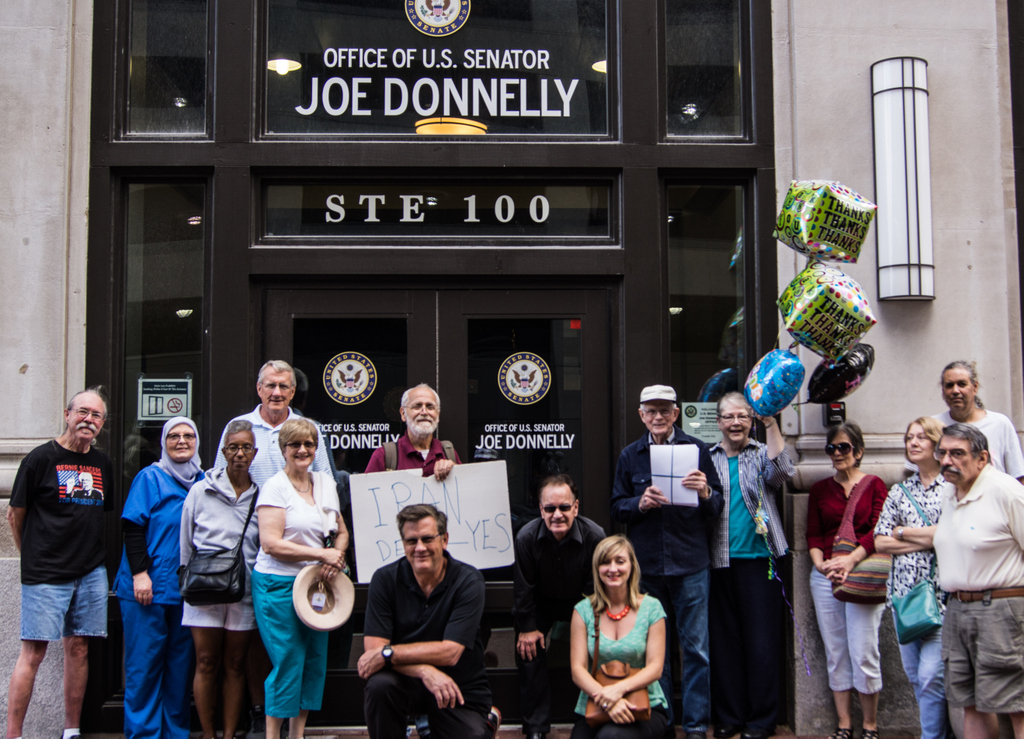
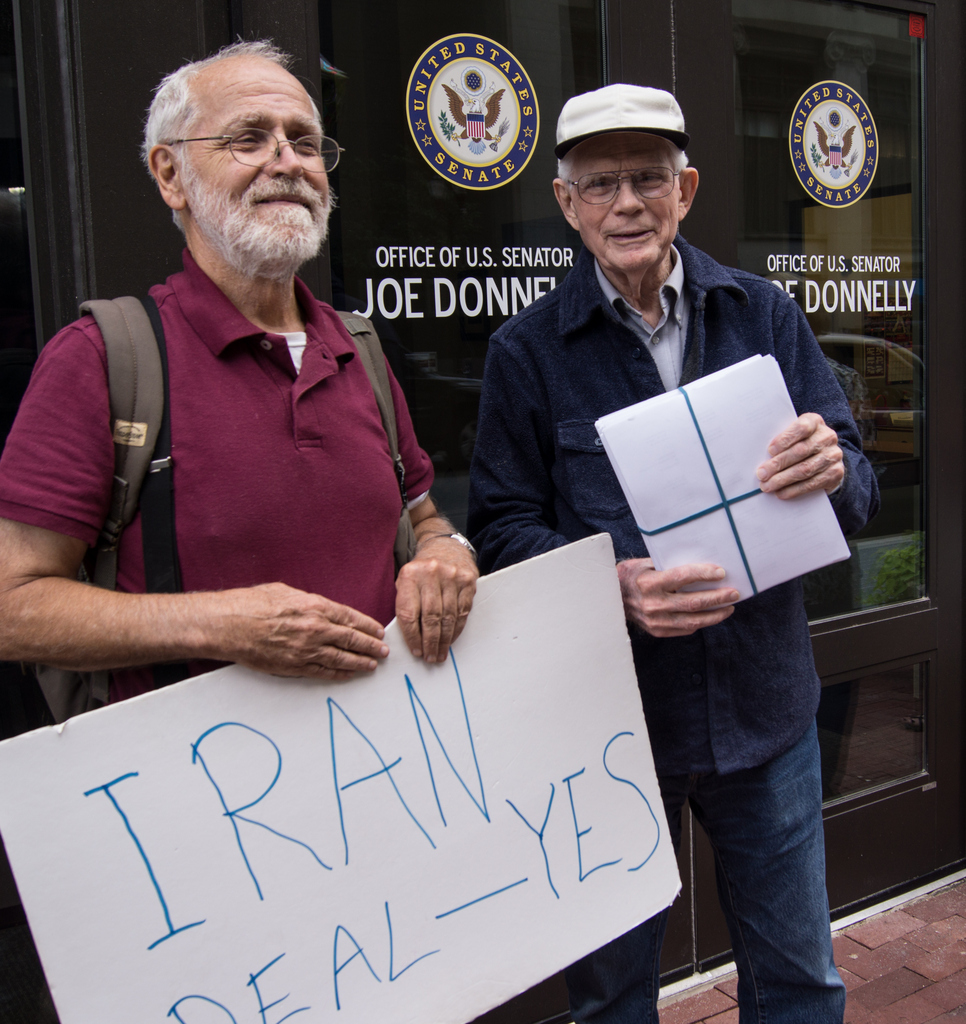
When MoveOn couldn’t find anyone else to do it, I’ve spent the past week, with the help of Erin Polley, AFSC, organizing the delivery of a petition with over 10,000 Indiana signatures supporting the Iran nuclear deal. Members of North Meadow Circle of Friends, Indiana Moral Mondays, and MoveOn met with staff of Senator Joe Donnelly’s Indianapolis office yesterday. Senator Donnelly now supports the deal, so this was a ‘thank you’ event, which the Senator’s staff indicated didn’t happen very often.
“While Durbin and Nancy Pelosi were tracking the votes in their respective chambers, the president took a larger part and also played rougher in this fight than had been his custom. He accused Republicans of “making common cause” with Iran’s hard-liners. He stated that the alternatives were the deal or war. Even some of his allies thought he’d gone a bit overboard with these statements, potentially alienating some undecided Democrats, and he pulled back from them. Obama responded to the requests by Pelosi and Durbin to make calls to wavering Democrats, more calls than he’d made on any previous legislation. He held special briefings in the White House for members of Congress; he participated in a conference call with the outside groups on his side.”
As a direct result of that call, with the help of MoveOn we organized the delivery of over 10,000 signatures of Hoosiers who support the Iran Nuclear Deal to Senator Joe Donnelly’s office. Iran petition delivery to Senator Donnelly
The following Minute was approved the summer of 2015.
Iowa Yearly Meeting (Conservative) supports the peaceable agreement among world powers, including the United States and Iran, to dramatically curb Iran’s nuclear program in exchange for easing international sanctions against Iran. We hope this will be the beginning of many more peaceful negotiations.
Delivering petitions to support Iran deal to Sen. Donnely
This new year begins with multiple global climate threats.
Devastating fires burning in Australia are forcing thousands to be pushed to the water’s edge. Evacuations are occurring. Wildlife is being devastated. Nearly half a billion birds and animals are feared dead. The smoke from the fires drifts across the Tasman Sea, turning New Zealand glaciers black, which will accelerate the ice melting from climate change.
Flooding in Indonesia:
The flooding has highlighted Indonesia’s infrastructure problems. Jakarta is home to 10 million people, or 30 million including those in its greater metropolitan area. It is prone to earthquakes and flooding and is rapidly sinking due to uncontrolled extraction of ground water. Congestion is also estimated to cost the economy $6.5 billion a year. President Joko Widodo announced in August that the capital will move to a site in sparsely populated East Kalimantan province on Borneo island, known for rainforests and orangutans.
Indonesia capital floods leave 43 dead, 397,000 displaced.” By NINIEK KARMINI, Associated Press, January 2, 2020
Flooding in the Midwest. Some of the levees damaged in last year’s flooding have not been repaired.
As central U.S. producers make plans to harvest corn and soybeans in a year marked by record rain and flooding, prospects already indicate the 2020 crop year could bring more of the same. That’s because one of the building blocks of spring flooding — ample amounts of soil moisture — is already in place.
High soil moisture after the fall season, which can serve as a priming mechanism for flooding.
Frozen ground, causing late winter or early spring precipitation to run off instead of infiltrating the soil.
High snowpack, offering meltwater for flooding.
A rapid spring melt, causing snow to quickly turn into liquid and add to flooding. Spring rain itself.
Venice, Miami and other coastal cities are experiencing flooding as sea levels rise.
Surface concentrations of methane are increasing in the arctic.
These massive situations are beyond human control. And yet people continue to think in terms of the status quo. Even in the face of the environmental devastation occurring in Australia, Prime Minister Scott Morrison, speaking about the coal industry, says “I am not going to write off the jobs of thousands of Australians by walking away from traditional industries.”
We feel hopeless. Yet this is what “radical hope” is about. We need a new vision to help us navigate through environmental collapse. We can’t cling to the status quo. In the end we may well join the thousands of species that are already extinct.
But we need to live the best we can for ourselves and our children now. As I wrote yesterday, we need a new vision, and the willingness to change our culture to implement that vision.
The Crow had an established practice for pushing at the limits of their understanding: they encouraged the younger members of the tribe (typically boys) to go off into nature and dream. For the Crow, the visions one had in a dream could provide access to the order of the world beyond anything available to ordinary conscious understanding.
Jonathan Lear. Radical Hope: Ethics in the Face of Cultural Devastation (Kindle Locations 664-668). Kindle Edition.
Is there a way we can create similar conditions for youth or others to obtain a vision today?
I often don’t know what the Spirit will lead me to write until I sit down at my computer, center myself, and listen. I believe the reason I was led to read this book was because it distills a lot of ideas I’ve been thinking about, and justice actions I’ve been involved in, for years.
For my entire adult life I’ve known the supply of fossil fuels was limited, and no more could be created. As a scientist I could visualize the damage (invisible) greenhouse gas emissions were doing to Mother Earth. My faith led me to know I could not contribute to this situation, and thus could not own a personable automobile. That resulted in a lifetime of tension with my Quaker faith community, neighbors and friends when I could not convince them to give up their cars and move away from fossil fuels embedded in our culture.
Part of the reason for this failure to convince others to stop using fossil fuels is related to what Albert Einstein said, “we cannot solve our problems with the same thinking we used when we created them.” People could not envision a future that didn’t continue to have what appeared to be unlimited fossil fuel supplies that were easily extracted.
Sooner than anyone imagined, the realities of dwindling supplies of fossil fuels and the damage done to our environment from burning vast amounts of those fuels are apparent to everyone. The extraordinary air temperatures and the fires engulfing Australia are hard to believe. Rapidly evolving environmental devastation is one reason our culture is collapsing now.
The other reason our culture is collapsing is our economic system and the political institutions based upon that. Capitalism helped create our current crisis. Demanding an ever growing economy, dependent on fossil fuel energy, and seeing natural and human resources as simply inputs to profitable outputs. Valuing monetary gain above all else. Capitalism is failing due to lack of jobs with adequate pay and extreme distribution of wealth. Millions of men, women and children live in poverty as a result.
Realizing our culture is collapsing, Jonathan Lear looked for examples of a culture in the past that navigated its way through collapse. In Radical Hope: Ethics in the Face of Cultural Devastation he tells how the Crow Nation’s culture collapsed when the buffalo disappeared.
The Crow had an established practice for pushing at the limits of their understanding: they encouraged the younger members of the tribe (typically boys) to go off into nature and dream. For the Crow, the visions one had in a dream could provide access to the order of the world beyond anything available to ordinary conscious understanding. Young Plenty Coups took the traditional resource of seeking a dream-vision, and with some help from the elders in the tribe he put it to a new use. This gave the tribe resources for thought-for practical reasoning-that would not have been available to them in any other way. And it gave Plenty Coups the resources for a transformation of the virtue of courage.
Jonathan Lear. Radical Hope: Ethics in the Face of Cultural Devastation (Kindle Locations 664-668). Kindle Edition.
At the time Plenty Coups went on his spirit quest he was nine years old. And although the buffalo were being hunted by White men, they were still plentiful, which makes his vision more powerful as it looks to the future.
The practice was for the youth to tell the tribe his dream, to help interpret what it means, and then to act on that interpretation.
The elders of the tribe listened to young Plenty Coups’s dream. Yellow Bear, “the wisest man in the lodge,” offered this interpretation:
“He has been told that in his lifetime the buffalo will go away forever,” said Yellow-bear, “and that in their place on the plains will come the bulls and cows and calves of the white man. I have myself seen these Spotted-buffalo drawing loads of the white man’s goods. And once at a big fort … I saw cows and calves of the same tribe as the bulls that drew the loads. “The dream of Plenty-coups means that the white man will take and hold this country and that their Spotted-buffalo will cover the plains. He was told to think for himself, to listen, to learn to avoid disaster by the experiences of others. He was advised to develop his body but not to forget his mind. The meaning of this dream is plain to me. I see its warning. The tribes who have fought the white man have all been beaten, wiped out. By listening as the Chickadee listens we may escape this and keep our lands.”
The buffalo were disappearing from traditional Sioux hunting grounds, and as a result the Sioux were pressured to move in on the Crow. It is in this context that young Plenty Coups had his dream-and it was in this context, too, that the tribe took the dream as a key to the challenges they had to face. They decided on a foreign policy that would guide their acts for the next century. They explicitly recognized in an official council that their buffalo-hunting way of life was coming to an end, and they decided to ally with the white man against their traditional enemies. This is the way they hoped to weather the oncoming storm and hold onto their land.
Jonathan Lear. Radical Hope: Ethics in the Face of Cultural Devastation (Kindle Locations 718-728). Kindle Edition.
This is a fascinating story and illustration of how the Crow Nation came to find a way to navigate their cultural collapse. How they were able to learn to be at peace with the White settler-colonists while maintaining their basic culture and traditions, adapted to the loss of the buffalo.
Can we use this model to navigate our own cultural collapse? The collapse of our fossil fuel based, capitalist economic model?
To do so would require:
A vision from someone. Perhaps it needs to be from youth.
The interpretation of, and actions based upon this vision by the community (elders?)
I would be very interested to hear your thoughts about cultural collapse and/or this vision based model. Please leave your ideas in the comments. Thank you.
I have a vision that has evolved over the years as I’ve tried to move us off fossil fuels. Perhaps that will be what I write next.
Greetings as a new year begins! Powerful forces at work indicate a number of significant events and changes will occur this year. Most important will be increasingly severe and frequent environmental disasters, which will stress cultures globally. For decades industrial societies have refused to face the consequences of profligate mining and use of fossil fuels. It has been discouraging each New Year to look back on how little was done to protect Mother Earth, and to not see much hope of change in the coming new year.
But this year I see signs of hope, that the awakening youth across the world understand the existential threat posed by deepening environmental disasters in a way that so many of their elders have not, do not. They are demanding change because they are now seeing the consequences of not doing so.
What changes are needed? Who has answers? Einstein was right when he said, “we cannot solve our problems with the same thinking we used when we created them.”
For the past several weeks I’ve been writing how the Crow chief, Plenty Coups, helped guide his Nation through their cultural collapse, as the buffalo their culture depended on disappeared. The story is described by Jonathan Lear in Radical Hope: Ethics in the Face of Cultural Devastation. How did Plenty Coups find answers to a problem his culture had never faced? The details are laid out in yesterday’s post, The Crow and Visions.
At the age of 9 years, Plenty Coups went on a vision quest. The elders of the tribe listened to young Plenty Coups’s dream. Yellow Bear, “the wisest man in the lodge,” offered this interpretation:
“He has been told that in his lifetime the buffalo will go away forever,” said Yellow-bear, “and that in their place on the plains will come the bulls and cows and calves of the white man. I have myself seen these Spotted-buffalo drawing loads of the white man’s goods. And once at a big fort … I saw cows and calves of the same tribe as the bulls that drew the loads. “The dream of Plenty-coups means that the white man will take and hold this country and that their Spotted-buffalo will cover the plains. He was told to think for himself, to listen, to learn to avoid disaster by the experiences of others. He was advised to develop his body but not to forget his mind. The meaning of this dream is plain to me. I see its warning. The tribes who have fought the white man have all been beaten, wiped out. By listening as the Chickadee listens we may escape this and keep our lands.”
Jonathan Lear. Radical Hope: Ethics in the Face of Cultural Devastation
The key to moving forward was to listen like a Chickadee-person.
Young Plenty Coups’s dream calls on him, and it gives him ethical advice-advice that seems designed to help him survive the cataclysmic rupture that is about to occur: become a chickadee! “He is least in strength but strongest of mind among his kind. He is willing to work for wisdom. The Chickadee-person is a good listener. Nothing escapes his ears, which he has sharpened by constant use. Whenever others are talking together of their successes and failures, there you will find the Chickadee-person listening to their words.” Becoming a chickadee, then, is a virtue-a form of human excellence. One trains oneself by sharpening one’s ears; one acquires the ability to learn from the wisdom of others. And after one acquires this character trait, a new form of excellence opens up: one can survive the coming storm. “The lodges of countless Bird-people were in the forest when the Four Winds charged it. Only one is left unharmed, the lodge of the Chickadee-person.” Chickadee virtue called for a new form of courage, yet it drew on the traditional resources of Crow culture to do so.
So the chickadee had an established position in traditional Crow life; but in Plenty Coups’s dream the chickadee was put to a new use. Young Plenty Coups was told to acquire the skills of listening and learning from others. But there was no longer any indication of what doing this might mean. In ordinary circumstances stances the meaning would be straightforward: if one were already ready in a warrior culture, one might be able to pick up tips from others about military strategy, how to shoot a bow, and so on. If one were already in a farming culture, one might pick up tips from one’s neighbors about how to rotate crops, what kind of fertilizer is good for this soil, and so on. But the dream-advice to become come a chickadee is being given in full recognition that upcoming events will be extraordinary. There is a storm coming that will blow down all the trees but one. And nothing is said about what constitutes the wisdom of others, what their successes are, or how one should learn from them. In particular, there is no first-order advice that one should simply pick up the skills and values of the white man. Indeed, there is no first-order advice at all-unless “learning to listen” counts as first-order behavior. Part of what it is to acquire the virtue of the chickadee is to be able to spot what the “successes” and the “wisdom” of others are-and to learn from them. The wisdom of a chickadee consists in being able to recognize the genuine wisdom of others. I shall discuss in the next chapter how this might be possible, but for the moment it suffices to note that Plenty Coups used the chickadee to radicalize a second-order virtue. It may be that the chickadee will learn from the white man in the sense of acquiring his skills and values; it may also be that the chickadee will see that there are failures in what the white man takes to be his successes, and will learn from that. And it may be that the chickadee “learns from others” in ways that allow him to go forward in entirely new directions. The only substantive commitment embodied in the chickadee virtue is that if one listens and learns from others in the right way-even in radically different circumstances, even with the collapse of one’s world-something good will come.
Jonathan Lear. Radical Hope: Ethics in the Face of Cultural Devastation (Kindle Locations 819-832). Kindle Edition.
The Crow people survived by learning to adjust their culture after the buffalo were gone.
Our culture (in the United States) is shifting and on the verge of collapse. Evolving environmental chaos and the failure of our capitalist economic model are the main factors.
The Crow people looked to their youth for visions. We should do the same. What are the youth you know telling you? What is their vision? Perhaps it is not to be like a Chickadee-person. Perhaps it is.
My Quaker Yearly Meeting’s, Iowa Yearly Meeting (Conservative), Peace and Social Concerns Committee has recently be working harder to engage with our youth. Environmental chaos is the main thing they are concerned about.
The idea of being like a Chickadee is familiar to Quakers, who emphasize listening to the Spirit, and listening to each other. I sometimes wonder whether we listen closely enough. There is a danger of trying to fit what we hear into our current circumstances. Maybe being intentional about listening closely and being expectant of the possibility of hearing something totally new would be helpful.
Yesterday’s post was about the decisions the Crow Nation made when their culture collapsed as a result of the destruction of the buffalo by White men, as described in “Radical Hope: Ethics in the Face of Cultural Devastation” by Jonathan Lear. Lear uses this historic, real life story to see if there are lessons we might learn to help as we are going through our own cultural devastation.
The question thus becomes as urgent practically as it is significant theoretically: Might there be a certain plasticity deeply embedded in a culture’s thick conception of courage? That is, are there ways in which a person brought up in a culture’s traditional understanding of courage might draw upon his own inner resources to broaden his understanding of what courage might be? In such a case, one would begin with a culture’s thick understanding of courage; but one would somehow find ways to thin it out: find ways to face circumstances courageously that the older thick conception never envisaged. The issue would then be one not simply of going over to the thick concepts of another culture, but of drawing on their traditions in novel ways in the face of novel challenges. If this is a possible act, it would be good to know what kind of psychological adjustments make it possible. I want to argue that Plenty Coups did make just this sort of transformation.
Jonathan Lear. Radical Hope: Ethics in the Face of Cultural Devastation (Kindle Locations 658-664). Kindle Edition.
The Crow had an established practice for pushing at the limits of their understanding: they encouraged the younger members of the tribe (typically boys) to go off into nature and dream. For the Crow, the visions one had in a dream could provide access to the order of the world beyond anything available to ordinary conscious understanding. Young Plenty Coups took the traditional resource of seeking a dream-vision, and with some help from the elders in the tribe he put it to a new use. This gave the tribe resources for thought-for practical reasoning-that would not have been available to them in any other way. And it gave Plenty Coups the resources for a transformation of the virtue of courage.
The Crow, like other American Indian tribes, had a theory of dreams. They took dreams to be meaningful: revealing-often in enigmatic form-an order in the universe that was typically hidden from ordinary conscious life. They recognized that dreams were related to their wishes. Indeed, they sought dreams as a means of getting some sort of authoritative word on whether or not their wishes would be gratified.
Jonathan Lear. Radical Hope: Ethics in the Face of Cultural Devastation (Kindle Locations 664-668). Kindle Edition.
I was very interested to read about this idea of a vision quest, the vision Plenty Coups had, and how his vision was integrated into the Crow culture at the time when their culture was collapsing.
The rural, Quaker culture I was raised in didn’t have a deliberate act of a vision quest. Instead, we believe as we worship and connect with the Spirit, we may experience such a vision. This might occur at any age, and perhaps more than once. Such a vision might “provide access to the order of the world beyond anything available to ordinary conscious understanding .”
I hadn’t thought of this until now, but many Quaker youth did experience a vision quest as we struggled with how to respond to the requirement to register with the Selective Service System (the “draft”) when we turned 18 years of age. Although this is still a requirement, the consequences of that decision were different, potentially life and death, in the 1960’s during the Vietnam War. My experiences actually covered a span of years and resulted in a significant spiritual deepening.
Following is a recounting of part of Plenty Coups’ dream/vision.
“Listen Plenty-Coups,” said a voice. In that tree is the lodge of the Chickadee. He is least in strength but strongest of mind among his kind. He is willing to work for wisdom. The Chickadee-person is a good listener. Nothing escapes his ears, which he has sharpened by constant use. Whenever others are talking together of their successes and failures, there you will find the Chickadee-person listening to their words. But in all his listening he tends to his own business. He never intrudes, never speaks in strange company, and yet never misses a chance to learn from others. He gains successes and avoids failure by learning how others succeeded or failed, and without great trouble to himself … The lodges of countless Bird-people were in the forest when the Four Winds charged it. Only one person is left unharmed, the lodge of the Chickadee-person. Develop your body, but do not neglect your mind, Plenty-Coups. It is the mind that leads a man to power, not strength of body.”
Obviously, allowances need to be made for the fact that this is the dream of a youth being recounted by an old man. It is likely that there have been revisions in the telling and retelling of the dream. On the other hand, this dream was recounted to the tribe at the time. The tribe may itself have collectively revised the dream in various ways. Nevertheless, the fact that he recounted his dream in public when he was nine, and that the tribe immediately incorporated the dream into its own self-understanding, gives us confidence that, in the broad scale at least, this was a piece of imaginative activity going on at the time.
Jonathan Lear. Radical Hope: Ethics in the Face of Cultural Devastation (Kindle Locations 708-717). Kindle Edition.
The practice was for the youth to tell the tribe his dream, to help interpret what it means, and then to act on that interpretation.
In the dream, the dreamer recognizes that he is not able to grasp its meaning. It is as though the dream itself is calling attention to its own significance. The young dreamer, exhausted from his ordeal, was brought back to the tribe amidst much rejoicing. In a formal setting, the boy recounted his dream to the wise men of the tribe. It is fascinating to see how the Crow used dreams cooperatively. The young men were sent out to dream; and at a later ceremonial occasion the old men interpreted the young men’s dreams. The tribe relied on what it took to be the young men’s capacity to receive the world’s imaginative messages; it relied on the old men to say what these messages meant.
The elders of the tribe listened to young Plenty Coups’s dream. Yellow Bear, “the wisest man in the lodge,” offered this interpretation:
“He has been told that in his lifetime the buffalo will go away forever,” said Yellow-bear, “and that in their place on the plains will come the bulls and cows and calves of the white man. I have myself seen these Spotted-buffalo drawing loads of the white man’s goods. And once at a big fort … I saw cows and calves of the same tribe as the bulls that drew the loads. “The dream of Plenty-coups means that the white man will take and hold this country and that their Spotted-buffalo will cover the plains. He was told to think for himself, to listen, to learn to avoid disaster by the experiences of others. He was advised to develop his body but not to forget his mind. The meaning of this dream is plain to me. I see its warning. The tribes who have fought the white man have all been beaten, wiped out. By listening as the Chickadee listens we may escape this and keep our lands.”
So it seems that for the Crow, dream-interpretation consisted in showing how the vision embodied in a dream applied-or would come to apply-to reality. At the time of the dream the buffalo on the plains were still plentiful, but the Crow had reason for concern. As Richard White has pointed out, the average number of buffalo robes shipped down the Mississippi River increased from approximately 2,600 robes in 1830 to about 50,000 in 1833. In 1848 a local priest estimated that 110,000 robes were shipped downriver.
The buffalo were disappearing from traditional Sioux hunting grounds, and as a result the Sioux were pressured to move in on the Crow. It is in this context that young Plenty Coups had his dream-and it was in this context, too, that the tribe took the dream as a key to the challenges they had to face. They decided on a foreign policy that would guide their acts for the next century. They explicitly recognized in an official council that their buffalo-hunting way of life was coming to an end, and they decided to ally with the white man against their traditional enemies. This is the way they hoped to weather the oncoming coming storm and hold onto their land.
Jonathan Lear. Radical Hope: Ethics in the Face of Cultural Devastation (Kindle Locations 718-728). Kindle Edition.
This is a fascinating story and illustration of how the Crow Nation came to find a way to navigate their cultural collapse. How they were able to learn to be at peace with the White settler-colonists while maintaining their basic culture and traditions, adapted to the loss of the buffalo.
I shared my struggles related to war, in this case the Vietnam War, and the Selective Service System with my Quaker meeting (circa 1970)
Letter to Bear Creek Monthly Meeting
Homer Moffitt, Clerk Bear Creek Monthly Meeting
Dear Friends,
I am thankful for your kind letters and encouragement concerning my work in Indianapolis. I am learning much about love, and as I respond to the love of others, and they to mine, we are all amazed at how it grows.
I am enclosing a statement I have written concerning conscription, and my decision not to cooperate with the Selective Service System any more. I sent a copy of that statement, along with my draft cards, to my draft board.
Again, I tried very hard to follow the leading of the inner light. If I alone were making the decision, this would probably not be my choice. Thomas a’ Beckett, torn between his obligations to the Church and those to the State, was searching for guidance. When he realized all the forces that influence him—selfish desires for power and personal gain, fear of punishment or displeasing people, etc., he said. “I am loathsome.” But then he heard what he believed to be the voice of God saying, “Nevertheless, I love.”
I, too, feel shamed when I realize the factors that often influence my decisions and actions. On this matter, I have tried very hard to be sensitive to the will of God, and hope to do so in the times to come. Still somewhat uncertain that my choice is right, I am comforted in knowing that He still loves.
Love, Jeff Kisling
In reply:
Dear Jeff,
We have found your statement explaining your relationship to the Selective Service System very moving. Several of us are aware that your decision on this has been a difficult and lonely one. We want to assure you of our love and support as you meet the events which result from your courageous stand.
On behalf of the Peace Committee of Bear Creek Monthly Meeting
KONICA MINOLTA DIGITAL CAMERA
KONICA MINOLTA DIGITAL CAMERA
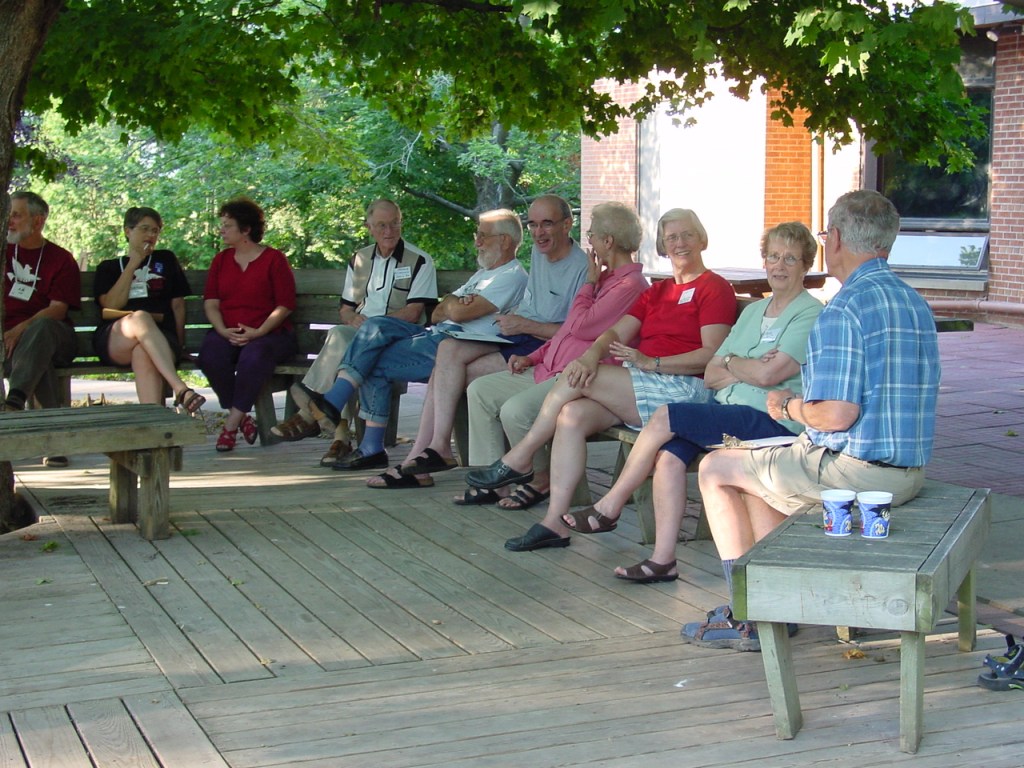
AM Deb Fink Horace Autenreith George Welch Jim Ginger Kenney Mary Autenreight Birdie Kisling Don Nagler
I’ve been writing about“Radical Hope: Ethics in the Face of Cultural Devastation” by Jonathan Lear. He looked for a culture that had experienced cultural collapse to see if that would give us some ideas for how to deal with our own culture’s collapse. Knowing some native nations in this country had been forced into collapse, he studied how the last great chief of the Crow Nation, Plenty Coups, guided his people through their cultural collapse.
Plenty Coups recognized the slaughter of millions of buffalo by White men meant the end of his people’s culture. The buffalo, as a source of food, blankets and tipi covers, as well as a relation, disappeared in a very short time. So many parts of the Crow culture no longer made sense–training young men as hunters, and curing buffalo hide for blankets, for example.
But when the buffalo went away the hearts of my people fell to the ground, and they could not lift them up again. After this nothing happened. There was little singing anywhere.
Plenty Coups, Crow Chief
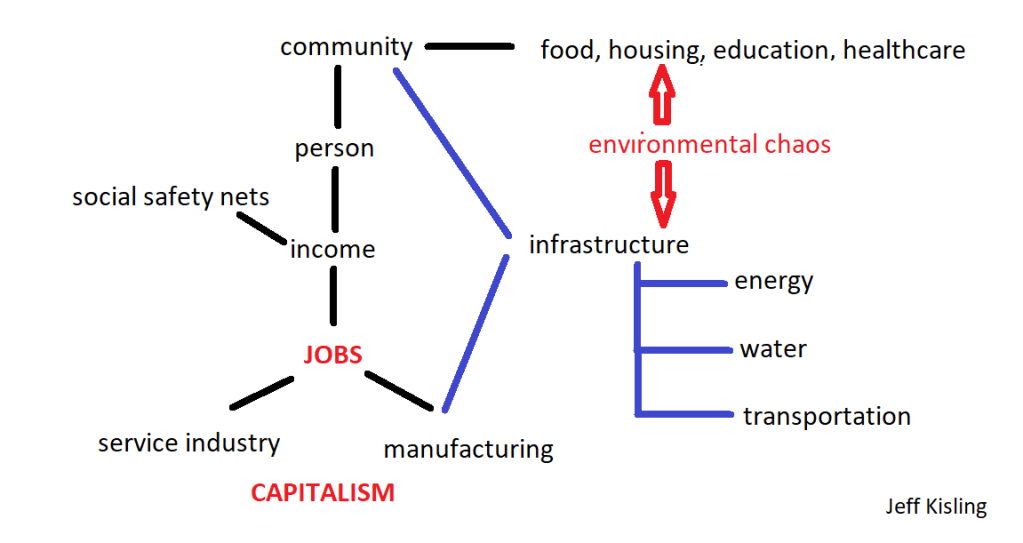
Our own culture is collapsing now. The two major components of this collapse are
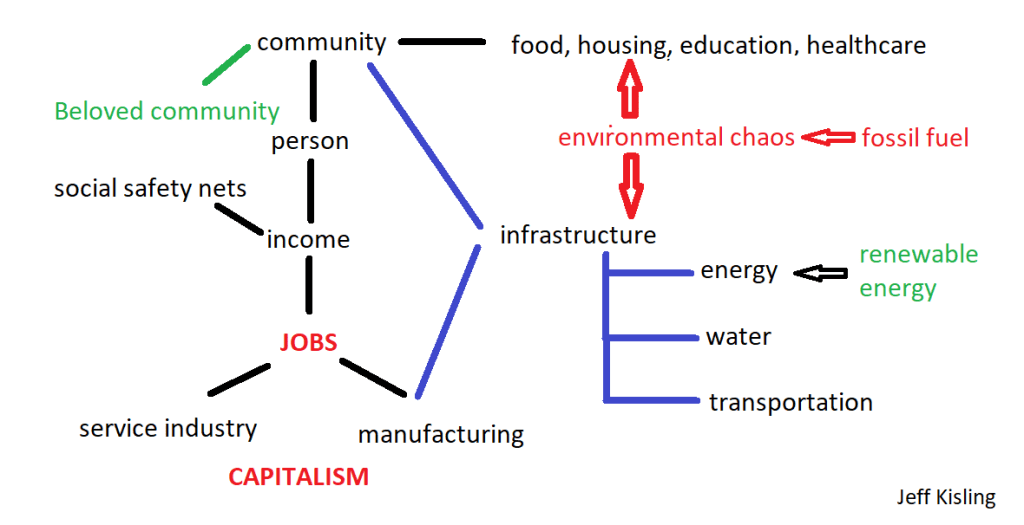
The capitalist economic system and the political institutions based upon that. Capitalism helped create our current crisis. Demanding an ever growing economy, dependent on fossil fuel energy, and seeing natural and human resources as simply inputs to profitable outputs. Valuing monetary gain about all else. Capitalism is failing due to lack of jobs with adequate pay and extreme distribution of wealth. https://kislingjeff.wordpress.com/2019/12/23/cultural-collapse/
Rapidly increasing frequency and severity of damage from environmental chaos will impact every aspect of our lives: food, housing, education, healthcare, and break down the infrastructure related to transportation, water and energy systems needed for both communities and for manufacturing.
Forces causing collapse of our culture
The 2010’s may go down in environmental history as the decade when the fingerprints of climate change became evident in extreme weather events, from heat waves to destructive storms, and climate tipping points once thought to be far off were found to be much closer.
New studies showed polar ice caps melting and sea level rising much faster than just 10 years ago. Ocean researchers showed how marine heat waves kill corals and force fish to move northward, affecting food supplies for millions of people in developing countries. They tracked changes to crucial ocean currents and concluded that hurricanes will intensify faster in a warming world.
Climate Science Discoveries of the Decade: New Risks Scientists Warned About in the 2010s. A decade of ice, ocean and atmospheric studies found systems nearing dangerous tipping points. As the evidence mounted, countries worldwide began to see the risk. By Bob Berwyn, InsideClimate News, Dec 28, 2019
If you care about the planet, and about the people and animals who live on it, there are two ways to think about this. You can keep on hoping that catastrophe is preventable, and feel ever more frustrated or enraged by the world’s inaction. Or you can accept that disaster is coming, and begin to rethink what it means to have hope.
Ever since I read what Plenty Coups said, “the hearts of my people fell to the ground, and they could not lift them up again. After this nothing happened”, I’ve had this picture of the hearts of the people here, and around the world, fallen to the ground. “After this nothing happened” captures how we have failed to adapt and respond to the threats from environmental, economic, and political collapse. Now is the time, as Jonathan Franzen says, to “accept that disaster is coming, and begin to rethink what it means to have hope.”
This is the period in which Plenty Coups grew up: it is the period in which, by his own account, things were still happening. Even this thumbnail sketch of the historical context should suffice to show that the Crow not only knew what they were fighting for; they also had a vivid sense of what they were fighting against. They were fighting to prevent utter devastation at the hands of the Sioux. This was the prospect of a Crow holocaust: a weakened tribe being fatally overrun by the Sioux. In this worst possible scenario, men, women, and children would be slaughtered-the tribe would be exterminated-with perhaps a few survivors taken into captivity as slaves. This was a very real possibility. It is in this context that the Crow tribe decided to ally with the white man, in particular the U.S. government, in what became a common battle against the Sioux.
It seems clear, then, that the Crow were living within a world of possibilities that they understood fairly well: they understood what it was for them to flourish; what it was for them to survive and cope with the challenges of hunting, disease, and war; what it was to face the prospect of utter devastation. It is worth dwelling for a moment on this extreme possibility of destruction. Had there been a Crow holocaust it would have been fair to say that a way of life had come to an end-at least, in some familiar sense of those terms. The tribe would have been destroyed; there would no longer be any people to carry out their traditional rituals. Still, if we think of the inner life of the one surviving Crow slave, he would have the conceptual resources to understand what had happened to himself and his people. This worst possible scenario was one that he well understood. And, however unrealistic, his dreams of escape, revenge-of planting his coup-stick again!-would would make complete sense to him, as well as to his Sioux masters. Let us assume that there was no chance of this dream’s coming to fruition: still, the possibility it describes would continue to make sense.
This is enough to show that the type of devastation the Crow actually endured as they willingly moved onto the reservation in the 1880’s was of a different order from anything for which they could thoughtfully plan.
Jonathan Lear. Radical Hope: Ethics in the Face of Cultural Devastation (Kindle Locations 250-263). Kindle Edition.
Against a background of unrelenting pressure from the Sioux, the Crow signed the first Fort Laramie Treaty in 1851, in which the United States recognized their right to 33 million acres of what is now Montana and Wyoming. It also promised to pay the tribe $50,000 worth of supplies per year. But, as Frederick Hoxie points out, there were neither enforcement procedures nor established penalties for failing to comply. The United States paid out this amount once. The 1860’s were a period of terrible wars with the Sioux. In 1867 the United States negotiated a second Fort Laramie Treaty, in which it recognized only 25 percent of the land recognized in the first treaty: Crow lands were reduced to 8 million acres. During this period, the Crow fought on the side of the United States against their common enemy, the Sioux; and they inflicted significant damage. But the emerging peace on the northwest plains only increased the immigration of white settlers, and thus placed increased pressure on Crow lands. In 1882 Crow land was reduced again, to about 2 million acres. And in the period 1882-1884 the Crow-their resources depleted, threatened by disease, cold, and starvation-moved to a reservation. Intertribal warfare was forbidden by the U.S. government. Hunting became impossible, both because all the beaver and buffalo had been killed and because the Crow were now forbidden to pursue a nomadic life. There was also devastating mortality. As Hoxie points out, nearly one-third of the 2,461 Crows recorded in the 1887 census died in the 1890’s, as a result of a confluence of poor sanitation in new conditions of confinement, lack of ability to resist diseases carried by white settlers, and malnutrition. The younger generation was all but wiped out. Not surprisingly, those who survived suffered massive disorientation. Ambitious young men, wishing to establish themselves in the tribe, could think only in terms of warfare-but warfare had been forbidden.
Jonathan Lear. Radical Hope: Ethics in the Face of Cultural Devastation (Kindle Locations 278-289). Kindle Edition.
Those are the practical actions Plenty Coups and the Crow Nation made in the face of cultural devastation. What I hope to write about next is how a vision Plenty Coups had led to these practical steps.




















































 Quakers, social justice and revolution