Languish

This morning I was led to hear a discussion about languishing, prompted by the New York Times article, There’s a Name for the Blah You’re Feeling: It’s Called Languishing
The neglected middle child of mental health can dull your motivation and focus — and it may be the dominant emotion of 2021
.
What also caught my attention was hearing the author was Adam Grant, who wrote the book Think Again that I’ve been reading.


Languish

1. To be or become weak or feeble; lose strength or vigor:
  crops languishing from a lack of rain
2. To exist or continue in miserable or disheartening conditions:
languished away in prison.
3. To remain unattended or be neglected: 
legislation that continued to languish in committee.
4. To become downcast or pine away in longing: 
languish apart from friends and family; languish for a change from dull routine.
Languish, The Free Dictionary


There’s a Name for the Blah You’re Feeling: It’s Called Languishing

At first, I didn’t recognize the symptoms that we all had in common. Friends mentioned that they were having trouble concentrating. Colleagues reported that even with vaccines on the horizon, they weren’t excited about 2021. A family member was staying up late to watch “National Treasure again even though she knows the movie by heart. And instead of bouncing out of bed at 6 a.m., I was lying there until 7, playing Words with Friends.

It wasn’t burnout — we still had energy. It wasn’t depression — we didn’t feel hopeless. We just felt somewhat joyless and aimless. It turns out there’s a name for that: languishing.

Languishing is a sense of stagnation and emptiness. It feels as if you’re muddling through your days, looking at your life through a foggy windshield. And it might be the dominant emotion of 2021.

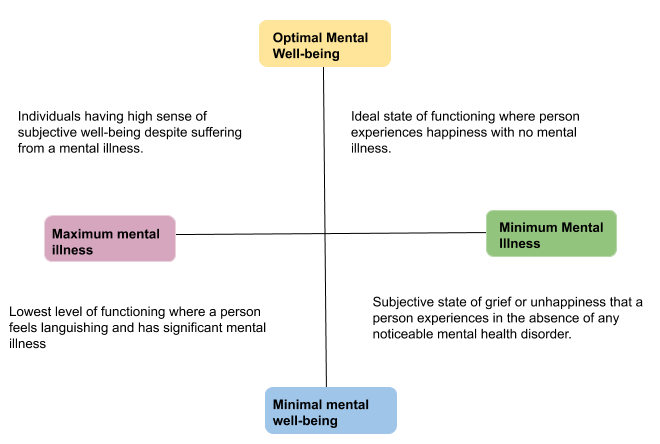
Mental Health Continuum Model

In psychology, we think about mental health on a spectrum from depression to flourishing. Flourishing is the peak of well-being: You have a strong sense of meaning, mastery and mattering to others. Depression is the valley of ill-being: You feel despondent, drained and worthless.

Languishing is the neglected middle child of mental health. It’s the void between depression and flourishing — the absence of well-being. You don’t have symptoms of mental illness, but you’re not the picture of mental health either. You’re not functioning at full capacity. Languishing dulls your motivation, disrupts your ability to focus, and triples the odds that you’ll cut back on work. It appears to be more common than major depression — and in some ways it may be a bigger risk factor for mental illness.

There’s a Name for the Blah You’re Feeling: It’s Called Languishing,
The neglected middle child of mental health can dull your motivation and focus — and it may be the dominant emotion of 2021
by Adam Grant, The New York Times, April 28, 2021


MHC Diagram
Mental Health Continuum Model

From Languishing to Flourishing

As a complement to the mental health continuum model, the ‘Languishing vs. Flourishing’ perspective came into the picture. Within this perspective, mental health disorder or an overall distressed state is referred to as ‘languishing,’ whereas, a more positive and content state is called ‘flourishing.’

Studies on this model focused on four fundamental aspects:

  • The prevalence of flourishing and languishing in the overall sample population.
  • The association of languishing with significant depression and other mental health illnesses.
  • The relationship between flourishing and happiness and whether one calls for the other.
  • The understanding of mental health and mental health disorders among the general population.

What is the Mental Health Continuum Model? by Madhuleena Roy Chowdhury, Positive Psychology, 3/1/2021


Matthew Iasiello, MA, an Australia-based researcher, is investigating techniques to promote flourishing and reduce languishing. Earlier this year, he and his colleagues published a review of current psychological interventions that are being used to improve mental well-being.

Further research is needed, but the initial data point to mindfulness, cognitive and behavioral therapy, and acceptance and commitment therapy-based interventions as places to start.7

Mindfulness involves intense focus and awareness of what you’re sensing and feeling, moment by moment, without judgment. It has been shown to help people relax and reduce stress.8

“The one intervention type that worked incredibly across the board [was] mindfulness,” Iasiello says, adding that “the cool thing about mindfulness is that there’s lots of different ways to practice it.”

What Is Languishing, and What Can We Do About It? by Sarah Simon, VeryWellHealth, April 29, 2021


I am really interested in the concept of languishing because it is something I’ve noticed affecting many people I know, now that I know it’s name. What I want to do is share some of my personal stories and ideas about languishing and things that can be done about it. I intend to write about faith and Mutual Aid among other things. But this background research has made this post long enough. To be continued…


Posted in Uncategorized | Leave a comment

Climate tipping points that might already have been reached

As storms and fires become increasingly frequent and devastating, we are bombarded with more, increasingly alarming articles about climate change. Yesterday I wrote an introduction to climate tipping points. I did that because I came upon an interesting paper that goes into detail about three tipping points that might already have been reached.

In a 2019 paper, Professor Timothy Lenton, a global leader on the subject, identified nine climate tipping points, from melting permafrost in the Arctic to the loss of tropical coral reefs. Here we will focus on what he deems the three most critical tipping points: the Amazon rainforest, the West Antarctic ice sheet and the Gulf Stream system.

Lenton highlights these three because the West Antarctic ice sheet may have already passed a tipping point; the Amazon because it is a crucial crucible of biodiversity and for its warehouse of carbon; and the Gulf Stream system because of its potential for profound changes with connected ramifications all around the planet.

CBS News spoke to Lenton and several other scientists about the state of climate tipping points. While they have different areas of expertise, ranging from oceans to atmosphere to biosphere, their message was unanimous: Changes are happening faster than what was expected and the chance of hitting tipping points in the climate system, which just a decade ago appeared remote and far off, now seems much more likely and more immediate.

“This is why I have been raising the alarm,” Lenton said. “In just a decade the risk level has gone up markedly — that should be triggering urgent action.”

Climate tipping points may have been reached already, experts say
BY JEFF BERARDELLI, CBS News, APRIL 26, 2021

 Climate tipping points –too risky to bet against. The growing threat of abrupt and irreversible climate changes must compel political and economic action o emissions by Timothy Lentan et al, Nature, Nov 27, 2019

The Amazon rainforest

Deforestation and climate change are destabilizing the Amazon — the world’s largest rainforest, which is home to one in ten known species. Estimates of where an Amazon tipping point could lie range from 40% deforestation to just 20% forest-cover loss8. About 17% has been lost since 1970. The rate of deforestation varies with changes in policy. Finding the tipping point requires models that include deforestation and climate change as interacting drivers, and that incorporate fire and climate feedbacks as interacting tipping mechanisms across scales.

Climate tipping points –too risky to bet against. The growing threat of abrupt and irreversible climate changes must compel political and economic action o emissions by Timothy Lentan et al, Nature, Nov 27, 2019

Having studied the Amazon for 56 years and visited hundreds of times, Dr. Thomas Lovejoy is one of those experts. 

“We are really right at that tipping point. We see the signs in longer dry seasons, hotter dry seasons, tree species that prefer drier conditions gaining dominance over those that prefer wet conditions,” explains Lovejoy, a professor at George Mason University and founder of the Amazon Biodiversity Center. “So we know that it’s right there at the tipping point right now.”

When Lovejoy started studying the Amazon in the 1960s, 10 million people lived there and the forest was 97% intact. Now there are 30 million people living there and deforestation in the Brazilian Amazon is at 20% — the critical level at which scientists believe the Amazon starts to tip towards the point of no return, where it no longer survives as a lush wet rainforest and transitions into an arid savanna.

Lovejoy says this transition from rainforest to savanna could happen as fast as a mortgage cycle. “I would say it’s a matter of something that happens on the timescale of decades like 10, 20, 30 years, not centuries. So, a lot of the people alive today would actually get to see that negative consequence.” 

Climate tipping points may have been reached already, experts say
BY JEFF BERARDELLI, CBS News, APRIL 26, 2021


West Antarctic ice sheet

The latest research finds that global warming thresholds that would trigger tipping points on both the Greenland and Antarctic ice sheets are not that far away. The authors of a 2018 study find that these tipping points will likely occur between 1.5 and 2 degrees Celsius of global warming above pre-industrial levels — the level at which the Paris Climate Agreement aims to halt warming. The Earth has already warmed by 1.2 degrees, and 1.5 degrees of warming may be less than 15 years away.

Of all the threats posed by climate change, sea level rise is arguably the biggest. That’s because with billions of people living along the world’s coastlines, rapid sea-level rise will force massive disruption. Given the immense amount of heat already absorbed in the ocean system due to human-caused climate change, there’s no doubt several feet — and likely much more — of sea level rise is already locked in, but the question is how fast will it happen?

Climate tipping points –too risky to bet against. The growing threat of abrupt and irreversible climate changes must compel political and economic action o emissions by Timothy Lentan et al, Nature, Nov 27, 2019


Research in the past decade has shown that the Amundsen Sea embayment of West Antarctica might have passed a tipping point3: the ‘grounding line’ where ice, ocean and bedrock meet is retreating irreversibly. A model study shows5 that when this sector collapses, it could destabilize the rest of the West Antarctic ice sheet like toppling dominoes — leading to about 3 metres of sea-level rise on a timescale of centuries to millennia. Palaeo-evidence shows that such widespread collapse of the West Antarctic ice sheet has occurred repeatedly in the past.

The Greenland ice sheet is melting at an accelerating rate3. It could add a further 7 m to sea level over thousands of years if it passes a particular threshold. Beyond that, as the elevation of the ice sheet lowers, it melts further, exposing the surface to ever-warmer air. Models suggest that the Greenland ice sheet could be doomed at 1.5 °C of warming3, which could happen as soon as 2030.

Climate tipping points –too risky to bet against. The growing threat of abrupt and irreversible climate changes must compel political and economic action o emissions by Timothy Lentan et al, Nature, Nov 27, 2019


The Gulf Stream system 

Lenton described a potential tipping point in the Gulf Stream system as “profound.” That’s because the Atlantic Ocean circulation is a linchpin in Earth’s climate system. It is the driving force behind the Global Ocean Conveyor Belt (pictured below) and transports 20% of the excess heat which accumulates at the Equator towards the Northern Hemisphere polar regions. This is how Earth attempts to balance out unequal heating from the sun, and the flux of heat is a big factor controlling weather patterns. 

What concerns scientists is that this current is slowing down. In fact, a new study found it is moving the slowest it has in at least 1,600 years and may decrease speed by up to 45% by 2100, possibly tipping the circulation into collapse. 

ocean-conveyor.png
Climate tipping points may have been reached already, experts say
BY JEFF BERARDELLI, CBS News, APRIL 26, 2021

Before we go any further, it is worth mentioning that the Gulf Stream system is a newly popularized nickname for the Atlantic Meridional Overturning Circulation (AMOC for short). One look at that name and it’s clear why the Gulf Stream system may be preferable. 

But in that AMOC name there are some clues as to why this current system is so important. “Meridional” means transport in a north-to-south or south-to-north direction. And “overturning” implies that the current moves vertically as well. So this current is the engine that propels ocean heat to the ends of the Earth. 

gulf-stream-current-2.jpg
Climate tipping points may have been reached already, experts say
BY JEFF BERARDELLI, CBS News, APRIL 26, 2021

Climate tipping points may have been reached already, experts say
BY JEFF BERARDELLI, CBS News, APRIL 26, 2021

Posted in climate change, Uncategorized | Leave a comment

Climate tipping points

Yesterday I wrote, again, about our evolving environmental chaos. Ghastly Future

There is great urgency to do what we can to mitigate the damage we are doing because there a boundaries that, if broken, cannot be recovered from. There is increasing concern that we may have already reached some of these tipping points.

Through decades of research, and now lived experience, it has become clear that the impacts of climate change will have drastic and far-reaching consequences on our planet. And while some of those consequences are predictable — like more extreme weathersea-level rise and loss of biodiversity — the pace at which these unfold and their eventual severity hinge on what happens with key linchpins in the climate system, called tipping points.

A tipping point is a threshold or point of no return in the climate system that once passed can no longer be reversed. Passing a tipping point does not necessarily mean immediate, drastic consequences, but it does mean those consequences become unavoidable, and over time the impacts may be dramatic. 

In a 2019 paper, Professor Timothy Lenton, a global leader on the subject, identified nine climate tipping points, from melting permafrost in the Arctic to the loss of tropical coral reefs. Here we will focus on what he deems the three most critical tipping points: the Amazon rainforest, the West Antarctic ice sheet and the Gulf Stream system.

Climate tipping points may have been reached already, experts say
BY JEFF BERARDELLI, CBS News, APRIL 26, 2021

We may be about to pass – or may already have passed – tipping points in the Earth’s climate, according to a group of leading scientists.

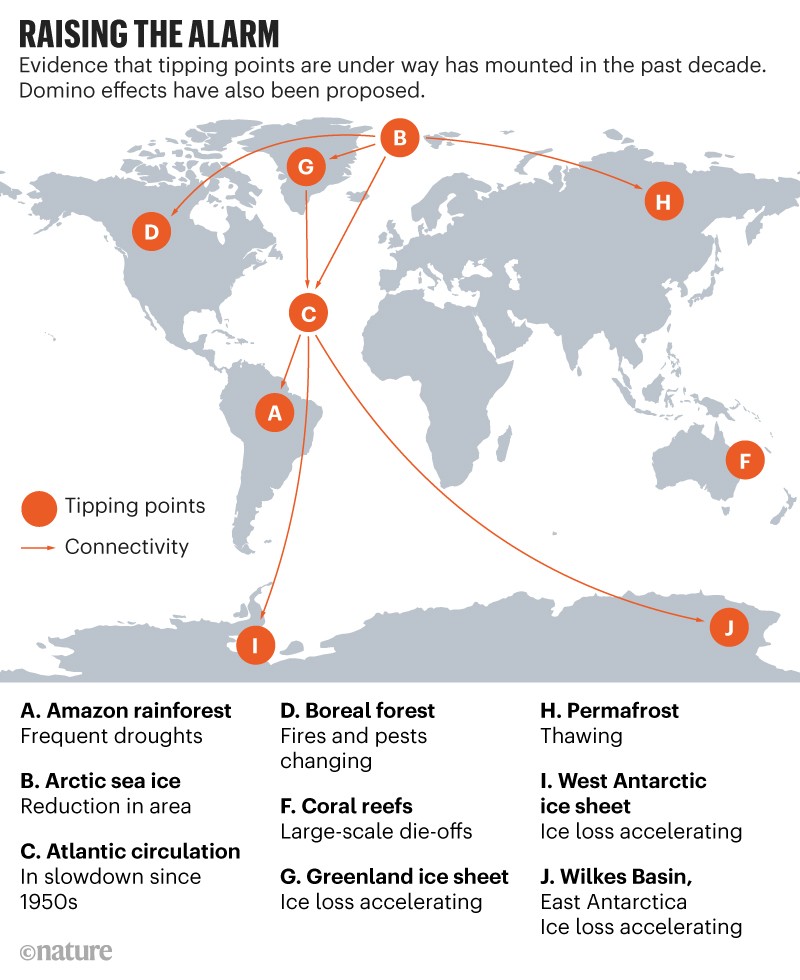
The scientists analyzed evidence on these nine components of our climate system – called “tipping points” because they are under growing threat of abrupt and irreversible changes.

1. Amazon rainforest
2. Arctic sea ice
3. Atlantic circulation
4. Boreal forests
5. Coral reefs
6. Greenland ice sheet
7. Permafrost
8. West Antarctic ice sheet
9. Part of East Antarctica

9 climate tipping points pushing Earth to the point of no return by Rosamond Hutt, World Economic Forum, Dec 5, 2019

Passing one of these tipping points – from the collapse of the West Antarctic ice sheet to the loss of coral reefs and the Amazon rainforest – may increase the risk of crossing others, the scientists write in a commentary article in the journal Nature:

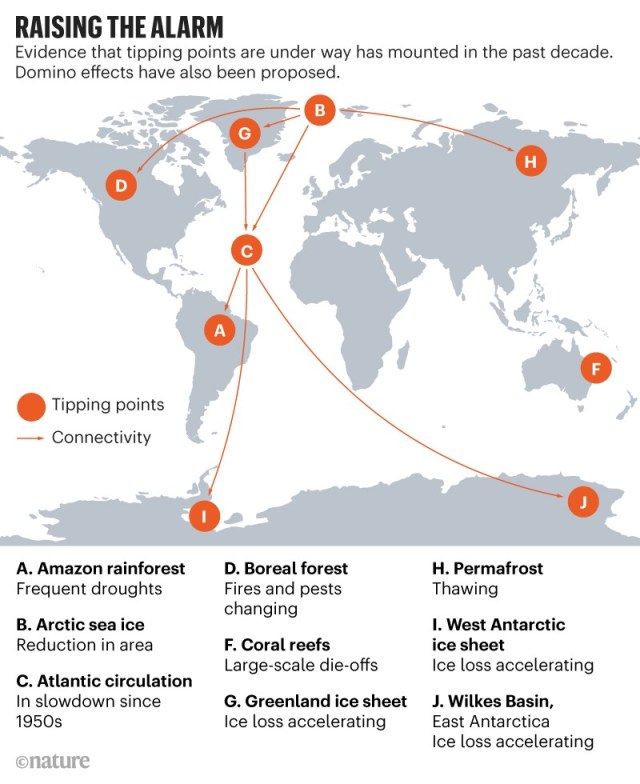
That article in Nature just mentioned includes the following graphic. Climate tipping points –too risky to bet against. The growing threat of abrupt and irreversible climate changes must compel political and economic action o emissions by Timothy Lentan et al, Nature, Nov 27, 2019


Following is a link to an interactive website related to climate change:
Tipping Points: Global Climate Change, Made Local – Climate Tipping Points There are links to a lot of resources.

Grist has a nice presentation on Points of No Return.
The 7 climate tipping points that could change the world forever – Grist | Grist

Posted in climate change, climate refugees, Uncategorized | 1 Comment

Ghastly Future

Even though I’ve been led by a concern for our environment since my teenage years, which has taken many forms, I have often found what we are facing to be nearly overwhelming. Despite seeing the perilous path we are on, there have been large blocks of time I have not given this the full attention it needs from us all. The consequences of the damage to Mother Earth are now an existential threat.

It grieves me to think we would likely not be in this situation if those of us who rejected the idea of personal automobiles had prevailed.

In the paper “Underestimating the Challenges of Avoiding a Ghastly Future”, the researchers cite more than 150 scientific studies and conclude, “that we are already on the path of a sixth major extinction is now scientifically undeniable.”

We report three major and confronting environmental issues that have received little attention and require urgent action. First, we review the evidence that future environmental conditions will be far more dangerous than currently believed. The scale of the threats to the biosphere and all its lifeforms—including humanity—is in fact so great that it is difficult to grasp for even well-informed experts. Second, we ask what political or economic system, or leadership, is prepared to handle the predicted disasters, or even capable of such action. Third, this dire situation places an extraordinary responsibility on scientists to speak out candidly and accurately when engaging with government, business, and the public. We especially draw attention to the lack of appreciation of the enormous challenges to creating a sustainable future. The added stresses to human health, wealth, and well-being will perversely diminish our political capacity to mitigate the erosion of ecosystem services on which society depends. The science underlying these issues is strong, but awareness is weak. Without fully appreciating and broadcasting the scale of the problems and the enormity of the solutions required, society will fail to achieve even modest sustainability goals.

“Underestimating the Challenges of Avoiding a Ghastly Future” by Corey J. A. Bradshaw, Paul R. Ehrlich, Andrew Beattie, Gerardo Ceballos, Eileen Crist, Joan Diamond, Rodolfo Dirzo, Anne H. Ehrlich, John Harte, Mary Ellen Harte, Graham Pyke, Peter H. Raven, William J. Ripple, Frédérik Saltré, Christine Turnbull, Mathis Wackernagel and Daniel T. Blumstein, 13 January 2021, Frontiers in Conservation Science.

Flinders University Professor Corey Bradshaw summarizes the perspective paper “Underestimating the challenges of avoiding a ghastly future.”

Humanity is causing a rapid loss of biodiversity and, with it, Earth’s ability to support complex life. But the mainstream is having difficulty grasping the magnitude of this loss, despite the steady erosion of the fabric of human civilization (Ceballos et al., 2015IPBES, 2019Convention on Biological Diversity, 2020WWF, 2020). While suggested solutions abound (Díaz et al., 2019), the current scale of their implementation does not match the relentless progression of biodiversity loss (Cumming et al., 2006) and other existential threats tied to the continuous expansion of the human enterprise (Rees, 2020). Time delays between ecological deterioration and socio-economic penalties, as with climate disruption for example (IPCC, 2014), impede recognition of the magnitude of the challenge and timely counteraction needed. In addition, disciplinary specialization and insularity encourage unfamiliarity with the complex adaptive systems (Levin, 1999) in which problems and their potential solutions are embedded (Selby, 2006Brand and Karvonen, 2007). Widespread ignorance of human behavior (Van Bavel et al., 2020) and the incremental nature of socio-political processes that plan and implement solutions further delay effective action (Shanley and López, 2009King, 2016).

We summarize the state of the natural world in stark form here to help clarify the gravity of the human predicament. We also outline likely future trends in biodiversity decline (Díaz et al., 2019), climate disruption (Ripple et al., 2020), and human consumption and population growth to demonstrate the near certainty that these problems will worsen over the coming decades, with negative impacts for centuries to come. Finally, we discuss the ineffectiveness of current and planned actions that are attempting to address the ominous erosion of Earth’s life-support system. Ours is not a call to surrender—we aim to provide leaders with a realistic “cold shower” of the state of the planet that is essential for planning to avoid a ghastly future.

Frontiers | Underestimating the Challenges of Avoiding a Ghastly Future | Conservation Science (frontiersin.org)

The paper has the following sections

  • Biodiversity Loss
  • Sixth Mass Extinction
  • Ecological Overshoot: Population Size and Overconsumption
  • Failed International Goals and Prospects for the Future
  • Climate Disruption
  • Political Impotence
  • Changing the Rules of the Game

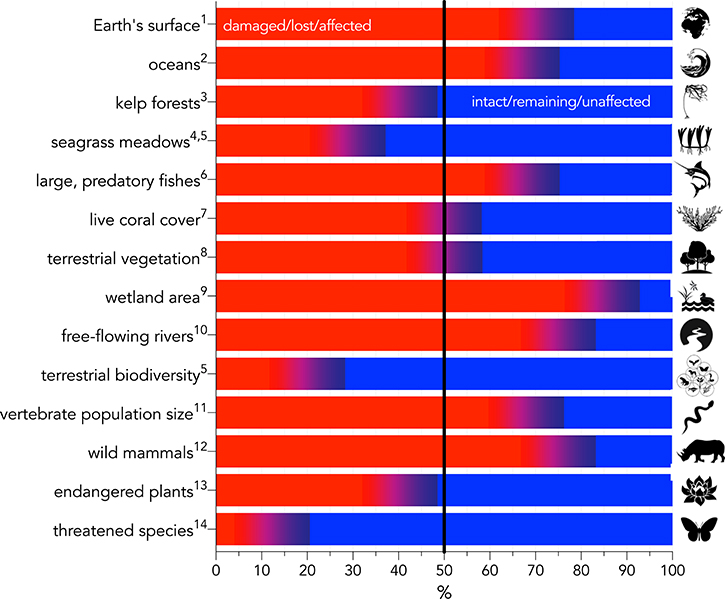
Summary of major environmental-change categories expressed as a percentage change relative to the baseline given in the text. Red indicates the percentage of the category that is damaged, lost, or otherwise affected, whereas blue indicates the percentage that is intact, remaining, or otherwise unaffected. Superscript numbers indicate the following references: 1IPBES, 20192Halpern et al., 20153Krumhansl et al., 20164Waycott et al., 20095Díaz et al., 20196Christensen et al., 20147Frieler et al., 20138Erb et al., 20189Davidson, 201410Grill et al., 201911WWF, 202012Bar-On et al., 201813Antonelli et al., 202014Mora et al., 2011.

Three years ago I wrote Design and Build Beloved Community Models. I was envisioning how to respond to a large migration of climate refugees that I think will be moving to the Midwest as sea levels rise and flood coastal areas.

“Along America’s most fragile shorelines, [thousands] will embark on a great migration inland as their homes disappear beneath the water’s surface.” LA Times, Victoria Herrmann Jan 25, 2016

We need to build model sustainable communities. There have been, and are numerous such experiments in intentional community. 

But for climate refugees we need a model created with the intention of being replicated many times over with minimal complexity, using locally available materials—a pre-fab community.


Those are basically the physical components. But we also need to change how we live together. I’ve been learning about Mutual Aid for over a year now. And clearly see how we have to learn to live as equals in community, with a flat or horizontal hierarchy. Reject the vertical hierarchy of the culture most of us live in now. Vertical hierarchies create conflicts when people try create positions of power over us.

Posted in climate change, climate refugees, immigration, Mutual Aid, revolution, Uncategorized | Leave a comment

Sensemaking

Over the years I’ve often thought about the concept of sensemaking, the action or process of making sense of or giving meaning to something, especially new developments and experiences. sensemaking | Search Results

It is increasingly difficult to make sense of all that is going on today. All the bad things I had anticipated for the future are suddenly happening now. And things I never imagined, like the assaults on truth and science, come at a time when they are desperately needed.

sensemaking–the action or process of making sense of or giving meaning to something, especially new developments and experiences.

At the collective level, a loss of sensemaking erodes shared cultural and value structures and renders us incapable of generating the collective wisdom necessary to solve complex societal problems like those described above. When that happens the centre cannot hold.

Threats to sensemaking are manifold. Among the most readily observable sources are the excesses of identity politics, the rapid polarisation of the long-running culture war, the steep and widespread decline in trust in mainstream media and other public institutions, and the rise of mass disinformation technologies, e.g. fake news working in tandem with social media algorithms designed to hijack our limbic systems and erode our cognitive capacities. If these things can confound and divide us both within and between cultures, then we have little hope of generating the coherent dialogue, let alone the collective resolve, that is required to overcome the formidable global-scale problems converging before us.

Pontoon Archipelago or: How I Learned to Stop Worrying and Love Collapse. By James Allen, originally published by Medium
June 18, 2019

Celebrants have an important part to play in the legacy humanity caries into the future. I suggest that our responsibility as ceremonialists, as humans who help other humans meaningfully connect with the web of life, is to find ways now to help people connect with the story of this world’s beauty, even as the world we love recedes. I believe there is a gift we can bring to our communities, to help people learn the art of losing. To help us all to meet the rising tides.

Celebrants & Ceremony in Response to Climate Grieving, Dina Stander, July 26, 2019

I believe faith communities need to play a crucial role in helping us move through the oncoming, increasingly severe chaos. Faith can provide sensemaking for those who have no framework for making sense of our broken systems.

People of faith can be celebrants. Indigenous peoples are celebrants. Their cultures are based upon a timeless connection to Mother Earth and everything that is part of Her/us.


The problems before us are emergent phenomena with a life of their own, and the causes requiring treatment are obscure. They are what systems scientists call wicked problems: problems that harbour so many complex non-linear interdependencies that they not only seem impossible to understand and solve, but tend to resist our attempts to do so. For such wicked problems, our conventional toolkits — advocacy, activism, conscientious consumerism, and ballot casting — are grossly inadequate and their primary utility may be the self-soothing effect it has on the well-meaning souls who use them.

If we are to find a new kind of good life amid the catastrophes these myths have spawned, then we need to radically rethink the stories we tell ourselves. We need to dig deep into old stories and reveal their wisdom, as well as lovingly nurture the emergence of new stories into being.

Pontoon Archipelago or: How I Learned to Stop Worrying and Love Collapse. By James Allen, originally published by Medium
June 18, 2019

How do we rethink the stories we tell ourselves? We need to let go of the stories we have discovered to be untrue. Learn about, and embrace stories of other cultures that are true. People of faith need to seek, and really listed for, Spiritual guidance. And actually implement that guidance.

One idea is to share stories from earlier times. “We need to dig deep into old stories and reveal their wisdom.” The Quaker Stories Project is an example. https://quakerstories.wordpress.com/

To re-think those stories. To consider what they say about our world today. To see if they represent something we have lost. Something it might be good to return to.

Seeking out new people and experiences are ways we can create new stories. For more than a year I have been learning new stories from my friends in the Mutual Aid community. We have been learning, together, how to live and work together in ways without a vertical hierarchy. Where decisions no longer come from leaders who try to wield power without consent. As my friend Ronnie James, who is my Mutual Aid mentor says:

I’m of the firm opinion that a system that was built by stolen bodies on stolen land for the benefit of a few is a system that is not repairable. It is operating as designed, and small changes (which are the result of huge efforts) to lessen the blow on those it was not designed for are merely half measures that can’t ever fully succeed.

So the question is now, where do we go from here? Do we continue to make incremental changes while the wealthy hoard more wealth and the climate crisis deepens, or do we do something drastic that has never been done before? Can we envision and create a world where a class war from above isn’t a reality anymore?”

Ronnie James

It all comes down to what type of ancestor I want to be for my descendants. Do I want to be a regular nobody that did nothing to protect our planet or do I want to be like Crazy Horse who fought and died for the little bit of land that we have left to protect? We have that chance right now to make that decision. This kind of resistance runs through all of our blood because we are the Indigenous Peoples of these lands. It’s at vital choice for the survival of humankind.

What Kind of Ancestor Do you Want to Be? Why I Fight the KXL by TaSina Sapa Win, February 28, 2019

Posted in #NDAPL, climate change, decolonize, Indigenous, Native Americans, Seeding Sovereignty, Uncategorized | Leave a comment

Forgiveness

This morning’s prayers led me to reflections about forgiveness. This might be because we will be talking about Indigenous boarding schools at my Quaker meeting this morning. There were many terrible things about kidnapping native children and taking them far from home. To schools where they were forced to try to learn how to assimilate into White culture. Where many were abused, many died. Though we can’t know what they did, some of our ancestors were part of these schools.

From September 1 – 8, 2018, a small group of native and non-native people walked and camped along the route of the Dakota Access pipeline in central Iowa. This was called the First Nation-Farmer Climate Unity March. One goal was to bring attention to the abuse of eminent domain to force landowners to permit the pipeline to be built on their property.

But the other goal was for this group to get to know each other. Begin to trust each other, so we could work on things of common interest or concern together. I didn’t know how that would develop. One thing that was on my mind was the Quaker involvement in the native boarding schools. I didn’t know whether to bring this up. For one thing I didn’t know if that would be traumatic for the native folks, and/or for me.

A friendship quickly developed with one particular native friend, Matthew. To the extent that when the Spirit moved me to do so, with some trepidation I brought up the native boarding schools. Apologized for my relatives’ involvement. He didn’t say anything at the time, but later that day he told me his family’s story related to forced assimilation.

Months later there was another opportunity to thank him for sharing his story, and he said “thank you for listening.” I like to think of this as asking for forgiveness and laying down our burdens next to each other.


When we made it back home, back over those curved roads that wind through the city of peace, we stopped at the doorway of dusk as it opened to our homelands.

We gave thanks for the story, for all parts of the story because it was by the light of those challenges we knew ourselves— We asked for forgiveness.

We laid down our burdens next to each other.

Harjo, Joy. Conflict Resolution for Holy Beings: Poems. W. W. Norton & Company. Kindle Edition

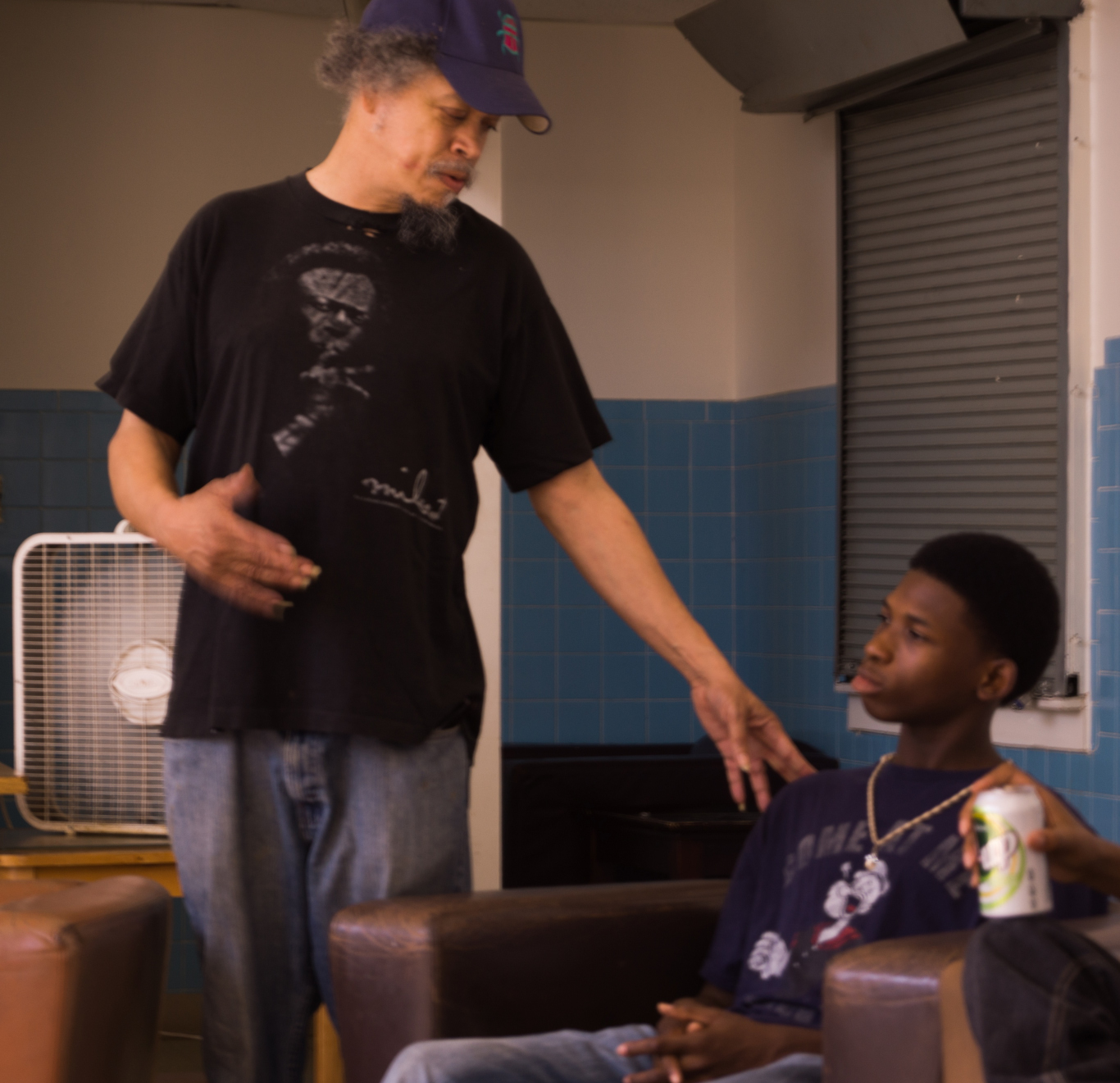
I think back to the years I spent with the Kheprw Institute community in Indianapolis. A black youth mentoring and empowerment community. Of course the history here relates the enslavement and white supremacy.

Sharing stories was a large part of the work we did together. Imhotep, one of the Kheprw leaders, said these shared discussions were revolutionary. “We gave thanks for the story, for all parts of the story because it was by the light of those challenges we knew ourselves— We asked for forgiveness.

This past year has been one of much learning and change for me. It was over a year ago that I began to make connections with Des Moines Mutual Aid. I don’t know why I hadn’t known about Mutual Aid prior to that, but am so grateful that I have.

There are two parts of this that I’m reflecting on this morning. One is my Mutual Aid friends are a very diverse community. Being an older white male, I sensed the hesitancy of many toward me. There is a wariness in general for any new person because these people are sometimes involved in things that bring attention from law enforcement. Not for doing anything wrong. Just because of peacefully protesting.

And just as important, anyone who comes to be involved in Mutal Aid has to learn a whole different way for being and working together. A fundamental part of Mutual Aid is learning to work without the vertical hierarchy that is present in almost all our relationships in our current cultures. Learning to work in ways without the vertical power structures.

These are some reason I’m thinking of forgiveness this morning. I have noticed a gradual acceptance of my presence as a white male. And as someone who has benefitted from white superiority

These things are the beginnings of forgiveness as I think of it.

Paying attention to past and present wrongs by white people in general, such as racial injustice, and finding ways to seek forgiveness, has been cathartic for me.

I’ve been involved in so many meetings and conversations about white superiority and racial justice. Most of those experiences are oriented toward identifying concerns in general, and don’t usually offer much more than going to more conferences, reading books, etc.

As I’ve tried to show here, I think it is important to think of what white people need to be forgiven for. I know many white people reject ownership of things done in the past. The problem is, trauma is passed from generation to generation. People today continue to suffer from past traumas. White people suffer transgenerational trauma, too.

For these things to happen, white people need to find ways to be with black, indigenous and other people of color (BIPOC).

We gave thanks for the story, for all parts of the story because it was by the light of those challenges we knew ourselves— We asked for forgiveness.

Joy Harjo
Posted in #NDAPL, Dakota Access Pipeline, Des Moines Mutual Aid, First Nation-Farmer Climate Unity March, Quaker, race, Uncategorized, white supremacy | Leave a comment

The XR activists who took on oil giant Shell – and won

Below this story of yesterday’s victory of Extinction Rebellions (XR) activists is story of my friends from Bold Iowa who also argued the necessity defense in 2019.

Six Extinction Rebellion activists have been acquitted in a landmark verdict at Southwark Crown Court this afternoon.  

The jury delivered its not guilty verdict for each defendant, despite Judge Perrins ruling that five of the six had no defence under the law. 

The trial, for criminal damage to the Shell HQ building in London’s Waterloo in April 2019, which could have led to a maximum five year prison sentence and / or a £10k fine each, is XR’s second only case to be heard before a jury. [1]

The verdict is being hailed as a major victory for climate campaigners everywhere facing increasing criminalisation. Defendant Simon Bramwell, 49, cofounder of Extinction Rebellion, said: “It is a significant victory for the truth of these times, when despite the letter of the law, jurors can clearly see that a broken window is a just response to a breaking world.”

“How fitting that this comes after Earth Day and the two year anniversary of the death of environmental lawyer Polly Higgins, founder of the Stop Ecocide campaign, to whom we dedicated our non violent direct action against Shell. With today’s verdict, it is clear who the real climate criminals are in the climate and ecological emergency. ‘Shell knew’ as we wrote.” [2] [3]

BREAKING: The XR activists who took on oil giant Shell – and won by Extinction Rebellion, April 23, 2021


Jury nullification is what such a jury decision is called in the USA. It is a rare and brave jury that will stand up to the prosecutors and judge to situationally apply morality as a standard superior to some laws. “A jury’s knowing and deliberate rejection of the evidence or refusal to apply the law either because the jury wants to send a message about some social issue that is larger than the case itself, or because the result dictated by law is contrary to the jury’s sense of justice, morality, or fairness.”

https://www.law.cornell.edu/wex/jury_nullification

https://youtu.be/cBYs-6T9YD8

Transcript:

On April 15th, the first day of Extinction Rebellion protests in London, an associated action took place at the Shell Headquarters on the South Bank near the London Eye.
Three activists glued their hands on to the entrance doors of the lobby, while two others climbed onto the glass canopy high up over the entrance. One more sprayed slogans on the wall to the right of the doors. The protesters planned to commit criminal damage worth more than £6000, which although small change for the oil giant, will ensure that they’d be prosecuted in a crown court in front of a jury. Using a punch tool, they also managed to shatter or damage several of the glass doors. The pair on the canopy hung a ‘Stop Ecocide’ banner, sprayed slogans, and dripped thick oily black paint down the walls.

In court, the campaigners hope to present evidence of Shell’s willful ecological destruction, citing internal documents that show the corporation’s own climate scientist were issuing warnings nearly 40 years ago, which the company has done its best to hide and ignore. They will defend their actions as ‘crimes of conscience’.

We recently interviewed international lawyer Polly Higgins, who is helping island states to amend international law and bring in a new crime of ‘ecocide’. She also spoke of how activists can use a ‘crime of conscience’ defense. Five people were arrested at the scene, but the other two remained on the glass canopy overnight, and came down after 25 hours. As they descended, another highly respected international lawyer, Farhana Yamin (one of the chief negotiators of the Paris Agreement) glued herself to the floor by the front doors, and two other protesters joined her.


FOR IMMEDIATE RELEASE
Monday, November 11, 2019, 10:00 a.m. CT

Contact: Miriam Kashia at (319) 459-1154 or miriam.kashia@gmail.com
Contact: Ed Fallon at (515) 238-6404 or ed@boldiowa.com
Website: www.boldiowa.com

Trial of five Iowa climate activists set for November 12

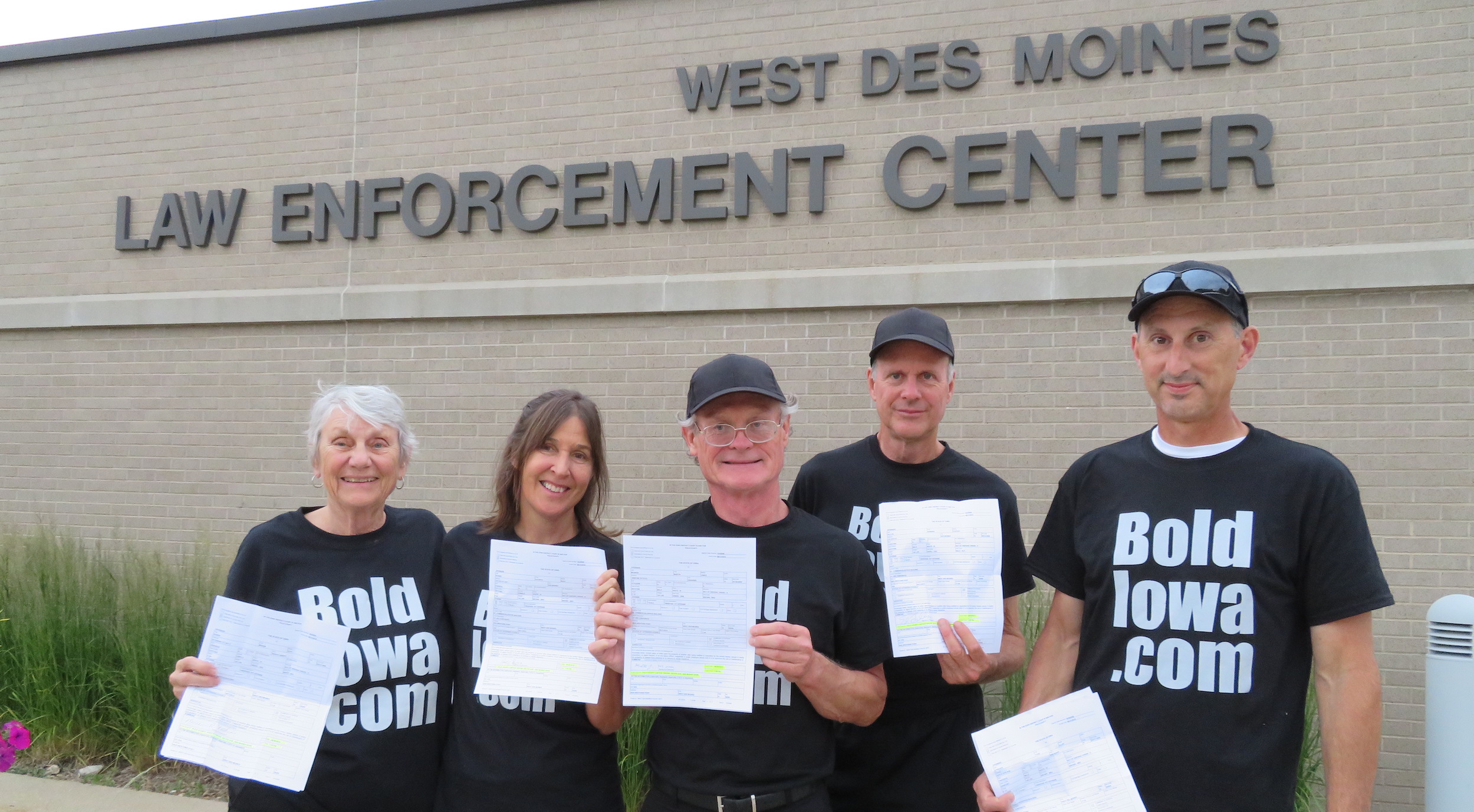
Dressed in black and wearing adult diapers, Bold Iowa supporters were arrested at a GOP rally and fundraiser for President Trump on June 11, 2019 while holding a sign reading, “Climate Denier in the White House scare the S#*T outta you? IT DOES US!”

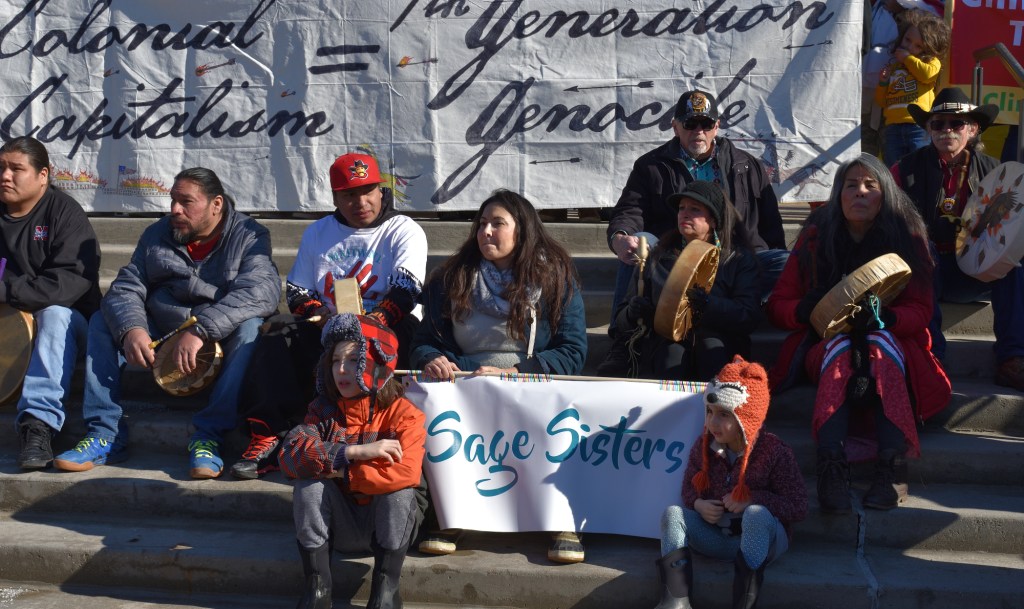
DES MOINES, IOWA — The trial of the Iowa Climate Defenders Five (Todd Steichen, Martin Monroe, Miriam Kashia, Kathy Byrnes, and Ed Fallon) is scheduled to move forward on Tuesday, November 12 at 2:00 at the Polk County Justice Center, 222 5th Avenue, Des Moines, Iowa 50309. Before the trial at 1:30, the five will hold a press conference outside the building.

Bold Iowa climate activists arrested at Trump/GOP fundraiser

On June 11, 2019, President Trump visited Hy-Vee’s Ron Pearson Center in West Des Moines for a GOP rally and fundraiser. Thirty Bold Iowa supporters called out the president’s climate denial to him and attendees. Initially, protesters blocked one of the entrances to the facility’s parking lot. Later, five carrying a banner approached the building, hoping to enter and bring their urgent message to the attention of the president and the audience. At that point, they were arrested by West Des Moines police for simple misdemeanor trespass.

“Women’s right to vote. Civil rights. Stopping the Vietnam War. Environmental protections. The Women’s Movement. LGBTQ rights and marriage equality. These and so many other significant social justice shifts were accomplished because ordinary citizens were willing to take to the streets, and in many cases, willing to commit civil disobedience,” said Kashia. “History tells us that this is what has turned the tide.”

“We risked arrest because it’s urgent that we capture the attention of politicians, the press, and the public in this unprecedented moment where saving human life and the planet is on the line,” said Fallon. “We wanted to emphasize to those gathered at the rally and fundraiser that climate change threatens our very survival, and a president who denies the problem — whose policies in fact greatly exacerbate the threat — must be called out and challenged.”

Because of the worsening climate emergency, the Iowa Climate Defenders Five feel called to act in the interest of present and future generations and the planet. Similar cases across the country have seen judges responding more sympathetically to the climate necessity defense.

The urgency of climate change is also shared by Iowa scientists in the Iowa Climate Statement and in a report by the Iowa DNR. Both warn about the harm being done because of our dependence on fossil fuels.

Furthermore, earlier this year, the Iowa Supreme Court stated in its ruling in Puntenney vs the Iowa Utilities Board (the Dakota Access Pipeline case), page 37, “We recognize that a serious and warranted concern about climate change underlies some of the opposition to the Dakota Access pipeline.”

Bold Iowa’s mission is to build rural-urban coalitions to (1) fight climate change, (2) prevent the abuse of eminent domain, (3) protect Iowa’s soil, air, and water, (4) defend the rights of farmers, landowners, and Indigenous communities, and (5) promote non-industrial renewable energy.

Climate Activists Go to Trial by Ed Fallon, Bold Iowa, November 11, 2019

The urgency of climate change is also shared by Iowa scientists in the Iowa Climate Statement and in a report by the Iowa DNR. Both warn about the harm being done because of our dependence on fossil fuels.


Last week, a Polk County District judge ruled against the Climate Defenders Five, finding us guilty of misdemeanor trespass in our protest against President Trump’s abject denial of climate science during the president’s visit to West Des Moines in June.

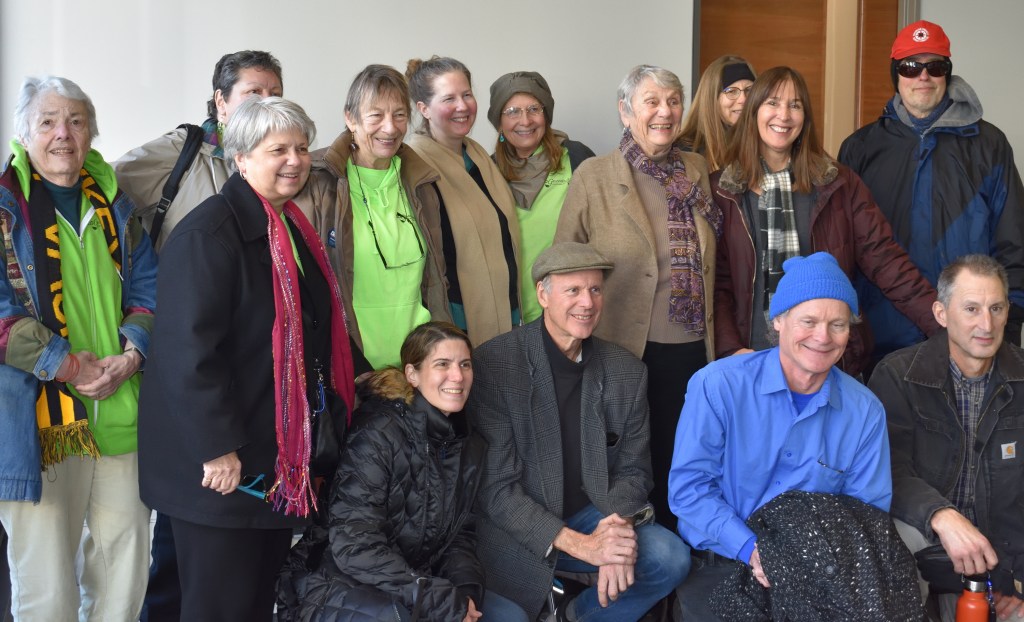
Climate Defenders Five after being released from jail: Miriam Kashia, Kathy Byrnes, Marty Monroe, Ed Fallon, Todd Steichen (Photo by Shari Hrdina)

With all due respect, the Court completely failed to understand the growing urgency of the climate emergency, and thus the necessity justification of our defense. In saying that it recognized our “concern for the President’s policy on climate change,” the court got it wrong. The president has no policy on climate change. It’s his complete denial of the scientific proof of climate change that concerns us, not his nonexistent policy.

The Court also claimed that the “Defendant(s) did not present substantial evidence for the affirmative defense of justification in remaining on the Property.” Yet what could be greater cause for justification than an existential threat to our very survival?

Court fails to understand urgency of climate crisis by Ed Fallon, Bold Iowa, Dec 4, 2019

See more in my posts about Bold Iowa “necessity defense” | Search Results | Quakers, social justice and revolution (jeffkisling.com)

Posted in Uncategorized | Leave a comment

Multisystem Failure

By far the largest system failing is our environment. The Biden administration announced the goal of greenhouse gas reduction of 50% from 2005 levels by 2030. It is an outrage that legislative proposals consistently fail to even begin to address the reality of the problems we face today. It was this climate announcement that led me to write about multiple systems failing.

Not only is the climate plan short on details, a reduction of 50% is not nearly enough. And the consequences of rapidly evolving environmental chaos will increasingly lead to all kinds of systems to fail. Infrastructure in general will be damaged and destroyed. Power and communication systems will collapse. Transportation systems will be impacted.

It has been excruciatingly painful to see so much police violence. Finally, many white people (I’m “white”) see and hear the stories of what life is like for people of color. What black, indigenous and other people of color (BIPOC) live with every minute of every day. Police violence that kills men, women and children, or locks them up for years.

This is just one example of the racism that permeates every system in this country. This language demonstrates racism and white privilege. I say locks “them” up because police abuse and violence is not much of a problem for white people.

At least until we white people begin to show some public support. Then we lose our privilege and become “them” too. There is the onslaught of legislation to subvert civil liberties. Legislation to punish anyone who dares to protest. Legislation to protect police abuse. To protect anyone driving into a crowd of protesters. How insane are these policies?

There are increasing calls for police reform. Even further, for the abolition of police and prisons. I’ve been involved with the Quaker Abolition Network. And last night attend my first meeting with Democratic Socialists of American. Abolition is one of the main things they are working on. abolition | Search Results | Quakers, social justice and revolution (jeffkisling.com)

The political system is broken. Representatives don’t even try to pretend they represent their constituents any longer. Decline to support legislation that is overwhelmingly supported by the public. And pass legislation their constituents oppose. Corporate money, gerrymandering and all kinds of voter disenfranchisement subvert the democratic process and ways to change the system.

What is portrayed as truth has also been subverted. The last administration lied repeatedly to manipulate their supporters. Deliberate misinformation has become the norm for many political groups.

Endless wars in so many countries to protect resources like oil kill combatants on all sides. Kill civilians and destroy their infrastructure. This is morally reprehensible. While politicians resist the small funds for the public good, they continue to budget vast sums for the military. This administration is no exception.

The COVID pandemic has nearly destroyed our medical systems and our economy. Have strained education systems.

As more and more people are forced to recognize these multisystem failures, they wonder what to do.

It is clear to many of us that you cannot use a system that causes these problems to fix them. It is so frustrating to me to see all the work of well intentioned people wasted on trying to make incremental changes within these systems when the systems need to be replaced instead.

For example, the economic system of capitalism has been severely damaged by the COVID pandemic. But capitalism is based on extraction of resources, mainly fossil fuels, and continuous growth. Capitalism is designed to create the vast imbalance of wealth that we have. And capitalism is used to keep so many worried about surviving, so they won’t have the energy to agitate for change.

What is the answer? I believe we have to create communities that reflect our values. This is why I’ve been so invested in learning about, participating in Mutual Aid. For me, Mutual Aid shows how to build such communities, beloved communities.

You can click on the full screen symbol to more easily read this flip book.

Posted in capitalism, Des Moines Mutual Aid, Mutual Aid, Uncategorized | Leave a comment

Religious Socialism

My friend Fran Quigley is director of the Health and Human Rights Clinic at Indiana University McKinney School of Law and has been teaching me about Religious Socialism. This began when he contacted me about writing I have been doing related to the evils of capitalism. The Evil of Capitalism. I suggested that he contact the Friends Committee on National Legislation (FCNL) and he had done that.

Great post, as always! Thank you for prioritizing solidarity with our Black sisters and brothers in your advocacy.

This post of yours struck me close to home. I too have become fully convinced of the evils of capitalism. Moreover, I have come to the conclusion that my faith dictates that I work to replace it. Turns out I am far from alone, so I’ve been devoting much of my time this past year to the Religion and Socialism Committee of the DSA, www.religioussocialism.org .

And, as part of a book project on religious socialism, I have published several articles profiling activists from different faith and spiritual traditions who feel called to advocate for a socialist society.  (Examples, if you are interested: a Catholic socialist, a Jewish rabbi socialist, a Black Presbyterian minister socialist, a Liberation Theologian Lutheran minister/professor,  Muslim socialists , a Buddhist socialist and a Black Baptist minister socialist.  I also co-wrote with longtime Religion and Socialism activist Maxine Phillips a short, one-stop primer on the argument for Christian socialism: https://mphbooks.com/democratic-socialists/ )

Fran Quigley

Among the things he shared with me is an article he wrote about sometimes negative views about socialism.

I will be interested to know if you get any negative response to your socialism discussion. U.S. Americans of a certain age, especially those of us who can remember the Cold War, often have some knee-jerk resistance to the term. I recently wrote about that a bit in this article profiling a Black Presbyterian woman minister who is a socialist: https://jacobinmag.com/2020/12/angela-cowser-institute-for-christian-socialism

Of course, identifying as a socialist can create some challenges in that organizing. For example, Ray Sells, the retired Methodist minister, is not as excited about her embrace of socialism.

“I don’t see the reason to use that word,” he says. “It just turns off so many people from the start. Why can’t we just advocate for things like affordable housing and good public education without putting on a label with all those negative connotations?”

When Cowser is told about Sells’s objection, she nods in understanding. But her experience is that talking about socialism in faith communities is less problematic than Sells and others expect — especially when the conversation is with younger Americans, who polls show prefer socialism over capitalism on average, and black Americans, who similar polls show are likely to hold favorable views of socialism.

“I actually don’t get much pushback on it,” she says. She points out that church communities with strong tithing and aid cultures and healthy union workplaces are already quite socialist, as are many American institutions like public schools, infrastructure, and public safety.

“Plus, the biblical basis for socialism is just undeniable. Just look at the early books of Acts, where the body of believers responded to poverty — and a very gendered poverty — by organizing money and resources for the benefit of poor people,” she says. “And the Jubilee platform in Deuteronomy lays out the whole program for a sharing economy where no one person can be strong without the community being strong.”

To Rev. Angela Cowser, “the Biblical Basis for Socialism Is Undeniable”
BY FRAN QUIGLEY, Jacobin, 12/25/2020
Rev. Angela Cowser, a cofounder of the Institute for Christian Socialism, argues that a society rooted in the dictates of the Gospel would look radically different from the one we have now. There is a name for what that change should look like: socialism.

Following is some general information about Religious Socialism (RS) from Maxine Phillips.

The RS group is older than DSA, having been started in the seventies by John Cort, a Catholic activist in the Democratic Socialist Organizing Committee. It published a print newsletter for about thirty years. You can find pdfs of some of those old newsletters at religioussocialism.com. Click on “issues.”  This is a dead site, so nothing else works on it.  After John’s death (at age 92) and some other changes, we stopped publication for a while, but rebooted a couple of years ago with a website.

At the moment, our primary activities are the website (religioussocialism.org), a Facebook page https://www.facebook.com/religioussocialism/) as well as a Twitter feed https://twitter.com/religsocialism ,  a podcast series https://soundcloud.com/religioussocialism and a Twitter page for the podcast at https://twitter.com/religsocialpod 

We are not out to “convert” anyone but to bring a socialist perspective to our work with faith communities. We have an intersectional approach, i.e., class always matters, and so do other identities, and we can work on what unites us.

During this time of uprisings and a pandemic, we can reach out to others in our faith communities and in other organizations to work in coalitions for racial and economic justice.

As I’ve learned more about Religious Socialism, I’ve written a few blog posts related, including Religious Socialism – Introduction | Quakers, social justice and revolution (jeffkisling.com)

Fran and Maxine also wrote Christian Socialist. Before Karl Marx, there was Jesus Christ. And before secular socialism, there was Christian socialism by MAXINE PHILLIPS and FRAN QUIGLEY.

This weekend will be a series of presentations related to “Building the Religious Left” Virtual Conference.

This weekend, we welcome the largest gathering of the multi-faith religious Left in DSA’s history, perhaps in U.S. history. Each of our traditions has a history on the Left, and we will continue to work within our own traditions. But we can also work together. This weekend, more than 600 of you want to create a different story than the one the religious Right tells. This conference marks the beginning of that journey.

We are working on uploading some fascinating short talks and interviews in conjunction with the conference and will update registrants by Saturday morning about those.

If you have not done so, please register for specific sessions through the links in this document and for the conference as a whole here. We will be sending out emails if/as panels or workshops change, and the only way that we can have your email is through this form.

If you can’t attend the whole conference, no problem. All panels and workshops will be recorded and links sent to you if you register here.

Saturday, April 24, 2021

(All times are U.S. Eastern Time)

11-a.m.-noon: Shabbat Room: Join Rabbi Robin Podolsky for a time of centering prior to the conference opening

Noon-1:15 p.m.

The Fire This Time: Forging a Multi-Faith Movement for Religious Socialism

There is a resurgence of socialist analysis and organizing, but little attention has been paid to the increased amount of religious commitment–the fire of both embodied analysis and practice– being brought to bear in the moment. In the spirit of James Baldwin’s iconic texts, communities of faith, in the wake of union organizing in Alabama and pending prospects of the PRO Act in Washington DC, have the opportunities to help spark the fires of our verdant, variegated religious traditions toward transforming our political economy, undoing white supremacy, and realizing a more just society. Join us as we talk through the possibilities, challenges, and pathways for religious socialism in this critical moment. Panelists Andrew Wilkes, Xavier Pickett, Jazmine Brooks, and Samy Amkieh.

1:30-2:45 p.m.

Multi-faith Perspectives on Medicare for All

Panelists–including Hebah Kassem of the Green New Deal Network; Sanjeev Sriram, M.D., of the National Physicians Alliance, David W. Greene, Sr., President of Concerned Clergy of Indianapolis and Pastor of Purpose of Life Ministries; Rabbi Robin Podolsky, who teaches Jewish Thought at California State University at Long Beach and serves as affiliated clergy at Temple Beth Israel of Highland Park and Eagle Rock–will discuss what their religious traditions have to say about the moral imperative of ensuring healthcare for all. Fran Quigley of the DSA Religion and Socialism Working Group will be the moderator.

Strategies of De-escalation: What Muslim Thought Contributes to the Practice

Waleed Sami will explore ways that political activists can de-escalate tense situations, with special reference to the impact of Muslim thought on de-escalation strategies. He is a doctoral student at Virginia Commonwealth University’s Counselor Education program and is particularly interested in looking at how inequality and the political economy impact mental health. Imaan Javeed of the DSA Muslim Caucus will moderate the session.

Refugees at the Border: How do we respond?

Duane Campbell, co-chair, DSA Immigrant Rights Working Group, and Eddie Chavez Calderon, member, Arizona Jews for Justice will separate fact from false news about the situation at the border and engage with participants about how to convey information to potential coalition partners and move them to action.

3-4:15 p.m.

Black Church Radicalism

Joshua Davis, executive director of the Institute for Christian Socialism, will moderate a panel with Andrew Wilkes, co-pastor of Double Love Experience; Angela Cowser, Associate Dean of Black Church Studies and DMin programs at Louisville Seminary; and Obery M. Hendricks, author of many works on Christianity and politics, including The Politics of Jesus

Mutual Aid: Connection and Change, not Charity

Megan Romer of DSA Southwest Louisiana speaks with Shabd Singh of Metro DC DSA and Zellie Imani of BLM Paterson (panel in formation) about Mutual Aid and why it isn’t just charity repackaged.

Democratic EcoSocialism & the Green-Red-Black New Deal: Getting the Change We Need

How can environmental justice advocates bring about real change for all affected communities? Marie Venner, whose family is part of the Juliana v. United States case, is co-chair, CatholicNetwork US and an applied researcher with the National Academies Cooperative Research Programs. She will talk with Desiree Kane, a two-spirit Miwok storyteller, multimedia journalist, and co-founder of Grinding Stone Collective; George Lakey, nonviolent direct action trainer and activist for climate justice and author, among other works, of Strategy for a Living Revolution and How We Win; and climate justice activist Rodney S. Sadler, Jr., Associate Professor of Bible and Director, Center for Social Justice and Reconciliation, Union Presbyterian Seminary.

Worthy of Their Hire: The Alliance of Labor and Faith

UMC pastor Don Jones of Knoxville DSA, will moderate a panel on worker justice with DSAer Lisa Rung, East Tennessee Poor People’s Campaign; Jim Sessions, former director of the Highlander Center and retired UMC pastor; and David Linge, professor emeritus, Department of Religious Studies, University of Tennessee and community activist.

4:30-5 p.m.:

Create a ‘Zine to Remember this Day and your Takeaways

Bring some paper, pens, markers, collage materials, whatever strikes your fancy to this art-making event with Nicole-Ann Lobo to finish off this stimulating and inspiring day. (Link will be sent.)


Sunday, April 25, 2021

2-3:15 p.m.

Views from Left Field: Mapping the State of Contemporary Jewish Life

Join moderator Lawrence Dreyfuss and the staff of Jewish Currents for a panel discussion on how the divided political landscape in North America is shifting Jewish communal life in the synagogue and the home. We will consider the recent rise of socialism, the schisms exacerbated by the Trump presidency, and how these changes have altered social bonds within Jewish community. Jewish Currents is a widely read magazine committed to the rich tradition of thought, activism, and culture of the Jewish Left. Participants: Editor-in-chief Arielle Angel, Assistant Editor Mari Cohen, Managing Editor Nathan Goldman, and Managing Director Joe Roberts.

Abolition: Can Religion Help Us Imagine a World Without Policing and Prisons?

Stephen Crouch of the NYC RS Group will speak with abolition activists Rabbi Barat Ellman, Anthony Jermaine Ross-Allam, and Nura Ahmed to explore such questions as, What are the religious roots of abolition? What should the role of faith communities be in abolition? How might religious imagination help us in imagining a world without policing and prisons? Is “Defund the Police” an effective slogan? Is abolition socialist? But what do we do with all the “bad” people? What spiritual resources from your tradition, maybe ritual or textual, do you see as pointing to the abolition of the Prison-industrial Complex (PIC)?

Using Values to Drive Social Change Around Poverty Issues: An experiential workshop

In their book, Broke in America: Seeing, Understanding, and Ending U.S. Poverty, authors Joanne Samuel Goldblum and Colleen Shaddox lay out the case for what is essentially a democratic socialist revision of the U.S. economy. The authors have spoken with many groups, religious and otherwise, about these reforms and built support by linking the change they advocate with values that the audience already embraces. This workshop will consist of three parts. The authors will present information on the science of persuasion and what research tells us works and doesn’t work; each author will model   arguing a socialist reform from the basis of her faith tradition – Joanne (Judaism) Colleen (Roman Catholicism); and participants will work independently for 10 minutes developing an argument for a socialist reform from their faith tradition. We will return to the group and share as many of these as time allows.

Civil Disobedience from the Soul: Preparing Spiritually for Protest and Direct Action

Charles “Chaz” Howard , vice president for social equity and community at the University of Pennsylvania will lead this experiential workshop in which participants will reflect on the spiritual, mental, and emotional preparations that might make for more effective protesting and direct action. Attendees will consider historical change makers as well as some contemporary examples, all the while looking ahead to what our own practices could look like in the future as we seek to engage a range of systems of oppression and injustice.

3:30-4:45 p.m.

Intra-group Organizing by Religion

Do you want to meet other DSAers who share your faith tradition to talk about next steps in countering the religious right? Sign up and then break into groups for Buddhists; Catholics; Earth Religions; Hindus; Humanists, Jews; Muslims; Protestants, Quakers,LDS, and Nondenominational; Unitarian Universalists; and Others. If there are only one or two people in some categories, we encourage you to join another group or attend the workshop on one-on-one organizing.

How to Organize One on One

Former DSA staffer, Boston DSA activist, and current rabbinical student Lawrence Dreyfuss will take you step-by-step through the structured organizing conversations so crucial to every organizing campaign.

5-6:15 p.m.

How to Start a Local Religion & Socialism Group

Learn from different groups in various stages of formation and share your experiences and questions with other DSA activists.

6:30-7 p.m.

Create a ‘Zine to Remember this Day and your Takeaways

Bring some paper, pens, markers, collage materials, whatever strikes your fancy to this art-making event with Nicole-Ann Lobo to finish off this stimulating and inspiring day. (Link will be sent.)
Posted in abolition, capitalism, Democratic Socialists of America, Religious socialism, socialism, Uncategorized | Leave a comment

Time Stood Still

Yesterday time stood still. Images of crowds of people staring at their phones all over the country. Those inside focused on television, cell phone, tablet or computer screens.

A collective silence. It’s almost too ironic to say a collective holding of breaths.

Because we knew what would happen if, once again, there were no consequences for police who continue to kill black, indigenous and other people of color (BIPOC).

We thought police body cameras might reduce police abuse, but studies haven’t found that to be the case. What has been effective are videos from bystanders’ cell phones. These videos make it difficult to ignore police abuse. Such videos brought attention to the killing of George Floyd. The police report made no mention of Derek Chauvin’s knee on George Floyd’s neck. There would have been no investigation were it not for the civilians’ videos.

Video after video clearly showing police killings, with no police accountability, and widespread public protests, finally sensitized White people’s awareness to what BIPOC people have always known.

The world changed following the deaths of George Floyd, Breonna Taylor, and other Black women and men. Millions of people were motivated to publicly protest these brutal murders and to proclaim that Black lives matter. Their deaths were the tipping point that roused the public’s conscience to confront racism publicly.

As people of faith, we believe that there is that of God in every person, and we are called to create a society free of racism. At the center of our witness is an unwavering commitment to “the fundamental equality of all members of the human race.”

The re-emergence of white supremacy today elevated the need to be vigilant and be more persistent in our anti-racist advocacy. We cannot afford to sit back as white supremacy wrecks our society, our democracy.

We Cannot Afford to Sit Back as White Supremacy Wrecks Our Society
By Adlai Amor, Friends Committee on National Legislation (FCNL), August 10, 2020

We, like our ancestors, believe in abolition. Our hope is that, one day, prisons and police will vanish from this earth. We believe that justice will be served when no more blood from Black peoples’ bodies is spilled in the street. One murderous cop’s conviction isn’t enough to ensure it will never happen again. We believe George Floy’s legacy to be more than another human put into prison, but to put an end to policing. To abolish a system the perpetuates the enslavement and slaughter of Black folks. To end the pigs ability to murder, manipulate, abuse, traumatize and terrorize our community. To eradicate all systems that uphold white supremacy.

Des Moines Black Liberation Movement

Des Moines Black Liberation Movement


Great Plains Action Society

4/20/2021 · Judiciary justice is not real justice. Though we used what we currently possess to prevent one corrupt pig from causing further harm, we know that white supremacist systems remain in place–murderously violent systems that have actively targeted black and brown bodies for centuries out of fear, hate, and greed.

And the mass imbalance of power remains. In the end, colonial-capitalism sacrificed only one foot soldier to ensure its survival.

May this encourage us to keep up the fight.
May we win so we can see authentic justice.
Rest in Power, George Floyd.

#DefundThePolice
#AbolishWhiteSupremacy
#SayHerName
#GeorgeFloyd
#ZacharyBearHeels
#BLM
#GreatPlainsActionSociety

Great Plains Action Society

Blog posts on abolition abolition | Search Results

What would it mean for us to take seriously and collectively as a Religious Society a call to finish the work of abolition, hand in hand and side by side with those affected  and their loved ones? What would it mean for us to stand fully with the calls to abolish the police and fully fund community needs instead? What would it mean to reckon with our past complicity with harm and fully dedicate ourselves to the creation of a liberating Quaker faith that commits to build the revolutionary and healing faith we long to see come to fruition? What would it look like to finally and fully abolish slavery?

A Quaker Call to Abolition and Creation by Lucy Duncan, Friends Journal, Friends Journal, April 1, 2021

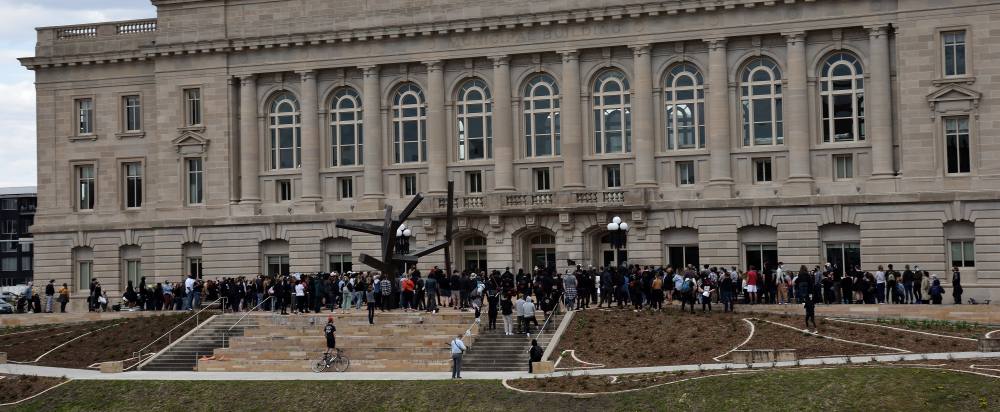
Photo from the “Back the Black” protest at the Des Moines City Hall, 4/17. 2021

“Back the Black” protest at the Des Moines City Hall, 4/17. 2021
Posted in abolition, Black Lives, Des Moines Black Lives Matter, Friends Committee on National Legislation, Great Plains Action Society, prison, race, Uncategorized | 2 Comments