I’ve been writing about the health screening checkpoints at the borders of the Oglala and Cheyenne River Sioux tribes in South Dakota, set up to try to reduce the chances of spreading the coronavirus on tribal lands.
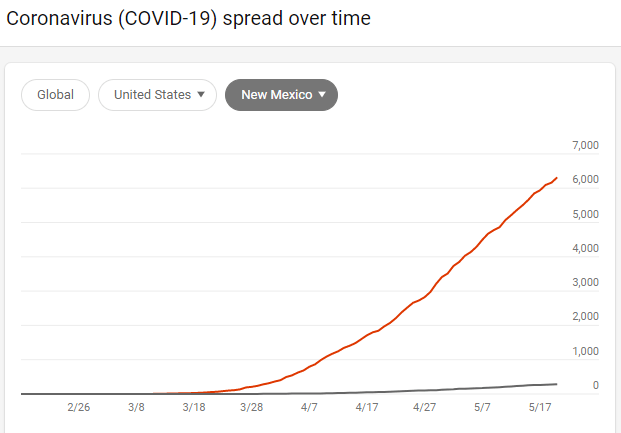
The rapid rise in infections in New Mexico supports how important it is to try to reduce the spread of the virus on native lands. Conditions like crowded homes, sometimes no running water, and the need to travel great distances for food and healthcare by means of crowded vehicles result in the rapid spread of the virus on reservations.
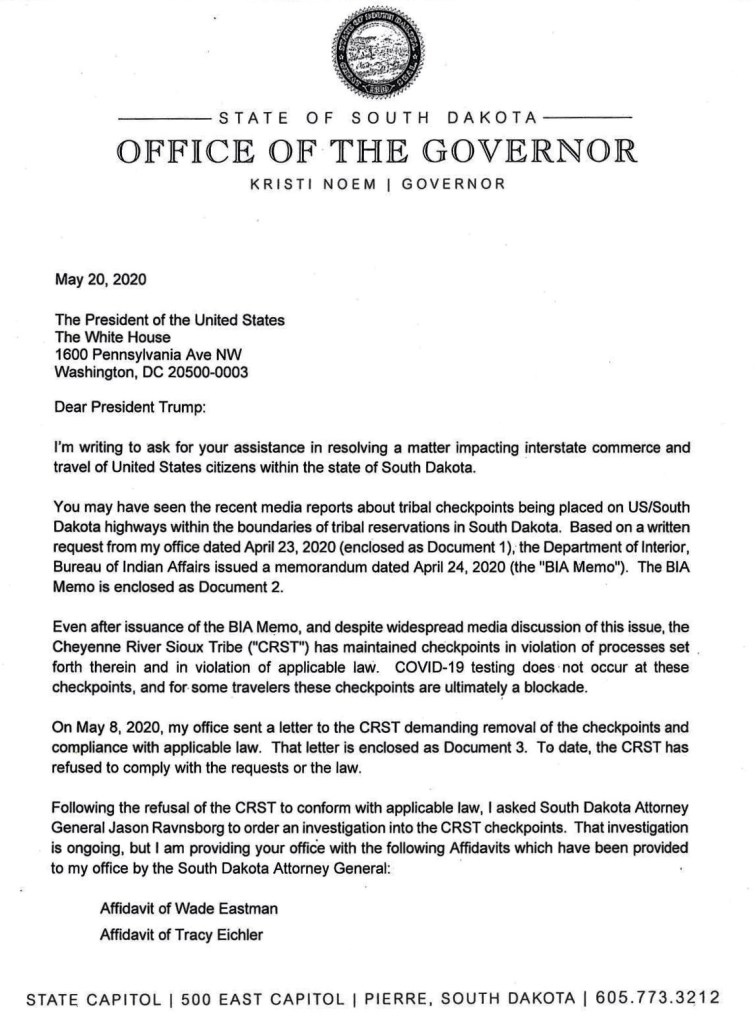
Yesterday the governor of South Dakota sent the letter below about the checkpoints to the White House. Who knows what will happen now?
SIOUX FALLS, S.D. — South Dakota Gov. Kristi Noem said Wednesday she is appealing to President Donald Trump’s administration in her standoff with two American Indian tribes over coronavirus checkpoints they set up on federal and state highways.
Noem said at her daily briefing that she has sent affidavits and video to the White House, the Department of Justice, the Interior Department and her state’s congressional delegation, asking for help resolving the dispute.
“This is not taking sides. This is simply upholding the law,” the Republican governor said.
The tribes set up the checkpoints last month to keep unnecessary visitors off the reservations.
Oglala Sioux President Julian Bear Runner said tribes have been in regular consultation with state authorities, but he insisted that Pierre ultimately has no authority over their actions.
“The Oglala band is ready to stand against foreign intrusions in our daily lives. We have a prior, superior right to make our own laws and be governed by them,” Bear Runner said in a video message over the weekend.
“We are not moved by threats when they come from a position of weakness.”
Cheyenne River Sioux Tribe Chairman Harold Frazier told MSNBC on Sunday that federal-tribal treaties allow the tribe to monitor who comes through reservations and to turn away travelers if they’re from areas known to be coronavirus hot spots.
“We have every legal right to do what we’re doing,” he said. “We’re just doing preventative action. It’s nothing to try to hinder people.”
Frazier said that with few hospital beds on its reservation, his tribe believes the checkpoints will save lives.
South Dakota tribes defy governor and maintain checkpoints in coronavirus fight. “We have every legal right to do what we’re doing,” said Cheyenne River Sioux Tribe Chairman Harold Frazier. “We’re just doing preventative action.”, David Li, NBC News, May 10, 2020
I write with unfortunate news: we’re now dealing with an outbreak of the novel coronavirus at Pine Ridge. We’re up to at least five positive tests here, a rapidly growing number that has forced a 72-hour lockdown.
This demonstrates why it’s absolutely critical that many of you have taken the time to tell South Dakota Governor Kristi Noem not to challenge our COVID-19 checkpoints. Fortunately, your pressure is working. You sent more than 15,000 emails to the governor, and she flinched — failing to follow through on her 48-hour legal deadline.
I thank you, with all of my heart, for listening and acting in friendship with my relatives. If we stand our ground and keep the conversation going, we will prevail — over ignorance in our state capitol and over this pandemic.
Wopila — my sincere thanks for your attention,
Chase Iron Eyes Lead Counsel The Lakota People’s Law Project
Transcript of the video above.
This is Chase Iron Eyes. I’m here on the Pine Ridge Reservation the Oglala Lakota Nation and we as you know we’re going through an existential threat. Indian tribes tribal nations have a prior and superior right to make our own laws and be governed by them.
Kristi Noem is letting her entire state expose themselves to coronavirus. She has publicly stated that she’s going to rely on her constituents’ common sense and resiliency. Resiliency. This is a governor of one of our state’s, the state that currently illegally occupy our land. Kristi Noem knows that entirely half the state of South Dakota belongs to us, belongs to the Lakota Nation, the Great Sioux Nation.
The Lakota people want nothing more than to be left alone. That’s all we’ve always ever wanted, was to be left alone, unmolested, undisturbed. Kristi Noem we are waiting for you to file your suit. You have no legal merit, no grounds.
Our only job is to protect our children. That is our only reason for existing in this place at this time. So I want to let you know that we are completely dedicated to ensuring that we survive far after oppressive, extractive, capitalism and your colonial poison are gone. We rewrite the social contract in our own blood right now for a brand new America.
This has been Chase Iron Eyes and I approve this message. thank you.
Part of transcript from video above
President of the Oglala Sioux tribe Julian Bear Runner: I really feel that the governor needs to really have a serious consultation with the tribe and not try to dictate to us as tribal leaders. What is in the best interest of our people. But rather listen and support the tribes because we live here, we know our people. I’ve been born and raised here. We involve our spirituality within our actions and that’s what helps lead and guide us and that has got us through history to today. And so we incorporate a lot of our traditions with the decisions that we make as tribal leaders. My advice to her is to really sit down and just take the lead from the tribes. Listen to us and support us.
This is another of those times, and there have been many, when I’m beginning a journey into something I want to know more about. That is, I’m likely to make some errors, but that is how I/we grow.
The concept of decolonization isn’t new to me. But as Denise Altvater says below, “it can’t just be about learning from visuals and from presenters and from workshops, it has to be from the heart.” That is why walking and sharing stories on the First Nation-Farmer Climate Unity March was so profound for me. That was an opportunity to build friendships with native people. As we opened our hearts to each other, I began to learn how colonization effected, and continues to effect the lives of my friends. I can feel it in my heart. I’m not talking about any kind of equivalency, but have come to find White people have also been negatively affected, although we often don’t realize it.
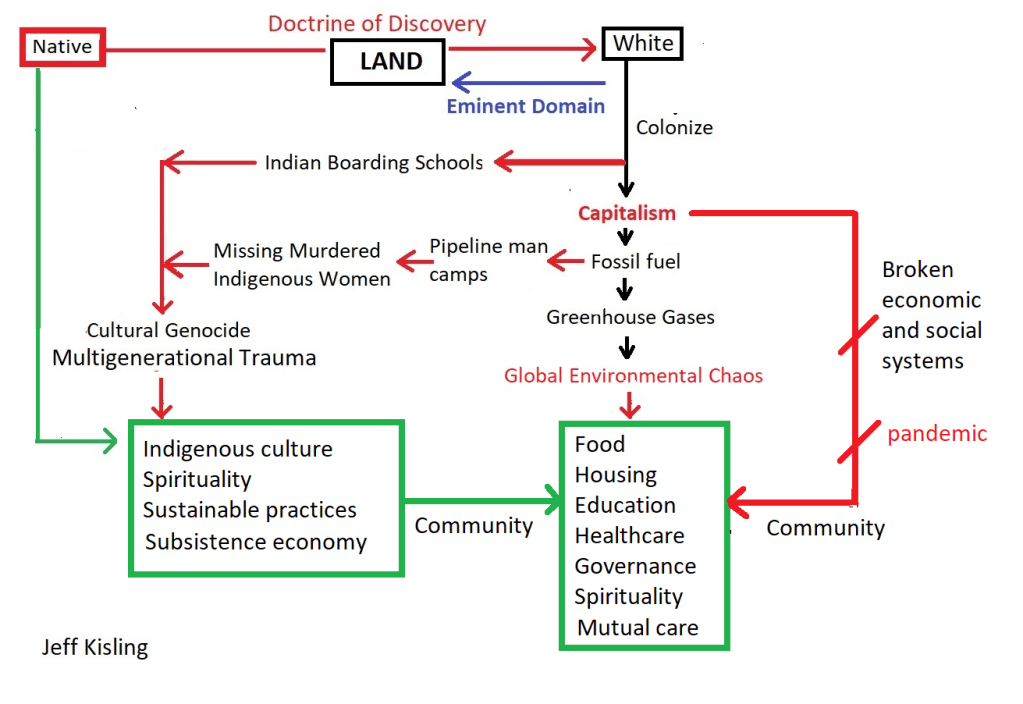
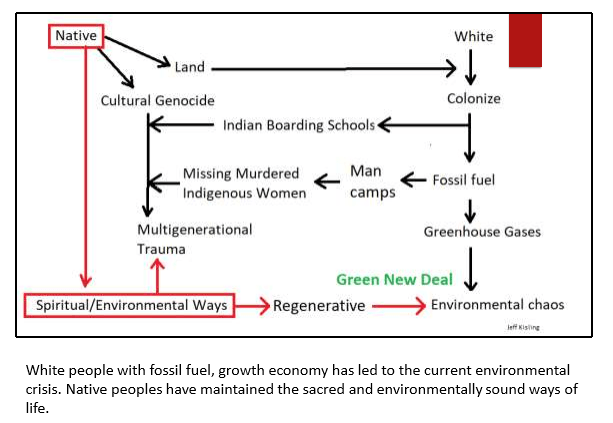
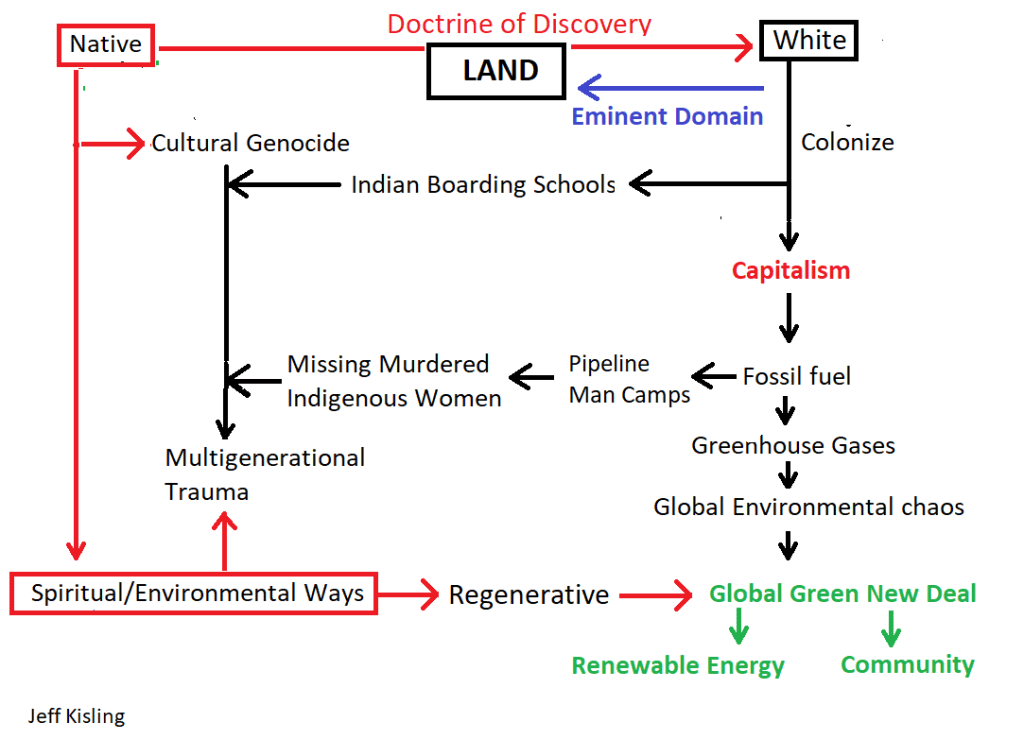
As I’ve worked on thinking through the diagram below, “Colonize” is at the top and impacts all that is found below it.
There are so many ways the COVID-19 pandemic has changed our lives and our environment. I think some of the most significant changes are the reduction of greenhouse gas emissions and the improvement of air and water quality.
Another is the exposure of how unjust and fragile capitalism is. Referred to below as a “framework for oppression.”
At this same time, indigenous leadership is arising all over the world. Ready to reinstate a culture and way of living that can heal Mother Earth and ourselves. I pray my White friends can embrace this opportunity. One of the best ways to learn more is by listening to indigenous people talking about what they are working on in this series called SHIFT, Seeding the Hill with Indigenous Free Thinkers, a project my friend Christine Nobiss is involved in. https://seedingsovereignty.org/shift The next episode will be on May 28th https://us02web.zoom.us/webinar/register/WN_BtSNxkiVSWGl_Dr7rbMnUg
Following are some excerpts from the first article in the AFSC series about decolonization, Thinking about decolonization as Thanksgiving approaches: A conversation with Denise Altvater part 1, Acting in Faith by Christina Elcock, Nov 21, 2017.
Christina Elcock works for AFSC as the QVS Friends Relations Fellow. She writes blog content and curates series of posts for the Acting in Faith blog. Lucy Duncan has worked at AFSC for many years and is a friend of mine.
Denise Altvater: Well, in my program, the core work that I do includes decolonization, racism, and looking at colonization altogether. For me, decolonization is a framework for transforming the domination of Christianity. For me, colonization is a shift of the different parts of time. Colonization becomes parts of institutions, illegal frameworks, social services, economic structures, and all those things require social change. They act against us, the framework of oppression. So, when I work, I really have to acknowledge that racism on the individual level and colonization on the systematic level are really intertwined, they’re locked in place with each other. Anti-racism efforts are not successful if they’re not paired with decolonization practices. I used to do anti-racism work for a long, long time without doing decolonization work. I now find that it’s more effective and powerful when they pair with doing work around decolonization.
Lucy Duncan: What does that look like? How would you describe the different aspects of doing anti-racism work and decolonization work, specifically?
Denise Altvater: Well, all people of color (POC) live with the effects of both institutional and individual racism daily. The attention in the past several decades has been on individual racism, but, it’s the institutional racism that specifically excludes POC by adopting policies that result in our exclusion that is much more devastating. So, when we go and we work around racism and decolonization we, (meaning white people from here on) have to reconcile what the dominant society has done and the fact that people exist on the territory of Native people. The person with the decolonized mind can accept the past and love their present and create their future regardless of what stands in their way. As long as they understand that all of these systems are in place to devalue and eliminate all of these groups of people and they accept that, they can reconcile that within themselves, move forward and really make huge changes. We present the truth and ask that the people in our workshops accept the truth. When they do that, we can begin to move forward toward decolonizing hearts, minds, and hopefully eventually, the land.
Denise Altvater serves as Coordinator as the Wabanaki Youth Program in Maine. She has created a supportive web of connection and communication in a region where Native Communities have been isolated and abused. With her leadership, the American Friends Service Committee’s Wabanaki Program (Maine) was instrumental in developing the first Truth and Reconciliation commission between a sovereign Tribal nation and a U.S. state and she recently has become focused on offering decolonization workshops for faith communities. Christina Elcock and Lucy Duncan open up a conversation with Denise to explore the importance of decolonization and why it’s vital in order to heal from the cracks and abuses of a dehumanizing system.
Denise Altvater: Well, this one man got up in our most recent decolonization workshops, after we had presented all the material and done the timeline of colonization. We did an exercise where everybody got four slips of paper in the room and wrote down four things that meant the most to them in their lives. Then somebody went around and they had to give up one of those things to that person – and they did. Some of them were really hesitant and had a hard time giving up one of those slips of paper and so the next time around the person went and took one of those pieces of papers away from them. What that represented was, “This is what Native people went through. This is the losses that they experienced.”
Christina: Wow, that’s really powerful.
Denise: And then people had to talk about what it felt like to lose those things. For them it was real. Some of them became very emotional because some of them lost their family, some of them lost their faith, some of them lost their hope. We did an exploration of colonialism and we talked about understanding how decolonizing ourselves leads to considering what the deep impact of colonization was, all that people lost. We talked about the impact colonialism had on Native people and the benefits that continue to flow to white people to the detriment of Native people. Then we invited them to identify ways to counteract the taking of things and the impacts of colonialism. We talk about ways to counteract colonialism that are grounded in the teachings of their faith and some of the strategies of decolonization that individual faith leaders implement and explore in their faith communities.
Denise: It can’t just be about learning from visuals and from presenters and from workshops, it has to be from the heart. We talk about this work and we talk about decolonizing our hearts and minds. I remember when we did the Truth and Reconciliation process from the beginning, that’s what we always said, that the process was a decolonization of the hearts and minds of Native people, because we needed to decolonize of our hearts and minds. It’s what kept us going because that process, for us, was always about healing, it was never, ever about anything else. Even though we had to go through the process that everyone else wanted us to, it was always about the healing.
A week ago I wrote about some diagrams I’ve been working on. The intention was to visually represent things I’ve been learning about indigenous culture and the complex interactions between native people and the White settlers.
As usually happens, as you think about the systems being modeled, the need for changes is revealed. Some things might be simplified, some expanded. Other parts of the model are added. But that is one of the main reasons I like to work on models. A good model can help you understand and explain the subject better.
This earlier model was focused on what I had been learning about the tragedies of the Quaker Indian boarding schools, and the epidemic of missing and murdered indigenous women (MMIW).
It is clear to me that we have to transition away from fossil fuels as quickly as possible, and native ways of living within sustainable boundaries was how to do so. As had done for thousands of years.
I knew more than the environmental and agricultural practices needed to be addressed. Those additional pieces needed to be added to the model. This is the updated, current version of the model further explained below.
When I became old enough to think about it, I found the capitalist model didn’t fit with my spiritual (Quaker) values. Its basis is in materialism and a dominating view of natural resources and people as commodities for production. Production of things that don’t have real value.
This pandemic has forced us all to fundamentally re-evaluate what is important to us. And see how broken the capitalistic system is. When the only way we can get necessities is with money, and our source of money is taken away, we experience what those who have been left out of this system live with every day.
When, in this time of a medical crisis, we lose our health insurance, we experience what is the norm for millions of people who have been left out.
When schools close we question our educational models. We realize our children are not being prepared with life skills, as we had not been, either. We rejoice in being present when something new is learned. When we can pass some of ourselves to the children. Our own joy in learning and discovery is renewed by what our children pass to us.
The pandemic heightens our awareness that these systems are operated for the wealthy. The political and economic systems feed off each other in a spiral that takes more and more for those who get increasingly wealthy. Far beyond any possible need for more wealth. Leaving less and less for the rest of us.
Most fundamentally, most of the people invested in these corrupt political and economic systems have lost touch with their spirituality. That has allowed them to accept the tenets of these systems. And leaves them helpless to know what to do now.
My recent experiences with indigenous peoples have given me many of the insights I’ve tried to express in the model, and shows me it is much more than sustainable practices that we need to learn. We need to return to a subsistence economy. We need to return to our spiritual roots. We need to build the communities of our dreams.
As my friend Ronnie James wrote:
I’m of the firm opinion that a system that was built by stolen bodies on stolen land for the benefit of a few is a system that is not repairable. It is operating as designed, and small changes (which are the result of huge efforts) to lessen the blow on those it was not designed for are merely half measures that can’t ever fully succeed.
So the question is now, where do we go from here? Do we continue to make incremental changes while the wealthy hoard more wealth and the climate crisis deepens, or do we do something drastic that has never been done before? Can we envision and create a world where a class war from above isn’t a reality anymore?”
Ronnie James
As we stand on the precipice of the climate crisis, it is vital that we turn to Indigenous Nations around the world for guidance on how to move forward. Traditional ecological knowledge, Indigenous cosmologies, and societal structures can help stop the self-destructive model of colonial-capitalism.
However, our people can’t help make this transition happen if we are still fighting oppression and ongoing poverty. It’s past time to break the money cycle that stays in White circles, which is why we were at SOCAP advocating for an Indigenous led regenerative economy next week in occupied Ohlone land (so-called San Francisco). Listen as our board member and movement auntie Ladonna BraveBull Allard shares her thoughts on colonial capitalism on Randall’s Island in NYC during #IndigenousPeoplesDay!
Thank you to our beautiful collective member Fintan for this beautiful video, to @IPDNYC, auntie Ladonna, and all those who continue to grow these movements and our communities together.
We need to shift away from our capitalistic system to one that embraces indigenous ways of living. Not only to find answers to the dramatic failures of the current political and economic systems, but also to address the urgent need to deal with our environmental catastrophe. Seeding Sovereignty’s SHIFT the Narrative project is working to do that.
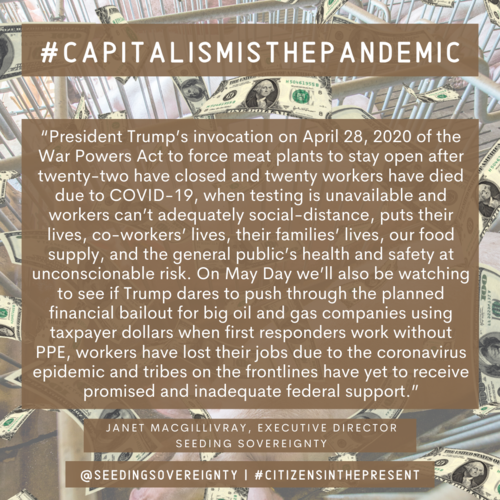
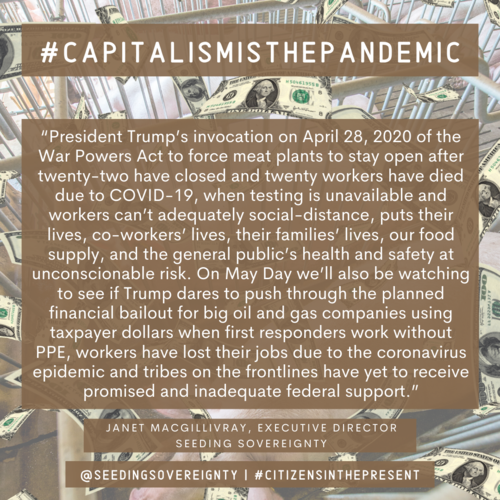
We demand an end to the colonial-capitalist economy supported by institutionalized white supremacist and heteropatriarchal systems that have devastated our lands, climate, and peoples through ceaseless resource extraction, land occupation, border imperialism, misogyny, homophobia, enslavement, and genocide. This viral pandemic is part of a much larger problem as explained by Buffalo-based media artist, Jason Livingston, who conceived this action, “The crisis began before the virus, and the crisis will continue beyond the vaccine.” #CapitalismIsThePandemic
I’ve previously written aboutSHIFT the Narrative, a project organized by my friend Christine Nobiss, a project of Seeding Sovereignty. A description of SHIFT the Narrative and information about the next episode can be found at the end of this.
How do White people learn about indigenous solutions? An obvious way is to hear indigenous people discussing their ideas. But where can we find opportunities for that? These online SHIFT the Narrative discussions are an excellent way. I’ve learned a great deal from these interviews. One of the most profound things I’ve personally learned as I listen to these women leaders is how it feels, for a change, to not be the gender that is in control of the conversation. As quoted above, we should demand an end to institutionalized white supremacist and heteropatriarchal systems.
This morning I was led to a definition of narrative shift which helps me understand this idea better. It was written in 2011 about education, but the principles are true today.
Narrative shift is a literary term that is used to identify the place in a story where the character actually telling the story changes. One of the most obvious advantages of the narrative shift is the change of both perspective and sense of reality that a new voice can bring to the story. Narrative shifts remind us that there are other points of view and alternative ways of looking at the same phenomenon.
When you gather passionate and dedicated voices that have become so accustomed to being spoken to, spoken for and spoken about, then a different story begins to emerge.
These are not new voices in the story, but it has been a while since the telling of the story has been handed over to them. And, at this point, a full narrative shift has not taken place. What is evident from these emergent conversations, however, is that the paradigm shift for which we have longed for many years has already taken place in the hearts and minds of many of those best positioned to bring that shift to life.
These are voices that are not traditionally invited to the table but, in recent months, they are voices that have begun to build their own tables, their own conversations and their own sense of the change they would like to see. The challenge in the months and years to come is to find ways to continue the momentum created by this narrative shift. You may have your own ideas on how this might take place. Following is a list of a few of my own.
SHIFT the Narrative is a live, online interview series produced by Seeding Sovereignty that covers different aspects of Indigenous political engagement and current issues in Indian Country through interviews with expert guest speakers.
On Thursday, May 28, we will be speaking with Kali “K.O” Mequinonoag Reis and Owl. Kali, Seaconke Wampanoag and Cherokee Nations, is the first mixed Native American Female World Champion Boxer. Owl, Ramapough Munsee Lenape Nation, is an attorney working at the intersection of human rights, Indigenous rights, and the environment.
The Seaconke Wampanoag and Ramapough Munsee Lenape Nations are not federally recognized, though they are recognized by the states that engross their territories. We will discuss the ongoing fight for sovereignty with the understanding that there are many pitfalls to federal recognition but why it is necessary to protect land rights. This is an important conversation considering the current crisis the Mashpee Wampanoag Nation is facing as their land trust has been revoked during COVID-19. An important part of this discussion will delve into what it is like to be Indigenous after 400 + years of living with European and African ancestry.
Stay ahead of the curve! Join Sikowis and S.A. as we interview expert guests every second Thursday! Conversations will surround political work in Indian Country such as getting out the vote, organizing to change policy, issues of sovereignty, running for office, and much more.
Writing on this blog is a spiritual exercise. The discipline of waiting to hear what I should write is usually the foundation for my path for the rest of the day. Or week. Or year. Or lifetime.
During the rest of the day I try to continue to be attuned to this, listening to the Inner Light. When I first wrote that previous sentence, I realized I am not listening to my Inner Light, but to ours, together. During the day I sometimes hear what I should write about the next day. If I am blessed to have another day.
Many years ago I found walking and photography had also become spiritual practices. Praying while walking. Seeking quiet places to walk. Walking with my camera as I nearly always do. To the extent that people will ask me where my camera is if they see me without it.
When talking with my friend Diop Adisa about photography once, I said even if I don’t have my camera with me, I still take photos in my mind. He laughed and said he did the same thing. We came up with the term “Zen photography”.
Photography can be a spiritual practice. Looking for an image to capture helps keep me grounded in the moment. I became aware of a spiritual connection between being immersed in the Inner Light that would hold a channel open, so when I discovered an image, that visible light connected to the Inner Light.
Years ago the Spirit taught me the connection between the Inner Light and visible light can be bidirectional. The Inner Light would sometimes uncover the visible image. I learned to stand before a subject, in silence, and wait for the image to photograph to be revealed to me. At the times when that occurred, I would be both focused on the physical place where I was, and taken out of that place to where the Inner Light was shining.
I was astonished years ago when I became aware that I was talking to the Spirit when I held the camera. Saying things like ‘that’s a beautiful flower you created’. Or, ‘you know what I’m trying to do here. Could you help me out?’ There were sacred times when I received an answer.
In order to deal with the chaos that exists in the world today, you need some grounding. That grounding best comes from knowing who you are.
– Michael Ray –
Some of this reflection was stimulated by what I found on a new, for me, website, Dumbo Feather.
From the very first issue, Dumbo Feather magazine has provided a platform for people to tell their stories. The people in our pages are not necessarily famous. They are changemakers, leaders, artists, writers, lawyers, activists, philosophers, teachers, builders, scientists. They use their craft to make the world a better place and, by telling their story, they are motivating others to do the same. [see “All the we are is story” below]
Less than two months ago, when so many of us were feeling alarm around the bushfires and wider climate emergency, we shared a resource for turning that alarm into much-needed action. Now we are in the midst of another emergency that is forcing us into varying states of economic distress, isolation and anxiety. We are united in our vulnerability and our courageous attempts to think and live differently as the fragility of the economy reveals itself to us.
There is a deep desire among us to find freedom and imagination in this moment. Much of the work, of course, is in cultivating the resources within to help weather the storm. As we at Dumbo Feather navigate the turbulence and uncertainty of this time, and strive for moments of clarity, peace and a re-imagining of what’s possible, we are committing to sharing ideas that are helping us find refuge. We will keep adding to this list as inspiration strikes and new resources come our way.
[ Following is one section of those resources.]
THINGS YOU CAN DO
Be in nature and observe life, maybe spend time with a particular tree and enter a regular conversation with it
Stay present to what you’re feeling, your emotions are probably changing on an hourly basis; observe them, be curious about what’s triggering them
Celebrate the wins for the planet as a consequence of this de-growth period. Join in its relief. We are part of nature, after all
Plant seeds and grow a garden (even if it’s pots on the balcony)
Create a routine for your day. Include break times, walks, coffee chats with loved ones via Zoom
Order books from local bookstores – many bookshops are offering free delivery to surrounding areas. Buy food from local businesses and grocery stores
Everywhere people ask, “what can we do?” The question, what can we do, is the second question. The first question is “what can we be?” Because what you can do is a consequence of who you are. Once you know what you can be, you know what you can do.
Arkan Lushwala
All this brings to mind the concept of Spiritual Warrior. I hadn’t thought in those terms until I received a message from my good friend Joshua Taflinger.
I am inspired to share with you all more directly a post I wrote, because I consider you an established & effective nature/spiritual warrior, and believe that there is a need for the perspectives shared in the attached post to be more common thought in the minds of the many.
If you feel truth from this writing, and are inspired, I highly encourage you to re-write your own version, in your own words/perspectives, and post to your network.
With the intention of helping us all wake up, with awareness, clarity, and direction.
..spreading and weaving reality back into the world….
What has risen to the surface at Standing Rock is a physical/spiritual movement. Learn how to quiet your mind. To find the silent receptive space to receive guidance. To learn to adapt and follow the pull of synchronicity to guide you to where you will find your greatest support and strength.
What I have found in my time praying in the indigenous earth based ways, is that it’s not about putting your hands together and talking to god…. It’s about quieting and connecting with the baseline of creation, of nature. Tuning into the frequency and vibration of the natural world, the nature spirits. The beings and entities that have been in existence, for all of existence, the examples and realities of sustainability and harmony. It’s about becoming receptive to these things. Being open and flowing with them. The spirit guides us, but we have to make ourselves receptive to feel, sense, and respond to this guidance.
Joshua Taflinger
The Spiritual Warrior is a person who challenges the dreams of fear, lies, false beliefs, and judgments that create suffering and unhappiness in his or her life. It is a war that takes place in the heart and mind of a man or woman. The quest of the Spiritual Warrior is the same as spiritual seekers around the world.
Each Warrior of the Light contains within him the spark of God. His destiny is to be with other Warriors , but sometimes he will need to practice the art of the sword alone; this is why, when he is apart from his companions, he behaves like a star. He lights up his allotted part of the Universe and tries to point out galaxies and worlds to all those who gaze up at the sky. The Warrior’s persistence will soon be rewarded. Gradually, other Warriors approach , and they join together to form constellations, each with their own symbols and mysteries.
Coelho, Paulo. Warrior of the Light: A Manual (p. 89). HarperCollins. Kindle Edition.
For us, warriors are not what you think of as warriors. The warrior is not someone who fights, because no one has the right to take another’s life. The warrior, for us, is one who sacrifices himself for the good of others. His task is to take care of the elderly, the defenseless, those who cannot provide for themselves and above all, the children, the future of humanity.
Sitting Bull
ALL THAT WE ARE IS STORY. From the moment we are born to the time we continue on our spirit journey, we are involved in the creation of the story of our time here. It is what we arrive with. It is all we leave behind. We are not the things we accumulate. We are not the things we deem important. We are story. All of us. What comes to matter then is the creation of the best possible story we can while we’re here; you, me, us, together. When we can do that and we take the time to share those stories with each other, we get bigger inside, we see each other, we recognize our kinship — we change the world one story at a time.
Richard Wagamese (October 14, 1955-March 10, 2017)
Aren’t most of us numb in the face of the number and severity of assaults on our social and political norms, on the rule of law, on the unraveling of civil liberties, against the lawful mechanisms to influence change and have oversight on our government, on our economy, on our health and our very lives?
Especially unnerving to me are the recent dismissals of so many inspectors general, the filling of so many senior positions with those who support the president, and publicly calling for the prosecution of his political enemies. We’ve been moving deeper into authoritarianism for over three years now.
Even more disturbing are the callous decisions that will unquestionably lead to a massive increase in the numbers of COVID-19 infections and death.
I’m a strong believer in critical thinking, which often results in conclusions divergent from what is accepted as truth. That can make it difficult to speak out about your conclusions. You wonder if your thinking is correct when so many think otherwise.
Recently I’ve come to the conclusion that many have already come to, that what appears to be the unbelievable incompetence of the government has instead diverted attention from the policies that are accomplishing their goals.
When President Trump, Republican leaders, right-wing think tanks and billionaire CEOs aggressively push to send people back to work before the coronavirus is contained, this is not a “reopening.” It’s the opposite: an unraveling of the conditions that we need to safely and sustainably reopen our society. While the red herring of a “reopening” has dominated news cycles and Trump administration press conferences, the United States has moved ever further away from what we all desperately seek: a point at which this all ends, and it’s safe to go to the library, stroll maskless through a park, eat dinner with a loved one, and go to work without fear. The Right doesn’t own the “reopening” terrain—it has forfeited it by barreling down a road that leads to mass death, suffering, and more and more closures down the road.
A recent article by Robert Reich lists a four step plan for the Trump re-election strategy.
So what is Trump’s reelection strategy? Ignore the warnings of public health experts and reopen the economy at all costs.
Step 1: Remove income support, so people have no choice but to return to work.
Step 2: Hide the facts.
Step 3: Push a false narrative about “freedom” and “liberation.”
Step 4: Shield businesses against lawsuits for spreading the infection.
Here’s the truth: The biggest obstacle to reopening the economy is the pandemic itself.
Any rush to reopen without adequate testing and tracing – a massive increase from what we’re doing now – will cause even more deaths and a longer economic crisis.
We’ve been trained that it is bad form to bring up Hitler and the Nazis’ rise to power and the horrible things done in the concentration camps. But now is the time to consider the parallels of what happened there to our present situation. What happened in Germany happened because of the silence of the populace. Because Jewish people were demonized as “others”, their lives of no value. They served as a scapegoat. To create conditions that would make the public support the Nazi’s agenda.
We have our own concentration camps now, of course. Massive numbers of people of color in particular, with absurdly long sentences for nonviolent crimes, imprisoned. Now trapped in conditions ideal for the widespread coronavirus infections and deaths. I can’t imagine how that feels.
And the huge numbers of people trying to immigrate into the US have been placed in their own prison camps. Including thousands children and babies, separated from their families. Who isn’t sickened by this, other than those who created these situations?
The question is how can we do something about these conditions? Even the often ineffective public protests aren’t safe because of the risk of infection (other than the protests of those who don’t believe in the virus).
Social media posts and online media sources are only seen by those with the same opinions.
Not only is the administration and most of Congress in the grip of special interests with vast sums of money, but the last bastion of hope, the courts and justice system have also been corrupted.
Where are the charismatic, moral leaders like Martin Luther King? I admire and have attended gatherings with Rev. William Barber and the Poor People’s Campaign. But this movement is struggling to be heard.
Where are the people of faith, including myself?
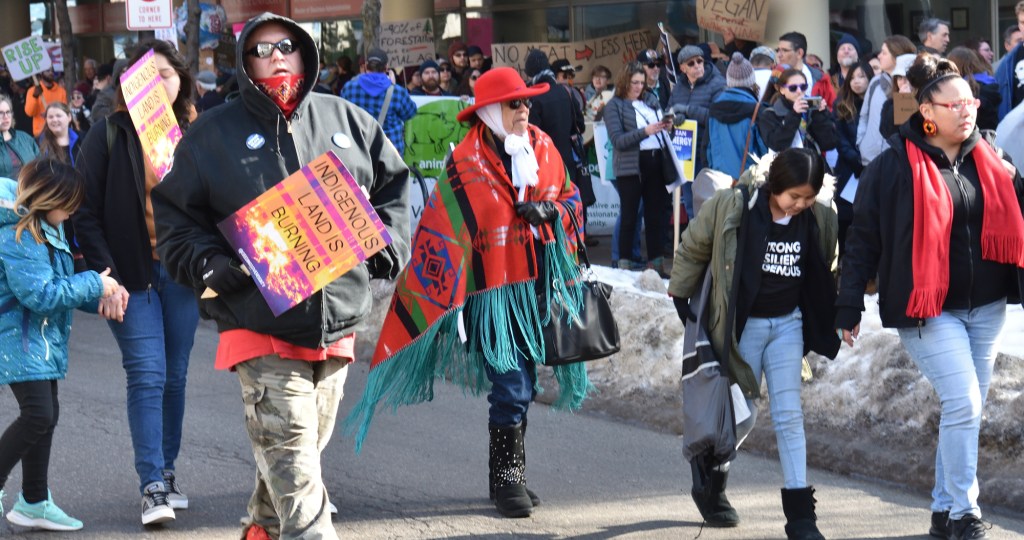
As many of you may know, I’ve sought opportunities to build friendships with and learn from indigenous peoples. Initially related to our environment and Mother Earth. But increasingly I’ve become convinced that indigenous leadership offers answers to the abuses above. I treasure the friendships I was blessed to make on the First Nation-Farmer Climate Unity March. That opened so many door to continue to learn.
I’ll close for now with this quote from my friend Ronnie James.
I’m of the firm opinion that a system that was built by stolen bodies on stolen land for the benefit of a few is a system that is not repairable. It is operating as designed, and small changes (which are the result of huge efforts) to lessen the blow on those it was not designed for are merely half measures that can’t ever fully succeed.
So the question is now, where do we go from here? Do we continue to make incremental changes while the wealthy hoard more wealth and the climate crisis deepens, or do we do something drastic that has never been done before? Can we envision and create a world where a class war from above isn’t a reality anymore?”
Following is information about the outbreak of the the covonavirus at Pine Ridge from Chase Iron Eyes, Lead Counsel of the Lakota People’s Law Project.
I write with unfortunate news: we’re now dealing with an outbreak of the novel coronavirus at Pine Ridge. We’re up to at least five positive tests here, a rapidly growing number that has forced a 72-hour lockdown.
This demonstrates why it’s absolutely critical that many of you have taken the time to tell South Dakota Governor Kristi Noem not to challenge our COVID-19 checkpoints. Fortunately, your pressure is working. You sent more than 15,000 emails to the governor, and she flinched — failing to follow through on her 48-hour legal deadline.
As Oglala Sioux Tribe President Julian Bear Runner’s spokesperson and public relations director, protecting the people of this nation and sharing our stories are my sacred duties. I’m proud of the powerful conversation my president had last night with Don Lemon on CNN. Please watch and share it. We must continue to win the public education battle.
This outbreak is yet another demonstration of Governor Noem’s statewide policy failure with COVID-19. This is why we’ve taken matters into our own hands. We are so obviously on the right side of this that 17 state lawmakers, including a Republican, have penned an open letter to the governor in support of us. Even Fox News is having a hard time spinning this one in the governor’s favor.
I thank you, with all of my heart, for listening and acting in friendship with my relatives. If we stand our ground and keep the conversation going, we will prevail — over ignorance in our state capitol and over this pandemic.
Wopila — my sincere thanks for your attention,
Chase Iron Eyes Lead Counsel The Lakota People’s Law Project
From the transcript of this video:
Don Lemon: You say that the checkpoints are necessary because governor Noem isn’t doing enough to protect tribal health and safety. What does she need to do?
President of the Oglala Sioux tribe Julian Bear Runner: I really feel that the governor needs to really have a serious consultation with the tribe and not try to dictate to us as tribal leaders. What is in the best interest of our people. But rather listen and support the tribes because we live here, we know our people. I’ve been born and raised here. We involve our spirituality within our actions and that’s what helps lead and guide us and that has got us through history to today. And so we incorporate a lot of our traditions with the decisions that we make as tribal leaders. My advice to her is to really sit down and just take the lead from the tribes. Listen to us and support us.
Don Lemon: You and leaders of the Cheyenne River Sioux tribe say medical resources are very limited. An outbreak would be devastating. The closest ICU hours away. Is standing your ground a matter of life or death?
Julian Bear Runner: Indeed, sir it definitely is a life or death situation for us. You know right now here on the reservation we currently have four ventilators that is being provided through the Indian Health Service which is a treaty obligation of the United States to provide us that help. I reside amongst 30,000 tribal members that live here on the reservation. We have 45,000 enrolled members and we have a service to each and every one of those individuals but you know how is four ventilators going to really you know if this pandemic or this virus hits the reservation?
A great majority of my membership suffer and right now we currently have positive cases here on the reservation and they’re not requiring those intensive medical procedures at this moment. But if you look at our you know one of our southern relatives the Navajo Nation Indian Health Service the United States government has the obligation to them as well.
It’s very fearing for me as a tribal leader because I have an obligation to look out for the health and welfare of every enrolled tribal member. This conflict comes at a time when the governor refused to issue an official stay at home order and South Dakota’s new coronavirus cases are on the rise. There are now more than 3700 cases in the state.
I have been thinking and praying, trying to discern what the Spirit is asking of me in these times of confusion, fear and violence. Violence in the sense of tearing apart the fabric of our lives, as well as the physical violence arising in our midst. The violence of the virus. What does nonviolence mean today?
So many things no longer make sense, which reminds me of something I had written titled Sensemaking.
…there remains the most existential risk of them all: our diminishing capacity for collective sensemaking. Sensemaking is the ability to generate an understanding of world around us so that we may decide how to respond effectively to it. When this breaks down within the individual, it creates an ineffective human at best and a dangerous one at worst. At the collective level, a loss of sensemaking erodes shared cultural and value structures and renders us incapable of generating the collective wisdom necessary to solve complex societal problems like those described above. When that happens the centre cannot hold.
Where do we turn for answers to what does make sense? People of the Spirit know that is where we will find answers. It can be frustrating when we feel we have an urgent need for help. But the answer will come in its own time. Part of faith is believing not only that the Inner Light will reveal the answers to us, but will do so at the right time.
I recently heard Freda Huson, of the Wet’wuwet’en people, say “I believe in my prayers.”
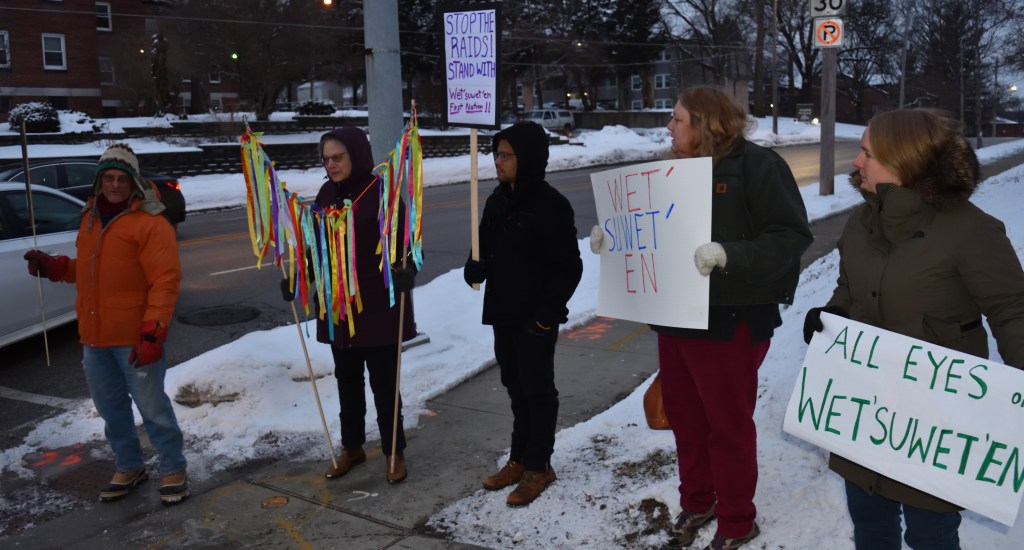
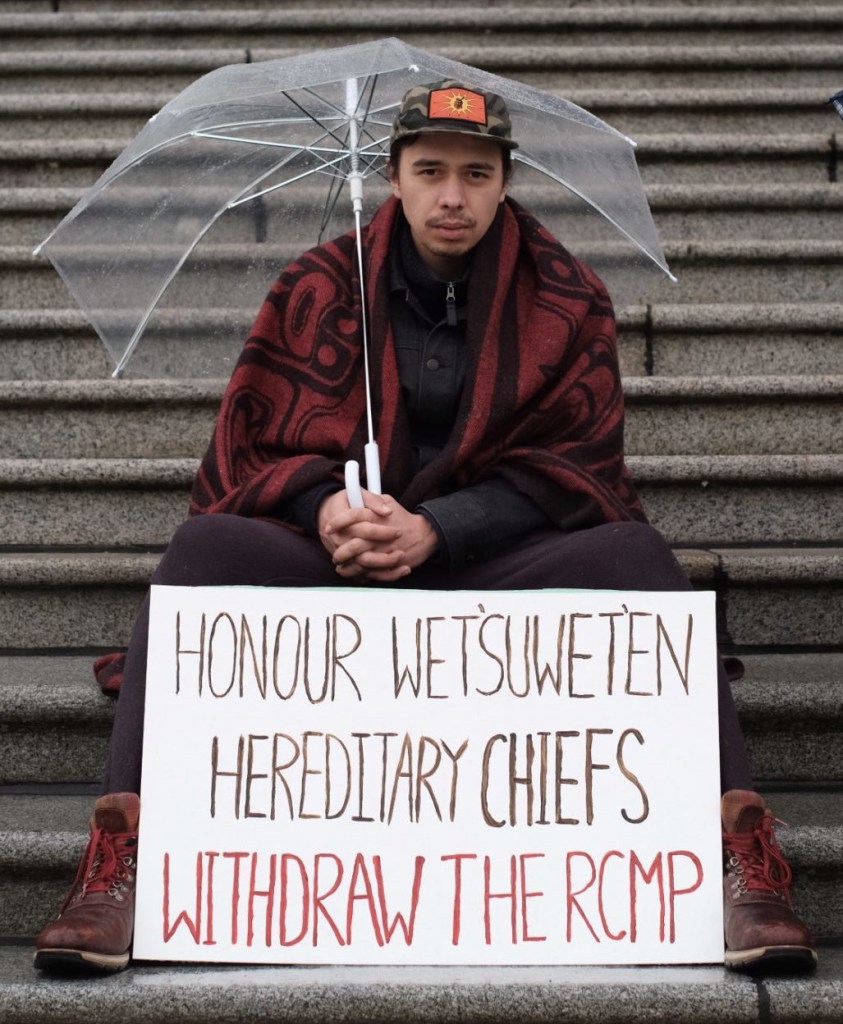
I have been following and writing about the struggles of the Wet’suwet’en peoples to stop the construction of the Coastal GasLink (CGL) pipeline on their unceded territory in British Columbia. I’m moved by the spiritual strength so many there have exhibited, on so many occasions.
I was led to see the article below this morning, during my usual scan of news related to the Wet’suwet’en peoples. It pertains to a situation I’ve been praying about lately, which is how do we Quakers adapt to not having face-to-face meetings because of the coronavirus?
These two articles are about the use of the videoconferencing software, Zoom, to connect people remotely for our recent Midyear Meeting, of Iowa Yearly Meeting (Conservative).
There was very little time to come up with a solution once it was decided Midyear meeting would not be held as in person meetings. The meetings went very well for those who were able to connect using Zoom. A committee of Friends did a lot of excellent work in preparation for the meetings, including a lot of training for people not comfortable with Zoom.
The concern is about those who were not able to attend because they could not or would not use Zoom. This is an ongoing concern because it will be a long time until we can safely gather in person. It is a concern now because the annual meeting of Quakers who belong to Iowa Yearly Meeting (Conservative) will be held in about two months. It has been decided that will not be a face to face meeting. People are working on how these meetings will be held.
I’m focused on one of the committees that meets during Yearly Meeting. I’m clerk of the Peace and Social Concerns Committee. I just asked committee members whether they were comfortable using Zoom for our work. Not everyone is. Some who aren’t have said to go ahead without them, but I don’t think that is a good choice.
I haven’t come up with an answer yet. But I find the story below about ceremony during the time of the coronavirus very interesting.
An Indigenous leader is telling the RCMP to stay off reserve land after armed officers were dispatched to break up a sacred ceremony.
“These are First Nations lands. This is Indian land. Stay off our lands unless you are invited,” said Chief Bobby Cameron of the Federation of Sovereign Indigenous Nations.
Public health orders do not supersede First Nations law and treaties, asserts Cameron, who added that maintaining tradition and ceremony is even more important during the COVID-19 pandemic.
“Our ceremonies, our sun dances, our sweat lodges, our pipe ceremonies will continue and no matter what any government or what the RCMP may try to say or do, those ways are going to continue.”
While powwows across the country have been cancelled, traditional ceremonies cannot be delayed, Cameron said. They cannot move online, like many church services, because they are inherently connected to the land.
Concern arose last weekend when about 35 people took part in a sun-dance ceremony organized by Clay Sutherland on the Beardy’s and Okemasis Cree Nation, about 90 kilometres northeast of Saskatoon. An elder had received a vision that it was important to hold the sacred ceremony to support people during COVID-19 and to empower scientists and researchers to find a cure, Sutherland said.
“We were doing this, not only for our communities and our loved ones, but we were doing this for all of mankind,” he said. “We did not expect to get a pushback from the government. We did not expect all these things to happen.”
A public health order in Saskatchewan limits gatherings to 10 people.
Sutherland said precautions were put in place and direction from the First Nation’s leadership was followed. People coming to the ceremony from off-reserve had their temperatures checked and were advised to self-isolate for the following two weeks.
Turning and turning in the widening gyre The falcon cannot hear the falconer; Things fall apart; the centre cannot hold; Mere anarchy is loosed upon the world, The blood-dimmed tide is loosed, and everywhere The ceremony of innocence is drowned; The best lack all conviction, while the worst Are full of passionate intensity. …
The Second Coming, William Butler Yeats
KONICA MINOLTA DIGITAL CAMERA
KONICA MINOLTA DIGITAL CAMERA
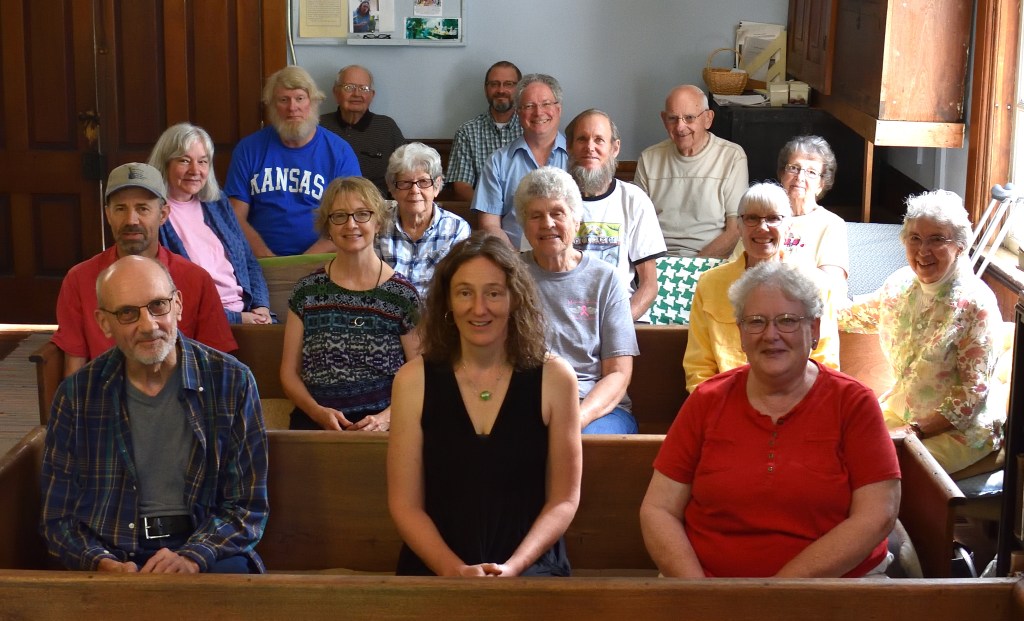
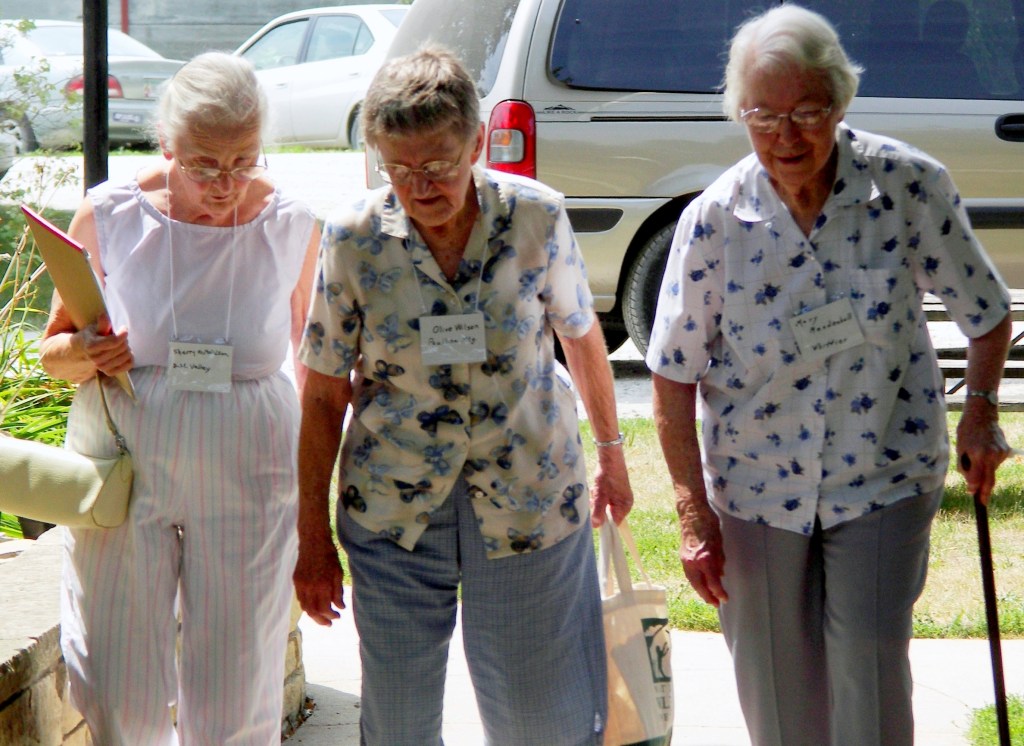
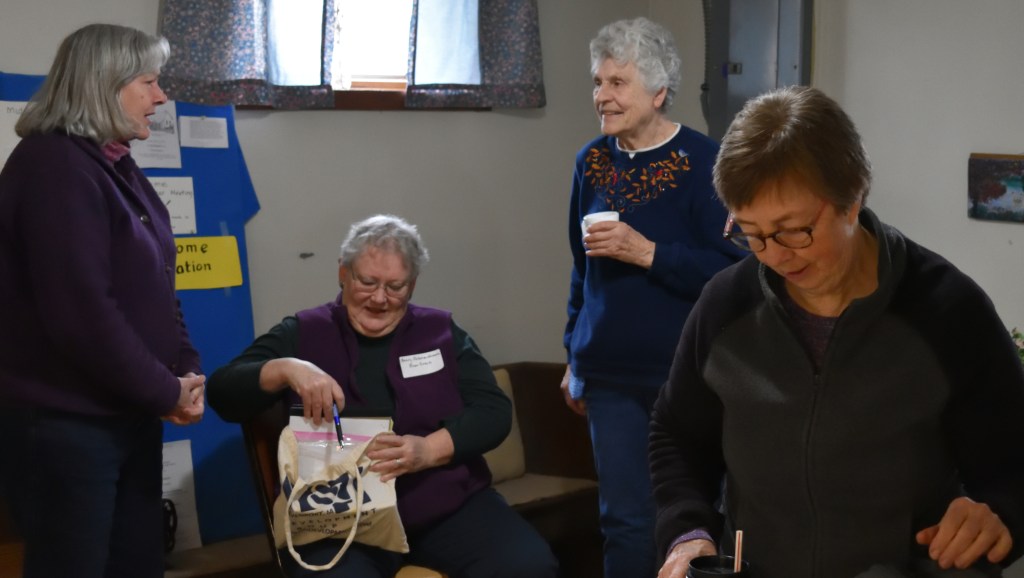
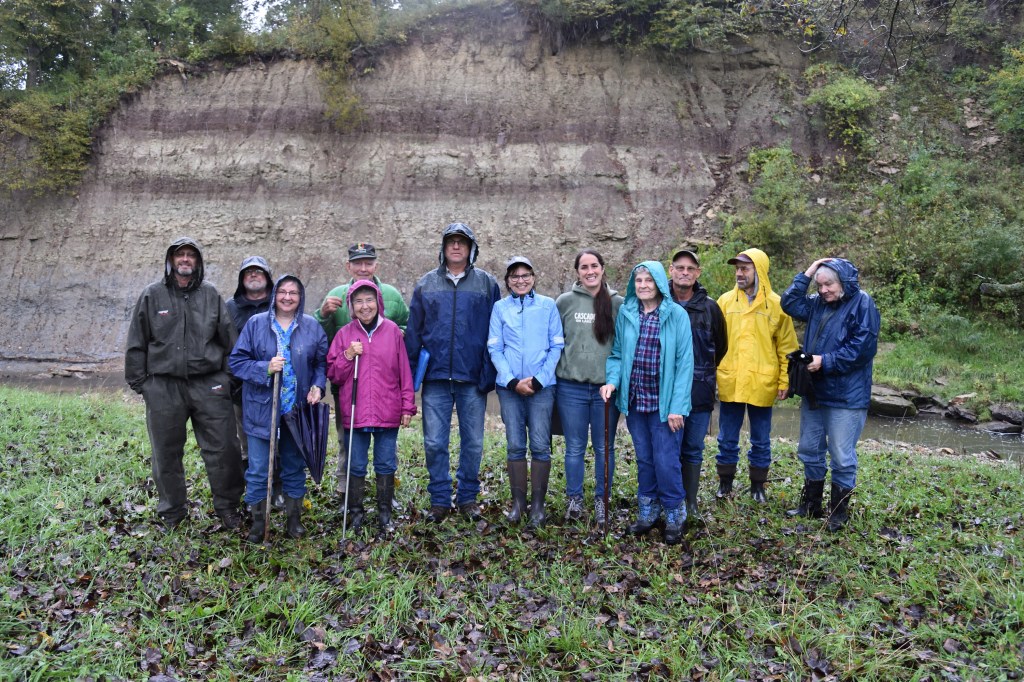
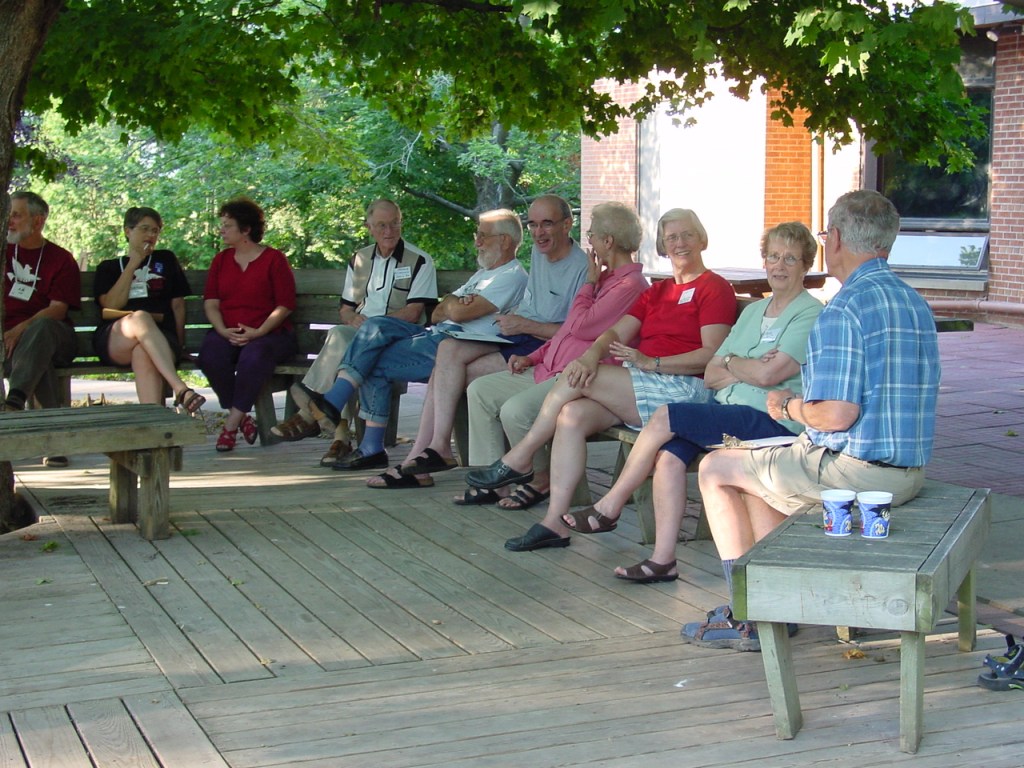
AM Deb Fink Horace Autenreith George Welch Jim Ginger Kenney Mary Autenreight Birdie Kisling Don Nagler
One of my goals as a photographer is to tell stories, as in photojournalism. I actually wrote a few blog posts about a photo and 1,000 words 1 photo : 1,000 words I’ve found it helpful to ask myself what story I am trying to tell when taking certain photos.
But it is actually some diagrams I’ve been working on that I hope might be worth 1,000 words. Or at least help explain things visually that are difficult to express in words.
Quakers, including myself, often feel led to do various types of peace or justice work. The reason “led” is commonly used is because Quakers try to discern what the Spirit or God is asking them to do during our silent meetings for worship.
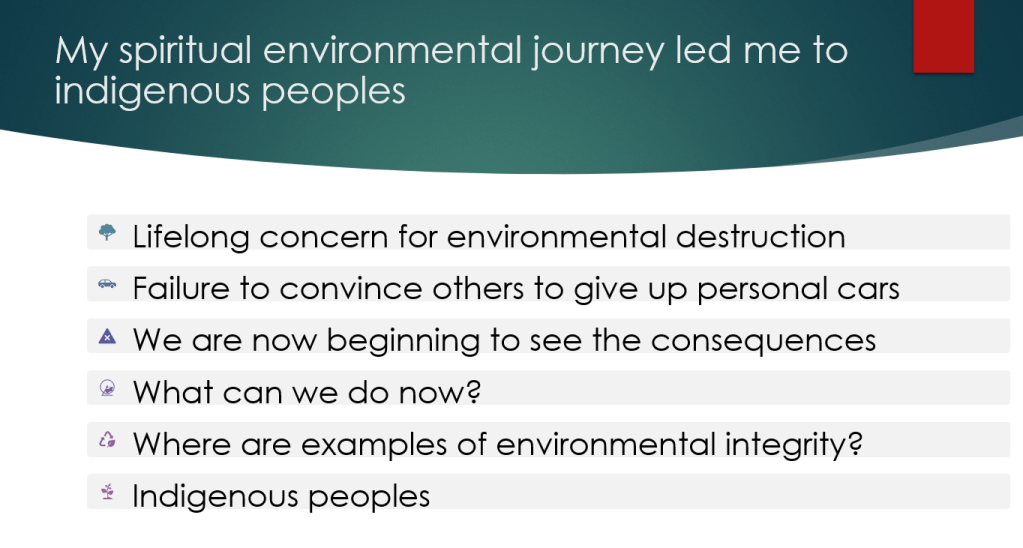
Over the course of my life I have felt the Spirit was asking me to do a series of things. Although I didn’t always realize it at the time, each step was built on the preceding steps. Growing up on a farm made me appreciate nature. Family camping trips did, too. Being required to register for the draft at 18 years of age made me search deeply into the conflict between church and state, as well as the idea of killing another person in any circumstance, leading me to be a draft resister. Moving to Indianapolis at 20 years of age, prior to catalytic converters, the clouds of noxious smog and the vision of that obscuring my beloved Rocky Mountains, led me to live without a car.
Thus I was sensitized to our evolving environmental disaster. My work as a research scientist meant I could visualize the damage greenhouse gas emissions were causing. I saw many ways the extractive, capitalistic system was dramatically accelerating damage to our environment. This was obviously an unsustainable situation.
I was alarmed, and knew we had to curb the use of fossil fuels. This became a life long contention with Quakers most of whom I felt were not making necessary changes in their lives.
This led me to look for people and cultures that did live sustainably, which led to indigenous cultures. It took seeking out opportunities to learn about and get to know some native peoples, but I was blessed to have found, to have been led to, opportunities to do so. I believe it is essential to spend significant amounts of time, to develop friendships with those who are in need or oppressed. That is necessary because such communities must first get to know and trust you before you can work together.
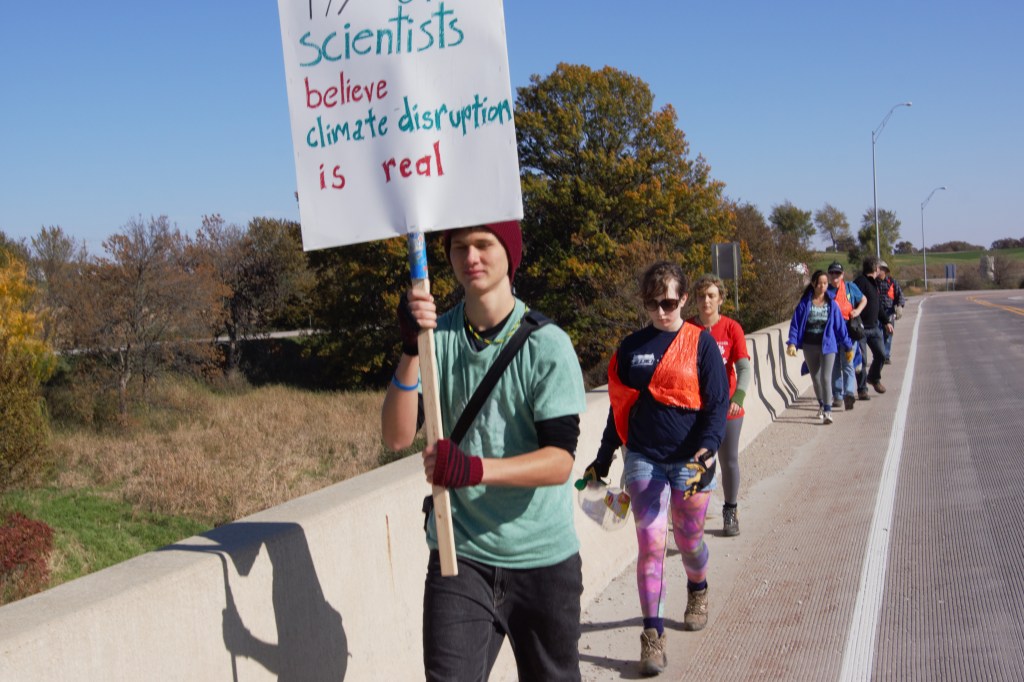
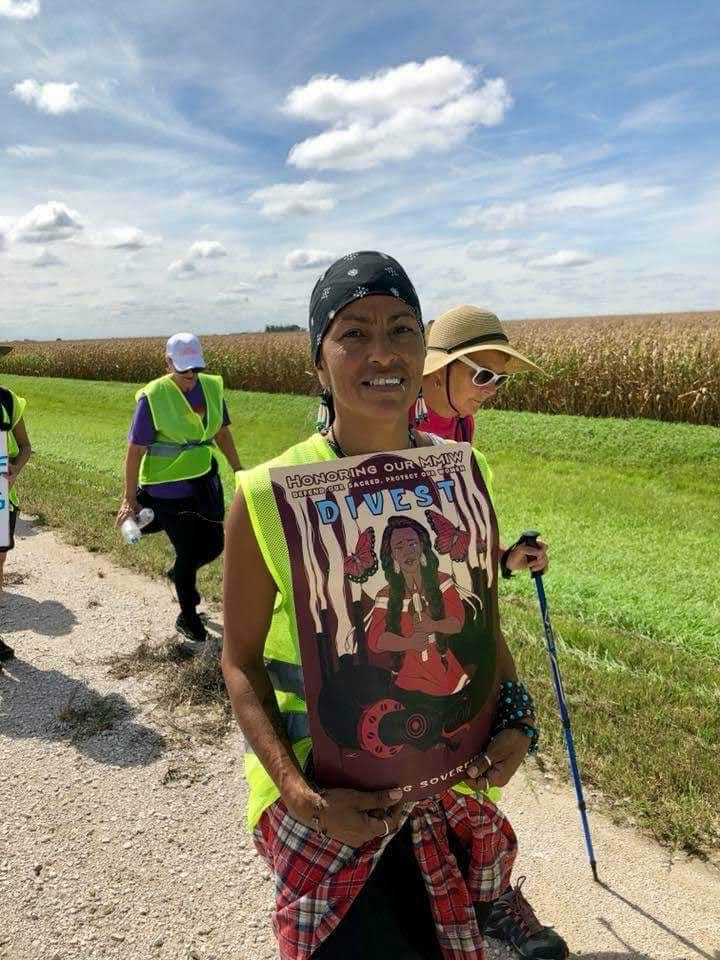
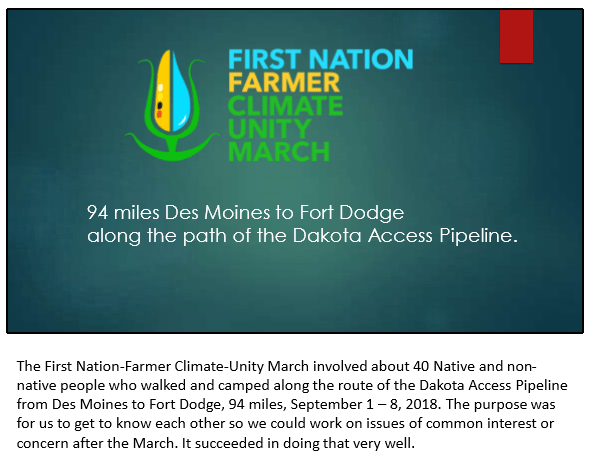
The most significant experience I had along these lines was walking with around thirty native and non-native people on the First Nation-Farmer Climate Unity March. In that small group four of us were Quakers or connected with Quakers. As the name implies, the idea was for people of these two cultures to spend enough time together to get to know each other, so we could work together on things of common interest and concern. Walking, eating and camping together for 8 days as we walked 94 miles along the path of the Dakota Access pipeline in central Iowa, sharing the physical strains and joys, good friendships were made. Many blog posts and photos from that experience can be found here: https://firstnationfarmer.com/ I appreciated it when I heard someone express it as our sacred journey. Since that March in September, 2018, friendships have deepened and work together has indeed happened and continues.
There was one thing I was led to do during the March that was very uncomfortable. I needed to tell my new friends I was aware of the tragic history of Quakers and the Indian Boarding Schools. Some of what I wrote about that is on the March website https://firstnationfarmer.com/ We could not have developed honest relationships if a history of this magnitude was not dealt with. As I try to show in these diagrams we are finally getting to, spirituality is an important part.
It looks like I’ve used 1,000 words already. But I hope this background will help explain these diagrams. Or rather, hope the diagrams help explain the preceding better.
I hope this is mainly self explanatory. I’ve been learning more about the Doctrine of Discovery, that White people used to take native lands. As I mentioned above, I’ve been learning more about the awful history of the Indian boarding schools that attempted to forcibly assimilate native children into White culture. What I hadn’t known was how this deep trauma was passed from generation to generation and has been described as an open wound today.
The other thing I was ignorant about was the epidemic of missing and murdered indigenous women (MMIW). That is directly related to the man camps of those working on fossil fuel pipelines.
Capitalism is, of course, the engine driving the fossil fuel industry.
It seems to me the path to dealing with our accelerating environmental chaos is to find ways to move toward indigenous environmental and spiritual ways.
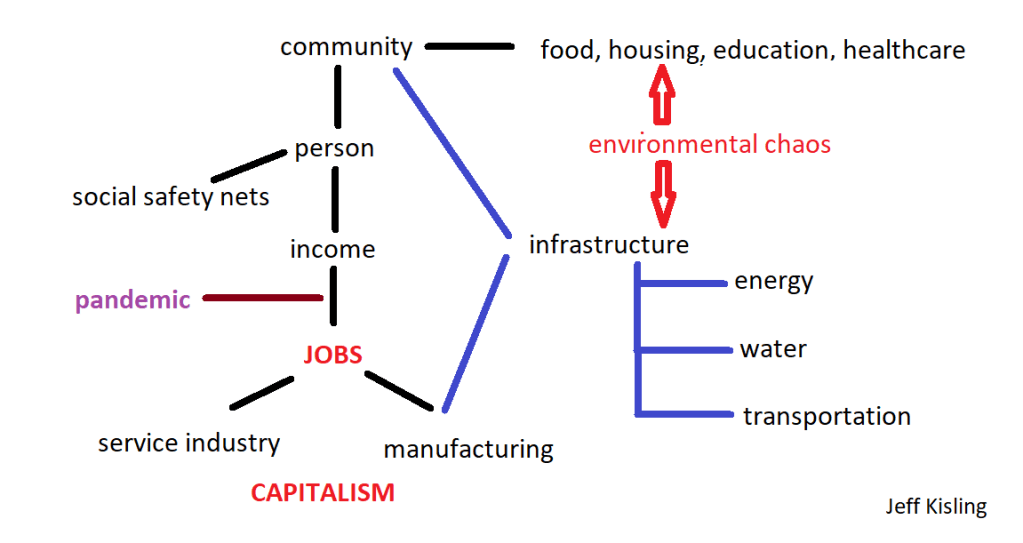
Capitalism as the root cause of so much of this led me to work on another diagram.
Capitalism is the process by which those fortunate enough to have work are paid money for their financial needs, or partly meeting those needs. Others rely on social safety nets like Medicare, food stamps, etc. The pandemic has created major problems with this system. As is environmental chaos, which will only worsen.
I realized the CAPITALISM in the first graph is expressed in the second graph. Combining those resulted in this diagram. This diagram is hard to read. You can download a better version of it here: https://1drv.ms/u/s!Avb9bFhezZpPipwzk2g47jaB9Z8goA
For the past several days I’ve been writing about South Dakota Republican governor Kristi Noem’s efforts to have the Cheyenne River Sioux, in northern South Dakota, and the Oglala Lakota Sioux, in the southwest corner of the state, take down their Covid-19 checkpoints on highways entering their lands. This is a microcosm of decades of colonialism, the Republican policy of putting economics above public safety, the infringement on civil liberties by criminalizing peaceful protest, and the suppression of indigenous rights. Noem is one of the few governors, all Republicans, who refused to issue stay-at-home orders, like our governor, Kim Reynolds, in Iowa. Both states have significant outbreaks of Covid-19 in meat processing plants and the surrounding communities. Des Moines, Iowa, is one of the nation’s ten leading coronavirus hotspots.
The Oglala Sioux and Cheyenne River Sioux do have stay-at-home restrictions.
RAPID CITY, S.D. (KOTA TV) – Pine Ridge Reservation remains under a 72-hour lockdown because of two new reported positive coronavirus cases. But the debate over checkpoints is still ongoing.
Debra White Plume wants checkpoints on the reservations to stay because “I am worried that it could spread like wildfire.”
This comes after two new positive cases were reported in the Wounded Knee district on the Pine Ridge Reservation. The same district where White Plume lives.
White Plume said Governor Kristi Noem is not doing enough to protect the people by not issuing statewide closures.
This has become an urgent problem now because the Oyate Health Center in Rapid City (formerly Sioux San Hospital) has had 16 new cases of COVID-19 in just more than a week
RAPID CITY, S.D. (KOTA-TV) – The Oyate Health Center in Rapid City (formerly Sioux San Hospital) has had 16 new cases of COVID-19 in just more than a week–that’s the word Monday night from Jerilyn Church, CEO of the Great Plains Tribal Chairmen’s Health Board and the Oyate Health Center.
Monday evening a press release from CEO Jerilyn Church cited 12 new cases in the past week. However, later Monday evening Church told KOTA/KEVN-TV, she had learned of 4 additional new cases Monday, bringing the total to 16.
Church told us they have only been able to conduct testing for a little over a week.
In Monday evening’s press release, CEO Jerilyn Church says the Indian Health Service was immediately notified of the results and “the South Dakota Department of Health was notified that at least one of the positive cases is an employee at the Lacrosse Street Walmart in Rapid City. It is uncertain if other employees tested positive and to what degree the public may have been exposed.”
Church told KOTA/KEVN-TV Monday night, “We have to take this very seriously and it is the responsibility of organizations like ours and public entities to be very transparent with the community on what we are dealing with.”
In a phone interview Monday night Rapid City Mayor Steve Allender says he and Church spoke both Sunday night and Monday.
Allender also said he’s very concerned about the 12 cases (which KOTA/KEVN later learned is now 16 cases) because those 12 cases are not from 12 different families but rather a smaller group of families, where the disease spread from family member to family member. He said the virus can impact entire families all at once.
Prior to this news, I received the following from an email from the Lakota Peoples’ Law Center.
We have a potentially explosive situation at the Cheyenne River and Pine Ridge Reservations. If you’ve been looking at the news, you may have seen that South Dakota Governor Kristi Noem has threatened our tribes with legal action because we have taken the rational step of setting up COVID-19 checkpoints on roads entering our homelands.
In our new video, my colleague, Chase Iron Eyes — who serves as public relations director for Oglala president Julian Bear Runner — discusses the urgency of protecting our citizens. (Photo courtesy of Warrior Women Project.)
Governor Noem has failed to mandate common sense protections for tribes and all the people of her state during the COVD-19 pandemic, so the Oglala and Cheyenne River Nations have taken matters into our own hands by setting up these checkpoints on reservation roads to limit the pandemic’s spread.
They are not roadblocks, and there is no truth to Governor Noem’s repeated assertions that essential or emergency traffic is being detained or turned back. Here at Cheyenne River, we are requiring visitors to fill out a health questionnaire or travel through the reservation without stopping. And just yesterday, two more positive cases at Pine Ridge forced a 72-hour lockdown to enable contact tracing and keep folks safe.
Although Governor Noem asserts that the tribes have not engaged in adequate consultation with state officials, both the Oglala and Cheyenne River Nations have interacted with a swath of state agencies on this issue. 17 state senators have now published an open letter declaring that she has no legal authority to regulate activity on reservation roads without tribal consent.
Governor Noem in no position to issue threats. She’s failing to protect her own constituents within our jurisdiction, so we will. This is a life or death situation, and we have a right to live.
Wopila tanka — my gratitude for your action!
Madonna Thunder Hawk Cheyenne River Organizer The Lakota People’s Law Project
P.S. Our nations may be within South Dakota, but Governor Noem does not have the legal authority to allow COVID-19 onto our reservations.
With the new COVID-10 cases reported from the Oyate Health Center I think it is clear that the tribal checkpoints should remain.
I stand in solidarity with the Cheyenne River and Oglala Lakota nations, and I call on you to stand down in your threat of legal action against the tribes for establishing checkpoints to protect their people.
Your focus should be on protecting the public health and safety of your state and surrounding regions during this COVID-19 pandemic. Rather than demanding that tribes remove checkpoints on roads entering the Pine Ridge and Cheyenne River reservations, you should be issuing stay-at-home orders, suspending evictions and utility shut-offs, and closing nonessential businesses in South Dakota.
Please respect the efforts of the Cheyenne River and Oglala Lakota nations to keep the COVID-19 pandemic away from their homelands. Both tribes maintain that they have liaised appropriately with state governmental agencies, and 17 state lawmakers have said the two tribes are within their rights to regulate the safety of their people with checkpoints.
There is a lack of evidence backing your claim that essential or emergency services have been compromised. Meanwhile, Pine Ridge is on a 72-hour lockdown because of two new cases of COVID-19. The tribe needs time to perform contact tracing, and you should not be standing in the way of it executing essential functions to keep people safe.
The sole stated purpose of both tribal governments is to stop or slow the spread of COVID-19. The world is watching, and you are on the wrong side of history.
Please retract your threat of legal action over the checkpoints and stand down. If you will not protect the tribes, at least let them protect themselves.
Transcript of the video above.
This is Chase Iron Eyes. I’m here on the Pine Ridge Reservation the Oglala Lakota Nation and we as you know we’re going through an existential threat. Indian tribes tribal nations have a prior and superior right to make our own laws and be governed by them. Kristi Noem is letting her entire state expose themselves to coronavirus. She has publicly stated that she’s going to rely on her constituents’ common sense and resiliency. Resiliency. This is a governor of one of our state’s, the state that currently illegally occupy our land. Kristi Noem knows that entirely half the state of South Dakota belongs to us, belongs to the Lakota Nation, the Great Sioux Nation. The Lakota people want nothing more than to be left alone. That’s all we’ve always ever wanted, was to be left alone, unmolested, undisturbed. Kristi Noem we are waiting for you to file your suit. You have no legal merit, no grounds. Our only job is to protect our children. That is our only reason for existing in this place at this time. So I want to let you know that we are completely dedicated to ensuring that we survive far after oppressive, extractive, capitalism and your colonial poison are gone. We rewrite the social contract in our own blood right now for a brand new America. This has been Chase Iron Eyes and I approve this message. thank you.
Tribal Nations — Highly Vulnerable to COVID-19 — Need More Federal Relief
American Indian and Alaska Native families are more vulnerable to the pandemic than U.S. residents overall due to the legacies of colonialism, racism, and the federal government’s failure to support these communities’ social and economic well-being. That has left tribal governments facing unique challenges in the current environment, including:
A higher risk of COVID-19 complications. Despite health disparities between American Indians and Alaska Natives and the overall population, the federal Indian Health Service (IHS) budget was meeting just half of tribal health needs even before COVID-19, the U.S. Commission on Civil Rights reported. The pandemic will stretch those IHS funds to the breaking point. American Indians and Alaska Natives also have higher rates of underlying medical conditions — such as heart disease, lung disease and asthma, diabetes, kidney and liver disease, and immune-compromising diseases —putting them at higher risk for COVID-19’s more dangerous effects.
Housing and demographic challenges. Federal underfunding of tribal governments and communities has created a housing shortage on reservations that makes it hard for families to practice the social distancing needed to combat the virus. Sixteen percent of American Indian and Alaska Native households in tribal areas are overcrowded, compared to just 2 percent for all U.S. households. And while older people generally are among those more susceptible to the virus’ health effects, that’s especially true for American Indian and Alaska Natives: 10 percent of those aged 50 and older live in multigenerational households, versus 6.5 percent of their counterparts in the general population, partly given many tribal cultures’ emphasis on community and multigenerational living.
Historic economic challenges. The virus and the sharp economic downturn that’s gathering momentum are disproportionately affecting large and important sections of tribal economies: gaming, tourism, hotels and conferences, retail, and resource and energy development. And unlike federal, state, and local governments, many tribal nations lack a tax base. Instead, they use tribal enterprises and member-owned businesses to generate vital revenue for public health, education, child care, and public safety, as well as for general government operations. Tribes are often their region’s largest employers and among the state’s largest, employing both Native and non-Native workers.



































 Quakers, social justice and revolution