SHIFT the Narrative Episode 4

This is the 4th episode of the excellent SHIFT the Narrative series, a project of Seeding Sovereignty. The biographies of Owl and Kali Reis are at the end of this.

Kali “K.O” Mequinonoag Reis, Seaconke Wampanoag and Cherokee Nations & Owl, Ramapough Munsee Lenape Nation

We will be speaking with Kali “K.O” Mequinonoag Reis and Owl. Kali, Seaconke Wampanoag and Cherokee Nations, is the first mixed Native American Female World Champion Boxer. Owl, Ramapough Munsee Lenape Nation, is an attorney working at the intersection of human rights, Indigenous rights and the environment.

The Seaconke Wampanoag and Ramapough Munsee Lenape Nations are not federally recognized, though they are recognized by the states that engross their territories. We will discuss the ongoing fight for sovereignty with the understanding that there are many pitfalls to federal recognition but why it is necessary to protect land rights. This is an important conversation considering the current crisis the Mashpee Wampanoag Nation is facing as their land trust has been revoked during COVID-19. An important part of this discussion will delve into what it is like to be Indigenous after 400 + years of living with European and African ancestry. 

You can watch the entire program at the following link:

https://www.facebook.com/watchparty/1672766572872905/?entry_source=FEED


Several speakers talked about the violence in Minneapolis due to the police killing of George Floyd. Violence is all too common for black and indigenous people.

Steven Smith (Owl) started with a prayer of thanks to the earth, waters, wind and fire. He was speaking in his native language, which he was learning as a way to preserve that language. He said when he was at Standing Rock it was suggested that people start with a prayer when they were going to speak.

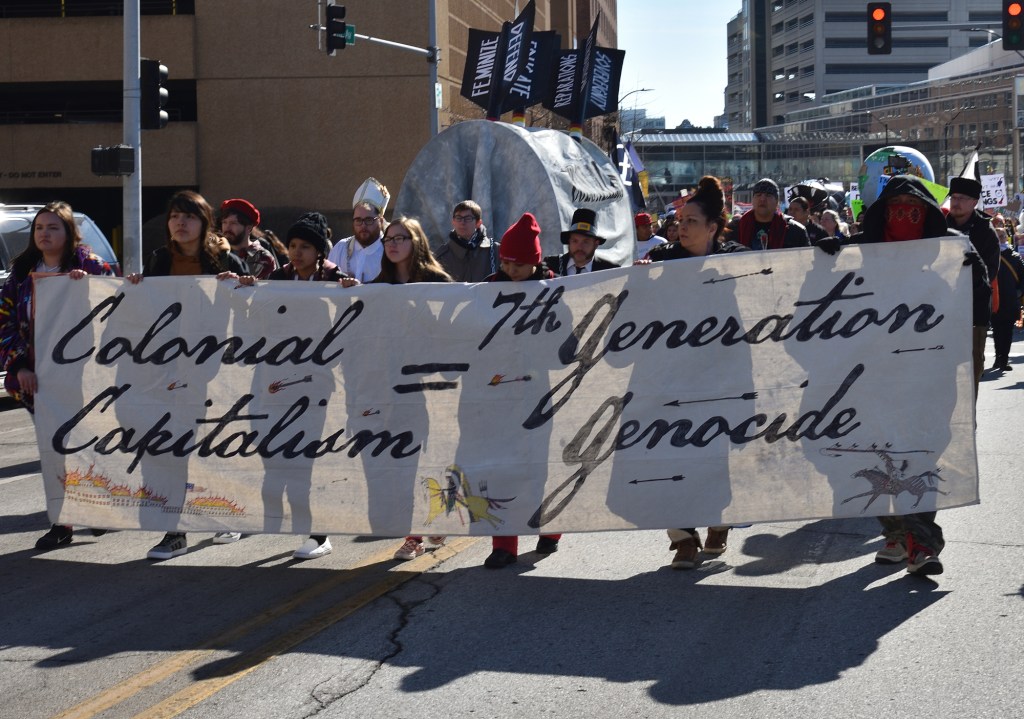
He spoke about genocide and dispossession. One thing they were doing to maintain their identity was bringing their language back.

Next the following video clip was shown, that contains parts from the videos American Native, and Real Indian with John Trudell.


There a many steps to get Federal recognition There is discrimination, lumping anyone not White into one classification. In the past there were laws making it legal to kill natives. Native people would go into hiding for survival, hiding their identity,

There is currently a crisis because the Mashpee Wampanoag Nation’s land trust has been revoked. They do have state recognition. Their land is only 25 miles from Manhattan. The land is poor and rocky, so they were left alone until transportation became important. Then the land was valuable and attempts were made to take it away using zoning and taxes. It got to the point that permission was needed to put up a tipi.

Kali spoke about how complex it is for a tribal nation to be recognized and the need to be able to claim what had always been theirs.

S.A. Lawrence-Welch said the colonial system was meant to erase peoples and was successful at times.

One question was whether tribes with heavy African ancestry have a harder time getting recognition?

Kali Reis said the double rejection of being black and native made it harder to get help.

S.A. Lawrence-Welch talked about the Hollywood image of what is Indian. And images from folk lore.

Owl said that darker skin was like gravity, with even more force pulling you down. Mentioned COVID-19 does not discriminate.

African ancestry made identity more difficult. The first enslaved people in New Jersey were Native people. African people came to natives for help. Both were resistance fighters.

As a river doesn’t have a single source, ancestry often doesn’t either. In Virginia, in the past when asked about race the only choices were white or black, no in between. No native. A matter of genocide to define us in ways that erase us as a people.

Christine Nobiss-how we think of indigeneity is deeper that black or native. An imperialist notion of divide and conquer. Also related to border imperialism. All linked to institutional White supremacy.

Owl pointed out how important this election is. He gave an example of the current president saying things like Republicans should not vote for a certain bill related to native interests because it is supported by “Pocahontas” Warren, for example.

Kali talked about registering to vote and getting  Native country engage politically. Need to know politics if going to be effective.  Set example by voting,

Not solve problems in 90 minutes.  Beginning steps.

Disheartening work in politics. How to use the challenge to make change?

Kali  –  question who I am.  Got caught up in other people’s perception of me.  Learned to have faith in my indigenous traditions.  Questions from own community.  Not black, white.  Go internally to be proud of who I was.   Give young people to courage to be what they are.  Internal struggle.

Owl – the mountains are our protectors and our correctors.  The mountains teach us.   Different relationship to land.

Regarding the Census– automatically defaults to black or white if you only indicate native.

DNA test results?   

OWL for me being native is about relationships.

Kali – delicate approach, want to claim they are now native American. Can overstep boundaries. No one can teach you to be indigenous. Educate yourself.  Not something to advertise “I am indigenous”

Christine – there is a form of privilege that cannot be brought into the equation.


Steven Smith (Owl) – Son of William Alfred Smith, Esquire, who spent his early childhood in the Ramapo mountains and grandson of Ira Smith, professor and educator from Hillburn, NY. Steven D. Smith received his bachelor of arts in political science from the University of California at Santa Cruz and his doctorate of jurisprudence from the University of California at Berkeley. Mr. Smith studied Mexican culture and history as a Pacific Rim scholar of the University of California for which he wrote an essay on an afro-mestizo community on the pacific coast of Mexico. Mr. Smith has traveled and lived extensively in Latin America and the Caribbean including Mexico, Cuba, Haiti, Guyana and Ecuador. Mr. Smith has taught and lectured on a wide variety of subjects including business law at Virginia Tech, science, technology and law for Virginia Tech and the University of Richmond School of Law, and introductory law for high school students. He has lectured on diverse subjects such as telecommunications policy, trade policy, environmental law, and the human rights of indigenous people. Steven Smith is a member of the California bar and Virginia bar of attorneys. Mr. Smith has assisted Navajo, Tohono O’odham, and Guyanese villagers with major environmental issues in national courts and before Congress and the United Nations.

Fighting to maintain identity can lead some to doubt themselves.

Kali “K.O” Mequinonoag Reis is the first mixed Native American Female World Champion Boxer. Kali (Kaylee) has racked up a 16-7-5kos record, three WORLD titles in the Middleweight division and is currently ranked #1 in the US & #2 in the world in the Welterweight Division. She has traveled all around the world to compete proudly representing who she is as a mixed Indigenous woman and was the FIRST Female Boxing match to be aired on HBO May 5, 2018 with over 1.4 Millions viewers. Raised in a single parent household by her mother Patricia “ Gentle Rain, she is the youngest of five children. Mequinonoag, meaning “Many Feathers, Many Talents” is her Native name given to her by her mother. Kali’s mixed background includes lineage from the Seaconke Wampanoag, Cherokee and Nipmuc tribes as well as ancestry from the Cape Verde Islands.

“Boxing is how I pray, every punch is a prayer”. Kali started in boxing as a means to express herself through some very difficult & trying times surrounding identity, victimization, societal acceptance and the absence of her father around the age of 13. What started as a means to let anger out turned into a much more meaningful journey for Kali. She has taken her “fight” beyond the ropes. Kali also works as a residential counselor at St Marys Home for Children mentoring young girls ages 12-18. Her experiences as a young girl motivates her to be a beacon of positivity and hope for these young girls. Kali is also an advocate for ALL young adults, especially in Native Country. Kali has a passion for those struggling with addiction, suicide, depression, genetic genocide as well as MMIW movement. She hopes to continue to use her platform she has build with her gift of boxing to continue to shed light on what Indigenous peoples have been fighting against for centuries. FIGHT4ALLNATIONS is Kali “KO’s” slogan and it is what she will continue to do however she needs to for the people.

Posted in decolonize, enslavement, Indigenous, Seeding Sovereignty, Uncategorized | Leave a comment

Decolonizing trauma

There is a concept in justice work that oppressed communities should not be asked to teach others about their situation.

So how can White people learn about indigenous solutions? An obvious way is to listen to indigenous people discussing their ideas. But where can we find opportunities for that without being burdensome?

The online SHIFT the Narrative discussions are an excellent way. I’ve learned a great deal from these interviews. One of the most profound things I’ve personally learned as I listen to these women leaders is how it feels, for a change, to not be the gender that is in control of the conversation. The next presentation is TODAY. Register here: https://us02web.zoom.us/webinar/register/WN_BtSNxkiVSWGl_Dr7rbMnUg

I recently wrote about the concept of narrative shift and how effectively these SHIFT the Narrative discussions use this technique.

When you gather passionate and dedicated voices that have become so accustomed to being spoken tospoken for and spoken about, then a different story begins to emerge.

From Paradigm Shift to Narrative Shift. Who is telling the education change story? by: Stephen Hurley, EdCan Network, November 4, 2011

This morning I came across some articles about decolonizing trauma, which made me more aware of how significant these SHIFT the Narrative discussions are. “Native women’s personal narrative explored the racialized, gendered, and sexual nature of their colonization. In doing so, they transformed the debilitating force of an old social control, shame, into a social change agent in their generation.”

And I think the second quote below is very insightful about pitfalls of efforts to heal. “A healing movement for boarding school survivors was being created that did not actually create space for survivors.


In this essay I make the case for remembering and understanding the impact of Canadian First Nation women’s first-person and experiential narrative on white, mostly male mainstream scholarship. I argue that these narratives were political acts in themselves that in their time exploded the measured “objective” accounts of Canadian (and U.S.) colonial histories. First Nations women in Canada changed the actual conditions for what could be said about the poverty and discrimination that were their daily fare. 

It is these women’s acknowledgment of their actual experiences that illuminated a space for both men and women to speak one of colonialism’s nastiest “domestic” secrets. First Nation men’s and women’s personal testimony in the early 1990s put Canada in an international spotlight for genocidal child abuse spanning a century. Their personal testimonies shamed Canadians’ simple belief in the benign nature of their child education–assimilation policies. But their stories hadn’t magically appeared. They were at the heart of the struggle. Native women’s personal narrative explored the racialized, gendered, and sexual nature of their colonization. In doing so, they transformed the debilitating force of an old social control, shame, into a social change agent in their generation. I explore here their sixth sense about the moral affective heart of capitalism and colonialism as an analysis. A felt analysis is one that creates a context for a more complex “telling,” one that illuminates the deeper meaning of their “education” in Canada.

 Felt Theory: An Indigenous Feminist Approach to Affect and History
Dian Million, Wicazo Sa Review, University of Minnesota Press
Volume 24, Number 2, Fall 2009

I was part of a larger collective that organized human rights/legal training for Native boarding school survivors. Frequently, survivors would drive hundreds of miles to attend, at considerable expense, because they really wanted this information. But when they arrived at the training, flashbacks from their years of boarding school abuse prevented them from walking through the door.

A healing movement for boarding school survivors was being created that did not actually create space for survivors.

In my years of organizing in the anti-violence movement, these experiences taught me that by privatizing healing, we were building a movement that continued to structurally marginalize survivors.

Of course, since we continued to have problems, we continued to destroy our own organizing efforts internally with no space to talk about what was going on. Indigenous organizer Heather Milton-Lightning once prophetically declared at an Indigenous Women’s Network gathering many years ago that our movements were shunning people who might have issues like substance abuse. She called on us all to embrace whoever wants to be part of our movements as they are rather than as who we think they should be.

The challenge for us, she noted, was to build movement structures around the people we really are. These movements have demonstrated that historical trauma impacts us on the individual and collective level. We cannot decolonize without centering the impact of trauma in our organizing. Rather than privatize our traumas, how can we rearticulate trauma as place from which to develop what Million calls “felt theory” – a place from which to understand our social and political conditions?

DECOLONIZING TRAUMA by Andrea Smith, Sojourners, Sept 19, 2016

#SeedingSovereignty #SHIFT

Posted in Uncategorized | Leave a comment

SHIFT the Narrative

Jan 14, 2020, Las Vegas - Seeding Sovereignty was a proud national co-host of the second Native American Presidential Forum.
https://seedingsovereignty.org/shift

I recently wrote about the concept of narrative shift and how that idea is being used by my friend Christine Nobiss and her colleagues involved with SHIFT – Seeding the Hill with Indigenous Freethinkers, a project of Seeding Sovereignty. The idea is to give voice to those who aren’t heard when discussing indigenous issues, the native people themselves.

I’ve also been praying and writing about the many reasons White people need to learn from and follow the lead of indigenous peoples. How I finally came to the realization that Quaker values are much more consistent with indigenous values that with the corporate capitalist system.

Decolonizing is how White people can move away from the capitalist system to a system that reflects the values of indigenous peoples, and Quakers.

Yesterday I listed a number of resources to learn about decolonization.

There is a concept in justice work that oppressed communities should not be asked to teach others about their situation.

So how can White people learn about indigenous solutions? An obvious way is to listen to indigenous people discussing their ideas. But where can we find opportunities for that without being burdensome?

The online SHIFT the Narrative discussions are an excellent way. I’ve learned a great deal from these interviews. One of the most profound things I’ve personally learned as I listen to these women leaders is how it feels, for a change, to not be the gender that is in control of the conversation. The next presentation is tomorrow. Register here: https://us02web.zoom.us/webinar/register/WN_BtSNxkiVSWGl_Dr7rbMnUg

Thursday, May 28th, 2020
4pm EST | 3pm CST | 1pm PST

We will be speaking with Kali “K.O” Mequinonoag Reis and Owl. Kali, Seaconke Wampanoag and Cherokee Nations, is the first mixed Native American Female World Champion Boxer. Owl, Ramapough Munsee Lenape Nation, is an attorney working at the intersection of human rights, Indigenous rights and the environment.
The Seaconke Wampanoag and Ramapough Munsee Lenape Nations are not federally recognized, though they are recognized by the states that engross their territories. We will discuss the ongoing fight for sovereignty with the understanding that there are many pitfalls to federal recognition but why it is necessary to protect land rights. This is an important conversation considering the current crisis the Mashpee Wampanoag Nation is facing as their land trust has been revoked during COVID-19. An important part of this discussion will delve into what it is like to be Indigenous after 400 + years of living with European and African ancestry. 


Sandwich Month Meeting (Quakers) recently published: Letter: An open-hearted plea concerning native peoples and Mashpee in particular. SouthCoastToday.com, May 22, 2020


Posted in decolonize, Indigenous, Seeding Sovereignty, Toward Right Relationship with Native Peoples, Uncategorized | Leave a comment

Moral Reckonings

As Krista Tippett says below, “it feels important to me, in a moment like this, to look below the radar of rupture — to see models and practices that work, and that in fact can take up the huge hard problems.”

So many of us have expressed the idea of using the opportunity of the chaos of the pandemic to build a better world.

What I discern from the Spirit as I pray is often a consistent message, which is we White people in the United States cannot make any progress on justice issues until we confront the enslavement of black people and continued racial injustice. And the genocide and continued oppression of native peoples by White people. We need to make progress on those issues, or our efforts to build a better world will not succeed. And we need the knowledge and leadership of black and indigenous people to build a better world for us all.

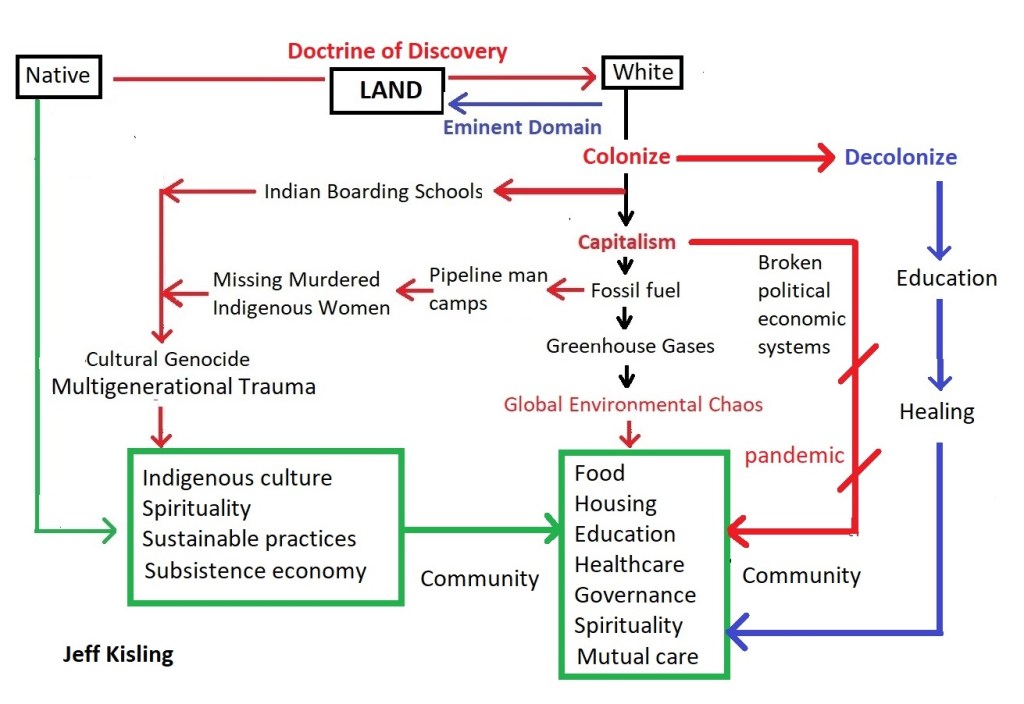
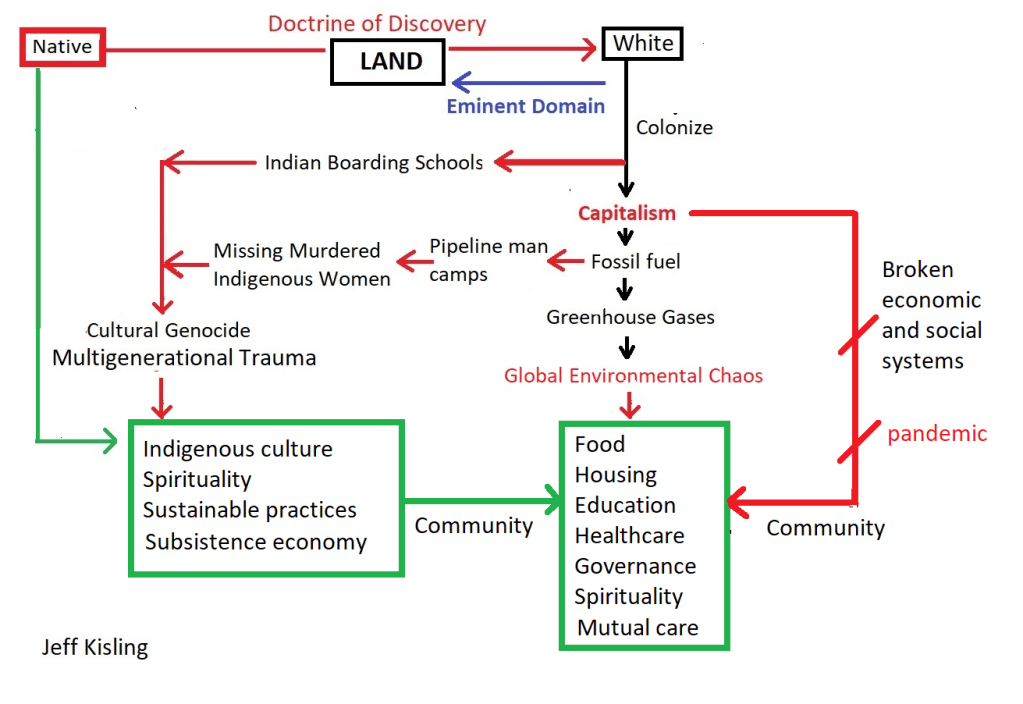
In terms of models mentioned above, this is the previous state of a model I’ve been working on for some time now. I recently wrote about this version of the model in the blog post Quakers and Social Change Today.

I have sought every opportunity recently to get to know indigenous people. At first because I respected the way they lived within sustainable environmental boundaries. And their subsistence economy and spiritual grounding. The more I learned, the more I realized indigenous ways are in line with my Quaker values, not the values of the White society I was born into, raised and now live in.

I have felt devastated since discerning that. I realized I didn’t know what to do next. I knew I didn’t want to remain in a corporate capitalist system, if that system even survives the pandemic. And although I am so grateful for what I have been learning from my indigenous friends, I cannot become an indigenous person.

The Guswenta: Two Row Wampum Belt is a Symbol of Sovereignty

This belt symbolizes the agreement and conditions under which the Haudenosaunee welcomed the newcomers to this land.
“You say that you are our father and I am your son.”
We say, ‘We will not be like Father and Son, but like Brothers’.”
This wampum belt confirms our words. These two rows will symbolize two paths or two vessels, traveling down the same river together.
One, a birch bark canoe, will be for the Indian People, their laws, their customs and their ways.
We shall each travel the river together, side by side, but in our own boat.
 Neither of us will make compulsory laws or interfere in the internal affairs of the other.
Neither of us will try to steer the other’s vessel.

From a 1614 agreement between the Haudenosaunee and representatives of the Dutch government, declaring peaceful coexistence. The agreement has been kept by the Haudenosaunee to this date.

What could I do about this dilemma? Sometimes I don’t see the answer that is right in front of me. I’ve been learning a lot about decolonizing. I learned from the way it has impacted my friends as we shared stories while walking down empty country roads during the First Nation-Farmer Climate Unity March in September, 2018. The last evening on the March we gathered around a fire, and my friend Trisha Entringer gave a presentation and lead a discussion about colonization.

Last summer I learned a lot from Paula Palmer and the Toward Right Relationships with Native Peoples workshops and presentations she led.

The Quaker organization American Friends Service Committee has some excellent resources on colonization. https://www.afsc.org/category/blog-tags/decolonization

As does the organization of my friend Christine Nobiss, Seeding Sovereignty.

I’m also glad to know about an organization of diverse Quakers who are focusing on decolonizing Quakers. https://www.decolonizingquakers.org/

Updating the previous model (above) I see the new path Decolonize. As best I know now, that path first requires education, such as offered from the previous resources, and healing. Both are large topics to be explored in future blog posts.


Every day we have a choice. We can take the easier road, the more cynical road, which is a road sometimes based on a dream of a past that never was, fear of each other, distancing and blame, or we can take the much more difficult path, the road of transformation, transcendence, compassion, and love, but also accountability and justice.

– Jacqueline Novogratz –

Moral reckonings are being driven to the surface of our life together: What are politics for? What is an economy for? Jacqueline Novogratz says the simplistic ways we take up such questions — if we take them up at all — is inadequate. Novogratz is an innovator in creative, human-centered capitalism. She has described her recent book, Manifesto for a Moral Revolution, as a love letter to the next generation.

On Being with Krista Tippett Jacqueline Novogratz: Towards a Moral Revolution, May 20, 2020

Krista Tippett, host: The world keeps changing, and moral reckonings are being driven to the surface of our life together: who will we be to each other in our communities, our nations, our globalized world? What are politics for; what is an economy for — and education, and health care, and borders? Jacqueline Novogratz is a voice I respect on the inadequacy of the simplistic ways we take up such questions, if we take them up at all — the necessity of moral imagination and the cultivation of character alongside all of the so-called hard skills that are no longer serving us.

This is at the heart of her book, Manifesto for a Moral Revolution: Practices to Build a Better World. It feels important to me, in a moment like this, to look below the radar of rupture — to see models and practices that work, and that in fact can take up the huge hard problems. Acumen, which Jacqueline Novogratz founded and leads, is an exercise in creative, human-centered capitalism: a venture capital fund that serves some of the poorest people in the world — people whose incomes have previously excluded them from the power of the market.

Towards a Moral Revolution by On Being, syndicated from onbeing.org, May 26, 2020


 “I used to think that top environmental problems were biodiversity loss, ecosystem collapse and climate change. I thought that thirty years of good science could address these problems. I was wrong. The top environmental problems are selfishness, greed and apathy, and to deal with these we need a cultural and spiritual transformation.”

Gus Speth

Posted in #NDAPL, climate change, decolonize, enslavement, First Nation-Farmer Climate Unity March, Indigenous, Native Americans, Quaker, race, Seeding Sovereignty, Uncategorized | Leave a comment

#ShutDownAIMCo Online Day of Action

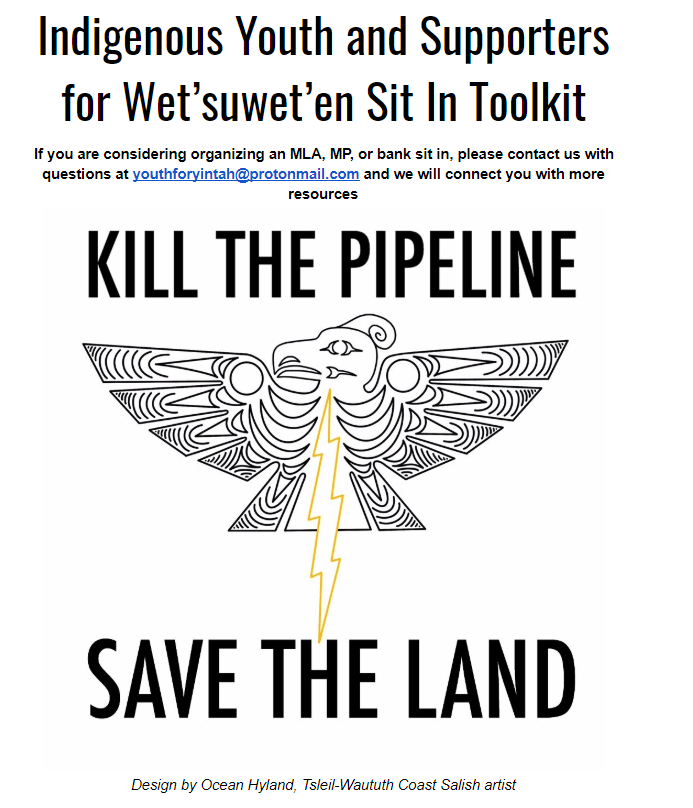
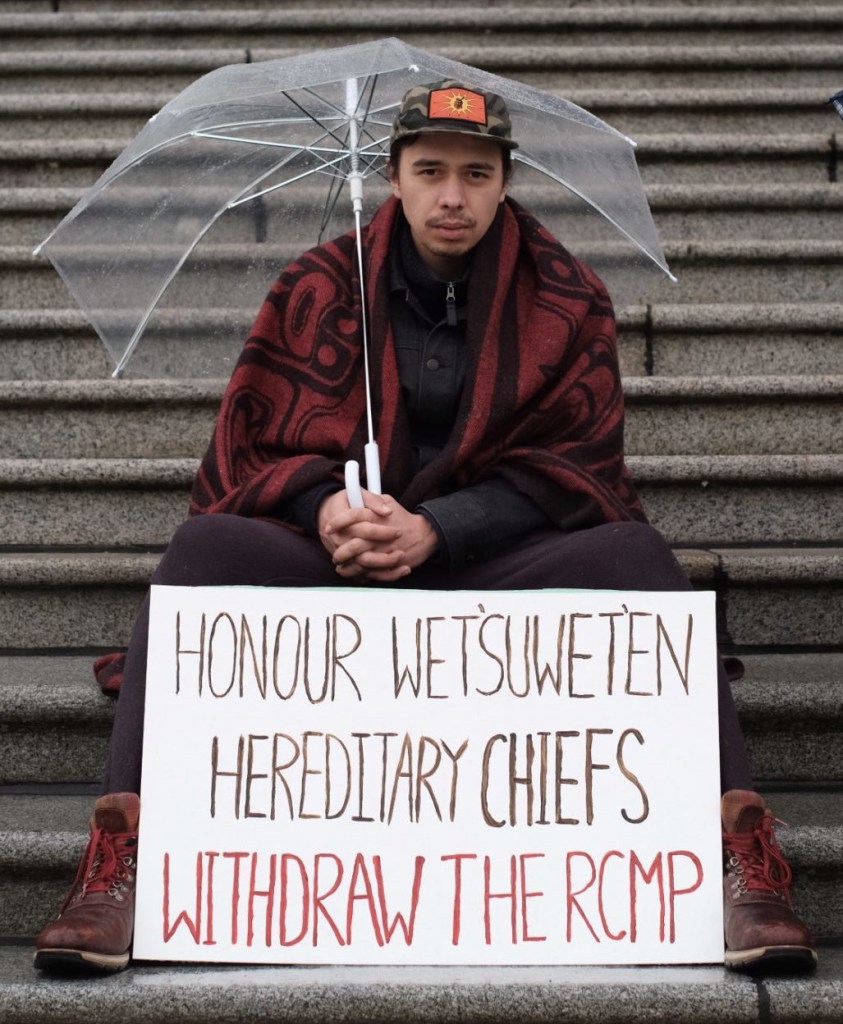
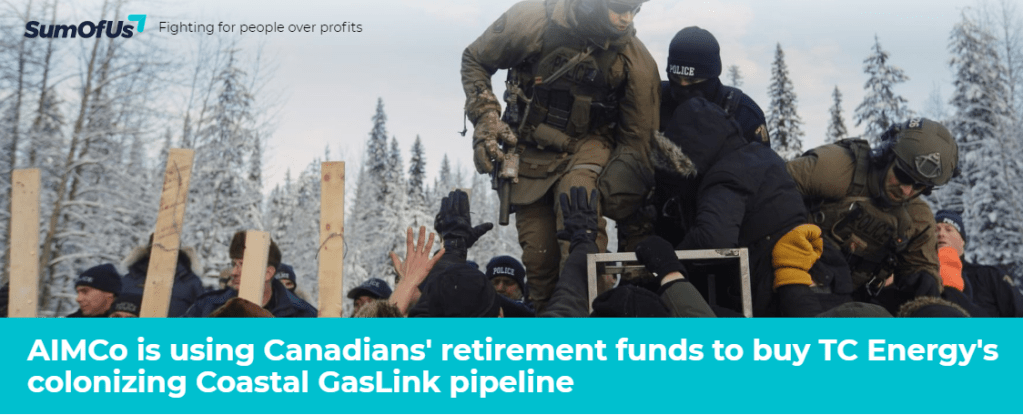
Despite the COVID-19 global pandemic, international solidarity calls for an end to all construction, and an eviction notice by Wet’suwet’en hereditary chiefs, CGL and RCMP continue to illegally occupy sovereign Wet’suwet’en yintah. Their presence on the territory puts communities at risk; endangers Indigenous womxn, two-spirit, and non-binary people with the building of man camps along the pipeline route; and threatens land, water, climate, and air.
Onward!
-Unist’ot’en Solidarity Brigade

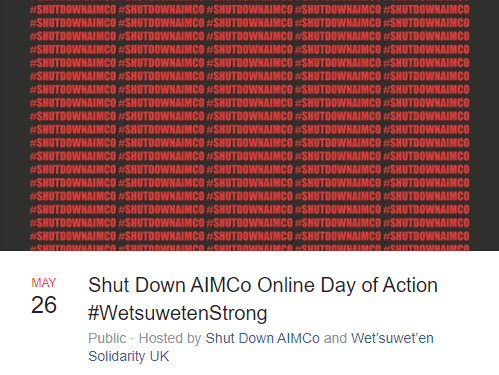
Tuesday May 26 Shut Down AIMCo Online Day of Action

More information about the event: Share

Details Join the #ShutDownAIMCo Online Day of Action and take a stand in solidarity with the Wet’suwet’en nation!

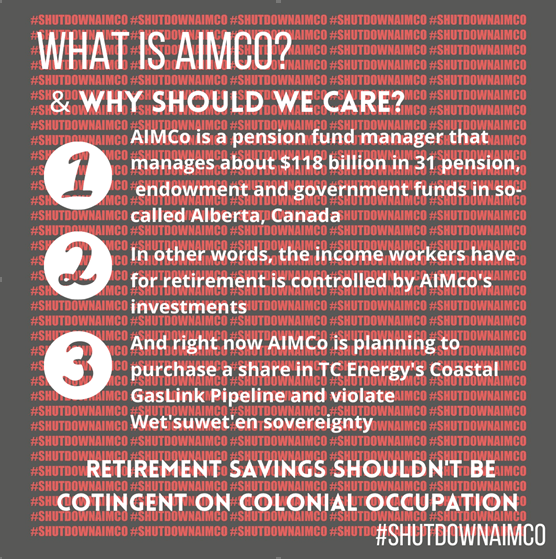
AIMCo, a public pension fund manager in so-called Alberta, is set to finalize a deal with TC Energy at the end of this month to purchase a 65% share in Coastal GasLink pipeline alongside U.S. based investment firm KKR. Hundreds of thousands of supporters have raised their voices to let KKR know their violence will not go unnoticed through emails, calls, and tweets. Earlier this month a petition with over 200,000 signatures was delivered to KKR calling on them to cease funding of CGL.

Now is the time to tell AIMCo we are watching their investment in violent, colonial structures! Here’s how you take action today and let AIMCo know loud and clear: This pipeline will never be built!

🌿Check out the #ShutDownAIMCo toolkit for more information on AIMCo, the action, and how you can get involved: https://docs.google.com/document/d/1t1FW1BbOnIfVHNm9MWIxmXeeHXv8-Ev4tc0SL7_7FU8/edit#

🌿Email AIMCo today with this messaging tool: https://bit.ly/messageaimco

🌿Sign your name to the petition calling for AIMCo to divest from CGL: https://bit.ly/2TtixY7

🌿Call AIMCo’s head office at +1-780-392-3600 and ask to speak to Kevin Uebelein. You will most likely be directed to his assistant’s line. Not sure what to say once you’re patched through? The toolkit above has sample call scripts that are easy to use!

🌿Text or call AIMCo’s director of corporate communication at +1-780-932-4013. See the toolkit for sample text/call scripts.

🌿Tweet at AIMCo’s director of corporate communication, Dénes Németh @denesnemeth. Need some help drafting the tweets? Click on the link to our toolkit above for some sample messages.
————————————————————
Want to get more involved? Here are some resources which can help support further organizing in your community, ways to donate, and further information about the Wet’suwet’en’s upholding their rights and title:

https://www.yintahaccess.com/http://unistoten.camp/supportertoolkit2020/?fbclid=IwAR0C5rVMGvT9nRgqlAnQFPEKhqLJlYcyEG489GxZr0-FG8_ygFQvJbr5STYhttps://www.facebook.com/wetsuwetenstrong/

Donate to Raven Trust’s Wet’suwet’en legal defence fund: https://fundraise.raventrust.com/give/269632/#!/donation/checkout
& the Unist’ot’en Camp Donation Page: https://unistoten.camp/support-us/donate/

Follow @Unistoten @Gidimten on twitter and https://www.instagram.com/gidimten_checkpoint/ on Insta


AIMCo, one of Canada’s largest pension fund managers, quietly started the paperwork to buy a 65% equity interest share of the Coastal GasLink pipeline.

This is the same pipeline that Wet’suwet’en hereditary chiefs have bravely and peacefully resisted for years. The same pipeline that led people across Canada to blockade rail, truck and ferry traffic in solidarity with land defenders on the frontlines earlier this year.

If built, the Coastal GasLink pipeline would bring us one step closer to climate collapse. Canadians’ retirement savings need to fund a renewable path, not the rapidly depleting LNG industry that is going to contribute to our warming planet.

Will you add your name to the petition calling on AIMCo to drop its risky investment in Coastal GasLink pipeline before the deal is finalized?

AIMCo is massive — it manages 30 pension funds worth over 100 billion dollars. And it’s getting bigger — AIMCo will soon manage the 18 billion dollar Alberta Teachers’ Retirement Fund.

It was in the news last month when it lost 4 billion dollars of Canadian retirement savings, due to its risky investment decisions — a far greater portion compared to other funds of its size.

There is no riskier investment than the Coastal GasLink pipeline. The pipeline risks the Wet’suwet’en communities’ health, safety, and way of life. It is also a huge environmental liability, as the oil and gas sector has been the largest industrial contributor to methane emissions in Canada. Finally, the investment is financially risky because natural gas prices are at an all time low and and also, the pipeline will never make a dollar because the leadership of Wet’suwet’en Land Defenders will stop it from being built.

Join the fight with Wet’suwet’en leaders by calling on AIMCo to pull out of the investment to buy Coastal GasLink pipeline.

When SumOfUs members like you have spoken up, we have stopped Canadian retirement savings from being invested in destructive and unethical projects. Together, we pushed the Canada Pension Plan (CPP) to divest in prison corporations profiting from Trump’s disgusting border policies, and we pushed the Quebec Provincial pension fund (CDPQ) to divest from the company that is most responsible for the Amazon fires – all in the last year and a half.

And we can make sure Canadian pension funds are not funding this pipeline, but we need you to act fast as the AIMCo deal could be finalized as early as this week.

Photo credit: Amber Bracken

More information

Alberta pension manager loses $4-billion on investment bet gone wrong
Globe and Mail. 21 April 2020.

TC Energy to sell a 65% stake in its Coastal GasLink pipeline CBC. 26 December 2019.


Posted in Indigenous, Uncategorized, Unist'ot'en, Wet’suwet’en | Leave a comment

No Warming, No War

A final thought about the military these days is the U.S. army is the largest producer of greenhouse gases. And our military actions for years have been to protect oil fields. An objective for those who work for peace is to transition to renewable energy sources as quickly as possible. No one will be going to war for the sun and wind.

Memorial Day and Peace, Jeff Kisling, 5/25/2020

That was how I concluded my blog post earlier on this Memorial Day. Which reminded me of a Facebook group I had created, No War No Warming US, in December, 2015, that I haven’t added much to since.

Could this be an idea whose time has come? As it says below, “in the face of both COVID-19 and the climate crisis, we urgently need to shift from a culture of war to a culture of care.”

In a strange twist, it has taken a global pandemic to significantly reduce the world’s fossil fuel emissions.

The COVID-19 pandemic has utterly changed life as we know it — but it’s also laid bare how Washington’s militaristic budget priorities have left the country woefully unprepared for a crisis. With massive shortages in public health resources and shocks to the broader economy throwing Americans off their health care, states are left clamoring for help from the military to cope.

All this could be a preview of shocks to come as our climate crisis continues unabated.

While meaningful climate action has stalled on Capitol Hill and in the White House, planners at the Pentagon have been quietly preparing a militarized, “armed lifeboat” response to climate chaos for years. Unfortunately, the tendency to understand climate change as just another national security issue has misdirected resources away from the programs that we need to mitigate and adapt to a warming climate.

In this report, we’ll lay out how militarism and the climate crisis are deeply intertwined and mutually reinforcing. The military itself, we explain, is a huge polluter — and is often deployed to sustain the very extractive industries that destabilize our climate. This climate chaos, in turn, leads to massive displacement, militarized borders, and the prospect of further conflict.

True climate solutions, we argue, must have antimilitarism at their core.

In the face of both COVID-19 and the climate crisis, we urgently need to shift from a culture of war to a culture of care. Funneling trillions into the military to wage endless wars and project military dominance has prevented us from investing in true security and cooperation. If we don’t transform our society and the way we confront crises, we will face even more unjust and inhumane realities in a climate-changed future.

NO WARMING, NO WAR: HOW MILITARISM FUELS THE CLIMATE CRISIS — AND VICE VERSA by Lorah Steichen and Lindsay Koshgarian, Institute for Policy Studies

Following are the key findings of that report.

KEY FINDINGS:

Recognizing that the impacts of climate change will dramatically increase instability around the globe, this paper examines the role of militarism in a climate-changed world. As outlined below, climate change and militarism intersect in a variety of alarming ways:

  • The Pentagon is a major polluter. U.S. Militarism degrades the environment and contributes directly to climate change. The Pentagon is the world’s largest institutional user of petroleum; just one of the military’s jets, the B-52 stratocruiser, consumes about as much fuel in an hour as the average car driver uses in seven years. Plans to confront climate change must address militarization, but “greening the military” misses the point entirely. Militarism and climate justice are fundamentally at odds.
  • The United States has a well-known history of fighting wars for oil. The fossil fuel industry relies on militarization to uphold its operations around the globe. Oil is the leading cause of war: An estimated one-quarter to one-half of all interstate wars since 1973 have been linked to oil. And all over the world, those who fight to protect their lands from extractive industries are often met with state and paramilitary violence.
  • Climate change and border militarization are inextricably linked. It is clear that on a warming planet, cross-border migration will rise. Estimates project that around 200 million people will be displaced by the middle of century due to climate change. As the U.S. continues to ramp up border security, so do threats to all people’s freedom to move and stay. Immigrant justice is climate justice, and challenging militarism is critical to achieving both.
  • Over-investment in the military comes at the high cost of under-investing in other needs, including climate. For decades, the U.S. has invested in military adventurism and prioritized military threats above all over threats to human life. Compared to the $6.4 trillion spent on war in the past two decades, the cost of shifting the U.S. power grid to 100% renewable is an estimate $4.5 trillion. The bloated U.S. war economy presents an opportunity to redirect significant military resources, including money, infrastructure, and people, toward implementing solutions to climate change.
  • Workers need a way out. The fossil fuel and military sectors mirror each other in the way that workers frequently end up funneled into lethal work due to limited options. We need a Just Transition for workers and communities in both sectors. In order to rapidly transition to a green economy, we must fund millions of jobs in the green economy. Funding the green economy instead of a bloated military budget would be a net job creator; for the same level of spending, clean energy and infrastructure create over 40% more jobs and energy efficiency retrofits create nearly twice the level of job creation.
  • Racism and racial oppression form the foundation for both the extractive fossil fuel economy and the militarized economy. Neither could exist without the presumption that some human lives are worth less than others, and racial justice would undermine the foundations of both.

NO WARMING, NO WAR: HOW MILITARISM FUELS THE CLIMATE CRISIS — AND VICE VERSA by Lorah Steichen and Lindsay Koshgarian, Institute for Policy Studies


You can download the complete primer NO WARMING, NO WAR: HOW MILITARISM FUELS THE CLIMATE CRISIS — AND VICE VERSA by Lorah Steichen and Lindsay Koshgarian, Institute for Policy Studies here:

Click to access No-Warming-No-War-Climate-Militarism-Primer.pdf

Posted in climate change, peace, Uncategorized | Tagged | Leave a comment

Memorial Day and Peace

As a Quaker and someone who believes War is Not the Answer, I have conflicting feelings about Memorial Day. I respect those who felt they should serve in the military, knowing they might have to put their lives at risk, and possibly be wounded or killed. Today is about remembering them. And I think it is also a day to think about those who have worked or are working for peace.

[Note: I am glad to have been reminded that Friends who are not white feel left out, are left out when the assumption is made that the word Quaker alone implies white Quakers. In these stories from the past Quaker does refer to white Quakers. The more general references to Quakers who have worked and continue to work for peace includes Quakers of all races and genders]

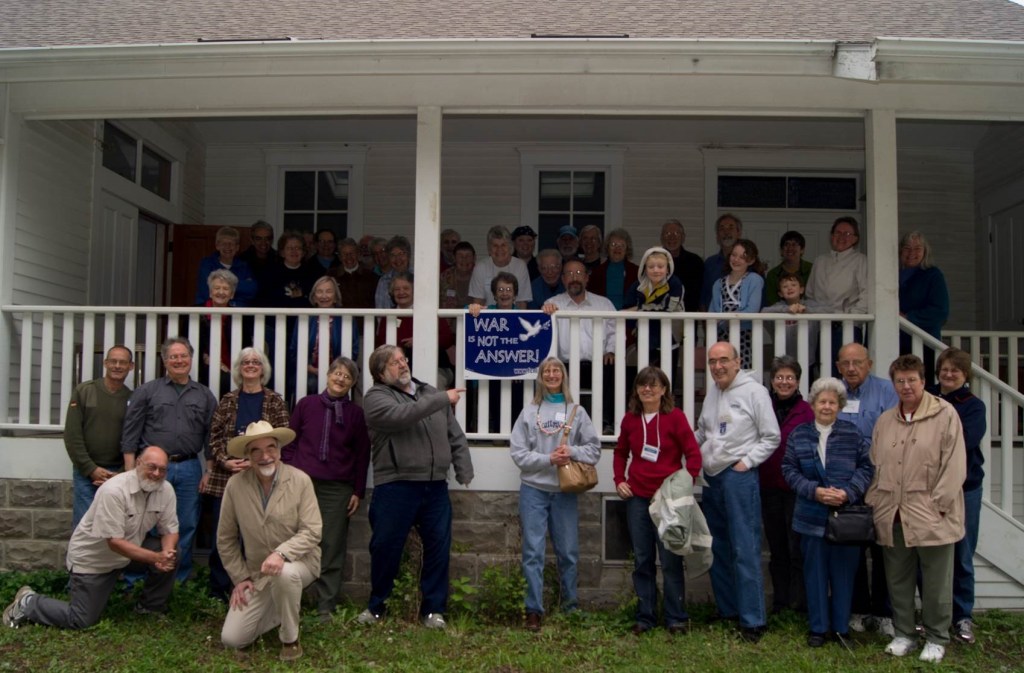
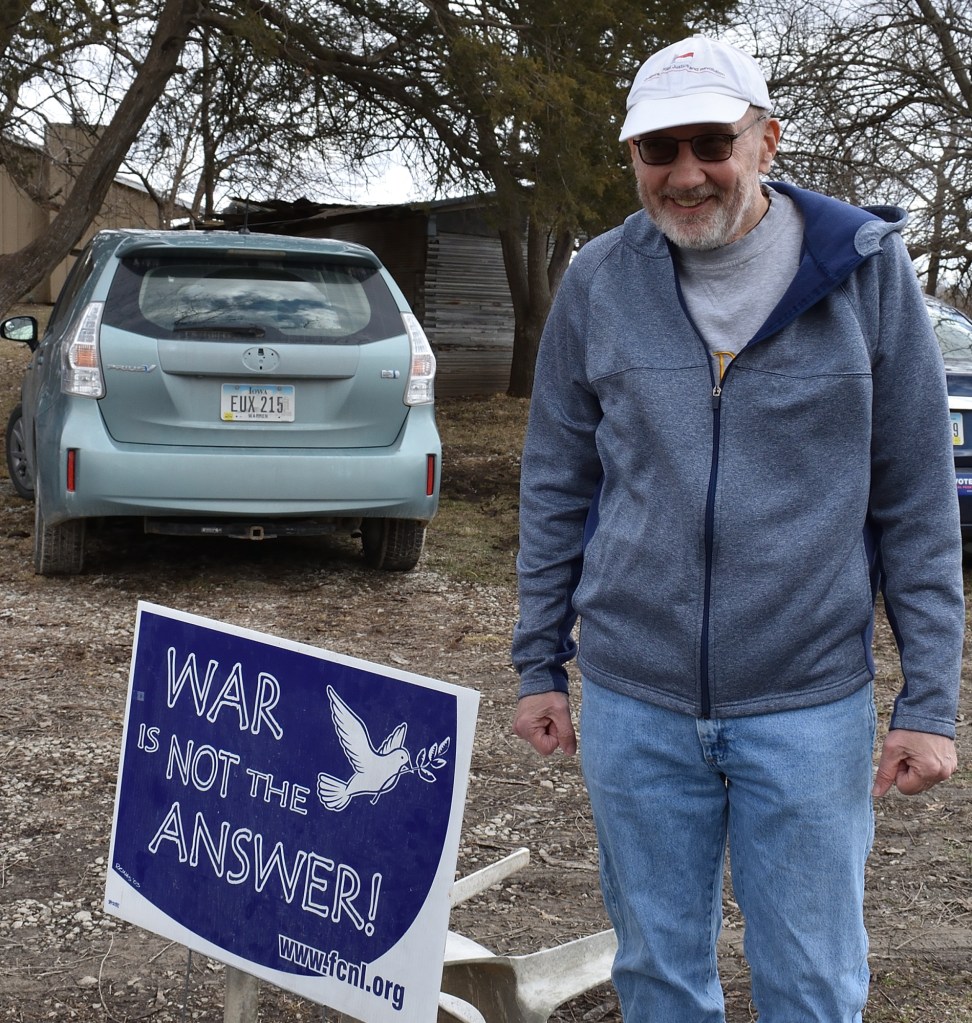
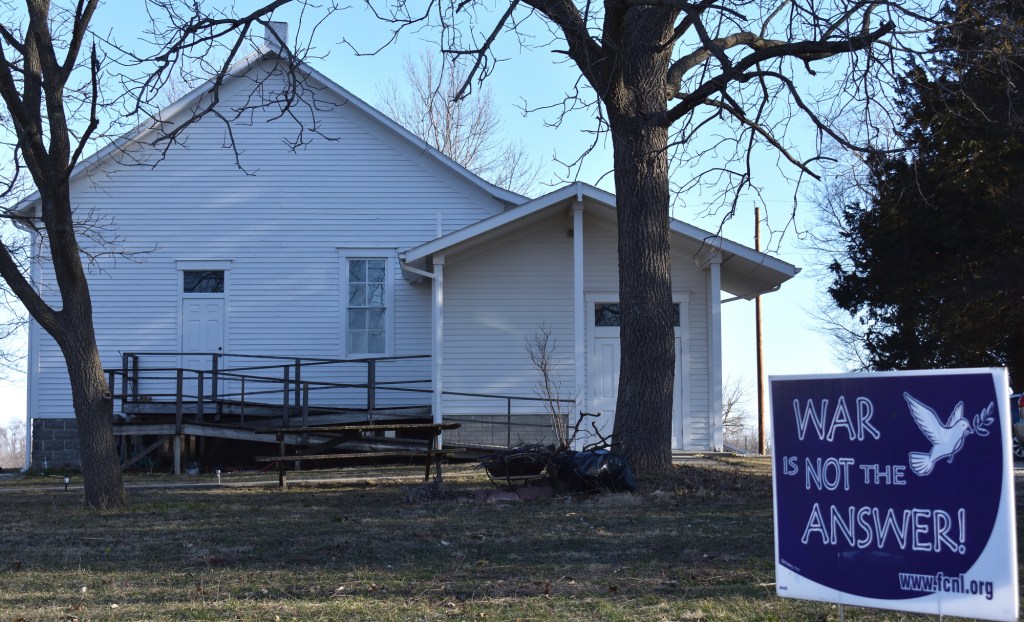
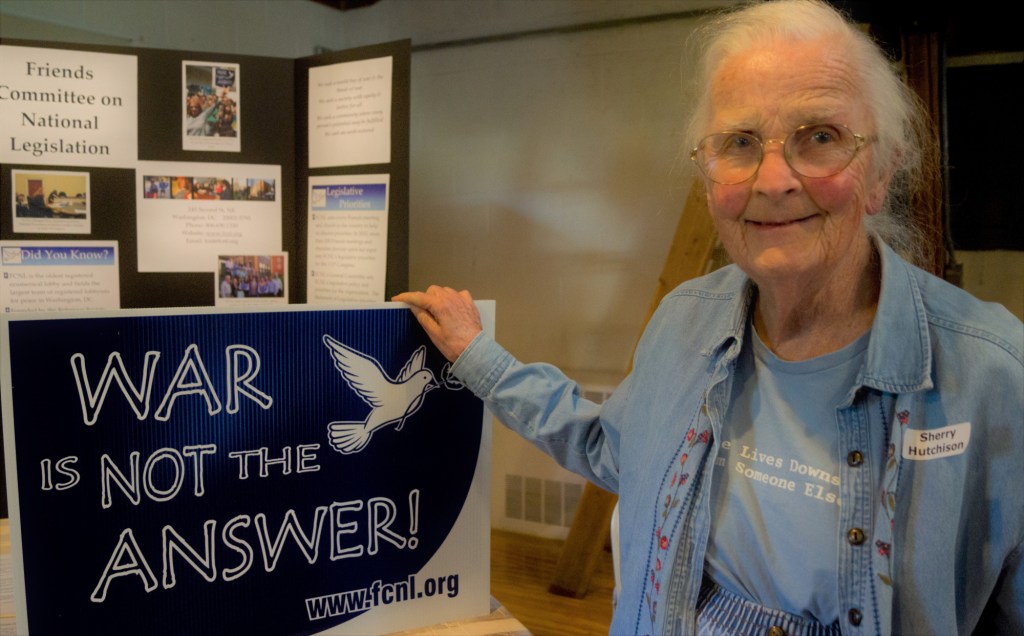
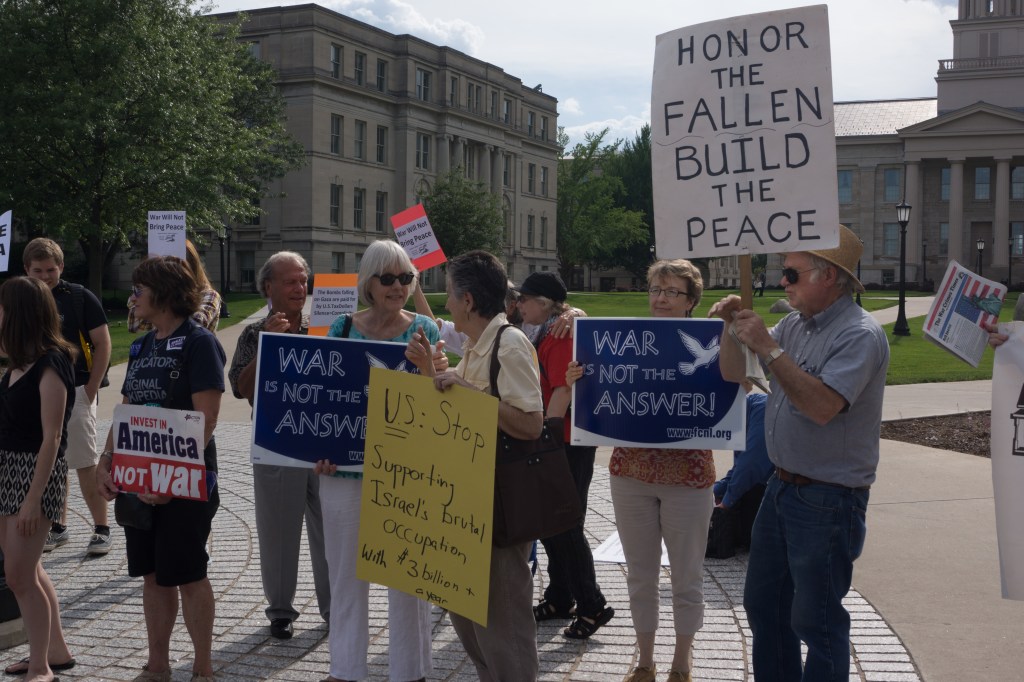
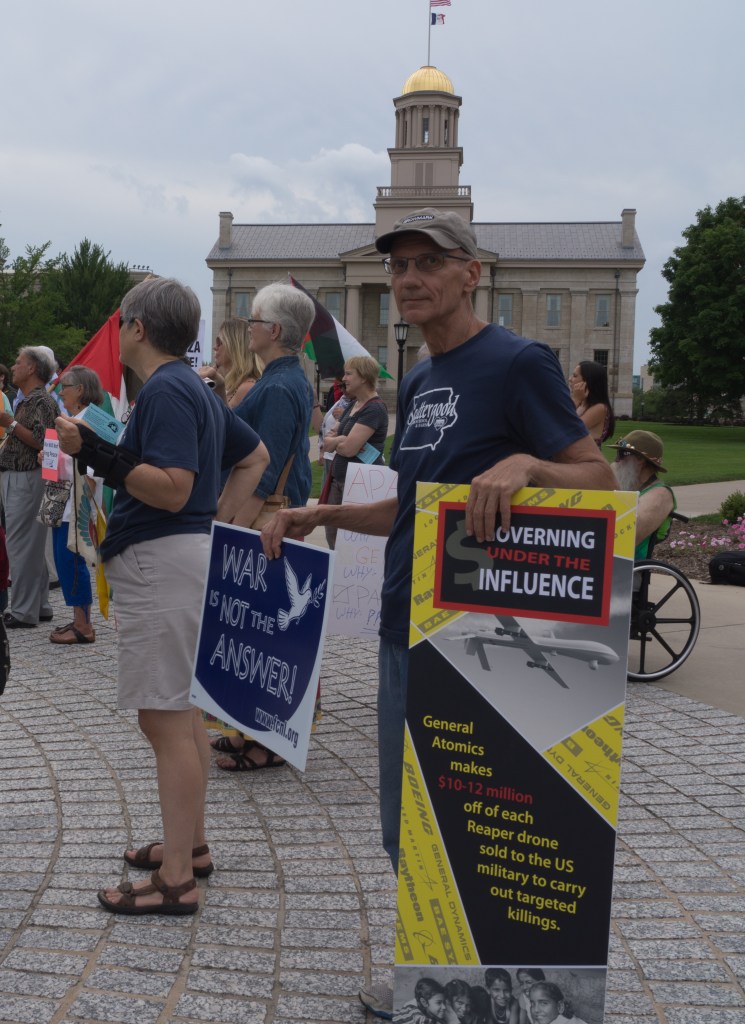
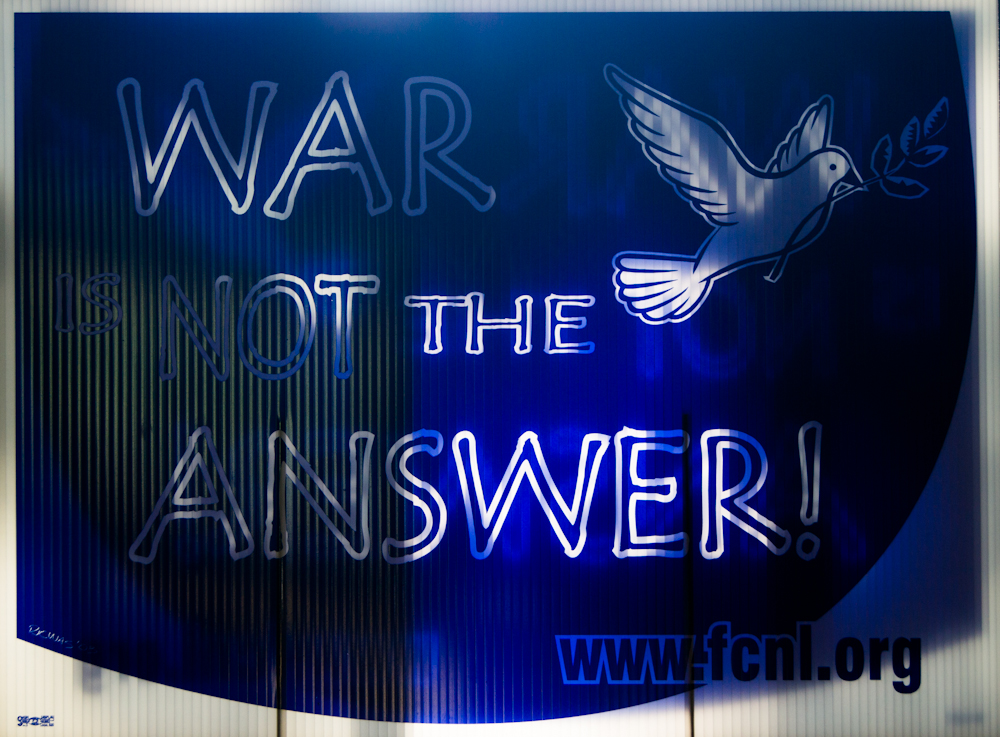
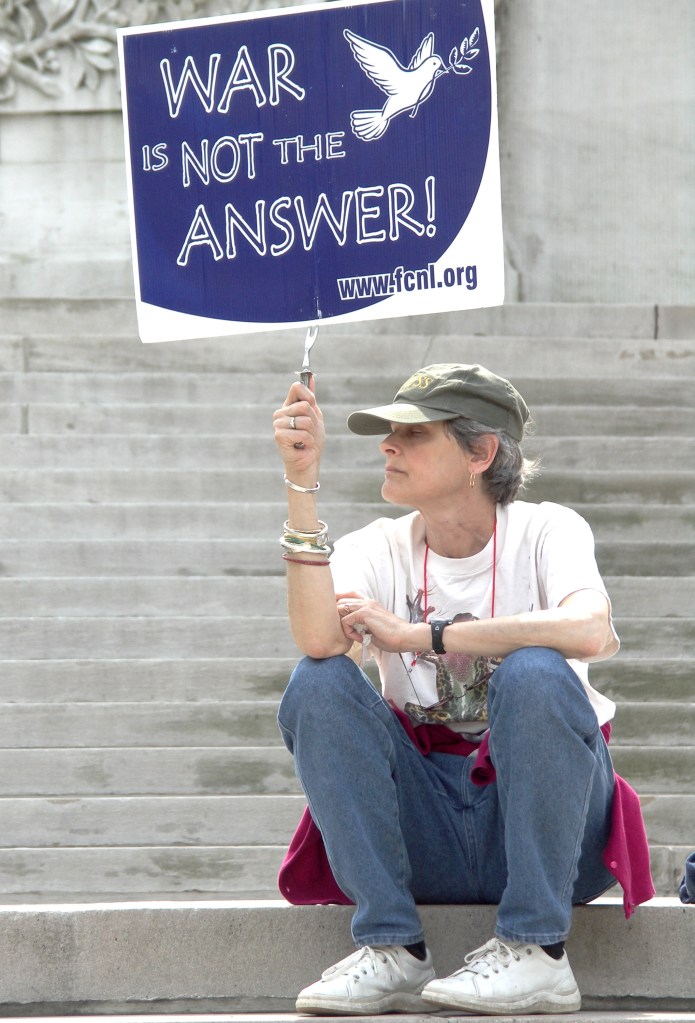
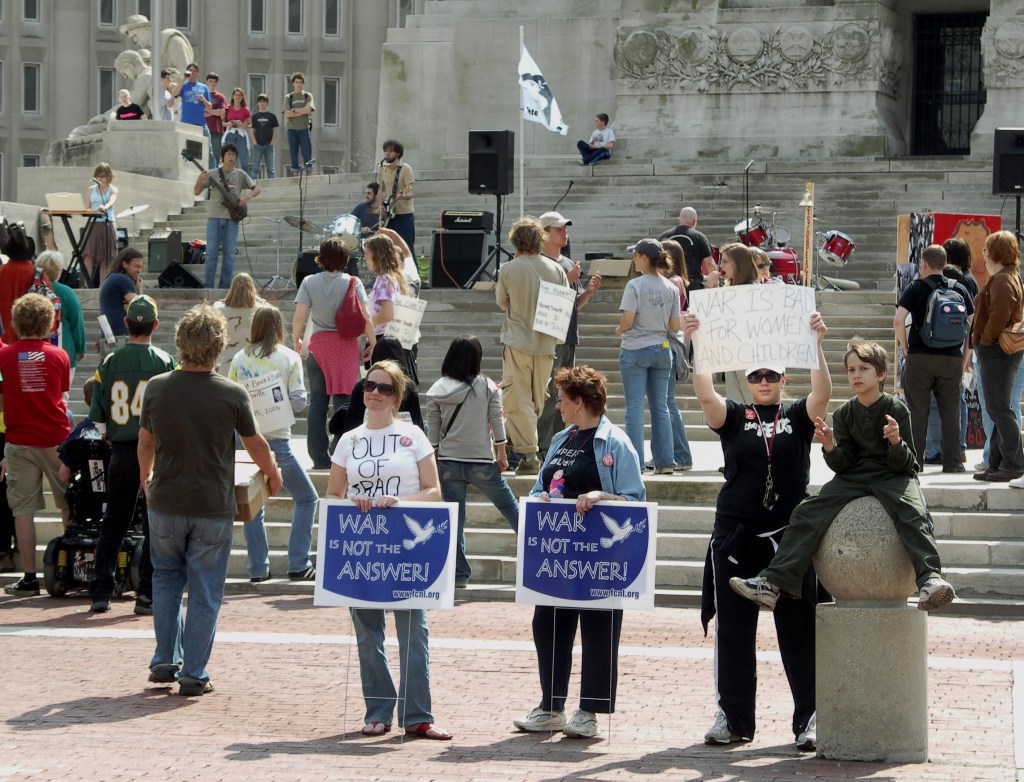
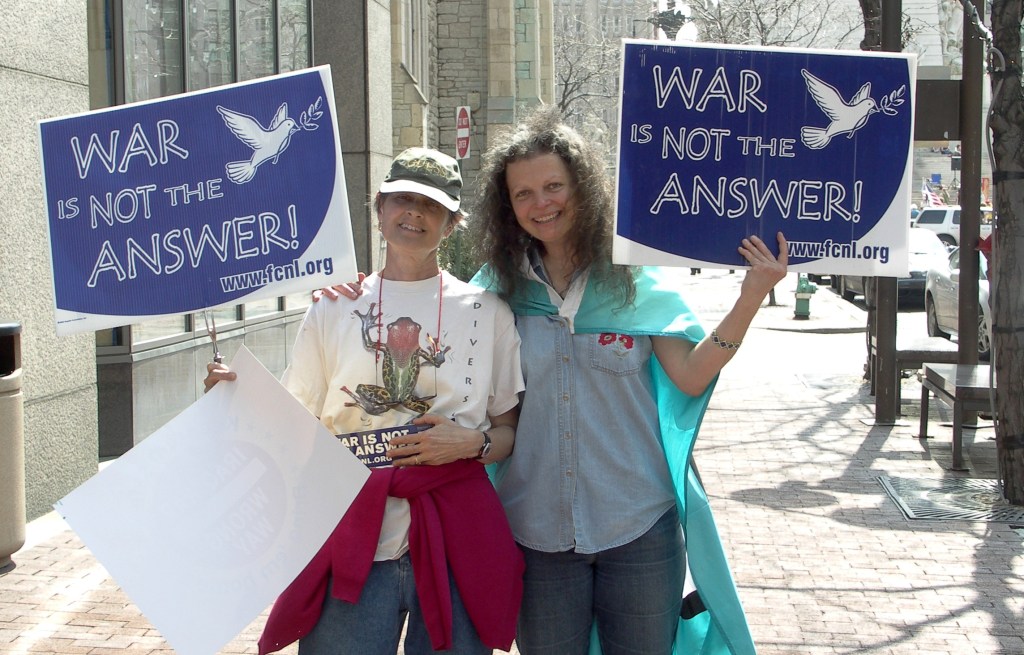
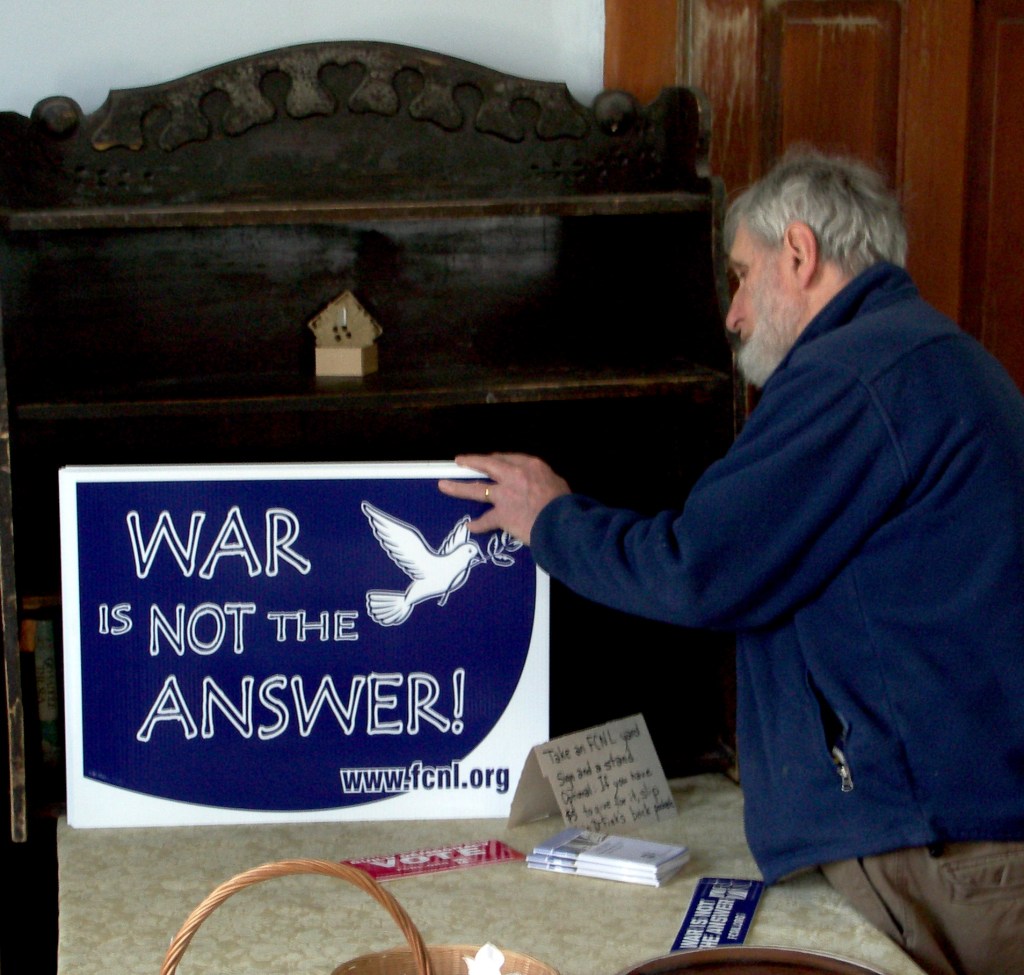
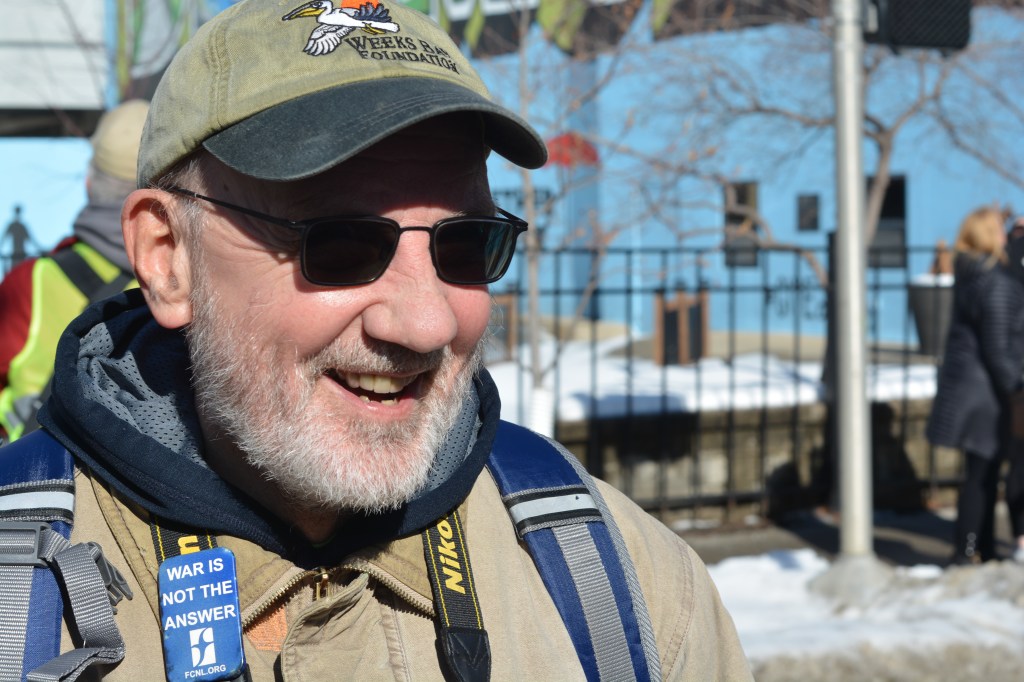
War is Not the Answer” is a campaign of the Friends Committee on National Legislation (FCNL) to encourage people to consider alternatives to armed conflict. I have worn the button on my camera strap for many years. Those who know me know I carry my camera (almost) everywhere.

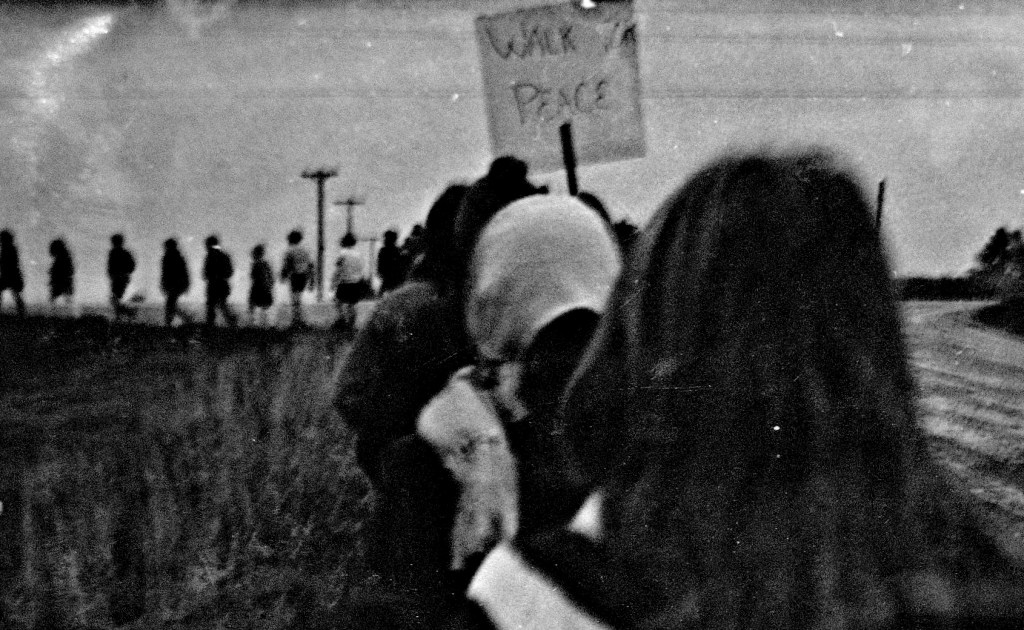
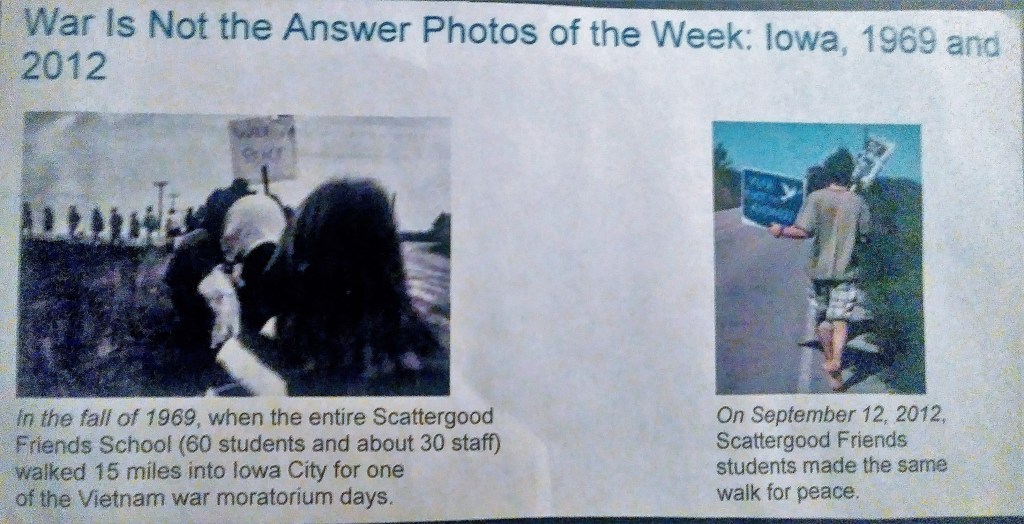
FCNL collects photos people send them of the War is Not the Answer signs. On the Moratorium Against the War in Vietnam on October 15, 1969, the entire student body of Scattergood Friends School, where I was a Senior at the time, marched in silence from the School to the University of Iowa, a distance of about 12 miles, to participate in the anti war activities there. This was before the War is Not the Answer signs. In 2012 another peace march occurred from the School into Iowa City. FCNL published these combined photos.

This slideshow is of War is Not the Answer signs in many locations:

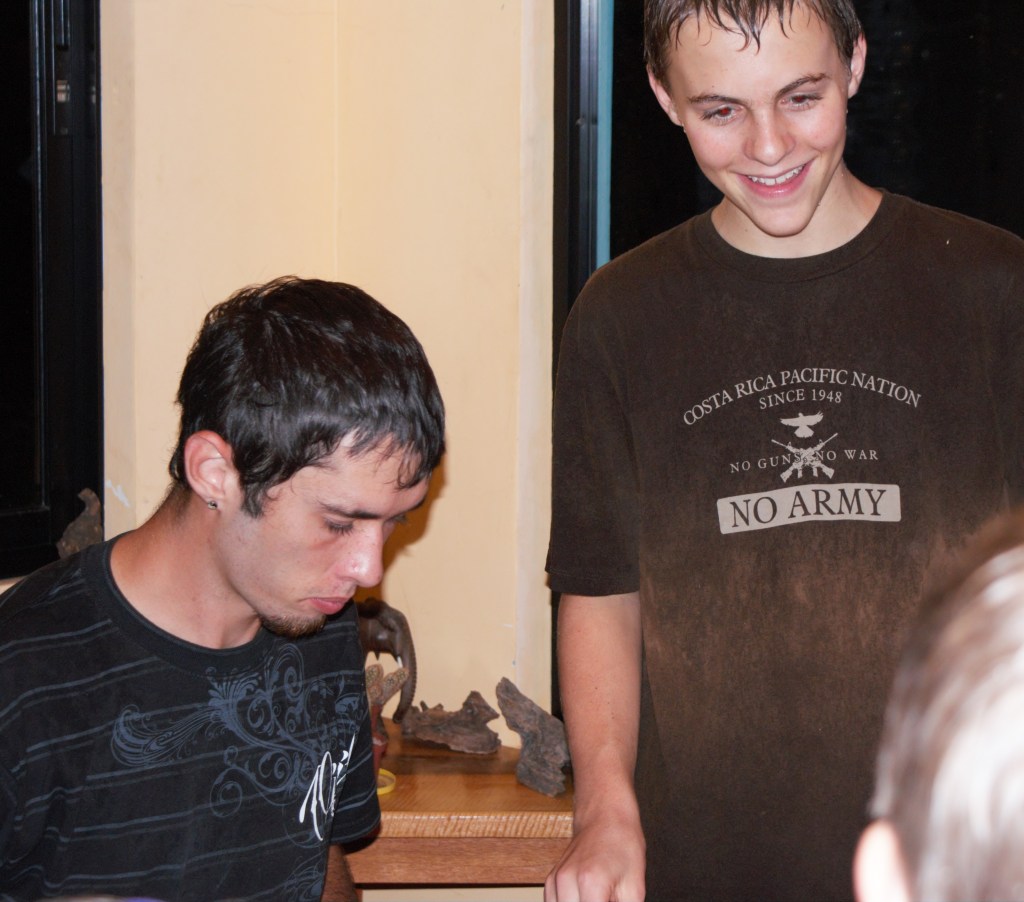
Around 1950 a group of Quakers left the United States because of the newly enacted peacetime conscription for war. They settled in Monteverde, Costa Rica. As it says on the shirt my cousin Jeffrey is wearing, Costa Rica has not had an army since 1948.

Meanwhile, a number of Quaker men in the United States refused to register as required for the Selective Service System, for peacetime conscription for the military. Nearly twenty men from Iowa Yearly Meeting (Conservative) refused to register, and many went to prison as a result.

One of those was my mentor and friend, Don Laughlin, now deceased. Late in his life he was working on a project to collect the stories of those men. I was helping him collate the stories that he called “Young Quaker Men Face War and Conscription.” His story and mine are included.

View “Young Quaker Men Face War and Conscription” here: https://1drv.ms/b/s!Avb9bFhezZpPiaMFA58DbzX6vnhaYw

A final thought about the military these days is the U.S. army is the largest producer of greenhouse gases. And our military actions for years have been to protect oil fields.

An objective for those who work for peace is to transition to renewable energy sources as quickly as possible. No one will be going to war for the sun and wind.

Posted in civil disobedience, peace, Quaker, Uncategorized | Leave a comment

Name the names

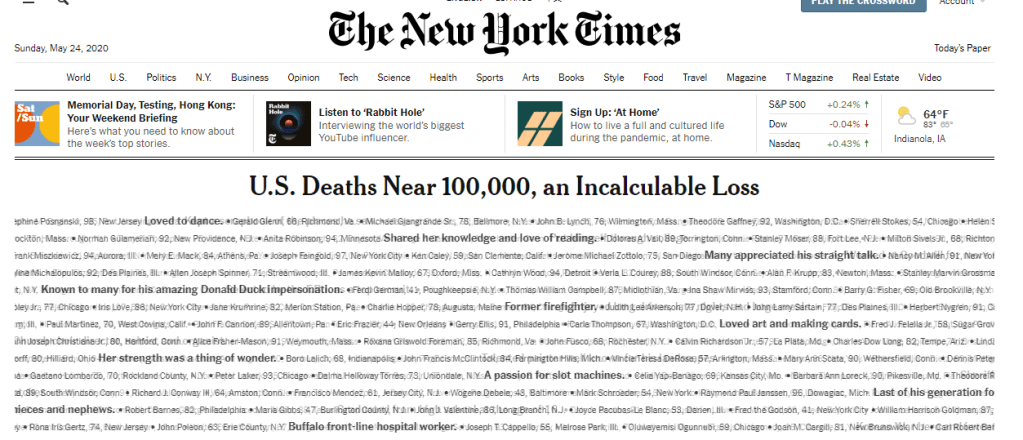
I cannot comprehend the deaths of 100,000 people due to the coronavirus in the United States. Just as I could never comprehend the deaths of millions of people from previous pandemics, natural disasters and wars.

But a count reveals only so much. Memories, gathered from obituaries across the country, help us recon with what is lost.

By the New York Times, May 24, 2020

The New York Times has a moving interactive, drawn from many news sources, that lets us know a little about some of the people who died.

The descriptions of the lives of a thousand people in the United States who died because of the coronavirus were drawn from hundreds of obituaries, news articles and paid death notices that have appeared in newspapers and digital media over the past few months. They have been lightly edited for clarity.

The New York Times, May 24, 2020
https://www.nytimes.com/

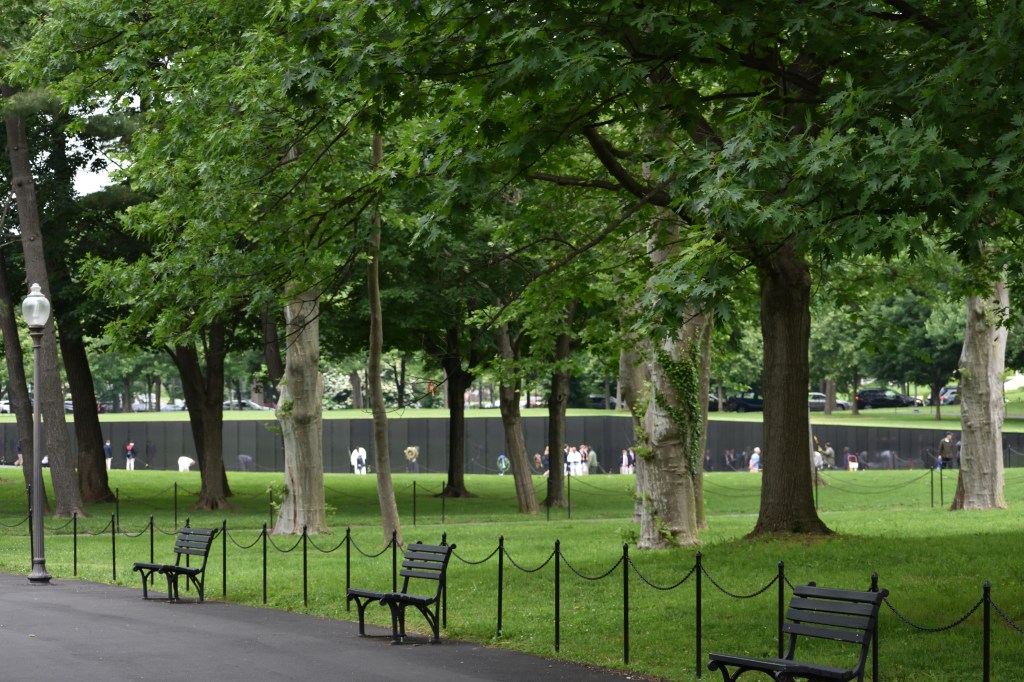
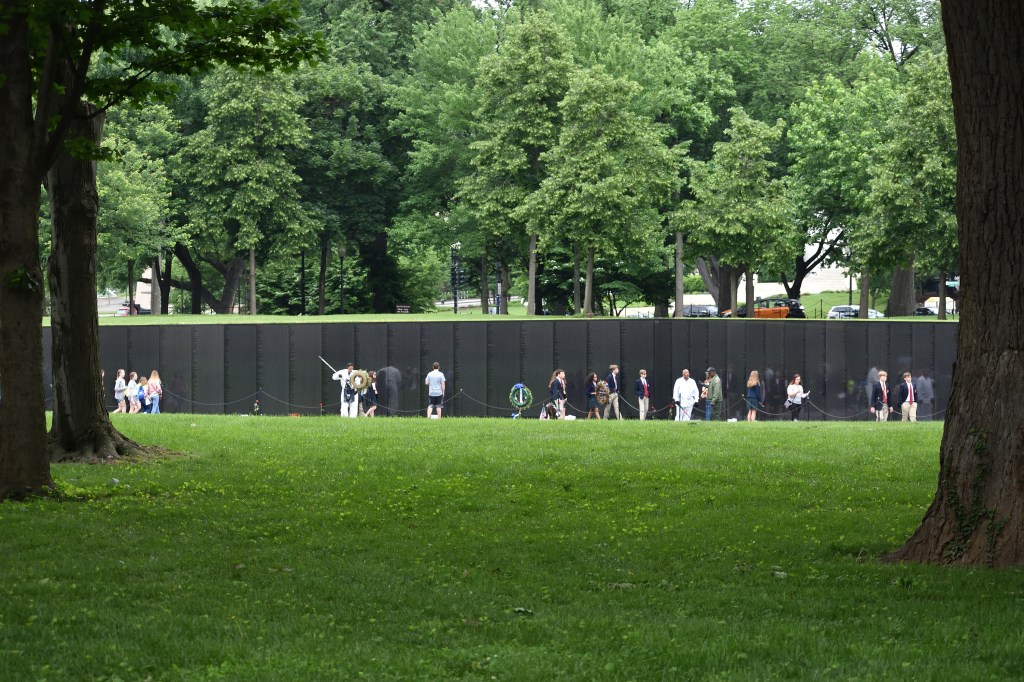
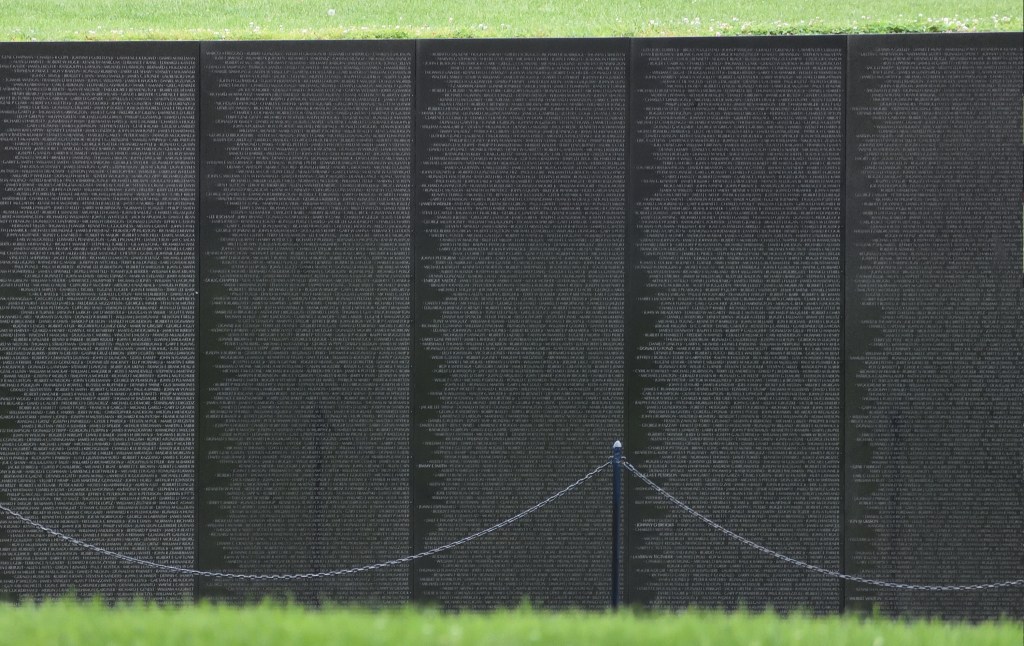
Seeing the tightly spaced list of the names of the people dead because of the coronavirus above brings to mind another tightly spaced list of names, those who died during the Vietnam War. The power of the Vietnam War Memorial is that it also names the names.


There have been many, too many, occasions when people named the names of those lost or killed. Those killed by racial violence, for example. Or those who died on Sept.11, 2001.

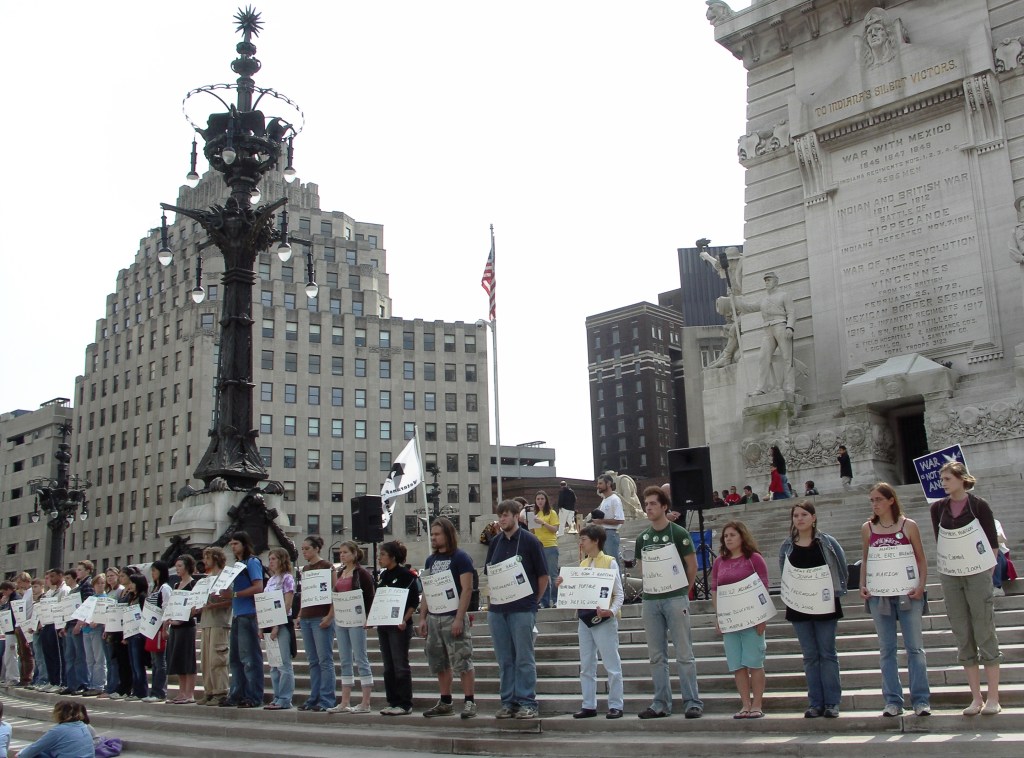
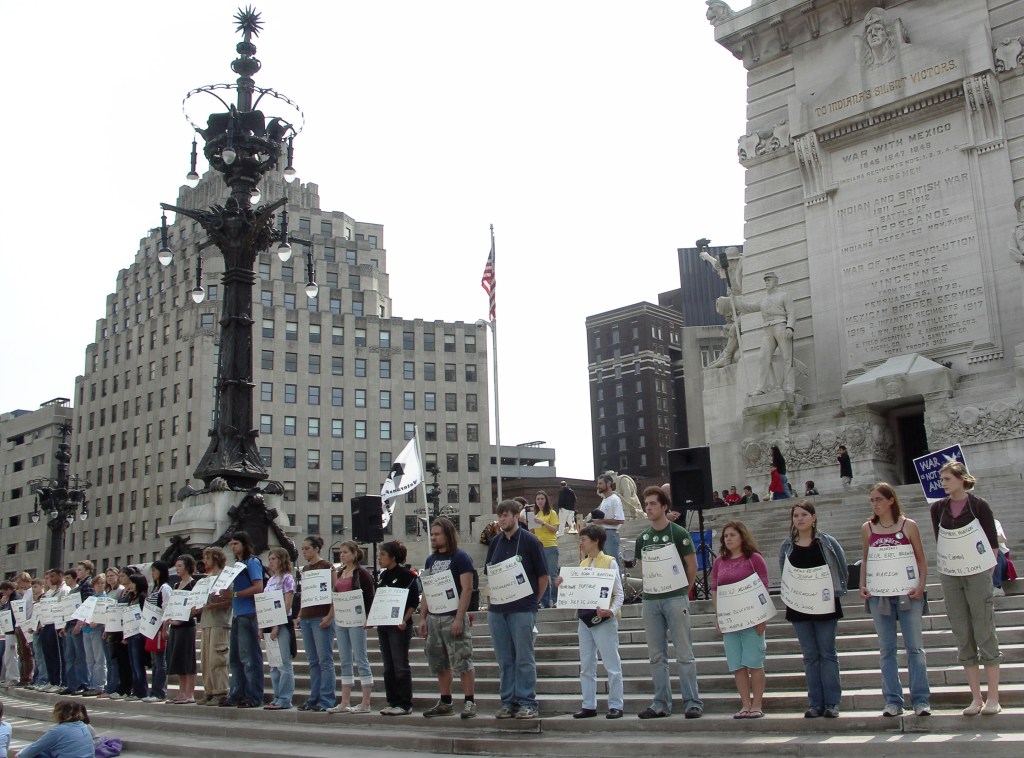
In this photo each student is holding the name, hometown and date of death of an Indiana soldier killed in the Iraq War.

Names of Indiana soldiers killed in the Iraq War.

Many people are writing penetrating things about this tragic milestone. This moving paragraph by Peggy Noonan is the one that has resonated most with me.

People have suffered. They’ve been afraid. The ground on which they stand has shifted. Many have been reviewing their lives, thinking not only of “what’s important” or “what makes me happy” but “what was I designed to do?” They’ve been conducting a kind of internal life review, reflecting on the decision that seemed small and turned out to be crucial, wondering about paths not taken, recognizing strokes of luck. They’ve been thinking about their religious faith or lack of it, about their relationships. Phone calls have been longer, love more easily expressed, its lack more admitted.

A Plainer People In a Plainer Time. As the lockdown forces us to turn inward, we rethink what’s important and what we were meant to do. Peggy Noonan, The Wall Street Journal, May 21, 2020

“They’ve been thinking about their religious faith or lack of it…”

I’ve thought a great deal about the spiritual poverty in our country these days. I think we need to recruit Spiritual Warriors in the same manner as soldiers are recruited for war. Train and build armies of Spiritual Warriors. (see more: https://kislingjeff.wordpress.com/?s=spiritual+warrior)

Too many people have let their spiritual lives falter.  I think now is a time when we need to invite more people to work on their spiritual lives.  We seem to be moving into a dark time.  Attention to the Spirit is how we can navigate the future, and stand up to the forces of oppression.

I’m hoping we will continue to see the rise of Spiritual Warriors.  Quakers, Native Americans, you.

Jeff Kisling, Recruiting Spiritual Warriors, Jan. 7,2017
Posted in Native Americans, Quaker, Spiritual Warrior, Uncategorized | Leave a comment

Using twitter for political action during the pandemic

Social distancing prevents large public gatherings, including rallies and demonstrations. Face to face meetings with legislators are not possible either. This is troublesome in a time when governments are using the focus on the pandemic to take attention away from unjust actions, such as closing borders to immigrants.

MoveOn, a political action organization, has begun to use twitter to apply political pressure. The following is from a recent email message to MoveOn members.


Dear MoveOn member,

In a world where we have to maintain physical distance, we’re all looking for ways that we can use digital spaces to bring us closer together.

That’s why, earlier this month, we took action together in an unprecedented way to demand #RealReliefNow for working people in the government’s coronavirus response. In less than one hour, we were trending #3 on Twitter with an online protest that reached as far and as wide as any protest we’ve organized in person. 

This massive Twitter rally took place in the pivotal days before the Democrats released an expansive bill that put people first, pushing forward critical voices that helped shape the HEROES Act, which included protections for essential workers, student debt relief, investments to protect jobs, direct financial support, and so much more. 

Interested in joining our next Twitter rally? This works only when many of us work together, and we need as many of us raising our voices at once! Text TWEET to 668366 and we’ll let you know about the next opportunity to join a collective action with people all across the country.

Joining an online rally is safe and simple. That’s why more than 41,000 MoveOn members who are active Twitter users were invited to join this Twitter rally to demand #RealReliefNow and got this campaign to trend.

Together, we tweeted our members of Congress directly, shared what people-centered relief would look like in our communities, and called out Trump and the GOP for continuing to send billions of dollars to corporations and the wealthy. We know that members of Congress heard us—and that millions of folks around the country heard and shared these messages.

Your tweets became your protest signs, your stories were shared, and, together, we demanded real relief that serves people, not corporations.


As it says above, use your phone to send a text to 668366 that reads TWEET.

You will receive the following reply:

MoveOn: Thanks for signing up for text message alerts. We’re excited to tweet with you and will let you know when there’s breaking news or urgent action to take.

Our Twitter handle is @MoveOn. Follow here: http://mvn.to/1uf/5sox5h

What’s your Twitter handle?

(for example, my Twitter handle is @jakislin)


Clicking on the tweet will take you to a website with more information.

Here is my latest tweet:


Posted in Uncategorized | Tagged , , , , | Leave a comment

Quakers and social change today

Note: I need to make a few things clear about the following. When I say “we” I’m talking about the demographics of most Quaker meetings today, i.e. primarily White, and tending to be older in age. Secondly, this is not about any particular Quaker Yearly Meeting (the organization of Quaker Meetings in a geographic area). Third, I’ve been clerk of my yearly meeting’s peace and social concern committee for almost ten years. Part of that involves feeling a responsibility to think about these issues and how we work on them. Fourth, I’ve had a life long struggle (68 years old now) of trying to get Friends to reject the personal automobile culture, with no success. I’ve lived without a personal automobile since I was in my early 20’s. I feel our actions should align with our professed beliefs. Finally, the thing that most irritates Friends, is I don’t believe committee work is social justice work. The reason I work on our peace and social concerns committee is because it’s role is primarily to report on the actual work being done in local Quaker meetings.

I believe working for justice requires us to develop personal relationships, to build friendships with those who are suffering injustice. And secondly, for us to follow the leadership of those in the oppressed communities. When living in Indianapolis I was blessed to be able to develop dear friendships with the people of the Kheprw Institute (KI), a black youth mentoring community. Even though I moved to Iowa three years ago, I still maintain those friendships. I’m including some of the recent writings from my friend, Imhotep Adisa, and photos taken at KI at the end of this.

Since returning to Iowa I’ve been led to opportunities to develop friendships with Native people. One reason is because White people continue to consume oil and other resources at rates far beyond what Mother Earth can renew. And that attitude comes from the acceptance of White dominant culture. Simply put, I have found indigenous cultures represent my Quaker values, and White culture does not. I put all the blog posts, photos and videos of the First Nation-Farmer Climate Unity March on this website, for some examples of Quakers and native people getting to know each other: https://firstnationfarmer.com/
Finally, we get to what I shared with our peace and social concerns committee. I’ve written extensively about these things on my blog, Quakers, social justice and revolution.


I would guess a number, if not all of you have questioned the role of our peace and social concerns committee for the Yearly Meeting, and the world. Now seems to be a time to re-evaluate almost everything, as the pandemic has disrupted so many aspects of everyone’s lives around the world. This on top of what we had already been experiencing with environmental devastation and the breakdown of our political and economic systems.

We have wrestled with what peace means in times of endless wars that don’t respect political borders, and that kill so many civilians. For purposes we don’t even know.

Most of you have heard me say I don’t believe we can make any progress on justice issues until we confront the enslavement of black people and the genocide of native peoples by White people.
Many of you know I have sought any opportunity to get to know indigenous people. At first because I respected the way they lived within sustainable environmental boundaries. And their subsistence economy and spiritual grounding. The more I learned, the more I realized indigenous ways are more in line with my Quaker values than the White society I was born into, raised and now live in.
I’ve heard the cautions to not idealize Native Americans and about cultural appropriation. I’ve been working on this long enough that I think I have a handle on those things, but still learning.

I realized early on that I was having trouble explaining all of these things. Probably from my computer programming days, I’ve found it useful to diagram them. Here is my most recent project.

I think this is pretty self-explanatory. The endpoint is what kind of community we want to build. The communities most of us live in, based on capitalism, that have led to broken political, social and economic systems, the failure of which has exploded into public view because of the pandemic? It is shocking to see how completely the capitalist system has failed.

Or can we work to transition to an adaptation of communities combining our Quaker beliefs and those of indigenous cultures?

I know change is difficult. Or perhaps you have your own experiences related to these things, so this might not be such a change for you.

As my friend Ronnie James writes:

I’m of the firm opinion that a system that was built by stolen bodies on stolen land for the benefit of a few is a system that is not repairable. It is operating as designed, and small changes (which are the result of huge efforts) to lessen the blow on those it was not designed for are merely half measures that can’t ever fully succeed.
So the question is now, where do we go from here? Do we continue to make incremental changes while the wealthy hoard more wealth and the climate crisis deepens, or do we do something drastic that has never been done before? Can we envision and create a world where a class war from above isn’t a reality anymore?”

Ronnie James

Is equity possible in a world after COVID-19? By IMHOTEP ADISA, Indianapolis Recorder, May 15, 2020

Over the last couple of years, the word equity has become more and more prominent in discussions of how to address growing poverty and inequality along lines of race, class and gender. In light of the coronavirus, equity for those in impoverished communities, mainly those of color, is almost unattainable. 

America’s preexisting conditions

In my view, there are three preexisting conditions that already had a large number of people questioning the morality and sustainability of our social order:

1.     The resurgence of racist ideologies which has made possible the current presidency, which in turn has refueled the resurgence.

2.     The resurgence has re-awakened a segment of society that felt the fight for civil rights had already been won.

3.     The concern that growing wealth disparities will eventually lead to social instability and put the entire social order at risk. 

Faced with unemployment that is probably close to 20%, levels not seen since the Great Depression, the push to make our society more equitable has transcended identity politics and been brought into the mainstream.

Resistance to change

Though there may be a lot of energy and interest in changing our society, in truth, any critical look at past efforts to make America a more equitable society will show that the challenges of doing so are often met with lots of resistance, trickery and violence. Inequitable structural conditions simply change their clothes, as folks attempt to create a more equitable society.

If we’re honest about it, this country has never been equitable. In fact, it was built on inequity and it continues to be fueled by inequitable structures.

Continue to push for something different

How can we create some processes and procedures to mitigate inequity in our social, legal and economic structures? How can we begin some conversations about creating a system that is equitable? What can each of us do in the present to advance equity in our society? And how do we continue to fight for equity during these difficult times?

First and foremost, all of us, every last one of us, must engage others in our work, home and play spaces to have honest, open and authentic conversations around the issue of inequity. Some of us, particularly those in positions of power, must have the courage and strength to look more deeply at the inequitable structures that exist within their own organizations and institutions.

As layoffs and lockdowns free up our time and mental energy, we can put energy daily into building relationships that can birth more equitable ways of being through genuine human connection and opportunities for empowerment, agency, self-determination and rebirth. The old structures and false solutions do not provide the promise of equity. At this moment, we need brave new connections that begin to pave the way for a better path forward.

Imhotep Adisa is the executive director and co-founder of the Kheprw Institute, a nonprofit organization focused on empowering youth and building community wealth in Indianapolis.


Many photos and stories about the First Nation-Farmer Climate Unity March, where a group of us walked for 94 miles along the path of the Dakota Access Pipeline, can be found here: http://firstnationfarmer.com/

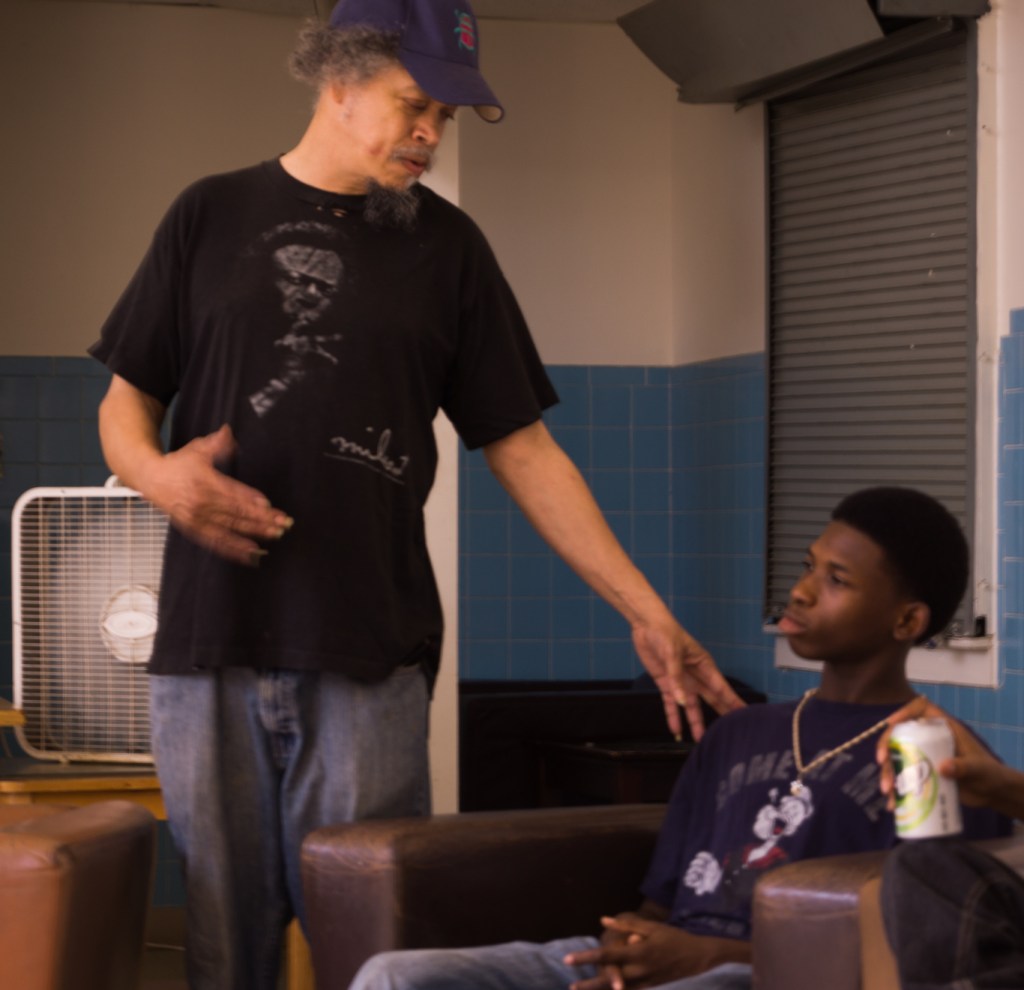
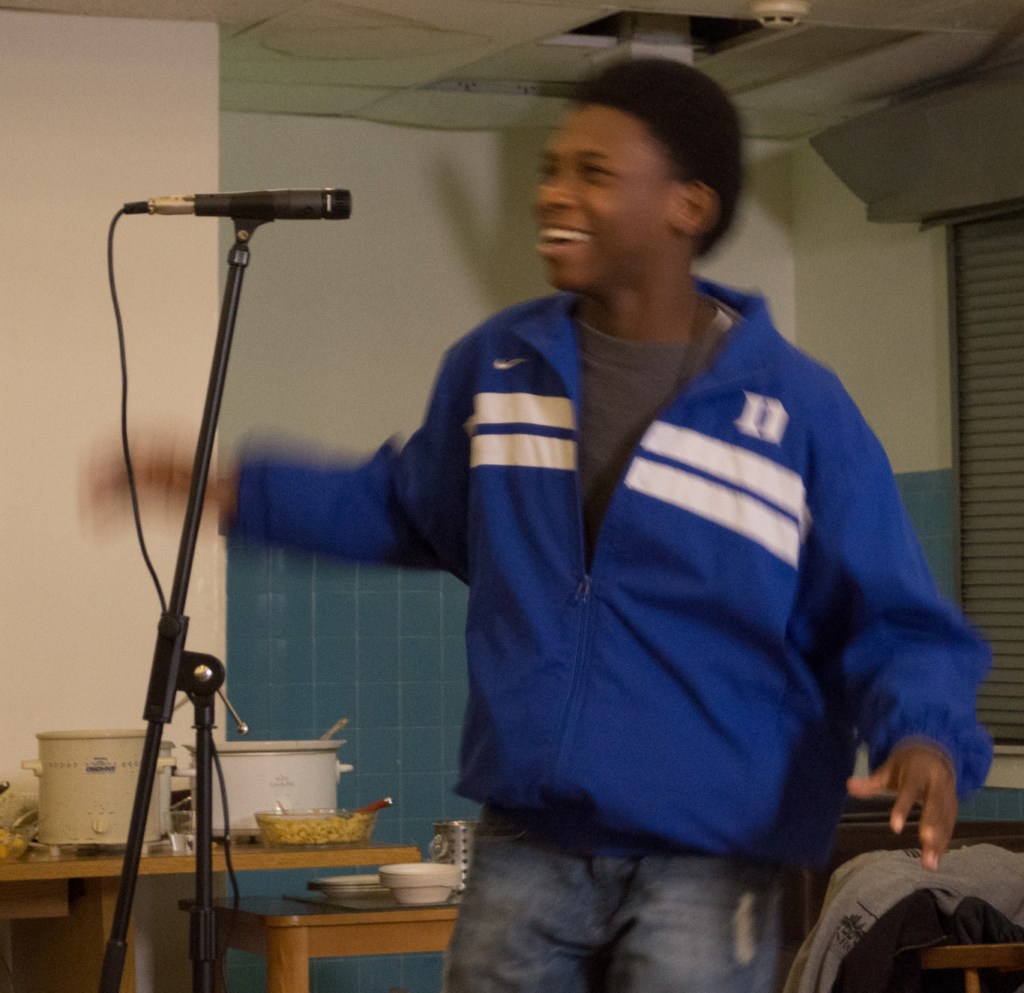
Following are photos at the Kheprw Institute (KI) in Indianapolis.

Posted in Black Lives, First Nation-Farmer Climate Unity March, Kheprw Institute, peace, Quaker, Quaker Meetings, Uncategorized | 2 Comments