The answer to “What can I do?”

I have been wondering about the convergence of several things lately.

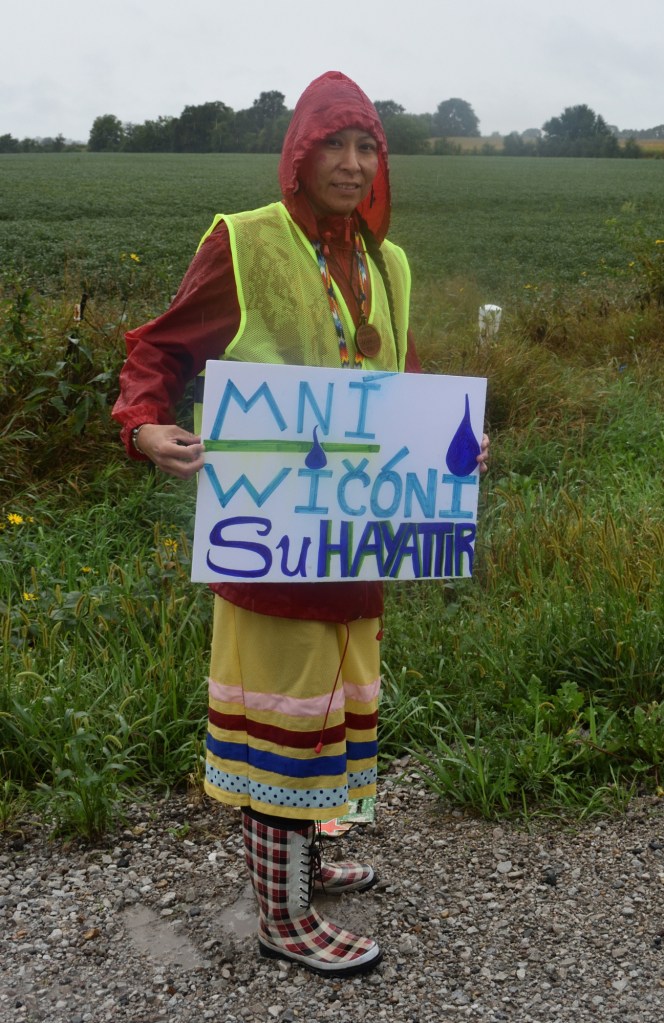
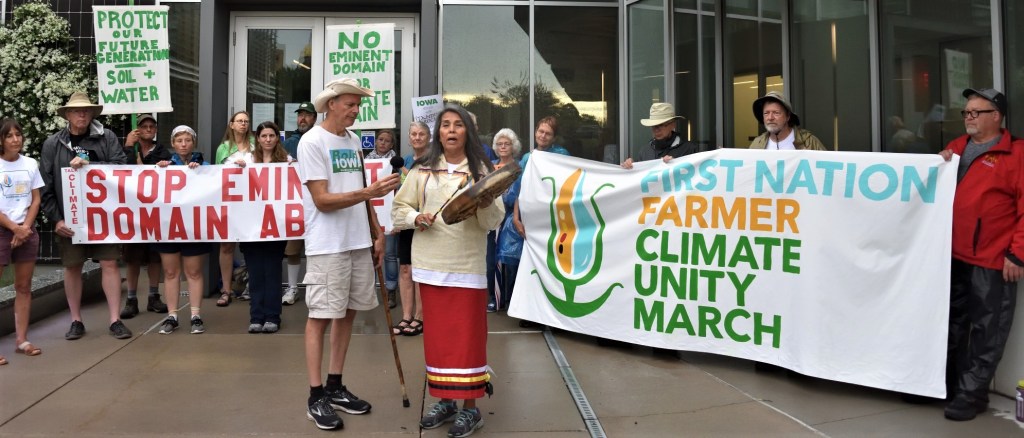
  • I was blessed to have participated on the First Nation-Farmer Climate Unity March in 2018. That was the experience I had been searching for. The opportunity to develop friendships with American Indians and those who work to decolonize White people. http://firstnationfarmer.com/
  • The devastation from the pandemic has exposed the fragility of our economic and political systems.
  • The public execution of George Floyd by the police has triggered sustained protests against police abuse and more broadly, systemic racism.
  • We continue to witness the evolving environmental disaster with hurricanes on the east coast and out of control wildfires on the west.

The convergence of these things has brought this country, the world, to a place we are beginning to realize we will not completely recover from.

For my entire life I have worked to try to create change. To turn away from war, to build peace. To stop the profligate burning of fossil fuels and other environmental assaults.

But I have had little success.

It has been really difficult to convince people to change, to create change. This convergence, though, has brought us to a place where changes are forced upon us. Change is happening, will continue to happen. The status quo is unraveling.

The question is what can we do to influence the course of changes for the better?

I am honored to be working with a group of Friends who are working for change. Working on the process of decolonizing Quakers. https://www.decolonizingquakers.org/

In years past I might not have been so hopeful that yet another conference or series of webinars would actually create any change. But with the convergence of forces listed above, change is being forced upon us. Might this be the time our work for justice will actually make progress?

The question people will be asking now is “what can I do?”

Several years ago I was blessed to hear Arkan Lushwala speak about “Indigenous Ways of Restoring the World” during a call sponsored by the Pachamama Alliance.  “Arkan Lushwala is a rare indigenous bridge of the global north and south, carrying spiritual traditions from the Andes in his native Peru as well as being adopted and initiated by the Lakota people of North America.”

I was very excited when I heard the title of his talk. As I’ve been saying the solutions for our environmental chaos must come from a spiritual center.

“Everywhere people ask, “what can we do?”
The question, what can we do, is the second question.
The first question is “what can we be?”
Because what you can do is a consequence of who you are.
Once you know what you can be, you know what you can do”

Arkan Lushwala

This is why we need Spiritual Warriors.  Because we ask ourselves the first question, “what can we be?”  Knowing that,  “our actions are precise, our actions are in harmony with the movement, the sacred movement, of that force that wants to renew life here on Earth and make it better for the following generations.”

The answer to “what can I do?”

Speaking about what is happening on Earth right now,
many of the conditions of life that we used to take for granted,
now are really out of balance.
Hopefully we still have time to get back into balance
so life may continue.
I travel around the world and meet people and talk to people
from all different cultures.
And everywhere people ask, “what can we do?”
The question, what can we do, is the second question.
The first question is “what can we be?”
Because what you can do is a consequence of who you are.
Once you know what you can be, you know what you can do,
and we cannot afford wasting time;
we have little time.
We need to be precise now.
When someone sincerely asks, “what can I do?”
my humble answer,
the only answer that I find in my heart to be sincere is,
“First find out what you can be.”
Action is extremely necessary at this time.
This is not a time just to talk about it.
The most spiritual thing now is action.
To do something about what’s happening.
To go help where help is needed.
To stand up when we need to stand up,
and protect what is being damaged.
And still, this action needs to be born
from a place in ourselves that has real talent,
real intelligence, real power,
real connection to the heart of the Earth,
to universal wisdom,
so our actions are not a waste of time.
So our actions are precise,
our actions are in harmony with the movement,
the sacred movement,
of that force that wants to renew life here on Earth
and make it better for the following generations.

#SeedingSovereignty #DecolinizingQuakers

Posted in #NDAPL, climate change, Indigenous, Spiritual Warrior, Uncategorized | Leave a comment

Working towards right relationship with Indigenous Peoples

My intention in writing yesterday’s blog post, Urgency to Decolonize, was to bring attention to the concepts of decolonization. I don’t think many White people are very familiar with that topic. And below I include an excerpt from the article “How Racism Against Native People is Normalized” because I also think most White people don’t think about racism being related to Native people.

I feel the urgency for us White people to look at decolonization and racism against Native people now because of the opportunity presented by protests and attention to structural racism triggered by the public death of George Floyd at the hands of the police.

And because the U.S. is becoming a failing state (see Urgency to Decolonize), meaning it is increasingly unlikely our current economic and political systems will offer solutions to the threats of environmental chaos, the COVID-19 pandemic, and collapse of our economy. I contend we need to stop trying to make incremental changes to these failing systems and instead look for alternatives.

As my friend Ronnie James says,

I’m of the firm opinion that a system that was built by stolen bodies on stolen land for the benefit of a few is a system that is not repairable. It is operating as designed, and small changes (which are the result of huge efforts) to lessen the blow on those it was not designed for are merely half measures that can’t ever fully succeed.

So the question is now, where do we go from here? Do we continue to make incremental changes while the wealthy hoard more wealth and the climate crisis deepens, or do we do something drastic that has never been done before? Can we envision and create a world where a class war from above isn’t a reality anymore?”

Ronnie James

How do we White people learn more about these things? Following are several websites. A couple include information about workshops.


Following is more information about the webinar series, Working Towards Right Relationship with Indigenous Peoples.

As more and more people confront how deeply white supremacy is embedded in our culture and institutions, focus has largely centered on the systemic racism visited on Black people.  Yet we know that European settler colonists brought a racialized world view with them when they came to exploit the land and peoples of North America.  The nation states of North America are built on the so-called Christian Doctrine of Discovery, which purports to justify the theft of land and resources and the enslavement or destruction of many Nations, including the theft and enslavement of Africans from their homelands and the actual and attempted genocide of Indigenous Peoples.

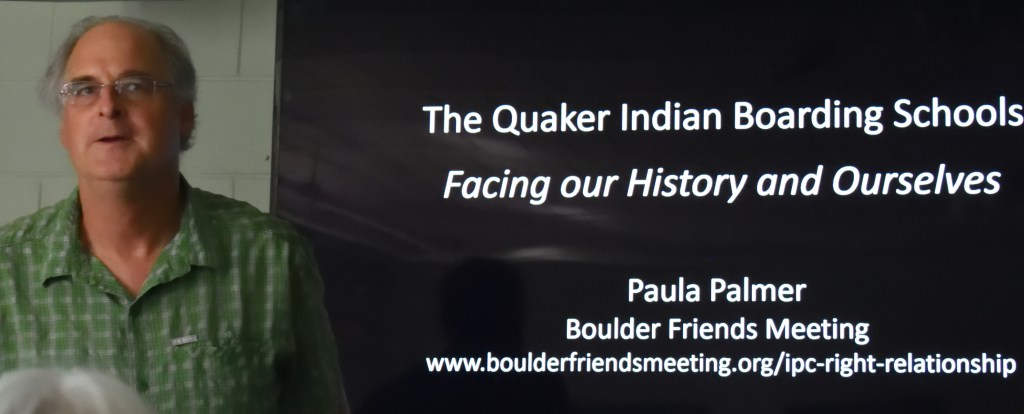
Quaker descendants of European settlers benefitted and continue to benefit from this oppressive history. Quakers individually and corporately also played a direct role in the attempted cultural genocide of Indigenous Peoples. Among other things, they ran and supported Indian Boarding Schools, which were designed to “civilize” Indigenous peoples by separating children from their families and communities and erasing their native language, customs, and culture.

Beginning on August 10 and continuing on the second and fourth Mondays of August, September and October, 7:30 to 9:00 p.m. Eastern time (U.S. and Canada). Co-sponsored by Pendle Hill, Decolonizing Quakers, Canadian Friends Service Committee, and Friends Peace Teams/Toward Right Relationship with Native Peoples

A 2018 Pendle Hill conference helped broaden and deepen a conversation about the Quaker role in the genocide of Native Peoples and about ways of moving toward right relationship—awareness, acknowledgment, apology, and reparative work. A group of Friends convened to form a steering committee for a continent-wide organization that would continue the explorations and the work identified at the conference, now calling itself “Decolonizing Quakers.”

Originally planned as a conference for May 2020, the webinar series is intended to further the goals and intended action steps of the 2018 conference — with re-organized format that accommodates pandemic realities. 

Working Toward Right Relationship With Indigenous Peoples. A Six-Part Webinar Series


I am Dena’ina Athabascan and Unangan (Aleutian), an Alaska Native living in California. As a Native person, there is not a day that passes where I don’t come across some form of exploitive, anti-Native behaviors in play. Not a day.

Racism toward Native people is normalized, so much so that many people do not see it as racism at all. Racist stereotypes of Native people are seemingly ingrained into the psyche of people starting in childhood, some subliminal, some direct.

How Racism Against Native People Is Normalized, From Mascots to Costumes by Heather Davidson, Teen Vogue, OCTOBER 31, 2018

To talk about decolonization, people need an understanding of what we are decolonizing from. Colonization is when a dominant group or system takes over and exploits and extracts from the land and its native peoples. Colonization has taken place all over the globe, through the stealing of lands; the raping of women; the taking of slaves; the breaking of bodies through fighting, labor, imprisonment, and genocide; the stealing of children; the enforcement of religion; the destruction—or attempts to destroy—spiritual ways of life. All of these things have left a psychological, spiritual, and physical imprint on indigenous peoples, and a governmental ruling system that we did not create, that was not made for us. These are the things we need to heal from, where we need to start reclaiming. This is where organizing and decolonizing comes in.

What Decolonization Is, and What It Means to Me. “Decolonizing is about reclaiming what was taken and honoring what we still have.” BY TINA CURIEL-ALLEN, Teen Vogue, MARCH 4, 2018

#DecolonizingQuakers #SeedingSovereignty
Posted in decolonize, Indigenous, Native Americans, Toward Right Relationship with Native Peoples, Uncategorized | Leave a comment

Urgency to Decolonize

I believe we need to stop our fragmented and ineffective responses to the chaos we are living in within the context of our current economic, social and political systems. These systems are broken. Capitalism is broken. Our political system is broken.

When White settlers arrived in this land, they made the conscious choice to colonize. The roots of our current situation go back to that decision. Rather than learn how to live in this new land from the Indigenous peoples, who had thrived here for thousands of years, the White settlers infected the land with the culture they brought from Europe.

Colonize: to come to settle among and establish political control over the indigenous people of an area.

These are now turbulent times, which are rapidly worsening on multiple fronts. The COVID-19 pandemic is wrecking havoc globally and to a far greater extent in the U.S.

Why has this country’s response to the pandemic been so disastrous? Because the U.S. is a failing state.

[ For further information see: https://kislingjeff.wordpress.com/2020/07/30/a-system-that-was-built-by-stolen-bodies-on-stolen-land-for-the-benefit-of-a-few-is-a-system-that-is-not-repairable/ ]

Two of the characteristics of a failed state are:

—functional failures: inability to respond adequately to challenges threatening the security of the society and its population against threats posed by internal and external hostile political actors, as well as by ecological instabilities, by widespread extreme poverty and hunger, and by a deficient health and disaster response system;

—normative failures: refusal to abide by systemic rules internationally as embedded in international law and the UN Charter, claiming impunity and acting on the basis of double standards to carry out its geopolitical encroachments on the wellbeing of others and its disregard of ecological dangers; patterns of normative failures

Is the United States a Failing State? A Failed State? by Richard Falk, Global Justice in the 21st Century blog, July 22, 2020

The settlers established capitalism as the economic system. They used the Doctrine of Discovery to justify claiming land ownership. And setup political systems that ensured that White property owners would retain their power, thereby building racism into these structures from the beginning.

These White dominant systems worked fairly well for White people for decades. But decidedly not for Indigenous peoples, African Americans and other people of color.

But for White people there was/is an undercurrent of unease. Although White people tried to not think about it, avoided talking about it, we knew the treatment of Indigenous peoples and African Americans was not just wrong, but immoral. Regardless, White people continue to this day to refuse to rectify the situation, continue to take advantage of their privileges. But now the systems that provide those privileges are failing. The privileges are disappearing.

COVID-19 has spread across the world, changing everyone’s lives. In the U.S. the capitalist economy essentially shut down and all the weaknesses of capitalism were exposed. Capitalism depends upon a cycle of money. People are paid wages, often subsistence wages, for their work, which they then use of buy food, pay for housing, utilities, medical care and other material things. The vast majority of people have little monetary savings and thus no source of money to use when jobs are lost. Meaning most people have nothing to draw from when wages are no longer coming in. The cycle of money is broken. These are examples of the functional failures of a failing state as described above.

There have been signs of the failure of capitalism for decades. The Great Depression of the 1930’s broke the cycle of money. Fortunately the country elected a capable and visionary leader, Franklin D. Roosevelt, to pull the nation out of the depression.

In his speech accepting the Democratic Party nomination in 1932, Franklin Delano Roosevelt pledged “a New Deal for the American people” if elected. Following his inauguration as President of the United States on March 4, 1933, FDR put his New Deal into action: an active, diverse, and innovative program of economic recovery. In the First Hundred Days of his new administration, FDR pushed through Congress a package of legislation designed to lift the nation out of the Depression. FDR declared a “banking holiday” to end the runs on the banks and created new federal programs administered by so-called “alphabet agencies” For example, the AAA (Agricultural Adjustment Administration) stabilized farm prices and thus saved farms. The CCC (Civilian Conservation Corps) provided jobs to unemployed youths while improving the environment. The TVA (Tennessee Valley Authority) provided jobs and brought electricity to rural areas for the first time. The FERA (Federal Emergency Relief Administration) and the WPA (Works Progress Administration) provided jobs to thousands of unemployed Americans in construction and arts projects across the country. The NRA (National Recovery Administration) sought to stabilize consumer goods prices through a series of codes. Through employment and price stabilization and by making the government an active partner with the American people, the New Deal jump-started the economy towards recovery.

The Franklin D. Roosevelt Presidential Library and Museum

It is painfully obvious that the current administration and the Republican party have shown no such leadership to our current crises.

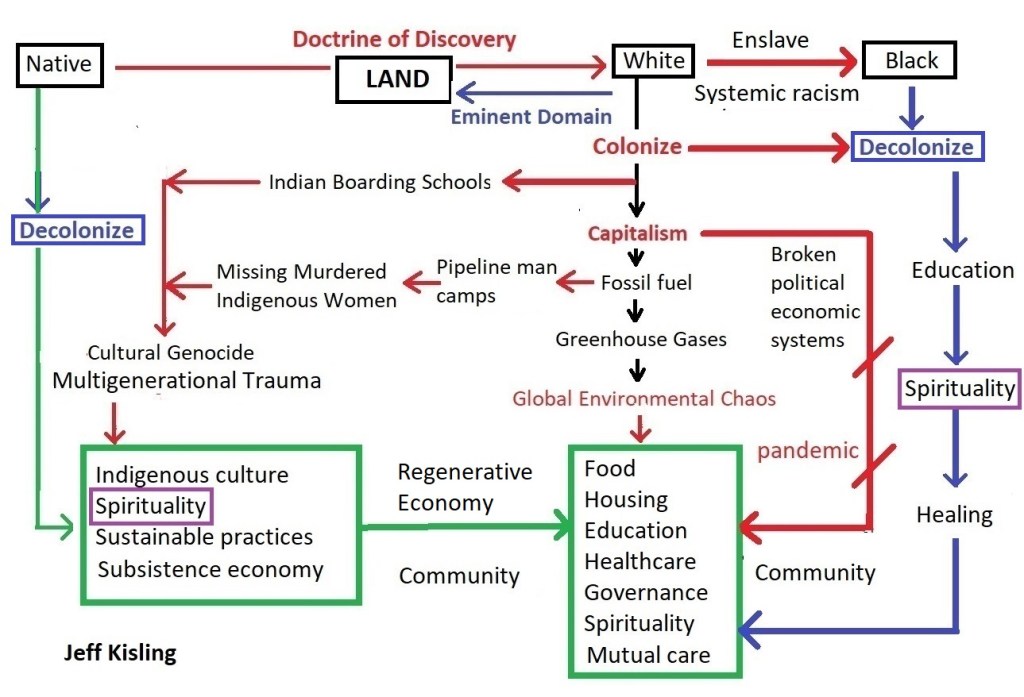
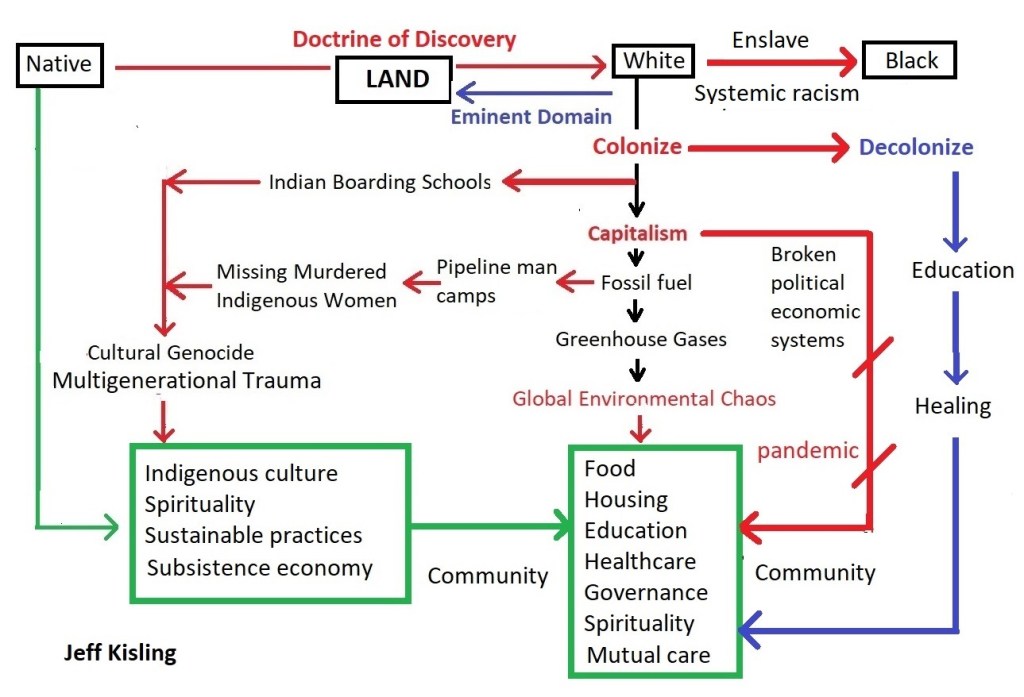
I have been working on this diagram to help me understand the interrelationships among Indigenous peoples, African Americans, and White colonists.


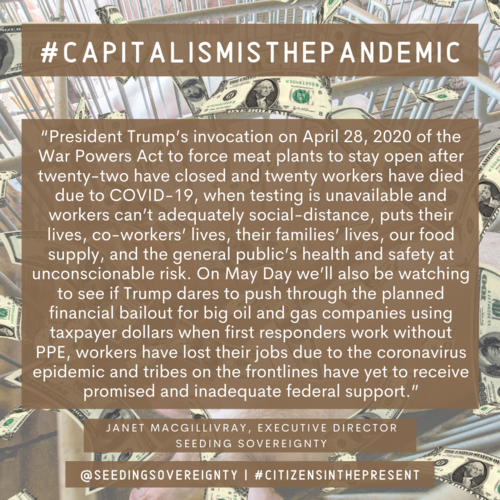
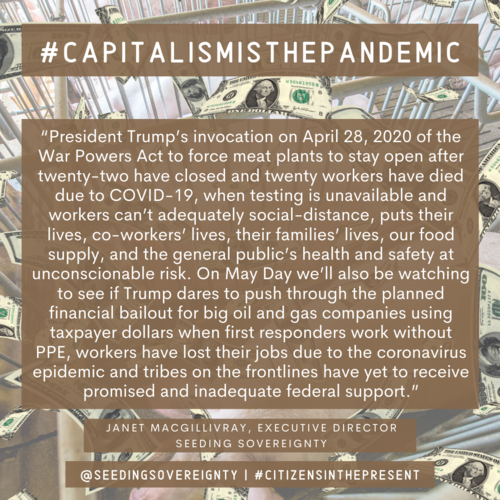
The pandemic has broken the capitalist system. As my friends at Seeding Sovereignty say, capitalism is the pandemic.

On May 3, a 50’ sky banner visible to millions stating #CAPITALISMISTHEPANDEMIC circled Manhattan–the US bedrock of capitalism and banking–to deliver a powerful message of protest against colonization and worker injustice in solidarity with essential workers who aren’t properly protected or supported.

https://seedingsovereignty.org/capitalism-is-the-pandemic

The intersecting crises of income and wealth inequality and climate change, driven by systemic white supremacy and gender inequality, has exposed the frailty of the U.S. economy and democracy. This document was prepared during the COVID-19 pandemic which exacerbated these existing crises and underlying conditions. Democratic processes have been undermined at the expense of people’s jobs, health, safety, and dignity. Moreover, government support has disproportionately expanded and boosted the private sector through policies, including bailouts, that serve an extractive economy and not the public’s interest. Our elected leaders have chosen not to invest in deep, anti-racist democratic processes. They have chosen not to uphold public values, such as fairness and equity, not to protect human rights and the vital life cycles of nature and ecosystems. Rather, our elected leaders have chosen extraction and corporate control at the expense of the majority of the people and the well-being and rights of Mother Earth. Transforming our economy is not just about swapping out elected leaders. We also need a shift in popular consciousness.

A Peoples Guide to a Regenerative Economy

Decolonization begins with turning away from capitalism. And instead do what White settlers should have done when they arrived. Learn from Indigenous people the way to live in this land.


“I believe that we have the capacity to create a world that is compassionately intent on preserving the integrity of all life in a harmonious balance. And that the Sacred Instructions for creating that world exist within every one of us right now and are waiting to be called forth…”

Sherri Mitchell, Penobscot Nation, excerpts from introduction to Sacred Instructions: Indigenous Wisdom for Living Spirit-Based Change

Posted in decolonize, Indigenous, Native Americans, race, Seeding Sovereignty, Uncategorized | Leave a comment

“A system that was built by stolen bodies on stolen land for the benefit of a few is a system that is not repairable”

So many things that used to work no longer do. I think most White people are hoping their pre-COVID-19 ways of living will return if and when the pandemic is brought under some level of control. A growing number of us not only believe life won’t return to what was normal, it should not. We are working to envision and create better social, economic and political systems.

As my friends at Seeding Sovereignty say “capitalism is the pandemic.”

What had been normal was decidedly not good for those who didn’t belong to the dominant culture of White, straight, wealthy males and their White supremacy. As my friend Ronnie James says:

I’m of the firm opinion that a system that was built by stolen bodies on stolen land for the benefit of a few is a system that is not repairable. It is operating as designed, and small changes (which are the result of huge efforts) to lessen the blow on those it was not designed for are merely half measures that can’t ever fully succeed.

So the question is now, where do we go from here? Do we continue to make incremental changes while the wealthy hoard more wealth and the climate crisis deepens, or do we do something drastic that has never been done before? Can we envision and create a world where a class war from above isn’t a reality anymore?”

Ronnie James

I came across the following that I found to help understand the current conditions in the U.S. It has become increasingly clear that the U.S. is a failing state.

There are several measures of a failing state that cast light on the American reality:

—functional failures: inability to respond adequately to challenges threatening the security of the society and its population against threats posed by internal and external hostile political actors, as well as by ecological instabilities, by widespread extreme poverty and hunger, and by a deficient health and disaster response system;

—normative failures: refusal to abide by systemic rules internationally as embedded in international law and the UN Charter, claiming impunity and acting on the basis of double standards to carry out its geopolitical encroachments on the wellbeing of others and its disregard of ecological dangers; patterns of normative failures include endorsements of policies and practices giving rise to genocide and ecocide, constituting the most basic violations of international criminal law and the sovereign rights of foreign countries; the wrongs are too numerous to delimit, including severe and systemic denials of human rights in domestic governance; economic and social structures that inevitably generate acute socio-economic inequalities on the basis of class, race, and gender.

Some additional considerations accentuate the failing state reality of the U.S. due to the extensive extraterritorial dimensions that accompany the process of becoming ‘a failing global state.’ This new type of transnational political creature should be categorized as the first historical example of a ‘geopolitical superpower.’ Such a political actor is neither separate from nor entirely subject to the state-centric system of world order that evolved from the Peace of Westphalia in 1648, and became universalized in the decades following World War II. Although lacking a true antecedent, the role of European ‘great powers’ or ‘colonial empires’ give clues as to the evaluation of the U.S. as a global state or geopolitical superpower;

—effectiveness: the loss of effectiveness by a failing state is disclosed by its inability to maintain and exert control over challenges to its supremacy. Such an assessment if vindicated by failed military operations (regime-changing interventions) and the inability to learn from and overcome past mistakes, disclosures of vulnerability to homeland security (9/11 attacks) and overly costly and destructive responses (9/12 launching of ‘war on terror’; declining respect and trust by secondary political actors, including close allies, in the context of global policy forming arenas, including the United Nations; as a further reflection of this failing dynamic of lost control is the pattern of withdrawal from arenas that can no longer be controlled (Human Rights Council, WHO) and the rejection of agreements that appear beneficial to the world as a whole (Paris Climate Change Agreement and Iran Nuclear Program Agreement-JCPOA;

—legitimacy: the legitimacy of a global state, which by its nature potentially compromises the political sovereignty and independence of all other states, reflects above all else, on its usefulness as a source of problem-solving authority, especially in war/peace and global economic recession settings; the degree of legitimacy also depends on perceptions by political elites and public opinion that the assertions of global leadership are in general beneficial for the system as a whole, and as particularly helpful to states that are vulnerable due to acute security and development challenges; in this regard, the U.S. enjoyed a high degree of legitimacy after the end of World War II, as a source of security, and even guidance, for many governments in most regions of the world throughout the Cold War, and was also appreciated as the architect of a rule-governed liberal economic order operating with the framework of the Bretton Woods institutions charged with avoiding recurrences of the Great Depression that undermined stability and economic wellbeing during the 1930s, developments that then contributed to the rise of fascism and the outbreak of a systemic war costing upwards of 50 million lives. The American leadership role was also prominent in achieving global public order in such settings as the management of the oceans, avoiding conflict in Antarctica and Outer Space, establishing international human rights standards, and promoting liberal internationalism as a way to enhance global cooperative approaches to shared problems.

Is the United States a Failing State? A Failed State? by Richard Falk, Global Justice in the 21st Century blog, July 22, 2020


Posted in decolonize, Uncategorized | 2 Comments

We’re here to create peace

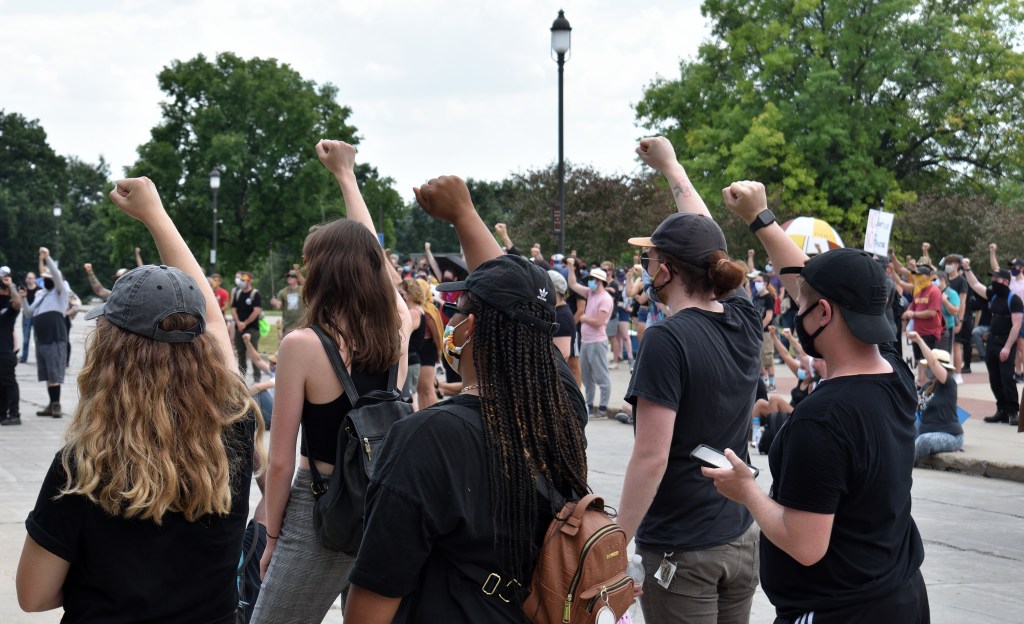
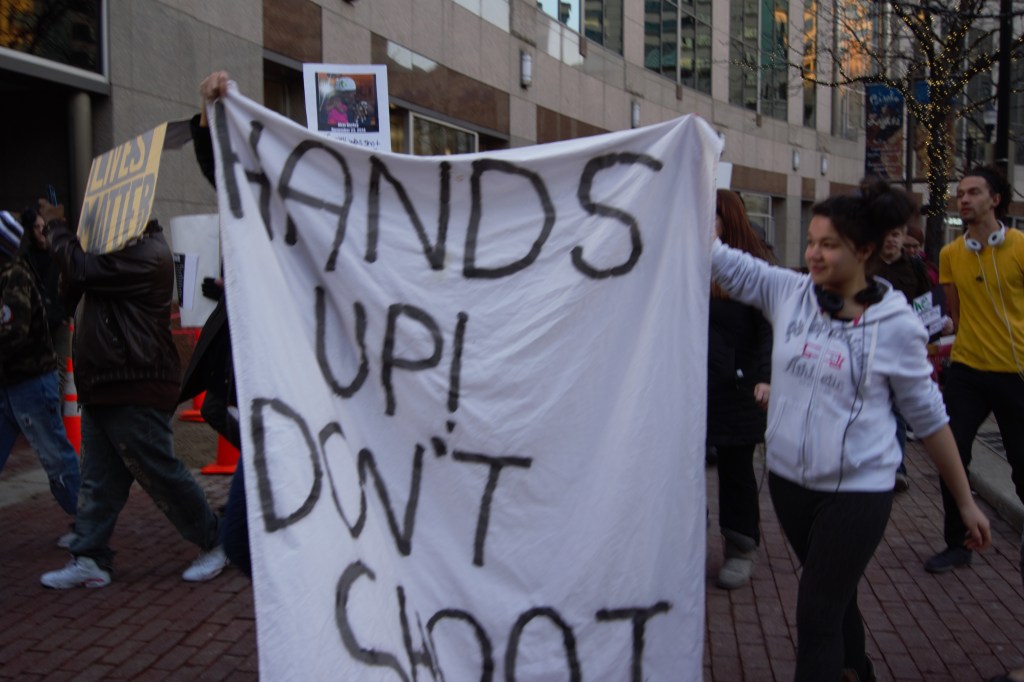
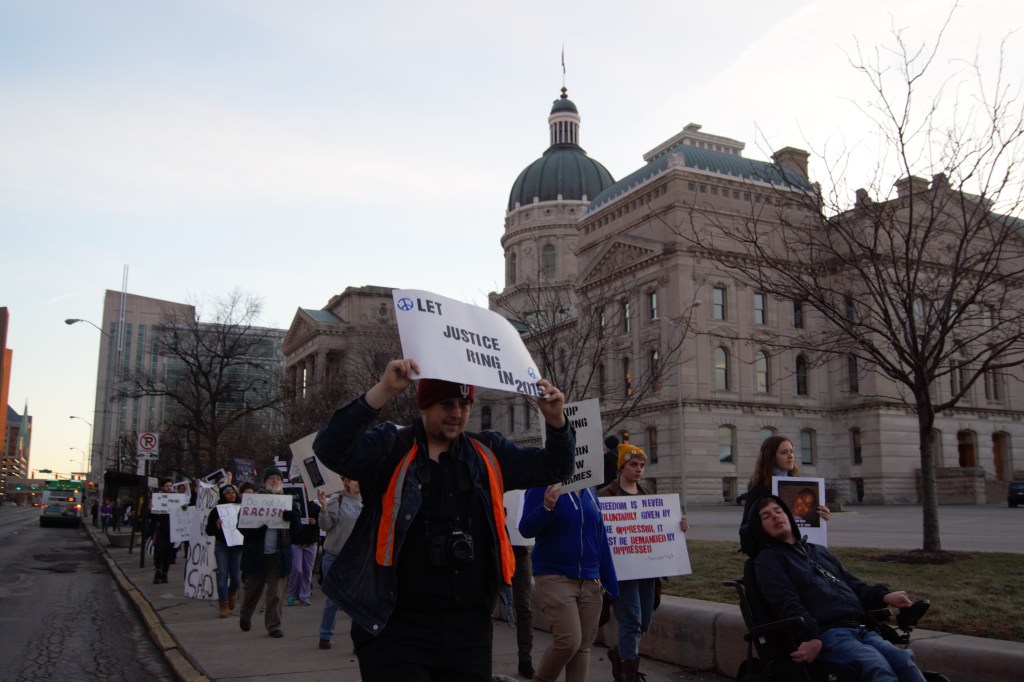
Sustained protests have occurred all over the country and around the world since the public killing of George Floyd by police in Minneapolis, May 25, 2020. The demonstrations represent anger from years of deaths of hundreds of people, disproportionately people of color, by police. Far too often of unarmed people. Protests against centuries of systemic racism, which began with the arrival of White European colonists.

The protests had been almost universally peaceful. That has been crucial to the increasing support for Black Lives Matter in this country.

Following are comments from Nahko Bear, talking to the Indigenous youth at Standing Rock. He warns the them not to respond when the police try to instigate violence. Because that would be used to justify the police moving in against the water protectors. I read that everyone who came to Standing Rock was required to attend training for nonviolent resistance.


Remember that nonviolent direct action is the way to a successful revolution. And that is a hard one, because they are so bad.  When they come at us you just want to hit ’em, you know?  Just sit with that.  I know it’s tough.  They’re going to try to do everything they can to instigate you.

But remember what we’re here for. We’re here to create peace for our Mother. We’re not here to create more violence.

Are you guys feeling proud, are you proud of yourselves?  Because the whole world is watching.  The whole world is watching.  So whatcha gonna do?  Gonna show love?  Are you gonna be smart?  You gonna think before you act?  Take care of each other?  Your gonna show ‘em what family does.  They don’t know what that’s like.

Nahko Bear at the Water Protectors Youth Concert, Standing Rock, Sept. 8, 2016

Nonviolent discipline began to break down in some places in the last few weeks. Specifically in Portland, Oregon, where the president ordered Federal law enforcement officers to the streets of the city. Officers in riot gear with assault rifles and shields. Who used tear gar. Officers without identification. Who detained people without explanation. Protesters have been thrown into unmarked vehicles. First amendment civil liberties flagrantly violated.

Why Portland? Why now? The president publicly stated he was sending these troops to “Democrat” cities. “Why now?” Because the approval of the president, and Republicans in general, is falling lower and lower due to their abject failure to respond to the COVID-19 pandemic in this country. They are looking for ways to distract people’s attention from those failures.

In the past, finding excuses to go to war with other countries has been used to gain political support for a president. I’ve been afraid that’s what this administration would try to do. Now we see they are trying to use armed conflict as a distraction, but the target of this conflict is us, the American people, peaceful protesters.

Unfortunately this distraction seems to be having a little success. Now the news is full of videos of conflicts with militarized police. Images that make it look like the protesters are violent. Now the president and Republicans are using those images, calling protesters anarchists. Fearmongering. Law and order. More accurately, martial law and order.

There are a number of questions about who is trying to instigate the violence.

My friend Ed Fallon did a good job of discussing these things on his weekly radio program, the Fallon Forum. I was honored that he read some of what I’ve written on this blog about nonviolence. The part about my writing begins at 13:42

The Fallon Forum http://fallonforumpodcast.s3.amazonaws.com/ff072720.mp3

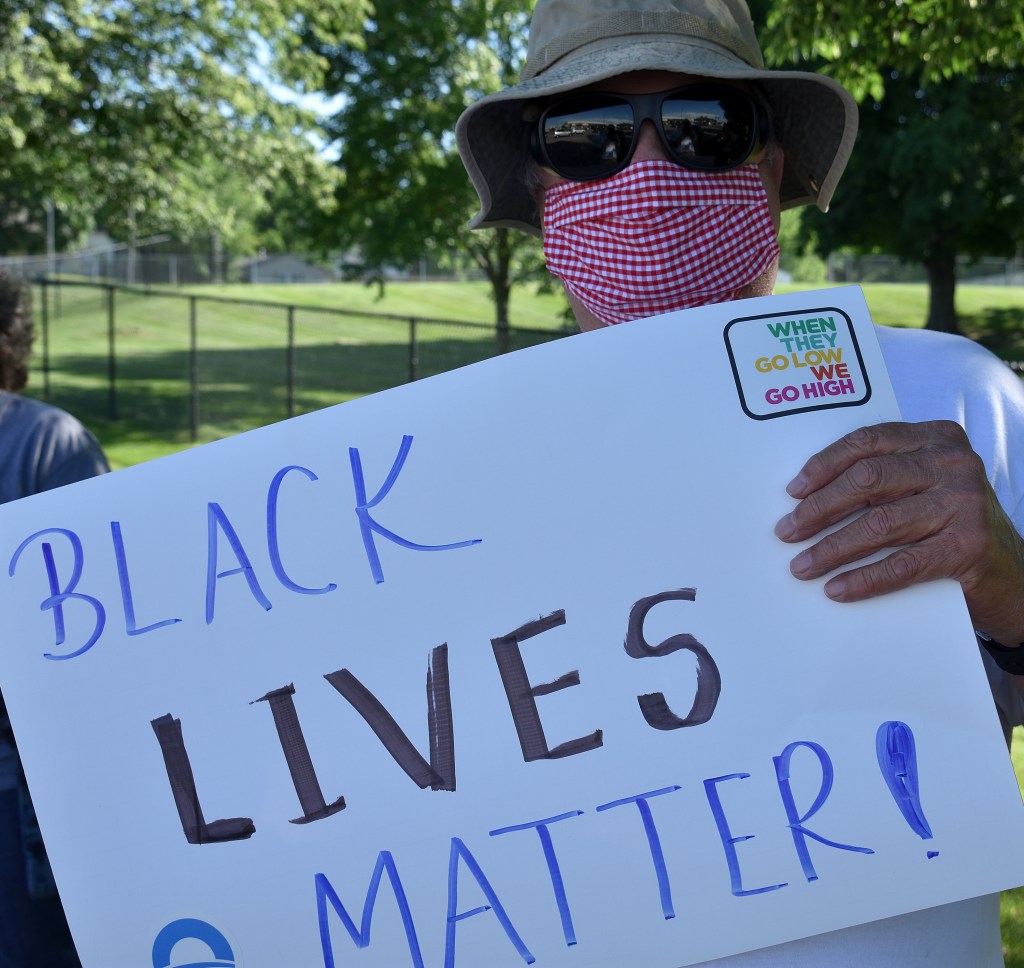
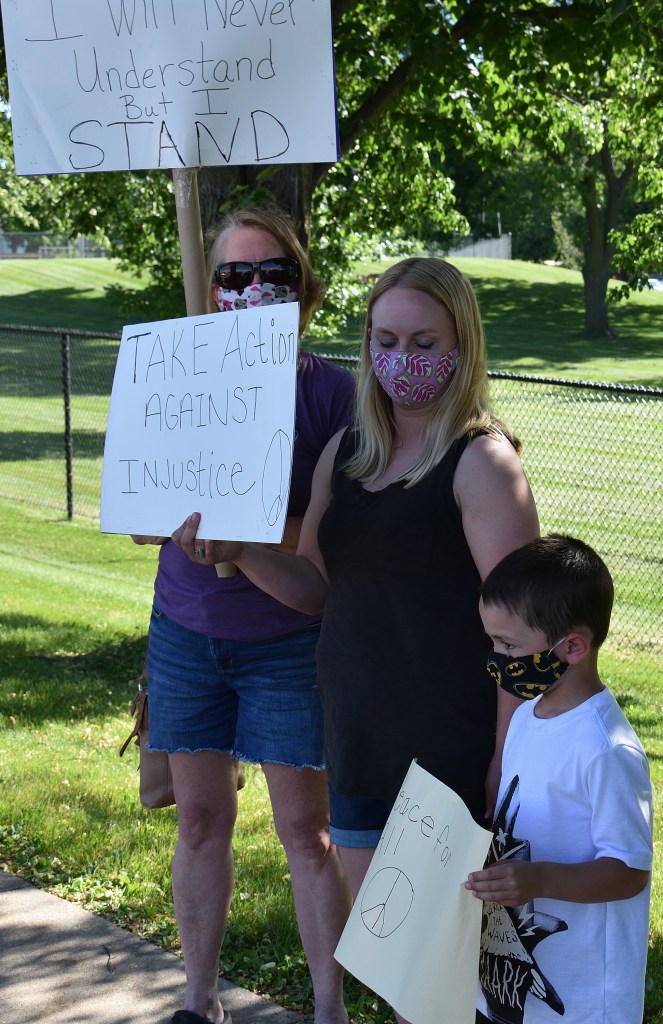
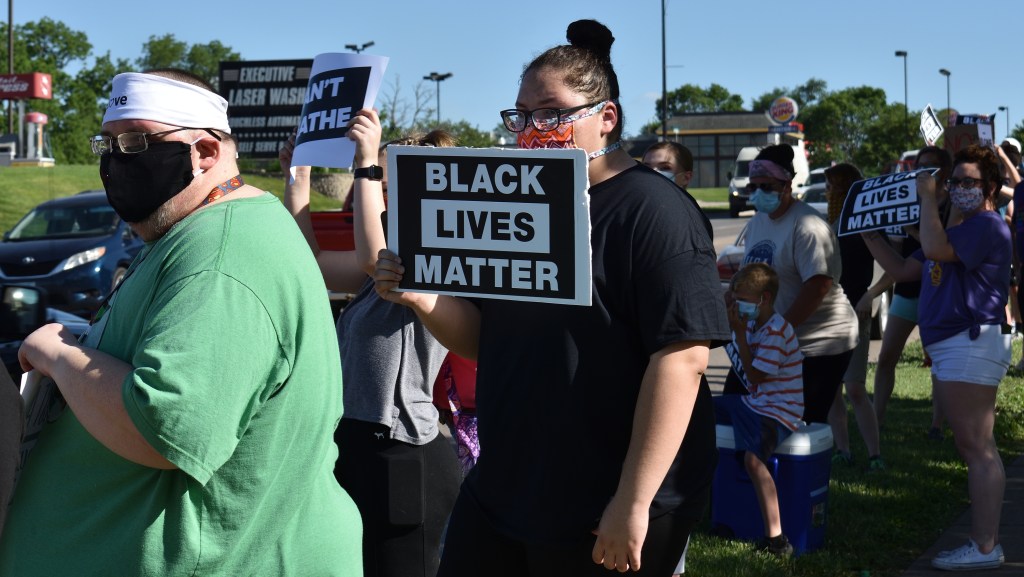
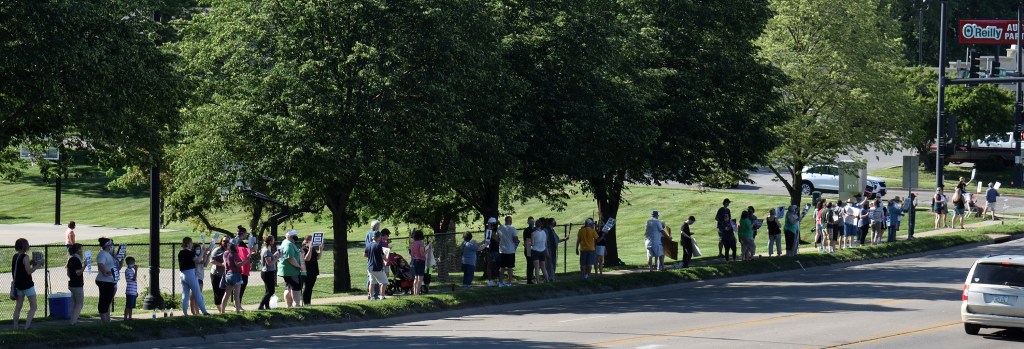
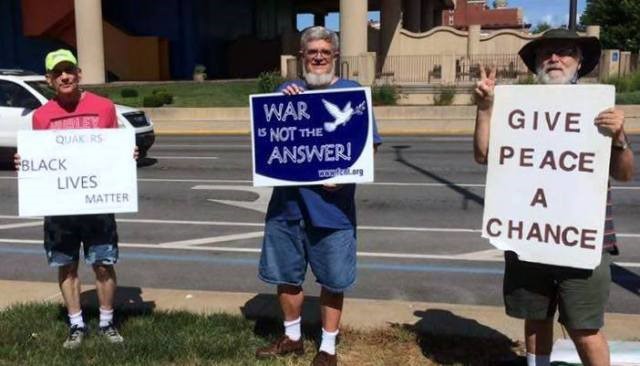
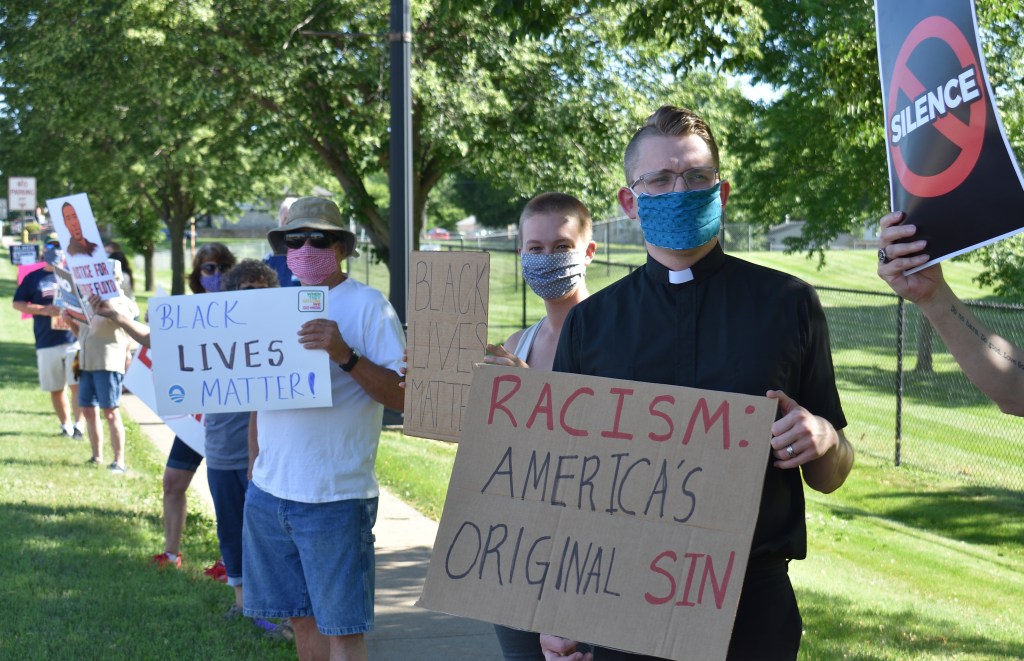
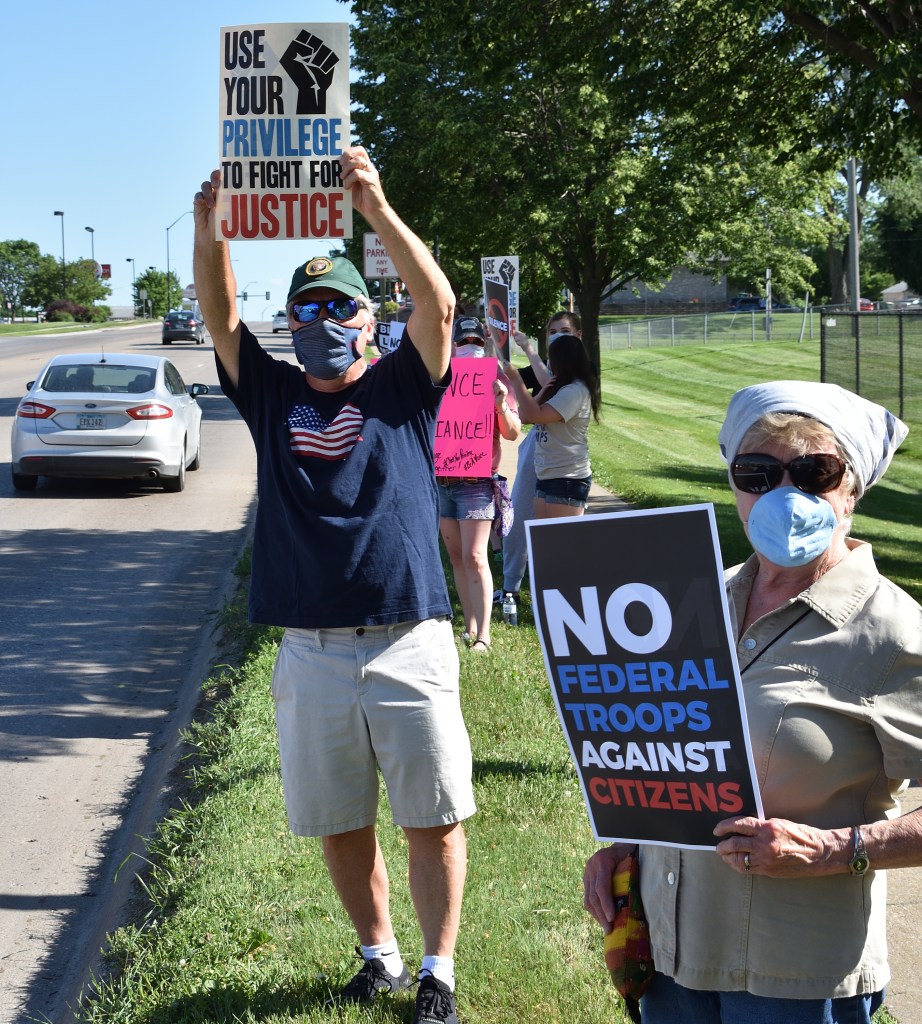
What can those of us who support peaceful protest do? These days the answer is more circumscribed than in the past. Public events like demonstrations carry the risk of acquiring COVID-19. Those in high risk categories should avoid public gatherings. For those who feel safe doing so, public rallies are one possible response. Some of the photos below are of a rally in Indianola, Iowa, where people are using face masks and trying to maintain some social distancing.

It might be helpful to review nonviolence and de-escalation theory and techniques, some of which is discussed in the the following article. There might be opportunities for you to teach those you are with about these techniques.

I think the best thing to do right now is to disengage from the police forces. Take away the excuse for state violence. Instead, use the time and energy to work on other avenues to reduce police abuse. To begin building beloved communities.


Posted in Black Lives, civil disobedience, race, Uncategorized | 1 Comment

De-escalation

I received some pushback regarding yesterday’s post, Non violence / No violence. The objections related to this:

As expressed in many ways in the following, the point of nonviolence is to de-escalate situations. The goal is to create a space, to step back from violence, so the underlying issues can be identified and addressed. It is up to the protesters to try to make this happen. Up to the protesters to refuse to react to the provocations.”

I think my mistake was to say the point of nonviolence is to de-escalate situations. Rather, civil disobedience is used to directly confront unjust decisions nonviolently. This can generate a certain amount of conflict. Training for nonviolent actions involves teaching how to deal with such conflict if it occurs by using de-escalating techniques.

The following is from the Keystone Pledge Participant’s Guide, which was used by the Rainforest Action Network (RAN) to train people to participate in nonviolent direct actions. This was how I was trained to be an Action Lead. And it was from this manual that I trained others to participate in local nonviolent actions.

Dealing with and de-escalating conflict 

An integral component of civil disobedience is directly confronting unjust decisions or actors. Often, this will involve a certain amount of conflict. This section is designed to keep you safe during instances of conflict and confrontation. It is more important to be safe and de-escalate conflict than it is to debate with agitated people about climate change or the Keystone XL Pipeline. 

Finding the courage to step up and act is the first step in de-escalation. The second step is to learn how to act in a disciplined, non-violent way, making intentional choices. 

Before entering into your action think about your intentions. Remember that in the heat of the moment, if you are prepared and have developed “muscle memory” on how to respond to conflict that you’ll be much safer and successful in your action. That’s why it’s so important to practice. 

Here are some tips on verbal and non-verbal communication in de-escalation: 

Body language– Keep your hands in front of your body with palms out. Put the center of your gravity in your stomach. Ground yourself. 

Eye Contact– Maintain limited eye contact.  Loss of eye contact may be interpreted as an expression of fear, lack of interest or regard, or rejection.  Excessive eye contact may be interpreted as a threat or challenge. 

Volume- How do we get someone to lower the volume in their voice? Listening. Matching their volume. “I can’t hear you.” “I want to understand what you are saying.” 

Speed, motion– De-escalation favors slower rather than faster. Smooth over choppy. 

Content– Introduce yourself. Clear. Compassionate. Non-judgmental. Humorous. “I want to understand what you are saying.” Refer agitated people to police or police liaison. 

Touch– Don’t touch unless a person’s hand is extended to you. Never touch the police, their vehicles, their equipment or their animals (horses, dogs). 

Keystone Pledge Participant’s Guide


Nonviolence is one of the core principles which is non-negotiable for everyone who wants to take action under the name of XR. De-escalation is a key skill for anyone involved in any action. It helps maintain nonviolent interactions and atmosphere.

XR’s nonviolence has both a strategic and ethical dimension: Strategically, nonviolence is an effective tool in mass mobilisations, as evidenced by social science research. Upholding nonviolent tension means actively creating a respectful culture and basis for trust whilst also exposing and confronting injustice. Ethically, XR takes the view that by undertaking the conscious, often challenging work of removing violence from the way we act and interact, we can connect more deeply and positively with each other and the world around us. Through this deliberate practice we can model, or ‘prefigure’, the future we hope to create.

Large Crowd and 1to1 Nonviolence & De-escalation Training, Extinction Rebellion

Philosophy of nonviolent security

  • Security has an eye out for the safety and well-being of everyone. They are looking for, and are prepared to deal calmly with unusual events and avoid unnecessary violence.
  • In any action, both escalation and de-escalation of conflict may be called for. Security works with these ebbs and flows, for the sake of the group, its message, and its overall goals.
  • De-escalation requires treating people with respect and dignity. Folks in security roles may have to be firm, in the interests of everyone’s safety, but shouldn’t be “bossy” or assume any authority over other protestors.
  • Security folks are centered in their own resilience; they leverage self-awareness for the safety and power of the group.

De-escalation tactics

  • Draw disrupters away from the crowd and out of attention.
  • Listen attentively to argumentative people, occupying their time, allowing the rest of the group to focus on action goals.
  • Move your group of protestors away from disrupters or create a neutral area between them.
  • Surround disrupters with de-escalators; link arms if necessary.
  • Invite the group of protestors in your group to sit down to help isolate a person.
  • Divert attention: Start singing a song, do something silly or funny, create some theater, pass out balloons or flowers.
  • In the event of violence against protestors (by police, for example, or an organized attack by counter demonstrators), remind people to cover their heads, don’t grab legs, etc, and help people make quick decisions for their safety.
  • Keep thinking creatively!

Training for Change. De-escalation and Nonviolent Security


Posted in civil disobedience, Extinction Rebellion, Keystone Pledge of Resistance, Uncategorized | Tagged | Leave a comment

Nonviolence / No violence

Protesters in the streets who are clashing with law enforcement are making a huge mistake. For weeks the public protests related to the killing of George Floyd and more broadly against police brutality and systemic racism were peaceful and there was little violence. Then the Federal administration deployed unidentified/secret police in riot gear, with assault weapons, to Portland, Oregon. The excuse given for their deployment was to protect Federal property, even though that hadn’t been a problem during the previous weeks of peaceful protest.

The only conclusion I can come to is these Federal police were sent to provoke the violent responses from the protesters. Unfortunately their efforts worked. The president is now referring to that violence as anarchy, and using these violent clashes to justify sending more secret police to more cities. He is making this a partisan issue by targeting “Democrat” cities. And we are now seeing Republican ads using video from these “riots” for fearmongering in hopes of improving the president’s low poll numbers as the election approaches.

The point of civil disobedience is to confront injustice nonviolently. That can generate a certain amount of conflict. The goal is to create a space, to step back from violence, so the underlying issues can be identified and addressed. It is up to the protesters to try to make this happen. Up to the protesters to refuse to react to the provocations. That is how we maintain the moral high ground. Nonviolence is a matter of us maintaining our discipline. We can look back on, for example, students sitting calmly at the segregated lunch counters, not reacting as they were taunted, as food was dumped on them. These are the things we remember. Not conflict and violence.

It is sad to see these failures to maintain discipline in the face of violence occurring at the same time we honor the life of John Lewis, who led the Student Nonviolent Coordinating Committee (SNCC). John Lewis who taught nonviolent tactics. And who used every opportunity to talk about love and creating beloved communities.

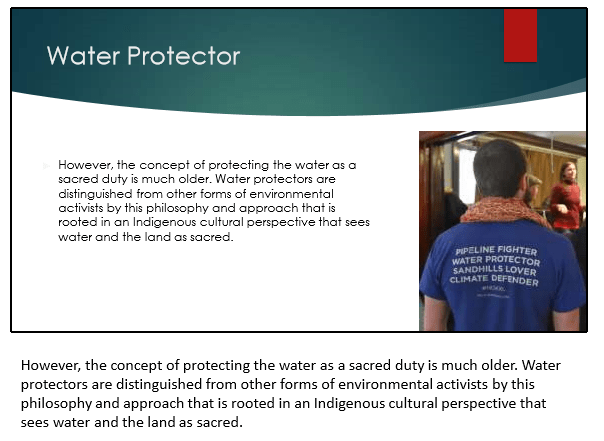
Language matters. Those working against pipelines call themselves water protectors, not protesters. That defined our work together as working for something, as opposed to against something. Using this language changed the orientation of the work, keeping attention on the concepts of nonviolence. What might be a new, nonviolent term for the current movement?

Following are a number of statements about nonviolence.

“One day we must come to see that peace is not merely a distant goal that we seek, but that it is a means by which we arrive at that goal. We must pursue peaceful ends through peaceful means.   

—Martin Luther King, Jr. 

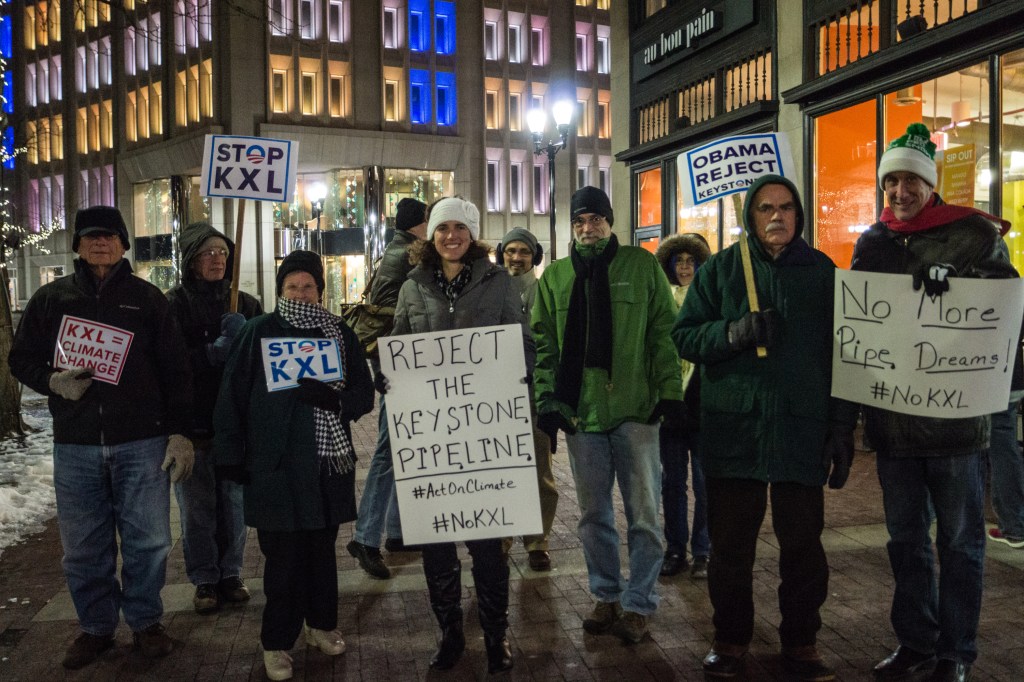
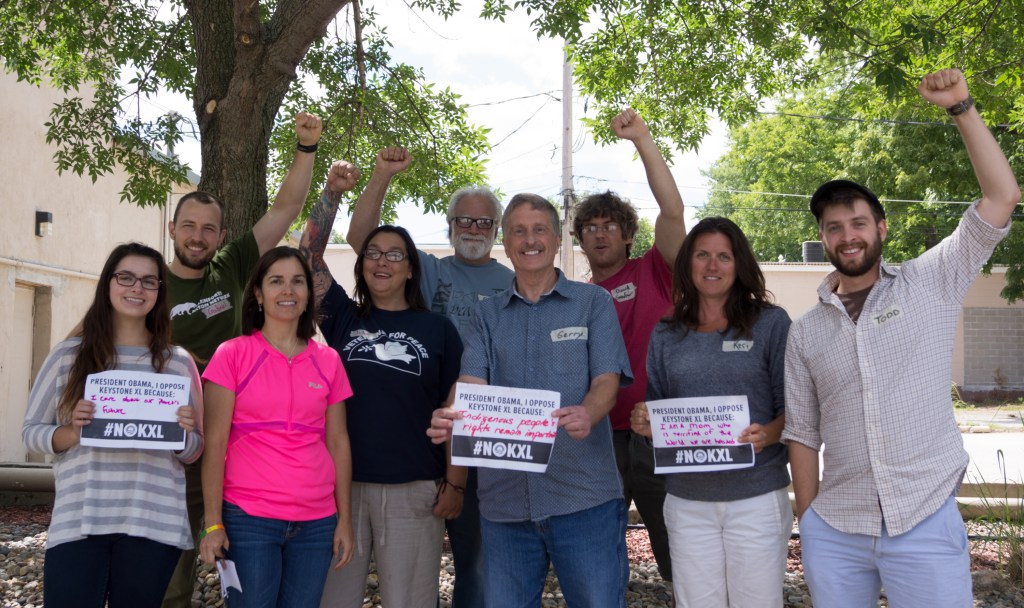
“I pledge, if necessary, to join others in my community, and engage in acts of dignified, peaceful civil disobedience that could result in my arrest in order to send the message to President Obama and his administration that they must reject the Keystone XL pipeline.”

Keystone Pledge of Resistance

You shouldn’t make this pledge lightly. We certainly don’t ask lightly. We ask in the belief that there are tens of thousands of people out there who feel as strongly about this as we do; who believe that these circumstances call for extraordinary action, and want to be part of that action in their community. And we ask with the faith that those who commit to participate and organize actions will participate only in the most dignified manner.

NON-VIOLENCE GUIDELINES AND PRINCIPLES 

  1. With the recognition that history is on our side in the fight against the fossil fuel industry, that we are a part of the proud and successful tradition of nonviolent civil disobedience, and that our actions also reflect on tens of thousands of others standing together across the country, we will conduct our behavior in only the most peaceful and dignified manner. 
  2. We are each firmly committed to the safety of all participants and the surrounding community, and will not bring with us any weapons, drugs or alcohol, or participate in any acts of vandalism or destruction of property. 
  3. We will work to protect everyone around us from insult or attack, including those who may oppose or disagree with us. 
  4. We will remember that irresponsible actions could endanger others, or lead to the arrest of people who do not want to go to jail, and will not use threatening language or threatening motions toward anyone. 
  5. We will act and communicate in a manner of openness, friendliness and respect toward everyone we encounter, including police officers and members of the community at large. 
  6. As members of this action, we will follow the directions of the designated organizers.
  7. If an individual has a serious disagreement with the organizers of the action, the individual will withdraw from the action. 
  8. If an individual does not respect these guidelines and principles, that individual cannot participate in an action as part of the Pledge of Resistance to the Keystone XL pipeline. 

Rainforest Action Network (RAN)


Code of Nonviolence (First Nation-Farmer Climate Unity March):

  • There will be no cursing, no displays of anger, and no destruction of property. We will cooperate with police officers and other public officials.
  • We will act with love, openness, compassion, and respect toward all who we encounter and their surroundings. We will not be violent in our actions, words, or toward any person or property.
  • We will act fairly and honestly with people regardless of the situation or the role they play.
  • We will remain calm and aware at all times.
  • We will keep a clear state of mind and refrain from the use of alcohol or drugs, other than for medical purposes. We will not have any illegal drugs or alcohol with us while marching or while in camp.
  • We will carry no weapons.
  • We will seek dialogue with those who may disagree with us. We will maintain a spirit of openness, friendliness, and respect toward all with whom we engage.

First Nation-Farmer Climate Unity March https://firstnationfarmer.com/


“Each time a man stands up for an ideal, or acts to improve the lot of others, or strikes out against injustice, he sends forth a tiny ripple of hope, and crossing each other from a million different centers of energy and daring, those ripples build a current that can sweep down the mightiest walls of oppression and resistance.”  

—Robert F. Kennedy 

“Nurturing hopes is meaningful in and of itself. It is worth working towards them, regardless of the outcome. When we make this shift away from the results, we will find greater courage to act on our own aspirations for the world. We will find our nobility of heart.” 

—the Karmapa 

“We must do what we conceive to be the right thing and not bother our heads or burden our souls with whether we will be successful. Because if we don’t do the right thing, we will be doing the wrong thing and we will just be a part of the disease and not a part of the cure.”    

 —E. F. Schumacher, Author of Small Is Beautiful  

Remember that nonviolent direct action is the way to a successful revolution.
And that is a hard one, because they are so bad (chuckles).  When they come at us you just want to hit ’em, you know?  Just sit with that.  I know it’s tough.  They’re going to try to do everything they can to instigate you. 

But remember what we’re here for. We’re here to create peace for our Mother. We’re not here to create more violence.

When you’re feeling bad, when you’re feeling frustrated, put all your prayer into your palms, put them to the ground, put them back to the sky, honor the Father, the Mother, just know it will be alright.

Are you guys feeling proud, are you proud of yourselves?  Because the whole world is watching.  The whole world is watching.  So whatcha gonna do?  Gonna show love?  Are you gonna be smart?  You gonna think before you act?  Take care of each other?  Your gonna show ‘em what family does.  They don’t know what that’s like.

You gotta put down the weight, gotta get out of your way. Get out of your way and just look around the corner at your real self and look at all the potential that this beautiful Earth and love has to offer you. 

Nahko Bear

Posted in #NDAPL, civil disobedience, Keystone Pledge of Resistance, peace, Uncategorized | Tagged | Leave a comment

All that we are is story

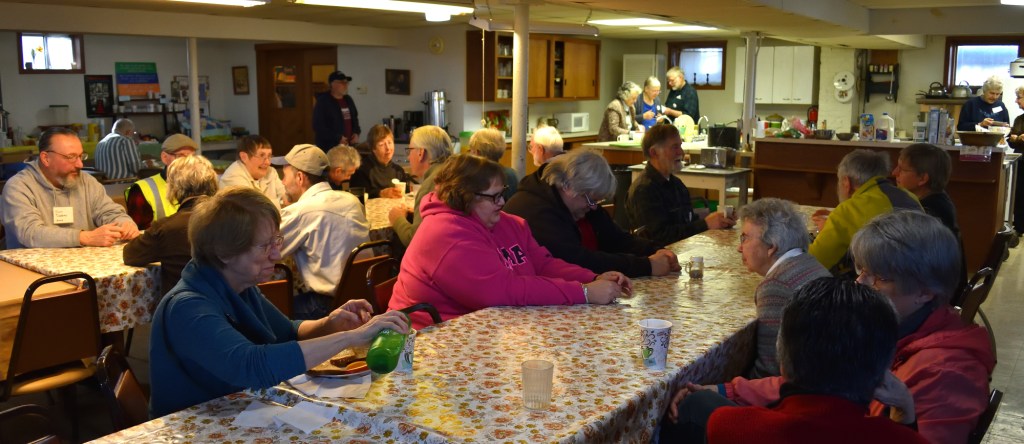
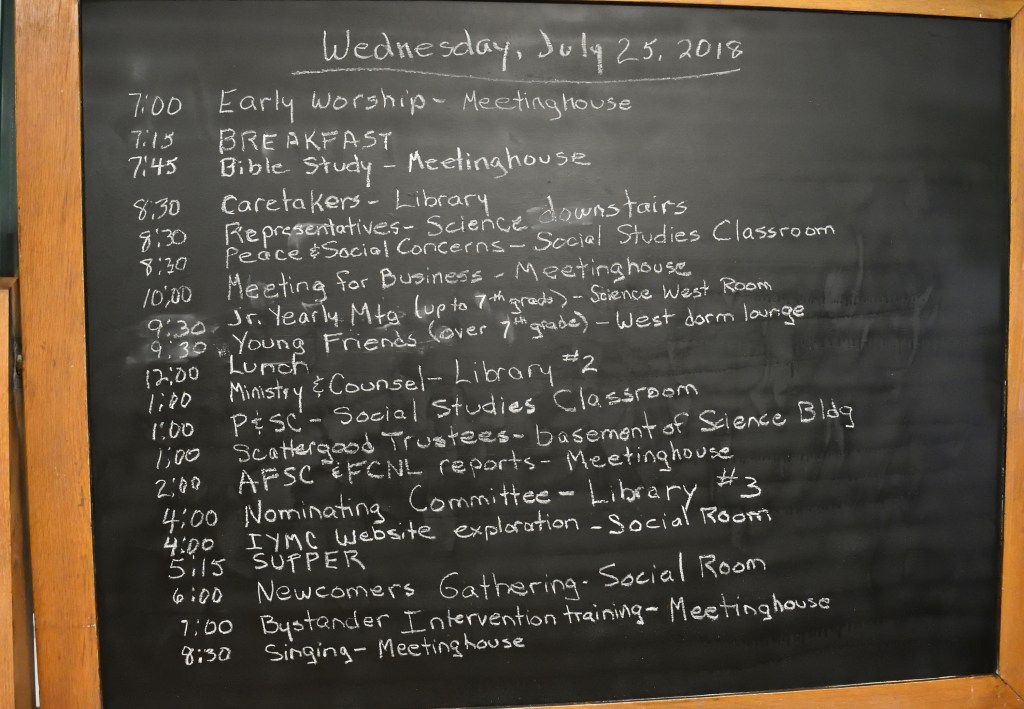
Iowa Yearly Meeting (Conservative) is holding our Annual Session this weekend. In this age of the COVID-19 pandemic, we, as so many others, are using Zoom (an online meeting app) to connect with each other. When we resume, we re-Zoom.

What I miss about not meeting face-to-face at Scattergood Friends School and Farm, where we usually meet, are exchanging stories of what has been going on in our lives. I have become increasingly aware of how important stories are. One of my favorite quotes is “All that we are is story” by Richard Wagamese. “We change the world one story at a time.”

ALL THAT WE ARE IS STORY

From the moment we are born to the time we continue on our spirit journey, we are involved in the creation of the story of our time here. It is what we arrive with. It is all we leave behind. We are not the things we accumulate. We are not the things we deem important. We are story. All of us. What comes to matter then is the creation of the best possible story we can while we’re here; you, me, us, together. When we can do that and we take the time to share those stories with each other, we get bigger inside, we see each other, we recognize our kinship — we change the world one story at a time.

Richard Wagamese (October 14, 1955-March 10, 2017) Ojibwe from Wabeseemoong Independent Nations, Canada

I enjoyed last night’s session of worship sharing. Worship sharing begins with a statement or question. Then those in the group take turns responding. Each response contains a story within. Often a story that others hadn’t heard before. People who have known each other a long time, get to know each other better. Especially spiritually.

I encourage us to create more opportunities for worship sharing. Not only among ourselves, but with others in our wider communities. The language used for wider participation needs to avoid expressions that others might not relate to.

During last night’s worship sharing, I expressed that I believe we are in a time of spiritual poverty. I think that should encourage us to share our spiritual gifts with others. Sharing our stories is the way we can do that. It is important to keep in mind that sharing is as much about listening deeply to the story you are being told as it is about telling your own story. As I have become more aware of this, I find I no longer care about sharing my experiences as much as I practice and enjoy listening to others’ stories. Actually, I’ve found that creating new relationships begins with encouraging the other person to share about themselves. When they see you are interested and paying attention to them, that creates an atmosphere where they will then want to hear your stories (maybe).

For some years we have been collecting Quaker stories. I would love to hear stories you might have to tell. We’re looking for more stories to add to this collection.

I think one thing we have to offer the world are stories about what was and might be. https://quakerstories.wordpress.com/

https://quakerstories.wordpress.com/

If we are to find a new kind of good life amid the catastrophes these myths have spawned, then we need to radically rethink the stories we tell ourselves. We need to dig deep into old stories and reveal their wisdom, as well as lovingly nurture the emergence of new stories into being. This will not be easy. The myths of this age are deeply rooted in our culture. The talking heads (even the green ones) echo these myths with the dogmatic fervour of zealots. They talk of “saving the planet” through transitioning to a “sustainable” future, primarily through new renewable energy technologies. They seem only able to conceive of a good life that mirrors our lives more or less as they are now, where the living standard continues to improve and rate of consumption continues to grow, yet somehow decoupled from all the pollution, destruction and guilt.

Pontoon Archipelago or: How I Learned to Stop Worrying and Love Collapse By James Allen, Medium, June 18, 2019.

We are our stories, stories that can be both prison and the crowbar to break open the door of that prison; we make stories to save ourselves or to trap ourselves or others, stories that lift us up or smash us against the stone wall of our own limits and fears. Liberation is always in part a storytelling process: breaking stories, breaking silences, making new stories.   ’

Rebecca Solnit, ‘Silence Is Broken’, in ‘The Mother of All Questions’

Following are five questions posed to us during our most recent Midyear Meeting of Iowa Yearly Meeting (Conservative) . I think telling our stories is pertinent to answers to several of these questions.

  • If we are called to change the world, as our Testimonies tell us, do we need to find like-minded people to work on solutions?  
  • Do Friends think it is God’s responsibility to decide who will find their way to our faith tradition?  
  • Do we as individuals and as a meeting, do enough to bring new people into our faith community? If not, why? 
  • When new people come into our community, do we have a way to help them understand our faith community transform our lives, and how Quaker history speaks to us today? 
  • Do we talk about our spiritual experience with one another, and when opportunities arise, with non-Quakers outside of our meeting?

One Quaker practice I really appreciate is the consideration of questions like these below. We refer to them as queries. There are twelve sets of queries, so each Quaker meeting discusses one set of queries each month. The various things people say to answer the questions are then summarized into a written response.

Our answers will likely be different in the face of the pandemic. Might help us live through it ourselves, and might help others as well.


ENVIRONMENTAL RESPONSIBILITY

  • What are we doing about our disproportionate use of the world’s resources?
  • Do we see unreasonable exploitation in our relationship ‑with the rest of creation?
  • How can we nurture reverence and respect for life?  How I can we become more fully aware of our interdependent relationship with the rest of creation?
  • To what extent are we aware of all life and the role we play? What can we do in our own lives and communities to address environmental concerns?

SOCIAL AND ECONOMIC JUSTICE

  • How are we beneficiaries of inequity and exploitation? How are we victims of inequity and exploitation? In what ways can we address these problems?
  • What can we do to improve the conditions in our correctional institutions and to address the mental and social problems of those confined there?
  • How can we improve our understanding of those who are driven to violence by subjection to racial, economic or political injustice? In what ways do we oppose prejudice and injustice based on gender, sexual orientation, class, race, age, and physical, mental and emotional conditions? How would individuals benefit from a society that values everyone? How would society benefit?

PEACE AND NONVIOLENCE

  • What are we doing to educate ourselves and others about the causes of conflict in our own lives, our families and our meetings? Do we provide refuge and assistance, including advocacy, for spouses, children, or elderly persons who are victims of violence or neglect?
  • Do we recognize that we can be perpetrators as well as victims of violence? How do we deal with this? How can we support one another so that healing may take place?
  • What are we doing to understand the causes of war and violence and to work toward peaceful settlement of differences locally, nationally, and internationally? How do we support institutions and organizations that promote peace?
  • Do we faithfully maintain our testimony against preparation for and participation in war?

Posted in Arts, climate change, peace, Quaker, Quaker Meetings, Uncategorized | 2 Comments

Let our lives speak for our convictions

The annual sessions of Iowa Yearly Meeting (Conservative) begin today. Because of the COVID-19 pandemic, our meetings this year will occur remotely using Zoom, a video and audio online meeting application. The following is from the Yearly Meeting’s website https://www.iymc.org/

Welcome to Iowa Yearly Meeting (Conservative)

Iowa Yearly Meeting (Conservative) includes monthly meetings, worship groups and preparative meetings in Iowa, Minnesota, Missouri, Nebraska, South Dakota and Wisconsin. All branches of the Religious Society of Friends (Quakers) share common roots in a Christian movement that arose in England during the middle of the 17th century. Conservative Friends are “conservative” in the sense that they tend to “conserve” the Friends tradition as it was believed and practiced in the mid-19th century. Among the principles which guide our faith are:

Most fundamentally, Friends perceive “that of God” in all persons. This living presence, experienced variously as the Inner Light, the Holy Spirit, the Inward Christ, and the Divine Center, enables a person to enter into intimate communion with God, without intermediaries. Friends are led, inspired, enlightened, or chastened as they come into the Light in prayer. God is Love, and each of us has a spring of that Love within to draw upon for strength, wisdom, and compassion.

By means of the Inner Light, a person can discern “Truth.” Its entirety is more than any one person can know, and human frailties limit and color the measure granted us. A greater understanding of Truth can be attained by sharing discernments with one another, always humbly aware that anyone may be mistaken or may, by God’s grace, bring to light the very Truth we seek.

from the Iowa Yearly Meeting (Conservative) website: https://www.iymc.org/

Our annual gatherings usually take place at Scattergood Friends School and Farm. Many of us attended this high school boarding school so it is like a reunion to return.

Many of those who attend Yearly Meeting serve on committees related to the work of a spiritual community, such as Ministry and Counsel, and Peace and Social Concerns.

We live in uncertain times. It is appropriate that the theme of the annual sessions this year is “Finding hope in troubled times.”

Quakers are about putting our spiritual beliefs and leadings into practice.
This morning I am strongly led to consider the following epistle (letter) that was signed by several members of our Yearly Meeting. Around the time this was written (circa 1960) I was a student at Scattergood Friends School. This epistle was an important influence on my decision to be a draft resister. But I often return to this eloquent statement about living our convictions. Much of our work as Quakers, and much of the business we will be considering at this Yearly Meeting, will relate to putting our beliefs into action.


An Epistle to Friends Concerning Military Conscription

It matters little what men say they believe when their actions are inconsistent with their words. Thus we Friends may say that all war is wrong, but as long as Friends continue to collaborate in a system that forces men into war, our Peace Testimony will fail to speak to mankind.

Let our lives speak for our convictions. Let our lives show that we oppose not only our own participation in war, but any man’s participation in it. We can stop seeking deferments and exemptions, we can stop filling out Selective Service forms, we can refuse to obey induction and civilian work orders. We can refuse to register, or send back draft cards if we’ve already registered.

In our early history we Friends were known for our courage in living according to our convictions. At times during the 1600’s thousands of Quakers were in jails for refusing to pay any special respect to those in power, for worshiping in their own way, and for following the leadings of conscience. But we Friends need not fear we are alone today in our refusal to support mass murder. Up to three thousand Americans severed their relations with the draft at nation-wide draft card turn-ins during 1967 and 1968. There may still be other mass returns of cards, and we can always set our own dates.

We may not be able to change our government’s terrifying policy in Vietnam. But we can try to change our own lives. We must be ready to accept the sacrifices involved if we hope to make a real testimony for Peace. We must make Pacifism a way of life in a violent world.

We remain, in love of the Spirit, your Friends and brothers,

Don Laughlin, Roy Knight, Jeremy Mott, Ross Flanagan, Richard Boardman, James Brostol, George Lakey, Stephen Tatum, Herbert Nichols, Christopher Hodgkin, Jay Harker, Bob Eaton, Bill Medlin, Alan & Peter Blood.


Posted in Quaker, Quaker Meetings, Uncategorized | Tagged | Leave a comment

SHIFT the Narrative 7/23/2020

Today was another excellent episode of the SHIFT the Narrative series.

Christine Nobiss and S.A. Lawrence-Welch discussed issues surrounding voter engagement and what that means to People of the Global Majority. “This is another interactive episode where we want to talk to our community about experiences with political engagement and what expectations are for not only the 2020 Presidential Election, but for local and state governments. We’ll also talk about our own efforts to turn out the vote for Indigenous folx in 2020 and beyond!”

Following are the notes I took while listening to today’s episode. You can see videos of the previous episodes of SHIFT the Narrative here: https://seedingsovereignty.org/shift-the-narrative

Need Federal, legislative change.

We need to infiltrate the system that does not work well for us.

“Do you want to vote?”

They know we have power in our vote and they don’t want to see that.

Other Indigenous people pull back and don’t engage the political system.

Christine “I believe we can do both.”

We care deeply for our many friends who are going through so much on the front lines.

This incremental stuff is getting to be too much for me.

SA Lawrence-Welch.  “Burn it all down” (an expression of how some people feel)

We both reside within the borders of this country but neither of us can vote here.
So many are just in survival mode.  Have no energy left for politics.

This is all Native land.  There is an onus on us to speak up for the land.

Incremental change is stifling

Start with dialog so we can come up with solutions.

What does voter engagement mean to the people of the world majority.

Federal, state, local engagement.

SA in Portland.  Discouraging to see people punished for expressing political rights. For me it is emotional because I see people being hurt. (Portland)

Christine: I’m a huge proponent of this idea that’s been in my head for years about how we engage with this issues on the front lines  (Mission statement)
Indigenous Folx
Creating Radical Change
In a time of climate crisis, Seeding Sovereignty; an Indigenous womxn-led collective, works on behalf of our global community to shift social and environmental paradigms by dismantling colonial institutions and replacing them with Indigenous practices created in synchronicity with the land.

The land is at the center of every issue we face as Indigenous people. When we are working on environment crises, when we are looking about funding for healthcare, schools

Protection and land management is the deeply rooted ancestral ties to make these changes across the board if we understand the land we are on, appreciated there have been generations and eons of work that build beautiful communities.

We have already faced our apocalypse. So have Black people.  We faced so much worse in the past.

Authority Native people have from the land. We can teach.

It hurts my heart that we are navigating political choices while in the midst of a pandemic.

Vote by mail

                People repressed by restrictions.

                Indigenous turnout has been low.  Some say 35% not registered-Christine thinks more than that

                Why low turnout?

           Don’t trust the system, disenfranchisement,

Native people didn’t become citizens in 1924

                Civil rights movement and Red power movement in 1960’s

                Late to get to the point where we can begin to influence for our OWN good

                Our people are much more vulnerable related to COVID-19

                                Highest rates of diabetes in the world

Vote by mail is a necessity for us

                Many Indigenous don’t use postal mail system or have addresses.

                Money for gas, time off work.  26.6% poverty rate

                Housing crisis. Overcrowding.  Multiple generations per home.

                Not having “static” address

                A lot of movement within the communities is cultural

                “Red lining”  requiring static address for mail/ballot

                How to understand why a PO Box is not acceptable

                Voter suppression

                                In person registration vs not in person—have to match signature

                Voting by mail is not easy under any circumstances

                Some states all mail in vote Colorado, Oregon, Washington, Utah, Hawaii

                                Some other states require a reason why can’t vote in person

                                In other states people can request mail in ballot without needing an excuse.

                Polling stations on reservations. 

Great distances to travel to polling places currently

                Disenfranchised/poverty affect all this

What organization on forefront of Indigenous voting?

                Unify people, show we have numbers
                About 5 million identifying native folks

In Census must say Indigenous only. Otherwise default to white or black

Native vote 2020   4 Directions

Nativevote.org

NARF

MCIA  (MCAI)?

To overcome mail in problems:  Not easy

                Need tribes and intercity community centers to provide address and accept ballots
                TRANSPORTATION 

Number 1 thing to get people out to vote are relatives)

                T shirts, etc to encourage voting.  Community of people support same things.

                Being a person in your community who advocates for local issues.  E.g. NoKXL. 

Need candidates that advocate for US.

                Remember-also voting for local

”I don’t think anyone throws away their vote.”  SA

Tribes should have representatives in Congress.

New Project  August 1, 2020 RadicalizeTheVote.org   

“Radicalize the vote.”   Accessible way for people to register to vote.  SHIFT the Narrative.

We’re here and this is what we want.  We are stewards of the land.

City hall, PTA

Elders among most disenfranchised. English.  Digital divide. Need to empower and lift up our elders.  Help them figure these things out.

We should be unifying for real change. Will affect future generations

Curb side voting

 NARF Native American Rights Fund

Need national resources for voting 

Continue SHIFT the Narrative, SHIFT the Youth, SHIFT Plus

Scary times for us if let things continue the way they are going

Millennials soon to be largest demographic.  IMPORTANT to get into voting.

Take energy and passion from being on the front lines to get out the vote. GOTV


Posted in #NDAPL, decolonize, Indigenous, Native Americans, Seeding Sovereignty, Uncategorized | Leave a comment