A few days ago I wrote “I’ve been sitting here for a long time, hoping the Spirit would show me what to write, what to say about the unmarked, undocumented burial site, with the remains of 215 Indigenous children, that was recently discovered at a former residential school in British Columbia. I honestly can not comprehend how these things happened. And continue to happen today when Native children are taken from their families by government social services.”
The horror is compounded by having some idea of how many of these atrocities occurred across the lands called the United States and Canada. Knowing the numbers of those subjected to, severely damaged from, killed, or committed suicided as a result of these atrocities are much greater than we yet know. And the damage impacts subsequent generations, those living today.
I’m still waiting for the Spirit show me the way, to tell me what I can do.
I am so stricken by these atrocities that I don’t know if I can face my Native friends.
Those who are affected by tragedies like this should be the ones to tell the story.
Following is a press release from the Kamloops Indian Band related to the unmarked burial sites of Kamloops Indian Residential School students.
And the Introduction to the report referenced in the press release, Where are the Children buried? “This report addresses the question where deceased Indian Residential School (IRS) students are buried.”
Kamloops Indian Band FOR IMMEDIATE RELEASE Statement from the Office of the Chief, Kukpi7 Rosanne Casimir
5 pm, May 31, 2021, Kamloops – As the last logs go on our sacred fire, I want to extend my heartfelt gratitude for the outpouring of support to our community. Thank you for helping us bring to light such hard truths that came from the preliminary findings regarding the unmarked burial sites of Kamloops Indian Residential School students so that we may begin the process of honouring the lost loved ones who are in our caretaking. We love, honour, and respect these children, their families, and communities.
To the Prime Minister of Canada and all federal parties, we acknowledge your gestures, but as a community who is burdened with the legacy of a federally mandated Indian Residential School, Canada must face ownership and accountability to Tk̓emlúps te Secwépemc as well as all communities and families. Our community is still gathering all the facts in this evolving tragedy. We will keep you informed as more information comes to light.
We have heard from many survivors, from our own community and beyond. They are finally being heard after so many years of silence and disbelief about the deaths of children in the residential schools. No words are sufficient to express the comfort and love we wish to extend to survivors and intergenerational survivors. We see you, we love you, and we believe you. We are thankful to the many who are working hard with us to ensure supports are there as you come to terms with these latest findings as well as your own truths and traumas.
We are deeply disturbed to learn that the Saint Joseph’s church was vandalized. The church was built from the ground up by Tk̓emlúps te Secwépemc members. We understand the many emotions connected to a Roman Catholic run residential school. At the same time, we respect the choices that Tk̓emlúps te Secwépemc ancestors made, over a 100 years ago, to erect this church.
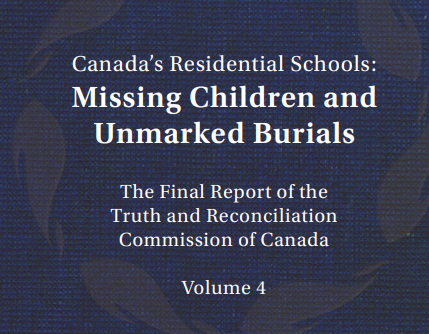
Regrettably, we know that many more children are unaccounted for. We have heard that the same knowing of unmarked burial sites exists at other former residential school grounds. It was something that the TRC raised in the early days of their work. However, it was not part of their original mandate. The TRC sought for it to be included and were turned down twice by the federal government. That said, the TRC was nonetheless able to do some important work on the topic and we encourage you to revisit Canada’s Residential Schools: Missing Children and Unmarked Burials: The Final Report of the Truth and Reconciliation Commission of Canada, Volume 4 (see Executive Summary below)
For further important context, we also direct your attention to the report “Where are the Children buried?” completed by Dr. Scott Hamilton. The report “addresses the question where deceased Indian Residential School (IRS) students are buried. This is difficult to answer because of the varying circumstances of death and burial, coupled with the generally sparse information about Residential School cemeteries. It requires a historic understanding of school operations that contextualizes the patterns underlying death and burial.”
We ask all Canadians to reacquaint themselves with the Truth and Reconciliation Commission Final Report and Calls to Action – upholding the heavy lifting already done by the survivors, intergenerational survivors, and the TRC. In addition, to show your solidarity, we encourage you to wear an orange shirt and start conversations with your neighbours about why you are doing so.
Tk̓emlúps te Secwépemc is now accepting donations that will automatically be deposited into a separate account set up for this initiative. The email is: donations@kib.ca There is no other fundraising initiative that Tk̓emlúps te Secwépemc has authorised or is participating in at this time.
Media – please respect our need to attend to our loved ones, to the ceremonies and protocols required at this time. Defer from visiting our community until further notice. We are grieving these lost children that are in our care. During this time of pandemic, we do not wish to have a tragedy upon a tragedy. We are concerned for the well being of all with the growing crowds that are coming to our community. We have yet to suffer a loss due to COVID-19 and we also want to ensure that anyone who comes to our community is not put at risk either.
Following is the Introduction to the report referenced above.
Where are the Children buried?
Dr. Scott Hamilton Dept. of Anthropology, Lakehead University Thunder Bay, Ontario shamilto@lakeheadu.ca
Introduction
This report addresses the question where deceased Indian Residential School (IRS) students are buried. This is difficult to answer because of the varying circumstances of death and burial, coupled with the generally sparse information about Residential School cemeteries. It requires a historic understanding of school operations that contextualizes the patterns underlying death and burial. When documentation is insufficient, this historical perspective also aids prediction which former school sites are most likely to be associated with cemeteries. Also important is identifying the locations of the former schools as precisely as possible (an issue complicated by the fact that some schools were rebuilt in various locations under the same name), and then seeking out physical evidence of a nearby cemetery (or cemeteries). In some cases information is readily available, but in others there was little to be found in the available archival documents. In those situations attention shifted to an internet-based search, coupled with examination of maps and satellite images. This report concludes with recommendations how to address the gaps in our current knowledge about school cemeteries, and how best to document, commemorate and protect them.
The Truth and Reconciliation Commission of Canada’s “Missing Children and Unmarked Burials Project” is a systematic effort to record and analyze the deaths at the schools, and the presence and condition of student cemeteries, within the regulatory context in which the schools were intended to operate.
The project’s research supports the following conclusions:
• The Commission has identified 3,200 deaths on the Truth and Reconciliation Commission’s Register of Confirmed Deaths of Named Residential School Students and the Register of Confirmed Deaths of Unnamed Residential School Students. • For just under one-third of these deaths (32%), the government and the schools did not record the name of the student who died. • For just under one-quarter of these deaths (23%), the government and the schools did not record the gender of the student who died. • For just under one-half of these deaths (49%), the government and the schools did not record the cause of death. • Aboriginal children in residential schools died at a far higher rate than school-aged children in the general population. • For most of the history of the schools, the practice was not to send the bodies of students who died at schools to their home communities. • For the most part, the cemeteries that the Commission documented are abandoned, disused, and vulnerable to accidental disturbance. • The federal government never established an adequate set of standards and regulations to guarantee the health and safety of residential school students. • The federal government never adequately enforced the minimal standards and regulations that it did establish. • The failure to establish and enforce adequate regulations was largely a function of the government’s determination to keep residential school costs to a minimum.2 • Truth & Reconciliation Commission • The failure to establish and enforce adequate standards, coupled with the failure to adequately fund the schools, resulted in unnecessarily high death rates at residential schools.
I’ve been sitting here for a long time, hoping the Spirit would show me what to write, what to say about the unmarked, undocumented burial site, with the remains of 215 Indigenous children, that was recently discovered at a former residential school in British Columbia. I honestly can not comprehend how these things happened. And continue to happen today when Native children are taken from their families by government social services.
I’m glad a friend sent me the following message. I hope to stay all the way in my lane. From the recent statistics, I noticed people have been searching for things related to Quakers and residential schools from blog posts I’ve written in the past. This has long been a deep concern of mine. I see my lane being engaging with Quakers about these things. “And be ready to listen when we come full with our voice.“ quaker Indigenous boarding schools.
Unless your ass is Native to Turtle Island, please stay all the way in your lane regarding the residential school remains found in Canada. We don’t need your voice, your fresh take, or your perspective on the why and the how. We can speak for ourselves. Share our words, and take a whole damn seat. This horror was not an “act of racism”, it was genocide. Genocide you benefit from daily. It was about the land, land you occupy. We deserve to have the whole conversation, on our terms. Not the ones you’re comfortable with. Not the conversation that validates your position. Let us grieve in the way we do – and be ready to listen when we come full with our voice.
Ninga Odé
The discovery of the remains of 215 Indigenous children at a former residential school in British Columbia prompted outpourings of grief and questions as efforts to identify the students began.
An earlier version of this article referred incorrectly to the burial site discovered at Kamloops Indian Residential School as a mass grave. The Tk’emlúps te Secwépemc First Nation says the remains were found spread out; it considers it an unmarked, undocumented burial site, not a mass grave. The article has been corrected.
Discovery of remains of Indigenous children prompts grief and questions in Canada by Antonia Noori Farzan, Washington Post, May 29, 2021
In this country called the United States, there were many such residential schools, where forced assimilation and cultural genocide was government policy. Schools where more than 100,000 Native children attended, where often the same abuses and deaths occurred.
President Grant saw the residential schools as a solution to Indigenous resistance to the westward movement of white settler colonists.
Beginning with the Indian Civilization Act Fund of March 3, 1819 and the Peace Policy of 1869 the United States, in concert with and at the urging of several denominations of the Christian Church, adopted an Indian Boarding School Policy expressly intended to implement cultural genocide through the removal and reprogramming of American Indian and Alaska Native children to accomplish the systematic destruction of Native cultures and communities. The stated purpose of this policy was to “Kill the Indian, Save the Man.”
Between 1869 and the 1960s, it’s likely that hundreds of thousands of Native American children were removed from their homes and families and placed in boarding schools operated by the federal government and the churches. Though we don’t know how many children were taken in total, by 1900 there were 20,000 children in Indian boarding schools, and by 1925 that number had more than tripled. The U.S. Native children that were voluntarily or forcibly removed from their homes, families, and communities during this time were taken to schools far away where they were punished for speaking their native language, banned from acting in any way that might be seen to represent traditional or cultural practices, stripped of traditional clothing, hair and personal belongings and behaviors reflective of their native culture. They suffered physical, sexual, cultural and spiritual abuse and neglect, and experienced treatment that in many cases constituted torture for speaking their Native languages. Many children never returned home and their fates have yet to be accounted for by the U.S. government.
For the past five or six years I’ve searched for and found opportunities to be engaged with and learn from Indigenous peoples. This grew out of working together to bring attention to the Dakota Access pipeline (DAPL) in Indianapolis, beginning in 2016. I felt a deep spiritual connection from the beginning of these interactions.
I’ve struggled my whole life to try to bring attention to the dangers of fossil fuels and greenhouse gases. As a Quaker I had been taught the way we create social change is by living according to our beliefs. To be an example to others. For the past forty years living without a car was my example. Much to my dismay, that didn’t convince anyone else to give up their car. So I was very grateful for opportunities to spend time with Native people, whose lives are examples of living within the ecological boundaries of Mother Earth.
I wanted to strengthen spiritual bonds between Native people and myself. Which meant trying to find appropriate ways to share my Quaker faith. I use writing on this blog as a way to explore my spirituality. But that wasn’t something Native people read, at first.
In the fall of 2018 I was blessed to participate on the First Nation-Farmer Climate Unity March. As the name implies, the idea was for a group of Native and non-native people to get to know each other, so we could work on things of common concern. It was a small group of about 15 Native and 15 non-native people. We walked and camped together over eight days, along the path of the Dakota Access pipeline, 94 miles from Des Moines to Fort Dodge, Iowa. During the hours walking together, mainly on quiet, rural roads, we shared our stories with each other. That, and the challenges of physical exertion, blisters, and walking through pouring rain, standing in a circle and offering prayers every time we crossed the pipeline, was a really effective way to create community among us. We became friends, and there have been multiple occasions since when we’ve worked together. As one example, several of us spent an hour with Iowa Senator Chuck Grassley’s staff in Des Moines, talking about legislation related to Native concerns.
Another result of becoming friends has been the opportunity to share my blog posts on Facebook groups that some of my new friends do read. Likewise, now I know where to find their writings. Indigenous Led | Great Plains Action Society is one. These became one way to continue to remain in touch with each other.
I hope it gives you some context for the subject of this blog post, the Quaker Indigenous Residential/Boarding Schools. The schools are referred to as either residential or boarding schools. Not nearly all of those schools were run by Quakers, but for several reasons many were. If you haven’t looked into this yourself, I imagine you think, as I did, that these schools were helping Native children learn how to adapt to the White society that had taken over their lands. Unfortunately that could not be further from the truth.
Quaker Indigenous Boarding Schools
More than 100,000 Native children suffered the direct consequences of the federal government’s policy of forced assimilation by means of Indian boarding schools during the nineteenth and twentieth centuries. Their bereft parents, grandparents, siblings, and entire communities also suffered. As adults, when the former boarding school students had children, their children suffered, too. Now, through painful testimony and scientific research, we know how trauma can be passed from generation to generation. The multigenerational trauma of the boarding school experience is an open wound in Native communities today.
What does this history mean to us, as Friends, today?
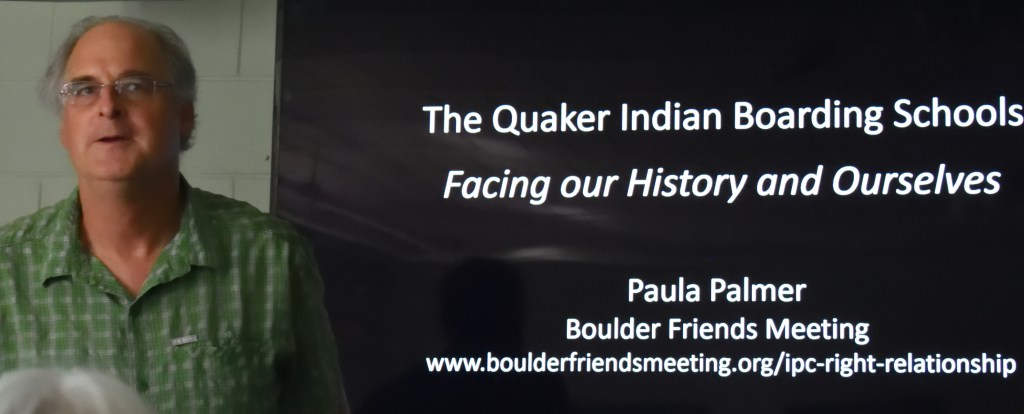
This question is not for me to answer, but to pose to Friends for individual and collective discernment. It is clear that Quakers were instrumental in promoting and implementing the forced assimilation of Native children. Through a lens of European Christian superiority, Quakers tried to remake Native children in their own image. In their writings, I found no appreciation for what the children would lose in this process. “For their own good,” the children would be raised by Quaker teachers (removed from their own families and kinship relationships), receive English names (lose their family lineage), speak English (lose their Native languages), wear “citizens’ dress” (lose the beautiful and skillful art and handiwork of their tribes), become farmers and homemakers (lose the hunting and gathering knowledge of the land and ecology), and aspire to European lifestyles (lose competence in their own cultures and pride in their Native identities).
From our twenty‐first‐century vantage point, we know (or can learn) how Native people suffered and continue to suffer the consequences of actions that Friends committed 150 ago with the best of intentions. Can we hold those good intentions tenderly in one hand, and in the other hold the anguish, fear, loss, alienation, and despair borne by generations of Native Americans?
Native organizations are not asking us to judge our Quaker ancestors. They are asking, “Who are Friends today? Knowing what we know now, will Quakers join us in honest dialogue? Will they acknowledge the harm that was done? Will they seek ways to contribute toward healing processes that are desperately needed in Native communities?” These are my questions, too.
So what do we do as 21st-century American Quakers? How do we bring our values of peace, community, and equality to the truth of what our ancestors did? Palmer is working on that, too. Learning our part is surely the first step; owning it, the second. And after that, we must work to make sure we aren’t doing it again with our missions and projects on reservations and elsewhere in the US and beyond in South America and the Great Lakes region of Africa. And more to the question of what do we do in our everyday lives; we each seek the Light of God in our prayer and meditation and in the silent expectant waiting of worship with Friends. And then we bravely do as we are led.
Hopefully that explains why I felt there was one thing I had to do as I began to develop these friendships. I had to confront, within myself and then with my new friends, Quaker history related to Native peoples. Quakers were among those who taught at the Native boarding schools that were created to assimilate native children into White culture. Forced assimilation, since these children were often forcibly removed from their families. All kinds of significant trauma occurred. Trauma to the children and to their families and communities. And that trauma has been passed from generation to generation. Examples below illustrate what Paula Palmer said above, that the “multigenerational trauma of the boarding school experience is an open wound in Native communities today.”
Many Quakers are very uncomfortable about examining this history. One reason is it doesn’t fit with the idea of Quakers doing good in the world. But that is the reason I’m bringing this up now. Too many times Quakers and other social justice people have used the approach of implementing a solution they have come up with, often with little or no input from those they want to help. And they think they should lead the implementation their solution. That approach never works, and the Native residential school is an example of the grave dangers of that approach.
At first I wasn’t sure how much my Native friends knew about the indigenous boarding schools. Which shows my ignorance because they not only knew about those schools, but had their own experiences today related to the trauma that originated in the past. So there was no way we could get to know and trust each other if I didn’t acknowledge that somehow.
The following story occurred during the First Nation-Farmer Climate Unity March that I mentioned above.
It didn’t take too many hours of getting to know Matthew when the Spirit led me to say to him, “I know about Quakers’ involvement in the Native boarding schools. I’m sorry they did that.” I was apprehensive about whether I should have said that, whether that was appropriate or could pull up bad memories. We continued to walk side by side. All I noticed was a slight nod of his head. He always smiles, and that didn’t change.
One of the next times we walked together, Matthew shared a story with me. He had been living at Standing Rock for about six months, when he learned a new rope was needed to ferry people back and forth across a narrow channel of water. He offered a rope so the ferry’s operation could continue. He went on to say his mother called him after she recognized the rope while watching a TV news story. She was very upset because that brought back terrifying memories of how the Native families would try to help their children escape when white men came to kidnap them and take them to a boarding school.
After the March I realized there were several other Native friends who knew I was a Quaker, but with whom I had not shared an apology like the one above with Matthew. I felt I needed to do so because we continued to work on things together, and I sometimes shared a Quaker perspective with them.
One of my friends said “Awww Jeff… as long as you acknowledge it and learning how to be an ally then that’s all we can ask.”
Another told me, “thank you. My grandmother grandfather and aunt were in boarding schools. The trauma is horrific and it still resonates within the generations afterwards. Because, as you know, the institutionalized racism and frontier culture still exist.”
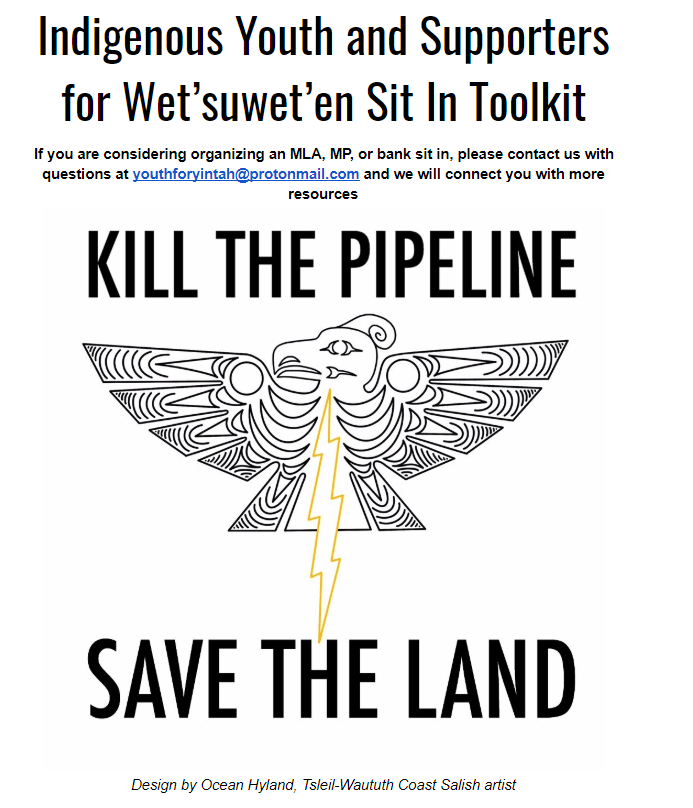
One of the reasons this is so much on my mind is because I’ve been hearing Indigenous Youth for the Wet’suwet’en speak very eloquently in their public gatherings. For the past several months I’ve been learning all I can, and writing about the Wet’suwet’en peoples and their courageous actions to keep pipelines like the Coastal GasLink pipeline from being built on their incredibly beautiful lands. And I have been surprised at how often the Native residential schools, and forced assimilation, have been spoken about.
We’ve had to fight for over a hundred years. And despite the residential schools despite the epidemics of smallpox, tuberculosis. Despite the enfranchisement. Despite the reserve. Despite all the assimilatory policies of Canada that have existed up until the modern day, our system of governance and the Wet’suwet’en system of governance has persevered and they have remained strong as is demonstrated by the five clans of the Wet’suwet’en when they evicted Coastal GasLink from their territories.
Kolin Sutherland-Wilson
Victoria Redsun says it is difficult to be a young, Indigenous person in an urban environment right now.
“We see our people on the streets and hurting,” says Redsun who adds that residential schools are still fresh in her memory and the issues around violence and genocide against Indigenous women is still happening.
Lands under attack 'for profit and for colonialism' says artist and activist – APTN News https://t.co/1WGWLdjl4U
I am “inconvenienced” by the Wet’suwet’en protests. I live close to Clark and Hastings , am dependent on public transit, walk slowly, and use a cane. So when the buses are rerouted it is quite inconvenient for me. But , I need to talk about scale and proportionality here. Yes it is a drag and inconvenient for me, but it is far more “inconvenient” to have a pipeline you did not agree to traversing your land. It is far more inconvenient to have to live with boil water advisories. It was far more inconvenient to have your children forcibly removed and sent to residential schools, and it is totally inconvenient to have your unceded land stolen. So while walking the extra way to or from the bus stop (and finding it) is inconvenient and not easy for me it is nothing in comparison to what Indigenous peoples and especially the We’tsuwe’ten are facing. And, the courage of the protestors give me convenient hope.
For those of us who believe in peace and oppose war, Memorial Day is a time to reflect on the militarism of this country. I find it especially troubling how the country has shifted away from formal declarations of war, to the declaration of the Korean War as a police action, to the undeclared Vietnam War. To the present day “war on terror” where U.S. military actions don’t respect borders, and armed drones kill those who have been declared, under nebulous authority, terrorists, often with significant civilian casualties. Each step making armed aggression move further away from public scrutiny. Making it more difficult to generate peace actions.
I was struck by the quote from the following article: no one will honor the dissenters who have resisted morally bankrupt wars (although the quote continues “from within the ranks of the U.S. military”, that sentiment it applies to all dissenters).
Amidst all the pageantry and military worship going on around the country this weekend, few people will recognize the millions of civilians and foreign fighters who have perished due to the endless wars fought by the United States, and no one will honor the dissenters who have resisted morally bankrupt wars from within the ranks of the U.S. military.
On Memorial Day, We Should Remember Most U.S. Wars Were Started for Resource Theft, Imperial Hubris and Racist Animus By Matt McKenna, CovertAction Magazine, May 30, 2021
I was at Scattergood Friends school this weekend for graduation ceremonies. In talking with Friends from Kansas City, I asked how my cousin John Griffith was doing. Which led to a discuss of how his example, and that of a number of other Quakers was significant in my decision to resist the draft during the Vietnam War. And I learned new stories of the Friend I was talking with, as he attempted to be classified as a conscientious objector during that war.
Don Laughlin was my friend, mentor and another draft resistor. The letter he wrote to my draft board is included in the book of stories, Young Quaker Men Facing War and Conscription, links to which follow. Don collected a lot of stories of young Quaker men and their experiences related to war and conscription. Prior to the end of his life in 2016 I began to help put the stories together as the following PDF and other formats. But he did all the work of collecting the stories.
Among the stories are a powerful letter that also affected my decision, “An Epistle to Friends Concerning Military Conscription”, that was signed by Don, my cousin Roy Knight, and other Quakers.
It matters little what men say they believe when their actions are inconsistent with their words. Thus we Friends may say that all war is wrong, but as long as Friends continue to collaborate in a system that forces men into war, our Peace Testimony will fail to speak to mankind.
Let our lives speak for our convictions. Let our lives show that we oppose not only our own participation in war, but any man’s participation in it
An Epistle to Friends Concerning Military Conscription
While a student at Scattergood Friends School, I attended the national conference of Quakers who came together to write the 1968 Richmond Declaration on the Draft and Conscription. Richmond Declaration on the Draft
Nineteen years old at the time, with a registration date of June 30, 1942, I (John Griffith) wrote a registered letter on June 29, 1942, to General H. B. Springs, head of Selective Service in South Carolina.In this letter I wrote: “I take this opportunity to inform you of my position. I am conscientiously opposed to war, for any cause whatever, and shall refuse to comply with this act, or any act in the future which I feel to be a contradiction of Christian teachings, democratic liberty and individual freedom.”More of John’s story is included in the book, A Few Small Candles: War Resisters of World War II Tell Their Stories.
Following are the stories Don Laughlin collected of Young Quaker Men Facing War and Conscription.
I am just beginning to learn about LANDBACK. When I asked my Indigenous friends how I could best support them, they said “LANDBACK”. One of the ways I learn is by writing. Here are some posts thus far: landback | Quakers, social justice and revolution (jeffkisling.com).
Learning which sources of information are authentic is one of the first challenges. Most of the following is from landback.org. which is a project of the NDN Collective. Friends tell me this is a good source.
NDN Collective is an Indigenous-led organization dedicated to building Indigenous power. Through organizing, activism, philanthropy, grantmaking, capacity-building and narrative change, we are creating sustainable solutions on Indigenous terms.
LANDBACK is a movement that has existed for generations with a long legacy of organizing and sacrifice to get Indigenous Lands back into Indigenous hands. Currently, there are LANDBACK battles being fought all across Turtle Island, to the north and the South.
As NDN Collective, we are stepping into this legacy with the launch of the LANDBACK Campaign as a mechanism to connect, coordinate, resource and amplify this movement and the communities that are fighting for LANDBACK. The closure of Mount Rushmore, return of that land and all public lands in the Black Hills, South Dakota is our cornerstone battle, from which we will build out this campaign. Not only does Mount Rushmore sit in the heart of the sacred Black Hills, but it is an international symbol of white supremacy and colonization. To truly dismantle white supremacy and systems of oppression, we have to go back to the roots. Which, for us, is putting Indigenous Lands back in Indigenous hands.
It is a relationship with Mother Earth that is symbiotic and just, where we have reclaimed stewardship.
It is bringing our People with us as we move towards liberation and embodied sovereignty through an organizing, political and narrative framework.
It is a long legacy of warriors and leaders who sacrificed freedom and life.
It is a catalyst for current generation organizers and centers the voices of those who represent our future.
It is recognizing that our struggle is interconnected with the struggles of all oppressed Peoples.
It is a future where Black reparations and Indigenous LANDBACK co-exist. Where BIPOC collective liberation is at the core.
It is acknowledging that only when Mother Earth is well, can we, her children, be well.
It is our belonging to the land – because – we are the land.
We are LANDBACK!
In addition, LANDBACK is more than just a campaign. It is a meta narrative that allows us to deepen our relationships across the field of organizing movements working towards true collective liberation. It allows us to envision a world where Black, Indigenous & POC liberation co-exists. It is our political, organizing and narrative framework from which we do the work.
Recently I’ve been thinking and praying a lot about Mutual Aid and #LANDBACK. Two concepts I hadn’t known about prior to 2018. That was the year I began to make connections with Indigenous people. And those became things they were teaching me.
People of faith believe the Spirit can led us, if we pay attention. There are many spiritual practices. Some find organized religious practices work for them. Many find the messages of ministers or other spiritual leaders helpful.
Many Quakers come together to worship in silence, expectantly waiting to hear the Spirit. This might not happen every time. Indeed, there may be weeks, months, or years when one doesn’t have a spiritual leading.
The other part of spiritual practice is obedience to a leading. I find little evidence to show someone making changes in their life in response to a spiritual leading. Obviously someone can follow a leading without sharing that with others.
But I am often in situations where people do share things about their spiritual life. May describe a spiritual message they have received. And yet we can’t see how their lives have changed in light of that message. We’ve been told our actions speak louder than words. That how we live our lives should be examples others might follow.
I have observed inconsistencies between our professed beliefs, and how we actually live for my whole life in a very specific way. On a family vacation we went to California, and all of us coughed all the time we were in Los Angeles. The air was foul and limited visibility. This was in the early 1960’s, before catalytic converters. People who lived there told us we would get used to it.
I had a similar experience when I moved to Indianapolis in 1971. Still before catalytic converters began to appear around 1975.
I was led to believe polluting our air, land and water was not just bad policy. It was morally wrong to treat Mother Earth that way. To poison the environment for our children and future generations.
No only did that not make sense to me logically, I discerned it to be spiritually wrong. That meant I could not own a car, among other things. So I did not.
And that was when I saw people not following their beliefs. Almost everyone was concerned about what we were doing to our environment. Would admit we needed to stop the profligate use of fossil fuels. And then try to justify why they had to have a car. “I know we have to stop burning so much fossil fuel, BUT…” What I call “interpreting” spiritual leadings. Trying to force whatever our leading might be, to fit within our lives. our beliefs, as they are. Trying to justify retaining the status quo. The anxiety becomes greater now that we can’t (easily) hide from the multiple, severe consequences of air, water and land pollution.
But it seems the greater the urgency to change, the more resistance to change there is in many cases. The more frantically people hold on to their justifications. The more depressed many of us are, recognizing these great paradoxes in our lives.
None of that is new. What is new is finding the institutions and practices that once worked, at least for white people, are failing now.
Returning to Mutual Aid and #LANDBACK, I’ve seen similar justifications for not working to make these things happen. Fundamentally, they both require a rejection of the mainstream powers in our society today; capitalism and the dominance of white supremacy.
What I’m trying to say, asking us all to do, is challenge ourselves to envision new ways of living together. Put attention on those things we try to justify not doing, even though we know they are the right thing to do. Be completely open to spiritual leadings. Don’t say “but…”
And realize whether we do that, or not, forces are in play now that will continue to upend our lives. Capitalism will not survive the environmental and political changes occurring now. And without those structures, white supremacy will no longer be.
This is the time to find better ways to live. To learn how to build, and live in new communities now. So we can be as ready as possible for the collapse that is coming. And reap the benefits of living in such communities now.
We are living in difficult times. Some of the more recent have been especially brutalizing: the shooting death of a child, Palestine reduced to rubble, public violence from hate of others-Asian, black, Indigenous, Jewish peoples, out of control police violence, impotent political and economic systems and rapidly deepening environmental chaos.
With varying degrees of success, I’ve tried to live a Spirit led life. But lately my faith has been tested.
It makes no sense to consume fossil fuels to the extent that we poison our living spaces; air, land and water. And yet fossil fuel consumption continues to increase.
It makes no sense to allow corporations to profit from public land and water.
It makes no sense to fight endless wars on terror, when we act as terrorists, and increase the number of people joining the terrorist groups.
t makes no sense to distribute the weapons of war to domestic police forces. And for the epidemic of the use of deadly force, including the killing of unarmed people
It makes no sense to squander billions of dollars on the military and deny small fractions of that money to actually address the desperate needs of millions struggling for basic necessities.
Actions speak louder than words. It’s been more than a year now that I have been blessed to have found another community that embodies my own values. Des Moines Mutual Aid is a local implementation of the idea of Mutual Aid, which has been practiced for centuries in many places, globally. We work to address survival needs in the present. To give food to the hungry, shelter for the houseless, bail money for those arrested for agitating for justice and change. My Mutual Aid friends and the work they do, tirelessly, helps me maintain my faith.
Then, you must do this: help the next person find their way through the dark.
Joy Harjo Conflict Resolution for Holy Beings: Poems
I’ve been reflecting upon the image of the spirit wandering the Earth in its human feet. We need to call our Spirit back. “Call in a way that your spirit will want to return.”
For Calling the Spirit Back from Wandering the Earth in Its Human Feet (excerpts)
Do not hold regrets.
When you find your way to the circle, to the fire kept burning by the keepers of your soul, you will be welcomed.
You must clean yourself with cedar, sage, or other healing plant.
Cut the ties you have to failure and shame.
Let go the pain you are holding in your mind, your shoulders, your heart, all the way to your feet. Let go the pain of your ancestors to make way for those who are heading in our direction.
Ask for forgiveness.
Call upon the help of those who love you. These helpers take many forms: animal, element, bird, angel, saint, stone, or ancestor.
Call your spirit back. It may be caught in corners and creases of shame, judgment, and human abuse.
You must call in a way that your spirit will want to return. Speak to it as you would to a beloved child.
Welcome your spirit back from its wandering. It may return in pieces, in tatters. Gather them together. They will be happy to be found after being lost for so long.
Then, you must do this: help the next person find their way through the dark.
Harjo, Joy. Conflict Resolution for Holy Beings: Poems (pp. 5-6). W. W. Norton & Company. Kindle Edition.
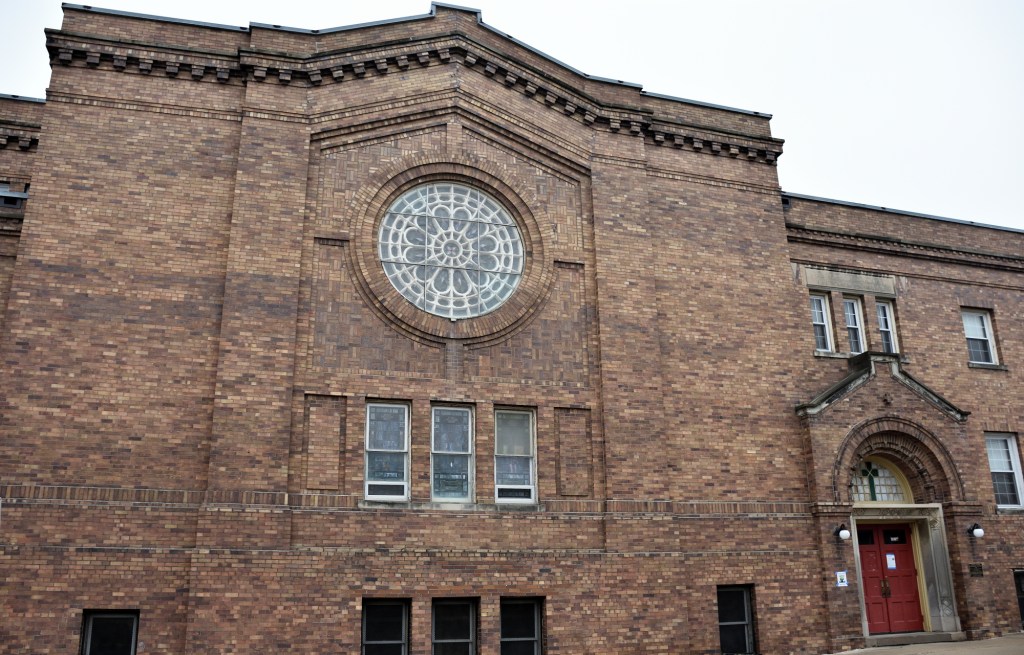
Trinity United Methodist church is where we put together and distribute boxes of food for those who are hungry.
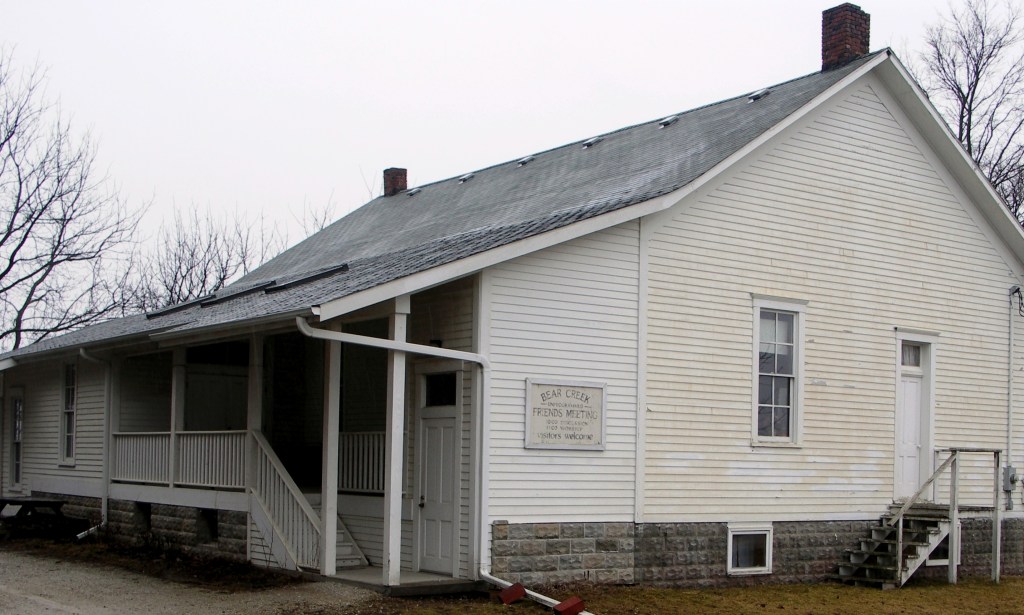
Bear Creek Quaker Meeting
Memorial tree planting ceremony
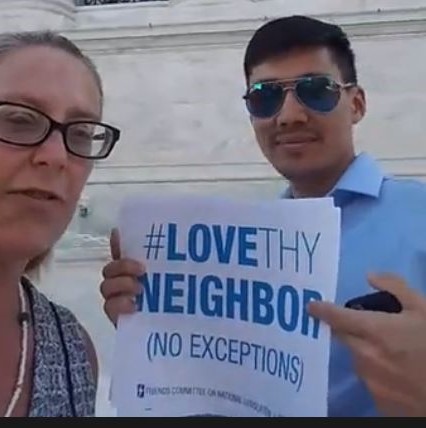
Love They Neighbor
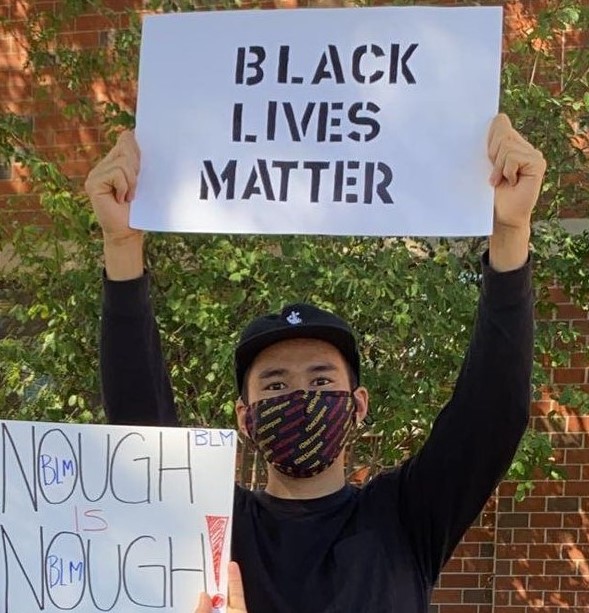
Black Lives Matter
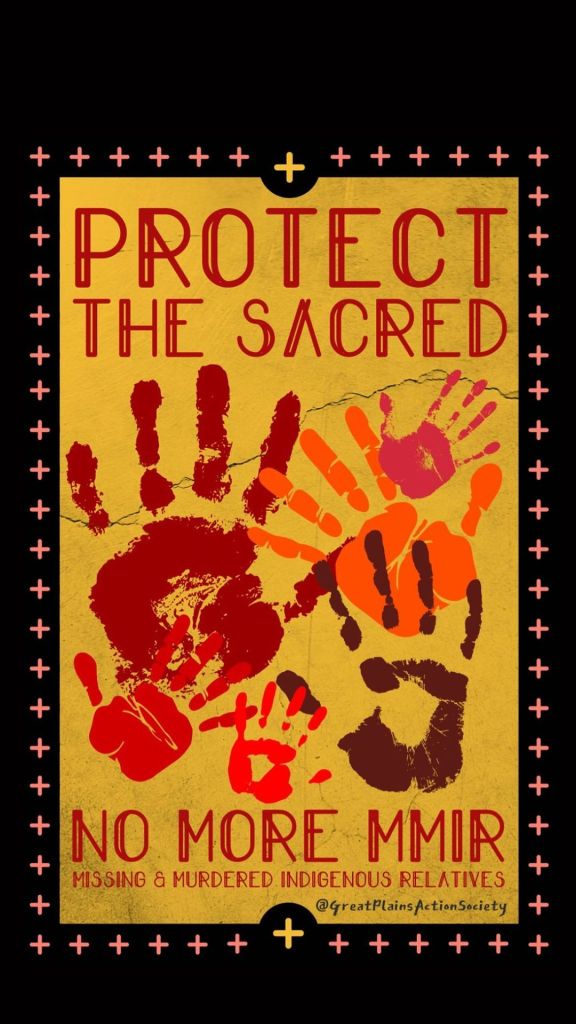
No more missing and murdered Indigenous relatives
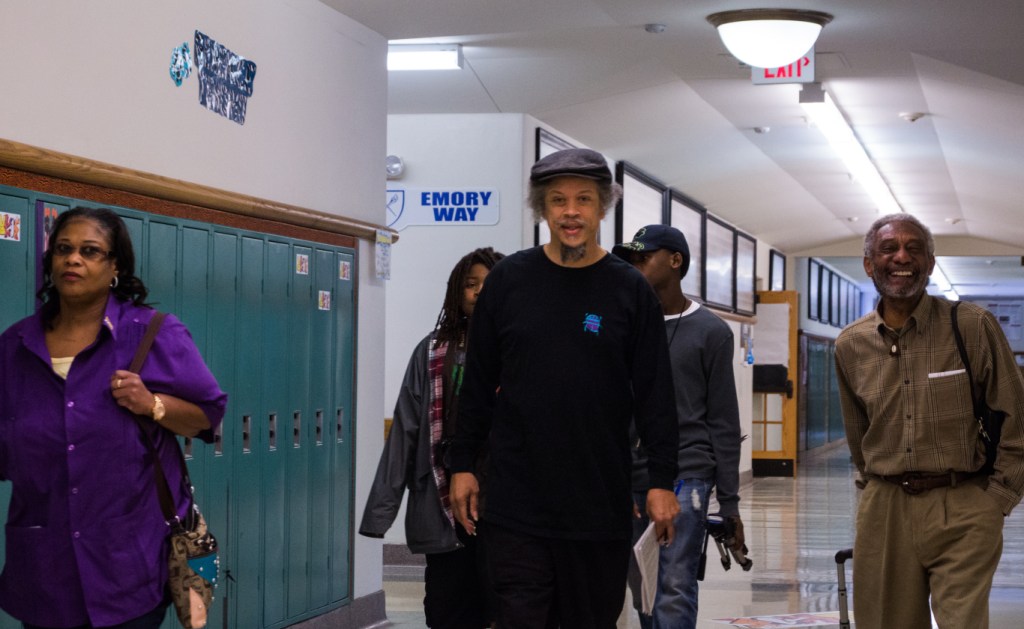
Kheprw Institute
Imhotep, Kheprw Intitute
Trinity United Methodist Church
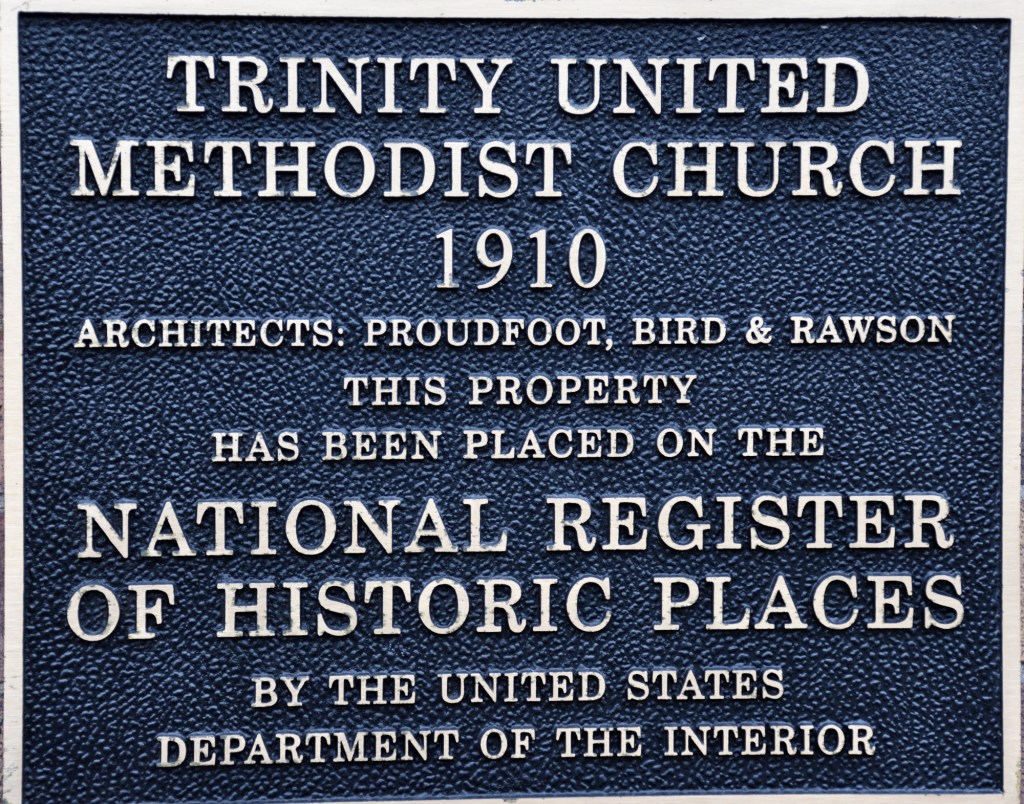
Trinity United Methodist Church
Alton and Foxy Onefeather
In the First Nation Farmer Climate Unity March 2018
We make conscious decisions to either sit back and watch, or stand up and be heard. We make choices as to whether protect our future generations, or we allow for a destitute future for them. We make choices as to enter the uncomfortable place of change and movement, or we continue on this downward spiral. What will your choice be? Will you sit back and allow for human rights violations to occur, or will you #RiseUp with us?
Militarized RCMP attempted to force the Wet’suwet’en peoples to allow construction of the pipeline in 2019. But they were unsuccessful.
Since that time, the Wet’suwet’en people continued to build structures on their land, such as the healing center. But were aware of the likelihood of another RCMP invasion to attempt to force them to allow construction of the Coastal GasLink pipeline. Yesterday’s post describes that invasion occurring on Feb. 6, 2020.
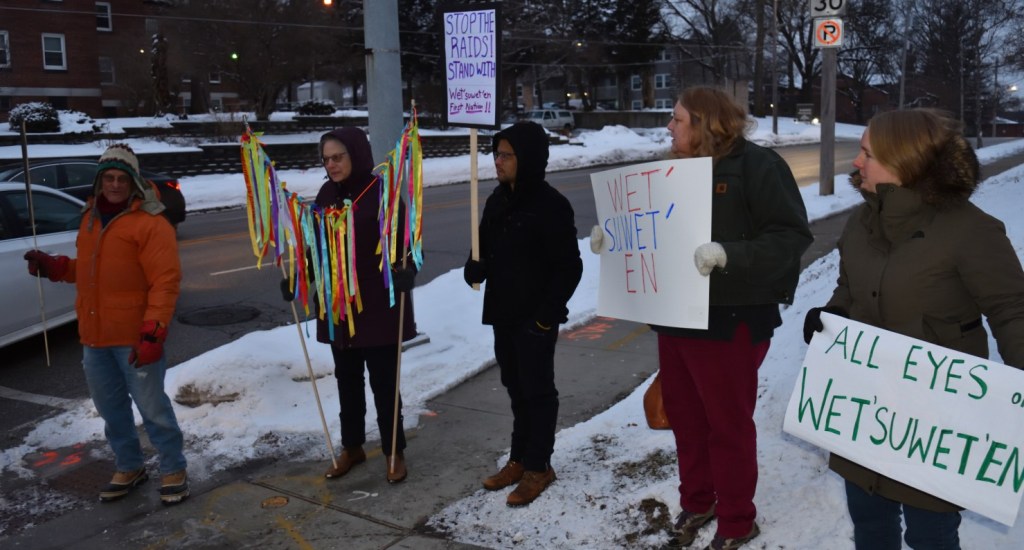
In the summer of 2019 Paula Palmer came to Iowa and Nebraska to give presentations and workshops related to her ministry regarding “Toward Right relationship with Native Peoples.” Peter Clay, Linda Lemons and I were among those who helped organize those events. Afterwards, we wanted to see what we could do with what we had learned. We had scheduled to get together with a few others at Friends House on February 7, 2020.
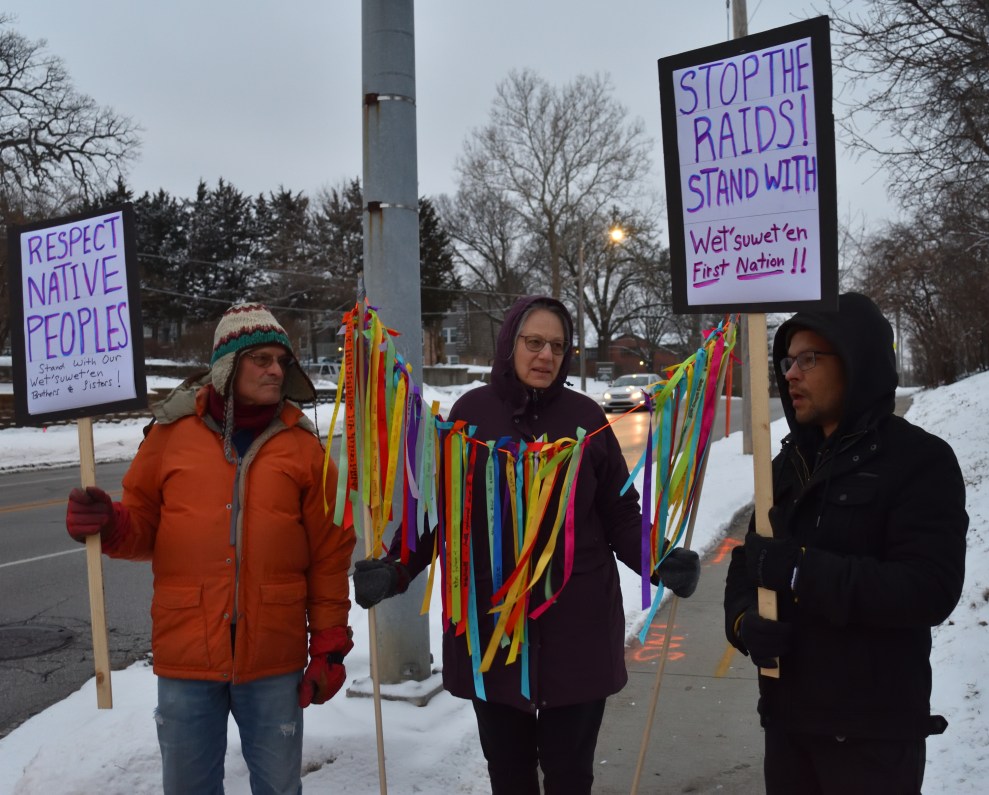
When we learned about the RCMP invasion of the Wet’suwet’en lands that began on February 6th, we decided to hold a vigil in support of the Wet’suwet’en prior to our scheduled meeting on February 7th. That’s how Friends House became the site of the vigil. [Note: We met at Friends House, attached to Des Moines Valley Friends meeting, but this wasn’t an approved event the Meeting.]
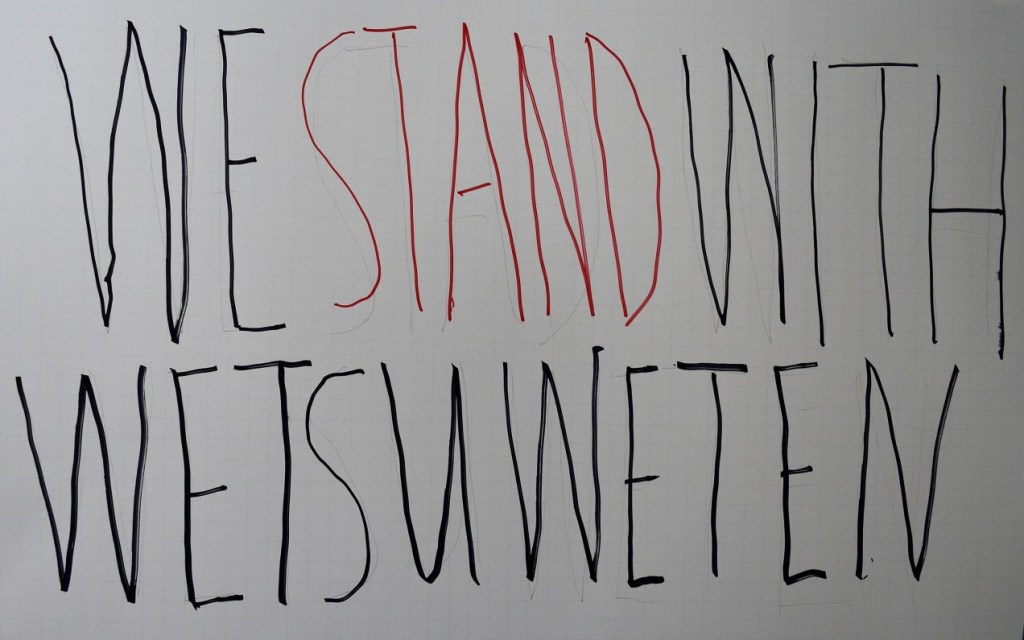
Peter and I made signs, and Linda brought prayer ribbons.
We knew there was almost no media coverage of what was going on with the Wet’suwet’en peoples, and didn’t think anyone else would join us. I was surprised and glad to see someone none of us knew at the time approach. Ronnie James is an Indigenous organizer with many years of experience. He told us he was surprised anyone in Des Moines knew about the Wet’suwet’en peoples.
I believe this meeting was Spirit led. Ronnie was to become a very good friend. After the vigil, he accepted my Facebook friend request, and began to teach me about his work with Des Moines Mutual Aid. This was life changing for me. I don’t know why I hadn’t heard of the concept of Mutual Aid, but am grateful for his generous time mentoring me. I soon became involved with one the Des Moines Mutual Aid’s projects, the weekly food distribution.
Ronnie is part of the Great Plains Action Society, along with people I had become friends with during the First Nation-Farmer Climate Unity March in 2018. Including Sikowis (Christine Nobiss), Alton and Foxy Onefeather, and Trisha Cax-Sep-Gu-Wiga Etringer.
Time to Rise Up! RCMP Invades Wet’suwet’en Territory
SHARE WIDELY
Feb 6, 2020
This morning at approximately 4:30am, heavily militarized RCMP launched their long anticipated raid on Wet’suwet’en land defenders. RCMP invaded unceded Wet’suwet’en territory to facilitate construction of the Coastal Gaslink pipeline.
Dozens of cops with dogs and assault rifles arrested 6 unarmed people at the 39 km marker of the Morice West Forest Service Road, and a large contingent of RCMP trucks and heavy equipment have moved onwards towards the Gidimt’en Access point at the 44 km marker.
This was a monitoring post, set up to look out for Wet’suwet’en people further up the road at the Gidimt’en Checkpoint and Unist’ot’en Camp. NO ONE was violating any injunction.
RCMP said they would use the least amount of force possible, but they deployed a full scale invading force.
We have never ceded or surrendered this land and we never will. We stand strong. No amount of force will stop us from being Wet’suwet’en, or living on our lands.
Two camps currently face the prospect of militarized police violence. We won’t back down. All eyes on #Wetsuweten yintah!
Where ever you are, those who stand with us, we need you now. We need you to take a stand and stand up and fight back against this kind of oppression against our people.
The time has come for supporters to rise up and #ShutDownCanada.
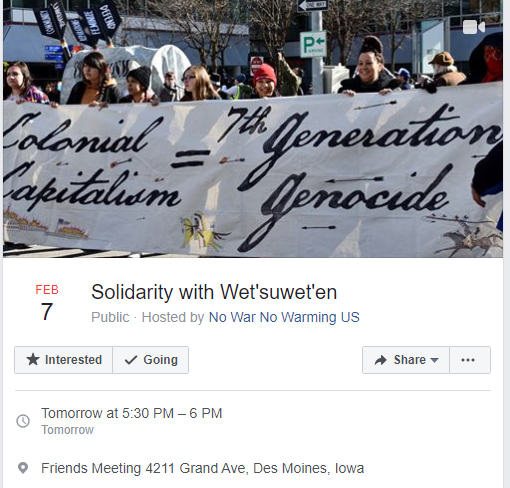
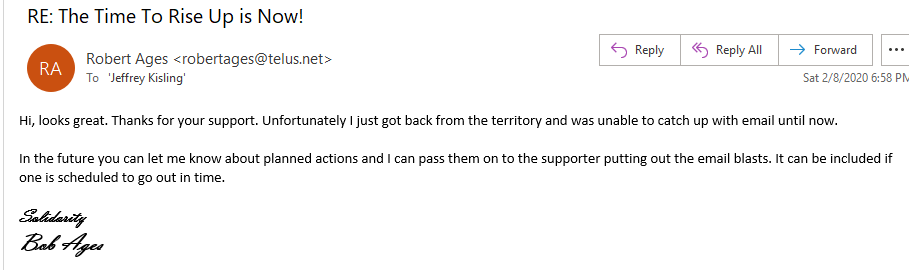
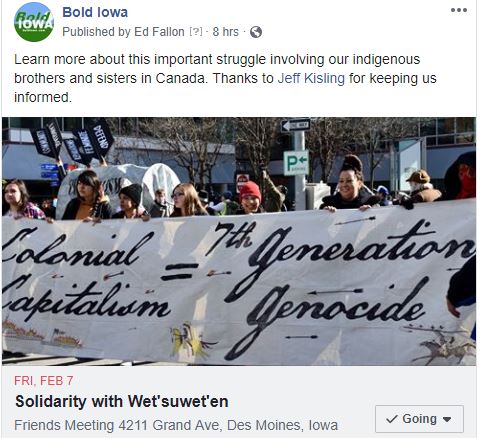
In response, I created a Facebook event, “Solidarity with Wet’suwet’en” to be held the next day. Supporters were asked to share their events with Wet’suwet’en organizers so they could all be posted in one place. To show how much support there was for the Wet’suwet’en, and make it easier for people to find events to attend.
Join us at 4211 Grand Ave in Des Moines, Iowa, tomorrow evening at 5:30 for a vigil in solidarity with the Wet’suwet’en people.
Bold Iowa and Iowa Citizens for Community Improvement shared our event with their members.
Earlier in this series about #LANDBACK I wrote the first time I heard that term was from Denzel Sutherland-Wilson. I shared the awful video of Royal Canadian Mounted Police (RCMP) pointing sniper rifles at him. Canada is ready to kill us
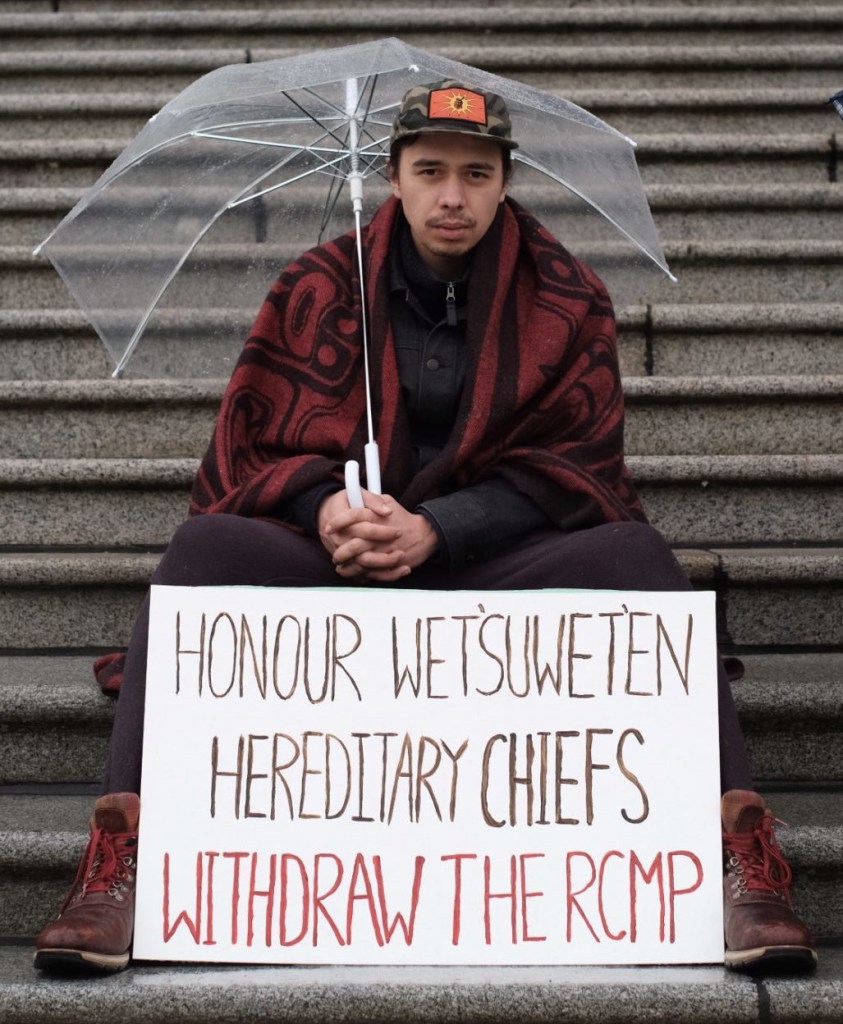
At this same time his brother, Kolin Sutherland-Wilson, was bringing attention to these issues, including sitting outside the doors of the British Columbia legislature by himself for a week. His video on Colonialism in Canada is an excellent review of the subject, and brings together many of the issues related to #LANDBACK. (see below)
The following are excerpts from: Why Kolin Sutherland-Wilson can’t stay quiet. UVic student’s week-long protest draws attention to movement against pipeline project in northwestern B.C. by Josh Kozelj, Martlet, Jan 22, 2020
It was not until 1997, following failed negotiations with the province, that the Supreme Court of Canada found B.C. had no right to extinguish the rights of Indigenous peoples to their traditional territory. It was made clear that it was the hereditary chiefs who have the authority and title over this land.
Kolin was four years old.
It’s now 2020, and as a natural introvert, Kolin would prefer to avoid the spotlight.
He describes himself as a “hermit,” and typically enjoys quiet time at home with his wife and cat. However, when he woke up last December and learned that the B.C. Supreme Court granted an injunction to stop Wet’suwet’en peoples and anti-pipeline protesters from blocking roads to a pipeline project on their traditional territory, he knew something had to be done.
After the hereditary chiefs called for a week of solidarity, Sutherland-Wilson decided to stage a solo week-long strike of his own outside the B.C. Legislature in support of the Wet’suwet’en peoples against the pipeline. He walked out during the first week of classes on Jan. 6 and was there from 9 a.m. to 5 p.m. every day of that week.
Sitting in the NSU’s office in the basement of the Student Union Building, on an abnormally cold and snowy day in Victoria, Sutherland-Wilson gently clasps his hands together and stares straight ahead. The words “All Eyes on Wet’suwet’en” are written in big block letters on the whiteboard just over his right shoulder. He closes his chestnut-brown eyes for a few seconds, opening them to reveal weary tinges of red.
“Sitting on the steps was the least I could do, just to be a constant presence down there at the Legislature, just to be a constant reminder that what is happening is unacceptable and that B.C. has a duty to approach this nation-to-nation relationship in good faith and to not rely once again on the force of the RCMP like they did last year,” he says.
On Jan. 6, the first day of his week-long protest, Sutherland-Wilson published a video, “Colonialism in Canada: What is happening at Unist’ot’en?” to YouTube explaining the history of the Wet’suwet’en nation and why they continue to fight for their land.
It’s the final weekday of his week-long protest at the Legislature, and Kolin is sitting on the front steps.
The weather is cold, and he’s there day until night, but it’s nothing compared to the snow, ice, and freezing temperatures that protesters are facing on Wet’suwet’en territory in northwestern B.C.
Hundreds of UVic students walked out of class on Jan. 10 to stand in solidarity with Sutherland-Wilson and the hereditary chiefs. They marched around Ring Road and met Kolin at the Legislature with signs and banners — shocking the student who originally planned to just be a single constant presence at the provincial building.
“When everyone came down and joined me at the Legislature,” he says before pausing and recollecting the moment. Sutherland-Wilson tears apart his hands from a clasped position, and begins to rub them along the length of his thighs.
“Just the fact they went down there to join me, and stand in solidarity with the Wet’suwet’en … I think it really helped me fully communicate my purpose for being down there.”
He says a lot of his knowledge comes from his father and Elders in his home community, the same people who have been fighting this same struggle for generations.
It’s tiring and cold sitting on the steps of the Legislature for hours and hours on end, but Sutherland-Wilson says it’s his duty to follow his heart.
“Lives are on the line, people I love and know,” He says. “I don’t really have a choice but to make as much noise as possible, to try and get as much information out there as possible.”
There’s probably a million other places he would be — including quiet time at home with his wife and cat — but, like his father over two decades ago, he knows there’s still work that needs to be done.
Why Kolin Sutherland-Wilson can’t stay quiet. UVic student’s week-long protest draws attention to movement against pipeline project in northwestern B.C. by Josh Kozelj, Martlet, Jan 22, 2020
In this video Kolin speaks to those gathered with him at the gate of the British Columbia Legislature as mentioned above.
Later, Kolin was among those arrested during a sit-in that began after a “wholly ineffective” meeting with B.C. Minister for Indigenous Relations and Reconciliation Scott Fraser. The demonstrators said they met with Fraser to discuss the ongoing dispute over the Coastal GasLink pipeline in northern B.C., but they don’t believe their concerns were addressed.
Kolin jokes at one point about arrest: “You know it’s funny, young Indigenous people trespassing on unceded Indigenous land.”
These 7 youth, from our delegation of youth from many Indigenous nations, are inside the monument to colonial governance where so-called BC conducts its colonial business. Relatives & supporters outside are singing, & drumming to hold the ceremonial space.

















 Quakers, social justice and revolution