Art (re)defined?

I was enjoying this poster, which led me to think yet again about whether photography is an art, or not.  Evidently experts don’t agree on a correct answer.  (In any case I do mix with all classes of society)

tumblr_m2fq3cTdkG1r0cqu1o1_500

I feel passionate about my own photography.  People ask me what is wrong during any of the very few times I venture out without my camera around my neck.  And I spend so many hours editing the images.  I used to worry that I shouldn’t be spending so much time with photography.  But it seems somehow to be driven from my spiritual life.  Someone once wrote that artists have to be good a solving the myriad of problems that come up during their work.  They just use different tools to solve their problems.  I do feel I have developed a set of mental/spiritual/artistic tools for my photographic work.  The times the artist is involved in practicing their art are usually times of silence and deep inward listening.

Somehow being deeply connected to beauty, however you are led to do so, is really important for your life in general.  It is especially important as a part of my spiritual life.  (Those of you who know me know I can’t stop myself here–just one more thing that really bothers me about economically depressed neighborhoods is the lack of beauty there, other than the people themselves).

Returning to the original question, I always end up thinking how could something that creates so much beauty, and helps make others aware of beauty, not be art?  I just now realized that to me, it is my passion that makes it art for me.

So, instead of my previous view that artists become passionate about some area of art, couldn’t it really be that whatever someone is passionate about, that is art?

Posted in Uncategorized | Leave a comment

Why the Iran Deal Succeeded

The New York Times (10/22/2015 Issue) used the title  How They Failed to Block the Iran Deal that this quote comes from:
“While Durbin and Nancy Pelosi were tracking the votes in their respective chambers, the president took a larger part and also played rougher in this fight than had been his custom. He accused Republicans of “making common cause” with Iran’s hard-liners. He stated that the alternatives were the deal or war.  Even some of his allies thought he’d gone a bit overboard with these statements, potentially alienating some undecided Democrats, and he pulled back from them. Obama responded to the requests by Pelosi and Durbin to make calls to wavering Democrats, more calls than he’d made on any previous legislation. He held special briefings in the White House for members of Congress; he participated in a conference call with the outside groups on his side.”

That was the call I wrote about at the time:  Obama briefs activists

As a direct result of that call, with the help of MoveOn we organized the delivery of over 10,000 signatures of Hoosiers who support the Iran Deal to Senator Joe Donnelly’s office.  He had announced his support of the deal after the event was organized, so we used it as a thank you, instead.  Similar petitions were delivered all over the country.
Iran petition delivery to Senator Donnelly

The article also mentions the work of the Friends Committee on National Legislation.

The following Minute was approved this past (2015) summer:   Iowa Yearly Meeting (Conservative) supports the peaceable agreement among world powers, including the United States and Iran, to dramatically curb Iran’s nuclear program in exchange for easing international sanctions against Iran.  We hope this will be the beginning of many more peaceful negotiations.

Posted in Uncategorized | Leave a comment

Vision and the Future

Before when I thought of how Gandhi said we should be the change we want to see, I had focused on the implementation/action part of that, since I did have a vision of the change I wanted to see.  But I’ve come to realize a great many people don’t have a vision.  And I have come to believe that is the root cause of much of the conflict and lack of progress to address problems that we see today.  Far too many people accept things the way they are now and feel they have to stay within those boundaries.  But as many people have pointed out, you can’t solve current problems with current thinking–new ideas are where the solutions will be.

One’s vision seems to develop and change with time.  As that happens, the other part of what Gandhi said, “be the change” comes in, and you have to figure out how to apply that vision in your own life.  Following, I try to explain how my vision evolved and how I tried to implement it.  My life view has been determined by begin raised as, and living as a Quaker.  Many people are surprised there are still some of us around.  Organized religion may or may not be part of your life, but however we do, or do not express it, I believe every one of us has some form of spiritual life.
DSC06512

I was born into, and spent my early childhood in the Bear Creek Quaker meeting community near Earlham, Iowa, which defined our spiritual lives.  Our family rented several different farms, and farm work defined the rest our lives.  I think I was about eight years old when I had a significant spiritual experience during meeting for worship, which made real the beliefs that had been more in my head prior to that.  It was some time before I realized how fortunate I was, to have that experience to draw upon for my faith ever since.

Attending Scattergood Friends (High) School was also significant.  Each student and staff member is part of an academic and religious community that functions by using Quaker practices for everything.  The reason I was so involved with the Quaker parts, especially, of Scattergood, was because I had that previous spiritual experience to work with.  One lesson I didn’t realize I had learned until later was that whatever you are confronted with, you always ask–“What is the solution”, never–“Is there a solution?”  And it is to God that you ask the question.

I was at Scattergood during the last half of the 1960s, when our country was rocked by the Vietnam war and the antiwar movement that took to the streets to stop it, as well as the civil rights struggle at the same time.  I deeply studied Quaker history, nonviolence, and struggles for justice.  Being at Scattergood we got a priceless education in how to respond to these dramatic global struggles from our own Quaker beliefs and experiences.  We held a draft conference at the School.  We also went into the small neighboring town of West Branch (Scattergood is on a farm) and knocked on people’s doors to see how they felt about the War, and were surprised to find how deeply people felt against it.  During the October, 1969, National Moratorium against the Vietnam War, the entire School marched 12 miles into Iowa City to participate in the protests going on at the University of Iowa, where we saw mannequins representing Vietnamese bodies floating in the river, and the University shut down.

DSC09398-2

I left Earlham College after one year and joined the Friends Volunteer Service Mission (VSM), a program of the Friends United Meeting to offer opportunities for young Friends to do meaningful community service as their alternative service for the draft.  The country was still in an uproar, and I didn’t feel right about having a student deferment from the draft.  I had been granted conscientious objector status, but struggled with the cooperation with the Selective Service System that doing alternative service represented. Many Iowa Quaker families had to deal with the consequences of the men being imprisoned for refusing to cooperate with the Selective Service System during previous wars.  That had a profound effect on me–seeing how these families chose that path as an expression of their faith.  I did turn in my draft card and became a draft resister.  A Supreme Court case meant, in the end, I didn’t have to serve jail time.
Friends Volunteer Service Mission

Friends Volunteer Service Mission

But while I was trying to figure that out, I joined the VSM project in an economically depressed neighborhood on the southwest side of the city.  It was a culture shock for an Iowa farm boy to find himself trying to figure out how to live in the city.  This was before both bicycle helmets, and catalytic converters, and the image of me riding my bicycle through traffic (no bicycle lanes, of course), wearing a motorcycle helmet, enveloped in a dense fog of exhaust might help explain why I became even more of an environmental radical.

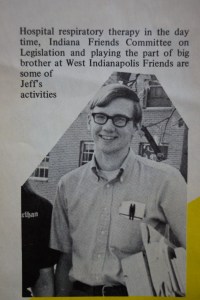
The idea of VSM was to find an alternative service type of job for the first year, and save enough money to support yourself to work fulltime in the community during the second year.  I found there were no youth programs at all, so I spent my second year working with the neighborhood kids.  We organized a 4H club, played soccer, went swimming, and went on bicycle explorations around the city with a couple of cameras.  And then developed the film and prints in a darkroom I setup in the bathroom.  Although I moved home to Iowa after that, I missed the kids so much that I returned to Indianapolis.

This was in the days before car rental was common, so I did buy an old car from a neighbor for $50 to drive to Iowa.  When my best friend, Randy, wrecked my car, having been uncomfortable about having one, I decided that was an opportunity to see if I could get along without.  The experience of living without a car had a profound effect on my life and spiritual outlook and practices.  As you can probably relate from your own experience, whenever you take a chance, take a leap of faith, so many unexpected things happen as a result, almost all contributing to your further, deeper spiritual and other development.  Three things that emerged from not having a car were that I became much more in-tune with the environment on personal level, I became a much better runner, and it was also helpful for my photography to be able to stop and take a photo instead of driving past, or not even able to see the image from a car.  And sometimes there was another effect.  It made it a little more difficult for the fossil fuel proponents to dismiss what I would try to say, since their first question is usually  “Well, don’t you drive?”

The past forty years have been a really bad time for environmentalists.  It has been so frustrating to know the science, and to come to the realization that those in power are truly corrupt, doing anything they could to keep the truth from the general public in order to protect their profits.  And to realize that even when people do learn the facts, personal convenience would win out over environmental principles.  This was especially disappointing from Friends.

Nearly three years ago, when I saw the Keystone Pledge of Resistance, a pledge to use nonviolent civil disobedience to try to confront the fossil fuel industry and the American people, to try to stop the reckless extraction and consumption of fossil fuels, I believed this was a campaign that would allow me to put my Quaker beliefs into practice for our environment, and that became my focus.  A commitment to nonviolence is a commitment for all parts of your life.  I had been there to participate and to see nonviolence work for the civil rights and anti-war movements, and I believed it was exactly what was needed now, for our environment.

DSC04424

The Pledge became one of my main focuses.  I attended the action leader training sessions in Des Moines, since they weren’t offered in Indianapolis.  Together with Ted (Muncie) and Wayne (Indianapolis), who were trained in Cincinnati and St. Louis, we selected and scouted our target (the Federal building) and held six, so far, training sessions to prepare local activists for nonviolent civil disobedience actions.  There have also been national vigils that we participated in.

It has been fascinating, for me, to watch this group of people being engaged with all kinds of groups and events, and not all related to our environment.  And we have grown into a community as we have come to have a history of being engaged on the streets and in the Statehouse together.  We know and trust each other, and call upon each other to support new things we get involved with (all the time).  So I’ve been learning about organizing.

But there was always this awareness of the racial, social and economic problems that people tried to ignore despite how many of their friends, neighbors, and themselves are affected.   And the knowledge that simply through the circumstances of the family I was born into, my life was significantly better in many ways than that of a great many others in America and the world.   This was a spiritual problem for me.

KI community discussion

KI community discussion

God (finally) provided me with a way to begin to learn about that.  About three years ago the environmental group 350.org organized a national day for environmental education/actions.  Only one event was listed in Indiana that day, and it was at the KI Eco Center, which was how I found out about it.  When I was with a group of mainly young people from the Eco Center for our first time together, Imhotep, one of the community leaders, asked me a series of questions about myself.  I don’t talk a lot about myself, but Imhotep, I’ve come to learn, is very good at drawing stories out of people.  So I began to talk about Quakerism.  When Imhotep asked me to talk more about that, I said something like, “Quakers believe there is that of God in everyone, and that includes you, and you…”  The very first time, I think I hesitated slightly as I was asking myself, “Ok, we Friends always say this, but do you really believe this of a group that is different from you?”  And I’m really glad the answer was an immediate and emphatic YES, but it also seemed to reaffirm that by exploring it consciously and publicly.  At that point I remember smiling at the thought, and the young person whose eyes I was looking into saw it, too, I think.  Each person smiled at me as I said that to them.  That seemed to satisfy the questions for the evening.  I was not used to speaking about faith in public outside Quaker circles, and this was a lesson that it is important to do so.  From the beginning, my experience at the Eco Center has been a shared, spiritual one.

My spirit was so glad to have this community to learn from and try to contribute to.  I really enjoyed getting to know the community there.  And I was very impressed (and reminded of Scattergood School) by the young people leading open community discussions about such things as The New Jim Crow.  When there was an opening in the schedule, I asked if we could hold a community discussion about nonviolent civil disobedience and social change, and they graciously agreed to do so.  I thought there would be sharing of past experiences, and an interest in using direct actions now.  A number of the Keystone Pledge of Resistance people came and spoke about why nonviolent action was so important to them.  But this was one of the first occasions where I was to learn that I made an incorrect assumption.  What the discussion revealed was that bad experiences and mistrust between people of color and the police meant there isn’t the willingness to take that risk, on the part of many.  It was I lesson I was glad to learn.

We all seemed to be learning how to work together as we went along.  There wasn’t a structured program to plug into necessarily.  As various events, mainly community discussions or technology offerings occurred, I would look forward to attending as further opportunities to spend time in that community, learning and getting to know people.  There are all sorts of things related to care of our environment going on–building rain barrels, aquaponics, composting, and gardening.  I was really happy to have the opportunity to teach photography during summer camp last year.  I later learned that this process is called accompaniment, the idea being to not try to jump into helping lead, but instead listening and waiting to hear what it is that the community needs that you could help with.

Then last year, a group began organizing a Moral Mondays movement here in Indiana.  Several years ago Rev. William Barber, then President of North Carolina’s NAACP, organized a series of nonviolent civil disobedience actions in the State Capitol building during the legislative sessions, to protest the repressive policies being enacted.  That movement grew to the point that eventually 100,000 people were arrested.

Indiana Moral Mondays

Indiana Moral Mondays

We are very fortunate that Erin Polley and the American Friends Service Committee (AFSC) she works for made this a big focus for her work.  It has seemed something of a miracle to see so many diverse groups (NAACP, labor unions,  education, faith , healthcare, women’s issues, peace, and environmental groups) all coming together to speak and act with a moral voice in the state.  A number of North Meadow Friends have been very involved with Indiana Moral Mondays (IMM) in a variety of ways.  Also, my friends at the Kheprw Institute (KI Eco Center) have been involved as well, including helping to lead an environmental panel discussion during the launch of IMM last September.  It is so good to see people engaged in so many different ways.  I am on the media committee, the photographer, and the environmental working group.  One thing our environmental group is working on is making renewable energy available in economically depressed neighborhoods.  Once the equipment is paid for, solar and wind continue to produce electricity, for free.  I’ve met my state representative, and have described this, and asked if he would be interested in helping create legislation to make this happen.

A lot was accomplished this first year of IMM.  We attended lots of committee hearings and held numerous public events related to justice issues and the state legislature.  Others are beginning to see IMM as both a moral voice and a broad coalition of justice organizations that are finding ways to work together effectively.

As we prepare for future legislative sessions and actions, we are aware we may be forced to use nonviolent civil disobedience actions.  Keystone Pledge of Resistance is a partner with Indiana Moral Mondays.  We were able to use our experience to provide the first nonviolence training session for Indiana Moral Mondays this spring, and more training sessions will occur.

I am also very fortunate that North Meadow Circle of Friends meets just a few blocks from where I live, and has become another spiritual home (the other being my home meeting in Iowa).  There is a lot of interest in activism.  And there are a lot of kids in the meeting, too.

DSC08295 DSC08281

What we have here are several great opportunities to put our faith into action, and an evolving community of like-minded activists to work with.  The key to making this work is to put our differences aside, and find which things we can agree on, and work on those things together.  The Moral Mondays movement refers to this as “fusion” politics, and that is what has been the key to working together and getting things done.

After many years of oppressive politics combined with a dis-engaged public, there is now an awakening social unrest.  So many people have been oppressed in so many ways.  The events in Ferguson last year shocked the nation, both the initial killing of yet another unarmed young black man, and the excessive, military style response.  These tragedies continue to occur.

At the same time more and more people around the world are pushed further into poverty.  Millions go without adequate food, water, shelter, education, healthcare, respect and love.  Every day thousands die from starvation and preventable disease.  This is not acceptable.

What is my vision now?  I believe we are called to be out in the communities, in the streets, actually working side by side with those suffering.   That involves accepting others and their differences.  I think we have a debt to pay for the privileges we have been given, and the only way to begin to pay it off is by actually working side by side with others.  We need to do this for our own spiritual health.  We need to turn away from focusing on ourselves, and work to build the beloved community that Martin Luther King envisioned.

Posted in Uncategorized | Leave a comment

Environmental Responsibility

Every month our Quaker meetings have discussions related to a series of questions, called queries, that help us examine our lives.  This month’s queries are about environmental responsibility.  First is the introduction to the subject, the advice, then the queries, and finally my response.  Several years ago my small Quaker meeting in rural Iowa, Bear Creek, began the practice of sending the queries to members who live away from Bear Creek.  Those who can then send their response back to the meeting, and those long distance responses are included in the discussion of the query by those who are actually present at the meetinghouse, and a combined response is put together.

ADVICE

All of creation is divine and interdependent: air, water, soil, and all that lives and grows. Since human beings are part of this fragile and mysterious web, whenever we pollute or neglect the earth we pollute and neglect our own wellsprings. Developing a keen awareness of our role in the universe is essential if we are to live peacefully within creation.

The way we choose to live each day‑‑as we manufacture, package, purchase and recycle goods, use resources, dispose of water, ‑design homes, plan families and travel‑affects the present and future of life on the planet. The thought and effort we give to replenishing what we receive from the earth, to keeping informed and promoting beneficial legislation on issues which affect the earth, to envisioning community with environmental conscience, are ways in which we contribute to the ongoing health of the planet we inhabit.

Preserving the quality of life on Earth calls forth all of our spiritual resources. Listening to and heeding the leadings of the Holy Spirit can help us develop qualities which enable us to become more sensitive to all life

QUERY

  • What are we doing about our disproportionate use of the world’s resources?
  • Do we see unreasonable exploitation in our relationship ‑with the rest of creation?
  • How can we nurture reverence and respect for life?  How I can we become more fully aware of our interdependent relationship with the rest of creation?
  • To what extent are we aware of all life and the role we play? What can we do in our own lives and communities to address environmental concerns?

My response:

We are in a bad position, knowing what we know about the effects of greenhouse gases, the depletion of fossil fuel reserves, and contamination of water supplies, and yet having bought into the American dream of what the middle class should be.  As a result, we live in homes that are much too large, requiring energy to heat and, in some cases, cool.  Our neighborhoods are extremely poorly designed, built on the assumption that everyone drives everywhere they need to go.  Improved urban designs are emerging.  Portland, Oregon, has been redeveloping itself in an energy conscious way for many years now.  Los Angeles just announced a radical redesign of its transportation systems, bringing pedestrian and bicycle traffic to the fore, and cars behind.  Indianapolis is working on re-zoning, limiting cars downtown, and emphasizing self-contained neighborhood communities.  Plans are moving forward for big mass transportation changes, including light rail.

Friends who can do so should consider moving into multi-tenant buildings that are on mass transit routes.  Every time I’ve moved in Indianapolis, the key requirement was that the new place be on a bus route.  Those who have air conditioning should stop using it.  These things aren’t negative (other than the air conditioning part, maybe), but, in my experience, have enriched my life and helped me be more connected to my neighbors and community.

Many Friends still live in rural areas, and currently don’t have many transportation options.  It seems this could be one area we might make some progress in, since I haven’t heard of anyone else doing so.  Is anyone interested in working on a rural response to fossil fuel?  Maybe Friends could work more on sharing rides to meeting and for shopping.  It is also good to use alternatives to face to face meetings when at all possible.

One thing our meetings should consider is switching to renewable energy for electrical power and heating.  The ideal would be the installation of solar panels or a wind turbine, so the meetinghouse doesn’t have to rely on the power grid, whose future is uncertain.  This also makes financial sense, since fossil fuel prices will soon explode.

Where we can exert influence is to speak out against continued fossil fuel development, fossil fuel subsidies, and personal transportation infrastructure such as more parking garages, roads, etc.

It is encouraging that youth around the world are engaging with these efforts.   It is discouraging that we are running out of time to avoid runaway climate destruction, if we haven’t already.

DSC05598-2 DSC08641 todd1

Posted in Uncategorized | Leave a comment

Big Thompson Canyon Colorado

http://bit.ly/BigThompsonDSC05651

As I mentioned I broke up the over 1,000 photos I took on the recent trip to Rocky Mountain National Park into folders identified by subject, mainly to help with organizing as I work through editing them.  I have the impression that most people don’t edit their digital photos, or only their best ones.

Those of us who are more invested in digital photography do spend a lot of time editing photos.  I usually end up editing a given photo at least two or three times, for several reasons.  One is that with modern photo editing software there are all kinds of adjustments that can be made, and often changing one means something else needs to be adjusted as a result.  Another reason is that, especially in situations with tricky lighting, working on a series of photos taken at nearly the same time and place is helpful.  As you get one photo to look the way you want it to, that helps know how to adjust the others in the series.

The first series of photos were of the flatlands of Iowa, Nebraska and Colorado: http://bitly.com/MidwestFlatlands

This new series is of Big Thompson Canyon, the 25 mile connection between Loveland, Colorado, at the foot of the mountains, and Estes Park, the town at the entrance of Rocky Mountain National Park.  These were particularly difficult for a number of reasons.  There aren’t that many places to pull off the road, so almost all of these were taken from a moving car (as were most of those from the flatlands series and others).   Secondly, in many places the walls are very steep and high, so it is hard to frame the shots, and the lighting can be difficult.

I was disappointed when we approached the canyon entrance because it was a very dark, overcast day.  Fortunately, we made a trip into Loveland in the middle of our stay, so I had another chance to take photos as we went up and down the canyon, this time with good lighting.  So you can see similar shots with different lighting.  I’m still not completely satisfied with every one of them.

There was a tragic flood through the canyon in 1976 when over a foot of rain fell in about three hours, resulting in a dam breaking and a wall of water 20 feet high flooding the canyon, killing 143 people.

http://bit.ly/BigThompson

Posted in Uncategorized | 1 Comment

Language impedes communication

I recently shared some news about the American Friends Service Committee’s (AFSC) Quaker Social Justice Ministry program  http://www.afsc.org/document/small-group-social-justice-ministry-model.  A big part of that program involves engaging with (accompanying) people who are experiencing injustice.  Several of the Quakers (Friends) who attend North Meadow Circle of Friends have been involved with a community rebuilding/youth mentoring group called Kheprw Institute (KI), and there is a common desire for both groups to work together.

To try to help people get to know some of the people at KI and what they do, I recently sent an email message with a photo, and an explanation of how things were going. The photo was of Diop Adisa with his father, Imhotep, both of whom I have gotten to know over the past couple of years. Diop is a musician, and I had just purchased his album Black Dragon https://dioooop.bandcamp.com/album/black-dragon, and shared a song from that, again to try to help people get to know more about KI and the people who are involved there.

After sending that, I kept thinking about some of the language in the song, and began to wonder (a little bit too late) if some people I sent it to might be offended by some of the words.   No one has let me know that they were, but that, of course, doesn’t mean that someone wasn’t offended.

I get offended, myself, in these situations.  To me words are just words, and while personal verbal attacks can be very hurtful, I object to finding fault in the language used to describe injustice.  People use music and other art forms to expose injustice, and that work should be encouraged, not judged, especially from what might be a privileged perspective.  The awful situations these works expose are what is truly objectionable.

If we want to learn about others and their lives, we have to be able to listen to their stories, as they choose to tell them.  Getting past judging the language is just a small first step in learning not to judge, period.  These are some of the first small steps needed, by many of us who think of ourselves as white, in order to begin to become aware of the injustices engrained in our society.

Black Lives Matter

Black Lives Matter

Posted in Uncategorized | Leave a comment

Pope Francis on economic privilege

Pope Francis beautifully expresses the political ideal:

“If politics must truly be at the service of the human person, it follows that it cannot be a slave to the economy and finance. Politics is, instead, an expression of our compelling need to live as one, in order to build as one the greatest common good: that of a community which sacrifices particular interests in order to share, in justice and peace, its goods, its interests, its social life. I do not underestimate the difficulty that this involves, but I encourage you in this effort.”  Pope Francis, address to joint session of Congress, 9/24/2015

Our politics have gotten off track, serving business and the wealthy instead of the common good.    Those interests always object to policies that help the common good if there is any cost to themselves.  We need to make our representatives aware that we want our political system to work for the common good, and support those who do that.  Among the Presidential contenders only Bernie Sanders has consistently promoted and supported these ideals.  As has our Congressional Representative, Andre Carson (below).

Indiana Moral Mondays is working for these policies in the Indiana state government.

“The challenges facing us today call for a renewal of that spirit of cooperation, which has accomplished so much good throughout the history of the United States. The complexity, the gravity and the urgency of these challenges demand that we pool our resources and talents, and resolve to support one another, with respect for our differences and our convictions of conscience.”  Pope Francis, 9/24/2015

DSC03113 DSC00811 DSC03711 DSC01755

Congressman Andre Carson flashes me the Peace Sign

Congressman Andre Carson flashes me the Peace Sign

Posted in Uncategorized | Leave a comment

Economic privilege 2

There is a fundamental tension between spirituality and materialism.  Materialism is about accumulating wealth, focusing on the individual, as opposed to sharing with and helping others, and community building that is central to spiritual life.

The Bible talks about how difficult it is for the rich to enter heaven.  “Lay not up for yourselves treasures upon earth, where moth and rust doth corrupt, and where thieves break through and steal:  but store up for yourselves treasures in heaven, where moths and vermin do not destroy, and where thieves do not break in and steal.  For where your treasure is, there will your heart be also.”  Matthew 6:19-20

This tension is commonly on display in our political discourse, where business and the wealthy work to protect their interests,  which they think includes supporting massive, repressive military and law enforcement systems, and minimizing social safety net and other programs to help those in need.  Unfortunately the wealthy have used their money to corrupt the political system and pass legislation and policies that have created masses of people who can no longer support themselves, through no fault of their own, significantly increasing the need for social safety nets.  This is fundamentally wrong.

It also doesn’t make sense regarding business.  The way business grows is by selling goods and services.  The less disposable money people have on hand, the less they buy.

There are also fundamental questions related to the earth’s resources, and who they belong to.  Air and, to a lesser extent, water are seen as “commons”–resources for all, not just certain individuals.  Land was also once seen as a common.  Private land ownership is a relatively new concept.  Does wealth entitle one to claim common land as private, especially now that much of the land has been parceled up?  Doesn’t everyone deserve access to enough land and water to grow enough food the sustain themselves and their families and communities?

It is natural to take the circumstances we are born into as the way the world has to be, often not realizing that much of how we live is new, and not always an improvement of what was before.  It is important for us to learn as much as we can from history, to be aware of what worked well, and what didn’t.  That is especially important now, because major global forces are at work that are changing our environment, commons and other resources, and will change even more.

Years of denial and hope that environmental damage will just go away have put us on a course many feel the human race cannot survive.  The more extreme weather patterns with severe, sustained droughts and local deluges of rainfall will continue to get worse.  The impacts on crops will result in more migrations of more and more people.

Along with that, modern industrial/technological economies will collapse when fossil fuel supplies dwindle.  There is encouraging news related to the increase in renewable energy.  But the energy density of wind and solar electrical energy cannot begin to replace all the work currently being done by internal combustion engines.  It is a fundamental error to think that renewable energy supplies can simply replace oil.

As our economy continues to fail and people all over the world try to cope with more extreme weather, and decreasing supplies of water and food, social mechanisms to help those in need will be overwhelmed.  Social unrest will spread and deepen as people become desperate to try to meet their most basic needs.

We are now being forced to find how to deal with these changes, with more extreme changes and needs rapidly evolving.  Now is the time to shape the path we want to take.  One path continues to embrace materialism and self preservation.  That would require more aggressive and repressive actions to preserve wealth and property.

Or we can embrace the concept of the beloved community, opening ourselves and our resources to build strong communities, and in the process find just solutions to many of the problems we face.  I hope we decide to build those communities.

To do so will require leadership.  One thing these leaders must do is show their willingness to turn away from materialism.  As Jesus said, “If you want to be perfect, go, sell your possessions and give to the poor, and you will have treasure in heaven. Then come, follow me.”    Matthew 19:21  This is really very clear.

So, thirty years ago I asked people to give up their cars.  That is probably easy compared to asking people now to give up the rest of their possessions.   Hopefully there will be a better response this time.

DSC00818

Peace Vigil

Peace Vigil

DSC01858

Posted in Uncategorized | Leave a comment

Photo history

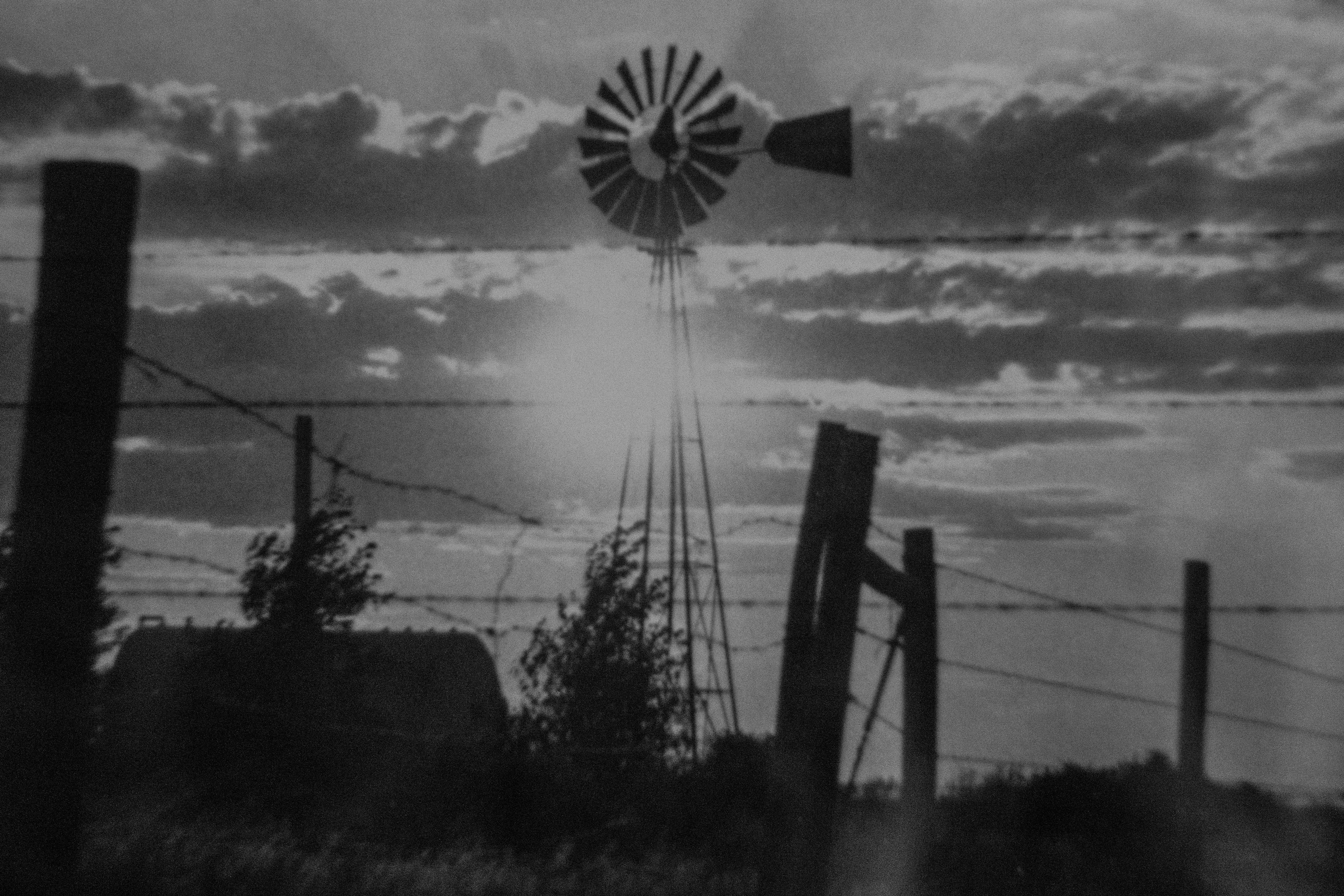
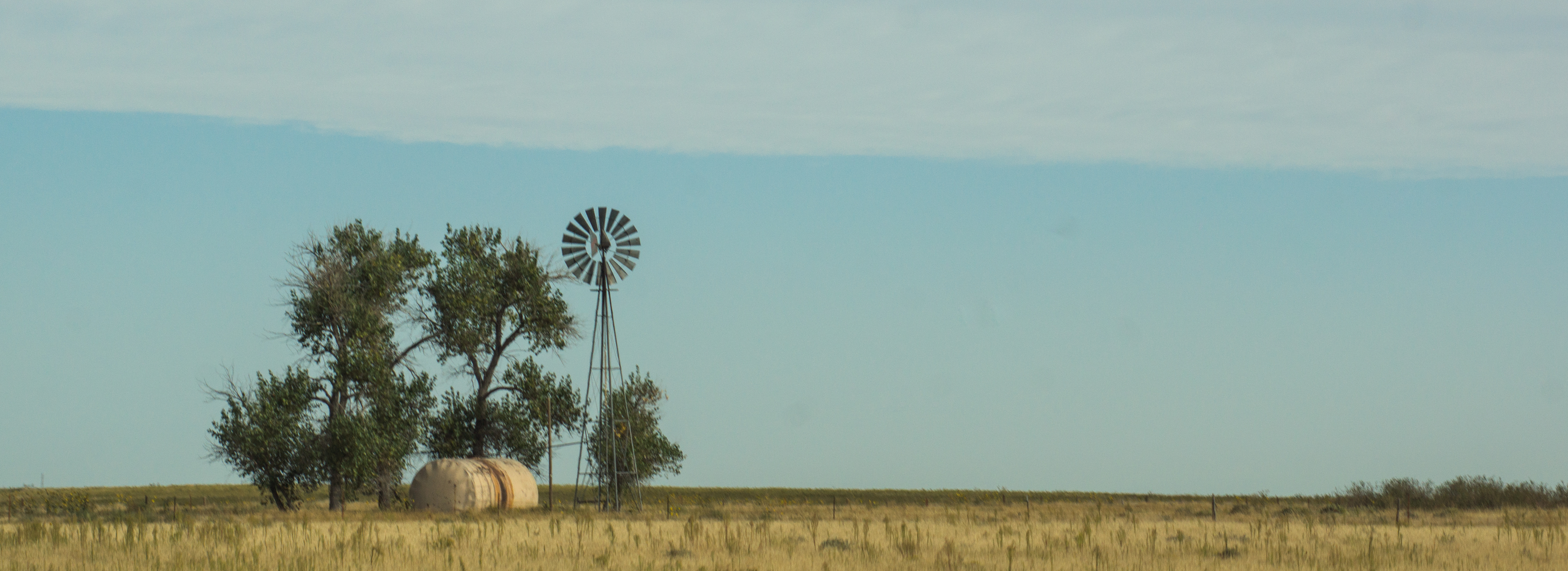
This black and white photo was taken in the early 1970’s when I was still trying to develop photos in the bathroom of whatever apartment I was in at the time.  Trying to make them light-tight was a real challenge.  So much so, that I only tried to develop photos when it was dark outside.

The color photo is of the same windmill, taken this summer.  I was surprised that both Mom and Dad remembered the original picture.

DSC00009-2 DSC00121

Posted in Uncategorized | Leave a comment

Economic Privilege

There are several reasons why I’m revisiting the idea of giving up personal automobiles now.  Mainly because I’ve been thinking a lot about privilege and inequality for a long time.  Cars represent environmental privilege.

The massive concentration of wealth in the hands of a very small number of people is well known.  But less attention is paid to the significant imbalance of wealth among “the other 98 %” of us.  There are significant differences in wealth and economic opportunity based upon race, gender and/or social/economic status.

The industrial revolution needed a vast number of jobs for manufacturing.  That created the great migration of people from rural areas, where they were self-sufficient, to cities to live where the jobs were being created.  People were no longer self-sufficient, instead needing to purchase food, clothing, transportation, and shelter from their wages.  When those jobs were replaced with machines, we did not adapt our economic system, which meant that those who were once self-sufficient no longer had a way to meet their basic needs, and the welfare state came about.

There is a great variety of work that needs to be done by society, but we haven’t successfully found ways to connect those needs to people who can meet those needs and be rewarded for their work, so they can survive.

Also, no discussion of the economic situation in the United States can ignore the vast amount of our economic resources spent on militarization.  We can go a long way toward a more effective and humane economy by investing even a small percentage of that money in the civilian sector.

All of this raises basic questions about how our government and economy should work.  When did things change, or was it always the point of government, to  protect wealth and business instead of serving the common good?

I experienced economic inequality as soon as I left Earlham College to join the Friends Volunteer Service Mission (VSM) in an inner city neighborhood in Indianapolis in the early 1970’s.  It was quite an education to experience how much different, materially, life was in the inner city from what I was used to.  And we thought we were living simply in Iowa.  Most people in that Indianapolis neighborhood didn’t have their own washers and dryers.  No one owned the place they lived in.  No one had central air conditioning.   Most families had a car, but it was always an old, used one.  Few people traveled or went on vacation.

I stayed in Indianapolis after VSM.  It was uncomfortable to see how hard my best friend, Randy, worked, and how little he was paid compared to my salary from the hospital.  While some feel additional education entitles them to a higher salary, I’m not sure about that.  But I do feel that it is not worth 4, 5 or more times greater.  I came to think of that as educational economic privilege.

Which comes back to personal automobiles.  I do not believe there is any way environmentally, economically, or morally to justify personal automobiles. Thirty years ago I gave up having one, and am really grateful that I did for so many reasons.  Not the least of which has been the benefits to my spiritual life.  When Friends believe something is wrong, they try to change their personal lives to address that.

I feel our economic system is wrong, in that it no longer aligns the needs of society with opportunities for us to address those needs.  We need to find a way to somehow address these problems of meeting basic needs by finding ways to compensate people for work that really needs to be done, such as child care, care of the elderly, education and mentoring, environmental cleanup, growing gardens and food, etc.  Financial contributions to agencies that address these issues helps move in the right direction.

Indiana Moral Mondays

Indiana Moral Mondays

KI community discussion

KI community discussion

One idea would be to create another national work program similar to the Civilian Conservation Corp, which was a very successful model.  We need to call attention to how broken our economic system is, and work to create one that works.  In the meantime, we should examine our own economic situation.  How are our decisions and actions based upon materialism?

Posted in Uncategorized | Leave a comment