
There isn’t a lot of text, but here is what I presented at the annual meeting of the Indianapolis Peace and Justice Center yesterday.
https://docs.com/jeff-kisling/3889/peacebuilding
There isn’t a lot of text, but here is what I presented at the annual meeting of the Indianapolis Peace and Justice Center yesterday.
https://docs.com/jeff-kisling/3889/peacebuilding
There are a number of reason why I’ve been thinking about peace lately.
The American Friends Service Committee (AFSC) is facing severe financial problems. As a result, the long term Iowa Peacebuilding program is being terminated, so available resources can be used for AFSC’s other major program in the Midwest, which is work on immigration issues, including providing legal services.
I spoke with AFSC’s Midwest Director, Brant Rosen, about this yesterday. I’m the clerk of Iowa Yearly Meeting (Conservative)’s Peace and Social Concerns Committee, and know Iowa Friends are disappointed about this. But I agree with Brant, who said the anti-war paradigm of the past just doesn’t work today. Our military forces are spread throughout the world, and the United States seems to intervene wherever a threat is perceived to exist.
On the other hand, AFSC sees the immediate impact on people’s lives when working on immigration issues. This is an example of accompaniment (more below).
Friends often refer to their work in these areas as “peace and social concerns”, the two being closely connected. I believe, and Brant said this yesterday, that addressing social concerns is peace building.
We are nearing the completion of our first year of implementing the Quaker Social Change Ministry (QSCM) program at North Meadow Friends. QSCM is a new program from the American Friends Service Committee (AFSC) that provides a framework for faith based peace and social justice work. The emphasis is on accompaniment, which is to become involved with a community that is experiencing injustice(s) now, in order to learn from them what the problems are, and what they need to address those problems. And to evaluate how things are going from a spiritual perspective. I’ve written of our developing connections with the Kheprw Institute (KI), a small group who have been mentoring youth for over a decade in an economically depressed inner city neighborhood of Indianapolis. I believe this is peacebuilding.
I recently reposted a Call to Peacebuilding that was written shortly after the events in Ferguson, Missouri, that discusses this more.
This Sunday evening I’m speaking at the annual meeting of the Indianapolis Peace and Justice Center. The topic is open ended, so I’ve been wondering what to say to people who are involved in peace and justice work.
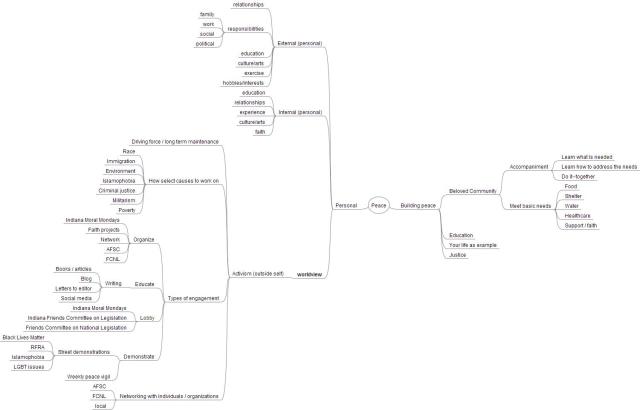
Once again I turned to mind maps, to try to sort out these relationships between peace and social justice. Below is what I’ve come up with so far. Basically, it seems peace begins with oneself. There are internal and external factors that influence how we feel about peace, which determines our worldview. Our worldview determines what we do, how we translate what we feel about peace into some kind of action.
Building peace basically comes down to building the Beloved Community with those impacted by injustice.
PDF of the following available here.
A photo of students in a German class at an Indianapolis High School giving the Nazi salute is horrible in so many ways.
There are two different possible scenarios.
One is that the students were ignorant of what that salute represents, which is allegiance to a political organization that took privilege to the ultimate level by actually implementing the “final solution” of killing those who weren’t members of their political class. Over six million Jewish people, and millions of others were systematically rounded up, killed, and cremated. That salute indicates support for that. Historic scenes show crowds of thousands raising their hands. This was a way to apply peer pressure and enforce conformity and consent.
The second scenario is that these students yearn for a similar situation of entitlement, which requires that “others” be oppressed.
One wonders which of those two scenarios Donald Trump had in mind when he encouraged his audiences to raise their hands.
The huge numbers, disproportionately of young, black men who are currently imprisoned for outrageously long sentences for nonviolent crimes should raise alarms in our country. And the killing of so many, disproportionately young, black men on the streets should raise alarms. The isolation of communities of disproportionately poor, black people should raise alarms.
The Nazi final solution could not have happened without the consent of the German people who didn’t belong to the Nazi party. That was an implied consent based not on an active “Yes”, but by not saying “No”.
Similar elements today are using the same implied consent. If you do not consent, you must actively say “No” as often and as creatively and as effectively as you know how. We have not taught our children well evidently.
“Teach Your Children”
Crosby, Stills, Nash and Young
And you, of the tender years can’t know the fears that your elders grew by,
And so please help them with your youth, they seek the truth before they can die.
Teach your parents well, their children’s hell will slowly go by,
And feed them on your dreams, the one they fix,the one you’ll know by.
Don’t you ever ask them why, if they told you, you would cry,
So just look at them and sigh and know they love you.


This was written by Jim Poyser, Executive Director of Earth Charter Indiana.

September 2014
Peace has been a central concept of the faith and practice of Friends from our earliest days. Unfortunately our country’s recent history has been a widening and deepening practice of violence, to the extent that we grow weary of the constant erosion of peace, and too often, reluctantly, accept these conditions, both at home and abroad.
The following, from The Militarization of Indian Country by Winona LaDuke, reminds us that peace must be actively pursued:
Many of our Native communities have instructions on how to live a life of peace. The Haudenosaune Great Law of Peace is one of the most notable examples of how our nations organized our societies to ensure peace was possible. The Haudenosaune tell of The Peacemaker, a messenger who came to the people and delivered a set of principles, or laws, for them to follow:
The Peacemaker came to the people with a message that human beings should cease abusing one another. He stated that humans are capable of reason, that through the power of reason all men desire peace, and that it is necessary that people organize to ensure that peace will be possible among the people who walk about on the Earth. That was the original word about laws–laws were originally made to prevent the abuse of humans by other humans.
Let us rededicate our Quaker communities as societies to ensure peace, and rededicate ourselves to teaching peace, and not learning war and violence anymore. And let us work to adjust our laws to prevent the abuse of humans by humans.
Let us continue to examine our own lives for the causes of violence and war. People continue to be abused on the basis of race, socioeconomic status and other factors. Our own spiritual health requires us to carefully examine how our own race and socioeconomic status give us advantages, and to work toward true equality for everyone, instead. We cannot understand some of these embedded injustices until we interact with those who are different from us. Friends have always been involved in community building, and more is called for now. That is how peace is built. The past two years working with a community revitalization group in a black, impoverished neighborhood has been a tremendous peace education for me.
This is a crucial time to work for peace. Changing the face of the enemy to “terrorists” has led to the expansion of our war efforts with little regard to national boundaries. The use of drones has sanitized killing, terrorized populations, and led directly to the swelling of the ranks of terrorists. Escalating violence by the United States will continue this cycle of increasing violence and insecurity. War is truly not the answer, and we must emphatically proclaim that today.
Recent events in Ferguson, Missouri, revealed the extent to which police forces are being militarized, largely unnoticed by the public, without our consent. The tragedy of this is the psychological shift it represents, with law enforcement changing from community based policing, to a militarized force of oppression, which sees the public as the enemy. It is important that we work to re-establish community based policing, and both stop the flow of, and remove existing military equipment from our police departments.
Poverty is a form of violence and abuse. The incredible maldistribution of wealth is an abuse. The economic model that worked fairly well under conditions of nearly full employment no longer works in the face of industrial automation replacing huge numbers of workers. More equitable tax laws will help, but we also need to revise the nature of employment and compensation in a service oriented age. The establishment of a public works program, similar to the Civilian Conservation Corps of the post-depression era, would be very beneficial now. Rebuilding our crumbling infrastructure would provide many jobs. As long as our national attention and resources are concentrated on wars, the problems humanity faces—climate change and the real needs of people everywhere—will remain unaddressed
Friends, let us rededicate ourselves to peace. Don’t succumb to weariness, nor hide your light under a basket. To teach peace requires waking people up. We may need to teach others the use of nonviolent civil disobedience, and employ it when necessary to speak truth to power.
9 Blessed are the peacemakers, for they shall be called sons of God. 10 Blessed are those who have been persecuted for the sake of righteousness, for theirs is the kingdom of heaven. Matthew 5:9-10
Jeff Kisling and Sherry Hutchison, co-clerks, Peace and Social Concerns
Iowa Yearly Meeting (Conservative)


Traveling to Rocky Mountain National Park with my parents last fall, I began to capture as many photos of windmills as I could from the backseat of the car. The telephoto lens was really helpful. Traveling at 70 mph wasn’t.


It was great to see the new wind turbines making their appearance, too.
This particular windmill is from a photo taken many years ago, and the 2015 version of the same.


Microsoft is offering everyone a place on the Internet to store an unlimited number of Microsoft Office documents. The website is docs.com This is a free service from Microsoft.
You can create named collections, then add any document that fits into that collection, whether Word, PowerPoint, Excel or OneNote. You decide the privacy setting for each document-public, private, or various common licenses.
Then you can easily share just what you want, with just who you to see it. I would encourage you to explore this, and share your documents and stories.
As an example, here is my docs.com site (which I just setup this week):
My friends at Sustainable Indiana 2016 have just published their book, “Explore Sustainable Indiana, Celebrating Hoosier Solutions to Our Climate Crisis”. Order your copy here.
Sustainable Indiana staff include John Gibson, Jim Poyser, Shannon Anderson, Judy Voss and Richard Clough. They have appeared in many of my blog posts, because they involved in so many environmental efforts. John and Jim were very active in the Keystone Pledge of Resistance, and they have all been involved in Indiana Moral Mondays and many other projects.
“Sustainable Indiana 2016 is a Indiana Bicentennial Legacy Project of Earth Charter Indiana. Our mission has been to collect and celebrate stories of people who are taking the lead on a sustainable future in Indiana. This book contains some of those stories, for Hoosiers and by Hoosiers, to serve as a guide to a future that gives us a deeper and healthier connection to our environment and each others.”
They were kind enough to include one of my stories, Cars as Weapons of Mass Destruction in the Transportation chapter.
It is really uplifting to see this collection of wonderful stories of hope and solutions people have come up with that can be used by others now.


Last night the Indianapolis City Council finally approved a referendum to be placed on the ballot in November for approval of the proposed improvements in the IndyGo city bus system, and development of a bus rapid transit (BRT) system, called the Red Line. The plan is known as Indy Connect, which is detailed at this website would be funded by a 0.25% income tax increase and funds from the Federal government.
Some of the improvements would be shorter wait times, all lines would run seven days a week with expanded hours (5 am – 1 am weekdays), improved payment systems, and real time bus location information available to riders.
“It’s also a growth issue; employers and younger workers are moving to more walkable areas served by transit,” Indy Chamber President Michael Huber said in a statement after the vote. http://www.indystar.com/story/news/2016/05/09/council-expected-vote-putting-rapid-transit-funding-ballot/84147010/
As someone who has depended on the Indianapolis city bus system for 40 years, these are extremely welcome developments, and I hope the referendum passes. Your vote would be greatly appreciated!


You are probably familiar with the old practice of placing canaries in an area of a coal mine to indicate when the air is unfit to breath. Since then that idea has been used to refer to things that indicate when a change has occurred in the more general sense.
News from Saudi Arabia might be seen that way. 70% of the country’s revenue is from oil, and “Saudi Arabia’s foreign-exchange reserves declined to $587 billion at the end of March, down more than 21% from a peak of $746 billion in August 2014, according to the latest central-bank data.” according to the Wall Street Journal.
Recently there has been considerable shake-up in government agency roles and personal, all related to moving away from the country’s dependence on oil. Much of the change is also being focused on the country’s youth, mindful of the recent Arab Spring uprising that caused political changes in many countries in the region.


 Quakers, social justice and revolution