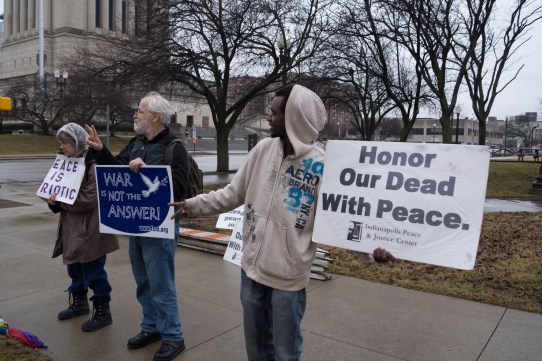
Public Square 5 – Vigils and Demonstrations

After recently writing about being in the public square, and signs used in public, I realized the next step should probably relate to how those signs are used, which are usually either displayed in windows or yards, or during vigils and demonstrations.

As I was returning home from our weekly peace vigil in downtown Indianapolis, one of my new neighbors mentioned she liked my (FCNL War is Not the Answer) sign.  I thanked her, and asked if she would like me to get one for her, and she said “yes”.  She wasn’t in when I got one, so I left it at her door.  The next time I saw her she thanked me for it and said she had put it in her (5th floor) window.  The next time I was out I looked up and saw it.

Noah Merrill has shared how the Black Lives Matter sign displayed in the yard of Putney (VT) Friends Meeting has been vandalized.  Some of the Facebook comments related to that indicate some useful discussions can occur when these things happen.  That would be the desired result.  Not just making your own statement, but inviting others to engage in discussion.

As I understand it, a vigil involves standing in public, usually with signs of what the vigil is about, in silence, but willing to engage with anyone who wants to engage.  Vigils are usually held not just once, but on a regular schedule.  The peace vigil held in downtown Indianapolis has been occurring nearly every Friday afternoon since the attacks on September 11, 2001.  The consistency is a message about ongoing concern.  If it is a peace vigil, sometimes participants show the peace sign, and passersby sometimes return the gesture.  Recently Debbie has held a sign that says “Honk for Peace” which receives some response.
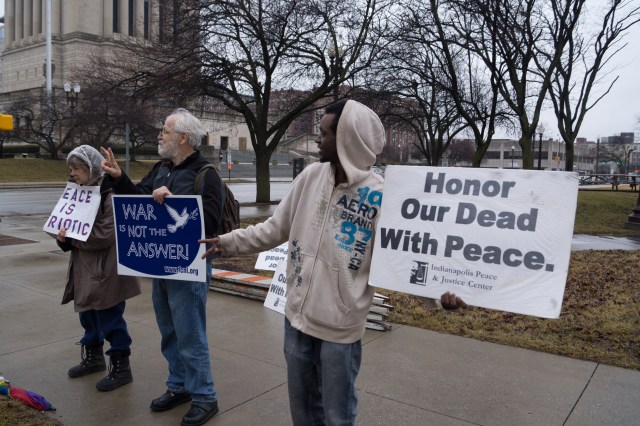
Peace

Demonstrations, on the other hand, tend to occur in response to a more immediate, crisis type of situation.  We have tragically seen this happen over and over again recently in response to police killings, for example.

These days social media is the usual mechanism to let people know the details of a planned demonstration–who, when, where and why.  Social media can also be used to invite those who are interested to gather to plan the demonstration.  For example, people were invited to the White Pine Wilderness Academy the evening before the demonstration in downtown Indianapolis related to the Dakota Access Pipeline to make the signs for the event.

Demonstrations often involve leaders speaking to the crowd, for which a bull horn or public address system is very important if the group is large.

Marches are also often part of demonstrations, usually after the crowd is addressed by people speaking about the issues.  The importance of nonviolence is also usually addressed.

Public safety is crucial for responsible demonstrations.  My experience is that it is very helpful to let the police know about the demonstration, and interact with them the day of the demonstration.  It is somewhat ironic to see the police safeguarding demonstrators marching through downtown, stopping traffic at intersections, especially during those demonstrations related incidents of police shootings.  The Indianapolis Metropolitan Police have always been very friendly and helpful, in my experience.

Trying to get the news media to cover your event is often frustrating, but obviously extremely valuable if you can make that happen.

dsc04499

I don’t know how you can measure what effect vigils and demonstrations have in most cases.  Sometimes there are eventually changes to laws or policies.

But people do pay attention.  For example, one day I was walking through the Central Library on the way to the peace vigil, carrying a War is Not the Answer sign, when a librarian beckoned me over, to ask if I was going to stand in front of the Federal building.  She said she appreciated seeing us there every week.


Posted in #NDAPL, Arts, Black Lives, Indiana Moral Mondays, Keystone Pledge of Resistance, Quaker Meetings, Uncategorized | Leave a comment

Public Square 4 – Signs

Continuing the discussion of getting out into the public square, using signs is a common way to try to convey your message.

The Quaker organization, Friends Committee on National Legislation (FCNL) has had a War is Not the Answer campaign in response to the military build up after the attacks on September 11, 2001, distributing more than 1 million bumper stickers, yards signs, and large signs you can hold.  There is a story I can’t verify that Google maps were irritated by these signs showing up all over the place in their mapping photographs.  Matt Southworth, who used to be in charge of this campaign, speaks about this in this YouTube video.


These were the main signs we have used during our weekly peace vigil in downtown Indianapolis.  I was grateful for this well constructed, large, plastic sign yesterday when we got caught in a downpour of rain.  We stayed for a while, under umbrellas, but it eventually became too much.  As I headed home, I came upon a women trying to find a little shelter under a tree in the park, so I shared the shelter of the sign with her.   I mentioned the reason I had the sign was our weekly peace vigil.

Peace

Peace Vigil

I must admit it felt a bit strange when, several years ago, I started to bring a sign that said “Stop Keystone Pipeline”. That made me think more about what “peace” means.  Peace is not just the absence of war, but rather the existence of a just society.  “No justice, no peace.”  I put together a multi-media presentation about Peacebuilding as I thought about these ideas.  The environmental injustice represented by the fossil fuel industry and Keystone pipeline was not peaceful, and my fellow vigil members eventually became comfortable with this addition (they had to think about it, too).

When President Obama rejected the pipeline, that presented opportunities for updated messages:

Then there was the consideration of the Iran deal:

Lately, as I’ve mentioned in previous blog posts,  I’ve moved on to another subject, Black Lives Matter, which represents another area of injustice and no peace.

And most recently, I participated in a sign making evening at the White Pine Wilderness Academy, where a group of us made signs for our demonstration in downtown Indianapolis to support #NoDAPL , the Dakota Access Pipeline resistance.

Signs are an important tool in being in the public square, and present opportunities for building community.


Posted in #NDAPL, Arts, Black Lives, climate change, Keystone Pledge of Resistance, peace, Quaker Meetings, Uncategorized | Leave a comment

No Words for the Horror of War

syrianchildrenwar

Posted in peace, Uncategorized | Tagged | Leave a comment

Creative Resistance

We are literally in a life and death struggle against the fossil fuel industry.  The industry’s global financial and political reach is massive, and infrastructure is everywhere.  The industry has spent millions and millions of dollars to cover up the environmental and health consequences of fossil fuel extraction and burning.  Politicians were, and are, paid great sums for favorable legislation and regulation.

Once people finally began to understand the realities, most despaired of being able to make the needed changes.

Fortunately a symbolic target was realized with the Keystone XL Pipeline decision.  Environmental activists from the Rainforest Action Network, CREDO, and the Other 98% created the national Keystone Pledge of Resistance campaign, and traveled to 25 cities in the United States to train local leaders (400) to organize and act locally if it looked like the President might approve the pipeline.  At the same time Indigenous people trained hundreds in the art of nonviolent civil disobedience.

While the decision was being considered, Bold Nebraska and many farmers and others had a barn raising event along the route of the pipeline that included a wind turbine and solar panels.

As we know, President Barack Obama courageously stood up for us and rejected the pipeline application.

The powerful nonviolent resistance in support of the Standing Rock Sioux has been amazing to behold.  Recently another creative and practical means of support involved the delivery and installation of solar panels at the site of the resistance.  This is an amazing symbolic action.  Story here: http://www.whitewolfpack.com/2016/09/two-men-packed-power-filled-gift-for.html

BarackKeystone


Posted in #NDAPL, civil disobedience, climate change, Keystone Pledge of Resistance, renewable energy, revolution, Uncategorized | Leave a comment

Fossil Fuel Infrastructure

It is a struggle to get decision makers to stop investing in fossil fuel infrastructure and development.  Unfortunately, time is not on the side of our environment.

The utilities commission in Indiana will soon be making a decision regarding investing over $100 million dollars in an old, outdated coal burning facility in Petersburg, Indiana.

Comments must be made by the end of the day today, September 27.  Especially if you live in Indiana, please send your comments to uccinfo@oucc.IN.gov

My response:

I strongly oppose spending more money on the coal burning facility in Petersburg.  We have to stop burning fossil fuel and adding even more CO2 to the atmosphere and contributing more to global warming.  Coal ash is a public health hazard.  All coal plants should be closed as soon as possible.


Posted in #NDAPL, climate change, Uncategorized | Leave a comment

Keystone’s Legacy and #NoDAPL

A fascinating REUTERS story this morning explains the role of the Obama Administration in recent events related to the Dakota Access Pipeline (DAPL).  I wondered how three Federal agencies could come up with their statement and decision so quickly.  The response was obviously coordinated somehow, and this story talks about that.

President Obama did visit the Standing Rock Sioux Reservation in 2014.

Brian Cladoosby, president of the National Congress of American Indians spoke to nearly a dozen of President Obama’s Cabinet-level advisers at a September 6 meeting of the White House’s three-year-old Native American Affairs Council. During the meeting he implored the administration to support the efforts to stop the Dakota Access Pipeline.

dsc04596

Evidently there are internal disagreements in the administration about DAPL.   Some are critical of the Army Corps of Engineers’ conclusions about the environmental impact of the pipeline.

“This month’s win for the tribe, which could be reversed by regulators, is a rare instance of protests resulting in quick federal action and the triumph of an unusual alliance between environmentalists and Native Americans, who both say they were emboldened by the defeat of the Keystone XL pipeline last fall.” from the Reuters story

Those of us who spent years working on the Keystone Pledge of Resistance faced widespread criticism both within and outside the environmental movement for focusing our efforts on a single pipeline.  The strategic significance of that is becoming more and more apparent.  This is a good lesson about carefully choosing your battles, and #NoDAPL is the battle today.  I urge you to join the fight.


Posted in #NDAPL, civil disobedience, Keystone Pledge of Resistance, Uncategorized | Leave a comment

Treaty Alliance Against Tar Sands Extraction

One of the most significant events for environmental justice and human rights occurred Thursday,  September 24, when over 50 tribes and First Nations in Canada and the U.S. signed the Treaty Alliance Against Tar Sands Extraction.  Since then the number of signatories has risen to close to 100.  The treaty formalizes the recent gathering of so many Native Americans and First Nations people in North Dakota in solidarity in their resistance to the Dakota Access Pipeline, and includes opposition to the transportation of tar sands.

“Therefore, our Nations hereby join together under the present treaty to officially prohibit and to agree to collectively challenge and resist the use of our respective territories and coasts in connection with the expansion of the production of the Alberta Tar Sands, including for the transport of such expanded production, whether by pipeline, rail or tanker.
As sovereign Indigenous Nations, we enter this treaty pursuant to our inherent legal authority and responsibility to protect our respective territories from threats to our lands, waters, air and climate, but we do so knowing full well that it is in the best interest of all peoples, both Indigenous and non-Indigenous, to put a stop to the threat of Tar Sands expansion.”

Those of us who fought against the Keystone Pipeline know that we joined the resistance that had been started by the First Nations in Canada.  The Cowboy and Indian Alliance was very effective in the U.S.  The work of indigenous people in Canada and the U.S.  was the primary reason President Obama rejected the Keystone Pipeline.

It is the spiritual and moral force of these efforts that have prevailed, and will continue to succeed, against the massive amounts of money and political influence of the fossil fuel industry.  Quakers and other people of faith have been blessed to be engaged in these efforts.

“We urgently need to get off oil to prevent a climate disaster for our People— not to dig a deeper hole.”   Grand Chief Stewart Phillip  of the Union of British Columbia Indian Chiefs


Posted in #NDAPL, civil disobedience, climate change, Keystone Pledge of Resistance, Quaker Meetings, renewable energy, Uncategorized | Leave a comment

Public Square 3

In this September’s issue of Friends Journal, Rev William Barber writes “Quakers, it’s time to get back into the public square. If you believe that there’s life above the snake line, it’s time to get back in the public square.”   The Third Reconstruction.

I’ve written two blog posts encouraging Friends to do just that (links below).  This is yet another, because I think this is an important time for Friends to speak out in public.

I had another personal experience with this yesterday at our weekly Peace Vigil in downtown Indianapolis.  Last year the sign I held there read “Stop Keystone Pipeline”.  Lately I’ve been using my new sign, “Quakers – Black Lives Matter”.  I think this is an example of what Rev. Barber is asking us to do.  In this case, how are people who are saying “Black Lives Matter” going to know we support that idea, if we don’t find ways to say so publicly?  Because there is an implied question, which is “do YOU believe Black Lives matter?”

Yesterday that sign caught the attention of Keith Mitchell-Burnett, who has been working on issues of poverty and unemployment for twenty years.  He said those he works with in the Black community know these problems cannot be solved by Black people alone, and he has been looking for white allies.  So he stopped and we talked for over half an hour about these issues, and his work, and ours.  We gave him permission to do a short video interview of us, to be posted on his organization’s website.  We exchanged contact information, and will see how things develop.

This is why you need to be on the public square in your community.

This is a low time for social justice in the United States.  Conflicts related to racial injustice and human rights, economic injustice, foreign and domestic militarism, environmental injustice, and the infringement on civil liberties meant to protect those who work to address these issues is profoundly discouraging.

Friends recognize how interrelated these things are, and how ineffective it is to try to approach any of those things in an isolated manner.

Friends’ belief that the spirit of God continues to speak to all of us defines our approach.  The more we can express that in the world, the more we are able to connect to others working for peace and justice.  The more we can answer the spiritual longing felt by so many.  The more we can build the Beloved Community to embrace us all.  Those who join the Beloved Community naturally work to improve the conditions of everyone, and all of these separate concerns begin to be addressed from this central, spiritual core.

For this to happen, Friends need to find a public voice.  We need to practice expressing, by words and actions, how we see the spirit working today in the world, among all beings.  And we need to be working side by side with people outside our usual circles of Friends and friends.

It is encouraging to see Friends engage in the struggle against the Dakota Access Pipeline, for example, by visiting the camps of Native Americans and others protecting our water in North Dakota, joining protests and actions against the pipeline in Iowa, Nebraska, Minnesota and Indiana, and gathering resources needed by those at the camps.

I hope you will listen to your Inner Light.  Are there messages there that should be shared publicly?   Is there a still small voice that is encouraging you to speak?  Can your meeting find ways to encourage Friends to speak in public, and support each other in doing so?  If you don’t hold public peace vigils, might this be one way to start?

It’s time to get back into the public square

Public Square 2


Posted in #NDAPL, Black Lives, civil disobedience, climate change, Keystone Pledge of Resistance, peace, Quaker Meetings, race, revolution, Uncategorized | Leave a comment

California Desert Protection

As explained in this video, the U.S. Bureau of Land Management has come up with an historic plan to permanently protect large areas of California desert, including protection from renewable energy development in places like this that would negatively impact the ecosystem.


Transcript:

Published on Sep 14, 2016

The U.S. Bureau of Land Management has issued an historic and far-reaching decision balancing conservation with renewable energy development across a vast swath of the California desert. It’s called the Desert Renewable Energy Conservation Plan, or DRECP, and will permanently protect significant areas of public lands in the California desert—including the Silurian Valley, Mayan Peak, and Chuckwalla Bench.

The plan also identifies certain areas of public lands in the desert that will be available for potential renewable energy development.

Read more about the Desert Renewable Energy Conservation Plan at: http://pew.org/2cKRLUb

*TRANSCRIPT*

Text: The Bureau of Land Management has issued an historic and far-reaching decision balancing conservation with renewable energy development across a vast swath of the California desert. It’s called the Desert Renewable Energy Conservation Plan, or DRECP.

PATRICK DONNELLY of the Amargosa Conservancy: “The DRECP is considered by many as a solar development plan but it also has really substantial conservation provisions in it, specifically designating National Conservation Lands. The planners of the DRECP recognized what a unique area Amargosa is; almost every acre of public land in the Amargosa region is proposed as NCL. This will help protect our critical resources, in particular places like Tacopa Marsh that provide habitat for endangered species that thrive in our area. Conservation designations under the DRECP are the single most important conservation objective that we are pursuing here in the Amargosa.

FRAZIER HANEY of the Mojave Desert Land Trust: “One of the conservation vehicles in the DRECP for public lands is to include those conserved lands inside of the National Conservation Lands. These are nationally significant lands across the West, that our national monuments, our wilderness areas, our wilderness study areas. The DRECP would include these treasured places inside of that system of national lands.

The National Conservation Land designation in the DRECP would take advantage of this opportunity that we have to protect an entire ecosystem. And, if we get it right by protecting these conservation lands, these amazing places, we protect the wildlife corridor between the Mojave and the Sonoran populations of desert tortoise. We protect key corridors for the movement of bighorn sheep. We are protecting watersheds, we protect spring sources, that all the wildlife in the desert depend on. We are protecting some of the areas that we know are critical for wildlife and the survival of wildlife that don’t have an existing layer of protection right now. When we think about the DRECP and the National Conservation Lands, we are really finishing the work that was started in 1976 by Congress when they said that the California desert was easily scared and slowly heals.

TEXT: Thank you, BLM, for directing future renewable energy projects to less sensitive areas while conserving wild places and protecting the desert’s iconic wildlife. We look forward to you ensuring these protected areas are also made off-limits to industrial mining.

Posted in renewable energy, Uncategorized | Leave a comment

Police abuse cited by court

How can our commitment to the principles of nonviolence be used in these days where police violence is out of control?

The nonviolent protests related to not standing for the National Anthem are one way, and because of the risks taken by nationally recognized athletes and others, much needed conversations are finally beginning to occur with a much broader audience.  I really appreciate these actions.  We have to add our voices.  Silence is violence.

But police practices, in the end, are what need to be changed.  There just has to be better training and more accountability.

Ruling by the Massachusetts Supreme Judicial Court:

“We do not eliminate flight as a factor in the reasonable suspicion analysis whenever a black male is the subject of an investigatory stop. However, in such circumstances, flight is not necessarily probative of a suspect’s state of mind or consciousness of guilt. Rather, the finding that black males in Boston are disproportionately and repeatedly targeted for FIO [Field Interrogation and Observation] encounters suggests a reason for flight totally unrelated to consciousness of guilt. Such an individual, when approached by the police, might just as easily be motivated by the desire to avoid the recurring indignity of being racially profiled as by the desire to hide criminal activity. Given this reality for black males in the city of Boston, a judge should, in appropriate cases, consider the report’s findings in weighing flight as a factor in the reasonable suspicion calculus.”

Standing Rock Sioux Tribal Chairman David Archambault II addressed the United Nations Human Rights Council in Geneva, Switzerland, to build international opposition to the construction of the Dakota Access Pipeline near the reservation.

“Thousands have gathered peacefully in Standing Rock in solidarity against the pipeline,” said Archambault. “And yet many water protectors have been threatened and even injured by the pipeline’s security officers. One child was bitten and injured by a guard dog. We stand in peace but have been met with violence.”


Posted in Black Lives, civil disobedience, peace, Quaker Meetings, Quaker Social Change Ministry, race, revolution, Uncategorized | Tagged | Leave a comment