Environmental Queries

I have written before about the Quaker practice of considering a set of questions or queries as a group, to explore various subjects related to how we are living our lives.  There are twelve sets of queries, so the usual practice is to consider one set each month.  A written response, representing the group discussion is then approved by the meeting.

Some of us at Bear Creek had some suggestions for additions to the advice and queries related to environmental responsibility, which we will be discussing next.  Please note that these changes have not been officially approved by Iowa Yearly Meeting (Conservative).

I’ve also mentioned Bear Creek’s practice of inviting members of the meeting who cannot be present for the discussion because they live away from the meeting, to send their responses prior to the meeting’s discussion.  My response to these queries is included below.

10. ENVIRONMENTAL RESPONSIBILITY AND ADDRESSING CLIMATE CHANGE

ADVICE 

All of creation is divine and interdependent: air, water, soil, and all that lives and grows. Since human beings are part of this fragile and mysterious web, whenever we pollute or neglect the earth we pollute and neglect our own wellsprings. Developing a keen awareness of our role in the universe is essential if we are to live peacefully within creation. 

 Modification:  The environmental damage occurring to the earth and the environment is significantly greater than most of us understand or witness directly. Numerous conditions are creating dramatic changes in air and water temperatures, rising sea levels, acidification of the oceans, changing precipitation patterns with floods, droughts and massive fires, scarce clean water supplies, and a cascade of other such consequences.

The way we choose to live each day‑‑as we manufacture, package, purchase and recycle goods, use resources, dispose of water, -‑design homes, plan families and travel‑-affects the present and future of life on the planet. The thought and effort we give to replenishing what we receive from the earth, to keeping informed and promoting beneficial legislation on issues which affect the earth, to envisioning community with environmental conscience, (insert) to ending our reliance on fossil-fuel cars immediately are ways in which we contribute to the ongoing health of the planet we inhabit.

Preserving the quality of life on Earth calls forth all of our spiritual resources. Listening to and heeding the leadings of the Holy Spirit can help us develop qualities which enable us to become more sensitive to all life

QUERY 

  • What are we doing about our disproportionate use of the world’s resources?
  • Do we see unreasonable exploitation in our relationship ‑with the rest of creation?
  • How can we nurture reverence and respect for life?  How I can we become more fully aware of our interdependent relationship with the rest of creation?
  • To what extent are we aware of all life and the role we play? What can we do in our own lives and communities to address environmental concerns?

Suggested additions:

  • Are we willing to commit ourselves to addressing climate change immediately?
  • How can we “be patterns, be examples” in implementing the immediate cessation of the use of fossil fuels?  How can we offer meaningful, tangible support for the rapid development of locally owned and operated renewable energy systems?
  • How do we build local, just, self-sufficient, resilient, Beloved communities? How do we invite, encourage, train, and send out into the wider world a nonviolent collective of spiritual visionaries, truthtellers, organizers, and change-makers in order to protect the Earth? Are we willing to be sent out ourselves with this message? 


My response:

It is interesting to consider these queries while I am in Rocky Mountain National Park.  One of the main reasons I became concerned about environmental damage from cars as a teenager was my fear that the mountains (that I’m looking at now) that I had seen during our family camping trips, would be obscured by smog.  I was raised during the time before catalytic converters when cities were enveloped in smog.  I almost wish catalytic converters had not been developed.  I think people would have realized the damage auto exhaust was doing.

It was a great spiritual experience for me to have Bear Creek meeting take up my concern about fossil fuel transportation, leading to the approval of a minute on ethical transportation.  That minute was taken up by the Yearly Meeting this year, and a modified version was approved (see below).  The last part of the minutes discusses the visible witness of using bicycles.  I recently rode my bicycle 40 miles from Des Moines (where I was participating in an environmental justice event) to Bear Creek meetinghouse.  While at the meetinghouse, we had an event related to the national StopETP (Energy Transfer Partners) actions that weekend, where we discussed the musical activism of Nahko and Medicine for the People and their support for the water protectors at Standing Rock.

I have come to the conclusion that the damage we have done to Mother Earth is so severe and irreversible that it will become uninhabitable for humans in the not so distant future.  What I pray about these days is how we will live, and help others live, through the changes in climate we will be experiencing until then. 

I’ve been concerned that many systems we rely on will be breaking down, mainly as a result of a number of consequences of the environmental damage that has occurred and will continue to occur.

More hurricanes like the ones we’ve seen this summer, rising oceans flooding major coastal cities and changing precipitation patterns with increasing desertification will, I think, begin to overwhelm Federal, state and local governments’ ability to continue to provide services.  And all of that plus the death of life in the oceans from acidification from absorbing CO2 will create massive numbers of climate refugees.

It would seem the Midwest would be one of the bright spots in the future, which would likely mean many refugees would be coming here for food, water and shelter.

If that will be happening, how can we plan ahead to try to deal with it?

  1. Energy.  It would seem important to have local sources of renewable energy.  Is now the time to think about solar panels for the meetinghouse, for example?  And a group of solar panels for community power?
  2. Housing.  What would be the best type of shelter to provide?  Multitenant structures, or very small family/personal structures, like straw bale houses?
  3. Water.  I don’t know how many water wells there are in the Bear Creek area.  It would seem to drill more might be important.  And to create more ponds.  I think we have to plan for the situation where we would no longer have municipal supplies of water.
  4. Community planning.  How best to lay out housing and cultivated land for the time when we may not have fossil fuel for mechanized farming any longer?
  5. Food storage.  It would seem building food cellars would be a good idea.  And places to do food preservation.  Electrically powered refrigeration is likely to be limited or nonexistent.

A new book I’m reading that is an excellent source of information about climate change is Climate Change: What Everyone Needs to Know by Joseph Romm.

Jeff 

Ethical Transportation Minute

Approved by Iowa Yearly Meeting (Conservative)  2017 

Radically reducing fossil fuel use has long been a concern of Iowa Yearly Meeting (Conservative).  A previously approved Minute urged us to reduce our use of personal automobiles.  We have continued to be challenged by the design of our communities that makes this difficult.  This is even more challenging in rural areas.  But our environmental crisis means we must find ways to address this issue quickly.

Friends are encouraged to challenge themselves and to simplify their lives in ways that can enhance their spiritual environmental integrity. One of our meetings uses the term “ethical transportation,” which is a helpful way to be mindful of this.

Long term, we need to encourage ways to make our communities “walkable”, and to expand public transportation systems.  These will require major changes in infrastructure and urban planning.

Carpooling and community shared vehicles would help.  We can develop ways to coordinate neighbors needing to travel to shop for food, attend meetings, visit doctors, etc.  We could explore using existing school buses or shared vehicles to provide intercity transportation. 

One immediately available step would be to promote the use of bicycles as a visible witness for non-fossil fuel transportation.  Friends may forget how easy and fun it can be to travel miles on bicycles.  Neighbors seeing families riding their bicycles to Quaker meetings would have an impact on community awareness.  This is a way for our children to be involved in this shared witness.  We should encourage the expansion of bicycle lanes and paths.  We can repair and recycle unused bicycles, and make them available to those who have the need. 

Icons1

Posted in #NDAPL, bicycles, climate change, Ethical Transportation, Indigenous, Quaker Meetings, renewable energy, Uncategorized | Tagged | Leave a comment

Climate Refugees

It is difficult to see and to consider the consequences of the devastation from this summer’s hurricanes.  Now it appears a mass exodus from Puerto Rico is beginning, with many indicating they may not return.

What is really discouraging is the probability that similar or even stronger hurricanes will continue to occur in this region in the future.  While no one can say for certain that another category 5 hurricane will hit the region next year, it is highly likely that more such hurricanes will occur in the coming years.  The oceans have been acting as huge heat sinks, absorbing much of the heat from increased greenhouse gas emissions.  An article in Scientific American discusses this.  Oceans Hid the Heat and Slowed Pace of Global Warming   “About 90 percent of the Earth’s heat is stored in the oceans due to the atmosphere’s limited storage capacity, according to the study.”

A similar article Is Global Warming Really Paused?  in Decoded Science.

The following graph is from the National Centers for Environmental Information.

400px-Ocean_Heat_Content_(2012)

The warmer ocean waters increase the intensity of hurricanes.

The two questions are:

  1. Does it make sense to rebuild in these areas?
  2. How do we help climate refugees?

The damage in Houston, Puerto Rico, and the islands in the Caribbean is a precursor of what will continue to occur in the future.  What specific steps can we take now to prepare for that?


Posted in climate change, Uncategorized | Tagged , , | Leave a comment

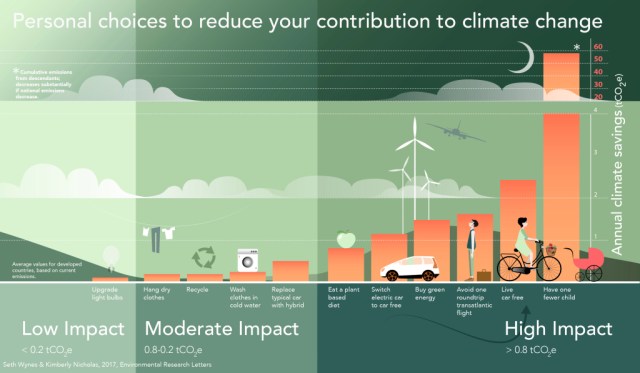
Personal actions to reduce greenhouse gas emissions

The July 12, 2017, article in Environmental Research Letters, The climate mitigation gap: education and government recommendations miss the most effective individual actions, by Seth Wynes and Kimberly A Nicholas, estimates the annual amount of greenhouse gas emissions that would be saved by various personal actions.

“We recommend four widely applicable high-impact (i.e. low emissions) actions with the potential to contribute to systemic change and substantially reduce annual personal emissions: having one fewer child (an average for developed countries of 58.6 tonnes CO2-equivalent (tCO2e) emission reductions per year), living car-free (2.4 tCO2e saved per year), avoiding airplane travel (1.6 tCO2e saved per roundtrip transatlantic flight) and eating a plant-based diet (0.8 tCO2e saved per year). These actions have much greater potential to reduce emissions than commonly promoted strategies like comprehensive recycling

personalclimateimpact

The following minute was approved by Iowa Yearly Meeting (Conservative) this summer.

Radically reducing fossil fuel use has long been a concern of Iowa Yearly Meeting (Conservative).  A previously approved Minute urged us to reduce our use of personal automobiles.  We have continued to be challenged by the design of our communities that makes this difficult.  This is even more challenging in rural areas.  But our environmental crisis means we must find ways to address this issue quickly.

Friends are encouraged to challenge themselves and to simplify their lives in ways that can enhance their spiritual environmental integrity. One of our meetings uses the term “ethical transportation,” which is a helpful way to be mindful of this.

Long term, we need to encourage ways to make our communities “walkable”, and to expand public transportation systems.  These will require major changes in infrastructure and urban planning.

Carpooling and community shared vehicles would help.  We can develop ways to coordinate neighbors needing to travel to shop for food, attend meetings, visit doctors, etc.  We could explore using existing school buses or shared vehicles to provide intercity transportation. 

One immediately available step would be to promote the use of bicycles as a visible witness for non-fossil fuel transportation.  Friends may forget how easy and fun it can be to travel miles on bicycles.  Neighbors seeing families riding their bicycles to Quaker meetings would have an impact on community awareness.  This is a way for our children to be involved in this shared witness.  We should encourage the expansion of bicycle lanes and paths.  We can repair and recycle unused bicycles, and make them available to those who have the need.

Icons1

Posted in bicycles, climate change, Quaker Meetings, Uncategorized | Tagged | Leave a comment

No Hope?

I wrote Unrealistic Hope about people who had just experienced Hurricane Irma who are hoping a similar storm would not happen again.  About the continued refusal of so many to accept the changes to the climate that are occurring now, and the more devastating changes rapidly approaching.

After rereading Realistic Hope, I wonder whether most of those few who read that believe I’m either naïve or delusional.  The more accepted view is we will be facing increasing lawlessness and violence as people fight over diminishing resources resulting from increasing environmental damage.  Dwindling clean water, food and productive land.  The global responses to refugees, many of them climate refugees, is not encouraging.  Nor is the assessment of the military that climate change is a threat multiplier and will be the likely cause of future international conflicts.

What we all want to, and do, avoid facing is just how badly our environment has been damaged, and what the future holds.

There is ever increasing evidence, and conclusion by many scientists and others, that we have damaged our environment beyond repair, and the extinction of the human race (as so many species already have) is unavoidable now.  I believe that is true.

As a person of faith, I can’t help but hope maybe God will somehow save us.  But that assumes it is God’s will we survive.  Defying God’s will, as we have by what we have done to the environment, has consequences.  And we seem to think that those of us on planet Earth are the center of God’s universe, so to speak.

If you are a person who has, what I believe is, unrealistic hope you won’t change how you are living.

If you believe that humans are causing at least some environmental damage, you may, or may not, modify how you are living to try to mitigate that.

If you believe we are on a path to human extinction, as I do, what do you do?  Do you say we might as well not even try to stop doing things we know damage the environment since there is no hope now?

Or do you try to live with more respect for the environment, and your fellow man?  Continue to search for and follow God’s will, if you are a person of faith?

Extinction, if it does occur (other than from nuclear or biological war) is at least a few decades away.  What I was trying to express in the blog post realistic hope was a vision of a best case scenario for how we can try to live until then.


DSC_1910

“Out of a mountain of despair, a stone of hope”  Martin Luther King Memorial


Posted in climate change, Uncategorized | Tagged , | Leave a comment

Scattergood graduate’s social justice video project

Recently graduated from Scattergood Friends School and Farm, Rezadad Mohammadi directed, produced and did much of the work on the video below,  “The War on Drugs” (U.S.A. and Mexico), Mass Incarceration and Solitary Confinement.

After a revealing history of the War on Drugs, the next segment is about mass incarceration and the intentional targeting of people of color.  This reminded me of some of the first discussions I participated in at the Kheprw Institute, where black youth led community discussion about Michelle Alexander’s book, The New Jim Crow.

The following segment about the horrors of solitary confinement was really powerful.  That is a moral outrage.

The video ends with some of the work of the American Friends Service Committee’s (AFSC) project 67 Suenos, a program to help give immigrant youth a voice for change in their communities.  One project, included in this video, is a 260 foot mural titled “Solidarity YES! Hatred NO!”.   Rezadad’s video ends with photos of parts of the mural, and wonderful interviews with the youth involved.

Mural1

Posted in Arts, Black Lives, Kheprw Institute, Uncategorized | Tagged , , , | 1 Comment

Realistic Hope

I recently wrote Unrealistic Hope about the continued refusal of people and our government to come to grips with the reality of climate change even in the face of Hurricanes Harvey and Irma.

This led me to continue to think about what realistic hope would be.  Even though dramatic changes are rapidly approaching which will make life much more difficult for us all, most of us (at least the fortunate among us) live in places of natural beauty and in some sort of supportive, loving community.

One of the wonderful things about humanity is how people respond during crises, helping those in need, whether they know them or not.  I believe a realistic hope for our future is to create conditions to facilitate building self sustaining Beloved communities, where people anticipate and prepare for these crises. And prepare to help those who will not be prepared.

One important step is to have an accurate idea of what the crises will be and when they will occur.  Research and education are needed, including calling out propaganda that hides the facts.

Based on that, we need to develop realistic visions of the future.  We need to envision how we will meet the basic needs of food, water, shelter, education and healthcare for vast numbers of people who will be displaced from not only the places where they once lived, but from the very lifestyle they knew all of their (previous) life.

The hallmark of this will be the disappearance of most forms of convenience and governmental structure.  We will be forced to do the work it takes to have supplies of food, water and energy from resources in our immediate vicinity.  One thing that would help is having a local source of renewable energy such as an array of solar panels.  Another would be to have a 3D printer to manufacture tools, utensils, parts, etc.

Perhaps the greatest challenge at the moment is to change the mindset of American culture away from materialism, racism and militarism.  To return to an understanding that people and our environment are what are important.  To reject the corporate gain and resource extractive mentality.  There are hopeful signs this is beginning to occur.

We urgently need to develop, model and teach a realistic hope for our future.

Posted in climate change, Uncategorized | Tagged | Leave a comment

Richard Rohr and Prophetic Nonviolence

I appreciate Eleanor Mullendore sharing the writings of Fr. Richard Rohr from the Center for Action and Contemplation.   https://cac.org/

Drawing from his own Franciscan heritage and other wisdom traditions, Richard Rohr reframes neglected or misunderstood teachings to reveal the foundations of contemplative Christianity and the universe itself: God as loving relationship.

Each week of meditations builds on previous topics, but you can join at any time! Watch a short introduction to the theme “From the Bottom Up” (8-minute video)—click here. If you’ve missed earlier messages, explore the online archive.

Practice: Contemplative, Active, and Prophetic Nonviolence

by Richard Rohr

Prophets are nonpartisan and thus their work never ends. Throughout history, they have spoken truth to power, regardless of the ruler’s political persuasion. They are able to lovingly criticize their own group, recognizing their own complicity in a violent system.

We still need courageous, humble people to speak up for justice and peace. For Christians, John Dear says, the great question is: “How do we follow the nonviolent Jesus more faithfully in this culture of violence and war?” He offers three basic steps: contemplative, active, and prophetic nonviolence.

More than ever . . . we have to dig deeper spiritual roots and that means practicing contemplative nonviolence. We have to take time for quiet meditation with the God of peace every day. . . . It’s hard to change the world; we can barely change ourselves. But God can change us and the world if we allow the God of peace to touch us, disarm us, heal us, and send us out as instruments of God’s peace. . . .

Second, we need to be public activists of nonviolence. It does not serve anyone to sit around and complain . . . about the Republicans or the Democrats. We need to take action, and not just private action but public action for justice, disarmament, and peace.

[Now] is a good time to reflect on our public lives as active peacemakers, to investigate the quality of our loving kindness and peaceableness behind our activism, as well as the boldness and derring-do of our work…

Third, we need to be prophets of nonviolence, that is, we need to speak out publicly . . . and lend our voice to the grassroots movement calling for an end to war, racism, nuclear weapons, poverty, corporate greed and environmental destruction, and for a new culture of peace and nonviolence.

In effect, like the nonviolent Jesus, we are announcing the coming of God’s reign of peace and nonviolence, here and now, right in our midst, despite what we hear on TV or Twitter. . . .

Don’t be afraid to be bold! Let’s not give in to fear, but practice fearlessness and herald a bold vision of a new culture of peace and nonviolence.

This is what it means for me to follow the nonviolent [and prophetic] Jesus these days. We may get pushed back, dismissed, ostracized, or harassed for our stand, but he endured far worse and remained meticulously nonviolent, loving and faithful. He set the example, and we want to follow him.

Today begins a week-long Campaign Nonviolence organized by John Dear and Pace e Bene, a nonprofit founded by the Franciscan Friars of California. You can find actions near you and take the Campaign Nonviolence Pledge at paceebene.org.

Posted in Uncategorized | Tagged | Leave a comment

Reflections on September Journey

This past weekend’s 3 day journey happened as a result of spiritual leadings.  Quakers (among others) believe we can communicate directly with God or the spirit, which is why we don’t feel the need for a minister, meditating together in silence to try hear what the spirit is saying to us.  Something is added by doing this as a group.  Occasionally someone will feel led to express what they are experiencing vocally, which often resonates with others.

Its not like God speaks in words, but rather nudges us along a path.  My grandmother, Lorene Standing, used to say God’s will is revealed in a series of small steps.  Each step reinforces the ones before.  Things begin to happen that reinforce these steps.  This may occur over a short time, or years.

Interestingly, Dallas Chief Eagle spoke about this for quite a while around the bonfire at the end of the Prairie Awakening celebration.  The desire to attend the celebration was where the idea for this journey started.

He told us to empty our mind.  When thoughts enter, say “no”.  To be completely still.  He then had us do this together.  Afterward he asked the children what they felt, and they said “good, “peaceful” and “happy”.  He said to practice this, and that we would also learn to recognize the spirit in others.

My spiritual life has been profoundly affected by time spent with Native Americans in Indianapolis last year as we worked in various ways to support the water protectors at Standing Rock, including several awareness raising and prayer events with burning sage and drums.  We also had an event where we went to two of the banks involved in funding the Dakota Access Pipeline, Chase and PNC, and withdrew $110,000.  I also had my own defunding experience.

A number of Iowa Yearly Meeting (Conservative) Friends have been drawn to the brave nonviolent struggle of the water protectors at Standing Rock, some having visited there.  As this year’s Peace and Social Concerns Committee report says “The witness and commitment of the Water Protectors at Standing Rock inspire us, as does the support for them from Indigenous Peoples all over the world”.  The first evening at Yearly Meeting was a panel discussion about “Building Bridges with Native Americans”.  Iowa Friend Peter Clay had visited Standing Rock several times.  Christine Nobiss of Indigenous Iowa spoke, as did Donnielle Wanatee, who invited us to attend the Meskwaki Powwow at the settlement she lives at near Tama, Iowa.  Dad and I did attend and enjoy the powwow, and shared photos with the organizers.

This month at Bear Creek we discussed the queries related to social and economic justice.  I said there was a growing consensus among the activists I work with that we need to confront two foundational injustices of United States history, taking the land and genocide of Native Americans, and the enslavement of and continued injustices related to African Americans.  Bear Creek Friends’ years of support for the Prairie Awakening celebration and the people involved throughout the year, is one way to do so.  This was further stimulus for me to attend.

DSC_3245-001

The problem was I have refused to have a personal automobile for the past 40 years or so.  That worked fairly well in Indianapolis where public transportation was available.  But I knew this would be a challenge when I moved to Indianola, Iowa.  Many friends in Indianapolis gave me money to buy a nice bicycle when I left, and I have been working to build up my endurance.

So I was praying for a way to get to the Prairie Awakening celebration at the Kuehn Conservation Area, near Bear Creek meetinghouse, about 40 miles from Indianola.  Going by car with my parents was not an option, because they were going to be in Bloomington, Illinois.

Then I learned that an event was going to be held at the Iowa State Capitol building the Friday of the Prairie Awakening celebration weekend.  That was when my parents were leaving town, so I thought they could drop me off.  Afterwards I would ride my bicycle to Bear Creek meeting, which was about 40 miles away.  I was apprehensive about that, not having ridden that distance, yet.  But that was how my leading was evolving, so I had faith things would workout somehow.  Bear Creek clerk, Jackie Leckband, offered to pick me up in her truck if needed, so there was a backup plan.

The event at the State Capitol was part of a new national campaign called StopETP, Stop Energy Transfer Partners, the company behind the Dakota Access and many other pipelines.  This event involved delivering a petition to the Governor to remove a member from the Iowa Utilities Board (that approves pipelines, etc) who has close ties to the fossil fuel industry, organized by Bold Iowa and Indigenous Iowa.  Christine Nobiss who spoke at Iowa Yearly Meeting attended.

After the event, I began to ride through downtown Des Moines to get to the bike trails along the Des Moines River through the city.  It was a struggle, but I made it to the meetinghouse around 6 pm.  I stayed in the cottage on the meetinghouse grounds.

CapitolBearCreek

Earlier in the week I awoke with a vision related to Bear Creek and StopETP, described in detail here https://kislingjeff.wordpress.com/2017/09/07/bear-creek-friends-meeting-and-stopetp/   Saturday evening I showed videos related to Standing Rock at the meetinghouse.

Sunday morning I attended meeting for worship, then Russ and Jackie Leckband gave me a ride to the Prairie Awakening, which they have been involved with for many years.  That is described in this previous blog post: https://kislingjeff.wordpress.com/2017/09/12/september-journey-day-3-prairie-awakening/

My parents returned to Indianola from Illinois that evening.  Monday morning Dad picked me up.  He had to be in Earlham anyway to attend a funeral.

I wanted to try to show how this came together as a series of leadings related to Quakers, Native Americans, spirituality and environmental justice.


Posted in #NDAPL, Black Lives, Ethical Transportation, Indigenous, Quaker Meetings, race, spiritual seekers, Uncategorized | Tagged | Leave a comment

Unrealistic Hope

I feel deeply sorry for those affected by hurricanes Harvey and Irma and appreciate all efforts to help them recover.

But it distresses me deeply to hear people in such vulnerable areas as the Florida Keys talk about rebuilding.  It compounds these tragedies to realize people continue to deny why these storms were as powerful as they were, to continue to refuse to accept that storms like these will occur more frequently and with ever greater strength.  I just heard one survivor from the Keys say “I hope I never see another storm like this in my lifetime”.  That will be an unrealistic hope if he stays there.

People who should (do) know better suggest this is not the time to talk about climate change and its consequences.  True leaders would use the lessons of these disasters to acknowledge that we need to plan for the multiple consequences of environmental crises that will be coming at us at an accelerating rate–increasing frequency and strength of storms, rising sea levels, increasing air and water temperatures, changing precipitation patterns with huge areas of drought, death of sea life from acidification of ocean water, dwindling supplies of clean water, and air, etc.

These tragedies should make us stop fossil fuel use and infrastructure (such as pipeline) development immediately.  They should stimulate a massive transition to the development of renewable energy right now.  They should spur us to focus on building resilient communities in areas that will not be flooded by rising seas.  They should make us plan for how we will deal with food and water insecurity, and massive numbers of climate refugees.

Addendum:  My Friend Anne Reynolds from North Meadow Circle of Friends sent me the link to the following EXCELLENT podcast discussion about climate change:

https://www.samharris.org/podcast/item/what-you-need-to-know-about-climate-change


Posted in climate change, renewable energy, Uncategorized | 2 Comments

Diop – Flex (Hey)

Check out the new video by my friend Diop Adisa, filmed in Ghana, Flex (Hey).


DSC_3257

After Diop recently asked me how I was doing since I moved to Iowa, I asked him the same.  He said “I’m doing pretty good, just trying to continually figure it all out.

Posted in Arts, Black Lives, Kheprw Institute, Uncategorized | Tagged | Leave a comment