Civil Disobedience and the Civil Rights Movement

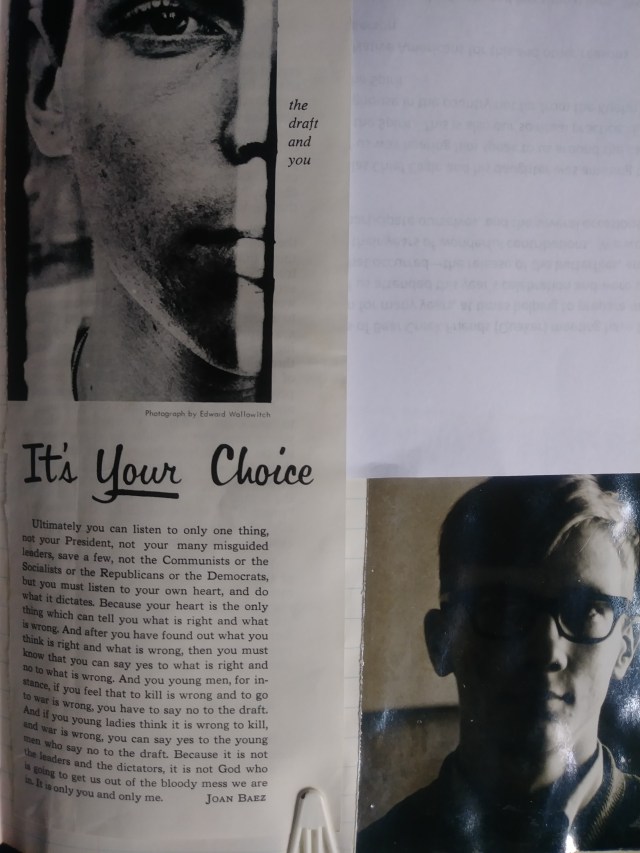
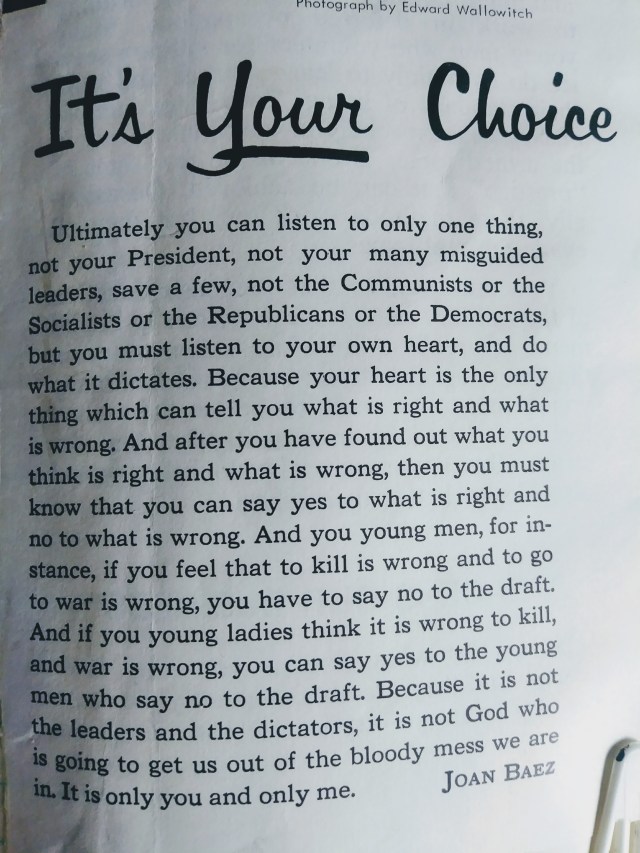
If you’ve read recent posts from this blog, you know I’ve been using the journal I started when I was a Senior at Scattergood Friends School to share what was going on at a particularly significant and chaotic time in my life, and for the country.  That was in 1969, at the height of the Vietnam War.  Yesterday’s post was the conclusion of the long, difficult process of coming to my decision to commit an act of civil disobedience, and become a draft resister.

The other significant influences on my life that I hadn’t mentioned, since they weren’t written in my journal then, were related to the civil rights struggle that was going on at the same time, including the eloquent speeches by, and example of Martin Luther King, Jr.  In 1963, for example, Martin Luther King, Jr, wrote his Letter from Birmingham Jail about nonviolent resistance.

The key to the success of any nonviolent campaign, besides inspiration and commitment, is training.  It is a sad commentary that our country devotes so much effort and billions of dollars to training our armed forces, but to work for peace and justice, we have to do our training ourselves.  The success of the civil rights movement hinged on the incredible organization and training of thousands in the techniques of nonviolent civil disobedience and direct action by John Lewis and the Student Nonviolent Coordinating Committee (SNCC) and many others.

There was the inspiration of the willingness of so many to risk their lives, and the tragic deaths of  James Chaney, Andrew Goodman, and Michael Schwerner and others.

The courage of the parents of, and the high school, middle school and elementary students who marched in Birmingham in 1963 with over 1,000 of them filling the jails after being brutally attacked by dogs and with fire hoses.

Although there were consequences for both of them for doing so, Martin Luther King, Jr, and Mohammad Ali were among those who spoke out about the connections between the civil rights and the anti-war movements.

DSC_2052

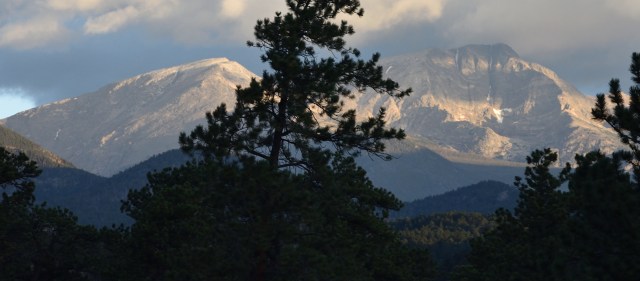
Martin Luther King, Jr. Memorial, Washington, DC

Mohammad Ali was an inspiration to me. He chose to be a draft resister, too:
“It is in the light of my consciousness as a Muslim minister and my own personal convictions that I take my stand in rejecting the call to be inducted. I do so with the full realization of its implications. I have searched my conscience.”
“Under no conditions do we take part in war and take the lives of other humans.”
“Man, I ain’t got no quarrel with them Vietcong…they never called me nigger.”

At Mohammad Ali’s memorial service Rabbi Michael Lerner, who was also arrested for protesting the Vietnam War, gave an incredible speech honoring him and his moral integrity.  He said, “the way to honor Mohammad Ali is to be Mohammad Ali today!


Posted in Black Lives, civil disobedience, peace, Uncategorized | Tagged , , , , , | Leave a comment

Journal–Conclusion of Draft Resistance Story

Yesterday I described what happened the first time I turned in my draft card.  At my parents request, I asked the draft board to return the draft card, to give my family more time to accept my decision.  The draft card was returned to me.  I wonder what the board thought about that.

Following is what happened nearly two years later, when I received the order to report for civilian service as a conscientious objector.

Journal 1/25/1972

“Received order to report for civilian work on February 1. As I approach the decision, its revelation, and the consequences, I draw back in fear.”

At last the draft issue was coming to a head. I left Earlham knowing I would lose my student deferment and be eligible for induction. I was reclassified 1-0 (conscientious objector to do alternative service) in October, 1971, I think. I looked for jobs in hospitals, and accepted the one at Methodist partially because I knew, if I did decide to do alternative service, such a job would qualify.

Up to this point I still had alternatives. Now the ‘official’ order had come. It didn’t matter that I would continue to work at the hospital or even that I would receive credit for what work I had done. What did matter was whether I would acknowledge that I was actually doing alternative service. I enjoyed my work at the hospital and felt called to continue with it, whether the government approved or not. But I had to decide whether I would accept the work on their terms or mine.

I’ve already indicated how much reading, thought, and worry I put into the draft decision. I thought I would suddenly receive the answer some day during Meeting for worship. It didn’t happen exactly that way. I remember one meeting in the fall of my senior year at Scattergood when I knew it would be wrong to cooperate with the Selective Service System. I knew with certainty yet the time wasn’t yet right to act on that knowledge. My grandmother (Lorene Standing) says the will of God is most often revealed in a series of small steps.

I think my task was first to prepare for the decision, its consequences and the reaction to it; and to prepare my family and those close to me for the decision. Then I would act.

I had done what I could to prepare myself and others. Now the time had come.

The first of February I returned to Earlham to visit friends and to get support before going ahead with my decision.

Took bus to Richmond. Bright clear day—snow on ground. Beautiful walk to Earlham from downtown. Seems like coming home. Good to see Jan. After spaghetti lunch, walked downtown to YWCA where Jan had swimming lesson. Al Inglis picked us up there at 3:00 pm. Went back to Earlham and talked.

4:00 pm. Went to Meeting for worship. Jan, Al, Dav Nagle, Marggie Schutz, Margaret and Lewis Taylor, Becky Gibson, Jim Bay, Ruby, and several others attended.

Al had read my letter to the draft board and my statement on the draft earlier, and asked if I would let him read it during Meeting. I told him that would be alright, so he did.

Into the Meeting, Al spoke of support and the future and how God spoke through me. I would hope that would be true, but felt unworthy.

Margaret Taylor spoke of Iowa Friends who had always spoken against war and done what they felt right. She spoke of her support for me.

Becky Gibson spoke, very movingly, about finding who you are, and how important it is to do what is right.

Then Dav spoke, also very movingly. He is certainly an able minister—one of the people I love and respect very much. He seems always to be close to the center. He said severing ties with Selective Service is a major decision—but ALL decisions are major when they deal with principle and the Spirit. All, each of our decisions must be integral. “Severing ties with Selective Service is not an isolated act in this life of Jeff’s.”

After a good while I felt moved to speak. When confronted with a decision, we are told to do God‘s will. But God’s will is so difficult to discern among many influences—people, law, self (selfishness and pride). Realizing this, Thomas A’ Beckett said, “I am loathsome.” This was how I felt at times. But after he said that, he heard what he believed to be the voice of God saying “Nevertheless, I love.”

Later, I shook hands with Jan to break meeting. There was much tender, loving discussion and support afterward. Here I received such strength as I could find nowhere else. Is there any other way to wrestle with and be led to a decision? I am amazed at the power and bond of love. May I strengthen and spread it.”

Journal 1/30/1972

I received a letter from Ron Ellyson, a classmate of mine at Scattergood and close friend (Member of Iowa Conservative Friends):
“As for your decision to not cooperate with the desires of Selective Service, I think it is fine. It is a choice which you made after years, actually, of thought and deliberation and certainly you should have enough faith in your judgment to stay with that decision through all the hassles it will cause you.” Ron Ellyson.

2/6/1972 First Day

I mailed the following to the draft board today, along with my registration certificate and classification (1-0) card:

Dear members and clerk of the draft board:

I have received an order to report for civilian work February 1, 1972.

I want to thank you for your concerned questions at my personal appearance, when we were considering my position as a conscientious objector. I have appreciated Mrs. Landon’s kindness and consideration, even when I returned my draft cards. Thank you for giving me more time to consider this decision. I hadn’t realized what a powerful affect that action would have on some people. The extra time gave them, and me, a chance to come to grips with the decision and its consequences. However, my beliefs have remained basically the same and the time has come to act accordingly.

I am sure none of us really want war. Many are convinced that war is a ‘necessary evil’—the only way to achieve peace. I think I can understand that, and I do respect those who sincerely believe it—their sacrifice has been very great.

But I do not believe war is the way to peace. True peace is a personal, internal, spiritual matter. When we come to know and love ourselves and our God, then and only then do we have peace. From this point, peace and love will flow from us and should engulf those we live and work with. This is the only way to find and promote peace.

In this matter, war has no place.

The enclosed attempts to illustrate my beliefs in relation to the Selective Service System. I hope this will help you to understand why I feel I cannot cooperate with the Selective Service System. I want it to be clearly understood that I am not doing alternative service. It is not my choice. There is nothing else I can do.

Love,
Jeff Kisling

Letter to my draft board

I write concerning my relationship with the Selective Service System. There are many alternatives. In fact, someone once said the only alternative not open to a young man facing the draft is that of being left alone. I explored several of these. I applied for and was granted conscientious objector status (1-0). Then I had a student deferment, which made me very uneasy. I am now doing work which should qualify as alternative service, but for reasons I will attempt to explain herein, I find this alternative to be unacceptable.

I find it difficult to understand why one young man must explain his decision to do civilian work for a non-profit organization while another need make no explanation, indeed is encouraged to fight and perhaps kill other human beings. But it is one’s duty to explain one’s actions in order that others might understand, and perhaps follow. Noncooperation is less understood than conscientious objection, so I feel all the more compelled to try to present an explanation. I must try to explain, to spare my family the burden of doing so, for they neither clearly understand nor agree with my decision. (Note: they fully supported alternative service, but didn’t want to see me imprisoned).

This decision grew out of my experience as a member of the Society of Friends. Meetings of the Society of Friends can be a source of strength and guidance as one begins and continues to search for meaning in life. Quakers have always believed that there is that of God in every man, that each of us has the ability to communicate with that of God in us, and the responsibility to respond to that of God in everyone. It is evident that Jesus had communion with God—evident in the actions of his life and in his teachings—culminating in “not as I will, but as thou wilt.” This is the essence of Jesus’ teaching—that God’s will can be discerned and should be obeyed even at the cost of doubt and persecution. Quakers readily accept Jesus as an exceptional person and try to live up to the principles he gave us to live by. But we are even more concerned that we obey that Inner Light to which He was so sensitive, so we can have personal contact with and guidance from God. Thus, Quakers try to minimize distractions from “this (secular) world” in order to discern the will of God in their hearts and His presence in their midst. They gather together in a simple room and settle down together, searching in silence—each contributing to the spirit of the meeting as a whole. There are times when a member feels he has been ‘moved by the spirit’ to share with the group, in which case the meeting considers the message in further silence.

There is a spirit which comes from the silence which gives direction to life. The spirit is often difficult to discern because of our ties to ‘this world.’ We are afraid or too proud to give up our desire to ‘reason through’ decisions. Thus we develop a system of beliefs and guidelines composed of traditional beliefs, our own reasoning, and as much guidance from the Inner Light as we are willing to seek and accept. Thus our decisions, being not entirely grounded upon our faith, may not always be ‘right’. But we can do no more, nor should we do less, than follow our conscience as occasions arise—always seeking to become more attuned to the spirit.

Adolescence is that period when one begins to seriously consider ‘who he is’ and his purpose in the world. It is a time when one has so many question and so few answers. The extent to which a young person searches for, and finds answers to these questions is dependent upon guidance given by parents, peers, school and church; the degree to which this guidance corresponds to his own experience and needs; and his own self-discipline and desire to continue the search. Too often the leadership and resources are not available; he is ‘turned off’ by inconsistencies or shallowness or insincerity on the part of those he looks to for guidance and example; or materialistic demands distract from the search.

The draft requires fundamental moral decisions at this time in life. This may not be bad in itself, but tremendous pressure is brought to bear to influence the decision—tradition, parental and peer pressure, the law, etc. The Selective Service System tries to attract men to the armed forces by relying on these pressures and by not making alternatives widely known.

The pressures in this case are for action which is contrary to the experience and desires of most young men—frustrating, anguishing when one is searching for truth, honesty and integrity. This type of experience stifles personal growth and leads to the loss of a spirit of idealism and faith in the goodness of men. Can there be a graver crime than that of destroying the spirit and dreams of the young? Only that of destroying life itself, and the Selective Service System is directly implicated in both.

Most of us agree that conscription and war are unjust-evil. The question is, how do we deal with evil? ‘Resist not evil’—a phrase widely known but little understood and less obeyed. ‘Do not set yourself against one who wrongs you’ (NEB) is a better way to put it, I think. In setting ourselves against those who harm us, we look, to some extent, for some way to hurt, or at least hinder them. We look for the worst in others and play upon their weaknesses rather than looking for the best and trying to fortify it. Out task is to overcome evil by doing good.

The time we spend ‘resisting evil’ could be better spent in trying to find out where we can do better ourselves. You do not change others by opposing them—rather, by respecting and trying to understand and learn from them, you can both benefit and move nearer the truth. A life of example—showing the possibilities and fruits of a life lived in love and concern for others, is the only way to overcome evil.

I do not want my example to be alliance with evil. Thus, I cannot serve with the Selective Service System. However, I will not set myself against it. I will break my ties with Selective Service, and concentrate on the difficult task of working for peace in whatever way I can.

Letter to Bear Creek Monthly Meeting

Homer Moffitt, Clerk
Bear Creek Monthly Meeting

Dear Friends,

I am thankful for your kind letters and encouragement concerning my work in Indianapolis. I am learning much about love, and as I respond to the love of others, and they to mine, we are all amazed at how it grows.

I am enclosing a statement I have written concerning conscription, and my decision not to cooperate with the Selective Service System any more. I sent a copy of that statement, along with my draft cards, to my draft board.

Again, I tried very hard to follow the leading of the inner light. If I alone were making the decision, this would probably not be my choice. Thomas a’ Beckett, torn between his obligations to the Church and those to the State, was searching for guidance. When he realized all the forces that influence him—selfish desires for power and personal gain, fear of punishment or displeasing people, etc., he said. “I am loathsome.” But then he heard what he believed to be the voice of God saying, “Nevertheless, I love.”

I, too, feel shamed when I realize the factors that often influence my decisions and actions. On this matter, I have tried very hard to be sensitive to the will of God, and hope to do so in the times to come. Still somewhat uncertain that my choice is right, I am comforted in knowing that He still loves.

Love,
Jeff Kisling

In reply:

Dear Jeff,

We have found your statement explaining your relationship to the Selective Service System very moving. Several of us are aware that your decision on this has been a difficult and lonely one. We want to assure you of our love and support as you meet the events which result from your courageous stand.

On behalf of the Peace Committee of Bear Creek Monthly Meeting


The conclusion to the draft story is that I was drafted at a time when men were not being drafted for the armed forces. A Supreme Court case declared this to be illegal, so my order to report for civilian service was invalidated and I wasn’t prosecuted. I did finish my two years with Friends Volunteer Service Mission in Indianapolis.

Struggling with my decision related to registering for the draft triggered a deep look into my spiritual life and how to express that in the rest of my life.

Posted in civil disobedience, Quaker Meetings, Uncategorized | Tagged , | 2 Comments

Scattergood Journal–Returning My Draft Card

Even though I was convinced that I should not cooperate with the Selective Service System, at the time of my 18th birthday, November 21, 1969, I reluctantly registered for the draft as required by law.  I hadn’t yet come to the point where I had enough resolve to risk imprisonment.  But the larger factor was that my parents strongly felt I should do alternative service as a conscientious objector instead.  So I was very unhappy during Christmas break at home in Marshalltown.

I didn’t handle what happened next very well, as the following shows.  I’d rather edit it a little so I wouldn’t look quite so inept, but leaving it like it is shows how difficult things were then.  I knew I couldn’t return to Scattergood until I had returned my draft card. So following is the unedited version.

Journal, January 5, 1970, Scattergood Friends School

“I turned in my draft card Friday morning, January 2, 1970. I knew neither of my parents approved at all, but wasn’t prepared for what happened. Earlier in the week I had talked to Dad, telling him that’s what I thought I should do. He didn’t say much except that I knew he strongly disapproved, but I thought he told me that he thought he was standing in my way and I should do what I thought was right. I didn’t tell him the day I was going to do it, but thought he knew that I was going to do it.

That morning Mom took me uptown. She knew I had the card and I told her I was going to turn it in. She told me she didn’t want me to, but I told her I was going to. After that, as I recall, she didn’t say anything but looked unhappy. I took that to mean that she didn’t approve, but knew I was going to do it.

Well, I stood outside in the cold and snow for about 5 minutes and finally went in. I told the secretary I was going to turn in my draft card. She told me I would have to see the clerk, Helen Landon, so I sat down and waited. The secretary asked me if I had requested form 150 and if I had filled it out and I told her I had.

I went into the clerk’s office.  She was a pleasant person, having helped me fill out form 100 earlier and given me form 150. (note: I assume form 100 was the registration form, and 150 the application for conscientious objector status).  I told her I was turning in my draft card. She asked me if I had given it enough serious thought, to which I replied affirmatively. She said it had to be my decision, and then asked if I wasn’t still in high school. I told her I was. She said she would look up the regulations and write to me.

Everyone at home was very upset. Mom thought she had told me not to do it, and Dad was upset because he thought I hadn’t told him I was going to, which is really right. I told him I thought that was what I should do.

The next day they wanted me to try to get it back, saying they could accept it better in a year, feeling I would be more mature and no longer under the influence of Scattergood. I was shaken by the whole thing and, to spare their feelings, agreed to try to get it back. I don’t know what has happened, yet.”

End of Journal entry.

I read something recently about teenagers being clueless about the magnitude of the repercussions of some of their decisions.  That was sure true here.  I want to emphasize my parents were concerned for me, and were convinced I didn’t realize the seriousness of what I wanted to do.  I had no doubt by this time what the right thing to do was, but was also afraid of the probable consequences.  But I knew I could return my draft card at any time (assuming it was returned to me this time). At any rate, things were put on hold as we waited either until I was called to perform alternative service, or there were consequences from turning the card in this time. It was looking like I might be one of the few people to turn in their draft card twice.

20171107_145934_Burst0120171107_150049

Posted in civil disobedience, peace, Uncategorized | Tagged | Leave a comment

All That We Are Is Story

ALL THAT WE ARE IS STORY. From the moment we are born to the time we continue on our spirit journey, we are involved in the creation of the story of our time here. It is what we arrive with. It is all we leave behind. We are not the things we accumulate. We are not the things we deem important. We are story. All of us. What comes to matter then is the creation of the best possible story we can while we’re here; you, me, us, together. When we can do that and we take the time to share those stories with each other, we get bigger inside, we see each other, we recognize our kinship — we change the world one story at a time.
Richard Wagamese (October 14, 1955-March 10, 2017)
Ojibwe from Wabeseemoong Independent Nations, Canada

“All that we are is story.”  I immediately recognized the truth of that when I read it recently (maybe because it helped make a little sense of this compulsion I have to write so much).   And is the connection I’ve noticed between several seemingly separate things I’ve been thinking and writing about recently.

One of those is related to the discussion about our Quaker queries. “One of the keys of Quakerism has always been our faith is not limited to Sunday services. That we strive to live every moment of our lives faithfully. That relates to the concept of putting our faith into action. The actions are how we live our own lives. This is also related to the ideas above about pushing and pulling. Rather than pushing our beliefs on others, we try to live our own lives in such a manner as to pull others into living the truth we try to model by our lives.”  The examples of how we live our own lives are our stories.

In that same blog post I also wrote something that I’ve been thinking about since: “But this does lead me to reflect on what I have seen as my failure to get Friends and others to stop using fossil fuels. I know I was lead to live without a car, and have written about the many unexpected blessings that occurred in my life as a result. What puzzles and disappoints me is I had thought my example of living without a car would influence others, but it has not.”  The thing is that others often are influenced by people’s example, without that person ever knowing that.  Perhaps something occurs in another time or place.  When I said I felt I had failed to influence others by my refusal to own a car, I was talking in the narrow sense of not being aware of a single person I knew who gave up their car.  But as I’ve shared before, many people throughout my life have made comments that let me know they were aware of my refusal to own a car.  People know this story.

Since giving up cars was a strong and persistent spiritual leading, I couldn’t help but wonder why God didn’t help make people give up their cars?  Faith is believing if we are as faithful as we can be, the rest is in God’s hands.

The other threads related to stories have been sharing the journal entries from my time at Scattergood Friends School.   And, related to those, the recent discussion in particular about the example of Quaker men who refused to participate in war.  Evalyn Kellum (Quaker) expressed that very well. “That statement and all those Quaker men, who were conscription age at that time affected so much in their life times. They helped shape each of the major Quaker institutions of the time and their impact continues to do so.”  Their stories demonstrate we are story.

Many in Iowa Yearly Meeting (Conservative) have been concerned about how stories of Friends are lost when those Quakers die.  My mother in particular has tried to get Friends to write some of those stories so they are preserved, and can be shared with others.  That lead to the creation of the Quaker Stories Project, that you are encouraged to read, share with others, and add your own stories to.  (one way to do that is email jakislin@outlook.com).

“All that we are is story.”

https://quakerstories.wordpress.com/

quakerstories

Posted in Quaker Meetings, Uncategorized | Tagged , , | 2 Comments

Scattergood Journal — Conscientious Objector Letters

First I’d like to share what my Friend Evalyn Kellum, of North Meadow Circle of Friends, where I attended when I was living in Indianapolis, wrote about An Epistle to Friends Concerning Military Conscription:

Thank you for sending your struggle with conscription. It had been a long time since I read the letter signed by all those young men. In looking down through the list of men who signed that letter, it is amazing how many of them continued to have such a direct influence on Friends and others through out their lives. They directly influenced Quakers through out their lives. They also continued to speak out on issues and act on their beliefs for the rest of their lives.
I actually remember thinking in my late teens and early adulthood that I wished I could be drafted in order to sign such a statement! That statement and all those Quaker men, who were conscription age at that time affected so much in their life times. They helped shape each of the major Quaker institutions of the time and their impact continues to do so.

I’m in Madison, Wisconsin, and my brother Randy also spoke about what an powerful letter that is.

One of the reasons I shared the Epistle was because I had written that out as my journal entry November 8, 1969.  It was also a large influence on my thinking about conscription.

Even though I was pretty much convinced that draft resistance was what I was being led to do, when it came time when I was required to register, I hadn’t reached the point where I could actually refuse to do so.  The main reason was because I had not been able to get my family to be able to accept the decision, yet.  My parents were definitely against all war, and were encouraging me to be a conscientious objector.  They were not comfortable with the idea of me being in prison, and the life long consequences of a felony conviction.

So it was really hard for me to register for the Selective Service System.  I was very unhappy after having done so. But I knew I could, and probably would, turn in my draft cards eventually.

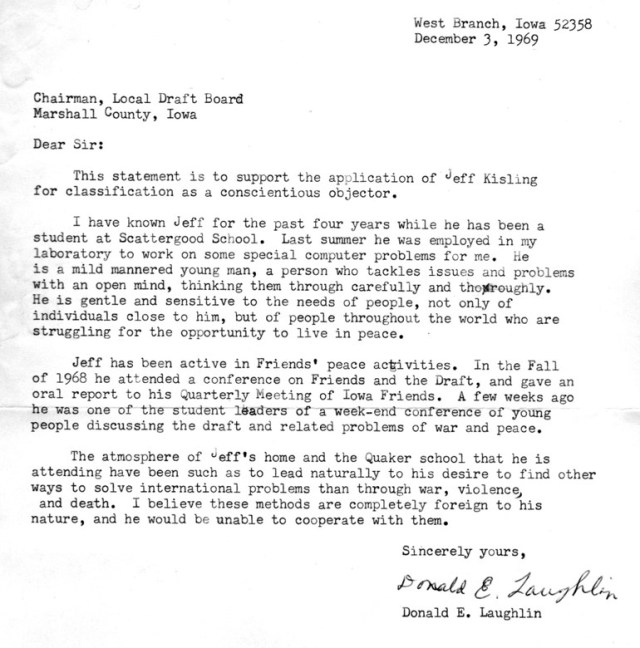
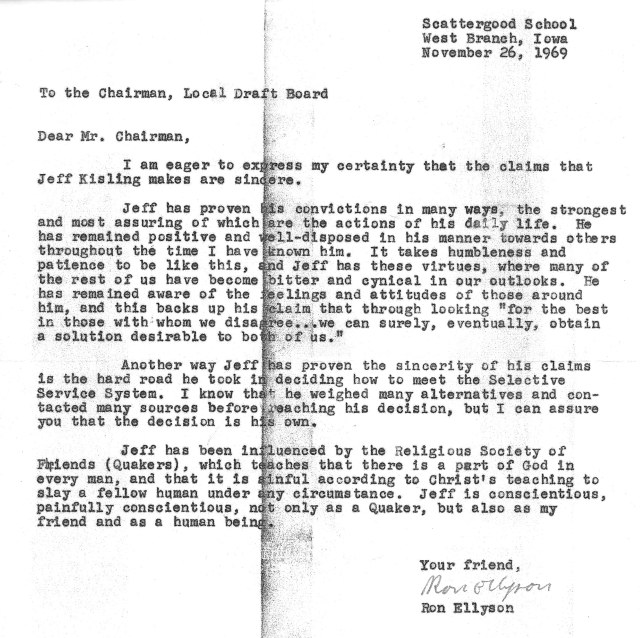
In the meantime, Don Laughlin, and my classmate and close friend Ron Ellyson, wrote letters to my draft board to support my application for conscientious objector status.  Such letters were a required part of the process.

DonnLauughlinLetterfor Jeff
COLetterRon

Posted in civil disobedience, peace, Quaker Meetings, Uncategorized | Tagged , , | Leave a comment

Scattergood Journal – Epistle to Friends Concerning Military Conscription

I’ve been sharing entries from my journal from my Senior year at Scattergood Friends School, which was the time I was struggling with what to do as I faced my 18th birthday on November 21, 1969, when every male was required to register for the Selective Service System.

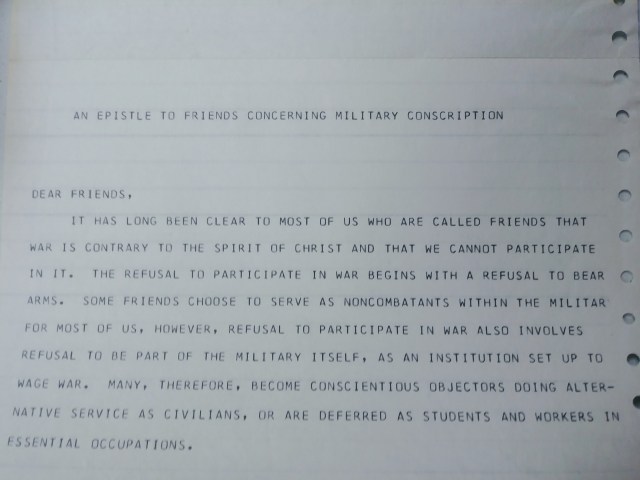
One of the most influential things I read during that time was An Epistle to Friends Concerning Military Conscription.  I’m not sure exactly when it was written, but it clearly and powerfully made the statement about Friends and military conscription.  It was also signed by two Iowa Yearly Meeting (Conservative) Quakers, who I knew very well, Don Laughlin and Roy Knight.

An Epistle to Friends Concerning Military Conscription

Dear Friends,

It has long been clear to most of us who are called Friends that war is contrary to the spirit of Christ and that we cannot participate in it. The refusal to participate in war begins with a refusal to bear arms. Some Friends choose to serve as noncombatants within the military. For most of us, however, refusal to participate in war also involves refusal to be part of the military itself, as an institution set up to wage war. Many, therefore, become conscientious objectors doing alternative service as civilians, or are deferred as students and workers in essential occupations.

Those of us who are joining in this epistle believe that cooperating with the draft, even as a recognized conscientious objector, makes one part of the power which forces our brothers into the military and into war. If we Friends believe that we are special beings and alone deserve to be exempted from war, we find that doing civilian service with conscription or keeping deferments as we pursue our professional careers are acceptable courses of action. But if we Friends really believe that war is wrong, that no man should become the executioner or victim of his brothers, then we will find it impossible to collaborate with the Selective Service System. We will risk being put in prison before we help turn men into murderers.

It matters little what men say they believe when their actions are inconsistent with their words. Thus we Friends may say that all war is wrong, but as long as Friends continue to collaborate in a system that forces men into war, our Peace Testimony will fail to speak to mankind.

Let our lives speak for our convictions. Let our lives show that we oppose not only our own participation in war, but any man’s participation in it. We can stop seeking deferments and exemptions, we can stop filling out Selective Service forms, we can refuse to obey induction and civilian work orders. We can refuse to register, or send back draft cards if we’ve already registered.

In our early history we Friends were known for our courage in living according to our convictions. At times during the 1600’s thousands of Quakers were in jails for refusing to pay any special respect to those in power, for worshiping in their own way, and for following the leadings of conscience. But we Friends need not fear we are alone today in our refusal to support mass murder. Up to three thousand Americans severed their relations with the draft at nation-wide draft card turn-ins during 1967 and 1968. There may still be other mass returns of cards, and we can always set our own dates.

We may not be able to change our government’s terrifying policy in Vietnam. But we can try to change our own lives. We must be ready to accept the sacrifices involved if we hope to make a real testimony for Peace. We must make Pacifism a way of life in a violent world.

We remain, in love of the Spirit, your Friends and brothers,

Don Laughlin
Roy Knight
Jeremy Mott
Ross Flanagan
Richard Boardman
James Brostol
George Lakey
Stephen Tatum
Herbert Nichols
Christopher Hodgkin
Jay Harker
Bob Eaton
Bill Medlin
Alan & Peter Blood.

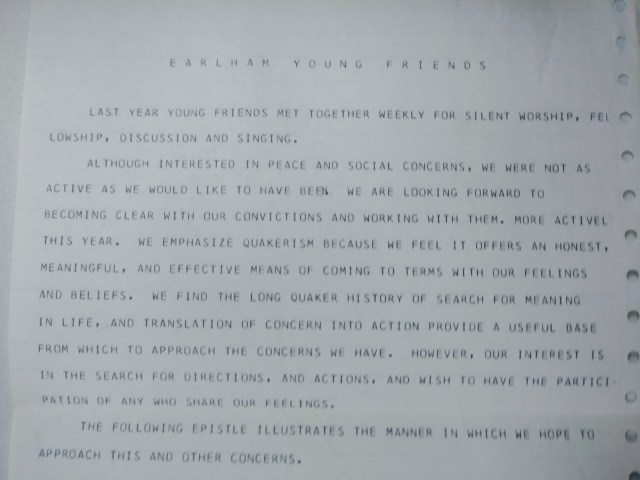
When I attended Earlham College the following year (1970), I was involved with Young Friends, which is where I became lifelong friends with David Nagle.  This was before personal computers were widely available, and word processors hadn’t been invented.  Since I was studying computer programming, I would create announcements of Young Friends meetings and documents as computer code listings that could be printed from the mainframe computer.  One thing we shared was this epistle.

20171111_055404 (2)20171111_055425_Burst01 (2)

Posted in civil disobedience, Uncategorized | Tagged , , | Leave a comment

Scattergood Journal – Draft Conference and Draft Registration

The previous blog post has some discussion about preparing for the draft conference that was held at Scattergood November 15, 1969, as part of the Moratorium Against the Vietnam War.  Following are more journal entries from that time.

November 8, 1969

I’ve been reading quite a bit out of the Bible lately–mostly the New Testament. And I find that very helpful at the present time.  I remember a discussion somewhere, sometime, in which the point was made that God would always be willing to walk with you, but it is up to you to decide whether or not you wish to walk with God.

“Throughout your life may you walk with God.”  Nellie Marley

November 9

The family came today (Sunday).  Of course we talked a lot about the draft.  Dad doesn’t think I’m mature enough to make such a decision as noncooperation, even though he says he thinks I’m more mature than many my age.  We were talking about compromise and democracy a lot.

November 14

“November 14 is the next national day of Resistance. On the three previous days, over 3,000 men returned draft cards to the U.S. government and began to non-co-operate with the Selective Service System, began to say Yes to what they believed. For more information about the Resistance contact: Chicago Area Draft Resisters”

November 15  Draft Conference, Scattergood Friends School

ScattergoodDraftConference

(Note:  After all the writing leading up to the conference, I was disappointed that I didn’t write much about what happened that day)

I felt the draft conference was successful.  We had about 25 guests.  The speakers, films and literature were all good.

November 17 (Monday)

I have come home to spend the week trying to think through my draft decision-birthday Friday, 21st.

November 19

I really think our present system of conscription is wrong. It makes me almost blindly furious at times.  It’s really difficult when most accept and support something you feel to be wrong. I’m torn between what seems to be philosophy and what appears to be reality.

November 26

Registered (with the Selective Service System), but not convinced!  (note: this isn’t the end of the story)

“Depart from evil and do good.” Psalms 37:27

December 3

Disillusionment abounds.

Every day the conflict between idealism and practicality grows. Is idealism worthless?

December 5

War is immoral. But how much must, or can one separate himself from war in a society and world which accepts war?

It is a question of where one chooses to draw the line. I am not sure that it is possible to escape responsibility for war. But up to a certain point we must do all we possibly can to prevent or stop it.

The Selective Service System is an institution organized to acquire manpower for the armed forces, and to channel manpower not available for the armed forces into an area considered to be in the national interest. This institution acts on one’s lack of maturity by forcing such a decision at an early age, when beliefs are not firmly established, and it acts on one’s lack of information–propaganda. After deferments are exhausted, there are three ways to fullfil one’s “obligation” of service to one’s country-

  • combative service in the armed forces (1-A)
  • noncombative service in the armed forces (1-A-O)
  • alternative civilian service as a conscientious objector to war (1-O)

Great pressure (parents, peers, recruiters, propaganda–society) is put on most young men to participate in the armed forces, and virtually no information is volunteered, or even readily available about the other two alternatives, which are just as legal and valid (more valid).

Posted in civil disobedience, peace, Uncategorized | Tagged , , , | Leave a comment

Scattergood Journal – Beginning to plan next Moratorium Day

The last post from my journal from my Scattergood days was about the Peace Walk the School did as part of the Vietnam War Moratorium Days, October 15, 1969.  The plan was to have another Moratorium Day November 15.

Journal, October 24, 1969

I, along with Ann D, was appointed to organize a draft conference here at Scattergood for the November Moratorium. We plan to have it on Saturday, Nov. 15, inviting kids from West Branch, Kalona (Iowa Mennonite School), West Liberty, Tipton, Iowa City and Cedar Rapids High Schools.  We’ve been working with Tim Gardner, newly in charge of the AFSC office in Iowa City. I’ve spent hours on this thing so far, and its really made me feel good for a change.  I’ve gotten to know a lot of people a lot better, too.

October 29

“War is a crime against humanity.  I therefore am determined not to support any kind of war, international or civil, and to strive for the removal of all causes of war.”  Enrollment pledge of the War Resisters League.  Signed Jeffrey A Kisling

I’ve been trying to think of what I might say to my draft board if I don’t register.

November 1

The month of my first fateful decision begins.  Arlo Tatum, National Secretary of the Central Committee for Conscientious Objectors (CCCO) will be here tomorrow.

November 4

I’ve been very glad that I could get involved in the draft conference planned for November 15.  I always relate this work and concern for others to what I am thinking about conscription.  Last Friday night Bob Scattergood took us Senior boys to West Branch to watch the football game. I spent most of the time watching the people–the parents, the kids, the football players–wondering what they are thinking and doing today.  And I am sorry that they really haven’t considered the draft and conscription, mainly through lack of information and adverse social and political pressure.

I feel people would reach the same conclusions I do about conscription, that it should be rejected, if they had enough information–not influence, just stimulation to consider many sides of the issue and to learn facts of the case–and enough motivation to really consider the issues. I’m really glad I can have a part in beginning to make that information available to students in this area, and, perhaps later, I can help get more information over a larger area.

I wish they could see things the way I do, because I am convinced that what I believe in is good and right. It is a vision of the imagination, perhaps not a practical vision in the eyes of many, but it is a vision I believe in and feel obliged to try to live up to.  This vision encompasses the teachings of Jesus, the prophets, some philosophers, the principles of nonviolence, resisting evil with good, doing unto others as I would have them do unto me, devotion to principles, respect for one another, community based on consensus, caring, hoping, living.  Ideals, perhaps, that man cannot attain, though I believe we can, and I want to try–we must live in the world today as we would like people to be able to live in the future, if that future world is to be attained on this earth.

Why not be a C.O. (conscientious objector) and do alternative service–do something “effective” for two years instead of “wasting” two, three, or more years in prison?

I believe that as long as the government has the manpower, and little dissent from the public, it will continue to get involved in more Vietnams, or something even worse.

But the Selective Service System itself doesn’t see the procurement of military personnel as its only, or even, perhaps, primary purpose, according to its own publications.  By “pressurized guidance” and “channeling” the Selective Service System tries to direct the lives of American young men into institutions and vocations which it defines as in the “national interest.”    Following is an excerpt from the Selective Service pamphlet, Channeling, July 1965:

“Throughout his career as a student the pressure continues. It continues with equal intensity after graduation. He is impelled to pursue his skill rather than embark upon some less important enterprise and is encouraged to apply his skill in an essential activity in the National interest. The loss of deferred status is the consequence for the individual who has acquired the skill and does not use it or uses it in a nonessential activity.”

(note: It’s scary to read that now, in 2017)

If I am to love my neighbor as myself, can I let him go to war, though he probably doesn’t want to?  The social pressure is tremendous, propaganda widespread, and little or no information is available about alternatives. Or can I stand by and watch him forced through college and into a profession he probably would not have chosen, had he had a real choice? Why is there campus unrest? Because many of those people wouldn’t be there if they weren’t afraid of the consequences.  Most of these people are being directed into a field considered to be in the national interest. Most are force into science and technology. Who is left in the humanities? Who cares about the poor, the black, the environment, freedom, justice, and the future of the world?

November 6

“Is it not possible that an individual may be right and a government wrong? Are laws to be enforced simply because they are made?  Or declared by any number of men to be good if they are not good?”  Henry David Thoreau, A Plea for Captain John Brown, 1859

Posted in civil disobedience, peace, Uncategorized | Tagged , , | Leave a comment

Queries and Action 2

There has been some very interesting and helpful discussion about queries on the unofficial Facebook page related to Iowa Yearly Meeting (Conservative).  It has been especially helpful for me to hear about pushing versus pulling, with pushing being the idea of being pressured to have certain responses.  The significance of that is both our natural reaction against being pressured and that the point is to search for what the Spirit is leading us to do, not other influences.

So I can see the query I suggested, “Do we spend time in a diversity of communities, especially those experiencing injustice?” is pushing, and would be better if phrased in a pulling way.

Pushing tends to keep people from even considering the intended idea.

But before getting to that, I would like to step back to the larger questions of our lives and actions and the role of queries.

One of the keys of Quakerism has always been our faith is not limited to Sunday services.  That we strive to live every moment of our lives faithfully.  That relates to the concept of putting our faith into action.  The actions are how we live our own lives.  This is also related to the ideas above about pushing and pulling.  Rather than pushing our beliefs on others, we try to live our own lives in such a manner as to pull others into living the truth we try to model by our lives.  For example, George Fox said, “I told them I knew from whence all wars arose … and that I lived in the virtue of that life and power that took away the occasion of all wars, that I was come into the covenant of Peace which was before all war and strife.”

I’ve often written about the example of Quakers who could not participate in war, or the Selective Service System that conscripted men into the military.  Their action was their inability to register for the draft, or enter military service.  That is a powerful example of pulling.  Those examples have been felt far beyond the communities and times those men and those supporting them lived in.

They may also have participated in peace vigils, lobbied their representatives, written letters to the editor, etc, as other witnesses to these beliefs.  Those actions seem to be moving in the direction of pushing, perhaps.  But they are rooted in their own examples of faithfulness, and intended to create dialog, to invite others to examine their own lives.

So I retract my initial clumsy attempts to suggest new queries that push for action, and look forward to more suggestions along the lines of those intended to pull.

But this does lead me to reflect on what I have seen as my failure to get Friends and others to stop using fossil fuels.  I know I was lead to live without a car, and have written about the many unexpected blessings that occurred in my life as a result.  What puzzles and disappoints me is I had thought my example of living without a car would influence others, but it has not.  I have also engaged in pushing related to that, but after wise counsel from Friends, I tried to stop doing so.

The result, in any case, is we have severely damaged Mother Earth, to the point some of us believe is beyond repair.  What could we have done to prevent this?

Many of us have similar concerns in other areas, such as Friends and racial justice.

Would better queries have been, and are they now the answer?  When I talk about action, I’m referring to the action of the spirit on our own lives.  Can we create queries that pull, that will help us with these things now?

DSC_4456DSC_4552DSC_4745DSC_4870

Posted in peace, Quaker Meetings, race, Uncategorized | Tagged | Leave a comment

Connections

Reading over the recent Scattergood Journal posts, I realized they are a bit disjointed.  There were a number of references in them that could have been more fully explained. If you didn’t see the video that was in yesterday’s post, the reference to Don Laughlin probably didn’t make much sense.  I went back and edited it to explain that a little.

What I’ve been thinking about since writing those posts are the various connections our lives are made of.  I’d like to take this opportunity to provide a fuller story.  Not that the specific things are important in themselves, but more as an example of connections.

When I began the first post by saying that reading Chris Matthew’s new book, Bobby Kennedy: A Raging Spirit, triggered thinking about those times, I didn’t delve into how much I have grown to admire him (Kennedy) as I learned more about him throughout my life.  I still remember the shock and sadness I felt when I heard he had been shot and how we hoped he might survive.  The whole nation was wondering what our country was coming to, with his death so soon after the killing of Martin Luther King, and in addition to the assassination of his brother.

The Kennedy-King Park in Indianapolis is where Bobby Kennedy announced the death of Martin Luther King in what is considered to be one of the greatest political speeches of all time.  The park was only a few blocks from where I lived.  The power of that speech, and the fact that he insisted on giving it even though the police tried to convince him not to, fearing for his safety in addressing a crowd of predominately black people, is solemnly commemorated every year at the park.

There is a moving sculpture commemorating this at the park that I’ve taken photographs of on many occasions.  Since the figures are elevated, I once spent a morning setting the camera timer, and thrusting it up in the air at the end of an extended tripod.

I also created a video of photos of the sculpture with the audio of Martin Luther King’s last speech, and Robert Kennedy’s speech announcing King’s death.

Our U.S. Congressman, Andre Carson, who happens to be both black and a Muslim, always either attends that annual ceremony and speaks, or sends a message.  One connection is that I spent some time talking with his legislative director, Nathan Bennett, on a lobby visit during a Friends Committee on National Legislation (FCNL) annual meeting.  Nathan was very well versed on environmental issues and we talked about the Keystone Pledge of Resistance I was involved with.  It was unnerving to be talking about committing civil disobedience while in a Congressional office.  I made sure he understood this was a personal view, and not supported by FCNL.  Another connection was Congressman Carson greeting those of us who were marching for Indiana Moral Mondays during the Pride Parade.  I was involved in Indiana Moral Mondays, by which I had a number of connections with Rev. William Barber, the NAACP President and minister who began the Moral Mondays movement in North Carolina.

I mentioned the Richmond Declaration on the Draft and Conscription of 1968, which I helped write.  That happened when Scattergood faculty member Kent Van Zant drove fellow student Scott Hoskins and I to Earlham College so we could be part of that.  I actually don’t remember much about that, other than the large number of Friends who attended.  We broke up into small groups then came together to come up with the declaration.

The first journal blog also mentions some letters I received from some universities, one referencing a National Science Foundation program that made it possible me to spend the summer before my Senior year working with Don Laughlin in his medical electronics lab.  Don is an Iowa Yearly Meeting (Conservative) Quaker who became a close friend and mentor, so there are many connections with him throughout my life.  That summer project got me started on one path of my career, that of a computer software engineer.  We worked on two projects that summer.  One involved using the University’s mainframe computer and IBM’s Circuit Analysis Program to design an electronic circuit for a heart monitoring device.  This was in the days of punched computer cards.  I’d drop the three boxes of cards off at the computer center, come back in three hours, and find the program didn’t execute because of a typo.  But we eventually got the circuit designed, and he taught me how to solder components under a microscope, to build the circuit.  Then to see the heart signals appear across the oscilloscope screen was magic!

The second project involved the Hospital’s first personal computer.  It was the size of a large suitcase, and was programmed by typing the code on a keypad, and saving it on a magnetic card.  Don wanted me to write a program that would automate the calculations that were being done in the pulmonary function testing laboratory.  It was nice to be able to create a program to reduced about an hour of manual calculations to about five minutes with the software.  This ended up being an amazing connection, because my career eventually involved becoming a registered respiratory therapist, which eventually lead to working in an infant pulmonary function research lab at Riley Children’s Hospital, where writing computer software was one my main responsibilities.  One of my first memories there was seeing signals of a baby breathing move across an oscilloscope screen.  The magic this time occurred several week later, when the computer software I was beginning to write first began to show the tracings of a baby breathing move across a computer screen.

One other connection related to Don Laughlin and that summer before my Senior year at Scattergood was attending my first peace vigils.  He took me downtown in Iowa City each week.  I remember the fear of doing that in public, but also the powerful spiritual connection with those who stood silently, witnessing together.

Another connection related to Don was that he, along with a number of Iowa Yearly Meeting (Conservative) Quakers, refused to cooperate with the Selective Service System, and, with many of those other Quakers, including Don Mott, Roy Knight, Herbert Standing and John Griffith, served time in Federal prison.  Roy Knight, John Griffith and Herbert Standing were my cousins.  Another connection was that Don was working at Scattergood Friends School as the farm manager when my mother was a student there.

There were quite a few other connections with Don. He wrote a letter to my draft board, supporting my application for conscientious objector (CO) status.  Although it was granted, I eventually turned in my draft cards.

At the time of Don’s death, I was helping him with his project involving collecting the stories of Iowa Quakers related to war and draft resistance.

The assassinations, the draft resistance of Iowa Quakers, the widespread protests against the highly unpopular Vietnam War, and attending peace vigils, set the scene for my Senior year at Scattergood, where my journal writings began.

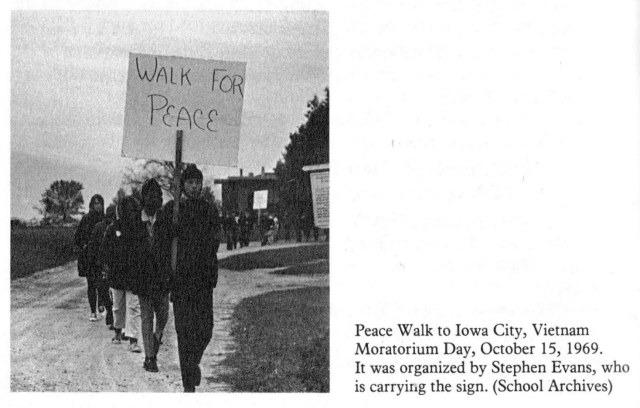
The most recent post talked about the Peace Walk.  This was how the school decided to participate in the Moratorium to End the War in Vietnam, a coordinated effort to have demonstrations and teach-ins across the United States, on October 15, 1969.  It was remarkable that all of the students participated, and many of the staff.  I imagine we were all apprehensive about what the reactions might be.  The relations between the School and West Branch weren’t very good as I remember.  I had forgotten about the written statement that we were going to be walking in silence, but thinking back I do remember that’s what we did.  And I don’t remember any reactions as we walked through West Branch.  The kids there would have been in school at the time.  I do remember Sara Berquist filling cups of hot chocolate from the back of the school station wagon at one point along the route. PeaceWalkScattergoodHistory

The caption above mentions Stephen Evans. The final connection I’ll mention occurred several years ago during an FCNL annual meeting in Washington, DC.  There were usually around 250 Quakers in the meeting room.  When people spoke, they were given a microphone, and asked to begin by giving their name and where they were from.  I was surprised when I heard, “My name is Stephen Evans…”.  I think this was the first time we had seen each other since Scattergood.  We had a nice visit later that day.

Posted in civil disobedience, peace, Quaker Meetings, Uncategorized | Tagged , , , | Leave a comment