Volunteer Service Mission Story-Part 3

Beginning work in the neighborhood
Now that I’d found a job, I began to see what I could do in the neighborhood.

The objectives of Friends Volunteer Service Mission (VSM) are:
1. To provide the reconciling, caring presence of the Church in mission
2. To express in tangible ways, one’s personal commitment to Christ
3. To provide a means of furthering personal and social growth
4. To solve problems together while living in community
5. To acquire relational skills with those of different cultures and different opinions
6. To express gratitude to God in service for the endless privileges he has given

Just how does one try to realize these objectives? How does one measure, or even know what he is achieving? This was the question I pondered those first days, week, months in Indianapolis. I was anxious to get started on something but not sure what. “Evangelism” was also on my mind. How was I to share my religious experience? I believed in the traditional Quaker view of letting God be shown in everyday life. I wanted to be uncompromising in regard to my beliefs, and yet not hurt anyone. Concentrating on my life, rather than judging others seemed to be the way to achieve that.

One of the basic issues I was wrestling with was the relationship between the spiritual church and social service. Those of us at VSM were asked to be at Indiana Yearly Meeting that first summer, where we would discuss this relationship. I remember putting a lot of effort into writing the following in preparation for that presentation. Then, when I was in Richmond, praying just before the presentation, it didn’t feel right to deliver that. I ended up simply saying we believed the spirit would lead us, and our purpose was to find out how to follow.

What we are going to get involved in and how we are going to use our limited time, resources and abilities are very important questions for us to consider. I found it a valuable experience, in trying to deal with these questions, when asked to consider the relationship between the spiritual church and social service.
Our commitment to the spiritual church is foremost in importance. Christian service is a necessary result of a commitment to the spiritual church. This relationship between the spiritual church and Christian service is very clearly illustrated in the history of Christianity and of Quakerism. The greatest commandment is to love God with all our heart, soul and mind. The second greatest commandment is to love our neighbor as ourselves. This is the essence of the new covenant.
Quaker commitment to the spiritual church is the search for and obedience to the inner light—the will of God. It has been said that God is love. Recently I have read that God is silence. God is ineffable, but these two words seem to be helpful in searching for a description. Perhaps a better word would be creativity. Active, loving silence is the essence of creativity. In silence an idea is born, and a creative act formulated. Perhaps ‘God is creativity’ encompasses ‘God is love’ and ‘God is silence.’
Our commitment to the spiritual church necessitates the creative use of our talents; that is, waiting to be shown how we can use our abilities to perform the will of God, and then doing what we are shown despite anxieties or persecution.
This is where commitment to the spiritual church leads to Christian service. The spiritual church shows the way, but we must respond, individually or collectively, in action.
In the past that action has been along the lines of improving man’s outward condition; providing food, clothing, shelter, and better laws and community services. There is a definite need for this. And yet, there is a real yearning for spiritual fulfillment in the world today. In the United States especially we are well off, for the most part, materially, but have lost a sense of worth in ourselves and others.
Our primary responsibility in social service is to love our neighbor as ourselves. If we do that, we would hope that they could share our commitment to the spiritual church; the search for and obedience to the inner light, the development of creative abilities—creative worship, personal relationships, recreation, art—creative living. It is very difficult to be creative. But from creative acts one develops in ways and receives rewards available from no other source. Creativity involves bringing into the world something new to the world.

I began to meet people. Paul introduced me to people at the church. We visited several at their homes the first few weeks I was there. I was slowly getting to know some of the people in the immediate neighborhood.

The first time I met Ronnie Anderson, he came to the house with his Boy Scout uniform on, ready to go to a meeting. He lived across the street with his wife Susie and daughter Tina. His mother and father lived on the other side of his double with the two children they still had at home, Dennis and Nila. Ronnie worked at the local drugstore.

The Methodist Youth Fellowship was another of Ronnie’s activities. I began attending meetings with Ronnie and soon began helping with singing, playing my guitar, the lessons, and recreation. I introduced ‘capture the flag’ which was an immediate success. These kids were Junior High age.

“It is moving to see how kids can respond, and so creatively, to someone who will take an interest in them. I find it interesting work.” Journal 7/26/1971

This was to be significant. I had found something interesting, rewarding, and in line with my ideas of what I wanted to do, and how I wanted to do it. I just couldn’t spend my time in meeting after meeting, especially when I couldn’t see much result from them. (My aversion to meetings continues to this day). I needed to be involve with people. Adults seemed so closed, wrapped up in their jobs, home, set ideas, personal interests and problems. It seemed natural to turn to the kids, or maybe they came to me. At any rate, kids more and more became my focus, not only in the neighborhood, but I would soon begin my lifelong career working in pediatrics at Riley Hospital for Children.

The first year developed slowly for me. I thoroughly enjoyed my work at Methodist Hospital as a respiratory therapist, and spent free time with the Methodist youth group and neighborhood kids.

Organizations
That’s not to say there wasn’t a lot going on. A number of organizations were developing that Paul and Second Friends spent a good deal of time and effort working with.

Nick Block, pastor of Second Friends Church, was an innovative change agent. Coming from Kansas and an evangelical Friends background, Nick attended Earlham School of Religion, where he went through a good deal of change. He was full of energy and enthusiasm to put his ideas into action.

West Indianapolis Neighborhood Congress (WINC)
Early in 1971 Nick was instrumental in getting neighborhood people together for the first West Indianapolis Neighborhood Congress (WINC) Town Meeting. Like the town meetings of early New England, the purpose was to get the community together to discuss and take action on matters directly affecting them. The issue which gave impetus to the initiation of this organization was the proposed route of Interstate 70 through West Indianapolis. People were upset to find the chosen route for the Interstate would remove large numbers of houses, and divide neighborhoods, when an alternate route would have gone through a much less densely populated area.

The town meeting chose to do all it could to rectify the situation. A committee did succeed in getting a court order to halt construction until the matter could be dealt with. In the end, the proposed route would be followed, but an additional on/off ramp would be added in the neighborhood, so people could at least access the highway themselves.

Although the freeway was the focus of attention at the town meeting, a political structure was also set up to handle the broad spectrum of problems facing the neighborhood. As the freeway issue was worked out, other problems were addressed by WINC.

Indiana Friends Committee on Legislation (IFCL)
Another project Paul, and I to an extent, were involved in was the Indiana Friends Committee on Legislation (IFCL). The summer of 1971 Second Friends Quaker Men (Nick Block-leader, Les Paulsen, Bill Bernhard) sent an opinionnaire on legislative issues to all Friends Meetings in Indiana, to see what Friends felt about certain legislative issues. I used Earlham College’s computer to tabulate the over 600 responses, which did not indicate a concerted feeling on most issues.

Nonetheless, they went ahead and organized IFCL, modeled after the Friends Committee on National Legislation (FCNL), to be a faith lobby in the state legislature. IFCL’s Preamble to Legislative Policy, the rough draft of which Paul and I wrote, defines the purpose of IFCL.

Indiana Friends Committee on Legislation (IFCL)
Preamble to Legislative Policy
Adopted at Organizing Meeting, Indianapolis, Indiana, October 2, 1971

Friends consider their primary responsibility to be the search for and obedience to the will of God, which is revealed to every man. Through individual and corporate worship, Friends have continually realized that all men are brothers, and that every person is endowed with worth and dignity. Historically, Friends have sought to promote relationships among men which would permit individuals to develop fully in all dimensions of life. Since governments make major decisions affecting man in his relationship to society, Friends have sought to translate their religious concerns into social and political involvement. Indiana Friends Committee on Legislation seeks to express the Spirit of Christ and to relate our Christian faith and Quaker testimonies to the shaping of responsible decisions by our state government.

Because complete and accurate data are essential for intelligent decision-making, IFCL works to research and compile such information. Since no one has the complete solution to many of the issues facing us, Friends seek to use the best from the many points of view to arrive at an agreement which might not otherwise be achieved.

Our work includes the interpreting to persons in state government those moral and spiritual values which should undergird government and law. Naturally, there is concern with the passage or defeat of specific legislation; however, our primary purpose is the establishment of those conditions which will allow for the working of the Holy Spirit.

We strive to express ourselves by appropriate means of persuasion through visits to Indiana Legislators, testimonies before legislative committees, letter writing, and other methods congenial to Friends procedure. In this work, the Committee needs the cooperation of individual Friends Meetings, and other groups in making its policies as well-considered, appropriate, and effective as possible. IFCL cooperates with like-minded organizations in the preparation and circulation of information, especially where there is a community of interest around specific legislation.

IFCL does not (nor can any organization or individual) speak for all Friends. We recognize that sincere differences of opinion may exist on specific questions among thoughtful Friends, not withstanding their common heritage.

Steering Committee Members
Lester Paulsen, Chairman, Second Friends Church
Susan Rupp-West Newton, Robert Burns-New Castle, Nancy Mullin-Richmond, Paul Cluxton-Indianapolis, Car Jorden-Straughn, James Dunn-Maple Grove, Fred Lee-Indianapolis, Dan Carter-Russiaville


Posted in Quaker Meetings, Uncategorized | Tagged , | Leave a comment

Volunteer Service Mission Story-Part 2

Friends Volunteer Service Mission (VSM) seemed the ideal opportunity to test my ideas, beliefs—myself. The necessary Quaker emphasis was there, and no authority to answer to directly, save God. I could apply my own ideas, try my way.

I was also thinking of the Quaker emphasis on social service. I didn’t have much of a concept of social work, but I didn’t like most of the social organizations I was familiar with, which seemed to spend most of their time, effort, and resources on administration and fund raising, and very little time with the people they are intended to serve.

VSM seems to avoid these problems; being financially self sufficient with almost no administration. I talked to Al Inglis several times during my year at Earlham. I applied to VSM in early spring and went to Indianapolis with him to visit Neighborhood Friends, Inc (NFI), the VSM unit in the inner northeast section of Indianapolis, a black area, and Second Friends VSM in the inner southwest section of the city, basically a transient white population with a lot of industry.

At the time I was impressed with NFI. There was then much interest in race relations, and I was interested. But I was encouraged to go to Second Friends, instead, and I decided to do that.

Second Friends Unit

Paul Cluxton

Paul Cluxton, a graduate of Wilmington College and student at Earlham School of Religion (ESR) was the first person to join VSM, coming to Indianapolis in August 1970. He moved into the north side of the double at 1248 S. Lee Street, which is owned by and adjacent to Second Friends Church. Paul would soon finish his first year’s work at Indiana University Medical Center as a pharmacy technician. Attending meetings of various social and health organizations in the neighborhood occupied most of Paul’s free time. When on his own the second year, Paul would continue working with these organizations.

Connie Collett

In November 1971, Connie Collett, from the Wilmington, Ohio, a member of Wilmington Yearly Meeting, joined Second Friends VSM. She found an apartment three blocks from the VSM house on Lee Street. She got a job as cashier at the local grocery store right away and found that a good way to get acquainted with many of the people in the neighborhood.

Connie was quite a reinforcement for me. While Paul’s activities dealt mainly with social and political organizations, I was more interested in staying in the neighborhood and being with individuals there. This difference in emphasis was to produce a tension between us. I felt Paul wanted me to be active in organizations and help him in the work he was doing with them. I think he felt I wasn’t doing much by staying in the neighborhood. I think Paul’s work is important and has its place. I just didn’t want to do it that way myself. Connie felt as I did on this matter.

vsm

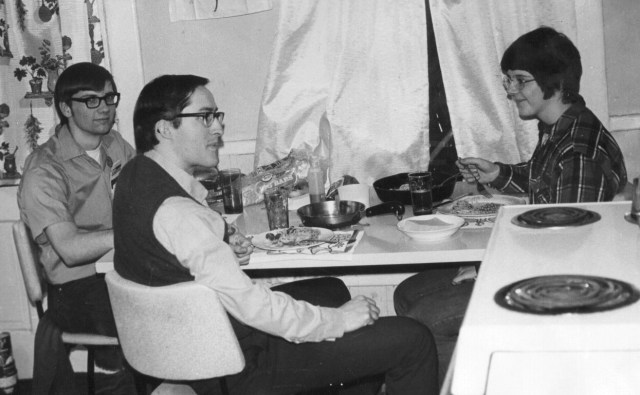
Jeff, Paul and Connie at Second Friends VSM

We weren’t moving very fast in establishing relationships, but there were a number of reasons for this. I am rather shy myself. Another reason is that many of the neighborhood people shy away from developing new relationships. Like most inner city neighborhoods, this was once a middle-class area with nice houses and businesses. With the development of industry in the immediate area, the trend to move to suburbia began, leaving the neighborhoods for those who worked in the nearby factories, or who couldn’t afford to leave, or those who choose to stay where they were raised. Overall our neighborhood underwent great changes. Heavy industry surrounded the area, bringing pollution and a more transient neighborhood. People would move from place to place, often coming from Appalachian states, in inner city Indianapolis until they could find a job. Once they did, they would move out to a better neighborhood. Thus, our neighborhood is characterized by a highly transient, Appalachian white, lower income population. All of these factors contribute to social withdrawal. After moving again and again one is frustrated at trying to develop relationships which will be disrupted in a short time.

With greater industrialization and declining income levels, public and community services become less reliable. Streets are not kept up well and public transportation is limited, while expansive freeways cut through the neighborhoods to carry commuters between the suburbs and downtown business centers.  At the time I was at VSM, Interstate 70 was being built, separating people who had been neighbors for years.

Food prices go up, service and quality go down. The doctors and clinics are either in the suburbs or downtown. And where is there room for kids to play, for people to enjoy outdoors? What do the people do for recreation? The grocery stores, shopping malls, country clubs, health centers, theaters, etc. are in suburbia. About all we have are the streets.

Yet the neighborhood is not the “jungle” I had preconceived it to be. I really like the people I have gotten to know. There is less juvenile delinquency here than in “better” neighborhoods. The suburbs are also transient and people tend to be isolated there, too.

Second Friends Church

Second Friends Church is in the same situation as many inner city churches. Its membership, the vast majority of which once lived in the immediate neighborhood, has largely joined the exodus to suburbia. Second Friends is a drive-in church, with very few members living in the neighborhood, so almost no contact with it.

Second Friends belongs to Western Yearly Meeting, Friends United Meeting, and has programmed worship services as opposed to the silent worship I am used to. It is very difficult for me to accept a Friends church with programmed services. It seems that programmed services are exactly what early Friends rebelled against, and I could not feel comfortable with Second Friends. I could not find the spiritual support I and VSM need there. I guess I sort of resented that and feel they resented my absence from their services.

Quaker Men of Second Friends is the supervisory body of Second Friends VSM, and are supposed to meet monthly, but do so irregularly. Whenever we had specific problems they were willing to help, but were not a group that could help us formulate our activities. They wanted to avoid specifying what we should do, which is very good. Yet we didn’t get the support needed to go ahead on our own; questions, suggestions etc.

I was apprehensive about working with Friends United Meeting, especially when I heard Conservative Friends didn’t approve of working with FUM Yearly Meetings.  So, I sent the following letter to my meeting concerning VSM.

To Bear Creek Monthly Meeting                                                                  7/10/1971

Lewis Mott, clerk

Dear Friends, I write in relation to a program sponsored by the Friends United Meeting (FUM) which I am now participating in. Known as the Volunteer Service Mission (VSM), the project is coordinated by Alan Inglis, director of Conscientious Objector Services for the Friends United Meeting. At present young Friends, especially those who wish to join the Volunteer Service Mission to fulfill their alternative service obligations, are being invited to join the project.

Following is a quote from a pamphlet describing the project: “It (VSM) seeks to open a new mission frontier, bring into creative relationship the spiritual and material needs in our social order and the energy, ideals, intelligence and sacrificial concern of youth. At a time when youth and adults alike tend to feel helpless before the magnitude and complexity of the problems facing us today, we believe that the talent and good will of youth-power can be mobilized and directed in constructive ministries to the world.”

Initially the volunteer spends time becoming familiar with the neighbors, neighborhood, and the community’s problems. He finds a job so that he will have funds to support his full time community work at a later date, usually after one year at the project. My unit is located in a poor, Appalachian white area of inner city Indianapolis. I live with another member of the Volunteer Service Mission who is working on the same project.

We are supervised and work closely with the nearby Second Friends Church. The Church’s worship service is semi-programmed, consisting of long periods of silence, speaking by members of the meeting, hymns, and a message from the pastor. I would like to have a minute from the meeting in support of this work. I understand that, in the past, minute were not granted for service in certain other Yearly Meetings. I am somewhat confused by this and anxious to hear what you have to say about it. Is the issue differences in religious practice, or the type of work these other Friends group are engaged in? I have the impression that it is the former.

Although, as Friends, we feel we should dissociate ourselves from organizations involved in social or political actions we disagree with, should the same apply to matters of religious practice and belief? Was I mistaken when I wrote the following to Senator Hughes: “I urge us all–young and old, radical, liberal and conservative–to unite our efforts to tackle the pressing problems facing us. Once we start getting our hands dirty, ideological difference will become very secondary, and solving problem will become primary.”

Or do Conservative Friends object to the type of social work some other Yearly Meetings are engaged in? Don’t we endorse the words of William Penn: “True Godliness doesn’t turn men out of the world, but enables them to live better in it and excites their endeavors to mend it”.

I don’t know if you, as a meeting, approve of this program and my participation in it. I am concerned to know your thinking, since Conservative Friends most closely, I believe, represent my own religious thinking. I made the decision to join the project as a result of my Conservative background, and guidance from the inner light, as well as I could discern it. However I will consider leaving the project should you, as a meeting, feel that would be the appropriate action.

Yours,

Jeff Kisling

I was relieved to receive the following reply.

“Thy letter was read with interest in our Monthly Meeting today, 8/28/1971. The Meeting wishes to encourage thee and other youths who are sincerely dedicated to an effort to solve the complex problems of the world. May you be guided in your efforts and enabled to realize the fulfillment of your concerns.”

These impressions of the neighborhood, Second Friends Church, various people, and the purpose of VSM in relation to all this would develop gradually. When I arrived in Indianapolis the first of July 1971, I had very few impressions, but very many questions. What is an inner city neighborhood like? What are its problems and needs? How does religion relate to a complex, materialistic, secular society such as ours? What can I do?

A more immediate question was how could I support VSM financially?

The Job

Finding my first serious employment seemed a daunting task. I began by looking into hospital work, since I was still considering alternative service at this point. I had written to many of the hospitals before I arrived in Indianapolis and one responded with a possibility. St Vincent’s Hospital thought my computer programming experience might be helpful for a position they had—a maintenance person who could classify all of the shop items, so a computer inventory system could be established. At this point I was eager to accept almost anything. Fortunately, it didn’t work out.

Next, I went to Methodist Hospital. Strangely the fact that I was a conscientious objector was helpful. Methodist had hired a good number of C.O.’s over the years and found them to be good employees. The next day I was to come for an interview with the transportation supervisor, who can from a Quaker family (Stanley) in Indiana. She told me I could replace someone who would be fired after one more unexcused absence. I went home to wait.

I was getting to know Indianapolis; riding my bicycle to the hospitals, I had to go through the downtown area. These July days were hot, traffic was heaving, and fumes hung in the air. But I enjoyed the bicycle; I saw it (and still do) as a part of my Quaker witness. It represented one aspect of a concept I was especially interested in working on, that being simplicity. Just what is simplicity in a technologically complex world? With my bicycle I was beginning to learn. Later as the dangers of fossil fuels became more apparent my continued bicycling related to environmental justice.

The next day I waited to hear from Mrs. Stanley. I finally called, to find she was in a meeting. Calling later, she said she was sorry, but the fellow had come to work that day, so there was no opening. Going back to the hospital’s personnel office I got an appointment to talk with the supervisor of the respiratory therapy department. After a few questions, she said I could attend the on the job training program that would begin in two weeks.

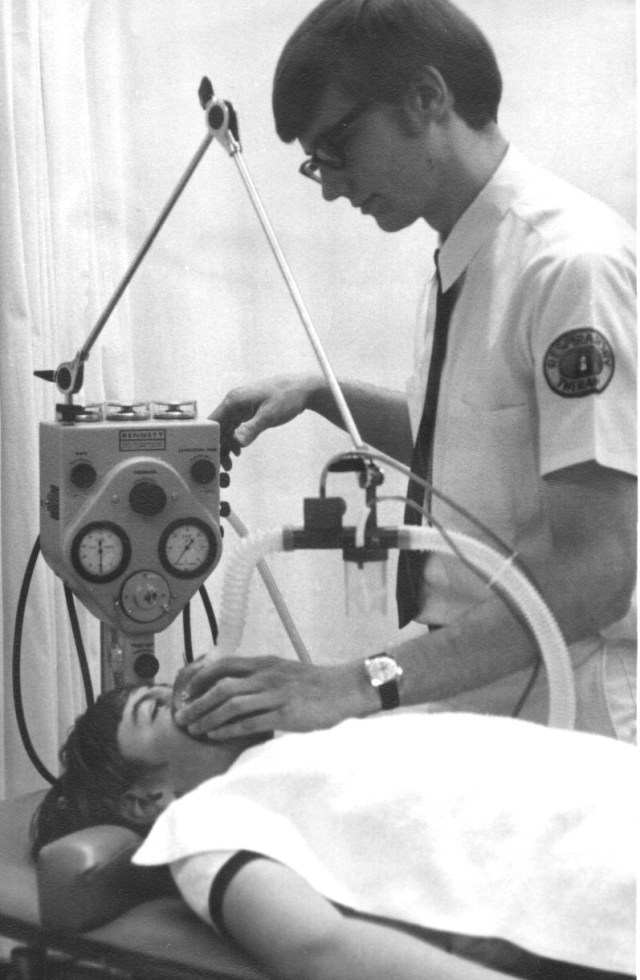
Respiratory therapy was to be one of the most rewarding aspects of my VSM experience. I now realize how important your work is to your whole life. My enjoyment and feeling of accomplishment in respiratory therapy would help tremendously when things went badly at the house.

Respiratory therapy is the fastest growing of several paramedical fields in development today. The objective of the field is to treat cardiopulmonary disorders; acute and chronic. Most of these disorders related to insufficient amounts of oxygen reaching the cells, due to any number o reasons—heart disorders, blood disorders, excess secretions in the lungs, or damaged lung tissue. Administering oxygen is one important aspect of respiratory therapy. Dealing with pulmonary secretions is also important. Various types of mist therapy, and physical therapy are used for this. Respiratory therapy is also responsible for emergency resuscitation. The most skilled and complex work is done in intensive care units, where respiratory therapists work with mechanical ventilators, physiologic monitoring and diagnostic procedures. I really enjoyed learning about anatomy and physiology, diseases and medicine, and the function and application of mechanical ventilators.

There are two related aspects of respiratory therapy that make it especially meaningful to me. One is patient contact. At Riley Children’s Hospital, where I worked during my second year at VSM, children are often hospitalized for months at a time, or return often, so I know some of the kids quite well. The other is a respiratory therapist can see the results of their work as a patient becomes able to breathe more easily and return to normal health.

After I left VSM, I returned to Iowa for 6 months. But I missed the kids so much, I returned to Indianapolis. I earned my degree in respiratory therapy, and worked in various positions in the field the rest of my life. I was a clinical specialist in neonatal intensive care for a number of years. I really enjoyed making trips in Riley’s newborn ambulance to community hospitals around the state of Indiana, to stabilize and bring babies who are sick back to the hospital. At one time I was keeping track, and had made over 550 such trips, but lost count after that. One of the first medical articles I had published was about the role of respiratory therapists on the neonatal transport team. Then after 3 years of being the Program Director and teaching respiratory therapy at a state college, I’ve spent the past 30 years writing computer software for, and working in the Infant Pulmonary Function Laboratory at Riley Hospital for Children.  Most of the work done there is research related to infant lung development and disease. I loved being able to work with kids, from newborn up to 2 years of age.

Posted in Quaker Meetings, Uncategorized | Tagged , , , , , | Leave a comment

Volunteer Service Mission Story-Part 1

I’ve been writing parts of the Friends Volunteer Service Mission (VSM) story from journal entries. At one point I consolidated the various pieces into a separate document to tell the VSM story, which will appear as a series of posts over the next few days.

Friends Volunteer Service Mission (VSM)

It is difficult to express my experience with Friends Volunteer Service Mission (VSM). VSM demanded the application of every aspect of me and my life to the VSM house and the neighborhood around it in inner city Indianapolis. For two years there I would receive much, give some, and change tremendously.

VSM is a unique approach to social work. An application to VSM through Friends United Meeting (FUM) is followed by an interview with the board of the specific VSM unit the individual is interested in. Upon acceptance, one moves into the VSM unit’s living quarters, located in the area the unit seeks to serve. One then seeks employment, and places the wages into the unit’s financial pool. A monthly budget taken from the pool covers necessary expenses. One usually holds a job for about one year; getting to know the neighbors and the neighborhood during free time. At the end of this year the individual has some idea of a need or concern he/she would like to work on, and there are enough surplus funds in the financial pool to provide for this individual’s expenses, that they might be released from regular employment to devote all their time to their particular concern.

The philosophy of VSM can be most accurately depicted by the concept of released Friend. In the past, a Friend could be released to pursue a deep concern with the spiritual and material support of their meeting. VSM is designed to be financially self-sufficient, but an individual should have the spiritual support of their meeting.

Quakerism

A Friend is led to a deep concern by listening to and following the will of God. This experience of knowing God’s will in one’s heart is the foundation of Quakerism and Christianity. Quakers have always believed there is that of God in everyone, that everyone has the ability to communicate with that of God within them, and the responsibility to respond to that of God in others. This is the driving purpose in a Quaker’s life; to discern and respond to the will of God.

The manifestations of this concept must of necessity be very personal, growing from an individual’s personal spiritual experience.

Quakerism has always been a large influence in my life. All my mother’s family are members of the Religious Society of Friends and many of them lived near us. We attended Bear Creek Monthly Meeting most of my childhood. Many of my friends belong to this meeting as well as many of my family relations.

In my experience there was little formal religious education. Quakerism was just there; and it permeated every part of our lives, even as a child or perhaps especially as a child, when it is a mysterious yet secure force. I grew up with members of the meeting among my heroes, and I love the many stories of the courageous acts of early Friends for human justice and religious liberty. Attending Scattergood Friends boarding school helped my development in Quakerism, especially in my friendships with young Friends.

Pacifism and the Selective Service System

While at Scattergood I was confronted by the decision dealing with the Selective Service System. I took this decision very seriously, seeing it as one of my first opportunities to take a stand base upon my religious convictions. This decision proved very painful but was significant as a period of maturing and religious experience while considering the issues of war and violence and church versus state.

Some of my most vivid childhood memories are related to war. While in 1st or 2nd grade some kids said that the planes passing overhead were Japanese bombers. Seeing that I was scared, they continued the game in the classroom by making screeching sounds with chalk on the blackboard; saying the bombs were falling. I was so upset I had to go home.

I was around 10 years old and talking with my mother about something someone had said in meeting that morning. She said war was wrong. I didn’t think so, and asked how we could defend against invasion. She said we didn’t have to fight, or work for them, or do anything they (invaders) wanted. How could they make us? How could they stay long under those circumstances? That seemed a perfectly reasonable answer to me and I have often looked upon that incident as the beginning of a mature view of pacifism and nonviolence.

Scattergood Friends School and Farm

I was beginning to get something out of meeting for worship and a lot of things I was learning about Quakers began to make sense. As mentioned above, my high school years I attended Scattergood Friends School, a coeducational college preparatory boarding school on a working farm that is run by Iowa Yearly Meeting (Conservative). At Scattergood Quakerism would be implanted at the core of my being. Quakerism had always been a part of my life. Now I was beginning the serious process of maturity and must look at things my way, accept and reject ideas and practices on my terms.

Scattergood was not just a school, it was a Quaker community on a working farm. Integral to the educational approach was that students did all the work at the School and on the farm, under adult supervision. Students were assigned to specific jobs, like laundry, dinner prep, working on the farm, baking bread, etc. on a rotating schedule. Teachers not only taught academics in the classroom, they instilled ideas as we worked, ate and played together. We were all involved in almost every aspect of each other’s lives. The example of the teachers and students, my reading, and meeting for worship all greatly influence me and drew me deeply into Quakerism.

Nonviolence, pacifism and the draft were often topics of discussion, especially for me and my classmates during our Senior year, when most of us boys would turn 18 years of age and be required by law to register for the draft. My 18th birthday was November 21, 1969.

At the beginning of that Senior year, I began keeping a journal. One of the passages written around this time follows:

“One of George Fox’s major insights was that the mark of a true believer, Christian, is a changed life. It seems to me that this is what I’m wrestling with. I fear that if I go to college and get a well-paying job, I’ll settle down into the same rut that I see most everyone settling into, and I don’t like it really. It looks comfortable–an easy way out. I feel I’m at the turning point. If I feel compulsion is wrong, I believe I’ll have to take a complete stand against it now, or I’ll never be able to take a stand against the government, with all the responsibilities I’ll soon acquire. I see the choice essentially between a way of life I idealistically believe to be best, but am not totally sure how to pursue, and a “normal” way of life which I am idealistically uneasy with but believe would be a comfortable way of life.”  Journal, October 6, 1969

This emphasizes how far reaching I considered the draft decision to be. Was my life to be based on principle, to follow absolutes no matter what the apparent cost, or was I to compromise, obey the law, and be conforming?

I went home the week before my birthday to talk with Mom and Dad about it some more. I felt I should make the decision at home. At Scattergood it seemed so easy to believe in nonviolence and Quaker witness. At home I was challenged to think of the practicalities of the decision, the probable affects, and forced to think of myself.

My parents were really involved in and concerned about the decision. They didn’t want me to be hurt and we all realized the serious consequences of breaking the Federal law. I only blame myself that I couldn’t make them see that I felt the consequences of not acting on principle could be more serious.

I vacillated between registering as a conscientious objector and not registering at all. At the time, my parents were so against noncooperation, and I hadn’t really made the decision myself, that I went ahead and registered, knowing I could refuse to cooperate later.

I was very unhappy about registering but felt I must be very sure before I took a step against the law and society and I hoped my parents might be able to accept noncooperation, if that was to be my decision, before I acted upon it. I registered on a Friday. Sunday, we arrived at Scattergood just in time for meeting. Afterward one of my best friends came up to me and said, “You registered, didn’t you? You don’t look like the same old Jeff.”

Of course, the draft weighed heavily upon me until I made a decision. Home for Christmas vacation, I was thinking of the new year and decided to turn in my draft cards. I told Dad that’s what I thought I’d do. He said he didn’t want to stand in my way if that’s what I really thought I should do. I told Mom I would turn them (draft cards) in one day when I went downtown, but neither of them realized I was going to do it that day. When I got home everyone was really upset. We finally agreed that I would try to get the cards back. If I did, I would wait a year. Then I could make my own decision—I would be away from the “influence” of Scattergood, in college, more mature, and they might be more able to accept it then.

So, I asked to have the cards returned and they were, eventually. The draft continued to occupy a lot of my time; reading, thinking, talking. I was getting a lot from meeting for worship. I was developing my own outlook on life, grounded in Quakerism but the result of my personal spiritual experience.

In the spring of my Senior year at Scattergood Al Inglis of the Office of Conscientious Objector Service of Friends United Meeting (FUM) visited the school. He was on his way west, looking for jobs for C.O.’s to do for alternative service. Most of the boys in my class met with him that evening and we had a beneficial discussion. He was interested to hear I was considering draft resistance. That summer I was to get a letter from him describing Friends Volunteer Service Mission. I don’t know how much it impressed me at the time. I did keep it in mind throughout the next year, which I spent at Earlham College in Richmond, Indiana, where the FUM Central Offices, including the VSM, i.e. Office of C.O. Services were located.

I was very dissatisfied at Earlham; I’m not sure of all the reasons. The draft issue was part of my general dissatisfaction. I applied for a student deferment without thinking much about it at the time. But I did realize how unfair it was to be deferred just because I was a student and this increasingly troubled me.

I was tired of the constant academic pressure with its emphasis on the intellect and reason when I was trying to discern the Spirit, the will of God. I wanted to try to approach ideas and people with my heart, with feeling rather than intellect and reason. I was accused of being an idealist and not practical. How could I respond to that, or know myself, unless I put my ideas to the test? To be on my own in the world, away from books and ideas and things in peoples’ heads was where I felt I needed to be.

I was also frustrated about the war (Vietnam) and concerned about what I could do to promote peace.


Posted in peace, Quaker Meetings, Uncategorized | Tagged , , , , | Leave a comment

Volunteer Service Mission (VSM)

For those who have been reading this blog recently, I have been sharing from the journal I began during my Senior year at Scattergood Friends School (1969).  At this point I’ve shared the writings from that year at Scattergood, and the following year at Earlham College.

Now I’m at the point where I have been writing about joining the Friends Volunteer Service Mission (VSM) in inner city Indianapolis, July 1, 1971. Opening the next volume of journals, I found the following, from the brochure describing VSM. This is a bit out of order since I’ve already begun sharing about VSM, but provides a good description of the program.

As I read this today, and remember my experience at VSM, I’m thinking this is something we should consider implementing again.

Volunteer Service Mission (VSM)

Volunteer Service Mission, a program sponsored by Friends United Meeting (FUM), is designed to provide young people with the opportunity to invest a year or more of their lives in service.

Society needs youth at their best–involved, self-sacrificing, and creative. Lasting effects of youth working with society, devoted to a great cause are written deep in the fabric of world history, of which Jesus and the Disciples, first generation Quakers and the Peace Corps are illustrations.

Volunteer Service Mission adds a new phase to this tradition (of youth in Christian service). It seeks to open a new mission frontier, bringing into creative relationship the spiritual and material needs in our social order and the energy, idealism, intelligence and sacrificial concern of youth. At a time when youth and adults alike tend to feel helpless before the magnitude and complexity of the problems facing us today, we believe that the talent and good-will of youth-power can be mobilized and directed in constructive ministries to the world.

An initial project, for example, is aimed at relating to the ghetto. A volunteer’s first year will be spent in developing trust relationships, and in learning about the key problems and human needs from some of the knowledgeable inner city residents.

Volunteers will secure suitable jobs in the city through social agencies such as welfare, recreational programs, hospitals, Goodwill Industries, OEO, etc, while living in a close-knit community within the ghetto. Participants continuing a second year, C.O.’s or other volunteers, may be able to determine their own job description. Funds earned will be pooled and subsistence wages returned from the pool to the participants. Through such voluntary and sacrificial service sufficient funds will be accumulated to support some full-time unsalaried workers in neighborhood development.

The challenge of our society which has frequently tended to alienate and isolate our youth is to enlist them to participate in the healing, reconciling, building tasks before us. Spiritually motivated and committed young people have provided the leadership for many of the redemptive moments in history.

Objectives

  1. To provide the reconciling, caring presence of the Church in mission
  2. To express in tangible ways one’s personal commitment to Christ
  3. To provide a means of furthering personal and social growth
  4. To solve problems together while living in community
  5. To acquire relational skills with those of different cultures and different opinions
  6. To express gratitude to God in service for the endless privileges he has given
vsm

Jeff, Paul and Connie at Second Friends VSM

VSM Jeff72

Jeff at Volunteer Service Mission 1971

VSM1

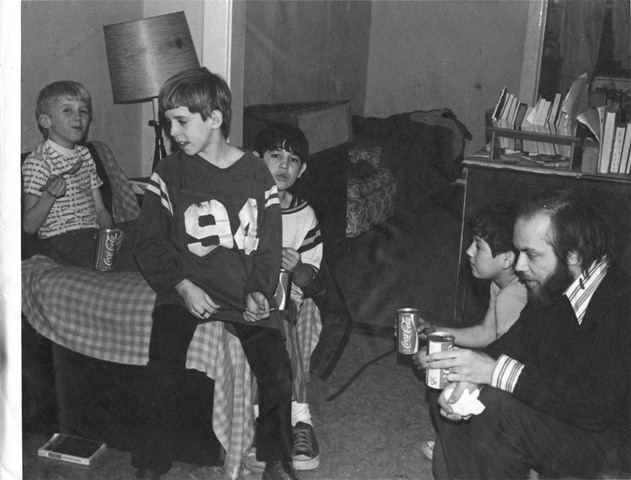
Neighborhood kids, Volunteer Service Mission, Second Friends

VSM JeffDen

Jeff working as respiratory therapist at Methodist Hospital during involvement in VSM

Posted in Quaker Meetings, Uncategorized | Tagged , | Leave a comment

Spirit of Christmas

In the Spirit of the Christmas season I urge each of us to consider how our lives reflect the teachings of Jesus, especially to “love your neighbor as yourself”.

For I was hungry and you gave me food, I was thirsty and you gave me drink, I was a stranger and you welcomed me, I was naked and you clothed me, I was sick and you visited me, I was in prison and you came to me.’ Then the righteous will answer him, saying, ‘Lord, when did we see you hungry and feed you, or thirsty and give you drink? And when did we see you a stranger and welcome you, or naked and clothe you? And when did we see you sick or in prison and visit you?’ And the King will answer them, ‘Truly, I say to you, as you did it to one of the least of these my brothers, you did it to me.’    Matthew 25:36-40

As literally millions of people will be added to the existing numbers of climate and war refugees, and essential resources such as water, food and even clean air become increasingly more difficult to find, we will all be sorely tested to find ways to be our brother’s keeper.

“Pope Francis has likened the journey of Mary and Joseph to Bethlehem to the migrations of millions of people today who are forced to leave homelands for a better life, or just for survival, and he expressed hope that no one will feel ‘there is no room for them on this Earth’”. The Guardian 12/14/2017

Posted in peace, Uncategorized | Tagged , , | Leave a comment

Bear Creek response regarding VSM

When I recently shared the letter I wrote to Bear Creek Meeting regarding my participation in the Volunteer Service Mission (VSM), I was wondering what the meeting’s response had been. Yesterday I began to review a document I had written about my VSM experience, and found the meeting’s response there.

“Thy letter was read with interest in our Monthly Meeting today, 8/28/1971.
The Meeting wishes to encourage thee and other youths who are sincerely dedicated to an effort to solve the complex problems of the world.
May you be guided in your efforts and enabled to realize the fulfillment of your concerns.”

To Bear Creek Monthly Meeting 7/10/1971
Lewis Mott, clerk
Dear Friends,
I write in relation to a program sponsored by the Friends United Meeting (FUM) which I am now participating in. Known as the Volunteer Service Mission (VSM), the project is coordinated by Alan Inglis, director of Conscientious Objector Services for the Friends United Meeting. At present young Friends, especially those who wish to join the Volunteer Service Mission to fulfill their alternative service obligations, are being invited to join the project.
Following is a quote from a pamphlet describing the project:
“It (VSM) seeks to open a new mission frontier, bring into creative relationship the spiritual and material needs in our social order and the energy, ideals, intelligence and sacrificial concern of youth. At a time when youth and adults alike tend to feel helpless before the magnitude and complexity of the problems facing us today, we believe that the talent and good will of youth-power can be mobilized and directed in constructive ministries to the world.”
Initially the volunteer spends time becoming familiar with the neighbors, neighborhood, and the community’s problems. He finds a job so that he will have funds to support his full time community work at a later date, usually after one year at the project.
My unit is located in a poor, Appalachian white area of inner city Indianapolis. I live with another member of the Volunteer Service Mission who is working on the same project. We are supervised and work closely with the nearby Second Friends Church. The Church’s worship service is semi-programmed, consisting of long periods of silence, speaking by members of the meeting, hymns, and a message from the pastor.
I would like to have a minute from the meeting in support of this work. I understand that, in the past, minute were not granted for service in certain other Yearly Meetings. I am somewhat confused by this and anxious to hear what you have to say about it. Is the issue differences in religious practice, or the type of work these other Friends group are engaged in? I have the impression that it is the former. Although, as Friends, we feel we should dissociate ourselves from organizations involved in social or political actions we disagree with, should the same apply to matters of religious practice and belief? Was I mistaken when I wrote the following to Senator Hughes: “I urge us all–young and old, radical, liberal and conservative–to unite our efforts to tackle the pressing problems facing us. Once we start getting our hands dirty, ideological difference will become very secondary, and solving problem will become primary.”
Or do Conservative Friends object to the type of social work some other Yearly Meetings are engaged in? Don’t we endorse the words of William Penn: “True Godliness doesn’t turn men out of the world, but enables them to live better in it and excites their endeavors to mend it”
I don’t know if you, as a meeting, approve of this program and my participation in it. I am concerned to know your thinking, since Conservative Friends most closely, I believe, represent my own religious thinking. I made the decision to join the project as a result of my Conservative background, and guidance from the inner light, as well as I could discern it. However I will consider leaving the project should you, as a meeting, feel that would be the appropriate action.
Yours,
Jeff Kisling

Posted in Quaker Meetings, Uncategorized | Tagged , | Leave a comment

Journal–Job Hunting

Journal 7/8/1971

Job hunting has been trying for me. You realize how inadequate you are. There have been ups and downs. A letter from and interview at St. Vincent’s hospital the first day had my hopes up. But the job isn’t very interesting–putting a mess of parts into order so an inventory system can be set up.

(Note: I was excited when I read about this job because it mentioned a computer inventory system.  I thought I would be writing the software. Instead, the job was just to sort and organize the inventory prior to implementing a computer system. As mentioned previously, I had taught myself some computer programming at Scattergood, and used that in Don Laughlin’s lab the summer prior to my Senior year at Scattergood (1969). In the end, writing computer software became one of the main parts of my career.)

The next day I spent all morning at Methodist Hospital. There was a possible opening for a transportation aide. The opening failed to materialize. This afternoon at Methodist I found there might be a position for my working with respiratory patients and oxygen therapy. It sounds very good; good pay and an opportunity for training as a technician.

(Note: This was during a time when respiratory, or inhalation, therapy technicians were being trained on the job. That involved in-hospital classes, and practicing under the supervision of a respiratory therapist. Not too many years later, graduating from an approved school and passing either the Certification or Registry exams would be required.) 

Journal 7/10/1971

I am very happy and relieved to have the job at Methodist Hospital as a technician in respiratory therapy. There is a 4 week training program–much to learn, and the work sounds very interesting. Will start July 17th.

7/17/1971

First day at work. Went well. Very interesting.

I’ve been working considerably on a statement on the draft.

7/20/1971

Another exhausting day. Administered some IPPB’s (Intermittent Positive Pressure Breathing) today.

(Note: IPPB treatments were at this time the main thing respiratory therapy technicians did. An IPPB machine was brought to the patient’s room and connected to compressed oxygen from a wall outlet. Then each breath the patient triggered would open a valve to deliver the breath under pressure. This was supposed to prevent atelectasis (alveolar collapse) that was commonly seen after surgery or trauma. This turned out to be one of the many things that were done in hospitals that sounded good, but research eventually showed was not effective in most patients.  IPPB treatments are rarely done today.)

7/22/1971

More classes at work today. So much to learn! I hate to jeopardize this job because of the draft, but this happens to all who are drafted.

8/17/1971

Much has happened lately. Job is going very well. Good relationships with everyone. Start on my own tomorrow.

(Note: So I found both of my career paths by what seemed to be random sets of circumstances, or perhaps, instead, I was led to these career choices. When I entered Earlham College I intended to major in physics. But I found working with patients as a respiratory therapist was a nice combination of being able to help people and being involved in science.  After VSM I obtained a degree in Respiratory Therapy from Indiana University, and passed my registry exams to become a Registered Respiratory Therapist–RRT.  After a number of years working mainly in Neonatal Intensive Care Units, and 3 years teaching respiratory therapy at a state college, I spent most of my career writing software and doing research in the Infant Pulmonary Function Laboratory at Riley Hospital for Children.)

(Note: Permission had been obtained to share all photos seen here.)

Posted in Uncategorized | Tagged , , , , | Leave a comment

Letter to Bear Creek Concerning VSM

To Bear Creek Monthly Meeting                  7/10/1971
Lewis Mott, clerk

Dear Friends,

I write in relation to a program sponsored by the Friends United Meeting (FUM) which I am now participating in. Known as the Volunteer Service Mission (VSM), the project is coordinated by Alan Inglis, director of Conscientious Objector Services for the Friends United Meeting. At present young Friends, especially those who wish to join the Volunteer Service Mission to fulfill their alternative service obligations, are being invited to join the project.

Following is a quote from a pamphlet describing the project:

“It (VSM) seeks to open a new mission frontier, bring into creative relationship the spiritual and material needs in our social order and the energy, ideals, intelligence and sacrificial concern of youth. At a time when youth and adults alike tend to feel helpless before the magnitude and complexity of the problems facing us today, we believe that the talent and good will of youth-power can be mobilized and directed in constructive ministries to the world.”

Initially the volunteer spends time becoming familiar with the neighbors, neighborhood, and the community’s problems. He finds a job so that he will have funds to support his full time community work at a later date, usually after one year at the project.

My unit is located in a poor, Appalachian white area of inner city Indianapolis. I live with another member of the Volunteer Service Mission who is working on the same project. We are supervised and work closely with the nearby Second Friends Church. The Church’s worship service is semi-programmed, consisting of long periods of silence, speaking by members of the meeting, hymns, and a message from the pastor.

I would like to have a minute from the meeting in support of this work. I understand that, in the past, minute were not granted for service in certain other Yearly Meetings. I am somewhat confused by this and anxious to hear what you have to say about it. Is the issue differences in religious practice, or the type of work these other Friends group are engaged in? I have the impression that it is the former. Although, as Friends, we feel we should dissociate ourselves from organizations involved in social or political actions we disagree with, should the same apply to matters of religious practice and belief? Was I mistaken when I wrote the following to Senator Hughes:  “I urge us all–young and old, radical, liberal and conservative–to unite our efforts to tackle the pressing problems facing us. Once we start getting our hands dirty, ideological difference will become very secondary, and solving problem will become primary.”

Or do Conservative Friends object to the type of social work some other Yearly Meetings are engaged in? Don’t we endorse the words of William Penn: “True Godliness doesn’t turn men out of the world, but enables them to live better in it and excites their endeavors to mend it”

I don’t know if you, as a meeting, approve of this program and my participation in it. I am concerned to know your thinking, since Conservative Friends most closely, I believe, represent my own religious thinking. I made the decision to join the project as a result of my Conservative background, and guidance from the inner light, as well as I could discern it. However I will consider leaving the project should you, as a meeting, feel that would be the appropriate action.

Yours,

Jeff Kisling

Posted in peace, Quaker Meetings, Uncategorized | Tagged , , , , | Leave a comment

Journal–7/6/1971

Journal 7/6/1971

I guess I feel badly because this is the first time I have really felt like I am a burden to others and have no means of support. I had thought the St. Vincent’s job was fairly secure, so wasn’t much worried about finding a job. I shouldn’t be so easily discouraged, I’ve hardly begun to look.

From the beginning every aspect of this project posed threats to my security, and to others–needing room and board, interrupting my college career, confronting the Selective Service System, leaving home, family, and a secured job. It was far from an easy step to take–in many ways I didn’t really want to do it.

People tell of being led to actions they didn’t want to take, which turned out to be the best thing they could have done. This is the first real action I have taken as a result of my trust in God.  I am not sure this is what He would have me do. I must admit that I felt no sudden, overwhelming “calling” to this project (VSM). But I always remember what grandmother Lorene Standing said, that God’s will is often revealed to us in a series of small steps. Perhaps a series of steps led to this. Perhaps not. Some feel I am running away; hiding in the inner city. I hope that’s not true. It seems to me that it would be much easier to hide in college. Sometimes I fear I did it for the status afforded by being able to say I worked in the “inner city community”.

Whether I have really trusted God in the past, I don’t know. I just hope that I can do so now and in the future. It seems as though I almost have to. But we always find ways of getting out of it, if we want to. The strange thing is, we usually do want to get out of it. Where is security in the long run? What is a meaningful vocation?

7/7/1971

My decision to join the Volunteer Service Mission is an outward manifestation of an inner change. Heretofore I had been struggling with the questions  ‘who am I?’ and ‘what is my relationship to God and my fellow man?’  I think I have made some progress by means of worship, study and waiting; waiting for the guidance of the inner light. But a transition of beliefs into action is essential. I believe the Volunteer Service Mission is an opportunity for one’s actions to compliment one’s beliefs.

Posted in peace, Quaker Meetings, Uncategorized | Tagged , , , , | Leave a comment

Journal-Volunteer Service Mission begins

Journal 7/4/1971

This is my third day with the Friends Volunteer Service Mission (VSM), Friends United Meeting (FUM), Second Friends Church, Indianapolis, Indiana. Dad, Randy and Jon came with me straight from Okoboji. I’m glad they did. We spent July1 at Howard Johnson’s in Indianapolis. Dad helped a lot with the last minute details. I miss everyone very much.

I spend the morning of July 2 in bed, trying to recover from  cold. Paul Cluxton, who has been here for at least 10 months, was working that day. Paul belongs to Wilmington Yearly Meeting, went to Wilmington College, had a church during his last two years there, and went to Earlham School of Religion. I think we will get along well.

We spent the afternoon and evening at the Southwest Social Center.  11 High School kids and two leaders were arriving for a 7 week project sponsored by the American Friends Service Committee (AFSC) and West Indianapolis Neighborhood Congress (WINC).

We met with the Quaker Men–Nick Block, pastor of Second Friends, Les Paulson, John Porter and Bill Burnhart, Saturday morning. They are working on Indiana Friends Committee on Legislation (IFCL).

I finished unpacking and wrote some letters. We spent more time with the AFSC group, including a picnic and baseball game. This morning felt better and went to Sunday School, where we considered what freedom is.

“For you were called to freedom, brethren; only do not use your freedom s an opportunity for the flesh, but through love be servants of one another. For the whole law is fulfilled in one word, ‘Your shall love your neighbor as yourself.'”             Galatians 5:13,14

“A Christian may submit to external violence, may be deprived of his bodily freedom, may not be free from his passions (he who commits a sin is a slave of sin) but he cannot help but be free, in the sense of not being compelled by some danger or external threat to commit an act which is contrary to his consciousness.”                   Leo Tolstoy

Sunday School was followed by Church. We began with songs, had a lay meditation followed by silence. Then Nick Block, pastor, spoke, telling us that we were a revolutionary community, whose time had come to venture forth, primarily through such actions supported by Quaker Men as Indiana Friends Committee on Legislation (IFCL), WINC, etc. I was uncomfortable with the service, being accustomed to unprogrammed (silent) meeting for worship, and yet I don’t know how you reach people and try to get them to support Christian actions in the community. Being a Conservative Friends is fine once you’re discovered and accepted it, but how do you reach others in the meantime?

(Note: I didn’t think much about it before hand, but being involved with a Quaker Church, with a minister, sermons, singing, etc, was one of the biggest adjustments I had to make at VSM.  Even now I don’t  understand  how Quakerism can be modified into traditional Christian church services.)

After Church Gary of Schenectady, who is at the other Volunteer Service Mission (VSM) unit in the black section of the city, and Tom, son of Les and Phyllis Paulson, joined us for lunch. Paul is a good cook, fortunately, and fixed friend chicken (though Gary is a vegetarian), rice, corn, tapioca, etc. We used some of Gary’s homemade yogurt.

We moved three beds to the Social Center for the AFSC group.

At present things seem to be going well. I have an interview at St. Vincent’s hospital Tuesday and hope to get the job there.

VSM jeff

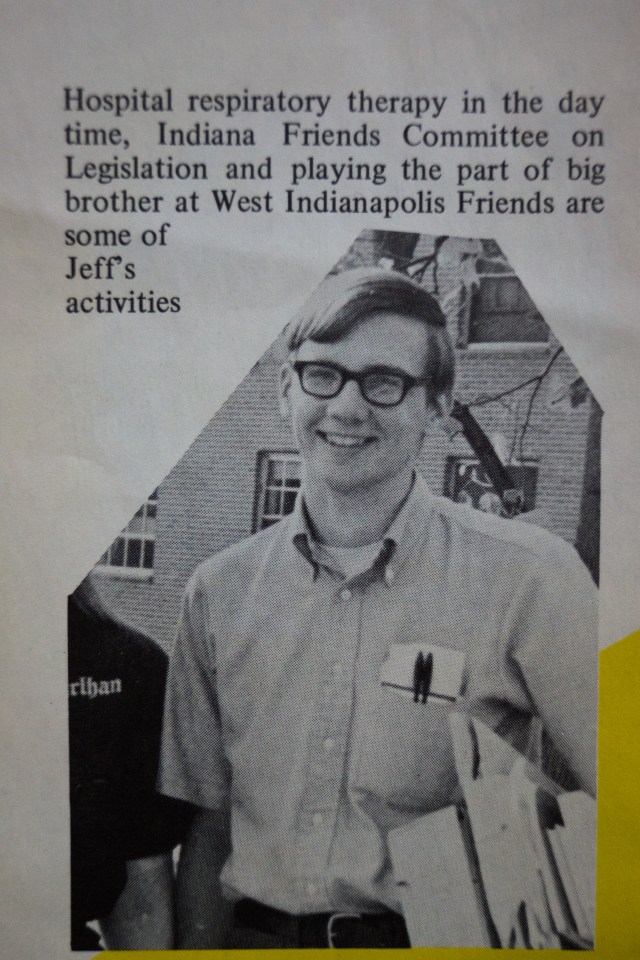
Volunteer Service Mission brochure


Posted in Quaker Meetings, revolution, Uncategorized | Tagged , , | Leave a comment