When one hurts, all hurt

This morning we learn of yet another mass shooting in our country. That hurt, hurts us all. Don’t you feel the pain?

If one part suffers, every part suffers with it; if one part is honored, every part rejoices with it. 1 Corinthians 12:26

Linda Washington talks about a friend who suffered from a kidney stone: “Isn’t it interesting that something so small can cause a whole body so much agony? But in a way, that’s what the apostle Paul alludes to in 1 Corinthians 12:26: “If one part suffers, every part suffers with it.” Throughout chapter 12, Paul used the metaphor of a body to describe Christians around the world. When Paul said, “God has put the body together” (v. 24), he was referring to the entire body of Christ—all Christians. We all have different gifts and roles. But since we’re all part of the same body, if one person hurts, we all hurt. When a fellow Christian faces persecution, grief, or trials, we hurt as if we’re experiencing that pain.”

That applies to every person on earth, not just Christians.

I was blessed to have had numerous opportunities to hear Rev. William Barber speak. He was often in Indianapolis because that is where he was raised. I often heard him say, “when one hurts, we all hurt”. 

“We believe we’ve got to shift the narrative of this country. And the only way we can do it is people have got to put their lives and their bodies on the line. You have preachers and poor people and impacted people who are in these lines. And we’re willing now to engage in an act of moral civil disobedience to drive home what is going on. We believe that injustice is happening in the halls of Congress and in the halls of state capitols around this country.”  Rev. William Barber

Rev. Barber has been on the streets, putting his body on the line, being arrested for civil disobedience. He organized and led the Moral Mondays movements, and the new Poor People’s Campaign.

He wrote an article in Friends Journal calling on Quakers to get back into the public square. https://kislingjeff.wordpress.com/2018/05/23/into-the-public-square/

We live in a time of spiritual poverty. We suffer and hurt from the pain others experience daily in this country. These continuous assaults wear us down to the point too many of us begin to feel there is nothing we can do.

But that is exactly why people of faith need to be showing what can be done. Demonstrating that there is hope.

We can become more involved with our Quaker organizations such as the Friends Committee on National Legislation (FCNL), the American Friends Service Committee (AFSC), the Friend World Committee for Consultation (FWWC), and Quaker Earthcare Witness (QEW).

We can become more involved in non-Quaker organizations, such as Bold Iowa, and Indigenous Iowa. We can become involved with today’s Poor People’s Campaign. We could have spent a week walking 94 miles, learning about Native Americans and other environmental activists on the First Nation-Farmer Climate Unity March.

We need to seek out new opportunities to ease the suffering of others, which will also ease our own suffering.

What we should not do is feel helpless. People of faith know the Spirit will guide us, and show us how to be our brother’s keeper.

“I hope that in this year to come, you make mistakes. Because if you are making mistakes, then you are making new things, trying new things, learning, living, pushing yourself, changing yourself, changing your world. You’re doing things you’ve never done before, and more importantly, you’re doing something.”  ― Neil Gaiman


Posted in #NDAPL, Arts, Black Lives, civil disobedience, First Nation-Farmer Climate Unity March, Indigenous, peace, Poor Peoples Campaign, Quaker, race, Uncategorized | Leave a comment

Discuss SURVIVE Act with Sen. Grassley’s staff

We are beginning to organize an FCNL Advocacy team in central Iowa. We will be focusing on Native American affairs.

Our first action will be to meet with Senator Grassley’s staff at his Des Moines office on November 20th at 11:00 a.m.

After introductions and talking about the Friends Committee on National Legislation (FCNL), Christine Nobiss will lead the discussion about the SURVIVE Act. More information below. You might remember Christine, who was on the panel discussing “Building Bridges with Native Americans” during Yearly Meeting in 2017. Christine is the founder of Indigenous Iowa, part of Bold Iowa, and was on the First Nation-Farmer Climate Unity March with Peter Clay, Jon Krieg and I.

If you could let me know if you plan to attend, I will let the Senator’s office know how many to expect. Senator Grassley’s Des Moines office is at 210 Walnut St Rm 721, Des Moines, IA 50309.     jakislin@outlook.com


October 15, 2018

Dear Mr. Kisling:

Thank you for taking the time to contact me to express your support for a tribal set-aside within the Crime Victims Fund. As your senator, it is important that I hear from you.

I was an original cosponsor of the Victims of Crime Act (VOCA), which established the Crime Victims Fund. As chairman of the Senate Judiciary Committee, I’ve also called on congressional appropriations leaders to provide an appropriate funding stream for Tribes under VOCA.  As stated in a letter I initiated to the Senate Appropriations Committee earlier this year, “individuals on Tribal lands experience high rates of domestic and sexual violence, and resources from the Crime Victims Fund are critical in addressing” these victims’ needs.  This letter was cosigned by several dozen of my Senate colleagues.

In June, the Senate Appropriations Committee approved a spending bill for the coming fiscal year, S. 3072, that would make significant resources available for tribes, including a 5 percent set-aside within the Crime Victims Fund.  This legislation further directs the Office for Victims of Crime (OVC) at the U.S. Justice Department (DOJ) to “consult closely with tribal stakeholders to improve services for tribal victims of crime to include expanded purpose areas described in the OVC final rule effective August 8, 2016.”   

If enacted, the fiscal year 2019 spending bill that Senate appropriations leaders approved also would make $91 million in competitive grant funds available for tribes as follows:  $50 million within DOJ’s Office of Justice Programs to help tribes improve the capacity of their criminal and civil justice systems; $7 million for a tribal youth program within DOJ’s Office of Juvenile Justice and Delinquency Prevention; $27 million for tribal resources and $3 million for a Tribal Access Program within the COPS Office at DOJ; and $4 million for a special domestic criminal jurisdiction program within DOJ’s Office on Violence Against Women.

I hope you find this information helpful. Your involvement in this issue is important, and I encourage you to keep in touch.

Sincerely,

Chuck Grassley
United States Senate  


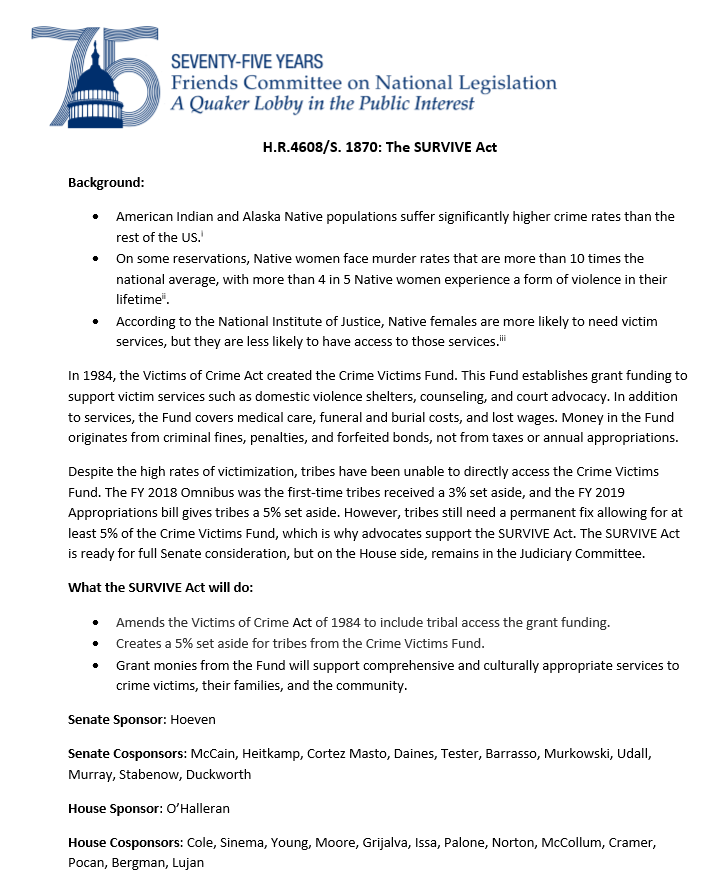
FCNL Survive Act fact sheet


According to federal data, American Indian and Alaska Native (AIAN) communities face some of the highest victimization rates in the country. Unfortunately, less than 0.7% of the Crime Victim’s Fund (CVF) established by the Victims of Crime Act reaches Indian tribes. This important funding provides victim services including crisis intervention, emergency shelter, medical costs, and counseling.

Currently, VOCA does not incorporate tribal governments for victim assistance and victim compensation formula grant programs. If we want to tackle the unacceptable disparities facing these communities, we need to make sure victims have equitable access to the critical resources VOCA funds support.

That is why I have introduced the bipartisan Securing Urgent Resources Vital to Indian Victim Empowerment (SURVIVE) Act. This bill would create a tribal grant program within the Department of Justice’s Office for Victims of Crime and require a 5% allocation from the CVF be provided to Indian tribes. It would expand the use of CVF funds for domestic violence shelters, medical care, counseling, legal assistance and services, and child and elder abuse programs to enable tribes to deliver critical services to their communities.  Tom O’Halleran, Member of Congress


While I’ve been writing about my adventures during the First Nation-Farmer Climate Unity March, I’ve been thinking about ways Quakers support Native Americans. The Friends Committee on National Legislation (FCNL), our Quaker lobbying organization, has made advocacy for Native Americans a priority for decades.

“Since 1976, FCNL’s Native American advocacy program has worked to restore and improve U.S. relations with Native nations so that our country honors the promises made in hundreds of treaties with these groups. FCNL provides information to Congressional offices and to national faith groups about the continuing struggles of Native people and advocates in support the resilient and inventive solutions proposed by tribal governments and Native American organizations.

This work takes us into all of the issue areas encountered by any government: land and borders; environment, energy, and natural resources; economic development; care for the safety and well-being of tribal citizens; and investment in the future through health and education.” Witnessing in Solidarity with the First Americans


Posted in #NDAPL, First Nation-Farmer Climate Unity March, Indigenous, Uncategorized | Leave a comment

‘Nothing changes until you make yourself uncomfortable’

In my experience there has never been an election that has presented a clearer choice of which direction to go. It has been deeply concerning to see the current Republican administration’s policies that have attacked our democratic norms, consistently not told the truth, and created policies that favor the wealthy.  That has relentlessly attacked the freedom of the press. That has demonized anyone they felt were the “other”.  That has worked to elevate authoritarianism and white nationalism, spreading messages of hate and fear mongering.

And perhaps never an election when we have greater concerns about the vote itself. There has been blatant suppression of the vote. And although it seems some agencies and social media companies have been doing some work to reduce the possibilities of interference with the election by foreign governments and perhaps others in our own country, the President has not seemed interested in working on these problems.

On the other hand, it is very encouraging to see more women and people of color become candidates for so many different offices in this election. And to see the large number of people paying attention to the issues, and coming out for early voting.

It is also encouraging to see many progressive candidates, instead of those from both parties that would continue with politics as usual.

As Diane Randal, Executive Secretary for the Friends Committee on National Legislation (FCNL) writes: Whatever the election results, FCNL’s advocacy for peace and justice will persist relentlessly. Our vision endures: for a world free of war and the threat of war; for a society with equity and justice for all; for communities in which each person’s potential will be fulfilled and an earth restored.

Manape LaMere, who provided security for us on the First Nation-Farmer Climate Unity March speaks with his father, who visited us during the march, on this video. “I’m with my father Frank LaMere today. We will discuss indigenous people involved in politics. It’s trajectory. And why we need to be active.”   https://www.facebook.com/RiverlandNativeVoterProject/

Frank LaMere says “healing begins when the talk of healing begins.”

“Nothing changes until you make yourself uncomfortable. Make everyone uncomfortable.”

“We have to coalesce because we have someone in the White House that is coming after each and every one of us…We’ve got to unify, we’ve got to speak out. And I’ll go so far as to when they send the army down there (to the southern border)  the Indian people, the people of Turtle Island, they need to go down there and meet them. And greet them. Because that’s us.” 

“I don’t care what you do, just act.”

“You have to have a long term vision. Some people say I want world peace. I want to end world hunger, too. But you can’t get all the way over there if you don’t deal with what is right in front of you.”

“You want to change things, you set your sights on what it is you want to change and you stay with it.”

“I think the creator said if you can learn and understand, I might let you change something. I might let you do something for the the family, for the people, the nation.”

Frank tells the story of young parents who wanted him to shake their baby’s hand, so one day they could tell him he had shaken hands with the man who had stopped the sale of alcohol at White Clay, Nebraska.

“Maybe all that was done so I could shake that young baby’s hand.”

“It might not be much, but do the little things you can do. Because at the end of the day it’s the little things that are so important.”

“There is no coincidence. We are to be here at this place and this time. We are to be here talking about these things.”

“We have to elevate these discussions. If you don’t get marginalized at least once every week, you probably aren’t saying much.”

“I’m afraid of the President of the United States and some time this will be a prophet discussion.”

Posted in #NDAPL, First Nation-Farmer Climate Unity March, Indigenous, Uncategorized | Leave a comment

Will we find the courage?

I try to avoid including too much of other’s writings in my blog posts, but Daniel Pinchbeck expresses what I’ve been trying to say about addressing our environmental catastrophe in ways that others might relate to better. If we don’t act now to change, we are doomed.

Materially, we can shift global practices in farming, industry and energy production within a few decades. We can reforest the planet. This would put a massive amount of excess carbon back in the Earth. But along with the material, industrial aspects of this transition, we will need to undergo a shift in our values, beliefs and habits. In other words, we need to change our technical and industrial base, our political and economic system, as well as our consciousness and our culture – our way of relating to the world. I know this is no small feat, but it is possible. It could occur through a tipping point, where a small group discovers a new way of being that quickly spreads out to encompass the whole. And it could happen fast.  Pinchbeck, Daniel. How Soon is Now: From Personal Initiation to Global Transformation (p. 20). Watkins Media. Kindle Edition.

Writes Lawrence LeShan in A New Science of the Paranormal. ‘We must be open to facing the possibility that we will find things so new and startling that they change our preconceptions about ourselves and about the universe we live in,’ he writes. ‘So far, we have not had that courage. Perhaps now with species extinction looming before us, we will find that courage.’   Pinchbeck, Daniel. How Soon is Now: From Personal Initiation to Global Transformation (p. 20). Watkins Media. Kindle Edition.

I saw the end of the long count as an invitation for humanity to undergo a global awakening and take a different path. This would mean adopting aspects of the worldview and some of the practices of indigenous and aboriginal cultures. These small-scale, traditional societies developed methods of longterm continuity based on their spiritual ethos of interdependence and connection to nature. As Native American sociologist Jack Forbes puts it, ‘The life of Native American peoples revolves around the concept of the sacredness, beauty, power and relatedness of all forms of existence. In short, the ethics or moral values of native people are part and parcel of their cosmology or total worldview.’ We can, I think, merge crucial aspects of the indigenous worldview – as well as the ecological and social practices that stem from it – with our advanced technical capacities. If we manage this, we can learn to respect the limits of the Earth and bring our global civilization back into balance.  Pinchbeck, Daniel. How Soon is Now: From Personal Initiation to Global Transformation (p. 21). Watkins Media. Kindle Edition.

A common theme of those who think and write about our environmental problems is to find ways for mainstream society to learn from and adapt indigenous ideas and practices.

Two-eyed seeing “recognizes the benefits of seeing from one eye with the strengths of Indigenous ways of knowing, from the other eye the strengths of the Western ways of knowing, and using both of these eyes together to create new forms of understanding and insight.”   Elder Albert Marshall (Mi’kmaq, Eskasoni First Nation) from Urban Tribes, edited by Lisa Charleyboy and Mary Beth Leatherdale

I’ve written of how I hope Quakers might, as Daniel Pinchbeck says above, “be open to facing the possibility that we will find things so new and startling that they change our preconceptions about ourselves and about the universe we live in.” If we can manage to get beyond the constraints of the thinking of the society we live in, and truly be open to the Inner Light, might we find a way? Will we have the courage to do so?

Maybe those of us who participated on the First Nation-Farmer Climate Unity March might be one of the “small groups that discovers a new way of being that quickly spreads out to encompass the whole”, as Pinchbeck says above.


Posted in climate change, Indigenous, spiritual seekers, Uncategorized | Leave a comment

Quakers, a “guarded” society, and environmental destruction

“Guarded” was the term used by early Quakers to express avoiding too much of an integration with the larger society they lived in. The term was usually applied to education. Quakers created their own schools to teach Quaker beliefs and values at the time their children were growing socially, spiritually and intellectually.

The Amish are a modern day example of communities remaining separate (“guarded”) from our American society.

Likewise, American Quakers who migrated to Costa Rica in the early 1950’s did so because they couldn’t remain in a country that was becoming increasingly militaristic. To this day Costa Rica does not have a standing army.

Costa rica no army

I wish American Quaker communities had maintained a similar separation. Although there are exceptions, I fear too many Friends have been unduly influenced by our wider society in many different ways.

Rather than enumerate all of them, my intention here is to talk about one in particular, environmental practices. Admittedly we have been discovering more and more about our environment and factors affecting the climate. But I would contend that any adult living in America in the early 1970’s could literally see the effects of fossil fuel combustion from automobiles. Clouds of noxious smog enveloped our cities. Your eyes would water, and you would cough as you inhaled the fumes. None of that could be good.

Catalytic converters came into use in 1975. Although they did remove the particles that caused the visible smog, the greenhouse gas, carbon dioxide, continued to be ejected into the air. I wish that hadn’t occurred because it allowed people to ignore the problems of greenhouse gas emissions, a problem that has been the primary cause of the increasing environmental devastation today.

Our environmental crisis has been caused by viewing natural resources as raw materials to build products and by squandering fossil fuel supplies. Some believe natural resources belong to whoever owns the land or material. The owner usually doesn’t worry about how sustainable the use of the resource is, or the environmental damage from the manufacture or use of the products made from these resources. Our economy is based upon fossil fuel energy.

Those views, which abuse Mother Earth, have led to the environmental chaos we are rapidly moving more deeply into today.

I wish Quakers had not been drawn into the fossil fuel economy. I wish we had been “guarded” about our own environmental integrity. You only need to hear the stories of your parents about the days when they had no electricity, telephones, no central heating or air conditioning, to be reminded that it is possible to live and thrive under conditions that seem primitive today.

My intention is not to blame anyone for the past, but rather to urge Friends and others to consider how we have been seduced by our fossil fuel economy and all the conveniences we enjoy from it. To urge you to step back, and reconsider your environmental practices now as if you would return to a “guarded” way of thinking and living. To not only think about that, but to actually change your lifestyle to stop using fossil fuels now.

The fact is we are on a rapid pathway to the extinction of life on this earth. And the next generations will have to try to live and adapt to an increasingly hostile environment. For example, by the year 2050 half of the people on the planet will not have access to clean water.  We don’t want to do this to our children.

There is another people who have maintained a “guarded” lifestyle, indigenous people. Native practices are based upon spiritual connections with Mother Earth, and among themselves. Belief in not using resources faster than they can be replenished.

As environmentalist Gus Speth says, “I used to think that top environmental problems were biodiversity loss, ecosystem collapse and climate change. I thought that thirty years of good science could address these problems. I was wrong. The top environmental problems are selfishness, greed and apathy, and to deal with these we need a cultural and spiritual transformation.”

My hope is that Quakers can reconsider our lifestyles and environmental practices, and we can be among the leaders of a “cultural and spiritual transformation”.  Fossil fuel use has to stop immediately if future generations are to have any chance of surviving.

I further hope Friends honor the leadership of native people in protecting Mother Earth. It was incredible to see all of the native Nations that came together at Standing Rock, and to witness their prayerful, spiritual work to protect the water. To witness their steadfast commitment to nonviolence, especially in the face of so much state sponsored violence.

I was profoundly affected by being among Native Americans as we worked to bring attention to the dangers of the Dakota Access pipeline in Indianapolis. Since then I have sought opportunities to be with and learn from Native Americans. Most recently I was able to do so by participating in the First Nation-Farmer Climate Unity March. A group of native and non-native people walked along the path of the Dakota Access pipeline, ninety four miles, from Des Moines to Fort Dodge, Iowa. The group was small enough (about forty native and non-native people) that we all got to know each other. I hadn’t considered ahead of time how much time we would have to share our stories as we walked together for hours a day, for eight days. As well as to eat and sleep together, and participate in evening discussions. As Manape LaMere said during the March, the reason we are marching together is so we can work together in the future. To do that, we need to begin to trust each other. To trust each other we need to understand each other. From all I’ve seen and heard, I believe we did begin to build that understanding and trust.

There is no time left. We have to make radical changes, to stop using fossil fuels altogether today if the human species is going to have any chance of avoiding extinction. The only way this will happen is if there is a spiritual transformation. Quakers know how to live spirit led lives.  So do indigenous people. I urge all Quakers to help each other see how we can disengage from our fossil fuel economy. To add our spiritual resources to those of indigenous people to bring about the spiritual transformation that has to happen right now  if we are to survive.

I’ve written about a practical model for how to do this here.

We have a binary choice to make this day. To continue with our current use of fossil fuels will result in the death of the planet.

[Those who don’t know me may wonder what I have done besides the experiences above. Whether I practice what I preach. About forty years ago I was given a spiritual vision showing me I could no longer have a personal automobile. I followed that leading. There is much more I have to do, but I’ve been trying to follow a spiritual path, with environmental integrity, all my life.]


Posted in #NDAPL, climate change, First Nation-Farmer Climate Unity March, Quaker, renewable energy, spiritual seekers, Uncategorized | Leave a comment

Colors of the Wind

I was looking for videos by Max Schneider and saw one called “Colors of the Wind”.  As a photographer I tried to imagine what the colors of the wind looked like. An image of the Northern Lights appeared in my mind.

Listening to it I was captivated by the lyrics. I had never seen the Disney Movie, Pocahontas. I’ll definitely have to do that now.

As I try to explain new experiences to people, I often say something similar to one of the lines in the song, “you’ll learn things you never knew you never knew.”

The song encapsulates many things I’ve been learning about Native Americans and their beliefs. The root cause of our damage to Mother Earth comes from the idea that the resources of the earth are just dead things that can be owned and exploited.

You think you own whatever land you land on
The earth is just a dead thing you can claim

I have also been learning:

But I know every rock and tree and creature
Has a life, has a spirit, has a name

My walks through the woods are much deeper now that I am reminded that everything has a spirit. I commune with the plants, trees, rocks, birds, squirrels and everything.

Can you paint with all the colors of the wind?

Max says, “really excited for you guys to hear this version of ‘Colors Of The Wind’ from Disney’s Pocahontas that I put together for ‘Everybody Loves Disney.’ This one’s a classic and was definitely one of my favorites as a kid, so I hope you all dig it.”

You think you own whatever land you land on
The earth is just a dead thing you can claim
But I know every rock and tree and creature
Has a life, has a spirit, has a name

You think the only people who are people
Are the people who look and think like you
But if you walk the footsteps of a stranger
You’ll learn things you never knew you never knew

Have you ever heard the wolf cry to the blue corn moon
Or asked the grinning bobcat why he grinned?
Can you sing with all the voices of the mountain?
Can you paint with all the colors of the wind?

Come run the hidden pine trails of the forest
Come taste the sun-sweet berries of the earth
Come roll in all the riches all around you
And for once, never wonder what they’re worth
The rainstorm and the river are my brothers
The heron and the otter are my friends
And we are all connected to each other,
In a circle, in a hoop that never ends

Have you ever heard the wolf cry to the blue corn moon
Or let the eagle tell you where he’s been
Can you sing with all the voices of the mountain?
Can you paint with all the colors of the wind

How high does the sycamore grow?
If you cut it down, then you’ll never know

And you’ll never hear the wolf cry to the blue corn moon
For whether we are white or copper-skinned
We need to sing with all the voices of the mountain
Need to paint with all the colors of the wind
You can own the earth and still
All you’ll own is earth until
You can paint with all the colors of the wind

Songwriters: Alan Menken,Stephen Laurence Schwartz
© Walt Disney Music Company
For non-commercial use only.

Posted in Indigenous, Uncategorized | Leave a comment

Pipe for Keystone XL Pipeline Arrives

According to Montana’s KRTV, pipe and materials to build the Keystone XL pipeline are beginning to arrive in Montana and South Dakota.  “Glasgow Mayor Becky Erickson said the company told her they could expect 40 to 45 trucks carrying pipe to go through the area every day.” A TransCanada spokesman says construction of the pipeline is expected to begin next spring or summer.

According to 350.org, “in August, a federal judge ruled that the federal review of the pipeline was inadequate – so the Trump Administration came back just 37 days later with another rushed job claiming the impacts of the project would be “minor.” Yet just last year, the Keystone 1 pipeline spilled more than 200,000 gallons of dirty oil in South Dakota. 

This fight is about to ramp up, but we’re ready. There are three active lawsuits, 17,000+ people ready to take peaceful action in solidarity with Indigenous communities on the route if called upon, and a strong coalition led by Indigenous leaders that’s prepared to take on whatever comes.”

According to Bold Nebraska, “the draft SEIS states that, while ‘cultural resources’ reviews remain ongoing, the Mainline Alternative route, which would cross the historic Ponca Trail of Tears, and come within 25 miles of the grave of Standing Bear, would have only “minor” impacts on these sacred sites. [1] Tribal Nations have continuously protested that TransCanada and the U.S. government have failed to conduct proper consultation with them about the project as sovereign nations.”

You can submit comments about the Keystone pipeline here. The deadline for accepting comments is November 8th, 2018.

[1] “Keystone XL Pipeline Advances Despite Incomplete Surveys of Tribal Sites,” Indianz.com, 7/31/18.


Posted in #NDAPL, civil disobedience, climate change, Indigenous, Keystone Pledge of Resistance, Uncategorized | Leave a comment

Build Bridges or Walls?

Listening to the passionate, inclusive answers by Congressman Beto O’Rourke to questions during last night’s episode of Hardball with Chris Matthews reminded me there is still hope for our political process. Mr. O’Rourke is running for the U.S. Senate in Texas.

Time and again he refused to get into the common political practice these days of attacking an opponent. And instead “called upon our better angels.” (he didn’t actually use that phrase but it summarized what he was saying). That phrase is from President Lincoln’s first inaugural address: “I am loath to close. We are not enemies, but friends. We must not be enemies. Though passion may have strained it must not break our bonds of affection. The mystic chords of memory, stretching from every battlefield and patriot grave to every living heart and hearthstone all over this broad land, will yet swell the chorus of the Union, when again touched, as surely they will be, by the better angels of our nature.”

It has been so discouraging and exhausting to hear the continuing calls of fear and hate by the current Republican President and Congress, who strive for division, in stark contrast to Congressman O’Rourke’s message of inclusion.

“This idea, Andrea, that we can send 5,000 service members to the border and somehow stop migrants, refugees, asylum seekers fleeing the most dangerous countries in the hemisphere — or that we could build a 2,000-mile wall at a cost of $30 billion, where we’d have to take someone’s ranch, or farm, or property through the use of eminent domain to build something that we don’t need at a time of record security and safety for border communities like mine in El Paso…” he said. “It’s ridiculous. It’s again this idea that we can be governed by our fears.”

He concluded: “Remember the proud heritage of this defining immigrant story, state, and experience that is Texas. That’s who we are… El Paso is one of the safest cities in the United States of America — not in spite of, but because we are a city of immigrants.”

Another time Congressman O’Rourke explained why he did not think it was unpatriotic for NFL players to kneel during the national anthem.

He said our freedoms have not only been won by the military (and thanked the veterans in the audience for their service), but also by Americans who put their lives on the line, peacefully protesting. He spoke about Martin Luther King and the struggles for civil rights. He mentioned those killed and imprisoned. The bravery of the Freedom Riders.

Congressman O’Rourke then said “nonviolent protests, including taking a knee at a football game to point out that Black men, unarmed, Black teenagers, unarmed and Black children, unarmed, are being killed at a frightening level right now including by members of law enforcement without accountability and without justice. And this problem, as grave as it is not going to fix itself and they’re frustrated frankly with people like me and those in positions of public trust and power who have been unable to resolve this or bring justice for what has been done and to stop it from continuing to happen in this country. And so non-violently, peacefully while the eyes of this country are watching these games they take a knee to bring our attention and our focus to this problem to ensure that we fix it. That is why they are doing it and I can think of nothing more American than to peacefully stand up or taking the knee.”

This election is a choice between building bridges or (literally) building walls.

Posted in civil disobedience, Uncategorized | Tagged , , | Leave a comment

Dust Bowl, Tar Sands and Prayer

As I learn more about Chief Arvol Looking Horse I find parallels to my own experiences related to our environment. It was a spiritual vision of the Rocky Mountains obscured by clouds of pollution that led me to give up owning a car nearly forty years ago (this being the days before catalytic converters, when cities were enveloped in smog). And a similar spiritual devastation when I saw the hundreds of square miles of the Canadian forests torn up to mine the tar sands. That led me to become an Action Lead in the Keystone Pledge of Resistance five years ago, and to help organize efforts in Indianapolis to support water protectors and defund the Dakota Access Pipeline.

I was profoundly affected by the prayers and spiritual practices of the Native Americans who joined us in the #noDAPL efforts in Indianapolis.

I first learned about Chief Arvol Looking Horse in 2016.  As a result of my walking on the First Nation-Farmer Climate Unity March last month, where I had opportunities to learn much more from, and become friends with Native Americans, I am interested in learning more. Searching for information, I re-discovered the writings and messages of Chief Looking Horse.

Now I’m interested to see how Quakers and all others who are spiritually guided can work together to try to protect Mother Earth from the environmental catastrophe we are facing. During my years of working within the Quaker community, I hadn’t thought about expanding those efforts to include those of other faiths. Now I see the truth in what Chief Looking Glass says, “We are at the crossroads in a great state of chaos, disasters, tears from our relatives’ eyes. Or we can unite spiritually all nations, all people, one prayer.”

This morning I was fascinated to read his story about prayers during the Dust Bowl in the 1930’s and tar sands today.


April 19, 2013

Mitakuye Oyasin!

My Grandmother shared with me a powerful time when the people came together for prayers during the Dust Bowl in the 1930’s. She accepted a C’anupa to bring out the White Buffalo Calf Pipe Bundle to end the drought and bring healing to Mother Earth. Even the non-native farmers heard of this prayer time and offered a cow to feed for the ceremony. The prayer was answered!

Recently I accepted tobacco from a Grandmother – Anpao Wic’ah’pi Was’te Winyan of the Ihanktowan Oyate. She had a dream of bringing People together at the bundle to pray for a healing of the biggest cancer that is spreading upon Mother Earth; caused from the Tar Sand efforts with XL pipeline that is threatening to come through our territory and our Sacred Sites.

Our Nation who is known as the Pte Oyate (The Buffalo People) will be praying with Sacred Bundle on May 18, 2013. Please bring food for feast and tobacco offerings.

I am asking “All Nations, All Faiths, One Prayer” to help us during this time of this gathering by praying with us on this day where ever you are upon Mother Earth.

We need to stop the desecration that is hurting Mother Earth and the communities. These recent spills of oil are affecting the blood of Mother Earth; Mni wic’oni (water of life).

Chief Bernard Ominiayak of the Lubicon Lake First Nation of Canada is also asking for prayers and to let the World know of his People’s stand against the Development that is happening against his People. They sit on 70% of oil; those that are after this oil are threatening their lives. His concern at this moment is of non-members, without their consent, signing away their rights and negotiating with Corporations that will forever affect their way of life  – to live off the land – handing them a death sentence. At this moment there are too many of their people dying from cancer. When they hunt, they are finding maggot-infested moose. When they fish they are finding two headed fish. The people are dying from trying to survive in a traditional way in their territory. The UN has submitted a statement in support of Lubicon Lake Nation’s stand to live in Sovereignty and live in their tradition.

We have many concerns at this time. Along with the First Nations whose territory is within the Tar Sands desecration; with their lives being threatened and also the high death rates of cancer, along with the sickness of the land and animals.

In a Sacred Hoop of Life, where there is no ending and no beginning!

Hec’el oinipikte (that we shall live)

Chief Arvol Looking Horse, 19th Generation Keeper of the Sacred White Buffalo Pipe

https://www.manataka.org/page108.html


Posted in #NDAPL, climate change, First Nation-Farmer Climate Unity March, Indigenous, Quaker, spiritual seekers, Uncategorized | Leave a comment

‘One Prayer’

The most powerful experiences I had during the First Nation-Famer Climate Unity March were spiritual. My experience as a Quaker was to try to live a Spirit led life. I had long had a desire to learn more about Native Americans because it was obvious, even with my limited knowledge, that Native Americans did live Spirit led lives.

However we express our Spiritual beliefs and practices, the fundamental belief is that the Spirit is universal. It makes no sense to believe otherwise. There is no way the Spirit could be limited to any particular group of beings.

The following video, ‘One Prayer’ featuring Chief Arvol Looking Horse is about the chaotic, spiritually disconnected time we live in. About how we are at a crossroad that will determine our future. “We are at the crossroads in a great state of chaos, disasters, tears from our relatives’ eyes. Or we can unite spiritually all nations, all people, one prayer.”

Can we unite spiritually now? Our experiences during the Unity March give me hope that we can. I have contacted the World Peace and Prayer Day website to see how I can join this effort. All nations, all faiths, one prayer.  worldpeaceandprayerday.com/

Mother Earth, she has a fever. Man has gone too far, disrespecting everything. Right now at home the Native American people, they’re gathering to stand up stop the pipeline. We always talk about the black snake where the black snake will be going atop the earth and that is when we will be faced with global disaster. The Native American people believe the black snake is the pipeline.

We have come to a time to face a great urgency. Even scientists are saying we have reached the point of no return. People are so disconnected spiritually. We need to reconnect with the Spirit. Mother Earth is the Spirit. Mother Earth is the source of life, not a resource. 

We are at a crossroads, but there is hope. I have been campaigning to the United Nations to declare June 21st as a world peace and prayer day. People of faith all over the world must be protected. I’m keen to first ask people all over the world to pray with us. To create an energy shift. That is what needs to happen to heal Mother Earth. 

1994 the first white buffalo was born. It was like a needle in a haystack. A message to the world, need to heal us together, survive together, come together. There is no one person higher than the other. There is no one nation higher than the other. We are at the crossroads in a great state of chaos, disasters, tears from our relatives’ eyes. Or we can unite spiritually all nations, all people, one prayer.

Join us at http://worldpeaceandprayerday.com/


Posted in #NDAPL, climate change, First Nation-Farmer Climate Unity March, Indigenous, peace, Quaker, revolution, spiritual seekers, Uncategorized | 2 Comments