Spiritual Fire

Yesterday I wrote about the imagery of light filled flowers and the Inner Light.  That reminded me of a message that was given to me during our Quaker meeting for worship at North Meadow Circle of Friends once when I became aware of the shifting patterns of light on the wooden bench before me.    (Quaker worship involves people gathering together to sit in silence for about an hour.)  As I indicated yesterday, we don’t have the language to talk about spiritual things.  Sometimes nonverbal expressions might be an alternative.  Because the shifting patterns of shadow and light continued after Meeting was over, I recorded a short video of what I was seeing, and repeated the message, and uploaded the video to YouTube.

At the end of Meeting that day, my friend Daniel Ballow said “I always wondered what spiritual fire looked like.”


Posted in Arts, Quaker Meetings, Uncategorized | Tagged , , , | Leave a comment

Ripple Effect of Stories

The following is from a PowerPoint presentation.  I hope this format works.

Slide1Slide2Slide3Slide4Slide5Slide6Slide7Slide8Slide9Slide10Slide11Slide12Slide13Slide14Slide15Slide16Slide17Slide18Slide19Slide20

Posted in Arts, Quaker Meetings, Uncategorized | Tagged , , , | 1 Comment

Full of Light

The flowers seem like cups holding light this spring.

We don’t have good language to talk about spiritual things.  The core Quaker belief is that there is that of God in everyone.  We often refer to that presence in us as the Inner Light.  The light these flowers hold seems an apt imagery for that concept.  I am imagining those cups of light shining inside every one of us.

Posted in Arts, Uncategorized | Tagged , , , , , | 4 Comments

Dawn of a new day

Crisp, clear spring mornings are a wonder.  This photo was taken on the walk to work this morning.

I’m imagining hearing Safety Suit’s version of Hallelujah.  (full disclosure–couldn’t help but listen to it now–brings tears to my eyes).

Also by Safety Suit:  These Times Are Hard


DSC02668

Posted in Arts, Uncategorized | Tagged , , , , | 2 Comments

KI and Quakers

Yesterday I wrote about religion, related to the book we were reading for the monthly book discussion at KI (Kheprw Institute), The 7 Habits of Highly Effective People: Powerful Lessons in Personal Change (25th Anniversary Edition) by Stephen R. Covey.   I mentioned that while I found the KI community to have a strong moral focus, from what I have learned so far, anyway, organized religion doesn’t seem part of the community.

I’ve also been writing about how KI is who North Meadow Friends is partnering with as we implement the Quaker Social Change Ministry program.

At my first meeting with the KI community I needed to try to explain where I was coming from, so the discussion quickly led to talking about Quakerism.  I had not planned to talk about that at all, but gentle questions were probing for more than surface information about who I am.

Quakers have never been active in trying to get others to join them.  And in our culture today, increasing numbers of people are turning away from traditional, organized religious institutions.  Along with that, one of the basic premises of the Quaker Social Change Ministry program is to learn what a community impacted by injustice, in our case the KI community, needs and to wait for the community to ask the Meeting for help with those needs.  This is the opposite of the common approach from prior efforts, where well meaning people tried to come up with what they thought would be solutions, which were usually not what the impacted community really needed.

So I have been really extremely cautious about injecting things related to Quakers into our conversations at KI.  At the same time, since Quakers attempt to be attuned to leadings from the inner light at all times, and because I have the impression that balanced discussions about faith and spirituality themselves are not a problem for KI, I also try to be open to a particular moment in time where such a discussion is relevant to the topic at hand.

Yesterday at KI during the community book discussion, we were discussing the urgent-important, not urgent but important, etc. idea, which was basically that we all tend to focus on what is urgent, and often ignore what is important but not urgent.  And it is important for each of us to find ways to pay more attention to those matters.

At that point I felt led to briefly say something along the lines of “that is why I appreciate our Quaker practice of sitting in silence together for an hour each Sunday morning.  It is so we can pay attention to those things that often get pushed aside by things that seem to be more urgent.”

Then one of the KI folks asked how long I had been doing that, and I said “all my life”.

She said, “Oh, I was going to ask what effect that had on your life.”

Then I shared that my spiritual practice had changed significantly after the death of best friend, Randy, about four years ago.  That made me re-evaluate what is really important in life, and realize how short our time on earth is.  I have since paid much, much more attention to what I am being led to do, and trying to be more faithful in following that.  I also mentioned that I first got connected to the KI community at around that time, and that has been important to my spiritual life since.

Later in the discussion Imhotep was summarizing some things, and mentioned spirituality and meditation.


Posted in Kheprw Institute, Quaker Meetings, Quaker Social Change Ministry, Uncategorized | Tagged , , , | Leave a comment

First Day and religion

In the past (and some continue the practice today) Quakers referred to the days of the week by number, with Sunday being First Day, Monday Second Day, etc.  This was because they objected to naming the days after Roman gods.  This is a First Day morning.

The following is from the book The 7 Habits of Highly Effective People: Powerful Lessons in Personal Change (25th Anniversary Edition) by Stephen R. Covey, which we are reading for this month’s community discussion at KI (Kheprw Institute):  “The principles I am referring to are not esoteric, mysterious, or “religious” ideas. There is not one principle taught in this book that is unique to any specific faith or religion, including my own. These principles are a part of most every major enduring religion, as well as enduring social philosophies and ethical systems. They are self-evident and can easily be validated by any individual. It’s almost as if these principles or natural laws are part of the human condition, part of the human consciousness, part of the human conscience. They seem to exist in all human beings, regardless of social conditioning and loyalty to them, even though they might be submerged or numbed by such conditions or disloyalty.”

He goes on to identify some of these principles as fairness, integrity, honesty, growth, potential, human dignity, excellence, service, nurturance, encouragement and patience.

This expresses what I have observed for a long time.  That there are many people and groups that live principled, moral, ethical lives that don’t included organized religion.  From my first encounters with the KI (Kheprw Institute) community I have been aware of the moral strength of the community, and yet I don’t sense that organized religion plays much of a role there.    I think this has helped the relationship between KI and Quakers, since in many ways Quakerism continues to be basically anti-organized religion.
The following quote about Josh Fox’s new film expresses similar ideas:

“The film is about organizing principles that are also permanent virtues and values,” says Fox. “Community, democracy, civil disobedience, creativity, human rights, innovation, courage, love, resilience, generosity. We need these values if we’re going to win any of these climate battles. But we’re going to need them even more if we lose them.”

Posted in Quaker Meetings, revolution, Uncategorized | Tagged , , , , | Leave a comment

A Beloved Community

There are two annual meetings of Quakers who belong to Iowa Yearly Meeting (Conservative).  Yearly Meeting is a week of gathering for worship, business and community interest meetings, held at Scattergood Friends School and Farm.  This usually occurs at end of July.

The other is Midyear Meeting, which was just held last weekend, at my home meeting, Bear Creek, in the countryside a couple of miles north of Earlham, Iowa. Midyear Meeting has more of a spiritual focus.  The usual pattern is to have an “outside” speaker/leader one year, alternating with having an Iowa Yearly Meeting (Conservative) Friend lead the weekend.  This year, Iowa Friends Rebecca and George Bergus lead us through discussions and exercises related to the topic of “Understanding Islam:  Overcoming Fear.”  They did an excellent job, and helped us explore our own understanding both by presenting information about Islam, and also posing questions to help us examine what we personally know and feel about Islam.

Both are occasions we all look forward to as opportunities to spend time with dear F/friends and learn about each other’s lives and activities.  This is a perfect example of a Beloved Community, where people care for and love each other, and work together for a better world, a concept Martin Luther King, Jr often spoke of.  Much of this is revealed by photographs from the weekend.   Beloved Community is a key concept of the Quaker Social Change Ministry program I’ve been involved with at North Meadow Friends in Indianapolis, and that we have been discussing during our Peace and Social Concerns Committee meetings.

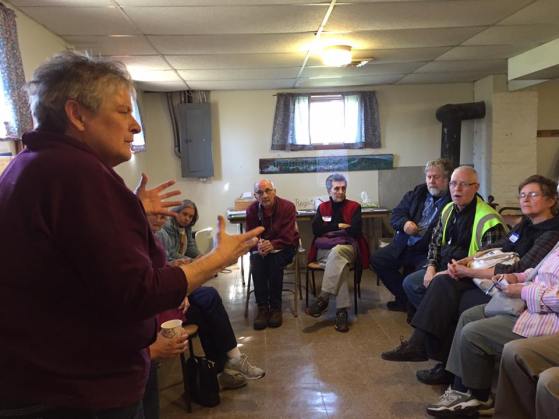
The following photo was taken by AFSC’s Jon Krieg during our Peace and Social Concerns Committee meeting at this year’s Midyear Meeting.  AFSC’s Kathleen McQuillen is shown speaking to us about some anti-BDS (Boycott, Divestment, Sanctions) legislation currently before the Iowa Legislature (for some reason–not their area of responsibility).

PeaceSocialConcerns


More photos are available online here.

Posted in Quaker Meetings, Uncategorized | Tagged , , , , , | Leave a comment

Youth > Fossil Fuels

I keep wondering when the world’s youth will respond to the evolving environmental disaster, which will define their lives.

350.org is organizing Youth > Fossil Fuels, a national wave of campus actions of students demanding that their schools divest from fossil fuel investments.  This morning twenty students from Swarthmore College used a theatre action to call attention to the administration’s ties to the fossil fuel industry.

Here is a link to join the coordinated actions at campuses across the country.

Related story here

We should support these student efforts, which will help us all.


Posted in Uncategorized | Leave a comment

Robert F. Kennedy’s Speech on the Death of Martin Luther King, Jr.

Indianapolis, Indiana, April 4, 1968

link to photo gallery

April 4, 1968, Robert F Kennedy gave several speeches in Indiana as he campaigned for the Democratic nomination for President of the United States.  This young white man, as the United States Attorney General, along with his brother the President, had been thrust into the middle of the civil rights struggle.  And then his brother was assassinated.

At Notre Dame he spoke about the Vietnam War, and told the students there that college deferments for the draft discriminated against those who could not afford to attend college, and should be eliminated.  Contrasting this willingness to speak the truth even when it is unpopular, and might cost votes, makes for a very sad commentary on the state of politics today.

After speaking about racism at Ball State, an African American student said, “Your speech implies that you are placing a great deal of faith in white America. Is that faith justified?” Kennedy answered “Yes” and added that “faith in black America is justified, too” although he said there “are extremists on both sides.”  Before boarding a plane to fly to Indianapolis, Kennedy learned that Martin Luther King, Jr. had been shot.   On the plane, Kennedy told a reporter “You know, it grieves me. . . that I just told that kid this and then walk out and find that some white man has just shot their spiritual leader.”

It wasn’t until the flight had nearly arrived in Indianapolis that he learned Martin Luther King, Jr, had died of his wounds.  There wasn’t time to write something to cover this news.  The Indianapolis event was to be held at a park in a predominately black neighborhood near downtown.  The Indianapolis police and city leaders tried to get him to cancel the speech, telling him they couldn’t protect him if there was a riot.  Rioting did break out in many cities that day.

But he insisted.  At the park, from the back of a flatbed truck, he said:

(link to video of Bobby Kennedy delivering this speech here)

Ladies and Gentlemen,

I’m only going to talk to you just for a minute or so this evening, because I have some–some very sad news for all of you — Could you lower those signs, please? — I have some very sad news for all of you, and, I think, sad news for all of our fellow citizens, and people who love peace all over the world; and that is that Martin Luther King was shot and was killed tonight in Memphis, Tennessee.

Martin Luther King dedicated his life to love and to justice between fellow human beings. He died in the cause of that effort. In this difficult day, in this difficult time for the United States, it’s perhaps well to ask what kind of a nation we are and what direction we want to move in. For those of you who are black — considering the evidence evidently is that there were white people who were responsible — you can be filled with bitterness, and with hatred, and a desire for revenge.

We can move in that direction as a country, in greater polarization — black people amongst blacks, and white amongst whites, filled with hatred toward one another. Or we can make an effort, as Martin Luther King did, to understand, and to comprehend, and replace that violence, that stain of bloodshed that has spread across our land, with an effort to understand, compassion, and love.

For those of you who are black and are tempted to fill with — be filled with hatred and mistrust of the injustice of such an act, against all white people, I would only say that I can also feel in my own heart the same kind of feeling. I had a member of my family killed, but he was killed by a white man.

But we have to make an effort in the United States. We have to make an effort to understand, to get beyond, or go beyond these rather difficult times.

My favorite poem, my–my favorite poet was Aeschylus. And he once wrote:

Even in our sleep, pain which cannot forget

falls drop by drop upon the heart,

until, in our own despair,

against our will,

comes wisdom

through the awful grace of God.

What we need in the United States is not division; what we need in the United States is not hatred; what we need in the United States is not violence and lawlessness, but is love, and wisdom, and compassion toward one another, and a feeling of justice toward those who still suffer within our country, whether they be white or whether they be black.

So I ask you tonight to return home, to say a prayer for the family of Martin Luther King — yeah, it’s true — but more importantly to say a prayer for our own country, which all of us love — a prayer for understanding and that compassion of which I spoke.

We can do well in this country. We will have difficult times. We’ve had difficult times in the past, but we — and we will have difficult times in the future. It is not the end of violence; it is not the end of lawlessness; and it’s not the end of disorder.

But the vast majority of white people and the vast majority of black people in this country want to live together, want to improve the quality of our life, and want justice for all human beings that abide in our land.

And let’s dedicate ourselves to what the Greeks wrote so many years ago: to tame the savageness of man and make gentle the life of this world. Let us dedicate ourselves to that, and say a prayer for our country and for our people.

Thank you very much.

robertkennedygrave

The text of this speech is displayed at Robert Kennedy’s gravesite in Arlington National Cemetery, Washington, DC.

Below are some photos from the Kennedy-King Park, where the speech was delivered, in Indianapolis.


Posted in Uncategorized | 1 Comment

Harmony Within the (Quaker) Meeting

I’ve mentioned that each month Quaker Meetings in Iowa Yearly Meeting (Conservative) consider one of the twelve sets of advices and queries, which are questions aimed at fostering discussions of the spiritual life of our meetings.

This month’s topic is harmony within the meeting.

“This is my commandment: Love one another as I have loved you.”         John 15:1

ADVICE

It is sometimes difficult to remember that love is a gift of the Divine Spirit and not simply a human emotion. As imperfect human beings, it is not always possible for us to feel loving toward one another, but by opening ourselves to the Light Within, we can receive and give love beyond our human abilities.

Relationships among meeting members take time to evolve. Sometimes misunderstandings develop. When differences arise, they should not be ignored for the sake of superficial unity. We believe disagreements which might divide or disrupt a meeting can be resolved through human effort and divine grace, and may result in a stronger and more creative meeting. True harmony depends upon each persons deep respect of and faithful attention to the Divine Spirit within us all. We endeavor to practice humility, attempting to understand positions of others and being aware of the possibility that we may be mistaken.

It is the responsibility of the Ministry and Oversight Committee to be sensitive to needs which may arise. Others in the meeting may be equally concerned, and because of greater understanding in certain cases, be able to give counsel. In reconciliation of differences, a position not previously considered may prove mutually beneficial. At times it may be necessary to confront individuals whose behavior is disruptive. A clearness committee or professional help may be suggested in some situations. We must always remember the power of holding one another in the Light, and the healing that comes from forgiving ourselves as well as others.

 QUERY 

  • What can we do to deepen our relationships with one another? How does gender affect the way we relate to each other? 
  • How does our meeting balance the needs for honesty and kindness? What topics do we avoid for the sake of “unity”? 
  • When in conflict with others, do we cultivate a forgiving spirit? Do we look to that of God in ourselves and seek to address that of God in those with whom we disagree? 

My response:

Dear Friends,
I think it says a lot about the Bear Creek Meeting community that a number of members choose to be as involved with the Meeting as they can, even though they live far away.  This practice of sharing our thoughts and beliefs monthly as we respond to the queries is one of the main ways the Meeting has offered people like me who can’t be there for these discussions, to be involved.  After hearing me speak about this a number of times, North Meadow Friends, the local meeting I attend in Indianapolis, has begun to consider Ohio Valley Yearly Meeting queries during worship sharing.
Not being in such close physical contact with meeting members, I know I am often unaware of much of the good work each person is involved with.  The issues and concerns are sometimes very different in inner cities versus rural communities.
One of the most deeply troubling things I have been trying to work through myself, and with the North Meadow and KI communities, is the widespread, structural racism that continues to evolve in our country.  This is often difficult for Friends to comprehend because of the lack of diversity in the general population in Iowa.  Friends have a great deal of trouble seeing how the dramatic changes in the US economy, with the massive redistribution of wealth and enactment of restrictive policies that favor the rich, has resulted in Friends being much wealthier than the vast majority of people in the United States.  This is a dramatic role reversal, and means Friends benefit from the racism built into our economic and political structures.
One way Bear Creek Meeting could continue to work on this is by community discussions involving those at Bear Creek, and Bear Creek members who live and do social justice work in inner cities.  I’ve mentioned working with the AFSC Quaker Social Change Ministry (QSCM) here in Indianapolis, which is a framework to help Friends engage in social change work, with a Quaker, spiritual emphasis.  One possibility might be to use QSCM as a mechanism for this, in a manner similar to our sharing responses to the queries by long distance members.
Posted in Uncategorized | Leave a comment